This one was a headache and a half.
The usual - check your stats. If things seem a little off, remember that land transfers can lead to loss (or gain, if you are receiving) of resource level, industry level, infrastructure level, and of course, population. Decided to do away with waiting for a year before updating the stats - it was more realistic, but a bigger workload for me.
And which one of you was the idiot who decided to give almost all the of the land in North America to three blue nations?
Outcast Member
- Last Seen: MIA
- Joined: 12 yrs ago
- Posts: 347 (0.08 / day)
- VMs: 1
-
Username history
- Outcast 12 yrs ago
-
Latest 10 profile visitors:
-
Most recent →
 salamimike
Status
User has no status, yet
Bio
User has no bio, yet
Most Recent Posts

Map not guaranteed to be accurate - trust the text before you trust the map
Europe
The British government began a program to try and shift public opinion in India to be more loyal to British Rule. Schools were built and analysts met to discuss the best methods.
(-£1,020, reserve level partially restored, +3% public support)
As a result of the recent peace in Europe, a number of land transfers, sales, and ship movements took place.
(-£5,000 to Britain, -£1,000 to the USA, +£1,000 to Russia, +£5,000 to France, -1 ironclad, -30 ships-of-the-line, -20 screw frigates, -30 sail frigates, -10 transports, all to France, +1 ironclad, +30 ships-of-the-line, +20 screw frigates, +30 sail frigates, +10 transports, all to Britain, +5% equipment to Britain)
An election was held in Britain, and was won by William Gladstone.
(+5% public support)
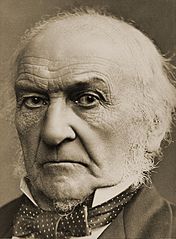
New Prime Minister of the United Republic, William E. Gladstone
In France, Emperor Napoleon III took a tour of the newly acquired lands in Canada, rallying public support amongst the people.
(-£120, +5% public support)
The Mexican/French treaty was implemented, giving benefits to both nations.
(-£5,000 to Mexico, +£5,000 to France, +1 navy sublevel to Mexico, +5% equipment to Mexico, +1 resource sublevel to France)
A university in Paris was founded, named 'Le Grand Université d'Adam'. It hoped to become one of the best in the world.
(-£320, +4% education rate)
An ambitious order was put through by the Prussian government to shipbuilders. Although they quickly got to work, the scale of the order dwarfed their capacities, and so the order was not able to be completed.
(-£14,200, +5 ironclads, +5 ironclads in 1 turn, + 7 transport ships, +7 transport ships in 1 turn, +7 transport ships in 2 turns)
A meeting was held to discuss the unification of the German states into one unified empire. Although there was some support by the common people, many nobles who were unwilling to relinquish power were less supportive. The meeting stalled, and it was decided it would be best to wait, with the next meeting slated for early next year.
The Prussian army conducted a series of drills to better prepare themselves
(-£540, +1 army sublevel)
The Austrian government implemented a propaganda campaign to try and impose a pan-Austrian identity on its citizens.
(-£140, +4% public support)
Hoping to alleviate the poor education rate in the empire, the Austrian government reformed and improved the education system, using the Swedish model as a guide.
(-£200, +5% education rate)
Naval drills were conducted to improve the training and skill of the sailors, with emphasis on defensive manoeuvres and working with land-based artillery.
(-£530, +1 navy sublevel)
Under the guidance of Louis Gerard De Geer, the Swedish parliament was reformed to make it more democratic.
(-£160, +4% public support)
Trading and port facilities were upgraded in Swedish coastal cities, in order to increase the efficiency of trade.
(-£510, +1 infrastructure sublevel)
Incentives were offered to those willing to work or invest in Swedish factories, resulting in an increase in industrial output.
(-£520, +1 industry sublevel)
Financial incentives were offered to Dutch entrepreneurs and industrialists to set up new factories and expand existing ones.
(-£490, +1 industry sublevel)
With the blockade lifted, Dutch ships could now travel the seas again. Influence was expanded in the Sanda and Arafura seas, and new areas around the region came under Dutch influence.
(new territory gained, +1 resource sublevel in 2 turns)
A closer political relationship was offered to the Ashanti Empire north of the Dutch Gold Coast. The Empire accepted the economic opportunities and military protection, as there was much anti-British feeling in the region.
The Russian military provided government funding to military inventors in order to encourage new technology.
(-£250, +4% equipment)
Lands east of the Urals was given to emancipated serfs. it was a long trek and poor land, so few took up the offer.
(-£400, +1 resource sublevel in 2 turns)
Roads and railways connecting European Russia to Siberia were planned, and construction began. It was a difficult and expensive process, however.
(-£550, +1 infrastructure sublevel)
The Romanian government was reformed and restructured, with additions to the Paris Convention forming a parliament and a senate of Romania.
(-£150, +4% public support)
Funding was placed into improving the industrial output of Romania.
(-£560, +1 industry sublevel)
Many of these new factories went to work producing better quality equipment for the Romanian army.
(-£180, +4% equipment)
Using the techniques learned during the battles in Sicily and southern Italy, new tactics were formed by the Italian military to better repel future amphibious attacks.
(-£500, +1 army sublevel)
The Regina Marina was expanded with new ironclads built and some other sailing vessels refitted with armour and steam.
(-£6,400, +7 ironclads, -3 ships-of-the-line)
Exploitation of resources in the newly acquired lands began, particularly in Venice and Tyrol.
(-£230, +1 resource sublevel)
The Ottoman Government called upon the Egyptian government to accept the de-vassalisation order. After the example set by Tunisia, the Egyptian government was more willing to listen.
(+3% public support)
Another call for Jihad was issued by the Caliph, calling on all true Muslims to fight against his enemies. There was a swell of volunteers for the army.
(+200,000 conscripts)
Training and drilling of the Ottoman army went ahead, with foreign experts providing guidance and knowledge. The Sultan made many visits to barracks to improve morale.
(-£490, +1 army sublevel)
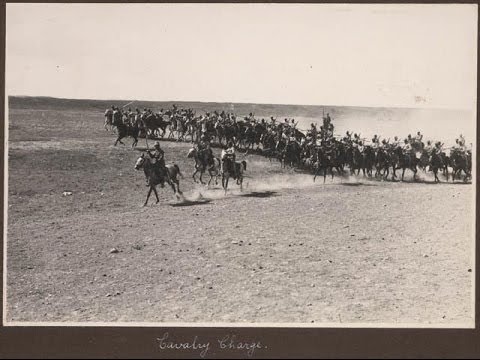
Ottoman cavalry practising a charge
In Greece, railroads were built to connect major industrial areas.
(-£540, +1 infrastructure sublevel)
With the Straits of Gibraltar no longer closed by the British, a Greek vessel managed to slip through into the Atlantic. They landed near a town in West Morocco and declared it to be a colony of Greece. The Moroccan government ignored them, and the Greeks eventually returned home. Many wondered why Greece would attempt to colonise an area that was already a semi-civilised nation and had recently been acknowledged as in the Spanish area of influence.
Rewards were offered to anyone who could come up with new designs for weaponry. A few designs were accepted and production was slated to begin in the new year.
(-£300, +4% equipment in 1 turn)
The Spanish government introduced a plan to increase the industrial output of the nation.
(-£500, +1 industry sublevel)
The Spanish government issued a public proclamation of support for Egyptian sovereignty in the face of the Ottoman de-vassalisation. Although the response was muted in Egypt, the mostly-Catholic population in Spain received it well. There was some small damages caused by Eqyptian nationalists.
(-£100, +3% public support, small decrease in income to the Ottoman Empire)
The Americas
The Quebec Treaty was ratified by the US senate, allowing the purchase of land from Britain.
An attempt was launched to try and find Jefferson Davis, but he managed to slip onto a ship bound for Britain. Fortunately, the ship was stopped and searched, and the man was discovered and returned to Washington to stand trial.
With the war now over, the US army was disbanded and sent home. A number were offered the chance to stay in the military as regulars. The army under the command of Grant was sent into the South to make sure it peacefully absorbed back into the USA.
(USA/CSA armies disbanded, +39,800 regulars)
Factories were built throughout Mexico to promote industrial output.
(-£520, +1 industry sublevel)
Using British designs, factories began producing better quality rifles and cannons for the Mexican army.
(-£300, +6% equipment)
The Mexican army conducted drills to improve it's quality.
(-£550, +1 army sublevel in 1 turn)
Attempts were made in Colombia to improve the quality of education and to make it more accessible to everyone.
(-£240, +5% education)
Infrastructure was increased in Colombia, focusing on river boats and canals, making use of the many rivers in the country.
(-£510, +1 infrastructure sublevel)
The returning troops from the USA brought with them examples of the weaponry used in the conflict. Reverse engineering yielded designs for better quality equipment.
(-£270, +5% equipment)
Better roads and railways were built in Northern Brazil, with hopes of linking it with the more developed south better.
(-£520, +1 infrastructure sublevel)
Harbour facilities in southern Brazil also were improved, however progress was slow.
(-£530, +1 infrastructure sublevel in 1 turn)

Painting of Rio de Janeiro by Friedrich Hagedorn
The number of factories was increased along the coast of Brazil.
(-£520, +1 industry sublevel in 1 turn)
In Argentina, a complete overhaul of of the military occurred, with the implementation of a strict professional military regime.
(-£560, +1 army sublevel)
Immigration to Argentina from other South American and European nations was encouraged, with plots of farmland used as incentives.
(-£190, +0.18% population growth)
Argentinean weapons makers liasoned with their European counterparts to adopt their procedures and techniques.
(-£210, +5% equipment)
Asia
Qing generals studied recent and older battles to understand what went right and what went wrong, in order to improve the chances of success for future battles.
(-£500, +1 army sublevel)
Military arsenals were implemented all over the country, to ensure higher quality equipment was available to all sections of the military.
(-£270, +5% equipment)
Railways continued to be built all over China, this time focussing on the regions of Shaanxi, Gansu, and Qinghai.
(-£520, +1 infrastructure sublevel in 1 turn)
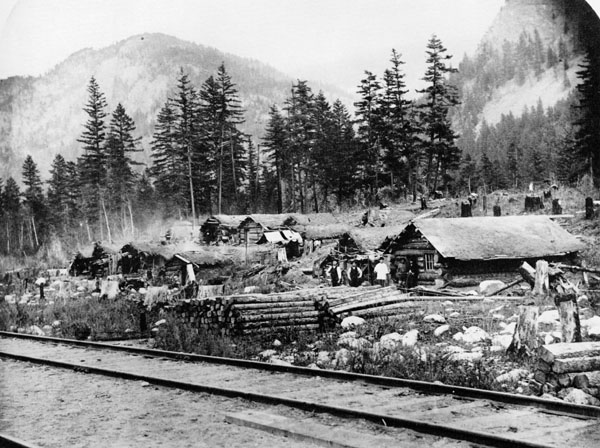
Chinese railway worker's camp
In Japan, shares in Japanese factories were sold, in order to raise funds for future economic growth.
(-£150, increased income)
incentives were offered to anyone willing to invest in Japanese factories.
(-£500, +1 industry sublevel)
Training camps were set up in the north in order to help Japanese soldiers adjust to colder temperatures, now that Japan was fighting in Kamchatka.
(-£530, +1 army sublevel)
If it isn't too much of a bother, could anyone who has ceded or received land since the last update mention it. There is a lot of changes and I don't want to forget anything when I'm making editing the map. Also any errors from the last map.
And don't bother with that 'who declared on who' thing. As far as I'm concerned, this was/is a war between the Allied Powers and the Eighth Coalition, and anyone on the opposing side is a legitimate military target.
And don't bother with that 'who declared on who' thing. As far as I'm concerned, this was/is a war between the Allied Powers and the Eighth Coalition, and anyone on the opposing side is a legitimate military target.
@Aegon: your new stats are up on the first page. Check them over to make sure there are no mistakes.
With the withdrawal of the British from the war, many thought this would be the end. However, others were determined to show that this was not so. The focus of the war moved east, to the Balkans and the Caucasus, and to the Far East.
The first action of the year was on Romania, as the hammer of the Austrian army fell on their old allies. Commanded by Archduke Albrecht, 280,000 Austrian troops marched around the south of the Carpathian Mountains and into Wallachia. They would not, however, find it an easy task. The full force of the Romanian army, as of yet untouched by the war, quickly moved west from their positions on the Russian border. Joining them was an Ottoman army, bringing the total strength of the defenders up to 230,000. Battle was joined early in the morning, with the Austrians getting the early advantage. However, as the attackers pushed forward, they came in reach of expert Romanian cannon, who did heavy damage to the Austrians. Attempts to dislodge the artillery positions were thwarted, as the cannons were dug into strong fortified positions, and the defenders continued to rain fire down on them. Eventually, the weight of the Austrian push was enough to force the defenders to fall back from the western part of Wallachia. The Austrian attack had fallen short of expectations, but it had had one important effect - the planned Romanian-Ottoman march into Russia had to be cancelled, as the Austrian attack was a far more pressing concern.
(-36,400 conscripts to Austria, -19,700 conscripts to Romania, -8,600 conscripts to the Ottoman Empire)
Austrian ships began a shelling campaign of Albanian ports, to try and cripple the Ottomans in the region. Damage was limited as the weaker Austrian navy was reluctant to engage the Turkish fleet, so the effect was limited. There was a small engagement between the two navies.
(-1 sail frigate to Austria, -1 sail frigate to the Ottoman Empire, small decrease in income to the Ottoman Empire)
Two huge armies collided in the Caucasus, as a 300,000 strong Russian army moved down to force the Ottomans out of the captured territory. Opposing them was an Ottoman force of 239,000, under the command of Iskender Pasha. The Russians were determined to force the Ottomans out, but the Ottomans would not budge. Muslim guerillas attacked supply lines, infrastructure, and other targets of opportunity, thus slowing down the Russian advance considerably. This gave the Ottomans time to prepare, and the Russian attack was quickly bogged down. After along and bloody fight, the Russians were forced to retreat, with the Ottomans giving chase. Iskender Pasha managed to reel in his troops, but not before they had pushed the Russians even further out of the Caucasus.
(-3,100 regulars to Russia, -52,600 conscripts to Russia, -3,900 regulars to the Ottoman Empire, -39,000 conscripts to the Ottoman Empire)
Lack of Russian naval presence in the Black Sea allowed the tiny Romanian fleet to bombard the city of Odessa. It did damage to the city, but there was a limit to the amount the ships could do. Land based artillery was mostly ineffective, however one barrage managed to score a hit on a Romanian frigate, forcing it back to Chilia for repairs.
(-1 sail frigate to Romania, +1 sail frigate to Romania in 1 turn, small decrease in income to Russia)
Although the British blockade had been lifted, the Russian fleet had been damaged enough that transporting any reasonable force east was out of the question. Resigned to a long walk, a considerably sized army marched along the poor roads connecting Siberia to western Russia. There was much hardship along the way, with harsh conditions and Muslim guerillas from the central Khanates causing the deaths of many, and the population living in the way of the army became angry and frustrated as the army stripped the land of resources to feed itself, as supply lines were struggling. Still, the Russians managed to reach the city of Omsk by the end of the year, ready to march the final distance to attack the Qing by the next year.
(-5,500 conscripts to Russia, -3% public support to Russia)
With the main Russian force still a distance away from the front lines, a combined Qing and Japanese force attacked from three different directions to encircle any defending Russians. Outer Manchuria was easily taken with only a few pockets of resistance. Qing troops also marched north to the lands east of Lake Baikal to set up defensive positions against the oncoming Russians, while the Japanese landed on Kamchatka and began marching north. Both armies released any political prisoners discovered, and used them to support a growing Siberian nationalism movement.
(-1,000 regulars to Russia, -3,400 conscripts to Qing, -900 conscripts to Japan, -4% public support to Russia)
As the year came to an end, it was clear the fighting hadn't. Many countries began drilling and preparing for the next year's campaigns.
The Netherlands finally completed it's conversion to an all-steam fleet, as the final sail frigates were stripped down and rebuild as screw frigates. To the surprise of the shipbuilders, and the delight of the navy, enough scrap metal was left lying around to build a new ironclad.
(-£2,000, -4 sail frigates to the Netherlands, +4 screw frigates to the Netherlands, +1 ironclad to the Netherlands)
The Prussian navy began extensive naval drilling, as well as studying Dutch training manuals, in order to improve the quality of the fleet.
(-£1,100, +1 naval sublevel, +1 naval sublevel in 1 turn)
The Austrian army began a modest conscription drive, to recruit some more troops for what was expected to be only a few more campaigns.
(+50,000 conscripts to Austria)
The Netherlands went the other direction, believing that the war was over for them, all conscripts were sent home. Many were offered the opportunity to sign up to the full time military, and a few took the chance.
(+3,300 regulars to the Netherlands, -236,700 conscripts to the Netherlands)
Qing troops began extensive drilling, in preparation for the arrival of the Russians.
(-£510, +1 army sublevel)
Ok, so the war. Britain and France are out. Russia is fighting the OE, China, and Japan. Prussia is fighting China, Japan, OE?. Italy is fighting the OE, I think. Austria is fighting the OE. What's the situation with Spain, Romania, Greece, the Netherlands, and Mexico? If you have withdrawn, make sure you edit out your war orders, just in case.
Just to confirm, you are taking Portugal, right Aegon?
@nacho; don't worry about it. Added you to the waiting list.
Kaldur Fief
It was a cold night. Lord Torak Harvestar didn't mind - cold was a regular visitor to the Kingdom of Kaldur, due to its location in the far east, a long way away from the coast. The ancestral castle he was living in had been built over natural hot pools of water, which filled the castle with steam and heat. They didn't need baths in the castle, as they could clean themselves and relax in the hot pools instead. It was a pleasant feeling, and Torak had banned his children from using them too often, lest it made them weak. As he was thinking of his children, one of them knocked on the door to his study. In walked Torak's eldest son and heir Thorn, followed by Torak's ward Detlan. Detlan's father had been a hedge knight slain in battle. Torak had not asked for him to serve him, but he had anyway, and when a giant crushed his skull in with a club, Torak had felt obliged to take his son in. Two years younger than Thorn, Detlan idolised him and trailed after him wherever he went, when he wasn't busy mooning over Torak's daughter Renn, that was. Torak stared at his son and asked him what the matter was.
"Have you heard?" asked Thorn. "Princess Helen has disappeared! Fled the Crownlands, it is said. There is a bounty on her head."
"Yes, I heard. Nothing to do with us,however, so don't concern yourself with it."
"But she might come here! We should send men out to try and look for her."
Torak fixed his gaze on his son. "We are quite far from the Crownlands, and our Kingdom does not share a border with it. It is a very slim chance that Helen will make her way to our cold lands. But you may be right. I will send word to Lord Eadric Summer to keep an eye out for her."
Thorn glared back. "That won't be enough! We need to find her! If we catch her and bring her back, it will prove our loyalty to the Overlord," he replied angrily. "The Lord knows we need to!"
Torak was unsurprised by the sudden heat in his son's voice. He had made these complaints before. "This is about the battle with the Bogans when Balthazar, may he rest in peace, was slain, isn't it?"
"Why did you run?" Thorn yelled. "You should have stayed and fought!"
"The war was over. How was I supposed to know that without Balthazar, the Crownland forces would be so incompetent? Besides, I was not the first lord to return home."
"You were near enough to first!" Barely containing his anger, Thorn's eyes darted around the room. They fixed on the round shield on the wall, embossed with the symbol of House Harvestar, a teal fox. "You certainly lived up to our symbol, didn't you father? A fox, always running away, always sneaking and conniving, always trying to do what suits you best rather than what is right. Look at the other houses, at our neighbours. House Griffiths has a wild unicorn, House Osgar a wolf. They must make fun of us, I know it."
Torak was now angry as well. He pointed a finger at a sword mounted horizontally on the wall. It was a huge ugly blade, straight edged, far larger than even a Mishfarden greatsword. "Look at that blade. That was taken from the dead hands of Keg the Giant King, all those years ago when he burned his way through our lands, trying to carve out a kingdom for himself, and thousands of good men died to stop him. There were no Griffith unicorns then, boy, nor any Osgar wolves. Even our vassals could not make it in time. No, the fox stood alone against Keg that day, and the giants learnt to fear the name of Harvestar. Remember that before you insult the fox again!"
Flushed, Thorn turned on his heel and strode out of the room, Detlan following close behind. Torak watched him go, before sighing to himself. The boy would have to learn to contain his anger if he was to ever inherit Kaldur. Torak sat at his desk to write out his messages. One would be to Lord Summer, as he had said. Others were to go to Icemark. The giants would come again, Torak knew, and when they did, the town of Giant's Bane would be the target. It was time to better protect it and the vital trade routes it was connected to.
© 2007-2026