As it is made obvious even by its name (in the Ekhrlithur language, used as an official lingua franca, “Yrrkeltharl” is a locative meaning “of [the sector/region of] Yrrkelthar), the Coalition is best defined as not so much a nation as a loose confederation of the inhabitants of the section of space it occupies. While there once existed a central government which presided over what was then a super-state formed by the fusion of the three local powers, its planets and systems are now the laboratories and playgrounds of its most outstanding scientific minds, who, aside from a few general guidelines and an obligation to support the collective military forces with tributes, enjoy access to vast resources and free rein in working with them.
With such a system in place, it should not be surprising that Coalition space should be a chaotic and almost frighteningly surreal place. The husks of consumed worlds can be found orbiting stars encased in energy absorption frameworks, near planets blighted by experimental weapons or razed by the formidable drone armies stationed there. Worse yet, whoever finds themselves dealing with it will have to endure the eccentric nature and usually poor coordination of its inhabitants, which might lead to strange situations involving guarantees of non-aggression being immediately followed by planetary invasion.
Official Name: Sovereign Coalition of the Yrrkeltharl Systems and Fleets. Common Name: Coalition, Yrrkelthar, Yrrkeltharl Coalition. Government: Decentralised Feudal Technocracy. Dominant Species: Ekhrilthur, though not significantly so. Capital: Erelvath, Ulvarith System (de jure; de facto, there is no single effective capital). Systems Owned: Numerous. Planets Owned: Uncertain. There is an official register somewhere, but the number often fluctuates anyway. Population: Uncertain. The unified census records have not been checked by anyone besides automated systems in decades.
History
Centuries ago, what would become known as the Yrrkelthar region only knew a single spacefaring species. The Ekhrilthur fungoids, having, after a period of internecine conflicts inevitable in creatures so inclined to individualism, consolidated into a single planetary state known as the Erelvath Conglomerate, began to expand outwards from their homeworld, taking advantage of the recently discovered slipspace drive. Their native Ulvarith system was the first to feel their thirst for energy and resources, with virtually all its noteworthy celestial bodies being mined dry and its star being surrounded with a network of collector panels, laying the foundation of more ambitious constructions yet to come.
As faster-than-light travel technologies improved, the Conglomerate reached to absorb more and more systems. Worlds were colonised, and more yet were consumed. It is to that time that the first records of the Ekhrilthur encountering other sapient life forms can be dated. According to those chronicles, one of the planets approached during their conquest was inhabited by a comparatively primitive civilisation, still fragmented and not yet having reached the space age, which, upon the arrival of the Conglomerate, proved hostile and put up a violent, if futile resistance, and was fully eliminated by the invaders’ robotic forces.
It was not much later that the second of such encounters occurred, though its resolution was by no means as fast as that of the first. On a world whose conditions, favourable to the development of life, had given rise to the formation and evolution of an enormous number of bizarre creatures, the Ekhrilthur vanguard came upon a remarkably developed invertebrate species. The Skirol, as they named themselves, were extremely proficient in the manipulation of genes and biomatter, having built their Global Union upon these arts, but had until then been unable to master space travel. Upon being informed of the Conglomerate’s intention to subjugate the planet and reduce them to second-class citizens at best on their own world (though nowadays many suppose that Skirol aggression also played its part), they rapidly, much to the Ekhrilthur’s surprise, beat back the occupying armies and seized their vessels.
Angered at this successful defense, the Conglomerate sent the bulk of its military fleet to devastate Skereth, as the offending species called their homeworld. Yet once again the crafty invertebrates proved themselves capable of exceptional feats: in an incredibly brief time they reverse-engineered the Ekhrilthur craft designs and began to produce monstrous semi-biological ships to rival those of their foes. After some years of pitched battles around Skereth, the Global Union fielded the first Leviathans, scoring a string of decisive victories and breaking the siege once and for all. Much to the Conglomerate’s horror, the Skirol spilled outwards from their planet like a black plague, infesting system after system.
For decades afterwards the two nations warred with each other over Yrrkelthar, leaving more systems ravaged in the wake of their clashes than the expansion of the Ekhrilthur could have ever accounted for. As hostilities progressively escalated, the two sides continued to build newer and more destructive weapons, yet neither could gain a lasting advantage over the other. It is worth noting, however, that the death toll was surprisingly low for a conflict of this magnitude, since both sides favoured indirect confrontations and the employment of mechanical or biological constructs in battle.
A temporary truce was reached between the Conglomerate and the Global Union only when, out of unfathomable distant reaches of the galaxy, a third force appeared to lay claim to the region. The N’vall, a cryptic and vastly technologically advanced species of semi-artificial beings that had been wandering the galaxy as nomads for an unknown time, forcefully entered Yrrkelthar with their fleets and armies of enslaved soldiers, seeking to establish their complete dominion over it. Due to the significant superiority of the newcomers’ weaponry over their own, Ekhrilthur and Skirol were forced to set aside their differences and form an uneasy alliance to resist their advance. However, even this necessary union proved unstable, and eventually fragmented, with the region descending into such chaos that the invaders were unable to fully commit their forces to securing a complete victory.
At length, as the war ran its course, the strength of the three species was depleted. The constant effort and resource drain that were battles and armament races had left the economies of the Conglomerate and Global Union in shambles, and even the seemingly all-powerful N’vall had seen their already low population dwindle dangerously. A peace treaty was drawn, ensuring a more or less equitable division of intact and devastated territories alike between the Ekhrilthur and Skirol, and relative freedom of action for the N’vall. Upon this foundation were successively built numerous trade deals, then large-scale partnerships, then state accords, until, over the centuries, international organisations sprang up that all but engulfed the respective governments’ authorities. Former tensions were forgotten, and eventually Yrrkelthar’s inhabitants were subsumed into one vast super-entity, directed by an enormously influential Nucleus.
Under the guidance of the Nucleus and its subsidiaries, the Coalition, as the new state had been named, expanded further outwards. The increase in the number of territories to manage put an increasing strain over the centralised system, which found itself constrained to set up more and more local authorities with more and more sweeping powers. Finally, the influence of these minor organs eclipsed that of the Nucleus itself, which, lost amid the network it had itself created, retained little more than vestigial status.
While these events took place, the Coalition’s wide and diverse scientific community, which had been becoming more important as the demand for new technologies grew over time, had, abetted by the military controllers, been edging its way into the administrative organs, conveniently rendering several functions dependent on advanced technical knowledge. Since the local nodes were most accessible, it was there that it held greater sway; and thus the spontaneous decentralisation helped bring about the new technocratic order, which has since then remained in place to this day.
It was not long after the new system had consolidated itself - and reaped its first share of planetary victims - that the Coalition had its first contact with an outside force since the time of the coming of the N’vall. Scouts from the nearby Empire of Astrana penetrated the dead space between it and the Yrrkelthar core, reaching the inhabited zone. Curious at the sight of the unknown human species, the locals promptly performed a series of forceful experiments upon them, often with lethal results. The tales of those few that returned to the Empire triggered a retaliatory strike, whereupon the Coalition, seeing its neighbour’s military power, did not further meddle in its affairs.
About a century later, the population of Yrrkelthar was further surprised by a third intrusion, this one far less benign than the previous one. The armies of the Daisan Order descended upon its rimward-facing border, destroying and plundering all in their way. At first, the Coalition, unaccustomed to defensive warfare, attempted to turn its normally aggressive scorched earth tactics against the invaders; however, this only led to further losses, as the mechanical hordes marched on, undeterred. Thereupon, it mustered its war fleets and met the Daisans head-on, successfully halting, or at least slowing, their advance. Yet their victories were costly and by no means final, and the threat from the mysterious distant rim looms still over Coalition space.
Starmap Information
Galactic Location
Major Holdings
- The Ulvarith System: Home system of the Ekhrilthur, and the official capital of the Coalition. While once it was the seat of the highest power in the region, nowadays it maintains its former superiority only in one field - that of industrial production. Ever since the Ekhrilthur first crossed space, they began laying the foundations for the great Ulvarith machine. It grew bit by bit, component by component, secondary megastructure by megastructure, until it reached its current condition: almost a single, immeasurably vast complex, uniting the function of material gathering, elaboration and construction. Ulvarith is the heart and pride of the Coalition, and the primary source of its vast drone armies.
- Skereth: Homeworld of the Skirol and, to this day, holder of the record for the greatest natural biodiversity in Yrrkeltharl space. Skirol Cycle-Weavers are to this day uncertain of whether they have encountered and catalogued every single species living on the planet, and there is scarce an inch of its surface that is not teeming with pluricellular as well as simple creatures, to say nothing of the lakes and oceans. Something all the seekers of Equilibrium agree on is that Skereth is virtually sacred, and thus none but a select few Trezklin, formed of the most illustrious Skirol to be found in the Coalition, are allowed to reside on its surface. Any who so much as visit it, drawn by the fame of its bio-pod laboratories and spawning pits, must undergo preemptive sterilization procedures, and, of course, never stray from the designated paths, lest they be seized by one of the planet’s many strange predators.
- Iurthelath: While typical Plasmators never remain in office for more than, at the very utmost, fifty standard years, not in the least because of lifespan limitations, the rulers of Iurthelath are a very notable exception. It is the only recorded case in Coalition history in which the title of Plasmator has been officially claimed not by an individual, but a group of researchers. The Iurthelathl Combine, as they are known, have remained in their position almost since it first appeared, and some suspect they simply found a loophole in the newly established rules. However this may stand, the Combine is an exceptionally diverse group, even including some N’vall, and its ever-evolving military designs are highly prized by Nodule controllers and fabricators alike. Less so by the inhabitants of the system, who, despite the official rules, constantly fear lest they be accidentally obliterated by the latest prototype.
- Nodule Nl-03: While political and military power alike is mostly more or less evenly distributed among the Nodules, with some variations due to the population and resource yield of given sectors, Nl-03 greatly outclasses it fellows. The reason for this is that it is perhaps the closest the modern Coalition has to a true Nucleus; a staging point for the forces of several outer sectors, and a few of the core ones as well. This degree of centralisation, previously unheard of in Yrrkelthar, has been forced upon it by the onslaught of the Daisan, and the speed with which it was put into practice is laudable by any standards. In less than three years, the previously scattered armies of the northern systems have been assembled here, ready to be deployed wherever the invaders might show themselves - though the strategic closeness of Nl-03 to the Imperial border has been a source of some perplexity.
- Mlan’entel E’thuur (lit. “The Fleet Lastborn”): N’vall wandering fleets are an impressive sight, hundreds, if not thousands, of large vessels of alien design glimmering through the void with the manifold eyes of their incomprehensible lights. Few of them, however, can rival the Mlan’entel E’thuur, “last” (which, in N’vall culture, is the most honourable position) of all. Its size is such that, were it not for the distinctly green light it radiates, it would often be mistaken for a nebula, and the power wielded by its outlandish armaments is such to have given pause even to the united fleet that stopped the Daisan advance. It is said that the mightiest of the I’nler reside on it, and that it occasionally seeks out the other N’vall congregations to conduct unnamed transactions; and none may guess where it is at any given moment.
- Vollnetlleayrrkeltharl (lit. “Dead space of Yrrkelthar”): While any starmap will make the Coalition appear rather impressive in terms of controlled territory, the truth is that very little of it beyond the core regions is inhabited. Most of it is vollnetlle - empty and lifeless. Graveyards of desolate planets float dimly between uncharted nebulae, and nameless stars burn out their course without having ever been perceived by living organs. Yet this does not mean that this space is quiet, and, worst of all, not put to use. Fleets of drone ships patrol it without cease, and uncountable myriads of machines restlessly work to strip the uninhabited worlds of as many resources as possible. The fate that befalls others is worse yet: failed experiments are left on them and left to rot, or, which is worse, multiply; they are transformed into vile, infernal “death worlds” by the destructive mechanical armies stationed there; or, most fearsome of all, are used as testing targets for new methods of planetary destruction and hostile terraforming. The expanses within and between systems are clogged by debris or exhausted weapons, and so much as venturing into these regions is a deadly risk.
Social Information
Species and Demographics
Ekhrilthur - 31% Skirol - 46% N’vall - 23%
Ekhrilthur:
These fungal creatures, hailing from a largely barren and inhospitable, but mineral-rich planet, have a long history of struggling with hostile environments, which, combined with their lengthy gestation period, frequently threatened to thin their numbers almost to the point of extinction. Consequently, there remains in them an atavistic aversion to being exposed to physical danger, and a proportional willingness to decrease the chance of such an occurrence as far as possible. As their soft, malleable pseudopods, which can, in various circumstances, exert a firm grip or perform fine manipulations, render them naturally suited for occupations wherein such flexibility can be vital, Ekhrilthur industry is the Coalition’s finest in terms of mechanical implements and technological advancement, its wares widely available on any inhabited world. Despite this, the Ekhrilthur themselves are seldom seen outside the core regions, preferring to remain in the safety of their territories, despite the latter often amounting to little more than planet-spanning factories and mining facilities.
Their homeworld is especially notable for the vast, continent-spanning subterranean cavernous formations, wherein most of its life-form population evolved. As a consequence of developing in an atypically dark and humid environment, the Ekhrilthur are particularly susceptible to light and dry climates, causing them to be seldom seen in the open, or indeed at all, on worlds close to a their orbital star; conversely, they appear to thrive on those near a system's rim. These beings appear as rough spheroids composed of grey gelatinous matter, moving and manipulating objects by the means of a variable number of malleable pseudopods which can, when necessary, exude a viscous substance.
Skirol:
The inquisitive Skirol developed in a rich and complex ecosystem, the entirety of which they still suspect they have not yet quite understood. Such a wealth of life never ceased to fascinate a great many of them, and, ever since the dawn of their civilisation, lead them to wonder how marvellous the world of organic forms might be if it were guided by a wise, calculating intellect - such as their own. Since the Skirol seldom hesitate before passing from words to action, there scarce can be found a life-form in Coalition space which they have not experimented upon, and the products of their biological engineering are slowly yet steadily making their way toward wholesale employment in the civilian sector as well as the military. Skirol are a rather common sight throughout the Coalition, especially about the fringe, where exploration expeditions are occasionally undertaken.
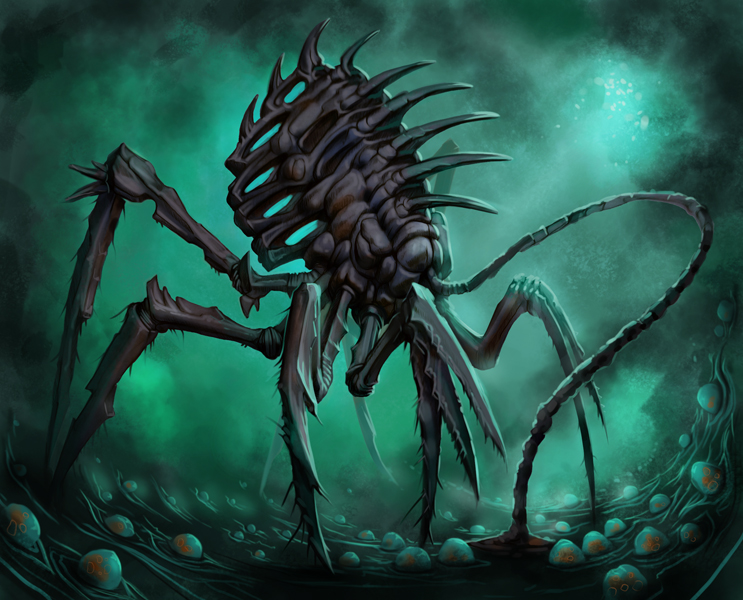
The Skirol are odd creatures exhibiting both arthropodal and molluscoid physiological traits, as well as certain others whose analogues have not been encountered in any other known animal. They visually resemble some form of arachnid or crustacean, encased in black segmented exoskeletons and possessing tentacular appendages extending from the frontal section of their heads.
N’vall:
Cryptic beings that appeared from unknown recesses of the galaxy during the Yrrkeltharl War, and have since become a constituent member of the Coalition, despite refusing to settle on any planet or stationary superstructure and living exclusively on their ships. Comparatively little is known about the N’vall, but something that is certain is that they are members, perhaps the last, of a species that sought to attain physical perfection. Having long abandoned natural procreation in favour of the precisely controlled artificial procedures enabled by their significant level of technological advancement, N’vall are “born” from a genetic fusion encoded into biomass growing around a metallic endoskeleton. Some of them possess strong psionic abilities, but it has not yet been determined what factors cause their development.
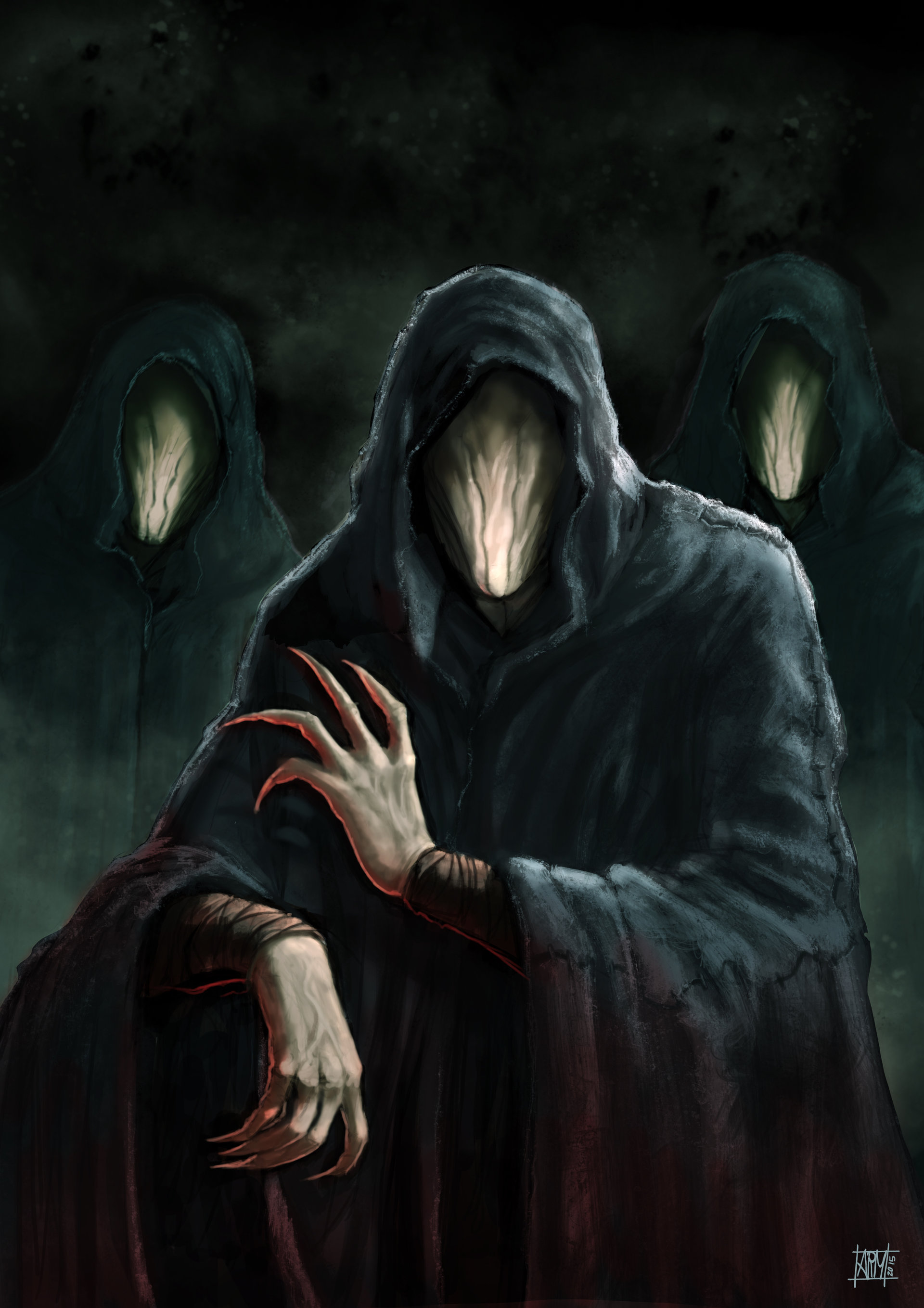
If seen in their customary garments, the N’vall might appear to a casual observer to be almost humanoid. However, their true anatomy is neither such nor even bipedal. They possess four arms, two of which usually remain folded under their cloaks, and lack any sort of hind limbs, instead relying on magnetic propulsors and somewhat arthropod-like mechanical prosthetics, and, should those fail, their own robust muscles, to move in a hovering or crawling fashion. N’vall hands have four digits, one of which appear opposable, but can be bent or rotated sideways with ease to provide a grip upon objects.
Society
Despite centuries of cohabitation, the three species of the Coalition have, over time, remained rather distinct in their social and cultural domains. Mingling has, to this day, remained limited to a macroscopic scale, since even when Ekhrilthur and Skirol share a planet, their environmental requirements and preferences drive them to settle separate locations. Nonetheless, time and regular trade have smoothed out any hostilities between them (a factor contributing to a comparatively rapid construction of peaceful relations was that, due to their biology and consequent social structures, none of the Yrrkeltharl inhabitants are familiar with the concept of trans-generational guilt). Overall, the Coalition’s society is, though as diverse as its geography, rather firmly unified, even though a casual observer might not see any immediate traces of unity proper in it.
The Ekhrilthur, being strongly inclined towards individualistic and materialistic attitudes, as well as possessing almost irrationally strong latent self-preservation instincts, mostly live in utilitarian, unsightly yet functional urban centers, large parts of which reach deep underground. Roads, streetways and passages between buildings take on the form of enclosed tunnels, making the cities fully self-contained pockets of space with only a scarce few entryways and aeration openings connecting them to the outside. Personal dwellings are typically small, narrow insulated capsules, with little, if any, decorations - indeed, in contemporary times ornaments are considered distasteful, and how pristine a home is is a clear sign of the owner’s status - and few visible furnishings. Common pastimes include electronic sensory stimulation, with chemical or biological drugs being rare, and mechanical design aided by small personal assembling devices.
Ekhrilthur society is the basis for the Coalition’s own technocratic system. With the all-pervasiveness of safety system in everyday life, technicians and engineers are the ones who hold the effectively greatest responsibilities, and consequently authority, among them, their influence rivalled only by that of the military (which, being entirely automated, is controlled by technicians itself). Ranks and standing are determined by skill and merit, with examinations and probation periods being required to pass from one of the standardised “levels” to the other. Egoism is not only sanctioned, but indirectly encouraged in these meritocratic communities. While small-scale corruption is not uncommon, nepotism is not practiced by the Ekhrilthur, as they reproduce by sporogenesis and do not entertain family ties.
It might be odd to hear that the notoriously materialistic Ekhrilthur are not only open to religion, but have even produced a faith of their own. In fact, the Creed of the Ultimate Truth is not so much a religious confession as a philosophical stance. In simple terms, those who subscribe to it believe that there is, concealed somewhere in the cosmos, a notion that, if discovered, would explain all uncertainties there exist on the nature and origin of the universe. The innumerable interpretations of this basic axiom have birthed almost as many schools of thought within the Creed, which incessantly contend themselves through discussions and debates.
Skirol, on the other hand, are strongly communal. They congregate in groups known as Trezklin, which can be loosely translated as “Swarm” or “Blight”, numbering anywhere from a few hundred to several thousand individuals, and only a rare few eccentrics are known to live in comparative isolation. The Trezklin is the foundation of the average Skirol’s life, providing at once a family, working environment and circle of friends, or “hunting-mates”. The internal hierarchy of these communities is, while mostly similar across the general Coalition-wide population, so bizarre and intricate as to be largely incomprehensible to outsiders. As far as anyone can tell, one’s authority is accrued proportionally with age, but even then it is in no way uncommon to have younger members significantly outrank older ones.
Trezklin are, as a rule, stationed in the wild, be it flatlands countryside, forests and jungles, swamps, mountain ranges, archipelagos or even shallow bodies of water if their members are augmented to survive in it. Some are nomadic, but the majority remain in the territories where they were originally founded. Skirol habitations, commonly named bio-pods, are semi-organic constructions incorporating one or more non-sentient living membranes draped over a synthetic structure, providing the advantage of a heat-preserving barrier that can be regulated in its various aspects. The standard bio-pod is a large, if sleek, edifice, either housing numerous inhabitants or containing some facility or the other; individual ones are uncommon and reserved for notable persons.
Similarly to the Ekhrilthur, Skirol do not have true religions, but rather philosophical ideologies. The overwhelmingly prevalent one is that of the Cyclic Equilibrium, whose broadly-worded mandate is to find and spread balance to all life. The interrogative of what exactly this balance is has perhaps as many answers as there are planets inhabited by Skirol. Some believe that this means all life-forms should be equal, and modify themselves in entire Trezklin to fit an “universal” biological template; others, on the contrary, see it as an exhortation to increase diversity, and surround themselves with all sorts of strange creatures; others yet think that only some select life-forms should be allowed to exist, and the others be either altered or eliminated. Whatever interpretation they may follow, the Skirol are usually drawn to active experimentation, and do not waste time before putting their views into practice.
Of the N’vall, not much is known. Without exception, they keep to their ships, never setting foot (even figuratively, given their ability to move by hovering above the ground) on any planet or structure not built by themselves and refusing entry aboard their vessels to all but high-standing Coalition officials and scientists. Communications with them are usually carried out by transmitter, or through their slave proxies. What little has filtered down indicates that the entirety of their fleets is ruled by a hierarchy of the psionically endowed, known as I’nler’attul, or I’nler (roughly translatable as “they who dominate/shape” and “dominating/shaping [ones]”), and that they have not relinquished their forebears’ quest of attaining perfection. Though they themselves acknowledge they have not yet reached that stage, they nonetheless see themselves as superior to other beings, and make no effort to conceal it.
Government
With the decline of the power of the Nucleus, two main influences swiftly rose to replace the mighty central authority, as they had been preparing to do for a rather long time - the scientific community network and the military controllers, which is little more than a formal subsection of the former. With defense and ease of force deployment being one of the local authorities’ main tasks, the military immediately established a strong hold on them, eventually growing to fill them altogether. While the Nucleus still participates in the administration of the core regions, it is now quite clearly of secondary importance.
That said, despite controlling the highly strategically important local centers of governance, known as Nodules, the armed forces to not take active part in the governance of systems and sectors. Instead, they limit themselves to enforcing peace, watching the borders and appointing planetary or system governors, called Plasmators. Tying back to the original extremity of the influence shift, Plasmators are chosen from noteworthy scientists and researchers. Their administrative duties are purely nominal, as planets have their own organs of government, the selection and maintenance of which, while vaguely following a standard structure (designed prevalently with the objective of making them as unobtrusive into the Plasmators’ work as possible) is mostly left to the populace. Rather, what their appointment means is that they and their supporting staff have free rein to employ their territory’s space and resources as their work and experiments require it. There are but a few major rules they must abide by lest the Nodules intervene, and the period of allotment is flexible enough.
While the N’vall are technically subject to the global laws of the Coalition, the fact that the latter are so few and loose leaves them significant freedom of action. Their fleets are free to wander about as they please, any empty system, as long as it is not hosting some Plasmator’s experiments, is open for them to exploit as necessary, and the Nodules do not interfere with the rule of the I’nler. Nonetheless, in times of war with an external enemy, they, as well as the rest of the Coalition, are bound to contribute a share of their forces for the common effort - something which they have thus far never disagreed with.
Technological Information
Technology Overview
It might at first appear that, much like its society, the Coalition’s work and accomplishments in the technological field are divided following the species of those who work on them - after all, many practices are to this day still exclusive to their respective inventors. However, upon a somewhat closer examination, it becomes clear that technology has intermingled far more than its creators. Hybrid designs are perfectly commonplace, and Skirol and N’vall energy sources have long since supplanted anything else in use. An explanation for this can be found in the nature of the contact between the Coalition’s members: while trade and commerce are slow in conducting cultural exchanges, scientific and technological ones flow much faster.
Nevertheless, a noticeable degree of historical specialisation does remain. Ekhrilthur technology is chiefly oriented towards mechanics and engineering, and about two hundred years ago has begun foraying into nanotechnology. It is notable, though, that virtual programming has never been their strong point: while they have been able to create some highly complex virtual constructs, the latter are mostly linear in their concept and functioning and lack much potential beyond the minimal necessary versatility. Ekhrilthur components are widely used in Skirol semi-organic constructs, and are occasionally sought after as mechanical prosthetics.
The Skirol are best known for their biological and genetic manipulations. Over the centuries, the number of species created by them through selection, hybridisation, genetic fusion or simply direct grafting has likely grown to exceed that of life-forms naturally found in Yrrkelthar. Ghastly though their amalgams might appear, it is undisputed that they are immensely useful in sectors ranging from medicine and agriculture to spacefaring and, of course, the armed forces. Among other things, the Skirol are responsible for the invention of two of the tools most famed within the Coalition and infamous without - bacterial tubes and engineered plagues. Body augmentations, practical or merely cosmetic, are likewise a common application of their arts.
Most arcane and relatively advanced of all, N’vall technology could appear to hail from another galaxy altogether. The principles it operates upon are either new but irrefutable, or known but having long been deemed unsuited for practical application. Theirs are the traction-core system, used either for highly efficient energy production or the construction of such fearsome weapons as vacuum rippers or gravity mauls, the secrets of neural melding, which subjugates those subjected to it to the will of the I’nler, magnetic levitation and the cloning of vat-grown biomass. The N’vall are likewise responsible for introducing the hyperspace drive into Yrrkelthar.
Major Techs
First brought into Yrrkeltharl space by the N’vall fleets, the vacuum-core principle has been a fundamental pillar of Coalition energy production for centuries. Its main application consists in the generators, large apparati from which obstruents are removed in order to create a partial vacuum. At the center of these structures, usually shaped like cylindrical vats, although spherical variants exist, there is placed a compressed cluster of superheavy matter, typically of the heftier metals, which is then made to spin and generate centripetal traction. The latter is collected by a system of pistons in the form of kinetic energy, which is then converted, through secondary additions to the generators, into the required forms. While the production of traction-core generators is significant, they are physically large and bulky, and are thus typically only used in industrial complexes, urban energy plants and aboard large ships.
A weaponised application of the traction-core principle, vacuum rippers are among the most redoubtable armaments wielded by Coalition fleets. They operate by releasing powerful radiation discharges at their center, then modulating the resulting fallout in such a manner that it initiates something akin to a sub-molecular chain reaction. Particles congregate in aberrant pseudo-nuclei which grow to monstrous proportions, the motion of displaced space propelling some of them forwards, where they will form other conglomerations, and so on. When the chain reaches a dense object - such as an enemy ship - the combined force of uncountable trillions of pseudo-nuclei triggers the formation of an unstable “core”, causing a tremendous implosion which, depending on the size of the vessel struck, can easily engulf a good part of a fleet. Since the radiation itself is only necessary in the first phase of the process, shields and protective fields will not defend against vacuum rippers, but highly robust or insulated ship armour can limit the size of the implosion. Furthermore, their significant size and weight mean they can only be mounted on tremendously large ships.
While traction-core generators are employed for heavy-duty purposes, the more versatile bacterial tubes provide accessible energy at virtually any scale. Developed by Skirol gene-weavers in conjunction with Ekhrilthur nanoengineers, the tubes, as they are known due to their cylindrical form, contain a liquid solution of highly conductive chemicals, in which there swim myriads of genetically modified bacteria. The microorganisms ceaselessly multiply, feed on each other, multiply and so forth, their activity producing energy which, greatly magnified by their environment, is gathered by outwards-reaching nanite networks. Available in a variety of sizes, tube sockets can be found on virtually any Coalition-made device, and every household, be it locule or bio-pod, has a cryogenic drawer with a supply of the batteries, though they seldom have to be changed.
As many an implement in Yrrkelthar space, bacterial tubes have found a specialised role of employment in warfare. Aside from powering the vast mechanical armies of the Coalition, military-issue tubes serve themselves as weapons, thanks to certain modifications. The bacteria contained in these models produce toxic waste as a side effect of their activity; while this has the disadvantage of requiring them to be changed somewhat more frequently, it also allows the devices containing them to eject the waste outwards, usually in a pulverised form, creating the tell-tale sickly yellow-green clouds that cover Coalition forces as they advance. The name “bio-laser” comes from the fact that, originally, it was chiefly energy beam weapons that used such a system; nowadays, though its practice has extended to particle and plasma weapons, as well as the drones themselves, the term remains as a broad catch-all term for Coalition planetary invasion weapons. It is little wonder that after the passage of such an army the ground should remain barren and infertile for decades on end.
While some may see the vollnetlle as wasted potential for so many thriving worlds and colonies, not to mention a dangerous regions that ought better to be cleared, the Coalition is perfectly satisfied with how things are there, and, if anything, would even wish for more of it were there any scarcity. The abundance of barren planets has enabled its engineers to design an efficient, rapid process of stripping a world of all resources with but a few practiced motions. The exact method slightly varies according to the composition of the planet, but the basic process is always the same: swarms of harvester craft descend upon it like hungry rahkal, bombarding the crust with burrowing charges, vaporising any liquid bodies and releasing fumes and radiation that leave any atmosphere there might be in shreds. Hordes of drones are then disgorged upon the battered surface, and collector modules descend upon it to devour and process the ores laid bare by the ravaging volleys. Finally, the planetary core, laid bare by continuous hammering, is solidified through exposure to the vacuum, and absorbed by the machines. The presence of organic life on the surface of a planet does but add an additional stage to the harvest, though to many it might appear to be the most gruesome one.
Somewhat akin to planetary harvesting, albeit by far less thorough, the Coalition’s hostile terraforming techniques are nonetheless much more varied. These invasive planetary alteration methods are deployed upon enemy worlds in support of invading armies, which, though they might be at a disadvantage on unfamiliar ground, are entirely optimised for combat in the pestilential conditions brought about by terraformation attacks. The latter may involve anything from engineered plagues designed to wipe out native life, through saturating the soil, air and water with toxins, mutagenic substances or corrosive acid, to seeding the surface with genetically modified parasitic organisms or deploying swarms of devouring self-replicating nanites. While any of these, used alone or in conjunction with others, is devastating to most life-forms in known space, the process is gradual and, though incredibly fast by terraforming standards, leaves defenders enough time to react should they be able to. Hostile terraforming is conducted through ground and orbital emplacements assembled by Coalition armies and fleets, and eliminating them, as well as any Ruinator ships stationed over the planet, is the key to stopping it while it is reversible.
Prior to the integration of N’vall technology into Yrrkeltharl designs, the most common form of plasma weapon were the stream projectors used by the Ekhrilthur. However, once the expertise in magnetic fields of the vat-born species had been assimilated into the technical knowledge of what had by then become the Coalition, its applications in the bellic employment of plasma, already known to the N’vall but new for the rest of the region, were greatly acclaimed. The final result of numerous trials and experiments was the unmaker, a weapon of variable size used nowadays by warships and heavy drones alike. These devices fire a double-layered sphere of plasma maintained compact by a magnetic field, resulting in a double shockwave, outward and inward, which weakens struck matter before drawing it into a destructive implosion.
Industry
The power of the Coalition, scientific and military alike, is entirely founded on the strength of its industry. Planets and asteroids are torn open every day to feed the insatiable metallic monster, and many thousands of varyingly automated factories regurgitate tools, wares, instruments, equipment, but most of all ships, drones and frames for semi-organic constructs. The vollnetlle is littered with their hideous forms, but they likewise abound in the core regions, and Ekhrilthur space in particular. Indeed, the Ulvarith system-complex, a mass of interconnected megastructures fully dedicated to pounding metal into uniform shapes, is the species’s pride, and many worlds inhabited by the fungi show signs of efforts to emulate this great work on great and small scales alike.
Military Information
Military Overview
The most notable feature of the Coalition military is that no member of the three constituent species ever takes to the field in person. All of its forces are composed of remotely controlled constructs, with the sole exception of Skirol and N’vall ships, which, however, are rather rare. No creature, be it living or mechanical, in its ranks is fully autonomous, since the Yrrkeltharl species are as distrustful of anything they cannot directly command as they are unwilling to descend into battle. This reliance on its creations rather than its population itself, and thus industry rather than reproduction, often grants the Coalition an immense numerical advantage. While its troops might be unwieldy and slow on the move, they are so many that enemy armies, whatever they might be, may easily find themselves dwarfed, and the foul contamination they spread as they advance further tips the scales of attrition in their favour.
Space Forces
Navy Doctrine: Sometimes called “pillar drill” after an ancient Ekhrilthur siege engine, the Coalition war fleets’ typical approach to battle seeks to make best use of the strengths of each of its vessel types. The innumerable lesser and medium Ekhrilthur drone craft seek to pin enemy fleets in place by surrounding them from all sides, hurling themselves forward with weapons blazing regardless of any damage or losses they might suffer. Once the foe is thus encircled, the “drill” proper, formed by heavy drone ships alongside the titanic Skirol semi-organic vessels and the powerful N’vall auxiliaries, advance upon it, releasing new waves of strikecraft and firing fearsome weapons such as vacuum rippers, giant unmakers and spinal beam projectors. With nowhere to turn, the enemy would ideally be at the mercy of this unstoppable force.
Avmal Thorn
The drone counterpart to corvettes. The Thorn strikes a balance between defense and offense, being moderately well-armoured for something of its size and armed with a complement of light beam weapons and unmakers. Most of all, however, its design emphasizes mobility, its traction-core-powered reactors allowing it to reach tremendous linear speeds - something that can prove deadly should it hurl itself against an enemy in a suicidal attack, triggering a destructive reaction from its inner generators. Given their numbers and apparent recklessness in charging forward regardless of losses, this tactic is to be expected whenever facing Thorns, though it should never be forgotten that its weapons alone can prove to be more than deadly for the unwary.
Nhuul Parasite
A larger type of drone ship, somewhat exceeding a large destroyer, the Parasite usually moves slower than the Thorn, but is far more dangerous. Better armoured, fitted with shields (which, like most protective fields of Coalition make, are not difficult to pierce, but rapidly reform if not taxed for a moment) and armed with larger beam and plasma emplacements, it is not only more durable and capable of inflicting damage, but can likewise latch on to larger foes after approaching them with a short acceleration burst, bury into their hulls and fire its unmaker into their interior. The results can be worse than crippling, and it is thus for the best to keep Parasites at a safe distance.
Tlaelon Scavenger
Similar in size to a light cruiser, Scavengers are the largest of the drone vessels employed in the encircling part of the “pillar drill”. Surprisingly resilient for something supposedly designed to be expendable, they are armed with a (relatively) small axial energy projector, as well as lesser secondary weapons, including unmakers. Their greatest danger, however, comes from the fact that they carry a complement of boarding pods loaded with assault and observer drones, and set to release poisonous gas or other debilitating agents once they cling onto a ship. Unlike their lesser counterparts, Scavengers are typically more cautious in battle, blasting foes from afar and only swooping in to deploy their pods when they detect a suitable opportunity.
Nfaal Devastator
The largest drone war vessels built by the Coalition, Devastators are under no aspect inferior to battleships. Heavily armoured, shielded and armed with a large spinal energy cannon alongside batteries of unmakers and heavy beam weapons, these juggernauts can wreak incredible devastation on a cornered enemy. They are, however, ponderous and of limited manoeuvrability, and can only effectively engage opponents frontally. While not defenceless on its other sides, a Devastator would be hard-pressed to eliminate smaller, elusive targets with freedom of movement, which is why they are mainly employed in the second phase of the drill manoeuver.
Uvnall World Eater
Not so much ships as immense mobile operation platforms, World Eaters are not designed for combat, being equipped with a mere few turret-mounted weapons. Their purpose is instead to complete planetary surface invasions and lay the foundations for the subsequent assimilation of a world. Each World Eater houses several miniature factories and spawning pits, and carries within itself a small army of troops and worker drones, enabling it to gather raw materials from its surroundings and churn out waves of reinforcements to bolster the ranks of the Invasion Forces. As someone once remarked, their function is rather similar to that of the Daisan landing spikes.
Klazk Swarmer
The mainstay strikecraft of the Coalition war fleets, Swarmers are in truth semi-autonomous living organisms, controlled via neural melding and augmented with mechanical devices, engines and weapons upon being spawned. Due to them usually being produced in pits carried by Skirol ships, there never is a scarcity of them on a battlefield, and they will be certain to make their way into the tightest of formations. Depending on their configuration, which can be changed during flight, they can act either as fighters, engaging other strike craft with their light frontal weapons, or bombers, opening their fore to reveal unmakers with which they target larger ships.
Zavruul Scourge
Fairly large and encased in a protective carapace allowing it to enter and exit atmospheres, Scourges are the primary dropships used by Coalition forces, and their main means of landing armies on a planet’s surface aside from World Eaters. Deployed by Ruinators or other such large ships orbiting a besieged planet, they descend on the surface in vast numbers, each bearing a strong cargo of drones, soldiers or monstrous creatures, and often strafe over settlements and fortified spots before landing, bombarding them with foul ammunition. They are, however, too large and unwieldy to be suited for atmospheric combat.
Ravreth Behemoth
Along with the Leviathans and Ruinators, Behemoths are the largest warships fielded by the Coalition, dwarfing even the proudest dreadnoughts and space stations and rivalling the World Eaters themselves in size. They are formed by a gargantuan metallic skeleton covered by tonnes of biomass akin to that used in building bio-pods, only in immeasurably larger amounts and of a rather more resilient variety. The “flesh” pervades the entire vessel, ready to, among other things, digest any who attempt to board it without proper pheromone and genetic identification and regenerate upon being damaged. The Ravreth is designed to serve as a carrier, being only lightly armed (for something its size) but housing several spawning pits which ceaselessly disgorge waves of Swarmers. As all ships of such size, Behemoths are each manned by a dedicated Trezklin, residing on board and effectively calling the vessel its home.
Voltharil Leviathan
Similar to Behemoths under many aspects, Leviathans are, however, geared more for direct combat than further bolstering fleets. They do not carry spawning pits, but instead are armed to the barely-metaphorical teeth, wielding such tremendous weapons as vacuum rippers, colossal unmakers and several axial-mounted energy and particle cannons. Since they often spearhead charging groups, with the less battle-suited Behemoths remaining behind, they are likewise better equipped to deal with enemy countermeasures, being capable of tearing through attacking fighters with ease and eliminating flak barrages fired to hold back the Swarmers.
Ulkor Ruinator
While Behemoths support fleets and Leviathans batter the enemy, Ruinators are built with the purpose of besieging attacked planets. Though they are not significantly armed, they contain all that is needed to begin hostile terraforming of an enemy world, along with a small fleet of Scourges ready to deploy Coalition troops on the surface. As long as one of these ships remains in orbit, it will continue to produce and deploy stations and devices that taint the soil and atmosphere. Due to how crucial their role is in planetary invasions, Ruinators are heavily guarded by more battle-ready craft; yet eliminating them is likely the most reliable way of disrupting an invasion.
(Images not to scale.)
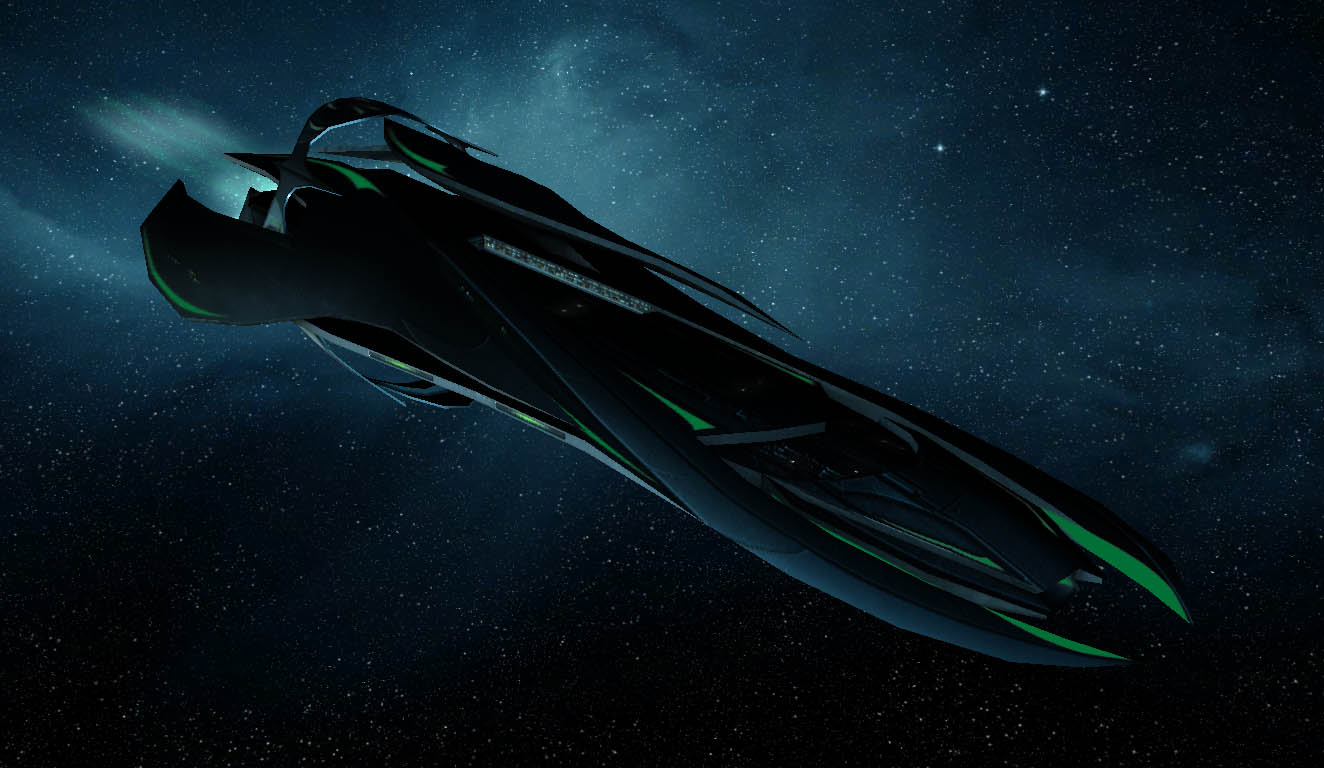
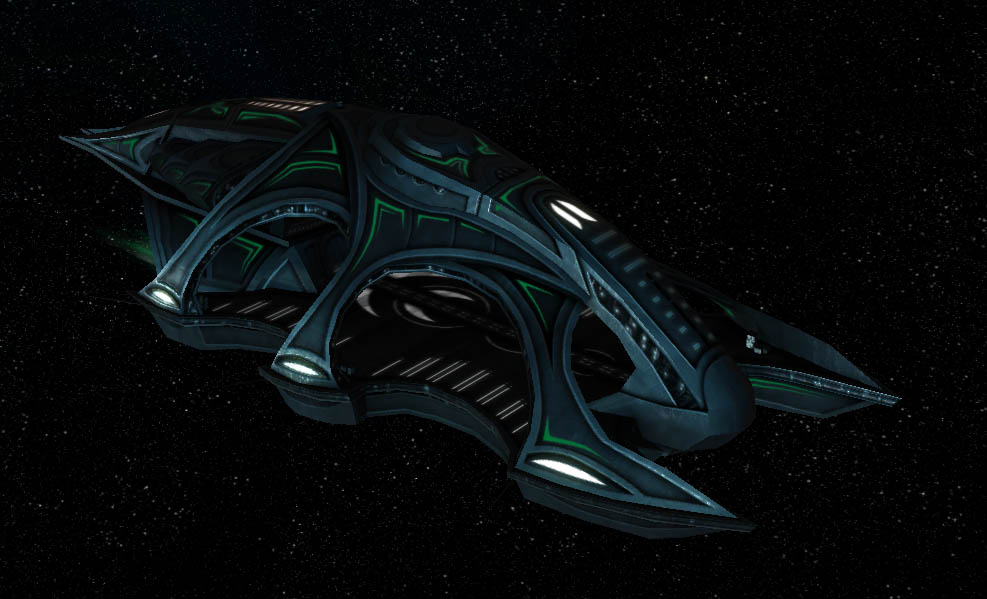
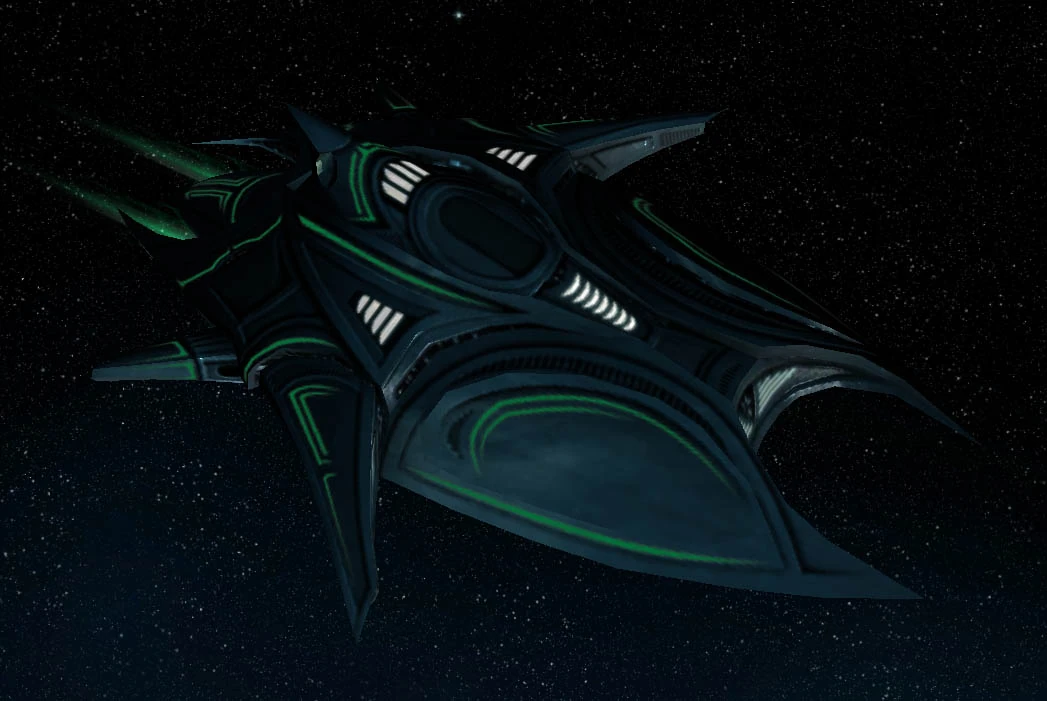
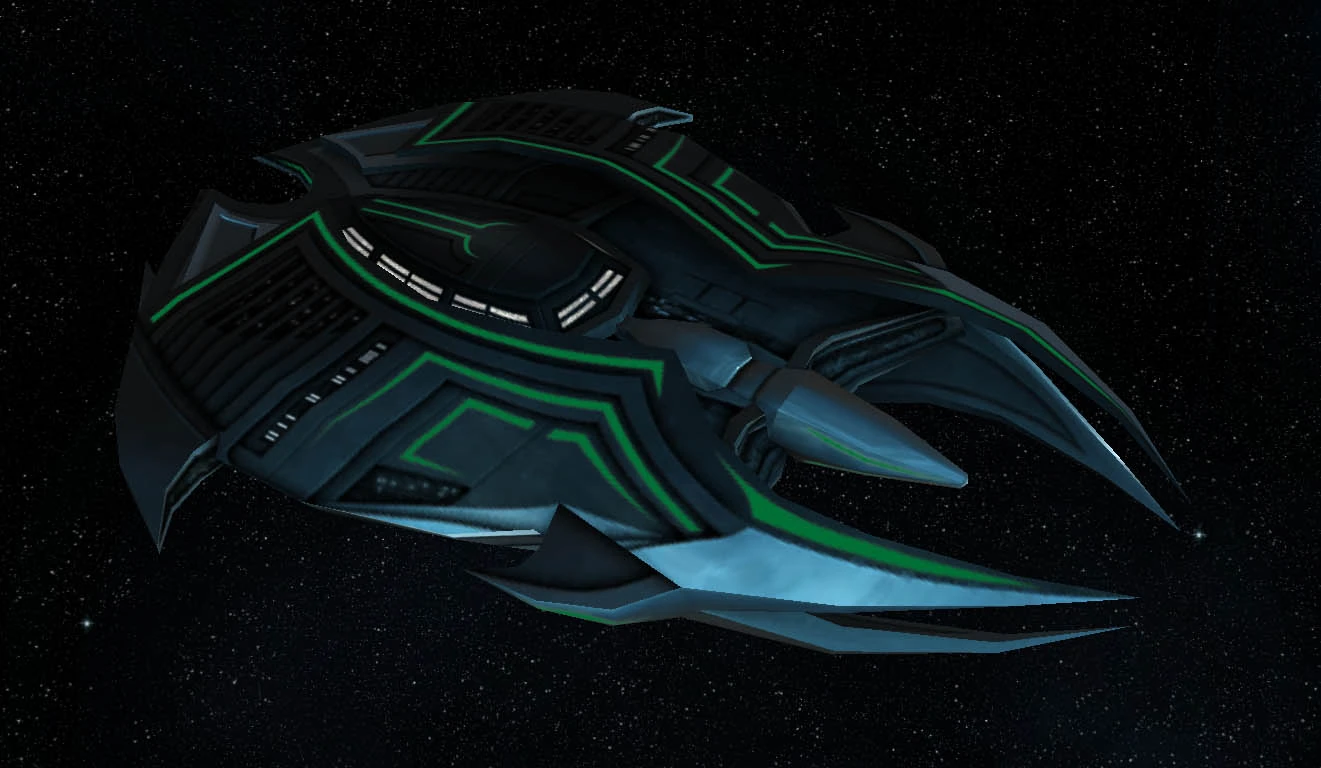
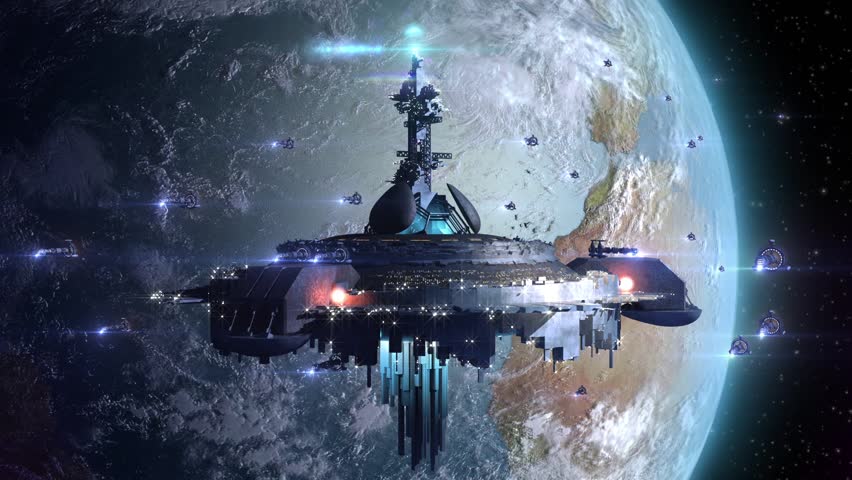
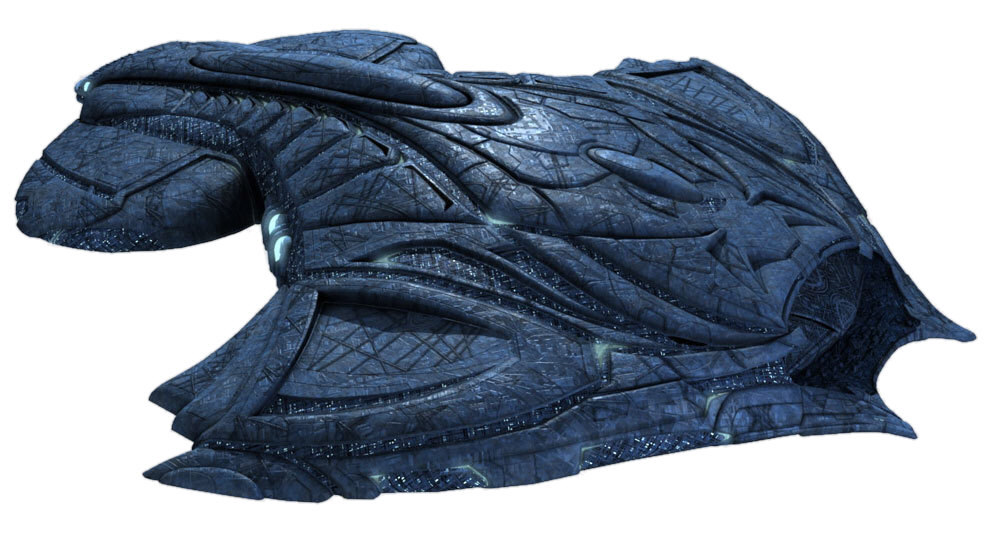
As strange and mysterious as their inhabitants, the N’vall ships defy even such loose classification standards as those of the Coalition. As far as anyone knows, they are divided into A’thaur Unaal (lesser homes), A’thaur I’entil (homes of the many) and A’thaur E’neval (homes of dawn), which are broad designations the I’nler use when communicating with Nodule authorities. The Unaal are the smallest vessels, ranging in size from about the equivalent of a small cruiser to a carrier; I’entil are as large as the typical capital ship; E’neval, which are nothing short of mobile cities, matching or even exceeding World Eaters in magnitude. Such proportions are chiefly due to the fact that virtually all N’vall vessels serve as habitats for the species, and thus contain dwelling quarters and various other necessary systems and implements. This, however, does not prevent them from being the most potent combat vessels at the Coalition’s disposal. Between unusual shields and arsenals of outlandish weaponry, the few Unaal and I’entil the N’vall may dispatch at the Nodules’ request make up as much as, if not more than, a fourth of an entire united fleet’s power. The E’neval are practically never seen in battle; however, the vague scraps of tales from the Yrrkelthar War paint an extremely grim picture of their destructive potential.
Ground Forces
Ground Doctrine: While fleet tactics, distinctive though they might be of the Coalition, do not bear much of a mark in the way of its, so to say, flavour, the doctrine followed by its Planetary Invasion Forces appears to take pride in displaying the worst of its destructive and corrupting tendencies. Officially named “Transformative Assimilation”, it consists in radically altering the terrain and environment around its immense armies of metal and biomass via the use of hostile terraforming. In addition to being necessary for the troops to operate at full effectiveness, as they are expressly built to do battle in such hellish conditions, it corrodes and weakens any resistance the enemy might offer, so that it might easily be swept away by the unwavering advance of the soulless tide.
Infantry
The bulk and backbone of any Coalition planetary invasion, infantry drones are so numerous that they alone might well exceed the populations of some lesser nations. While it is inevitable that in such a multitude there should exist hundreds of different types distinguished by the weapons and armour they carry, and consequently their specific role on the battlefield, all of them remain divided into four base models by their general shape. These models are, clockwise from top left:
- Assault Drones: The largest of the four types, assault drones are the shock troops of the Coalition’s robotic armies, hurling themselves at massed enemies to make way for the rest of the army or delivering rapid and hefty tactical strikes. They are encased in moderately heavy armour and carry powerful bio-laser variants, as well as being quite mobile and fast upon their feet. Of all types, they are the least numerous. - Bulwark Drones: Second in size to the assault variant, bulwark drones are much more thickly armoured, but relatively lightly armed. Their purpose is to hold back foes where they should attempt a counterattack, and wear down advancing forces by continuous fire while limiting their own losses. Being the bulkiest of the four models, they are likewise the least mobile. - Skirmisher Drones: Lightly armoured and moderately armed, skirmisher drones are the smallest type, but not, for that matter, the least dangerous. Where enemy ranks reveal a weakness but the use of assault drones would be excessive, they dart into the fray, striking and immediately withdrawing out of reach; or else they ambush scouts, disrupt convoy lines or launch raids upon momentarily defenceless targets. To best suit their function, they are faster even than the assault model. - Combatant Drones: Not exceeding in either offense or defense, combatant drones balance their complements of armour and weapons in a mostly even manner. Lacking a dedicated role, they make up the bulk of drone armies, their unspecialised nature granting them greater versatility than the other models in various situations. Or, at worst, making them suitable for the role of nondescript expendable troops.
Observer
Most often employed as pacifiers and law enforcers on inhabited worlds, Observers are likewise not an uncommon sight in war zones. Their agility and aptitude in blending with their surroundings and moving silently makes them good reconnaissance and scouting units, and their weapons can incapacitate or kill a target inconspicuously. Observers are most dangerous in urban environments or when boarding ships, where they might be hiding behind any corner and in any nook, ready to pounce on their inadvertent prey.
Colossus
Towering above the ranks of drone armies, Colossi are to the Coalition forces what heavy tanks are to most conventional militaries. Large, so thickly bound in metallic armour as to be impervious to any weapon below a certain power threshold, and bringing the full might of an artillery platform to bear, these drones excel at breaking sieges as much as they do in field battles. Their wide array of armaments additionally allows them to function as walking anti-air batteries, as well as making short work of threats on the ground at virtually any distance. However, as it could be expected of something so great and ponderous, they are slow and unmanoeuvrable, and rather limited as to what terrain they can traverse.
Titan
While Colossi might be of redoubtable size on their own, even they pale before the monstrosity that is a Titan. As imposing as sizeable buildings, these machines are nothing short of mobile fortresses, capable of crushing the stoutest defences merely by stepping on them and shrugging off even heavy weapon fire. Their own armaments are comparable to those of a small warship,greatly exceeding in strength, range and versatility those of their lesser counterparts. As though all of this were not enough, they are equipped with superior sensors, and can detect traps, ambushes and other subterfuges that lesser drones might miss. Fortunately, Titans are relatively rare, and suffer from all the disadvantages of a Colossus to an even greater extent.
Rahkal Spitters
The closest the Planetary Invasion Forces have to an atmospheric air-superiority unit, rahkal spitters are sentient predatory molluscoids modified by the Skirol to serve as optimal war beasts. Moving through the air with the aid of multiple gas-inflated bladder-like organs, the rahkal possess robust carapaces and sharp beaks, but they are most dangerous for the corrosive liquid they secrete and spit with surprising strength and accuracy, earning them their name. The skies of a planet under attack by the Coalition will soon be darkened by swarms of rahkal, as they have a tendency to breed rapidly whenever afforded with a sufficient supply of space and prey.
Kvazrul Shredder
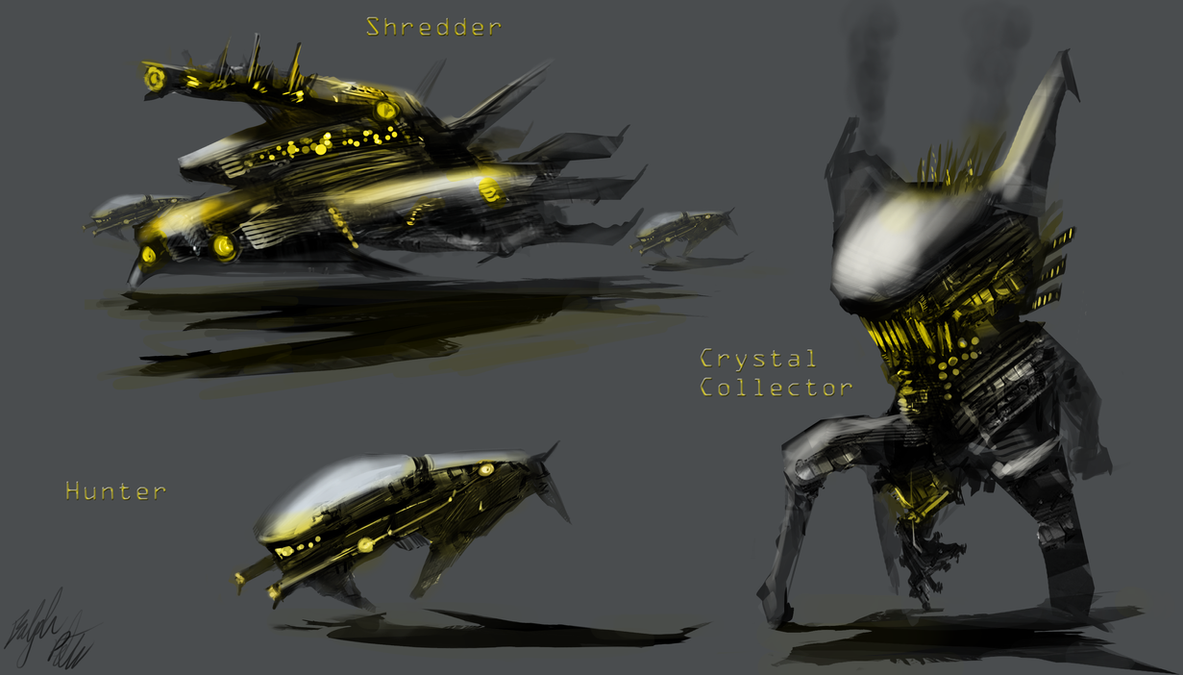
The kvazrul, carnivorous arthropods native to Skereth, were historically among the first creatures domesticated by Skirol communities, and thus it is little wonder that they should have been adapted for employment in warfare. Bred and augmented according to a design dating back to the Yrrkeltharl War, shredders are larger, stronger, more cunning and ferocious than normal kvazrul, and are armed with synth-metal claws and mandibles. During invasions, they are deployed to infest less urbanised or ruined areas, where they are adept at stalking and preying upon local life, sapient or not.
Kvazrul Contaminator
Another engineered kvazrul mutant, the contaminator is even more outlandish in its appearance than the shredder. It does not possess as many natural weapons, but instead carries upon its back a non-sentient symbiotic organism. Through neural stimulation, these beasts can trigger within their symbiotes an explosive biochemical reaction that ejects outwards, as a projectile, the lesser bioconstructs it was designed to carry. Those can range from virus bombs and toxic ammunition to seeds, spores or eggs of invasive alien wildlife whose spread quickens the hostile terraforming process.
Fham’nhl Terror
According to some disputable, though otherwise insightful, sources, the Fham’nhl (or however they were once called; now this name, probably invented by their masters, is all that remains of their cultural identity) were the first species to be enslaved by the N’vall to serve as powerful and obedient soldiers. While already fearsome enough upon first entering Yrrkelthar, modern bio-laser technologies have even further increased their destructive potential. Due to their imposing appearance, Terrors are often used as guards, enforcers and, on rare occasions, occupation troops, but their true expertise lies in brutally crushing pockets of resistance along battlefronts.
Var’nhl Champion
The most versatile and flexible in their choice of weapons of N’vall slave soldiers, Champions excel at close-quarters combat. Be it cornering foes in an enclosed space and finishing them off, clashing in the narrow corridors of a ship or meeting enemy melee specialists in an even fight, the design of their armour and motory enhancers has been long refined to optimise them for action in such conditions. The weapons they carry may vary from burst particle emitters, to high-dispersion plasma scorchers, to the dreaded vortex mauls, built to exploit the traction-core principle to potent effect, but what remains unchanged all throughout is their skill and superhuman attributes.
Sre’nhl Purifier
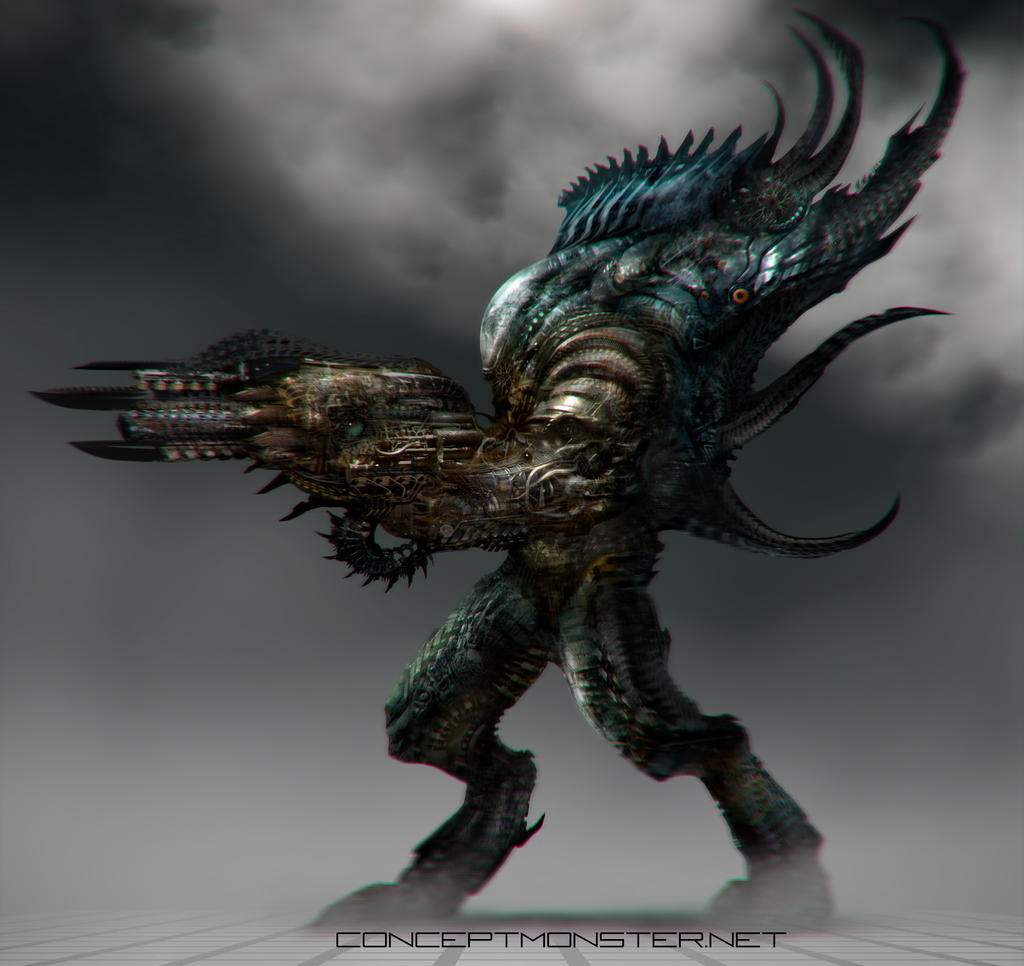
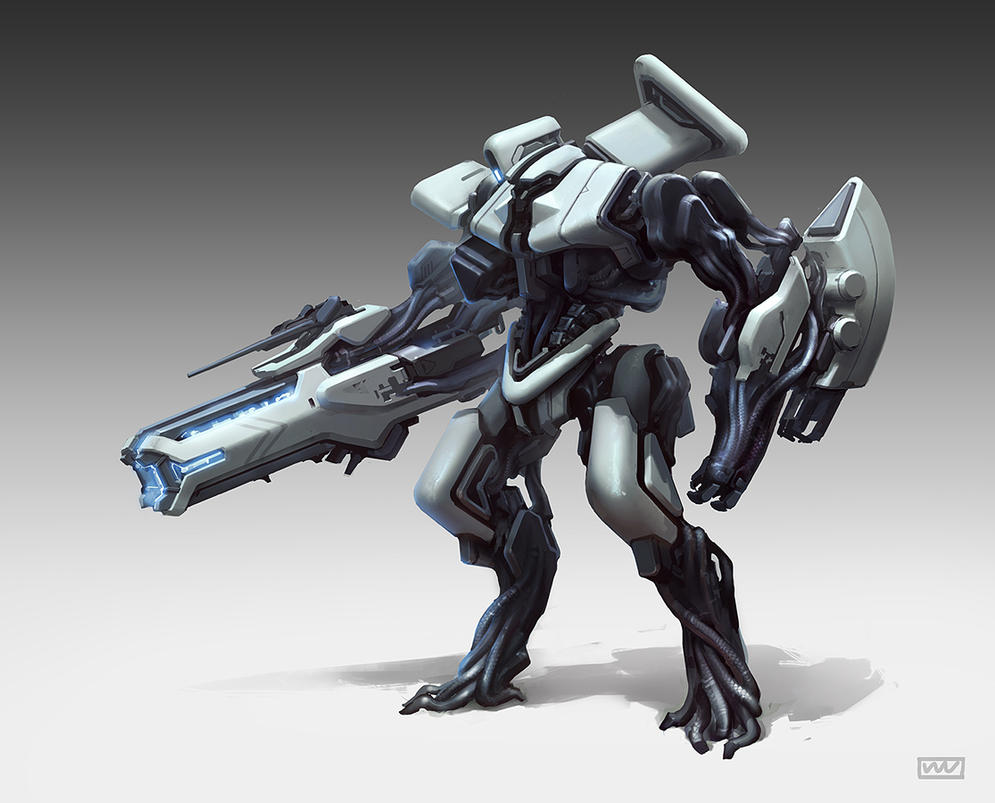
Even more direct in their purpose than Terrors or Champions, Purifiers exist solely to lay waste to everything and anything in front of them. Rumour has it that the bodies of their species are formed by viscous, semi-fluid filaments, forced into roughly humanoid suits of powered armour by the N’vall. The Sre’nhl are nightmarishly resilient and persistent, and equipped with state-of-the-art sensors to ensure that that which they are pointed at can never escape from them - an impulse that becomes fully understandable once one sees their arm cannon in action. While their heavy stomping gait might lead one to surmise they are slow and unwieldy, they seem to have an uncanny ability to always be wherever one least wants to see them in no time.
Despite the impressive power of their ship-mounted industry, the N'vall often find themselves in need of raw materials to fuel their production machines. To fulfil this necessity, they typically drain planets and asteroids of natural resources in a manner that inspired the Coalition's planetary harvest technologies, deploying a number of gatherer machine designs to the surface. While their primary intent is, as their name indicates, to collect the wealth of celestial bodies, these harvester machines are fully capable of dispatching any hostile local life they should encounter, dutifully processing what remains of it into repurposeable biomass. A fearsome combat force in their own right, the harvesters are only employed in a military capacity during the invasion of worlds the Coalition deems forfait, as they are painstakingly thorough in their elimination of all there is on the surface.
The water pouring from the shattered tank would have been a relief for Ulor's sparsely burned skin, had it but been less salty. As it was, however, it produced a rather unpleasant and more than slightly painful tingling over the scorched patches. Nonetheless, it was ever so slightly fresh, which, in other circumstances, would have made even it a welcome change. Yet, as it stood, it only made things worse. The dungeon was cool and damp enough on its own, and this seemed to be an ideal way to catch himself a rheumatism. Fortunately - though how fortunate that really was was debatable - he did not even have to exert the least mystical effort to dry himself, as the vegetative tiefling took it upon herself to provide to his and the paladin's sanitary need. The feeling of no longer being wet was pleasant; less so was the fact that she seemed convinced that hugging was a necessary part of the incantation. Grumbling something indistinct, he wagged at her a finger that seemed for a moment to smoothly change its shape into that of a tentacle tipped with a ferociously snarling mouth.
Waving away the gnome's remonstrances like a circling fly, Ulor headed back into the corridor, the octopus dutifully following a step behind. What there was to see in that room had been seen, and, while its physical contents had been somewhat disappointing, they had hinted at something else to be found down there. Something that would have rendered keeping diminutive people in tanks of salt water worthwhile (phrased this way, it appeared to be a ridiculously specific goal, but presumably these sectarians did not just waste their time like that). His first impulse was to head to the east, towards the light, as it was probably there that said something was more probable to be found - unless it did not need ready access to the tanks. However, seeing that the rest of the group was focused on the collapsed tunnel, he wisely decided against wandering off alone and hobbled towards the impromptu wall, which the bestial scoundrel had already clambered over.
He was still thinking of what he should do next when the half-breed followed into the breach, after the rogue called out that the way was clear. That might very well have been; yet it was always better to be safe, lest these savages topple something over him just as he entered. He motioned to the octopus, and the creature floated up and through the opening in the wall. Even as it did so, Ulor cast the greater current of his mind into its psychic mould. Its eyes were his, and his spirit pulsed through its mystic veins. Through its somewhat faded view, the mage could see the chamber's two occupants, the fallen guard and, most importantly, what he had been guarding. Dim pupils darted from side to side, seeking something on value - perhaps that very something that could solve the mystery of the vats.
Looking at the western chamber through Octopus, Ulor Investigates (a glorious 3) it for anything interesting.
As it is made obvious even by its name (in the Ekhrlithur language, used as an official lingua franca, “Yrrkeltharl” is a locative meaning “of [the sector/region of] Yrrkelthar), the Coalition is best defined as not so much a nation as a loose confederation of the inhabitants of the section of space it occupies. While there once existed a central government which presided over what was then a super-state formed by the fusion of the three local powers, its planets and systems are now the laboratories and playgrounds of its most outstanding scientific minds, who, aside from a few general guidelines and an obligation to support the collective military forces with tributes, enjoy access to vast resources and free rein in working with them.
With such a system in place, it should not be surprising that Coalition space should be a chaotic and almost frighteningly surreal place. The husks of consumed worlds can be found orbiting stars encased in energy absorption frameworks, near planets blighted by experimental weapons or razed by the formidable drone armies stationed there. Worse yet, whoever finds themselves dealing with it will have to endure the eccentric nature and usually poor coordination of its inhabitants, which might lead to strange situations involving guarantees of non-aggression being immediately followed by planetary invasion.
Official Name: Sovereign Coalition of the Yrrkeltharl Systems and Fleets. Common Name: Coalition, Yrrkelthar, Yrrkeltharl Coalition. Government: Decentralised Feudal Technocracy. Dominant Species: Ekhrilthur, though not significantly so. Capital: Erelvath, Ulvarith System (de jure; de facto, there is no single effective capital). Systems Owned: Numerous. Planets Owned: Uncertain. There is an official register somewhere, but the number often fluctuates anyway. Population: Uncertain. The unified census records have not been checked by anyone besides automated systems in decades.
History
Centuries ago, what would become known as the Yrrkelthar region only knew a single spacefaring species. The Ekhrilthur fungoids, having, after a period of internecine conflicts inevitable in creatures so inclined to individualism, consolidated into a single planetary state known as the Erelvath Conglomerate, began to expand outwards from their homeworld, taking advantage of the recently discovered slipspace drive. Their native Ulvarith system was the first to feel their thirst for energy and resources, with virtually all its noteworthy celestial bodies being mined dry and its star being surrounded with a network of collector panels, laying the foundation of more ambitious constructions yet to come.
As faster-than-light travel technologies improved, the Conglomerate reached to absorb more and more systems. Worlds were colonised, and more yet were consumed. It is to that time that the first records of the Ekhrilthur encountering other sapient life forms can be dated. According to those chronicles, one of the planets approached during their conquest was inhabited by a comparatively primitive civilisation, still fragmented and not yet having reached the space age, which, upon the arrival of the Conglomerate, proved hostile and put up a violent, if futile resistance, and was fully eliminated by the invaders’ robotic forces.
It was not much later that the second of such encounters occurred, though its resolution was by no means as fast as that of the first. On a world whose conditions, favourable to the development of life, had given rise to the formation and evolution of an enormous number of bizarre creatures, the Ekhrilthur vanguard came upon a remarkably developed invertebrate species. The Skirol, as they named themselves, were extremely proficient in the manipulation of genes and biomatter, having built their Global Union upon these arts, but had until then been unable to master space travel. Upon being informed of the Conglomerate’s intention to subjugate the planet and reduce them to second-class citizens at best on their own world (though nowadays many suppose that Skirol aggression also played its part), they rapidly, much to the Ekhrilthur’s surprise, beat back the occupying armies and seized their vessels.
Angered at this successful defense, the Conglomerate sent the bulk of its military fleet to devastate Skereth, as the offending species called their homeworld. Yet once again the crafty invertebrates proved themselves capable of exceptional feats: in an incredibly brief time they reverse-engineered the Ekhrilthur craft designs and began to produce monstrous semi-biological ships to rival those of their foes. After some years of pitched battles around Skereth, the Global Union fielded the first Leviathans, scoring a string of decisive victories and breaking the siege once and for all. Much to the Conglomerate’s horror, the Skirol spilled outwards from their planet like a black plague, infesting system after system.
For decades afterwards the two nations warred with each other over Yrrkelthar, leaving more systems ravaged in the wake of their clashes than the expansion of the Ekhrilthur could have ever accounted for. As hostilities progressively escalated, the two sides continued to build newer and more destructive weapons, yet neither could gain a lasting advantage over the other. It is worth noting, however, that the death toll was surprisingly low for a conflict of this magnitude, since both sides favoured indirect confrontations and the employment of mechanical or biological constructs in battle.
A temporary truce was reached between the Conglomerate and the Global Union only when, out of unfathomable distant reaches of the galaxy, a third force appeared to lay claim to the region. The N’vall, a cryptic and vastly technologically advanced species of semi-artificial beings that had been wandering the galaxy as nomads for an unknown time, forcefully entered Yrrkelthar with their fleets and armies of enslaved soldiers, seeking to establish their complete dominion over it. Due to the significant superiority of the newcomers’ weaponry over their own, Ekhrilthur and Skirol were forced to set aside their differences and form an uneasy alliance to resist their advance. However, even this necessary union proved unstable, and eventually fragmented, with the region descending into such chaos that the invaders were unable to fully commit their forces to securing a complete victory.
At length, as the war ran its course, the strength of the three species was depleted. The constant effort and resource drain that were battles and armament races had left the economies of the Conglomerate and Global Union in shambles, and even the seemingly all-powerful N’vall had seen their already low population dwindle dangerously. A peace treaty was drawn, ensuring a more or less equitable division of intact and devastated territories alike between the Ekhrilthur and Skirol, and relative freedom of action for the N’vall. Upon this foundation were successively built numerous trade deals, then large-scale partnerships, then state accords, until, over the centuries, international organisations sprang up that all but engulfed the respective governments’ authorities. Former tensions were forgotten, and eventually Yrrkelthar’s inhabitants were subsumed into one vast super-entity, directed by an enormously influential Nucleus.
Under the guidance of the Nucleus and its subsidiaries, the Coalition, as the new state had been named, expanded further outwards. The increase in the number of territories to manage put an increasing strain over the centralised system, which found itself constrained to set up more and more local authorities with more and more sweeping powers. Finally, the influence of these minor organs eclipsed that of the Nucleus itself, which, lost amid the network it had itself created, retained little more than vestigial status.
While these events took place, the Coalition’s wide and diverse scientific community, which had been becoming more important as the demand for new technologies grew over time, had, abetted by the military controllers, been edging its way into the administrative organs, conveniently rendering several functions dependent on advanced technical knowledge. Since the local nodes were most accessible, it was there that it held greater sway; and thus the spontaneous decentralisation helped bring about the new technocratic order, which has since then remained in place to this day.
It was not long after the new system had consolidated itself - and reaped its first share of planetary victims - that the Coalition had its first contact with an outside force since the time of the coming of the N’vall. Scouts from the nearby Empire of Astrana penetrated the dead space between it and the Yrrkelthar core, reaching the inhabited zone. Curious at the sight of the unknown human species, the locals promptly performed a series of forceful experiments upon them, often with lethal results. The tales of those few that returned to the Empire triggered a retaliatory strike, whereupon the Coalition, seeing its neighbour’s military power, did not further meddle in its affairs.
About a century later, the population of Yrrkelthar was further surprised by a third intrusion, this one far less benign than the previous one. The armies of the Daisan Order descended upon its rimward-facing border, destroying and plundering all in their way. At first, the Coalition, unaccustomed to defensive warfare, attempted to turn its normally aggressive scorched earth tactics against the invaders; however, this only led to further losses, as the mechanical hordes marched on, undeterred. Thereupon, it mustered its war fleets and met the Daisans head-on, successfully halting, or at least slowing, their advance. Yet their victories were costly and by no means final, and the threat from the mysterious distant rim looms still over Coalition space.
Starmap Information
Galactic Location
Major Holdings
- The Ulvarith System: Home system of the Ekhrilthur, and the official capital of the Coalition. While once it was the seat of the highest power in the region, nowadays it maintains its former superiority only in one field - that of industrial production. Ever since the Ekhrilthur first crossed space, they began laying the foundations for the great Ulvarith machine. It grew bit by bit, component by component, secondary megastructure by megastructure, until it reached its current condition: almost a single, immeasurably vast complex, uniting the function of material gathering, elaboration and construction. Ulvarith is the heart and pride of the Coalition, and the primary source of its vast drone armies.
- Skereth: Homeworld of the Skirol and, to this day, holder of the record for the greatest natural biodiversity in Yrrkeltharl space. Skirol Cycle-Weavers are to this day uncertain of whether they have encountered and catalogued every single species living on the planet, and there is scarce an inch of its surface that is not teeming with pluricellular as well as simple creatures, to say nothing of the lakes and oceans. Something all the seekers of Equilibrium agree on is that Skereth is virtually sacred, and thus none but a select few Trezklin, formed of the most illustrious Skirol to be found in the Coalition, are allowed to reside on its surface. Any who so much as visit it, drawn by the fame of its bio-pod laboratories and spawning pits, must undergo preemptive sterilization procedures, and, of course, never stray from the designated paths, lest they be seized by one of the planet’s many strange predators.
- Iurthelath: While typical Plasmators never remain in office for more than, at the very utmost, fifty standard years, not in the least because of lifespan limitations, the rulers of Iurthelath are a very notable exception. It is the only recorded case in Coalition history in which the title of Plasmator has been officially claimed not by an individual, but a group of researchers. The Iurthelathl Combine, as they are known, have remained in their position almost since it first appeared, and some suspect they simply found a loophole in the newly established rules. However this may stand, the Combine is an exceptionally diverse group, even including some N’vall, and its ever-evolving military designs are highly prized by Nodule controllers and fabricators alike. Less so by the inhabitants of the system, who, despite the official rules, constantly fear lest they be accidentally obliterated by the latest prototype.
- Nodule Nl-03: While political and military power alike is mostly more or less evenly distributed among the Nodules, with some variations due to the population and resource yield of given sectors, Nl-03 greatly outclasses it fellows. The reason for this is that it is perhaps the closest the modern Coalition has to a true Nucleus; a staging point for the forces of several outer sectors, and a few of the core ones as well. This degree of centralisation, previously unheard of in Yrrkelthar, has been forced upon it by the onslaught of the Daisan, and the speed with which it was put into practice is laudable by any standards. In less than three years, the previously scattered armies of the northern systems have been assembled here, ready to be deployed wherever the invaders might show themselves - though the strategic closeness of Nl-03 to the Imperial border has been a source of some perplexity.
- Mlan’entel E’thuur (lit. “The Fleet Lastborn”): N’vall wandering fleets are an impressive sight, hundreds, if not thousands, of large vessels of alien design glimmering through the void with the manifold eyes of their incomprehensible lights. Few of them, however, can rival the Mlan’entel E’thuur, “last” (which, in N’vall culture, is the most honourable position) of all. Its size is such that, were it not for the distinctly green light it radiates, it would often be mistaken for a nebula, and the power wielded by its outlandish armaments is such to have given pause even to the united fleet that stopped the Daisan advance. It is said that the mightiest of the I’nler reside on it, and that it occasionally seeks out the other N’vall congregations to conduct unnamed transactions; and none may guess where it is at any given moment.
- Vollnetlleayrrkeltharl (lit. “Dead space of Yrrkelthar”): While any starmap will make the Coalition appear rather impressive in terms of controlled territory, the truth is that very little of it beyond the core regions is inhabited. Most of it is vollnetlle - empty and lifeless. Graveyards of desolate planets float dimly between uncharted nebulae, and nameless stars burn out their course without having ever been perceived by living organs. Yet this does not mean that this space is quiet, and, worst of all, not put to use. Fleets of drone ships patrol it without cease, and uncountable myriads of machines restlessly work to strip the uninhabited worlds of as many resources as possible. The fate that befalls others is worse yet: failed experiments are left on them and left to rot, or, which is worse, multiply; they are transformed into vile, infernal “death worlds” by the destructive mechanical armies stationed there; or, most fearsome of all, are used as testing targets for new methods of planetary destruction and hostile terraforming. The expanses within and between systems are clogged by debris or exhausted weapons, and so much as venturing into these regions is a deadly risk.
Social Information
Species and Demographics
Ekhrilthur - 31% Skirol - 46% N’vall - 23%
Ekhrilthur:
These fungal creatures, hailing from a largely barren and inhospitable, but mineral-rich planet, have a long history of struggling with hostile environments, which, combined with their lengthy gestation period, frequently threatened to thin their numbers almost to the point of extinction. Consequently, there remains in them an atavistic aversion to being exposed to physical danger, and a proportional willingness to decrease the chance of such an occurrence as far as possible. As their soft, malleable pseudopods, which can, in various circumstances, exert a firm grip or perform fine manipulations, render them naturally suited for occupations wherein such flexibility can be vital, Ekhrilthur industry is the Coalition’s finest in terms of mechanical implements and technological advancement, its wares widely available on any inhabited world. Despite this, the Ekhrilthur themselves are seldom seen outside the core regions, preferring to remain in the safety of their territories, despite the latter often amounting to little more than planet-spanning factories and mining facilities.
Their homeworld is especially notable for the vast, continent-spanning subterranean cavernous formations, wherein most of its life-form population evolved. As a consequence of developing in an atypically dark and humid environment, the Ekhrilthur are particularly susceptible to light and dry climates, causing them to be seldom seen in the open, or indeed at all, on worlds close to a their orbital star; conversely, they appear to thrive on those near a system's rim. These beings appear as rough spheroids composed of grey gelatinous matter, moving and manipulating objects by the means of a variable number of malleable pseudopods which can, when necessary, exude a viscous substance.
Skirol:
The inquisitive Skirol developed in a rich and complex ecosystem, the entirety of which they still suspect they have not yet quite understood. Such a wealth of life never ceased to fascinate a great many of them, and, ever since the dawn of their civilisation, lead them to wonder how marvellous the world of organic forms might be if it were guided by a wise, calculating intellect - such as their own. Since the Skirol seldom hesitate before passing from words to action, there scarce can be found a life-form in Coalition space which they have not experimented upon, and the products of their biological engineering are slowly yet steadily making their way toward wholesale employment in the civilian sector as well as the military. Skirol are a rather common sight throughout the Coalition, especially about the fringe, where exploration expeditions are occasionally undertaken.
The Skirol are odd creatures exhibiting both arthropodal and molluscoid physiological traits, as well as certain others whose analogues have not been encountered in any other known animal. They visually resemble some form of arachnid or crustacean, encased in black segmented exoskeletons and possessing tentacular appendages extending from the frontal section of their heads.
N’vall:
Cryptic beings that appeared from unknown recesses of the galaxy during the Yrrkeltharl War, and have since become a constituent member of the Coalition, despite refusing to settle on any planet or stationary superstructure and living exclusively on their ships. Comparatively little is known about the N’vall, but something that is certain is that they are members, perhaps the last, of a species that sought to attain physical perfection. Having long abandoned natural procreation in favour of the precisely controlled artificial procedures enabled by their significant level of technological advancement, N’vall are “born” from a genetic fusion encoded into biomass growing around a metallic endoskeleton. Some of them possess strong psionic abilities, but it has not yet been determined what factors cause their development.
If seen in their customary garments, the N’vall might appear to a casual observer to be almost humanoid. However, their true anatomy is neither such nor even bipedal. They possess four arms, two of which usually remain folded under their cloaks, and lack any sort of hind limbs, instead relying on magnetic propulsors and somewhat arthropod-like mechanical prosthetics, and, should those fail, their own robust muscles, to move in a hovering or crawling fashion. N’vall hands have four digits, one of which appear opposable, but can be bent or rotated sideways with ease to provide a grip upon objects.
Society
Despite centuries of cohabitation, the three species of the Coalition have, over time, remained rather distinct in their social and cultural domains. Mingling has, to this day, remained limited to a macroscopic scale, since even when Ekhrilthur and Skirol share a planet, their environmental requirements and preferences drive them to settle separate locations. Nonetheless, time and regular trade have smoothed out any hostilities between them (a factor contributing to a comparatively rapid construction of peaceful relations was that, due to their biology and consequent social structures, none of the Yrrkeltharl inhabitants are familiar with the concept of trans-generational guilt). Overall, the Coalition’s society is, though as diverse as its geography, rather firmly unified, even though a casual observer might not see any immediate traces of unity proper in it.
The Ekhrilthur, being strongly inclined towards individualistic and materialistic attitudes, as well as possessing almost irrationally strong latent self-preservation instincts, mostly live in utilitarian, unsightly yet functional urban centers, large parts of which reach deep underground. Roads, streetways and passages between buildings take on the form of enclosed tunnels, making the cities fully self-contained pockets of space with only a scarce few entryways and aeration openings connecting them to the outside. Personal dwellings are typically small, narrow insulated capsules, with little, if any, decorations - indeed, in contemporary times ornaments are considered distasteful, and how pristine a home is is a clear sign of the owner’s status - and few visible furnishings. Common pastimes include electronic sensory stimulation, with chemical or biological drugs being rare, and mechanical design aided by small personal assembling devices.
Ekhrilthur society is the basis for the Coalition’s own technocratic system. With the all-pervasiveness of safety system in everyday life, technicians and engineers are the ones who hold the effectively greatest responsibilities, and consequently authority, among them, their influence rivalled only by that of the military (which, being entirely automated, is controlled by technicians itself). Ranks and standing are determined by skill and merit, with examinations and probation periods being required to pass from one of the standardised “levels” to the other. Egoism is not only sanctioned, but indirectly encouraged in these meritocratic communities. While small-scale corruption is not uncommon, nepotism is not practiced by the Ekhrilthur, as they reproduce by sporogenesis and do not entertain family ties.
It might be odd to hear that the notoriously materialistic Ekhrilthur are not only open to religion, but have even produced a faith of their own. In fact, the Creed of the Ultimate Truth is not so much a religious confession as a philosophical stance. In simple terms, those who subscribe to it believe that there is, concealed somewhere in the cosmos, a notion that, if discovered, would explain all uncertainties there exist on the nature and origin of the universe. The innumerable interpretations of this basic axiom have birthed almost as many schools of thought within the Creed, which incessantly contend themselves through discussions and debates.
Skirol, on the other hand, are strongly communal. They congregate in groups known as Trezklin, which can be loosely translated as “Swarm” or “Blight”, numbering anywhere from a few hundred to several thousand individuals, and only a rare few eccentrics are known to live in comparative isolation. The Trezklin is the foundation of the average Skirol’s life, providing at once a family, working environment and circle of friends, or “hunting-mates”. The internal hierarchy of these communities is, while mostly similar across the general Coalition-wide population, so bizarre and intricate as to be largely incomprehensible to outsiders. As far as anyone can tell, one’s authority is accrued proportionally with age, but even then it is in no way uncommon to have younger members significantly outrank older ones.
Trezklin are, as a rule, stationed in the wild, be it flatlands countryside, forests and jungles, swamps, mountain ranges, archipelagos or even shallow bodies of water if their members are augmented to survive in it. Some are nomadic, but the majority remain in the territories where they were originally founded. Skirol habitations, commonly named bio-pods, are semi-organic constructions incorporating one or more non-sentient living membranes draped over a synthetic structure, providing the advantage of a heat-preserving barrier that can be regulated in its various aspects. The standard bio-pod is a large, if sleek, edifice, either housing numerous inhabitants or containing some facility or the other; individual ones are uncommon and reserved for notable persons.
Similarly to the Ekhrilthur, Skirol do not have true religions, but rather philosophical ideologies. The overwhelmingly prevalent one is that of the Cyclic Equilibrium, whose broadly-worded mandate is to find and spread balance to all life. The interrogative of what exactly this balance is has perhaps as many answers as there are planets inhabited by Skirol. Some believe that this means all life-forms should be equal, and modify themselves in entire Trezklin to fit an “universal” biological template; others, on the contrary, see it as an exhortation to increase diversity, and surround themselves with all sorts of strange creatures; others yet think that only some select life-forms should be allowed to exist, and the others be either altered or eliminated. Whatever interpretation they may follow, the Skirol are usually drawn to active experimentation, and do not waste time before putting their views into practice.
Of the N’vall, not much is known. Without exception, they keep to their ships, never setting foot (even figuratively, given their ability to move by hovering above the ground) on any planet or structure not built by themselves and refusing entry aboard their vessels to all but high-standing Coalition officials and scientists. Communications with them are usually carried out by transmitter, or through their slave proxies. What little has filtered down indicates that the entirety of their fleets is ruled by a hierarchy of the psionically endowed, known as I’nler’attul, or I’nler (roughly translatable as “they who dominate/shape” and “dominating/shaping [ones]”), and that they have not relinquished their forebears’ quest of attaining perfection. Though they themselves acknowledge they have not yet reached that stage, they nonetheless see themselves as superior to other beings, and make no effort to conceal it.
Government
With the decline of the power of the Nucleus, two main influences swiftly rose to replace the mighty central authority, as they had been preparing to do for a rather long time - the scientific community network and the military controllers, which is little more than a formal subsection of the former. With defense and ease of force deployment being one of the local authorities’ main tasks, the military immediately established a strong hold on them, eventually growing to fill them altogether. While the Nucleus still participates in the administration of the core regions, it is now quite clearly of secondary importance.
That said, despite controlling the highly strategically important local centers of governance, known as Nodules, the armed forces to not take active part in the governance of systems and sectors. Instead, they limit themselves to enforcing peace, watching the borders and appointing planetary or system governors, called Plasmators. Tying back to the original extremity of the influence shift, Plasmators are chosen from noteworthy scientists and researchers. Their administrative duties are purely nominal, as planets have their own organs of government, the selection and maintenance of which, while vaguely following a standard structure (designed prevalently with the objective of making them as unobtrusive into the Plasmators’ work as possible) is mostly left to the populace. Rather, what their appointment means is that they and their supporting staff have free rein to employ their territory’s space and resources as their work and experiments require it. There are but a few major rules they must abide by lest the Nodules intervene, and the period of allotment is flexible enough.
While the N’vall are technically subject to the global laws of the Coalition, the fact that the latter are so few and loose leaves them significant freedom of action. Their fleets are free to wander about as they please, any empty system, as long as it is not hosting some Plasmator’s experiments, is open for them to exploit as necessary, and the Nodules do not interfere with the rule of the I’nler. Nonetheless, in times of war with an external enemy, they, as well as the rest of the Coalition, are bound to contribute a share of their forces for the common effort - something which they have thus far never disagreed with.
Technological Information
Technology Overview
It might at first appear that, much like its society, the Coalition’s work and accomplishments in the technological field are divided following the species of those who work on them - after all, many practices are to this day still exclusive to their respective inventors. However, upon a somewhat closer examination, it becomes clear that technology has intermingled far more than its creators. Hybrid designs are perfectly commonplace, and Skirol and N’vall energy sources have long since supplanted anything else in use. An explanation for this can be found in the nature of the contact between the Coalition’s members: while trade and commerce are slow in conducting cultural exchanges, scientific and technological ones flow much faster.
Nevertheless, a noticeable degree of historical specialisation does remain. Ekhrilthur technology is chiefly oriented towards mechanics and engineering, and about two hundred years ago has begun foraying into nanotechnology. It is notable, though, that virtual programming has never been their strong point: while they have been able to create some highly complex virtual constructs, the latter are mostly linear in their concept and functioning and lack much potential beyond the minimal necessary versatility. Ekhrilthur components are widely used in Skirol semi-organic constructs, and are occasionally sought after as mechanical prosthetics.
The Skirol are best known for their biological and genetic manipulations. Over the centuries, the number of species created by them through selection, hybridisation, genetic fusion or simply direct grafting has likely grown to exceed that of life-forms naturally found in Yrrkelthar. Ghastly though their amalgams might appear, it is undisputed that they are immensely useful in sectors ranging from medicine and agriculture to spacefaring and, of course, the armed forces. Among other things, the Skirol are responsible for the invention of two of the tools most famed within the Coalition and infamous without - bacterial tubes and engineered plagues. Body augmentations, practical or merely cosmetic, are likewise a common application of their arts.
Most arcane and relatively advanced of all, N’vall technology could appear to hail from another galaxy altogether. The principles it operates upon are either new but irrefutable, or known but having long been deemed unsuited for practical application. Theirs are the traction-core system, used either for highly efficient energy production or the construction of such fearsome weapons as vacuum rippers or gravity mauls, the secrets of neural melding, which subjugates those subjected to it to the will of the I’nler, magnetic levitation and the cloning of vat-grown biomass. The N’vall are likewise responsible for introducing the hyperspace drive into Yrrkelthar.
Major Techs
First brought into Yrrkeltharl space by the N’vall fleets, the vacuum-core principle has been a fundamental pillar of Coalition energy production for centuries. Its main application consists in the generators, large apparati from which obstruents are removed in order to create a partial vacuum. At the center of these structures, usually shaped like cylindrical vats, although spherical variants exist, there is placed a compressed cluster of superheavy matter, typically of the heftier metals, which is then made to spin and generate centripetal traction. The latter is collected by a system of pistons in the form of kinetic energy, which is then converted, through secondary additions to the generators, into the required forms. While the production of traction-core generators is significant, they are physically large and bulky, and are thus typically only used in industrial complexes, urban energy plants and aboard large ships.
A weaponised application of the traction-core principle, vacuum rippers are among the most redoubtable armaments wielded by Coalition fleets. They operate by releasing powerful radiation discharges at their center, then modulating the resulting fallout in such a manner that it initiates something akin to a sub-molecular chain reaction. Particles congregate in aberrant pseudo-nuclei which grow to monstrous proportions, the motion of displaced space propelling some of them forwards, where they will form other conglomerations, and so on. When the chain reaches a dense object - such as an enemy ship - the combined force of uncountable trillions of pseudo-nuclei triggers the formation of an unstable “core”, causing a tremendous implosion which, depending on the size of the vessel struck, can easily engulf a good part of a fleet. Since the radiation itself is only necessary in the first phase of the process, shields and protective fields will not defend against vacuum rippers, but highly robust or insulated ship armour can limit the size of the implosion. Furthermore, their significant size and weight mean they can only be mounted on tremendously large ships.
While traction-core generators are employed for heavy-duty purposes, the more versatile bacterial tubes provide accessible energy at virtually any scale. Developed by Skirol gene-weavers in conjunction with Ekhrilthur nanoengineers, the tubes, as they are known due to their cylindrical form, contain a liquid solution of highly conductive chemicals, in which there swim myriads of genetically modified bacteria. The microorganisms ceaselessly multiply, feed on each other, multiply and so forth, their activity producing energy which, greatly magnified by their environment, is gathered by outwards-reaching nanite networks. Available in a variety of sizes, tube sockets can be found on virtually any Coalition-made device, and every household, be it locule or bio-pod, has a cryogenic drawer with a supply of the batteries, though they seldom have to be changed.
As many an implement in Yrrkelthar space, bacterial tubes have found a specialised role of employment in warfare. Aside from powering the vast mechanical armies of the Coalition, military-issue tubes serve themselves as weapons, thanks to certain modifications. The bacteria contained in these models produce toxic waste as a side effect of their activity; while this has the disadvantage of requiring them to be changed somewhat more frequently, it also allows the devices containing them to eject the waste outwards, usually in a pulverised form, creating the tell-tale sickly yellow-green clouds that cover Coalition forces as they advance. The name “bio-laser” comes from the fact that, originally, it was chiefly energy beam weapons that used such a system; nowadays, though its practice has extended to particle and plasma weapons, as well as the drones themselves, the term remains as a broad catch-all term for Coalition planetary invasion weapons. It is little wonder that after the passage of such an army the ground should remain barren and infertile for decades on end.
While some may see the vollnetlle as wasted potential for so many thriving worlds and colonies, not to mention a dangerous regions that ought better to be cleared, the Coalition is perfectly satisfied with how things are there, and, if anything, would even wish for more of it were there any scarcity. The abundance of barren planets has enabled its engineers to design an efficient, rapid process of stripping a world of all resources with but a few practiced motions. The exact method slightly varies according to the composition of the planet, but the basic process is always the same: swarms of harvester craft descend upon it like hungry rahkal, bombarding the crust with burrowing charges, vaporising any liquid bodies and releasing fumes and radiation that leave any atmosphere there might be in shreds. Hordes of drones are then disgorged upon the battered surface, and collector modules descend upon it to devour and process the ores laid bare by the ravaging volleys. Finally, the planetary core, laid bare by continuous hammering, is solidified through exposure to the vacuum, and absorbed by the machines. The presence of organic life on the surface of a planet does but add an additional stage to the harvest, though to many it might appear to be the most gruesome one.
Somewhat akin to planetary harvesting, albeit by far less thorough, the Coalition’s hostile terraforming techniques are nonetheless much more varied. These invasive planetary alteration methods are deployed upon enemy worlds in support of invading armies, which, though they might be at a disadvantage on unfamiliar ground, are entirely optimised for combat in the pestilential conditions brought about by terraformation attacks. The latter may involve anything from engineered plagues designed to wipe out native life, through saturating the soil, air and water with toxins, mutagenic substances or corrosive acid, to seeding the surface with genetically modified parasitic organisms or deploying swarms of devouring self-replicating nanites. While any of these, used alone or in conjunction with others, is devastating to most life-forms in known space, the process is gradual and, though incredibly fast by terraforming standards, leaves defenders enough time to react should they be able to. Hostile terraforming is conducted through ground and orbital emplacements assembled by Coalition armies and fleets, and eliminating them, as well as any Ruinator ships stationed over the planet, is the key to stopping it while it is reversible.
Prior to the integration of N’vall technology into Yrrkeltharl designs, the most common form of plasma weapon were the stream projectors used by the Ekhrilthur. However, once the expertise in magnetic fields of the vat-born species had been assimilated into the technical knowledge of what had by then become the Coalition, its applications in the bellic employment of plasma, already known to the N’vall but new for the rest of the region, were greatly acclaimed. The final result of numerous trials and experiments was the unmaker, a weapon of variable size used nowadays by warships and heavy drones alike. These devices fire a double-layered sphere of plasma maintained compact by a magnetic field, resulting in a double shockwave, outward and inward, which weakens struck matter before drawing it into a destructive implosion.
Industry
The power of the Coalition, scientific and military alike, is entirely founded on the strength of its industry. Planets and asteroids are torn open every day to feed the insatiable metallic monster, and many thousands of varyingly automated factories regurgitate tools, wares, instruments, equipment, but most of all ships, drones and frames for semi-organic constructs. The vollnetlle is littered with their hideous forms, but they likewise abound in the core regions, and Ekhrilthur space in particular. Indeed, the Ulvarith system-complex, a mass of interconnected megastructures fully dedicated to pounding metal into uniform shapes, is the species’s pride, and many worlds inhabited by the fungi show signs of efforts to emulate this great work on great and small scales alike.
Military Information
Military Overview
The most notable feature of the Coalition military is that no member of the three constituent species ever takes to the field in person. All of its forces are composed of remotely controlled constructs, with the sole exception of Skirol and N’vall ships, which, however, are rather rare. No creature, be it living or mechanical, in its ranks is fully autonomous, since the Yrrkeltharl species are as distrustful of anything they cannot directly command as they are unwilling to descend into battle. This reliance on its creations rather than its population itself, and thus industry rather than reproduction, often grants the Coalition an immense numerical advantage. While its troops might be unwieldy and slow on the move, they are so many that enemy armies, whatever they might be, may easily find themselves dwarfed, and the foul contamination they spread as they advance further tips the scales of attrition in their favour.
Space Forces
Navy Doctrine: Sometimes called “pillar drill” after an ancient Ekhrilthur siege engine, the Coalition war fleets’ typical approach to battle seeks to make best use of the strengths of each of its vessel types. The innumerable lesser and medium Ekhrilthur drone craft seek to pin enemy fleets in place by surrounding them from all sides, hurling themselves forward with weapons blazing regardless of any damage or losses they might suffer. Once the foe is thus encircled, the “drill” proper, formed by heavy drone ships alongside the titanic Skirol semi-organic vessels and the powerful N’vall auxiliaries, advance upon it, releasing new waves of strikecraft and firing fearsome weapons such as vacuum rippers, giant unmakers and spinal beam projectors. With nowhere to turn, the enemy would ideally be at the mercy of this unstoppable force.
Ground Forces
Ground Doctrine: While fleet tactics, distinctive though they might be of the Coalition, do not bear much of a mark in the way of its, so to say, flavour, the doctrine followed by its Planetary Invasion Forces appears to take pride in displaying the worst of its destructive and corrupting tendencies. Officially named “Transformative Assimilation”, it consists in radically altering the terrain and environment around its immense armies of metal and biomass via the use of hostile terraforming. In addition to being necessary for the troops to operate at full effectiveness, as they are expressly built to do battle in such hellish conditions, it corrodes and weakens any resistance the enemy might offer, so that it might easily be swept away by the unwavering advance of the soulless tide.
Osveril is still in his growing pains, so don't be afraid if his thoughts are barely coherent. They should get better in time which could mean they will become completely incoherent, but well, pure is pure, isn't it?.
The sound of the waves had always remained regular, almost like breathing. Even the shifts in its rhythm had been steady and gradual, a slight respite from the jarring, erratic fluctuations that seemed to be everywhere and in everything. Everywhere and everything. The very words seemed unpleasant, unnecessary. But, as it had been forced to admit, they could not be avoided, and it had to come to terms with them. It could not change what it did not understand.
Osveril walked on beside the murmuring sea, its steps more uniform than the waves and tides. Smooth, square footprints were trodden into the damp sand at constant intervals, but not a grain was lifted from any of them. It marched on by night and day, never perceptibly swerving from its perfectly straight path. Sometimes it clambered up and down dunes; at others it found itself wading through the shallows. It did not seem to mind, nor care.
It walked on. And it thought.
This universe of force and matter had shown itself to be slightly less chaotic than what the visions conjured by Mother Beauty had led it to expect. There seemed to be a constant, if vague, proportion between the magnitude of changes and their frequency. Small ones, like the motion of minute bodies, were fast and ubiquitous. Those were the worst of all. Larger masses only slid over one another rarely and gradually.
It was probably an effect of time. Time, Osveril concluded, was there to regulate these exchanges and transformations, imparting to each the speed and quantity that fit it best. Clearly, it was not doing its work well, and would eventually have to be changed or replaced. Or removed entirely. A truly pure world would have no use for such influences. For now, however, there were more pressing matters to attend to.
Substance would be the first to be reduced to a state free of taint. Inevitably. Everything here flowed through that filter. Not at all like the Gap, which erred in excess of media. In a way, it pondered, this would make the first steps of the cleansing much easier than they would have been elsewhere: since matter was so crucial in the life of the cosmos, it could easily focus the bulk of its efforts on its structures. Many of the minor facets would then probably collapse, having lost their foundations in reality.
Besides, it sensed that most of the impurities lay in this great universal stratum. All these aberrant shapes of concreteness, supernumerary bulks of substance, wayward, pointless vectors of force. The more Osveril perceived, the more surprised it was that all of this had not yet collapsed and suffocated under its own diseased weight. Clearly, there had to be pillars and supports built to sustain this mass, skeletons blindly reared by Mother or the other gods.
It did not take the Hollow Absolute long to find them. Or, rather, it. There was something just beneath the smothering blanket of the manifest, something robust, yet elusive. It knew its senses were not made to grasp this sort of construction, but it could dimly guess at its full shape and purpose. The web gave integrity to the space over it. And - order. A malformed, limping parody of pure order, put there by someone who did not know any better. Yet it could now be certain that someone had, for all their being unsuited to such a task, attempted it. You're not the first.
This discovery complicated matters. Osveril knew it was not yet strong enough here to affect those laws with anything approaching precision, and precision was key. Nor could it neglect them, as their continued existence was a threat to anything it could create. Indeed, if they allowed itself to remain intact outside the Womb at all, it was only thanks to this fleshly shell it was now bound to. At the same time, their presence was a sign that, somewhere, there might be divine minds more malleable than Mother. Minds that could be made to receive the grey absence, and enter the final vision of Purity.
Purity. What is Purity?
Osveril stopped.
When it thought about making the cosmos, its matter and its web of substructures pure, the terms were as clear as it was meet for their subject to be. Things could not be allowed to remain as they were, and measures had to be taken. This was all. There could be no doubt about this verdict, no appeal to it. However, as soon as it lowered its attention from the whole to the singular components of this great directive, it found them lacking at the very core.
Purity was the centerpiece of more than merely its desires, since those latter were not distinct entities unto themselves. Nor even its duty, which was one with them. Purity was, quite simply, itself. Ever since it had faced destruction in the Gap and been born as the new Void - perhaps before as well, but it could not remember - the carapace it inhabited had tinged its emptiness with that meaning. If Osveril was anything at all, it was Purity.
What am I?
Mother had been able to answer this question, and, at the time, it had replied to her own. She had been satisfied with the universal summation, and did not need anything else. But it could and had to understand in full.
Osveril raised a hand and swiped a finger through the air, cutting the world. This time, it did not let the void close upon itself, but pried it open and pushed it apart. The sky groaned at this outrage, the breeze, which was just then rising from the sea, shimmered at the edges of the anomaly in a flurry of displaced motion, the soil at its feet, unexpectedly relieved of its burden, heaved liquidly. Within there was none of this. Only a weak echo of the space the formlessness did not occupy, and even that soon faded.
Despite its stolid and unfeeling nature, a pang of something that might have been remembrance coursed through the Absolute as it cast its spinning perception into the emptiness. This was not what the old absence had rested in, incapable even of suspecting that there could be anything. It was clean, and this cleanness defended itself with almost touching determination.
It gestured again, and a ripple of unstable voids tossed a handful of sand into the rift. The grains scattered as they flew forward; then they were still and grey; then they were gone. It followed their rapid deterioration with interest, its mask tipping forward in satisfaction. Clean. Pure. There could be no question of it. The cycles within, which had until then pulsed discontentedly, hovered perfectly still.
And yet, something was amiss. If Purity was so easily found, why had it, who Was the Void, been so perplexed when it had first sought it? Why was it still not ready to march forth and consume all this ocean of matter with numberless mouths of hungry, cleansing emptiness, but stood meditating before this single tear in the cancerous skein?
What else is pure?
Once again, it seemed entirely clear. Here, before Osveril, was Purity. Nothing else, no other nothing, was necessary.
Or was it?
Purity is universal. It must be.
This cosmos, in its current state, did not contain more than faint traces of it. But there could be potential. Things that were malleable, like the minds of order-seeking gods. It was itself breathing proof of this - standing with a solid foot in the world of matter, yet nurturing the yearning for what was untainted in the coils that were inside. To reduce tractable substance, as well as that which resisted, to complete absence would risk being wasteful, and risk and waste were impure.
It cannot be bound, for it must bind all things.
This was not the Gap yet?. Other laws, it had felt it, were at work here. More diversity, more flexibility, more adaptability were needed to fulfill its mandate. No one constant, however perfect, was enough. It demanded more, for Purity and for itself.
This, then, was the second answer. Osveril was potential. Superior to that which was in the world, as it could – would – realise itself, and all else, alone.
Realise into what? The first question remained. What was Purity here?
Osveril cast its senses back into the world, feeling, seeking. Matter was everywhere, but in one point, especially, it jutted up in harsh, defiant lumps. Rocks. The forces in the water had hewed off an unknown portion of them, but their bulk stood still. It seemed to the Hollow One that they were waiting, patient in the agony of their position, to be mended.
Leaving the gaping void behind itself, it moved a few steps towards the stones. There was life crawling all over them. Small and ubiquitous, like the equally microscopic changes. It could probably perceive the shapes around itself just as well by touching life alone. So much of it to purge. All in its own time.
It raised a hand, and the particles of dust it had called forth in the Womb flowed out from it, then from the arm behind it, the shoulder, the entire body. The grey cloud was so thick it seemed to be an extension of the Absolute’s form, swelling monstrously into a pulsing, wavering mass. But that only lasted a moment; once again, the dust wove itself into threads, then grasping tendrils stemming from the immobile claws.
Moved by a single will, the innumerable specks wound through the air towards the rocks. The filaments were solid, many-faced and eager. They spun around the eroded boulders, circling ever tighter like hungry snakes. The dust began to scatter as it touched the stone, spreading upon it like the tiny motes of life. The darker, wave-scarred grey was swallowed by this new, alien tide.
Each grain of dust was a perfect, angular shape. And each angle was an impossibly sharp edge. Innumerable fragments of Osveril gouged the universe, shearing away all that was foul and superfluous. Sparks of void flickered through what had been for millennia. Now it was not only the sky, but stone and life that groaned as they were ground together, pierced, sheared, erased.
It could feel the rocks changing under its influence. Not only in shape, nor only in substance, but in how it stimulated the cycles. Or, more precisely, did not stimulate them. The deeper the filaments burrowed into these clots of existence, the slower became the gnawing, drilling motions of the essence in its frame, which mere instants before had still been just barely endurable. It reacted to the potential that became truth.
In a blink, it was complete. The tendrils drew back, gathering themselves from the unrecognisable faces of rock and winding into the fissures whence they had emerged. In their wake, they left Purity.
The stones were no longer ungainly growths moulded haphazardly by fickle elements. They were intricate structures of rigid, perfectly chiseled rhomboids, symmetrical both in and between themselves. Long, narrow slits ran through these figures, giving both them and the whole they formed the appearance of fragile, yet stable grids. No excess, no lack. Exactly as much as necessary.
Within, the rocks were hollow. Not merely empty for the wind to blow through. The indistinct, inchoate shadows of voids, stretched into the realm of form - a necessary concession - to leave no figment of space among these forced walls, filtered through the many identical openings.
As Hollow as their maker.
Osveril contemplated its handiwork. All of the demigod, both outside and the non-existing inside, were, for perhaps the first time since its coming into being, pleased. It drank in the origin and the goal, the beginning and the end of all its striving. How close it was. How simple reaching it had been, after all those doubts and questions. A wave of the hand, a projection of will, and Purity had come.
Purity has come.
…
has Purity come?
The rotations, which had almost become immobile, suddenly jerkeв back into motion.
A multitude of flaws, previously hidden, now leapt to its senses. The shape was impure: too many edges, not enough faces. The substance was impure: the stones of the world could not be relied upon to be suitable vessels; their composition itself was flawed. The core was perhaps worst of all: why had it given shape to the void? How could it have believed that this was in any way necessary?
Absence
given
shape
No, this was justifiable. But the rest? Incomplete. Imperfect. Impure.
It had been mistaken when it had thought that there was nothing but gods in the universe. Yet this was more alarming. It proved that it could be mistaken about itself.
This could not be allowed. No more.
Osveril struck the staff it was carrying - it was carrying the staff, it remembered - into the sand, and moved a step backward, leaving it standing. Its arms folded into right angles, hands snapping into a predatory, menacing position. It seemed ready to spring on something, like a feral creature, and sink its grey blades into yielding flesh, but it remained still.
For the third time, dust flowed out of its body. Not in a steady, quickening stream, however. It breathed in, and the small grey clouds hung immobile in the air. It breathed out, and new myriads were exhaled from the joints and cracks of its shell. In and out, slower and slower, longer and longer. The strands of dust became mist, then walls, then a vortex. Then it did not inhale anymore. Air whistled out, stirring the inexplicable soundless storm that raged around it. When there was no more air, came dust; and when there was no more dust, no one could have seen what came next.
The grey blight rose as a towering pillar, high into the darkening sky. Clouds shrank from it, and a wind died against it. Time and again, a cold, dim light seemed to shine through its crawling walls.
Slowly, excruciatingly, Osveril tightened its grip on the world. Incorporeal arms were mangled and severed by substance, and the void screamed for them. And more of them came. They crushed and stifled, forcing space to withdraw and be replaced by waves of nonentity. There would be no half-measures. The Absolute would be hollowed out in full.
The storm lasted for as long as Osveril was out of breath.
***
When the last of the dust had withdrawn into the purified shell, it was night again. Of the major, rare changes, this alternation in the heavens was the one Osveril preferred above all. With the tremendous source of energy overhead hidden behind the horizon, its surroundings became much less flooded with vibrations of heat, and the pitilessly scorching light became stunted and indirect. Darkness, however relative, was a relief.
Yet this time, as the triangular mask swept from side to side, regaining its bearings, it was clear that something was different.
There was no relief in the dark, as there could be no relief at all. Relief was a sign that it was weak before something, and sought to rest from the struggle. Weakness was impure, and so was relief.
Weakness will be purged.
The absence of a face came to rest on the void it had opened before. Before, it had awakened memories, as fond as they could be, of the timelessness before being. Though Osveril did not know the meaning of that word, it had been pleasant. A recollection of peace amid the gibbering havoc that advanced from all sides.
Now, there was no memory, only awareness that such things were unnecessary distractions. It was not anymore what it had not been, as it had repeated more than once, and clinging to that was hindering. All it needed was knowledge that this void was pure, and of where it could be found. Everything else was superfluous. Memory was impure.
Memory will be purged.
It was not only thoughts that had become so distinct and transparent. The senses which were cast outwards from the Absolute’s presence were so much sharper, more focused, more certain of their purpose. It felt all the threads of the great, aberrant design laid bare before itself, open to being taken, one by one, and tugged to see how strong was their potential. Whether they could withstand Purity, or were fit only for annihilation.
And Purity itself would be found. All in good time.
Time. When had it first thought of time? Soon after encountering it, as was meet. It and life. Both things that had to be altered, but which it could not reach itself. Not alone.
The staff still stood where Osveril had left it. It had been just outside the circle of the grey storm, and continued to pulse, unperturbed, with amniotic light. It lifted the gnarled stem and passed its hand along the jagged surface, this time tapping it slightly with the tip of a finger. Something was inside it, altogether unlike the exterior, but what exactly it could not detect. Complex, for certain, and capable of shaping life. There seemed to be only one way to discover it, the same one it used in the search for Purity.
The probing limb met with an even surface, then several yielding spots, crammed tightly together. Access to the workings of the core? It pressed one of them, marked with a circular symbol. Parallel lines appeared on the flat - screen? - above, then were almost immediately replaced by a dozen of rectangles. It tried another of the spots - these must have been buttons, then. One of the rectangles grew larger than the others, blinked, and the lines closed over it again. And thus for all of them.
The staff was missing something. It did not have anything to work with. No life.
Osveril lifted the tip to its mask. There were traces of purity of purpose in the thick, robust spike. Odd for Mother, though irregularity was to be expected from her. It could be improved.
Not before the full extent of its functions was clear.
Life was all around, but not all of it was suitable for the first test. A safe margin was preferable, and in this case it was to be sought in physical extension.
A step, and the staff was thrust, with a single fluid motion, into a heap of fresh seaweed gathered by the rising waves. Spiral-like patterns enclosed in a square flashed briefly on the screen, then the entire shape shrank to almost invisible proportions.
A second step in the opposite direction, and a small, winding shape, unprotected by the sand it had so arduously burrowed into, was chipped just deep enough for the staff to take effect. Once more, the square appeared and shrank, now containing a slightly different scheme. And another one for the clam Osveril pried open. Another for the swimming forms that were brought into reach by skein-twisting void. Another for the large, carapace-bound creature that had crawled out of the water to scavenge. And another. And another.
It did not stop until it began to dawn.
When, satisfied with its work, Osveril examined the screen again, part of it was now dark with the diminished catalogue of signs. The first experiment had then been successful to a point. Life was there to be moulded.
The Absolute pressed a sequence of buttons. Some of the squares grew to fill the screen for a second, the patterns within them superimposing and combining into something new.
Suddenly, the lower end of the staff vibrated, as though to expel something stuck in its interior, and a small body fell onto the sand. Osveril hollowed out the space between its hand and that form, and lifted it into the focus of its senses.
The body was alive, or, rather, it had been a moment ago. It was too small, frail and undeveloped to endure the world without protection.
As was I.
It needed a womb.
This, then, was how life would be reshaped. A birth brought on from outside, in manifold imitation of the coming of Osveril.
The Absolute closed its hand, void wisps consuming the stillborn creature. It did not resemble any of those whose likeness it had gathered. A combination of them? This would be ideal. If even some living things had a measure of potential in them, it could select their best traits and build new entities from them alone. Perfect vessels for Purity.
Osveril sounded the sea for one last time, then turned away from it. There was much more to evaluate and correct, and now it knew how. Piece by piece. Step by step. Life by life.
The Void That Is walked on.
Somewhere on the coast of the Fractal Sea, Osveril is walking along the beach and exploring the material world. He doesn’t like it, but admits that at least whoever created the laws of physics meant well.
He then thinks about his mission, and what the purity he is supposed to bring actually is. His first impulse is to reduce everything to void and call it a day; however, for some reason he isn’t entirely satisfied with that, and does some mental gymnastics to justify being more diverse.
Following through on his newest resolution, he transforms some rocks into void-ridden abstract sculptures, but almost immediately realises this is not the ideal he was looking for. Irritated by this mistake, he burrows deeper into the universe to become stronger and more focused. (3 Might spent to level up to 2.)
With that out of the way, Osveril tries to figure out how Transgenesis works. The sampling part is simple enough, and he methodically punctures the local wildlife. (The genes of various beach- and shallows-dwelling creatures are added to Transgenesis’s memory.) The staff's second function is more complicated, though, and he accidentally creates a hybrid embryo, which promptly dies and is used as target practice.
With now a (marginally) better idea of what to do, Osveril heads inland.
With his barbaric companions being, for the moment, kept at bay by the vision, Ulor was able to examine the remaining tank at leisure. Without heeding the dwarf's remonstrances, he turned to face it. The large vat itself did not seem very remarkable - thick, dirthy glass, warm to the touch and tinged green. Its occupant, while increasingly restless, did not seem to be in any way deleteriously affected by its contents. Either they were harmless, or they had not had enough time to act; but, considering that it was almost full, the latter would seem unlikely. The liquid's effects, then, if it had any in itself, were probably something subtle.
He sniffed the air, and a pungent, briny smell assailed his nostrils. It was strong and unpleasant, yet, for some reason, it did not strike him as abnormal. Strange. Ulor bent down to dip his finger into the large puddle that had formed from the carelessly shattered tank. It no longer appeared green. He tasted it, and it seemed no different from salt water. Perhaps it was salt water. Indeed, there seemed to be no reason for it not to be salt water. In that case, the effect of the tanks lay in something else altogether, which was apparently not here at all.
A wave of the fingers, and the flames died down, fading as though they had never been there (which, effectively, they had not). Motioning to the octopus to follow him, Ulor stepped aside, still squinting and grumbling irritatedly at the rest of the party. "See that you are more careful next time. We will not always have the luxury of two exemplars being about."
Ulor rolls a 15 while Investigating the tanks and their contents through various senses, and dismisses the illusion.
Hoping I am not overstepping any bounds of authority, I would say that, as long as the Network exists in as much as name, all sorts of misfits and malfeasants are welcome to hide in it.
The lower they went, the damper it became. Soon, the trickling and gurgling of small streams could be heard, and Ulor with the octopus were greeted by the penumbral dimness of a dungeon. If the cathedral aboveground had conveyed a sense of familiarity and a long-lost home being rediscovered, these grimy tunnels appealed to an entirely different aspect of the mage's slumbring joy. It was the subterranean darkness of foul lairs, shadowy caverns, putrid catacombs and sigtless mazes that often concealed the most striking and extraordinary esoteric secrets, buried under piles of malodorous rubble, in decomposing grimoires or on frightfully ancient tables. Then and again, if he was lucky, he might even happen upon some ongoing process of unnameable summoning or conjuration, or encounter some uncommon creature. Now, this descent promised to be especially bountiful in all of these regards, given what they had encountered above. All in all, he was pleasantly impatient.
Having reached the bottom, Ulor paused for a moment, warily looking around, as the foremost members of the group advanced further north. There did not seem to be much to the west; the south was dark, but it might have warranted investigating, provided nothing menacing appeared out of it at present; eastwards, there was a weak light. That was most likely where some of the most valuable finds would lie, as well as potential dangers. Like the south, it would have to be probed thoroughly and cautiously, and the water he heard there might just help with that-
A warning shout, followed by a loud, crashing sound brought his attention back to the northern passage. What had these oaves already broken? The voice had been that of the feline; little wonder - what could one expect of these animalistic beings? - but all the more aggravating. She seemed bent on destroying what few leads they could find, and, he suspected, would lead them entirely astray unless her bestial clumsiness was restrained.
Ulor hurried down the corridor, octopus floating alarmedly behind him, and emerged into the chamber in time to see the dwarf being eased out of the shattered tank. His face was distorted by a spasm of anger as he observed the foul liquid flowing in a pool over the ground, amid the remains of the container. "Savages!" he croaked, standing between the second tank and the vandals responsible for this ruin, "Do you have any idea of what you are breaking? What alchemical mixtures might be at work here? Hold!"
He swiped his staff over the floor, as if to draw a line in front of himself, and tall, unnaturally green tongues of flame rose up as a wall, blocking him and the surviving vat out of the others' sight. "Not a step closer until I am finished with this one!" Ulor enjoined, as the octopus hovered in circles above him and presumably tried to appear intimidating.
Ulor conjures a Silent Image to try and keep the others away from the second tank.
Nothing further had delayed Ulor's incantation, and the scented smoke had continued to rise from the censer, spinning between his deftly darting hands. The pale vapours split into strands, swaying as weeds, their blue veins weaving themselves into strange forms. It might have been a trick of the cathedral's vaulted walls and corners, but it seemed that the warlock's whispering was joined by a second voice, not quite an echo nor quite a howling breeze. A cloud detached itself from the column ascending from the thurible. It spun, slowly, deliberately, around an invisible nucleus, becoming first a sphere, then something more elongated. Tendrils sprouted from it, and blue spots pulsed at its poles. The smoke became flesh.
The Octopus had come.
Where, a moment ago, there had been only the traces of burned incense, there now hovered the familiar shape of the tentacled familiar. Ulor rubbed his temples with a relieved expression, then patted the creature on its gelatinous body. All was in its place now. Well, not quite all, but, at least, what had already been in place before.
And in good time, as well. The party had just uncovered what seemed to be a damp downward passageway, to be trodden with caution - what better task for an octopus? Ulor nodded, and whispered something without words. The familiar swayed and twisted, then, slowly, carefully, began to swim towards the doorway. As it did, its pale skin began to change in colour, becoming dimmer and dimmer. Only the blue eyes remained unchanged on the less and less visible background; eyes through which the master was ready to see.
Ulor summons back Octopus, who is ready to follow Yvah and Araerys down the stairway with a Stealth roll of 23.