
Hoyo~
Hopefully this is an okay place to put this info. I'm used to a dedicated "Extra OOC Pages" kind of forum for this sort of stuff. So, if it has to be moved please let me know and I'll move it.
But, for now, this is the lore and worldbuilding of my RP, the Chainmaster's Shadow!
I hope you enjoy!
--------------------
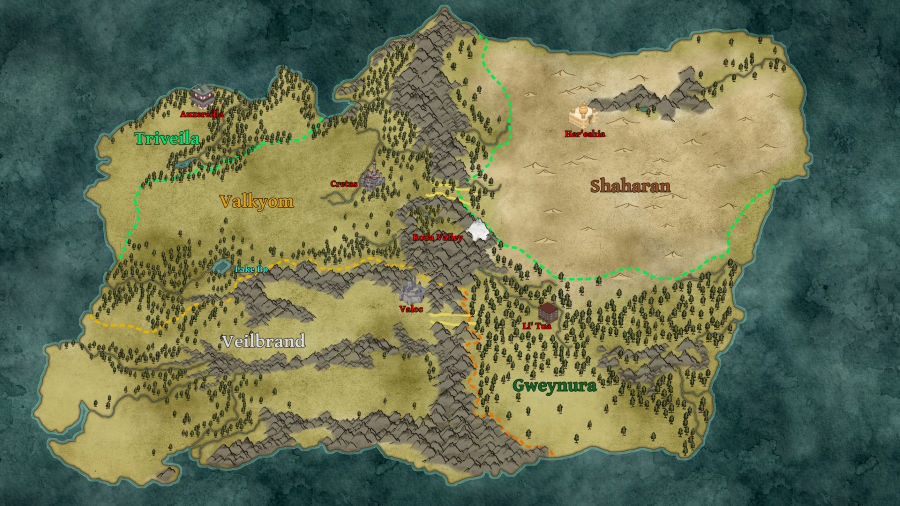
Because Valkyom is the central nation, I'm going to go into the most depth on them and give basic overviews of the other four nations. If any questions about the other four pop up I'll be happy to answer them directly. But, for now, this should be enough to make your characters and sculpt their backstories around the history of each one!
Capital City: Cretas
Valkyom is the central nation of this continent, both literally and figuratively. It lies up against the Western face of the Cre' Itian Central Mountain Range which splits the continent vertically in half making it, again both literally and figuratively, a central hub of trade, a central stage of international diplomacy, and a central hub of travel and tourism.
Culturally, you can think of Valkyom as the USA of this RP world in that it's a melting pot of dozens upon dozens of various cultural elements from all across the continent. The only difference is, unlike the USA today which is a product and child of various Western European and South American (mostly Mexican) cultural elements and linguistics, Valkyom is the true origin of the other four nations, as well as the mother of their respective cultures. Everything started here and expanded outward.
As such, Valkyom is affectionately referred to as "The Mother Nation."
In Valkyom, life is centered upon two central pillars:
1) Compassion and cooperation with one's neighbors and community
2) Citizen empowerment
From the Royal Family to even the homeless, compassion for one's neighbors and community run deep within the DNA of Valkyom's citizenry. In the slums, the homeless form tight-nit social groups who would live and die for one another. The commonwealth form community groups as well, and it's very common to see families from across town meet, have lunch together, go shopping together, take their children to school or to sports activities together, etc. Even in the nobility it's common to see genuinely friendly and non-business focused social groups form and enjoy life together.
The Royal Family has a deep love and respect for its citizens and openly views them, rightfully so, as the lifeblood of the nation's success and stability. As such they have pushed rather aggressively over the last few generations to empower their citizens by keeping taxes fair, strictly moderating and employing policies preventing landlords from charging more than the actual worth of a property to new families looking to buy their first homes, ensuring fair and competitive wages for even the most mundane and thankless jobs like street sweepers, trash collectors, etc so they too can earn an honest living without struggling to keep themselves and their families above the poverty line, and maintaining open communication with the homeless population so they don't feel abandoned and left out to dangle in the wind. They have also, over the last two generations especially, reduced the influence and power of the noble class to the point where they have as much influence on policy and public social existence as the average commoner. They're only "Nobles" now because of their financial wealth. But that wealth no longer serves or empowers them as it did generations ago.
This highly benevolent and citizens-first mindset has not gone over well with everyone. Particularly certain circles of the nobility who retain highly conservative views of concentration and centralization of wealth, stronger social divides and an emphasis on power appropriate for one's 'status,' etc. And there are some very quiet whispers and rumors that the royal family is being targeted not necessarily for forcible removal via assassination, but a social uprising that's been slowly gathering support amongst the older and more conservative families and estates throughout the nation.
..................................................
Another important note about Valkyom is that it has several unique policies compared to other nations.
1) Medical institutions (such as private and public clinics, apothecaries, etc) are considered "neutral ground" and physical conflict or military action of any kind is forbidden within them. There is also an emphasis on the protection of those in healing professions such as doctors, nurses, apothecaries, etc, as it's believed that their desire and willingness to protect and preserve the health of their communities makes them invaluable to the progress of the nation as a whole.
2) De-escalation before violence. All of Valkyom's Guards from the lowest ranked city patrol to the highest rank in the Royal Guards are thoroughly trained and pressed to de-escalate situations before any violent actions are taken. "Violence," as defined in their training, is any forcible physical altercation including grabbing someone's arm or lapel, or even a common shove. Putting your hands on someone is forbidden unless the situation has escalated beyond their ability to control with words and de-escalation language alone and it becomes necessary for either their safety, or the safety of those in the surrounding area, to physically detain the culprit(s). Even then, they emphasize non-violent restraint. They will not draw their weapons unless a weapon has been drawn on them first.
Additionally, those in leadership positions are screened thrice over before being given any positions as the trust between the citizens and their law enforcement officials must be preserved. Currently, the poster child for this effort is Captain Drake of the Royal Guards. He comes from a broken home and worked his ass off the right way to earn his place among the Royal Guards, and when walking the streets he acts more like another member of the commonwealth who happens to be wearing armor and a sword at his hip rather than a figure of authority. It's only when he has to adopt that authoritative persona that he does so. At all other times he's just a normal guy.
This emphasis on peaceful de-escalation, coupled with the likes of men like Captain Drake occupying positions of authority who are just regular guys who happen to be figures of authority, has fostered a strong bond of trust between the citizens and the law enforcement bodies nation wide. So much so that it's not uncommon for people, usually women and children, to give gifts to the Guards as they go about their patrols like handing them food, giving them a home-made article of clothing or a toy, etc.
And no, this is not a bait and switch. There is no corruption in the law enforcement of Valkyom. It's genuinely clean, well meaning, and only employs people of strong character who have been thoroughly vetted to their ranks.
..................................................
Valkyom has been shaped by social and political tragedy in both the ancient and recent past, but none worse than the Crimson Crusade.
Nearly two centuries ago Valkyom endured what became known the single greatest stain on its history. The monarchy of the time launched this crusade against its own people, primarily targeting dissenters and minorities who opposed the highly religious rule of the time. Tens of thousands of people died throughout this dark time. Ancient traditions were abolished and lost to time. Families were torn apart. Entire districts were burned to the ground. Etc.
This event has become a permanent black mark on Valkyom's very soul. And to this very day it remains a deeply rooted point of shame for the Royal Family.
This event, though it was nearly two centuries ago, is one of the primary reasons the current Royal Family holds the beliefs and values it does, and why it pushes in a completely different direction. They also openly reject the mindset and attitudes of the time which led to this tragedy, and have made no secret that they intend to ensure Valkyom never again must endure such senseless bloodshed within its borders. Let alone from the very figures who are supposed to serve as leaders. They strongly believe their role is to guide the citizenry, not actually "rule" it. And this flies completely in the face of traditional conservative "ruling class" mentality and ideology.
Another tragic event from the time of the previous Royal Family a generation ago was known as the Night of Blue Lanterns. During the night of the Festival of Fallen Light, Guards typically patrol along predetermined routes lit by lanterns similar to those released during the festival's events. This night, lanterns emitting blue light were hung throughout the routes which confused and misled the guards prompting slower responses to violent actions which were taken by a terrorist group. Dozens of people were killed due to the confusion caused by the blue lanterns, and the event forever stuck in Valkyom's memory as it pushed for tighter control over such event security, and the removal of reliance on physical objects to 'mark' the way in favor of training the Guards to memorize their patrol routes by walking them dozens of times prior to the festival taking place.
..................................................
Today, there are a number of special yearly events which are staples of Valkyom's culture and historical identity.
First is Virelamoré. The Virelai Tree is the national tree of Valkyom, and blooms in spring with beautiful violet flowers in a very similar fashion to the pink cherry blossom trees of Triveila. Celebrations with art, music, song, and dance abound during this festive time. But the main feature are the story scrolls which are hung from the branches by the commonwealth, wherein which they tell stories of what this last year has done to bring them joy and happiness, told in a very poetic styling.
The Festival of Fallen Light is another staple, wherein which floating paper lanterns are released into the river flowing through the capital city under the light of the last full moon in Autumn. Following the release of the lanterns, prayers are made for the dead paying honor and respect to the legacy they've left behind. This festival is one of Valkyom's most treasured events, for despite the pain death brings it is considered a time of healing and release of the emotional burdens and scars the passing of one's loved ones have left behind so that not but love, light, and happiness remain.
Finally, Healer's Day in mid summer. This holiday is observed to pay respect and honor to those who take up the healing professions nationwide. Healing institutions and individuals were often caught in political crossfire in generations past. And a well-known and respected clinic of old was destroyed and burned to the ground once it was discovered they were giving aid and relief to the poor and to the perceived "enemies" of a certain political faction which, thankfully, no longer exists. Following this tragedy, and after the current Royal Family came to power, they declared clinics and other medical establishments to be protected neutral territory where no military action or conflict may be taken, nor violence allowed to erupt at any time. On Healer's Day, it's common for the people to deliver gifts and stand outside the clinics of working doctors and healers of all kinds to sing and give praise and thanks for the work they do, and to remember and honor those who died in an effort to bring relief and health to all.
..................................................
Religion in Valkyom is monotheistic, centered on a benign Goddess known as Peur'tia. She is largely viewed by Her followers as a guiding light rather than a hands-on Goddess who manipulates or directs the lives of those who believe in Her. Additionally, She is neutral. Neither good, nor evil. She is viewed as fair and unbiased in Her guidance and leadership, and She doesn't demand payment or compensation for Her role in their lives. Even so, it's not uncommon for Her followers to place small offerings at Her shrines and statues as a sign of respect and hope that She will listen to and bless their prayers and wishes.
..................................................
Valkyom is run on a Monarchy. The Royal Family currently consists of the King and Queen, as well as the crown Prince and Princess, the former of whom is next in line for the throne. They have been in power now for 26 years, and are nearly ready to abdicate the throne to their son. The only thing preventing this is that he has yet to choose a bride to rule by his side as Queen. Once he finds a suitable bride and the marriage is arranged his parents are fully prepared to cede the throne to him.
This readiness to relinquish the throne to their son, despite his popularity among the commonwealth, is being treated with cautious optimism from most, and contempt by many of the more conservative noble families. The main reason for this is because not only is he the spitting image of his father, a handsome young man in his prime with flowing dirty blonde hair and strong golden-amber eyes, but he is a near mirror image of his parents politically. This means that when he takes the throne it's unlikely that much will change. And that's not exactly what the conservative noble houses want.
..................................................
Linguistically, Valkyom has several common sayings to observe and watch out for:
* "Voice first, blade last" - This is common among the guards and military forces as all of them are trained to be diplomatic unless violence becomes inevitable
* "The tree remembers" - This is a saying used by the commonwealth in reference to the Virelai Tree, and means to never forget the past or turn away from one's mistakes
* "Walk with gentle steps," or simply "Gentle steps" - This is a phrase warning to tread cautiously with whatever one is doing
* "Speak to be seen" - This is a common saying in the slums and is used mostly by those below the poverty line as a means to keep their spirits up and remind them that a louder voice will be heard before silent prayers
* "The river takes what we can't" - Used exclusively during the Festival of Fallen Light as the first phrase in whatever prayers you offer to the dead, and it's there to remind you that your loved ones aren't forgotten, their voices aren't lost, your grief is shared by all around you, and the story of the dead will travel with the light of the moon into eternity
* "Your hands tell your story" - This is a common saying among hardworking folks who do things with their hands, as it's believed the state of one's hands can often tell you how hard one works
* "A warm meal forgives a cold world" - This is a universally used saying whenever one offers hospitality to another. It's a reminder of the cultural focus on cooperation and helping, respecting, honoring, and loving one's neighbors and community.
Most powerful Clan: Her'eshia
Shaharan, located in the Northeast on the other side of the Central Mountain Range from Valkyom, is the most simplistic of the five nations as it has no central government, and no central religious institution. Also, if related to real-world locations, it's the North Africa/Middle East of this RP world.
Without a central government the nation is broken up among large clans, within which are multiple smaller clans, usually made up of between 3-10 families total, within which all have their own unique culture, historical archives, songs and dances and musical styles, etc.
Should you choose to create a character from this nation, they will come from a clan with a life all its own which, though I will give a few guide points to follow to ensure everything is in-line with the lore, will mostly be up to you to craft.
Here are some important details about how life in Shaharan works:
1) Clans are nomadic, or semi-nomadic, and typically carve out specific territories for themselves from amongst the vast rolling dunes, salt flats, rocky canyons, and windswept mesa's throughout the nation's landscape. Typically they create homes out of rock, mud, or teepee structures depending on the environmental hazards which exist. For example, they won't use teepees in the open dunes due to sandstorms and occasional high winds which may upend such structures.
2) Travel is typically a night-time endeavor due to the extreme heat of day time. And never alone. Only a fool travels alone in this harsh land.
3) Clans are divided into the following hierarchy from most authority to least authority: Clan Leader (typically an elder), War Leader(s), Spirit Keepers, Hunter/Warriors, Artisans and Traders, Children.
4) There are several unique beasts which stalk the landscape in Shaharan including massive feline creatures called, fittingly, Sand Cats. These beasts are slightly smaller than your average horse, but incredibly strong, agile, and well-adapted to the heat and harshness of the desert landscape. For more powerful (or sometimes more fool-hardy) clans, these beasts can be captured and tamed into beasts of burden. But make no mistake, they are not pets. These creatures could, at any time, turn on their humans and escape back into the wild if they so desired. And such has happened many times in the past. Thus, it's thought of more as a temporary alliance than a true 'taming.' Very, very few Sand Cats have ever chosen to remain with the Clan which tamed them for more than a few years. And only one in history has ever stayed for the duration of its natural life. This Sand Cat belonged to the Shesh'rahl Clan of the Northern Dunes region, and was named Ihk'real. A statue was created on a cliff overlooking the dunes the Clan calls home, and it still stands tall and proud to this day. Forever immortalized as a watchful guardian of its home and its people and has become a native legend.
5) Blood feuds are common both between and within families. Action, strength, and skill rule all in Shaharan. If you have the capability to overtake the position of another, no matter who it is, do it. This is most commonly seen between siblings or closely nit family groups due to their proximity both socially and structurally within the Clan. So, it's not uncommon for childhood bonds to be broken leading into adulthood.
6) Some core beliefs of basically every Clan include: Worth is proven through action; words are meaningless. Survival is sacred, but not at the cost of being dishonorable. A lie which preserves life is wisdom while one which betrays trust is death. The desert reveals truth by stripping away weakness. Wealth is temporary, reputation is eternal. Life is harsh, so kindness, when given, is priceless.
7) "Shaharan Mercy" states: If a defeated enemy can survive the desert to return home, they deserve to live. If they cannot, the desert has passed its final judgement.
8) Clothing in Shaharan is primarily layered linen and wrapped robes. Men and women both commonly wear turbans, veils, or shawls to protect their heads, hair, and faces from the sandy winds. They wear leather sandals or cloth bindings in place of boots or shoes. And colors tend to remain earthen with tan, rust-red/brown, and green with occasional colors like indigo blue used in rare instances, typically for Clan Leaders or other positions of importance.
9) Weaponry in Shaharan is usually curved sabers, spears, or hooked knives. Rare, but still used, are weighted ropes and throwing blades. There are no firearms, bows, or other projectile weapons in Shaharan as they believe such ranged weaponry are weak and used only by cowards who are too afraid to get up close and personal to earn their kill or dominance the right way.
10) Some common sayings in Shaharan include:
* "The desert kindles truth" (aka, hardship exposes character)
* "Water is life, but trust is the cup which carries it."
* "A lone traveler seeks death; a caravan seeks home."
* "The sun judges all."
* "May your shadow fall long." (a statement of blessing, may you survive to see many sunsets)
* "Heat hardens the heart unless cooled by kindness."
11) Shaharan believes the desert itself as a whole has a spirit, and that this spirit is an honest, unbiased judge of one's character. There are no "gods" or figures of authority or guidance. Just the spirit of their homeland. It's also believed that one's ancestors watch from the stars, and that if one listens carefully to the wind they can hear and feel the wisdom of those ancestors reaching out to guide them in times of hardship. This is why it's very common to see young warriors, both male and female, standing alone amongst the dunes at night after experiencing difficult times.
12) A few rituals akin to festivals, but far less festive in nature, include: Night of Still Winds, which takes place on the final night of Summer and is a time to honor one's ancestors. Water Offering, wherein which young hunters offer a small cup of water to the sands of the desert in hopes of receiving the desert spirit's blessing before their first ever solo hunt. Sand Burial, wherein which an enemy who fought and died honorably is partially buried at the juncture between the dunes and hard soil. Their upper body is left to the dunes while their lower body is buried beneath the soil. This symbolizes their return to Earth, and is a symbol of honoring one's opponent for the valor they displayed. Enemies who fight and die without honor are simply left wherever they fell.
13) Shaharan's people, by and large, view the other nations, particularly Valkyom, as "soft, but noble-hearted." And they will usually adopt as friendly a disposition as a hardened warrior culture can offer, but are still sharp tongued and don't mince words or sugar coat their opinions.
Capital City: Auxereilla
Triveila, located in the Northwest, is the Japan of this continent, right down to the architecture, manner of dress, naming conventions, etc.
Obviously, since it's heavily based on Japan there are going to be differences like not using the same terms they do for cultural elements like the Shinto Religion, Oni's or Kappa's for demons or spirits, etc. The way I've chosen to name these cultural elements will indeed be highly similar. For example, instead of Oni or Kappa, Triveila uses the terms Achi and Ōta for those same types of spirits/demons.
Triveila, just like Japan, prioritizes honor, respect, dignity, and valor as the four pillars of its cultural identity.
And regrettably, also just like Japan, women play a passive supporting role in all things rather than acting as figures of authority or power outside of very few circumstances. They are expected to be delicate, respectful, polite, and subservient to their male counterparts, and especially to their husbands. You will never see a woman who lives in Triveila acting tough or trying to fight against these norms because it's simply not done, and it's not a priority for them. Their way of life has always been more about finding happiness in family, particularly their children. Should a husband become abusive or neglectful a woman may petition the local lord for a separation and take custody of the children for their health and safety.
Triveila's landscape is largely comprised of rolling grasslands, marshes, expansive river networks, and fertile floodplains.
Many of Triveila's largest cities are port cities which serve as the center point of the continent's international shipping operations with other continents. This includes the capital city of Auxereilla.
The economy is focused on the bounty of the sea including fishing, abalone, pearls, bones, coral, etc.
The government is a Monarchy, currently presided over by the Queen who is without a King to rule beside her as her husband, the former King, was recently assassinated. The crowned Princess is next in line for the throne as the sole heir, and is currently searching for a suitable husband. Triveila has also put together a trade council comprised of guild representatives, each guild representing a function of life such as shipping, agriculture, textiles, fishing, pottery, merchants, etc. A Speaker or Chancellor usually mediates any disputes which arise during meetings and other functions.
Society in Triveila prioritizes stability, community prosperity, fairness, and openness to outsiders.
Central values of Triveilan life include: Balance, honesty, hospitality, pragmatism, adaptability, and taking joy in the simple things rather than chasing widespread fame, glory, or recognition.
Triveila lacks a centralized religion, and instead, similar to Shaharan's belief in a desert spirit, focuses on river-based folklore and spiritual belief. For example, they believe the waterways carry the world's memory. Rivers guide souls to their final resting place. Water spirits bless or curse depending on treatment. And a strong current represents ferocity of purpose.
A few known ceremonies from Triveila include: River Lantern Day, which is similar in form but distinct in function from Valkyom's Festival of Fallen Light. The difference is that the River Lantern Day is a night to release lanterns into the ocean as the tides recede for the purpose of guiding spirits who were lost at sea back home. The ocean is unpredictable and a cruel mistress, and though it's not common there are yearly instances where fisherman or overseas tradesmen never return from their voyages. Taken by the sea, and left to wander the waves eternal unless guided home by these lanterns.
Fashion focuses on breathable but warm fabrics like cotton, hemp, and linen. Bright, watery colors are common like teal, green turquoise, and white. Sleeves are kept short in the heat and worn long for sun protection and from the cold. Cloth belts and sashes are the norm over leather belts. And most jewelry is made of the bounty of the sea rather than precious metals or gems.
Some common sayings in Triveila include:
* "A deal is a promise carried downstream." (reputation travels far)
* "Calm waters don't mean safe waters." (appearances can be deceiving)
* "Drink deep, and speak true." (be honest in return for kindness)
* "Where the river bends, follow your fortune." (a statement encouraging adaptability)
* "A poor trade makes a poor friend." (fairness builds strong relationships)
The Triveilan military is heavily focused on adapting its water-focused lifestyle into its combat style. Polearms, spears, tridents, and even the use of nets are their primary means of combating enemies, as well as utilizing ambush tactics. Though rare, they will sometimes even use the waters of the deeper rivers to facilitate ambushes while using reeds to breath. They have a highly skilled navy and are the best sailors you'll find in Cre' Est.
Capital City: Valoc
Veilbrand, located in the Southwestern side of the continent, is a nation which vaguely resembles Eastern-European countries. Think industrial era Poland, Hungary, or Romania. This is especially true in the fact that Veilbrand has a fundamentally broken government and economy due to one man: Eagon To' Veilbrand.
Eagon rose to power 12 years ago by murdering the previous King and Queen and usurping the throne for himself. He assumed total power and authority by killing anyone and everyone who opposed him until only his loyal followers were left. He gave them positions of power and the stability of the nation completely collapsed in a matter of weeks.
The economy is all but non-existent and the concept of money now holds basically no meaning. Everyone must hunt or grow their own food because trade with other nations has been completely cut off by Eagon's forces at all major border crossings and checkpoints. Nothing comes in or leaves.
Eagon, and by extension all of his loyal followers and military forces, are highly abusive of the populace. Their patrols are greatly feared. Should you venture into the remnants of a town or village and observe them, the moment they see or hear a patrol coming they hide and pray they won't be found. Why? Because the patrols treat the elderly with scorn, women with lust, men with disdain and ridicule, and children with indifference. They would just as soon kick a child out of their way as they would pull a woman away from her family and have their way right there out in the open street for all to see.
Eagon's pathological cruelty borders on the fantastical. But he is no fantasy. He's very real. And so are his forces. They act of their own accord against the populace with impunity.
However, there is a glimmer of hope. A Revolution has begun. And a brave few have taken up arms and are fighting back. Sadly, this Revolution seems doomed from the start. They are precious few in number. Less than 1,000 in total. And they stand against an army of nearly 100,000 well-trained soldiers. Why? Because Eagon is a former general and prides himself on his own military prowess, and demands only the best from all of his soldiers. Any weakness in his military is snuffed out and replaced with the strongest candidate.
Still, the Revolution fights on under the Maiden of Revolution, an enigmatic and mysterious figure who some say doesn't actually exist. But her influence runs strong, and the courage she brings to the few forces fighting to free Veilbrand from Eagon's tyranny burns deep in their hearts.
Prior to Eagon's ascent to power, the monarchy was already empty and held by a powerless figurehead, and was effectively controlled by nobles. He was "King," but in title only which is why it was so easy for Eagon to slay him and his wife, the "Queen," and take over. The real power belonged to wealthy trade lords and corrupt bureaucrats and ministers. Crime was already abundant with highly organized syndicates, thieves and assassin guilds, and nefarious mercenary companies. Eagon took advantage of this unstable state to instill himself as the supreme leader and basically burn what little stability Veilbrand had to the ground.
The Revolution is hell-bent on ending his reign, fracturing the noble and bureaucratic systems, returning power to the people, and returning Veilbrand to the prosperous nation it was in centuries past.
People in Veilbrand today live in eternal poverty to the point where money basically doesn't even mean anything anymore. If you have a coin, just toss it in a wishing well. It's about as good in there as it is in your pocket.
The one thing which has remained strong is the concept of loyalty to one's community. People, both individually and in family groups, form tight communities which work together to scrape whatever they can from the dilapidated remains of the villages, towns, and cities they once proudly called home. Children grow up fast, and it's not uncommon to see and hear children as young as 7-10 years old acting more like adults than children from anywhere else in the world. Drinking culture was already huge, but is now even worse. And violence is a casual event which is viewed as inevitable, though it usually doesn't end in death. Just a good beating.
A few common sayings in modern Veilbrand include:
* "Trust doesn't fill your belly."
* "Take what you can, pay what you must."
* "The law is where the coin lands." (justice = bribery)
* "Hunger makes honest liars." (acknowledges moral compromise)
The people of Eagon don't trust people of power. And many don't even trust the Revolution or the Maiden of Revolution. They're just waiting to die. Be it quickly or slowly, they're waiting for their lives to end so the suffering ends. They're a broken, defeated people.
Should the Revolution succeed the future will be in the people's hands for the first time in generations. But even then they have a long way to go before they become a stable, prosperous nation once more.
Capital City: Li' Tua
Gweynuram, lying in the Southeast region of the continent, is arguably the only genuinely fantasy-based nation of this world.
It's much like a traditional fantasy Elf nation wherein which they live in complete harmony with nature, don't cut down trees for lumber if they don't have to and go out of their way to regrow those they do cut down, treat every animal with reverence even if they're a food source and give thanks to their nourishment, and in general exist in a nearly utopian society where everyone seems to be happy and living in harmony with one another and their environment.
Unlike Elves, however, they're not Legolas when it comes to archery. They do have fine archers. But no better than any other nation. And although Gweynura does have a central military they are not inherently a militant or combat-focused culture. Their warriors are few in number, but fierce in capability. And they would prefer to end any and all conflict with peaceful negotiations. If war ever does break out their warriors will use the very nature they call home as a weapon against their would-be conquerors, as they are never the aggressors in such times.
In fact, a central tenet of Gweynuran life is "The first victory is avoiding battle."
The government is more of a locally voted stewardship rather than a rulership, and leaders are often the most, or among the most popular individuals in the community. Their role is simply to serve as a central point of communication between the various districts and sectors of their villages and towns, and to help make decisions which guide the community as a whole forward while preserving the traditions and respect for nature which has granted them such happiness and peace.
Fashion in Gweynura emphasizes flowing, breathable fabrics in greens, off-whites, and soft gold hues. Floral and vine patterning are common. And sandals rather than shoes or boots are the norm.
Similarly, plates and bowls are all made of wood, as are utensils, and most forms of home decor as well are carved from the bark and bodies of fallen trees.
Some common sayings in Gweynura include:
* "The forest hears all, but judges none." (be honest, nature doesn't lie)
* "A steady hand grows steady hearts." (often said to artisans and healers)
* "Roots first, branches after." (build your foundation before seeking glory)
* "Drink the moment." (be present, enjoy peace, and savor beauty)
* "Where water flows, peace follows." (encourage de-escalation)
* "Follow the green path." (follow what nourishes you)
The people of Gweynura are easily identified by their calm, introspective, artistic, empathetic, and diplomatic ideals and attitudes.
Hopefully this is an okay place to put this info. I'm used to a dedicated "Extra OOC Pages" kind of forum for this sort of stuff. So, if it has to be moved please let me know and I'll move it.
But, for now, this is the lore and worldbuilding of my RP, the Chainmaster's Shadow!
I hope you enjoy!
--------------------
(Sorry it's small, but I didn't want to oversize it; I'll write the names of each capital city in each nation's respective section)
Because Valkyom is the central nation, I'm going to go into the most depth on them and give basic overviews of the other four nations. If any questions about the other four pop up I'll be happy to answer them directly. But, for now, this should be enough to make your characters and sculpt their backstories around the history of each one!
Valkyom
Capital City: Cretas
Valkyom is the central nation of this continent, both literally and figuratively. It lies up against the Western face of the Cre' Itian Central Mountain Range which splits the continent vertically in half making it, again both literally and figuratively, a central hub of trade, a central stage of international diplomacy, and a central hub of travel and tourism.
Culturally, you can think of Valkyom as the USA of this RP world in that it's a melting pot of dozens upon dozens of various cultural elements from all across the continent. The only difference is, unlike the USA today which is a product and child of various Western European and South American (mostly Mexican) cultural elements and linguistics, Valkyom is the true origin of the other four nations, as well as the mother of their respective cultures. Everything started here and expanded outward.
As such, Valkyom is affectionately referred to as "The Mother Nation."
In Valkyom, life is centered upon two central pillars:
1) Compassion and cooperation with one's neighbors and community
2) Citizen empowerment
From the Royal Family to even the homeless, compassion for one's neighbors and community run deep within the DNA of Valkyom's citizenry. In the slums, the homeless form tight-nit social groups who would live and die for one another. The commonwealth form community groups as well, and it's very common to see families from across town meet, have lunch together, go shopping together, take their children to school or to sports activities together, etc. Even in the nobility it's common to see genuinely friendly and non-business focused social groups form and enjoy life together.
The Royal Family has a deep love and respect for its citizens and openly views them, rightfully so, as the lifeblood of the nation's success and stability. As such they have pushed rather aggressively over the last few generations to empower their citizens by keeping taxes fair, strictly moderating and employing policies preventing landlords from charging more than the actual worth of a property to new families looking to buy their first homes, ensuring fair and competitive wages for even the most mundane and thankless jobs like street sweepers, trash collectors, etc so they too can earn an honest living without struggling to keep themselves and their families above the poverty line, and maintaining open communication with the homeless population so they don't feel abandoned and left out to dangle in the wind. They have also, over the last two generations especially, reduced the influence and power of the noble class to the point where they have as much influence on policy and public social existence as the average commoner. They're only "Nobles" now because of their financial wealth. But that wealth no longer serves or empowers them as it did generations ago.
This highly benevolent and citizens-first mindset has not gone over well with everyone. Particularly certain circles of the nobility who retain highly conservative views of concentration and centralization of wealth, stronger social divides and an emphasis on power appropriate for one's 'status,' etc. And there are some very quiet whispers and rumors that the royal family is being targeted not necessarily for forcible removal via assassination, but a social uprising that's been slowly gathering support amongst the older and more conservative families and estates throughout the nation.
..................................................
Another important note about Valkyom is that it has several unique policies compared to other nations.
1) Medical institutions (such as private and public clinics, apothecaries, etc) are considered "neutral ground" and physical conflict or military action of any kind is forbidden within them. There is also an emphasis on the protection of those in healing professions such as doctors, nurses, apothecaries, etc, as it's believed that their desire and willingness to protect and preserve the health of their communities makes them invaluable to the progress of the nation as a whole.
2) De-escalation before violence. All of Valkyom's Guards from the lowest ranked city patrol to the highest rank in the Royal Guards are thoroughly trained and pressed to de-escalate situations before any violent actions are taken. "Violence," as defined in their training, is any forcible physical altercation including grabbing someone's arm or lapel, or even a common shove. Putting your hands on someone is forbidden unless the situation has escalated beyond their ability to control with words and de-escalation language alone and it becomes necessary for either their safety, or the safety of those in the surrounding area, to physically detain the culprit(s). Even then, they emphasize non-violent restraint. They will not draw their weapons unless a weapon has been drawn on them first.
Additionally, those in leadership positions are screened thrice over before being given any positions as the trust between the citizens and their law enforcement officials must be preserved. Currently, the poster child for this effort is Captain Drake of the Royal Guards. He comes from a broken home and worked his ass off the right way to earn his place among the Royal Guards, and when walking the streets he acts more like another member of the commonwealth who happens to be wearing armor and a sword at his hip rather than a figure of authority. It's only when he has to adopt that authoritative persona that he does so. At all other times he's just a normal guy.
This emphasis on peaceful de-escalation, coupled with the likes of men like Captain Drake occupying positions of authority who are just regular guys who happen to be figures of authority, has fostered a strong bond of trust between the citizens and the law enforcement bodies nation wide. So much so that it's not uncommon for people, usually women and children, to give gifts to the Guards as they go about their patrols like handing them food, giving them a home-made article of clothing or a toy, etc.
And no, this is not a bait and switch. There is no corruption in the law enforcement of Valkyom. It's genuinely clean, well meaning, and only employs people of strong character who have been thoroughly vetted to their ranks.
..................................................
Valkyom has been shaped by social and political tragedy in both the ancient and recent past, but none worse than the Crimson Crusade.
Nearly two centuries ago Valkyom endured what became known the single greatest stain on its history. The monarchy of the time launched this crusade against its own people, primarily targeting dissenters and minorities who opposed the highly religious rule of the time. Tens of thousands of people died throughout this dark time. Ancient traditions were abolished and lost to time. Families were torn apart. Entire districts were burned to the ground. Etc.
This event has become a permanent black mark on Valkyom's very soul. And to this very day it remains a deeply rooted point of shame for the Royal Family.
This event, though it was nearly two centuries ago, is one of the primary reasons the current Royal Family holds the beliefs and values it does, and why it pushes in a completely different direction. They also openly reject the mindset and attitudes of the time which led to this tragedy, and have made no secret that they intend to ensure Valkyom never again must endure such senseless bloodshed within its borders. Let alone from the very figures who are supposed to serve as leaders. They strongly believe their role is to guide the citizenry, not actually "rule" it. And this flies completely in the face of traditional conservative "ruling class" mentality and ideology.
Another tragic event from the time of the previous Royal Family a generation ago was known as the Night of Blue Lanterns. During the night of the Festival of Fallen Light, Guards typically patrol along predetermined routes lit by lanterns similar to those released during the festival's events. This night, lanterns emitting blue light were hung throughout the routes which confused and misled the guards prompting slower responses to violent actions which were taken by a terrorist group. Dozens of people were killed due to the confusion caused by the blue lanterns, and the event forever stuck in Valkyom's memory as it pushed for tighter control over such event security, and the removal of reliance on physical objects to 'mark' the way in favor of training the Guards to memorize their patrol routes by walking them dozens of times prior to the festival taking place.
..................................................
Today, there are a number of special yearly events which are staples of Valkyom's culture and historical identity.
First is Virelamoré. The Virelai Tree is the national tree of Valkyom, and blooms in spring with beautiful violet flowers in a very similar fashion to the pink cherry blossom trees of Triveila. Celebrations with art, music, song, and dance abound during this festive time. But the main feature are the story scrolls which are hung from the branches by the commonwealth, wherein which they tell stories of what this last year has done to bring them joy and happiness, told in a very poetic styling.
The Festival of Fallen Light is another staple, wherein which floating paper lanterns are released into the river flowing through the capital city under the light of the last full moon in Autumn. Following the release of the lanterns, prayers are made for the dead paying honor and respect to the legacy they've left behind. This festival is one of Valkyom's most treasured events, for despite the pain death brings it is considered a time of healing and release of the emotional burdens and scars the passing of one's loved ones have left behind so that not but love, light, and happiness remain.
Finally, Healer's Day in mid summer. This holiday is observed to pay respect and honor to those who take up the healing professions nationwide. Healing institutions and individuals were often caught in political crossfire in generations past. And a well-known and respected clinic of old was destroyed and burned to the ground once it was discovered they were giving aid and relief to the poor and to the perceived "enemies" of a certain political faction which, thankfully, no longer exists. Following this tragedy, and after the current Royal Family came to power, they declared clinics and other medical establishments to be protected neutral territory where no military action or conflict may be taken, nor violence allowed to erupt at any time. On Healer's Day, it's common for the people to deliver gifts and stand outside the clinics of working doctors and healers of all kinds to sing and give praise and thanks for the work they do, and to remember and honor those who died in an effort to bring relief and health to all.
..................................................
Religion in Valkyom is monotheistic, centered on a benign Goddess known as Peur'tia. She is largely viewed by Her followers as a guiding light rather than a hands-on Goddess who manipulates or directs the lives of those who believe in Her. Additionally, She is neutral. Neither good, nor evil. She is viewed as fair and unbiased in Her guidance and leadership, and She doesn't demand payment or compensation for Her role in their lives. Even so, it's not uncommon for Her followers to place small offerings at Her shrines and statues as a sign of respect and hope that She will listen to and bless their prayers and wishes.
..................................................
Valkyom is run on a Monarchy. The Royal Family currently consists of the King and Queen, as well as the crown Prince and Princess, the former of whom is next in line for the throne. They have been in power now for 26 years, and are nearly ready to abdicate the throne to their son. The only thing preventing this is that he has yet to choose a bride to rule by his side as Queen. Once he finds a suitable bride and the marriage is arranged his parents are fully prepared to cede the throne to him.
This readiness to relinquish the throne to their son, despite his popularity among the commonwealth, is being treated with cautious optimism from most, and contempt by many of the more conservative noble families. The main reason for this is because not only is he the spitting image of his father, a handsome young man in his prime with flowing dirty blonde hair and strong golden-amber eyes, but he is a near mirror image of his parents politically. This means that when he takes the throne it's unlikely that much will change. And that's not exactly what the conservative noble houses want.
..................................................
Linguistically, Valkyom has several common sayings to observe and watch out for:
* "Voice first, blade last" - This is common among the guards and military forces as all of them are trained to be diplomatic unless violence becomes inevitable
* "The tree remembers" - This is a saying used by the commonwealth in reference to the Virelai Tree, and means to never forget the past or turn away from one's mistakes
* "Walk with gentle steps," or simply "Gentle steps" - This is a phrase warning to tread cautiously with whatever one is doing
* "Speak to be seen" - This is a common saying in the slums and is used mostly by those below the poverty line as a means to keep their spirits up and remind them that a louder voice will be heard before silent prayers
* "The river takes what we can't" - Used exclusively during the Festival of Fallen Light as the first phrase in whatever prayers you offer to the dead, and it's there to remind you that your loved ones aren't forgotten, their voices aren't lost, your grief is shared by all around you, and the story of the dead will travel with the light of the moon into eternity
* "Your hands tell your story" - This is a common saying among hardworking folks who do things with their hands, as it's believed the state of one's hands can often tell you how hard one works
* "A warm meal forgives a cold world" - This is a universally used saying whenever one offers hospitality to another. It's a reminder of the cultural focus on cooperation and helping, respecting, honoring, and loving one's neighbors and community.
Shaharan
Most powerful Clan: Her'eshia
Shaharan, located in the Northeast on the other side of the Central Mountain Range from Valkyom, is the most simplistic of the five nations as it has no central government, and no central religious institution. Also, if related to real-world locations, it's the North Africa/Middle East of this RP world.
Without a central government the nation is broken up among large clans, within which are multiple smaller clans, usually made up of between 3-10 families total, within which all have their own unique culture, historical archives, songs and dances and musical styles, etc.
Should you choose to create a character from this nation, they will come from a clan with a life all its own which, though I will give a few guide points to follow to ensure everything is in-line with the lore, will mostly be up to you to craft.
Here are some important details about how life in Shaharan works:
1) Clans are nomadic, or semi-nomadic, and typically carve out specific territories for themselves from amongst the vast rolling dunes, salt flats, rocky canyons, and windswept mesa's throughout the nation's landscape. Typically they create homes out of rock, mud, or teepee structures depending on the environmental hazards which exist. For example, they won't use teepees in the open dunes due to sandstorms and occasional high winds which may upend such structures.
2) Travel is typically a night-time endeavor due to the extreme heat of day time. And never alone. Only a fool travels alone in this harsh land.
3) Clans are divided into the following hierarchy from most authority to least authority: Clan Leader (typically an elder), War Leader(s), Spirit Keepers, Hunter/Warriors, Artisans and Traders, Children.
4) There are several unique beasts which stalk the landscape in Shaharan including massive feline creatures called, fittingly, Sand Cats. These beasts are slightly smaller than your average horse, but incredibly strong, agile, and well-adapted to the heat and harshness of the desert landscape. For more powerful (or sometimes more fool-hardy) clans, these beasts can be captured and tamed into beasts of burden. But make no mistake, they are not pets. These creatures could, at any time, turn on their humans and escape back into the wild if they so desired. And such has happened many times in the past. Thus, it's thought of more as a temporary alliance than a true 'taming.' Very, very few Sand Cats have ever chosen to remain with the Clan which tamed them for more than a few years. And only one in history has ever stayed for the duration of its natural life. This Sand Cat belonged to the Shesh'rahl Clan of the Northern Dunes region, and was named Ihk'real. A statue was created on a cliff overlooking the dunes the Clan calls home, and it still stands tall and proud to this day. Forever immortalized as a watchful guardian of its home and its people and has become a native legend.
5) Blood feuds are common both between and within families. Action, strength, and skill rule all in Shaharan. If you have the capability to overtake the position of another, no matter who it is, do it. This is most commonly seen between siblings or closely nit family groups due to their proximity both socially and structurally within the Clan. So, it's not uncommon for childhood bonds to be broken leading into adulthood.
6) Some core beliefs of basically every Clan include: Worth is proven through action; words are meaningless. Survival is sacred, but not at the cost of being dishonorable. A lie which preserves life is wisdom while one which betrays trust is death. The desert reveals truth by stripping away weakness. Wealth is temporary, reputation is eternal. Life is harsh, so kindness, when given, is priceless.
7) "Shaharan Mercy" states: If a defeated enemy can survive the desert to return home, they deserve to live. If they cannot, the desert has passed its final judgement.
8) Clothing in Shaharan is primarily layered linen and wrapped robes. Men and women both commonly wear turbans, veils, or shawls to protect their heads, hair, and faces from the sandy winds. They wear leather sandals or cloth bindings in place of boots or shoes. And colors tend to remain earthen with tan, rust-red/brown, and green with occasional colors like indigo blue used in rare instances, typically for Clan Leaders or other positions of importance.
9) Weaponry in Shaharan is usually curved sabers, spears, or hooked knives. Rare, but still used, are weighted ropes and throwing blades. There are no firearms, bows, or other projectile weapons in Shaharan as they believe such ranged weaponry are weak and used only by cowards who are too afraid to get up close and personal to earn their kill or dominance the right way.
10) Some common sayings in Shaharan include:
* "The desert kindles truth" (aka, hardship exposes character)
* "Water is life, but trust is the cup which carries it."
* "A lone traveler seeks death; a caravan seeks home."
* "The sun judges all."
* "May your shadow fall long." (a statement of blessing, may you survive to see many sunsets)
* "Heat hardens the heart unless cooled by kindness."
11) Shaharan believes the desert itself as a whole has a spirit, and that this spirit is an honest, unbiased judge of one's character. There are no "gods" or figures of authority or guidance. Just the spirit of their homeland. It's also believed that one's ancestors watch from the stars, and that if one listens carefully to the wind they can hear and feel the wisdom of those ancestors reaching out to guide them in times of hardship. This is why it's very common to see young warriors, both male and female, standing alone amongst the dunes at night after experiencing difficult times.
12) A few rituals akin to festivals, but far less festive in nature, include: Night of Still Winds, which takes place on the final night of Summer and is a time to honor one's ancestors. Water Offering, wherein which young hunters offer a small cup of water to the sands of the desert in hopes of receiving the desert spirit's blessing before their first ever solo hunt. Sand Burial, wherein which an enemy who fought and died honorably is partially buried at the juncture between the dunes and hard soil. Their upper body is left to the dunes while their lower body is buried beneath the soil. This symbolizes their return to Earth, and is a symbol of honoring one's opponent for the valor they displayed. Enemies who fight and die without honor are simply left wherever they fell.
13) Shaharan's people, by and large, view the other nations, particularly Valkyom, as "soft, but noble-hearted." And they will usually adopt as friendly a disposition as a hardened warrior culture can offer, but are still sharp tongued and don't mince words or sugar coat their opinions.
Triveila
Capital City: Auxereilla
Triveila, located in the Northwest, is the Japan of this continent, right down to the architecture, manner of dress, naming conventions, etc.
Obviously, since it's heavily based on Japan there are going to be differences like not using the same terms they do for cultural elements like the Shinto Religion, Oni's or Kappa's for demons or spirits, etc. The way I've chosen to name these cultural elements will indeed be highly similar. For example, instead of Oni or Kappa, Triveila uses the terms Achi and Ōta for those same types of spirits/demons.
Triveila, just like Japan, prioritizes honor, respect, dignity, and valor as the four pillars of its cultural identity.
And regrettably, also just like Japan, women play a passive supporting role in all things rather than acting as figures of authority or power outside of very few circumstances. They are expected to be delicate, respectful, polite, and subservient to their male counterparts, and especially to their husbands. You will never see a woman who lives in Triveila acting tough or trying to fight against these norms because it's simply not done, and it's not a priority for them. Their way of life has always been more about finding happiness in family, particularly their children. Should a husband become abusive or neglectful a woman may petition the local lord for a separation and take custody of the children for their health and safety.
Triveila's landscape is largely comprised of rolling grasslands, marshes, expansive river networks, and fertile floodplains.
Many of Triveila's largest cities are port cities which serve as the center point of the continent's international shipping operations with other continents. This includes the capital city of Auxereilla.
The economy is focused on the bounty of the sea including fishing, abalone, pearls, bones, coral, etc.
The government is a Monarchy, currently presided over by the Queen who is without a King to rule beside her as her husband, the former King, was recently assassinated. The crowned Princess is next in line for the throne as the sole heir, and is currently searching for a suitable husband. Triveila has also put together a trade council comprised of guild representatives, each guild representing a function of life such as shipping, agriculture, textiles, fishing, pottery, merchants, etc. A Speaker or Chancellor usually mediates any disputes which arise during meetings and other functions.
Society in Triveila prioritizes stability, community prosperity, fairness, and openness to outsiders.
Central values of Triveilan life include: Balance, honesty, hospitality, pragmatism, adaptability, and taking joy in the simple things rather than chasing widespread fame, glory, or recognition.
Triveila lacks a centralized religion, and instead, similar to Shaharan's belief in a desert spirit, focuses on river-based folklore and spiritual belief. For example, they believe the waterways carry the world's memory. Rivers guide souls to their final resting place. Water spirits bless or curse depending on treatment. And a strong current represents ferocity of purpose.
A few known ceremonies from Triveila include: River Lantern Day, which is similar in form but distinct in function from Valkyom's Festival of Fallen Light. The difference is that the River Lantern Day is a night to release lanterns into the ocean as the tides recede for the purpose of guiding spirits who were lost at sea back home. The ocean is unpredictable and a cruel mistress, and though it's not common there are yearly instances where fisherman or overseas tradesmen never return from their voyages. Taken by the sea, and left to wander the waves eternal unless guided home by these lanterns.
Fashion focuses on breathable but warm fabrics like cotton, hemp, and linen. Bright, watery colors are common like teal, green turquoise, and white. Sleeves are kept short in the heat and worn long for sun protection and from the cold. Cloth belts and sashes are the norm over leather belts. And most jewelry is made of the bounty of the sea rather than precious metals or gems.
Some common sayings in Triveila include:
* "A deal is a promise carried downstream." (reputation travels far)
* "Calm waters don't mean safe waters." (appearances can be deceiving)
* "Drink deep, and speak true." (be honest in return for kindness)
* "Where the river bends, follow your fortune." (a statement encouraging adaptability)
* "A poor trade makes a poor friend." (fairness builds strong relationships)
The Triveilan military is heavily focused on adapting its water-focused lifestyle into its combat style. Polearms, spears, tridents, and even the use of nets are their primary means of combating enemies, as well as utilizing ambush tactics. Though rare, they will sometimes even use the waters of the deeper rivers to facilitate ambushes while using reeds to breath. They have a highly skilled navy and are the best sailors you'll find in Cre' Est.
Veilbrand
Capital City: Valoc
Veilbrand, located in the Southwestern side of the continent, is a nation which vaguely resembles Eastern-European countries. Think industrial era Poland, Hungary, or Romania. This is especially true in the fact that Veilbrand has a fundamentally broken government and economy due to one man: Eagon To' Veilbrand.
Eagon rose to power 12 years ago by murdering the previous King and Queen and usurping the throne for himself. He assumed total power and authority by killing anyone and everyone who opposed him until only his loyal followers were left. He gave them positions of power and the stability of the nation completely collapsed in a matter of weeks.
The economy is all but non-existent and the concept of money now holds basically no meaning. Everyone must hunt or grow their own food because trade with other nations has been completely cut off by Eagon's forces at all major border crossings and checkpoints. Nothing comes in or leaves.
Eagon, and by extension all of his loyal followers and military forces, are highly abusive of the populace. Their patrols are greatly feared. Should you venture into the remnants of a town or village and observe them, the moment they see or hear a patrol coming they hide and pray they won't be found. Why? Because the patrols treat the elderly with scorn, women with lust, men with disdain and ridicule, and children with indifference. They would just as soon kick a child out of their way as they would pull a woman away from her family and have their way right there out in the open street for all to see.
Eagon's pathological cruelty borders on the fantastical. But he is no fantasy. He's very real. And so are his forces. They act of their own accord against the populace with impunity.
However, there is a glimmer of hope. A Revolution has begun. And a brave few have taken up arms and are fighting back. Sadly, this Revolution seems doomed from the start. They are precious few in number. Less than 1,000 in total. And they stand against an army of nearly 100,000 well-trained soldiers. Why? Because Eagon is a former general and prides himself on his own military prowess, and demands only the best from all of his soldiers. Any weakness in his military is snuffed out and replaced with the strongest candidate.
Still, the Revolution fights on under the Maiden of Revolution, an enigmatic and mysterious figure who some say doesn't actually exist. But her influence runs strong, and the courage she brings to the few forces fighting to free Veilbrand from Eagon's tyranny burns deep in their hearts.
Prior to Eagon's ascent to power, the monarchy was already empty and held by a powerless figurehead, and was effectively controlled by nobles. He was "King," but in title only which is why it was so easy for Eagon to slay him and his wife, the "Queen," and take over. The real power belonged to wealthy trade lords and corrupt bureaucrats and ministers. Crime was already abundant with highly organized syndicates, thieves and assassin guilds, and nefarious mercenary companies. Eagon took advantage of this unstable state to instill himself as the supreme leader and basically burn what little stability Veilbrand had to the ground.
The Revolution is hell-bent on ending his reign, fracturing the noble and bureaucratic systems, returning power to the people, and returning Veilbrand to the prosperous nation it was in centuries past.
People in Veilbrand today live in eternal poverty to the point where money basically doesn't even mean anything anymore. If you have a coin, just toss it in a wishing well. It's about as good in there as it is in your pocket.
The one thing which has remained strong is the concept of loyalty to one's community. People, both individually and in family groups, form tight communities which work together to scrape whatever they can from the dilapidated remains of the villages, towns, and cities they once proudly called home. Children grow up fast, and it's not uncommon to see and hear children as young as 7-10 years old acting more like adults than children from anywhere else in the world. Drinking culture was already huge, but is now even worse. And violence is a casual event which is viewed as inevitable, though it usually doesn't end in death. Just a good beating.
A few common sayings in modern Veilbrand include:
* "Trust doesn't fill your belly."
* "Take what you can, pay what you must."
* "The law is where the coin lands." (justice = bribery)
* "Hunger makes honest liars." (acknowledges moral compromise)
The people of Eagon don't trust people of power. And many don't even trust the Revolution or the Maiden of Revolution. They're just waiting to die. Be it quickly or slowly, they're waiting for their lives to end so the suffering ends. They're a broken, defeated people.
Should the Revolution succeed the future will be in the people's hands for the first time in generations. But even then they have a long way to go before they become a stable, prosperous nation once more.
Gweynura
Capital City: Li' Tua
Gweynuram, lying in the Southeast region of the continent, is arguably the only genuinely fantasy-based nation of this world.
It's much like a traditional fantasy Elf nation wherein which they live in complete harmony with nature, don't cut down trees for lumber if they don't have to and go out of their way to regrow those they do cut down, treat every animal with reverence even if they're a food source and give thanks to their nourishment, and in general exist in a nearly utopian society where everyone seems to be happy and living in harmony with one another and their environment.
Unlike Elves, however, they're not Legolas when it comes to archery. They do have fine archers. But no better than any other nation. And although Gweynura does have a central military they are not inherently a militant or combat-focused culture. Their warriors are few in number, but fierce in capability. And they would prefer to end any and all conflict with peaceful negotiations. If war ever does break out their warriors will use the very nature they call home as a weapon against their would-be conquerors, as they are never the aggressors in such times.
In fact, a central tenet of Gweynuran life is "The first victory is avoiding battle."
The government is more of a locally voted stewardship rather than a rulership, and leaders are often the most, or among the most popular individuals in the community. Their role is simply to serve as a central point of communication between the various districts and sectors of their villages and towns, and to help make decisions which guide the community as a whole forward while preserving the traditions and respect for nature which has granted them such happiness and peace.
Fashion in Gweynura emphasizes flowing, breathable fabrics in greens, off-whites, and soft gold hues. Floral and vine patterning are common. And sandals rather than shoes or boots are the norm.
Similarly, plates and bowls are all made of wood, as are utensils, and most forms of home decor as well are carved from the bark and bodies of fallen trees.
Some common sayings in Gweynura include:
* "The forest hears all, but judges none." (be honest, nature doesn't lie)
* "A steady hand grows steady hearts." (often said to artisans and healers)
* "Roots first, branches after." (build your foundation before seeking glory)
* "Drink the moment." (be present, enjoy peace, and savor beauty)
* "Where water flows, peace follows." (encourage de-escalation)
* "Follow the green path." (follow what nourishes you)
The people of Gweynura are easily identified by their calm, introspective, artistic, empathetic, and diplomatic ideals and attitudes.
2x Like
