 Member
 Only difference between this map and present is now Greece has eastern Anatolia and Constantinople is independent, as far as I see.
Oh and according to every other map, Latvia is independent.
Only difference between this map and present is now Greece has eastern Anatolia and Constantinople is independent, as far as I see.
Oh and according to every other map, Latvia is independent.
- Last Seen: 5 yrs ago
- Joined: 12 yrs ago
- Posts: 793 (0.18 / day)
- VMs: 0
-
Username history
- Meiyuuhi 8 yrs ago
- ███████ 12 yrs ago
Status
Recent Statuses
6 yrs ago
Current
The Imperium rises.
1
like
8 yrs ago
Here we go again.
11 yrs ago
Is there a cure for wallowing in nostalgia?
11 yrs ago
Still can't decide whether I like Brazil or Russia more.
Bio
User has no bio, yet
Most Recent Posts
Only difference between this map and present is now Greece has eastern Anatolia and Constantinople is independent, as far as I see.
Oh and according to every other map, Latvia is independent.Hm...what about a pan-American movement in the US, Canada, and Mexico, instead of the US alone? That would increase the number of natives fighting for independence tenfold. Not only that, but it would provide some relief on the US for a while as the fighting becomes concentrated in Canada and Mexico (though the war would inevitably reach Cascadian territory and the Western US). As for the Balkans, my mistake. I didn't know Serbia had taken control of those countries. Still, a union of some sort does not seem out of the question. Also, wasn't Croatia annexed by Austria?I'd say not, considering Prussia annexed Austria. It's fairly clear on the OP maps, I just checked.
Balkan league against Serbia, anyone?Edit: I honestly think you guys could form up as a sort of collaborative association like the SAC, potentially more integrated and centralized, and just do your own thing but you could also operate in joint Balkan League operations.The problem with this is Serbia is basically a Fascist state that wants to take over Bosnia, Croatia, and Bulgaria cause South Slav Unity. I am not so sure the other balkan states would want to cooperate with Serbia for those reasons.
Edit: I honestly think you guys could form up as a sort of collaborative association like the SAC, potentially more integrated and centralized, and just do your own thing but you could also operate in joint Balkan League operations.
Fair enough. Since I heard rumors of a wiki, I managed to find it and read a fair bit of it. Don't worry, I steered clear of the 'non-canon' pages. I also added a page myself to give people curious about my last post a bit more information.It's only non-canon because Aaron has little confidence in Brazil's position as a great power *grumble grumble* We may be poor and mildly undeveloped, but goddamn it we can forge alliances halfway around the world! Mind you, there is already an Italy page but I think it's referred to a republic. I dunno if you can change the name or delete it or whatever. Revan's Native American concept is.. interesting to say the least.
Just don't be a Prospo and drop in once every thousand years to make a small post, and I'm sure you will be good.
I daresay I speak for most of the roleplay when I say that a decent rhythm of posting is more valuable than quantity of text. *cough*hugs*cough* Though I do intend for my next post to be much larger, and to start multiple new story arcs.
República Federativa do Brasil
(The Federative Republic of Brazil)
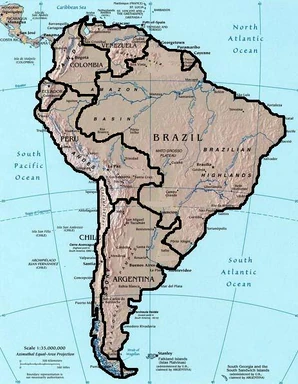
 Map of Brazil and the Surrounding Continent:
 Vice President, Former Leader of the Liberal Party, 1976-1980: Jonathan Feliz
Senior General do Exercito of the Brazilian Army: Antonio Buendia
Leader of the Liberal Party: Senator Catarina Bela
Minister of Agriculture: Armando Monteiro
Minister of Defense: Casimiro Silva
Minister of Development and Trade: Estevao Madeira
Minister of Education: Calista Torres
Minister of Finance: Eduardo Victore
Minister of Foreign Relations: Adelina Moreno
Minister of Justice: Benjamim Franco
Minister of Science: Joao Esteves
Minister of Labor: Marcelo Neri
Head Diplomat of the American Embassy: Luis Geraldo
Vice President, Former Leader of the Liberal Party, 1976-1980: Jonathan Feliz
Senior General do Exercito of the Brazilian Army: Antonio Buendia
Leader of the Liberal Party: Senator Catarina Bela
Minister of Agriculture: Armando Monteiro
Minister of Defense: Casimiro Silva
Minister of Development and Trade: Estevao Madeira
Minister of Education: Calista Torres
Minister of Finance: Eduardo Victore
Minister of Foreign Relations: Adelina Moreno
Minister of Justice: Benjamim Franco
Minister of Science: Joao Esteves
Minister of Labor: Marcelo Neri
Head Diplomat of the American Embassy: Luis Geraldo
Map of Brazil and the Surrounding Continent:
History of Brazil:
Brazil, for a long time prior to 1914, had been long rocked by civil wars and rebellions, rapidly switching governments. However, in 1921, a military coup finally solidified Brazil's government. Under more organized control at last, the people were more oppressed, however, their economy also boomed, based off of a large agricultural and lumber industry, which eventually boosted them into more advanced markets such as manufacturing. This sudden rise in power inflated the military council's bureaucracy. As time went on, the military gradually lost control to a group of corporations designated to run the state businesses, but were actually more independent.
In 1925, the military council fought the corporations and their liberal revolt, and the corporations won. They intended to establish complete plutocratic control over the government. However, due to massive public outcry, the corporations separated and a civilian democratic government was formed. Capitalism- and democracy- boomed. Long a trading partner of the US, the Brazilian economy reeled from the major stock market crash of 1929. As a result, it turned its exports to more neighboring countries such as Argentina and Chile, gradually strengthening its relations among its Latin American peers.
During this time, the government had accumulated massive debt to its own people as well as foreign sources of capital, and when another military coup was attempted and the new government tried to default on its debt, there was a massive backlash which returned the government to civilian control.
Into the 1930s, with the growth of the economy and the middle class, corporate power grew, making sure that they would not be easily regulated, and forming trust-like monopolies in some cases. The following decades were mostly peaceful, as Brazil along with most of the South American countries became more isolated from the rest of the world and their conflicts.
Brazil's strengthening of ties with other South American countries lead it to establish Spanish as a second official language. Seeing the rise of communism, the major corporations tried to exert more control over the civilian government. Massive protests erupted over corruption and corporate control, and the corporations backed down. The civilian government gained further control and split many of the monopoly-like corporations as a result of its new-found power. In 1970, there was a major rebellion by those who opposed the closer ties with the rest of Latin America, and that rebellion was eventually stamped out, although there was some significant damage. During this time, however, Brazil paid off many of the debts it had incurred in the earlier part of the century, placing it back on strong economic footing.
Under Sofia Veracruz's presidency from 1968 to 1976, the influence of corporations and economic magnates over the civilian government was finally eradicated. Brazil adopted a much more left-wing economic model, using the profits from the economic growth achieved in the earlier part of the century to invest further without the need for loans. Adriano Claro's presidency further progressed this policy, placing many core industries under government control. Brazil's military forces were rapidly inflated in response to the massive growth of the Communist bloc, with weapons and equipment purchased mostly from Poland and a resurgent Britain. Scientific research has also benefited as a result, with investment in rocket technology beginning. Deforestation of the Amazon rainforest is definitely a problem, even though it hasn't yet been seriously considered. Brazil's economy is still rapidly increasing in size and is promoted by developmental policies exerted by the current government, and the population has boomed as well in response.
Brazil participated in limited diplomatic efforts during the late 1970s, fostering ties with the rising Eurasian powers of Ethiopia, Armenia, and the Slavic Union. In particular, trade ties with the Slavic Union have allowed Brazil to modernize its military to some extent to be able to deal with rising threats in both the East and West. Brazil feels a substantial kinship with Ethiopia and Armenia, and as such is committed to helping them and ensuring a positive relationship.
Characters:
President, 1976-1980: Adriano Claro
 Vice President, Former Leader of the Liberal Party, 1976-1980: Jonathan Feliz
Senior General do Exercito of the Brazilian Army: Antonio Buendia
Leader of the Liberal Party: Senator Catarina Bela
Minister of Agriculture: Armando Monteiro
Minister of Defense: Casimiro Silva
Minister of Development and Trade: Estevao Madeira
Minister of Education: Calista Torres
Minister of Finance: Eduardo Victore
Minister of Foreign Relations: Adelina Moreno
Minister of Justice: Benjamim Franco
Minister of Science: Joao Esteves
Minister of Labor: Marcelo Neri
Head Diplomat of the American Embassy: Luis Geraldo
Vice President, Former Leader of the Liberal Party, 1976-1980: Jonathan Feliz
Senior General do Exercito of the Brazilian Army: Antonio Buendia
Leader of the Liberal Party: Senator Catarina Bela
Minister of Agriculture: Armando Monteiro
Minister of Defense: Casimiro Silva
Minister of Development and Trade: Estevao Madeira
Minister of Education: Calista Torres
Minister of Finance: Eduardo Victore
Minister of Foreign Relations: Adelina Moreno
Minister of Justice: Benjamim Franco
Minister of Science: Joao Esteves
Minister of Labor: Marcelo Neri
Head Diplomat of the American Embassy: Luis GeraldoOkay, so I fixed the stuff on the wiki up for Brazil to destroy all the noncanonical things.
Then I saw there was a new one posted on page 45.
So are we for sure using that one and scrapping the old one? If so I'll just transfer. It seems like people are still making edits to the old one.
Also, that's good, I have about two months until election day.
Brasilia, Brazil:
"Senhor President, Senator Catarina is here."
"Ah good, send her in." replied Adriano Claro, president of the Federative Republic of Brazil. He had arranged this meeting to discuss matters of policy with the senator, as he was certain that his majority in the Senate would not last and wanted to be on speaking terms with the senior Liberal Party leader before the election in August.
"Mrs. Belo, how wonderful to have you here today," Claro spoke in a friendly voice. "Would you like a cup of coffee?"
"I'm quite well without it, thank you, Senhor President." replied Senator Bela, a striking woman of thirty-eight. She was a rising star in the Liberal Party who had captured the spirit of Brazil's older residents and youth alike, eager for a change from the ever-left leaning People's Party and a new alignment in the world, and despite her young age in comparison to many of the Senators, she had a commanding knowledge of policy and a talent for speaking which put many of her fellow politicians to shame. There was some talk about her becoming the first female president. "Am I here for you to congratulate me on my stunning electoral victory?" she asked, laughing with a twinkle in her eye.
President Claro chuckled. "I'm not quite ready to concede to you yet, Senhora." "On the contrary, I expect we shall have to forge a coalition, with your party expected to carry the Senate by a fairly large margin. If we can't nail down a policy direction, I expect General Antonio will have both our heads." The President was joking, but only halfway.
"Surely that is the truth," replied Senator Catarina, shaking her head. "The army has accumulated far too much influence. We need to ensure that they remain submissive to our authority, or we shall suffer as this country, and many others on this continent, did during the thirties and forties." "But that is not the subject of this meeting, is it?"
Claro shook his head. "Spain," he said, the one word carrying all the meaning necessary to deliver his message.
"Imperialists." Bela pursed her lips at the subject. "Do they know no bounds? Must the entire world unite to contain them? And the Communists ask us to seek China to solve all of our problems. Amen I ask you, where are the Chinese now when their so-called allies are in need?"
"We must do something." spoke Claro, with a firm conviction in his voice. "But what?"
"It's clear to me that the Brazilian public would not stand behind another absurd foreign policy venture. You tried that in 1976, and it certainly did not fly." Bela sat thoughtfully for a moment. "We ought to take a page from Spain's own book. There are reports that men enthusiastic for the Spanish cause have joined an international battalion to fight in Africa. Surely we can promote the same?"
"Of course." Adriano leaned forward. "Many of the generals tell me that there are soldiers anxious to help the Ethiopian cause, but intervening directly would be disastrous." "If we outfit them with spare equipment and give them humanitarian aid to deliver, we can contribute in a small but meaningful manner to the resistance against Spain."
"All while showing them that the world is displeased with their actions." replied Senator Bela.
"That is an excellent idea which I shall anxiously put into practice. I thank you for it. Now, for the other matter which I wanted to discuss."
Catarina Bela nodded. "Economics." "There is little more divisive in all South America."
"Implementing the Liberal Party's plan of reform, returning all the state-owned industry to private control, would be nothing less than disastrous. You know this." Claro stared Senator Bela down while he said this.
She returned his expression evenly, with the solemnity of an expert poker player. "Perhaps. But you know full well the driving reason for my party's rise is the high taxes you have placed upon our people. Surely the idea of socialism is to improve the welfare of all people? How can you do this by crushing them?"
Claro's frown deepened. "A better tomorrow is worth the effort of today." His expression then lightened slightly, in an attempt to preserve the conversation's civility. "But I see your point. Would your party be amenable to some compromise on taxes in exchange for retaining state control of the upper echelons of industry?"
"I can see if that would be acceptable." Bela smiled, knowing full well that she had forced a concession without even winning an election. She then rose from her seat. "This has been a fine and productive conversation, Senhor President."
"Indeed it has," replied Claro. "I hope for further constructive dialogue in the future."
"As do I," replied Bela, before she strode out of the room.
Asuncion, Brazil:
"So tell me, Major, what have you been seeing in terms of the movement of forces on their side of the border?" General Antonio Buendia, the highest-ranking general in the Brazilian Armed Forces, asked the question dully as if he already knew the answer.
"Sir, the Argentinians have been ramping up their troop movement. It clearly isn't preparation for invasion, but it is highly aggressive and likely intended to provoke us into action. Reconnaissance planes have confirmed this."
Tensions had been rising between the Brazilians and Spanish-leaning Argentinians for the last two years. Few people suspected an actual invasion, that would be foolhardy considering Brazil had twice the forces, but any aggressive act in return would be a major hit to the Brazilian image, what with all the President's talk about eradicating imperialism.
General Antonio bristled with anger. "We must find grounds to give these Argentinians what is coming to them. Mark my words, that will be my advice to the next administration."
Sao Paulo, Brazil, Later that Week:
"My fellow Brazilians and South Americans," began President Claro as he stood before the microphone of the press conference room in Sao Paulo.
"Over the course of this century, we have seen many blatant examples of imperialism. The Great War which so rocked this world was driven by it, as the rival powers of Europe contested for influence over the rest of the world as if it was their own personal battleground. Nations have been annexed, even exterminated, all in the name of empire. But in all my life thus far, I have seen no such example as flagrant a violation of the international order as the unprovoked attack which now is taking place against the Ethiopian state by the so-called Second Spanish 'Republic'."
"Prime Minister Sotelo has continued his nation's violent colonialist legacy by trying to eradicate one of the few remaining bastions of hope for the great African people. And as such, the Federative Republic of Brazil categorically condemns the actions of the Spanish Republic, and applauds the new president of the United States for his words on the matter. Let this agreement show that the Americas, North and South, are united against this aggressive move."
"I have been asked many times by my fellow citizens and Latin American brothers what can be done to defeat this enemy. While Brazil lacks the strength to bring its forces to bear against such a European threat, already I am told that the first international brigades in support of our African comrades are being formed, with the intent to demonstrate the Brazilian people's support of the Ethiopian plight. I applaud the initiative of the great people of Brazil and of all South America in this action, and wish them the best of luck."
"Finally, I wish to reach out to the people of Ethiopia and express the greatest sympathy. I have already sent a bill before the Chamber of Deputies which would initiate a small but meaningful transfer of humanitarian aid. Every empire will fall in its day, and so too will the Empire of the Spanish vanish from the face of this earth."
© 2007-2026