 Member

 Scrawl Banditta
 Alisdragon911
 Double Capybara
Orr'gavol: The Hammersworn
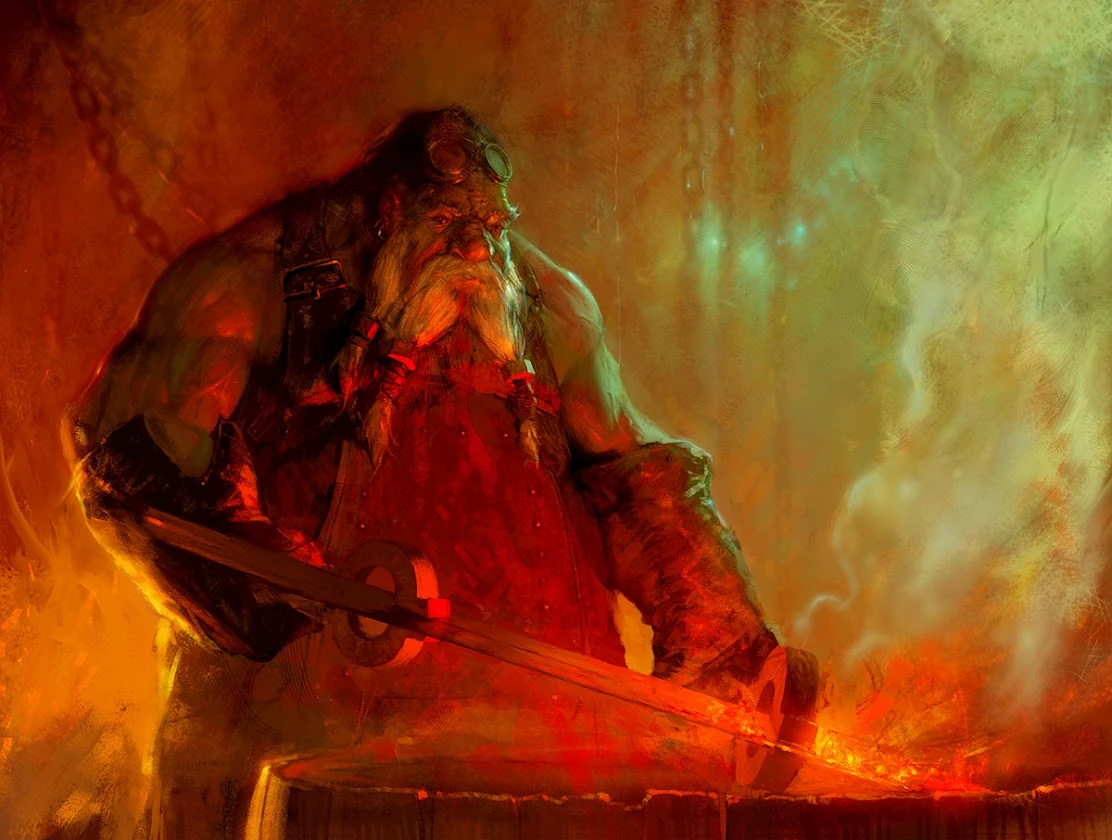
"The souls of the Hammersworn are like the fires of industry - everburning, never fading."
Nation/Clan/Kingdom/Tribe Name: Orr’gavol: The Hammersworn.
Represented Color: Orange
Race: Dwarves
Breed: Ironbeard
Capital: Gol’kharumm
Ruler: Foreman Osman Slag
Type of Government:
Worker Council. The nation is divided among ten crafters’ guilds, which each specialises within a single region of metalcraft, called the Unions. Each union has one representatives on the Worker Council, which is overseen by an elected foreman, the current one being Osman Slag of the Union of Steel. The foreman themself rules for a period of ten years, and holds executive power on the council - while the Union representatives have the ability to check the foreman should they disagree. However, this form of checking power is rarely exercises due the dwarves' natural value of respect for authority.
Religion:
While the nation as a whole does not hold a standardised religious belief, several of the unions hold on to ancient traditions, many of which feature gods and spirits. The faith of the Union of Bronze, for example, constructs a world image based on balance between two elements, whether it be copper and tin, wealth or poverty, or life and death - leading many of the other unions to critique them for being indifferent to the world at large. The Union of Gold worships all that glitters, so to speak, channelling their faith into adorning the armours and weapons created by the other unions with decorations that rival even the work of the gods - all to one day win the favour of the very gods they challenge.
The many religions within the Hammersworn have on numerous occasions spawned conflict among the Unions; however, due to a fear of rebellion, the council is reluctant to forbid the practices. This has created a generation-long divide on the council between the traditionalists and the “world-eyes”, so called for their denial of anything they cannot empirically observe and their stark hatred for anything abstract.
Geographical Location:
The Hammersworn have long lived at the foot of the Golumnar, “the Ancestor Mountains”. As the centuries passed and many conflicts, but internal and external, took their toll on the earlier civilisations, the Hammersworn were forced further down towards the lake of Darr and the Darr river. The event known as the Calamity, which ended the period of great prosperity after the Reunification, lead to a colossal population collapse and the loss of almost all infrastructure. The capital of Gol’kharumm, now a mere shadow of its former self, carves a fading black scar of soot and ruins from the foot of the southern Golumnar, through the Ancestor Woods, and into the Darr river. The dwarves moved further south, to the edge of the Ancestor Woods. They founded the Hovel, a temporary holdout until spring comes once more.
History:
“To think that such a system of compromise would arise from a people so stubborn is truly a truth we all accept too lightly - a day did not pass that our forebears did not plot each others’ deaths. Now, we are united.”
Calendarmaster Yosof Rust, Union of Glass.
In the beginning, there was the Golumnar, the Ancestor Mountains. Taller than any other, they stretched into the clouds and seemed almost like great stone beams that grounded the heavens to the earth. While the calendarmasters and several of the unions disagree today on how the Hammersworn first came to be, they agree that one day, a tribe of dwarves settled by the foot of the Golumnar, claiming a small patch of land in the river valley of Darr beneath the mountain. These dwarves created a culture of mountain worship, believing that the very gods of this world lived among the peaks of the mountains. This faith soon led to an event that would shape the dwarves’ culture for centuries to come.
At the time, they were known as the Gol’ungyr, the children of the mountain, and the philosophy of the time was that their very purpose in life was to reunite with their forebears at the highest peak of the Golumnar, and their daily routine revolved around mining and carving in the mountain to build the Umnastarr, the ancestor stair, a pathway up into the world of the gods. Under the guidance of the then-ruling monarch, who has later been referred to as King Holek the Mislead, the children of the mountain dug and built an elaborate system of roads, stairs, ramps and tunnels up and through the treacherous mountains, all to reach the pinnacle.
The project was, however, never completed. Fifty years after the king had ordered the project to start, a winter unmatched in cold and storms ravaged the river valley of Darr. The crops were devastated, and the animals that didn’t freeze to death were soon slaughtered and eaten by the starving dwarves. In the chaos, an insurrection against king Holek resulted in a thousand of deaths, roughly half the population at the time, as well as the execution of the king. The following monarch, Popomel, declared the Umnastarr project an unholy sacrilege against Golumnar, and that the winter was a warning to all who dared climb too close to heaven. Any attempt to surmount Golumnar was declared heretical and punishable by death, and the children of the mountain remained in the river valley of Darr, attempting with great difficulty to repair their decimated civilisation.
Popomel’s line did not rule for long, either. The dwarves were stagnating, for without a greater purpose in life other than to survive, they grew agitated and restless. Fights and large brawls grew more and more common, and merely a decade after Popomel’s grandson, Popomel the Second, has been crowned king, a rebellion once again raged through the nation. The king and his family were slaughtered and replaced by an unstable dictatorship ruled by ever-changing strongmen. The kingdom soon split into two, then four, then finally ten. Each faction migrated throughout the river valley of Darr, settling in the many ridges and caves at the foot of Golumnar and the forests around the Darr river. From here, some factions found great mineral wealth in the mountains - they began working the metals and minerals into tools, armour and weaponry. These factions soon became prosperous crafters’ enclaves, forming great industrial towns. Other factions discovered the minerals and gems of the earth and in the waters of the Darr river, and began to shape these into intricate jewelry and tools of research and science, forming hubs of alchemy and craftsmanship. To make room for the growing towns, the dwarves levelled many acres of forest, which left them with heaps of wood. This was soon used to dabble in ship crafting, and soon growing settlements of trade formed along the Darr. The relationship between the river dwarves and the mountain dwarves remained sour for hundreds of years, sometimes escalating into skirmishes in the forests and acts of sabotage against infrastucture. However, this also applied to the river and mountain dwarves among themselves.
This age of division, yet prosperity, ended when yet another gruesome winter surged through the river valley. The dwarves who held up inside the warm forge-towns, half of which were often built partly inside the mountains, survived the winter without sustaining any losses to their populations. The river dwellers, however, were nearly annihilated by the storms. The Darr froze and made trading for food impossible; the woods were nearly chopped to the last tree to feed the dying embers in the dwarven hearths. It was at this point that the river dwarves, in their desperation, returned to the mountains to seek refuge with their long antagonised brethren. Among the five mountain cities, none would accept river dwarves into their homes.
Desperate, the river dwarves banded together and laid a suicidal siege to the smallest of the forge-cities, Gol’kharumm. The mountain dwarves, drunk with hubris and arrogance, decided not to fight back against the attack, nor to post sentries at night, stating that to waste arrows on their brethren would be like stabbing a butchered boar. The river dwarves used this to their advantage and used their knowledge of alchemy to craft explosives that blew the gates of the city open. Once inside, they overthrew the local strongman and quickly assumed leadership of the city. The other forge-cities quickly heard the news and mobilised against the river dwarves.
When the entirety of what had once been the Children of the Mountain were locked in a battle against itself, the winter, as if by the gods’ command, turned to the warmest, lushest spring ever seen in the valley of Darr in but a few days. The dwarves, awestruck by this seemingly divine gift, laid down their arms and came together in the centre of Gol’kharumm to discuss what the future of their nation should be - should they split up and live as they now had for centuries? Should they band together and take over the whole valley? Should they migrate further south in search of new lands to settle?
A council with representatives from every city of the old nation formed to oversee the restoration of what the winter and the war had taken away. This council quickly became more organised and efficient as time passed, taking more and more power away from each individual city. After merely five years, the council had gathered so much power than it effectively become a new centralised government. In order to make itself even more effective, once every ten years, a member of the council would be elected to rule as a leader and make the executive decisions in the name of every major city. As the cities grew ever closer, the borders faded, and the citizens of these former cities started to refer to their kind as a Union, as they were only united in culture and specialisation. As there had once been ten cities, so spawned ten Unions. These were named according to a major mineral component of their crafts. As the leader then became the head of many workers, and was supposed to be a leader among equals, and not a king, their title was changed to foreman.
Everything seemed to indicate that the now dubbed Hammersworn were developing into a nation to rival the continent's greatest. Tools, weapons and armour flowed from the forges and anvils like water through a lake, and the calendarmasters and alchemists mapped the stars and the properties of the earth. However, as quickly as it had grown, the Hammersworn civilisation suddenly faced great losses. The calendarmasters speculate that an alchemical catastrophe occurred in one of the underground universities, which led to a colossal cave-in that demolished all the dwarves had built over the last centuries. The outside cities relied on the materials from the inside, and the few who survived knew they would be beyond saving when the winter would strike again. What remained of the Worker Council gathered the survivors and put them to work, for whatever it was worth.
They are at the mercy of the mountain now.
Below is a list of the ten current Unions.
Location:
