Meung Civil War: The Meung Dominion had reigned since 1731, one of the longest standing dynasties of all time. Largely decentralized, issues such as taxation and education were relegated to provincial governors. Mostly agrarian, the Meung utilized reactionary ideologies to maintain their immense population. The fear among the nobility was that embracing Continent thought would lead to a greater desire for democracy, or worse, liberation. It was that very declaration from the Xian, formerly the province of Liaotzu, that stirred such great alarm in the Meung royalty and the ensuing Meung Civil War (1910-current).
Flag of the Imperial Dominion of Meung
Emperor Wang Lun immediately ordered the mobilization of the Imperial White Army, a force long held in decay from bureaucracy and corruption--but undoubtedly the largest in the world, dwarfing even the neighboring Republic of Staratia's. Under the leadership of the eighty-one year old General Zhu Yuanzhang, 140,000 conscripts anticipated to begin arriving by the end of the month, some traveling as far south as the border with Zellonia's colonial holdings.
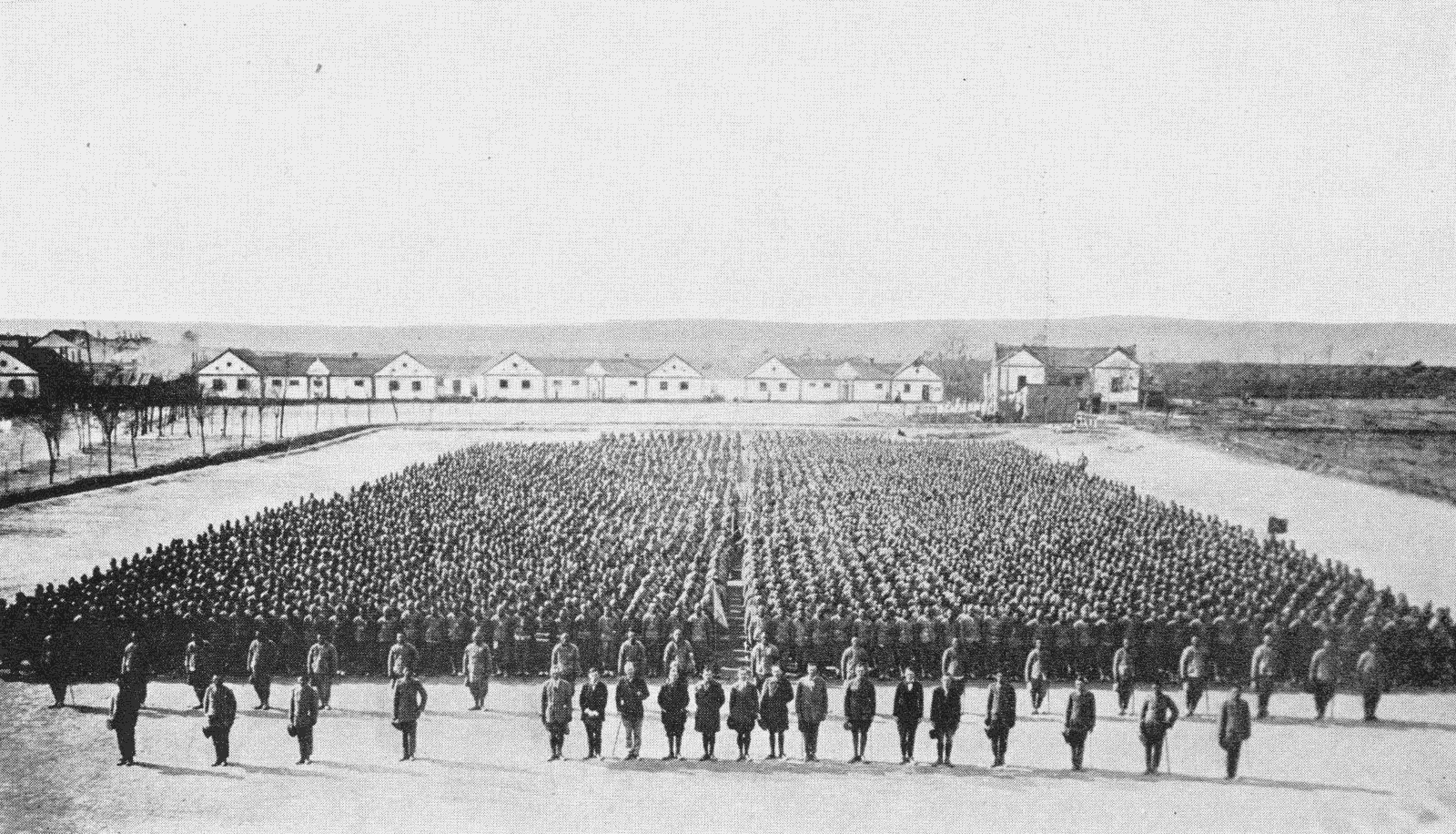
The assembly of the Sacred Battalions, Meung Civil War, 1910
The only force present in the capital of Yuan was the the Sacred Battalions, two 1,000 strong battalions of the soldiers finest soldiers. General Yuangzhang immediately assembled these men at the local parade grounds for presentation to the populace and the Emperor as a legitimate show of force. Equipped with Tyro-Antarian M1902 Schutze's and Zellonian ZLR-12 rifles, they were the closest thing to a professional army in all of Faresia.
Colony of Leylon, Western Zellonian Serranthia (Known only to Xian): While formally at war with the Meung Dominion, the fledgling Republic of Xian was met with a more radical thought process within the handful of military commanders in it's employ. The thought among many of these commanders was that the Continental powers would most likely support the status quo and by extension, the Dominion. Sharing a border with the Republic of Zellonia's colony of Leylon meant a vast amount of resources was just in reach. By raiding the borderlands, huge surpluses of goods could be acquired at very little cost. The opposition to this was aggravating the nation of Zellonia while already in a war for survival.
Raid Leylon: Dispatch a force to cross the border and seize whatever items of opportunity present themselves. Minimize casualties, but if necessary, defend yourselves and leave no trace of your presence in the area.
Our Attention Must Be Elsewhere: While tempting, every man must be sent to the war against the autocratic Meung! We've neither the time nor resources to give the Great Powers an excuse to dally in our affairs.
The Great Faresian Race: Expeditions by the Staratian explorer Maurian Hert in 1907 and 1908, as well as the Saurilian Expeditions of 1909 headed by Bröj Milbert ended in the complete cartography of Southwest Faresia. Thought to be mostly an empty expanse of water. The truth is, there's land there. And lots of it. Fledgling nations like the Kingdom of Blutland and Tyro-Antarian Empire have the opportunity to begin overseas empires, while nations such as the Republic of Zellonia see further opportunities to maintain global dominance.
Island Chains of Southwest Faresia, Zellonian Faresia Pictured Above
The islands, as indicated by reports made public by the Staratian and Saurilian explorers, indicates many of these lands are dense in both population and resources. The price however to colonize is extensive, and many nations scoff at the idea of such an endeavor, so far from the modern world.
-- North Surayana: $496,000,000 -- Tylum Island: $109,000,000 -- South Surayana: $349,000,000 -- Teroshi Islands: $742,000,000 -- Mero Isles: $275,000,000 -- Burvandian Peninsula: $981,000,000 -- Miroku Island Chain: $560,000,000
"Greetings be upon you, Ambassador Mehmet!" The Sultan rose to his feet. Those assembled drew in their breaths, for the weight of the Sultan's feet upon the worn stone was only given to those deserving. If nothing else, Mehmet deserved some praise. Given the backwater post of the diplomatic embassy in the faraway Zellonian Republic, few would have guessed that such power could come with the power of the pen--a pen held by a lowly ambassador such as Pasha Mehmet, none the less. Mehmet's arrival was beset by the Imperial Guard, and his purpose was to see the Sultan directly.
Ambassador Pasha Mehmet, photograph taken 1907
"It is an honor," Mehmet said, stopping at the foot of the archaic, gilded throne. The Sultan slid back into the seat and eyed the plain clothed man as if in awe. "As much as it is an honor to bring greatness to the Sultanate."
"Yes," the Sultan nodded. The signing at Tanaz has effectively reigned in power in the region by breaking up the Zello-Blutlandic Alliance, an alliance so fresh the ink had barely drawn on whatever treaty they had signed. So effective was the Treaty that the once far and away Zello-Suljic relations had also been opened for analysis one more. "And it must be made apparent, Ambassador Mehmet. You will not maintain your post in Zellonia."
"I live to serve," Ambassador Mehmet said, dropping his chin against his plain black tunic.
"A facet I wish to extend to the Karalians. No," the Sultan said, waving to a nearby servant, who brought forth a folded envelope. "While Minister Turkysi has served the Empire for three decades, the Council and I have agreed that it is Divine Will for you to be elevated to the position of the Minister of the Foreign Office, responsible for setting foreign policy."
Ambassador--not Minister--Mehmet's eyes shot wide. "It is truly an honor, Sultan. As always, I live to serve the Realm, the Empire and the Sultan. I will conduct myself with all the dignity expected of me." With another wave, the servant stepped forward and handed the envelope to the new Foreign Minister. He hesitated before ripping open the envelope.
"Enclosed you will find disturbing news, Minister Mehmet," the Sultan said in the wake of the scurrying Sultan. "News reaches that the easily enamored Queen of Saurilia has sent diplomats to the fledgling Kingdom of Blutland to formalize a mutual defensive alliance."
But why? The Minister wished to wonder aloud the question, but understood it was not the incentive of the Sultan to answer such inquiries. Blutland and Saurilia held no mutual ideas, claims or goals, but it was often beyond the realm of understanding for the uncivilized Easterners. Few understood still the wisdom of the Seljuk. "I will send our best diplomats to better understand the ambitions of the Northerners, Divine One."
"I've no doubt of that, Minister Mehmet. Go, you've a days work ahead of you and already the sun has reached it's highest point."
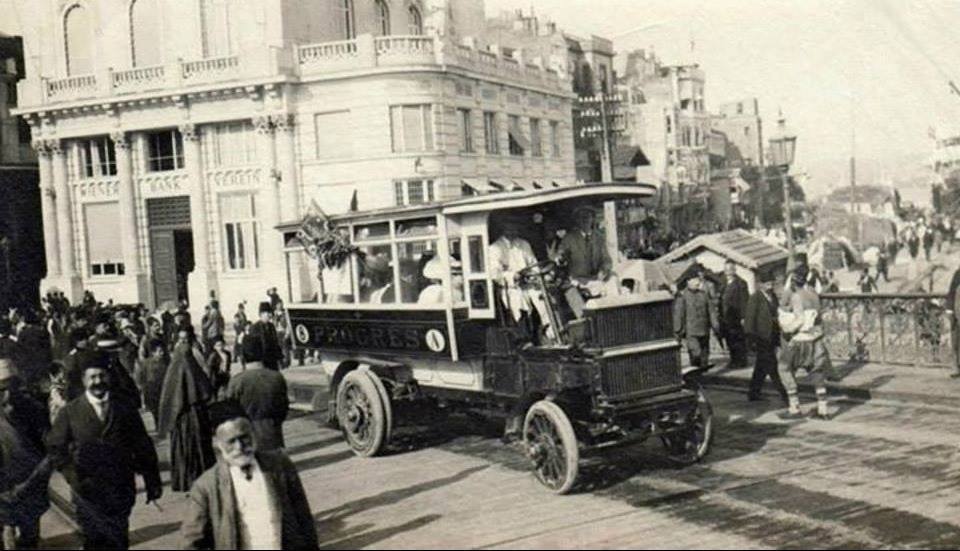
After more airy pleasantries had been exchanged, and paperwork signed, the new Foreign Minister was swept out of the Palace of the Seljuk Capital and into the city proper. As a Minister of the Divine Council, he was allotted certain privileges that did not exist as a lowly foreign ambassador. One was the use of the City Taxi's, foreign purchased automobiles that could ferry government officials around the bustling city of Tankara. He asked the front guard to hail him one, and set off for the Foreign Office.
A photograph of the Seljuk capital, Tankara, circa 1910
Karalian Uprising: Brief fighting along the outskirts of the city occur. Elements of the Seljuk Army engage Karalian militia, taking potshots from the roof of a nearby building. After some intense rifle fire, the shooting dies down. Seljuk soldiers do not approach the building.
July 2nd
Republic of Zellonia: Five unnamed destroyers leave Zellonian port, heading through the Inner Sea and passing through the Strait toward Faresia.
July 3rd
Kingdom of Samgola: The new foreign ambassador Abdulla Hakeem meets with the Zellonian diplomat Lovles Nukey who requests a Defensive Pact. The Kingdom of Samgola, while grateful, understands that while the protection of the largest naval power in the world might be helpful, they do not wish to have an alliance with an international world power, and thus refuse the offer.
July 4th
The Dorset Incident begins, when the Zellonian Fleet off the coast of the Empire of Seljuk refuses to leave without it's imprisoned crew from the ZRN Dorset, a destroyer interned after Zellonian soldiers landed and defiled Seljuk holy grounds. The The Seljuk foreign ambassador to Zellonia Pasha Mehmet meets with his Zellonian counterpart to begin negotiations. [Zellonia has Initiative].
July 5th
Treaty of Haraht (1910): The Seljuk Empire and Republic of Staratia meet in the Staratian city of Haraht and negotiate a Non-Aggression Pact to last three years. With the document signed, the massive Republic has--for now--effectively protected it's southern flank from potential aggression.
July 7th
The The Republic of Xian declares independence from the thousand year Meung Dominion. A weak bastion of modern democracy, the Continental nations must now decide whether to Recognize (+4 Support) their independence or Deny (+3 Militarism) it for personal or political interests.
July 8th-July 14th
Karalian Uprising: The Saurilian 1st Armed Battalion begins it's offensive operations in the capital of Karalia. Waiting until nightfall, the 10,00 strong force marches in column formation into the city. From outside the city, Seljuk soldiers listen in as sporadic rifle fire increases--until a full out battle, the Second Battle of Karalia, begins.
Saurilian troops of the 1st Armed Battalion marching toward Harakas, Karalia, 1910
The Saurilian's--basically armed and unprepared for night fighting in a hostile and foreign environment, lose 1,850 men in a week of fighting. Under General Sjorn, the Saurilians have entrenched themselves in the Market District, pinned by rifle fire with fierce fighting, house by house. The 'civilians,' they went in to save often turn out to be men carrying rifles. And on more than one occasion a Saurilian soldier opened fire on a suspicious looking person who turned out to be unarmed.
July 15th
Kingdom of Sessau: The Kingdom of Sessau, long holding claims on the northern Kingdom of Mille, successfully annexes the smaller kingdom--granting high levels of autonomy while centralizing aspects of the region such as education and the military. The King of Sessau officially proclaims himself an Emperor.
July 16th The Seljuk ambassador to Zellonia, Pasha Mehmet and the Zellonian new foreign ambassador to Seljuk, Julio Grenez meet in Southeastern Seljuk, in the coastal city of Tanaz. After hours of negotiation, both parties sign the Treaty of Tanaz.
TREATY OF TANAZ (1910)
Article I. The Seljuk Empire will release the entire crew of the ZRN Dorset and absolve them of any crimes for potential extradition.
Article II. The Seljuk Empire will release the ZRN Dorset back into the custody of the Republic of Zellonia.
Article III. The Seljuk Empire acknowledges the claim of the Western Straits, and by extension, control of the Straits by the Republic of Zellonia for a term of up to 20 years, at which point the claim will be renegotiated.
Article IV. The Republic of Zellonia agrees to formally terminate the Zello-Blutlandic Alliance as of July 16th, 1910 for a minimum period of ten years, at which point the alliance can be renegotiated.
[X] Ambassador to Zelloinia, Pasha Mehmet, Representative of the Imperial Government of the Sultan of Seljuk [X] Ambassador to the Seljuk Empire, Julio Grenez, Representative of the Republic of Zellonia
Harakas, outskirts of the Karalian capital, June, 1911
General Mahmed surveyed the encirclement one final time. The preparations had been drawn up only nights before and probably served to it's inefficiency. Seljuk troops were unruly and lacked discipline. Their rifles, Schutze M1902's purchased from the neighboring Tyro-Antarian Empire were hardy, but not well designed for prolonged combat in the sandy desert. Mahmed wanted to forget the unfortunate reality that the majority of his soldiers were not trained to dissemble and clean their own rifles. From his low stool at the desk in his tent, Mahmed reviewed the order of battle--sent from Seljuk's General Staff.
Seljuk 2nd Army
* The Seljuk 2nd Army is commanded by General Mahmed (Loyal/Alcoholic) -- Objectives: The complete encirclement of the Karalian capital and the ultimate capitulation of the 'Karalian Dissidents,' who have self-proclaimed themselves the Karalian Provinces.
Cavalry: Five line regiments and one Hejaz brigade -- 9th Cavalry Division (Süvari Fırkası) [5,600 men. 5,600 M1902 Schutze Rifles]
Artillery: Nine field and three horse batteries, one İhtiyat regiment. -- 1st Artillery Division (Topçu Fırkası) [6,800 men. 70 60mm Glaskanonen Field Guns] -- Engineer: One sapper company, eight companies of engineers, one company of artificers. * Engineer regiment (İstihkâm Alayı) [1,100 men. 1,100 M1902 Schutze Rifles]
The encirclement of the massive Karalian city was an undertaking neither supported by Seljuk military theory or logistics. The lone railway between the Western Empire and the Back End (so referred due to it's abysmal infrastructure) was often overloaded and forcibly slowed bringing in supplies by disrepair. General Mahmed understood that while it was simply a matter of time before the Karalians surrendered en masse, every day was a worthless battle of attrition in supplying an army simply out of its element. The 1st Artillery Division, under equipped with only 70 Blutlandic field guns purchased in 1898, often ran it's course of shells and had to wait until the next train delivery before bombardments could fully. Similarly, the Engineer Regiment--İstihkâm Alayı--was the only of its kind in the entire Empire. It's workers divvied up ten hours shifts in building sand embankments and shooting positions. This wasn't to be a shooting war anymore. It was just a waiting game.
Elements of the 2nd Seljuk Infantry Division, 2nd Regiment marching into Karalia, 1910
The worst opponent in the Back End of the Empire was the sun, the sand and the heat. The Karalians, who had largely given up now, were hoping the Seljuk's resolve might simply dissolve away. The Sultan however knew that allowing the ethnic minorities to stand up would embolden other minorities to do the same, which was one of many reasons the Sultan questioned a lack of assistance, martial or economic, from the Tyro-Antarian Empire, who had similar ethnic problems with their border.
On June 30th, General Mahmed was informed of an incoming presence from the south. The Zellonians were back again, he wondered? Messengers indicated however it was the long overdue arrival of the Saurilians--ten thousand men strong--as an amateur expeditionary force. The Saurilian 1st Armed Battalion under a General Sjörn. The first question upon admitting the General to his quarters was a simple one: "Are battalions not commanded by lieutenant colonels in most modern armed forces, General?"
A question more of disdain for foreigners than anything else, Mahmed allotted the Saurilian 1st Armed Battalion the southern flank. "If you wish to prove yourself in combat, your men are more than welcome to siege the city. It's a mottled mess of buildings, stone and straw and clay. Otherwise, we wait. The men, the women, the children; they slowly starve day by day, as is due punishment for those who oppose the Sultan."
June 16th A new company, Ellis Automobiles opens for business in the Republic of Zellonia. Semi-subsidized by one of the Great Houses, it's single factory is responsible for the Ellis Gooden automobile, a four door sedan--the first of its kind and the Ellis Hewett, a sleek coup with a 48 hp EH-48 motor. In a potential time of war, their grand new industrial complex would be accessible to the state.
Automobile enthusiasts in Zellonia with an Ellis Hewett, 1910
June 17th Testing at the Tastra Plant reveals the Escarra KhZ motor, putting out nearly twice as much power as the original Tastra ZhR motor. The Escarra can power the prototype TA-1 armored car brings it up to a maximum speed of around 15 miles per hour. The gun boasts a mantlet in the roof where a soldier can peek out and fire with his rifle. Although a machine gun could be placed there, if desired.
Staratian TA-1 Armored Car on proving grounds
June 18th With additional funding and two more months, the Heidrich Shipways and Shipping company finishes it's final design for the Sturm-class Light Cruiser design. Due to technical limitations, the only possible addition was increasing the 12 guns to 12" instead of 10" and adding an additional 2 centimeters of armor on the central belt.
Sturm-class Light Cruiser Design
Sturm-Class Specifications Dimensions 138,6 x 13,4 x 5,1 m
Displacement 4570t – 5587t FL
Crew 346
Propulsion 2 screws, 2 Kurgen turbines, 16 standard wt boilers, 25,000-29,000 hp
Speed 27.5 – 28.2 knots top speed
Range 5,820 nmi (10,780 km; 6,700 mi) @ 12 knots
Armament 12 x 115mm (singles), 2 TT 500 mm Sub, 120 mines
Armor Belt: 62 mm (2.4 in), Conning tower: 100 mm (3.9 in)
June 19th A finished batch of 80,000 Schutze M1902 rifles reach the Tyro-Antarian Imperial Army.
June 20th The training of twelve infantry divisions in the Kingdom of Jouran finishes. These men, mostly without rifles, join the Kingdom of Jouran's Doucal Army, quickly becoming an eminent force for such a small nation.
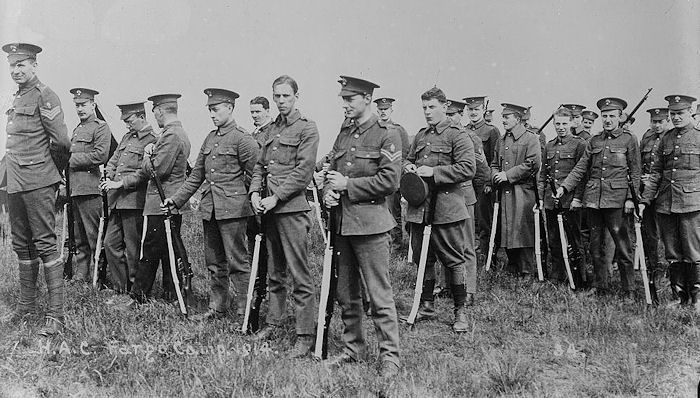
Soldiers of the Jouran Doucal Army, circa 1910
June 22nd The Seljuk Army surrounds the Karalia capital, which refuses to surrender. Seljuk troops dig in, encircling the city and constantly threatening starvation if the Karalians do not surrender. The Karalians send no messenger to respond.
Seljuk troops in the Karalian theater, 1910
June 23rd The Meung Dominion, receiving a pitiful offer from Zellonia, accept the offer from the Saurilian Empire and effectively hand over the coastal city of Tsungmao to the Saurilians at the promise of $500,000,000 to be paid off over a period of ten months.
June 30th The Staratian arms manufacturers Ferdi and Leopold Industries and Hüber Steel both submit Blueprints and prototypes for the design competition for a new rifle: the HS-19. Each version of the HS-19 is available for review and can be Accepted or it's Design ramifications changed to suit Staratia's needs, although this will significantly add time to it's design timetable.
Description Designed by Hugo Ferdi of Ferdi and Leopold Industries, the HS-19F is a five-shot, bolt-action, internal magazine–fed, military rifle. The main disadvantages of Ferdi's rifle were a more complicated mechanism and a long and tiresome procedure of disassembling (which required special instruments – it was necessary to unscrew two fasteners). Compared to the 1898 HS-16, the 1891 HS-12 has a commonality in that it uses two front-locking lugs to lock up the action. However, the HS-16's lugs lock in the horizontal position, whereas the Blutlandic Otto Mark II's locks vertically. The HS bolt body is multi-piece whereas the Otto is one piece. The HS body uses interchangeable bolt heads like the Tyro-Antarian Schutze. Unlike the Otto, which uses a "controlled feed" bolt head in which the cartridge base snaps up under the fixed extractor as the cartridge is fed from the magazine, the HS has a "push feed" recessed bolt head in which the spring-loaded extractor snaps over the cartridge base as the bolt is finally closed. Like the Schutze, the HS uses a blade ejector mounted in the receiver. The HS bolt is removed by simply pulling it fully to the rear of the receiver and squeezing the trigger, while the HS-19 has a bolt stop lever separate from the trigger.
Like the Otto, the bolt lift arc on the HS-19 is 90 degrees, versus 60 degrees on the Schutze. The Otto bolt handle is at the rear of the bolt body and locks behind the solid rear receiver ring. The rifling of the HS barrel is right turning (clockwise looking down the rifle) 4-groove with a twist of 1:9.5" or 1:10". The 5-round fixed metallic magazine can either be loaded by inserting the cartridges singly, or more often in military service, by the use of 5-round stripper clips.
Description: The HS-19H or Huber 19 (H19) rifle is a manually operated, magazine fed, controlled-feed bolt-action rifle, 1,250 mm (49 in) in length and 4.09 kg (9 lb) in weight. It has a 740 mm (29 in) long rifled barrel and carries 5 rounds ammunition in an internal magazine. The HS-19H has two sling swivels, open front sights, and a curved tangent-type rear sight, known as the Huber Sight.
The controlled-feed bolt-action of the HS-19H is a distinct feature and is regarded as one of the simpler bolt-action system designs. he HS-19 system consists of a receiver that serves as the system's shroud and a bolt group of which the bolt body has three locking lugs, two large main lugs at the bolt head and a third safety lug at the rear of the bolt, which serves as a backup in case the primary locking lugs failed. This third lug is a distinctive feature and was not present on previous HS bolt action designs. The two main locking lugs are positioned opposed to each other and display a locking surface of 56 mm2 (0.087 in2), whilst the third safety lug normally plays no part in locking the action to avoid asymmetric and hence unbalanced bolt thrust forces. The diameter of the HS-19 system receiver ring was also enlarged to 35.8 mm (1.41 in) diameter compared to previous HS "small ring" bolt action designs that had 33 mm (1.30 in) diameter receiver rings for additional strength and safety. Accordingly, the barrel shank was enlarged to 28 mm (1.10 in) diameter with 15.88 mm (0.625 in) of threaded area at 12 threads per inch compared to previous HS "small shank" bolt action designs that had 24.9 mm (0.98 in) diameter with 16.38 mm (0.645 in) of threaded area at 12 threads per inch barrel shanks for additional strength. The bolt handle is permanently attached to the bolt and, on the HS-19H, is straight and protrudes out for optimal leverage.
Another distinctive feature of the H19 system is the controlled-feed mechanism, consisting of a large, non-rotating claw extractor that engages the cartridge case rim as soon as the round leaves the magazine and firmly holds the cartridge case until the round is ejected by the ejector, mounted inside the receiver. Combined with a slight bolt retraction at the last stage of the bolt opening cycle, caused by the cammed surface on the rear receiver bridge, this results in a positive cartridge case extraction. The HS-19 bolt-action will cycle correctly, irrespective of the way the rifle is moved or positioned during the bolt cycling action or if the cartridge has been fired or not. Only if the bolt is not brought back far enough, sharply enough, in a controlled round feed bolt-action the cartridge case may not be cleanly ejected and a jam may result.
Political Situation in June, 1910
RELATIONS -- Zellonia/Samgola: [+9] As one of the first two countries to acknowledge Samgolan independence, Zello-Samgolan relations are off to a great start.
-- Staratia/Estalia: [-4] Both Republics, Staratia and Estalia are at odds as Staratia supported the independence of Estalian Serranthia independence in 1906, sending the rebels there rifles and supplies. Since, the Estalians have wagered a high tax on Staratian trade there through the Strait of Kalif.
-- Thecia/Estalia: [+9] Estalia and Thecia have enjoyed trade for hundreds of years, and while Thecian monarchism reigns supreme, Estalia and Thecia possess a burgeoning trade relationship stymied only by Thecia's distance.
-- Dongaria/Estalia: [+1] With little trade, culture and geography in common, the Kingdom of Dongaria and the Estalian Republic have no opinion of one another. Most Dongarians believe Estalians to be lazy.
-- Tyro-Antari Empire/Estalia: [+0] Two nations whose paths have rarely crossed, the Dual Monarchy and the Coastal Republic have little to discuss, their embassies are rarely used. The former, a more land based power and the latter a more sea based power also have little to complain of one another.
-- Blutland/Estalia: [-14] The Estalians have long harbored their Blutlandic cousins as a weaker bunch. With an inadequate navy, but a superior holding on the Continent, the Estalians often feel themselves looking inwards to a nation they see as inferior.
-- Blutland/Tyro-Antari Empire: [+4] Based perhaps on geography, the Tyro-Antarians and Blutlands see themselves as acquaintances at a ballroom party. Neither party has reason to thumb their nose at the other, and neither party has reason to ask the other for a dance.
-- Madeira/Estalia: [+16] Long time friends, Madeiran and Estalian relations are some of the best they have been since the early 1800's. The Madeirans and Estalians are culturally similar, in that Madeirans speak the Estalian language, albeit with a very unique dialect.
Zellonia/Sessau: [-22] In the early 1800's the Zello-Sessauan Wars were some of the most fierce of the continent. They ended with the Zellonians eventually conquering and fragmenting the large Sessauan Empire, which later became the Kingdom of Sessau.
Zellonia/Estalia: [-15] Although friendly originally, Zellonian's recent decision to begin expanding militarily has soured Zello-Estalian relations, as Zellonia and Estalia may have divergent intentions over the Kizurgas Islands in the Inner Sea.
Zellonia/Dongaria: [-10]
Tyro-Antarian Empire/Seljuk Empire: [+11]
-- Empire of Saurilia: +3 Political Support -- Kingdom of Blutland: +1 Political Support -- Tyro-Antarian Empire: +1 Political Support -- Republic of Staratia: +1 Political Support -- Republic of Zellonia: +1 Political Support
June 6th A cloudburst in Staratia adds to existing flood waters, killing 800 people in villages in the Hronstadt district, another 180 in Hemesvar and 100 in Toldava.
June 7th The Seljuk Army begins it's offensive across the river into Karalian territory. General Mahmed acknowledged that even while inebriated, he found the constant "over the shoulder" attitude of the Saurilian military advisers strange. Proclaiming that crossing the river would be a bloodthirsty affair, the actual crossing turns out to be a twelve hour, uneventful action. The Karalian freedom fighters, who number less than 8,000, do not possess the numbers to oppose the two infantry divisions of the Seljukii Army.
Seljuk troops forming up to cross the river, 1910
June 8th Republic of Zellonia diplomat Trellis Roberts arrives in Kamrun, Samgola and opens diplomatic relations along with Saurilian diplomats as well. [+8 Relations]
June 10th Ships of the Zellonian fleet shell a Karalian village, killing 273 villagers and 3 Blutlandic merchants. 15,000 Zellonian soldiers enter the city and garrison it. The Kabas Incident reflects poorly on the Zellonian Republican Navy, drawing the ire and objections from Sessau and Estalia. That same day, 5,000 Zellonians enter the Seljuk Holy City of Denuyyid on the Southern Coast.
The Seljuk government immediately requests that they leave the city, and are so enraged that the the Zellonian destroyer ZRN Dorset is boarded at the harbor city of Fuyasi and it's crew taken prisoner.
Zellonian soldiers marching through Denuyyid, June 1910
June 12th The Meung Dominion, the largest nation in Faresia--second in size only to the Republic of Staratia, admits in an international conference that due to failing budgets and high unrest, it is willing to lease the city of Tsungmao out to any Continental nation that is interested. With a population of 14,000,000, it is a highbrow provincial coastal city with 2 Minor Dockyards and 1 Textile Factory.
It is now taking bids to lease this city out for a period of 20 years.
City of Tsungmao, circa 1905
June 13th The Seljuk Empire Navy Bureau officially receives a request to design a new Light Cruiser. The following schematics:
-- [Request Category]: [Naval] -- [Request Perimeters]: [Light Cruiser] -- [Desired Requirements]: The Seljuk Sultanate Navy (SSN) requests a light cruiser design with exceptional range, understanding foregoing belt armor and ammunition storage in exchange for coal storage for fuel as well as serving power for possible surface raiding. Requested armament would be 5.9" guns with a possible speed of up to 32 knots.
June 14th The Seljuk Army starts advancing on the Karalian capital of Seyyud, which is being protected by a mere 3,500 men. The Karalians there begin destroying the sent Otto Mark II rifles in hopes of depriving them to the inevitable Seljuk conquerors. Mass looting begins and over 10,000 flee northeast to the Tyro-Antarian border. The Tyro-Antarians, who had since done nothing to secure their border, find tens of thousands Karalians sneaking across the border.
Karalian freedom fighters stop for a photo, June 1910
June 15th The Republic of Zellonia Army Department of Development finishes it's theoretical designs on a 155mm howitzer; the largest cannon ever made. Were one designed and produced, it would give the small Zellonian Army the theoretical punching power of a much larger nation.
Basic idea of a 155mm howitzers, June 1910
Political Situation in June, 1910
RELATIONS -- Zellonia/Samgola: [+9] As one of the first two countries to acknowledge Samgolan independence, Zello-Samgolan relations are off to a great start.
-- Staratia/Estalia: [-4] Both Republics, Staratia and Estalia are at odds as Staratia supported the independence of Estalian Serranthia independence in 1906, sending the rebels there rifles and supplies. Since, the Estalians have wagered a high tax on Staratian trade there through the Strait of Kalif.
-- Thecia/Estalia: [+9] Estalia and Thecia have enjoyed trade for hundreds of years, and while Thecian monarchism reigns supreme, Estalia and Thecia possess a burgeoning trade relationship stymied only by Thecia's distance.
-- Dongaria/Estalia: [+1] With little trade, culture and geography in common, the Kingdom of Dongaria and the Estalian Republic have no opinion of one another. Most Dongarians believe Estalians to be lazy.
-- Tyro-Antari Empire/Estalia: [+0] Two nations whose paths have rarely crossed, the Dual Monarchy and the Coastal Republic have little to discuss, their embassies are rarely used. The former, a more land based power and the latter a more sea based power also have little to complain of one another.
-- Blutland/Estalia: [-14] The Estalians have long harbored their Blutlandic cousins as a weaker bunch. With an inadequate navy, but a superior holding on the Continent, the Estalians often feel themselves looking inwards to a nation they see as inferior.
-- Blutland/Tyro-Antari Empire: [+4] Based perhaps on geography, the Tyro-Antarians and Blutlands see themselves as acquaintances at a ballroom party. Neither party has reason to thumb their nose at the other, and neither party has reason to ask the other for a dance.
-- Madeira/Estalia: [+16] Long time friends, Madeiran and Estalian relations are some of the best they have been since the early 1800's. The Madeirans and Estalians are culturally similar, in that Madeirans speak the Estalian language, albeit with a very unique dialect.
Zellonia/Sessau: [-22] In the early 1800's the Zello-Sessauan Wars were some of the most fierce of the continent. They ended with the Zellonians eventually conquering and fragmenting the large Sessauan Empire, which later became the Kingdom of Sessau.
Zellonia/Estalia: [-15] Although friendly originally, Zellonian's recent decision to begin expanding militarily has soured Zello-Estalian relations, as Zellonia and Estalia may have divergent intentions over the Kizurgas Islands in the Inner Sea.
June 1st The 17th and 18th Infantry Division of the Zellonian Royal Army finish training. They are sworn in on a field outside the city of Cronus in Northern Zellonia. 20,000 men strong, they join one of the weaker armies on the Continent, but one with long held traditions and discipline. These 20,000 are that of a volunteer force, another long held tradition with the Zellonian Royal Army.
Zellonian army recruits, 1910
June 2nd After spending a weekend in counsel with the Seljuk Sultan, Saurilian military advisers Sveen Aal, Jacob Morland, and Mari Teslow depart from the capital of Hakas. Sveen Aal, recording in his journal, notes that the Sultan is very unpopular in the Empire, as displayed by the rioting in the capital and outside the palace. After an eight hour long train ride through the desert, the three Saurilians reach the front--held by 20,000 Seljukii soldiers.
8 of the 60 Havka machine guns have fallen into disrepair--three due to broken gas springs, and five due to overheated (and later discarded) barrels. The front is quiet, as the river forces a crossing before either position can come into contact with one another. The three advisers meet briefly with General Hassan Mahmed (Loyal/Alcoholic), who explains that while wickedly lethal, the Havka machine guns are prone to breakdown.
June 4th The Saurilian Class of 1910 at the Vest-Agtder Aviation School graduate. Although only twenty-five were admitted, twenty men eventually graduated. The 1st Aviation Squadron and the 2nd Aviation Squadron were split into nine pilots each, with two men who showed initiative and ambition during their training promoted to commander of the two squadrons. With exactly twenty aircraft in the entire empire, each man was assigned his own plane.
2nd Aviation Squadron, Class of 1910, Saurilian Empire
June 5th The Karalian Provinces send diplomats to both the Tyro-Antarian Empire and the Kingdom of Blutland, requesting military aid and military advisers to help repulse the Seljuk armies that will inevitability cross the river. In exchange for aid, the Karalians promise exclusive trading rights after the war has ended.
June 8th The tribal peoples of Serranthia in the area between Sessauan Serranthia and Zellonian Serranthia formerly announce the Kingdom of Samgola. With a population of only 1,900,000, the Samgolans are a mostly nomadic people, with coastal cities and a capital situation at the harbor city of Kamrun. King Havekon is the reigning monarch, a fifty-nine year old chieftain who accepted the crown only after coercion from several other tribes.
Kingdom of Samgola, June 1910
Nations may now post PRODUCTION (June)
Political Situation in June, 1910
RELATIONS -- Staratia/Estalia: [-4] Both Republics, Staratia and Estalia are at odds as Staratia supported the independence of Estalian Serranthia independence in 1906, sending the rebels there rifles and supplies. Since, the Estalians have wagered a high tax on Staratian trade there through the Strait of Kalif.
-- Thecia/Estalia: [+9] Estalia and Thecia have enjoyed trade for hundreds of years, and while Thecian monarchism reigns supreme, Estalia and Thecia possess a burgeoning trade relationship stymied only by Thecia's distance.
-- Dongaria/Estalia: [+1] With little trade, culture and geography in common, the Kingdom of Dongaria and the Estalian Republic have no opinion of one another. Most Dongarians believe Estalians to be lazy.
-- Tyro-Antari Empire/Estalia: [+0] Two nations whose paths have rarely crossed, the Dual Monarchy and the Coastal Republic have little to discuss, their embassies are rarely used. The former, a more land based power and the latter a more sea based power also have little to complain of one another.
-- Blutland/Estalia: [-14] The Estalians have long harbored their Blutlandic cousins as a weaker bunch. With an inadequate navy, but a superior holding on the Continent, the Estalians often feel themselves looking inwards to a nation they see as inferior.
-- Blutland/Tyro-Antari Empire: [+4] Based perhaps on geography, the Tyro-Antarians and Blutlands see themselves as acquaintances at a ballroom party. Neither party has reason to thumb their nose at the other, and neither party has reason to ask the other for a dance.
-- Madeira/Estalia: [+16] Long time friends, Madeiran and Estalian relations are some of the best they have been since the early 1800's. The Madeirans and Estalians are culturally similar, in that Madeirans speak the Estalian language, albeit with a very unique dialect.
Zellonia/Sessau: [-22] In the early 1800's the Zello-Sessauan Wars were some of the most fierce of the continent. They ended with the Zellonians eventually conquering and fragmenting the large Sessauan Empire, which later became the Kingdom of Sessau.
Zellonia/Estalia: [-15] Although friendly originally, Zellonian's recent decision to begin expanding militarily has soured Zello-Estalian relations, as Zellonia and Estalia may have divergent intentions over the Kizurgas Islands in the Inner Sea.
May 21st The Foulois Accords are ended without conclusion. The Tyro-Antarian Empire remains in control of the strategically important islands, with infuriated diplomats from Zellonia, Estalia and Blutland leaving empty handed.
May 24th The Staratian national bounceball team played its first international, defeating Sessau, 6–2, at Jardin.
May 27th A fire at the Sprengstoff Company near Kanza in Tyria sets off a blast that kills fifteen people, and injures more than 100. Most were spectators who ignored warnings to leave the area. The blast shattered windows in neighboring towns.
May 28th After discovering Otto Mark II rifles among the Karalian dead, the Seljuk Empire sends a diplomatic warning to the Kingdom of Blutland that further support of the Karalian rebels will incur possible sanctions.
May 30th The Saurilian military advisers Sveen Aal, Jacob Morland, and Mari Teslow arrive in the Seljuk Empire, passing through a meandering Zellonian naval flotilla to do it. Under heavy guard, they're escorted first to the capital to talk with the Sultanate and his military staff.

 FortunesFaded
 Spiffy
 Scrawl Banditta