Saving for future use.
[OOC] Voyage of the Heiress: A Tale from Empire of the Clouds
- Large Group
- Historical
- Fantasy
- Casual
- 18+
- Steampunk
Join Status:
Apply
GM

InfamousGuy101 Infamous Fella
Member
Seen
41 min ago


WELCOME TO EMPIRE OF THE CLOUDS: VOYAGE OF THE HEIRESS
A spin-off of the Empire of the Clouds RP set in a fictional low-fantasy world with a technology level roughly equivalent to Earth 1910. Unlike the original, this story begins not in Inbur, but in the heart of the Commonwealth of Ardell where a wealthy Inburian patron has gathered a company of strangers for a task few would dare attempt.
His daughter has been kidnapped and taken to The Main, the ever-expanding continent of vast frontiers, untamed jungles, and former rapidly industrializing colonies, a continent analogous to the Americas. Reports suggest she has been spirited away somewhere south of Equaterra, into lands where law is little more than a piece of paper.
To recover her, the patron spares no expense. He has quietly procured one of the first Pathfinder-Class Airship from the Ardellian Military, a newly developed vessel built for speed, endurance, and survival in hostile skies. It will serve as both transport and base of operations for the expedition.
In this RP you will play one of those recruited for the mission. Perhaps you are a soldier, a mercenary, an explorer, or simply a wanderer drawn by the promise of fortune. The choice is yours but you begin in a lavish Commonwealth suite, gathered by the socialite’s assistant, a Mr. Aurelian Vey, with the promise of danger, discovery, and a reward beyond reckoning.
The world is wide and the path uncertain. Will you stand by your comrades and see the mission through? Will you uncover hidden truths in the frontier of the Main? Or will you seize the opportunity to turn the patron’s wealth and trust to your own advantage? The expedition awaits, and with it the unknown.
WORLD AFFAIRS
The year is 1077 of the Inburian Era, and the world stands at the edge of change.
Across the Old Continent, the Communalist state of Calaria grows ever more assertive, spreading its influence through agitation, subversion, and whispers of revolution abroad. The old Inburian Empire, weakened and decadent, feels the pressure mounting along its borders. While open war has yet to begin, few doubt it is coming and news of any skirmishes, military preparations, and bold political declarations have become the talk of the day throughout the Main.
Yet in the Main itself there is little appetite for Old Continental struggles. The peoples of the Main look upon the quarrels of the Old Continent with curiosity but are determined to avoid any direct entanglements.
This does not mean the Main is at peace. Far from it:
A fragile truce between the Confederacy and the Commonwealth holds, but only just, with fresh disputes stirring in Brendahl, the Commonwealth’s northern neighbor.
In Equaterra, wealth and land accumulate in the hands of great estates while peasants toil in misery, resentment continues as radical movements grow by the day, some inspired (perhaps quietly sponsored) by Calarian Communalism from across the Evig sea.
In the Grey Bay, the island nations of Nordisles, Isola Centrale, Oscuraria, and Coschi wage an endless struggle against marauders from the South who harass trade and shipping routes.
South of Equaterra’s jungled borders known as the Tandalar Expanse lies the vast southern hemisphere colloquially referred to as “The Southern Main” or Nohollum (South of Jungle) in native tongue. Nohollum is a vast and politically divided region of old kingdoms, young republics, tribal confederations, former colonial ports, and rising modern states. Among them, the Tlanecuayotl Empire remains the greatest power, a once tributary-based monarchy shaped by a rigid hierarchy of religious authority, noble rule and ancient traditions now forced to contend with the modern age. Around it exist rival powers such as the Ranquén Confederation, the rogue Kingdom of Qalata which had once been a tributary of the Empire, the wealthy transit republic of Ketenaam, the gold-rich Kingdom of Suyalliq, and the former colonial ports of Alfamarw and Clairrive, each with their own interests, grievances, and foreign ties. To traders, Nohollum promises wealth in gold, cattle, rubber, ports, and many other resources; to diplomats, it is a strange melting pot of primitive customs and shifting alliances; and to adventurers, it remains a place where modern rifles, ancient tribal customs, and untamed frontiers exist side by side.
Through all of this, a new current of thought commonly known as Mutualism spreads throughout the continent, echoing Calaria’s radical ideals. Among intellectuals and laborers alike, its message holds and governments across both the Northern and Southern Mains view it with suspicion.
The world is shifting. As the Old Continent edges toward war and the Main wrestles with its own divisions, industry and radical thought reshape society, while the once-honor-bound age of kings, nobles, and mythic powers fades into memory.
MAPS
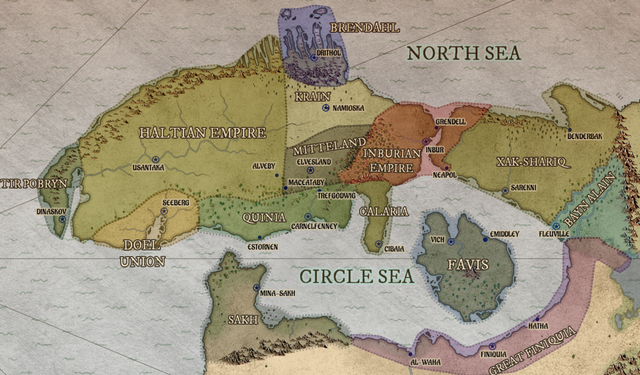
(Click the map for a larger version)

(Click the map for a larger version)

(Click the map for a larger version)
NATIONS & CULTURES
Major Peoples and Nations of the RP
The 'Mainers' are a 'melting pot' culture formed, for the most part, from the mixture of Brendahland, Doel and Monchian cultures in the Calarian Main. Mainer culture is dominant in the Commonwealth of Ardell.
Ardell, as a nation is only 136 years old and enjoys good relations with Favis, the Doel Union and most of the other New World Nations, with the notable exceptions of the Iktani Confederacy, the larger of the two Iktani dominated nations on the continent (the other being the isolated Kingdom of Hunyunak) and has fought a number of wars of conquest against the Confederacy. In the last fifty years, these have inevitably resulted in failure, with increasing Iktani military organisation and the strong defensive barrier of the Chichima river forming an easily defensible border.
Ardell has traditionally stayed out of Old World politics, though there are strong business ties, particularly with the Kingdom of Favis and the Doel Union and Mainers are common visitors.
While Ardell is a democracy, Iktani people are currently ineligible for citizenship and, thus, the right to vote though some have made a home for themselves in the Commonwealth nonetheless. Policies of forcible land seizures and deportation to the Confederacy have, while freeing up land for Mainer settlement, also had the long-tern detrimental effect of both bolstering Iktani manpower reserves and driving migration into major Iktani population centres, spurring industrialisation in the nearby state.
For a Mainer character, try this name generator: name generator.
Ardell, as a nation is only 136 years old and enjoys good relations with Favis, the Doel Union and most of the other New World Nations, with the notable exceptions of the Iktani Confederacy, the larger of the two Iktani dominated nations on the continent (the other being the isolated Kingdom of Hunyunak) and has fought a number of wars of conquest against the Confederacy. In the last fifty years, these have inevitably resulted in failure, with increasing Iktani military organisation and the strong defensive barrier of the Chichima river forming an easily defensible border.
Ardell has traditionally stayed out of Old World politics, though there are strong business ties, particularly with the Kingdom of Favis and the Doel Union and Mainers are common visitors.
While Ardell is a democracy, Iktani people are currently ineligible for citizenship and, thus, the right to vote though some have made a home for themselves in the Commonwealth nonetheless. Policies of forcible land seizures and deportation to the Confederacy have, while freeing up land for Mainer settlement, also had the long-tern detrimental effect of both bolstering Iktani manpower reserves and driving migration into major Iktani population centres, spurring industrialisation in the nearby state.
For a Mainer character, try this name generator: name generator.
The Iktani are the original inhabitants of the Calarian Main and make up just over half the population of Equaterra and over 90% of the populations of the Iktani Confederacy and Hunyunak. Every other State in the Main has a sizable Iktani population. Until recently the Iktani, while sharing strong cultural ties with one another, did not see themselves as a single people and prior to the arrival of the Calarians and other colonial powers, the Main was a patchwork of different states, many of whom had a deep seated animosity for one another.
While the Colonial nations initially enjoyed significant technological advantages over the Iktani tribes, the Iktani have had centuries to adapt and have long-since mastered Circle Sea weapons and tactics and while most Iktani states were destroyed and assimilated into Colonial Nations, the isolated Kingdom of Hunyunak was able to survive though it remains something of a rural backwater.
To the North, many tribal groups banded together into a Confederation of Tribes which has grown into a moderately industrialised power. The Confederacy remained neutral in the Equaterran war of Independence, despite public support for the Equaterran cause, mainly due to their Confederacy's strong animosity towards the Ardellians who had already intervened on behalf of the Equaterrans. Following the war, relations between Equaterra and the Confederacy have warmed significantly and historic boundary disputes have been settled.
The Commonwealth of Ardell, meanwhile, still maintains a claim on all Iktani territory East of the Rotsach range, which includes the majority of the Confederacy's arable land and population centres.
On Earth, the Iktani would appear to be 'Amerindian' people.
If you want to create an Iktani character, here is a name generator. Use any second name for a surname, if you want.
While the Colonial nations initially enjoyed significant technological advantages over the Iktani tribes, the Iktani have had centuries to adapt and have long-since mastered Circle Sea weapons and tactics and while most Iktani states were destroyed and assimilated into Colonial Nations, the isolated Kingdom of Hunyunak was able to survive though it remains something of a rural backwater.
To the North, many tribal groups banded together into a Confederation of Tribes which has grown into a moderately industrialised power. The Confederacy remained neutral in the Equaterran war of Independence, despite public support for the Equaterran cause, mainly due to their Confederacy's strong animosity towards the Ardellians who had already intervened on behalf of the Equaterrans. Following the war, relations between Equaterra and the Confederacy have warmed significantly and historic boundary disputes have been settled.
The Commonwealth of Ardell, meanwhile, still maintains a claim on all Iktani territory East of the Rotsach range, which includes the majority of the Confederacy's arable land and population centres.
On Earth, the Iktani would appear to be 'Amerindian' people.
If you want to create an Iktani character, here is a name generator. Use any second name for a surname, if you want.
The Tlanec (Essence People) are the dominant people of the Tlanecuayotl (Land of Essence) Empire, a great Southern state lying at the coastal regions beyond the Tandalar Expanse. For much of their history they lived under an ancient imperial order built around strict social hierarchies, warrior aristocracies, temple authority and elaborate religious rites, including ritual sacrifice. In older centuries, this made the Empire seem to many foreign observers like a civilization out of legend, severe and cruel.
That image is no longer entirely accurate.
Faced with the growing threat of foreign encroachment during the last century, a series of reforming rulers undertook a rapid push of military, political and industrial modernization. Firearms were adopted, roads and railways expanded, a modern officer corps was established with guidance from Nordisles and Favisian advisors and once autonomous regional tribes and settlements were brought more firmly under the authority of the central state. While many ancient customs remain, most now survive in ceremonial or highly restricted form. Public sacrifice has largely been abolished, though in remote regions or in matters involving the gravest crimes, this practice persists. Among the growing urban middle classes, such ways are increasingly looked upon with embarrassment or disdain.
Despite these reforms, the Tlanecuayotl Empire remains deeply shaped by its old traditions. The warrior class and priesthood still command significant influence, noble lineages continue to dominate local politics and the Emperor is regarded not merely as a ruler but as a sacred figure charged with preserving the balance between the people, the land and the gods. This blending of old and new has made the Empire difficult for outsiders to understand. To some in the Old Continent and the Main, it is an exotic relic awkwardly dressed in modern uniform. To others, it is one of the clearest examples that a non-Circle Sea power can modernise without surrendering its soul.
The Empire’s modernization has not brought peace to its frontiers, however. To the south, the Kingdom of Qalata remains a constant humiliation and source of tension. Once regarded by the Imperial court as a border region tributary, Qalata has long since become a fully independent and hostile kingdom. The most recent attempt to force the issue was the War of the Southern Marches which ended in stalemate, with Qalata holding firm thanks in great part to Equaterran and Calarian support. The resulting armistice remains uneasy, and the Empire maintains a heavy military presence along the southern frontier and patrol clashes and accusations of treaty violations remain common.
Relations with the Ranquén Confederation are little better. The Empire and the Ranquénche have fought several border wars over the centuries, and while neither side presently seeks open war, the frontier remains tense. Sporadic skirmishes, livestock raids and punitive expeditions continue to flare up, particularly in remote areas where Imperial authority weakens and local commanders are left to act on their own judgment.
To the north, relations with the Republic of Equaterra have also deteriorated, particularly since Equaterra’s backing of Qalata during the War of the Southern Marches. While the two states are not openly at war, suspicion runs deep. Imperial officials view Equaterra as a meddling foreign-backed republic intent on containing the Empire, while Equaterran leaders see Tlanecuayotl as a hierarchical and expansionist power best kept in check.
On Earth, the Tlanecayotl would broadly resemble the indigenous peoples of Mesoamerica such as the Aztecs.
If you want to create a Tlanecayotl character, either a guide, mercenary, or adventurer who has left the Empire to see the wider world try this name
generator
That image is no longer entirely accurate.
Faced with the growing threat of foreign encroachment during the last century, a series of reforming rulers undertook a rapid push of military, political and industrial modernization. Firearms were adopted, roads and railways expanded, a modern officer corps was established with guidance from Nordisles and Favisian advisors and once autonomous regional tribes and settlements were brought more firmly under the authority of the central state. While many ancient customs remain, most now survive in ceremonial or highly restricted form. Public sacrifice has largely been abolished, though in remote regions or in matters involving the gravest crimes, this practice persists. Among the growing urban middle classes, such ways are increasingly looked upon with embarrassment or disdain.
Despite these reforms, the Tlanecuayotl Empire remains deeply shaped by its old traditions. The warrior class and priesthood still command significant influence, noble lineages continue to dominate local politics and the Emperor is regarded not merely as a ruler but as a sacred figure charged with preserving the balance between the people, the land and the gods. This blending of old and new has made the Empire difficult for outsiders to understand. To some in the Old Continent and the Main, it is an exotic relic awkwardly dressed in modern uniform. To others, it is one of the clearest examples that a non-Circle Sea power can modernise without surrendering its soul.
The Empire’s modernization has not brought peace to its frontiers, however. To the south, the Kingdom of Qalata remains a constant humiliation and source of tension. Once regarded by the Imperial court as a border region tributary, Qalata has long since become a fully independent and hostile kingdom. The most recent attempt to force the issue was the War of the Southern Marches which ended in stalemate, with Qalata holding firm thanks in great part to Equaterran and Calarian support. The resulting armistice remains uneasy, and the Empire maintains a heavy military presence along the southern frontier and patrol clashes and accusations of treaty violations remain common.
Relations with the Ranquén Confederation are little better. The Empire and the Ranquénche have fought several border wars over the centuries, and while neither side presently seeks open war, the frontier remains tense. Sporadic skirmishes, livestock raids and punitive expeditions continue to flare up, particularly in remote areas where Imperial authority weakens and local commanders are left to act on their own judgment.
To the north, relations with the Republic of Equaterra have also deteriorated, particularly since Equaterra’s backing of Qalata during the War of the Southern Marches. While the two states are not openly at war, suspicion runs deep. Imperial officials view Equaterra as a meddling foreign-backed republic intent on containing the Empire, while Equaterran leaders see Tlanecuayotl as a hierarchical and expansionist power best kept in check.
On Earth, the Tlanecayotl would broadly resemble the indigenous peoples of Mesoamerica such as the Aztecs.
If you want to create a Tlanecayotl character, either a guide, mercenary, or adventurer who has left the Empire to see the wider world try this name
generator
Alfamarw once known as 'Alvmar' was the Haltian attempt at a colonial adventure. In 818 the Haltians purchased a section of coastal land from the Tlanecuayotl Empire which was within the territory of the subject Parayúna people.
The Empire began built the area up into a successful trading port with large shipyards meaning that modern Alfamarw is the centre of shipbuilding in Nohollum. The land was largely settled by Pobryn settlers.
In 1,064 Pobryn nationalists revolted both in Nohollum and in the Circle Sea. In the Circle Sea region they were successful in establishing the Republic of Tyr Pobryn, while in Alvmar they were equally as successful, renaming the city Alfamarw.
Despite its recent independence, the newly established Republic has maintained cordial relations with the Tlanecuayotl Empire, as the Imperial court seems largely apathetic to who ultimately governs the port so long as Tlanecuayotl continues to enjoy favorable trade through it.
While the bustling port-city is dominated by the Pobryn, there are large numbers of indigenous Parayúna who form an oppressed underclass and are much more visible in the surrounding countryside and villages. It is a small but densely populated state with one main city and a few outlying villages.
The population is approximately 65% Pobryn, 25% Parayúna and 10% Mixed. Mixed-race individuals are shunned from polite Pobryn society though can integrate into Parayúnan tribal structures, particularly if the father was Parayúnan.
Names should be either Tupi based (Parayúna) or Welsh (Pobryn).
If you want to create a name for a character try this name generator. or this one
The Empire began built the area up into a successful trading port with large shipyards meaning that modern Alfamarw is the centre of shipbuilding in Nohollum. The land was largely settled by Pobryn settlers.
In 1,064 Pobryn nationalists revolted both in Nohollum and in the Circle Sea. In the Circle Sea region they were successful in establishing the Republic of Tyr Pobryn, while in Alvmar they were equally as successful, renaming the city Alfamarw.
Despite its recent independence, the newly established Republic has maintained cordial relations with the Tlanecuayotl Empire, as the Imperial court seems largely apathetic to who ultimately governs the port so long as Tlanecuayotl continues to enjoy favorable trade through it.
While the bustling port-city is dominated by the Pobryn, there are large numbers of indigenous Parayúna who form an oppressed underclass and are much more visible in the surrounding countryside and villages. It is a small but densely populated state with one main city and a few outlying villages.
The population is approximately 65% Pobryn, 25% Parayúna and 10% Mixed. Mixed-race individuals are shunned from polite Pobryn society though can integrate into Parayúnan tribal structures, particularly if the father was Parayúnan.
Names should be either Tupi based (Parayúna) or Welsh (Pobryn).
If you want to create a name for a character try this name generator. or this one
In 836, Favis purchased a section of coastal land from the Tlanecuayotl Empire. Traditionally part of the Parayúnan homeland, ‘Clairrive’, though it never achieved the importance of other colonies such as the Nordisles and remained a bit of a backwater, mostly acting as a trade conduit between the Nohollum peoples and Favis, and, by extension, the wider Synaxis.
While initially administered by a Governor from Favis, in 966 the Colony was granted independence and the Governor, a man named Arnost Gillain, given the title of ‘Prince’. Clairrive, like most colonies remaining part of the ‘Commonwealth of Favis’. This means that Clairrive’s independence is guaranteed by Favis and the remainder of the Commonwealth. Favis’ membership of the Synaxis also means that this group could join in any war against Clairrive.
The city of Clairrive is dominated by the Parayúna people with a few Monchians who are typically bourgeoise business owners or farmers on the outskirts. While the Prince is ethnically Monchian the Parliament is predominantly Parayúnan and Parayúnan identity is core to the State.
Perhaps unsurprisingly, due to their oppression of the Parayúna, Clairrive has notably poor relations with Alfamarw.
Clairrive’s population is approximately 80% Parayúnan, 15% Creole and 5% Monchian.
Names should be either Tupi based (Parayúna) or Medieval Norman (Monchians).
If you want to create a name try this name generator.for a Parayúna or this one for a Monchian/Creolle.
While initially administered by a Governor from Favis, in 966 the Colony was granted independence and the Governor, a man named Arnost Gillain, given the title of ‘Prince’. Clairrive, like most colonies remaining part of the ‘Commonwealth of Favis’. This means that Clairrive’s independence is guaranteed by Favis and the remainder of the Commonwealth. Favis’ membership of the Synaxis also means that this group could join in any war against Clairrive.
The city of Clairrive is dominated by the Parayúna people with a few Monchians who are typically bourgeoise business owners or farmers on the outskirts. While the Prince is ethnically Monchian the Parliament is predominantly Parayúnan and Parayúnan identity is core to the State.
Perhaps unsurprisingly, due to their oppression of the Parayúna, Clairrive has notably poor relations with Alfamarw.
Clairrive’s population is approximately 80% Parayúnan, 15% Creole and 5% Monchian.
Names should be either Tupi based (Parayúna) or Medieval Norman (Monchians).
If you want to create a name try this name generator.for a Parayúna or this one for a Monchian/Creolle.
Equaterra began as a Calarian colony founded in 684 that, over time, expanded to encompass a large coastal region in Northern Nohollum.
This area was the traditional homeland of the Ibariko Iktani, Ibariko being the name for the coastal tribes and Takaribo being the inland, jungle tribes, a group of hunter-gatherer tribes who were initially unable to put up any particularly strong resistance to the Calarians.
The Ibariko were poorly treated, particularly in the early years of colonisation, being enslaved and put to work on sugar, tobacco and other plantations. In 983, spurred on by grievances over excessive taxation, Equaterra revolted against Calaria, supported by the Commonwealth of Ardell, with formal independence acknowledged in 991.
The Republic was founded with a liberal constitution that guaranteed the freedom and rights of the ‘Iktani’ people, though to this day massive inequalities exist between Calarian settlers and the Iktani. Much of the best land remains concentrated in the hands of old Calarian-descended families and plantation owners, with many Ibariko and Takaribo living as tenant farmers, rural laborers, or debt-bound workers on estates that differ little in practice from the old colonial plantations. This has created a deeply unequal countryside, where resentment toward the landowning class continues to simmer.
This situation has only worsened after the Calarian Revolution of 1067-70, which saw the oligarchic Republican Government overthrown by Communalists and many of Calaria’s merchant Princes flee to Equaterra and other former colonies, bringing with them a strain of reactionary politics which often leads to the suppression of any Iktani political voice.
Relations between Equaterra and the Tlanecuayotl Empire have long been tense. Even before colonisation, the northern peoples of the coastal region had a difficult history with the Empire, whose rulers made repeated attempts to extend their influence northward in earlier centuries. While these efforts rarely produced lasting control, they left behind a legacy of suspicion among the Ibariko and Takaribo, who remembered the Empire as a distant but dangerous power from the south. In the modern era, this tension has shifted into diplomatic disputes, arms races, and border conflicts over the resource rich Tandalar Expanse.
Equaterra’s support for the Kingdom of Qalata during the War of the Southern Marches has further poisoned relations. To Equaterra, backing Qalata helped contain an expansionist southern monarchy and preserve the balance of power in Nohollum. To the Tlanecuayotl Empire, it was blatant foreign interference in what it still regards as a matter of Imperial prestige and lost authority. Though the two states are not openly at war, relations remain cold, and both sides watch the other carefully.
Demographically, the population is around 35% Calarian, 45% Ibariko, 10% ‘Misto’ and 10% Takaribo, though census forms do not acknowledge the difference between Ibariko and Takaribo, lumping them together as ‘Iktani’.
Ibariko and Takaribo use Carib type names. Calarians use Italian names.
If you want to create a name try this name generator for an Ibariko/Takaribo or Misto, and this this one for a Calarian mainlander.
This area was the traditional homeland of the Ibariko Iktani, Ibariko being the name for the coastal tribes and Takaribo being the inland, jungle tribes, a group of hunter-gatherer tribes who were initially unable to put up any particularly strong resistance to the Calarians.
The Ibariko were poorly treated, particularly in the early years of colonisation, being enslaved and put to work on sugar, tobacco and other plantations. In 983, spurred on by grievances over excessive taxation, Equaterra revolted against Calaria, supported by the Commonwealth of Ardell, with formal independence acknowledged in 991.
The Republic was founded with a liberal constitution that guaranteed the freedom and rights of the ‘Iktani’ people, though to this day massive inequalities exist between Calarian settlers and the Iktani. Much of the best land remains concentrated in the hands of old Calarian-descended families and plantation owners, with many Ibariko and Takaribo living as tenant farmers, rural laborers, or debt-bound workers on estates that differ little in practice from the old colonial plantations. This has created a deeply unequal countryside, where resentment toward the landowning class continues to simmer.
This situation has only worsened after the Calarian Revolution of 1067-70, which saw the oligarchic Republican Government overthrown by Communalists and many of Calaria’s merchant Princes flee to Equaterra and other former colonies, bringing with them a strain of reactionary politics which often leads to the suppression of any Iktani political voice.
Relations between Equaterra and the Tlanecuayotl Empire have long been tense. Even before colonisation, the northern peoples of the coastal region had a difficult history with the Empire, whose rulers made repeated attempts to extend their influence northward in earlier centuries. While these efforts rarely produced lasting control, they left behind a legacy of suspicion among the Ibariko and Takaribo, who remembered the Empire as a distant but dangerous power from the south. In the modern era, this tension has shifted into diplomatic disputes, arms races, and border conflicts over the resource rich Tandalar Expanse.
Equaterra’s support for the Kingdom of Qalata during the War of the Southern Marches has further poisoned relations. To Equaterra, backing Qalata helped contain an expansionist southern monarchy and preserve the balance of power in Nohollum. To the Tlanecuayotl Empire, it was blatant foreign interference in what it still regards as a matter of Imperial prestige and lost authority. Though the two states are not openly at war, relations remain cold, and both sides watch the other carefully.
Demographically, the population is around 35% Calarian, 45% Ibariko, 10% ‘Misto’ and 10% Takaribo, though census forms do not acknowledge the difference between Ibariko and Takaribo, lumping them together as ‘Iktani’.
Ibariko and Takaribo use Carib type names. Calarians use Italian names.
If you want to create a name try this name generator for an Ibariko/Takaribo or Misto, and this this one for a Calarian mainlander.
The Kingdom of Hunyunak predates contact with the Circle Sea and unlike other states that saw invasion and meddling from the Circle Sea powers, Hunyunak’s isolation meant it was mostly left to its own devices.
This was not to say, however, that Hunyunak escaped unscathed from contact with the Circle Sea. Beginning is 684, the colonial enterprise of Equaterra saw many ‘Ibariko’ Iktani migrate (the main ethnic group in Equaterra) migrating South into the traditional territory of the ‘Takaribo’.
A slow but steady trickle of Ibariko and Takaribo migrated through Tandalar into the Eastern Hunyunak (East of the Urquhatun range), where they settled. By 781 the Population in the Eastern provinces was approximately 60% Ibariko/Takaribo, whom the local Kunquchuna people derogatively called ‘Chinchapuruna’ (wild forest people.) In 781 this led to a revolt known as the Irasiribana War, initially by the Ibariko/Takaribo, but rapidly joined by local Kunquchuna peasants, leading to the eventual loss of the Eastern provinces in 786.
Poor treatment by a local Governor also led to the Suyukallpa Independence War of 985-8, which similarly led to a sizable loss of territory to the Kingdom.
Hunyunak remains a largely unindustrialised agricultural nation with strong ethno-linguistic and political links to the Tlanecs and Tlanecuayotl Empire, though they are isolationist in nature, preferring to stay out of the affairs of the wider continent. Nearly the entire population is Kunquchuna.
The Hunyunak use Quechua type names.
If you want to create a name for a try this name generator.
This was not to say, however, that Hunyunak escaped unscathed from contact with the Circle Sea. Beginning is 684, the colonial enterprise of Equaterra saw many ‘Ibariko’ Iktani migrate (the main ethnic group in Equaterra) migrating South into the traditional territory of the ‘Takaribo’.
A slow but steady trickle of Ibariko and Takaribo migrated through Tandalar into the Eastern Hunyunak (East of the Urquhatun range), where they settled. By 781 the Population in the Eastern provinces was approximately 60% Ibariko/Takaribo, whom the local Kunquchuna people derogatively called ‘Chinchapuruna’ (wild forest people.) In 781 this led to a revolt known as the Irasiribana War, initially by the Ibariko/Takaribo, but rapidly joined by local Kunquchuna peasants, leading to the eventual loss of the Eastern provinces in 786.
Poor treatment by a local Governor also led to the Suyukallpa Independence War of 985-8, which similarly led to a sizable loss of territory to the Kingdom.
Hunyunak remains a largely unindustrialised agricultural nation with strong ethno-linguistic and political links to the Tlanecs and Tlanecuayotl Empire, though they are isolationist in nature, preferring to stay out of the affairs of the wider continent. Nearly the entire population is Kunquchuna.
The Hunyunak use Quechua type names.
If you want to create a name for a try this name generator.
Beginning is 684, the colonial enterprise of Equaterra saw many ‘Ibariko’ Iktani migrate (the main ethnic group in Equaterra) migrating South into the traditional territory of the ‘Takaribo’.
A slow but stead trickle of Ibariko and Takaribo migrated through Tandalar into the Eastern Hunyunak (East of the Urquhatun range), where they settled. By 781 the Population in the Eastern provinces was approximately 60% Ibariko/Takaribo (whom the local Kunquchuna people derogatively called ‘Chinchapuruna’ - wild forest people). In 781 this led to a revolt, initially by the Ibariko/Takaribo, but rapidly joined by local Kunquchuna peasants, angry at their exploitation at the hands of local governors. Eventually the rebels proclaimed the charismatic Takaribo chief, Warikano, to be their King. In 786, Hunyunak formally acknowledged the Kingship of Warikano, retreating to the west of the Urqhatun range, though the fledgeling Kingdom continued fighting large scale Ranquénche raids for a further two years, abandoning some of their claimed territory to the Ranquén.
Irasiribana is a densely populated though underdeveloped state. It has historical grievances with Equaterra and is firmly in the sphere of the Tlanecuayotl Empire.
Populations are approximately 50% Takaribo, 30% Kunquchuna and 20% Ibariko.
Ibariko and Takaribo use Carib type names.
The Kunquchuna use Quechua type names.
If you want to create a Kunquchuna character try this name generator or this name generator for a Takaribo.
A slow but stead trickle of Ibariko and Takaribo migrated through Tandalar into the Eastern Hunyunak (East of the Urquhatun range), where they settled. By 781 the Population in the Eastern provinces was approximately 60% Ibariko/Takaribo (whom the local Kunquchuna people derogatively called ‘Chinchapuruna’ - wild forest people). In 781 this led to a revolt, initially by the Ibariko/Takaribo, but rapidly joined by local Kunquchuna peasants, angry at their exploitation at the hands of local governors. Eventually the rebels proclaimed the charismatic Takaribo chief, Warikano, to be their King. In 786, Hunyunak formally acknowledged the Kingship of Warikano, retreating to the west of the Urqhatun range, though the fledgeling Kingdom continued fighting large scale Ranquénche raids for a further two years, abandoning some of their claimed territory to the Ranquén.
Irasiribana is a densely populated though underdeveloped state. It has historical grievances with Equaterra and is firmly in the sphere of the Tlanecuayotl Empire.
Populations are approximately 50% Takaribo, 30% Kunquchuna and 20% Ibariko.
Ibariko and Takaribo use Carib type names.
The Kunquchuna use Quechua type names.
If you want to create a Kunquchuna character try this name generator or this name generator for a Takaribo.
The Kete’namche peoples have inhabited the South of Nohollum for millenia, hunting and fishing, though the history of Ketenaam begins in 783 when the Doel Union approached a number of Kete’namche chiefs, purchasing the rights to build two ports on the East and the West of the continent (now known as Oospana and Wespana) to allow vessels to resupply and overwinter when the Southern passage froze over. An ongoing payment was made to the Kete’namanche, renegotiated every few years, to provide security, particularly against the warlike ‘Astenok’ (Kete’namanche word meaning ‘those who do not belong’ that they applied to the Qalata) tribes who ranged North of the Nalotaq river that now forms a part of the Northern border of Ketenaam.
Over time a creole language known as ‘Ketera’ sprang up, which would eventually become the national language, replacing both the Doelish and Kete’namche languages. It is infamously difficult to speak.
In 907 the Kete’namche formed the Kete’namche Confederacy with the Capital of Yarutéche which was renamed 'Yarutea' (the Ketera pronunciation) in 1031, maintaining good relations with the Doelish colonies. In 1030, the Doelish colonies were granted independence forming the ‘South Nohollum Union’, though almost immediately they began negotiating a union with the Kete’namche Confederacy.
In exchange for a certain degree of autonomy, the cities of Oospana and Wespana joined the Confederacy (they are the two largest and wealthiest cities of Ketenaam, eclipsing Yarutea) and the State was reformed as the ‘Republic of Ketenaam’ under a new, more-centralised constitution. Work was immediately begun on the Trans-Nohollum railway, completed in 1033. This railway now allows mass transit of goods between coasts in the Winter months and has made Ketenaam very wealthy.
The two main ethnic groups in the country are the majority 'Ketenaamche' (the creole version of Kete’namche) and the ‘'Zuidvelders' who are descendants of Doel settlers. Zuidvelders tend to be found more in the big cities (in some they are the majority) and are generally wealthier, though all Ketenaamers enjoy a significantly higher standard of living than their neighbors, and relations between the groups are cordial and respectful. Zuidvelders make up approximately 30% of the population with the remaining 70% being Ketenaamche. Intermarriage is very common though people will typically identify with their paternal ‘tribe’ rather than being labelled as ‘mixed’ ethnicity.
Unlike a lot of the other States, the Ketenaam borders are dotted with fortifications (except along the border with their allies in Suyalliq) and they operate two powerful navies - one on each coast.
Ketenaamche names should be Chon inspired.
Zuidvelders have Dutch sounding names.
If you want to create a Ketenaanmche character try this name generator or this for a Zuidvelder.
Over time a creole language known as ‘Ketera’ sprang up, which would eventually become the national language, replacing both the Doelish and Kete’namche languages. It is infamously difficult to speak.
In 907 the Kete’namche formed the Kete’namche Confederacy with the Capital of Yarutéche which was renamed 'Yarutea' (the Ketera pronunciation) in 1031, maintaining good relations with the Doelish colonies. In 1030, the Doelish colonies were granted independence forming the ‘South Nohollum Union’, though almost immediately they began negotiating a union with the Kete’namche Confederacy.
In exchange for a certain degree of autonomy, the cities of Oospana and Wespana joined the Confederacy (they are the two largest and wealthiest cities of Ketenaam, eclipsing Yarutea) and the State was reformed as the ‘Republic of Ketenaam’ under a new, more-centralised constitution. Work was immediately begun on the Trans-Nohollum railway, completed in 1033. This railway now allows mass transit of goods between coasts in the Winter months and has made Ketenaam very wealthy.
The two main ethnic groups in the country are the majority 'Ketenaamche' (the creole version of Kete’namche) and the ‘'Zuidvelders' who are descendants of Doel settlers. Zuidvelders tend to be found more in the big cities (in some they are the majority) and are generally wealthier, though all Ketenaamers enjoy a significantly higher standard of living than their neighbors, and relations between the groups are cordial and respectful. Zuidvelders make up approximately 30% of the population with the remaining 70% being Ketenaamche. Intermarriage is very common though people will typically identify with their paternal ‘tribe’ rather than being labelled as ‘mixed’ ethnicity.
Unlike a lot of the other States, the Ketenaam borders are dotted with fortifications (except along the border with their allies in Suyalliq) and they operate two powerful navies - one on each coast.
Ketenaamche names should be Chon inspired.
Zuidvelders have Dutch sounding names.
If you want to create a Ketenaanmche character try this name generator or this for a Zuidvelder.
The Ranquénche people were traditionally a nomadic group of people who ranged to the East of the Urquhatun ranges. Both Hunyunak and Tlanec were occasionally subject to Ranquénche raids for slaves and livestock but were generally able to repel them.
Some time around the 710s, the Ranquénche gained access to horses and cattle which radically changed their culture, though their warlike nature persisted. In the 780s, they intervened in the Irasiribana War, sacking several cities and driving both the Huyunak and rebels out of the Urquhatun foothills.
Since then, the Ranquénche have gradually become more settled, forming into a formal federation in 885 which has guaranteed their continued independence. Raiding gradually gave way to mercenary work and Ranquénche cavalry remains well regarded to this day, perhaps only rivalled by the Qalata.
Relations with the Tlanecuayotl Empire and Hunyunak have remained hostile for centuries. Several border wars have been fought between the Empire and the Confederacy, none decisive enough to settle the matter permanently.
The current border remains tense, with sporadic skirmishes, livestock raids and punitive patrols occurring whenever local commanders or tribal leaders decide the other side has pushed too far. Neither the Confederation nor the Empire presently seems eager for a full war, but both maintain watchful forces along the frontier and neither side trusts the other.
The Confederation is a largely rural, sparsely populated nation and their capital of Trawunlofche is a small, undeveloped affair that serves as an administration hub but has little industry to speak of.
Cattle and horses still form the backbone of the economy.
Names should use a Mapuche base.
If you want to create a name try this name generator.
Some time around the 710s, the Ranquénche gained access to horses and cattle which radically changed their culture, though their warlike nature persisted. In the 780s, they intervened in the Irasiribana War, sacking several cities and driving both the Huyunak and rebels out of the Urquhatun foothills.
Since then, the Ranquénche have gradually become more settled, forming into a formal federation in 885 which has guaranteed their continued independence. Raiding gradually gave way to mercenary work and Ranquénche cavalry remains well regarded to this day, perhaps only rivalled by the Qalata.
Relations with the Tlanecuayotl Empire and Hunyunak have remained hostile for centuries. Several border wars have been fought between the Empire and the Confederacy, none decisive enough to settle the matter permanently.
The current border remains tense, with sporadic skirmishes, livestock raids and punitive patrols occurring whenever local commanders or tribal leaders decide the other side has pushed too far. Neither the Confederation nor the Empire presently seems eager for a full war, but both maintain watchful forces along the frontier and neither side trusts the other.
The Confederation is a largely rural, sparsely populated nation and their capital of Trawunlofche is a small, undeveloped affair that serves as an administration hub but has little industry to speak of.
Cattle and horses still form the backbone of the economy.
Names should use a Mapuche base.
If you want to create a name try this name generator.
The Suyalliqni Kingdom is an ancient State that long predates the Old Continent’s contact with the Main. The population was traditionally agrarian and known for the building of fortress towns, mostly because of the constant threat of Ranquénche and Qalata raids. Their ancient capital of Turiqama lies high in the Urquhatun mountains and is reputed to be impregnable.
An otherwise unremarkable state, in 1027, gold was struck in the Urquhatuns, leading to a gold rush.
King Mallkuya V brought in experts from amongst the Doel who assisted in setting up modern mines, assisted by no small number of Ketenaamche. While the mainland Doel nearly all departed, many of the Zuidvelders remained.
This deal with the Doel has led to a lasting alliance with Ketenaam after it absorbed the former Doel Colonies in 1031 which was solidified in 1035 with the opening of the ‘Shon Atan’ (Beautiful Alliance in Ketera) railway bridge linking the Sutalliq gold mines to the Trans-Nohollum railway.
While there is quite a bit of money in Suyalliq, most of this is in the mining towns in the Urquhatun range and the provinces remain very poor.
The population is approximately 90% Suyalliqni, 8% Ketenaamche and 2% Zuidvelder. Ketenaamche and Zuidvelders are disproportionately wealthy and often resented, particularly in the provinces.
If you want to create a name for a Suyalliqni try this name generator.
An otherwise unremarkable state, in 1027, gold was struck in the Urquhatuns, leading to a gold rush.
King Mallkuya V brought in experts from amongst the Doel who assisted in setting up modern mines, assisted by no small number of Ketenaamche. While the mainland Doel nearly all departed, many of the Zuidvelders remained.
This deal with the Doel has led to a lasting alliance with Ketenaam after it absorbed the former Doel Colonies in 1031 which was solidified in 1035 with the opening of the ‘Shon Atan’ (Beautiful Alliance in Ketera) railway bridge linking the Sutalliq gold mines to the Trans-Nohollum railway.
While there is quite a bit of money in Suyalliq, most of this is in the mining towns in the Urquhatun range and the provinces remain very poor.
The population is approximately 90% Suyalliqni, 8% Ketenaamche and 2% Zuidvelder. Ketenaamche and Zuidvelders are disproportionately wealthy and often resented, particularly in the provinces.
If you want to create a name for a Suyalliqni try this name generator.
Forming the Southern provinces of Hunyunak until 988, Suyukallpa revolted after decades of abuse by Governors with little oversight from the King in 985. Hunyunak’s army proved woefully inept at suppressing the revolt, with many soldiers from the Northern provinces showing little willingness to fight in the South. After a string of military defeats, the independence of Suyukallpa was acknowledged in 988.
Suyukallpa was formed as a Kingdom. In 992 significant deposits of copper and silver were discovered by survey teams from the Iktani Cofederacy and Ketenaam. This spawned a mining boom and the the growth of industry though the country was slow to reform politically and in 1052 a general strike, followed by a military coup led to the installation of a Republican Government.
The next five and a half years were years of considerable political turmoil culminating in a second military coup, this time supporting the installation of a Communalist Government, who have run Suyukallpa until this day.
Suyukallpa remains industrialised and relatively prosperous with a relatively strong military for its small size. The population is nearly all Kunquchuna, though they are more than happy to offer safe harbour to revolutionary refugees from elsewhere in Nohollum or, indeed, anywhere else in the world and a vibrant ex-pat community exists in their capital city of Mayulluni.
The Kunquchuna use Quechua type names. If you want to create a name for a character try this name generator.
Suyukallpa was formed as a Kingdom. In 992 significant deposits of copper and silver were discovered by survey teams from the Iktani Cofederacy and Ketenaam. This spawned a mining boom and the the growth of industry though the country was slow to reform politically and in 1052 a general strike, followed by a military coup led to the installation of a Republican Government.
The next five and a half years were years of considerable political turmoil culminating in a second military coup, this time supporting the installation of a Communalist Government, who have run Suyukallpa until this day.
Suyukallpa remains industrialised and relatively prosperous with a relatively strong military for its small size. The population is nearly all Kunquchuna, though they are more than happy to offer safe harbour to revolutionary refugees from elsewhere in Nohollum or, indeed, anywhere else in the world and a vibrant ex-pat community exists in their capital city of Mayulluni.
The Kunquchuna use Quechua type names. If you want to create a name for a character try this name generator.
For countless generations the Táuqsel peoples have lived North of the Qársatek river, which formed a natural boundary between them and the Kete’namanche to their South. The Táuqsel lived in a combination of hunter-gatherer tribes, following the herds of deer and guanaco and more settled coastal communities which survived mostly on fishing and sealing.
Following the establishment of the city of Wespana, the Táuqsel began to trade with the city, trading furs for goods from the Circle Sea region and, later, manufactured goods from Ketenaam.
Geographically isolated and without hostile neighbours, the Táuqsel have faced little pressure to modernise. While the hunter-gatherer tribes have settled over the centuries, mostly turning to llama and alpaca farming, the country remains poor and reliant on primary industry.
In 930, inspired by the Kete’namche Confederacy to their South, the Táuqsel formed their own Confederacy, believing this would give them more negotiating power with the Kete’namche Confederacy and Doel Cities. To this day, the Táuqselaq Confederacy remains highly decentralised.
Táuqsel use Kawésqar type names. As Kawésqar is an endangered language and not well represented in most name generators, players may use a general Native American name generator as a fallback, though Patagonian-inspired names are preferred where available.
Following the establishment of the city of Wespana, the Táuqsel began to trade with the city, trading furs for goods from the Circle Sea region and, later, manufactured goods from Ketenaam.
Geographically isolated and without hostile neighbours, the Táuqsel have faced little pressure to modernise. While the hunter-gatherer tribes have settled over the centuries, mostly turning to llama and alpaca farming, the country remains poor and reliant on primary industry.
In 930, inspired by the Kete’namche Confederacy to their South, the Táuqsel formed their own Confederacy, believing this would give them more negotiating power with the Kete’namche Confederacy and Doel Cities. To this day, the Táuqselaq Confederacy remains highly decentralised.
Táuqsel use Kawésqar type names. As Kawésqar is an endangered language and not well represented in most name generators, players may use a general Native American name generator as a fallback, though Patagonian-inspired names are preferred where available.
The Qalata, or ‘Astenoks’ to their Kete’namanche neighbours were once a group of nomadic peoples who lived on the plains North of the Nalotaq river. The Qalata tribes migrated between the coast and further inland, following the movement of herds of deer and guanaco on their migration. On occasion they were known to join together into larger groupings to make war, frequently fighting amongst each other or raiding their more settled neighbours.
For much of their early recorded history, the Qalata existed on the southern frontier of the Tlanecuayotl Empire as a tributary people rather than a fully governed province. While the Empire claimed the region and occasionally extracted tribute, in practice Imperial control was always inconsistent due to the region's remoteness. Several Emperors shifted from demanding tribute from the local chiefs to sending full punitive expeditions that would ransack villages for it. The Qalata came to see Imperial authority with disdain.
In 790, concerned by the Doel construction of ports in the South of Nohullum, the Calarians founded the colony of Giuseppara in the ‘land of the Astenoks’. The first colony of Guiseppara did not last a year, being razed to the ground by the Qalata, with the inhabitants killed or enslaved and their horses and livestock stolen.
The Qalata quickly came to appreciate the horse and within the decade most Qalata tribes had adopted their usage, while retaining their traditional nomadic lifestyle. With this newfound skill, the Qalata became harder to collect tribute from as they increasingly began to assert their independence from the Tlanecuayotl.
In 795 the Calarians attempted to resettle Giuseppara with a significant garrison, though the colony was constantly plagued by Qalata raids and in 801 it was decided that it was too much of a drain on the Republic’s coffers, particularly while the wealthier colonies in the Main were under threat from colonial rivals.
The town was permanently abandoned. This event formed part of the founding myth of the Kingdom of Qalata, which came about in 963, when King Nalken of the Talokiri tribe managed to unite the Qalata, defeating a coalition of the Qashanai and Nolamiri tribes at the Battle of Taloraxa. Nalken’s victory did not merely unite the tribes, but formally ended any meaningful Imperial claim over the Qalata as tributaries.
The Tlanecuayotl Empire did not take lightly to this and several attempts were made to reassert authority over the region, most were limited frontier campaigns fought in the older style and defeated due to the hostile terrain and the Qalata's mobility by use of the horse which the Empire was ill-equipped to handle. The Empire was pushed out in most of its efforts and a tense stalemate ensued.
This came to boil with the War of the Southern Marches when a recently modernised Imperial army attempted to force the region back into fold. The campaign went poorly as Qalata forces, supported with arms, advisors and volunteers from Equaterra and Circle Sea powers, proved far more capable than the Imperial court had expected. The resulting armistice left Qalata independent, though the Empire maintains heavy military presence in the frontier.
Over time the Qalata have settled into a life of herding and agriculture, building a number of humble settlements across their lands. Over the centuries they have retained their reputation as cavalry soldiers, a reputation that rivals that of the Ranquénche, as well as something of a reputation for banditry.
The Kingdom of Qalata is relatively sparsely populated and has almost no industry to speak of.
If you want to create a name try this name generator.
For much of their early recorded history, the Qalata existed on the southern frontier of the Tlanecuayotl Empire as a tributary people rather than a fully governed province. While the Empire claimed the region and occasionally extracted tribute, in practice Imperial control was always inconsistent due to the region's remoteness. Several Emperors shifted from demanding tribute from the local chiefs to sending full punitive expeditions that would ransack villages for it. The Qalata came to see Imperial authority with disdain.
In 790, concerned by the Doel construction of ports in the South of Nohullum, the Calarians founded the colony of Giuseppara in the ‘land of the Astenoks’. The first colony of Guiseppara did not last a year, being razed to the ground by the Qalata, with the inhabitants killed or enslaved and their horses and livestock stolen.
The Qalata quickly came to appreciate the horse and within the decade most Qalata tribes had adopted their usage, while retaining their traditional nomadic lifestyle. With this newfound skill, the Qalata became harder to collect tribute from as they increasingly began to assert their independence from the Tlanecuayotl.
In 795 the Calarians attempted to resettle Giuseppara with a significant garrison, though the colony was constantly plagued by Qalata raids and in 801 it was decided that it was too much of a drain on the Republic’s coffers, particularly while the wealthier colonies in the Main were under threat from colonial rivals.
The town was permanently abandoned. This event formed part of the founding myth of the Kingdom of Qalata, which came about in 963, when King Nalken of the Talokiri tribe managed to unite the Qalata, defeating a coalition of the Qashanai and Nolamiri tribes at the Battle of Taloraxa. Nalken’s victory did not merely unite the tribes, but formally ended any meaningful Imperial claim over the Qalata as tributaries.
The Tlanecuayotl Empire did not take lightly to this and several attempts were made to reassert authority over the region, most were limited frontier campaigns fought in the older style and defeated due to the hostile terrain and the Qalata's mobility by use of the horse which the Empire was ill-equipped to handle. The Empire was pushed out in most of its efforts and a tense stalemate ensued.
This came to boil with the War of the Southern Marches when a recently modernised Imperial army attempted to force the region back into fold. The campaign went poorly as Qalata forces, supported with arms, advisors and volunteers from Equaterra and Circle Sea powers, proved far more capable than the Imperial court had expected. The resulting armistice left Qalata independent, though the Empire maintains heavy military presence in the frontier.
Over time the Qalata have settled into a life of herding and agriculture, building a number of humble settlements across their lands. Over the centuries they have retained their reputation as cavalry soldiers, a reputation that rivals that of the Ranquénche, as well as something of a reputation for banditry.
The Kingdom of Qalata is relatively sparsely populated and has almost no industry to speak of.
If you want to create a name try this name generator.
Minor Peoples and Nations of the RP, mostly from the Old Continent (The Circle Sea region).
Once a Merchant Republic, Calaria sees itself as the cradle of civilisation in the Circle Sea. Inbur itself began as a Calarian colony many millennia ago, though the two peoples have long since diverged into distinct cultures. Calaria was the birthplace of industrialisation and, ten years ago, the first nation to fall to a Communalist Revolution. The revolution swept away the old merchant-princes and aristocratic families who had dominated Calarian society for centuries, driving many into exile in neighboring states, particularly Inbur, and in the overseas colonies, many of which seized the opportunity to declare independence.
The Calarian Commune is led by Chairman Giusto Valier, a revolutionary statesman committed to the principles of Communalism. Communalists argue that society should be organized for the collective good rather than the enrichment of hereditary elites, financiers, and industrial magnates. They advocate universal education, workers' rights, land reform, and the abolition of inherited privilege. These ideas have proven especially attractive to laborers, intellectuals, and the rural poor throughout the Circle Sea and beyond.
Communalism remains deeply controversial as critics point to the violent purges that accompanied the Revolution, the suppression of political opposition, restrictions on independent institutions, and the willingness of the Commune to employ force in pursuit of its goals. Supporters argue that such measures are unfortunate necessities in the struggle against entrenched systems of exploitation; detractors view them as evidence that the revolution has merely replaced one form of tyranny with another.
Long before the Revolution, Calaria maintained extensive commercial, political, and cultural ties with the Main. Calarian merchants, settlers, and investors helped shape many of the continent's ports and trade networks, while the Calarian government frequently involved themselves in regional affairs. The Kingdom of Qalata, for example, received Calarian support during its struggles against the Tlanecuayotl Empire, and recently the Iktani Confederacy has engaged in trade talks with the Revolutionary government.
Communalist Calarian involvement in the Main has increasingly shifted from commerce to ideology. While official relations continue through diplomats and trade missions, Communalist agents are widely suspected of providing funding, training, and weapons to Mutualist organizations and other sympathetic movements throughout the continent. The Commune denies many of these accusations, though few governments in the Main are entirely convinced.
On Earth, the Calarians would appear to be Southern Europeans.
For a Calarian character, try this name generator: name generator.
The Calarian Commune is led by Chairman Giusto Valier, a revolutionary statesman committed to the principles of Communalism. Communalists argue that society should be organized for the collective good rather than the enrichment of hereditary elites, financiers, and industrial magnates. They advocate universal education, workers' rights, land reform, and the abolition of inherited privilege. These ideas have proven especially attractive to laborers, intellectuals, and the rural poor throughout the Circle Sea and beyond.
Communalism remains deeply controversial as critics point to the violent purges that accompanied the Revolution, the suppression of political opposition, restrictions on independent institutions, and the willingness of the Commune to employ force in pursuit of its goals. Supporters argue that such measures are unfortunate necessities in the struggle against entrenched systems of exploitation; detractors view them as evidence that the revolution has merely replaced one form of tyranny with another.
Long before the Revolution, Calaria maintained extensive commercial, political, and cultural ties with the Main. Calarian merchants, settlers, and investors helped shape many of the continent's ports and trade networks, while the Calarian government frequently involved themselves in regional affairs. The Kingdom of Qalata, for example, received Calarian support during its struggles against the Tlanecuayotl Empire, and recently the Iktani Confederacy has engaged in trade talks with the Revolutionary government.
Communalist Calarian involvement in the Main has increasingly shifted from commerce to ideology. While official relations continue through diplomats and trade missions, Communalist agents are widely suspected of providing funding, training, and weapons to Mutualist organizations and other sympathetic movements throughout the continent. The Commune denies many of these accusations, though few governments in the Main are entirely convinced.
On Earth, the Calarians would appear to be Southern Europeans.
For a Calarian character, try this name generator: name generator.
The Inburian Empire has been a major player in the Circle Sea since it was declared by 'Cyprien the Great' 1,077 years ago. For a period of 211 years, Inbur was ruled over by the Haltians, but was 'liberated' 258 years ago by the Hasikos dynasty who have ruled over the Empire ever since. Initially, Mitteland, Quinia, Favis and portions of modern day Xak-Shariq were technically part of the Empire, though these lands have been lost or gained full independence in the last century as the Empire has slowly begun to unravel although the former client Kingdoms have remained on good terms with the Inburians.
Inbur itself is a heavily industrialised state though rife with internal class struggles that are not improved by the absolutist tendencies of Emperor Pavlos V.
While Inbur’s focus remains largely on the Circle Sea, it generally maintains cordial relations with most states and trading interests across the Main.
On Earth, the Inburians would be described as 'Mediterranean' in appearance.
If you want to create an Iburian character, here is a name generator.
Inbur itself is a heavily industrialised state though rife with internal class struggles that are not improved by the absolutist tendencies of Emperor Pavlos V.
While Inbur’s focus remains largely on the Circle Sea, it generally maintains cordial relations with most states and trading interests across the Main.
On Earth, the Inburians would be described as 'Mediterranean' in appearance.
If you want to create an Iburian character, here is a name generator.
The people of the isle of Favis have always been somewhat different from the ‘Mainlanders’ though for large portions of their history they have been a client Kingdom of the Inburians.
Once an infamous pirate haven, the Kingdom of Favis is now a prosperous Constitutional Monarchy, headed by King Osmund, with a reputation for ship building and a powerful fleet that keeps the island safe from invasion. Favis maintains good relations with both Inbur and Bayn Alain.
Favis has also cultivated ties with the Tlanecuayotl Empire in Nohollum, stemming from the purchase of Clairrive centuries ago. While Clairrive is now an independent principality within the Favis Commonwealth, Favis retains an embassy and strong diplomatic presence there, and has provided the Empire with military advice and aid during its modernization.
On Earth, the Monchians would appear to be 'Western Europeans'.
If you want to create a Monchian character, here is a name generator.
Once an infamous pirate haven, the Kingdom of Favis is now a prosperous Constitutional Monarchy, headed by King Osmund, with a reputation for ship building and a powerful fleet that keeps the island safe from invasion. Favis maintains good relations with both Inbur and Bayn Alain.
Favis has also cultivated ties with the Tlanecuayotl Empire in Nohollum, stemming from the purchase of Clairrive centuries ago. While Clairrive is now an independent principality within the Favis Commonwealth, Favis retains an embassy and strong diplomatic presence there, and has provided the Empire with military advice and aid during its modernization.
On Earth, the Monchians would appear to be 'Western Europeans'.
If you want to create a Monchian character, here is a name generator.
469 years ago, the 'Eminent Kingdom of the Shariq' was the main rivals of the Inburian Empire but due to a magical mishap the Kingdom was destroyed and her lands rendered uninhabitable for two centuries. The surviving Shariq fled to Inbur, Calaria, Favis and other friendly countries. Eventually these three States would sponsor the recolonisation of Shariq lands. Xaq-Shariq was largely settled from by Calarian Shariq, Bayn Alain by Favis Shariq and the Western coast by Inburian Shariq.
With the exception of the coastline still controlled by the Inburians, Shariq lands are only modestly industrialised. There is a strong drive from the Shariq, particularly in Xaq-Shariq, towards rebuilding the old 'Eminent Kingdom' though recent attempts to integrate Bayn Alain met with failure, largely due to military support for the Amir of Bayn Alain from the Monchians.
The Shariq of Inbur are well integrated and the majority of the population are not in favour of unification with Xak-Shariq mostly for economic reasons (the Inburian Empire is wealthy).
While Shariq merchants, sailors and migrants can occasionally be found throughout the Main, their numbers are negligible, and they become a much rarer sight the deeper one travels into either the northern or southern interior.
On Earth, Shariq would appear as ‘Mediterranean’ in appearance.
If you want to create a Shariq character, try either this name generator. or this name generator.
For a surname, take one from their temporary homeland, i.e. Calaria, Inbur or Favis.
With the exception of the coastline still controlled by the Inburians, Shariq lands are only modestly industrialised. There is a strong drive from the Shariq, particularly in Xaq-Shariq, towards rebuilding the old 'Eminent Kingdom' though recent attempts to integrate Bayn Alain met with failure, largely due to military support for the Amir of Bayn Alain from the Monchians.
The Shariq of Inbur are well integrated and the majority of the population are not in favour of unification with Xak-Shariq mostly for economic reasons (the Inburian Empire is wealthy).
While Shariq merchants, sailors and migrants can occasionally be found throughout the Main, their numbers are negligible, and they become a much rarer sight the deeper one travels into either the northern or southern interior.
On Earth, Shariq would appear as ‘Mediterranean’ in appearance.
If you want to create a Shariq character, try either this name generator. or this name generator.
For a surname, take one from their temporary homeland, i.e. Calaria, Inbur or Favis.
Addonian culture has flourished for centuries on the arid South Coast of the circle sea, initially as a number of independent city States though in the last century there has been a strong drive towards Addonian unification led by the city of Finiquia.
Mina-Sakh, the largest and most populous of the Addonian cities has remained outside of the unification process. Both the Amir of Mina-Sakh and Malik of Great Finiquia (and the elites of both Nations) worry the other would gain undue influence in their city.
The region of Sakh, controlled by Mina-Sakh, contains the vast majority of arable land in the Addonian coast, which has left Great Finiquia with a worrying food deficit and a need to import food from neighboring states. This has, in turn, led to clashes with Bayn Alain over some of the arable land along the Northern border.
Both Addonian States are characterised by large, progressive, industrial metropolises surrounded by large swathes of undeveloped and sparsely populated hinterland.
Addonians culture is something of a melting pot born of early Calarian and Shariq cultures merged with those of the nomadic desert dwellers from further inland. Addonians tended to favour long robes and brightly-coloured tunics, often adorned, for both men and women with ostentatious gold jewelry, although in recent years the city dwellers have tended to adopt the fashion of the Northern states.
Like Favis, the Addonians have a strong naval heritage and operate significant fleets in the Circle Sea, though neither Sakh nor Great Finiquia is a match for the might of the Kingdom's Navy.
Addonian merchants and sailors are a more common sight throughout the Main, owing to their strong trade networks and preference for commerce over political entanglement. Both Mina-Sakh and Great Finiquia maintain a careful neutrality in most foreign disputes, seeing little profit in distant wars and far more in keeping their ports and shipping lanes open to all sides.
On Earth, Addonians could appear as anything from ‘Mediterranean’ to ‘West African’ in appearance.
If you want to create an Addonian character, here is a name generator.
Mina-Sakh, the largest and most populous of the Addonian cities has remained outside of the unification process. Both the Amir of Mina-Sakh and Malik of Great Finiquia (and the elites of both Nations) worry the other would gain undue influence in their city.
The region of Sakh, controlled by Mina-Sakh, contains the vast majority of arable land in the Addonian coast, which has left Great Finiquia with a worrying food deficit and a need to import food from neighboring states. This has, in turn, led to clashes with Bayn Alain over some of the arable land along the Northern border.
Both Addonian States are characterised by large, progressive, industrial metropolises surrounded by large swathes of undeveloped and sparsely populated hinterland.
Addonians culture is something of a melting pot born of early Calarian and Shariq cultures merged with those of the nomadic desert dwellers from further inland. Addonians tended to favour long robes and brightly-coloured tunics, often adorned, for both men and women with ostentatious gold jewelry, although in recent years the city dwellers have tended to adopt the fashion of the Northern states.
Like Favis, the Addonians have a strong naval heritage and operate significant fleets in the Circle Sea, though neither Sakh nor Great Finiquia is a match for the might of the Kingdom's Navy.
Addonian merchants and sailors are a more common sight throughout the Main, owing to their strong trade networks and preference for commerce over political entanglement. Both Mina-Sakh and Great Finiquia maintain a careful neutrality in most foreign disputes, seeing little profit in distant wars and far more in keeping their ports and shipping lanes open to all sides.
On Earth, Addonians could appear as anything from ‘Mediterranean’ to ‘West African’ in appearance.
If you want to create an Addonian character, here is a name generator.
The Elgafolk were never great city builders, preferring to live nomadic lives in the great plains North of the Circle Sea supplied, trading with and receiving tribute from the scattering of human cities along the inland trade routes. For a period of about two centuries, the Elgafolk rules the current Kingdoms of Krain and Mitteland and the Western portion of the current Inburian Empire, enslaving the local inhabitants, though they were outsted in the Inburian Liberation Wars, 258 years ago and driven back to the West of the Continent though many of the Elgafolk remained in the new Inburian Empire, often taking on senior positins in the notably pragmatic Hasikos administration and there remain significant Elga minority populations in the Inburian Empire to this day.
In the current era the Haltian Empire is something of a backwater - sparsely populated and with many of the Elgafolk and humans of the area living similarly to how they did 200 years ago though the former Capital of Alveby is a notable exception to this rule.
Neither Nationalism nor Communalism have taken root in the Haltian Empire to any major degree and with the exception of the Western Pobryn people who were granted independence five years ago (forming the nation of 'Tir Pobryn' after six years of vicious guerilla warfare), the Haltian Empire's peoples have continued to coexist in relative harmony.
The Elgafolk are biologically immortal and highly resistant to poison and disease. While they do not conceive as often as humans, Elgafolk women remain fertile for centuries and infant mortality rates are low. It is not uncommon for one of the Elgafolk to have up to twenty siblings, though these may have been born a century or more apart from one another.
Elgafolk are usually slightly larger than humans, with the males averaging 6'2'' and females 5'8'' in height.
Elga, or “Elves” as they are often called by Mainers, are not unheard of in the Main, though they are rarely found in large numbers and seldom form communities of their own there. In the Northern Main they are mostly seen as diplomats, officers, merchants, or travelers passing through major ports. In the Southern Main they are somewhat more common, owing largely to the old Haltian colonial venture in Alfamarw. While Alfamarw itself is now dominated by Pobryn settlers and their descendants, some Elga families remained in the region after Haltian influence faded, particularly in the surrounding countryside and former colonial periphery.
Over time, this has led to a small mixed population of Elga and Parayúna ancestry around Alfamarw, though they are rarely granted much standing in Pobryn society. Some have instead been absorbed into Parayúnan communities, where old Haltian blood is treated with less concern than loyalty, kinship, and usefulness to the local people.
If you want to create an Elgafolk character, here is a name generator
In the current era the Haltian Empire is something of a backwater - sparsely populated and with many of the Elgafolk and humans of the area living similarly to how they did 200 years ago though the former Capital of Alveby is a notable exception to this rule.
Neither Nationalism nor Communalism have taken root in the Haltian Empire to any major degree and with the exception of the Western Pobryn people who were granted independence five years ago (forming the nation of 'Tir Pobryn' after six years of vicious guerilla warfare), the Haltian Empire's peoples have continued to coexist in relative harmony.
The Elgafolk are biologically immortal and highly resistant to poison and disease. While they do not conceive as often as humans, Elgafolk women remain fertile for centuries and infant mortality rates are low. It is not uncommon for one of the Elgafolk to have up to twenty siblings, though these may have been born a century or more apart from one another.
Elgafolk are usually slightly larger than humans, with the males averaging 6'2'' and females 5'8'' in height.
Elga, or “Elves” as they are often called by Mainers, are not unheard of in the Main, though they are rarely found in large numbers and seldom form communities of their own there. In the Northern Main they are mostly seen as diplomats, officers, merchants, or travelers passing through major ports. In the Southern Main they are somewhat more common, owing largely to the old Haltian colonial venture in Alfamarw. While Alfamarw itself is now dominated by Pobryn settlers and their descendants, some Elga families remained in the region after Haltian influence faded, particularly in the surrounding countryside and former colonial periphery.
Over time, this has led to a small mixed population of Elga and Parayúna ancestry around Alfamarw, though they are rarely granted much standing in Pobryn society. Some have instead been absorbed into Parayúnan communities, where old Haltian blood is treated with less concern than loyalty, kinship, and usefulness to the local people.
If you want to create an Elgafolk character, here is a name generator
The Quinians are the majority culture on the coast, South of the Haltian Empire, centred around the Kingdoms of Estornen and Carnelfenney and have existed in this region since time immemorial slowly moving inland, absorbing and displacing the Folandet tribes in the pre-imperial era. During the time of the Inburian Empire the area was unified as a single client kingdom though during the Haltian Empire it devolved into two major Kingdoms and a number of semi-autonomous vassals, only to be unified again during the Inburian Liberation Wars.
Despite the long coastline, the Quinians have never been a major naval powers, though they do derive significant income from their port cities, many of which are major hubs of industrialisation. Rather than a major Navy, Quinia has a reputation for some of the finest infantry on the continent.
Quinians tend to dress distinctly from other peoples, often wearing kilts and bold plaid patterns on their clothing.
Quinia maintains solid trade and diplomatic relations with the Main as a whole, with Quinian merchants, officers, and advisers being occasional but respected visitors in its larger ports and cities.
On Earth, the Quinians would appear to be 'Northern Europeans'.
If you want to create a Quinian character, here is a name generator.
Despite the long coastline, the Quinians have never been a major naval powers, though they do derive significant income from their port cities, many of which are major hubs of industrialisation. Rather than a major Navy, Quinia has a reputation for some of the finest infantry on the continent.
Quinians tend to dress distinctly from other peoples, often wearing kilts and bold plaid patterns on their clothing.
Quinia maintains solid trade and diplomatic relations with the Main as a whole, with Quinian merchants, officers, and advisers being occasional but respected visitors in its larger ports and cities.
On Earth, the Quinians would appear to be 'Northern Europeans'.
If you want to create a Quinian character, here is a name generator.
TECHNOLOGY
The technological level for this RP aligns with the broader Empire of the Clouds setting as established by @Dyelli Beybi. In practical terms, this places the world at roughly the equivalent of Earth circa 1910, with one notable exception: airship technology is more advanced and refined, having seen greater investment and development across both the Old Continent and the Main.
Airships in this setting are reliable, long-range vessels capable of sustained travel and exploration. Helium has replaced hydrogen as the standard lifting gas, greatly reducing the risk of catastrophic ignition. While still complex machines requiring skill and maintenance, they are no longer experimental novelties but an increasingly vital part of commerce, reconnaissance, and long-distance travel.
Beyond this, the world remains grounded in its era. Expect bolt-action rifles, early automatic weapons, basic biplanes, telegraphy and the first widespread use of industrial machinery. Military innovations such as poison gas and trench warfare exist, though they are largely confined to the escalating tensions of the Old Continent rather than the focus of this story.
Unlike the original RP, Voyage of the Heiress is not centered on the frontlines of a great war. Instead, this is a tale of expedition, adventure and political intrigue, while technology more as a means to traverse vast landscapes, reach distant shores, and survive the uncertainties of the wider world there are still wider powers behind the curtains that our group may get involved with and with that alter the fate of the Main itself.
ZEPPELINS/RIGID AIRSHIPS
First, yes, “Zeppelin” is technically the name of a company that produces rigid airships rather than the craft themselves. That said, much like in the real world, the term has become commonplace, and most people refer to these vessels simply as zeppelins.
If you are unfamiliar with them, zeppelins are vast, rigid-framed airships that dwarf nearly anything else in the skies. They are among the most complex machines of their age, requiring coordinated crews and constant maintenance to operate effectively.
Within the Empire of the Clouds setting, airships are more developed than their real-world counterparts of the era. A standard vessel can cruise at roughly 80 miles per hour and reach altitudes of up to 20,000 feet, though most operations occur at lower, more practical heights. Endurance is measured in days rather than hours, with most ships able to remain aloft for close to a week depending on fuel reserves. Should fuel run dry, the ship will not immediately fall from the sky, but it will lose powered control and be left at the mercy of winds and currents.
Compared to airships, fixed-wing aircraft remain primitive. Early biplanes are only marginally faster, lack the range to rival airships, and cannot match their altitude or payload capacity. They are cheaper and simpler to produce, but their role is limited. Technologies such as interrupter gear have not yet matured, and aerial combat remains in its infancy.
Life aboard a zeppelin is largely contained within the rigid outer hull. Crew quarters, storage, and workspaces are built into the internal structure, offering some protection from the cold at altitude. The gondolas used for navigation, observation, and armaments are exposed by comparison, often uncomfortably so despite heat being redirected from the engines.
Armament exists, though its role varies depending on the mission. Defensive machine gun positions are typically mounted along the hull and within the gondolas, allowing coverage across most approach angles. These weapons can be used to deter hostile aircraft or engage targets below when required, though descending into range of ground fire is rarely advisable.
Crew can access the upper surface of the airship via internal ladders and hatches, though doing so is not without risk. At altitude, wind and exposure make even routine tasks hazardous, and anyone venturing topside would be wise to secure themselves properly. After all, it is a long way down.
Unlike the war-focused operations seen elsewhere in the setting, airships in this story serve a broader purpose. They are vessels of distance and discovery, capable of reaching remote regions, sustaining long journeys, and acting as mobile bases in lands where infrastructure is scarce. Whether crossing oceans, navigating jungles, or tracing the edges of the known world, they remain the single greatest tool for those willing to venture beyond it.
THE SCOUT-CLASS AIRSHIP
The vessel assigned to this expedition is not a standard military zeppelin, but a Scout-Class Airship, a newer Ardellian design intended for long-range reconnaissance, survey work, and operations beyond established infrastructure. How it came into the hands of your benefactor is not entirely clear, but what is certain is that no expense has been spared in preparing it for this journey.

Compared to traditional airships, the Pathfinder-Class Airship is smaller and more compact, trading sheer size for efficiency and maneuverability. Its frame is reinforced to better withstand turbulent conditions, making it particularly suited for travel over jungles, mountains, and regions where weather patterns are less predictable. It is not built for direct combat, but it is sturdy enough to survive environments that would strain more conventional designs.
Inside, the ship is designed to function as a self-contained expedition platform.
- A fully stocked kitchen and mess area allow the crew to operate independently for extended periods.
- Crew quarters are compact but livable, built with long journeys in mind.
- A cargo hold carries supplies, tools, and provisions necessary for exploration and survival in remote regions.
- A pair of lightweight reconnaissance biplanes are housed aboard the vessel, capable of being deployed and later retrieved for scouting, mapping, and short-range operations beyond the airship’s immediate reach. They are unarmed as the engineers determined any weaponry would add straining weight on them. The recovery crane is one of the first of its kind and as such may be prone to some quirks.
- An armory is included for personal weapons and defensive equipment, though this is not a warship by design and carries no major firepower placements unlike its larger cousins in order to save weight for the expedition.
Access points along the hull allow crew movement to observation posts and maintenance areas, though exposure to wind and altitude makes such activity dangerous without proper precautions.
The Pathfinder is a vessel built for reach and endurance. Meant to go where others cannot, remain where others would need to turn back, and carry its crew into parts of the world that are known only in outline.
SETTING CONTEXT
This section provides extra background for players who want a better sense of the world beyond the immediate expedition. You do not need to memorize all of this to make a character, but it explains many of the tensions shaping the story.
Calaria was the first Circle Sea power to successfully cross the Evig Ocean, reaching the continent now commonly called the Main over four centuries ago. The first Calarian explorers named the region the Gold Coast, drawn by its spices, minerals, fertile land and strategic ports. The lands they encountered were already inhabited by many different peoples, later grouped together by outsiders under broad names such as the Iktani in the north and various Nohollum peoples in the south.
Early colonisation relied heavily on alliances with local tribes and kingdoms, but as settler populations grew, so did land seizures, forced labor, political manipulation and warfare. Calaria came to dominate much of the southern Main, while Brendahlanders, Doel and Monchians established colonies further north and around key ports. Over time, the mixing of these settler populations produced a distinct Mainer culture in what would eventually become the Commonwealth of Ardell.
Ardell itself emerged 136 years ago, when the Doel Union and Kingdom of Favis granted independence to most of their colonies. The new Commonwealth soon went to war with Brendahland over control of the northern colonies, eventually reaching a treaty that recognized Ardellian expansion south and east of the Rotsach range. The problem was that the native Iktani Confederacy had not been invited to the negotiations, despite much of the land in question being theirs. The result was a series of wars between Ardell and the Iktani, ending only when the Chichima river became a hard barrier to further Commonwealth expansion. Ardell still maintains claims on much of Confederacy territory, while the Iktani continues to ardently defend its sovereignty.
Further south, Equaterra began as a Calarian colony founded in 684. Built on plantation agriculture and the exploitation of the Ibariko and Takaribo peoples, Equaterra eventually revolted against Calaria in 983 over taxation and political grievances. With support from Ardell and military aid from the Doel Union, Inbur and Favis, Equaterra achieved independence in 991. Though founded with a liberal constitution that promised rights for the local population, land and wealth remain heavily concentrated in the hands of Calarian-descended estate owners, leaving much of the rural population poor, dependent and resentful.
Beyond Equaterra lies Nohollum, a politically divided region of old kingdoms, tribal confederations, former colonial ports and modernizing states. The Tlanecuayotl Empire remains the greatest native power in the region, a hierarchical and religious monarchy that has spent the last century modernizing its army, roads and state institutions to resist foreign domination. Yet the Empire is surrounded by rivals both new and old. Its border with the Ranquén Confederation remains tense after centuries of raids and border wars, while the rogue Kingdom of Qalata continues to be regarded by Imperial hardliners as a lost southern march. The last major conflict between the Empire and Qalata, the War of the Southern Marches, ended in stalemate after Equaterra and Calarian backed Qalata with weapons, money and advisors.
These southern conflicts are subtly tied to the growing crisis in the Old Continent. Calaria, once a merchant republic and birthplace of industrialisation, fell to a Communalist Revolution ten years ago. The old merchant-princes and aristocrats were overthrown, many fleeing to Inbur, Equaterra and other former colonies. The new Calarian Commune, led by Chairman Giusto Valier, claims to fight for workers, peasants and the abolition of inherited privilege. Its supporters see it as the first truly modern and just society while its enemies point to purges, political repression and revolutionary violence as proof that it has simply replaced one tyranny with another.
Since the Revolution, Calaria and the Inburian Empire have waged a bitter war of propaganda, espionage and subversion. Calarian agents have proven especially effective at spreading unrest abroad, particularly among workers, intellectuals, rural poor and anti-colonial movements. In the Main, this influence has increasingly taken the form of support for communalist-adjacent Mutualist organizations, radical cells and sympathetic governments.
The monarchies and old republics of the Circle Sea now fear that Calaria intends to export revolution by force, while Calaria claims it is merely aiding oppressed peoples against corrupt aristocrats, landlords and industrial magnates. In the Main and Nohollum, governments watch these developments with anxiety. Some see Calaria as a threat to order itself. Others see opportunity. Most understand that if war comes to the Old Continent, the Main will not remain untouched for long.
Early colonisation relied heavily on alliances with local tribes and kingdoms, but as settler populations grew, so did land seizures, forced labor, political manipulation and warfare. Calaria came to dominate much of the southern Main, while Brendahlanders, Doel and Monchians established colonies further north and around key ports. Over time, the mixing of these settler populations produced a distinct Mainer culture in what would eventually become the Commonwealth of Ardell.
Ardell itself emerged 136 years ago, when the Doel Union and Kingdom of Favis granted independence to most of their colonies. The new Commonwealth soon went to war with Brendahland over control of the northern colonies, eventually reaching a treaty that recognized Ardellian expansion south and east of the Rotsach range. The problem was that the native Iktani Confederacy had not been invited to the negotiations, despite much of the land in question being theirs. The result was a series of wars between Ardell and the Iktani, ending only when the Chichima river became a hard barrier to further Commonwealth expansion. Ardell still maintains claims on much of Confederacy territory, while the Iktani continues to ardently defend its sovereignty.
Further south, Equaterra began as a Calarian colony founded in 684. Built on plantation agriculture and the exploitation of the Ibariko and Takaribo peoples, Equaterra eventually revolted against Calaria in 983 over taxation and political grievances. With support from Ardell and military aid from the Doel Union, Inbur and Favis, Equaterra achieved independence in 991. Though founded with a liberal constitution that promised rights for the local population, land and wealth remain heavily concentrated in the hands of Calarian-descended estate owners, leaving much of the rural population poor, dependent and resentful.
Beyond Equaterra lies Nohollum, a politically divided region of old kingdoms, tribal confederations, former colonial ports and modernizing states. The Tlanecuayotl Empire remains the greatest native power in the region, a hierarchical and religious monarchy that has spent the last century modernizing its army, roads and state institutions to resist foreign domination. Yet the Empire is surrounded by rivals both new and old. Its border with the Ranquén Confederation remains tense after centuries of raids and border wars, while the rogue Kingdom of Qalata continues to be regarded by Imperial hardliners as a lost southern march. The last major conflict between the Empire and Qalata, the War of the Southern Marches, ended in stalemate after Equaterra and Calarian backed Qalata with weapons, money and advisors.
These southern conflicts are subtly tied to the growing crisis in the Old Continent. Calaria, once a merchant republic and birthplace of industrialisation, fell to a Communalist Revolution ten years ago. The old merchant-princes and aristocrats were overthrown, many fleeing to Inbur, Equaterra and other former colonies. The new Calarian Commune, led by Chairman Giusto Valier, claims to fight for workers, peasants and the abolition of inherited privilege. Its supporters see it as the first truly modern and just society while its enemies point to purges, political repression and revolutionary violence as proof that it has simply replaced one tyranny with another.
Since the Revolution, Calaria and the Inburian Empire have waged a bitter war of propaganda, espionage and subversion. Calarian agents have proven especially effective at spreading unrest abroad, particularly among workers, intellectuals, rural poor and anti-colonial movements. In the Main, this influence has increasingly taken the form of support for communalist-adjacent Mutualist organizations, radical cells and sympathetic governments.
The monarchies and old republics of the Circle Sea now fear that Calaria intends to export revolution by force, while Calaria claims it is merely aiding oppressed peoples against corrupt aristocrats, landlords and industrial magnates. In the Main and Nohollum, governments watch these developments with anxiety. Some see Calaria as a threat to order itself. Others see opportunity. Most understand that if war comes to the Old Continent, the Main will not remain untouched for long.
CHARACTER APPLICATION
You may notice that some elements of this character application differ from what you might expect.
First, there is no dedicated equipment section. Characters may reasonably begin with personal items such as a rifle, revolver, or pistol if it fits their background, but this is not a major concern. The airship itself carries an armory and general supplies, and equipment will be accessible in-game as needed.
Similarly, there is no formal skills section. Characters are assumed to be generally competent in their respective fields, and their background will inform what they are capable of. A trained soldier will naturally handle combat situations more effectively than a civilian, while a scholar or engineer may excel in knowledge or technical problem-solving. The emphasis is on writing a background that clearly reflects your character’s experience rather than listing abilities outright.
It is also important to note that your character is not magical. While magic does exist within the setting, it is rare, poorly understood, and largely outside the control of player characters. It will primarily serve as a narrative element introduced by the GM rather than something for players to wield.
Finally, there is no separate personality section. Your character’s background and actions should convey who they are, and more importantly, who they might become. This story is meant to be one of growth and change, and characters are not expected to remain static. Development over time is encouraged.
When creating your application, please remove any instructional text in parentheses, as these are included only to guide you during the writing process.
Character Description
Name:
Gender:
Age:
Nationality:
Appearance:
(Feel free to describe with text or put pictures in here. If you are using a picture, I may ask you to change it if it is blatantly anachronistic.)
Personal Effects: (Any personal belongings you have with you. No magical artefacts... this is a low fantasy setting.
Background:
What is your job(Are you a soldier? A poacher? A singer?)
Backstory:(How did you come to be here? It could be as easy as having been directly contacted by Mr. Vey or an associate of his, get creative if you wish, somehow you ended up in the room with everyone else.)
RULES
In short, use common sense and treat your fellow writers with respect and there will be no issues. For those who prefer specifics:
Decisions
The GM’s word, as well as that of any Co-GM, is final. If you disagree with a ruling, you are welcome to ask for clarification or reconsideration once. Prolonged arguments or repeated complaints will not be productive for anyone involved.
Post Quality
Post length is flexible, but please maintain clear writing standards; proper spelling, grammar, and readability.
Try to include a hook in your posts, something other characters can react to. If your character isolates themselves or takes no actionable steps, others may have little to respond to.
Posting Commitment
Consistency keeps an RP alive. Aim to post at least once every 48 hours where possible. If you are unable to do so, notify the group via OOC or Discord. Unexplained absences, especially during active scenes, may result in your character being written out.
Posting Speed
Avoid rushing scenes. Give other players reasonable time to respond, particularly during important moments. At the same time, if a player has been absent for over 48 hours without notice, the scene may continue without them.
OOC Conduct
Respectful communication is expected in all OOC spaces. Hostility, passive-aggressive behavior, or unnecessary conflict will not be tolerated. Warnings will be issued if needed, followed by moderation actions if behavior does not improve.
IC Conduct
This is a collaborative story, not a competition. Write in a way that supports the narrative and other players.
Character Death
Character death is possible, though generally avoidable through reasonable decision-making and teamwork. Reckless actions or unexplained inactivity during critical moments may result in your character being killed off.
Godmodding
Treat threats as credible. Do not write outcomes that remove all challenge (e.g., single-handedly defeating enemies without resistance). The GM and Co will handle consequences, including damage or setbacks, where appropriate.
18+ Content
This RP allows for mature themes, but this is not intended for excessive gore or explicit content. Keep writing tasteful and appropriate to tone.
Banning Players
Enforcement of these rules is a last resort, but repeated violations may result in removal from the RP.


PrinceAlexus necromancer of Dol Guldur
Member
Seen
23 min ago

We are alive :)
PrinceAlexus necromancer of Dol Guldur
Member
Seen
23 min ago
Character Description
Name: Lt Laurent “Louis” Le Mariner
Gender: Male
Age: 23
Nationality: Favis
Appearance:
A taller man, dark hair and athletic having recently graduated from the Military academy with green eyes, a small scar on his cheek from a sabre competition accident and a lighter weight pugilist who took upon it as a way to build up his frame a little.
A certain charisma that might make him break him. Or both.
Personal Effects:
Imported Colt .45 semi auto.
Officers sabre engraved with his name and Favis Navy coat of arms.
Pair of knuckle dusters for when its time to fight dirty.
A small Favis symbol on a chain to remind him where he is from containing sand from a Favis beach.
Background:
What is your jobLt in Favis Royal Navy Fleet air arm. On extended duty.
Backstory:
Born to a family with a long history of service from Dubious privateers, outright pirates and Naval officers, to statesmen and more. The name weighed on his choices and future. His father had served a short time before becoming a foreign office member, his Uncle was a … the man was both an officer, a rogue and a diplomat at once. Making sense of that was difficult.
His mother had been a non inheriting daughter of a larger titled family, she bore no title bar a minor inheritance and a somewhat talent to find trouble but talk her way out of it.
They held a large townhouse in the capital and he, while not a Lord or titled, was a family of means, gentlemen and ladies who held various posts of influence over the decades with the name going back to the era of Piracy when Favis was a nation of barely legalised piracy under a glamour of legality.
After a few too many drinks he wanted to break the expectations his father had of joining the Marines and went to his aunt who got her brother to call in a favour. The now Admiral got him reassigned to the Favis Fleet Air arm, and that led to an offer…
He graduated well in his class at the officer academy, not the first but well and won the class dueling award in 2 of his 3 years earning a named and decorated sabre as an award from the academy commandant. He was s light weight boxer and used the time to build contacts, as well as to try and put on some muscle.
Favis needed to learn about airships, he was a young driven man, willing to take risks, and a certain expedition sounded like a good way to gain experience of airships to bring back knowledge and fulfill his desires for adventure. He sold it well, and soon found himself on a ship bound for the Main with his uncle's approval smoothing the way, a Rear admiral's support soon cleared paperwork out the way.
He upset his father, the argued but remained firm and took his own path in own ways, choosing a new gun out of the main, taking a path in a new branch of service where it had yet to fully decide what it wanted to become.
He took at times like his brother for his father's comfort, the old rogue had done well but it was not the path he wanted for his son.
That all led to a hotel in the Main, an adventure. An airship.
It was new. Dangerous and also entirely up to him to create his own opertunities. Perfect.
1x Thank

PrinceAlexus necromancer of Dol Guldur
Member
Seen
23 min ago
An post is up. It may need a few refinements but it is up!
1x Thank
© 2007-2026