Oooh a chance for almost completely broken character designs? How could I not be interested? First, however, I will need to take care of some other roleplays that I'm part of that aren't going anywhere.
DELETED jdl3932
 Banned
Sok Il-Seong
(Second Initiation)
STATUS:
That isekai idea works until you take into account the advanced part and include things like AI, brain machine interfaces, etc. Knowledge can just be downloaded.
5 yrs ago

- Last Seen: 2 yrs ago
- Joined: 8 yrs ago
- Posts: 3790 (1.37 / day)
- VMs: 27
-
Username history
- DELETED jdl3932 5 yrs ago
- ████████ 8 yrs ago
Status
Recent Statuses
5 yrs ago
Current
That isekai idea works until you take into account the advanced part and include things like AI, brain machine interfaces, etc. Knowledge can just be downloaded.
1
like
5 yrs ago
Some day's I regret setting foot in this site.
2
likes
5 yrs ago
What do you mean by added? Like to a PM or something?
1
like
5 yrs ago
What the pog doin?
1
like
5 yrs ago
Unless you love kids a little too much, then a prison sentence is what can be done about it.
9
likes
Bio
Most Recent Posts
I will say, playing Gusion will be interesting. I see him siding with the status quo though, especially given his nature as a restorer of dignity and friends.
EDIT: Odd given he's a demon, but eh. Makes it more interesting than a purely evil character.
EDIT: Odd given he's a demon, but eh. Makes it more interesting than a purely evil character.
I find myself interested. Possibly in playing Gusion.
"I'll keep that in mind," Alastor said as he took an inquisitive sip of his drink, finding the slight burn it had going down not too dissimilar from the gentle burn of the energies that made up his home.
"A gift?" He asked, eyeing Andy suspiciously. "What kind?"
While he doubted his human confidant was going to try and betray him, the old habit to withdraw into a fortress of mistrust and paranoia was still deeply ingrained within his psyche, through no fault of his own. His entire civilization was built upon paranoia after all. Power plays and schemes, dynasties rising and falling to the most delicate of political maneuvering.
So naturally he was somewhat concerned about this gesture of kindness, as well as the motivation that inspired it.
"A gift?" He asked, eyeing Andy suspiciously. "What kind?"
While he doubted his human confidant was going to try and betray him, the old habit to withdraw into a fortress of mistrust and paranoia was still deeply ingrained within his psyche, through no fault of his own. His entire civilization was built upon paranoia after all. Power plays and schemes, dynasties rising and falling to the most delicate of political maneuvering.
So naturally he was somewhat concerned about this gesture of kindness, as well as the motivation that inspired it.

"I will assist in the procurement of a base," Azrael said, locking gazes with Ignis, his lip twitching in annoyance. "I have had my fill of stinking mutts for the day."
Trailing off, the fallen angels stuffed his hands into his pockets as he fell into a deep muse. Mainly about the being that had touched him. While he had elected to ignore her, preferring to focus on the interrogation instead, her touch had not gone unnoticed. And neither had her pleading gaze. One that begged for a display of mercy. Of something he had forsaken a long time ago, along with the rest of the heavenly benefits and comradeship he once enjoyed. But that was familiar territory, and Azrael of all people did not need yet another refresher when it came to his banishment. Still, he found it somewhat odd that the mute girl would want mercy, especially for creatures as pathetic as the wolves, but to each their own he supposed. If being the savior of dejected mongrels like their jailors gave her contentment in this life, then so be it.
As for him?
A sadistic smile carved its way across Azrael's face as he wandered through fields of silent carrion in the depths of his minds eye.
He wanted something a bit more... visceral.
I think visitor's are supposed to post so the OP can adapt. At least if I understand the first post correctly.
Azrael rolled his eyes, easing up slightly now that the wolf had decided to talk. While he would have simply killed the mutt and moved on, the fact that their absence would be noticed gave him pause. Granted the bastard could have been lying, but at this point he couldn't afford being wrong. He was so close to escape. For the first time in thousands of years he was almost out of this lightless hell.
He couldn't fuck this up.
"It is not my age that makes my methods sloppy werewolf," he hissed, his eyes narrowing into slits. "It is the fact that I must do this at all, even though I could snuff out your pathetic little life with naught more than a caress. Believe me mutt, if I had my way, you and your pack would have joined the grave long ago."
Azrael spat, removing the blade from the werewolves throat as he ground its face into the cold stone floor with a booted heel, shaking off the delicate hands that had found their way onto his arm in the process. Dispelling his Quintessence, he bent down so that his face was level with the guards ear.
"Now, give us the movements of your patrols, and we'll let you return to your comrades. On the condition that you reveal nothing about what happened here. Say that you were waylaid and had to fight your way back, but do not reveal our involvement. Or by the Seventeen I swear I will personally hunt down and execute every last one of you."
The exiled angel placed his palm against the top of the wolfs head. Snarling, he channeled a tiny bit of his own essence into the creature. Not enough to extinguish its light fully, but more than enough to bring it close. To make it understand what being on deaths door was really like. Once that was done, however, he stood up to his full height and stepped away from the miserable creature.
"And we may all be prisoners wolf," he said, glaring at the werewolves prone form from over his shoulder. "But you are more of a slave than the weakest person here."
Tearing his gaze away from their prisoner, Azrael moved back to the edge of the group and waited. Curious to see if the wolf would make good on his promise.
In
The Crossroads (Multiverse-Style Battle Royale Crossover RP) (Unlimited Slots, Always Accepting!)
→
6 yrs ago
Forum: Casual Roleplay

~VS~

Part Two: Battle of The Impaler's.
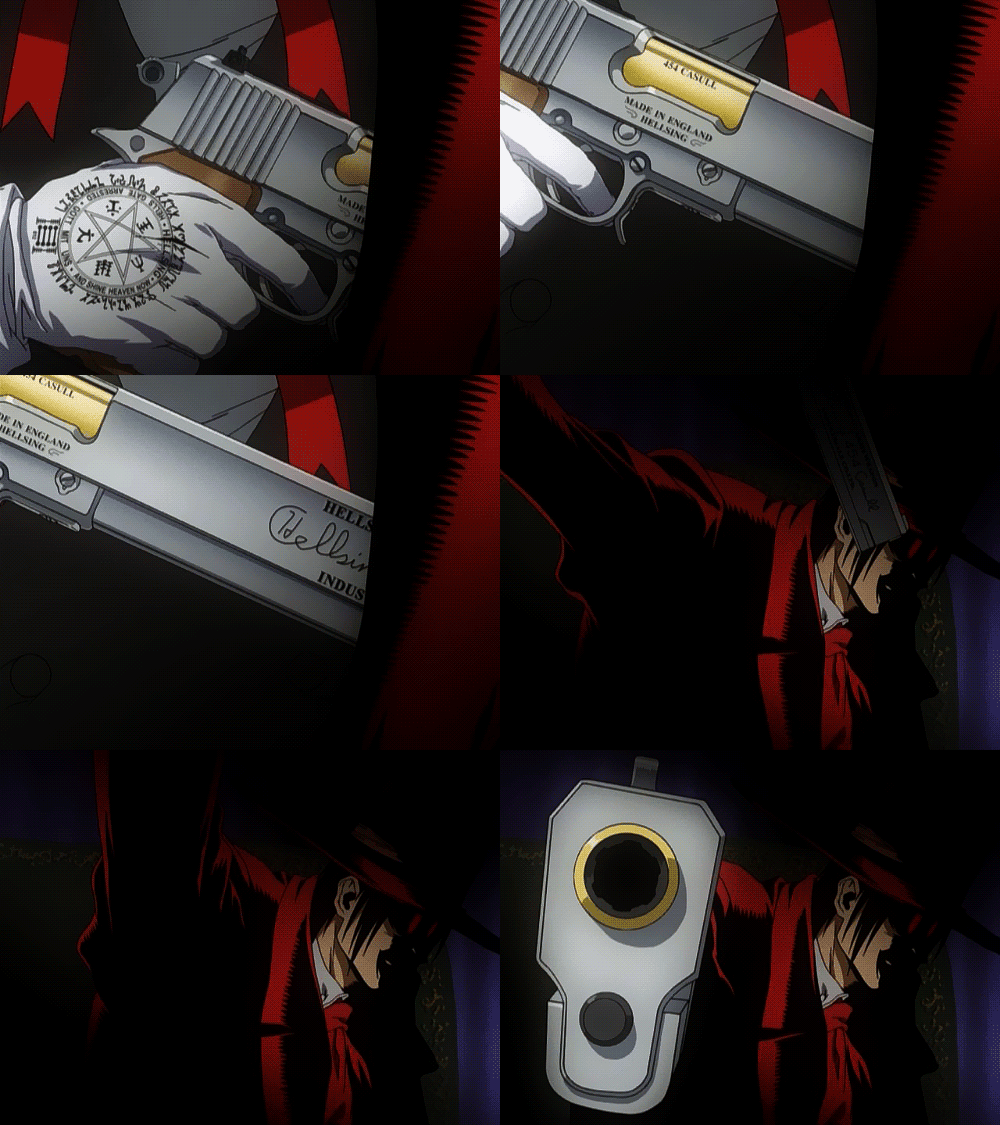
Alucard sprinted towards the malignance at full speed, eventually coming close enough to make out its features. It was a man, tall and pale skinned, with long claws and dark hair who was clad in a blood colored long coat with golden embroidery. A vampire then, from all appearances, and a powerful one at that if the malevolence he felt radiating off the guy in waves was any indication. Not that it bothered him much. He'd faced other vampires before and come out on top, and he'd do so again. As he drew closer, he took note of the crimson gauntlet surrounding the mans right hand, but did not make any attempt to move out of the way as he rushed towards him.
He wanted to see exactly what this blood drinker was capable of, what kind of weapons and abilities he would bring to bear. If that meant getting hit, then so be it. Alucard knew he was well within his limits in that regard. Predictably, the man lashed out, launching a whip of red tinged darkness towards him at high speeds. Watching the weapon arc through the air with a smirk, he allowed the whip to connect with his face and send him flying backwards into the side of a nearby building. Letting out a small chuckle, he clawed his way out of the rubble and got back to his feet, the large gash across his face already healing.
"Impressive!" He shouted, staring at the man from over the brim of his sunglasses. That attack had been more powerful than he'd been expecting, especially considering how underwhelming it'd looked.
Almost as though the vampire standing before him was holding back.
Leveling his Casull at the man-his eyes narrowing suspiciously-Alucard squeezed the trigger, sending a bullet spiraling straight for the mans forehead. Another test of his enemies capabilities, durability this time. While Alucard knew exactly how much damage his own body could take, just how much his opponent's was capable of tanking was still unknown.
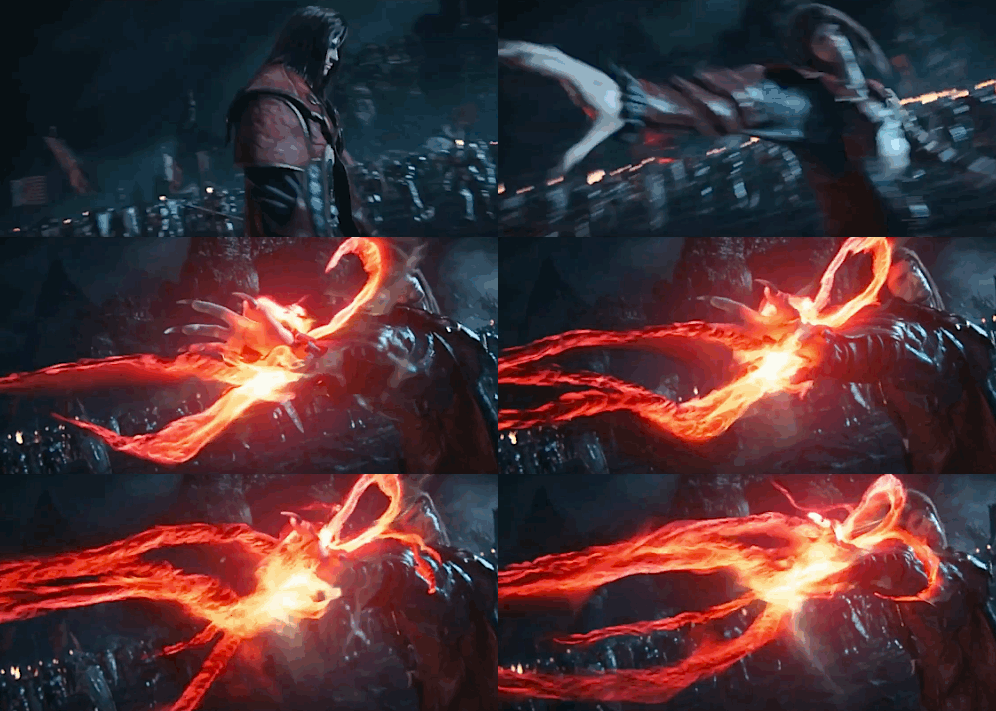
Dracula let out a quiet tsk as he slapped the other vampire away with his Shadow Whip, amazed at just how brash it had been. It was as though it had no concern for its unlife. Hell, maybe it didn't. Maybe it wanted to die, to put an end to its own existence as he himself did. Either because it saw its condition as a curse, or because it had simply grown tired of being. In any case the reason why hardly mattered as it had been taken care of. Turning away from the undead with sigh, Dracula dispelled his whip, and started to walk off when a shout caught his attention.
"Impressive!"
Halting midstride, Dracula turned round to find his opponent standing tall several feet away, its pistols still drawn.
One of which was pointed directly at his head. Watching as the other vampire pulled the trigger, his eyes narrowing into slits, Dracula saw the world slow as he called upon his supernatural reflexes. Striding towards Alucard, sidestepping the bullet as he moved in closer, Dracula summoned his void sword and took a swipe at his opponents neck, sending its head flying as the blade cleaved through lifeless flesh and bone with ease.



© 2007-2026