- Posting IC will be immensely beneficial to you as a player. It is, however, not necessary. This is designed so that you can still send in your orders if you are too busy to post, but posting IC will provide a tangible bonus to your DRM (Die Roll Modifier). - Each Turn represents one In-Game Month. The player will submit 3 Orders. - Each order is then subject to a 1d6 roll. A 6 means a perfect execution and a 1 means a horrible failure. Posting IC gives you a +2 die roll to a single order, or a +1 die roll to all three. [Specified at the end of your IC post.]. This means that more active players are rewarded. - Orders: * Economic: An order designed to benefit the nation economically. * Military: An order designed to affect your military. * Diplomacy: An order designed to conduct diplomacy. * Imperialism: Exploring and developing new lands. * Request Design: Required to design a new weapon of war. Fulfilling this order requires the following info - Type of Weapon: - Contract: [Domestic] or [International] - Desired Specifications: * Conference: Used to call a Political or Military Conference. Select which nations to invite. Begins a Conference. (See PM for rules). * Spend Point: Used to spend an available point in a Corporation to further their specialization.
1. City-State of Julia: +1 Tensions with Holy Empire of Vigentino.
Eurania and Faresia, 1905
The Fifth Continent, 1905
Nation Snapshot
Cydernian Republic
Capital: Sovachevitsa Head of State: Prime Minister Iosef Hataxuris (67) Population: 1,150,000 GDP Per Capita: $1,291 GDP: $1,484,650,000
Having gained independence in 1821, the Cydernian Republic has lived precariously on the Euranian continent under the nickname of the Crossroads to East and West. An amalgamation of Helroxi, Tyrian, Itheraen and Marnish cultures, the Cydernian identity itself has become more a conflagration of language, attitude and ideology in the last eighty years. Cydernia is a trade hub only by accident, as to get anywhere, you probably have to pass through Cydernia.
Following a conservative ideology that saw through to both a non-aggression pact and a defensive military alliance in 1897 with the Tyrian Empire, Cydernia was briefly embroiled in the Tyro-Helroxi War (1899-1900) where the Corpo Cydernia Centralis or Triple C was sent as an independent volunteer brigade attached under the 14th Imperial Army against the Helroxi. Her punishment was punitive debts that were only just paid off in the winter of 1904. The following election just after New Years saw the ultra conservative Iosef Hataxuris of the Cydernǎgarsko Natsionalno Dvizhenie (Cydernian Nationalist Party) win in a landslide victory.
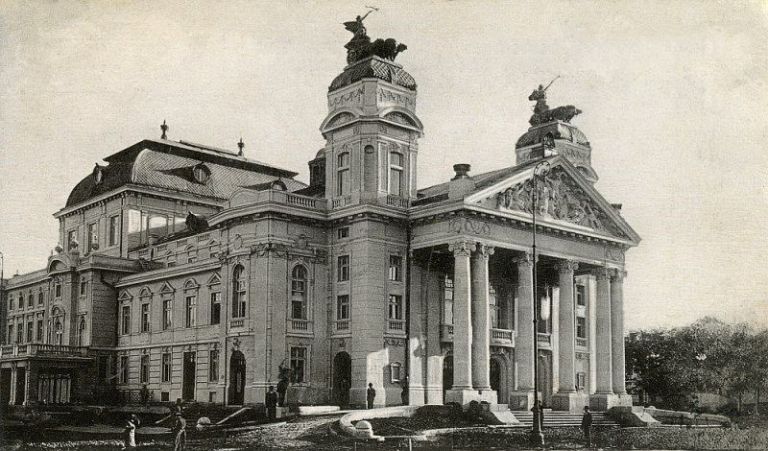
Cydernian State Assembly, circa 1900
Cydernia is mostly agrarian, with scant geography that lends itself to mining or extraction. Instead, she wagers her grains and vegetables to the more arid countries in the east like Sessau and Tara. Industrially defunct, Cydernia's small arms and munitions manufactories are nearly non-existent and she has traditionally purchased equipment from Julia in the South or neighboring Tyria to the North. Due to low wages and high poverty, few businesses see much reason to step into Cydernia to do business, but as both the locomotive and automobile begin to seriously contend for space in the world, it's inevitable they will find themselves in Cydernia.
Prime Minister Iosef Hataxuris, 1905
Likewise, the Cydernian Army was in similar straits. Facing strict budget cuts to keep the agricultural industry afloat after refusing to continue exports, the Cydernian Army--numbering nearly 98,000 men--has seen reduced wages, unreliable equipment and inconsistent training. Split into six infantry divisions and two cavalry divisions, they employ the Kaiser 1891 rifle and a mishmash of various field guns, although they only have 104 to bring to bear at any one time. A fierce jingoist, Hataxuris must navigate keeping his nation afloat and modernizing perhaps one of the most disheveled military apparatuses on the continent.
Soldiers of the Cydernian Army during the Tyro-Helroxi War, 1899
On February 5th, 1905, Prime Minister Hataxuris dispatched Foreign Minister Branko Trajkovski to the High Kingdom of Itherae to negotiate a political arrangement.
Whereas, the Government of the Cydernian Republic and the Government of the High Kingdom of Itherae desirous of strengthening the cause of peace between Cydernia and Itherae, will agree to the following:
Article I.: Both High Contracting Parties obligate themselves to desist from any act of violence, any aggressive action, and any attack on each other either individually or jointly with other powers.
Article II.: Should one of the High Contracting Parties become the object of belligerent action by a third power, the other High Contracting Party shall in no manner lend its support to this third power.
Article III.: The Governments of the two High Contracting Parties shall in the future maintain continual contact with one another for the purpose of consultation in order to exchange information on problems affecting their common interests.
Article IV.: Neither of the two High Contracting Parties shall participate in any grouping of powers whatsoever that is directly or indirectly aimed at the other party.
Article V.: Should disputes or conflicts arise between the High Contracting Parties over problems of one kind or another, both parties shall settle these disputes or conflicts exclusively through friendly exchange of opinion or, if necessary, through the establishment of arbitration commissions.
Article VI.: The present treaty is concluded for a period of ten years, with the proviso that, in so far as one of the High Contracting Parties does not denounce it one year prior to the expiration of this period, the validity of this treaty shall automatically be extended for another five years.
Article VII.: The present treaty shall be ratified within the shortest possible time. The ratifications shall be exchanged in Thermydon. The agreement shall enter into force as soon as it is signed.
[X] With Support of the Government, Foreign Minister Branko Trajkovski
[] With Support of the Government [Itheraen Delegation May Sign Here]
Hey, is it still possible to apply to this rp? This rp looks awesome so far. I'll be able to put application tommorow (or today, timezones are 'fun') if it's still open.
All players in this list may PM their orders now. Posting IC remains optional but strongly recommended.
1. Tyrian Empire 2. Republic of Paraka 3. Helrox Empire 4. Holy Empire of Vigentino 5. City-State of Julia 6. High Kingdom of Itherae 7. Confederation of Hokkan-Shirito 8. Empire of Toubrés
- Posting IC will be immensely beneficial to you as a player. It is, however, not necessary. This is designed so that you can still send in your orders if you are too busy to post, but posting IC will provide a tangible bonus to your DRM (Die Roll Modifier). - Each Turn represents one In-Game Month. The player will submit 3 Orders. - Each order is then subject to a 1d6 roll. A 6 means a perfect execution and a 1 means a horrible failure. Posting IC gives you a +2 die roll to a single order, or a +1 die roll to all three. [Specified at the end of your IC post.]. This means that more active players are rewarded. - Orders: * Economic: An order designed to benefit the nation economically. * Military: An order designed to affect your military. * Diplomacy: An order designed to conduct diplomacy. * Imperialism: Exploring and developing new lands. * Request Design: Required to design a new weapon of war. Fulfilling this order requires the following info - Type of Weapon: - Contract: [Domestic] or [International] - Desired Specifications: * Conference: Used to call a Political or Military Conference. Select which nations to invite. Begins a Conference. (See PM for rules). * Spend Point: Used to spend an available point in a Corporation to further their specialization.
1. City-State of Julia: +1 Tensions with Holy Empire of Vigentino.
Eurania and Faresia, 1905
The Fifth Continent, 1905
Turn 2
February, 1905 February 3rd In the Cydernian Republic, protests over Prime Minister Hataxuris' decision to cease grain exportation under the desire for autarky in agriculture leads to the February Strike, with farmers and rural workers flocking to the cities. Law enforcement is called out to maintain order and in a brief scuffle, three men are shot with one dead.
Cydernian February Strike, 1905
The strikes are temporarily ended but the leaders decide they will continue until the Prime Minister begins exporting much needed grain again.
February 4th In the City-State of Julia, the weapons manufacturer Thamber Corp finalizes theoretical blueprints on a 106mm fixed artillery piece capable of firing a shell over half a mile. [Thamber Corp Specialization Point added to Heavy Weapons.]
February 5th Military officers of the High Kingdom of Itherae set sail for the Confederation of Hokkan-Shiroto as per the Sallas-Jiang Trade Deal, they are expected to arrive at the end of the month to begin training the Confederate Army.
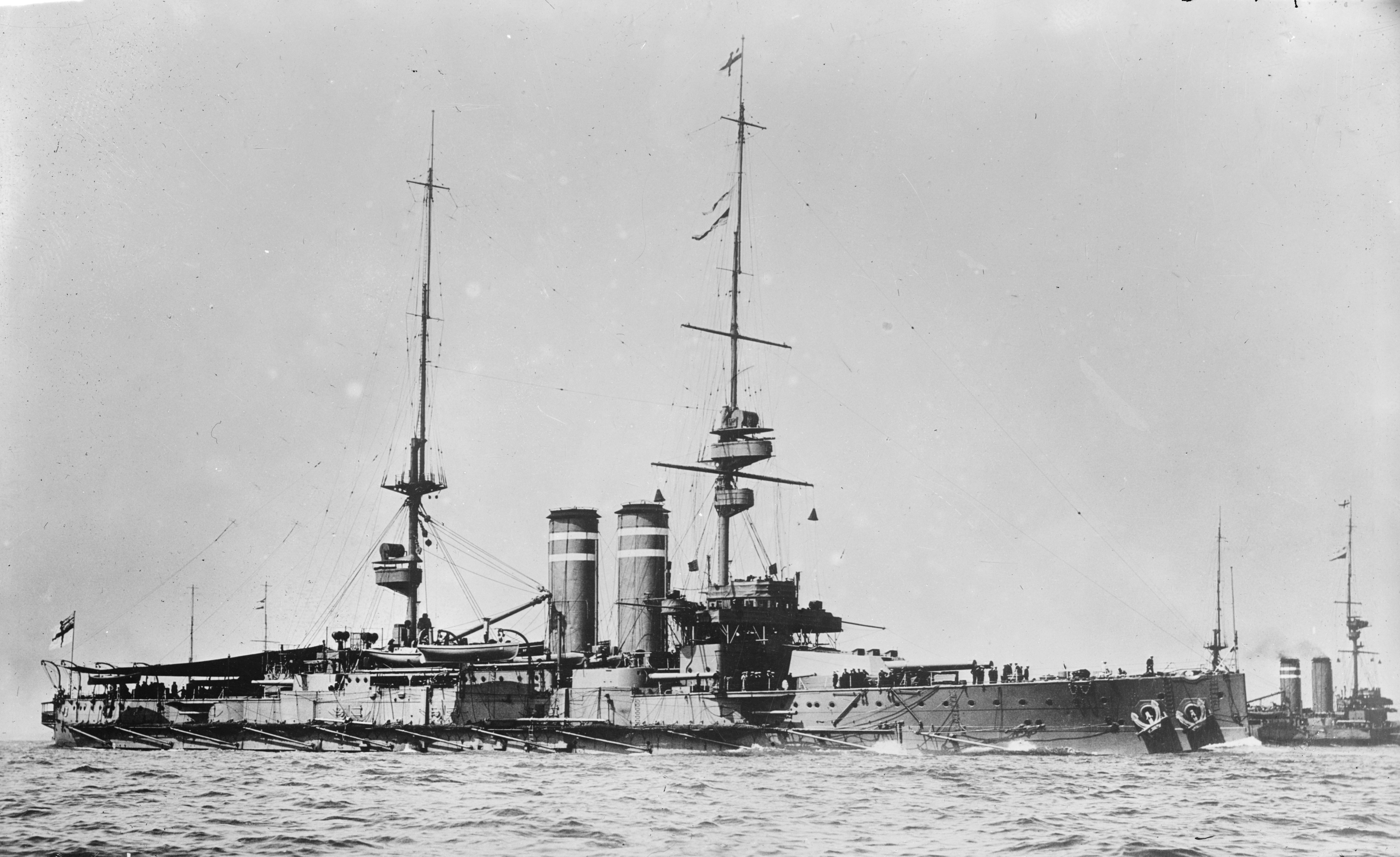
On the same day, the Empire of Toubrés launches the ETS Sadamastor, the first of her kind, a Sadamastor-class battleship and the largest in the world. ETS Sadamastor was laid down at E.N.V.C. Shipyard on October 14th, 1903, launched on February 5th, 1905, and planned to finish trials in June, 1905.
Although Sadamastor of the Sadamastor-class was a direct descendant of the Vincente class, they were also the first class to make a significant departure from the Vincente design, displacing about 1,000 tons more and mounting for the first time an intermediate battery of four 9.2-inch (234 mm) guns in addition to the standard outfit of 6-inch (152 mm) guns. The 9.2-inch was a quick-firing gun like the 6-inch, and its heavier shell made it a formidable weapon by the standards of the day when Sadamastor was designed; it was adopted out of concerns that Toubrian battleships were undergunned for their displacement and were becoming outgunned by foreign battleships that had begun to mount 8-inch (203 mm) intermediate batteries. The four 9.2-inch were mounted in single turrets abreast the foremast and mainmast, and Sadamastor thus could bring two of them to bear on either broadside. Even then, Sadamastor was criticized for not having a uniform secondary battery of 9.2-inch guns, something considered but rejected because of the length of time it would have taken to design the ships with such a radical revision of the secondary armament layout. In the end, it proved impossible to distinguish 12-inch and 9.2-inch shell splashes from one another, making fire control impractical for ships mounting both calibers, although Sadamastor had fire-control platforms on her fore- and mainmasts rather than the fighting tops of earlier classes.
Like all Toubrian battleships since the Vincente class, the Sadamastor had four 12-inch (305 mm) guns in two twin turrets (one forward and one aft). Mounting of the 6-inch guns in casemates was abandoned in Sadamastor, the 6-inch instead being placed in a central battery amidships protected by 7-inch (178 mm) armoured walls. Otherwise, Sadamastor's armour was much as in the Azmores-class battleships, although there were various differences in detail from the Azmores.
Sadamastor was the first Toubrian battleship with balanced rudders since the 1870s and were very maneuverable, with a tactical diameter of 340 yards (310 m) at 15 kn (28 km/h). However, they were difficult to keep on a straight course, and this characteristic led to them being nicknamed "the Wobbly Girl" during her sea trials. She had a slightly faster roll than previous Toubrian battleship classes, but had good gun platforms, although very wet in bad weather.
Primarily powered by coal, Sadamastor had oil sprayers installed during her construction, the first time this had been done in Toubrian battleships. These allowed steam pressure to be rapidly increased, improving Sadamastor's acceleration.
ETS Sadamastor on sea trials, February, 1905
February 6th The High Kingdom of Itherae orders production of Type 91 rifles, they are slated to be finished by the end of the month. Like the Kaiser 1891 rifle, the Type 91 uses two front-locking lugs to lock up the action. However, the Type 91's lugs lock in the horizontal position, whereas the Kaiser locks vertically. The Type 91 bolt body is multi-piece whereas the Kaiser is one piece. The Kaiser uses interchangeable bolt heads like the Helroxi Toshterin K1888. Unlike the Kaiser, which uses a "controlled feed" bolt head in which the cartridge base snaps up under the fixed extractor as the cartridge is fed from the magazine, the Type 91 has a "push feed" recessed bolt head in which the spring-loaded extractor snaps over the cartridge base as the bolt is finally closed. Like the Kaiser, the Type 91 uses a blade ejector mounted in the receiver. The Kaiser bolt is removed by simply pulling it fully to the rear of the receiver and squeezing the trigger, while the Mauser has a bolt stop lever separate from the trigger.
Like the Kaiser, the bolt lift arc on the Type 91 is 90 degrees, versus 60 degrees on the Toshterin K1888. The Mauser bolt handle is at the rear of the bolt body and locks behind the solid rear receiver ring. The Type 91 bolt handle is similar to the Ustrelan MLR-1 Rifle: It is attached to a protrusion on the middle of the bolt body, which serves as a bolt guide, and it locks protruding out of the ejection/loading port in front of a split rear receiver ring, also serving a similar function to Kaiser's "third" or "safety" lug.
The rifling of the Type 91 barrel is right turning (clockwise looking down the rifle) 4-groove with a twist of 1:9.5" or 1:10". The 5-round fixed metallic magazine can either be loaded by inserting the cartridges singly, or more often in military service, by the use of 5-round stripper clips.
Breakdown of the Itheraen LR Type 91 Rifle, circa 1894
February 7th
In the City-State of Julia, the Julian Independent Army begins Operation Sunrise, accomplishing it's military perimeters with ruthless efficiency and without errors.
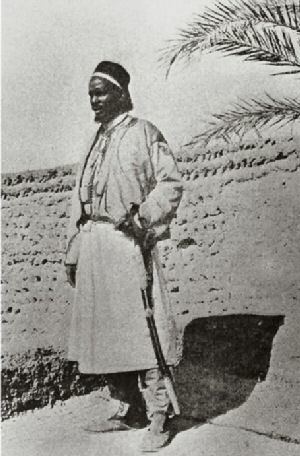
In Toubrian Serranthia, the Mullah Kahmar Mustafa announces his rebellion of the Tehmig people. His first act of rebellion is an ambush of the coastal fort Porto Guimarães and it's 280 man garrison. With nearly 1,100 men, he assaults the small town, killing 91 and taking the rest prisoner. Following his victory at Porto Guimarães, Mustafa's warriors leave the city--with it's prisoners in tow--back east into the desert. [Tehmig Rebellion begins in Toubrian Serranthia.]
Mullah Kahmar Mustafa, circa 1901
Forino Estadi Automobili: A mechanical company founded by Giovanni Mateo in 1899 in the Holy Empire of Vigentino, the Mateo Carriage is wildly considered the world's first automobile despite it's failure. F.E.A. is a privately owned firm currently operating out of Cogoli, Vigentino. - Inventions:
Forino 4HP: A 4 horsepower petrol motor that can theoretically power light machinery or pull a wagon if properly mounted. [0 Produced to date]
Segaso: An automobile company founded by Francisco Pereilla in 1905 in the Republic of Ustrela. The Segaso Modello 1 is the world's first city car. - Inventions:
Segaso Systéme 3.2HP: A 3.2 horsepower petrol motor mostly used to power the Segaso Modello 1. [306 Produced to date]
Segaso Modello 1: The world's first city car. Costing nearly $700, it is a luxury two passenger vehicle with a top speed of 11 miles per hour. [306 Produced to date]
All players in this list may PM their orders now. Posting IC remains optional but strongly recommended.
1. Tyrian Empire 2. Republic of Paraka 3. Helrox Empire 4. Holy Empire of Vigentino 5. City-State of Julia 6. High Kingdom of Itherae 7. Confederation of Hokkan-Shirito 8. Empire of Toubrés
- Posting IC will be immensely beneficial to you as a player. It is, however, not necessary. This is designed so that you can still send in your orders if you are too busy to post, but posting IC will provide a tangible bonus to your DRM (Die Roll Modifier). - Each Turn represents one In-Game Month. The player will submit 3 Orders. - Each order is then subject to a 1d6 roll. A 6 means a perfect execution and a 1 means a horrible failure. Posting IC gives you a +2 die roll to a single order, or a +1 die roll to all three. [Specified at the end of your IC post.]. This means that more active players are rewarded. - Orders: * Economic: An order designed to benefit the nation economically. * Military: An order designed to affect your military. * Diplomacy: An order designed to conduct diplomacy. * Imperialism: Exploring and developing new lands. * Request Design: Required to design a new weapon of war. Fulfilling this order requires the following info - Type of Weapon: - Contract: [Domestic] or [International] - Desired Specifications: * Conference: Used to call a Political or Military Conference. Select which nations to invite. Begins a Conference. (See PM for rules). * Spend Point: Used to spend an available point in a Corporation to further their specialization.
1. City-State of Julia: +1 Tensions with Holy Empire of Vigentino.
Eurania and Faresia, 1905
The Fifth Continent, 1905
Turn 2
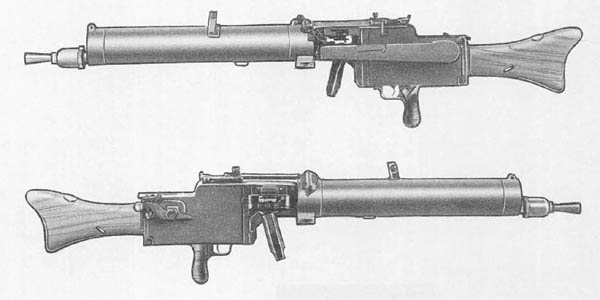
February, 1905 February 1st Operating as an entirely stated owned industry, Imperial Armouries of the Tyrian Empire finishes it's prototype Austerf MG 05/1. An almost exact replica of the Syndére from the neighboring Helrox Empire, the MG 05 was specifically designed to be a lightweight and more portable version. A lightened and thus more portable version — produced by "stepping-down" the upper rear and lower forward corners of the original MG 05's rectangular-outline receiver and breech assembly, and reducing the cooling jacket's diameter to 92.5 millimeters — was tested as a prototype in January by a team of weapon designers under the direction of Austerf der Wachat, the Imperial Design Bureau—the MG 05/1.
The MG 05/1 had been designed to be manned by three trained infantrymen spread on the ground around the gun and in the prone position. To accomplish that purpose, the MG 05/1 featured a short bipod rather than a heavy four-legged sled mount, plus a wooden gunstock and a pistol grip. At 18 kg, the MG 05/1 was lighter and less cumbersome than the standard MG 05, since the MG 05/1 had been designed to provide increased mobility of infantry automatic fire. It nevertheless remained a bulky water-cooled weapon that was quite demanding on the quality and training of its crews.
Tyrian MG 05/1 drawing from December, 1904
February 2nd The Sallas-Jiang Trade Deal is finalized after a week and a half of negotiations by the Confederation of Hokkan-Shirito and the High Kingdom of Itherae. Given a lack of specificity, the trade is brought overland through Tyria and Helrox.
Forino Estadi Automobili: A mechanical company founded by Giovanni Mateo in 1899 in the Holy Empire of Vigentino, the Mateo Carriage is wildly considered the world's first automobile despite it's failure. F.E.A. is a privately owned firm currently operating out of Cogoli, Vigentino. - Inventions:
Forino 4HP: A 4 horsepower petrol motor that can theoretically power light machinery or pull a wagon if properly mounted. [0 Produced to date]
Segaso: An automobile company founded by Francisco Pereilla in 1905 in the Republic of Ustrela. The Segaso Modello 1 is the world's first city car. - Inventions:
Segaso Systéme 3.2HP: A 3.2 horsepower petrol motor mostly used to power the Segaso Modello 1. [306 Produced to date]
Segaso Modello 1: The world's first city car. Costing nearly $700, it is a luxury two passenger vehicle with a top speed of 11 miles per hour. [306 Produced to date]


 FortunesFaded,
 Spiffy,
 Scrawl Banditta