Yeah, something around the end of Cold War would be preferable. Or alternatively using 1989-1990 as the dividing point after history changes. The latter has a double purpose because I think a literally present day NRP would hit too close to home.
I am perfectly satisfied with Neo Hungaria but I certainly don't mind a reboot. This game is filling up a long-missed niche. You can find a good number of Sci-fi, fantasy, medieval and nowadays even industrial age RPs here. The setting of this thread is kind of unique among them.
As for historical versus fantasy: I like both but personally I love to thinker with stuff. So in a fantasy setting with no guns I build sprig and air operated weapons, for example. Because I can. Just because for some reason it didn't historically happen it doesn't matter you have no way of inventing these.
Similarly if there's an alternate historical RP then I prefer to invent stuff which they could've created during the period but didn't. Because I can. Because I love doing this. If anything having a realistic framework actually aids me so in this sense the post-WW3 setting here was ideal.
Posted. Excuse me for being late, I was really planning to do this on Friday night. Worse, I even rushed a bit with this one, though everything that matters are already in it.
Yes, the fourth battlefield is New York or at least a 1000x1000m section of it. I leave it to the GM to decide where this part is. The streets are practically empty but otherwise everything else is operational. Also I imagined that if you reach the end of the battlefield then you are transported to the other end of the map.
"Huh, where am I?" Alicia looked around in confusion. She remembers patrolling the city like she always did at night but the last 20 minutes are like a blur to her. She vaguely recalls a conversation with a scary person talking about a battle to the death or something. It was a surreal experience and Alicia wishes that to be just a dream. Yet deep down she could feel that was reality. It happened and she found herself within the empty void with nothing but a small sphere floating in front of her. Alicia suddenly remembers the sphere which took her to this strange world. Maybe she can find her way home afterall!
Alicia touched the sphere and thought of returning home. Suddenly she found herself in the familiar scenery of New York.
"Oh no! The sun is almost up! Mom is going to scold me if I don't be in my bed at morning!" Alicia though this and ran. Yet something was strange. Wherever she went Alicia didn't meet anybody. All streets were completely empty. She checked the time on her watch, it was 5:00AM, just like five minutes ago. Did her watch broke? No, she checked the clocks on the street and they all showed 5:00 AM. As if the time's flow stopped. "No!...It can't..."
"Yes it did. Now, after you had your fun we have a tight schedule to follow. I take you to the main arena. Everyone is waiting for you!" Alicia heard that scary voice again. Soon the world around her became a blur and she suddenly found herself in the center of the arena. The crowd was cheering in the distance but Alicia had a feeling she wouldn't like the same thing they do. In her field of vision she saw 3 people, all of them looking mean and scary. She felt a strong bad guy vibe from them. Still, her mother taught Alicia to not judge book from its cover. "Howdy! My name is Alici-...*ekhm* I mean Shining Blaze." She waved at the strangers though Alicia didn't let her guard down. If what that Liaison guy said was true she's part of a four-way deathmatch of freaks across the multiverse thing. That was a cliche scenario in comic books but even after becoming a superheroine Alicia never thought this would happen to her. Yet she had no reason to be excited. Some bad guys kidnapped her and they are forcing poor Alicia to fight. She'll give them a good clobbering as soon as she escapes!
As is described right at the top of the coordinates section, the Sequential Anomalies are listed in order of their appearance on the maps, from left to right (which remains unchanged between maps since they only shift position vertically). So Wormhole One is the the Wormhole on the far left on both maps.
Okay, I missed that. Can make sense and hopefully this would help the other players, too. Either way I already found the two wormholes I'm looking for. Wormhole two and five. 11,000 lightyears of travel for the wormhole and after popping out at the other end it'd take around 10,050 lightyears to reach @Durandal. Meaning in a sense I can already make contact with him. @SgtEasy's civ is the other potential contact with the distance of around 12,800 lightyears. From Wormhole Five Mihdar's Space Communists are also "only" 14,500 lightyears away, too.
@TerminalMind to add numbers for the anomalies on the map? Without that the coordinates for the anomalies are kind of useless. For example which number is for the wormhole that propels me close to Durandal? What are the exit wormhole's coordinates? I have no way to tell aside from a wild guess or measuring one of the coordinates myself.
The manual calculation is actually faster once you get the hang of things but generally the online calculators are used because not all people are attuned to measure stuff.
BTW, since warfare is going to be a thing and I doubt every layman is knowledgeable about this thing, here's a brief summary on weapons, units and a bit of on the tactics used during this period.
First off, the musket. The dominating weapon during this era which will only rise in importance as time marches on. The most popular firing mechanism is the flintlock which actually has several variants but it generally doesn't matter. What you'd rather wish to know is that how effective are these in combat, right? Well, it fires a ball about 10 times heavier than an assault rifle bullet. These things are nasty and one hit anywhere is guaranteed to incapacitate the enemy (even if they don't die). Are they inaccurate as the myth says? Depends. Volley fires were tended to be at 30-50m in order to maximize their power but otherwise muskets can semi-accurately shoot for 160 meters and the musket ball can kill from even 300 meters away. It's possible to reach better accuracy with a tight-fitting ball but snug projectiles made the barrels foul with unburnt powder much faster so it was useless for massed armies. As for rate of fire, it depends on training and a tiny bit on the quality of equipment. The speed of volleys depended on the slowest reloading soldier in your fire team. So worst case was one per minute while the best shooters can perform 4 shots under the same time. Some Napoleonic sources state 6 but that was a century later and only expected during training. Muskets vs armor? Muskets didn't actually made armor obsolete, just less convenient. The so-called "musket-proof" armors were thick (5-8mm) and contained 2-3 different layers pressed together. These were heavy so they only protected the vitals and in case of riders the horse was pretty much exposed. As such armor will steadily go out of fashion as we progress in the 18th century here. Armor can save your life but not with complete certainty. Still, it does give a considerable headache for gunmen trying to shoot you down. Lastly, with the invention of gun bayonets your musketeers are effectively also pikemen and if the situation calls for it you can use them as such. Though the tendency of thinner formations did reduce their effectiveness in this role. Yet as time goes on the gunmen will rel more and more on their firearms instead of anything else and the tactic of a well-timed volley can stop many kinds of threats.
Second, the cannons. While nowhere as good as their modern or WW2 counterparts, artillery was a valuable asset not only during sieges but also within the battlefield. The classic cannons you see in various media are pretty much these. They are big metal tubes usually firing solid iron balls. They could be devastating on hit and with a bit of luck (and misfortune to the enemy) they bounced, increasing their path of lethality further. Basically think of Bowling but made sickeningly brutal, that's the contemporary cannonball in action. The range of these cannons were around 600-700 meters but certain unique pieces could fire for twice as far. Worths noting though that many armies preferred to shoot from 200-250 meters as this improved the cannons' lethality to a considerable degree. Aside from solid balls the cannon could fire multitude of creatively designed projectiles, you can look them up here. Firing with cannons was no easy thing, though. It required lot of technical skill, finely refined gunpowder and a list of other things. In a way you can measure a nation's wealth and technical development by the number and quality of their cannons. Cannons were shot by two means, linstock and gunlocks. Linstock is using a long slowmatch rod to directly ignite the primer, the matchlock of cannons. Fittingly with this theme the gunlocks use a flintlock mechanism. Technically the gunlocks were only really introduced in 1745 but in effect they aren't much different from flintlock so you may get them earlier.
Third, units. Just because your army uses guns it doesn't mean everybody has the same role. the overwhelming bulk of your infantry will be made of the line soldiers, that is the guys who stand in line tightly packed lines and fire. Next important element are the skirmishers. Skirmisher can be both a general term for harassers or mean a specific role. Skirmishers move ahead of the main army. They have lighter equipment for this reason and move in loose formation. They try to break the enemy's lines by attacking from the flank and even often use cover for safety. Skirmishers are rather exposed to cavalry attacks. Around this time nations also began using sharpshooters, skilled soldiers who may use better guns (early rifles, airguns, etc) with better fitting loads to shoot from further away. Sharpshooters/marksmen were rare for obvious reasons. Lastly, there are the grenadiers. During mid 17th century many nations tried using thrown bombs and for this role they recruited the most physically fit soldiers. Early grenades were a failure but the grenadier role stayed as elite assault units. Cavalry had many variations, too. Guns made firing lines dominate the battlefields yet the speed and power of cavalry charges was valuable if timed right. They also used guns (generally pistols and shortened muskets) but they were less accurate and generally it only softened up the target for a cavalry charge. Heavy cavalry still existed but the changes would trend to lighter units in the future. Aside from firing on horseback there's also the dragoons who use horses but dismount prior to combat and fight on foot.
So yeah, on paper a 17th century battle ma look simple. In effect the tactics were about mind games. I hope my long text above was helpful.
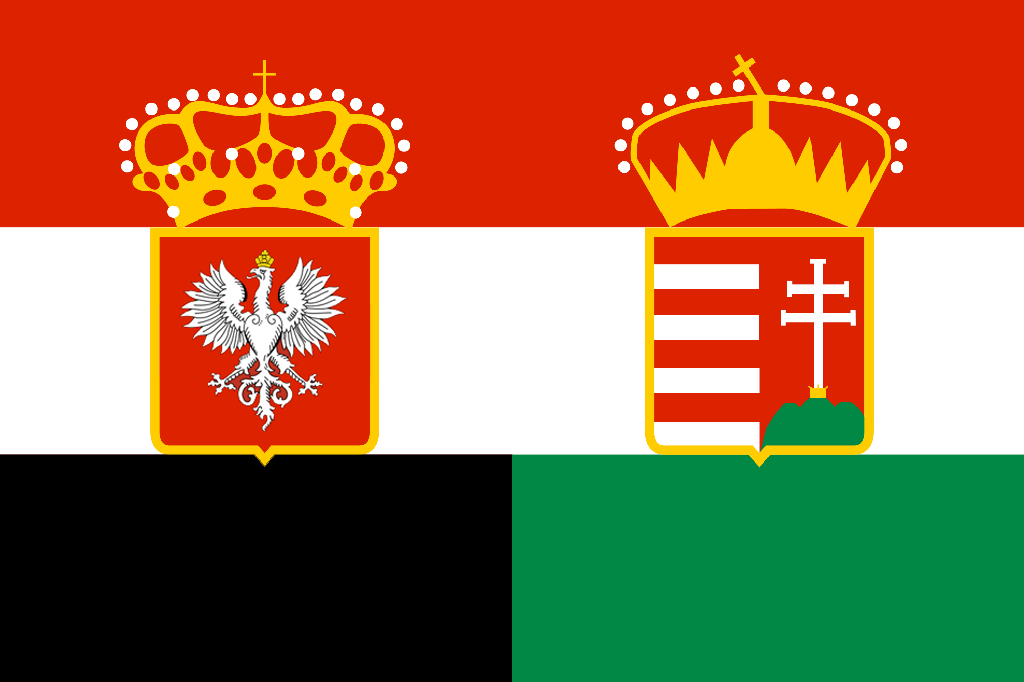
Alright, posting my more complete NS. The Military part is very much WIP for now but otherwise I'm ready:
United Kingdoms of Hungary-Poland
Nation Summary
Official Name: United Kingdoms of Hungary-Poland Unofficial Names: Báthory Monarchy, Hungary-Poland, The Dragon's Land Government: Personal union between Hungary and Poland (and their members) Population: c. 20 million Standing Army: 60,000 Primary Industries: Agriculture, Mining, (Smithy and Clothmaking as emerging big industries) Trade Goods: Salt, iron, coal, precious metals, grain, livestock, exotic goods from Asia Friends: Khazaria, Valois France-Spain, Sweden, Italy, Finland Enemies: Holy Roman Empire, Ottoman Empire, Novgorod Tribe
History/General Overview
Personal union of the Kingdoms of Poland and Hungary ruled by the Báthory Dynasty. Their first king was Stephen Báthory I. whose deft use of politics made him voivode of Transylvania, King of Poland and eventually also King of Hungary. His aim was to create a strong nation in Central Europe which is no longer prey to the great powers from neither the East or West. His vision was continued by his son Sigismund who took back Buda from the Ottomans and made several territorial gains in Hungary. In 1648 Hungary-Poland led the Holy League against the Turkish Menace. This coincided with the rebellion of the Janissaries thus rendering the Ottomans weak enough that the champaign concluded in major victory. The war abruptly ended when the Habsburg Monarchy went against the treaty and attacked Hungary before the Turkish forces could be truly expelled from Europe. Regardless, Sigmund achieved his main objective, reclaiming Hungary as a whole. Following this Poland-Hungary entered an era of consolidation and relative peace. The Pope urged the Báthory Dynasty to drive out the Turks but rivalry with the Habsburgs kept Hungary-Poland in check. The year is 1700 and the Kingdoms are ruled by their seventh shared king, Francis Báthory II. The world is at change as Europe erupts in war and turmoil once again.
Government Overview
Hungary-Poland is a personal union ruled by a shared king from the Báthory Dynasty. Both Hungary and Poland are technically elective monarchies but effectively the nation was reigned by the descendants of Stephen Báthory the Great ever since its conception. Over the century the Báthory Dynasty made many reforms and modernized the old feudal system with the ideas of Enlightenment. Regardless, the high nobility held great power in both countries and even during Sigismund's legendary reign the king required support from the estates of the realm to effectively rule the nation. Fortunately, tensions between the nobility and the Báthory Dynasty are relatively low which aided the nation's development considerably.
Francis Báthory II. (II. Báthory Ferenc) is the 7th king of the United Kingdoms of Hungary-Poland. His father Francis Báthory I. died only a few months after his son's birth in 1676, leaving only his mother Jelena Zrinska. He learned to ride on horseback by the age of 3 and he was taught by the best tutors in both the courts of Hungary and Poland. Following that he studied in Italy and later France. He was royalty but Francis didn't allow that to get into his head. The boy was described as spirited, friendly and humble. In spite of that Francis didn't forget his heritage and conducted himself the way which was befitting his birth. Descended from the branch of the Báthory dynasty, Francis was an unlikely candidate for the throne. Yet with the sudden death of Stephen Báthory II. without a male heir, he was the most logical choice. He was recalled from France and in the winter of 1698 Francis Báthory II. was crowned king as I. Ferenc (Hungarian) and Franciszek I. (Polish). He's an enlightened and studious ruler, fluent in several languages. He's also a brave man who had already proved his worth in battle. His honorable reputation was partially the reason for Francis' quick election.
Side Note: He's the alternate history version of Francis Rákóczi II. His grandmother was actually Zsofia Báthory so as an amusing twist of history he'd be likely the king of Hungary-Poland here. https://en.wikipedia.org/wiki/Francis_II_R%C3%A1k%C3%B3czi
Economy/Industry Overview
Hungary-Poland is gifted with plentiful arable lands and rich mountains. As such traditionally agriculture and mining are their two most important industries. As of the late 17th century Hungary-Poland became an important trade hub between the east and west, with a land route leading from Khazaria to Hungary and then to either North or Southern Italy which distributed the goods through Europe. Aside from exotic goods this also reinforced Poland-Hungary's status as the primary source of gold and silver, thus their trade could directly influence the economy of other nations. There exists an alternative route from the Ottoman Empire to Germany but because it's a sea route through Hungary-Poland's territorial waters they need to pay heavy tariffs.
This influx of money aided the modernization of Hungary-Poland massively, allowing them to invite foreign experts from all over Europe. From 1652 onwards clockmakers from England, France and even Germany traveled to Hungary-Poland and were employed by the royal court as well as the high nobles. This eventually lead to the foundation of the Royal Clockmaker Guild (Királyi Órakészítű Céh / Królewski Zegarmistrz Gildii) and several other derivatives. Other crafts and industries were on the rise as well. Number of mining towns collected extensive number of blacksmiths. Selmecbánya stands out the most as the location for the first ever mining academy in history, as well as Hungary's hub for firearm production. Speaking of universities, the Báthory Dynasty supported the creation of no less than 5 universities. While their fame didn't even approach Italy's the foundation of these were an important step towards the modernization of both countries. Overall, Hungary-Poland still needs to catch up to the more advanced nations in the West but they are close to approaching them.
Hungary-Poland has 3 shores to three different seas: Baltic Sea, Black Sea and the Mediterranean Sea. Seafaring is popular and common for trade. Although compared to the Western nations Hungary-Poland is too busy with their enemies to join in the colonization attempts.
 Member

 salamimike
 Durandals