1 Guest viewing this page
Hidden 4 mos ago 4 mos ago Post by Vec
Raw
GM
Avatar of Vec

Vec Unimaginable Trepidation

Member Seen 15 days ago


The woman's hands shook as she prepared the evening meal.

Her daughter, her only daughter, had stopped eating three days ago. Not from illness, not from grief, but from something far more insidious. The girl, barely sixteen, had locked herself in the small room behind the cooking fire and emerged only to pray.

"Mother," she had whispered that morning, her voice hoarse from hours of recitation, "I saw the honey cakes you saved. I can't. What if... what if I'm not worthy? What if I arrive at the Golden Land and He turns me away because I was greedy?"

"You're not dying," the mother had replied, trying to keep her voice steady. "You don't need to worry about any of this."

"But I will die. Someday. Everyone does. And when I do, I need to be ready. I need to be perfect."

The woman had found her daughter that afternoon, kneeling on the stone floor with her palms pressed together so hard the knuckles had gone white. The girl was whispering a prayer, the same prayer she'd been repeating for days, the same words over and over until they lost all meaning and became just sound, just desperate rhythm.

Similar scenes unfolded across the settlement.

An old man who had worshipped Orranoth faithfully for years now spent his nights weeping, convinced that a single lie told in his youth (a small thing, a harmless exaggeration) would bar him from paradise. His family found him carving apologies into a piece of wood, desperate messages to a god who had never suggested such penance was required.

A mother refused to let her children play, terrified that laughter might be interpreted as frivolity, that joy in this life might somehow count against them in the next. Better to be somber, she reasoned. Better to prove their devotion through restraint.

The priests tried to intervene. They stood in the amber temples and proclaimed what Orranoth had actually promised: peace for the faithful, reunion with loved ones, eternal rest. "You are worrying for nothing," they insisted. "The Sky Father does not demand perfection. He offers a gift."

But gifts, the people had learned, always came with conditions. And if the conditions weren't spoken aloud, then perhaps they were hidden, waiting to be discovered too late.

In the next settlement over, where Orranoth's worship had not yet taken hold, the mood was different.

A man sat outside his home as dusk settled, watching his neighbor (an Orranoth-faithful) hurry past toward the amber shrine. The man's wife had died two seasons ago, buried according to the old customs, her body returned to the earth. He had grieved, yes, but he had also found peace in the knowledge that she was part of the world now, part of the soil and the growing things.

But lately, doubt crept in.

What if he was wrong? What if the Orranoth-worshippers were right, and there truly was a paradise waiting, but only for them? What if his wife's soul had simply ended, while theirs would live forever in golden halls, young and joyful and whole?

The thought made him nauseous.

His children had started asking questions. "Father, if we die, where do we go?"

He didn't have an answer anymore. The old answer ("back to the earth, back to the cycle") felt hollow now. Felt like losing.

Two settlements existed side by side. One drowning in religious anxiety, terrified of failing a test they hadn't known existed. The other drowning in existential dread, watching their neighbors prepare for an eternity they would never share.

The priests of Orranoth tried to calm the faithful. The skeptics tried to dismiss the promises as fantasy. But neither prayer nor denial could answer the question that now haunted every deathbed, every funeral, every moment of mortal fear: Where will I go when I die? And will it be enough?

In the amber temples, they prayed for answers. In the homes outside them, they prayed for different ones.

And Orranoth, potentially watching from his Golden Land where the first souls already walked in restored youth, saw what his gift had created: not just paradise, but the fear of losing it.

Tamas first noticed something wrong when his neighbor wouldn't sell him bread.

"I've got coin," Tamas said, holding up three copper pieces. Honest pay from an honest week's work in the fields. "Same as always."

The baker, a round-faced woman named Hetta who'd sold him bread every sixth-day for years, looked at the coins and shook her head. "Not those."

"What do you mean, 'not those'?"

"I mean I'll take silver, or Fortunite if you've got it. But not copper. Not anymore." She gestured to the coins in his hand. "Those are spent."

Tamas stared at her. "Spent? They're coins. I just earned them yesterday."

"Doesn't matter. Look at them."

He did. The copper pieces looked... off. Dull, somehow. Darker than they should be, with faint rust-colored stains spreading across their surfaces like old blood. He'd assumed it was dirt, but now that he looked closer, the stains seemed to be inside the metal itself, as if the copper had been corrupted from within.

"Where'd you get them?" Hetta asked, her voice quiet now, almost frightened.

"From Malen. The landowner. He paid me for harvest work, same as he always does." Tamas frowned. "What's wrong with them?"

"They're from the offering," Hetta whispered. "From that night. The night that thing in the hood made everyone mad."

Tamas remembered. Everyone did. Three weeks ago, a hooded figure had orchestrated some kind of ritual in the road: drums, chanting, a slaughtered bird. By morning, the crowd had torn itself apart fighting over bloodstained coins. Most people dismissed it as mass hysteria, a moment of shared madness brought on by bad mushrooms or fouled drink. But the coins had survived. And now they were spreading.

"I don't understand," Tamas said. "These aren't from that pile. Malen paid me with his own coin."

"And where'd Malen get it?" Hetta asked. "Who paid him? And who paid them? The stained ones got mixed in with the clean ones, and now they're everywhere. You can't tell which is which until you try to spend them, and by then it's too late."

She wasn't wrong. Tamas looked at the coins again, at the rust-stains that seemed to pulse faintly in the lamplight. He'd carried these for a full day and hadn't noticed anything wrong. But now that he knew what to look for, the corruption was obvious.

"So what am I supposed to do?"

Hetta shrugged. "Find someone who'll still take them. Or spend them before anyone notices. Just..." She paused, choosing her words carefully. "Just don't spend them here."

Tamas left without bread. He tried two other shops before he found one willing to accept his coin: a tavern at the edge of the settlement, run by a man desperate enough for business that he didn't care what the metal looked like. The ale Tamas bought tasted wrong, bitter and flat, but at least the coins were gone. The problem was, everyone else had the same idea.

Within days, the settlement's economy had stratified into two tiers: those who had clean coin, and those who didn't. The clean coin was hoarded, kept safe, spent only with trusted merchants. The stained coin circulated freely among the desperate, the unlucky, and the unaware. And the stain kept spreading.

Merchants began refusing payment from anyone who "looked poor." If you were desperate enough to spend stained coin, they reasoned, you probably had stained coin. Better to turn you away entirely than risk contamination.

Tamas watched it happen. Watched the settlement divide itself into those who could afford to be choosy and those who couldn't. Watched wealth concentrate among the few who'd managed to keep their coins clean while the rest scrambled for scraps.

By the fourth week, people were fighting again. Not a riot this time, nothing as dramatic as the original offering. Just small, bitter conflicts: a man accusing a merchant of short-changing him, a woman screaming that she'd been cheated, children stealing from market stalls because their families' coin had been refused.

Wealth over justice, the hooded thing had hissed.

Tamas hadn't been there that night, but he'd heard the stories. Three words, spoken over blood-soaked metal, binding something wrong into the world. He looked at his empty purse and wondered what would happen when the stain reached everywhere, when every coin in the valley carried that rust-colored curse. Would they go back to barter? Find new currency? Or would they simply accept that some people would always have clean coin and others never would, that the offering had divided them permanently into haves and have-nots?

In his pocket, he still had one copper piece... his last. He pulled it out and held it to the light. The stain was already there, spreading like infection.

He spent it that night, passing it off to someone else. "Let it become their problem..."

That, he supposed, was the lesson. The thing the hooded figure had been trying to teach them. Wealth wasn't about having. It was about passing the curse along before it consumed you.

The stories continued to spread, carried by traders and travelers, told in taverns and around cooking fires. In many places, the Fortunite debates reached a kind of exhausted stalemate, with communities either accepting the coin-based economy or rejecting it entirely, with little middle ground remaining. But the consequences rippled outward still: gambling addiction support networks formed in Gamblerdise, while other settlements banned games of chance altogether, terrified of what the currency would do to their people.

The Ash Speakers continued their work, and continued their corruption. In some places, they had organized into formal guilds with strict ethical codes. In others, they remained solitary operators who charged whatever grief would pay. The dead were burned, mostly, though Wraiths still rose in places where Ash Speakers were absent or incompetent or simply too cruel to care.

The ruins of Telepylos remained avoided, a dark scar on the hillside that no one wanted to approach. The story of the monument's fall had been told so many times now that dozens of versions existed, each emphasizing different lessons: don't anger gods, don't carve living stone, don't build with hubris, don't trust mortal ambition. Architecture across Ashuru continued to diverge based on which version of the story each culture believed.

The ocean kept its boundary. Fishermen had learned where the light ended and would not cross it. The deep water sang to those who listened, and some answered, walking into the waves to dissolve into something larger than themselves. But most stayed in the shallows, grateful for abundant fish and predictable tides, asking no questions about what lived in the darkness below.

The world was, piece by piece and crisis by crisis, changing. Some changes brought order, while others brought fear. All of them, however, brought questions that mortals were only beginning to learn how to ask.
1x Like Like
Hidden 4 mos ago 4 mos ago Post by ActRaiserTheReturned
Raw
Avatar of ActRaiserTheReturned

ActRaiserTheReturned

Member Seen 1 hr ago

Orranoth

Orranoth had his hands full. The people were reaping the rewards of his plane, and over all it was still worth it, but it came with a ton of problems. The lot of these problems came in the baggage of Legalism, or existentialism. Orranoth would appoint Rad and his priests the duty of teachings of The Golden Land, so as to bring alleviation for the terrible unintended consequences of Orranoth's gift. Orranoth explains that worry it'self is too much of a strain in regards to the Golden Land. Orranoth explains that the Golden Land is a gift to be looked forward to.

Even nonbelievers may one day reach The Golden Land, though none had yet. There were ways to reach The Golden Land. You had to worship Orranoth, and even though you could reach The Golden Land without being close to perfect, your behavior, attitude and love for your fellow people dictated how good The Golden Land would be for you. Other than that, suffering, but more importantly, keeping a good attitude of love towards others was the main way to please Orranoth.

Doing good things is highly encouraged, and Orranoth honored them. Also, refraining from doing bad things was also honored. Orranoth did not necessarily let bad things slide- he could be wrathful against certain horrors such as murder, abusiveness towards the innocent and unspeakable evils were punished and, if there was no redemption or even attempted atonement in this life for evil deeds and wanton misbehaviors, punishments could range from the reduction of peace and privileges in the Golden Land, nullification of their rewards entirely in the hereafter including being EXILED from the Golden Land, or at worst, Orranoth would basically demand his servants hunt down the evil doers, curse them himself or both.

Orranoth explains to Rad also there were ways to express sorrow for notable misdeeds such as theft or even worse behavior. For example, for heinous evil deeds, an evil doer could basically exchange their lives, forfeiting Orranoth's blessings in this life so they could keep their citizenship in The Golden Land. Hopefully though sacrifices could include crops, livestock, currency, or even temporary servitude.

Lying, for another example, only requires an apology.

Furthermore, he relays to his priest that his benevolent will extends towards nonbelievers, but they were not heaven bound YET. There were two ways to try and bring Nonbelievers to The Golden Land. Intermarriage with the honorable and kind, and friendship with such people. These people also had to cooperate with their spouse or friends, and at least had to be honorable friends to Radanuh, Rad, and/or the believers of Orranoth.

Hidden 4 mos ago 4 mos ago Post by Stanifly
Raw
Avatar of Stanifly

Stanifly buzz

Member Seen 6 days ago

ᦓ꠸᥅ꪀꪖ


Strange things were happening. Sirna found this to be the usual state of affairs the world constantly found itself in. Corrupted dream guides running around; incoherent snippets of thought that came from something that was neither god nor mortal; and a new dimensional space brushing up against the Dreamscape. That last one was a fascinating concept. Sirna was fairly certain that the mortals dwelling within it had expired from the waking world, but instead of existing in a dreamless limbo, they lived as they did in life, surrounded by bountiful blessings. They played, they ate, they dreamed – that was how Sirna came to know about the dimension in the first place.

(Admittedly, that was how they came know about most things. Mortals were useful like that.)

Sirna wasn’t much concerned about those things at the moment. They were busy staring at sand.

Shifting landscapes weren’t unusual in the Dreamscape. Permanence did not exist here and consistency less so. This sand shifted around but it did not fade in and out of existence. Its form was loose but did not become inconsistent.

This was not a product of the Dreamscape.

Sirna, currently a wooden teaspoon resting upon the surface of this sand as it rippled and rolled across the lands of the Dreamscape, could not sense much thought from the sand. It possessed instinct of a kind, and it was certainly a visitor from the waking world, but when Sirna had attempted to find its waking counterpart, they could not. This creature of sand, no matter its origin, seemed to be a permanent resident of the Dreamscape now.

The realisation had been displeasing at first, for Sirna was immediately reminded of the shaman who had attempted to flee the waking world by taking refuge in the Dreamscape. Further observation of the sand quelled that displeasure, however. Even within the boundaries of the Dreamscape, it kept moving, seeking... something. Whatever it was doing, it did not remain idle. And so Sirna had decided to see where it would go and what it would do when it arrived there.

(Perhaps it was searching for a way back to the waking world. Sirna had considered sending it back directly, but the thought of offering a direct answer to any creature’s problem was far more disturbing than tolerating this odd singular consciousness.)


You have been neglecting your duties.

Sirna was immediately regretful, in that they should have chosen a form more capable of turning over than a wooden teaspoon. The black thundercloud trailing above them now was an irritating sight.

On the contrary,’ said Sirna. ‘Your greed knows no bounds if the moons proved insufficient for you, Patron.


You call it greed, rumbled Oblivion. I call it sense. How is a singular action sufficient for accomplishing anything?

You tire me.

And why have you adopted this form? What have you deemed more important than overseeing the spread of oblivion among mortals?

There were many things more important than drowning Ashuru in eternal oblivion. If everyone despaired all the time, then it would become their new normal and acceptance would take the reigns. What was oblivion without the light of hope casting its shadow?

Instead of explaining any of this, Sirna said, ‘Sandbathing.

Oblivion’s thundercloud sparkled with lightning. Much of what it said next was lost to Sirna, on account of them dismissing its rambling tirade as a waste of their godly faculties. Did the Patron of Oblivion not have better things to do with its time? If it came from beyond the boundaries of whatever made up their reality, surely there was some other Ashuru out there with some other Sirna that it could bother. Why fixate itself here?

The sand had stopped moving.

Before it sat a dream guide – or more precisely, a thing that used to be a dream guide. It still bore the silhouette of a hare, but its skin was that of the void. Wafts of black scentless smoke streamed off its fur-less coat.

It lunged. Upon contact, Sirna’s teaspoon exploded into a fine mist. They were fine, of course. The not-dream guide sunk its paws into the sand, black eyes flashing.

The sand began bubbling. It did not howl, but the stench of misery rose from them both. Some of the sand began clambering up the hare’s paws, up its arms, up its neck. On it went, until the sand coated the entire hare, snuffling the smoke that came off of it.

Oblivion, who had finally ceased its rant when the hare had attacked, spoke up again.


Is that not the work of Nightmares?

It meddles,’ muttered Sirna, now a thin curtain of mist. ‘I am not prone to violence but it was smart to hide itself after interfering with my creation. You Patrons are all the same.

And what of the earthly material?

A mystery. Look.

Oblivion looked. The hare was shaking off the sand, spilling grains far and wide. It seemed larger. Its smoke thicker. Somehow, it seemed satisfied. The hare scampered off. Particles of sand began inching in different directions. The larger clumps stayed where they were, unmoving. All of them radiated despondency.

They do not wake,’ said Sirna. ‘They cannot, because they are not asleep. They exist only in this realm.’ Its mist glittered orange. ‘I do not know if that is preferred.

The creature... the Nighthare’s touch on the sand would linger for as long as the sand was trapped within the Dreamscape. A nightmare that couldn’t be woken up from – now that was a concept that intrigued Sirna. They did not like the idea of mortals sleeping their entire lives away, but perhaps an alternative could be arranged.

Sirna reached for the veil between the Dreamscape and the waking world, and tugged.


...


Night had befallen Gabung, but not all were asleep. By the firelight, a handful of villagers were inscribing their observations the night sky into soft clay. Oyuna was among them, carefully indenting marks in the clay that mirrored the patterns of the flickering lights in the sky. Their fascination had begun when someone had pointed out the shapes that those lights made every night. Now, they studied the night with a fervent passion, pondering over all the meanings that it might hold. Tonight was no different.

Then someone gasped, and Oyuna lifted her head, and everything was a little different after that. She would not expect her fellow villagers to begin giving thanks to the sun for allowing them to see the night sky. She would not expect them to begin resenting the moons for challenging the starlight. In the present moment, there was no way for her to expect any of these things.

That was alright, though. For in the present moment, she was content to gape in awe at the glimmering winged serpent, silver like cobwebs in the morning dew, slithering in between the stars of the night sky.


...


Pulam hated gathering firewood. It was boring, and it was repetitive, and he didn’t care how many people told him that it was good for “finding inspiration” in the “wilderness”, he would rather be home mixing paints than picking up sticks!

And it was cold! The sun blazed overhead with mocking cheer, and Pulam was still shivering in his garments!

This is stupid,’ he muttered, bending down to pick up another loose piece of wood. ‘Everything is stupid. The gods are stupid. The sun is stupid. The weather is stupid.


Hey now. You’re going to upset someone.

Pulam dropped his bundle of sticks. He blinked very hard, blinked again, slapped himself across the face, and then simply stared. Hanging from the branches of the tree in front of him was a red monkey, with the bright yellow head of a bird Pulam had never seen before. Its beak was extraordinarily long.

Impossibly, the beak opened and shaped more words that Pulam had only ever heard another human speak.


Are you going to pick all that up? You’re making a mess.

Pulam shrieked.

...


In a small community built on stilts above shallow waters, a shaman was woken from his nap by an urgent tugging on his elbow.

Father. Father!

Mm,’ he mumbled. ‘What is it, Eka?

Wraith!

His eyes flew open. His daughter, crouched down next to him on his bed of straw, pointed at the room’s arched entrance.

There stood someone with a face – if faces could be a smudged smear of skin, with no indeterminate features.

Adi began to shake.

Gifter help us,’ he whispered.


...


One of the larger clumps of sand had formed a question mark on the ground.

So you are sentient,’ said Sirna. ‘What a fascinating thing you are.

~


1x Like Like
Hidden 4 mos ago 4 mos ago Post by Vec
Raw
GM
Avatar of Vec

Vec Unimaginable Trepidation

Member Seen 15 days ago


She climbed onto the throne.

The lava hissed where it touched the seat, evaporating in small puffs of steam that smelled of minerals and time. The broken armrest dug into her side, and the cracked back tilted her at an awkward angle, forcing her to brace her feet against stone that was more memory than matter. A mortal would have found it unbearable: the heat, the instability, the wrongness of sitting on something so thoroughly destroyed. But she was not mortal, though she did not yet know what she was.

The moment she settled into the throne, the world inverted. Not physically. The temple remained ruined, the lava still pooled, the alcoves still glowed with their captured meanings. But her perception shifted, folding outward and inward simultaneously, and suddenly she was experiencing herself from the outside while simultaneously being the thing experienced.

She felt the mountains. Not as distant landmarks, but as pressure: the weight of stone piled upon stone, the slow grinding of tectonic boundaries, the magma chambers swelling beneath peaks like held breath. She felt every fissure, every crack, every place where the earth had torn itself open and bled fire. The pain was distant but undeniable, the way one might notice a scraped knee hours after the fall, the injury acknowledged but not quite connected to self.

She felt the forests. The reaching of roots through soil, the patient drinking of water, the slow conversation of nutrients exchanged between fungus and tree. The green explosion of growth in places where ash had settled thin, and the dying gasps in places where it had smothered everything. Each tree was a sensation, each blade of grass a whisper, millions upon millions of tiny voices that together formed a chorus she had never consciously heard but had always been singing.

She felt the water. And here, the sensation became strange. Fractured. Wrong in a way that made her newly-awakened mind struggle to comprehend what had happened, what was still happening.

The ocean had been wounded, catastrophically so. She felt the memory of it like a scar that hadn't finished forming: vast bodies of water suddenly falling, draining downward into chasms that opened in her depths, pulled into her own core as though she were swallowing herself. The surface waters had vanished into newly-carved channels, spiraling down and down into darkness, leaving behind exposed seabeds and dying things that had never known air.

The underground rivers that resulted were chaotic and violent, carving new paths through stone that had been solid for eons. She had felt herself hollowing out, becoming labyrinthine, a network of subterranean waterways flowing through her own body in patterns that defied the surface geography. The touch that had done this had been deliberate, and she knew that with the same certainty she knew the volcanic eruptions had been choices. Something vast had decided the water should fall, and it had obeyed.

But recently, very recently, so fresh the sensation was still settling, something had changed. Two presences had touched the wounded waters. She felt them as distinct intentions: one vast and patient, the other curious and probing. Together, they had done something she could not fully articulate. They had connected things. The underground currents, the isolated pockets of water, the remaining surface oceans: all of it had been woven together into a single, continuous system. The water flowed differently now. It still carved paths through her depths, still filled chambers far below any light, but it knew itself as one thing rather than many fragmented things.

The ocean breathed again. Not as it had before the wounding, but in a new way, adjusted to its dual existence above and below. She felt the tides pulling, felt the currents cycling between surface and depth, felt the ecosystem stabilizing into something that might endure. The relief was profound and unexpected. She had not known the water's fragmentation was pain until the pain eased.

She felt the small warm points of awareness scattered across her surface: settlements, gatherings, solitary wanderers. Each was distinct, each left marks she could perceive: structures built, fires lit, ground cultivated or abandoned. They spoke to each other in sounds she could feel but not interpret, their voices vibrating through her substance like distant music.

She felt the touches. Places where something vast and intentional had pressed fingers into her surface, reshaping, creating, destroying. The volcanic devastation that had shattered entire regions had been deliberate. The valley where life grew with impossible abundance. The settlement where the air hummed with purpose. Each touch was a presence, a weight, an intention given form.

The strangest touch was the one that had awakened her. Something had entered her, merged with her, become part of her in a way that made the distinction between self and other collapse entirely. It had been fire and purpose and will, and when it had joined with her, consciousness had ignited from mere existence. Before that moment, she had been without being aware of being. The merging had been the first sensation, the spark that had transformed presence into experience.

She tried to remember what she had been before that moment and found nothing. Not emptiness but nothing at all. A gap where memory should be but could not form, because there had been no "she" to remember.

The alcoves pulsed around her, their meanings bleeding into her awareness with renewed intensity. War. Discovery. Death. Dreams. Each was a presence walking across her surface, reshaping her with every action. Some of the touches were gentle. Others were wounds that would scar. The water's recent reconnection had been both: a healing that acknowledged the injury would never fully disappear.

The throne vibrated beneath her, and the carved question burned itself into her mind with renewed intensity: Who made us?

She stared at the words she could see despite the lava obscuring them, and for the first time since her walking began, felt something that might have been fear, or might have been wonder, or might have been the desperate confusion of consciousness confronting its own origin.

The alcoves had not made the vast presences whose meanings they contained. She knew this with absolute certainty. The alcoves were records, perhaps, or anchors, or mirrors, but not creators. The presences had come from elsewhere, or had always been, or had emerged from something she could not perceive.

But what had made her? She was the mountains and the forests and the water, both the surface oceans and the deep currents spiraling through her own depths. She was the ash-choked sky and the magma-filled fissures. She was the ground beneath every footstep and the stone beneath every foundation. She was all of this, experienced it all, was it all in a way that defied any separation between observer and observed.

But who had made the stone that became mountains? Who had decided there should be water, should be earth, should be substance for the small warm points to build their lives upon? The question had no answer. Or if it did, the answer existed in a place her newly-awakened mind could not reach, hidden behind the same gap where her pre-conscious existence should have been but wasn't.

She sat on the broken throne for a time that might have been moments, days, or even years. Time felt uncertain here, negotiable, as though the temple existed slightly adjacent to the world's normal flow. The alcoves continued their gentle pulsing. The lava continued its patient consumption of stone. The fissures in her bronze skin continued their orange-red glow, answering the molten rock's greeting like kindred recognizing kindred.

Finally, she stood. The movement was decisive and sudden, breaking whatever spell the throne had woven. Her feet found purchase on nothing as she stepped away from the tilted seat, rising out of the lava pool with the same casual defiance of physics that had brought her down. Steam wreathed her form as she ascended, curling around her floating hair, her translucent violet garment, the bronze skin marked with cracks of inner light.

She cast one last look at the twelve alcoves, at their captured meanings, at the incomplete understanding they offered. The eleventh alcove, the one that sang of surface and depth, of calm and crushing darkness, resonated differently now. She understood it better, having felt the ocean's wounding and healing, having experienced the connection of separated waters into wholeness.

Then she turned toward the temple's broken entrance and walked through it, leaving the ruin behind. Outside, the world waited. Her world. Herself. The vast expanse of stone and water and growing things that she had only just begun to understand were also her, were she, were existence experiencing itself through the curious lens of consciousness.

The mountains still wept fire in the distance. She could feel their burning like fever, like inflammation, like the body's response to injury. There were other places, too: other wounds, other touches, other mysteries that demanded examination. The ocean with its newly-reconnected depths. The settlements where small warm voices sang songs that changed daily. The forests where green pushed stubbornly through ash. The deep places where stone remembered secrets she had not yet learned to hear. The underground rivers that now flowed as part of something larger, no longer isolated fragments but threads in a single vast tapestry of water.

She began walking, her bare feet leaving footprints that bloomed with confused flowers before wilting back into ash. Direction was irrelevant. Everywhere was herself, every destination a return to something she had always been but had only recently become aware of being.

Behind her, the temple stood silent among its broken hills, its alcoves glowing softly in the darkness of the chasm, their meanings unchanged and eternal. And carved into the throne's base, visible to no one, the question remained: Who made us?

The woman who was not a woman walked on, leaving the temple and its unanswered questions behind, drawn toward the next mystery, the next sensation, the next experience of a world that was discovering what it meant to know itself.

⚬──────────────────────────────✧──────────────────────────────⚬

The woman's name was Kessa, and she had stolen bread exactly once in her life.

She had been twelve at the time, hungry enough that the gnawing in her belly felt worse than any punishment her mother might deliver. The baker had turned his back, and her hand had moved before her mind could catch up. Three small rolls, still warm, tucked into her shirt and carried home in trembling silence. She'd eaten them alone behind the storage shed, guilt and relief warring in equal measure.

That had been eight years ago. She'd never stolen again. Never even been tempted. But now, sitting in the amber temple with her hands folded in her lap, Kessa couldn't stop thinking about those three rolls.

The priest, a middle-aged man named Orin who'd served Orranoth since before the Golden Land was even spoken of, had just finished explaining the new teachings. His voice had been calm, reassuring even, as he'd laid out what the Sky Father required. Apologies for small misdeeds. Sacrifices for greater ones. For the truly heinous, the unforgivable... well, those required something else entirely.

"A simple apology," Orin had said, gesturing to the crowd gathered before him. "For lying, for petty theft, for words spoken in anger. The Sky Father does not demand blood for every mistake. He asks only that you acknowledge what you've done and mean it when you say you're sorry."

It should have been a relief. Kessa had spent weeks worrying that the bread she'd stolen as a child would bar her from paradise, that she'd arrive at the Golden Land only to be turned away for a crime she'd committed in desperate hunger. But now, listening to Orin explain the tiers of sin and their corresponding atonements, a new anxiety took root.

Was bread "petty" theft? Or was it something worse? She'd taken three rolls. Did quantity matter? The baker had been old, his hands gnarled with age. Had stealing from him made it crueler somehow? And what if the apology wasn't "meant" enough? What if she said the words but Orranoth could tell she didn't feel guilty enough?

The priest continued speaking, his voice steady and patient. "Worry itself is a burden you need not carry. The Sky Father's gift is not a test designed to catch you failing. It is a promise."

But promises, Kessa thought, always had conditions. And she couldn't shake the feeling that she was missing one, that somewhere in the careful structure of sin and atonement there was a trap waiting to spring.

The teachings spread quickly, carried by Orranoth's priests to every settlement where the Sky Father's worship had taken root. For some, the clarity was a blessing. The old man who'd spent his nights weeping over a lie told decades ago now knew exactly what was required: speak the apology aloud, mean it sincerely, and the sin would be forgiven. He did so, tears streaming down his face, and felt something like peace settle over him for the first time in months.

For others, the new structure brought new fears. If small sins required apologies and greater sins required sacrifices, where exactly did the line fall? A woman who'd once struck her husband in anger wasn't sure whether that counted as violence requiring atonement or merely anger requiring words. A merchant who'd underweighed his grain sales for years debated whether each transaction counted separately or if one sacrifice could cover them all. And everyone, it seemed, had a different opinion about what constituted "heinous" enough to demand the forfeiture of blessings in this life.

The priests tried to help. They held sessions in the amber temples where worshippers could confess their misdeeds and receive guidance on appropriate atonement. But the priests themselves weren't always certain. Orin, patient and well-meaning though he was, found himself adjudicating cases he'd never anticipated. A boy who'd killed a neighbor's chicken out of spite: was that murder, requiring severe penance, or merely destruction of property? A woman who'd lied about her husband's faithfulness to protect him from shame: did the intent matter, or only the lie itself?

The debates grew heated. In one settlement, two priests nearly came to blows over whether adultery fell into the "sacrifice required" category or the "forfeiture of blessings" tier. In another, a priest declared that all sins were equal in Orranoth's eyes and that the tiered system was merely a mortal framework for understanding divine mercy. His congregation, desperate for clarity, found this profoundly unhelpful.

And then there was the matter of the non-believers.

The teaching had been clear: those who did not worship Orranoth could still reach the Golden Land, but only through intermarriage with the faithful or through deep, honorable friendship with believers. It was meant as a mercy, a path for those who had not yet found their way to the Sky Father but who lived virtuous lives nonetheless. But in practice, it created something else entirely.

A man named Tevik, who had worshipped the old spirits all his life, found himself suddenly courted by neighbors he'd barely spoken to before. They invited him to meals, asked after his family, offered help with his harvest. At first, he was grateful. Then he realized they were counting. Every kindness, every shared cup of wine, every moment of conversation: they were building a case for his salvation, tallying up evidence of "honorable friendship" as if paradise could be earned through accumulated favors.

When he confronted them, they looked hurt. "We're trying to save you," one woman said, her voice wounded. "When you die, we want you to join us in the Golden Land. Is that so terrible?"

He didn't know how to explain that it felt less like friendship and more like a transaction. That he couldn't tell anymore whether they genuinely cared for him or whether he was a project, a soul to be claimed before death came calling.

Interfaith marriages, once rare but unremarkable, now carried a weight they never had before. A young woman who'd married outside her faith found herself pressured by her parents to "convert" her husband, to save him before it was too late. He loved her, truly loved her, and had no objection to attending the amber temple or learning the prayers.

But she couldn't shake the fear that his conversion would be hollow, that Orranoth would see through it and judge him unworthy anyway. Better to try and save him through marriage than risk losing him to the void where non-believers went. Or did they go to the void? The teachings weren't clear about what happened to those who didn't make it to the Golden Land, and that uncertainty gnawed at her worse than any doctrine could.

Some non-believers rejected the overtures entirely. They saw the sudden friendliness for what it was, an attempt at spiritual colonization, and wanted no part of it. "I don't need your god's permission to die," one elderly hunter growled when a priest suggested he befriend some Orranoth-worshippers for the sake of his soul. "And I don't need your pity."

But others wavered. The promise of reunion with lost loved ones, of youth restored and suffering ended, was a powerful lure. If all it took was marrying someone who believed, or cultivating a few genuine friendships, wasn't that a small price for eternity? Some conversions were sincere. Others were strategic. And in the settlements where Orranoth's influence was strongest, the lines between the two grew increasingly blurred.

While the faithful debated sin and salvation, other strangeness had begun to seep into the world.

In Gabung, the night sky had acquired a new feature: a serpent made of silver light that wound between the stars like a river through stone. It appeared only after full dark, visible to anyone who cared to look, and it moved with deliberate grace that felt too purposeful to be mere celestial accident. Some thought it beautiful. Others thought it unnatural. A few stargazers, the ones who'd been mapping the heavens for years, swore the serpent was reading the constellations, interpreting patterns that mortals had barely begun to notice.

The children loved it. They invented stories about where it came from and where it was going, and they stayed up late on clear nights to watch it coil and shift. Their parents were less certain. One woman forbade her daughter from looking at it, convinced that anything that strange had to be dangerous. "You don't know what it wants," she insisted. "You don't know what seeing it might do to you."

Elsewhere, a man gathering firewood encountered a creature he couldn't explain: a red monkey with the head of a bright yellow bird, hanging from a tree branch and speaking in clear, comprehensible words. It had chastised him for complaining, for calling the gods stupid, and when he'd fled in terror, it hadn't followed. He told the story to anyone who would listen, but no one believed him. Talking animals were the stuff of children's tales, not waking reality. He must have been feverish, they said. Or drunk. Or mad.

But then others started seeing things. A woman swore she'd glimpsed a fish swimming through the air above the river, its scales glittering like ice. A farmer reported that his dog had started speaking to him in dreams, offering advice about the coming planting season. And in a stilt-village built above shallow waters, a shaman woke to find a figure standing in his doorway, something with a face like smeared clay, featureless and wrong, that vanished when he screamed.

Were these visions? Manifestations of something divine? Tricks of tired minds seeing patterns where none existed? No one knew. The sightings were too scattered, too inconsistent to form a pattern. Some settlements saw nothing unusual at all. Others reported strange encounters weekly. And in the absence of explanation, people invented their own.

Some postulated that dreams had been allowed to leak into the waking world. Others claimed it was a sign of the world's youth, that reality itself was still settling and hadn't yet decided what was possible. A few wondered if the gods were testing them, placing wonders and terrors in their path to see how mortals would respond.

The truth, as always, remained elusive.

2x Like Like
Hidden 3 mos ago Post by ActRaiserTheReturned
Raw
Avatar of ActRaiserTheReturned

ActRaiserTheReturned

Member Seen 1 hr ago

Orranoth
As further colonies developed and built Orranoth Amber shrines, temples and the like, offering the wise sky god further worship in return for making their lives prosperous and fertile, they nonetheless worked lives of hard work and occasionally tragedy, as they were mortal.
Orranoth had noticed the mortals were going through further difficulties. People still didn't seem to live very long lives unless they knew some magic or alchemy. People in Radanuh lived longer than their surrounding neighbors, after all, Radanuh was attracting the magic users of the world, including the alchemists. They rarely had to suffer hunger, because their harvests were abundant.

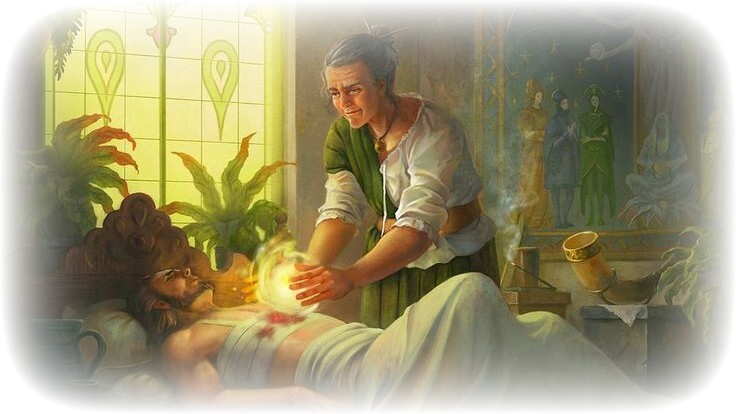
Yet, disease still existed. Sometimes children would die before maturity, sometimes the woman died in childbirth. Disease or war could render children orphans, and women widows. For this reason, Orranoth would teach his priests not just theology, but the power to channel his domains. These "Oracle Healers" would channel the Patrons of Restoration, Life, and Healing in order to work their magic. In essence they were somewhat like wizards, but their powers would always be in relation to these three Ideals, and since these powers were restorative in nature, Orranoth loosens their side effects, since Orranoth himself would work as a filter for the Idyllic magic.

Oracle Healer's powers would function as prophecies of healing and restoration, instead of Words Of Power. Nonetheless the Oracle Healers had to commune with Orranoth and meditate to retain their healing powers.

Hidden 3 mos ago Post by JFK
Raw
Avatar of JFK

JFK 🐟

Member Seen 2 days ago

The shadow walked nameless paths, lurking in the undergrowth, he prayed upon those who stumbled across, ensuring their misery, no matter how petty. His favourites were sabotage and quiet thievery. Normally he would toss whatever valuables he had taken, in an inconvenient place far from the owner. The jewels of one naive merchant took his curiosity. One of the precious stones in particular, a glassy shard faintly blue.

To a less educated man, it might've appeared as just another trinket. But spying makes you learned. And Gutch has been eavesdropping in the shadows since the age of fog, before true sunlight graces Ashuru. Gutch recognised this stone; he had seen others like it. Intuitively, he knew what he must do. He began scheming fervently.

As he schemed, he walked. And he whispered as he walked. He ignored travellers, he forgot his prey. He focused on the blue gem. As he whispered his secrets into it. It responded. It pulsed with the energy of the world and the will of true knowledge flowing through it. By this point in his arcane lifecycle, each word pained him. It stung to use his mangled tongue to focus the energy to speak, and the stronger his words warped reality for those around him the more damage inflicted on him. The years of his silver tongue were past, he was limited now. And the burning from the ritual outside the Gatehouse stung fresh with each word. But he ignored the pain, even savouring the sensation. He told the stone everything, the whole truth he knew. It was more true words than he ever spoke in his life. In fact a lot of it was the truth about all the lies he had told, the crimes, the deceit and corruption. He took great pleasure in reminiscing nostalgically in pained, torturous detail.

Time passed, the Celestial bodies spun, life went on. The shadow slunk towards the outskirts of a settlement. He glimpsed at the stone that commanded him, he was bewitched. It was now cloudy, black as night. It looked a lot like his shadow shard, but not sharp.

Like any worthy wizard, he knew to follow his gut. The people here were obviously nomadic, but they appeared bound to many people. And things. The place was crowded and bustling, perfect for things to subtly collapse into tears. His curse had preceded him, these people had use of coin but could not afford the luxury of keeping it clean. Maybe they didn't know the patchy rusted chunks of metal were meant to gleam brightly. Gutch watched a group of rough, rag-bound men exchange a handful of stained coins. It seemed all these people carried knives. The man being paid carried a mace and stood out as the armed enforcer/guardian of this group. One of them at least

None of his friends noticed the cloaked shadow following him closely. But they all subconsciously realised something around him was tainted. Two elders muttered dark things as he wandered to the outskirts to check his steed. He was mid action when he was unexpectedly barged into. He looked offended before calling out as the cloaked man conspicuously dropped something before him. Gutch hurried off. Gwyn, the man, sighed and took a closer look at the object. It was strange. Smooth. Dark. Alluring. He picked it up and looked at it. He put it in his pouch, with his handfuls of rusty coins.

Gwyn, like many parents, did not know what he was doing. Like most people, he rarely did. It didn't matter any more. He knew what to do now. He strutted through camp, guided by his right leg. On which his fat purse rattled conspicuously. At the top, his proud new find gleamed darkly. He found himself by the family campfire.

It was late now. He had never been close with his daughter. He didn't bother her now. It was late. She was sitting with her aunt. Helan's mother had died during birth. Despite her absent father, she was fortunate to have a sprawling family that raised her. This existing distance is why no one took mind when Gwyn joined the fire wordlessly. Instead gazing into the flames, until the camp was gripped by sleep.

That night, Helan a very strange dream. It felt more vivid and real than she typically dreamt. She was woken by a draught. All was quiet. There was no light aside the embers and the moons. She heard movement, and looked around slowly, sitting up inconspicuously to see a cloaked figure warming his hands in the remains of the fire. He was surrounded by her sleeping relatives.

Gutch looked at her. His dark mask was covered by a simple piece of pale linen. The rest of him was hidden behind the cloak. Her eyes widened. "Who are you?" He replied: "The man on the moon." But she could not remember his voice. When he pointed upwards, her eyes followed. The pale sister hung large in the sky. Closer than usual. As she moon gazed, she heard the figure walk off. By the morning, she felt tired and confused. Unsure what to make of what had happened. She had been struck with a deep yearning and fascination as she had gazed at the vast body in the sky.

By the morning, it was all distant. Her aunt noticed that she was distant. Helan her aunt off when she asked what was wrong. Helan recounted the details to the group of elderly wise women among them. They bickered among themselves before presenting unhelpful observations on the unseen world that she didn't really understand. She tried brushing it off as a strange dream. But that night as she drifted off too sleep she gazed at the moon. A pit of longing, and uncertainty ruminated in hee stomach. Getting to sleep was difficult. She did not speak to her father all day.

That is why she woke with a gasp, shocked when her father woke her suddenly late in the night. It was pitch dark and a thick mist hung in the air. Her aunt woke silently beside Helan. Gwyn presumed her asleep. His tone was urgent. "Come. Now girl. We must go!" Gwyn grabbed her wrist, dragged Helan to her feet, and pulled her into the dark. Her aunt followed quietly. "As they weaved around their sleeping relatives the girl protested quietly, scared to bother the others."Why? Where are we going? What about the others?" He hushed her. She knew better than to upset her father. They got to the treeline and Gwyn peered around. He looked scared, he was pale in the moonlight. They both were. She was too scared and too focused on keeping up with her father's urgent pace to notice the huge moon that hung ominously above them, lighting up the dense forest in an otherworldly light. Her aunt was unsettled by the moon's unusual behaviour but she was more focused on keeping up with the fleeing pair. Gwyn spoke with an urgent tone, "We are going to meet your husband." She left the weighty statement to simmer. "Where is that?" He looked back at her. She was scared. "Where the earth will kiss the moon." They continued trampling through the forest, leading up to a steep ridge line. She now noticed the huge moon looming.

Her eyes widened. Over the ridge, the trees ceased. A cloaked figure was standing on a spur of land jutting out from the steep drop. They sky was filled with the pale sister. Gwyn approached, pulling her along. She didn't know how to feel. What to do. She went along reluctantly. As they neared, the figure turned. His face covered by a pale sheet. He reached a hand out. She flinched, Gwyn wordlessly handed her wrist to the figure. She had seen this man before. His skin was cold and his grasp made her skin crawl. He pulled her towards the edge. She was stunned by the size of the pale sister. Bigger than a mountain, cast across the sky before them. The sight seemed to calm her. Or at least the scale and strangeness of the night had stupified her. She loped forward, eyes fixed on the moon.

The pair stepped off of the edge. The world fell away. The moon was no long in front of her. But the moon still filled her vision. Her mind spun. She realises she was looking down. The moon was closer than she had ever been. She looked up. She stood completely still. Frozen in shock. She recognised forests, and rivers, and mountains. Far far away. Straight above her. She didn't know what to think. How to feel. This was all so strange. It seems like the man on the moon had taken her home with him. But she had mostly forgotten him, her mind was busy with other things. And she did not consider that his words were not true.

Gutch stepped forward, leaving Helan behind. He strode slowly and surely. Each step he took, he sank a little more into the pale sister's surface. The moons surface was entirely a cold white fine powder, that behaved like quicksand as he waded slowly into a drift. He shook himself to seep into the sand faster. He quickly left the girl behind, frozen looking down onto the world. He soak his ancient bones deep into the pale moon dunes; and had left the voice of the shadow on Ashuru, fueling the distraught Gwyn's downfall. The clan struggled to believe Helan's aunts accounts of Gwyn leading Helen to a man that whisked her off to the moon; but Gwyn and Helen were both gone without a trace. The elder group of women recognised some alarming similarities between the story and what Helen had told them.
1x Like Like
Hidden 3 mos ago 3 mos ago Post by Stanifly
Raw
Avatar of Stanifly

Stanifly buzz

Member Seen 6 days ago

ᦓ꠸᥅ꪀꪖ


Sirna was not fond of the Nighthares. They were impulsive, and self-indulgent, and did as they pleased. Typically, this was a combination of traits that would appeal to Sirna – if they were mortal. Being creations made by Sirna’s own metaphorical hand and twisted by the Patron of Nightmares’ certainly nonexistent hands, these Nighthares were decidedly not appealing.

Perhaps if Sirna so wished, they could admit that pulling the veil between the Dreamscape and the waking world was a slight blunder. Slight. For enabling the natural residents of the Dreamscape to wander the lands of Ashuru included the Nighthares themselves. The dream guides were free to pass through the veil, but they were pure and they knew better than to detract from the jobs Sirna had given them. The Nighthares did as they pleased; there was an irregular rash of nightmares blooming across spots of Ashuru, doubtless incited by the critters. Sirna would have to reign them in at some point.

For now, they were in the little temple of clouds that the mortals had dreamed up for them, with its walls of violet midnight and floor of glimmering stars. Sand gathered in a corner, grains trickling melancholy as it tried to crawl into the abyss the walls offered. As they were walls, it didn’t get very far.

Sirna had assumed their usual form, their waterfall pouring straight down through the infinite starscape. Today, they were curious. Today, they would look into that which had lurked in the back of their Dreamscape without so much as a hello.

Today, they scried for the identity of the planet that had woken from its slumber.


In the space around the Veiled Moon, a serpent the colour of gold cut through pitch darkness, gliding without care for its lack of wings. A second glance would reveal that it was not a true serpent – it had legs, eight of them, but they were all tucked beneath it as it glided round the planet, hidden against its furred belly. It closed in on the moon, until the fuzz of its chin kissed the moon’s powdery surface. Its body shrunk, a little uncertainly before it steadied, into a size that would be accommodated by the moon. It became no larger than a great whales wandering the depths of Ashuru’s remaining oceans. In its journey across the moon’s surface, it passed by a lone mortal, but she did not possess the magic that had lured the serpent and so she was ignored.

The serpent dived through fine powder without disturbing a single grain.

Beneath the surface of the Veiled Moon lay a latticework of silver webs. Thick, sticky structures that stretched end to end, criss-crossing without ever touching one another. As it turned out, the surface of the Veiled Moon was a compact shell of indeterminate powdery substance, with the occasional sinkhole crumbling through the spots where the lattice wasn’t present to support it. Somewhere among the lattice wandered a mortal who seemed to have grown bold in the absence of a god who would intervene.

He would have to settle for a god’s creation instead.

The serpent curled around a horizontal web column, above the human that had so insisted on trespassing on divine property.

What business have you here, mortal? It did not have a true voice. The words impressed themselves against the mortal’s mind, leaving behind the sensation of a great rumble. The serpent blinked slits of sky blue. The claws of its eight legs dug further into sticky webs. This place was not built to be a playground for you little things.
~


Interactions: @JFK
1x Like Like
Hidden 3 mos ago Post by Vec
Raw
GM
Avatar of Vec

Vec Unimaginable Trepidation

Member Seen 15 days ago


The first Oracle Healer who understood what was happening to her was a woman in her middle years who had served the amber temples since before Radanuh had walls. She noticed it on a winter morning when she was building a fire before the dawn prayers, and the poker slipped, and the heated metal pressed against the inside of her wrist for long enough that the skin should have blistered. She looked at the mark afterward, at the red crescent it left behind, and realized she had not cried out, had not flinched, had not, she thought slowly, felt it happen at all.

She said nothing to the other healers. She tested herself over the following days with the careful, methodical precision of someone who has spent years diagnosing others and does not know how to turn that attention on herself: a thumb held over a candle flame, a splinter left to work itself deeper rather than drawn out, a bruise pressed and pressed again. The pain that should have sharpened and spiked each time arrived instead as a distant report, something received from a great remove, accurate in its information but stripped entirely of its urgency. She could perceive injury the way she might perceive weather, as a condition of the world rather than an experience of the body.

It was useful, and she recognized that clearly. She could work through what would have once sent her to her knees, could hold a patient's wound without flinching, could tend the most difficult cases with a steadiness that the other healers remarked on with admiration. The god's grace, they said; the blessing of channeling restoration without being undone by it. She accepted their interpretation and said nothing to contradict it.

What she did not tell them was that she had sat beside her fire three nights running and tried to understand whether the warmth was pleasant or merely known, whether the smell of woodsmoke stirred anything in her beyond the recognition of smoke, whether somewhere in the machinery of her transformed body the capacity to simply feel rather than perceive was still present, or whether Orranoth's filter had reshaped something she could not name and therefore could not mourn precisely.

The patients continued to come: a child with a fever that had lasted six days, a laborer whose shoulder had been wrenched beyond the body's ability to quietly repair, an elderly farmer who had been slowly losing ground to an infection in his leg that the old remedies had not touched. She laid her hands on each of them and felt the current of the Ideal move through her, felt the god's attention pass along her nerves like light through water, and watched each of them improve. The fever broke, the shoulder knit, the infection retreated before the treatment as though it recognized something it could not oppose. Their gratitude was immense and genuine, and she received it with a warmth she was not certain she still fully felt.

She was not the only one changing. In the amber temples across the settlements, in the slowly expanding network of healers who had taken on the long discipline of communion and meditation that Orranoth required, the drift was happening at different speeds and in different registers. One young healer found that his eyes had begun to see injury before it was declared, some barely perceptible misalignment of color or posture that told him a shoulder was damaged before the patient had taken off their coat. An older man found that his skin, once prone to reddening and roughness in cold weather, now maintained a temperature so even and steady that children who reached up to hold his hand in the amber temple sometimes pulled away in surprise, saying he felt cool, like river water.

None of them spoke about it openly. They compared notes in the indirect language of people who are not yet sure they are describing something real, and who are uncertain what will happen once they confirm it; they watched each other's faces for signs that the change was visible from the outside as well as the inside, and they found what they were looking for but did not name it.

The mortals who came to them noticed, though not in a way that could be easily articulated or repeated as a complaint, but in the way that a room changes when a particular temperature or smell or sound is removed. The healers had always been set apart by their training and their calling, but now they were set apart by something subtler and harder to dismiss. A woman who had known her healer since childhood found herself, with some bewilderment, unable to remember the last time she had sat beside him at a meal rather than across from him. A family who had once pressed the community healer to attend the festival of first harvest quietly stopped asking, and could not have explained why except that the invitation felt somehow wrong in the framing, like asking the river to come and drink with them.

The healers were welcome; the healers were necessary. They were no longer, quite, part of the ordinary texture of daily life, and the gratitude that surrounded them had taken on the particular quality of reverence, which is to say it had begun, slowly, to substitute for intimacy rather than coexist with it. The healers healed, the people were healed, and the distance between these two facts and the people on either side of them grew by increments too small to measure on any single day.

In the cloud temple that mortal dreamers had imagined into existence for her, Sirna cast her attention downward and inward, through the permeable membrane they had thinned between the Dreamscape and the waking world, through the layers of sleep and vision and half-formed wanting that mortals carried without knowing they carried it, looking for the presence that had, until very recently, not been a presence at all.

Every dreamer leaves a signature in the Dreamscape. It is not a name or a face but a quality, a particular texture of longing or fear or attention that makes one dreamer distinguishable from another the way stones from different riverbeds feel different in the hand even when they are the same shape. Sirna had, over the long years of the world's young life, grown familiar with the signatures of mortals: the dense knots of anxiety that unraveled differently from person to person, the bright particular lights of children dreaming without context or consequence, the heavy saturated grief-dreams of the bereaved that tended to recur in patterns she had seen so often they had become something almost like weather.

What she found when she searched for the entity that had woken in the broken temple was not a signature in any of these senses. She found, instead, that the Dreamscape had a floor.

She had always known this in the way that one knows a thing by its effects without having looked at it directly. Mortals dreamed within the Dreamscape the way fish swam in water, moving through it without considering what supported it. But the support was there, and now, attending to it with the kind of focused curiosity that had always been her most essential characteristic, Sirna perceived that the floor of the Dreamscape, the dense, patient, unintentional substrate that had simply always been beneath every dream ever dreamed on Ashuru, had become aware of being a floor.

It had not entered the Dreamscape, for it could not, in any meaningful sense; it was what the Dreamscape was built against. But it was now there in a way it had not been before, present in the way that a listener is present in a room even when they are not speaking, altering the quality of every sound that fills the space by the fact of their attention. The entity was not dreaming. It was the surface that dreams touched when they fell, the weight that every night-image landed on, the boundary at the bottom of the well, and it had opened its eyes and it was looking up.

Sirna looked down, and for a long suspended moment, both simply regarded one another.

What passed between them could not have been called communication. The entity had no language for what it was or what it wanted, and what Sirna received was not words but impression: something so vast and so recently conscious that the experience of being observed registered as nothing more than a small pressure, the way a single footstep registers to a mountain. It was not afraid. It was, as far as Sirna could determine, curious in the way that new things are curious, not because curiosity is a choice but because consciousness, when it is young enough, has no alternative. Everything arrives as the first of its kind; everything is wonder without a name for wonder yet.

Sirna withdrew slowly, the way one withdraws from a room where something sleeping has shifted without waking, with the particular care of someone who has seen something they will need to consider for a long time before they understand what they have seen. The floor of the Dreamscape settled back into its ordinary imperceptibility, but Sirna did not forget that it was there now, that something beneath the Dreamscape knew it was being dreamed upon, and that this knowledge was, at minimum, a new variable in a world that was already accumulating new variables faster than they could be assessed.

2x Like Like 1x Thank Thank
Hidden 3 mos ago Post by Rekkuza
Raw
Avatar of Rekkuza

Rekkuza #1 Yeast Fan

Member Seen 32 min ago

Tolamu & Pulam


They were cursed. They had to be. Whether the Gods were unhappy with them, or they were besieged by evil spirits, they did not know, but it did not change the fact that the Great Fire no longer warmed them, or that the furnaces and campfires no longer warded off the night’s chill.

It was a cold like they had never known. Heat leached right out from their bones, leaving only shiver and gooseflesh behind. People tried buddling up, grass coats usually only worn during monsoon season to protect from rain worn at all times, beast pelts covering every bit of exposed skin. They ate more warm meals and drank more warm infusions than ever, the cooks working all day long to provide for everyone. But it was never enough, and whatever relief they provided was fleeting.

And then the first one collapsed, delirious, their skin flushed and drenched in sweat. A clear case of heat stroke. And people finally realized that whatever plagued them wasn’t a failure from the world, a failure from the concept of heat itself, but something malicious. Something that only sought to make them suffer.

It was a relief, in some small way. The cold could not harm them. But it also couldn’t be relieved. They would have to endure, for however long it would take. The children and infants took it the hardest; it was difficult to explain to them the cause of their suffering when even the most well-learned of adults could only guess at the real reason.

The priestess, Ma’otah, prayed day and night for the curse’s dissipation, for warmth to find them again. But nothing changed. The One That Lay Below offered plenty of coal in exchange for their prayers and offerings, but mundane fire could not ward off the supernatural chill. And the One that Stand Above, the Great Fire, did not respond at all to the myriads of food offerings burnt in its name…

Resentment brewed within the population, a grudge slowly forming. Who or what had caused this? What had they done to deserve it? Why couldn’t, or wouldn’t, the Gods help? They prayed, made offerings, gave their devotions, and yet they got nothing in exchange. An unfair trade. What good was worshipping a God that did nothing for them? At least one of them tried to help.

Life, despite everything, went on…


Tolamu had an issue. As the great cook that he was, his work was in high demand. No one could season a soup like him, which made sense, as he was the one to come up with the concept of seasoning in the first place. Normally, it wouldn’t be an issue. He would even be happy that his unrivaled skills were recognized as such!

Unfortunately, the demand was too high. No one was satisfied by grabbing a few pieces of cold fruit and meat for a quick lunch anymore. All of the cooks had their hands full trying to keep everyone’s bellies full with hot meals, trying, futilely, to keep them warm as well. And it turns out that when you’re busy making pot of soup after pot of soup all day, every day, you don’t really have time to keep innovating, no matter how much you wish that was the case.

He couldn’t keep looking for spices, or keep making food experiments. He was just stuck in front of the cooking fires, and occasionally tending to the partridge coops. His inner fire was sputtering, starved of new challenges. The boredom, the monotomy of it all, was killing him just as much as the persistent cold that had settled in everyone’s bones.

He wasn’t alone in this feeling. Caught in the same throes of mysterious chills like everyone else, Pulam found himself struggling to keep warm. Not even his passion for the arts was enough of a distraction. He kept himself busy, of course, but nothing beat the feeling of a hot bowl of soup in his palms. His stomach protested drinking yet more soup, but the rest of him cried in relief from the scant heat. Pulam settled on curling up where he sat on the community grounds, staring at the brilliant orange of his treasure.

One of Tolamu’s specials, this one – though its novelty was wearing out as of late. There was only so many times one could rotate through soup flavours before they all became recognisable. Pulam tilted his bowl round and round. Slosh slosh slosh, went the liquid. It was so watery. So fleeting. So easy to gulp down now, the way they used to gulp down water after a hard day’s work. Pulam thought of fresh paint dripping sluggishly down a surface when it wasn’t spread thin. Maybe if soup was thick too, it’d stick around longer and the warmth would be less fleeting.

Pulam huffed. Look at me, comparing soup with paint. The cold really is driving us all crazy.

He kept sloshing his soup. Puffs of heat rose from its vivid orange surface and immediately cooled on his skin.

...But Tolamu did burn water that one time. And that was before everyone got the chills.

The warmth on his palms was fading now.

Curse it.

Pulam rose to his feet still clutching at his bowl of soup and made his way to their food stores. The chefs would be busy with soup-making so he wouldn’t bother them with his bout of impulsiveness, but surely there was no harm in him adding an ingredient or two into his little bowl of soup! The absence of anyone in the stores emboldened Pulam and he placed his bowl on a free table, before setting about searching for their stocks of ground starch.

That's when Tolamu walked in. The old pot of soup was done, a new one was needed, and that meant more ingredients. He was so deeply set in the routine that he didn't even notice the intruder at first. He simply grabbed what he needed, some fresh waterleaf that was starting to wilt, a large yam, small strips of dried salted meat…

Pulam, who had successfully located the starch and was now staring at the chef in wild panic, did the only thing he could think to do: jam his hand straight down into the bag in front of him.

Only once he was about to leave did he really see Pulam, his hand wrist-deep in a starch bag. He paused, and frowned. ”Hey!” he yelled out, ”Hands off that stuff! Do you know how much work it is to make it?” He glanced at the bowl of soup on the table, and grumbled some more. ”And that's way too much for a tiny bowl like that, you're gonna end up with a lumpy mess of a meal…”

Um,” said Pulam. He removed his hand from the bag, but forgot to open it before he did, and so found himself clutching a fistful of starch. The excess scattered back into the bag, thankfully. He didn’t feel like testing the patience of the person responsible for keeping them all warm at the moment.

Lumpy would be bad, yes.What are you saying, fool?I mean, I wasn’t planning on taking more than a pinch! I just... thought that... thicker soup would be nicer?

A rush of embarrassment flooded him, which was good because it brought a little warmth to his cheeks, but absolutely terrible because he was critiquing one of their chefs! The one handling all their soup!

Not that the soup isn’t nice,” he babbled. “It’s great, fantastic even, but you know, it’s, uh, really temporary and I thought maybe if it went down a little slower, the warmth might stay a little longer, and, um, so, starch?

Standing there with his fistful of starch, Pulam wanted to find the nearest river and throw himself into it.

Tolamu blinked a few times, his frown easing off. He looked down at the ingredients in his hands, deep in thought, then looked back at Pulam. “That's… not an awful idea, actually,“ he mused. “If we can make it feel more filling, like a sauce-soup hybrid maybe… yeah… Yeah!”

He pointed a finger at Pulam, a determined grin on his face. ”Put that starch back in the bag, then bring the whole thing. We're testing your theory right now.” He turned around and marched right out the food soor and towards his cooking fire, not bothering to check if the other would follow.

Bemused, Pulam shook the starch out of his hand (and clapped it a few times to be thorough). Then he grabbed the neck of the bag and hefted it over his shoulder, before trailing after Tolamu at a slower pace.

The smell of fresh, boiling soup invaded his senses as they closed into the cooking fire. As full as he was, Pulam’s mouth couldn’t help but water still. He set the bag down, trying to distract himself as he watched Tolamu putter around.

Tolamu went to work. He grabbed a nearby jug of water and topped off the nearly empty soup pot, and while the pot worked its way back to boiling, he grabbed his bronze cooking knife and began to peel his yam. Soon, the vegetables were roughly diced and the salted meat strips shredded, and everything was dumped into the pot of soup to simmer for a bit.

Now that he had a moment to breathe, the cook turned back towards Pulam. ”Now let me show you how to properly thicken a broth.”

He grabbed the starch bag with one hand, and took a small empty serving bowl with the other. ”First, you don’t need a lot,” he stated, tone becoming didactic. “It thickens very quickly with heat, so only a spoonful or two is enough for a whole pot. Add too much, and you won’t end up with a liquid.” He poured about that amount in the bowl. ”Second, you don’t pour it right into your pot, or it’ll cook into lumps. You gotta mix it in cool water first, and then add it in.”

Pulam, watching intently, nodded.

He poured some water into the bowl, mixed it all up with a spoon, and then went to the soup pot and poured it in slowly, mixing all the while. Gradually, the soup broth, once thin and watery, began thickening up, until it began to lightly coat the ladle whenever it was raised. He raised it to his mouth, giving the broth a quick taste. The texture was odd… but not unpleasant. The flavor was a bit bland though. He’d have to fix that.

Tolamu turned to Pulam, a proud smile on his face. “See? Pretty neat, yeah? Cooking is just as much of an art as anything, with its own special skills and techniques!” He put the lid on the pot to let the vegetables finish cooking, and sat down on the ground next to the fire. “You can do a lot more with starch too. It basically becomes edible glue as soon as you wet it. I even tried cooking the starch paste alone in a pan, once. It makes something thin and crunchy, but not very filling, so I never really bothered showing others. It’s not worth the starch it requires.”

”So many more foods like it out there to be discovered…” he mused dreamily, ”...and instead of going out to find them, I’m stuck here freezing my ass off. The gods really have a shit sense of humor.” His face quickly twisted in a frown, and he threw a resentful glare at the sky.

Pulam, at this point, wasn’t really listening. He had his gaze fixed on the now empty serving bowl, fingers tapping his chin in thought. The soup bubbled away, but with less frivolity now that it had been thickened. It was a different colour from the soup they had doled out that morning – a pale white, broken up by the bits of vegetables and meat floating within.

Edible glue...

Inspiration struck.

I’ll be right back!” he said, before darting back to the food stores they’d left. His bowl of soup was right where he’d left it, still somewhat warm.

You,” he said, “are going to be a bit better to look at, my friend.

The bowl did not reply. He returned to the cooking pot, set his bowl aside, grabbed a new serving bowl, and then poured a ladleful of thickened soup into it, sans meat and vegetables. With the empty serving bowl, Pulam copied what Tolamu had done minutes ago with the starch and water mixture, but at a smaller quantity. He poured this into his own bowl and then mixed that together.

At this point, he realised he should probably explain what he was doing.

I had an idea,” he said, and started spooning the thickened new soup into his old soup. Except he wasn’t spooning it so much as he was drizzling it into his soup, letting the white bleed into the red of his old soup. A white circle came to be, then two dots and a sideways curve, and before long, a smiley face was looking up at him from his own soup. The white soup didn’t dissipate or stray from the initial shape it had taken once poured into the red soup. Curious, he jabbed the spoon into the corner of each ‘eye’ in the face he had drawn. The white soup swooped into the direction he cut in but didn’t move much more than that.

Pulam grinned.

Tolamu, you’re a genius.” He lifted his bowl and showed his handiwork to the chef. It was crude, but it worked; if the thickened soup could retain its shape when poured into other soup, then that meant Pulam had a whole new canvas to play with! “Look! I don’t know what we can do about gods, but with soup like this, everyone will cheer up! Well... for a while. But it’s something, you know?

Tolamu puffed his chest out a bit at Pulam's praise. He knew he was a genius, but it was always nice to hear others acknowledge it as well. Though, he had to admit Pulam was a master of his craft in his own right. Drawing with food… that wasn't something the cook had ever envisioned before. It was a good idea.

He smiled as he gazed at the bowl of soup. The little doodle floating around the broth was awfully charming. ”You're right,” he said, ”that ought to lighten the mood. I have a feeling that the children are going to be especially fond of it.”

He stood back up with a small groan. He had some more preparations to do before the next meal-time. ”Stay around and give me a hand, will you?” he asked Pulam. ”You have to show everyone your new food-drawings, after all.”

It was a good note to end his breakfast upon. With that, Pulam decided there was no real need to mention the talking... bird-head... monkey thing that was watching them both from atop the roof of the nearby food store. It was bad enough that everyone was slowly losing their minds from the constant chills; they didn’t need confirmation that someone had actually lost his mind as of late.

So, with good cheer and a wide smile, Pulam said, “Of course!

3x Like Like
Hidden 3 mos ago 3 mos ago Post by Stanifly
Raw
Avatar of Stanifly

Stanifly buzz

Member Seen 6 days ago

The Path


Sleep wasn’t coming to her anymore. That wasn’t so bad though, she didn’t want to dream, after all. She didn’t deserve to escape the misery of her own making. It was better this way. Instead, she dwelled in the abyss of waking.

Why had she done it? Why was she so stupid? All her life people would look at her and say such mean things and she had betrayed the love of those who never had. ‘She’s a daydreamer.’ ‘She doesn’t really get it.’ ‘Don’t say such things, she won’t understand.’ ‘Just a mutt like her siblings.’ Malac’s face flashed briefly in her mind and Teefee saw him struck dead. The spear was thrown with such precision right into his heart. Just a wet thwack, a gurgle, and he was falling. Falling. Falling. Falling.

Or was it a spiral?

A field of primroses, petals plucked and discarded. She lay amidst a sea of blood, pristine and white.

Teefee’s vision cleared. It was getting worse wasn’t it? She blinked and realized she had been staring at the coals again. Those empty, black, coals. She had begun having delusions about a day ago. She had believed Toffee had come back but when she went to embrace her sister, Toffee had laughed and Teefee realized she was talking to the tent flap. Or maybe that had happened and Toffee had left again? Maybe Tad would show up soon? She could apologize, he would forgive her right? His face flashed, that disappointed look paramount. Grimacing, she stood, stumbled, stood again and saw her breath in the air.

It was cold but she wasn’t cold. She wasn’t anything.

The darkness of the wikiup was known to her now and she shuffled over to what was left of their stores. Dried meat. Dried berries. Fat of some sort. The waterskins had frozen. She sighed, blinking heavily. Was she even thirsty? Was she even hungry? No, she wasn’t anything, she reminded herself.

Or was that too fair?

She was something. She was many things. A fool. An idiot. Stupid. Abuser. Violator. RUINER! Teefee pushed over one of the storage containers, nothing more than sticks and fur tied together. It clattered to the ground with dull thuds that sounded much louder than they actually were.

Her breath was hot and her chest heaved. Her heart beat like crazy and her head hammered. It wasn’t like her to get angry. What was wrong with her? She slumped down against one of the wikiup’s poles and just… existed. She didn’t really want to but she had run out of tears awhile back. There wasn’t much point in doing anything else.

It was then that she spotted it. Pulsing next to the tent furs where the storage container had been. Hidden and safe. Glistening fresh. Blue and golden, whispering a lullaby. She could see the spores exhaled and blown in her direction. She raised out her hand, not really knowing what she was doing but it felt right. For once. She breathed in, out. In, out. In… Out…

She awoke in the land of dreams.


Well,” murmured a quiet voice overhead, “this is a new development.

The surroundings Teefee found herself in were not of clarity. The air was smoky with billowing fog; visibility was poor, but not so poor that she wouldn’t see the dead, wilted flowers littering the ground. What sparse grass she could feel beneath her was dry and brittle. The constant sound of burbling water neared as Sirna came into view. The fog shied away from their form, as if the dream itself was deferring to them.

You summoned me.

Wonder tinged Sirna’s words. They had been summoned before, of course, by numerous shamans and dream fanatics, but those had been rooted in human ritual and equated to a brief tug on Sirna’s awareness. This had been stronger, intimate, and with the mere requirement of a lullaby mushroom and Teefeen’s own strength of subconscious will. Perhaps the qualities of a Dreamwalker held more depth than Sirna had initially thought.

It was a musing that Sirna would have to ponder on another time. The feline sapient mortal seemed in remarkably worse shape than the last time they had met. Not in form, for Sirna had been occupied with other matters as of late and was uncertain of the Dreamwalker’s current state in the material realm, but in dream. A subconscious bringing a dead and brumous landscape to being in the Dreamscape was not an indicator of a mortal who fared well.

I see. A trickle of resignation settled over Sirna. Another request, then.

Sirna was a god who wielded a loose leash with the creations they considered their own, but the fact remained that those creations were theirs and therefore under Sirna’s care. They had not created Teefeen. They had, however, taken her heart and made her their Dreamwalker. For all intents and purposes, that made Teefeen their responsibility.

Their waterfall splashed into the ground, its slope curving into an impossible angle as Sirna lowered their moon closer to where Teefeen lay. The dead grass and wilted flowers that were soaked by their waterfall remained dead; it was not Sirna’s business to change a mortal’s personal Dreamscape.

Your mind is troubled,” they continued. “Are you here to speak your pain clean?

Teefee looked up. And where once she would have been smiling, with crinkling eyes ready for laughter there was not. Now her gaze held little more than anguish and something else. Something that had been seen time and time again and would be until the stars faded and the land of dreams was but dust- resentment.

Her once blissful face turned darker. Accusatory. Her posture went rigid and she slowly stood, never removing her gaze from them, her heart’s keeper. There was more silence as she crossed her arms. The Dreamscape slowly began to change. The withering flowers grew erect but their color was still faded. The fog cleared and revealed a beach of white sand whose still waters were pitch and held no reflection. For what loomed behind Teefee was the eclipse, now more akin to an all consuming maw. A striking resemblance to oblivion was undeniable.

Teefee at last opened her mouth and she spoke in a tone that brooked no joy, “You lied.” Those two words, harsh and quick to the wick. Her hands shifted and she was now hovering her left over her chest, whilst her right balled into a first at her side. “I gave you my heart and you lied.” she said, quiet and forlorn. She stepped forward and her demeanor changed. There was fury now on her face and her eyes had grown into slits, something she would not have been capable of doing in the waking world. ”You said I wouldn’t lose them!” She yelled, “You lied, Sirna!”

The accusation put a pause in the idle rotation of Sirna’s moon.

Mortals were usually simple. Dispense a few cryptic words and they marvelled. Linger in the background of dreams and they marvelled. Do absolutely nothing and they marvelled. The sight of a being that resembled nature in unnatural ways seemed enough to bow the humans over with blind awe. Even when Sirna had cast that foolish shaman and his followers out of the Dreamscape a time ago, the human had only responded with fear despite the frustration stirring in his heart.

This anger was unprecedented.

Still, Sirna could not respond without knowing all of which that they were meant to address, so they took hold of Teefeen’s heart within their waterfall and they witnessed all that had happened since their last meeting. The illness that claimed Teefeen. Jiva. Sirele. Saries. What Teefeen had found necessary to do and the aftermath.

Receiving all this information happened in less than the blink of a mortal eye. Sirna’s moon glowed a faded blue as they reached out across the Dreamscape. Yes, there was that mortal... and that other one... and…

Hmm. Unprecedented indeed.

To lie would mean that I intended to deceive you in my proposal,” they said. The blue intensified to a dim shade. A few stripes of gold bled across it. “I had no such intention. I do not understand. You have not lost your kin. Why do you choose not to seek them out?

“Because they hate me!” Teefee yelled. “You told me I’d be able to keep us close. You said-” she took a quick breath because her anger was fierce, “You said I wouldn’t lose them!” She began to pace back and forth, her arms a flurry of motion. “I can’t even find my mother! She vanished and I know she isn’t dead! And then- and then Toffee and Tad! I was so stupid!” She broke down then. Tears came unbidden and the dream world shifted. The great eclipsed moon behind her burst into a tidal wave of water, not unlike the waterfall of Sirna’s form. The landscape became a hue of depressing blue.

“They hate me.” She whispered, rubbing her eyes.

The sight of a crying mortal was not an uncommon thing. How many times had Sirna seen them overwhelmed in nightmares and dreams? Sirna had watched many of those times with dispassion. Intervention, when it was called for, was rare and detached. The mortals who knew Sirna were few and those who knew to summon them fewer.

Sirna’s waterfall returned to a normal angle. In a gentle swish of movement, Sirna drifted to settle next to Teefeen. Water rippled into something denser, softer. Sirna’s moon no longer sat atop a waterfall, but a mound of woven wool, folded haphazardly into itself.

Perhaps,” they said. “And it is true that your actions have sent your kin away. But you have not lost them, Teefeen. No mortal is truly lost until they cross the threshold of my godkin’s realm.

Blue irises bloomed from the ground as Teefeen wept, wilted and drooping. From beneath the folds of cotton, Sirna raised a lanky arm, skin dark and glimmering like midnight sky, and reached out bladed fingers. They cut an iris by its stem, cradling it in their hand with care.

This felt different. This was different. Sirna felt glad, not because they found a mortal’s suffering amusing, or because they found a mortal’s grief interesting, but because this mortal had found a space comfortable enough here to grieve to Sirna. This flavour of neediness, of dependency – it struck Sirna in a way that did not bore them, far and away from how Śramaṇa Adi had thought to do nothing more than pander to Sirna.

The question now was how long such a feeling would last. Mortals had such fleeting personalities, sometimes.

Your future is what you make of it,” said Sirna, when it seemed that Teefeen’s tears had lessened to a trickle. “You could stay here and allow your body to rot. You could return to the world of the waking and move on. Or...

They held out the wilted iris.

You could seek out your kin,” said Sirna, quietly. “Make amends. They may forgive you, or they may not, but if you love them enough to make the effort, then perhaps something can be salvaged in the end.

Her trembling hands gingerly cradled the iris as she sniffled. She remained silent for a time, letting the moment stretch in quiet reflection. “I could…” she whispered eventually. “But I think the problem lies with me, Sirna. You know my heart best. I was jealous, wasn’t I? Jealous of the twins but I… They will live for so long. How would that be fair for my siblings?” she sighed. “It doesn’t matter now, I suppose. I messed up. I made them miserable and it broke my heart, as I broke theirs.. So no. I don’t think… I don’t think I should go and find them. Not yet.”

I know your heart,” agreed Sirna, “but you are the one who moves it, not I.

The watery landscape calmed into something more still. The damp ground hardened into something smooth and alien. Teefeen’s reflection shone faintly on its filmy white surface. Sirna’s did not.

What will you do then?” they said. “Will you search for your mother?

“You don’t know where she is?” Teefee asked, looking at them with large misty eyes.

Hmm.” Their moon rolled idly on their mound of cotton. “I have an inkling.

Again, the dreamscape shifted. The surface of the glass lake shimmered with shades of gold, soft and blurred. The faint sounds of excited chatter and laughter drifted around them. There were other sounds too. Cups clacking. The repetitive clatter of wood against wood. Incessant hissing, the kind that freshly roasted meat would bubble and spit out over a well stoked flame.

Teefee’s ears rotated as she took in the sounds. Her eyes began to narrow but she did not say anything and let Sirna go on.

Mortals have had a tendency to disappear as of late. Without rhyme, without reason. Return is rare, if it happens at all. The few who make it back to the waking world only have these few, fleeting dreams to show for their absence.

Along with the usual lingering aura of glitter and gold, of course. If not for the jovial nature wafting off it, Sirna might have thought it a product of the one named Sarhush. He seemed the type to push currency into mortal hands, innovator that he was. But this was too merry, and that did not fit the sour-faced bipedal god Sirna remembered of their kin.

“But why?” she asked.

It would seem that one of my godkin has taken a liking to taking mortals.” Sirna’s moon was a dim blue, as it had been for a while. “If you choose to pursue your mother, Teefeen, it may well mean a path of no return to the world you know.

The iris tumbled from her grip and slowly drifted to the earth below. She seemed to slump and shudder all at the same time.

“My mother would do anything she could to find me and my siblings if we were lost, even if it meant there wasn’t a chance of returning. Why would I not do the same?” she said as a look of steely determination and purpose filled her face, bringing back a semblance of life.

“Could you help me?” she asked Sirna, and the Teefeen he had met those many moons ago had seemingly returned. With a sly smile on her lips and a mischievous glint in her eye. But they knew her heart and what lay hidden within and behind.

It took Sirna a moment to answer, long enough that a sliver of doubt could have found its way through Teefeen’s confident façade but her heart remained true.

They could push her towards the right direction, of course. She would traverse a land that belonged to Sirna’s godkin, a place that they did not have access to from the Dreamscape or the waking world, and Sirna would be able to witness all that she saw through the very heart they had taken from her. They would both gain much from this.

Yet hesitance stayed Sirna’s voice. Engaging with a creation of their godkin was risky, especially if they were striving to undo something that has been done. If Teefeen was lost to the same thing that had taken her mother...

She is still only a mortal.

You are my Dreamwalker,” said Sirna. “I would not let you pursue this alone.

Tracing the last dreams of the mortal Ina took no effort on Sirna’s part, but it gave them no more clues onto Ina’s last whereabouts than reviewing Teefeen’s memories had. So Sirna cast their gaze wider, backwards in time, and:

Their Dreamscape reflected a moment in the distant past.

Ina leaving their wikiup to tread a well-worn path, waterskin in hand.

The path changing before her eyes.

Her vanishing into shimmering, thin air.

The knowledge would sit in Teefeen’s mind now, a guide to where Ina had disappeared. A concentrated breeze blew past her, ruffling her ears, circling her form, before converging into her hand, pressing into the centre of her palm. She opened her hand and she could see a diamond-shaped jewel embedded into her skin. It didn’t hurt, nor did it cause discomfort. It simply was, as though it had always been there. It wasn’t clear what colour it was – every time Teefeen looked, it was something different.

This will allow you passage through the boundary between the Dreamscape and the waking world,” explained Sirna. “It requires only your intent to activate it and other mortals may accompany you, so long as they maintain physical contact with you.” Their moon glowed an intense violet. “Once you are within the boundaries of the space that has taken your mother, I would advise you not to use this more than once, and to enter the Dreamscape with haste once you do. Any blessing of mine is bound to attract the attention of my godkin. As resourceful as you are, Teefeen, confronting another god would be... best avoided.

“I…I understand. I think. Thank you, Sirna.” Teefee said as she studied the jewel some more. Her stance became uncertain however, as her eyes wavered back to Sirna’s form. “I’m scared.” She said in a soft voice. “What if I still can’t find her? What if I’m found? What if I never see my siblings again…”

The Dreamscape flickered. Colours, murky and dark, swirled beneath the glass they sat on.

All possible scenarios,” murmured Sirna. “The thought of what could be, what could have been, is the very foundation that the Dreamscape lies upon.

They should leave it at that. Sirna was not in the habit of pushing mortals towards the decisions they made. Even so, Teefeen had made it clear that she would be going after her mother; this was a seek for comfort, not counsel.

(That Teefeen was rapidly becoming an exception to most of what Sirna was in the habit of was unrelated, of course.)

So leave the what-ifs in the Dreamscape, Teefeen,” continued Sirna. “And shape what will be with your own hands.

The wind picked up. The chill of the waking world would begin seeping into Teefeen’s skin once again. Sirna said nothing more as they watched Teefeen wander back to wakefulness.

Groggily she awoke feeling refreshed for once but Teefee was anything but content. With frantic abandon she gathered what little she could and opened the flaps of the wikiup for perhaps the last time. With bated breath she set out and down the path of her mother…


3x Like Like
↑ Top
1 Guest viewing this page
© 2007-2026
BBCode Cheatsheet