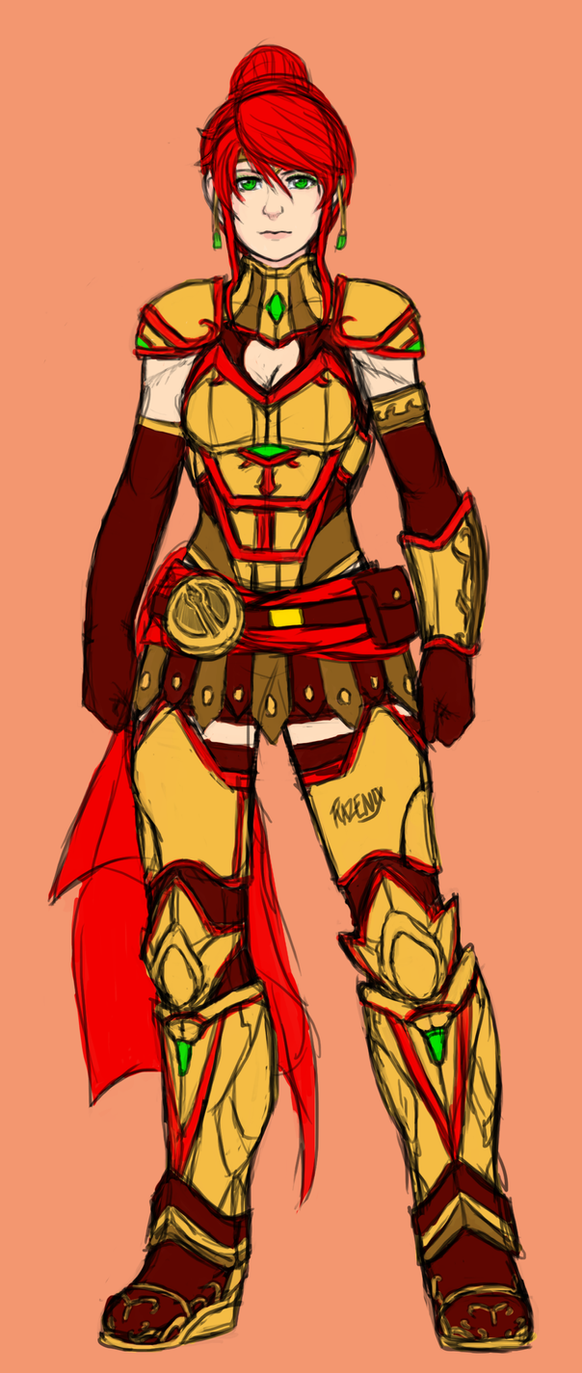
Weapon MechanicsMiló has the ability to fire rifle rounds with no obvious source of heat, or indeed any obvious source of rifle rounds. This is thanks to a result of two separate realisations on Akella's part. First, she has realised that what pushes the projectiles out of a regular gun's barrel isn't the heat of the exploding gunpowder itself, but the pushing force caused as a result of the explosion, in other words the explosion's
wind. With that in mind, Miló has an air Lapis hidden in the hilt of the weapon, the only use of which is to create directed, and surprisingly strong, bursts of air to propel projectiles out of the weapon; a fire Lapis is also present from prior iterations of the weapon, though it is there mostly because its removal would not affect Miló's functionality, instead serving to produce smoke and noise from the end of the barrel to hide how the weapon actually functions.
The second realisation is that a flat surface on a projectile actually provides more space for a given pushing force to work properly when compared to the standard spherical rounds, though Akella understands that this is perhaps not an understanding limited to her mind alone; since the vast majority of bullets produced nowadays are lead musket balls, Akella has taken it upon herself to enhance Miló's functionality by allowing the weapon to spontaneously generate its own ammunition, again via supplying energy to the embedded metal Lapis in a specific pattern, such that a pointed lead projectile may be formed within Miló's barrel whilst in one of its rifle forms, fitting snugly to the barrel's rifling without sticking when fired, thus producing a far more accurate (and cheaper) shot than most might anticipate from any projectile weapon.
Magnetism LapiThe functionality of most forms of Lapi are reasonably obvious - a metal Lapis lets you control metal, a healing Lapis heals your body, and a necromancy Lapis lets you resurrect and command the dead. Magnetism Lapi is one of the more complicated forms of Lapis to figure out, mostly because the mechanics of magnetism known to modern science in real life have not yet been entirely established in this setting, and even those who have encountered magnets are only likely to know that iron and steel are attracted to them, never mind that electricity and magnetism are in fact closely intertwined.
Essentially, however, the principle is the same: five basic types of magnetism exist, the most common of which is ferromagnetism, wherein parallel magnetic moments within the electrons are arranged in parallel with each other, producing a north and south pole within the substance, and which is strongest within metals such as iron, cobalt, and nickel. For the same reason, these are the metals magnetism Lapi is most effective on, requiring the least amount of stamina to affect under normal circumstances, as their magnetic moments do not cancel one another at room temperature, thus allowing natural ferromagnetism.
That being said, part of the functionality of magnetism Lapis is to actively induce the appropriate form of magnetism to achieve its effects (most often telekinetic in nature) in just about any material it is used upon regardless of its usual physical properties, often combining multiple forms of magnetism to both push and pull a target in certain ways. Therefore, whilst it may or may not take more stamina to do so, most metals both pure and alloyed can be affected by magnetism Lapi as well - for instance, Entolí is largely made of bronze, an alloy largely composed of copper, which is a substance that is naturally diamagnetic, such that the magnetism Lapi implanted into the armour only requires a comparatively small amount of stamina to induce a significant repulsive force against most metallic objects. However, less magnetically reactive substances may require an excessive amount of stamina to handle effectively with magnetism Lapi, and it is often more productive to simply acquire the relevant Lapi type, e.g. earth Lapi for generic soil.
 Member

 RPM
RPM teenangstlife
 Ezekiel