Avatar of Dinh AaronMk

Status

Recent Statuses

1 yr ago
Current As an American [user could not afford rest of post]
6 likes
3 yrs ago
Never spaghetti; Boston strong
3 yrs ago
The last post below me is a lie
1 like
3 yrs ago
THE SACRIFICE IS COMPLETE. THE BOILERMEN HAVE FRESH SOULS. THEY CAN DO SHIFT CHANGES.
2 likes
3 yrs ago
Was that supposed to be an anime reference

Bio

Harry Potter is not a world view, read another book or I will piss on the moon with my super laser piss.

Most Recent Posts

China

Northern Heilongjiang


The early morning sun had barely risen over the horizon and the air was already all sound. The intercoms all about the base shouted and repeated out their message, “ALL OPERATING UNITS TO REPORT TO STAGING GROUNDS.” they roared, broken and cracking from static, “STAGING OPERATIONS FOR SOUTHERN WINDS IN FULL EFFECT....” and then it would go on to give the count down until expected time of deployment. A list of units would be rattled off, calling out specific operating groups, regiments, and so on. Every light in the base was thrown on and the barracks, the garages, and the command center was glowing in a harsh glowing yellow light. The roads were bathed in the incandescent headlights of trucks, tanks, and what have yous.

The chaos was no less condensed in the command center. Standing with a clear view over the staging grounds the officers inside could look out and watch the quickly assembling body of soldiers in the cool morning air. But none of them had the time. The officers in charge of communications were deep into organizing the coming efforts with their fellow associated combat forces. Where radios were not being used, they had jumped to phones and were scratching out notes to hand to cadets and lieutenants who rushed them to relevant departments. Someone somewhere was contacting the closest airbase checking in on and organizing for support from light bombers and aerial reconnaissance. Someone elsewhere was checking ahead on intelligence operators who were supposedly clearing the ground work ahead, and had in face been there since before the deceleration had hit the floor in Congress. In many ways, the war had already begun before it was called official and now it was only an effort of the public army to advance it.

“What's the time table on the engineers to Wu'erka Island?” General Aiwen Wu asked over a phone as he paced his desk. While his uniform looked press fitted and professional, the speed of the morning had left the rest of him disheveled. He looking into the window without looking passed it, desperately trying to comb back hair which was still disheveled. He had on his desk an open shaving kit and a bowl of water he not touched.

“Our last report says they're there and ready and making preparations.” a woman's voice on the other end said.

“That is good to hear. Do we have a way into the country, to the banks of the Amur?”

“There is a dirt track.” the engineer correspondent said, “It'll get you there most of the way. You'll find it at...”

The engineer went on getting map coordinates. And like his sub-ordinates elsewhere he took down notes on this last minute information and jotted down what extra was needed.

“Thank you comrade, we will be moving on shortly. We will keep the local team posted when we can. I expect us to be there in two hours.”

“Copy that. I will try to patch a notice along to them before hand. They are pretty cut off up there.”

“As I understand the situation. Thank you.”

“Farewell, commander.” the correspondent said, hanging up the phone. Liberated from those duties he finished setting his hair and recapped his head. As he went to shave a subordinate walked in, he began to speak but Aiwen Wu directed him quickly to the note on the desk. He took it and broke out into a run through the door. For a second, he had the peace to shave.

“Comrade.” a new officer said, “The second armored support group is reporting problems starting one of their vehicles and won't be able to make it to the staging grounds.”

“My orders to them then are to stand down and fix their problem. They have eight hours to catch up.” Aiwen Wu slid his razor up his neck as he carefully watched himself in the reflection of his window. He was half paying attention to the gathering assembly outside.

Bit by bit, entire squadrons or units would file in with their trucks, and stand attentively alongside waiting for orders. For those without the fortune, they were stuck to loiter with the armored cavalry, standing with the tank crews with the expectation they would perch themselves on top for the duration of the journey. There were later units to follow, but these consigned to the primitive realm of horse drawn carriage. By mid afternoon they were expected to be on their way once this vanguard had entered first into Russia.

“Commander Wu, it is nearly time.” an officer said, passing by the command center. He turned and nodded to him. And adjusting the collar of his coat and his hat in the window, he turned to head out the door.

There seemed to be a relieved sigh as the time came. At Aiwen Wu's appearance in the halls many of the officers looked up and rose from their seats. Those that followed were individuals of a specialist nature. Communications operators, supply detail, commanders of operational security, and intelligence organizers of the internal and for-the-locals variety. The followed their superior officer in a hung silence that carried itself between the men like a shared silent burden. They were threaded by their professional attitude. And straight backed and firm shouldered they moved onward into the coming battle, the ideal figure to the men for bearing the weight to come.

Those on watch duty saluted the passing officer corp as they passed. Aiwen relieved them as they passed by returning the salutes. These were the men who would stay behind and as the bulk of the garrison headed north. Stepping out into the cool morning air Aiwen took a deep breath. If there was a point at which he felt he could turn back, in felt it would have been the threshold he had crossed. Though in reality that had long been crossed for him and he hadn't had the power to say no. All that he could hope was that all moving ahead would run smoothly.

From here to Eastern Mongolia, units under his command would be beginning their own first moves in a vast operation to flood into Eastern Russia. It was expected that for the first few weeks they may take the cossacks by surprise. By the information handed over by Radek's men it was believed the communications ability of the cossacks were entirely limited. It was not felt they had many radios or means of radio communication or informants on the Chinese side to alert them. For all intents and all hope they would be coming in from the dark, behind the fog of war and the first movements of refugees would carry the news to the warlord hetman of the east that they were on their way. At the crossing of the Amur, time would begin ticking to their first engagements, whatever form it will take.

But for now it was a cool northern Chinese morning. The sky was clear, the first rays of sun was blooming. A dew was on the trees, and the northern mountains from their forested valleys to snow-cap crowns were glowing a summer's orange.


“So where are you from?” the young private asked, leaning over his rifle as he leaned in towards the center of the truck. He was addressing another young grunt like himself. Both had to be no older than nineteen. Perhaps eighteen. For the past few months it had not been unknown that something was going to happen, and up until a week ago they had not been told if they were participating, but everyone had prepared as if they were. While the men on the truck had only gotten five hours of sleep the previous night with all the last-minute work they had to do to check and prepare, the two privates were far too excited and anxious to let the jostling of the truck put them to sleep.

“Liaoning, just across the river from Korea.” the other private said. He was small framed, his green field uniform hung loose from his frame and his pudgy baby-ish face made his entire head look far larger than would fit the black wool cap he wore. The military uniform was a green field jacket, and off-brown also slightly greenish pants tucked into black boots. In some form or another all the men on the truck wore some sort of soft hat, a black fur cap with side that could be pulled down, a linen hat that was as flat as a deflated balloon. A few had been afforded helmets, decades old tin crowns with wide brims or formed tight to the head like the German helmets; without the spike.

“Oh no shit? I'm from western Jiangsu.” said the first. He made an attempt to smile politely but it was a strained effort. He was far too nervous and his leg jumped as they drove along. His usually flat cheeks folding out. Suddenly he became self conscious and he frowned, and it returned to being long. He had the first hints of a potential beard on his chin, but thinned out as it followed his jaw line. “What's it like living so close to the Imperialists?” he asked, referring to the Japanese.

“There are a lot of emergency drills. Sometimes you can see them across the river.” the other said, “I never caught your name. What is it?”

“Su Song.” the first answered, doing his best to bow from his seated position.

“Wu Hong.” the other said, “I think I've seen you a few times on the parade grounds, and in the cafeteria. I didn't think you were in this unit.”

Song laughed nervously, “I had just been assigned here.” he said stiffly.

“I've been here for only less than a year.” Hong laughed.

“Yeah?”

“Yeah.” Song sniggered, “So what do you think? Did you ever think you would end up in this?”

Hong shook his head, “To tell the truth I was never looking for adventure.” he said, “I just wanted to get out, is all. But it looks like I'm going all the way.” It was no lie. He had never hoped to see himself on campaign anywhere, that he would wile his time in some base somewhere for a year or two, and come out calling himself a veteran. Then he would go home, and get married. Now the looming future threatened that fantasy, and he wasn't sure if he would survive his year, or if he would even be given a year, and end up staying longer.

“I was sort of hoping we would be going to war against the dajiao penzu.” Song responded, “But I guess it's the Russians now.”

“Are you really that excited?” Hong asked.

“A-a little. I figured at some point it would happen, whether or not I was in. Given where I come from, I would be in the middle of it. I might as well be fighting.”

Hong nodded grimly, “So, do you know anyone who ever fought before?” Song asked.

“Between my dad and my uncles, my family had been in every battle in the northern theater!” Hong declared boastfully, “It was only natural that I should follow, I think.”

“My uncle fought, but he was killed by the Japanese. My father would have, but he was so injured before the war from illness he couldn't have marched.” Song admitted, he felt shame in admitting it.

“Well, then you will be the first.” Hong told him, “There is no shame in that.”

Song twisted his mouth back up into an insincere smile. He doubted that was the case. But hoped that his new friend across the way would believe him. Truth be told, his heart weighed heavily at the prospect and he began to consider how long this might last. He began to consider what they had been told.

They would be going to fight a Cossack named Yuri Mykhalov. Once, he commanded the Amur Host, the right hand of the Czar in former times who clamped down on all of his opponents and were the defacto presence of reactionary power in the Russian far-east. Since the occupation of the Amur Host's territory by the Japanese, an embittered Mykhalov managed to bring the rest of the Siberian hosts under one banner, reaching from the Bering Straights to the Ural Mountains. Ostensibly at first as an Anti-Japanese force to preserve what little remained of Russia in Siberia, but also as a ruthless army of cut throats who terrorized the entire Siberian countryside and lynched political enemies.

They had declared themselves to the Czar in Saint Petersburg, but had no means of coordinating with anyone in Western Russia. Ill equipped, ill armed, they were a pocket of Russia lost in the 18th century. Optimistically the generals proclaimed they would be at the foothills of the Urals by the following summer, at which point those who would could take their leave of the army, being a veteran of a campaign of bringing peace and proper, popular rule of law in the Russian Far East under a real state of the people, for the people.

Song did not know how much of that was truth. But he had heard nothing about any of that and he had to go along with it. Truth be told he had never seen a Russian, though he was told they looked very much like any European. And remembering the Japanese, whose outer extent they would be temptingly close he said to Hong in false modesty, relaxing his smile, “Perhaps you might be able to fight your wokou.”

He took pleasure in that thought and he shifted about in his seat, laughing. Outside the country scenery passed by. The headlights of the troop carrier behind them casting its long golden glow against the road and into the canvas wrapped shelter of the back of their own.

Foshan


“Captain Arban, Huang Du.” the senior officer said, as he welcomed the two agents into his office. It was a small room, with two pairs of windows looking out onto one of the many canals of Foshan city. Mid afternoon, and the city outside was full of life. Through the closed windows the municipal speakers were prattling of the latest in local news which was ultimately meaningless to the two agents now entering, if any word could be plucked out. “I've read your after action reports. I would like to collect a formal report for the commander to send along to the Dragon. Please take a seat. And can I interest you in anything to eat?” the commander finished, asking them politely.

He was by no means a remarkable man, with a pencil thin mustache and round spectacles. But unlike the Japanese like officers he almost emulated his face was larger and complexion darker and marked by slight imperfection.

“That's not necessary.” Arban said.

“Please I insist. It is not like I will hold it against either of you.” the officer said, standing up behind his desk.

The office wasn't very large, and the three of them easily dominated the room, barely larger than a broom closet. Then again, the outward supporting office for the Southern Qíngbao Ju in Foshan wasn't a very large or conspicuous structure anyways. It was a far cry from the sub-command office in Hong Kong, but they had not docked there or performed their reporting duties in Hong Kong.

“My wife prepared some brilliant dumplings. They are vegetarian though, I hope you do not mind. But they have to be better than navy rations.” he explained, walking over to an ice box in the corner of the room. The thought of the navy, let alone its rations made Arban's stomach turn and he lost a little of what appetite he had.

“It's really not necessary comrade, really.” Arban said.

“Please, you must.” the officer said, “I can't eat all of them, and I think by refrigerator might be going. I don't want these to go bad.” he had already come back and placed a small basket of dumplings down on the desk between them. “There will be no refusing.” he said.

Huang Du was quick to appreciate the offering, and took a dumpling in hand. “So what was the ship you encountered?” the officer asked.

“A Filipino ship. Or at least that's the flag I saw.” Huang Du said, “It was passing out of the Gulf of Tonkin into the general South China Sea.”

“How'd you come to locate it?”

Huang Du was biting into the dumpling. So Arban answered, “We had a call come in over the radio from the navy's aerial recon indicating there was a ship heading in the direction of Vietnam. We set out to intercept it on what we thought would be its return course. We found it later that morning.”

“When'd you set out?” the officer asked, himself taking a dumpling.

“The evening before.” Arban said.

“How was the sea?” the officer asked, almost off handidly.

Arban didn't want to answer. And Huang Du did for him, “He didn't like it. But the conditions were rather calm. It had been a long time since I've been out on the water, comrade.”

“So the Filipino ship, did it not make any retaliatory measures against you? Did it see you as a threat?”

“I don't think it ever knew we were there.” Huang Du answered, “Or at the least made no effort to let us know it acknowledged us.”

“It passed us by.” Arban added on, “If it suspected something, I believe it might have figured well enough to not cause an incident so close to China's maritime claims, if not within them.”

“As a commanding officer, while not yours, I am in a position to offer any conjecture or thoughts on what we uncovered. Do you have any thoughts that pertain to this matter that you would like to put forward?”

“I do.” Huang Du said, as he collected himself another dumpling, “That primarily I do not believe the Philippines could actually be a significant player in this conflict. That they could not be the force that's seen the north fall under the same, new banner. If I had to suggest anything it's that the Philippines may be acting as a front for someone else. The Japanese perhaps, of America. It's hard to say because I can't say we have any evidence for that. If it were the Japanese I would suspect they would make a more brazen attempt, especially if Indochina is not loyal to France.”

“On that line of thought,” Arban interjected, “I would suggest it's perhaps the French. But any further measures taken to get a fuller sense on what is happening in Vietnam would require knowing what the northern Vietnamese are being armed with. If investigation is going to be continued, I would recommend operations to acquire the supplies being shipped into the country as evidence on the case. Or even working on infiltrating the Philippines to determine if they are operating as a third party.

“Beyond that, I do not feel I am in a position to recommend anything further. I do not know what Politburo or Congress's aims are towards Vietnam. And anything I could say on that is beyond my rank and my duty.”

“Very well, thank you comrades.” the officer said, “I think we can prepare this for a full report. You can speak with the secretary on your way out, she will organize the tickets you need to get back to your base. I imagine you'll be asked to debrief again. I don't know what else is being done, but I wish for you the best.”

Kazakhstan


Guo and Chao crawled up the hill. In the setting evening light the town below them was starting to twinkle in the fading sun. Not entirely with electricity, for out from the city center they familiar wavering and wiggling of fire light and the off-color glow of closer lanterns throwing out their dim glow against the dawning night. Several miles back they had pulled from the main road, a dirt highway they had stumbled upon from out of the blue and then began following it at a random direction, hoping it would lead them somewhere. When the first of the scant motorized traffic they had encountered since China began to appear on the road, they had chose to avoid suspicion and to abandon the road entirely. And as they had when they crossed the Chinese border began to navigate the rugged hills of eastern Kazakhstan.

It was slow going, and although now in the height of summer the nights felt numbingly cold. But the clarity of the nights the glow of a distant city was a clear marker over the not-so-distant horizon and they oriented themselves to that as they ambled blindly through a foreign landscape. Sometimes getting lost, sometimes stopping to fixing a problem that had come up from driving off road. At a point, a stone had punctured – or nearly done so – a tire and they had labored for the better part of several days trying to patch it from the odd supplies they did have. It turned out they had no means to properly patch a tire, but super glue had some how made it into their supplies, and with that, hope in the machine, and an air pump they had set the motorbike right. At times even they would surrender and collecting their belongings they would both take the vehicle onto their shoulders and hump it through the wilderness. It felt both too hot, and cold in Kazakhstan's naked openness.

They had believed for a time they would need to replace the Chinese license plate that they had. That being on the road with it would be suspicious and attract too much attention. And meeting their first other vehicle on the road had become the impetus for them to do their best to hide, whatever the labor so as to avoid arrest and possibly being sent back home. Neither knew exactly what sort of power China had, if nomads like them would even be returned to China. But still too, if nothing else they would not be treated friendly beyond for being Chinese nationals.

“How many of them do you think have a motorcycle, a car even?” Asked Guo. Since being on the road, Guo had begun growing a thick heavy beard that hid his round boyish face. Between the growing beard and the acne scars he looked to be taking on the tiger-like face of Guan Yu. Chao meanwhile had the sort of disposition that did not take kindly to facial hair, and it came in uneven and weird. In the reflection of their motorcycle's mirrors he had tried to shave with a knife, doing more to often tear the hairs out then properly cut them clean. For that what occurred was patchy and uneven, mixing baldness with thin pastures of short uneven black hairs.

“It's worth the shot.” Chao said. He sounded tired. He felt worn to the bone. Exposure to the sun for as long as they had both been out had only made he and Guo's complexion darker and redder. Their hair was filled with sand, and all changes of clothes had become dirty and smelled like gas; most of which was becoming numb to them. “Listen, I'll go in and see if I can find something. Anything. I'll come back when I do, stay here and watch the camp.”

“If you insist.” Guo answered him, looking back at the camp. It was not much. Empty food packaging littered the dry grass and rocky earth, and the remains of a small fire sat smoldering, flanked by what was probably a bed, little more than a mat of grass they had pulled up, small pillows, and a coarse military-style blanket. The bike stood somewhere off to the side, and all of it in a low dip between two rocky hills.

“But what happens if you get caught?” asked Guo.

“I'll try not to.” Chao replied.

“That doesn't fucking answer my question.” Guo spat, “What if you get caught?”

“Then if I'm not back in a few hours... Do whatever you want. Go home or keep moving.”

“I'll fucking go home then.” Guo joked, “Shit ain't worth it without someone to complain.”

“Alright, I'm off.” Chao began, standing up. Half way down the hill Guo shouted out.

“This plan, I think this means your head is full of water.” he shouted

“And you're not too bright either!” Chao called back, “But perhaps if you have any better ideas, you might start by re-routing the Yellow River to here.” The two of them laughed, and Chao went back to the purpling evening.

It was deep into night as Chao came close to the city. By this point he had stepped into green pasture and groves of trees. The city itself obscured by forest. But even out here, there stood a few shacks illuminated through the brush by the faint gas lights at the windows, or the bleating of goats. Chao went to those first, and began creeping about the periphery searching for something to use. Or something to steal. But between each shack he found little in the way of anything. Keeping out of the light cast from inside, he could hear the evening chatter of the occupants and families inside; sometimes fights, sometimes joking. But that was all inside. Outside he found only goat pens, piles of junk, abandoned carts. There would be sometimes small vegetable gardens, or someone would have tried farming as he came closer to the city and there would be wide open fields.

But, there was nothing of use. What there was was junk, left to a pile and forming sort of informal fences along the road side; themselves little more than dirt goat paths snaking through the green wilderness. There it would be lit from the light of some outskirt shack, or a tent reminiscent of the Mongols or the Uighur, either made of real animal hide or something rehashed and modern, looking tattered and gauche. But over there it would be a blanket of blackness as the last smoldering rays of the sun disappeared and the stars popped out in force.

Chao began to think back to home as he wandered in the direction he thought the city was. Comparatively, here was no different than some of the western rural settlements, or places like Urumqi weakly lit by electrical lighting. But unlike those towns, those villages, those cities they passed through on their cross country trip there was a sense of order and ancient practice in the methodology that appeared there. But in this country, either it was so new or so little done there was no real thought to the practice. More often than not as he walked he did not so much fear being robbed by someone hiding in the brush, but tripping over some collected garbage somewhere. There seemed to be no way to collect and centralize it here in these parts, and as he walked about he concluded these people must be far behind what could be called the civilized world.

Then he came to a creek, and realized he had wandered from any sort of path and he starred across its inky black waters to the now closer glow of the city behind it. He looked about himself, hoping to see some kind of bridge only to quickly realize that of course, it was the middle of the night, and that at the edge of some creek there was nothing but thick brush to obscure his vision and he had wandered through an opening and now stood on the muddy bank.

He knew better to doubt water, and he would not try to wade it. It was also getting cold, and being wet would make him miserable. Wisely he turned back and trudged up the hill and began following the dark suggestion of the creek until he found his bridge, a ramshackle crossing of thrown together boards of wood that creaked and threatened to snap under his feet as he crossed. It frightened him, and he did not wish to stop or spend any more time on it than was necessary.

Hens cackled nervously as he cross over into the neighborhoods across the creek. More than a few goats bleated at him and he shirked back from those houses. Dogs too barked, but as the settlement became denser, the road becoming less a mule track and more a dirty street none of this seemed to be much worry. It was as dark here as it was lit, and the competing dim lighting of candles and lanterns threw odd shadows against one another until everything felt as dark as if it were unlit. He strained his eyes in this odd twilight where he could not see right.

But for what he could see, nothing looked much different than the trash collecting on the other side. Seeing many of the homes they looked like little more than bare cinder-block shacks with cheap sheet metal or re-purposed wood. There was an eerie barbaric, primitive nature in the architecture Chao felt, far divorced from even the poorest models of shacks and single-room homes of China. Farm animals seemed to roam free, and at one intersection a small tribe of goats munching on scattered refuse in the streets. In the faint light they looked up at him and bleated, and feigning disinterest trotted away.

He did not know how far in he managed to go, but Chao managed to find something. Chained to the side of a gate was an old motorcycle with bent and rusting wheel fenders. He knelt low to check it out, warily looking around him suspecting he was being watched. He looked down to below the seat and found...

Nothing.

Puzzled he looked closer, and lower, but found no plates. He snooped to the front, and found no such plates, above or below the head light or anywhere. And he found no identification on the side of the vehicle.

He began to wonder if it was possible to go without plates in Kazakhstan, and his curiosity got the better of him. He rose to his feet and ran off deeper into the town, finding what motorbikes or other transport he could find. But all of them, as he could tell, had no plates. But his combing was cut short as he heard voices on the street. Looking up he spotted a large staggering group of people. In coarse loud voices they sang drunkenly as they shuffled down the street. One of them saw Chao, and shouted out. Or at least he thought he was being pointed out.

He decided he had been there long enough, and bolted.

Dragon Diaries


Li Chao

July 4th, 1960. The year of the metal rat.

Kazakhstan it would seem is a harder country than we would have thought. Much of the country as we've been in is largely without roads. We have ridden alongside the foothills of mountains through brush and forest. Looked up at rocks and bathed in springs. But our clothes are feeling dirtier and Guo and I are afraid for our provisions. The previous evening we found that the fruit we had brought was beginning to mold, and we had to toss out half our apples. What we have left in terms of fruit is canned and it seems we lost our can opener. We still have a few tools, and there's no shortage of rocks to help us open them, but it's no surprise we sometimes lose it. So for the first time, we made the mutual decision to start rationing. I would like to say it was an easy decision, but I could tell Guo wanted to argue it. But he restrained his protests and conceded to what had to be done.

All the same, we are both growing thick beards. It is strange to see either of us not clean shaven and Guo looks like a soldier out of some Warring States battlefield. I made the comment to him, and he told me to fuck off. His beard it seems is very itchy.

I can not say I blame him. With out any way to sharpen or keep our razors clean now I've been forced to let my beard grow in. But it bothers me too and I've been trying to cut it with a knife, or scissors, or whatever we have on hand. The effects have been far from appealing, and although it looks terrible I'm at least without comfort. For his complaining though, Guo seems intent on keeping his.

We end the day though finding a real road, or what looks like one. To tell the truth it is completely unpaved, but it's wide enough to be one. But as we rode down down it, to call it a road would be asking too much from it and even driving down it is catching fish in a tree. But too our surprise and our horror, it is used. A rather sorely beaten truck that looks to be as old as either of our dads bumped past us going the other way with an entire bed full of chicken cages. It would have been funny, seeing a site we often saw in town on such poor roads until we realized we were on a road used by actual cars! The decision was made quick to leave, and knowing what we had not seen in so many days did exist in this country we knew we would need to find something to hide ours.

There is one thing I do not want, and that is to be caught. I do not know if I and Guo will go to prison or forced to return to China. We have come so far, even if we are not half way. It would be a shame to have to go back.

But damn whatever happens. We will follow the road, but at a distance. We crossed the steppe as we left China, and we will continue to do so without roads, conditions stay the same. We at least do not need to worry about the rain, the weather here is dry.
The ocean lapped up along the shore. Its low crashing cheers joining with that of a small group of young men who played along the long dark shore. On the western face of the Cuban Islands western reach there was little left along the shore line save for the dark soil mixing with golden yellow that indicated it had ever been inland, and that the surf had not crawled further inland in the intervening years since the nuclear apocalypse. From time to time with the passing of the tides some piece of a ruin or another would stick out from the ocean, piercing the tropical blue waters like a dock post if it were a tree, or barely breaking the water's surface like a turtle's shell if it were an old building. At times more often, the suggestion that the water beyond the tide line was shallow or precarious was the odd stranded or abandoned ship that was let to rot in the salty surf and sun, turning gray and becoming a roost for seagulls as weeds and algae bloomed around it.

Palms and alligator apples lined the shoreline beyond where storm tides had stripped clean the earth and pulled it towards the sea, creating the dark brown beach that drifted this way and that in the ocean breezes, or was whetted and ran down to sea in the storms. Bare footed the young men running along it felt the warmth of the naked Earth under them as they kicked a leather skinned ball back and forth. There was no particular goal in this. But the effort carried them along the shore and over the afternoon they had moved a mile across the shore passing the rough dirty ball between one another. Their noise and traipsing would frighten crabs from their hidden burrows and they would race away moments before the brown heel of one of the Cuban players passed over where they had been hiding.

Each of the men winding their way across the beach was athletic in build, their limbs sinewy in tight toned muscle. These were men who had come to know the rigors of the fight on the sea or on the coast. They had set sail north several times to loot the Mississippi Golf and to prowl its shrimpers and unprotected villages. Each knew at least one elder who in before their births had at one point gone over into the North in the hopes of conquering it in liberation. So too had they also tried to bring the same against Mexico. But while the fighting had been fierce there the attempts had been eventually repulsed. Now there was talk of heading into Belize, to those inclined to the arguments among the International it was felt this was merely a play. The real prize among those who cared to make for serious adventures was the great Brazilian island of Guiana, sometimes called Amapa. But this would be an adventure if called for would not likely call on these young men, who were still hardly boys to volunteer themselves to it.

But this was all just talk still.

So they continued to play across the beach. Finding not just amusement but also exercise to keep their foot work clean. This they all were adept at, and like many went without so much as shoes. Through jungle, over rocks, or brown earth and beach they had no need for shoes. They were strong, the muscles of their feet and toes hardened to kick the ball, calloused against sharp cutting rocks. They were deeply kissed by the sun and they were of a deep smokey, earthly tone; like ground pulp of the coffee bean. Their brightly colored outfits of beaten wood pulp, made fine like cloth and woven into strips of pig's leather hung light off their shoulders and moved with the ease and relaxed movement of an easy breath as they moved, ran, and twisted and turned.

The group comprised of such: Miguel Antonio Silvia. The oldest at twenty-five he was already an experienced man in the ways of fighting and the raid. Years ago a wayward bullet had struck his cheek, and gazing across the bone gave him a twisted scar that whipped and traced a line across the left side of his head to one of his large elephantine ears. His intense concentration on the ball was reflected in his green eyes, and long unevenly shorn hair flew in the warm tropical air as he jumped and ran delicately to intercept the ball before it could hit the waves and kick it off to whomever would have it. Though twenty-five, boyishness remained on his face like a phantom, he was round, almost clean if it were not for the first thin growth of a beard.

The second was Jorge Royo, lighter skinned than the rest with a lighter shade of hair, almost ginger with a touch of cinnamon. He glowed red under the sun and was more the junior of Miguel in both age and physique. Perfectly clean shaven, he had never managed to grow a beard and his head was crowned in coarse wiry hair that made something like a woolen cap on his head.

Between the two in age was Gabriel Carlos Ramirez. Tall and spry he stood imposing, even above Miquel, and with a heavy build with the strength of a sword fish or a shark. He smiled brightly as he moved with a grace far beyond what would be described of his build. But while his body was tall and burly, his face was narrow and sharp, his nose stuck out like a broad hook and the bridge of his nose had the soft crimson hew of sun burn. His high cheeks had been kissed and speckled by many small freckles.

Jesus Ikal and his brother Rodrigo stood out on the periphery of the group. Outsiders to the island as much as the group here. Migrants to the island, residents of Cuba for only a couple years. Their fortunes had drifted them from the mainland, from the Mayan Mexico across the sea. They had insinuated themselves into the group and were welcomed well enough into it. Both were unremarkable looking young men, with wide pan-like faces and narrow Indian eyes. Jesus' nose was heavier though than his younger brother, who was only twenty. But Rodrigo's chin had picked up the same proportional size as his brother's, and was held nearly as far out as either one's blunted flat noses.

The game progressed into the shadow of a large ship that had centuries ago been washed ashore in some storm long ago. Its hull had sunk into the sand and its bow rested far into the forested inland where it was broken on the rocks. Thrown like a javelin by some now ancient storm it had been embedded into the northern shores of Pinar del Rio Island. There it languished, its metal hull rotting away in the salty air of having been stripped away to as high as man's easy reach. It was half a skeleton now and years of being washed by rain and washed had streaked its hull with long streaks of rusty red and brown and inside in the scant light stalactites of rust had formed on the interior and had mixed with crystallized salt and the shit of sea gulls.

The game to an abrupt end in the shadows of the great bulk as a voice shouted, “Viva, Comrades!”

They stopped, and the ball was allowed to roll harmlessly to a stop between two of the players as they looked up to see who had shouted. Walking towards them was a broad shouldered man in a tattered green canvas field outfit. He rose his hands in greeting and he met with the group half way.

“Good evening, Raul.” Miquel greeted him, nodding his head.

“I hope I am not disturbing anything.” the older man said with a wide smile. He was wearing a thick graying beard, and the rest of his hair was tied up in a ponytail underneath his field-green cap, “But I bring news.”

“Then what is it?” Gabriel asked, his tone was sharp, blunt in its delivery. To any other man he may have been considered rude. But Raul knew each of the young men and took it as no sour slight.

“Have you been keeping up in the rumors and the talk?” Raul asked. Most of the young men shook their head, save for Miquel whose eyes lit up with interest. “The International Congress has come to a conclusion on where our efforts of liberation are to pass. Volunteers are called out for, and since all you have come to serve in some capacity before, I thought I would bring it to you.”

“What are the details?” Gabriel asked, again bluntly and without and consideration towards the delivery.

“I'll explain on the way back to San Capital. Now, viva!” Raul said, turning to head back. The whole group of five followed.

“I know it had been long rumored that any ploys against the mainland might next be towards Belize.” Raul continued, “But I'm under good confidence that it's believed that to liberate Belize from its warlords may incite reaction from Mexico. I realize that for you, the last conflict with the Mexican Estado Libre did not end conclusively. Though we burned Cancun and Merida we did not fair well in the jungles. Our only legitimate victory had been consolidating our alliance with the Estado Zapatista in Chiapas, they wore forced to give up half their territory. And it would seem that the Mexican League attracted help from beyond the Rio Grande, while the naval force of Mexico was greatly damaged, someone came to their aid and actually continuing it became complicated.”

“So what then, are we just giving up in Mexico?” asked Jesus Ikal with a real feeling of worry.

“Hardly.” Raul smiled, laughing, “The delegate from the Zapatista said they would continue on as they had for generations before against them. There may be formal peace for the time, but it is not without conflict. But while they keep Veracruz's attention it was decided in Congress to turn the attention back south, and sans fighting in the jungles we will liberate what we can of Brazil, and bring revolution to its ruin.”

The group murmured between themselves. Could it be serious? Could it be true? “Comrade High Commander believes we need twenty-thousand brave comrades and we're beginning to scour for anyone who may. The regulars had already been reached out to, and they will learn what they can of Amapa and open doors to us. Viva, comrades! Exciting times again!”

The way back to the village took them from off of the beach and they walked through the forests and jungles of the highlands. Much of it was young growth, and between the branches and trunks of apple trees, cashew trees, and palms they could spot the ruins of the world before enveloped in vines. At a point as they came closer the dense young foliage began to break and the path took on an air more like a mule trail and open fields full of beans and squash became more a presence. There would be at times clusters of small farmer communes and the sounds of cocks and the rooting of hogs entered into the soundscape of songbirds and breeze.

Crossing a bridge over a small creek they heard the songs of washerwomen somewhere further upstream, and looking to find they could find glimpses of the old wives and young daughters washing clothes in the cool water the trickled down from mountain streams, their white dresses wet from the splashing or they going topless in the heat.

Cresting a hill they now came to look down at the small village tucked into the bosom of the green mountains. The crowns of the trees and forests obscuring their view from the sea, but the smell of the ocean was still strong even with the flowery and fruity aroma of the wild orchards around them. The village of Sans Capital below them looked to be sleepy and calm, laid wide out over the gentle mountain hills in a series of clumped shacks or sturdier brick and mortar homes slowly being raised from the middle of the commune. Just looking down onto it there was a feeling of excitement below in its mud streets for all the flags were out and flying.

On the streets the old men sat stooped on their stoops, clutching walking streets or canes as they laughed and talked to one another. Chickens and roosters ran free in the village and they pecked through the mud and overturned dust of the street in search of worms or insects that they could further scratch up. Their cackling and cawing echoed in the afternoon air as Raul, Gabriel, Jorge, Miquel, Jesus and Rodrigo made their way to the center of town. There gathered around a notice board were a few handfuls of men their age or older, looking excited or anxious. Nearby at a makeshift desk made of an overturned apple crate and under a tattered tarp canopy sat a burly black man, a large cigar in his mouth.

“Senior Jovenel, I have brought those volunteers I told you about. As I said, they are eager.”

The man at the desk looked up, and laughing smiled. He rose and invited them over. “Then come. Come!” he cheered, “Are we ready to partake in the next great throw of our history, and bring liberation to our brothers under warlords to the south?” he talked in a thick accent, reminiscent of the French islands to the east, lost or barely there.

“I am ready to bring the new world!” Miguel declared. Approaching the recruiter he turned his head so he might see the scar on his face.

“He is as mature a fighter as any. My recommendations is to let him lead, and he will be a strong force.” Raul said, “I have experience on this matter.”

Jovenel nodded, “We will see.” he said, “Your name, comrade?”

“Miguel Antonio Silvia.” Miguel answered.

“So it is.” the man nodded, directing his attention to the others the process was repeated.

“Jesus, Rodrigo,” the recruiter said of the last two, “You two are brothers, and I would feel guilty about recommending a mother's two sons to fight together.”

“Our mother will be fine. She has more back home in Guatemala.” Jesus said, Rodrigo nodding.

“Are you sure? To die is one thing, but to leave the spirit of our kinsfolk in total sadness is one thing entirely.” Jovenel said.

Both Jesus and Rodrigo nodded in confirmation and the recruiter clapped his hand on his crate. “Very well then.” he said, writing down their names.

“If it would be possible, these young men have such a relationship it would make sense for them to be together. A mutual love for one another makes good men fight like devils for one another. They will be safer together.” Raul advised.

“I can not make promises.” Jovenel said, “But I will recommend it to the mission's Comrade Commander. Perhaps justice will done for them, and they will set foot on the beaches together. In the next week, we will learn. The full recruit list will be posted here in your village then.”

“Thank you comrade, and viva!” Raul cheered.
cops make me hekkin' mad, dog.
@Dinh AaronMk

Wow. Your rather literate in these subjects.


Read a book ni🅱 🅱a


To expand too, mass-production has been an inestimable boon on modern society by organizing human labor in such a way more can be made with less. The advent of the industrial revolution evolved the before-stated re-orientation of European class structure from a economic society less dependent on agricultural produce and workshop labor to the large manufactury where the world's tools, instruments, and commodities can be produced cheaply and quickly. While early on it had more of an impact on the professional tradesmen by relegating the work they did professionally into a series of route tasks that could be done unprofessionally with as much quality - or at least more quantity than before with the added bonus of parts being more readily replaceable before following standardization - the ground work for industrialism's following triumphs would begin to play its greater role across all of society.

As soon as mechanization was perfected the large part of human society could then be taken from the poor rural community and added to the... poor urban one as more unskilled labor. Or at the least old farming families could produce more food with less work, creating an economy of time never before seen which could be saved on putting themselves through college or the next generation in college contributing to an expansion of the intelligentsia, a second boom so-to-say after post Black-Plague Europe and the changing social dynamic during the 16th and 18th centuries; this time in the 19th and early 20th century. The growth of the college and university going class, and thus contribution to the degree-holding class as a means to advance society continued on with societal shifts like the sharp raise of industrial wage growth prompted by Union activity or even Henry Ford's five-dollar an hour salary creating the blue-collar middle-class. And even today with automation taking over more of the factory space there's a fifty or sixty-year of human development where in the west it is more economical to get a professional college degree to get into the high-skilled workforce which is really driving technical progress ahead.

By laying out this present model the point is clear: that a population with more people free and open creates the opportunity that those idle will advance a field of human society.

Anthropologically this is asserted as what made humanity go from simple village life to complex city-state life and eventually more and more complex political models resulting in the end the nation state, as created from a group of the population who can be idle for much of the year or all of the year because they are supported in whole or in part by the surplus of society's own production.

A collapse of automation and the mechanical farm would mean that far more brain-trustees would be forced to work in the fields or the workshops using their labor time less to advance the current state and more to simply maintain the status quo. Or, you know: making sure their family and community doesn't starve. This is assuming that these people don't already starve in their intellectual idleness.

This comes down as the root ultimately of my argument. That the collapse of modern technical manufacture and harvest destroys the opportunities of labor savings in fully mechanical farms, and fully or largely automated factories, that forces more and more of what'd be today's "professional" workforce to take up the plow and hammer. They're not there anymore to re-invent the tank, or the battleship, or the power plant, or nuclear fission. Materially, as determined by their immediate circumstances, they got to keep themselves alive.
@Dinh AaronMk

Improvise. Adapt. Overcome.

We humans are rather resilient creatures - and we have yet to scratch some avenues of research and technology. Due to either moral, religious, economic or political reasons.

In all honesty, conflict breeds progress - and once the initial shock is survived, mankind would usually either find new ways. If something proves costly or unable to be reached - say coal or land - then you adapt and start developing new ways or you die.

When basic survival is on the table - you either adapt or you don't survive.


Communication also creates progress, much less conflict. We got what we have today because of large international networks of dynamic character. We all share our own progress in fields to others who find the areas to re-investigate. Not that we've been at war with one another that demands progress, that a broader field of researchers was thrown together to see this progress happen.

But also what is important is the social environment progress takes place in. The reason Europe wasn't a hotbed of scientific or even philosophical advancement for the centuries in the middle ages wasn't that they weren't actively competing with one another; they will killing themselves for centuries. But that there was no solid grounds under which anyone could carry out progress-minded policy and development. And that on top of that, the social conditions of medieval society meant that very few people had the means to pursue education, the church didn't actually have that big of an effect.

The same conditions can likewise be reflected on Africa, where with much longer human habitation than the rest of the world and some of the wealthiest land in terms of agriculture and raw material has been at conflict with itself for thousands of years, which surely has not lent itself to great leaps in technological progress. And while areas of the continent did experience sudden lurches "forward" it was never a permanent experience and either stayed put or withdrew.

The following shock too of a great crisis would also do little in way of being another means of advancing humanity either. After being sacked and invaded, and subject to its own natural disasters Rome and Italy became - and in a way, still to this day - are a shell of Italy's former glory. Since the dissolution of the German Kingdom of Lombardy in 774 and clear into the mid 19th century Italy has only ever been a conglomerate of petty princedoms and Republics without any regional cohesion, this with the legacy of one of the most advanced societies of the classical period: of Rome.

The Maya too, which built a society whose complexity has only recently been revealed to be far larger than we anticipated fell quietly out of its greatness into the soft night of unrealized calamity before the Spanish even arrived and the Maya community has not yet re-asserted its former greatness and scale, human improvisation and adaptability aside.

Charlemagne's Empire has never been realized again since the fall of the Karling dynasty and Western Europe is still now a handful of independent nations despite short-term successes at matching that scale (Napoleon).

Great Empires have rarely ever been realized after their fall at the hands of even human calamity, let alone natural. What you're really saying trivializes the matter to suit specific ends to power on your side of the equation and still overlooks the immense complexity of the global trade networks and industrial complex in any field that allows the present world to exist. None of which came about with the Second World War as the sole reason, but of the birth of and the development of international partnerships of scientists, engineers, and economic groundwork over an area far larger than a single country. And that over this past hundred years the economic development of these countries has progressed beyond the rigors of an agricultural economy into a middle-class industrial or service economy.

One of the particular stunning characteristics of Europe during the Renaissance and the Enlightenment periods was the closing of the gaps between the wealthy feudal nobility and the former serf population to expand the bourgeoisie middle class, newly minted wealthy farmers or merchants able to gobble up the wealth lost by a dying upper-class at the end of the middle ages. If conflict breeds innovation than the middle ages should have seen leaps to the scale of rocket science across all areas of society. But when the old warrior elite began losing its relevance in European society and the material needs were met for broader literacy, so to did Europe's development towards modernity and its own investigations into the natural science, its charting of the world, and its expansion of markets to bring in more materials for its burgeoning and exploitative middle class to utilize. And this done in the 12,000 years since the collapse of the classical equivalent of the modern world: the Roman Empire.
@Dinh AaronMk

Hence why 400 years was taken to get us back onto some moderate level of society.

At the cost of millions of life here and there.


I never read it as 400 years as a return to modernity. Just four-hundred after the fact. But this trivializes the matter as well, because after four-hundred years of coming back from the brink too, how would you propose returning to obtaining the raw materials needed to supply a modern society given that after a century of exploitation, much of the raw materials we can obtain it is only with engineering modern to our time?

The depths and capabilities of drilling for oil has been a process necessary to pursue supplies of oil found deeper underground. We cap entire mountains to dig out coal and iron. We have to go further and deeper, even for the primitive resources like iron and copper. The old world is economically devoid of much of the raw material for its own society from centuries of exploitation by ancient and medieval society, how do you expect to get anything new from the world? Or from where land - especially in the British isles - is at more of a premium now than it is today with much of the former arable land under water and to also keep on claiming mineral exploitation.
@EveryMemeAKing

So far, I have been the only one - whom has stated and explained how my society managed to retain Old World Knowledge. Not only in using 21st Century tech, but also improving on it. And slowly developing more themselves.


It's worth pointing out that while perhaps on some level retaining knowledge on how computers work does not equate being able to use that technology. First and foremost, the technical means we possess today is an effect of globalism and international trade, with materials like natural rubber imported from South America being a stepping stone to the production of artificial rubber from oil, to be used in any variety of sealing applications in combustion engines, tires, fuel hoses, and any application where the flexibility to take movement and varying levels of stress and heat in a given system where more rigid lines like copper or iron would run up against a certain point and not being made for those applications sheer or break.

Computer technology too is built on the backs of materials mined largely in Africa, assembled by more computers in delicate work in an manufacturing system of decreasing size and increasing efficiency.

Every modern tool and amenity - no matter how mundane it seems - is built off an interlinked architecture of equally advanced tools, or tools built in part through global trade. This architecture itself incredibly vulnerable in a nuclear event that would not only damage local energy production but also local manufacturing capabilities. The rise in sea levels also included in this RP would do an additional number to whatever means is left by drowning the large industrial ports and rendering the commercial shipping dead. Immediately after, the ability to receive new fuel oil to run international shipping to obtain those far away resources in a commercially viable way is gone and what is left is on severe short supply.

Consider also that for the most part fuel refineries - particularly at least in the United States - is coastal infrastructure so that newly refined fuel can be put directly in oil freighters for distribution into the world market. Many of the key industrial ports for that purpose is gone.

Which comes back around to the before point: you may know how to build a tank, but you can not possibly run a tank. The energy needs to run a factory to build a tank or to begin manufacturing the necessary replacement parts to operate a pre-war tank is out of the hands of every nation. Access to diesel fuel - particularly in Europe - would be difficult or even impossible since all viable fuel reserves are in the north sea and any remaining oil drilling platforms are probably too flooded or at an unsafe level given current sea levels and how this would be an effect in way of storms, never mind the industrial apparatus that would manufacture the tooled parts for these drills would also have been destroyed in the nuclear fire. The materials for computer boards in the targeting and aiming systems in these old tanks would have suffered degradation over time from the elements, never mind that without a running engine the batteries on board a tank may not be able to sustain life any longer than they would without an engine running to keep the computers functional for the first week, EMPs aside.

An event as large scale as this would be setting society way back.
New Auslassia

North Brunswell


With the sun barely over the horizon and great pink and orange bands painting the horizon, heralding the coming dawn two figures strolled across a barren landscape. Following a dirt road they walked under the sleepy boughs of gnarled trees. A man and an alternative, silhouetted black against the dawning morning's sky. The desert around them sparkling like diamonds in the virgin light as the cold night frost still blanketed the red and orange earth.

A kilometer down, the early morning lights of Broken Barrows Station were beginning to flick on. Spots of silver light against a background of velvet midnight purple and bands of warm orange. The weather was clear, and there weren't any storms predicted. But more importantly, some equipment had turned up missing.

The pair stepped up to the nearest bungalow, one of several scattered haphazardly about. The ramshackle huts sat dark, the wooden planks unfinished and drained and desiccated by the sun and by weather. The tin roofs sagged and patches of corrugated iron were a rusty red. Out front of each hung displays of glass bottles that sparkled and shone in the early light of an early dawn. Some hung from wire from the awnings, others were tied with robe from the branches of spindly trees. Some had made their own trees from salvaged metal pipe and hung their bottles from them, or stuck them on mouth over plumbing. The range of brands on display ranging in shape from whiskey to cheap wine, gin to beer, moonshine and scotch and fruit brandy. To the two walking up onto the doorstep of one they knew it wasn't so much the inhabitants put their level of drinking on display, for the most part none of the inhabitants here could put down as much as the display as bottles would lead a passerby to suggest.

Roger Weetherby knocked on the front door.

“Fuckin' cunt's prolly' still asleep.” Baro Daro groaned under his breath, “That bender sleeps lik'a chord-a-wood. T'ain't no rappin's gonna wake the shit.”

Roger looked aside at his weasily companion and rolled his eyes. He reached out again and knocked harder. The bungalow was eerily still. “Feckin' told'cha.” Baro Daro insisted, “Watch this.”

The weasel stepped off the porch and slinked about the side of the bungalow. Following him to the edge of the porch Roger leaned off the hand railing watching as the beast man rummaged through a pile of garbage off the side of the house. The alternatives racked his claws through thrown out boxes and useless plastic bottles, pieces of paper and thrown out rinds and bones until finding whatever it was that would please him. Pulling out a open and empty sardine teen he held it tight in his clawed hands and began working at the rolled back lid, prying it off and folding it up.

“Now what's this you're going to do?” Roger asked.

Baro Daro didn't both with a response and stepped back up onto the porch. Taking the now folded piece of metal he shoved it underneath the window and began slicing and sliding it erratically across the sill until he popped the lock and slid the window up on its dried frame. He was snake like as he pulled himself through into the darkened interior of the bungalow.

“Ye followin' or do I gotta open the door for tha' queen?” he said from inside. He looked out from the window and in the faint light his eyes shone. Roger felt his spine go cold at the image.

“Fine, I'll open the door for ya.” he said, and the lock on the door clicked open. Roger followed inside.

It took a moment for the lights to come on as the switch was hit. But after several seconds the incandescent lighting had flickered on showing the sparsely furnished home in a sickly yellow light. Baro Daro stood in a corner crooning over a table of unattended glass bottles. “Not today.” Roger told him, moving to the back of the home. Down a short hallway he stopped at a door and rapped on the scratched unfurnished door.

“Tracker, you bastard. Wake up!” he called out. For once he heard movement on the other side.

“An' lower yer riser you peckin' cunt or get somethin' on. I know how you is with your bitch in there!” Baro Daro called back. “Don't do us a flush.”

“Quit your gabbin'!” a voice shouted angrily from the other side, “It's five hunder. Why are you in my station?”

“I got an early morning job for you. Get out here now!” Roger shouted.

“Really?” a second softer voice said, sleepy and unhappy.

Satisfied his tracker was awake, Roger walked back into the living room and sat down at one of the stiff armchairs in the room.

There was decorating principle or theme in Tracker's home. The furniture was all mismatched, pulled from flea markets or from road side give aways no doubt. He had an abundance of armchairs it seemed however, ranging from sun baked black leather worn out from the elements, being sat in too much and cracked and scratched to thread bare patterned or plain colored upholstered chairs red, blue, green, or an uneasy off-yellow. There was at least a table, as worn and stained from too many cups placed upon it with no coaster. Magazines without covers languished without order under the table.

There was a television set in the corner that looked better off. But somehow Roger doubted Tracker was connected to any cable or broadcasting service. The presence of a video player on top of it at least indicated that he was using it for something not broadcasted.

The living room shared the same space with a kitchen and a motley collection of wrought iron or old aluminum appliances filled the cooking space, where at its center a rust-stained beige-colored sink took center space. The refrigerator looked old and rumbled on and off where it stood, stacks of cans and containers were piled high on top of it.

From the back a small framed figure walked tentatively out. Her hand sparsley covered in a deep chocolate fur she held a bathrobe tight around her. She never looked directly at the guests, but her coyote eyes tentatively looked between the guests that had let themselves in. Her foot falls clicked on the hard unfinished wood floor as she made her way to the fridge. “You want some fetch? Have you eaten yet?” she asked in a low voice.

“Already ate.” Roger said.

“Bacon.” Baro Daro said.

The alternative nodded and opened the door of the fridge. With conscious movements she ruffled through looking for bacon. As she looked Tracker slinked out. The clothes he wore looked well worn and coated in a layer of dust and sand. He rubbed at his face and wiped the sweep away in his eyes. “Oi, so what you blokes want this early in the morn. It's still bloody dark out you daft cunts.” he groaned.

“Some gear's gone missing from the station.” Roger said, “Someone broke into the motor pool and did off with a ute and a couple hundred kilos of processed bird.”

“If it's a damn bingle your chasing than you don't need me.” Tracker said.

“You daft bastard, you just don't wanna 'cuz your shaggin' some new sack?” Baro Daro sneered, laughing sharply as he licked his lips and leaned over to get a better look at the young altie girl now at the stove. A pan full of bacon sizzling heartily, the cool morning air filling with the greasy smile.

Tracker harumphed. “Say 'bout, how much shorter is she than you; in cakes? Oh, half? Gotta head fulla hair.” Baro Daro laughed, “Can't say much 'bout me wife but it's gotta make her soft under the sheets.” he winked.

“Fuck off with yer gabber, cunt.” Tracker said under his breath, “You're lucky it's early.” Baro Daro laughed.

“You're not on the hops.” Roger commented, pointing about the room, “I figure you'd enjoy the money. Besides, the more combing the bush the faster this is tied up. Bonus if it's done in a couple days.”

Tracker sighed, “Right, I'll come get th' rove back.”

“You still want that bacon?” the coyot girl asked from the stove.

“Take it t' go, deg.” Baro Daro said, standing up. She watched him from the corner of her eyes as he walked to the door. The mongoose stopped short of leaving, looking down at a table set alongside the door. “Oi, Tracka' where'd get the leaf?” he asked, holding up a pamphlet.

“Some batty bloke tried t' sell me into some cult last night.”

“Cunts're out again?” Baro Daro said, turning the pamphlet over in his hand.

“Blokes and sass-givers!” he read out, “Th' era of dreams comes again! It is seen! All hair naked oafs and altie shall walk the fuckin' clouds of whatever and his oldiers and shiet. Ass-cension is coming!” Baro Daro laughed, “Got a leaf like this tacked to my door.”
Nation Name:
Posadist Internationale

Flag/Banner(s):


Political Environment and Government Type:
The Posadist Internationale encompasses less a centralized authority than it does a confederation of communalized states and regions that survived the nuclear blast and subsequent rise of the world's oceans. Regularly, the member states of the Internationale meet on Havana Island to negotiate common issues and pass legislation. The nominal head of the Internationale is the Comrade High-commander, elected through the Internationale Congress. Likewise, additional high-commanders rule – if chosen necessary – to preside over the outlying regions as elected by local councils or politburos.

Location On Map:

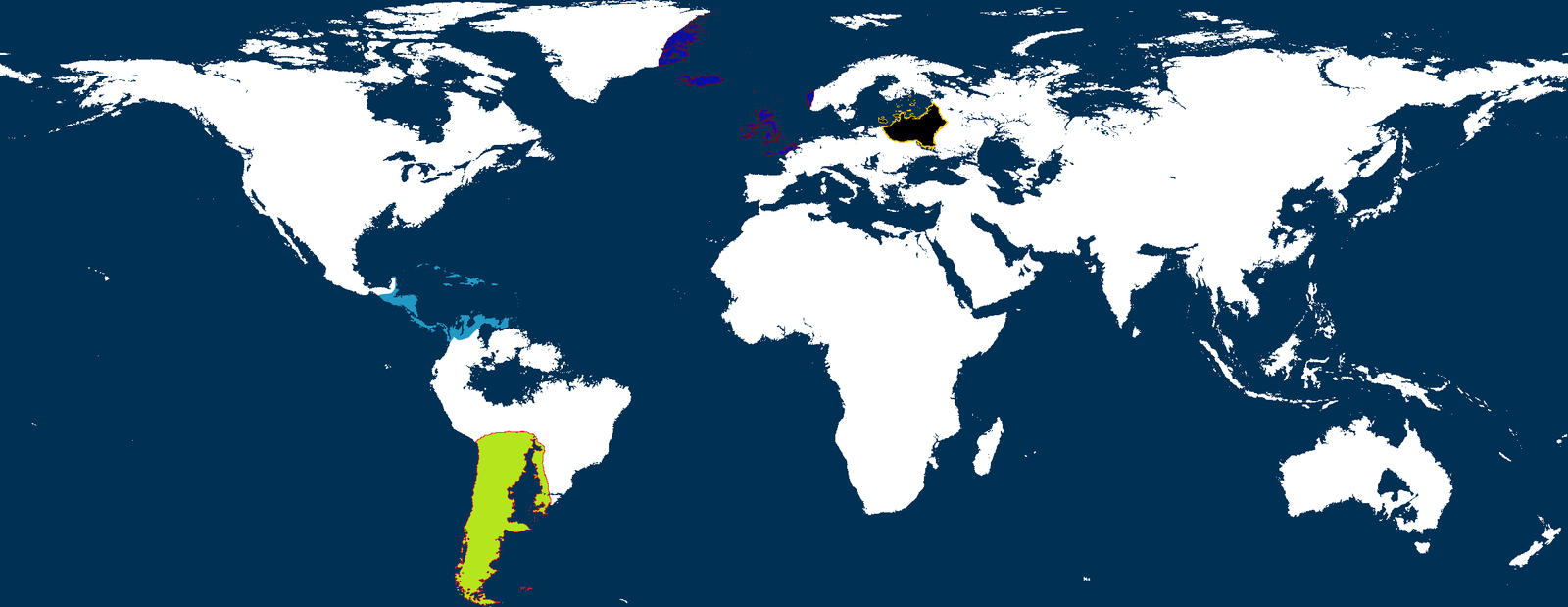
Cuban and Caribbean islands, northern South America, Central America, and Southern Mexico

Demographics:
Latin American (Cuban, Afro-Carib, Colombian, Venezuelan, etc), Haitian, Mayan/indigenous

As a whole, Christian tradition has been somewhat maintained in the territories of the Internationale. However, severed from Europe as an effect of the nuclear war and general collapse of the modern world, the Catholic Church effectively ceased to exist, at least in the Americas. To fill the void left behind and a stronger center to their beliefs the nature of Christianity evolved to encompass and adapt aboriginal beliefs to make a heresy in of itself. Voodoo and other ancient religions imported to the New World as an effect of the Slave Trade integrated itself and the Creole and Spanish traditions of Voodoo more seamlessly meshing in the regional diaspora.

Compounding it further is the now widespread Cult of the Extraterrestrial, a belief that aliens exist and guide humanity and where the trinity and God take the form of unknown aliens beyond Earth. To the believers, extraterrestrial life has perfected the way to live and its followers seek to emulate their ways to ascend to a high means of existence more in harmony with themselves and world. To the believers, nuclear Armageddon was a necessity to purge the world and lay the way to rebuild humanity in an enlightened harmony.

Culture:
Nominally Latin American still. French-Creole, Spanish, and English is spoken. Within Central America indigenous practices have seen a resurgence.

Important States and Cities:
Havana Island – the seat of the Internationale
Tegucigalpa
Managuqa
San Jose
Barranquilla
Caracas
Belize
Guatemala
Tuxtla Gutierrez
San Juan
Santiago De Los Caballeros

History:
Following the nuclear wars, the devastation was not limited solely to the Great Powers. The nuclear fallout flowed over the Gulf of Mexico as the fires burned north over the horizon. As the seas rose, the problems were compounded as much the Caribbean was thrown into disarray. The governments of Cuba, Haiti, and the Dominican Republic were thrown into as much disarray as the United States. Enveloped in crisis, the governments of the Caribbean islands collapsed as they were drowned by the sea or in migrants fleeing the United States or their not inundated homes.

What was left of international aid proved feeble and week and collapsed within the year. Incapable of hosting large populations, people fled the islands for the mainland, either choosing to brave nascent radiation in America or the relative health of South America. Either way, the crisis banded communities together who took charge of the situation to mostly save themselves. By this point all semblance of government had eroded and what remained in the likes of Cuba of government was isolated on an island and incapable of exercising control over the rest of its former nation.

The ideological importance of the Castros faded in favor of pragmatic survival as large groups turned whole scale to agricultural economies from the now stalled and faded manufacturing economy that the recent reforms in Cuba had been trying to capitalize on to expand the island nation's way of life. But much of this had lost value, and with the ocean waters heated from nuclear radiation hurricanes became all the more powerful and stunning as annually they were hammered by immense storms that swept the Caribbean and Gulf State of the Southern United States.

In the lack of control however, and the call for answers an ember that had been simmering hidden for almost fifty or sixty years became to pop and spark with life. With nuclear annihilation came the rebirth of the fringe philosophy of J. Posadas. While long dead, Posadas' legacy had been carried on by its few believers and on into the 21st century by a group of radical alien believers or ultra-left activists and no less than a few comedic types. But according to the philosophy of Posadas, nuclear annihilation was considered a way to wipe the slate clean, to rebuild the world free from the old sins. And not only that, that it was an inevitability anyways.

The resurgence of Posadism in the discourse of Cubans who have lived under a communist system for decades came as no effort of any one man, and for the most part the early fringe proselytes faded from common history like so many missionaries of the middle ages. Attracted on the promise of a responsive people's democracy, and that all was ultimately well in the world – no matter the crisis past or present – that they could begin again. And with the might and fury of the United States removed from the equation, they could begin again.

It was however another question in how to reconstruct Cuba. As an experiment over the next few hundred years Cuba was stitched together community by community. Ultimately the former government in a much maligned and decayed Havana was itself annexed into the new people's movement. Following which was bringing the revolution to the other islands and the chain of islands remaining in the Caribbean was steadily liberated and incorporated into the collective.

Forays on the coast of South America expanded the new tradition to new communities and swathes of the coastal and near coastal communities of Colombia and Venezuela were brought in over time. As was central America. Though, efforts to bring Revolution to North America were resisted by the city states there, operations have not let up. While in the south the rural inland and jungles proved to the Posadists that their position at sea may have perhaps put them at a disadvantage as a power of the inland sea.

All the same, for the Hispanic communities of central America they became an attractive force, ultimately meeting resistance from the “zombie” government of Mexico and elsewhere with incorporation of Chiapas and the Maya.

Other:
nucc
© 2007-2026
BBCode Cheatsheet