Dinh AaronMk
 Member
my beloved (french coded)
STATUS: As an American [user could not afford rest of post] 1 yr ago
- Last Seen: 11 mos ago
- Joined: 12 yrs ago
- Posts: 7860 (1.74 / day)
- VMs: 13
-
Username history
- Dinh AaronMk 12 yrs ago
-
Latest 10 profile visitors:
-
Most recent →
 AliceAbigail,
 Scrawl Banditta,
 Wilted Rose,
 mickilennial,
 Ekreture,
 Supermaxx,
 erikh
erikh
Status
Recent Statuses
1 yr ago
Current
As an American [user could not afford rest of post]
6
likes
3 yrs ago
Never spaghetti; Boston strong
3 yrs ago
The last post below me is a lie
1
like
3 yrs ago
THE SACRIFICE IS COMPLETE. THE BOILERMEN HAVE FRESH SOULS. THEY CAN DO SHIFT CHANGES.
2
likes
3 yrs ago
Was that supposed to be an anime reference
Bio
Harry Potter is not a world view, read another book or I will piss on the moon with my super laser piss.
Most Recent Posts
All hail Barrack, House of Obama, King of the Americans and the First Men.
Congo-Gabon Border, Africa
The soft lights of control panels shone in the pilot's face, giving readings on the Osprey's condition as it glided above the thick jungle canopy below. Low rolling hills could be seen in the distance, mired from view by the haze of distant mist. Dark, distant clouds hung in the bright blue sky, beckoning a coming rainstorm.
“It looks cloudy.” a female voice said. The co-pilot. She was a dark-skinned woman, lite chocolate features from a mixed parentage, “Think we can get this done before it rains then?” she asked, turning to her partner.
“Naw, naw.” the Aussie said in a exasperated breath, “It looks t' be too far out t' caw'tch up with us.”
“You think?” the copilot asked again. Half-assed writing on her green pilot's helmet read: Fleetfoot. Her partner: Soarin.
“If we'a go t' faw'r in then we're coming back out and we tell the baw'sses.” Soarin said flatly, checking their GPS position on a screen to his left, “Maw'be we can get us some help with a saw'tellite.”
“I copy.” Fleetfoot replied, “Should I get the drone down then?”
“If you wo'uld.” Soarin nodded, “Let's get this dawne so we can get some o' that barbie at base.”
“I hear you.” smile Fleetfoot, flipping a switch a small screen to her right clicked on, showing a flickering black and white screen of the jungles below. With a twitch from the flat plasma screen the scene began to move. The ship's on board drone helicopter was down and on the move.
Dropping through the air the jungle below began to rush upwards only to slow to a crawl as the small device gained control of its descent and whipped forward over the trees, controlled by the gentle and precise twitches and moves on Fleetfoot's controls as she dove it into the trees.
Under the tree line, the merits of the black and white interface came to. The cold trees glowed softly, just enough to be visible against each other as the view through the thermal camera peered on through the thick brush. And over it all, the burning white hot shapes of living, roaming mammals and birds that populated the higher crowns of the thick Congo.
No sound came through the drone. It wasn't needed, not for the purposes of Fleetfoot and the crew. Soarin as well had his own thermal imaging. Tucked under the cockpit hung the bulbous, tumorous main thermal camera. A center screen showed the heat-signature of the forest below, though most of the information it could provide was lost in the incredible noise of the forest. The thick leaves shrouded everything but the birds that flew above, or the monkeys that climbed in the high branches. Occasionally, other images would pass through, but the veil of leaves made it hard to make out anything, especially flying so fast.
The Osprey flew over the forest, searching for anything that might be their mark. And in the distance, the clouds grew closer.
“Found them.” Fleetfoat said plainly, breaking over a half an hour's silence, “fives miles out at 175 degrees.”
“Cawpy that.” Soarin said, rounding the Osprey around.
“Looks like twenty individuals, armed, walking south by south east.”
“Sawnds like we gawt our blokes then.” Soarin smiled, hitting a button for all unit coms.
“We got 'em.” he said. On cue from the back the small team they carted shot up off their benches to take their stations by the door. As the Osprey turn about they readied their lines.
“Straight ahead, four-hundred meters.” Fleetfoat said after several minutes.
“Good on 'em,” Soarin added, “Sending a present.”
Through the cockpit glass two silver spears shot out from the side of the craft, trailing white smoke behind them as they screamed over the jungle canopy and into the tree-line to explode in a brilliant flash of fire and light. The trees parted and bowed against the explosive blast as a black cloud bloomed over the greenery. With a rush the Osprey flew over the smokey, still smoldering crater they had left, a harsh alarm signaling the opening of the doors as the craft lowered.
“Move! Move!” Flash screamed as the sound of the rotors roared into the cabin. Sweeping buffeting winds ripped through as the fist cables were anchored into the ceiling and dropped down over the side. Soon after the pinging of bullets against the hull of the hovering Osprey.
The first pair of boots to hit the ground mushed down the singed and still burning foliage left by the Osprey's missiles. The bright red dome of the soldier's helmet acting as a magnet. But the small arms fire the pinged and reflected off could do little to phase the heavily armored beast as it stepped forward out of the firing zone. Bits of ash and leaves dancing in a cyclonic spin around him. The bulbous plates on his shoulders and the heavy chest plate giving him more of a build akin to a heavy beetle.
A small, chain-fed machine gun rested in the ballistic-plastics reinforced gloves. Stepping out of the landing zone, the machine gun let open its rounds. Bright flashes of yellow swept the edge of the artificially forced clearing. Brass casings flashed in the sun as behind him the rest of the squad landed, and swept out, firing into the trees.
Gun fire popped and echoed through the trees as the mercenary squad spread out, dipping into the trees. And in moments, the firing silenced.
Kampala, Uganda
“Hey, what the fuck did you do to the TV!?” cried a man as he sat up from his chair, angrily yelling over the dull silence of the office. The room was very nondescript, and featured many of the same features of a growing Kampala. Plain, colorless dry-wall, a dropped ceiling, and a tasteless blue-gray rug could make it feel like it was any old office from the 2000's. Cheap photos in plastic frames hung from the wall, and suspended in the corner of the room was a flat-screen TV with a broken, frozen image.
“Hey, I ain'd did shid man!” shouted the man's companion. A tall native with broad shoulders. A Ugandan dressed in a ASF uniform some few sizes too small for him. Some effort had been made to tuck it into his dress pants as he leaned against the reception counter. But the effort was lacking, and was made up for by a clean white under shirt. “Mutesa ain'd done shid, man.”
“Better fucking not, I'm missing the game!” swore the other. A white man in a more relaxed uniform. From behind the counter he had been trying to watch a soccer game. But the satellite image had died and was now showing a jittering two frames a minute as the rest of the image lagged and broke behind in huge square chunks. Absolute silence hung over the cool office as the two sat by, staring at the dead screen.
“It's the fucking African cup.” the white man said, saddened and frustrated.
“Well maybe id's da Oculli.” Mutesa smiled, “You know deh do da crazy dhings, man. Deh like da Illumandi and shid.”
“Are you fucking crazy?”
“Aw no, you da crazy one Mark.” Mutesa laughed heartily. He had a distinctive deep throaty laugh. It was a done that matched his size, and the cheerful sort of disposition he had. But he was a fortunate one by some respects, many from his village did not enjoy get high paying jobs.
“Hey, just because the fucking Illuminati started the fucking world war to kill Obama doesn't mean the Occuli are taking over my soccer games because it's not some limp-dick liberal shit.
“So fuck off and fix it man.”
“You do know id's supposed d' rain today bruddah?” smiled Mutesa, “You dhink dhat's why?”
“God fucking damn it, I need a drink.”
“Too early for Waragi, bruddah. It's only two.”
“Yea fuck that.” Mark grumbled, drumming his fingers across the reception desk as he stared at the frozen TV screen. Thunder rolled outside, heralding the storm to come. The TV screen flickered weakly, before shutting off and being replaced by a dancing signal lost box. “Shit, now I'll need to read up on the match later.” he cursed.
“Id can'd be so bad.” Mutesa comforted, pushing away from the wall and walking across the room. He smiled as he kicked across the cheap carpet. He could always mess with Mark more. In fact, he could. “So who do you d'ink ordered d'is wea'der dhen? Dhat Birdie chick?”
“Oh to Hell with you.” chuckled his Mark, shaking his head.
“You know she wasn'd so bad, once upon a d'ime.” Mutesa continued, “I remember going d'a see a movie of her's wid an' old girlfriend of mine.”
“And it was mediocre?” Mark said.
“Like shi'd.” Mutesa laughed, “You whide man an' your sill dhings. Id makes no sense d' me somedimes.”
“Hey, you familiar with Emilia Clark at all?”
“Is she one of dem crazy ones?”
“Aw, no, no!” Mark cheered clapping her hands, “I take it you never heard of Game of Thrones then?”
“Shid sounds like some Umerican gameshow.” Metusa snickered.
“Aw, no. No.” Mark laughed, “I'll need to see if I can find it then.”
“Well you besd be careful, dhey say da interned is a Iranian conspiracy now.”
“Fine, fine.” Mark muttered.
From the far-side of the room there was a soft electric ring that cut through the silence like the cut of a knife. The soft subtle ring broke the eerie TV-less silence and drew the two's attention up to the entrance. The figure that stood in the door brought the two to a sharp salute of attention at the stiffly standing figure.
“At ease, gentlemen.” a voice spoke in a soft French accent. The two men on duty responded, relaxing and watching in Pierre Loffaine.
Pierre was a man whose features have been dictated by almost constant conflict. The battles he fought and wars he witnessed were etched deep into his face and body. Weary, tired lines ran around his features like an artist's attempts at accentuating every wrinkle in his face. His eyes starred off distantly, but knowingly. And staring into them Mark and Metusa both knew that the Frenchman could see deeper into them than they could him.
The kiss of Africa had come to rest on his face. The sun had tanned him, if not burned the top of his nose which glowed a fierce red, even inside. His bright blue eyes shone strong against the soft amber-orange around his eyes. “I see we are doing well.” his stress-thin mouth uttered as he looked between Mark and Metula. “Your uniform is small.” he commented to the Ugandan.
“I-I'm afraid the quader masder got my size wrong.” Metula said tensly, trying his best to defend himself.
Pierre simply noted, “Is he working on it then?” he asked.
“He is, sir.” nodded.
Pierre nodded his head slowly, stepping through the reception room. His steps were taken slow, almost sagely. The years of battle was not only on his face, but wore on his entire body. At several places even claiming whole parts of him.
Much of the commander's left-arm had been replaced with metal. All he had now to claim as his own was a heavy metal prosthetic. A cybernetic implant of steel and titanium. As he walked the shining red arm rose to his chest, the rubber-tipped fingers gingerly playing with the buttons on his uniform.
“Keep up the good work.” Pierre said distantly as he strolled through into the hall, disappearing out of sight.
The soft lights of control panels shone in the pilot's face, giving readings on the Osprey's condition as it glided above the thick jungle canopy below. Low rolling hills could be seen in the distance, mired from view by the haze of distant mist. Dark, distant clouds hung in the bright blue sky, beckoning a coming rainstorm.
“It looks cloudy.” a female voice said. The co-pilot. She was a dark-skinned woman, lite chocolate features from a mixed parentage, “Think we can get this done before it rains then?” she asked, turning to her partner.
“Naw, naw.” the Aussie said in a exasperated breath, “It looks t' be too far out t' caw'tch up with us.”
“You think?” the copilot asked again. Half-assed writing on her green pilot's helmet read: Fleetfoot. Her partner: Soarin.
“If we'a go t' faw'r in then we're coming back out and we tell the baw'sses.” Soarin said flatly, checking their GPS position on a screen to his left, “Maw'be we can get us some help with a saw'tellite.”
“I copy.” Fleetfoot replied, “Should I get the drone down then?”
“If you wo'uld.” Soarin nodded, “Let's get this dawne so we can get some o' that barbie at base.”
“I hear you.” smile Fleetfoot, flipping a switch a small screen to her right clicked on, showing a flickering black and white screen of the jungles below. With a twitch from the flat plasma screen the scene began to move. The ship's on board drone helicopter was down and on the move.
Dropping through the air the jungle below began to rush upwards only to slow to a crawl as the small device gained control of its descent and whipped forward over the trees, controlled by the gentle and precise twitches and moves on Fleetfoot's controls as she dove it into the trees.
Under the tree line, the merits of the black and white interface came to. The cold trees glowed softly, just enough to be visible against each other as the view through the thermal camera peered on through the thick brush. And over it all, the burning white hot shapes of living, roaming mammals and birds that populated the higher crowns of the thick Congo.
No sound came through the drone. It wasn't needed, not for the purposes of Fleetfoot and the crew. Soarin as well had his own thermal imaging. Tucked under the cockpit hung the bulbous, tumorous main thermal camera. A center screen showed the heat-signature of the forest below, though most of the information it could provide was lost in the incredible noise of the forest. The thick leaves shrouded everything but the birds that flew above, or the monkeys that climbed in the high branches. Occasionally, other images would pass through, but the veil of leaves made it hard to make out anything, especially flying so fast.
The Osprey flew over the forest, searching for anything that might be their mark. And in the distance, the clouds grew closer.
“Found them.” Fleetfoat said plainly, breaking over a half an hour's silence, “fives miles out at 175 degrees.”
“Cawpy that.” Soarin said, rounding the Osprey around.
“Looks like twenty individuals, armed, walking south by south east.”
“Sawnds like we gawt our blokes then.” Soarin smiled, hitting a button for all unit coms.
“We got 'em.” he said. On cue from the back the small team they carted shot up off their benches to take their stations by the door. As the Osprey turn about they readied their lines.
“Straight ahead, four-hundred meters.” Fleetfoat said after several minutes.
“Good on 'em,” Soarin added, “Sending a present.”
Through the cockpit glass two silver spears shot out from the side of the craft, trailing white smoke behind them as they screamed over the jungle canopy and into the tree-line to explode in a brilliant flash of fire and light. The trees parted and bowed against the explosive blast as a black cloud bloomed over the greenery. With a rush the Osprey flew over the smokey, still smoldering crater they had left, a harsh alarm signaling the opening of the doors as the craft lowered.
“Move! Move!” Flash screamed as the sound of the rotors roared into the cabin. Sweeping buffeting winds ripped through as the fist cables were anchored into the ceiling and dropped down over the side. Soon after the pinging of bullets against the hull of the hovering Osprey.
The first pair of boots to hit the ground mushed down the singed and still burning foliage left by the Osprey's missiles. The bright red dome of the soldier's helmet acting as a magnet. But the small arms fire the pinged and reflected off could do little to phase the heavily armored beast as it stepped forward out of the firing zone. Bits of ash and leaves dancing in a cyclonic spin around him. The bulbous plates on his shoulders and the heavy chest plate giving him more of a build akin to a heavy beetle.
A small, chain-fed machine gun rested in the ballistic-plastics reinforced gloves. Stepping out of the landing zone, the machine gun let open its rounds. Bright flashes of yellow swept the edge of the artificially forced clearing. Brass casings flashed in the sun as behind him the rest of the squad landed, and swept out, firing into the trees.
Gun fire popped and echoed through the trees as the mercenary squad spread out, dipping into the trees. And in moments, the firing silenced.
Kampala, Uganda
“Hey, what the fuck did you do to the TV!?” cried a man as he sat up from his chair, angrily yelling over the dull silence of the office. The room was very nondescript, and featured many of the same features of a growing Kampala. Plain, colorless dry-wall, a dropped ceiling, and a tasteless blue-gray rug could make it feel like it was any old office from the 2000's. Cheap photos in plastic frames hung from the wall, and suspended in the corner of the room was a flat-screen TV with a broken, frozen image.
“Hey, I ain'd did shid man!” shouted the man's companion. A tall native with broad shoulders. A Ugandan dressed in a ASF uniform some few sizes too small for him. Some effort had been made to tuck it into his dress pants as he leaned against the reception counter. But the effort was lacking, and was made up for by a clean white under shirt. “Mutesa ain'd done shid, man.”
“Better fucking not, I'm missing the game!” swore the other. A white man in a more relaxed uniform. From behind the counter he had been trying to watch a soccer game. But the satellite image had died and was now showing a jittering two frames a minute as the rest of the image lagged and broke behind in huge square chunks. Absolute silence hung over the cool office as the two sat by, staring at the dead screen.
“It's the fucking African cup.” the white man said, saddened and frustrated.
“Well maybe id's da Oculli.” Mutesa smiled, “You know deh do da crazy dhings, man. Deh like da Illumandi and shid.”
“Are you fucking crazy?”
“Aw no, you da crazy one Mark.” Mutesa laughed heartily. He had a distinctive deep throaty laugh. It was a done that matched his size, and the cheerful sort of disposition he had. But he was a fortunate one by some respects, many from his village did not enjoy get high paying jobs.
“Hey, just because the fucking Illuminati started the fucking world war to kill Obama doesn't mean the Occuli are taking over my soccer games because it's not some limp-dick liberal shit.
“So fuck off and fix it man.”
“You do know id's supposed d' rain today bruddah?” smiled Mutesa, “You dhink dhat's why?”
“God fucking damn it, I need a drink.”
“Too early for Waragi, bruddah. It's only two.”
“Yea fuck that.” Mark grumbled, drumming his fingers across the reception desk as he stared at the frozen TV screen. Thunder rolled outside, heralding the storm to come. The TV screen flickered weakly, before shutting off and being replaced by a dancing signal lost box. “Shit, now I'll need to read up on the match later.” he cursed.
“Id can'd be so bad.” Mutesa comforted, pushing away from the wall and walking across the room. He smiled as he kicked across the cheap carpet. He could always mess with Mark more. In fact, he could. “So who do you d'ink ordered d'is wea'der dhen? Dhat Birdie chick?”
“Oh to Hell with you.” chuckled his Mark, shaking his head.
“You know she wasn'd so bad, once upon a d'ime.” Mutesa continued, “I remember going d'a see a movie of her's wid an' old girlfriend of mine.”
“And it was mediocre?” Mark said.
“Like shi'd.” Mutesa laughed, “You whide man an' your sill dhings. Id makes no sense d' me somedimes.”
“Hey, you familiar with Emilia Clark at all?”
“Is she one of dem crazy ones?”
“Aw, no, no!” Mark cheered clapping her hands, “I take it you never heard of Game of Thrones then?”
“Shid sounds like some Umerican gameshow.” Metusa snickered.
“Aw, no. No.” Mark laughed, “I'll need to see if I can find it then.”
“Well you besd be careful, dhey say da interned is a Iranian conspiracy now.”
“Fine, fine.” Mark muttered.
From the far-side of the room there was a soft electric ring that cut through the silence like the cut of a knife. The soft subtle ring broke the eerie TV-less silence and drew the two's attention up to the entrance. The figure that stood in the door brought the two to a sharp salute of attention at the stiffly standing figure.
“At ease, gentlemen.” a voice spoke in a soft French accent. The two men on duty responded, relaxing and watching in Pierre Loffaine.
Pierre was a man whose features have been dictated by almost constant conflict. The battles he fought and wars he witnessed were etched deep into his face and body. Weary, tired lines ran around his features like an artist's attempts at accentuating every wrinkle in his face. His eyes starred off distantly, but knowingly. And staring into them Mark and Metusa both knew that the Frenchman could see deeper into them than they could him.
The kiss of Africa had come to rest on his face. The sun had tanned him, if not burned the top of his nose which glowed a fierce red, even inside. His bright blue eyes shone strong against the soft amber-orange around his eyes. “I see we are doing well.” his stress-thin mouth uttered as he looked between Mark and Metula. “Your uniform is small.” he commented to the Ugandan.
“I-I'm afraid the quader masder got my size wrong.” Metula said tensly, trying his best to defend himself.
Pierre simply noted, “Is he working on it then?” he asked.
“He is, sir.” nodded.
Pierre nodded his head slowly, stepping through the reception room. His steps were taken slow, almost sagely. The years of battle was not only on his face, but wore on his entire body. At several places even claiming whole parts of him.
Much of the commander's left-arm had been replaced with metal. All he had now to claim as his own was a heavy metal prosthetic. A cybernetic implant of steel and titanium. As he walked the shining red arm rose to his chest, the rubber-tipped fingers gingerly playing with the buttons on his uniform.
“Keep up the good work.” Pierre said distantly as he strolled through into the hall, disappearing out of sight.
Keyguyperson said
Name of Nation: United European Territories (UET), or simply United Europe.Territories:AustriaBulgariaCroatia Cyprus Denmark EstoniaFinland France GermanyGreeceHungaryIreland ItalyLatviaLithuaniaLuxembourgMaltaNorwayPortugal RomaniaSloveniaSpainSwedenUnited KingdomGovernment Type: The UET is a Federation, ruled by a Council of multiple representatives elected by the different members, and then one or two elected by the nation as a whole.Military: The UET military is highly advanced, with both the Navy and Air Force utilizing lasers and railguns. The land forces also utilize railguns on tanks, but the footsoldiers use the much less efficient coilgun rifles due to the huge size of railguns, and pistols are almost always conventional. However, the coilguns are quieter than gunpowder weapons, and coilgun pistols are often used on stealth missions at the expense of re-usability (Coilgun pistols are ten shots max without battery packs). The Air Force often uses lasers for dogfighting and railguns in conjunction with conventional bombs for ground attack. However, most air-to-air operations are composed entirely of firing a missile and watching the blip on the radar disappear, as it has been since the early 2000s. The Navy uses railguns exclusively for close to mid-range ship-to-ship combat, and missiles for long-range ship-to-ship. Lasers are used against air targets, and to great effect. The military as a whole has a focus on air power, sending in bombers first, then the troops and/or ships.Economy: The economy of the UEF follows a revised version of the Nordic Model, which is referred to as the "European Federation Model". The government controls all companies, but some autonomy is allowed. The main exports of the Federation are oil, coal, and natural gas. Obviously, foreign trade hasn't gone well after the war. Aerospace, engineering, and scientific industries are the most common, with the Federation being among the leading powers in science and engineering.Foreign Policy: The UET seeks good relations, but they do not particularly like dictatorships. Or nations where they consider free market to have "run rampant".History: The UET was formed in the heat of the war, when a man named Dmitri Saveli pushed for the unification of the old European Union. At first, the nations refused to accpet it, but it eventually became clear that unless they became a single nation all of them would fall to invading armies. Right in the middle of WWIII, the UET was formed and with a true union in place they were able to survive the war and earn a place beside nations such as the North American Federation. However, the OFR took multiple nations from the UET while it was still in its infancy, and Germany never joined from the start as it seemed reluctant to give up its history for whatever reason.Foes: The Order of the Fourth Reich, due to refusing to join in the middle of the war, as it was predicted at the time that the UET would be defeated without Germany. Not to mention them nicking several nations from the UET through conquest while the organization of the nation was still weak.Demographics: The UET has about 500 million citizens, but no official survey has been conducted on race. Mainly because they just don't care, why should it matter what the citizens look like? They're all people. However, it is estimated that less than 30%-%40 of the UET is Caucasian, but those numbers are no more than educated guesses made by independent researchers.Other: I don't even have to say that it has a space program, that's a given for my nations.Oh yeah, I apologize for my short history. I know, its bad. I promise I can roleplay better.
I want to say no.
I call dibs on the Marianas Trench.
I'mma have to get on one shortly.
Vilageidiotx said
We might reach a point where working for a living is obsolete. Which would mean a major economic shift the likes hasn't been seen since the 18th century. It would completely change how the market works.
And with it the political argument on whether to push ahead with this, or wind back to the old manner of production. A sort of new-age Reactionary movement.
Or unmanned vehicles in the later part of the war.
But as the world recovers that leaves a lot of questions in regards to how automation should be treated. Should the nation return to less automation for the sake of job creation at the sacrifice of a competitive edge?
The RP's sort of at the thresh hold of two dystopias. One post-war, and one where automation is on the way to taking over a lot of low-skill jobs and changing the job market, making even some high-skilled jobs very competitive.
But as the world recovers that leaves a lot of questions in regards to how automation should be treated. Should the nation return to less automation for the sake of job creation at the sacrifice of a competitive edge?
The RP's sort of at the thresh hold of two dystopias. One post-war, and one where automation is on the way to taking over a lot of low-skill jobs and changing the job market, making even some high-skilled jobs very competitive.
I think an important thing to bring up is that the modern economy is fast on track to international integration. Violence or Earthquakes in China can have rippling effects throughout the international economy as many consumer goods at least raise in price due in part to disturbed supply. Violence in the middle east can raise oil prices across the world. So somewhere there had to be advancement that reconditions societies for some economic independence, or the belligerent sides somehow break down in alliances that somehow give all sides enough of a share of resources they only need to worry about how to ration it.
But one thing's for sure when we're done, the international market and the face would most likely shift as post-war sanctions take effect, or during-war sanctions on other nations continue stubbornly.
This will in turn not only re-shape the face of government in the military and its functions, but the public conscious as they argue if the "old way" is better or if they should pursue a "new way". 3D printing could very well become a thing modern socialists cling to, parading it as the means for public production all throughout society as the traditional capitalist elements seek to control it to protect their self interests.
You could also have situations where the ASF itself can find it very, very easy to arm itself with custom parts and become a majority independent of the world market through 3d printing, which could be a part of growing manufacturing independence, which adds to economic independence all over. Why have china build your cars when you can print and assemble the parts in the garage? Or why let the common man do it when traditional bourgiese bodies can clamp down on public use and use 3d printing for cheap at-home production?
But one thing's for sure when we're done, the international market and the face would most likely shift as post-war sanctions take effect, or during-war sanctions on other nations continue stubbornly.
This will in turn not only re-shape the face of government in the military and its functions, but the public conscious as they argue if the "old way" is better or if they should pursue a "new way". 3D printing could very well become a thing modern socialists cling to, parading it as the means for public production all throughout society as the traditional capitalist elements seek to control it to protect their self interests.
You could also have situations where the ASF itself can find it very, very easy to arm itself with custom parts and become a majority independent of the world market through 3d printing, which could be a part of growing manufacturing independence, which adds to economic independence all over. Why have china build your cars when you can print and assemble the parts in the garage? Or why let the common man do it when traditional bourgiese bodies can clamp down on public use and use 3d printing for cheap at-home production?
One thing that might be worth addressing is the international condition post-war, beyond a few really weird-as-shit political shifts (Germany going back to an Empire) and territorial gains. Mostly dealing with the economic concerns of such a massive war going on for fifteen years.
To the major participants of the conflict, you have the obvious bit concerning a lot of young men and women being killed on the front-line, creating a significant artificial population dip in the national demographics. And for nations with a shrinking population like Russia this could catastrophic in the future as they get a ticking time-bomb that is a a massive aging population being supported by a smaller youth demographic. As a reference, here's the Russian population pyramid from 2010:
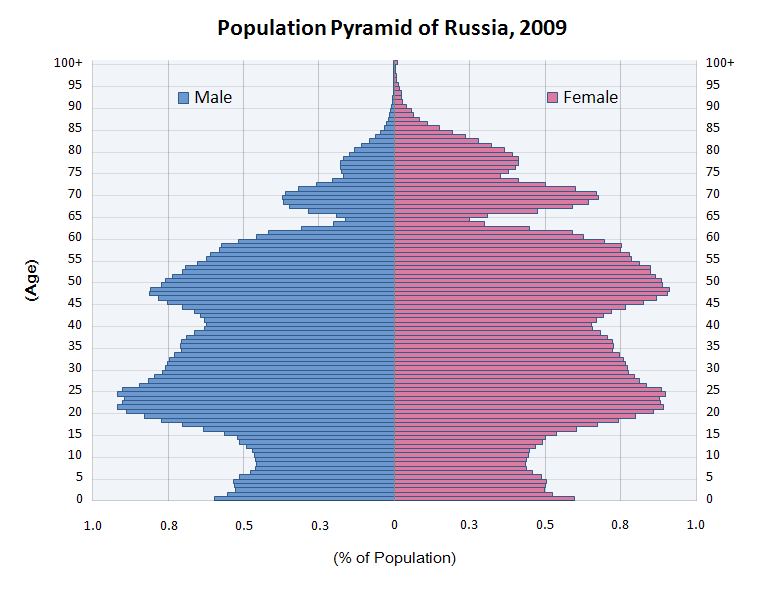
There's a bunch of Soviet-borns who'd be seniors by the time this RP picks up and just as many middle-aged Soviet-era citizens who would have children that would have died in the war. And already we see the patterns associated with a industrial or post-industrial society, which is a stabilized or even shrinking population brought from across the board economic potential that would distract from child bearing and family planning. There'd be a dip like what is seen in the 65-70 demographic who found WW2. So project that on the current 10-20 year old demographic(s) and you got another huge cut being made to the working-age youth.
And Russia already has issues with keeping its army full because there are so few service-age people.
And others:
US, now and projection in the future:

Germany:

China:

So we got a future population crisis in many areas. And larger older populations make the issues of pensions a contentious issue as the state tries to keep money in the hand of their older generation and a smaller working youth population to keep the pension fund full.
On top of this we got the economic concerns in 3d printing to worry about and the changing face of manufacturing brought by it. Will everyone be the owners of the means of production to produce whatever they want or need? Or will the rites to produce be in the hands of those that already do, giving them more manufacturing power with less a need to employ? Either way there'll be an economic impact which'll only layer itself on the residual effects of war-time inflation (and someone somewhere has to pay for those bombs). Even if you weren't in the war you'll be feeling the pinch as interest rates adjust to inflation and the value of every other currency makes dramatic swings.
I have the feeling this isn't being considered when people continue to chant "reconstruction". Reconstruct with what exactly? Who benefits? How does it benefit? Who hurts? How does it hurt? What post-war political, philosophical, and economic questions remain post-war? What of the fate of armies? With so few service-age men and women in many top-powers there'll be that contentious matter of how to supplement the empty ranks, and how to effectively field a modern army at lower costs.
To the major participants of the conflict, you have the obvious bit concerning a lot of young men and women being killed on the front-line, creating a significant artificial population dip in the national demographics. And for nations with a shrinking population like Russia this could catastrophic in the future as they get a ticking time-bomb that is a a massive aging population being supported by a smaller youth demographic. As a reference, here's the Russian population pyramid from 2010:
There's a bunch of Soviet-borns who'd be seniors by the time this RP picks up and just as many middle-aged Soviet-era citizens who would have children that would have died in the war. And already we see the patterns associated with a industrial or post-industrial society, which is a stabilized or even shrinking population brought from across the board economic potential that would distract from child bearing and family planning. There'd be a dip like what is seen in the 65-70 demographic who found WW2. So project that on the current 10-20 year old demographic(s) and you got another huge cut being made to the working-age youth.
And Russia already has issues with keeping its army full because there are so few service-age people.
And others:
US, now and projection in the future:
Germany:
China:
So we got a future population crisis in many areas. And larger older populations make the issues of pensions a contentious issue as the state tries to keep money in the hand of their older generation and a smaller working youth population to keep the pension fund full.
On top of this we got the economic concerns in 3d printing to worry about and the changing face of manufacturing brought by it. Will everyone be the owners of the means of production to produce whatever they want or need? Or will the rites to produce be in the hands of those that already do, giving them more manufacturing power with less a need to employ? Either way there'll be an economic impact which'll only layer itself on the residual effects of war-time inflation (and someone somewhere has to pay for those bombs). Even if you weren't in the war you'll be feeling the pinch as interest rates adjust to inflation and the value of every other currency makes dramatic swings.
I have the feeling this isn't being considered when people continue to chant "reconstruction". Reconstruct with what exactly? Who benefits? How does it benefit? Who hurts? How does it hurt? What post-war political, philosophical, and economic questions remain post-war? What of the fate of armies? With so few service-age men and women in many top-powers there'll be that contentious matter of how to supplement the empty ranks, and how to effectively field a modern army at lower costs.
Russia better fight tooth and nail with NATO over those Baltic states, because they're members of it.
© 2007-2026