STATUS:
Have you ever had a dream that you um you had your you could you’ll do you wants you you could do so you’ll do you could you you want you want them to do you so much you could do anything?
2 mos ago
Current
Have you ever had a dream that you um you had your you could you’ll do you wants you you could do so you’ll do you could you you want you want them to do you so much you could do anything?
7
likes
4 mos ago
I've just come out of an existential eldritch hysteria induced nap and running on 6,000 years of sleep
5
likes
10 mos ago
I tap refresh and wait and see, a flashing note, a reply for me. No new posts, just the same old screen, yet still I hope for what might've been.
7
likes
11 mos ago
"He who has felt the deepest grief is best able to experience supreme happiness."
2
likes
11 mos ago
Looking for a few people to help create a shared sci-fi universe. If that sounds fun, drop me a PM!
1
like
Bio
Hadn't updated this in a WHILE so I deleted it. I'm Ducksworth, or Duck, or Duckie. PM if you wanna know more, yeah?
Though Melion had traversed the path to the Festival many times before, there remained one indignity he had never learned to stomach, water. For all his associations with bloom and bounty, his dominion ended where the water began. Water was necessary, yes, but not like this. Not endless and heaving. Not the gut-lurching pull of tide beneath a boat’s belly. And so, when his bare feet finally touched the sun-warmed stone of the island’s dock, he stepped down with the reverence of a man kissing holy ground. His usual complexion, radiant and golden as spun honey, had taken on the pallor of crushed sage.
For a while, he disappeared to a quiet plot just beyond the formal gardens. He always did. Over time, the space had grown to suit him, foxglove, milkweed, and clover sprang freely here, forming a microcosm of the wild, an offering to his presence. His bees, soft-bodied and drowsy with pollen, flitted between petals, brushing against the leaves as if in quiet worship.
Melion knelt, barefoot and bare-chested, letting his fingertips sink into the loam. His breath steadied. The silence here was not empty, it pulsed with memory and rhythm, with the language of green things. Were mortals to find this grove, it would not be long before they built a shrine. But for Melion, it was simply a place to breath and restore. He let the bees rest on him, one on his shoulder, another behind his ear. Then, when he felt the weight of sickness replaced by the steadiness of rooted life, he rose.
The marble steps to the palace felt cool beneath his soles, each step a quiet hymn. His gait was unhurried, fluid as a stalk in the wind. The Feast was still young, and the hushed air of anticipation clung to the halls like perfume but already, Melion could sense the pulse of festivity humming.
At the threshold stood a greeter, a young man with a crown of red hair and a diplomat’s poise. They exchanged nods, words were sparse but cordial. Melion neither delayed nor dwelled; the routine was familiar now, though never stale. He allowed himself to be guided through winding halls toward the dressing suites. Each step he took left a faint, momentary shimmer on the floor, as if pollen had graced the marble and vanished.
The chamber that awaited him was opulent, strung with dresses and robes in a rainbow of silks and sheer gauze. For most, this might be a moment of grand selection, but Melion had always struggled with the attire offered in years past. Too tight. Too sculpted. Too unnatural. He preferred garments that breathed like living things, those that fluttered, that spilled, that refused to cling. This year, however, was different.
He wandered through the fabric displays in silence, trailing his fingers along sleeves and hems. The air carried the scent of pressed lavender and ink. A few bees hovered at the ceiling. The selection was finer, more thoughtful. But still, he waited. Then, a whisper of wings. A single blue morpho butterfly descended from the rafters and landed lightly on the edge of a hanging gown. It fanned its wings once. Melion smiled, a slow understanding.
The gown it had chosen was exquisite. It began in a deep, near-black midnight blue at the single-shouldered strap, where fabric clung loosely across his collarbone like dusk embracing twilight. As it descended, the color lightened, cool peacock blue over the chest and waist, then fading to a smoky teal as it flowed down to his ankles. Sheer panels revealed glimpses of golden skin beneath, layered with graceful asymmetry that mimicked the fall of petals after rain. The waist was cinched not by corset or stitch, but by a delicate golden chain, loose enough to sway with each step.
His right arm remained bare. Around his bicep he fitted a circlet of beaten gold, unadorned, but perfect. It shimmered like a sunbeam through treetops. The mask, of course, completed him. Smooth, sculpted, and elegant, the same midnight hue as the dress’s shoulder. It curved up at the temples into flared arcs, suggestive of divinity without ostentation. It covered his eyes and the bridge of his nose, matte in finish but dusted with a spectral shimmer. Subtle etchings curled along its edges like vines or the veins of leaves. Through the twin eyeholes, his golden irises shone like twin lanterns, luminous and unreadable.
Satisfied, he allowed the mirror a final glance, then turned toward the double doors. They parted before him with a slow, silken groan, revealing a ballroom already steeped in scent and splendour. Light spilled through stained glass, fractured into ribbons across the floor. Music curled faintly in the air, not yet jubilant, still laced with restraint. Servants flitted between tables, and here and there, gods mingled beneath banners and chandeliers, effortlessly divine, each a beacon of domain and design.
Melion’s arrival did not turn heads so much as still them. His presence was not thunderous, but quiet, rooted. A bloom among fire, frost, and storm. Some stared, curious or intrigued, while others, gods less swayed by novelty, offered polite nods or brief appraisals before returning to their conversations.
Among those gathered, he noted two presences familiar to him, though distant in nature. Gutsey, seldom seen in conversation and yet somehow now engaged, stood now in curious contrast to his usual solitude. Morrígan lingered too, a figure carved in shadow and grace. Though their domains were separate, mortals often wove tales pairing them as a natural duality, decay and renewal, ending and beginning. Melion had always found the assumption quaint. Useful for ballads, perhaps, but misleading. She was not a gardener of endings, and he not a ward against them. He did not disturb either.
Instead, he drifted past silver platters and velvet curtains, toward the gardens beyond, where the air grew looser around the lungs. Out here, the scent of flora overpowered perfume. The hush of water, whether from the island’s encirclement or the careful work of mortal hands, played against his skin like a blessing. The sky above was soft with dying light.
He settled onto a stone bench with one leg draped loosely over the other, hands resting atop his knee. From here, he could watch as his bees meandered freely, weaving between blooms with lazy delight. A jade-winged butterfly nestled into his hair, unnoticed. His expression softened. Let the Feast bloom on inside. He would join in time, as was proper, but now savoured the company of simpler things.
God of Growth, Bounty, Renewal & Agriculture God of Growth, Bounty, Renewal & Agriculture
Name: Melion Title: God of Bounty Gender/Sex: Male Age: 6200~ Species: Melithir
Information: The Melithir is a solitary, hive-controlling monster of uncertain classification. Throughout all known history, only one has ever been alive at a time. Whether this is due to the rarity of its creation, some biological exclusivity, or a form of instinctual succession is a matter of speculation, even to the Melithir itself. Debates were as to whether the Melithir is a species at all or a singular, recurring phenomenon: one entity reborn throughout time in different forms and memories, always alone, always singular.
It is not born in the conventional sense, but rather grown deep beneath the earth, nested within the roots of forgotten groves or sun-warmed ruins where wild nature has overtaken civilization. Its chrysalis forms as a burial pod, woven of golden mycelium, flower-pulp, and crystallised nectar. At first glance, it appears to be nothing more than corrupted vegetation, something rotting and beautiful in equal measure. Once this cocoon reaches critical mass, often after a century of dormancy, it begins to emit a biological call, summoning pollinators to guard it. Bees, butterflies, wasps, and other nectar-seeking creatures answer this summons in swarms, orbiting the hidden chrysalis like a living veil. Though unaware of the purpose, they become erratic and territorial, bound unconsciously to its protection.
When the Melithir hatches, it is a soft, near-silent thing, fragile, speechless, and dependent. Yet even then, it establishes a seamless and absolute neural dominance over every pollinator within its range. The bond is not trained or coaxed, it simply is, like a natural order. These creatures act as extensions of its awareness, its will, and its needs. In this juvenile stage, the Melithir remains hidden beneath forest and ruin, guiding its swarm to deliver food, protect it from predators, and maintain the secluded haven in which it rests. This state may last for centuries.
Eventually, the creature’s mind and power mature. With time, it weaves for itself a humanoid body, serene and uncannily beautiful. The Melithir’s true body is humanoid, formed of waxen flesh with a texture like warm, polished nectar. It smells unmistakably floral, sweet and heady, like overripe clover or fermented honey. Its skin carries pale, bioluminescent striations beneath the surface, and its eyes are clear amber, flecked with darker golden rings.
Despite rumors, the Melithir does not physically contain creatures, nor does it birth them. It simply commands all pollinators within its domain with absolute authority. They are not domesticated. They are compelled, drawn to it by instinct, not fear. These creatures act as its extensions: scouts, defenders, weapons, and witnesses. As it endures through the ages, its control deepens, and its bond to the natural world around it strengthens. No known method of reproduction has been observed. Though it does seek companionship, no second Melithir has ever appeared while another still lives.
The Melithir’s dominion is defined by its Hive Control, a vast sensory network composed of bees and other pollinators through which it can perceive, communicate, and influence its surroundings. These creatures allow it to lead migrations, distribute seeds, or weaponize entire swarms in defense.
It is known to emit a powerful Pheromantic Aura, capable of deeply influencing the emotional state of nearby living beings. This subtle atmosphere can induce calm, euphoria, reverence, or in rare cases, visions and obedience. Many who encounter it find their fear replaced by admiration before they even recognize its presence.
In a living, fertile landscape, the Melithir is nearly untouchable. Its creatures form a vast surveillance net that makes ambush nearly impossible. It understands terrain intimately, and can pacify or confuse most would-be intruders with its pheromones. Even those who come with blades may hesitate to strike when wrapped in a sense of awe.
Hunting Melithir is, however, relatively easy with some knowledge. Covering one's senses with cloth to avoid its pheromones, as well as wearing thick protection to protect from its controlled swarms means that their physical, rather weak form, had no real protection. Combined with rumours that the golden sap that would be seen as its blood giving long life, often referred to as Mirelixir, Melithir, once found, didn’t often live long lives compared to what their lifespan could be. The oldest before Melion being roughly 400.
The Melithir is not without limits. In dry or barren terrain, deserts, frozen plains, stone-carved cities, its power is sharply reduced. Without flora or insects, it loses its eyes, its hands, its voice. Its physical form, while ageless, is still mortal. It wears no armor and possesses no innate physical might, relying instead on its control, environment, and loyal defenders.
Its final weakness lies in its mindset. The Melithir is focused on ensuring balance. It will not permit unnatural growth, nor excessive decay. It enforces a sense of ecological equilibrium that may seem cruel or indifferent to those who expect protection or healing. It may allow a forest to burn if it believes new life must rise from the ash. It does not mourn what it deems necessary.
Classification: Fae or Forest spirit Also known as: Hive-Fae, Hivelord/lady, Bloomwraith, Gilded Death, Sweetrot
Known Lairs: Thick woods, overgrown ruins, forgotten shrines, and glades Avoid any place where flowers bloom wildly out of season.
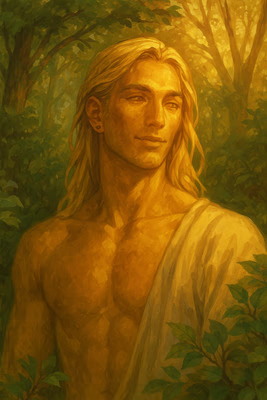
Description: A beautiful deceiver. The Melithir wears the shape of a golden-skinned youth. Its hair is often long and pale.
It walks barefoot, untouched by thorns or blood. Wherever it treads, life blooms too quickly. Bones found near such sites are often flower-covered, the armor around them rusted through but unbroken.
Observed Powers: Swarms: All manner of stinging and fluttering things obey its call. Not just bees but wasps, hornets, butterflies, and even biting gnats.
Sweet Death: It overwhelms a man’s will with some aura or scent. Witnesses speak of soldiers lowering weapons and kneeling in bliss before the insects consumed them alive.
Resources to gather following successful kill: Its blood, Mirelixir, is golden, thick, and glows faintly. Said to cure illness, extend life, and mend wounds that should never heal. Others swear it brings visions or fertility, depending on how it is distilled or ingested.
Appearance: Melion stands at just over six feet tall, his body graceful, but with an unsettling stillness. His physique is lean and androgynous, with softly defined musculature that evokes beauty more than strength.
His skin is smooth and seamless, the color of pale honey or polished amber. It carries a faint luster in the light, like hardened resin, and near the extremities, his fingertips, temples, and collar, it grows slightly translucent. Beneath these thin spots, a slow blue glow emits through vein-like filaments, mimicking a circulatory system of liquid light.
Melion’s face is symmetrical to the point of unease. His cheekbones are high and sculpted, his features narrow and elongated, almost elven in their delicacy. His nose is fine, his lips full but expressionless, and his jawline tapers smoothly. A soft crown of luminous strands that sprout from his scalp like gossamer filaments, glinting faintly like silken threads spun from light. They hang weightlessly around his head and shoulders, swaying without wind.
His eyes are his most unnatural trait. Large and clear, their irises are molten honey: translucent, golden, and softly radiant. They reflect light like the surface of syrup, and the pupils are faint, difficult to discern at a glance, giving the impression that he is always staring directly through you. He does not blink unless mimicking the act.
His hands and feet are slender, his fingers tipped with slightly pointed nails the same golden hue as his skin. If broken, his flesh fractures like wax, cracking rather than tearing, and exudes a slow-oozing sap that smells of crushed wildflowers.
From afar, Melion appears divine. Up close, he is uncanny. There is no flaw, no blemish, no pore. He is beauty refined into stillness.
Personality: Melion is warm. That’s the first word anyone would use. He speaks softly, smiles easily, and listens as though your words are the most important thing in the world. Around him, people tend to relax, even if they don’t know why. He has a way of making you feel like you belong, like everything about you has already been accepted without question.
He doesn’t interrupt. He doesn’t argue. He just is, calm, unhurried, constant. The kind of presence that makes rooms feel quieter. He tends to tilt his head when listening, as if trying to understand a language he’s only recently learned. And yet, there’s no mistaking his intelligence. He notices details others miss. He rarely forgets a name, and always remembers the smallest offering or kindness given to him.
At a glance, he seems deeply empathetic. Gentle with animals. Patient with awkward conversation. Affectionate in the smallest of gestures, a brush of fingers against a leaf, a brief lull in his voice to let bees land on his shoulder. He’s someone people find themselves wanting to impress, without knowing why.
But Melion is also… distant. Not cold, just removed. He doesn’t ask for company. He never seeks out interaction. He’s content to sit for hours on his own, watching trees sway or bees crawl along the grass. Some think he’s shy. Others think he’s meditative. The truth is harder to name.
Melion can be dangerous, but no one sees it. Not directly. He doesn’t raise his voice. He doesn’t lash out. But people have disappeared, poachers, desecrators, men who took too much from the land without giving back. The strange thing is that people still pray to him for help solving those disappearances.
He says very little. But when he laughs, it’s like honey warmed by fire. And most people never question anything else.
History: Melion was born in the quiet aftermath of ruin. He rose from the roots of an ancient tree split by fire, formed of sap and resin, ash and honeycomb. The war had ended long before he opened his eyes, long enough that the wounds it left on the land had begun to scar over. The world he emerged into was a quiet, broken thing. Forests were smaller. Rivers ran thinner. Bees, once thick as clouds, were rare and wandering.
He knew no name for himself then, and found no others like him.
For decades, he wandered the wounded woodlands in solitude. His touch mended the wild, sick trees, made meadows bloom again, and hives returned to slumbering hollows. His pollinators spread further, whispering of him in their silent, sacred language. Through them, he watched the world change. But though the land began to heal, the loneliness did not.
Then, one summer, a girl stumbled into his grove. Young, perhaps eight, no older, chasing dragonflies beyond her village's edge. She was afraid at first, as any child might be when stumbling into something strange. But she returned the next day, and the day after, always just a little braver.
She would talk to him. He would listen. In time, he answered. She brought questions, stories, wilted flowers, and drawings of bees. He showed her how to cup her hands without fear when they landed. He taught her the language of leaves, the meaning of old petals, and how to tell when a plant was lying.
She never asked what he was. She called him Melion, mispronounced from a word he'd once whispered to her by accident. He accepted the name.
Years passed. Her visits continued, growing less frequent but no less fond. He remained unchanged. She grew taller, louder, full of questions and opinions. She told him about her life, her siblings, the boys at school, the way adults laughed when she spoke of the man in the woods.
One day, she came to him crying. He was her friend, and she didn’t know who else would listen. No one believed her, not even her mother, about the golden man in the woods. She came to him crying, bruised and beaten.
Melion didn’t say a word. He only offered her the comfort of stillness, a shelter beneath blooming branches and watchful bees. She never saw the bodies. She came back weeks later, clutching a letter and unsure how to feel, because her tormentors were dead. He didn’t explain, she never asked, and still she returned.
She visited into her teens, and still in her twenties. Sometimes she came with laughter, other times with silence. She spoke of books and family, of life beyond the forest. And Melion listened. Always listening. The grove was fuller then, verdant, alive. It grew with her.
Eventually, when her hair had begun to grey, she brought him a gift: a hand-carved box filled with dried herbs and other things she had kept for him over the years. She said she had always known that he was not human. That she didn’t need to understand what he was to know he had protected her, healed the woods, and never asked for anything in return.
And then she said something he would never forget. That she knew what had happened to the boys. That she had suspected for years. And that she forgave him. Not because it was just, but because if anyone had hurt her children the way they hurt her, she would have done the same.
That was the last time she visited.
Melion found her grave months later. Packed earth near the edge of the grove where wildflowers now bloomed thick and untamed. He stood for a long time among them. The grave bloomed more with each visit. Foxglove. Clover. Milkweed. Poppies. A riot of color spread over the mound, woven through with humming wings and golden pollen. The land would know who she was.
Years passed. Then, one evening, her children visited the grave. They saw the flowers and they saw him, standing motionless in the grove’s light, untouched by time. They wept, not from fear, but from the slow relief of believing. They whispered his name, passed down in bedtime stories and broken memories.
And Melion remained, watching from the trees. As he always had.
Mythical Significance: Spring Festival - On the first Moon of Spring, rural villages and forest-bordering towns hold joyous, reverent, and quietly superstitious festivals. It is believed to honour a benevolent Forest God who restored the land, helped farmers grow crops, kept animals safe, and ensured the world was filled with beauty. It was whispered for a long time that they were called Melion, these rumours spread from a family whose matriarch had passed. It wasn’t confirmed until he attended his first Feast for the Gods where one mortal servant came back and spoke of Melion, confirming all their beliefs.
The celebration is quiet but heartfelt. Families gather to plant wildflower seeds near forest borders, children wear flower crowns woven from clover, milkweed, and foxglove, honey sweets are shared, bees are honoured and left offerings of pollen-dusted fruit, soft herbs and sweet water on old stones or tree stumps.
Relationships: Open to discussion!
▶ Getsuy ◀ To some, Getsuy is the end of all things, hunger incarnate, a gnawing darkness that devours without remorse. To Melion, he is as necessary as the sunlight. The Wendigo’s presence does not stir fear within Melion, nor revulsion. Instead, there is recognition. After all, the vines must die for new shoots to rise, and bones must feed the soil.
Getsuy sometimes finds his way to Melion’s grove, a place of peace where even his hunger quiets. Rarely do they speak. There is no need. He sits among the bees and blossoms, the predator still and watchful, the monster no longer monstrous. Melion does not disturb the silence. He offers no judgment, only warmth, stillness, and a soft understanding with a smile. The flowers bloom near Getsuy’s hooves, and the grove hums gently, as if recognizing something long buried.
There are whispers that trespassers near the grove vanish before crossing its edge. Melion knows who lingers at the boundary, but he does not stop him. Balance must be kept, and the hunger must be fed. At least this way, the flowers will bloom a beautiful red.
▶ Morrígan ◀ They are not friends, though the festival has bound their paths often enough to form something quieter: familiarity. Melion, god of bloom and bounty, and Morrígan, herald of the end, opposite ends of the cycle that even gods cannot escape.
Where he brings bees and blossoms, she carries silence and stillness. He has never feared her. She has never flinched at his light. Their conversations are rare, brief, and spare. Yet, beneath them, something ancient resonates, a rhythm not of words, but of purpose.
Once, they passed one another in the aftermath of a village wildfire. Melion stepped through soot and smoke, coaxing green shoots up through scorched earth while Morrigan sat beside the still warm bones. Neither intruded on the other. That was the only time they met beyond the festival.
Mortals have long mistaken them as twin aspects of a single force: the beginning and the end, birth and death, growth and decay. Shrines are built with both their sigils etched side by side, wreaths of blackthorn twined with foxglove. Melion never corrects it. Morrígan doesn’t bother to notice.
They are not a pairing. They are balance. And balance does not need understanding to endure.
Color: D1A054
Other: Melion cares not for pretending to be a God. He does his duty as is ingrained in him. He attends the feast to be with others who understand him better than humans. To speak and understand what others go through, to see the world through their eyes, even for just a month.
Favourite colours are green, purple, and red.
It may be obvious, but Melion actually is a vegetarian. He does not eat, harm, or use animals.
Thick tar-like substance invaded his lungs, spewing forth visions of fire and force, of volcanic waste blistering his senses. At least, that was how it felt. The chaos, already overwhelming before it began, had spiralled into something worse, something louder, heavier, more alive. And he was drowning in it.
The fire, the noise, the raw presence from his fellow Task Force Obsidians, all forged in sharper flames than he’d ever known. Then came the Zodiac, the arrival of a greater adversary, a new class entirely. It crushed the air from his chest, left him static in place, movement reduced to blurred water-logged cascades of pandemonium.
He swallowed hard. His mouth dry, his throat burned, both clawing at him like a hundred hungry dogs.
The bracers tugged on him, urging him to action, begging him to use them, to activate them once more and become greater than he was, just like before, when he went from useless to becoming danger himself. His mind spiralled, full of options, and the louder absence of them. Letting the gauntlets rise again, allowing himself to use them again after what happened last time, it grated on him like iron in bone. Sooner or later, he’d not likely have a choice, but now, right now, he could choose. But what if he did nothing? What if standing still was just becoming what he had always feared, a waste within. A weight for others to burden. A shadow cast by people doing the real work.
His fists clenched, nails digging into palms, knuckles whitening with tension.
No.
All around him, others surged. Their Noble Arms roared to life, some shining, some cracking the air, some bending light and reality. Each one moved forward. Not all cleanly, or heroically, but forward.
His fingers unfurled, not by conscious thought, but by something else. Metal braced his hands, surging to greet him like a long lost friend. Armour laced itself over skin, not summoned, not commanded. He hadn’t called them, he had needed it, and that was enough.
His gauntlets returned, born before he willed it. No. because he willed it. Steel, weight, presence. They didn’t hum, nor shine. But they were there once again when he needed them. Quiet, heavy, and unrelenting. Just like him.
And with them came the noise, the storm inside. The gauntlets didn’t just respond to his body. They surfaced everything else too. Anger, fear, fury, frustration, it all rose to the top like oil on water. The grief didn’t vanish; it sharpened. Became a blade to carry forward.
A breath. A beat. Then…
Griff burst forward, the moment too sharp for hesitation, too loud for thought. The gauntlets didn’t weigh him down, they propelled him forward. Every step slammed against the deck, shockwaves thrumming through his bones.
Gunfire snapped in his direction. Muzzle flashes flared through the smoke like fireflies with teeth. He threw himself behind a broken chunk of bulkhead plating, one gauntlet raised to shield his face as concrete and sparks bit the air around him. He wasn’t just hiding. He was moving.
His hand found a jagged slab of runway concrete, jagged, heavy, scorched, and with a grunt, he hurled it. The makeshift missile cartwheeled through the air and smashed into the ground between two gunmen, shattering and spraying rock and force in every direction. One soldier stumbled. The other flinched.
That was all the invitation he needed.
He broke cover in a blur, low and fast. One was mid-reload, fumbling with a mag but Griff didn’t let him finish. He shoulder-checked a low crate mid-run, angling the impact to shove it into a second gunman while vaulting over it at speed. His gauntlet slammed the first man's rifle sideways, and his other fist hammered directly into the soldier’s ribs. There was a sound like a branch snapping underfoot, and the man went down, screaming.
More shouts. Another volley of shots. Griff dove behind a cargo container and hooked one arm through a cracked mooring chain. Using the leverage, he threw himself upward, just enough to land on top of the container with a clang. He hit hard on one knee, rolling to absorb the jolt, and immediately launched forward again.
Down below, one of the soldiers tracked upward, weapon raised. Griff vaulted off the edge, dropping like a hammer, feet first, but with all his body weight behind a downward punch.
CRACK.
He didn’t just floor the soldier, he cratered the deck beneath them.
Smoke. Screams. Sparks. Still more enemies coming. He couldn’t think about numbers. Couldn’t think about pain. It all blurred into the raw pressure of battle. The roar in his blood.
A crate slammed open behind him, another soldier, shotgun raised.
Griff grabbed a metal barrel from the debris beside him, and hurled it like a javelin. It slammed into the man, sending him reeling just long enough for Griff to surge forward and crush his helmet under one iron fist.
This wasn’t the same boy who flinched at Nil’s power. This wasn’t the kid afraid of the edges of his own strength. This was something else. Something grim and fast and burning. The fear, the doubt, the grief, it all still hurt. But this? This was something he could do.
Interacting with: NULL Location: Aboard the Gunpowder Storm
Edric had volunteered to stay aboard. There was always work to be done, and it wouldn’t get done swilling the pisswater that the local taverns or wenchhouses suffered upon their patrons. Not that he didn’t enjoy a pint, gods knew he had, but time on land could soften a man when he wasn’t looking. One drink became two, two turned to dice or worse, and soon the whole evening slipped away. He didn’t begrudge the crew their pleasures. But for him, the quiet was its own reward. Besides, ships didn’t rest, not really. Not even in dock.
He started forward along his usual route, a loop he had walked more times than he could count. It wasn’t written down, but it was there all the same. Start at the fo’c’sle, check the rigging coils by the windlass, then move down along the starboard rail. Midships, pause, watch, listen. A ship talks if you let it, you just have to know how to hear her.
The ropes were too loose again. He knelt beside the pile, hands moving with quiet precision, no grumbling, no muttering, just the steady pull and tuck of a man who’d done it a thousand times before. The lines coiled tighter now, neater. Done right. He let his fingers trail the rope a moment longer than needed and felt the oil, the wear. Not bad quality, not great either. He made a note of that.
Next came the railings, especially where the crew leaned too often, rough fingers left splinters. A fraying gasket drew his eye. He crouched low again, blade flashing for a moment in the dull light before cleanly slicing the binding free. From a pouch at his hip, he pulled a new cord, tied it, and tugged it tight.
Onward. He passed the hatch down to the hold and pressed his palm to the wood. It was solid but the hinge… he knelt again and ran his thumb through the grit and rust gathering there. Salt and time, the Silent killers. He made a note to oil it later.
The sweep wasn’t about urgency, it was about rhythm, repetition, and comfort. A ship was too big to hold in your head all at once, but if you walked her long enough, listened to her, you’d feel it when something was off.
He paused amidships. That was always where he stopped, like a heartbeat between steps. He let his hand rest on the mainmast, fingers splayed. She didn’t speak in words, but Edric swore he could hear something when it was quiet enough. Not voices, or ghosts, Just… the ship, breathing, waiting.
He exhaled through his nose and kept going. The port rail. The cannon mounts. He nudged each, letting his boot do the talking. Solid, but the boards beneath… he crouched, ran a hand along the grain. Still some soot, and the fastenings? Loose. Danneil would get to them, sure, but if he didn’t, Edric would. That was the rule. You didn’t leave things half-done. You didn’t assume someone else would do it. Not if you wanted to keep the sea on the other side of the hull.
He moved again, past the galley hatch, then the quarterdeck steps, and finally the wheel. All part of the loop. All steps in a dance only he deemed to remember.
At the stern, where the wind hit clean off the water, Edric laid a hand on the railing and stared out at the harbor’s edge. Sunlight glinted on the sea like shattered gold, it was peaceful, almost too much so. He'd never liked Nassau. Too many soft hands, too many loud mouths, but a ship in port was still a ship, and this one still had her shape.
He didn’t say a word. Just stood there, listening. The ship wasn’t quiet, not really. She whispered as she shifted, as she waited. She always did.
The door shattered inward with a deafening crack, wood splintering and hinges screeching in protest as a wall of bodies surged through. Emrys jerked back in fright, heart lurching into his throat. The air changed, thickened with the sudden stink of wet fur, iron, and something older and animal beneath it all, a musk that bypassed language and went straight to instinct.
One of the intruders peeled off without breaking stride. He was thick-necked and feral-eyed. With a howl of motion, he slammed his bat into the television. The screen burst, shower of sparks, broken glass, and static squealing before it collapsed in ruin across the floorboards. The violence was casual, almost gleeful. The sound made Emrys flinch again, his head whipping toward it.
And that was when they took Quill. He barely registered the net, just a blur of motion, a shout, the sudden void where the bird had been. The net snapped shut, cinched tight by thick fingers. Quill’s screech split the air, furious and frightened, before vanishing behind a wall of leather and motion.
“Quill!” Emrys shouted, instinct yanking him forward. His hand reached, half-lifted, but it was like grabbing smoke. The weight of his own uselessness struck hard. No fire, no strength, not even a ward to hold the line. The apartment that had been his safe space now felt like a cage, and he was the one locked inside it. The thief was already gone, retreating through the crowd with practiced ease.
“Let him go,” Emrys said, voice sharp and dry in his throat. It wasn’t a demand. It wasn’t a plea either. It was the only thing he could say that didn’t feel like crumbling.
He froze as the rest of them closed in. Heavy boots scuffed across wood. Chains clinked, one dragging across the floor with an ugly, dull scrape. Eyes gleamed, some smiled, and some licked their lips. Emrys couldn’t tell if it was for show, or if they simply didn’t know how not to look like predators anymore.
The stink was overpowering now. Sweat, breath, leather soaked in blood and rain. One of them sniffed at him, actually sniffed, with a sound too wet, too canine to be mistaken for anything else.
The largest of them stepped forward. The leader, most likely. A titan in a threadbare Hawaiian shirt stretched tight over a barrel chest. His beard looked like it had been grown for war. Eyes like dull coals locked on Emrys with dispassionate focus. He didn’t bare his teeth, didn’t growl. He didn’t have to. He slapped the bat into his palm with a hollow thud.
“We need you to do us a favour…”
Emrys didn’t speak. He stood there, fists weakly clenched, staring at the spot where Quill had been. The chalk dust still clung to his palms. All his effort, his circles, his trying… Nothing, now.
If this was the only way forward, if it meant getting Quill back, then fine. He wouldn’t run. He wouldn’t beg. All he could do was try.
Emrys watches helplessly as Werewolves shatter his home, kidnap his familiar, and force him into a choice he's not ready to make.
The silence that followed was broken only by the familiar voice in his mind, dry, smug, and maddening.
“Have you tried doing it correctly?”
Quill, perched high atop the bookshelf like some faded gargoyle, tilted his smoky green eyes toward him. Emrys didn’t answer. He just turned and glared, exhausted. It wasn’t the first time he’d failed, and it wouldn’t be the last, but that didn’t make it any less infuriating. He had tried. Again and again. And again. It just wasn’t working.
“Your circles were very round,” Quill offered. “I’ll give you that.”
Emrys muttered a curse under his breath and dropped back to his knees, pressing the damp cloth into the chalk lines until they smeared into pale ghosts on the floor.
Master Elandros had insisted the Ward of Threshold was a perfect exercise for him, simple, reliable, and harmless if it failed. “Wards are foundational,” he’d said, like a man reciting a proverb from memory, not even glancing up from his book. Emrys had nodded dutifully, masking the sting of being left behind.
He wasn’t ready, apparently. Not polished enough. Not confident enough. Not worthy of brushing shoulders with the brilliant and the immortal. So while his master donned robes and command, Emrys was left in the quiet apartment with a stick of chalk, a stern book, and an incorrigible familiar who had no off-switch.
The television played in the background, volume turned low. Gowns shimmered across the screen, sequins catching the light like bits of starlight trapped in silk. The Tem Gala. Every beautiful mask in the city was there. They walked the red carpet like it was a ritual of their own, names and houses whispered with reverence, the occasional flash of something inhuman behind the eyes.
Emrys stayed behind. Practicing.
His circles were precise, his incantation steady. He had followed the book word for word, gesture for gesture. And still the ward refused him. He could feel the moment it faltered, like a breath held too long collapsing in on itself. The power simply slipped. Slid out of reach. Gone.
He scrubbed the floor in tight, angry circles.
’Maybe I’m not ready. Maybe he’s right.’
Then the television stuttered. A flicker. A soundless beat. He looked up.
The static came first.
Then the light.
It drew his gaze to the window, where the skyline fractured in silence. The top of the Tem Tower bloomed, gold, then red, then white-hot orange. It swallowed the horizon with awful beauty. For a second it looked like a sunrise had torn open the world in the wrong direction.
Then came the sound.
A deep, bone-deep thrum that cracked against the windows like a god pounding on the door. The television went blank. The lights buzzed and died. The apartment froze.
Emrys stood motionless, cloth still clutched in his hand, forgotten.
The fire burned on the skyline. Ash drifted from the distant wound in the city. Somewhere, alarms began to howl. He couldn’t look away.
“Quill…” he whispered. “What was that..?”
No reply.
For once, the bird had nothing. No smug remark. No muttered rhyme. No scathing insight.
He was staring too.
And that silence, that, was what finally made Emrys afraid.
Emrys stayed behind to practice. Then the sky caught fire.
The sky over Nassau was the kind of sharp, scorching blue that hurt to look at. Not a cloud to be seen, not even a promise of one. The sun pressed down like a hand on the back of your neck, and the Gunpowder Storm creaked faintly at anchor, a restless sleeper too proud to groan.
Up in the rigging, barefoot men moved like spiders, adjusting canvas that barely caught wind enough to stir. One of them, too eager by half, fumbled with a knot that wouldn’t hold.
“Twist it again,” came a voice from above. Calm. Solid.
Edric Blake didn’t shout unless he had to, especially when someone was earnestly trying hard to learn. The boatswain was perched a few lines higher, braced against the mainmast with one boot hooked and one hand gripping rope. Sweat darkened the collar of his shirt and clung to his brow, but there was no sign of discomfort. He pointed once, a silent correction, and the young sailor adjusted, earning a short nod and a small smile in return.
With that, Edric descended, hand-over-hand down the rigging. His calloused palms slid down lines he’d coiled himself a dozen times over. As his boots hit the deck, the scent of pitch, salt, and hot wood washed over him like home.
Down on deck, the shade offered brief relief, not cool, but cooler, the way a palm frond doesn’t fight the sun but makes peace with it. Tar steamed between the seams, thick in the air, as two greenhands dragged their mops across the boards with all the enthusiasm of chained ghosts.
Edric watched them for a moment. “Swab it proper!” he barked, “or were you waitin’ on the captain himself to show you how?”
The pair startled, glancing up. One dropped his mop with a clatter, the other nearly tripped trying to fix his grip. They flushed red in the ears, then set to work with twice the effort. He gave a grunt, not quite approval, but enough to leave them be, for now.
He stooped beside a coil, giving a line a sharp pull. It bit back with just enough give to earn a nod. Spotting one of the riggers passing by, a lad who knew a reef knot from a granny hitch, Edric jerked his chin toward the fore.
“Tell Davie the staysail’ll need a new reef knot before midday. She’s runnin’ loose.”
“Aye, bosun,” came the reply, feet already turning.
He didn’t care for the murmurs about the Queen Anne’s Revenge moored just ahead, nor the hush that fell when Blackbeard had crossed the deck. Let the officers worry about plots and partnerships. Edric had rigging to inspect and a crew to keep alive. A ship wasn’t kept afloat by gossip, and sails didn’t mend themselves.
Still, the motion near the captain’s quarters caught his eye. Ishaan stood tall, or as tall as a man like that did, bearing the weight of age and wisdom both. Edric respected him more than most. The Quartermaster had a way of making decisions stick, even when tempers ran hot and rum ran low.
Then came Anne. Red hair catching fire in the sun, she stepped into the light like she belonged in it. There was precision in her every movement, like a knife honed for one purpose. She and Ishaan exchanged words just outside the door, nothing loud, but enough to see her posture shift, just slightly, firm as oak. Edric watched longer than he meant to, eyes narrowing with a hint of something unreadable. Then he turned away. Ropes to tighten. Boards to check. A ship to keep breathing.
Hadn't updated this in a WHILE so I deleted it. I'm Ducksworth, or Duck, or Duckie. PM if you wanna know more, yeah?
<div style="white-space:pre-wrap;">Hadn't updated this in a WHILE so I deleted it. I'm Ducksworth, or Duck, or Duckie. PM if you wanna know more, yeah?</div>
 Member
 Stryder BC
 MaeB
MaeB Lady Arya
 BunniesOfDoom
 ShankySpice
 Obscene Symphony
 Lewascan2
 tadcfnaf