Joined. But I have a question about the power costs.
Like in one portion - a Create Race has a cost of 22 power and then 6 power? Can you specify please?
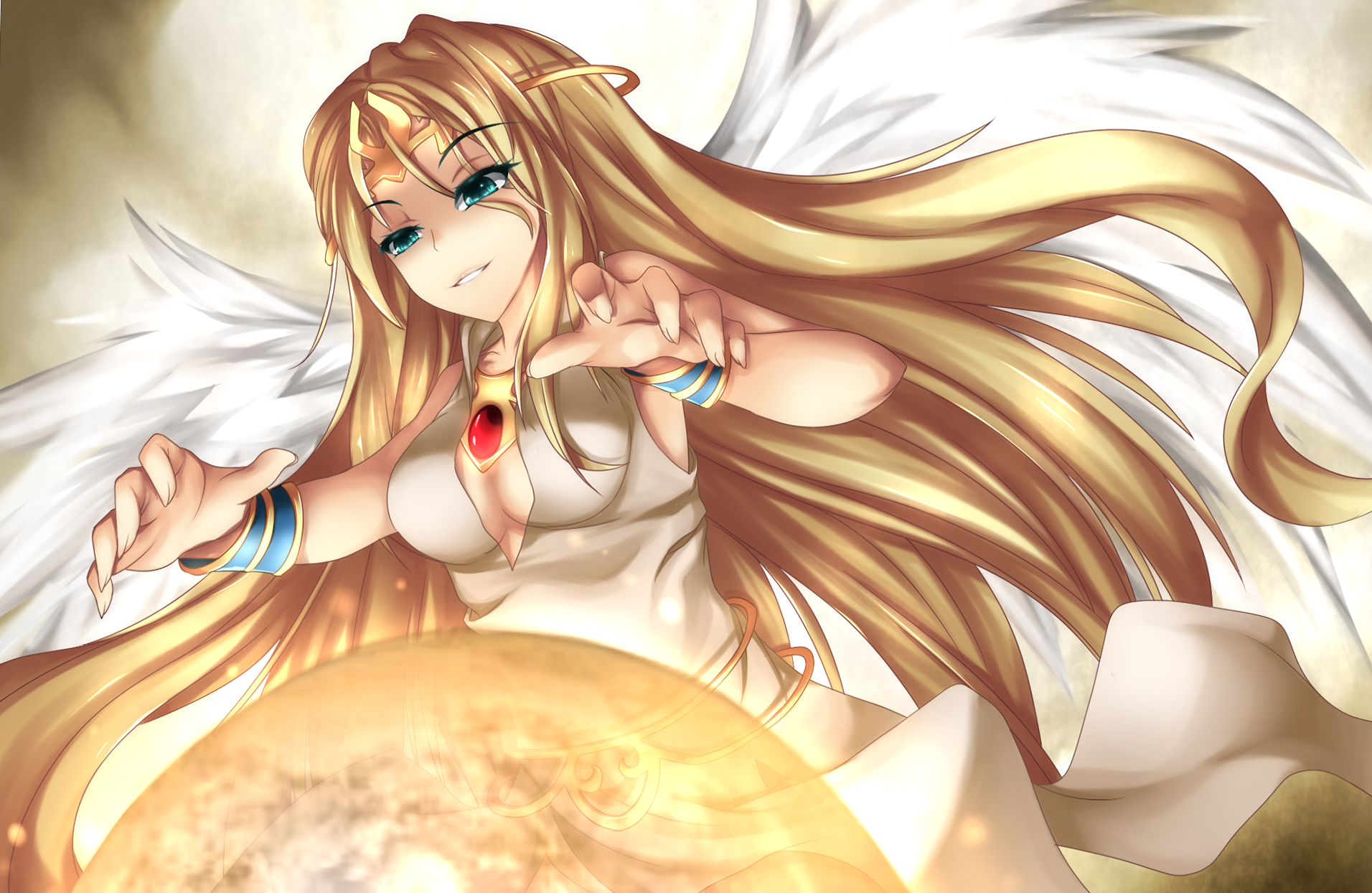
Deity Name: Illias, Goddess of Life and Creation Deity Description: In some ways, those whom would look upon Illias she would see her as the picture of perfection and creation. Her entire appearance is made to invoke purity, peace and harmony. In a way, her personality is that of a caring mother - whom wants to have her children prosper and for her creation to claim their place in her domain of purity and love. As it would happen, she would react in a rather proactive fashion if her children were threatened by war or by false prophets or kings.
Granted this has a hidden meaning, as she has moments of obsession - as she sees her Creation as her own and doesn't like to share, nor would she support the idea of her children mingling with those of her enemies or rivals. Even it would mean peace or coexistence. In addition, she sees the worship of her subjects as the just return that she deserves - as a mother has cared, she expects her children to do their duty and honor her mother and her wisdom. Thus, the great weakness is her pride - as she sees anyone in defiance an insult against herself and can deliver petty punishments - while those honoring and respecting her, as deserving personal rewards and gifts.
The true shape of the world was amenable to only the FIRST FATHER, ALNAEUS. His tidings however came to pass that he would create new life. The First Breath is the reported story of the birth of NUDRISS, ANTAY and AMELIA. They, since time immemorial, have been referred to as the OLD GODS and it was their hand that shaped the world.
The relationships between the OLD GODS and ALNAEUS has long been lost to history, but those storytellers and orators have never failed to recite NUDRISS' disdain for his father's desire to create beings in which he was not master of. The palette of the world following the First Breath was barren, with many millennia coming and going where the Old Gods simply existed--embodying no other purpose than to vex one another. It was only following the Second Breath, carried out without any word or preparation, that the Old Gods saw what the First Father had done--created a new plane of existence, a World from which all energies flowed into and out of. Like a splash of paint against a once transparent canvas, had the All Father simply shown his children what their own eyes could not see, or was he demonstrating to them what only he was capable of--Creation? There was no explanation, no introduction. No sooner had ALNAEUS breathed the world into existence, he slithered back into the nether, failing to speak or sing, condemn or praise.
A World Without Shape, 0 F.A. (First Age)
- NUDRISS: 25 Power Remaining - ANTAY: 24 Power Remaining - AMELIA: 23 Power Remaining - ILLIAS: 22 Power Remaining
MECHANICS - PM your Actions (in the Order in which you wish them to occur, to the GM). - Post IC for your actions to be implemented.
ALNAEUSThe First Father, God of Creation [DECEASED]
Considered the Creator of the Deities, he is both revered for Creation and sometimes feared or maligned as being the only one truly inescapable of judgment, punishment or retribution. In imagery he is often depicted as an old man with a longing gaze holding a walking stick. All the Known Deities are considered Children of Alnaeus and by some extension may thus consider themselves siblings. He is a mostly reserved deity, having little in the way of opinion outside of wishing to see all his children happy and thriving.
ANTAY | God of the Forge (Murtox)
Antay is a calm and meticulous being. His main concerns are those of creation and reason, both of these reasons are Antay's drive to action. However, behind the mask of a serene God, there is a more authoritarian and pro-active being that a face value approach would take many to believe. Among his ethical values, there is little place for wrong or good being those quite superfluous for a being like him. Among other beings of his kind, he seeks order and the establishment of proper conduct between them, else he may get infuriated by less than acceptable displays, for this very reason one must be careful when talking to Antay for his ire is something that may appear out of nowhere.
This ire is a strong emotion within Antay, the product of his own pridefulness and wishes to control what he can and leave the rest aside. He doesn't shy away from conflict if the situation arises and may hold grudges against others more often than other beings of his kind unless there is a concerted effort to heal the relationship with him.
AMELIA | Goddess of War & the Changing Winds (jimapple)
Amelia's one real desire is for war. Her almost single focused and drive are for beings to engage in the most physical and violent aspect of life. Her insatiable appetite for destructive battles is driven by the desire for legendary feats and to flush out heroes that are to be honored and remembered. Interestingly, she likes to live among these created. Seeing their lives up close as they are off the battlefield only fuels her passion to see the dichotomy in their personalities as they become unrecognizable on the battle filed. Amelia normally finds a likely hero that she will live with and she is playful and supportive towards them until she can manipulate a war for them to be a part of. She does not consider herself and others like her gods or goddesses but merely powerful beings. She longs for the day when the war to end all wars will commence and the created and the other powerful beings are embroiled in one glorious war.
ILLIAS | Goddess of the Sea (NecroKnight)
In some ways, those whom would look upon Illias she would see her as the picture of perfection and creation. Her entire appearance is made to invoke purity, peace and harmony. In a way, her personality is that of a caring mother - whom wants to have her children prosper and for her creation to claim their place in her domain of purity and love. As it would happen, she would react in a rather proactive fashion if her children were threatened by war or by false prophets or kings.
Granted this has a hidden meaning, as she has moments of obsession - as she sees her Creation as her own and doesn't like to share, nor would she support the idea of her children mingling with those of her enemies or rivals. Even it would mean peace or coexistence. In addition, she sees the worship of her subjects as the just return that she deserves - as a mother has cared, she expects her children to do their duty and honor her mother and her wisdom. Thus, the great weakness is her pride - as she sees anyone in defiance an insult against herself and can deliver petty punishments - while those honoring and respecting her, as deserving personal rewards and gifts.
HUM | Handler of Souls, God of Life & Death (Ascendant)
Hum spends much of his time to himself, regarding the world and trying to determine exactly what it is he desires. Does he wish to see the world burn? To play the greatest cosmic joke in existence? Since his birth, Hum has kept his interests firmly secret. Hum is the Handler of Souls and is the owner of the Realm of the Dead. Hum has the power to raise the dead back into a form of Undead, keeping them in the realm of the living beyond their natural state, or to resurrect them entirely back in the world of the living.
IRA | The Weeping God, Goddess of the Flame (BoopImADragon)
Ira is a destructive and emotional goddess, passionate and hateful, loving and cruel. She will destroy what displeases her and weep that it has now been destroyed. She is a creature that lives in the now and doesn’t ponder long about the past or future. Her desires aren’t unfathomable or complex, nor does share care for them to be. She is a slave to her temperament and her compassion.
DUHYXBINKeeper of Knowledge, God of Time (DX3214)
Duhyxbin is born out of the need for balance between, chaos and order, knowing all that was before and knowing a few of what will come, as tomorrow is not written and the ink is still not been passed into the book, His curiosity motivates him to understand more and the universe recently birthed and realms that his brothers will make as he is the lord knowledge.
XANAROS | King in the Waste, God of Destruction (Schlyerwalker)
The King in the Waste believes that creation is a divine flaw, an awkward hiccough in the otherwise uninterrupted perfection of NOTHING. Its holy quest is to return existence to this natural state. The Gods, even their great Father, are an accident, an embarrassing -- and temporary -- blemish. It hates noise, and color, and chaos, and harmony. It craves silence and loneliness, and one day, to be the last being in the multiverse, before it extinguishes itself and brings about total, and absolute oblivion. But first, to accomplish this, it must perform the most profane and perverse of actions; creation.
A being of self-loathing and nihilism, the King possesses a cruel and mocking sense of humor. It belittles other Gods and mortals alike, it openly speaks in scathing rebuke of our great Father, and laments the creation of the world and the beings upon it. Even its own creations are not above its scorn; far from it. Perhaps the King is even more embarrassed of its own flawed existence, and that of its servants, than even the other Gods', and their own little puppets. Regardless, the King is callous, antagonistic, demeaning, and utterly devoid of empathy when dealing with other beings.
ALCADEAS (Conrad)
Archangel Alcadeas is regarded as the 'big brother' of other deities, but only metaphorically speaking. Altough he may or may not be the first of the children of Alnaeus, he is viewed as the mature mediator of conflicts between the celestial family of gods. Alcadeas considers himself second only to his father Alnaeus, and whatever his father might order, he will not hesitate to carry out his task. He is also quick to reinforce his opinions and rules over anything, should he wish so. He values a strict code of hierarchy, with his father above anything.
SOLUMNA (Nexerus)
Solumna is a legendarily solitary deity, thoroughly disinterested in divine politics and contemptuous of many aspects of creation. They are concerned with the cold, with silence, and above all, with order. They dislike war and chaos and creation for the disturbances they make, and they seek for rhythm in creation—if creation is to exist at all. Suspicious (but not hostile) to Alnaeus' decision to create the world, they would have it formed into a winterscape of queer formations of ice and snow, constructed according to their own divine plan, and surrounded and separated by endless, wind-swept tundra. Genderless, their preferred form is of an obelisk of ice, silent and motionless inside the tundra. When they require a humanoid form, they take the shape of a statue of ice, devoid of fine personal details. Less power-hungry than other deities, Solumna ambitions only for silent coldness.
Notable Realms
- The Natural Plane: Created by The First Father for a place where his child could exist, the Natural Plane is the glass jar that holds all living things. Sometimes referred to as The Known World, it is filled with oceans and grasslands and natural wonders—-all manufactured by the Gods. Gods that exist in this realm often take on various different forms. Some hang out in the open, while others hide themselves away. - Total Population: 67 (Thousands)
- Sanctuary: The Realm of the Dead and the Realm of HUM, Sanctuary is where souls go after their natural bodies fail. It is designed and controlled entirely by HUM, who has attempted to make it into a paradise--a reward for those whom are allotted entry.
At once, there was nothing and then everything. The stories of how things came to be may one day be varied, fantastical and even truthful, but even to the very real deities of the world, the true matter remains hidden. The most common assumption is that ALNAEUS, the First Father, breathed life into the world. Ageless and eternal, ALNAEUS is considered the First Father and Father to All and the vast pantheon of deities that exist are considered to be his children, though there is little evidence to suggest this is true.
The first story of creation, known by the deities themselves, is The First Breath, whereupon finally exhausted and bored of being the sole thought in the entire plane of existence took a deep breath, and from it, crafted the dozens of deities that now populate the world. This was also considered one of the last times ALNAEUS' presence was felt on the world itself. Left to their devices, the deities were free to act as they wished.
The First Breath, unknown artist, dated 456 S.A. (Second Age)
Gods, Men and Everything in Between is a pseudo Nation RP where players take on the role of Deities, commonly referred to as a God or Goddess. The story above is the starting lore. The game takes place over Five Ages, which will thus be referred to as the First through the Fifth Age. While every action will be available in each Age, their costs will vary.
- Deity Name: - Deity Description: (This should cover intended personality, as actual history will be largely non-existent yet)
Mechanics - Turns: Every Turn is X amount of time, pending on the Age. * First Age: 1 Turn is considered to be approximately 500 Years. * Second Age: 1 Turn is considered to be approximately 100 Years. * Third Age: 1 Turn is considered to be approximately 10 Years. * Fourth & Fifth Age: 1 Turn is considered to be approximately 2 Years.
- Power: Power determines how Strong your Deity is and how easily they can influence the world. * Every Deity begins the game with 20 Power. * First Age: At the end of the First Turn, every Deity gains 10 Power, every subsequent turn they gain 1 less, until reaching 0 Per turn. * Second-Fifth Age: At the end of the First Turn of all subsequent turns, every Deity gains X Power per X amount of Worshipers they have. * Using Power: Every Turn, a Deity has 3 Actions to Spend Power. They are administered in the order in which they are submitted, and Deities' abilities are used in the order of STARTING POWER. - Example: Gilna has 10 Power and Corvo has 7 Power. The deployment of actions will look like his: - Gilna Action 1 - Corvo Action 1 - Gilna Action 2 - Corvo Action 2 - Gilna Action 3 - Corvo Action 3
- Actions: Each Deity can do up to 3 Actions per turn. Every Action costs Power. Here is a list of the Actions a Deity can perform. Costs will be listed for the first two ages, followed by the description.
Shape Land (3 Power / 5 Power): This power directs the creation, modification, or erosion of mountains, hills, lakes, streams, rivers, forests jungles, deserts, grasslands, tundra, steppes and other land forms. On the game map, this power allows for the creation of land forms within a 1 inch diameter area. Using this power reportedly can create who ranges of mountains, inland seas or vast wastelands.
Shape Climate (2 Power / 4 Power): This power directs weather patterns that frequent in a 1" area like fog, rain, snow, sun, heat, cold, sleet. You may wish to create snowy steppes or hot and humid jungles upon your forest.
Create Race (22 Power / 6 Power): This power effects the creation of a race in the world. This includes traditional fantasy races as well as non-traditional. You may, for example, have more than one race of dwarves. Consider not only humans, elves, dwarves, orcs and trolls. Races must be sapient and humanoid. Each race must be given a starting point in the world where they begin to build their civilization. Races start with either +1 Blessing, +1 Curse, +1 Corrupt, +1 Pure or Neutral, as directed by the Deity who created them.
Create Creature: (11 Power / 8 Power): This power effects the creation of a lesser creature in the world. This includes non-sapient creatures such as dragons, elementals and other monsters that may inhabit the land. They may be assigned a Size (Small, Medium, Large or Colossal) that will dictate how common or rare they are. These are creatures that will not form cultures or cities.
Create Subrace (8 Power / 4 Power): This power is used for the creation of splinter groups from an existing race. These must arise in territory roughly adjacent to their ancestors and may or may not start getting along with their neighbors. Dark Elves, deep dwarves, human pirates and the likes are the subject of this power.
Create Order: (6 Power / 4 Power): By this power, the god creates an order of people within a race. This may include religious sects, orders of knights, etc. The cost for Commanding a Race are doubled if using an Order created by a different God.
Command Race/City (8 Power / 4 Power)*: By this power, the priests of the gods influence a race to action. Cities are founded with this power but it can be used for just about anything. An immortal must first establish their power by creating sects within the race before influencing them via this order. This power may be used for starting wars, founding cities, making alliances, settling territory, raising armies, et cetera.
Advance Race (10 Power / 5 Power): This power causes a civilization to gain expert knowledge of a given science or magic. These might include war magic, healing, warfare, steel, weapon smithing, sailboats, writing, engineering, architecture, farming, et cetera. So as long as that civilization persists, it will always be aware and use this invention.
Purify/Corrupt (5 Power / 3 Power): Here, gods go about changing the general alignment of a civilization. There is no limit. Pure civilizations are generally benevolent, altruistic and just. Corrupt civilizations are greedy, snide and malevolent.
Bless/Curse (7 Power / 4 Power): Blessing a civilization will decrease the cost for any deity to act upon them, while cursing them will increase the cost.
Intervene (10 Power / 7 Power): Through this power come the changing of fortunes for Champions, Civilizations and Orders. A gold mine may be found, a storm at sea may strike a fleet, an Avatar may escape death, plague, famine may strike, etc. These are the great, unplanned winds of fortune that blow through the history of the world. Intervene is the Action required to use Domain Special Abilities.
Champion (9 Power / 5 Power): Through this power, the god creates a champion from among the populace. They can be a high priest, a dragon, a great warrior, etc. They will act as 1 Worshiper and can be ordered with this same action. If they are slain, that God loses 3 Worshipers immediately.
Consolidate Power: A deity may Consolidate Power at any time. This is the only action that must be announced (as in, via IC post). The deity chooses a Domain to attempt to garner control over and how much Power they are using in that attempt, which is sent privately to the GM. They cannot use more Power then they have.
[Please Post your Deity now. Thanks.] [First Deity to be posted receives +5 Power, second receives +4 Power, et cetera.]
I'll throw my hat into the "Gods, Men and Everything in between" idea. God NRPs were actually tried and there's a decent following for it. I figure the reason why this is picked is the same for most of us. We wish to finally play such game to competition or at least to our satisfaction.
@TheodorableCan you divulge more details about how this game would be played? Would there be game mechanics or more narrative based with events spawning and in-character deeds rewarded with various achievements? I'd support the latter more as it's basically the ideal of what most players in this section like (yet never really get). Game mechanics have to be very expertly created to avoid somebody gaming the system. Plus I don't like the idea of being beaten because of a cheese strat rather than writing down a fun story and mutually decide to have things play out the way they do. I am just curious. Thank you in advance.
It will be the former. All of my games are specifically designed to have concrete mechanics that can be utilized. Every turn (which we will call a Millennium in the First Age, a Century in the Second and a Year in the Third), every Deity will have 3 Actions.
Actions not used are saved. Such actions would be: Change Landscape, Change Climate, Create Race, Corrupt/Purify Race, Create Subrace, Instruct Race, Bless/Curse Race, Consolidate Power, etc.
All of these have concrete results, some modified by a DRM (Die Roll Modifier). I have long been a proponent, in accordance with real life, that the results craft the narrative, not the other way around.
I—-as the GM—-am simply here to hold the game together and make sure everyone abides by the game mechanics and crafts the world they want. Purely narrative games fail because they become a tyranny of the majority or the GM. In a game of ten players, it becomes a game of six players telling the other four what they can or cannot do. Or, in the realm of “mutual” megotistion you get gridlock. Here, you can fully envision the world and races you want, limited only by the reactions of other players.
I don’t personally believe any of my games have allowed for cheese or min-max strategies, so I wouldn’t be worried. There will be a plethora of random events dictated by a die roll referencing a list of events which I will make available to the players.

 FortunesFaded
 Spiffy
 Scrawl Banditta