Ditto. It's Thanksgiving week and I work in wholesale; additionally, another RP has been waiting for a post for longer than this one. Hopefully when I'm ready to start tackling my first IC I can also come at you (plural) with some actionable suggestions for character histories (though I'm also fine with not knowing everyone from the get-go, too).
TokyoPewPew
 Member
rpguilder (derogatory)
STATUS: the virgin "complains that all the current games don't appeal to him" vs. the chad "launches the games he wants to see in the world" 3 mos ago
- Last Seen: 36 min ago
- Joined: 3 yrs ago
- Posts: 290 (0.31 / day)
- VMs: 12
-
Username history
- TokyoPewPew 3 yrs ago
-
Latest 10 profile visitors:
-
Most recent →
 Mole,
ZwagXerathYT,
Mole,
ZwagXerathYT,
 CabbageAngel,
vue2026,
CabbageAngel,
vue2026,
 WardenCelestine,
 evierose,
 Festive,
 Cherrytree,
 N3v3rM0r3,
 RPM
RPM
Status
Recent Statuses
3 mos ago
Current
the virgin "complains that all the current games don't appeal to him" vs. the chad "launches the games he wants to see in the world"
8
likes
4 mos ago
Isn't this like your fourth "forevermore" in the last three months?
3
likes
7 mos ago
The only people who get upset at you for setting and enforcing boundaries are the ones who were most looking forward to trampling them.
9
likes
8 mos ago
Advanced rpers and not fucking posting—name a more iconic duo
6
likes
10 mos ago
RIP Charlie "It's Worth It to Have Some Gun Deaths Every Year So We Can Have the 2nd Amendment" Kirk. It was an honor not to give a fuck, just like you would've wanted. 🥰
10
likes
Bio

Most Recent Posts
#7bcdc8
I did say in the initial interest check, though, that the maximum number of players I'd want for the campaign was six.
Yeah, I know. 🫣 I'm not sorry (but I also kind of am).
Thanks for giving me a shot though! Even if it hadn't paid off I had a lot of fun writing it.
"If you're listening to this audio tape, either you're the assignment editor of a major news company and I've just placed it on your desk among a veritable hoard of notes, journals, and other evidence——or you've found it on my corpse. Either way, hello, thank you, and I apologize for the mess.THE EDGE OF THE OTHER SIDE IS TIME. "What I say next I say only for that latter category of person: my name isDr. Marion Lovelace, PhD. I'm 45 years old. I'm a professor of anthropology and geoarchaeology at Washington University, St. Louis; a cultural anthropologist myself, and an author. (Don't worry. You haven't read it.) My sister is Cathy Finch, née Lovelace. She and I haven't spoken in a while but hopefully she still lives in Shrewsbury, Massachusetts. You can trust her to inform the rest of the family of what's become of me. I don't know what state you will have found me in but these are brave, strong people all; they can handle the truth, no matter how grisly, so spare them none of the details. Especially if, as I yet suspect, I am merely the latest link in a long chain of atrocities committed in this place. But I'm sorry; I get ahead of myself. No, I do not know what condition you've found me in, because in truth at the time of recording this I do not yet understand the nature of just what it is that I seek to confront out here. What I do know, however: once upon a time I came here intent on researching a topic which only indirectly pertained to the subject of thisexposé.Only to leave again totally unsatisfied, perturbed, and haunted. By the questions I didn't think to ask. By the truths I never consented to... | __________________________________________  |
"What I learned instead, in brief, is that a great many very powerful people have attempted to hide something here, and hitherto succeeded. That I am in grave danger for attempting to bring this something into the disinfecting sunlight. That I walked away from my first close encounter with no evidence, no evidence at all of any value, save for a haunting feeling, a kind of possession which has lingered on me since I first visited this place as a postgrad not quite twenty years ago. And yet I trust mySuspicious Mindabsolutely: something is gravely, urgently amiss in Stone's Throw, Oregon.per sē. How should I say it?——...well. Maybe it will come to me.Homo habilisConnected the Dots: bodies stink. That which stinks makes us sick. That which makes us sick kills us quicker.Ergodo not loiter near corpses nor carrion nor anything resembling these,quod erat demonstrandum.And yet...this gravelaying tradition——is it not a total contradiction, no, I daresay a complete culturalrejectionof the instincts and natural laws every other society takes for granted? (Well, every society except one, but I will spare you the suspense: the Kitseshawsee share no sociological DNA with the ancient Numidians, nor any other Berber peoples of the early Iron Age for that matter. At least not in the thirteen thousand years since the Bering land bridge sank into the sea. And many, many thanks to my old thesis advisor for her much-too-gentle recommendation to find another angle for my dissertation. Like I said: hopelessly bemusing.)substantivethan simple curiosity, wanting to pick his brain a bit. In any case, I was telling him what I recalled of a place I hadn't seen since my schooling years——both from the locals and from their newspaper archives: a certain industrial farm just a few miles upriver of Lamplight, and its need to wipe out various broadleaf and bindweed species that were choking out its cranberry and blueberry bogs. A chemical called monosodium methyl arsenate. Bad containment practices. Worse disposal. I spoke also of the Kitseshawsee, of their abysmal child mortality rates even by reservation standards. The way their little ones die vomiting and seizing and bleeding from the eyes. The way the ones who manage to adulthood can't feel their feet or fingers, cannot walk without gaiting, can't wear certain textiles for the way their skin Flakes off in sheets. Early onset kidney failure. Twenty different kinds of cancer, running through the family trees the way hair color and nipple shape do for you and me. And to the tribe itself none of this is unusual, none of this is tragic or heartbreaking. It's just how people go when it's their time. It's just...life."goddamnwatershed. And certainly not a farm which grows cranberries. YouSee? It All Fits Together.stupidman——hand over your doctorates and resign right now if that's not just you trying to sound important. If that's how you really feel! The thought that someone so apathetic, so smug, so unconcerned with the lived experiences of others could be the one placed in charge of a——...ugh. Look, it's because of justice. Alright? We all know about the Trail of Tears. About forced sterilization, about throwing the Japanese into concentration camps, about Tuskegee. But just this once——just thisfuckingonce, I would like to live in a world where it's the victim who gets to see justice, not her grandchildren. Just this once, I don't want them to pay 'reparations'——the government, or PuraLife, or whoever it is that's been doing this. Just this once I want to believe in a world where people who destroy other people, who destroy community, who destroy culture, have to either sit in a cell for the rest of time, or die, or just...just, go the hell away if they cannot coexist with the rest of society. And I'm here to make that happen so that in another thirty years I'm not looking back on a life of standing aside and doing nothing. So that's it. I'm here to expose the bottled water company's profit scheme, or expose whatever it is the government buried here and then smothered in MSMA so nobody would go digging, or——whatever's going on. That's myraison d'être. Of the last couple years and of right now. And...and that's what I suspect I'm about to give my life for. And I don't know. I thought I would be more scared than this. But it feels alright.Landjäger. A swig of Laphroaig 18, my favorite whisky. Please, if it's my body you found and not my report, let that be what you pour over my grave. Or if you don't have the time to bury me, leave it in my coat pocket, like the grave-goods of so many noble civilizations. I'm in a treeline not far from town. This is it: the moment I kick this dingy old Yamaha back to life and cross my own personal Rubicon. My Hellespont. If I've read the map correctly the first military installation is four klicks from here; pray for me. My name is Dr. Marion Lovelace. Signing off. |
The works of the roots of the vines, of the trees, must be destroyed to keep up the price, and this is the saddest, bitterest thing of all. Carloads of oranges dumped on the ground. The people came for miles to take the fruit, but this could not be. How would they buy oranges at twenty cents a dozen if they could drive out and pick them up? And men with hoses squirt kerosene on the oranges, and they are angry at the crime, angry at the people who have come to take the fruit. A million people hungry, needing the fruit- and kerosene sprayed over the golden mountains. And the smell of rot fills the country. Burn coffee for fuel in the ships. Burn corn to keep warm, it makes a hot fire. Dump potatoes in the rivers and place guards along the banks to keep the hungry people from fishing them out. Slaughter the pigs and bury them, and let the putrescence drip down into the earth.
There is a crime here that goes beyond denunciation. There is a sorrow here that weeping cannot symbolize. There is a failure here that topples all our success. The fertile earth, the straight tree rows, the sturdy trunks, and the ripe fruit. And children dying of pellagra must die because a profit cannot be taken from an orange. And coroners must fill in the certificate—died of malnutrition—because the food must rot, must be forced to rot. The people come with nets to fish for potatoes in the river, and the guards hold them back; they come in rattling cars to get the dumped oranges, but the kerosene is sprayed. And they stand still and watch the potatoes float by, listen to the screaming pigs being killed in a ditch and covered with quick-lime, watch the mountains of oranges slop down to a putrefying ooze; and in the eyes of the people there is the failure; and in the eyes of the hungry there is a growing wrath. In the souls of the people the grapes of wrath are filling and growing heavy, growing heavy for the vintage.
— John Steinbeck
Rix Harrow listened with an orbweaver's patience. His fingers heavy with fat imitation jewels (zirconium rainbow-clear, nosebleed-crimson lab corundum) yet long, quick, spindly. These he steepled in his biding, arachnid way; and only when his old associate was finished explaining did he mete out a small, scoffing laugh. "Cute—real cute," Harrow said. "So that's how you picture it. I take all the risk here, yeah?—I stick my neck out, steal from my 'estimable employer,' break my back like a Venutian scraprat and for what exactly? You fence it off to a junkyard somewhere and for my troubles you kick down five, maybe ten heeliecents a pound on this fabled pile of skarn-shit? And that's if you even remember sorry old Rix at all. Jesus. That's precious. You know, here I chose to give you the benefit of the doubt, man, here I thought, 'Maybe the years have softened up that old turd a bit.' Nope—still trying to bend people over the barrel, same as always, 'cause you're the galaxy's pimp and everyone's your goddamn junkie hoe." |
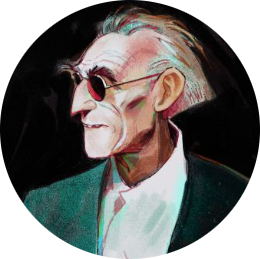
Harrow's knee had started to bounce, his costume jewelry clinking as those spidery fingers wrung and tapped and fretted. One of his overgrown fingernails chased an itch across his brow; shoved the bridge of his teashade sunglasses back up the grease-slick of his nose down which they had slid. He sucked in a hiss. "There was something needed moving, actually, but...no. No, fuck you, now I'm mad," he snarled. "Not that we coulda talked business anyway, what with this dryness wracking my throat. You know how I am, geezer, I can't talk business with a thirst...unless you're ready to apologize? Ah, screw it. Not like you remember my order anyway." |
The Maverick Model 12 inspired little in the way of awe or reverence or raw, virile sex appeal. It wasn't the kind of weapon they made generate-on-demand beamfilms about, starring laconic detectives or flinty-eyed gunfighters; too lumpy, too awkward with its bulbous air tank and a magazine wide enough to row a canoe with. And quiet, so pathetically quiet. Compared to the twitterboom from an arc blaster or even the tzzzzzzk of a laser pistol, how was the Model 12's sharp, wiffley little psss-tunk—more of a fart than a roar—supposed to terrify and demoralize? Leave a jackrat pissing his off-designer cargoes in horror and not in laughter? Fibrodiamond darts—gas-propelled fibrodiamond darts! Like something outta the fucking Middle Ages. What next? Maybe the bounty hunter would trade in his atmosuit for a banana-leaf loincloth, his RetNet visor for a nosebone. Maybe while he was at it he'd tie them off to his elbow and go spearfishing, or dip them in neurotoxins for a monkey-hunt through the jungle.
Well—fair enough. Maybe the first slackjaw at the end of the pan-sec corridor would've laughed, too, as so many had before him. Maybe. Had it been his buddy's hand on his shoulder jostling him awake from the stim nods and not a 7.22mm caliber flechette splattering his throat across the camera room door. Instead the usual. From the gun its wimpy hiss-thwunk-wheeze, the recoil shuddering through Zardok's arm, then—in less time than seemed possible for a subsonic delivery system—a wet clatter off the wall. The jackrat thrown awake, his eyeballs welling with tears, his lips with a pink foam spurting down his chin all over his stylish a-symm jacket. His hands searching, grasping for the piece of ice he could feel still lodged in his windpipe, finding only the leaky hole, his lungs burning hotter and hotter as he took breaths which embarked yet never arrived, and confusion, so much bursting, bug-eyed confusion. Like an ant colony pouring from a log that smoldered on both ends. Like a kitten in a microwave.
It was the second guard wrenched out a startled and grief-throttled scream, the sight of his pal's blood dribbled down the wall leaving little to conjecture. He opened fire, and yes, skinny arms struggled to control the backcharge from a too-big weapon, and yes the terror trembled through him and the rage and the panic but these didn't make him miss, it wasn't these which caused the arc to streak past the mercenary into the corridor behind him—sparks frolicking, oxide fumes frizzing from the freshly pockmarked durasteel. Not really. While the jackrat wondered whether he could beg instead, or bargain or backtrack into the safety of the armored room behind him, Zardok raised his plated vambrace to his face, unceremoniously shielded his eyes from the flash and his naked face from its burn; and brought the fight with him, step by strident step. While the jackrat wrestled with the thought of killing—not indirectly, not slaughter-by-proxy, but with his own two hands—how different it seemed from the overdoses, the unpaid debts, the "warnings to the rest," all out of sight, easily rationalized, "deserved"—Zardok had already closed the distance. Hesitation. Simple hesitation had determined this exchange's outcome before it had ever begun.
Unbraced arm leaping from the recoil, he'd squeezed off the next dart as the last ribbons of plasma fizzled past, as the hairs on his neck stood down from the charge in the air petering off. The dart bit breastplate, screeching, sparking; not penetrating, but slamming the punk backward into the wall with a concussive shove. Zardok steadied, reacquired, and fired another. And another, every punch to his carapaced midsection staggering the punk's breathing, his stance. His aim, his very composure, until he laid crumpled in the corner, wincing and wheezing, and above him loomed the bounty hunter's muzzle trained on his forehead from a distance unworthy of maybes and perhapses. A distance at which the jackrat could gawk down the barrel and see the glitter of the nitrogen-ice condensation gathered on the rifling. And behind that twinkle the twinkle of the next fibrodiamond tip. Staring back at him.
"How many guys inside?"
A squinting, bleary blink. "Fuh—wha—"
"How many, chucklenuts?"
"Tuh—...two. Please don't kill me. Not like that. Anything but—"
"You know," the bounty hunter said, leering aside, "I'm a gambling man. Comes with the career choice I guess. Nothing beats a quick-draw duel at high noon; a last-ditch close call squeeze out on the Asteroid Belt; chasing, casing, tailing, you name it. And I'd put down ħ50 heels, right here, right now, that your retinal signature open-sesames that there door console. Am I right?"
"Uhmn—" blubbered the punk.
Zardok sighed, grabbed him by the oversized jacket collar, flopped him out of the corner and onto the floor like an angler tosses his catch into a cooler. The jackrat floundered and splayed not far from where his buddy's combat-booted feet, also trout-on-icelike, still kick-spasmed their last. Lips yearning, tongue lolling, eyeballs bulging, but the kid couldn't look at his friend's face, not the face or anything else. He just glowered at the floor, wincing each time the boot soles squeaked against the mirror-polished floor, maybe counting the ceiling tiles in the reflection; playing any little mind-game he could, to block out the sight the sound and most of all the reeks, his friend's evacuated bowels collecting in his underwear, blood and sour bile frothing from the ventilation in his neck.
"Aw, man. You got pretty eyes," growled Zardok. "Real puppydog heartbreaker eyes, yeah, and they're breakin' mine somethin' bad. Figures. You bat your lashes and the world just eats outta your hand, huh? And you work your magic on a big ol' softie like me and—well, shit, kid, you win. You win already! I'll tell you what then. You get one more shot—you give it to me no bullshit this time, you get to keep your pretty blue eyes. Lie to me again, I go down to the cafeteria and I find me an ice cream scoop. Privy?"
Zardok watched the unfolding in real time, right there at his feet. Disbelief first. Then confusion then anger, the kid almost daring forth the death which didn't come, sick of waiting, of dreading. Then at some point enough seconds had passed that it must have dawned on him maybe the hunter wasn't toying with his food after all, maybe he really didn't have to die, maybe no one else had to die at all who hadn't died already and maybe, just maybe he'd get out of this alright. Fuck the money (it had blood on it anyway). Fuck the drugs. Fuck Van Zantz and his "empire" and his chromed-out gorillas. A one-way ticket off this glorified stripmine of a moon. If the kid had that he could get an indenture on an apartment, work a dead-end gig to pay it off, and sure it wouldn't be much but it also wouldn't be this, on his knees on a toothbrushed corporate floor with a gun to his head next to his buddy's blood, backpedaling so as not to get it on himself as the puddle crept and crept and crept. Running out of room. It kept pouring out of him, the puddle widening, and he was running out of floor to crawl across to keep out of it.
"Three," said the kid, who'd caught his breath, whose ribs had stopped aching. "No, four, sometimes it's four. Are you really gonna let me go?"
Zardok shrugged. "Depends. I let you go you going back to school, getting your diploma, a part-time job? Or you gonna keep slingin' Kick for some wannabe slumlord?"
"Hell no, man, I'm out. I'm never touching this shit again I swear to fucking God."
"Good. Between you and me, you weren't much cut out for it anyway." The bounty hunter's eyes met his, giving him one of those fatherly, atta-boy kinds of looks. Next he nodded to the door. "Open it. And gimme the yap on your boss while you do."
"Uh, yeah. Sure." The kid circumvented the puddle on his way to the console, still ignoring the body, by then mercifully still and quiet, its suffering maybe finally almost through. Started navigating menus and plugging in passcodes. "Van Zantz doesn't leave the brezhnevka; everything happens through cameras, bots, comms, fixers. They've claimed the whole second-from-the-top floor, him and his muscle. He's never alone. They got every stairwell, every elevator locked down. They peep it out all in shifts."
"Can't take a piss without his ten bodyguards giving the sign-off, huh? That's some kinda life," scoffed Zardok. "What the hell do you kids even idolize in a chickenshit like that?"
"I dunno...the money. Made it seem easy I guess, easier than going legit. You know how they treat people. The companies."
"I do." Above the doorway was a camera and sure enough, true to the kid's word, it didn't sweep the corridor indiscriminately, didn't just so happen to catch the events of the last few minutes in the glint of its peripherals; it was trained, focused, pan-tilt-zoomed on the two of them and the corpse. Zardok smiled and waved. "Keep talking," he advised. "It'll be over sooner."
"Right. Right, okay." Still hunched over the console the kid prattled off what details he could recall, messy and scrambled with the circumstances pressing down on him: floor plans, security layouts. Front door procedures; the way the hunter and his crew would need a resident's keycard to get in, unless they wanted to chance it with the doormen. The way the windows weren't barred and reinforced like on so many other moons (the gravity too low—unfeasible as a suicide method) and maybe that was a way in. The kid seemed to really think that was how things were going to shake out: monolith and underdog, climax and dénouement, struggle and triumph, all guns and fire and glory. A shame. Retrieving the gas grenade from his duster, squeezing the spoon, and biting down on the pin, it was the singular time Zardok felt sorry for him. Sorry for the way things had to be.
The kid was stooped down at eye-level with the scanner squinting through the green glare when the doors hissed open. His friends had heard the whole exchange. Weapons drawn, furies stoked. "Corvik, you FUCKING TRAIT—" began their indignant battle cry cut short. Clink. Clatter. Hiss-thwunk-wheeze.
"Corvik's" cerebral fluid painted the door console, a dart tip jutting from the ruin of a forehead opened like an eggshell, the back of his mohawked head glittering with nitrogen-ice residue. He streaked down the wall into a slack pile on the floor. Meanwhile the safety lever sprung away down the hall ricocheting off the walls with a ting-a-ting, and the rest of the grenade arced along its toss, and it landed somewhere in the farthest reaches of the camera room. The panic struck wordlessly and all at once: one or two of Van Zantz's mooks taking quick action, thinking if they scrabbled fast and scrabbled hard they might find the grenade and hot-potato it back to the bounty hunter; or else they might evacuate the camera room before detonation, gambling on the nailer running low on ammo, its gas tank low on PSI, gambling on the hunter's reflexes being good but not good enough to take all of them in full awares the way he'd ambushed the two lunkheads outside. But the rest, paralyzed by indecision—taking a moment too long to decide, hunker or escape, hunker or escape—when Zardok shut the door and shot the console, shot it until the sparks and the electrical arcs melted plastic, superheated copper, the doors closed and the last that Zardok saw of them (three or four he couldn't say) was their gormless, slackjawed, sheep-meeting-the-wolf expressions.
He backed up; waited for the beating against the other side of the door to weaken, to slow, then to cease, only a minute or two in all, before spitting the pin across the floor ting-a-linga. Growling into his RetNet unit. "Captain to crew," he said, finger to temple, retina navigating the visor UI with deft side-aside glances. "Rabgood, I'm tied up at the pan-sec room and I'm gonna need you to meet me here. Bring me more ammo and a gas charge. Oh, and the biggest laser we got. Gonna have to cut our way in."
Well—fair enough. Maybe the first slackjaw at the end of the pan-sec corridor would've laughed, too, as so many had before him. Maybe. Had it been his buddy's hand on his shoulder jostling him awake from the stim nods and not a 7.22mm caliber flechette splattering his throat across the camera room door. Instead the usual. From the gun its wimpy hiss-thwunk-wheeze, the recoil shuddering through Zardok's arm, then—in less time than seemed possible for a subsonic delivery system—a wet clatter off the wall. The jackrat thrown awake, his eyeballs welling with tears, his lips with a pink foam spurting down his chin all over his stylish a-symm jacket. His hands searching, grasping for the piece of ice he could feel still lodged in his windpipe, finding only the leaky hole, his lungs burning hotter and hotter as he took breaths which embarked yet never arrived, and confusion, so much bursting, bug-eyed confusion. Like an ant colony pouring from a log that smoldered on both ends. Like a kitten in a microwave.
It was the second guard wrenched out a startled and grief-throttled scream, the sight of his pal's blood dribbled down the wall leaving little to conjecture. He opened fire, and yes, skinny arms struggled to control the backcharge from a too-big weapon, and yes the terror trembled through him and the rage and the panic but these didn't make him miss, it wasn't these which caused the arc to streak past the mercenary into the corridor behind him—sparks frolicking, oxide fumes frizzing from the freshly pockmarked durasteel. Not really. While the jackrat wondered whether he could beg instead, or bargain or backtrack into the safety of the armored room behind him, Zardok raised his plated vambrace to his face, unceremoniously shielded his eyes from the flash and his naked face from its burn; and brought the fight with him, step by strident step. While the jackrat wrestled with the thought of killing—not indirectly, not slaughter-by-proxy, but with his own two hands—how different it seemed from the overdoses, the unpaid debts, the "warnings to the rest," all out of sight, easily rationalized, "deserved"—Zardok had already closed the distance. Hesitation. Simple hesitation had determined this exchange's outcome before it had ever begun.
Unbraced arm leaping from the recoil, he'd squeezed off the next dart as the last ribbons of plasma fizzled past, as the hairs on his neck stood down from the charge in the air petering off. The dart bit breastplate, screeching, sparking; not penetrating, but slamming the punk backward into the wall with a concussive shove. Zardok steadied, reacquired, and fired another. And another, every punch to his carapaced midsection staggering the punk's breathing, his stance. His aim, his very composure, until he laid crumpled in the corner, wincing and wheezing, and above him loomed the bounty hunter's muzzle trained on his forehead from a distance unworthy of maybes and perhapses. A distance at which the jackrat could gawk down the barrel and see the glitter of the nitrogen-ice condensation gathered on the rifling. And behind that twinkle the twinkle of the next fibrodiamond tip. Staring back at him.
"How many guys inside?"
A squinting, bleary blink. "Fuh—wha—"
"How many, chucklenuts?"
"Tuh—...two. Please don't kill me. Not like that. Anything but—"
"You know," the bounty hunter said, leering aside, "I'm a gambling man. Comes with the career choice I guess. Nothing beats a quick-draw duel at high noon; a last-ditch close call squeeze out on the Asteroid Belt; chasing, casing, tailing, you name it. And I'd put down ħ50 heels, right here, right now, that your retinal signature open-sesames that there door console. Am I right?"
"Uhmn—" blubbered the punk.
Zardok sighed, grabbed him by the oversized jacket collar, flopped him out of the corner and onto the floor like an angler tosses his catch into a cooler. The jackrat floundered and splayed not far from where his buddy's combat-booted feet, also trout-on-icelike, still kick-spasmed their last. Lips yearning, tongue lolling, eyeballs bulging, but the kid couldn't look at his friend's face, not the face or anything else. He just glowered at the floor, wincing each time the boot soles squeaked against the mirror-polished floor, maybe counting the ceiling tiles in the reflection; playing any little mind-game he could, to block out the sight the sound and most of all the reeks, his friend's evacuated bowels collecting in his underwear, blood and sour bile frothing from the ventilation in his neck.
"Aw, man. You got pretty eyes," growled Zardok. "Real puppydog heartbreaker eyes, yeah, and they're breakin' mine somethin' bad. Figures. You bat your lashes and the world just eats outta your hand, huh? And you work your magic on a big ol' softie like me and—well, shit, kid, you win. You win already! I'll tell you what then. You get one more shot—you give it to me no bullshit this time, you get to keep your pretty blue eyes. Lie to me again, I go down to the cafeteria and I find me an ice cream scoop. Privy?"
Zardok watched the unfolding in real time, right there at his feet. Disbelief first. Then confusion then anger, the kid almost daring forth the death which didn't come, sick of waiting, of dreading. Then at some point enough seconds had passed that it must have dawned on him maybe the hunter wasn't toying with his food after all, maybe he really didn't have to die, maybe no one else had to die at all who hadn't died already and maybe, just maybe he'd get out of this alright. Fuck the money (it had blood on it anyway). Fuck the drugs. Fuck Van Zantz and his "empire" and his chromed-out gorillas. A one-way ticket off this glorified stripmine of a moon. If the kid had that he could get an indenture on an apartment, work a dead-end gig to pay it off, and sure it wouldn't be much but it also wouldn't be this, on his knees on a toothbrushed corporate floor with a gun to his head next to his buddy's blood, backpedaling so as not to get it on himself as the puddle crept and crept and crept. Running out of room. It kept pouring out of him, the puddle widening, and he was running out of floor to crawl across to keep out of it.
"Three," said the kid, who'd caught his breath, whose ribs had stopped aching. "No, four, sometimes it's four. Are you really gonna let me go?"
Zardok shrugged. "Depends. I let you go you going back to school, getting your diploma, a part-time job? Or you gonna keep slingin' Kick for some wannabe slumlord?"
"Hell no, man, I'm out. I'm never touching this shit again I swear to fucking God."
"Good. Between you and me, you weren't much cut out for it anyway." The bounty hunter's eyes met his, giving him one of those fatherly, atta-boy kinds of looks. Next he nodded to the door. "Open it. And gimme the yap on your boss while you do."
"Uh, yeah. Sure." The kid circumvented the puddle on his way to the console, still ignoring the body, by then mercifully still and quiet, its suffering maybe finally almost through. Started navigating menus and plugging in passcodes. "Van Zantz doesn't leave the brezhnevka; everything happens through cameras, bots, comms, fixers. They've claimed the whole second-from-the-top floor, him and his muscle. He's never alone. They got every stairwell, every elevator locked down. They peep it out all in shifts."
"Can't take a piss without his ten bodyguards giving the sign-off, huh? That's some kinda life," scoffed Zardok. "What the hell do you kids even idolize in a chickenshit like that?"
"I dunno...the money. Made it seem easy I guess, easier than going legit. You know how they treat people. The companies."
"I do." Above the doorway was a camera and sure enough, true to the kid's word, it didn't sweep the corridor indiscriminately, didn't just so happen to catch the events of the last few minutes in the glint of its peripherals; it was trained, focused, pan-tilt-zoomed on the two of them and the corpse. Zardok smiled and waved. "Keep talking," he advised. "It'll be over sooner."
"Right. Right, okay." Still hunched over the console the kid prattled off what details he could recall, messy and scrambled with the circumstances pressing down on him: floor plans, security layouts. Front door procedures; the way the hunter and his crew would need a resident's keycard to get in, unless they wanted to chance it with the doormen. The way the windows weren't barred and reinforced like on so many other moons (the gravity too low—unfeasible as a suicide method) and maybe that was a way in. The kid seemed to really think that was how things were going to shake out: monolith and underdog, climax and dénouement, struggle and triumph, all guns and fire and glory. A shame. Retrieving the gas grenade from his duster, squeezing the spoon, and biting down on the pin, it was the singular time Zardok felt sorry for him. Sorry for the way things had to be.
The kid was stooped down at eye-level with the scanner squinting through the green glare when the doors hissed open. His friends had heard the whole exchange. Weapons drawn, furies stoked. "Corvik, you FUCKING TRAIT—" began their indignant battle cry cut short. Clink. Clatter. Hiss-thwunk-wheeze.
"Corvik's" cerebral fluid painted the door console, a dart tip jutting from the ruin of a forehead opened like an eggshell, the back of his mohawked head glittering with nitrogen-ice residue. He streaked down the wall into a slack pile on the floor. Meanwhile the safety lever sprung away down the hall ricocheting off the walls with a ting-a-ting, and the rest of the grenade arced along its toss, and it landed somewhere in the farthest reaches of the camera room. The panic struck wordlessly and all at once: one or two of Van Zantz's mooks taking quick action, thinking if they scrabbled fast and scrabbled hard they might find the grenade and hot-potato it back to the bounty hunter; or else they might evacuate the camera room before detonation, gambling on the nailer running low on ammo, its gas tank low on PSI, gambling on the hunter's reflexes being good but not good enough to take all of them in full awares the way he'd ambushed the two lunkheads outside. But the rest, paralyzed by indecision—taking a moment too long to decide, hunker or escape, hunker or escape—when Zardok shut the door and shot the console, shot it until the sparks and the electrical arcs melted plastic, superheated copper, the doors closed and the last that Zardok saw of them (three or four he couldn't say) was their gormless, slackjawed, sheep-meeting-the-wolf expressions.
He backed up; waited for the beating against the other side of the door to weaken, to slow, then to cease, only a minute or two in all, before spitting the pin across the floor ting-a-linga. Growling into his RetNet unit. "Captain to crew," he said, finger to temple, retina navigating the visor UI with deft side-aside glances. "Rabgood, I'm tied up at the pan-sec room and I'm gonna need you to meet me here. Bring me more ammo and a gas charge. Oh, and the biggest laser we got. Gonna have to cut our way in."
The I.S.P.S. Cimeter docked as do all starships: slowly and then all at once.
As one speck among dozens crawling along the skyscape of Andrastea-1, going and coming, backing and forthing across the viewports—and bitting and byting no doubt across some security room's autologger screen also—it neither demanded nor deserved any extraordinary attentions: meandering no faster than a tailless asteroid or a satellite knocked adrift, its nav lights blinking out no more Lumens than another dim star, a routine log check raising little if any concern. No malice. No urgency. Just another dot among the millions and millions freckle-sprayed in every conceivable direction across the skin of the Black.
Likewise, as Andrastea-1's .beaconFire protocol locked on to the Cimeter's autonav, and a few bursts of retroburn dampened its speed and corrected its tri-axial coords, and it coasted toward the hangar's burnshields smooth as imitation foie gras butterknife-swiped across a crust of sourdough, coming into view was the perfectly unexceptional silhouette, spawned by the kind of unimaginative design ethos which inspires no songs—no wistful, sighing romances. Command bridge up and aft; gyroscopic gun towers jutting; em-sphere generators smoothed and flush and recessed. Sleek, aerodynamic for atmo work, yet stout, staunch, for the shrugging-off of orbit junk and other detritus. This too roused little scrutiny.
It was when the prow first slipped through the shields and the incinerated residue began to float therefrom in ashen heaps that the first among the hangar's worker-legions took notice. They did not concern themselves with the mess, tousled from the ship like snow off a skier coming in from the cold—the sweeper bots attended to that—no, instead these employees ogled what was left behind. A leprous shell of ablative plating, cratered with drift-junk impacts, scorched and slagged where a chance few lucky particle shots had bypassed the em-shields. Began the speculation, the whispers, that the Cimeter had even survived a blow from a N.E.M.E.S.I.S. gun (a glancing blow, but nonetheless)—a great gash running fore-to-aft along the portside bilge, huge and jagged and gaping—for no other weapons came to mind, and indeed very few existed in realspace, which could inflict such devastation as that which the Cimeter wore like a battle-wound. In all a ship as pocked and scarred as its crew no doubt, shaking off this cosmic dust the way a well-traveled stranger steps into a saloon, and yet here it was, all but sauntering into their little glorified refueling station. Those expecting trouble examined the murderous black paintjob—what remained of it—made their excuses, retreated toward the neutrino poisons aisle or the stabilized xenon kits, buried their noses in busiwork as if restocking this-or-that pallet and taking here-and-there inventories was all the sudden the most important and noble task in all the galaxy. Others remained unfazed; or at least too curious to be unfixed from where they stood. They wanted to see for themselves what kind of crew chases down that kind of trouble—shot at with such intensity and such frequency that they hadn't the time, or the heelies, or the simple patience to keep their armor shipshape. (Not mentioning what kind of stim psycho banks in range of a hostile N.E.M.E.S.I.S. gun and lives.) They weren't gawking, these hangar workers. Never gawking. Their furtive glances they stole sidelong; and they measured well their distances from the landing pad. Not so close as to invite the instigations of whoever was even then stepping down from the boarding plank (depressurizing with a hiss, hydraulics whining). Yet still near enough to see. To overhear.
Little did they know that behind his unconcerned swagger and his unflappable smile, Captain Zardok of the Cimeter observed them likewise. In fact he had gleaned quite a bit about them—about their operation—from the moment he swiped a match across his moonboot and lit a cigar.
His skin matched his ship's: swart and starburnt, striped and streaked with pinkish wounds; some fresher than others. These however were his only embellishments, the rest of him unassuming, unceremonious. No medals or patches or any other insignia. His dark, thick hair cropped short, not for style but for keeping a good seal on his atmosuit helmet. A pleather duster, as scratched and shabby as its wearer, guarding the joints and pivots of said suit from the ubiquitous regoliths and lunar dusts. Zardok's rictus-grin didn't falter. Not as he took his first deep breath of atmo in maybe two weeks, maybe more (not month-old farts pumped out of the cabins and scrubbed and pumped back in in a closed loop but real air, clean, decent air, or as clean as it got out here). Nor as he noticed the station wagies staring, trying to figure him out, chewing on him like a bully stick. Not even as one of those wagies barked at him to put out the cigar, that it wasted oxygen and poisoned the air for everyone else and besides, didn't he know there were dangerous chemicals always venting around, some of them volatile others flammable, was he some kind of idiot? Zardok simply shrugged, did as told—and kept on smiling all the while. Maybe whatever extrasolar radiation had singed his skin to that queer shade of dirty-engine-oil brown it had also shrunk the muscles in his face; raisined his brain. Or maybe he was ruminating on the hiss, the flare-up leaping from his match (the O2 enrichment levels); the way the cigar smoked blobbed and billowed outward (the station's art-grav and air pressure settings); and of course the security protocols, amounting to little more so far than a few teenagers at their first-ever part-time jobs, still swallowing all the training video mantras, still spewing the company slogans. Utterly unaware of who they really worked for.
Zardok gave the air another taste to be sure—smack, smack—fresh, dry, a little floral; like candied violets.
Snuffing the cigar against the durasteel plates lapped over his barreled chest, he dropped it into the handwarmer pockets of his duster, into which his balled hands followed. He walked with unhurried purpose. Catching in his leery gaze the CCTV glint up in the ceiling corners, following their circuitry into the greebling of the walls, these converging at a single point and terminating in a kind of panopticon which monitored the entire hangar from some three stories up. Zardok gave a mirthful little skip, even clicked his heels, but found the grav conditions lacking: a hair too strong to just boost himself up there and melt through the smoky aluminum glass. So he exited across the hangar, left his ship to its fate in the hands of the underpaid attendants and fixmongers. Strolled his way through the first employees-only door to throw a warning flag in his face: I.D. REQUIRED BEYOND THIS POINT — TRESPASSERS WILL BE PROSECUTED TO THE FULLEST EXTENT OF THE yadda yadda, blah, blah. He marveled at how easy it was. A little too easy. Even the elevator wasn't hard to find: a corridor, a switchback, a scanner which didn't prompt him for the aforementioned employee card, buttons which didn't trace his bios through the cross-osmotic membranes of his gloves. Already cracked. Already disabled. Hmm. A bad feeling by then was coalescing in Zardok's gut, and a bad feeling meant out came the nailer from his thigh holster once the doors had closed behind him. He checked the magazine and the pressure gauge, tucked himself behind the doorwell, reached up to the side of his face where he pressed the button hidden in his temple, activating the RetNet visor shrouded over his right eye. He started recording; pushed the relay through to the central closed-server node transceiving from the Cimeter. Didn't sense any sniffing or tunneling afoot as the first packets went out. Good. The bounty having a real-deal coderunner under his employ would have complicated things considerably. But there was still the security room; the cameras and the alarms and the maglocks.
The doors opened and Zardok ejected himself from the elevator, standing then in a cleaner, more garnished kind of employee area. Not clogged with Engineering's vent and pipework confluences, not with IT's wire nests and server farms but with conference rooms. Human Solutions offices. Break areas with bad coffee and stale lemon loaf and imitation potted plants standing plump and erect in wads of very real coconut rusk. Whatever office supply storage rows and cubicle corridors he walked in search of a late-night manager shredding CVs at a pulpwood desk, all the usual slogans slathered the walls. In every direction every format every font.
Welcome to a Culture of Caring — refer a friend into our family and earn up to* a ħ50,00 bonus!
Great Benefits, Competitive Pay, & Flexible Hours — We're Here to Help You Thrive.
Driven by Values; Powered by People. And so on. He couldn't help but grimace, which to his rictus-stricken features meant only the faintest downturn in the corners of that pig-iron grin.
"Can I help you find something?"
Hurriedly stowing the nailer within his coat, somewhere beneath his opposite armpit, Zardok turned to face whoever had caught him sniffing about. Much to his relief this figure wore the frumpy trappings of middle management: an ill-fitting lapel jacket over her standard-issue Mackee's boilersuit, her left breast emblazoned with the chipmunk-cheeked and eminently punchable countenance of the chain's beaming mascot. Were it not for her weary and ragged expression Zardok might have made the mistake of speaking to the patch and not the person forced, by threat of corrective action, to brandish it for every minute of her every 6.49-hour shift. The ones who said shit like "If you've got time to lean...," who guh-hyucked a bit too hard at their subordinates' wisecracks, who sighed and nodded in solidarity at the very same grievances they'd turn around and relay to their bosses later—those were the ones gave Zardok the shivers, more like feeding queries into a particularly convincing droid than conversing with a natch.
"Well, sure!" he wheedled, grateful for the strands of hair fallen out from her dress code-compliant bun, the bags under her eyes, the milky-coffee-tinge to her teeth. These were the little things what broke the Turing test, telling him there was someone in there still worth pitying. "I'm the new muscle Van Zantz sent for. You could point the way for me."
"He's not here," said this burnt-out thirty-something. "Doesn't leave the upper levels much at all in fact." Zardok scoured her features for any sign of relief—or if not relief then anxiety, terror, any reaction whatsoever to that name—did she fear him?—hope her prayers had been answered?—did the gang even prey on people like her, the drones that is, or were they only operating down in the bathrooms, the greasy spoons, the drydocks, these two worlds coexisting without ever colliding?—nothing. At least nothing he could glean from this insipid little meetcute. Unreadable as a mossy old Buddha.
" 'Course. Everyone knows that," he sighed with a twinkle in his teeth, continuing the gambit. (After all it had gotten him this far.) "I meant he told me when I arrived I'd be checking in with the boys in the peep-room. Gotta get briefed before I can get started."
She turned and gestured, the cheap synthetics of her jacket violinning the cheap synthetics of her boilersuit, their music swishy and shrill. "Right...down that hallway. The double doors shouldn't be locked but you can come and fetch me if they are."
"I just might. Thanks." Zardok took his first few steps, then planted, pivoted. Met her stare with his again. More to learn. More he needed to know. "Oh, hey. Between you and me. If those boys find out it was the cutie downstairs waved me through, I'm not getting you into hot water, am I?"
"With Van Zantz or with my bosses?"
Bingo. "Either, or, all of the above."
"He doesn't touch us. Says employees are off-limits," she said. "Doesn't stop the occasional shakedown so some fiender can score a fix, but once Zantz finds out, suddenly there's no more fiender. Someone finds him the next day strung up by his guts."
"You're deliciously calm about all this. Is it really that safe with us gangers running amok? Or has working corpo just got you jaded?"
"You? Dangerous?" She shook her head with a belabored smirk. "Nah, Zantz just knows they'll send someone in to 'handle' him if they start receiving a million and one claims all from the same franchise. Comprehensive for the robbery, medical for the injuries, whatever."
This mousy little thing really had it all figured out, didn't she? And so did the quarry for that matter. Zardok couldn't help a laugh escaping his roomy lungs. "Sounds like a lot has changed since his Tytania days. Well. I've got more to learn than I thought."
"That you do," she teased. "I'm Krynn, by the way."
"Vakar." He reached for that errant strand of hair; pulled away mere centimeters from tucking it behind the alabaster folds of her ear. "Oops. Almost forgot. Look, don't touch, right?"
"You're awful."
"That I am. Unfortunately, I'm also in a bit of a hurry." Zardok smiled wider if that was possible; tipped a hat he wasn't wearing. "You have a good night now, Krynn. You've been mighty helpful."
"Mm. Sounds like we'll be seeing each other," she said. "You should start thinking of ways to repay me."
Making his way to the second elevator Zardok was all coquetry; all glances and chuckles and little flutters of his fingers. Once inside, with the sliding doors closed behind him, he exhaled with something resembling relief. He drew and checked the nailer again—the first dart glinting at the top of the magazine, good PSI readings on the tank—not because he didn't trust his equipment. Really it was more habit than anything. A kind of ritual of his.
As one speck among dozens crawling along the skyscape of Andrastea-1, going and coming, backing and forthing across the viewports—and bitting and byting no doubt across some security room's autologger screen also—it neither demanded nor deserved any extraordinary attentions: meandering no faster than a tailless asteroid or a satellite knocked adrift, its nav lights blinking out no more Lumens than another dim star, a routine log check raising little if any concern. No malice. No urgency. Just another dot among the millions and millions freckle-sprayed in every conceivable direction across the skin of the Black.
Likewise, as Andrastea-1's .beaconFire protocol locked on to the Cimeter's autonav, and a few bursts of retroburn dampened its speed and corrected its tri-axial coords, and it coasted toward the hangar's burnshields smooth as imitation foie gras butterknife-swiped across a crust of sourdough, coming into view was the perfectly unexceptional silhouette, spawned by the kind of unimaginative design ethos which inspires no songs—no wistful, sighing romances. Command bridge up and aft; gyroscopic gun towers jutting; em-sphere generators smoothed and flush and recessed. Sleek, aerodynamic for atmo work, yet stout, staunch, for the shrugging-off of orbit junk and other detritus. This too roused little scrutiny.
It was when the prow first slipped through the shields and the incinerated residue began to float therefrom in ashen heaps that the first among the hangar's worker-legions took notice. They did not concern themselves with the mess, tousled from the ship like snow off a skier coming in from the cold—the sweeper bots attended to that—no, instead these employees ogled what was left behind. A leprous shell of ablative plating, cratered with drift-junk impacts, scorched and slagged where a chance few lucky particle shots had bypassed the em-shields. Began the speculation, the whispers, that the Cimeter had even survived a blow from a N.E.M.E.S.I.S. gun (a glancing blow, but nonetheless)—a great gash running fore-to-aft along the portside bilge, huge and jagged and gaping—for no other weapons came to mind, and indeed very few existed in realspace, which could inflict such devastation as that which the Cimeter wore like a battle-wound. In all a ship as pocked and scarred as its crew no doubt, shaking off this cosmic dust the way a well-traveled stranger steps into a saloon, and yet here it was, all but sauntering into their little glorified refueling station. Those expecting trouble examined the murderous black paintjob—what remained of it—made their excuses, retreated toward the neutrino poisons aisle or the stabilized xenon kits, buried their noses in busiwork as if restocking this-or-that pallet and taking here-and-there inventories was all the sudden the most important and noble task in all the galaxy. Others remained unfazed; or at least too curious to be unfixed from where they stood. They wanted to see for themselves what kind of crew chases down that kind of trouble—shot at with such intensity and such frequency that they hadn't the time, or the heelies, or the simple patience to keep their armor shipshape. (Not mentioning what kind of stim psycho banks in range of a hostile N.E.M.E.S.I.S. gun and lives.) They weren't gawking, these hangar workers. Never gawking. Their furtive glances they stole sidelong; and they measured well their distances from the landing pad. Not so close as to invite the instigations of whoever was even then stepping down from the boarding plank (depressurizing with a hiss, hydraulics whining). Yet still near enough to see. To overhear.
Little did they know that behind his unconcerned swagger and his unflappable smile, Captain Zardok of the Cimeter observed them likewise. In fact he had gleaned quite a bit about them—about their operation—from the moment he swiped a match across his moonboot and lit a cigar.
His skin matched his ship's: swart and starburnt, striped and streaked with pinkish wounds; some fresher than others. These however were his only embellishments, the rest of him unassuming, unceremonious. No medals or patches or any other insignia. His dark, thick hair cropped short, not for style but for keeping a good seal on his atmosuit helmet. A pleather duster, as scratched and shabby as its wearer, guarding the joints and pivots of said suit from the ubiquitous regoliths and lunar dusts. Zardok's rictus-grin didn't falter. Not as he took his first deep breath of atmo in maybe two weeks, maybe more (not month-old farts pumped out of the cabins and scrubbed and pumped back in in a closed loop but real air, clean, decent air, or as clean as it got out here). Nor as he noticed the station wagies staring, trying to figure him out, chewing on him like a bully stick. Not even as one of those wagies barked at him to put out the cigar, that it wasted oxygen and poisoned the air for everyone else and besides, didn't he know there were dangerous chemicals always venting around, some of them volatile others flammable, was he some kind of idiot? Zardok simply shrugged, did as told—and kept on smiling all the while. Maybe whatever extrasolar radiation had singed his skin to that queer shade of dirty-engine-oil brown it had also shrunk the muscles in his face; raisined his brain. Or maybe he was ruminating on the hiss, the flare-up leaping from his match (the O2 enrichment levels); the way the cigar smoked blobbed and billowed outward (the station's art-grav and air pressure settings); and of course the security protocols, amounting to little more so far than a few teenagers at their first-ever part-time jobs, still swallowing all the training video mantras, still spewing the company slogans. Utterly unaware of who they really worked for.
Zardok gave the air another taste to be sure—smack, smack—fresh, dry, a little floral; like candied violets.
Snuffing the cigar against the durasteel plates lapped over his barreled chest, he dropped it into the handwarmer pockets of his duster, into which his balled hands followed. He walked with unhurried purpose. Catching in his leery gaze the CCTV glint up in the ceiling corners, following their circuitry into the greebling of the walls, these converging at a single point and terminating in a kind of panopticon which monitored the entire hangar from some three stories up. Zardok gave a mirthful little skip, even clicked his heels, but found the grav conditions lacking: a hair too strong to just boost himself up there and melt through the smoky aluminum glass. So he exited across the hangar, left his ship to its fate in the hands of the underpaid attendants and fixmongers. Strolled his way through the first employees-only door to throw a warning flag in his face: I.D. REQUIRED BEYOND THIS POINT — TRESPASSERS WILL BE PROSECUTED TO THE FULLEST EXTENT OF THE yadda yadda, blah, blah. He marveled at how easy it was. A little too easy. Even the elevator wasn't hard to find: a corridor, a switchback, a scanner which didn't prompt him for the aforementioned employee card, buttons which didn't trace his bios through the cross-osmotic membranes of his gloves. Already cracked. Already disabled. Hmm. A bad feeling by then was coalescing in Zardok's gut, and a bad feeling meant out came the nailer from his thigh holster once the doors had closed behind him. He checked the magazine and the pressure gauge, tucked himself behind the doorwell, reached up to the side of his face where he pressed the button hidden in his temple, activating the RetNet visor shrouded over his right eye. He started recording; pushed the relay through to the central closed-server node transceiving from the Cimeter. Didn't sense any sniffing or tunneling afoot as the first packets went out. Good. The bounty having a real-deal coderunner under his employ would have complicated things considerably. But there was still the security room; the cameras and the alarms and the maglocks.
The doors opened and Zardok ejected himself from the elevator, standing then in a cleaner, more garnished kind of employee area. Not clogged with Engineering's vent and pipework confluences, not with IT's wire nests and server farms but with conference rooms. Human Solutions offices. Break areas with bad coffee and stale lemon loaf and imitation potted plants standing plump and erect in wads of very real coconut rusk. Whatever office supply storage rows and cubicle corridors he walked in search of a late-night manager shredding CVs at a pulpwood desk, all the usual slogans slathered the walls. In every direction every format every font.
Welcome to a Culture of Caring — refer a friend into our family and earn up to* a ħ50,00 bonus!
Great Benefits, Competitive Pay, & Flexible Hours — We're Here to Help You Thrive.
Driven by Values; Powered by People. And so on. He couldn't help but grimace, which to his rictus-stricken features meant only the faintest downturn in the corners of that pig-iron grin.
"Can I help you find something?"
Hurriedly stowing the nailer within his coat, somewhere beneath his opposite armpit, Zardok turned to face whoever had caught him sniffing about. Much to his relief this figure wore the frumpy trappings of middle management: an ill-fitting lapel jacket over her standard-issue Mackee's boilersuit, her left breast emblazoned with the chipmunk-cheeked and eminently punchable countenance of the chain's beaming mascot. Were it not for her weary and ragged expression Zardok might have made the mistake of speaking to the patch and not the person forced, by threat of corrective action, to brandish it for every minute of her every 6.49-hour shift. The ones who said shit like "If you've got time to lean...," who guh-hyucked a bit too hard at their subordinates' wisecracks, who sighed and nodded in solidarity at the very same grievances they'd turn around and relay to their bosses later—those were the ones gave Zardok the shivers, more like feeding queries into a particularly convincing droid than conversing with a natch.
"Well, sure!" he wheedled, grateful for the strands of hair fallen out from her dress code-compliant bun, the bags under her eyes, the milky-coffee-tinge to her teeth. These were the little things what broke the Turing test, telling him there was someone in there still worth pitying. "I'm the new muscle Van Zantz sent for. You could point the way for me."
"He's not here," said this burnt-out thirty-something. "Doesn't leave the upper levels much at all in fact." Zardok scoured her features for any sign of relief—or if not relief then anxiety, terror, any reaction whatsoever to that name—did she fear him?—hope her prayers had been answered?—did the gang even prey on people like her, the drones that is, or were they only operating down in the bathrooms, the greasy spoons, the drydocks, these two worlds coexisting without ever colliding?—nothing. At least nothing he could glean from this insipid little meetcute. Unreadable as a mossy old Buddha.
" 'Course. Everyone knows that," he sighed with a twinkle in his teeth, continuing the gambit. (After all it had gotten him this far.) "I meant he told me when I arrived I'd be checking in with the boys in the peep-room. Gotta get briefed before I can get started."
She turned and gestured, the cheap synthetics of her jacket violinning the cheap synthetics of her boilersuit, their music swishy and shrill. "Right...down that hallway. The double doors shouldn't be locked but you can come and fetch me if they are."
"I just might. Thanks." Zardok took his first few steps, then planted, pivoted. Met her stare with his again. More to learn. More he needed to know. "Oh, hey. Between you and me. If those boys find out it was the cutie downstairs waved me through, I'm not getting you into hot water, am I?"
"With Van Zantz or with my bosses?"
Bingo. "Either, or, all of the above."
"He doesn't touch us. Says employees are off-limits," she said. "Doesn't stop the occasional shakedown so some fiender can score a fix, but once Zantz finds out, suddenly there's no more fiender. Someone finds him the next day strung up by his guts."
"You're deliciously calm about all this. Is it really that safe with us gangers running amok? Or has working corpo just got you jaded?"
"You? Dangerous?" She shook her head with a belabored smirk. "Nah, Zantz just knows they'll send someone in to 'handle' him if they start receiving a million and one claims all from the same franchise. Comprehensive for the robbery, medical for the injuries, whatever."
This mousy little thing really had it all figured out, didn't she? And so did the quarry for that matter. Zardok couldn't help a laugh escaping his roomy lungs. "Sounds like a lot has changed since his Tytania days. Well. I've got more to learn than I thought."
"That you do," she teased. "I'm Krynn, by the way."
"Vakar." He reached for that errant strand of hair; pulled away mere centimeters from tucking it behind the alabaster folds of her ear. "Oops. Almost forgot. Look, don't touch, right?"
"You're awful."
"That I am. Unfortunately, I'm also in a bit of a hurry." Zardok smiled wider if that was possible; tipped a hat he wasn't wearing. "You have a good night now, Krynn. You've been mighty helpful."
"Mm. Sounds like we'll be seeing each other," she said. "You should start thinking of ways to repay me."
Making his way to the second elevator Zardok was all coquetry; all glances and chuckles and little flutters of his fingers. Once inside, with the sliding doors closed behind him, he exhaled with something resembling relief. He drew and checked the nailer again—the first dart glinting at the top of the magazine, good PSI readings on the tank—not because he didn't trust his equipment. Really it was more habit than anything. A kind of ritual of his.
© 2007-2026