Star Federation of Mankind (usually shortened to Federation or SF) is a supernational government of all humans. It forms a polito-economical union with the numerous governments in the Solar System and its neighbors. The Federation's origins date back to about 300 years following the end of the Last Great War, the most destructive event of their history. Weary of war and to prevent this from ever happening the committee decided on strengthening international communications, integrating economic systems while synchronizing politics to better reconcile with each other. They planned it step by step with the eventual goal being complete unification within a hundred years, a dream which never happened. From the outside the Federation may seem like a single body but in reality they are anything but that. There are countless nations and political parties each pushing their own agenda. Humanity may have avoided major wars for centuries now but their political forums are very much like warzones themselves. Similarly what once was a benign movement for peace and the good of Mankind turned into the plaything of economic powers. Money is the king within the Federation and as long as they can get away with it the political powers engage in various unethical deeds for profit. The Federation is a highly advanced civilization with many achievements, but this also made them overly confident in their technology. Also ironically enough until just a few years they had difficulties to develop decently fast FTL drives, thus remaining largely isolated from the galactic community. They observed near-certain signs of distant alien civilizations and even sent out probes but the Federation has yet to make contact with any sentient lifeform other than themselves.
Species Overview
As its name suggests the Federation was formed between humans. Yet the definition of "human" changed considerably. Mankind is scientifically referred as Homo Sapiens Caelis, the new humans adopted for the space age. There are many minor differences like adaptation to varying gravity, improved intelligence and reflexes, extended longevity and resistance to most known diseases but overall humanity remained the same. The most striking differences happen after the birth. Technological advances in cybernetics and cosmetic surgery meant so long you had the money you could go completely wild. Humans have yet to meet any aliens but name a popular sci-fi species and the Federation likely has a fan sporting their looks. Cybernetic enhancements are also rather common, especially computer-assisted brain functions typically referred as "Cogs". Each government has different regulations on what kind of alterations a citizen can do and in certain regions this could go to the extreme. Another major advancement was the technology to transfer consciousness. As such it's possible to transfer one's mind to a different organism or even an entirely mechanical body. Due to complicated mechanics backing up or copying consciousness is difficult and also banned in the Federation. Similarly while it's possible to transfer consciousness to military hardware memories of the Last Great War (especially the terror once delivered by Ego the Living Battlestation) makes such actions widely opposed by the public.
Technological Overview
The Star Federation may have not met aliens but had plenty of time and will to develop on their own. They made massive advancements in science and could be perhaps considered pioneers in many technologies. Manipulation of matter and fields can allow them feats which others may consider magical. Their impulse drives are reactionless engines that along with mass lightening fields can allow great speeds and at compact size. Q-Fabs revolutionized industry as versatile manufacturer devices that can assemble objects quickly and down to the last particle from already available materials. Their conversion reactors can extract nuclear energy from any common material and safe enough to power clocks and cell phones. To a common citizen of the Federation it may even see there's nothing that technology cannot accomplish. That being said Federation has complex laws on the use of technology not to mention the extensive ways companies try to protect their copyright. The latter has the unintended side effect of making outsiders even more difficult to reverse engineer human technology.
- Quantum Fabricators: Commonly abbreviated as Q-Fabs they are sophisticated devices which can alter and convert matter and energy to rapidly assemble objects. Q-Fabs are versatile and it can create anything it was programmed to. There are also Q-Meds, medical Q-Fabs used for healing and building biological matter. Knowing the right people and having loads of money can ensure that the wealthiest people can live theoretically forever. Q-Fabs can technically use raw energy to create matter but this is only utilized at sufficiently small scale. Spaceships generally have sufficiently abundant energy to use that alone for air and food replicators.
- Metastable Matter: A development which made Q-Fab technology far more accessible. It's an unique state of matter which is relatively stable and dense with easily accessible energy. Can be useful for batteries (though even more efficient methods exist) but first of all it's used as an intermediary matter for Q-Fabs.
- Fold Drive: Standard and reliable FTL method which manipulates spacetime to raise the apparent velocity of the vehicle beyond the speed of light. It has relatively low power consumption but comparatively slow speed and other inherent issues. Still, it's relatively cheap and has many alternative applications. Fold Accelerators for example can accelerate projectiles and vehicles at faster-than-light apparent velocities even if, without "fold sustainers", they revert to sublight speed after reaching a certain distance.
- Farcaster: The new long range interstellar travel method developed within the Federation. In basic terms it works similar to your standard Hyperdrive as it punches a hole in reality to the higher mathematical dimension of the hyperspace to allow faster-than-light travel. It consumes great amounts of energy thus the ships have special capacitors for this role. On the other hand the same method can be modified to transport smaller objects and Farcasters can have a limited application as teleporters. The only downside is that Farcasters are rather difficult to scale down thus unless there's a similar device around the teleportation is usually limited to one way trips. The speed of Farcasters is dependent on the power relative to the mass it carries. Thus systems like "Hypercarriers" (huge transports allowing many ships to dock) and "Hypergates" (large almost stationary structures which also use quantum linking to enhance the speed even further) exist.
- Impulse Engine: Standard sublight engines used by Federation spaceships. They expel mass particles at near the speed of light generated from pure energy which means they can have yet unheard level of specific impulse and henceforth their common name. Without the right conditions mass particles rapidly decay into relatively harmless photons thus also making this design the safest engine known within the Federation.
- Gravitics: Electromagnetics within the Federation were long replaced by gravitics, devices that move objects around with the force of gravity. While inherently gravity is a weak force SF scientific developents made countless mechanisms known to amplify them. Gravitic actuators, accelerators, propulsions are all commonly used within the Federation. This combined with the Higgs technology and mass lightening methods resulted in a massive boon for starship propulsion and the rennewed dominance of projectile weapons.
- Hypercomms, Hypersensors: A family of devices that use known FTL methods to gather or transmit information rapidly over long distances. Their mechanism can differ by type with each having its own set of advantages and disadvantages. Hypercameras and Hypertelescopes for example gather the tachyonic shadow of electromagnetic waves to allow up to a certain distance to see events in real time regardless of light-lag. Another common hypersensor is the Foldwave Radar which is rather self-explanatory.
- Quantum Link: One of the oldest forms of FTL communication it uses quantum entanglement to instantly transmit information to the linked device. It used to be expensive and not very reliable the technology reached maturity once other FTL mechanisms were understood. Abreviated as Q-Link this method offers lagless communication free of the typical interference. The only downside that you require to use more standard measures first to establish the link thus it generally only works between two familiar recipients. q-Link can be also used for power transmission but this method accelerates the degradation of the link thus usually not advised. While free of normal interference there are "Q-Jammer" devices that are designed specifically to scramble quantum comms.
- Conversion Reactors: The most common method of power generation. They can be practically found everywhere, be it in factories, cars or even cell phones. Conversion reactors are the ultimate result of nuclear research and could be said to be the distant relatives of fission and fusion energy. Thanks to their degree of sophistication the conversion reactors are actually fairly safe and incredibly easy to use.
- Zero-Point Energy Extractor (ZPEE): The ramscoop of space-time, this complex device allows harnessing vacuum energy which makes it ideal for starships and other power-hungry machines. The device requires lot of power to run and difficult to scale down, thus they won't replace conversion reactors anytime soon.
- Vacuum Compression Capacitors: Just as space itself can be used to harness energy it also turns out to be the best method to store power. Vacuum Compression Capacitors and ZPEEs are virtually the same technology used for different purposes. In effect vacuum capacitors are zero-point energy extractors that are deliberately inefficient. For this reason they can be made more compact and many hi-energy equipment is relying on these. Actually, many companies within the Federation are working on the means to make vacuum capacitors even more popular and replace other alternate batteries. Its advantages over the other means are weight savings, far higher capacity and even safety. When destroyed the spatial compression within the cell ceases and space expands around the unit. Anything caught within its area of effect simply ceases to exist. Yet space holds massive energy densities thus the failure of a vacuum cell only results in minuscule expansion. Even for the most massive starship batteries it fails to erase the entire vacuum cell. Thus ironically vacuum cell technology is both the safest and most destructive power storage mechanism known by the Federation.
- Durachrome: The most common military grade armors are chiefly made of durachrome. It's a hard, superdensely packed material family with its variants used both for ground troops and starships. Due to its weight anything made from it usually requires mass lightening to compensate.
- Structural Integrity Fields: Special complex field which reinforces the bind of atoms and generates bubbles of fake mass to further enhance the toughness of material.
- Higgs Shield: An extension of structural integrity fields this kind of protection forms layers of fake mass generated by the field emitters which can act like a regenerative extra layer of armor.
- Lightwave Barrier: A rather peculiar type shield which contrary to its name actually traps tachyons in a limited boundary around the vessel. It deflects massless and low-mass particles like light and radiation the best while practically useless against heavier projectiles. Starship-based lightwave barriers also have some other properties to compensate for spatial effects.
- Gravity Deflector: The various gravitic devices can also produce a shield of gravity around the ship. These tend to extend pretty far, up to even hundreds of kilometers and activated only during combat. The gravity shield's main purpose is to intercept, disrupt and disperse incoming attacks instead of directly stopping them. The weakened attacks would be then handled by the rest of the defense systems.
- PASER: Projectile Acceleration Sustained by Effector Rails. It's a gravomagnetic mass accelerator and the basis of most weapon systems within the Federation. In spite of that the term PASER is most commonly used for handheld weapons since the term "gun" earned much notoriety during the Last Great War. For other weapons and devices using the same mechanism they merely use the term Gravomagnetic Accelerator or Grav for short.
- IGP: Intelligent Gravomagnetic Projectile. Common name for the projectiles launched from Gravomagnetic Accelerators. There are countless different kinds of IGP, some of them are entirely solid projectiles while others have sensors, AI, warhead, propulsion and at times even other features. The options are nearly limitless. IGPs are effectively the combination of physical projectiles and missiles.
- PPA: Pressed Particle Arms. Special use of gravoagnetic accelerators when unstable particles of incredible density are created on site and unleashed at velocities very close to the speed of light. The stream of particles are extremely thin, a nanometer or even less. Thanks to their density and concentrated nature the stream is extremely efficient at penetrating defenses after which the particles slow down and violently explode within. While shot from gravometric accelerators this kind of application requires special modifications not availible for all PASERS or Q-Boxes. Due to the instability of the metaparticle mix PPA are relatively short ranged and the effectiveness of the stream weakens with distance.
- SAS: Spatio Accelerator System. Also called Fold Accelerators these weapons use Fold Drive derived mechanisms to accelerate projectiles faster than the speed of light. While this obviously increases their effective range compared to Gravomagnetic means the projectile is limited to a relatively narrow "fold channel" which prevents nearly any kind of maneuvering. Certain large ISFPs are also equipped with micro fold drives to mitigate this issue but at the expense of payload and other functions.
- ISFP: Intelligent Space-Fold Projectiles. The Spatio Accelerator variant of IGPs. Unless they are equipped with Fold Drives on their own they are known to have limited mobility compared to IGPs.
TBA
Military Overview
The main military force of humanity is the Federation Starfleet. They are a multi-national force recruited from the military of other nations. Starfleet has strict selection process and only allows the best. While combat skill is important they put even more focus to human relations and handling stressful situations. They are hardly the only military, though. Each national government maintains their own military and police forces as well as security forces employed in private sectors. Still, when it comes to military power Starfleet is the largest factor, especially in terms of space force. Due to the memory of the Last Great War the term warship and associated aesthetics garnered a huge negative opinion. To avoid being labeled as proponents of war Starfleet eschewed dedicated weapons on their starships altogether. Instead of cannons, guns and missile bays the Federation uses modified Q-Fabs to create projectiles and launch them at various exits. Following that these projectiles are assisted and directed by altering the function of the shields. The end result is the Q-Box, a versatile weapon system which may be less powerful and much less efficient but with centuries of relative peace they never needed more. On the ground the Federation relies on drones and robots considerably though because of the terrors during the Last Great War they are always accompanied with a human operator supervising them. Anything done by these machines is the responsibility of the operator. Overall the size of the Federation military is small and their equivalent is almost more focused on PR than actual military needs. That being said their highly advanced technology allows them to get away with this surprisingly well.
The best of the best, the so-called "elite" of the Federation. Starfleet personnel are thoroughly selected and then pass a difficult training to become part of the main peacekeeping body of the Federation. In the age of drones and robots these people risk their lives for the sake of Mankind. Well, that's how it was supposed to be. In effect Starfleet is an old organization which grown increasingly clique-like. Starfleet indeed has a rigorous selection process, one so insane almost no person can pass. Yet many thousands of people are admitted to Starfleet each year. How? By the mere fact the system is full of faults and corrupt officials. Being admitted into Starfleet is no longer the matter of skills but connections. As such it comes as no surprise that the once highly competent Starfleet is much less than what it's supposed to be. Granted, Starfleet is still the greatest collection of the Federation's scientific and technological prowess but when it comes to combat ability their performance is...erratic to say at least. Starfleet combatants once used their skills combined with technology to be a superior force. Nowadays they use technology to supplement their skills and their inexperience at war makes them commit ridiculous mistakes on occasion. Exceptions still exist but your average Starfleet personnel knows little more about battle than how to pull the trigger. They can disassemble their PASERs or fix a phase modulator even in their sleep but many Starfleet members can't even throw a decent punch.
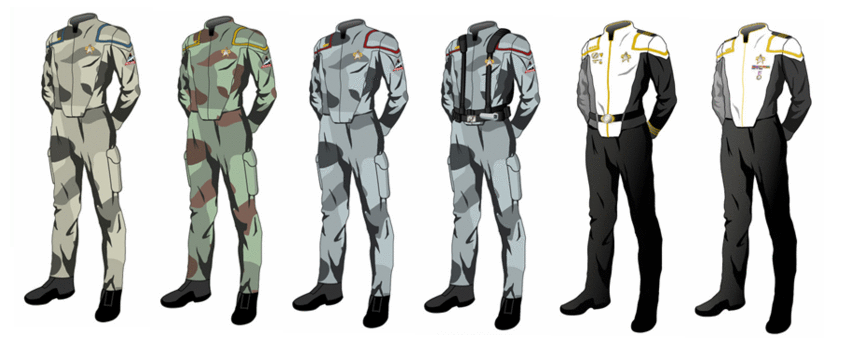
Specially made outfit which doubles as their protective suit. It's woven of durachrome-enhanced metamaterials and because of that the suit actually weighs over 10kg when not worn. The suit is durable enough to withstand certain small arms but that's only one of its function. The uniform is filled with various sensors both to check the surroundings and to monitor the status of the wearer. It's also equipped with an artificial gravity generator which doubles as an inertial compensator. The suit's wearer is cushioned from force and can walk in various gravities. Lastly the suit has an environmental shield to protect against hazardous environment and provide life support even in space.
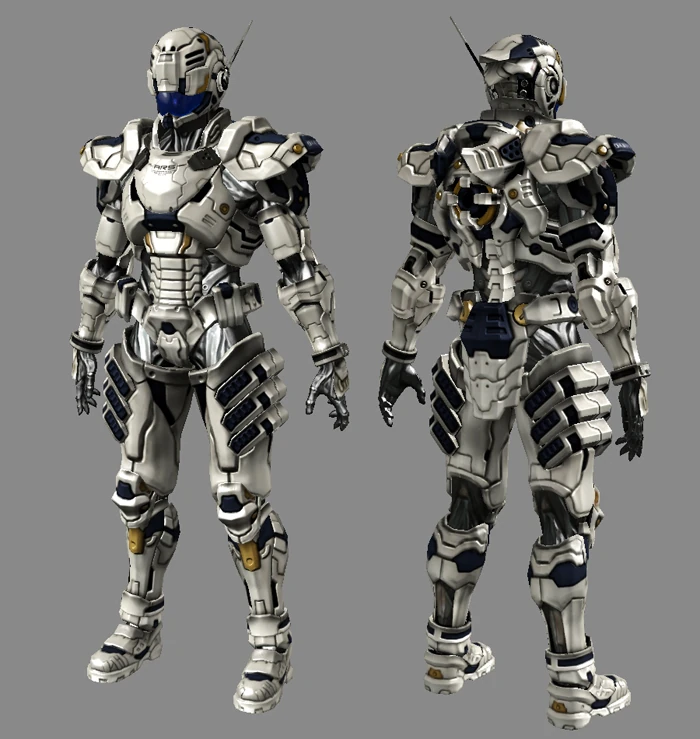
Augmented Reaction Systems Suit is a special equipment worn in the rare high-intensity conflicts. Only those who pass Class III Weapons Test can be allowed to wear ARS Suits and only when receiving the permission of the Captain or higher authority. Unofficially called the "Battlesuit" this compact armored suit is enhanced by inertial fields and gravitic acutators, giving the user massive strength and mobility on par with a land vehicle. For further boost it uses micro impulse engines that can both increase speed and allow the capability of flight. In terms of protection the inner suit is made of nanomesh muscle fibers sufficient against light anti-personnal weapons while the key areas are reinforced by durachrome composite plates. For this reason and other concerns the suit weighs around half a ton without the mass lighteners kicking in. Aside from armor it also sports complex shield system using Higgs shields, Lightwave Barriers and Gravity Deflector technology. It also has active protection systems and limited countermeasures. The suit has a micro Q-Fab/Q-Med for providing ammo, food and life support as well as do emergency operations on the field. The suit has a virtually enhanced interface along with various sensors and computer assistance. ARS Suits turn the otherwise frail Starfleet security personnel into a fighting machine fitting both the role of SWAT and vehicular assault. Starfleet has next to no combat vehicles and instead they rely on their ARS Suits to fill that out.
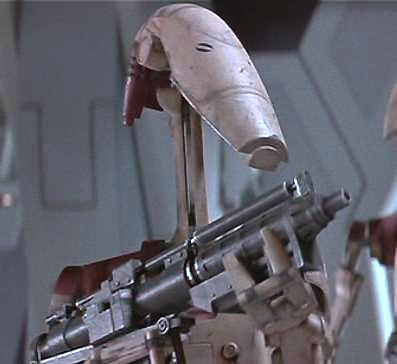
Federation Robotic Intelligence Enabled Normal Drone (FRIEND) is an AI-equipped humanoid machine made to replace human infantry. They are based after the robotic armies from the Last Great War but with at least one major difference, they are bound to the orders of their designated (human) operator. FRIENDs have a rather sophisticated AI to rapidly adapt to various combat and non-combat situations but they are fitted with several restrictions for safety. The presence of human operator is only required for one thing: accountability. Anything the robots do are the responsibility of the operator. Technical specifications wise FRIENDs are built of light composites with only minimal use of Durachrome or similar superheavy materials in order to make them more economical. As a consequence FRIENDs are relatively unprotected albeit being machines they can sustain considerable damage before losing capacity for combat. Physically a FRIEND is stronger and faster than regular humans though nowhere close to the capabilities of the ARS Suits. They have sophisticated sensors and targeting system which can make them dangerously good shots.
@Clockwork giantAnd as usual here a popular NRP theme never truly dies out. roleplayerguild.com/topics/88853-times.. This is a relatively newer steampunk game. I haven't been active there for a while but I think they still accept people.
NS doesn't take one night to do, not by the standards some people here like to keep =P Mine's not finished yet either >.<
With lot of breaks but I am technically working on my NS for over a week now, so I agree. The problem is the lack of "life" in the OOC to maintain the spirits.
Anyways, I made a minor edit. Added some general info about my military and halfway done with the ground forces. I also finished my list of missile types. Space forces must wait a bit because they are going to be much longer.
Where's the chatzy link, again? I can't find it in the OP. EDIT: Paste tense. Duck edited the OP to include it now. EDIT2: Or not. The link is apparently broken. EDIT3: Till it's fixed use Google and search for: Per Aspera Chatzy
Official Name: Das Grösses Mortereich aller Todestern (Gothic Standard), Imperium Magni Morte (High Gothic) Common Name: Morte Imperium, Mortereich, Morte Empire Government: Elected Centralized Totalitarian Monarchy Insignia: A decorated large red "I" symbol with a skull motif in the center. I equates for Imperium meaning the empire in the archaic/ceremonious High Gothic. Political Description: The Mortean government is imperial, formed under necessity during the early centuries to fend off the Luxans. Initially it was a typical monarchic government with the rule of Karl von Metzel and his descendants. However this soon changed and for 800 years now the Kaiser is an elected title which currently only assumed for the length of 2 years. It's possible to get re-elected but no more than 4 times in a row (so a total of 10 years of rule). Since the title is elected technically anyone can become a Kaiser, provided they pass the rigorous selection method for candidates. There's a few days of promotion and campaign and then the candidates get voted on. There are no solid political parties, albeit siding with certain groups may provide benefits at the election. After appointed as the Kaiser he or she has absolute power to do anything for the good of the Empire. Yet the Kaiser is tightly monitored and after 2 years pass he or she is thoroughly evaluated and potentially punished for any misconduct (sometimes even executed). The Empire also have ministers and other political leaders with their own powers and responsibilities. Their conditions are similar to that of the Kaiser but to a lesser extend. In Morte everyone watches the other and ready to report wrongs straight back to the authorities. This complex relation of hierarchy and keen supervision what defines Morte social structure the most. In terms of foreign politics ever since the final defeat of the Luxans it's practically non-existent. Though with the first expeditionary fleet being sent off-world that's soon to be changed.
Home System
System Name: Todestern (also the name of their star) Todestern is a death world located within the Stormlosweg sector. It used to be a plentiful system with a luminous yellow dwarf star. Then the terrible Kilonova Disaster happened. A relativistic neutron star fragment hit their own star, drastically altering it during the process. It changed and shifted adopting a sickly greenish hue while emitting highly dangerous radiation. During this time it also gained a new name, Todestern (literally meaning Death Star). Absorbing the energy of the neutron star fragment Todestern is an unique astronomical body with many strange and highly dangerous properties. Aside from its constant radiation hazard Toderstern is the most notable for its solar winds filled with antimatter.
Inhabited Planet(s): Mortis and Lux are the only habitable planets and just barely (see descriptions)
Homeworld: Mortis Mortis is the 3rd planet of the Todestern system. Before the Kilonova Disaster it was used to be Lieberland, a lush green planet. That was until VR220 (Vor dem Reich 220 - 220 years before the Empire) when a neutron star fragment impacted with their star Leichtstern and changed the fate of the system forever. The gravity of the star suddenly increased, shifting the planet's orbit thus promoting it to the third planet while the star underwent its slow and ugly transformation into Todestern. The planet was now known as Mortis, an irradiated death world with only minimal habitability. Yet the dwellers of this world prevailed and through the use of their technology this planet is the home of most Morteans.
Major System Assets: Todestern Ring Not quite a ring but a system of solar panels and mining bases surrounding their star thus providing much of the Empire's energy need both directly via solar power and indirectly via collecting antimatter from the solar winds. Permanent colonies are established in the Ring for the workforce, infamous for their poor living conditions. Aside from energy production some of the larger solar panels were also re-purposed to power orbital construction sites.
Lux Former homeworld of the Luxans. While situated further from the sun Todestern the fact Luxans made no preventive measures doomed the planet to the same state as Mortis. For centuries after the Kilonova Disaster this planet provided home for the crazed Luxan race. After the third Luxan War the planet turned to Morte custody but the Luxans never lived it down and in a few centuries they became extinct to the Morte's purging. Lux's position further away from Todestern made it safer for agriculture though radiation protection is still necessarily.
Brennenweg One of the two gas giants of the Todestern system and the primary location of the Morte space industry. The planet has a ring system and multiple moons as well as located in the vicinity of the asteroid belt between Lux and Brennenweg. Thanks to its rings Brennenweg can collect decent amount of antimatter which is then utilized for starting up atomic reactors for local use. Brennenweg is responsible for mining raw minerals and the main producer of advanced superdense materials essential for spaceships. Of course it's also the main location of the Morte warship production.
Silberdort A cluster of multiple large colonies established almost at the edge of the system, located at a spot safe from radiation. The original plan was to establish extra habitation for the Empire's growing population. But they soon realized the luxury in free air, decent greenery and the overall leisure of life made possible in Silberdort. Soon the colonies transformed to a place exclusive for the upper class while the rest of the Empire still struggles with overpopulation.
Outer Rim: Todestern like most star systems is surrounded by an asteroid belt. While not as prominent as Brennenweg these asteroids are also mined for minerals. In addition the Outer Rim is important for defense with warning buoys and paroling starships ensuring nobody penetrates the borders.
Racial Information
Species: Mortean Population: ~ 2 billion (overpopulated!) Morphology: Morteans are humanoid creatures with blueish skin, glowing eyes (usually red hue), sharp teeth and slightly pointed ears. They are at average shorter in stature (around 150 cm) due to malnutrition but at times they can grow above 2m in height. Due to the effects of radiation they have an alarmingly high percentage of mutations which is sometimes very visible. Unlike humans the Mortean blood is colored cyan.
Anatomy: Morteans have human-like body makeup but there are considerable differences in their chemical system. Mortean bones are made of various bio-steels, enhancing their durability and tolerance to radiation. Though its not so amazing side effect is that Morteans can get stuck to sufficiently strong magnets. Their sharp teeth are capable of chewing through many things and it isn't impossible for a Morteans to eat raw metals (though not the most nutritious choice for sure). Mortean stomachs are versatile and work by different reactions and this generally applies to their entire system. Toxins that could be lethal to humans may be even considered nutrients. In reverse the Morteans have a number of harmful and deadly toxins specific to their physiology. Biologically the Morteans can live for 200 years but in effect the mutations and awful living conditions reduce the average life expectancy to 40 years. Due to their relatively well-adopted physiology to their environment there's a popular theory that the Morteans were actually engineered this way. Though due to the lack of documentation from the Dark Ages and beyond it's currently impossible to determine.
Brief History
TBA
Cultural Information
TBA
Technological Information
Power generation: - Solar Power: Considerable portion of civilians use solar power mostly gathered from panels surrounding Todestern. This is stored in plasma cell batteries which then be centrally distributed to the population.
- Plasma Engines: Morte's equivalent of internal combustion engines. They use superheated plasma and electromagnetic fields to drive motors or provide power. They are common as emergency generators where nuclear power is not affordable as well as operating vehicles outside the power grid. Many surface military vehicles also use plasma engines.
- Atomic Reactors: Powerplants using various nuclear reactions to provide energy. They are usually catalyzed by the pair annihilation of small amounts of antimatter thus they can effectively use almost anything as fuel.
- Antimatter Reactors: Compact mechanisms using controlled pair annihilation to provide massive power. Antimatter reactors have the best power yield but providing them with sufficient antimatter for long term operation is nigh-impossible. As such they are only used for the most energy-intensive applications within the Empire.
Engineering/Fabrication: Having both time and abundant energy sources the Morte made great progress at the research of nanotechnology and metamaterials. They can alter atoms for special functions, create matter from more exotic particles (other than just electrons, protons and neutron), force matter into different grid structures or even compress either atoms or grids into a denser yet stable state. The simpler processes are long part of the industry while the most exotic means either are rare or only studied in research labs. While this sounds impressive compared to modern material science the Morte are still far from being the masters of the field and depend on the same raw resources as everyone else.
While metamaterials opened up new possibilities industry was truly revolutionized by using nanotechnology. Nano-scale construction improved material quality and combined with the manipulation of electromagnetic waves introduced a whole new industrial method: Nanolathe. By spraying nano-scale particles on an electrical field it's possible to establish a "pattern" after which the constituent materials can be applied on the surface from layer to layer. The whole process can be described as a new and improved form of 3D printing which allows precise and relatively swift fabrication. More importantly nanolathes are versatile and aside from procuring the raw materials a factory line can quickly switch between products. One of the main drawbacks of nanolathes are their energy need which is why they are always located close to an abundant power source. Decent quality fabrication also requires a large area suspended in zero gravity and expensive equipment (though the versatility of nanolathes does compensate a lot).
Starship propulsion STL Propulsion - Magnetoplasmadynamic Drives A family of thrusters utilizing both heat and electromagnetic forces to turn inert propellant into plasma and expel it at great velocity. It's a variable and versatile system which can combine both high thrust and specific impulse. Also referred as Plasma Drives they practically can use almost anything as propellant. For longer treks it's preferable to burn less propellant while raising the exhaust velocity to maximum. For combat maneuvers it's advised to use more and denser propellant to attain higher thrust. The larger and more complex a plasma drive is the higher efficiency it could reach. A sizable portion of the Morte ships are nothing but their propulsion systems alone.
Intrasystem FTL - Foldspace Drive By manipulating and folding spacetime it's possible to cheat special relativity and effectively move the ship at superluminal speeds. Fold Drives are economical and dependable, capable of continuous operation so long the ship doesn't use power on much else. Compared to other races' intrasystem drives Warp is slower and requires the ship to navigate in normal space. The gravitational forces of the Foldwave Bubble(also called warp field) protects the ship from micrometeroid impacts but larger objects may burst the bubble and the fold/warp effect is suddenly gone, returning the ship to its real speed.
Interstellar FTL - Hyperdrive Technology partially built after decoded texts of the ancients. Hyperdrives punch holes in reality to access subspace. They allow quicker and effective travel to interstellar distances but consume massive amounts of energy. That and Hyperdrives are recent inventions which tend to have their own kinks and malfunctions. Considering this and that majority of the Morte fleet is reserved for home defense only a limited amount of warships are currently equipped by Hyperdrives.
Armor: Durachrome is the most popular family of armor materials within the Empire. It's classically created by fusing metal atoms until they reach an "island of stability" as well as compress the grid structure to the densest stable form. The end result is a metallic matter with great strength and density best identified for its brilliant reflection (hence its name). To ease production Durachrome is typically created within the intense pressure and massive gravity of the gas giant Brennenweg which thus became the industrial heart of the Morte Empire. Of course material strength is only one facet how Morte protect their ships as they employ composites, complex structures and patterns designed to better resist attacks. Morte use their armors as the chief form of defense and it often makes up 30-50% the mass of warships.
Shielding: Panzerbereich A shielding which uses electromagnetic fields to suspend and rapidly circulate fine metallic nanoparticles for protection. This sphere of particles is generally raised at a standoff distance, roughly around 10 times the ship's length in radius. Panzerbereich are chiefly used as radiation protection as well as converter to channel the trapped surplus energies back to the ship's reserves. During space combat its main purpose is to serve as light standoff protection. It can disperse energy weapons, break fragile kinetic penetrators or pre-detonate thinly skinned missiles. Of course the Empire's ships can't shoot through the shields without the same disadvantages either thus they momentarily open holes in the field to send out signals, attacks or launch fighters. The rate of making these holes and closing them is exponentially longer with size. Thus opening tiny holes for comm signals or radar scans may take an instant, holes for weapons to fire through can take few moments but to open a hole for the fighter bay and then closing it might take a considerable time which makes them the most vulnerable.
Sensors: - Standard sensors: A category used to describe typical slower than light sensing and detection equipment like radars, telescopes and so on.
- Hypersensors: A category of superluminal forms of sensing and detection. They are typically active detection like foldspace radars but there are tachyon imagery methods which passively gathers background tachyonic shadows of objects. Tachyonic sensors are crude and require digital enhancement by combining it with other sensory data to be more reliable.
Communications: Foldwave radio is a superluminal communication method replacing nearly all standard methods. They are fast, precise and more resistant to interference. Quantum Link is an older superluminal mechanism which was used to disprove past skepticism about faster than light travel. It uses quantum entanglement to resonate between two attuned devices thus effectively achieve instant communication regardless of the distance. While it has considerable potential they can be only used between two matching pairs of communicators specifically created that way.
Computation: Quantum computing is widely utilized in Morte systems. Unlike semiconductor type deterministic computers a quantum computer works by probability and uses various quantum mechanisms. Quantum computers store data in qubits and these systems are inherently not compatible with normal computers. Quantum computers don't inherently offer greater computation speed but their mechanics allow mathematical formulas which speed up probability calculations massively. You could say that quantum computers are made for quantum mechanics, a field of science important to understand particles and nanotechnology. Military-grade quantum computers operate at extreme temperatures and use warp fields to minimize quantum decoherence. This allows them to operate at much higher performance in return for considerable power drain. In addition when a military grade quantum power loses power or has a warp field malfunction it instantly turns toast. To prevent the worst case scenario starships also have backup systems storing most data in case of emergencies.
Weapons: - Plasma Railguns: Railgun systems that use plasma armature to electromagnetically launch matter at hypervelocity. Plasma armatures don't degrade from the strain and recycle the waste heat back into the power reserves. Plasma Railguns can either shoot solid projectiles or small packets of matter at far greater velocities (thus behaving like energy weapons).
- PPE: Pressed Particle Emitter. Not quite an unique weapon but a mechanism. It accelerates tiny amounts of flash-compressed matter in an extremely thin stream of great density. Since the particle mix is unstable it violently explodes but before that it will likely penetrate the hull. The effectiveness of the PPE degrades with range thus they are most commonly used at shorter distances.
- Missiles, Torpedoes: Best interpreted as AI/telemetry guided tiny spacecraft these weapons are used for long range warhead delivery. Depending on their design and loadout they can fill out many roles. Missiles are usually described as the smaller type used for long range interception or light ordnance unleashed en-masse. Torpedoes are much larger and generally fielded against enemy warships. Torpedo launchers are classically found at the front since they tend to be shot via electromagnetic catapults to give them a speed boost.
- Plasma Warhead: The equivalent of conventional warheads in Morte. Essentially they're weaponized plasma cells that violently burst when triggered though the exact mechanics are more complicated. Plasma warheads are inherently dense with electromagnetic fields and manipulating this could alter the shape of the explosion to fit more specialized purposes. In addition the charged plasma naturally acts like EMP, knocking out any insufficiently reinforced electronics. While versatile plasma warheads are much less energetic than nuclear missiles and many strategists feel they're redundant compared to the raw kinetic energy of missiles.
- Atomic Warhead: Compact nuclear devices commonly used for long range ordnance. They can use various types of fusion and fission alike depending on which design fits the purpose the best. The most popular type splits superdense radioactive metamaterials for massive power.
- Antimatter Warhead: While nuclear reactors can be catalyzed by antimatter this kind of warhead relies entirely on the pair annihilation of matter-antimatter for destructive effects. They are undoubtedly powerful but nowadays Morte considers them a waste of strategic materials since Atomic Warheads can reach yields close to the same level. As such pure antimatter warheads are rare though not completely unheard of within the Empire.
- Lancer Warhead: By shaping the power of atomic reactions it's possible to unleash a relatively coherent "lance" of extreme velocity plasma to attack reinforced targets. They're the atomic equivalent of shaped charges and have the best effect on direct hit as the cone of plasma jet loses intensity with range.
- Jaeger Warhead: A refinement over the Lancers, Jaeger warheads are using reduced charge for a more controlled emission and an AI that aids targeting the beam. Jaegers are essentially nukes that shoot energy beams at the target from relatively long distance. For the sake of better control and size restrictions they are less powerful than Lancers while also considerably more difficult to make but their versatility should not be underestimated.
- Kinetic Warhead: The simplest form of space missile, it's nothing but propulsion with a superdense penetrator core at the front.
- Multi-kinetic Warhead: Missiles that carry multiple kinetic penetrators and disperse them in well-calculated pattern prior to impact. Sometimes the sub-munitions also have guidance and limited propulsion to assist them finding targets. Other times the warhead is nothing but the void combat equivalent of a canister shot.
- Beehive Warhead: When canister shots are put to the logical extreme. Beehive Warheads are a deceivingly sophisticated weapon which uses countless micron-sized balls of superdense metamaterials precisely positioned by an electromagnetic field emitted from the center of the device. The result is a deadly "wall" of trillions of hypervelocity micropellets usually spread exactly a centimeter from each other spread in a circular area with dozens of kilometers in diameter. Beehive warheads are excessively used for long range interception and they can be dangerous to anything not sufficiently protected.
Military Information
General Description: With almost a thousand years of constant warfare with outside aggressors Morte became a militaristic nation where soldiering is part of every citizen's duty. Just prior to reaching adulthood all Morteans regardless of gender receive combat training and discipline. The best of the trainees are offered to become part of the regular military which, given the overall better living conditions of soldiers, is an offer not many refuses. Even after the training adult Morteans are obliged to periodically refresh their soldiering skills and accept to be drafted in a moment of notice. This kind of social structure aided Morte to eventually triumph over their technically superior enemy, very much drowning them in numbers. On the other hand having a hundred years without war the Morte civilization faces the greatest crisis since their foundation: Peace and prosperous growth.
Space Forces: The Mortenkriegsflotte is the most important part of the military. Their task is to secure the Empire's borders and fend off foreign invaders. With centuries of war history and conflicts with aliens the Morte amassed considerable experience at space warfare. Their starships are built armored and tough, designed to survive more than a few penetrating hits. On the other hand Morte ships are relatively small to allow them to manufacture even more of them. The preferred Morte fleet tactic is massed long ranged fire and thus their main cannons are fixed at the front.
Ship Categories - Small Craft:Fighters and such space vehicles. They are agile and small, perhaps even too small because they lack a viable FTL drive.
- Escort: Demi-warships often just large enough to carry an FTL drive and guns enough to be considered a threat. They are lightly armored but numerous compared to warships.
- Warship: The backbone of the Mortenkriegsflotte
- Capital Ships: The largest warships which are often equipped with nanolathes and other equipment to better support the fleet. Their extra capabilities increase the versatility of a fleet considerably.
Ship Classes - Fighters: Small space vessels usually consisting little more than a cockpit with guns strapped to the engines. They are swift and also light enough to be employed in surface combat. Their chief roles in space are interception though they can have some anti-ship capabilities.
- Gunships: Little brother of the destroyers these vessels are armed to teeth while being small enough to be loaded into carriers. Their role is bombardment and attacking warships.
- Corvette: Usually the smallest kind of Escort, they are lightly equipped but at least capable of FTL travel.
- Destroyer: Escort ships equipped with anti-ship weapons and essentially used as force multipliers. Destroyer is less of a fix class and more like a design philosophy with Heavy Destroyers actually counting as warships.
- Frigate: Usually the smallest type of warships, frigates are less heavily built than the rest of their peers. Compared to other ships their STL/FTL speed is superior but at the expense of protection and firepower. Perhaps exactly because of this the century of peacetime saw renewed interest in them and most innovations and new ship classes were frigates.
- Cruiser: The standard warship they are mid class in weight and the workhorse of the fleet.
- Battleship: Heavily armed and armored ship designed for more demanding roles.
- Carrier: Large warships designed for carrying as many small craft as possible. Their variants fickle between the size of warships and capital ships.
- Dreadnought: The largest type of warships which deserve to be referred as capital ships. They tend to use more experimental technology, both for its good and bad.
Ground Forces: Most of the Empire's wars were fought in space which means they put relatively less emphasis on ground forces. Many equipment used in surface battles are over a hundred years old. Vehicles are relatively small in number. Infantry due to their usefulness for boarding actions saw the most improvements in the history of the Empire. There isn't a single adult in Morte who didn't serve in the infantry for at least a short while. Currently at "peacetime" the size of the ground military is limited to 2.5 million but this number can steadily climb during wartime. On the other hand the Morte has limited experience at planetary warfare (mostly involving the Luxan Wars from centuries ago) and their training mostly composes of policing, ship boarding an the basic army drill.
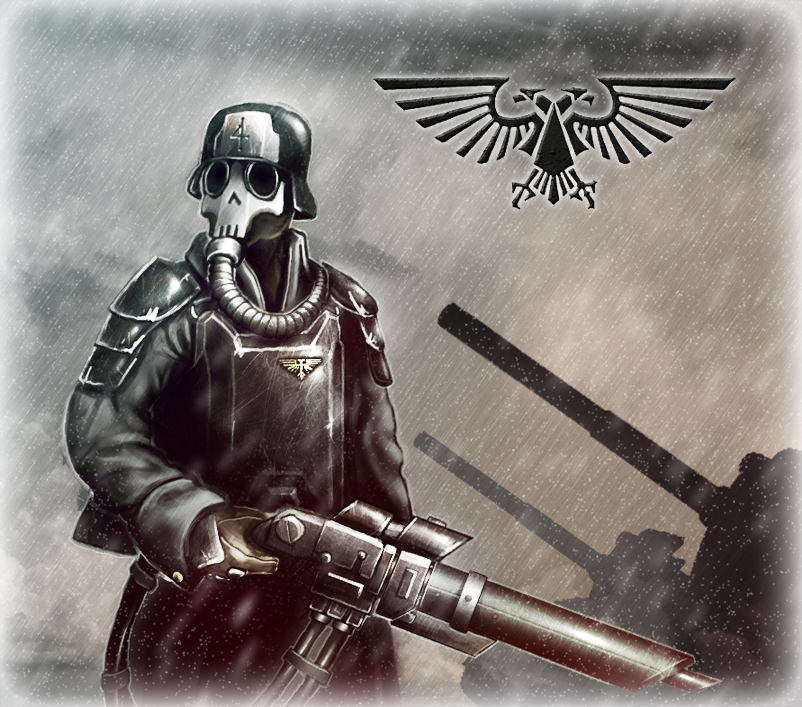
The common foot soldier serving within the Empire. They wear nanofiber mesh suits which provides minimal protection and acts as an external layer of artificial muscles for small but notable assistance. This is reinforced by plates of durachrome layered with other elements to provide passable protection against futuristic small arms or the odd hypervelocity shrapnel. Morte suits are environmentally sealed and provide safety in hazardous areas. Their most common armament are PASER Rifles and plasma grenades. Against more protected targets they generally use missile launchers and portable PPEs.
Positron Accretion Stimulated by Electromagnetic Radiation. It's an old kind of weapon mechanism Morte utilized to arm their ships with in the past. While wasting antimatter is no longer a viable option at ship-to-ship warfare a refined version of this technology found application within the line infantry of all things. It shoots nanograms of positron jacketed in metaparticles neutral to it and shoot out via electromagnets like a particle accelerator. As the thin particle "shell" penetrate the target the positrons react with normal matter thus producing an explosion akin to a small grenade (not to mention spreading EM radiation). Preparing the "particle shell" takes some time (for safety reasons) thus the PASER Rifle is limited to semi-automatic rate of fire. To avoid a lucky shot to the AM storage leading to catastrophic results the antimatter is kept in metaparticle form and only converted prior to assembling the "particle shell" in the chamber. PASERS consume a surprisingly low amount of energy per shot and reliable enough that a soldier can use it for the entire length of battle without any maintenance or recharge. On the other hand once the enemy understands the nature of the PASER they are relatively simple to deal with. Either shields or sufficiently thick layer of exotic material which lacks electrons would render the PASER into just a highly focused low energy particle rifle which only leaves a microscopic wound channel. The good in the bad that Morte ship interiors are specially prepared thus PASERs are pretty much safe to use within.
.
TBA
TBA
Notable Fleets: TBA
Ancient Relics Owned
None yet. The Morte system only contained a chache of ancient records which they used to decode some of the language (thus they speak the common tongue... or at least their archeologists do).
 Member

 salamimike,
ivoryrolland95,
salamimike,
ivoryrolland95,
 Durandals