

SR:SDG v1.1

Shadows of Dead Gods
::::::::::::::::::::::::::::::::::::::::::::::::::::::::::::::::::::::
CONNECTING TO JACKPOINT VPN...
...IDENTITY SPOOFED
...ENCRYPTION KEYS GENERATED
...CONNECTED TO ONION ROUTERS
::::::::::::::::::::::::::::::::::::::::::::::::::::::::::::::::::::::
:>LOGIN
:>ENTER PASSCODE
__________
...BIOMETRIC SCAN CONFIRMED
CONNECTED TO <ERROR: NODE UNKNOWN>
::::::::::::::::::::::::::::::::::::::::::::::::::::::::::::::::::::::::::::::::::::::::::::::::::::::::::
"It seems like every other Wednesday there's some drek coming down the pipe that spells the end of the world as we know it. Why can't we ever just have a normal every other Wednesday? One day, every other Wednesday, I just wanna sleep in and snuggle my cat. Is that too much to ask for?"
- Brick, Seattle Shadowrunner
::::::::::::::::::::::::::::::::::::::::::::::::::::::::::::::::::::::::::::::::::::::::::::::::::::::::::
Welcome back to JackPoint, chummer; your last connection was severed 34 hours, 42 minutes, 16 seconds ago
TODAY'S HEADS-UP
"I hear Silk has been in a bit of a mood lately. Someone snubbed her a whole lotta cash. Just a head's up, chummers, she might be in the business of making new business partners."
- Styx
::::::::::::::::::::::::::::::::::::::::::::::::::::::::::::::::::::::::::::::::::::::::::::::::::::::::::
INCOMING
:>>> Word through the grapevine is that KFC was responsible for poisoning their competitor's chicken populations. Might be a good idea to look at the stock trade situation soon.
:>>> Police are cracking down on the Tacoma combat street races that have been out of control for the past four months. Watch your speed out there, chummers.
:>>> Someone let it slip that the Halloweeners got themselves a fraggin' huge stockpile of Panacea. Would be a shame if someone took it.
::::::::::::::::::::::::::::::::::::::::::::::::::::::::::::::::::::::::::::::::::::::::::::::::::::::::::
TOP NEWS ITEMS
:>>> Kimiko Hatsunada, spokeswoman for Renraku Seattle, announced a hot new gene-therapy process they're dubbing 'HELIX' is almost ready for commercial availability. Human trials have been safely conducted, and some millionaire clients are already receiving the treatment in private. Kimiko stated that HELIX will be available to all in the new year. When questioned about the safety of the process following the disastrous Vortex project, Kimiko vowed that HELIX will not follow in the same path as Vortex, and that the megacorporation is done meddling with quote 'things we cannot hope to ever understand'. Her comment was met with healthy skepticism.
:>>> A strange fungal outbreak in Aztlan has some Aztechnology officials concerned about public health. Citizens are being urged to avoid fungal growths as preliminary tests have revealed a mutant strain of HMHVV is present in the fungus. Fears of a new VITAS outbreak stir, and the CAS has begun bolstering its southern border with increased patrols and thorough, no exceptions searches.
:>>> Tensions are escalating in Antarctica after a major Orichalcum vein was discovered during a survey. Saeder-Krupp and the UCAS have both staked their claim, and Ares Macrotechnology has publicly supported the UCAS claim over the resource. In a rare public showing, Lofwyr has stated that he's 'always known the vein was there, as it was always his since before mankind ever stepped foot on the ice'.
::::::::::::::::::::::::::::::::::::::::::::::::::::::::::::::::::::::::::::::::::::::::::::::::::::::::::
JACKPOINT STATS
87 Users are active on the network.
LATEST NEWS
Monad colony ship arrives in orbit over Mars for final resupply before departing for its next stop at the Jovian Deep Space habitat around Jupiter.
PERSONAL ALERTS
:>>> You have 1 new private message.
:>>> You have 15 new responses to your JackPoint posts.
:>>> Your subscription to 'Elven Muscle Mommies' will renew in three days.
There are three other Members online and in your area.
YOUR CURRENT REP SCORE: 728 (69% Positive)
CURRENT TIME: 15 April 2086, 1346 hrs
::::::::::::::::::::::::::::::::::::::::::::::::::::::::::::::::::::::
First and foremost, thank you for showing interest in this RP! I am aware that 6th edition is not the most beloved of SR's editions as it had a very bad launch. However, the system has mostly been stabilized thanks to the continuous release of books and updates to the core book. So much so that I think it is a totally fine system to run nowadays. I have played enough SR6 across several campaigns as both a GM and a player that I am very comfortable GMing this campaign for you!
As you may or may not already know, Shadowrun has notoriously been a very crunchy game with layers upon layers of mechanics and depth. SR6, while easily the most newcomer friendly edition, is still a very deep and crunchy game with lots of rules and lots of things to consider. It is okay to not know it all. Hell, there are things I am still learning and I have regularly been playing SR6 for a few years at this point. And that is okay. As a GM, I value good roleplay and enthusiastic interaction over hard rules adherence almost every time. If something is just awesome, even if the rules don't overly support something, I'll try to make it work so long as it doesn't break things or undermine what is trying to be accomplished in the narrative.
The next few sections on this page will be some basic walkthroughs on how to interact with the system, namely core game concepts, how dice rolls work in SR6 and character creation so that you can understand the basics and learn the rest as you go. I will also include a simple codex on commonly known terms within the Shadowrun universe that your characters simply ought to know as denizens of its varied societies.
When I cite rules or gear, I will share a reference to those rules and items in the PDFs that I will give access to so you can look and read up on those things yourselves. Just know that when I say 'SR6', I am referring to the Core Rulebook (Berlin Edition).
Finally, this campaign will take place in the same continuity that every other campaign I've run and been a part of in, and so I will explain the major points that would be known to the public and to the runners connected to Shadowland. Your actions and involvement in this particular campaign will have ripples in other Shadowrun campaigns I am running IRL and online through other platforms, and you may wind up doing things (often times without knowing) that are a consequence of something that happened in another group's campaign. Your team is simply one of many operating concurrently on their own problems and jobs.
I hope you all enjoy what I aim to bring to you!
As you may or may not already know, Shadowrun has notoriously been a very crunchy game with layers upon layers of mechanics and depth. SR6, while easily the most newcomer friendly edition, is still a very deep and crunchy game with lots of rules and lots of things to consider. It is okay to not know it all. Hell, there are things I am still learning and I have regularly been playing SR6 for a few years at this point. And that is okay. As a GM, I value good roleplay and enthusiastic interaction over hard rules adherence almost every time. If something is just awesome, even if the rules don't overly support something, I'll try to make it work so long as it doesn't break things or undermine what is trying to be accomplished in the narrative.
The next few sections on this page will be some basic walkthroughs on how to interact with the system, namely core game concepts, how dice rolls work in SR6 and character creation so that you can understand the basics and learn the rest as you go. I will also include a simple codex on commonly known terms within the Shadowrun universe that your characters simply ought to know as denizens of its varied societies.
When I cite rules or gear, I will share a reference to those rules and items in the PDFs that I will give access to so you can look and read up on those things yourselves. Just know that when I say 'SR6', I am referring to the Core Rulebook (Berlin Edition).
Finally, this campaign will take place in the same continuity that every other campaign I've run and been a part of in, and so I will explain the major points that would be known to the public and to the runners connected to Shadowland. Your actions and involvement in this particular campaign will have ripples in other Shadowrun campaigns I am running IRL and online through other platforms, and you may wind up doing things (often times without knowing) that are a consequence of something that happened in another group's campaign. Your team is simply one of many operating concurrently on their own problems and jobs.
I hope you all enjoy what I aim to bring to you!
Game Information and Resources
Core Concepts
This is a simplified overview of how Shadowrun 6th Edition works. It is designed to get you playing quickly.
For full rules and deeper mechanics, refer to the provided PDFs. There are some Houserules and Optional Rules in effect that I will denote with colored text. Houserules will be specified in Green text, and Optional Rules will be specified in Blue text. There is a 'Rules in Effect' section that is a consolidated section of all the Houserules and Optional Rules in effect as well for more concise reference.
For the full system rules, you can find them throughout the Core SR6 rulebook. Page references have been added to everything in this section to help you locate them in the PDFs. All page references are accompanied by a tag (ex. [SR6]). These tags denote which book the rule is drawn from. A full list of the tags can be found in the 'Shadowrun Book Archive' section.
Dice Pools
Ref: pg. 35-36 [SR6]
Most actions in Shadowrun are resolved by rolling a number of six-sided dice (d6).
Dice Pool = Parent Attribute + Skill
Add any additional dice pool modifiers to a pool if they apply, such as specializations, bonuses/penalties, gear modifiers, etc...
Example:
Shooting an Ares Predator Heavy Pistol
Agility (4) + Firearms (3) + Heavy Pistol Specialization (2) = 9 dice rolled
Edge
Ref: pg. 44-48 [SR6]
When acting in opposition to someone (or something) compare your relevant rating to your opposition. Traditionally, this is Attack Ratings and Defense Ratings, though Social Ratings, Device Ratings, and other ratings might apply in certain contexts. The GM will inform you when other ratings apply.
In the case of a simple attack, you compare your Attack Rating to your target's Defense Rating. If the Attack Rating is 4 or more higher than the Defense Rating, the attacker gains a point of Edge. When the Defense Rating is 4 or more higher than the Attack Rating, the defender gains a point of Edge.
Edge can also be gained for good roleplay, advantageous positioning, thorough planning, and anything else that the GM decides is worth a reward in Edge. As this is a forum based campaign, and sessions are not a thing, all Edge will be refilled to your character's maximum at the beginning of a new chapter in the story.
Edge Boosts are instant effects that usually influence the outcome of dice rolls, they can be found on pg. 46-47 [SR6]. Edge Actions are usually modifiers to how an action is carried out, such as targeting a specific limb or laying on some extra drama in a social encounter. Plenty of expansion books bring their own collection of additional thematic Edge Actions. Be sure to check out the ones most relevant to your character's playstyle. The core set of Edge Actions can be found on pg. 47-48 [SR6].
[HOUSERULE] Edge can be spent on Edge Boosts before or after a dice roll (with GM approval) to encourage more active use of Edge and prevent players from banking this resource for a situation that might never come. Edge Actions must still only be used when applicable.
[HOUSERULE] In standard SR6, there are limitations to how much Edge can be gained in a turn which makes it a resource that has a bottleneck on generating. Since Edge is so important in SR6, one of the biggest problems in its system is that this critical resource is simply not plentiful enough to be used as much as the system wants it to be. To compensate for this, the maximum amount of Edge a player can gain PER TURN is doubled from 2 to 4. Additionally, Edge can be gained off of Attack/Defense Ratings multiple times for every incremental difference of 4 points. For example, if your Attack Rating was 8 higher than a target's Defense Rating, you would generate 2 Edge.
Rolling Dice & Skill Tests
Ref: pg. 35-36 [SR6]
Each die that rolls a 5 or 6 is a Hit.
The number of Hits determines success. If more Hits are rolled than the difficulty threshold, the difference is known as 'Net Hits'. In all types of tests, a tie favors the attacker, or the one initiating the test, unless stated otherwise.
Wild Dice are special dice that get added to a dice pool (or sometimes replace a die in the dice pool). Wild Dice roll the same as a normal d6, however they come with some extra caveats. On a roll of a 5 nothing happens, and the Wild Die counts as a Hit. On a roll of a 6, the Wild Die counts as having scored 3 Hits! On a roll of a 1, all your Hits that are 5s no longer count!
There are four common types of tests:
Simple Test: You must meet or exceed a set difficulty threshold of Hits as dictated by the GM.
Opposed Test: You roll against another character's test. The difficulty threshold is the opposition's Hits scored.
Extended Test: A continuous skill test that takes place over a specified interval of time. Each roll in an extended test counts for 1 time interval. Every subsequent test incurs -1 dice pool penalty. If an extended test's difficulty threshold is matched or exceeded, the test is successful. If the character's dice pool is reduced to 0 over the course of an extended test, the test is failed. The total amount of time spent after the test (regardless of a success or a failure) is the Interval x The Amount of Tests taken.
Teamwork Test: One character performs the main action as the leader. The other characters taking part in a teamwork test as helpers will roll first using the same skill test as the leader. Each hit scored by every helper adds +1 die to the leader's dice pool. This dice pool bonus cannot exceed the leader's skill rating.
Buying Hits is always an option you can choose BEFORE rolling for a test. If you decide to buy Hits, it is ALL OR NOTHING. You cannot buy SOME Hits and roll for the rest, you must commit your entire dice pool to this. You can buy Hits by converting 4 dice automatically into 1 Hit. Edge may not be spent if you choose to buy Hits, and the GM may choose to not allow the option to buy Hits for that test.
You may try again to perform a failed test so long as there is no immediate danger. But there is a caveat to this. If nothing has been done to improve your circumstances, immediately retrying a failed test will result in a -2 dice pool penalty. This penalty will stack if the test is repeatedly failed and subsequently retried.
Glitches
Ref: pg. 44 [SR6]
If half or more of your dice roll 1s in a test, you Glitch and something goes wrong. If half or more of your dice roll 1s in a test AND none of them are Hits, then you Critical Glitch.
Glitch: You succeed, but with a complication. For example, your gun jams while shooting, or you drop something during a stealth test.
Critical Glitch: You fail entirely, and something catastrophic happens. For example, your gun explodes in your hands, or your attempt at stealth ended with the alarm being triggered.
Initiative and the Turn Order
Ref: pg. 39 [SR6]
Initiative determines who acts first in combat. Determining your initiative is twofold. First, you find your Initiative Score as seen below:
Initiative = Reaction + Intuition
Then you roll a die for each Initiative Dice your character has, which is 1 die by default. Initiative Dice do not use Hits like in a skill test. Simply add up the total from all of your Initiative Dice and add it to your Initiative Score. That new total is your Initiative for combat. The higher the Initiative, the sooner you act in the turn order.
A full turn takes place over the span of 3 seconds.
By default, all characters have 1 Major Action and 1 Minor Action. However, you also gain a bonus Minor Action for every Initiative Dice your character has, and since all characters have 1 Initiative Die by default, all characters will inherently have 2 Minor Actions at a minimum. This means if you manage to get more Initiative Dice for your character from cyberware or some other method, you also get additional Minor Actions too. You cannot have more than 5 Minor Actions per turn.
Actions
Ref: pg. 40-44 [SR6]
There is a large amount of actions that you can take, some of which can only be performed in specific contexts. Edge Actions are also used to modify those actions. You can find the full list of Actions on pg. 40-44 [SR6].
Major Actions: Attacking, casting spells, hacking, etc.
Minor Actions: Moving, aiming, taking cover, drawing weapons, talking for more than 3 seconds.
You can trade 4 Minor Actions for 1 Major Action in a turn.
Damage, Condition Monitors, and Soak
Ref: pg. 38 [SR6]
There are two types of damage that attacks can deal: Physical and Stun damage. This is noted by the uppercase letter in a weapon or attack's Damage Value (DV). For example, an Ares Predator VI's DV is 3P. That means it is potentially dealing 3 damage to the target's Physical Monitor before Damage Soak reduction.
Characters track damage using two condition monitors for either damage type. Regardless of the type, the layout and principles are the same.
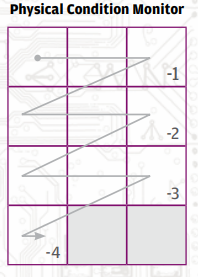
The amount of boxes a character's Physical Monitor has is determined using this formula: 8 + (Body/2 [rounded up])
The amount of boxes a character's Stun Monitor has is determined using this formula: 8 + (Willpower/2 [rounded up])
Note that some Qualities (like Built Tough), full cyberlimbs, and other factors increase or decrease the amount of boxes your character could have in their monitors.
For every full row that is filled on either monitor, the character suffers a stacking -1 dice pool penalty, resembling the strain from injuries the character is sustaining. If the Stun monitor is filled, the character is rendered unconscious, and further Stun damage becomes Physical. If the Physical monitor is filled, the character is rendered unconscious and goes into Overflow, risking death. If Overflow matches or exceeds twice your character's Body they are dead and gone forever.
[OPTIONAL RULE IN EFFECT] For every 8 Defense Rating your character has, 1 Physical Damage is converted to 1 Stun Damage. Additionally, you gain a +1 modifier to your Soak Dice Pool for every 8 Defense Rating your character has.
When your character receives damage from an attack, they then need to roll to Soak Damage. Every Hit in a Soak roll reduces the incoming damage by 1. To determine how many dice you have for Soak, use your Body Attribute. Account for any augmentations (like Bone Lacing), Qualities, Defense Rating protection, or other bonuses that might increase your Soak dice pool. A Soak roll is not affected by injuries on your character's condition monitors. You get the full dice pool unless the GM says otherwise. After rolling Soak, the remaining damage is applied to your character's Condition Monitor.
Healing damage depends on the type of damage that is being healed. For the full rules of Healing, refer to pg. 119-121 [SR6]. For this section, we will cover Natural Healing/Medical Assistance. Rest is the key factor to naturally healing any damage in either Condition Monitor. Anything that involves a dice roll is considered breaking Rest. If any person trained in the Biotech skill is caring for the injured character for at least half of their rest period, the injured character gains a +2 dice pool modifier when making their Healing test. Naturally recovering from Stun Damage is faster than recovering from Physical Damage. Healing tests are not affected by injuries on your character's condition monitors.
To heal Stun Damage, roll Body + Willpower once per hour.
To heal Physical Damage, roll Body + Body once per day.
Regardless of which damage type is being healed, each hit on a Healing test will recover 1 box of damage to the Monitor being healed. There are more immediate means of healing, either through magic or technology, but those are covered fully in SR6.
Final Note
This section covers only the basics needed to start playing. Shadowrun is a deep system, and if you want to explore further, the PDFs contain much more detail. If you have any questions about rules or where to find them, feel free to ask the GM.
This is a simplified overview of how Shadowrun 6th Edition works. It is designed to get you playing quickly.
For full rules and deeper mechanics, refer to the provided PDFs. There are some Houserules and Optional Rules in effect that I will denote with colored text. Houserules will be specified in Green text, and Optional Rules will be specified in Blue text. There is a 'Rules in Effect' section that is a consolidated section of all the Houserules and Optional Rules in effect as well for more concise reference.
For the full system rules, you can find them throughout the Core SR6 rulebook. Page references have been added to everything in this section to help you locate them in the PDFs. All page references are accompanied by a tag (ex. [SR6]). These tags denote which book the rule is drawn from. A full list of the tags can be found in the 'Shadowrun Book Archive' section.
Dice Pools
Ref: pg. 35-36 [SR6]
Most actions in Shadowrun are resolved by rolling a number of six-sided dice (d6).
Dice Pool = Parent Attribute + Skill
Add any additional dice pool modifiers to a pool if they apply, such as specializations, bonuses/penalties, gear modifiers, etc...
Example:
Shooting an Ares Predator Heavy Pistol
Agility (4) + Firearms (3) + Heavy Pistol Specialization (2) = 9 dice rolled
Edge
Ref: pg. 44-48 [SR6]
When acting in opposition to someone (or something) compare your relevant rating to your opposition. Traditionally, this is Attack Ratings and Defense Ratings, though Social Ratings, Device Ratings, and other ratings might apply in certain contexts. The GM will inform you when other ratings apply.
In the case of a simple attack, you compare your Attack Rating to your target's Defense Rating. If the Attack Rating is 4 or more higher than the Defense Rating, the attacker gains a point of Edge. When the Defense Rating is 4 or more higher than the Attack Rating, the defender gains a point of Edge.
Edge can also be gained for good roleplay, advantageous positioning, thorough planning, and anything else that the GM decides is worth a reward in Edge. As this is a forum based campaign, and sessions are not a thing, all Edge will be refilled to your character's maximum at the beginning of a new chapter in the story.
Edge Boosts are instant effects that usually influence the outcome of dice rolls, they can be found on pg. 46-47 [SR6]. Edge Actions are usually modifiers to how an action is carried out, such as targeting a specific limb or laying on some extra drama in a social encounter. Plenty of expansion books bring their own collection of additional thematic Edge Actions. Be sure to check out the ones most relevant to your character's playstyle. The core set of Edge Actions can be found on pg. 47-48 [SR6].
[HOUSERULE] Edge can be spent on Edge Boosts before or after a dice roll (with GM approval) to encourage more active use of Edge and prevent players from banking this resource for a situation that might never come. Edge Actions must still only be used when applicable.
[HOUSERULE] In standard SR6, there are limitations to how much Edge can be gained in a turn which makes it a resource that has a bottleneck on generating. Since Edge is so important in SR6, one of the biggest problems in its system is that this critical resource is simply not plentiful enough to be used as much as the system wants it to be. To compensate for this, the maximum amount of Edge a player can gain PER TURN is doubled from 2 to 4. Additionally, Edge can be gained off of Attack/Defense Ratings multiple times for every incremental difference of 4 points. For example, if your Attack Rating was 8 higher than a target's Defense Rating, you would generate 2 Edge.
Rolling Dice & Skill Tests
Ref: pg. 35-36 [SR6]
Each die that rolls a 5 or 6 is a Hit.
The number of Hits determines success. If more Hits are rolled than the difficulty threshold, the difference is known as 'Net Hits'. In all types of tests, a tie favors the attacker, or the one initiating the test, unless stated otherwise.
Wild Dice are special dice that get added to a dice pool (or sometimes replace a die in the dice pool). Wild Dice roll the same as a normal d6, however they come with some extra caveats. On a roll of a 5 nothing happens, and the Wild Die counts as a Hit. On a roll of a 6, the Wild Die counts as having scored 3 Hits! On a roll of a 1, all your Hits that are 5s no longer count!
There are four common types of tests:
Simple Test: You must meet or exceed a set difficulty threshold of Hits as dictated by the GM.
Opposed Test: You roll against another character's test. The difficulty threshold is the opposition's Hits scored.
Extended Test: A continuous skill test that takes place over a specified interval of time. Each roll in an extended test counts for 1 time interval. Every subsequent test incurs -1 dice pool penalty. If an extended test's difficulty threshold is matched or exceeded, the test is successful. If the character's dice pool is reduced to 0 over the course of an extended test, the test is failed. The total amount of time spent after the test (regardless of a success or a failure) is the Interval x The Amount of Tests taken.
Teamwork Test: One character performs the main action as the leader. The other characters taking part in a teamwork test as helpers will roll first using the same skill test as the leader. Each hit scored by every helper adds +1 die to the leader's dice pool. This dice pool bonus cannot exceed the leader's skill rating.
Buying Hits is always an option you can choose BEFORE rolling for a test. If you decide to buy Hits, it is ALL OR NOTHING. You cannot buy SOME Hits and roll for the rest, you must commit your entire dice pool to this. You can buy Hits by converting 4 dice automatically into 1 Hit. Edge may not be spent if you choose to buy Hits, and the GM may choose to not allow the option to buy Hits for that test.
You may try again to perform a failed test so long as there is no immediate danger. But there is a caveat to this. If nothing has been done to improve your circumstances, immediately retrying a failed test will result in a -2 dice pool penalty. This penalty will stack if the test is repeatedly failed and subsequently retried.
Glitches
Ref: pg. 44 [SR6]
If half or more of your dice roll 1s in a test, you Glitch and something goes wrong. If half or more of your dice roll 1s in a test AND none of them are Hits, then you Critical Glitch.
Glitch: You succeed, but with a complication. For example, your gun jams while shooting, or you drop something during a stealth test.
Critical Glitch: You fail entirely, and something catastrophic happens. For example, your gun explodes in your hands, or your attempt at stealth ended with the alarm being triggered.
Initiative and the Turn Order
Ref: pg. 39 [SR6]
Initiative determines who acts first in combat. Determining your initiative is twofold. First, you find your Initiative Score as seen below:
Initiative = Reaction + Intuition
Then you roll a die for each Initiative Dice your character has, which is 1 die by default. Initiative Dice do not use Hits like in a skill test. Simply add up the total from all of your Initiative Dice and add it to your Initiative Score. That new total is your Initiative for combat. The higher the Initiative, the sooner you act in the turn order.
A full turn takes place over the span of 3 seconds.
By default, all characters have 1 Major Action and 1 Minor Action. However, you also gain a bonus Minor Action for every Initiative Dice your character has, and since all characters have 1 Initiative Die by default, all characters will inherently have 2 Minor Actions at a minimum. This means if you manage to get more Initiative Dice for your character from cyberware or some other method, you also get additional Minor Actions too. You cannot have more than 5 Minor Actions per turn.
Actions
Ref: pg. 40-44 [SR6]
There is a large amount of actions that you can take, some of which can only be performed in specific contexts. Edge Actions are also used to modify those actions. You can find the full list of Actions on pg. 40-44 [SR6].
Major Actions: Attacking, casting spells, hacking, etc.
Minor Actions: Moving, aiming, taking cover, drawing weapons, talking for more than 3 seconds.
You can trade 4 Minor Actions for 1 Major Action in a turn.
Damage, Condition Monitors, and Soak
Ref: pg. 38 [SR6]
There are two types of damage that attacks can deal: Physical and Stun damage. This is noted by the uppercase letter in a weapon or attack's Damage Value (DV). For example, an Ares Predator VI's DV is 3P. That means it is potentially dealing 3 damage to the target's Physical Monitor before Damage Soak reduction.
Characters track damage using two condition monitors for either damage type. Regardless of the type, the layout and principles are the same.
The amount of boxes a character's Physical Monitor has is determined using this formula: 8 + (Body/2 [rounded up])
The amount of boxes a character's Stun Monitor has is determined using this formula: 8 + (Willpower/2 [rounded up])
Note that some Qualities (like Built Tough), full cyberlimbs, and other factors increase or decrease the amount of boxes your character could have in their monitors.
For every full row that is filled on either monitor, the character suffers a stacking -1 dice pool penalty, resembling the strain from injuries the character is sustaining. If the Stun monitor is filled, the character is rendered unconscious, and further Stun damage becomes Physical. If the Physical monitor is filled, the character is rendered unconscious and goes into Overflow, risking death. If Overflow matches or exceeds twice your character's Body they are dead and gone forever.
[OPTIONAL RULE IN EFFECT] For every 8 Defense Rating your character has, 1 Physical Damage is converted to 1 Stun Damage. Additionally, you gain a +1 modifier to your Soak Dice Pool for every 8 Defense Rating your character has.
When your character receives damage from an attack, they then need to roll to Soak Damage. Every Hit in a Soak roll reduces the incoming damage by 1. To determine how many dice you have for Soak, use your Body Attribute. Account for any augmentations (like Bone Lacing), Qualities, Defense Rating protection, or other bonuses that might increase your Soak dice pool. A Soak roll is not affected by injuries on your character's condition monitors. You get the full dice pool unless the GM says otherwise. After rolling Soak, the remaining damage is applied to your character's Condition Monitor.
Healing damage depends on the type of damage that is being healed. For the full rules of Healing, refer to pg. 119-121 [SR6]. For this section, we will cover Natural Healing/Medical Assistance. Rest is the key factor to naturally healing any damage in either Condition Monitor. Anything that involves a dice roll is considered breaking Rest. If any person trained in the Biotech skill is caring for the injured character for at least half of their rest period, the injured character gains a +2 dice pool modifier when making their Healing test. Naturally recovering from Stun Damage is faster than recovering from Physical Damage. Healing tests are not affected by injuries on your character's condition monitors.
To heal Stun Damage, roll Body + Willpower once per hour.
To heal Physical Damage, roll Body + Body once per day.
Regardless of which damage type is being healed, each hit on a Healing test will recover 1 box of damage to the Monitor being healed. There are more immediate means of healing, either through magic or technology, but those are covered fully in SR6.
Final Note
This section covers only the basics needed to start playing. Shadowrun is a deep system, and if you want to explore further, the PDFs contain much more detail. If you have any questions about rules or where to find them, feel free to ask the GM.
This section is broken into two components, Houserules and Optional Rules.
Houserules are custom rules brought in by the GM to tighten up some troublesome areas that they've encountered in past games.
Optional Rules are official alternative rules introduced by the books (primarily the Sixth World Companion) that address a lot of the pain points the community has expressed about Sixth Edition Shadowrun. The optional rules in this list are quite long. If new optional rules are discovered or deemed appropriate for inclusion mid-campaign, players will be informed that a new optional rule is in effect. Additionally, lines of text in green are found in the optional rules section, where the GM has slightly tweaked them.
Houserules are custom rules brought in by the GM to tighten up some troublesome areas that they've encountered in past games.
Optional Rules are official alternative rules introduced by the books (primarily the Sixth World Companion) that address a lot of the pain points the community has expressed about Sixth Edition Shadowrun. The optional rules in this list are quite long. If new optional rules are discovered or deemed appropriate for inclusion mid-campaign, players will be informed that a new optional rule is in effect. Additionally, lines of text in green are found in the optional rules section, where the GM has slightly tweaked them.
Better Edge
Edge can be spent on Edge Boosts before or after a dice roll (with GM approval) to encourage more active use of Edge and prevent players from banking this resource for a situation that might never come. Edge Actions must still only be used when applicable.
In standard SR6, there are limitations to how much Edge can be gained in a turn which makes it a resource that has a bottleneck on generating. Since Edge is so important in SR6, one of the biggest problems in its system is that this critical resource is simply not plentiful enough to be used as much as the system wants it to be. To compensate for this, the maximum amount of Edge a player can gain PER TURN is doubled from 2 to 4. Additionally, Edge can be gained off of Attack/Defense Ratings multiple times for every incremental difference of 4 points. For example, if your Attack Rating was 8 higher than a target's Defense Rating, you would generate 2 Edge.
During character creation, the Edge Attribute can be increased with Attribute points.
Strength in Combat
If a Close Combat attack hits its target, the attacker rolls a dice pool equal to their Strength Attribute. For every Hit, the DV of the attack is increased by 1.
Firing Modes
Any weapon that has the Semi-Automatic (SA) firing mode, but not the Single Shot (SS) firing mode, may now also fire in SS mode if the player chooses to do so.
Human Metatype Bonus
During character creation, the player may choose one Attribute that is not Edge and increase its maximum rank to 7. Attributes increased this way are not compatible with the Exceptional Quality. Alternatively, the player may choose to gain 1.0 Essence Hole instead. This houserule is put in place to give human characters more flexibility with their Adjustment Points rather just putting it all into Edge.
Edge can be spent on Edge Boosts before or after a dice roll (with GM approval) to encourage more active use of Edge and prevent players from banking this resource for a situation that might never come. Edge Actions must still only be used when applicable.
In standard SR6, there are limitations to how much Edge can be gained in a turn which makes it a resource that has a bottleneck on generating. Since Edge is so important in SR6, one of the biggest problems in its system is that this critical resource is simply not plentiful enough to be used as much as the system wants it to be. To compensate for this, the maximum amount of Edge a player can gain PER TURN is doubled from 2 to 4. Additionally, Edge can be gained off of Attack/Defense Ratings multiple times for every incremental difference of 4 points. For example, if your Attack Rating was 8 higher than a target's Defense Rating, you would generate 2 Edge.
During character creation, the Edge Attribute can be increased with Attribute points.
Strength in Combat
If a Close Combat attack hits its target, the attacker rolls a dice pool equal to their Strength Attribute. For every Hit, the DV of the attack is increased by 1.
Firing Modes
Any weapon that has the Semi-Automatic (SA) firing mode, but not the Single Shot (SS) firing mode, may now also fire in SS mode if the player chooses to do so.
Human Metatype Bonus
During character creation, the player may choose one Attribute that is not Edge and increase its maximum rank to 7. Attributes increased this way are not compatible with the Exceptional Quality. Alternatively, the player may choose to gain 1.0 Essence Hole instead. This houserule is put in place to give human characters more flexibility with their Adjustment Points rather just putting it all into Edge.
Armor Lessens Physical Damage
pg. 149 [SWC] For every 8 Defense Rating your character has, 1 Physical Damage is converted to 1 Stun Damage. Against damage from Blast Attacks, the damage is converted at a rate of 4 Defense Rating instead. This rule does not apply to toxins or status effects. Targets directly hit by an Anti-Vehicle Rocket/Missile do not benefit from this rule. Additionally, you gain a +1 modifier to your Soak Dice Pool for every 8 Defense Rating your character has.
New Ways to Use Edge
pg. 144 [SWC] Players may opt to convert an awarded Edge point from ratings, qualities, gear, etc. to a +1 dice pool modifier for each Edge converted this way. Alternatively, with the GM's approval, players may be able to convert their awarded Edge points into -1 dice pool penalties for their target for each Edge converted this way.
pg. 144 [SWC] All Optional Edge Actions from SWC are available.
First Aid for the Augmented
pg. 145 [SWC] For the Biotech Skill, the Cybertechnology and Biotechnology specializations/expertise applies to performing first aid on augmented individuals. This applies to using medkits as well. When doing so, the difficulty threshold for First Aid or Medkit healing is (Target's Essence, rounded down).
Transhumanism
A Mundane Character Power Balance
pg. 146 [SWC] For mundane characters only, this rule balances out the potential for augmentation with the mage's/technomancer's ability to perpetually grow stronger through Initiation/Submersion. Mundane characters can achieve 'Transhumanism', where they spend a week to create 1.0 'Essence Hole' that can be used to fit more augmentations into their body. The Karma cost for Transhumanism is 10 x New Transhumanism Rank. Like Initiation and Submersion, Transhumanism has no limit to the amount of times it can be upgraded. Note that the expanded Essence capacity does not allow the character to take more than two arms, two legs, one head, and one torso (unless they are a metatype that already allows more limbs).
Essence Hole: Whenever an Essence-costing augmentation is removed, your Essence remains at the same value rather than restoring however much Essence that augmentation costed in the first place. Instead, you establish an 'Essence Hole' of that same value. When you pay Essence to take augmentations, any Essence cost is always first paid from the Essence Hole, if you have one.
More Survivable Blasts
pg. 148 [SWC] Reduce blast DVs by two times the level of cover a character benefits from. This cover must be relative to the blast rather than relative to the attacker's position. Additionally, if a player has no cover but has the Prone status (pg. 53 [SR6]) reduce Close and Near blast DVs by 2. This DV reduction is an extension of the Hit the Dirt action (pg. 41 [SR6]) and therefore does not stack with it.
pg. 148 [SWC] This rule remedies the problem of not being able to avoid multiple blasts in the same round. This rule replaces the Avoid Incoming minor action with the following version:
Avoid Incoming (A) Minor Action: A character can use this action to get away from an incoming Blast or Gas attack. After scatter is resolved, a character makes a Reaction + Athletics - Dodge Penalty roll (see Dodge Penalty table, pg. 311 [SR6]). A character may move up to a number of meters equal to their hits in a direction of their choosing. They may dive to the ground at the end of this movement to gain the Prone Status (pg. 53 [SR6]). If the character has taken a previous Avoid Incoming, Move, or Sprint action in this combat round, then the movement must be as directly away from the center of the blast as possible.
Better APDS Ammo and Anti-Vehicle Weapons
pg. 149 [SWC] APDS ammunition halves (rounding down) structure ratings (pg. 113 [SR6]), as well as the rating of any DV reducing effects a target may have, such as hardened armor. This includes the hardened armor gained via Immunity to Normal Weapons (pg. 225 [SR6]).
pg. 149 [SWC] When firing an AV rocket/missile, designate exactly one primary target, which must be a barrier, motorcycle-or-larger sized vehicle or drone, or a large critter (10+ Body). If that designated target is in Ground Zero range after scatter is resolved, then that target is considered directly hit and suffers the full force of the shaped charge, resulting in double Ground Zero DV. Any other targets in the blast suffer effects as normal.
High Strength Reduces Recoil
pg. 150 [SWC] The Attack Rating penalties for firing mode attacks (pg. 108-109 [SR6]) are lessened by 1 if the attacker's Strength is 7 or higher, and by 2 at 10 Strength or higher. In order to benefit from high strength, both hands must be used to control the firearm, even if it could otherwise be used single-handedly. This does not incur off-hand penalties.
Dual Wielding
pg. 151 [SWC] This rule is in effect to engage in some Rule of Cool action to employ two weapons simultaneously on one target. A new Minor Action is introduced.
Dual Attack (I) Minor Action: This action may be used in conjunction with an Attack major action to attack a single opponent with more than one weapon. When combining dissimilar weapons, they both must have an Attack Rating for the target's range band. When the weapons are dissimilar, add up both skill ranks (including specializations or expertise) and then divide by two, rounded down. This value is used as the skill contribution to the dice pool. One weapon must be designated the primary weapon, which sets the unmodified AR and DV and damage type for the dual attack. The other weapon contributes +1 AR and +1 DV (of the primary weapon's same type, P or S, even if they are different) to the dual attack, or +2 DV if that weapon has 5 DV or greater. Blast Weapons may not be used in a dual attack. Firing mode attacks that only have one target may be employed, but increase any AR penalties for the attack by half for each weapon using a firing mode attack. Finally, remember that no Edge may be expended on a dual attack unless the character benefits from the Ambidextrous Quality.
Expanded Specializations
pg. 153 [SWC] There is no limit to the amount of specializations and expertises a character can have on a single Skill. However, a specialization must become an Expertise before another specialization can be taken.
Wild Die Extra Actions
pg. 159 [SWC] By spending a Minor Action, a player may add a Wild Die to their next test. This can apply to Untrained skill tests and spell adjustments as well.
pg. 149 [SWC] For every 8 Defense Rating your character has, 1 Physical Damage is converted to 1 Stun Damage. Against damage from Blast Attacks, the damage is converted at a rate of 4 Defense Rating instead. This rule does not apply to toxins or status effects. Targets directly hit by an Anti-Vehicle Rocket/Missile do not benefit from this rule. Additionally, you gain a +1 modifier to your Soak Dice Pool for every 8 Defense Rating your character has.
New Ways to Use Edge
pg. 144 [SWC] Players may opt to convert an awarded Edge point from ratings, qualities, gear, etc. to a +1 dice pool modifier for each Edge converted this way. Alternatively, with the GM's approval, players may be able to convert their awarded Edge points into -1 dice pool penalties for their target for each Edge converted this way.
pg. 144 [SWC] All Optional Edge Actions from SWC are available.
First Aid for the Augmented
pg. 145 [SWC] For the Biotech Skill, the Cybertechnology and Biotechnology specializations/expertise applies to performing first aid on augmented individuals. This applies to using medkits as well. When doing so, the difficulty threshold for First Aid or Medkit healing is (Target's Essence, rounded down).
Transhumanism
A Mundane Character Power Balance
pg. 146 [SWC] For mundane characters only, this rule balances out the potential for augmentation with the mage's/technomancer's ability to perpetually grow stronger through Initiation/Submersion. Mundane characters can achieve 'Transhumanism', where they spend a week to create 1.0 'Essence Hole' that can be used to fit more augmentations into their body. The Karma cost for Transhumanism is 10 x New Transhumanism Rank. Like Initiation and Submersion, Transhumanism has no limit to the amount of times it can be upgraded. Note that the expanded Essence capacity does not allow the character to take more than two arms, two legs, one head, and one torso (unless they are a metatype that already allows more limbs).
Essence Hole: Whenever an Essence-costing augmentation is removed, your Essence remains at the same value rather than restoring however much Essence that augmentation costed in the first place. Instead, you establish an 'Essence Hole' of that same value. When you pay Essence to take augmentations, any Essence cost is always first paid from the Essence Hole, if you have one.
More Survivable Blasts
pg. 148 [SWC] Reduce blast DVs by two times the level of cover a character benefits from. This cover must be relative to the blast rather than relative to the attacker's position. Additionally, if a player has no cover but has the Prone status (pg. 53 [SR6]) reduce Close and Near blast DVs by 2. This DV reduction is an extension of the Hit the Dirt action (pg. 41 [SR6]) and therefore does not stack with it.
pg. 148 [SWC] This rule remedies the problem of not being able to avoid multiple blasts in the same round. This rule replaces the Avoid Incoming minor action with the following version:
Avoid Incoming (A) Minor Action: A character can use this action to get away from an incoming Blast or Gas attack. After scatter is resolved, a character makes a Reaction + Athletics - Dodge Penalty roll (see Dodge Penalty table, pg. 311 [SR6]). A character may move up to a number of meters equal to their hits in a direction of their choosing. They may dive to the ground at the end of this movement to gain the Prone Status (pg. 53 [SR6]). If the character has taken a previous Avoid Incoming, Move, or Sprint action in this combat round, then the movement must be as directly away from the center of the blast as possible.
Better APDS Ammo and Anti-Vehicle Weapons
pg. 149 [SWC] APDS ammunition halves (rounding down) structure ratings (pg. 113 [SR6]), as well as the rating of any DV reducing effects a target may have, such as hardened armor. This includes the hardened armor gained via Immunity to Normal Weapons (pg. 225 [SR6]).
pg. 149 [SWC] When firing an AV rocket/missile, designate exactly one primary target, which must be a barrier, motorcycle-or-larger sized vehicle or drone, or a large critter (10+ Body). If that designated target is in Ground Zero range after scatter is resolved, then that target is considered directly hit and suffers the full force of the shaped charge, resulting in double Ground Zero DV. Any other targets in the blast suffer effects as normal.
High Strength Reduces Recoil
pg. 150 [SWC] The Attack Rating penalties for firing mode attacks (pg. 108-109 [SR6]) are lessened by 1 if the attacker's Strength is 7 or higher, and by 2 at 10 Strength or higher. In order to benefit from high strength, both hands must be used to control the firearm, even if it could otherwise be used single-handedly. This does not incur off-hand penalties.
Dual Wielding
pg. 151 [SWC] This rule is in effect to engage in some Rule of Cool action to employ two weapons simultaneously on one target. A new Minor Action is introduced.
Dual Attack (I) Minor Action: This action may be used in conjunction with an Attack major action to attack a single opponent with more than one weapon. When combining dissimilar weapons, they both must have an Attack Rating for the target's range band. When the weapons are dissimilar, add up both skill ranks (including specializations or expertise) and then divide by two, rounded down. This value is used as the skill contribution to the dice pool. One weapon must be designated the primary weapon, which sets the unmodified AR and DV and damage type for the dual attack. The other weapon contributes +1 AR and +1 DV (of the primary weapon's same type, P or S, even if they are different) to the dual attack, or +2 DV if that weapon has 5 DV or greater. Blast Weapons may not be used in a dual attack. Firing mode attacks that only have one target may be employed, but increase any AR penalties for the attack by half for each weapon using a firing mode attack. Finally, remember that no Edge may be expended on a dual attack unless the character benefits from the Ambidextrous Quality.
Expanded Specializations
pg. 153 [SWC] There is no limit to the amount of specializations and expertises a character can have on a single Skill. However, a specialization must become an Expertise before another specialization can be taken.
Wild Die Extra Actions
pg. 159 [SWC] By spending a Minor Action, a player may add a Wild Die to their next test. This can apply to Untrained skill tests and spell adjustments as well.
There are just some constants in the Sixth World that, to us as readers, seem wild and crazy. But to the denizens of this world, are totally normal and just another fact of life. Some history is very widely known, others are known only to people who peer beyond the curtain and see the inner workings of things. Shadowrunners are privy to some information about the world, the corporations, governments, and secret calamities that the average civilian is completely ignorant to. In this section, you will learn about the bread and butter of the world. Stuff that every runner inherently knows about the world and its major players. This is not meant to be a comprehensive lore section, and many things will be explained that are much more nuanced than what is read here. Thankfully, every book has plenty of lore on these topics, and they are actually quite interesting to go through.
Without further ado... Let's start with:
Without further ado... Let's start with:
A megacorporation is an economic superpower that influences the politics and governments around it, not the other way around. There are three grades of megacorporation. A, AA, and AAA.
AAA megacorps are the more powerful of the bunch, and there are only 10 of them around the globe. These are known as the Big Ten, and they have their fingers in just about every single industry in the global economy. AAA megacorps wield the same amount of power as some large countries, and they have the militaries to defend their holdings. AAA megacorps have risen and fallen in recent history, but there will always be ten. It is entirely possible for people to be born as citizens of a megacorp and not of any nation. The Big Ten control a corporate council that is seated about the Zurich Orbital Habitat where high level corporate negotiations and law-making take place. But do not be fooled, the Big Ten are constantly trying to subvert one another and gain the advantage over each other. Working for any of the corps in the Big Ten is often a risky gambit since you are nothing more than an ant under their boot. Refer to the Power Plays book for a very comprehensive look into the Big Ten.
Make no mistake, a megacorp is still a megacorp, even if it doesn't have the vaunted AAA rating. AA megacorps are surprisingly rare as they have somehow managed to avoid being bought out by a Big Ten member corp. There are around 40 completely independent AA megacorps. AA megacorps don't wield any influence in the Zurich Orbital court, nor do they have any holdings in the Z-O bank. But they are singularly powerful enough to still make huge plays in the global market. Before NeoNET collapsed, Spinrad Global was a particularly popular AA megacorp that was elevated into AAA status when NeoNET died off thanks to the merger with Global Sandstorm, a Saudi Arabian AA megacorp with deep reach into global oil markets.
Finally, there are A megacorps. While still megacorps, they aren't treated with the same level of severity as AA and AAA megacorps. They are listed as megacorps in size only. This is where the real feral competition takes place as A megacorps are constantly jockeying for power and influence so that they might be taken more seriously and elevate themselves to AA status. A megacorps frequently use shadowrunners to do underhanded business to get a leg up on their competition, and shadowrunners are often happy to take work from them since few prices are too small for an A megacorp when it comes to paying their shadowy contractors. A level of caution should be used when dealing with A megacorps, as they are just as quick to backstab their hired shadowrunners as they are to backstab their competition. These megacorps are dangerous because they are still powerful enough to make someone disappear without a trace while remaining entirely under the radar of the Big Ten and some of the larger AA megacorps.
There are no B status megacorps. Everything below A rank is simply that... A corporation. They are usually not multi-national, and they usually don't have anything larger than a standing security force to protect their investments. At this level, most corporations are simply subsidiary to some megacorp. Or subsidiaries of subsidiaries. Or subsidiaries of subsidiaries of subsidiaries. True enough, some corporations might not even know they're owned by a megacorp because the tangled family tree can be fraggin' confusing at times. Funnily enough, that goes the other way too, where some Big Ten megacorps might not even know a corporation is their own unless they start digging into their records. The result is a jumbled mess. But one truth remains for shadowrunners, all the intercorporate chaos is potential business.
AAA megacorps are the more powerful of the bunch, and there are only 10 of them around the globe. These are known as the Big Ten, and they have their fingers in just about every single industry in the global economy. AAA megacorps wield the same amount of power as some large countries, and they have the militaries to defend their holdings. AAA megacorps have risen and fallen in recent history, but there will always be ten. It is entirely possible for people to be born as citizens of a megacorp and not of any nation. The Big Ten control a corporate council that is seated about the Zurich Orbital Habitat where high level corporate negotiations and law-making take place. But do not be fooled, the Big Ten are constantly trying to subvert one another and gain the advantage over each other. Working for any of the corps in the Big Ten is often a risky gambit since you are nothing more than an ant under their boot. Refer to the Power Plays book for a very comprehensive look into the Big Ten.
1. Mitsuhama
2. Saeder-Krupp
3. Renraku
4. Aztechnology
5. Shiawase Corporation
6. Wuxing
7. EVO Corporation
8. Spinrad Global
9. Ares Macrotechnology
10. Horizon
2. Saeder-Krupp
3. Renraku
4. Aztechnology
5. Shiawase Corporation
6. Wuxing
7. EVO Corporation
8. Spinrad Global
9. Ares Macrotechnology
10. Horizon
Make no mistake, a megacorp is still a megacorp, even if it doesn't have the vaunted AAA rating. AA megacorps are surprisingly rare as they have somehow managed to avoid being bought out by a Big Ten member corp. There are around 40 completely independent AA megacorps. AA megacorps don't wield any influence in the Zurich Orbital court, nor do they have any holdings in the Z-O bank. But they are singularly powerful enough to still make huge plays in the global market. Before NeoNET collapsed, Spinrad Global was a particularly popular AA megacorp that was elevated into AAA status when NeoNET died off thanks to the merger with Global Sandstorm, a Saudi Arabian AA megacorp with deep reach into global oil markets.
Finally, there are A megacorps. While still megacorps, they aren't treated with the same level of severity as AA and AAA megacorps. They are listed as megacorps in size only. This is where the real feral competition takes place as A megacorps are constantly jockeying for power and influence so that they might be taken more seriously and elevate themselves to AA status. A megacorps frequently use shadowrunners to do underhanded business to get a leg up on their competition, and shadowrunners are often happy to take work from them since few prices are too small for an A megacorp when it comes to paying their shadowy contractors. A level of caution should be used when dealing with A megacorps, as they are just as quick to backstab their hired shadowrunners as they are to backstab their competition. These megacorps are dangerous because they are still powerful enough to make someone disappear without a trace while remaining entirely under the radar of the Big Ten and some of the larger AA megacorps.
There are no B status megacorps. Everything below A rank is simply that... A corporation. They are usually not multi-national, and they usually don't have anything larger than a standing security force to protect their investments. At this level, most corporations are simply subsidiary to some megacorp. Or subsidiaries of subsidiaries. Or subsidiaries of subsidiaries of subsidiaries. True enough, some corporations might not even know they're owned by a megacorp because the tangled family tree can be fraggin' confusing at times. Funnily enough, that goes the other way too, where some Big Ten megacorps might not even know a corporation is their own unless they start digging into their records. The result is a jumbled mess. But one truth remains for shadowrunners, all the intercorporate chaos is potential business.
Just because megacorporations are the biggest dogs on the world stage, that doesn't mean that countries no longer exist. In the 2080's, the geopolitical landscape isn't quite the same as the early 2000's.
The most notable changes to borders being redrawn is in the Americas. In North America, the United States and Canada merged into the United Canadian-American States (UCAS) in 2030. California was ejected from the UCAS in 2036, creating CalFree. And the southern states seceded in 2034 to created the Confederated American States (CAS). Quebec is an independent nation, and western Canada has seen the rise of an elven nation known as Tir Tairngire. The Native American Nations (NAN) formed in 2018, holding much of the western territory in the old United States of America. Seattle is within NAN territory, however it operates as a pseudo-independent city-state technically under the governance of the UCAS, but it is so mired in corporate extraterritoriality that has become something of a political and territorial outlier from the rest of North America.
Central America has amalgamated into a single superpower known as Aztlan which is directly governed by the AAA megacorp Aztechnology. Aztlan is a place of hyper-modern technology mixed with Aztec architectural and cultural revivalism, including state-sponsored blood magic rituals and human sacrifices used to fuel magical operations. They engage in frequent border skirmishes with Amazonia, a significant South American nation that consists of many old nations in northern South America. Amazonia is notably led by the dragon Hualpa. The country is defined by a strict ecological agenda that enforces the protection of the rainforest, often expelling non-Awakened beings from the interior and annexing neighboring territories like Venezuela and parts of Colombia. Aztechnology is banned from conducting business within Amazonia, leading to the closure of corporate factories such as those owned by Dassault.
In Europe, following the devastating EuroWars of the 2030's, a new political bloc rose in the New European Economic Community (NEEC). The Allied German States are comprised of a handful of new nations, some of which are almost exclusively metahuman. The AGN's center of power is in the anarchist city of Berlin. France and the UK still stand, but half of the UK has been turned to swampland following the devastating Black Tide of 2011. Furthermore, the UK suffered under a tyrannical regime, but has since returned to being a democratic republic after a successful revolution in the 2060's. Ireland and Scotland have broken away from the UK, forming the elven nation of Tír na nÓg.
Africa has seen some significant moments too. The most significant change is in the southern tip of Africa where the nation of Azania is in control following the collapse of the Republic of South Africa. Asamondo is a nation that has been plagued by the deadly vampiric disease known as HMHVV, leading to a majority population of ghouls. Asamondo serves as a haven nation for individuals infected with HMHVV who wish to escape the ridicule that comes with the virus. Addis Ababa is a city-state with a population of 5 million that is considered to be the only place of stability in the exceptionally chaotic Horn of Africa. Egypt has annexed most of Libya, and Lagos in Nigeria is notable for its notoriously high amount of cyber-piracy.
In Asia, China collapsed during the Awakening. A catastrophic earthquake destroyed China's nuclear arsenal, and in the wake of the calamity, several regions of China broke away and merged with other central Asian nations. The most notable of these are the Turkestan Federation and the Hong Kong Free Enterprise Zone. Hong Kong is especially worth mention as it has essentially become Asia's version of Seattle, a city that is owned more by megacorporations than any actual government, thus it has become a hotbed for shadowrunning in Asia. Japan has become THE global economic superpower. With three of the most powerful Big Ten megacorps based there, Japan has seen massive amounts of power, money, and a cultural revival. Southeast Asia is a chaotic region where borders have all but evaporated. Dubbed the 'South-East Asia Warzone', this region is essentially a battle royale for militaries and paramilitaries with Vietnam and Thailand being the only two areas within Southeast Asia that have seen any amount of stability.
Oceania saw the creation of ANZAC, the Australia and New Zealand Allied Confederation. Australia itself faces magical phenomena like the perpetual magical storm over Sydney. The outback has been designated as an 'ecological disaster area' following the introduction of awakened creatures and high concentrations of magic. The manasphere in Australia is widely considered to be unpredictable and dangerous.
Remarkably, Antarctica still remains the only place on Earth not controlled by any nation or megacorp. Outposts are still operated of course, with significant research efforts still underway in the frozen south pole. Orichalcum deposits have been discovered in Antarctica, leading to several nations and corporations moving in to try and secure resource deposits.
The most notable changes to borders being redrawn is in the Americas. In North America, the United States and Canada merged into the United Canadian-American States (UCAS) in 2030. California was ejected from the UCAS in 2036, creating CalFree. And the southern states seceded in 2034 to created the Confederated American States (CAS). Quebec is an independent nation, and western Canada has seen the rise of an elven nation known as Tir Tairngire. The Native American Nations (NAN) formed in 2018, holding much of the western territory in the old United States of America. Seattle is within NAN territory, however it operates as a pseudo-independent city-state technically under the governance of the UCAS, but it is so mired in corporate extraterritoriality that has become something of a political and territorial outlier from the rest of North America.
Central America has amalgamated into a single superpower known as Aztlan which is directly governed by the AAA megacorp Aztechnology. Aztlan is a place of hyper-modern technology mixed with Aztec architectural and cultural revivalism, including state-sponsored blood magic rituals and human sacrifices used to fuel magical operations. They engage in frequent border skirmishes with Amazonia, a significant South American nation that consists of many old nations in northern South America. Amazonia is notably led by the dragon Hualpa. The country is defined by a strict ecological agenda that enforces the protection of the rainforest, often expelling non-Awakened beings from the interior and annexing neighboring territories like Venezuela and parts of Colombia. Aztechnology is banned from conducting business within Amazonia, leading to the closure of corporate factories such as those owned by Dassault.
In Europe, following the devastating EuroWars of the 2030's, a new political bloc rose in the New European Economic Community (NEEC). The Allied German States are comprised of a handful of new nations, some of which are almost exclusively metahuman. The AGN's center of power is in the anarchist city of Berlin. France and the UK still stand, but half of the UK has been turned to swampland following the devastating Black Tide of 2011. Furthermore, the UK suffered under a tyrannical regime, but has since returned to being a democratic republic after a successful revolution in the 2060's. Ireland and Scotland have broken away from the UK, forming the elven nation of Tír na nÓg.
Africa has seen some significant moments too. The most significant change is in the southern tip of Africa where the nation of Azania is in control following the collapse of the Republic of South Africa. Asamondo is a nation that has been plagued by the deadly vampiric disease known as HMHVV, leading to a majority population of ghouls. Asamondo serves as a haven nation for individuals infected with HMHVV who wish to escape the ridicule that comes with the virus. Addis Ababa is a city-state with a population of 5 million that is considered to be the only place of stability in the exceptionally chaotic Horn of Africa. Egypt has annexed most of Libya, and Lagos in Nigeria is notable for its notoriously high amount of cyber-piracy.
In Asia, China collapsed during the Awakening. A catastrophic earthquake destroyed China's nuclear arsenal, and in the wake of the calamity, several regions of China broke away and merged with other central Asian nations. The most notable of these are the Turkestan Federation and the Hong Kong Free Enterprise Zone. Hong Kong is especially worth mention as it has essentially become Asia's version of Seattle, a city that is owned more by megacorporations than any actual government, thus it has become a hotbed for shadowrunning in Asia. Japan has become THE global economic superpower. With three of the most powerful Big Ten megacorps based there, Japan has seen massive amounts of power, money, and a cultural revival. Southeast Asia is a chaotic region where borders have all but evaporated. Dubbed the 'South-East Asia Warzone', this region is essentially a battle royale for militaries and paramilitaries with Vietnam and Thailand being the only two areas within Southeast Asia that have seen any amount of stability.
Oceania saw the creation of ANZAC, the Australia and New Zealand Allied Confederation. Australia itself faces magical phenomena like the perpetual magical storm over Sydney. The outback has been designated as an 'ecological disaster area' following the introduction of awakened creatures and high concentrations of magic. The manasphere in Australia is widely considered to be unpredictable and dangerous.
Remarkably, Antarctica still remains the only place on Earth not controlled by any nation or megacorp. Outposts are still operated of course, with significant research efforts still underway in the frozen south pole. Orichalcum deposits have been discovered in Antarctica, leading to several nations and corporations moving in to try and secure resource deposits.
The Awakening is the single-most defining event in the Sixth World. The return of magic to the world. The Awakening happened on December 24th, 2011, marking the beginning of the 'Year of Chaos'. While often attributed to a single date based on the Mayan calendar, the event was actually a gradual process spanning several years or even decades, characterized by a massive surge in world mana levels. This resurgence ended a three-thousand-year lull in mystical energies, causing metahuman races to throw off their human guises and assume their true forms. The immediate aftermath was a period of global turmoil, featuring the collapse of the telecommunications network, the rise of the Four Horsemen of the Apocalypse, and widespread chaos as ancient cultures utilized magic against suppressed nations.
Goblinization was a catastrophic, inexplicable metamorphosis event that began on April 30, 2021, when approximately 10% of the world's human population suddenly transformed into Orks or Trolls before the eyes of horrified spectators. Unlike the earlier Unexplained Genetic Expression (UGE) which affected newborns, this event struck adults and adolescents at puberty, causing severe physical agony, trauma, and death for many. The phenomenon triggered unprecedented global panic and discrimination, leading to race riots that escalated significantly after the UCAS passed the 14th Amendment in 2039, culminating in the violent Night of Rage in 2039. The social upheaval was so severe that it indirectly caused the Coffee Famine of 2022, the formation of the Humanis Policlub, and the splitting of nations like the independent Quebec and the Caribbean League.
The manasphere is the region surrounding a planetary body where mana exists and magic functions, primarily generated by the biosphere and life forms rather than being an inherent property of space itself. Space is a mana void, meaning magic cannot be used outside a manasphere unless a living ecosystem is actively cultivated to create a localized field, such as the micro-gaiaspheres on space stations with hydroponics. The lack of a manasphere has not stopped corporations like EVO corp from expanding operations out into space with colonies on Mars. EVO recently transferred ownership of a deep space vessel to monads who seek to leave Earth behind and find a home elsewhere among the stars.
Goblinization was a catastrophic, inexplicable metamorphosis event that began on April 30, 2021, when approximately 10% of the world's human population suddenly transformed into Orks or Trolls before the eyes of horrified spectators. Unlike the earlier Unexplained Genetic Expression (UGE) which affected newborns, this event struck adults and adolescents at puberty, causing severe physical agony, trauma, and death for many. The phenomenon triggered unprecedented global panic and discrimination, leading to race riots that escalated significantly after the UCAS passed the 14th Amendment in 2039, culminating in the violent Night of Rage in 2039. The social upheaval was so severe that it indirectly caused the Coffee Famine of 2022, the formation of the Humanis Policlub, and the splitting of nations like the independent Quebec and the Caribbean League.
The manasphere is the region surrounding a planetary body where mana exists and magic functions, primarily generated by the biosphere and life forms rather than being an inherent property of space itself. Space is a mana void, meaning magic cannot be used outside a manasphere unless a living ecosystem is actively cultivated to create a localized field, such as the micro-gaiaspheres on space stations with hydroponics. The lack of a manasphere has not stopped corporations like EVO corp from expanding operations out into space with colonies on Mars. EVO recently transferred ownership of a deep space vessel to monads who seek to leave Earth behind and find a home elsewhere among the stars.
This campaign takes place in the same continuity as every Shadowrun campaign ran by them. As such, there are some apocryphal changes to Shadowrun's lore that will be in effect during this campaign. Here are the most notable changes that everyone's characters ought to know as these events have reached the public.
Renraku was exposed two years prior for having been committing extremely dangerous and highly unethical research and development. Now known as 'Project Vortex', Renraku was attempting to power technology from energies from beyond our metaplane. While the staff in Project Vortex was successful in anchoring metaplanar energies to their technology, they didn't quite understand at the time what exactly it was that they were anchoring to. The Project had been tapping into a source of seemingly infinite energy that, unbeknownst to them, was a being that existed in the planar void between the metaplanes. A devourer that twisted planar realities and consumed manaspheres to sustain itself. This being, only referred by Project personnel as 'the Master', bent their minds into submission and redirected Project Vortex to use the energy to try and thin the veil to our metaplane and let the Master in. The Project was responsible for the abduction of thousands of metahumans and creatures, with the surviving subjects numbering only less than fifty. Many victims of the project were mutated and twisted into macabre creatures that fed on metahuman essence. Renraku faced massive scrutiny by the Justices of the Corporate Court, where they then denounced the rogue Project and pulled funding. In the years since, Renraku has been recovering from the reputation damage of the Project leaking. A closely tied product, Panacea, has been discontinued and is now a highly valuable contraband commodity for its unique ability to restore lost essence.
The Zurich Orbital Habitat has been temporarily closed since the Vortex incident following the Master's near emergence aboard the station. A team of shadowrunners that infiltrated Zurich Orbital, committed to the shutdown of Project Vortex after becoming test subjects for it, prevented the Master's emergence. This resulted in the purging of a large section of the station as it decoupled from the main body and crashed back down to Earth. The runners involved in the Zurich job have all gone down as legends, and they were all believed dead as the module burned up in the atmosphere.
Unbeknownst to the public at the time, a massive Matrix crash in Germany and parts of the National Republic of Poland was a consequence of continued research into the Vortex Project when it was discovered that the Master's reality-twisting nature was capable of even bending and altering data. Once exposure to the open Matrix had corrupted enough code, the following cascade of crashes led to a large scale blackout, affecting Saeder-Krupp the most, but also local infrastructure. G.O.D, the Grid Overwatch Division, was paralyzed by the massive, sudden crash.
A group of technomancers came together from around the world to contain the crash and start rebuilding it. The matrix has been restored, but petabytes of data was lost in the collapse. The crash in the infrastructure also brought down the local XGuide systems, leading to aircraft falling out of the sky, cars being run off the road, and boats crashing ashore. Matrix users who were fully jacked into the Matrix were killed in the crash, with the few survivors becoming thralls to the Master. After recovering, G.O.D moved quickly and provided resources to the technomancers working together to re-establish the Matrix.
Unrelated to the Vortex incident, an elven prince from Tir Tairngire was assassinated in his Seattle hotel from an anonymous sniper. Since his assassination, Tir Tairngire agents have been present and are coordinating a massive manhunt with local law enforcement to find the shadowrunners responsible for the heir's death. Police have been especially inquisitive and the Redmond Barrens, once a lawless hood, has seen new levels of scrutiny as homes are raided and known runner hubs expend resources to stay under the radar.
The Yakuza has also been mostly ousted from Seattle after a team of extremely capable runners waged a personal war for vengeance against them. They didn't just attack the Yakuza one teahouse at a time. They stole advanced experimental tech from Mitsuhama and launched an all out, simultaneous drone assault on the beating nerve center of Yakuza operations in Seattle. The runner who led the team, Tora, is widely considered to be a living legend among Seattle runners after not only picking a fight with the Yakuza and Mitsuhama, but winning and surviving to tell the tale. He can usually be found at the runner hub in the Barrens known as the Seamstresses Union.
A fixer that operates out of the Seamstresses Union, Silk, has become notorious for just how deeply connected she is. Silk is the de facto queen of the fixers. She's got contacts all around the globe, and enough runners on call that are loyal to her bank account to form a small army if she needed it. Every runner worth their salt chomps at the bit to get a contract from Silk to get in her good graces. Silk is known to take good care of the runners working through her, offering considerable amounts of aid after she's determined that the runners she is working with will bring a significant return in contributions.
Renraku was exposed two years prior for having been committing extremely dangerous and highly unethical research and development. Now known as 'Project Vortex', Renraku was attempting to power technology from energies from beyond our metaplane. While the staff in Project Vortex was successful in anchoring metaplanar energies to their technology, they didn't quite understand at the time what exactly it was that they were anchoring to. The Project had been tapping into a source of seemingly infinite energy that, unbeknownst to them, was a being that existed in the planar void between the metaplanes. A devourer that twisted planar realities and consumed manaspheres to sustain itself. This being, only referred by Project personnel as 'the Master', bent their minds into submission and redirected Project Vortex to use the energy to try and thin the veil to our metaplane and let the Master in. The Project was responsible for the abduction of thousands of metahumans and creatures, with the surviving subjects numbering only less than fifty. Many victims of the project were mutated and twisted into macabre creatures that fed on metahuman essence. Renraku faced massive scrutiny by the Justices of the Corporate Court, where they then denounced the rogue Project and pulled funding. In the years since, Renraku has been recovering from the reputation damage of the Project leaking. A closely tied product, Panacea, has been discontinued and is now a highly valuable contraband commodity for its unique ability to restore lost essence.
The Zurich Orbital Habitat has been temporarily closed since the Vortex incident following the Master's near emergence aboard the station. A team of shadowrunners that infiltrated Zurich Orbital, committed to the shutdown of Project Vortex after becoming test subjects for it, prevented the Master's emergence. This resulted in the purging of a large section of the station as it decoupled from the main body and crashed back down to Earth. The runners involved in the Zurich job have all gone down as legends, and they were all believed dead as the module burned up in the atmosphere.
Unbeknownst to the public at the time, a massive Matrix crash in Germany and parts of the National Republic of Poland was a consequence of continued research into the Vortex Project when it was discovered that the Master's reality-twisting nature was capable of even bending and altering data. Once exposure to the open Matrix had corrupted enough code, the following cascade of crashes led to a large scale blackout, affecting Saeder-Krupp the most, but also local infrastructure. G.O.D, the Grid Overwatch Division, was paralyzed by the massive, sudden crash.
A group of technomancers came together from around the world to contain the crash and start rebuilding it. The matrix has been restored, but petabytes of data was lost in the collapse. The crash in the infrastructure also brought down the local XGuide systems, leading to aircraft falling out of the sky, cars being run off the road, and boats crashing ashore. Matrix users who were fully jacked into the Matrix were killed in the crash, with the few survivors becoming thralls to the Master. After recovering, G.O.D moved quickly and provided resources to the technomancers working together to re-establish the Matrix.
Unrelated to the Vortex incident, an elven prince from Tir Tairngire was assassinated in his Seattle hotel from an anonymous sniper. Since his assassination, Tir Tairngire agents have been present and are coordinating a massive manhunt with local law enforcement to find the shadowrunners responsible for the heir's death. Police have been especially inquisitive and the Redmond Barrens, once a lawless hood, has seen new levels of scrutiny as homes are raided and known runner hubs expend resources to stay under the radar.
The Yakuza has also been mostly ousted from Seattle after a team of extremely capable runners waged a personal war for vengeance against them. They didn't just attack the Yakuza one teahouse at a time. They stole advanced experimental tech from Mitsuhama and launched an all out, simultaneous drone assault on the beating nerve center of Yakuza operations in Seattle. The runner who led the team, Tora, is widely considered to be a living legend among Seattle runners after not only picking a fight with the Yakuza and Mitsuhama, but winning and surviving to tell the tale. He can usually be found at the runner hub in the Barrens known as the Seamstresses Union.
A fixer that operates out of the Seamstresses Union, Silk, has become notorious for just how deeply connected she is. Silk is the de facto queen of the fixers. She's got contacts all around the globe, and enough runners on call that are loyal to her bank account to form a small army if she needed it. Every runner worth their salt chomps at the bit to get a contract from Silk to get in her good graces. Silk is known to take good care of the runners working through her, offering considerable amounts of aid after she's determined that the runners she is working with will bring a significant return in contributions.
The intent is for these resources to be accessible by members of this RP. Since I do not want to just provide free download links and essentially pirate these copies of the PDFs, I will provide links to this archive in private ONLY for those taking part in the campaign. Please use these PDFs honorably and support Catalyst Game Labs and Shadowrun properly if you enjoy the books and game system.
Shadowrun Sixth World: Berlin Edition
[SR6]
The core rulebook and the backbone on which everything is run on. If nothing else, you should have access to this book. The Berlin edition also has an expanded section at the back of the book featuring a small amount of lore for Berlin itself and the unique types of vehicles, drones, and people that can be found there.
Sixth World Companion
[SWC]
The core expansion to SR6 that includes extended character creation rules, new qualities, metavariants, mutants, gear packs (for those who don't want to spend hours pouring over every single item during shopping), optional and alternate rules (many of which we will be using).
Firing Squad
[FS]
The core combat expansion to SR6 that features new weapons, armors, gear, item mods, qualities, martial arts, combat rules, Edge actions, and more. If your character is focused on combat, this book will be a must-have.
Street Wyrd
[SW]
The core magic expansion to SR6 that features new spells, magical items, qualities, traditions, rituals, spirits, metamagics, adept powers, and more. If your character is focused on magic, this book will be a must-have.

Hack & Slash
[HS]
The core matrix expansion to SR6 that features new programs, decking equipment, qualities, sprites, complex forms, Edge actions, AI rules, and more. If your character is a decker or technomancer, or is focused in some way on the matrix, this book will be a must-have.
Double Clutch
[DC]
The core rigging expansion to SR6 that features new vehicles, drones, qualities, driving techniques, rigging equipment, custom vehicle rules, Edge actions, and more. If your character is a rigger or wheelman, or has drones in their kit, this book will be a must-have.
Smooth Operations
[SO]
The core social expansion to SR6 that features new social oriented equipment, clothing, Edge actions, spells, adept powers, and rules for Heist mechanics. It also goes in depth on how to maximize the strength of a social oriented character. If your character is a face or is otherwise skilled in social etiquette, this book will be a must-have.
Deadly Arts
[DA]
The advanced combat expansion to SR6 that features larger scale weapons of war including military vehicles, weapons, armor, spells, adept powers, drones, expanded rules, and lore on certain military and para-military forces. Deadly Arts has plenty of fun, rare, and expensive toys that may or may not come into play. But its contents are there for reference just in case.

Deus Ex Arcana
[DXA]
The advanced magic expansion to SR6 that features more in depth and nuanced magical capabilities. New spells, spirits, rituals, adept powers, and more can be found in this book. Much like Deadly Arts, this book is less likely to see use, but it is once again present for reference purposes and to keep the door open for player options.
Body Shop
[BS]
The core augmentations expansion that features many new options for cyberware and bioware. This book also contains new qualities, rules for overdriving augmentations, geneware, and much more. A very comprehensive book if you are looking to chrome up your character to the extreme. There are also rules for drugs and vices, and animal augmentation in this book.
Wild Life
[WL]
The core critters expansion that features dozens of awakened and emerged creatures that can be found around the globe. Organized by biomes, and ranging from small and harmless to huge and extremely aggressive, this book has profiles for all.
Tarnished Star
[TS]
The core law enforcement book that features police themed weapons, armor, vehicles, drones, and gear. There are also rules for conducting investigations in this book, as well as lore on multiple high profile law enforcement organizations around the world.
No Future
[NF]
The cyberpunk source book for players looking to make a more traditional 'pink mohawk' styled cyberpunk character. No Future grants insight on the sub-culture as well as provided equipment and game mechanics for disenfranchised rockers, athletes, medias, and artists.
Emerald City
[EC]
The setting source book for Seattle specifically. It contains more than just lore on each district within the city, but also points of interest, notable figures, travel times, transit options, and qualities for characters that grew up in those regions. Campaigns focused in Seattle benefit greatly from this book.
Astral Ways
[AW]
The setting source book for the variety of metaplanes including a handful of established metaplanes with rules and items to find there, as well as rules to create your own metaplanes as well. There are also rules for entering these metaplanes with your physical forms, as well as how that translates to matrix focused characters who don't have a matrix to work with.
Power Plays
[PP]
The setting source book for the Big Ten Megacorporations. This book has expanded lore on the ten most powerful AAA megacorporations that practically rule the world as their own pseudo-governments. It has history, information on internal affairs, known subsidiary companies, major figures within the corporations, as well as new qualities for characters with a background in the megacorporations.
Shadow Cast
[SC]
A resource book for players looking for character ideas. Shadow Cast doesn't have much in the way of rules on its own, rather, it showcases some more unique character archetypes that are possible within SR6's character creation system. However, each archetype in this book is also accompanied by a handful of quality paths that can be progressed down if the player finds one that fits their intended progression for their character.
Falling Point
[FP]
A source book that goes into detail on the most pressing ongoing problems in the Sixth World. These are core to the setting's continuity, and some of it will be changed for the purposes of this continuity. But it will give you a much broader vision of current events in this era of Shadowrun.
Null Value
[NV]
A source book that focuses on major threats within the matrix like hacker groups, rogue AIs, and more. This is a handy book to peruse if your character is related to the matrix in some way.
Collapsing Now
[CN]
A source book detailing some major factions and players in the criminal underworld that a shadowrunner is likely to cross paths with at least once in their (hopefully long, but likely short) career. Gangs, crime syndicates, shadow societies, runner unions, and more can be found in this book.
Holostreet: Exotics
[HS:Ex]
An officially endorsed second party expansion that introduces rules for playable versions of otherwise unplayable character types in SR6. Exotics has rules for lycanthropes, shapeshifters, dracoforms, and monads as well as walkthroughs on how to make such a character. There are some relevant items and powers related to those exotic characters that can be found in this book.

Holostreet: Go-Bag
[HS:GB]
A holostreet add-on to SR6 that introduces a wide variety of new weapons and items. Most of the weapons are unique or heavily modified versions of existing weapons.
Shadowrun Sixth World: Berlin Edition
[SR6]
The core rulebook and the backbone on which everything is run on. If nothing else, you should have access to this book. The Berlin edition also has an expanded section at the back of the book featuring a small amount of lore for Berlin itself and the unique types of vehicles, drones, and people that can be found there.
Sixth World Companion
[SWC]
The core expansion to SR6 that includes extended character creation rules, new qualities, metavariants, mutants, gear packs (for those who don't want to spend hours pouring over every single item during shopping), optional and alternate rules (many of which we will be using).
Firing Squad
[FS]
The core combat expansion to SR6 that features new weapons, armors, gear, item mods, qualities, martial arts, combat rules, Edge actions, and more. If your character is focused on combat, this book will be a must-have.
Street Wyrd
[SW]
The core magic expansion to SR6 that features new spells, magical items, qualities, traditions, rituals, spirits, metamagics, adept powers, and more. If your character is focused on magic, this book will be a must-have.
Hack & Slash
[HS]
The core matrix expansion to SR6 that features new programs, decking equipment, qualities, sprites, complex forms, Edge actions, AI rules, and more. If your character is a decker or technomancer, or is focused in some way on the matrix, this book will be a must-have.
Double Clutch
[DC]
The core rigging expansion to SR6 that features new vehicles, drones, qualities, driving techniques, rigging equipment, custom vehicle rules, Edge actions, and more. If your character is a rigger or wheelman, or has drones in their kit, this book will be a must-have.
Smooth Operations
[SO]
The core social expansion to SR6 that features new social oriented equipment, clothing, Edge actions, spells, adept powers, and rules for Heist mechanics. It also goes in depth on how to maximize the strength of a social oriented character. If your character is a face or is otherwise skilled in social etiquette, this book will be a must-have.
Deadly Arts
[DA]
The advanced combat expansion to SR6 that features larger scale weapons of war including military vehicles, weapons, armor, spells, adept powers, drones, expanded rules, and lore on certain military and para-military forces. Deadly Arts has plenty of fun, rare, and expensive toys that may or may not come into play. But its contents are there for reference just in case.
Deus Ex Arcana
[DXA]
The advanced magic expansion to SR6 that features more in depth and nuanced magical capabilities. New spells, spirits, rituals, adept powers, and more can be found in this book. Much like Deadly Arts, this book is less likely to see use, but it is once again present for reference purposes and to keep the door open for player options.
Body Shop
[BS]
The core augmentations expansion that features many new options for cyberware and bioware. This book also contains new qualities, rules for overdriving augmentations, geneware, and much more. A very comprehensive book if you are looking to chrome up your character to the extreme. There are also rules for drugs and vices, and animal augmentation in this book.
Wild Life
[WL]
The core critters expansion that features dozens of awakened and emerged creatures that can be found around the globe. Organized by biomes, and ranging from small and harmless to huge and extremely aggressive, this book has profiles for all.
Tarnished Star
[TS]
The core law enforcement book that features police themed weapons, armor, vehicles, drones, and gear. There are also rules for conducting investigations in this book, as well as lore on multiple high profile law enforcement organizations around the world.
No Future
[NF]
The cyberpunk source book for players looking to make a more traditional 'pink mohawk' styled cyberpunk character. No Future grants insight on the sub-culture as well as provided equipment and game mechanics for disenfranchised rockers, athletes, medias, and artists.
Emerald City
[EC]
The setting source book for Seattle specifically. It contains more than just lore on each district within the city, but also points of interest, notable figures, travel times, transit options, and qualities for characters that grew up in those regions. Campaigns focused in Seattle benefit greatly from this book.
Astral Ways
[AW]
The setting source book for the variety of metaplanes including a handful of established metaplanes with rules and items to find there, as well as rules to create your own metaplanes as well. There are also rules for entering these metaplanes with your physical forms, as well as how that translates to matrix focused characters who don't have a matrix to work with.
Power Plays
[PP]
The setting source book for the Big Ten Megacorporations. This book has expanded lore on the ten most powerful AAA megacorporations that practically rule the world as their own pseudo-governments. It has history, information on internal affairs, known subsidiary companies, major figures within the corporations, as well as new qualities for characters with a background in the megacorporations.
Shadow Cast
[SC]
A resource book for players looking for character ideas. Shadow Cast doesn't have much in the way of rules on its own, rather, it showcases some more unique character archetypes that are possible within SR6's character creation system. However, each archetype in this book is also accompanied by a handful of quality paths that can be progressed down if the player finds one that fits their intended progression for their character.
Falling Point
[FP]
A source book that goes into detail on the most pressing ongoing problems in the Sixth World. These are core to the setting's continuity, and some of it will be changed for the purposes of this continuity. But it will give you a much broader vision of current events in this era of Shadowrun.
Null Value
[NV]
A source book that focuses on major threats within the matrix like hacker groups, rogue AIs, and more. This is a handy book to peruse if your character is related to the matrix in some way.
Collapsing Now
[CN]
A source book detailing some major factions and players in the criminal underworld that a shadowrunner is likely to cross paths with at least once in their (hopefully long, but likely short) career. Gangs, crime syndicates, shadow societies, runner unions, and more can be found in this book.
Holostreet: Exotics
[HS:Ex]
An officially endorsed second party expansion that introduces rules for playable versions of otherwise unplayable character types in SR6. Exotics has rules for lycanthropes, shapeshifters, dracoforms, and monads as well as walkthroughs on how to make such a character. There are some relevant items and powers related to those exotic characters that can be found in this book.
Holostreet: Go-Bag
[HS:GB]
A holostreet add-on to SR6 that introduces a wide variety of new weapons and items. Most of the weapons are unique or heavily modified versions of existing weapons.
There are many methods to character creation in Shadowrun. The primary method in SR6 is what I will cover here, as it is the way the game is inherently made for. The Sixth World Companion book has alternate methods to creating a character that are allowed if you so choose, that I won't cover in this section. If you would like to check out the alternate creation methods, you can find them on pg. 27-48 [SWC]. Furthermore, many of the other books include additional lifepath modules, so feel free to browse around and explore your options a bit. Before we get into the meat of the creation process, there are a few things you might want to start considering for your character...
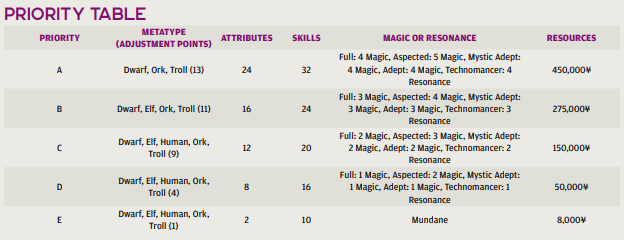
This is the foundation of what your character is going to be. Establishing your priorities will determine how many resources you have in specific areas to build your character. There are 5 levels of priorities, A through E. And there are five categories. Priority A is the highest priority, whereas E is the lowest. You must assign your order of priorities from most important to least important. The higher the priority in a category is, the more resources in that category you have to spend. Generally speaking, if your character isn't Awakened/Emerged (Mages or Technomancers), then Magic will most likely be your last priority (you are simply mundane).
KEEP IN MIND
Regardless of your priorities, you also have 50 Karma to work with to further customize your character. This Karma is used to buy Qualities during the creation process, and to fine tune your character at the end. You can only bring 5 of that Karma with you into the campaign, so you are encouraged to spend it. If you want to know more about what you can spend Karma on, read ahead to the Karma section of this walkthrough. I would also recommend that you read ahead to the Qualities step of this walkthrough to start perusing what options you have for starting Qualities as some can only be taken during character creation, and they might further inform your decision on priorities.
These are the resources you have to create your character with. Some characters might not have a need for large sums of money, whereas some (like Riggers) need money as their top priority to afford drones and expensive rigging cyberware. If you've pre-planned your character a bit, you'll have a good idea on what priorities you need to realize your character. From there, we can assign our points to establish the core Attributes and Skills of our character.
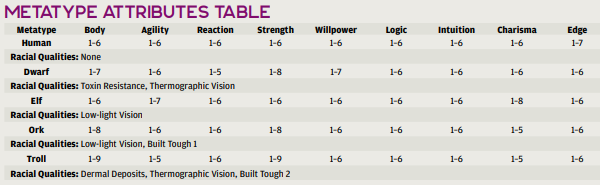
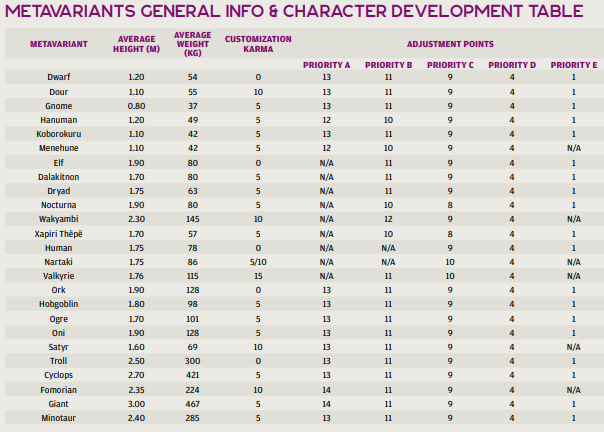

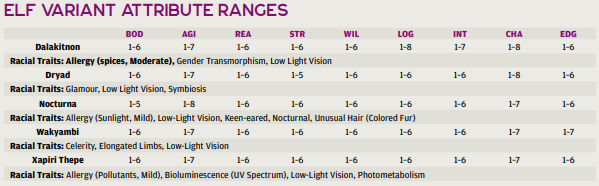
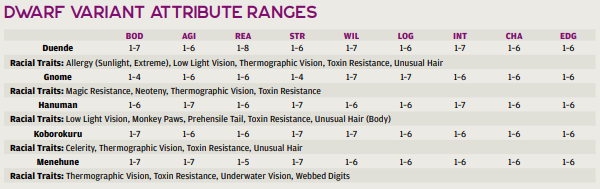
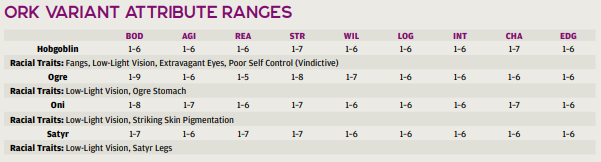
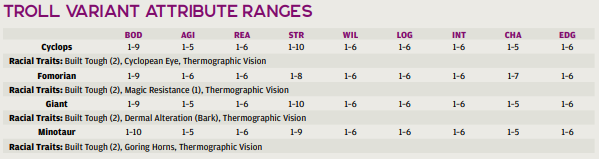 The first step is to distribute your adjustment points (the value decided by the priority given to the metatype category). These points essentially represent your racial advantages in certain areas. For example, trolls naturally have more strength and body than the other metatypes. Adjustment points can only be used on Edge, and ANY ATTRIBUTE that has a max rank higher than 6 (as shown in the above table). It is important to distribute your adjustment points BEFORE allocating your normal Attribute points to prevent wasting Attribute points. Note that ALL ATTRIBUTES START AT RANK 1. If your character has a Magic or Resonance Attribute (if the Magic category was Priority D or higher), then adjustment points can also be used to increase that Attribute as well in addition to the rank already provided by your Magic's priority level.
If you wish to play a metavariant instead of one of the five core metatypes, you can find the metavariants and their accompanying Attribute blocks on pg. 91 [SWC]. For ease of reference, I have also included them in a hider in this section beneath the metatype chart. Note that some metavariants have a Karma cost associated with them. Additionally, be sure to verify if your metavariant gets more or less adjustment points at your selected priority as detailed in the metavariant general info table.
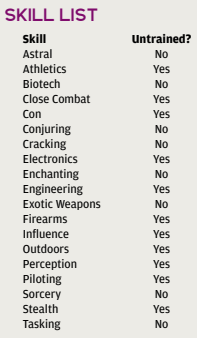
Now, much like Attribute Points, it's time we spend our Skill points at a 1-for-1 rate. There are a few notable differences here... Unlike Attributes, Skills do not all start at rank 1. The first rank of a Skill must be purchased. If a Skill has no ranks invested in it, then it is UNTRAINED. Referring to the table above, if a Skill can be used while untrained, then the character suffers a -1 dice pool penalty while performing that Skill test. Some Skills cannot be used at all if untrained, refer to the table. Other Skills require a character to have a Magic Attribute (if you selected any priority above E for the Magic category). A more detailed look at Skills (and specializations) can be found on pg. 93-97 [SR6].
Skills can also be specialized, whereby using that Skill while meeting the specialization's condition will grant a +2 dice pool bonus. During character creation, a specialization costs a single Skill point, and a Skill can only have one specialization. A Skill must be at least rank 1 to receive a specialization. In-game, specializations can later be turned into expertise (providing a +3 bonus instead), and a new specialization in that Skill cannot be taken until the previous specialization has been turned into an expertise.
Lastly, much like Attributes, ONLY ONE SKILL CAN REACH A MAX RANK OF 6 during character creation. There are some caveats to that, however. If using the Aptitude Quality (pg. 70 [SR6]), you can choose one Skill to raise its max to 7. Additionally, if using the Many Skills Quality (pg. 134 [SWC]), you can get two Skills to a max rank of 6 (or 7 if a Skill also has aptitude). With our example character, we chose Skills to be priority C, giving us 20 points to distribute among ranks and specializations.
Note the Skills with specializations costing an additional Skill point. Firearms is the only Skill maxed out at rank 6 (this example character does not have the Aptitude quality). Lastly, Exotic Weapons require a specialization to be considered 'trained', making it inherently more expensive to buy into initially.
Not all Shadowrunners are equal. And not all runners have the same upbringing. Shadowrunners come from a wide variety of backgrounds and run for a wide variety of reasons. Some are lone wolves, some are military veterans, some are family members, some are hobbyists, and some are corporate agents. Having a foundation of who your character was before becoming a runner will help drastically to guide you along in the creation process. Here are some basic questions to ask yourself about what you want your character to be:
What is your character's archetype? Most RPG systems use some sort of class system. Shadowrun is more freeform than that. In Shadowrun, you can mix and match Skills, Attributes, Qualities, and gear however you please. Your character fills a role exactly as niche or as broad as you want. But there are certain archetypes that still come up most frequently in Shadowrun, the core character types like deckers (hackers), mages, wheelmen (drivers), street samurai and weapons specialists, faces (social experts), and a few others. Having a broad idea of what you want your character to do first will help you build your character later down the line. Also, the Shadow Cast book features additional archetypes to sink your teeth into if you're looking for ideas.
What is your character's metatype? Are they a standard human? A stocky dwarf? A beefy ork? An elegant elf? Or a huge troll? Your metatype will decide many things going forward, and this is arguably the most important thing to understand going forward. You can find the metatypes on pg. 53-56 [SR6]. Furthermore, in the Companion, you can find metavariants, sub-types to the five core metatypes, on pg. 75-86 [SWC].
Where was your character born? Countries aren't the only option either as megacorporations have become pseudo-nations in their own right as well with swathes of territory under their dominion. Having a corporate SIN is just as commonplace as a national SIN, and often times, people will have one without the other, if any at all.
Where was your character raised? This can obviously be different from a character's birthplace. Think about your character's upbringing and the environment that shaped them throughout their early years.
Where was your character trained? As a shadowrunner, you didn't just have some sort of innate talent (or maybe you did). You most likely had some sort of prior training that helped your character fit into their new job as a runner. Maybe they were ex-military or ex-corporate security. Maybe they were brought up through a criminal syndicate or were forced to adapt in a hostile environment. Maybe they downloaded their skills off the matrix and had them implanted into your body's muscle memory. Be creative!
Where is your character now? Obviously Seattle, as that is the setting of this campaign. But think about the 'Why?'. Do they run out of a need to make ends meet? Do they run for vengeance? Perhaps it is for a greater goal or for some ultimate end. Maybe you run because it's your only way out of an even worse life? Or maybe you just run for the love of the game. Maybe you moonlight as a runner and lead a normal life just to spice things up. Every runner has their own unique motivations.
How does your character feel about the darker aspects of the world? Simply put, Shadowrunning is considered a criminal activity publicly. Every megacorp and even some nations use Shadowrunners for deniable, high risk missions, but you'll never see a runner gloating about it to the public. Given the dirty nature of a runner's line of work, there are a lot of things they see, hear, and do beyond the veil of what would be normal in a community. Again, not all runners are equal, and some are more evil and depraved than others. Shadowrun as a setting does not shy away from violence, sex, drugs, discrimination and racism among the metatypes, exploitation and unethical experimentation. Some runners thrive in the darkness of the world, others revile it and maintain strong moral compasses. And these personalities often clash as they wind up on jobs together. While I intend for this RPG to be mature, gritty, and sometimes dark, I expect OOC civility amongst us all and to verify with others on certain themes before posting something that might be considered a sensitive topic. We are all here for fun after all.
What is your character's archetype? Most RPG systems use some sort of class system. Shadowrun is more freeform than that. In Shadowrun, you can mix and match Skills, Attributes, Qualities, and gear however you please. Your character fills a role exactly as niche or as broad as you want. But there are certain archetypes that still come up most frequently in Shadowrun, the core character types like deckers (hackers), mages, wheelmen (drivers), street samurai and weapons specialists, faces (social experts), and a few others. Having a broad idea of what you want your character to do first will help you build your character later down the line. Also, the Shadow Cast book features additional archetypes to sink your teeth into if you're looking for ideas.
What is your character's metatype? Are they a standard human? A stocky dwarf? A beefy ork? An elegant elf? Or a huge troll? Your metatype will decide many things going forward, and this is arguably the most important thing to understand going forward. You can find the metatypes on pg. 53-56 [SR6]. Furthermore, in the Companion, you can find metavariants, sub-types to the five core metatypes, on pg. 75-86 [SWC].
Where was your character born? Countries aren't the only option either as megacorporations have become pseudo-nations in their own right as well with swathes of territory under their dominion. Having a corporate SIN is just as commonplace as a national SIN, and often times, people will have one without the other, if any at all.
Where was your character raised? This can obviously be different from a character's birthplace. Think about your character's upbringing and the environment that shaped them throughout their early years.
Where was your character trained? As a shadowrunner, you didn't just have some sort of innate talent (or maybe you did). You most likely had some sort of prior training that helped your character fit into their new job as a runner. Maybe they were ex-military or ex-corporate security. Maybe they were brought up through a criminal syndicate or were forced to adapt in a hostile environment. Maybe they downloaded their skills off the matrix and had them implanted into your body's muscle memory. Be creative!
Where is your character now? Obviously Seattle, as that is the setting of this campaign. But think about the 'Why?'. Do they run out of a need to make ends meet? Do they run for vengeance? Perhaps it is for a greater goal or for some ultimate end. Maybe you run because it's your only way out of an even worse life? Or maybe you just run for the love of the game. Maybe you moonlight as a runner and lead a normal life just to spice things up. Every runner has their own unique motivations.
How does your character feel about the darker aspects of the world? Simply put, Shadowrunning is considered a criminal activity publicly. Every megacorp and even some nations use Shadowrunners for deniable, high risk missions, but you'll never see a runner gloating about it to the public. Given the dirty nature of a runner's line of work, there are a lot of things they see, hear, and do beyond the veil of what would be normal in a community. Again, not all runners are equal, and some are more evil and depraved than others. Shadowrun as a setting does not shy away from violence, sex, drugs, discrimination and racism among the metatypes, exploitation and unethical experimentation. Some runners thrive in the darkness of the world, others revile it and maintain strong moral compasses. And these personalities often clash as they wind up on jobs together. While I intend for this RPG to be mature, gritty, and sometimes dark, I expect OOC civility amongst us all and to verify with others on certain themes before posting something that might be considered a sensitive topic. We are all here for fun after all.
This is the foundation of what your character is going to be. Establishing your priorities will determine how many resources you have in specific areas to build your character. There are 5 levels of priorities, A through E. And there are five categories. Priority A is the highest priority, whereas E is the lowest. You must assign your order of priorities from most important to least important. The higher the priority in a category is, the more resources in that category you have to spend. Generally speaking, if your character isn't Awakened/Emerged (Mages or Technomancers), then Magic will most likely be your last priority (you are simply mundane).
KEEP IN MIND
Regardless of your priorities, you also have 50 Karma to work with to further customize your character. This Karma is used to buy Qualities during the creation process, and to fine tune your character at the end. You can only bring 5 of that Karma with you into the campaign, so you are encouraged to spend it. If you want to know more about what you can spend Karma on, read ahead to the Karma section of this walkthrough. I would also recommend that you read ahead to the Qualities step of this walkthrough to start perusing what options you have for starting Qualities as some can only be taken during character creation, and they might further inform your decision on priorities.
A - Resources (450,000¥)
B - Attribute Points (16)
C - Skill Points (20)
D - Metatype Adjustment Points (4)
E - Magic (Mundane)
B - Attribute Points (16)
C - Skill Points (20)
D - Metatype Adjustment Points (4)
E - Magic (Mundane)
These are the resources you have to create your character with. Some characters might not have a need for large sums of money, whereas some (like Riggers) need money as their top priority to afford drones and expensive rigging cyberware. If you've pre-planned your character a bit, you'll have a good idea on what priorities you need to realize your character. From there, we can assign our points to establish the core Attributes and Skills of our character.
If you wish to play a metavariant instead of one of the five core metatypes, you can find the metavariants and their accompanying Attribute blocks on pg. 91 [SWC]. For ease of reference, I have also included them in a hider in this section beneath the metatype chart. Note that some metavariants have a Karma cost associated with them. Additionally, be sure to verify if your metavariant gets more or less adjustment points at your selected priority as detailed in the metavariant general info table.
BOD: 1
AGI: 3 (+2)
REA: 1
STR: 1
WIL: 1
LOG: 1
INT: 1
CHA: 2 (+1)
EDG: 2 (+1)
AGI: 3 (+2)
REA: 1
STR: 1
WIL: 1
LOG: 1
INT: 1
CHA: 2 (+1)
EDG: 2 (+1)
Next up is distributing your actual Attribute points. This is 1-for-1. Keep in mind, that during character creation, ONLY ONE ATTRIBUTE CAN BE AT MAX RANK as modified by metatype and Qualities. If using the 'Many Talents' Quality (pg. 134 [SWC]), you are able to max out TWO Attributes during character creation. The amount of points you have is determined by your priority given to the Attributes category. In our example priority selection, we chose Attributes to be priority B, giving us 16 Attribute points to spend.
[HOUSERULE] Edge can be increased with Attribute points.
Note in the example that only Agility was maxed out to rank 7, as the elf metatype maximum for that Attribute is 7.
[HOUSERULE] Edge can be increased with Attribute points.
BOD: 3 (+2)
AGI: 7 (+4)
REA: 4 (+3)
STR: 2 (+1)
WIL: 2 (+1)
LOG: 3 (+2)
INT: 3 (+2)
CHA: 3 (+1)
EDG: 2
AGI: 7 (+4)
REA: 4 (+3)
STR: 2 (+1)
WIL: 2 (+1)
LOG: 3 (+2)
INT: 3 (+2)
CHA: 3 (+1)
EDG: 2
Note in the example that only Agility was maxed out to rank 7, as the elf metatype maximum for that Attribute is 7.
Astral (Intuition)
Athletics (Agility/Strength1)
Biotech (Logic)
Close Combat (Agility2)
Con (Charisma)
Conjuring (Magic)
Cracking (Logic)
Electronics (Logic)
Enchanting (Magic)
Engineering (Logic)
Exotic Weapons3 (Agility)
Firearms (Agility)
Influence (Agility/Logic4)
Outdoors (Intuition)
Perception (Intuition/Logic5)
Piloting (Reaction)
Sorcery (Magic)
Stealth (Agility)
Tasking (Resonance)
1. Depending on the type of athletics being performed, strength will be used instead of agility.
2. Strength affects close combat damage and attack ratings, while the Skill test is performed using Agility.
3. Exotic Weapons Skill can be taken multiple times per exotic weapon and requires a specialization in that specific weapon. This Skill is the only Skill that does not require an expertise before taking another specialization.
4. When making a clear argument based on data or facts, Logic will be used instead of charisma.
5. For pattern recognition, Logic will be used instead of Intuition.
Athletics (Agility/Strength1)
Biotech (Logic)
Close Combat (Agility2)
Con (Charisma)
Conjuring (Magic)
Cracking (Logic)
Electronics (Logic)
Enchanting (Magic)
Engineering (Logic)
Exotic Weapons3 (Agility)
Firearms (Agility)
Influence (Agility/Logic4)
Outdoors (Intuition)
Perception (Intuition/Logic5)
Piloting (Reaction)
Sorcery (Magic)
Stealth (Agility)
Tasking (Resonance)
1. Depending on the type of athletics being performed, strength will be used instead of agility.
2. Strength affects close combat damage and attack ratings, while the Skill test is performed using Agility.
3. Exotic Weapons Skill can be taken multiple times per exotic weapon and requires a specialization in that specific weapon. This Skill is the only Skill that does not require an expertise before taking another specialization.
4. When making a clear argument based on data or facts, Logic will be used instead of charisma.
5. For pattern recognition, Logic will be used instead of Intuition.
Now, much like Attribute Points, it's time we spend our Skill points at a 1-for-1 rate. There are a few notable differences here... Unlike Attributes, Skills do not all start at rank 1. The first rank of a Skill must be purchased. If a Skill has no ranks invested in it, then it is UNTRAINED. Referring to the table above, if a Skill can be used while untrained, then the character suffers a -1 dice pool penalty while performing that Skill test. Some Skills cannot be used at all if untrained, refer to the table. Other Skills require a character to have a Magic Attribute (if you selected any priority above E for the Magic category). A more detailed look at Skills (and specializations) can be found on pg. 93-97 [SR6].
Skills can also be specialized, whereby using that Skill while meeting the specialization's condition will grant a +2 dice pool bonus. During character creation, a specialization costs a single Skill point, and a Skill can only have one specialization. A Skill must be at least rank 1 to receive a specialization. In-game, specializations can later be turned into expertise (providing a +3 bonus instead), and a new specialization in that Skill cannot be taken until the previous specialization has been turned into an expertise.
Lastly, much like Attributes, ONLY ONE SKILL CAN REACH A MAX RANK OF 6 during character creation. There are some caveats to that, however. If using the Aptitude Quality (pg. 70 [SR6]), you can choose one Skill to raise its max to 7. Additionally, if using the Many Skills Quality (pg. 134 [SWC]), you can get two Skills to a max rank of 6 (or 7 if a Skill also has aptitude). With our example character, we chose Skills to be priority C, giving us 20 points to distribute among ranks and specializations.
Athletics: 3 [Spec: Swimming] (+4)
Firearms: 6 [Spec: SMGs] (+7)
Biotech: 2 (+2)
Close Combat: 3 (+3)
Exotic Weapons: 2 [Spec: Narcoject Hornet] (+3)
Influence: 1 (+1)
Firearms: 6 [Spec: SMGs] (+7)
Biotech: 2 (+2)
Close Combat: 3 (+3)
Exotic Weapons: 2 [Spec: Narcoject Hornet] (+3)
Influence: 1 (+1)
Note the Skills with specializations costing an additional Skill point. Firearms is the only Skill maxed out at rank 6 (this example character does not have the Aptitude quality). Lastly, Exotic Weapons require a specialization to be considered 'trained', making it inherently more expensive to buy into initially.
If you chose Priority E for Magic, skip this part as your character is mundane and has no magical or resonant abilities.
If you chose any other priority level, then you can assign these points directly to your Magic Attribute. Adjustment points and Karma can be spent to increase your Magic/Resonance Attribute further during character creation if you so choose. There are some important things to know here...
All magi have a tradition which determines how that mage uses/treats magic. Mages of the hermetic tradition view magic as a science to be studied and understood at a fundamental level. Hermetics resist magical drain with their Logic Attribute. Shamans view magic as a spiritual connection and as a supernatural force to be wielded. Shamans resist magical drain with their Charisma Attribute. Adepts channel magic inward on themselves to enhance their bodies and capabilities, and they use Body + Willpower to resist drain from Adept Powers. There are additional traditions found in Street Wyrd and Deus Ex Arcana with their own rules.
Adepts can choose to become either Physical Adepts or Mystic Adepts. 'PhysAds' use their full Magic Attribute on adept powers to enhance their bodies and abilities. Mystic Adepts use a portion of their Magic Attribute on adept powers, and the other portion on learning spells to cast like a mage. For more rules on Adepts, refer to pg. 156-158 [SR6]. PhysAds get Power Points equal to their Magic Attribute to use toward learning Adept Powers which can be found in SR6, Street Wyrd, Deus Ex Arcana, Smooth Operations, and Deadly Arts. Mystic Adepts start by spending power points to learn adept powers, and then the remaining power points left over is multiplied by 2 to determine how many spells they can start with.
Magicians can either be full mages, where they use their Magic Attribute to perform any type of magical task, or Aspected Mages where they can only perform ONE type of magic (Spellcasting, Conjuring, or Enchanting), but for taking this limitation, they automatically gain a +1 bonus to their Magic Attribute. To determine how many spells a mage starts with, they multiply their Magic Attribute by 2 (before Karma or adjustment point increases). Spells can be found in SR6, Street Wyrd, Deus Ex Arcana, Smooth Operations, and Deadly Arts.
Technomancers fall under this category, but they're a sort of weird beast in their own right with a Resonance Attribute instead of a Magic Attribute. They effectively are hackers, but whereas deckers use equipment to interact with the matrix, technomancers have an innate connection to the matrix, and they exist in it in parallel to meatspace. Rather than spells or programs, technomancers use 'Complex Forms'. To determine how many complex forms they start with, multiply the character's Resonance Attribute by 2 (before Karma or adjustment point increases). Complex Forms can be found in SR6 and Hack & Slash.
During the final touches stage of character creation, the Magic/Resonance Attribute cannot be greater than 6.
If you chose any other priority level, then you can assign these points directly to your Magic Attribute. Adjustment points and Karma can be spent to increase your Magic/Resonance Attribute further during character creation if you so choose. There are some important things to know here...
All magi have a tradition which determines how that mage uses/treats magic. Mages of the hermetic tradition view magic as a science to be studied and understood at a fundamental level. Hermetics resist magical drain with their Logic Attribute. Shamans view magic as a spiritual connection and as a supernatural force to be wielded. Shamans resist magical drain with their Charisma Attribute. Adepts channel magic inward on themselves to enhance their bodies and capabilities, and they use Body + Willpower to resist drain from Adept Powers. There are additional traditions found in Street Wyrd and Deus Ex Arcana with their own rules.
Adepts can choose to become either Physical Adepts or Mystic Adepts. 'PhysAds' use their full Magic Attribute on adept powers to enhance their bodies and abilities. Mystic Adepts use a portion of their Magic Attribute on adept powers, and the other portion on learning spells to cast like a mage. For more rules on Adepts, refer to pg. 156-158 [SR6]. PhysAds get Power Points equal to their Magic Attribute to use toward learning Adept Powers which can be found in SR6, Street Wyrd, Deus Ex Arcana, Smooth Operations, and Deadly Arts. Mystic Adepts start by spending power points to learn adept powers, and then the remaining power points left over is multiplied by 2 to determine how many spells they can start with.
Magicians can either be full mages, where they use their Magic Attribute to perform any type of magical task, or Aspected Mages where they can only perform ONE type of magic (Spellcasting, Conjuring, or Enchanting), but for taking this limitation, they automatically gain a +1 bonus to their Magic Attribute. To determine how many spells a mage starts with, they multiply their Magic Attribute by 2 (before Karma or adjustment point increases). Spells can be found in SR6, Street Wyrd, Deus Ex Arcana, Smooth Operations, and Deadly Arts.
Technomancers fall under this category, but they're a sort of weird beast in their own right with a Resonance Attribute instead of a Magic Attribute. They effectively are hackers, but whereas deckers use equipment to interact with the matrix, technomancers have an innate connection to the matrix, and they exist in it in parallel to meatspace. Rather than spells or programs, technomancers use 'Complex Forms'. To determine how many complex forms they start with, multiply the character's Resonance Attribute by 2 (before Karma or adjustment point increases). Complex Forms can be found in SR6 and Hack & Slash.
During the final touches stage of character creation, the Magic/Resonance Attribute cannot be greater than 6.
SHOPPING SPREE!
I recommend that you do this last after you've established your character fully and have an idea what sort of gear you want for them. This section takes the most time as you're basically set loose in the books to buy the gear your runner is going to use. If you hadn't heard before, Shadowrun is basically a shopping simulator with items for just about every scenario.
Below are considerations during character creation to keep in mind...
All items have an Availability (AVAIL). During character creation, you cannot buy an item higher than availability 6.
You cannot carry over more than 5000¥ from character creation into the campaign, so if you got a lot of money from your priority... SPEND IT!
Don't forget that you also need a lifestyle which has a monthly cost to it. You pay upfront for your first month when picking a lifestyle.
Unless you have the SINner Negative Quality, your character has no ID, no Citizenship, and no Licenses. Consider buying Fake SINs and Fake Licenses for those Fake SINs in case you need to use public services or have an encounter with law enforcement.
Consider vehicle options, you cannot carry all of your equipment with you at all times, and doing the legwork for a job might mean that characters won't be in the place at the same time. You're gonna want wheels, possibly multiple sets of them. You can find vehicles in SR6, Double Clutch, Tarnished Star, and Deadly Arts.
Ammo! Your guns aren't magical, you're gonna need some ammo to go with them.
Gadgets are your friend, take some time to peruse the vast array of gadgets and devices to make your life easy.
If you're low on money, you can convert your starting Karma into cash at a rate of 2 Karma per 2000¥. If that isn't enough for you, you can take the In Debt Negative Quality to change the rate to 2 Karma for 5000¥, which you'll need to pay back during the campaign (with interest) or face consequences.
Consider different clothing options, if you're constantly wearing your battle gear, you're gonna stick out like a sore thumb.
Cyberware and Bioware is hella strong, and hella expensive. Keep in mind that you can buy far more expensive versions of that same 'ware that consumes less essence but also comes at a higher availability.
You can have illegal items (listed as (I) in the items availability), but getting caught with them will result in consequences. Items that require a License (L), require... you guessed it... A license to be able to legally own. Licenses don't need to be specific to that exact item. If you're curious about a specific license for an item, ask me and I'll provide you a fitting one.
If you're a rigger or a decker, you're going to want to set resources as your top priority. That drek is fraggin' expensive.
Books you can find things to buy in are:
SR6
Firing Squad
Street Wyrd
Hack & Slash
Body Shop
Smooth Operations
Double Clutch
Tarnished Star
No Future
Deadly Arts
Deus Ex Arcana
Go Bag
Holostreet: Exotics
I recommend that you do this last after you've established your character fully and have an idea what sort of gear you want for them. This section takes the most time as you're basically set loose in the books to buy the gear your runner is going to use. If you hadn't heard before, Shadowrun is basically a shopping simulator with items for just about every scenario.
Below are considerations during character creation to keep in mind...
All items have an Availability (AVAIL). During character creation, you cannot buy an item higher than availability 6.
You cannot carry over more than 5000¥ from character creation into the campaign, so if you got a lot of money from your priority... SPEND IT!
Don't forget that you also need a lifestyle which has a monthly cost to it. You pay upfront for your first month when picking a lifestyle.
Unless you have the SINner Negative Quality, your character has no ID, no Citizenship, and no Licenses. Consider buying Fake SINs and Fake Licenses for those Fake SINs in case you need to use public services or have an encounter with law enforcement.
Consider vehicle options, you cannot carry all of your equipment with you at all times, and doing the legwork for a job might mean that characters won't be in the place at the same time. You're gonna want wheels, possibly multiple sets of them. You can find vehicles in SR6, Double Clutch, Tarnished Star, and Deadly Arts.
Ammo! Your guns aren't magical, you're gonna need some ammo to go with them.
Gadgets are your friend, take some time to peruse the vast array of gadgets and devices to make your life easy.
If you're low on money, you can convert your starting Karma into cash at a rate of 2 Karma per 2000¥. If that isn't enough for you, you can take the In Debt Negative Quality to change the rate to 2 Karma for 5000¥, which you'll need to pay back during the campaign (with interest) or face consequences.
Consider different clothing options, if you're constantly wearing your battle gear, you're gonna stick out like a sore thumb.
Cyberware and Bioware is hella strong, and hella expensive. Keep in mind that you can buy far more expensive versions of that same 'ware that consumes less essence but also comes at a higher availability.
You can have illegal items (listed as (I) in the items availability), but getting caught with them will result in consequences. Items that require a License (L), require... you guessed it... A license to be able to legally own. Licenses don't need to be specific to that exact item. If you're curious about a specific license for an item, ask me and I'll provide you a fitting one.
If you're a rigger or a decker, you're going to want to set resources as your top priority. That drek is fraggin' expensive.
Books you can find things to buy in are:
SR6
Firing Squad
Street Wyrd
Hack & Slash
Body Shop
Smooth Operations
Double Clutch
Tarnished Star
No Future
Deadly Arts
Deus Ex Arcana
Go Bag
Holostreet: Exotics
This step can be done at any point, and I would suggest perusing and picking out Qualities to tentatively add to your character early on to better flesh out your idea of them. There are both Positive Qualities and Negative Qualities. Positive Qualities are taken with the starting Karma you are given for character creation. Negative Qualities actually award you with additional bonus Karma. However, you cannot have more than a net total of 20 bonus Karma from Qualities, and you can only have UP TO 6 QUALITIES IN TOTAL during character creation. While Karma is not the only thing you can spend your Karma on during character creation, it will most likely take up the bulk of it. You can only enter the campaign with up to 5 Karma, so spend it!
Books you can find Qualities in are:
SR6
Sixth World Companion
Firing Squad (along with Martial Arts)
Hack & Slash
Street Wyrd
Double Clutch (along with Driving Techniques)
Body Shop
Smooth Operations
Power Plays
Emerald City
Deadly Arts
Deus Ex Arcana
No Future
Shadow Cast (exclusively Quality Paths)
Books you can find Qualities in are:
SR6
Sixth World Companion
Firing Squad (along with Martial Arts)
Hack & Slash
Street Wyrd
Double Clutch (along with Driving Techniques)
Body Shop
Smooth Operations
Power Plays
Emerald City
Deadly Arts
Deus Ex Arcana
No Future
Shadow Cast (exclusively Quality Paths)
As stated earlier in this walkthrough, you start the character creation process with 50 Karma. If you've already gone through Qualities, it's possible that you've got even more (or less) depending on if you've bitten the bullet with some Negative Qualities or went all in on Positive Qualities. The most Karma you'll ever have during character creation is 70. Now is the time to really unleash it.
You can only carry over up to 5 Karma into the campaign after character creation. So SPEND IT
Here are some resources showing you what you can spend your Karma on during character creation. Unlike Attribute and Skill points, Karma is not a 1-for-1 exchange to upgrade those things. To find out how much Karma you need to bump a Skill up, multiply the rank you're trying to reach by 5. For example, upgrading a rank 3 Attribute to rank 4 would cost 20 Karma. Note that only in character creation, Quality costs are not double, but you are limited only to 6 total Qualities during character creation.
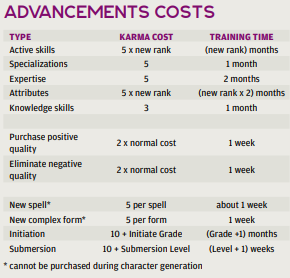
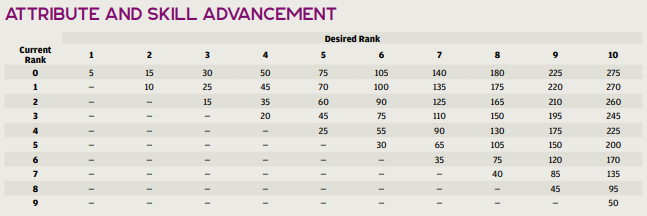
During the campaign, when I specify a time-skip to progress the campaign's timeline, you can opt to spend 2000¥ and a week's worth of downtime to gain 4 Karma, or 2 Karma and a week's worth of downtime to gain 4000¥. This is an abstract way of doing 'community service' (whatever community that might be), or 'working for the man' respectively.
You can only carry over up to 5 Karma into the campaign after character creation. So SPEND IT
Here are some resources showing you what you can spend your Karma on during character creation. Unlike Attribute and Skill points, Karma is not a 1-for-1 exchange to upgrade those things. To find out how much Karma you need to bump a Skill up, multiply the rank you're trying to reach by 5. For example, upgrading a rank 3 Attribute to rank 4 would cost 20 Karma. Note that only in character creation, Quality costs are not double, but you are limited only to 6 total Qualities during character creation.
During the campaign, when I specify a time-skip to progress the campaign's timeline, you can opt to spend 2000¥ and a week's worth of downtime to gain 4 Karma, or 2 Karma and a week's worth of downtime to gain 4000¥. This is an abstract way of doing 'community service' (whatever community that might be), or 'working for the man' respectively.
All shadowrunners have contacts, even newbies like you. They're likely how you got to where you are now. Contacts are valuable assets, NPCs under the GMs control that you give them who are meant to give you assistance in specific ways. There are a variety of pre-made contact types, but ultimately the contact and their services are up to you to decide. To determine how many contact points you have to spend to gain contacts, use your Charisma x 6.
Those points are used for two Attributes in a contact: Loyalty and Connection, but neither can be higher than your character's charisma during character creation.
Loyalty is that contact's reliability to you and how likely they are to not stab you in the back. The higher the loyalty, the better. Think of it this way, if you need a contact to do something risky, you'll probably burn a rank in loyalty for them to get something done. Those are the big asks of course, smaller favors might not affect loyalty unless you repeatedly neglect to pay them back in kind with money or favors.
Connection represents the level of services this contact has. Who do they know? How much information do they have? What sort of contraband can they get their hands on? Can they get you into something very elite and very exclusive? The higher the connection, the more valuable they are to keep in your back pocket. Just be sure not to piss them off, as those deep connections can likely be turned on you. This is an abstract display of their level of influence.
If you aren't sure about what kinds of contacts you ought to have, there are dozens of pre-made contact archetypes that you can find in SR6 and Sixth World Companion. Setting Sourcebooks and Runner Resource Books are also good places to inspire your own contacts like Emerald City, Power Plays, Null Value, Falling Point, Collapsing Now, Shadow Cast, and No Future. Other NPC Shadowrunners can also be contacts.
Those points are used for two Attributes in a contact: Loyalty and Connection, but neither can be higher than your character's charisma during character creation.
Loyalty is that contact's reliability to you and how likely they are to not stab you in the back. The higher the loyalty, the better. Think of it this way, if you need a contact to do something risky, you'll probably burn a rank in loyalty for them to get something done. Those are the big asks of course, smaller favors might not affect loyalty unless you repeatedly neglect to pay them back in kind with money or favors.
Connection represents the level of services this contact has. Who do they know? How much information do they have? What sort of contraband can they get their hands on? Can they get you into something very elite and very exclusive? The higher the connection, the more valuable they are to keep in your back pocket. Just be sure not to piss them off, as those deep connections can likely be turned on you. This is an abstract display of their level of influence.
If you aren't sure about what kinds of contacts you ought to have, there are dozens of pre-made contact archetypes that you can find in SR6 and Sixth World Companion. Setting Sourcebooks and Runner Resource Books are also good places to inspire your own contacts like Emerald City, Power Plays, Null Value, Falling Point, Collapsing Now, Shadow Cast, and No Future. Other NPC Shadowrunners can also be contacts.
Hex
Troll Earth Shaman
Connection: 5
Loyalty: 6
Afraid of the water, but has a notable affinity for earth spirits. She has a knack for failing upward and finding herself in the company of powerful people and in the possession of powerful artifacts. She might be able to source some good magic items, or get us an in with a notable person... If I can get a hold of her...
Troll Earth Shaman
Connection: 5
Loyalty: 6
Afraid of the water, but has a notable affinity for earth spirits. She has a knack for failing upward and finding herself in the company of powerful people and in the possession of powerful artifacts. She might be able to source some good magic items, or get us an in with a notable person... If I can get a hold of her...
Your character has a free native language, and specialized knowledge in certain topics. To determine how many points you get for Knowledge, use your Logic Attribute. Knowledge has no ranks, you simply are 'in the know' on that particular topic. Knowledge is something you can invoke on the GM to try and glean free information your character ought to inherently know about something, additionally, it is a reference I can use to deliberately feed you information pre-emptively. You can find a list of pre-made Knowledge Skills on pg. 99 [SR6], but keep in mind that these are examples, you are free to come up with your own Knowledge Skills (with the GM's approval).
Language Skills have ranks, up to 4. Rules for Language Skills can be found on pg. 99 [SR6], but the gist of it is that rank 1 is rudimentary understanding of the language whereas rank 4 is native/fluent in it. At rank 1, a Language Skill is effectively just another Knowledge Skill, costing 1 knowledge point to acquire. Each subsequent rank costs an additional knowledge point, and Karma costs apply as per Skill advancement costs.
Language Skills have ranks, up to 4. Rules for Language Skills can be found on pg. 99 [SR6], but the gist of it is that rank 1 is rudimentary understanding of the language whereas rank 4 is native/fluent in it. At rank 1, a Language Skill is effectively just another Knowledge Skill, costing 1 knowledge point to acquire. Each subsequent rank costs an additional knowledge point, and Karma costs apply as per Skill advancement costs.
Finally, we move on to calculating everything up to get the final numbers on things. There are a few stages to this that are important so read carefully.
Augmented Maximums
No Attribute bonus can go beyond 4 higher than your actual Attribute. If your strength is 2, the highest modified Attribute you could reach by augmentations, items, or magical buffs is 6. Your augmented Attribute is displayed in a bracket next to the natural Attribute, like so: STR: 2(6).
Attack Rating
Your main offensive stat to generate Edge in combat. If you are using ranged weapons, spells, or other devices, your AR will be dictated by that instead. Your unarmed AR is equal to your Reaction + Strength at Close Range only (If Rea and Str were both 3, this would look like 6/-/-/-/-).
Defense Rating
Your main defensive stat to generate Edge in combat. Your Body forms your base defense rating, but be sure to include any DR added by Qualities, powers, augmentations, and gear. Unless an armor specifically says its DR is cumulative, armor bonuses do not stack with each other. Something like a helmet would add to your DR along with full body armor, for example. A troll with Body 7, Dermal Deposits, Full Body Armor (with a helmet), and Aluminum Bone Lacing would have a total DR of 16.
Initiative
This determines how quickly you can act in combat and is broken into two components. Your Initiative Score and your Initiative Dice. Your score is the combined total of your Reaction + Intuition, plus any modifiers given by cyberware, powers, or other effects. This is a fixed number. Your Initiative Dice pool is how many d6 you roll, adding that roll to your Initiative Score to determine where you land in the turn order. Each Initiative Die you have also grants you an additional Minor Action, so by default all characters will have 1 Major Action, and 2 Minor Actions (1 by default, and another 1 for having 1 Initiative Die by default). Augmentations that provide more Initiative Dice also grant more Minor Actions (to a maximum of 5 Minor Actions per turn), and 4 Minor Actions can be converted into 1 Major Action in combat.
Derived Attributes
There are a few secondary Attributes derived from your primary Attributes. These are situational and come up in specific circumstances.
Composure (Willpower + Charisma): Used when pressure is being laid on and you need to keep your character cool. The GM may call on composure tests when they believe a particular scenario is meant to be especially stressful.
Judge Intentions (Willpower + Intuition): Used for getting a read on someone and seeing through their body language or speaking patterns. Players may attempt to use Judge Intentions on NPCs to get more clues about the way an NPC is behaving. This derived Attribute is not used to read minds.
Memory (Logic + Intuition): Used if your character needs to dig up information they might not have on hand. This is generally the GMs way to remind players of information that they didn't write down, or a way for players to get a reminding nudge in the right direction, but only if the memory test succeeds. If the player forgets, and the character fails their memory test, the information is lost until the player can remember it naturally!
Lift/Carry (Body + Willpower): This one is rather nuanced, so the rules for Lift/Carry can be found on pg. 67-68 [SR6]. As the name suggests, this is effectively the weights your character can lift in place and/or carry over a distance/timeframe.
Condition Monitors
Now it is time to figure out your character's total for their Physical and Stun Condition Monitors.
First, Divide your character's Body Attribute by 2 (rounding up), then add 8. This is your base, now add additional boxes added by Qualities like Built Tough. Remember that certain metatypes and metavariants have Qualities baked in, so verify if you have any relevant Qualities with your Metatype/Metavariant while doing this stage. You can find a full list of the metatypes and metavariants in the Step 3a. After you have determined any possible bonuses from Qualities, let's move onto augmentations. Each cyberlimb replacement adds 1 additional box to the Physical Condition Monitor. Lastly, if your character is an Adept, don't forget to include any changes to your monitors if you've taken passive increases to your Attributes through Adept Powers.
Next, do the same for your Stun Condition Monitor, but start with your character's Willpower Attribute instead of Body. Note that cyberlimbs do not increase your Stun Monitor like they do for your Physical Monitor. Be sure to verify with your Qualities, augmentations, and Adept Powers (if applicable) to make sure you aren't shorting yourself on valuable boxes!
Devices, Drones, and Vehicles all have Condition Monitors too. For most character's, these wont be relevant at all, so don't worry about getting those unless the GM needs them for a particular scene. If you want to know what they are anyways, for devices, use the Device Rating divided by 2 and add 8. Drones and Vehicles will use their Body attribute in the same way.
Starting Nuyen
It was mentioned before, but it will be stated again. You can only bring up to 5000¥ with you from character creation into the campaign. So be sure to spend any excess nuyen you might still have at this point!
Augmented Maximums
No Attribute bonus can go beyond 4 higher than your actual Attribute. If your strength is 2, the highest modified Attribute you could reach by augmentations, items, or magical buffs is 6. Your augmented Attribute is displayed in a bracket next to the natural Attribute, like so: STR: 2(6).
Attack Rating
Your main offensive stat to generate Edge in combat. If you are using ranged weapons, spells, or other devices, your AR will be dictated by that instead. Your unarmed AR is equal to your Reaction + Strength at Close Range only (If Rea and Str were both 3, this would look like 6/-/-/-/-).
Defense Rating
Your main defensive stat to generate Edge in combat. Your Body forms your base defense rating, but be sure to include any DR added by Qualities, powers, augmentations, and gear. Unless an armor specifically says its DR is cumulative, armor bonuses do not stack with each other. Something like a helmet would add to your DR along with full body armor, for example. A troll with Body 7, Dermal Deposits, Full Body Armor (with a helmet), and Aluminum Bone Lacing would have a total DR of 16.
Initiative
This determines how quickly you can act in combat and is broken into two components. Your Initiative Score and your Initiative Dice. Your score is the combined total of your Reaction + Intuition, plus any modifiers given by cyberware, powers, or other effects. This is a fixed number. Your Initiative Dice pool is how many d6 you roll, adding that roll to your Initiative Score to determine where you land in the turn order. Each Initiative Die you have also grants you an additional Minor Action, so by default all characters will have 1 Major Action, and 2 Minor Actions (1 by default, and another 1 for having 1 Initiative Die by default). Augmentations that provide more Initiative Dice also grant more Minor Actions (to a maximum of 5 Minor Actions per turn), and 4 Minor Actions can be converted into 1 Major Action in combat.
Derived Attributes
There are a few secondary Attributes derived from your primary Attributes. These are situational and come up in specific circumstances.
Composure (Willpower + Charisma): Used when pressure is being laid on and you need to keep your character cool. The GM may call on composure tests when they believe a particular scenario is meant to be especially stressful.
Judge Intentions (Willpower + Intuition): Used for getting a read on someone and seeing through their body language or speaking patterns. Players may attempt to use Judge Intentions on NPCs to get more clues about the way an NPC is behaving. This derived Attribute is not used to read minds.
Memory (Logic + Intuition): Used if your character needs to dig up information they might not have on hand. This is generally the GMs way to remind players of information that they didn't write down, or a way for players to get a reminding nudge in the right direction, but only if the memory test succeeds. If the player forgets, and the character fails their memory test, the information is lost until the player can remember it naturally!
Lift/Carry (Body + Willpower): This one is rather nuanced, so the rules for Lift/Carry can be found on pg. 67-68 [SR6]. As the name suggests, this is effectively the weights your character can lift in place and/or carry over a distance/timeframe.
Condition Monitors
Now it is time to figure out your character's total for their Physical and Stun Condition Monitors.
First, Divide your character's Body Attribute by 2 (rounding up), then add 8. This is your base, now add additional boxes added by Qualities like Built Tough. Remember that certain metatypes and metavariants have Qualities baked in, so verify if you have any relevant Qualities with your Metatype/Metavariant while doing this stage. You can find a full list of the metatypes and metavariants in the Step 3a. After you have determined any possible bonuses from Qualities, let's move onto augmentations. Each cyberlimb replacement adds 1 additional box to the Physical Condition Monitor. Lastly, if your character is an Adept, don't forget to include any changes to your monitors if you've taken passive increases to your Attributes through Adept Powers.
Next, do the same for your Stun Condition Monitor, but start with your character's Willpower Attribute instead of Body. Note that cyberlimbs do not increase your Stun Monitor like they do for your Physical Monitor. Be sure to verify with your Qualities, augmentations, and Adept Powers (if applicable) to make sure you aren't shorting yourself on valuable boxes!
Devices, Drones, and Vehicles all have Condition Monitors too. For most character's, these wont be relevant at all, so don't worry about getting those unless the GM needs them for a particular scene. If you want to know what they are anyways, for devices, use the Device Rating divided by 2 and add 8. Drones and Vehicles will use their Body attribute in the same way.
Starting Nuyen
It was mentioned before, but it will be stated again. You can only bring up to 5000¥ with you from character creation into the campaign. So be sure to spend any excess nuyen you might still have at this point!
You can find the example character sheet and template here.
v0.1 [2026-04-01]
- Included Preamble Section.
- Included unformatted Character Creation Walkthrough section.
v0.2 [2026-04-02]
- Committed empty space for all other front page sections.
- Formatted Character Creation Walkthrough section.
- Fixed some format inconsistencies, grammar errors, and spelling errors.
v0.3 [2026-04-02]
- Finished Book Archive section (links not yet attached).
- Finished Core Concepts section.
- Formatted front page and added header.
v0.3.5 [2026-04-02]
- Added a missing component (Condition Monitors) to the Final Touches section in the Character Creation Walkthrough.
- Tweaked some formatting in multiple places.
v0.4 [2026-04-03]
- Added Optional Rules and Houserules in Play section.
- Fixed some format inconsistencies, grammar errors, and spelling errors.
v0.5 [2026-04-03]
- Added Setting Primer section.
v0.5.5 [2026-04-03]
- Added flavor text at start of page.
- [0.5.51] Added missing section in GM's continuity detailing the Matrix crash in Eastern Europe.
- [0.5.52] Changed image sources for viewership in other regions.
- [0.5.53] Added Wild Dice to the Core Concepts Section.
- [0.5.54] Added new Houserule: Human Metatype Bonus.
v0.6 [2026-04-05]
- Added example character Jack 'the Grayman' Carter to the 0th post in the Characters Tab.
- [0.6.1] Moved example character and upcoming template to 1st post on Characters Tab here following accessibility issues.
v1.0 [2026-04-06]
- Added Character Sheet Template to the Characters Tab section, found here.
- [1.0.1] Fixed some typos and added some missing formatting on Spells and Adept Powers in the Example character sheet.
- [1.0.2] Added Astral Ways book to the Setting Sourcebooks section of the Book Archive.
v1.1 [2026-04-10]
- Added multiple missed attributes and pertinent character information to both the example character and the template. These are:
- Karma (with Spent and Unspent trackers) under Personal Information
- Defense Rating in Derived Attributes
- Condition Monitors in Attributes Section below Derived Attributes
- Matrix Attributes in the Matrix Section.
- Device Condition Monitors added to Matrix items like commlinks and cyberdecks.
- Included Preamble Section.
- Included unformatted Character Creation Walkthrough section.
v0.2 [2026-04-02]
- Committed empty space for all other front page sections.
- Formatted Character Creation Walkthrough section.
- Fixed some format inconsistencies, grammar errors, and spelling errors.
v0.3 [2026-04-02]
- Finished Book Archive section (links not yet attached).
- Finished Core Concepts section.
- Formatted front page and added header.
v0.3.5 [2026-04-02]
- Added a missing component (Condition Monitors) to the Final Touches section in the Character Creation Walkthrough.
- Tweaked some formatting in multiple places.
v0.4 [2026-04-03]
- Added Optional Rules and Houserules in Play section.
- Fixed some format inconsistencies, grammar errors, and spelling errors.
v0.5 [2026-04-03]
- Added Setting Primer section.
v0.5.5 [2026-04-03]
- Added flavor text at start of page.
- [0.5.51] Added missing section in GM's continuity detailing the Matrix crash in Eastern Europe.
- [0.5.52] Changed image sources for viewership in other regions.
- [0.5.53] Added Wild Dice to the Core Concepts Section.
- [0.5.54] Added new Houserule: Human Metatype Bonus.
v0.6 [2026-04-05]
- Added example character Jack 'the Grayman' Carter to the 0th post in the Characters Tab.
- [0.6.1] Moved example character and upcoming template to 1st post on Characters Tab here following accessibility issues.
v1.0 [2026-04-06]
- Added Character Sheet Template to the Characters Tab section, found here.
- [1.0.1] Fixed some typos and added some missing formatting on Spells and Adept Powers in the Example character sheet.
- [1.0.2] Added Astral Ways book to the Setting Sourcebooks section of the Book Archive.
v1.1 [2026-04-10]
- Added multiple missed attributes and pertinent character information to both the example character and the template. These are:
- Karma (with Spent and Unspent trackers) under Personal Information
- Defense Rating in Derived Attributes
- Condition Monitors in Attributes Section below Derived Attributes
- Matrix Attributes in the Matrix Section.
- Device Condition Monitors added to Matrix items like commlinks and cyberdecks.
1x Like


