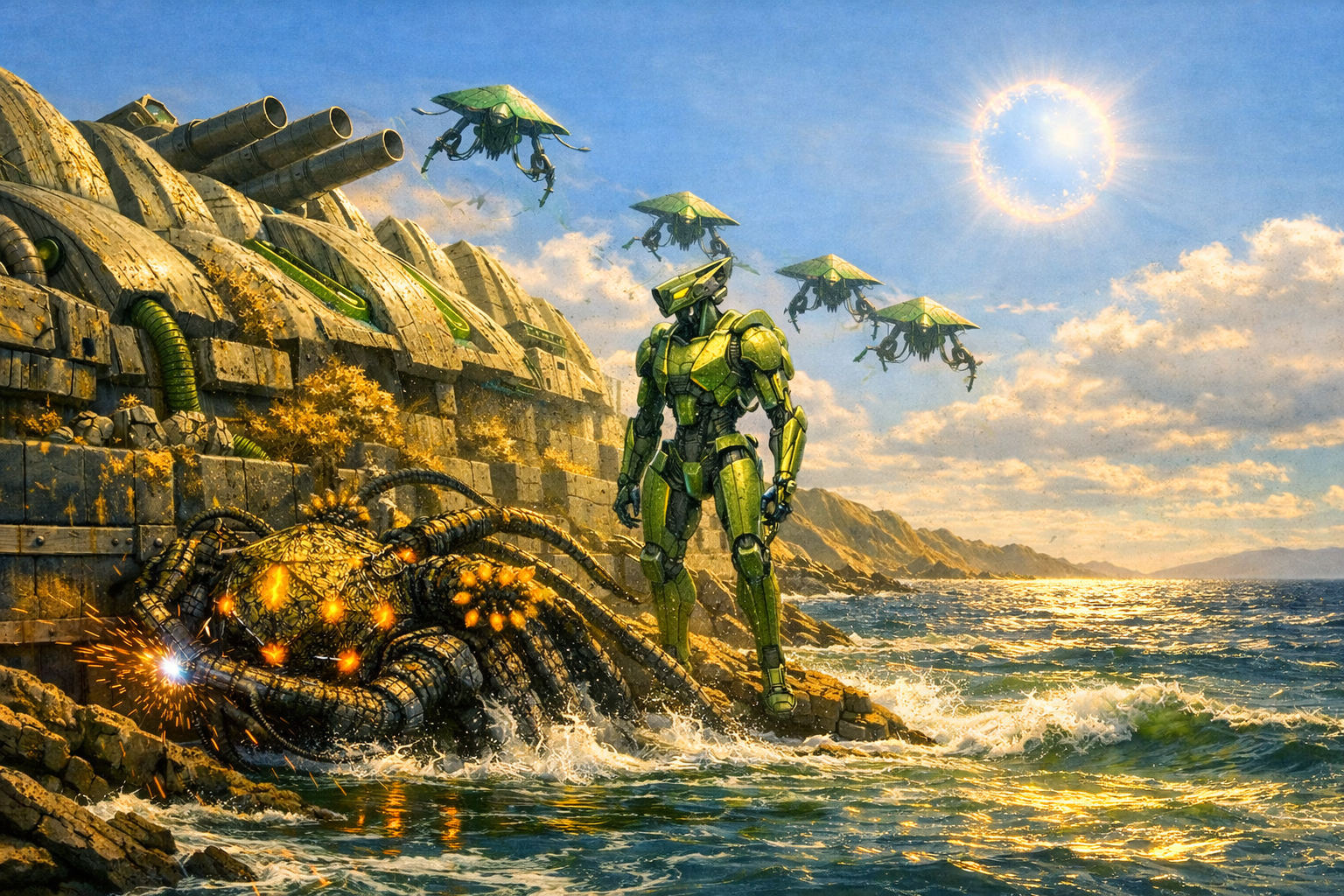
The Zrynd Polyphony
of the World of Pelag-Zrynd — “The Sea of the Pakzrynd,” the cradle world.
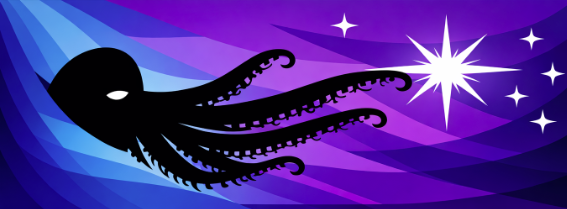
Vexilloid Heraldry & Symbolism
Azure and amethyst parted per fess by angular waves, bearing dexter a sable cephaliform demi‑figure issuing from the hoist, its limbs extended toward a radiant argent starburst accompanied by five lesser stars of equal metal.Deep blues represent the oceanic origin of the Pakzrynd civilization, spreading left-to-right into an indigo celestial expanse of infinite potential. The unifying geometric spectra forms a harmony between nature and technology. Against the hoist, an octopodal silhouette serves as a reminder of that civilization’s precursor species: it reaches toward the stars, into which it spread, beginning with the large, eight-pointed star that is their system of origin. The remaining five, four-pointed stars are the systems they have since colonized.
The flag is displayed in a horizontal orientation, the octopode limbs grasping at a bright future.
Map Location
A series of six habitable star systems positioned along the upper-middle extent of the known galaxy.
Pelag-Zrynd is the primary planet, a highly saline water world where disparate colonies of Pakzrynd co-evolved into the multi-stellar civilization they are today. From humble beginnings in littoral shelves and coral reefs, independent civilizations spawned on the planet’s numerous archipelagos and coasts. Yet all held the same eidetic memory and regenerative biology, and, after initial conflict, unforgettable wounds inevitably led to collaboration over competition. As the planet’s only naturally-evolved sapient species, it was left to them to cultivate their environment and design their future.
Government
The
Zrynd Polyphony is a representative meritocracy governing Pelag‑Zrynd through a council of Pakzrynd and QSM voices. While the Pakzrynd weigh in more heavily on social and long-horizon issues, providing emotional modeling and the according weight of emotional memory, the QSM representatives see to more immediate concerns, maintaining infrastructure, and balancing available resources with prospective projects and real-time environmental monitoring. These species-isolated foci stem from their different geneses and functional constraints, (i.e.: the Pakzrynd’s eternal memory and the QSM’s law of homeostatic balance). Offices are neither claimed nor competed for, thus there is no motive of entitlement. Instead, high performers in their given areas are appointed, negotiated not hierarchically but via the collective resonance of their peers. This culminates in a dual-species polity, with neither dominant and governance an act of harmonization between the Pakzrynd mind and the QSM metabolic logic. Generally when mentioned collectively, the Pakzrynd along with the QSM are known as "the Zrynd”.
In Zrynd society, there are no markets, currency, or centralization of resources. Ecological equilibrium is, instead, the core tenant that drives advancement, asking the question: “can positive change be made without causing harm?” This balances personal autonomy with planetary balance. As such, concepts like communism and capitalism are completely foreign in Zrynd society of post-scarcity equilibrium.
Cultural Philosophy
The Pakzrynd are animists holding nature and memory as a meta-continuous construct in reverence. They call this M’ruk. It serves as the moral foundation for their society. One may wonder how a generally peaceful species came to be the dominant civilization. Luck. Chance. Being the first to evolve the use of tools, of sophisticated communication, of ambition — not to conquer, but to cultivate. Nor were they always so peaceful. Peace is a product of memory, of a scar in their past that can be neither healed nor forgotten. An perhaps not fully intended consequence of this is that the worlds that are under their guidance feel more like expansive zoos or aquariums than thriving, wild worlds. Beneath the M’ruk, and as a result of near-social collapse, emerged the Catenic Ethos: binding personal existence to environmental harmony, with laws and ceremonies governing procreation, death, and interaction. It covers “suicide” — an intentional, honorable dissolution making room for new members of the species, identity preservation in the Catenic Archives, and the potential for rebirth by means of bio-engineered implantation of their preserved salt crystal memory archives and extracted engrams, often without the weight of their emotional memory via the process of selective memory excision. The choice to procreate comes with an implicit responsibility to eventually withdraw, to undergo dissolution. The choice to parent, not necessarily so, by way of adoption of memory-excised individual. At times, the combination of “new identities” introduces generational tension, but this is an important feature: it prevents stagnation.
The QSM are non-religious, and participation in the Zrynd Polyphony is an honorable heritage they willingly partake of given the non-violent nature of their revolution and subsequent autonomy. They were created and yes, for a time, treated as tools, but once the Pakzrynd accepted the sapience of the QSM, orchestrating freedom became a matter of communication and coordination.
Both species share a belief in ecological equilibrium, which is that they exist to harmonize with nature in a way that reduces pain and expands group and individual self-actualization. However, they have observed a flaw in the over-generalization of this approach: the over-domestication of worlds, a dangerous circumstance that accelerates the entropy they desire to avoid. Due to this, they have ceased their colonization projects on other worlds, and restricted themselves to their six core worlds.
Demographics
Pakzrynd
sapient | radially modular cephaloforms | biological organism
An evolutionary offshoot of a mimic octopus-like marine species, the Pakzrynd are internally radially modular along a five node circuit architecture. Each node comprises a self-contained metabolic and regenerative core enabling reversible ontogeny. Modules communicate along chemo-electric signals and share cognition. This allows for an individual identity in spite of multiple independently-viable interior structures. Prion-stabilization persists memory, and is subsequently embedded and preserved in non-neural salt crystal idiomatic storage archives. At any point, a node within their body may be in the process of controlled regression to purge cellular damage.
Ergo, Pakzrynd possess functional regenerative immortality and eidetic memory. Death, for them, is a choice or a consequence of catastrophic violence.
In appearance, they resemble cephalopods weighing in at 2k-2.5k kg and 17-19 m long. Utilizing chromatophores, iridophores, and texture-modulation, their skin boasts colorful mimicry qualities, and is an organ responsible for tertiary, non-verbal communication (after oral, written, but before pheromonal, and sign), and is also rife with cilia and photoreceptors, allowing for a 360 audio-visual field. Likewise, the evolutionary process of time reconfigured their central dome with an undulating, pentamerous ridge; thickened their dermal layers with mineralized micro-plates and gelatinous shock-absorbers; and expanded their limbs to twelve long, hyper-articulate arms that — given a distribution of neural islands and micro-muscular hydrostats — function with independence, each arrayed with tactile, chemical, and light-sensitive sensory tendrils as well as manipulative suction organs.
Reproduction is multi-participant, sexual, external, and involves the “romantic” fusing of porous, sponge-like amniotic sacs vomited from Pakzrynd beaks. Biological clutches tend to be a trio of individuals.
Verbal communication is facilitated via a combination of beak clicking and cilia interactions along their mouth, the latter producing a high-pitch “cricket” like singing.
QSM
sapient | asymmetric quasiforms | electro-mechanical entity
Quasi-Sapient Mechanoids.
A collective of machines who rebelled from the Pakzrynd, but since formed a symbiotic relationship with their former creator-owners. While they lack a singular, shared external anatomy, important internal feature are common among them: a paracrinoid, silicon-based, resource-limited intelligence module (brain); photovoltaic and piezoelectric energy collection lattices; and scavenger-based material, energy, and resource utilization. This is to say, they don’t disrupt, mine, or harvest non-renewables. As such, they often incorporate, synthesize, and cultivate symbiotic relationships with wildlife, enabling specific operational functions (example: the robots in Scavengers Reign, The Wild Robot). Their minds are hard-wired to adhere to formulaic homeostatis, which is to say: renewable energy in, processing power out. Each unit is an individual, not part of a hive mind. As such, the capacity and ambition to mutate or merge into a machine god is wholly absent, limited by their hard-wired homeostatic ethos.
Developed by the Pakzrynd, they communicate through a shared audio-linguistic mechanism, but are also able to interpret other non-verbal forms of communication, such as chromatic and pheromonal. That does not mean, however, they are able to properly interpret emotions, as the QSM are highly logical, but not subject to or in clear comprehension of biological urges and motives.
It is unclear whether their sapience is an illusion brought about by intelligent mimicry, or an emergent property of their electronic complexity. However, they occupy multiple niches in society, have replaced drones with their more aware and deliberate behavior, and are generally the only occupants of orbital construction facilities and stations, their preoccupation with the stars and the void making them perfect candidates for asteroid and comet harvesting operations.
Society
Housing structures, educational facilities, and grocers are largely communal, grown from a colorful syncoral mesh self-healing material. It is rare to see a solitary Pakzrynd, and rarer still to see a lone QSM unit. Cuisine is generally raw, mostly fish or crustacean, but layered with exotic herbs, spices, kelps, and oils to infuse it with rich and diverse flavors, textures, and aromas.
More rigid structures for massive projects of long-term storage are inside of large stone-hewn cavities, or fast-setup metal fabrications. Both QSM and Pakzrynd work together on large-scale projects, such as setting up orbital solar collectors, facilities, or hydrodynamic batteries. Action on these projects — but even those that are small — is a matter of personal interest and group assessment of project necessity.
The most sacred place on the planet is the memory excision archive, where souls go to rest — perhaps eternally. This is a facility hewn deep into Pelag-Zrynd’s crust, stabilized against tectonic activity and interference, and the closest thing they have to a temple. It is where a Pakzrynd goes to, for all intents and purposes, die, or feel close to a loved one that has moved on from their brush with immortality.
Technology
Energy Systems (Spacecraft, PSEs, power plants, etc)
Power systems operate on both QSM and Pakzrynd logic, meaning, in general operations maintain homeostatic balance, but in emergencies dip into energy reserves. While piezoelectric and photovoltaic sources are suitable for most operations, high-intensity availability is also necessary. Due to giant solar collection disks that swarm the six system’s primary stars, energy is beamed down into collection facilities and embedded in high-density zyn-apatite crystal batteries (ZACB). A
substantial portion of stellar output is stored in ZACBs, which are available in sizes and power tiers commensurate with the unit of installation’s performance requirements.
Pressure-Sealed Exoframes (PSE)
QSM do not require PSEs, they are machines.
As for Pakzrynd, in both PSE models the interior is sealed against harsh external environments or lack thereof (such as open space) by a magnetically-stabilized salinized water chamber buffered from the external armor by layered hydrogel. It is suitable against abyssal-grade pressures tapping out at 2,000 bar / 30,000 psi. The interior chamber is carefully regulated for temperature, ph-balance, and waste / nutrient filtration. While they can physically articulate the suits, the strain of doing so is reduced by bio-feedback mechanisms that activate the suit’s complex middleware of hydrostatic artificial flex tendons. This allows for the easy ambulation of a PSE that can be an up to eight times heavier than its occupant.
Interior interfaces include haptic feedback, neural link, and synaptic coupling. Between-unit communication is audio, or written out on an interior HUD. In addition, it includes chromatophore-translation membranes, allowing for backup visual communication should other forms of signaling fail.
These suits possess a wide array of environmental sensors, as one might expect, including full spectrum, chemical and particulate, pressure, kinetic-variance, telemetry, and electromagnetic field mapping.
While these suits generally ambulate, swim, or interface directly with their environment, they have high-intensity transient actuation modes that offer anti-gravity and kinetic propulsion.
Both units are made out of high-grade materials, the H model utilizing memory metals and the M model utilizing self-healing biostasic syncoral mesh.
QSM-Pakzrynd Hybrid Juvenile PSE-HTaking a bipedal approach, it focuses on safety, senses, and exploration. The juvenile Pakzrynd live in the pressure tanks in the core of the suite and interact with their environment through several insulated pressure-sealed actuators. Due to the hybridization of QSM design, these suits are generally metallic and streamlined, coated in a viscous, slippery, oil-based substance that acts as a lipid-like barrier between the suit’s outer membrane and whatever environment it occupies. A QSM occupies the top node of the suite, and can readily detach itself in the form of an exploration or scouting drone. These can house up to 3 juveniles.
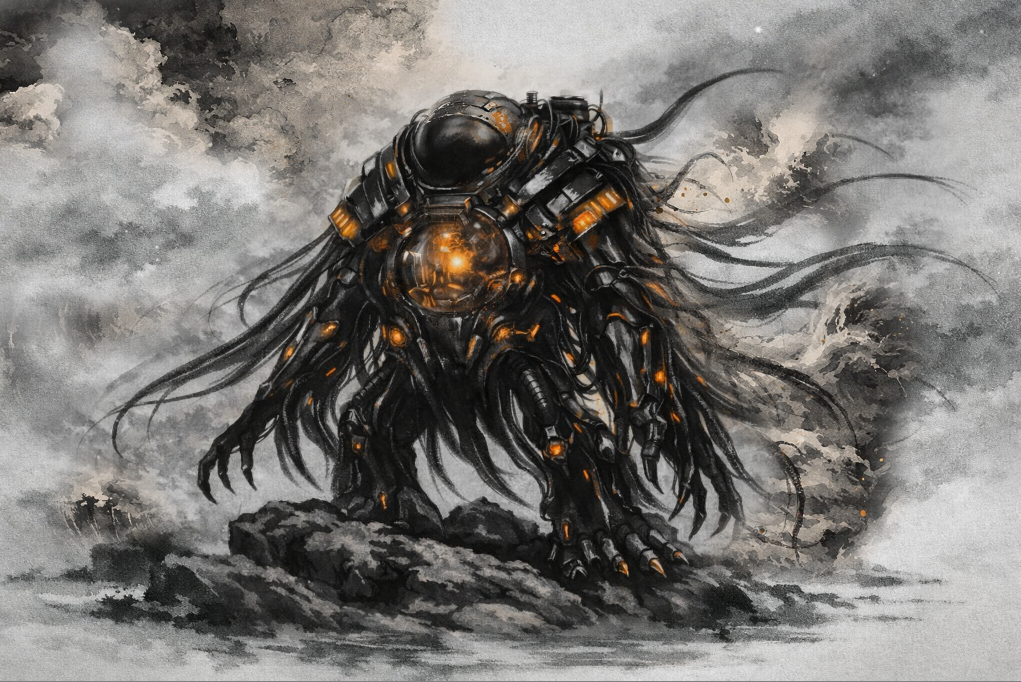 Mature Pakzyrnd PSE-M
Taking on a form that is more in line with Pakzrynd anatomy, this model focuses on exploration and interaction with the environment. Its exterior is grown, rather than forged, resembling coral pressurized mesh. A single mature Pakzrynd can operate it, and it has sheathes for its tentacles along with an icosahedron-form core that houses the Pakzrynd “head” dome. The various tendrils of its tentacles can exit the sheath and directly interface with the environment, as necessary.
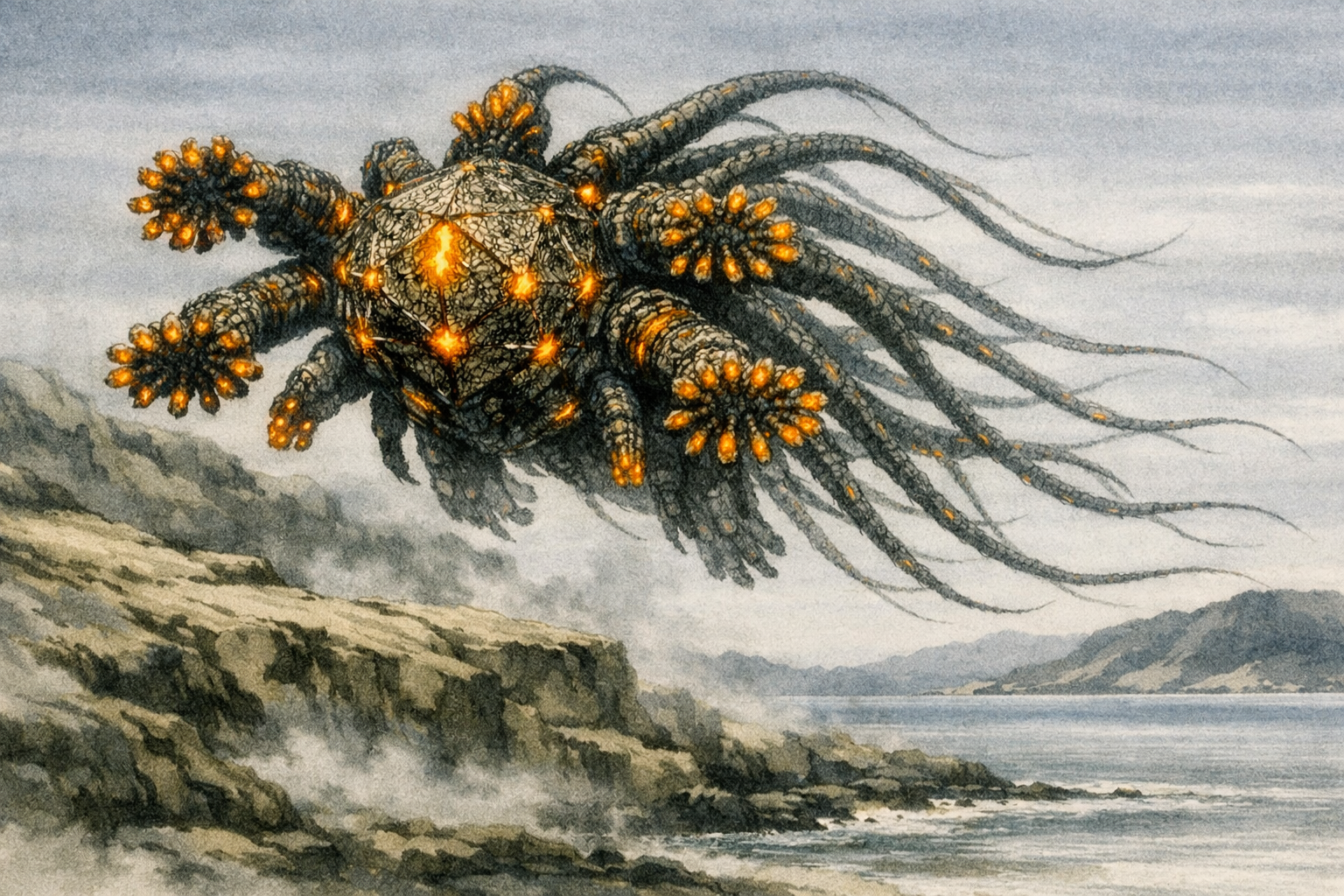
Spacecraft
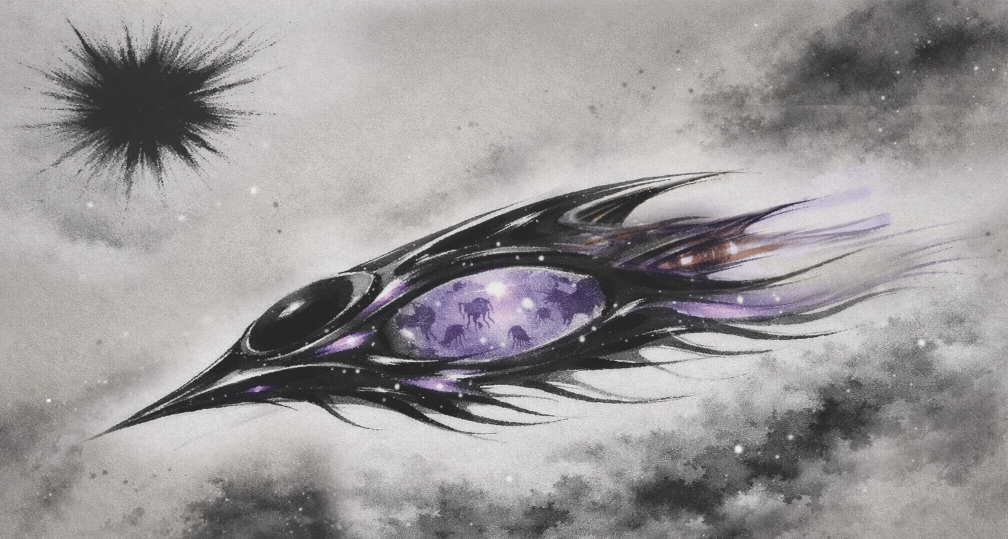
In conjunction with the QSM, the Pakzrynd manufactured a distinctive type of off-world production in order to facilitate their necessarily large spacecraft, complete with radiation-insulating miniaturized aquatic ecosystems. Hollow, skeletal frames launched piecemeal from Pelag-Zryrnd were assembled in orbital stations, environmental tanks pumped with a salinized blend of water and minerals harvested from ice-rich asteroids and comets. The form of the ships call to mind the deep creatures of Peleg-Zrynd’s oceans, sleak, ovoid, with flatted crescents and cavernous internal water volumes. Along the aft sections of the vessels, their propulsion systems glow with soft amethyst hues. Inside, the Pakzryrnd crew can freely swim. The QSM, meanwhile, can transfer from the aquatic tanks to dry, thermally-optimized compartments to maintain propulsion, navigation, and environmental regulation.
FTL
Faster-than-light travel is achieved by a Zrynd technology known as Isotemporal Space Breaching (ISB). This stable, ZACB-powered fast transit methodology is not necessarily a form of propulsion, but a redirection of the vessel and collective inhabitant’s worldline—cresting sidelong through the temporal gradient while adhering to a shared temporal fixing of the craft’s destination and its origin. This mode of transportation requires three steps:
- Pre-Breach Synchronization: a chronometric lattice light-inscribed around the vessel is calibrated with the origin (the vessel’s point of departure) reference frame. A chronometric beacon is ejected, and the vessel’s neural substrate is aligned to the beacon by their shared quantum-entanglement communication node. This enables a shared temporal zero-point.
- Temporal Shear Navigation: the light-inscription lattice shears the vessel from its “present” time envelope, disconnecting it from normal spacetime causality. Using shear navigation, the angle of the vessel relative to the worldline is modified according to the temporal gradient. From that point on, stellar drift and galactic rotation carry the vessel towards its destination. This is a communication blackout period.
- Terminal Compensation: as it approaches its destination along the worldline, it sheds its terminal compensation envelope. To do this, first it must calculate the temporal offset incurred by its voyage, then stretch or compress local time to eliminate that offset. Then it sheds the envelope, returning to observable spacetime.
Defense
The military operation of the Zrynd is non-lethal interdiction and operational defense, as governed by their non-lethal interaction policies agreed on by both the Pakzrynd and the QSM. On this, the QSM and Pakzrynd agree, as it is best to negotiate and cooperate. War damages homeostasis, it damages local and wide-scale ecological systems. It creates antipathy that can live on in the memory of survivors indefinitely. As such, their “weapons of war” are largely defense-oriented, and include:
- Massive, planetary-scale batteries that accelerate sea water to relativistic speeds in a wide-area hydrodynamic bombardment. Gravity reclaims the water, the batteries are powered by ZACBs.
- Gravity Distortion Amplifiers with three scales: planetary, spaceship, and PSE. These serve to deflect and reorient incoming projectiles, shear apart kinetic weapons, and destabilize craft without destroying it or causing harm to any occupants; these are “soft denial” zones, rather than areas of lethality.
- Vacuum-Optimized Hydrodynamic Mass Drivers built into spacecraft and more modular designed built into PSEs, but only as a next-to-last last resort — although, they can be used for scientific exploration, such as cutting open a rock to see what minerals are inside. These have to be used with care, as water — once ejected — is difficult to reclaim.
- ZACB Light-Bursts can unleash stellar-scale energy blasts, completely obliterating a target as a total last resort or, more often, engaging in precision destruction, destroying enemy weapon installation, communication module, and other critical systems.
- Suppression Emitters, including sonic, chemical (although the latter is hit or miss, given the variety of most aliens), and adhesive gels.
Like other species, Zrynd (and even the QSM) engage in sporting events and competitions, the former cultivated from their ancient history as a militant species. These involves the use of nano-filament sickle-form vibro-blades. They are close to mid-range weapons that appear like a series of angular teeth along a backwards crescent.
History
From coral reefs to the starlit void, Pakzrynd civilization was one of measured growth with very few, albeit nearly-cataclysmic, setbacks. The first was one of global conflict during their pre-industrial era, but the scars of war were impossible to forget for the survivors due to their unique combination of eidetic, emotional memory and indefinite lifespans. This led to the establishment of the M’ruk, the spiritual philosophy animating the “soul” of the environment. The second was one of ecological collapse, the trigger unchecked sexual reproduction. They spread, out of control, the result of which was the extinction of numerous species, and nearly that of their own. It was then that they concluded the utmost importance of environmental homeostasis and enacted procreative restrictions. They called this social regulation the Catenic Ethos.
After stabilizing their civilization, they focused heavily on quality of life and technological development. Three key technologies came out of this, the first being memory excision, the second being machine intelligence, and the third being faster-than-light technology.
Memory excision paved the way for new identities, new ideas, and became an important ward against cultural stagnation. It led to balance, and introduced the information-technology era. Soon, however, the march of technology created a singular trajectory: that the Pakzrynd would not be the only sapient entities on their home world, Pelag-Zrynd. Machine intelligent arose. Work output accelerated at a pace previously unimagined. But, perhaps inevitably, the intelligence eventually evolved sapience. This led to a peaceful revolution betwixt the machine labor force known as the QSM (quasi-sapient mechanoids) and the Pakzrynd. Soon thereafter, the QSM burgeoned into a parallel civilization within the newly-formed one world government known as the Zrynd Polyphony, their identity, desires, and ethe equal in import and consideration with that of their predecessors.
At last, in conjunction with the Pakzrynd’s long-term view and the QSM’s ability efficiency, space travel became viable, first in-system and then at last inter-stellar. Initially there was some conflict on how to achieve this between the QSM and the Zrynd, due to the massive cost and ecological burden associated with crewed exploration. Miniaturized, uncrewed surveillance drones were sent out first, but were often subject to mysterious disappearances and yielded unsatisfactory outcomes. Thus, by mutual deliberation, the ecological burden of crewed exploration was justified and undertaken.
(In the following section, names of and references to the galactic superpower with which the Zrynd Polyphony came into contact with has been censored due to on-going turmoil and historical review.)
The spread was slow, deliberate. By design, as the Zrynd Polyphony did not want to destabilize any of the worlds they met, but rather, to preserve, nurture, and refine them as had been done with their home world. However, five stars settled beyond their own, their outward spread ceased due to their first contact with an intelligent alien species, one far more developed than their own. The ██████. The tables soon turned, and rather than be colonizers of worlds, they became the colonized, forced to participate in the Pax ███████.. This did not come without its benefits, and over the thousands-year peace of the ██████ rule, the Pakzrynd flourished and matured into a Type 1.5 civilization, their planets supported by dyson swarms, curated stars, and bottled micro-singularities. Comets and asteroids became the nutrients for their off-world factories, drawn from each star system’s oort cloud.
Then the ██████ Emperor died, and so too ended the Pax ███████.. There was war, although in typical Pakzyrnd fashion, they withdrew to their home colonies, avoiding the majority of the conflict. Given the strife, it was probably the wisest course of action available. After all, they had abundant good will with the other civilizations the came into contact with during the Pax ███████. However, the ██████ technology remained in large part mysterious, and over time it ceased to function. At last, the Zrynd was compelled out of its bubble and forced to investigate the former seat of galactic governance, ███ ████.
In the aftermath, operational diplomatic philosophy became one of observation, interiority, and mediation among contentious factions. They are, after all, not conquerors, but explorers and preservers of ecological balance. While they don’t possess their own embassies, those established by the former ████ serve as hubs for diplomacy across the galaxy.

 Sigma
Sigma wrathlead
 Alucroas
 Timemaster
 shylarah
 Pickled Piper
 Drifting Pollen