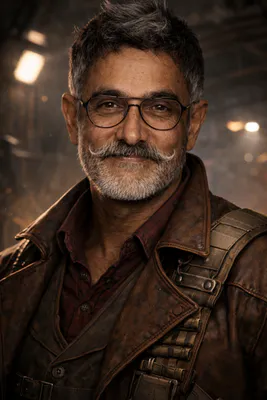
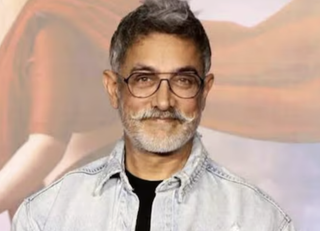
Face claim:
Name: Rashmi "Rancho" Chaudry
Sex: Male
Age: 56 years old
Occupation: Mechanical Engineer
Background: Rashmi Chaudry earned the nickname “Rancho” decades before Project Genesis, mainly as a mocking joke, during his high school days. Young Rancho constantly talked his classmates' ears off with dreams of living on a massive ranch estate with wide open spaces that stretched out to the vista of land untouched by civilization, just like the days of old Western Americana. He was relentlessly mocked of course, because the reality is there have been countless generations who were born, grew, and died under permanent smog, poisonous drinking water, and unrelenting scarcity.
While the elites designed systems from clean labs in their aerial megacities, Rancho struggled on the surface, where machines didn’t fail gracefully. They shattered, jammed, corroded, maimed and killed. He grew up surrounded by broken infrastructure and improvised survival and his first tools were all scavenged. When formal education finally came, he already understood machines in a way no classroom could teach. He became an engineer not out of ambition, but necessity to survive.
For over thirty years, Rancho kept systems alive on the lower strata in one of Earth's last megacities: air scrubbers that barely held together, water pumps that rattled like dying animals, jury-rigged generators built from mismatched parts. When corporations abandoned whole districts, it was engineers like him who worked incessantly day in and day out to keep things working with duct tape and not much else. When they failed, they had to make the grueling choice of deciding whether people lived another week or suffocated in the dark. He learned early that nothing stays fixed. Maintenance is survival. Lots of people can die horrible deaths.
When the Humanity Preservation Council announced Project Genesis, Rancho’s name surfaced without explanation. His genetic profile passed the Council’s brutal standards, but there were other notes in his file, observations from years spent maintaining systems that should not have survived.
At 56, Rancho had buried friends, family, and entire neighbourhoods. He had lived long enough to know that “second chances” always came with a cost. Still, when the offer arrived, he accepted, not for redemption, but because he refused to let humanity’s future be dictated by those who live in the skies and to maybe live to see wide-open vistas of land untouched by civilization.