
 Dane
Dane esqueleto
 xVampire3go
 KillamriX08
 Haha
Haha Nimbus
 Eventua
Union of Velorum
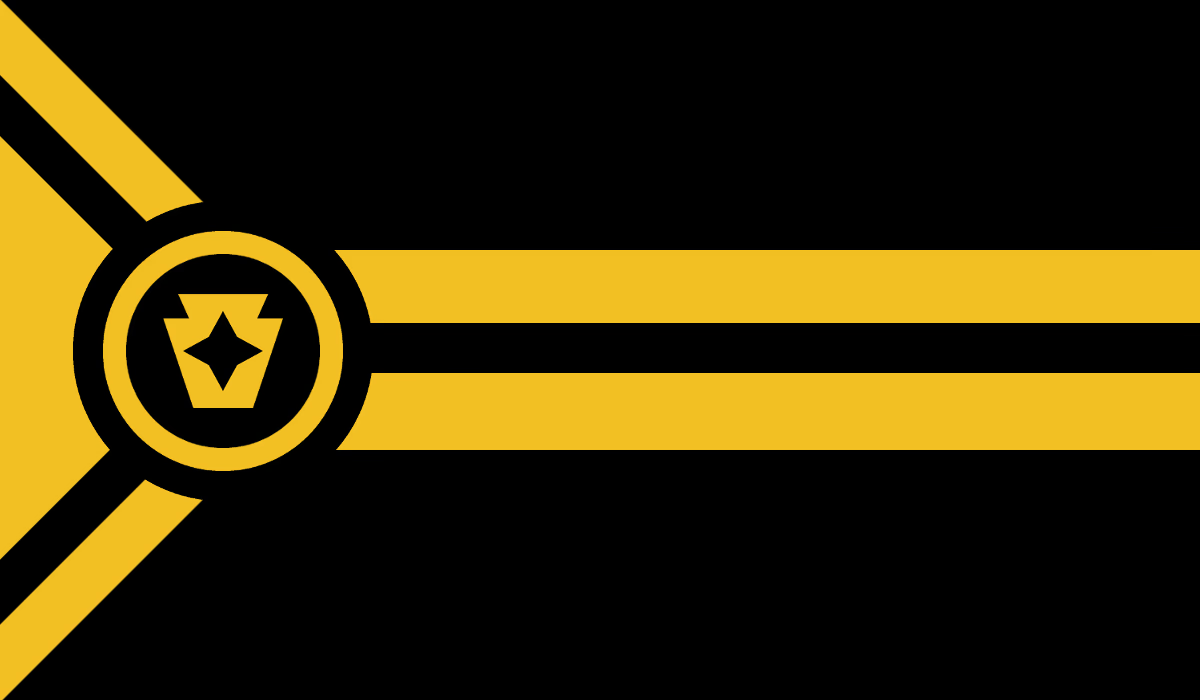
"With equal step, we move on"
Government Form:
Federal Direct Democracy
Population:
84 Million
What is humanity?:
Humanity is our past, our present and hopeful future
---
Planet/System Name and Description:
Talmian
A verdant gem resembling the Earth of a past long ago… once, now it’s a barren nuclear wasteland resembling the modern state of Earth. It has been completely irradiated and desolated, the brunt of nuclear winter has long been over and the soot has deposited on the surface, it’s commonly known and described as a Dead World.
Nansea I
The biggest moon orbiting the gas giant Nansea, it is the only celestial body partially lived in, though by few and mostly for extracting resources. It has clearly worse living conditions than the space habitats, due to being a barren moon with low gravity, nonexistent atmosphere and occasional meteor shower.
Nansea
A gas giant orbited by a ring of various moons and meteoroids.
Ulbricht
A gas giant orbited mostly by small meteoroids and dust.
Achlys
A dwarf planet influenced by Ulbricht’s gravitational pull, it is barren and extremely cold.
Praniza
A molten world, small in size and very close to the sun.
From the closest to furthest from the sun:
Praniza - Talmian - Nansea - Ulbricht - Achlys
A verdant gem resembling the Earth of a past long ago… once, now it’s a barren nuclear wasteland resembling the modern state of Earth. It has been completely irradiated and desolated, the brunt of nuclear winter has long been over and the soot has deposited on the surface, it’s commonly known and described as a Dead World.
Nansea I
The biggest moon orbiting the gas giant Nansea, it is the only celestial body partially lived in, though by few and mostly for extracting resources. It has clearly worse living conditions than the space habitats, due to being a barren moon with low gravity, nonexistent atmosphere and occasional meteor shower.
Nansea
A gas giant orbited by a ring of various moons and meteoroids.
Ulbricht
A gas giant orbited mostly by small meteoroids and dust.
Achlys
A dwarf planet influenced by Ulbricht’s gravitational pull, it is barren and extremely cold.
Praniza
A molten world, small in size and very close to the sun.
From the closest to furthest from the sun:
Praniza - Talmian - Nansea - Ulbricht - Achlys
Scrap - 24million people - orbiting Talmian
Observer - 16million people - orbiting Talmian
Deadbeat - 13million people - orbiting Ulbricht
Traveller’s Rest - 10million people - orbiting Nansea I
Quarry - 9million people - orbiting Nansea I
Radiator - 7million people - orbiting Praniza
Void Frontier - 5million people - orbiting Achlys
Observer - 16million people - orbiting Talmian
Deadbeat - 13million people - orbiting Ulbricht
Traveller’s Rest - 10million people - orbiting Nansea I
Quarry - 9million people - orbiting Nansea I
Radiator - 7million people - orbiting Praniza
Void Frontier - 5million people - orbiting Achlys
Demographics: 100% Humans, although the majority have undergone some mechanical and/or cybernetic improvements, although the level of such modifications greatly vary between individuals. Cybernetic neural interfaces are only obligatory on Void Frontier habitat, for the rest it’s completely optional.
Prosthetic Limbs are common and available to the majority since they are easy to manufacture and are pretty robust with minimal maintenance.
Artificial Organs from hearts, intestines or lungs are equally as accessible and transplanted for a variety of reasons.
Micromachines the size of human cells are used in the circulatory system to increase immunity, treat cancer or increase oxygenation.
Detectors are made to perceive and analyze what the human body cannot, like infrared, electromagnetic signals or chemical substances. Most are only attachments that can be checked from your forearm, although integrated detectors like thermal-eyes are possible they are especially expensive.
Neural Interfaces allow one to directly connect to specifically made systems, they are add ons to a human brain, causing only minor discomfort if they stop functioning.
Artificial Organs from hearts, intestines or lungs are equally as accessible and transplanted for a variety of reasons.
Micromachines the size of human cells are used in the circulatory system to increase immunity, treat cancer or increase oxygenation.
Detectors are made to perceive and analyze what the human body cannot, like infrared, electromagnetic signals or chemical substances. Most are only attachments that can be checked from your forearm, although integrated detectors like thermal-eyes are possible they are especially expensive.
Neural Interfaces allow one to directly connect to specifically made systems, they are add ons to a human brain, causing only minor discomfort if they stop functioning.
History: It was meant to be a successful colony, a mostly ideal planet with nonexistent dangers present, silos filled with two decades of supplies and even some pre-existing infrastructure, all brought down by the folly of mankind. The planet of Talmian had been colonised slowly and received small waves of pioneers while Earth was still in the process of gradually shooting itself in the leg more and more, settlements had already been established and prepared for the expected exodus.
Indeed a great Ark arrived on the planet bringing many people from the self-destructing cradle of humanity, however they also brought their conflicts and their squabbles, in just 2 years Talmian, meant to be a safe haven from the destruction, became another theater of war, the Ark would be destroyed when the first nuked was launched on the planet. 35 years since the Ark’s arrival and humanity had already forgotten their lesson, a handful of nations postured and prepared for a war fueled by old feuds and claims that would never be.
Year 36 would see the last nuke be launched on Talmian, likely by rogue elements who knew their time was nigh in the irradiated wastelands. The nations on the surface had destroyed each other in around a day and left to everyone who survived the gifts of radiation and nuclear winter, it is unknown exactly how the events transpired as such information was lost along with countless lives.
Fortunately three orbital stations had been constructed and fitted for human habitation, of these two survived, station Observer and station Scrap, with a combined population of 40.000 people, station Island was caught in posturing diplomatic crossfire and destroyed by one of the warring nations.
The following decades were brutal, survival on the stations was difficult, space was scarce and methods to quickly create new modules were limited, helping the unfortunate souls still on the surface was impossible, a thick fog of soot covered the entire planet, the very same that caused the nuclear winter. But humans adapt and in time adjusted to their new lives in the Void of space, spaceships were made to collect asteroids without need for reentry, stations would be made larger to accommodate new births and eventually brand new stations were constructed. By the time the nuclear winter subsides on Talmian, the void colonists were already moving on, swearing they would avoid falling to the same fate.
Culture and Society: The idea of a typical Union citizen is that of an industrious, freedom-loving humanitarian, obviously not everyone can live up to the expectations but this culture is ingrained in all the Habitats, with few variations that have built up through the last centuries. Daily life is generally peaceful and communal, individuals fit into their local Habitat’s culture and those who don’t can openly transfer to another.
Broadly speaking, a more communal culture based on cooperation and reconstruction is prevalent in Scrap and its colonies Quarry, Radiator and Deadbeat.
Cybernetics were first prevalent in Deadbeat and were taken a step further by its own colony Void Frontier which recently mandated neural-cyber integration for voting procedures.
Observer and Traveller’s Rest have a greater culture of self-reliance and have great emphasis on education.
---
Governance and Politics: The Union maintains a loose federal control and exclusively operates on external policy and matters which impact multiple Habitats, representatives are elected to represent each Habitat and scale to the voting population (meaning more control of Union matters is given to Habitats with greater populations). However representatives primarily fill Executive and Judiciary roles, matters of great importance are decided via Referendum, including a lot of the Legislation. This process actually takes a week at most, given the use of greater interconnectivity and communication at SOL or even FTL.
Each Space Habitat governs its internal affairs fairly independently, though they all have democratic systems, varying from representative republics to pure direct democracies to ballot electoral systems. Since the Union was formed all Habitats agreed to the principles of Peace, Democracy and Cooperation to maintain the Union and its ideals.
Technology Overview: Generally you can expect the Union to have good technology for their voidborne life, secondly the fields of computing and cybernetics are well-established but not necessarily the most advanced around. Finally their military capabilities have degraded and stagnated for centuries, even lesser are their experience in planetary construction and terraforming.
Space Engineering and Hydroponics have seen plenty of improvements as they’re necessary for life in space habitats.
Cybernetics are fairly advanced and simple mods are even common but full-bodies are still purely experimental.
Communication systems are as fast as the Speed of Light or faster (if allowed).
Artificial Intelligence is actually somewhat limited, they’ve been unable to create truly autonomous self-learning AI.
Weaponry has been left in the dust, literally, much was lost when Talmian self-immolated and the survivors in space didn’t have the need to recover such technology. Gunpowder and nuclear fission are the extent of their firepower.
Terraforming lol, lmao even. They have theoretical models but nothing proven for large-scale climate restoration.
Military Overview: Armed conflict is rare throughout the system, each Habitat maintains a small force for policing and anti-piracy, though a substantial part are non-armed counter-intelligence specialists and hackers.
Local police are usually armed with semi-automatic rifles and/or handguns.
Nuclear Weapons in Stock: 0
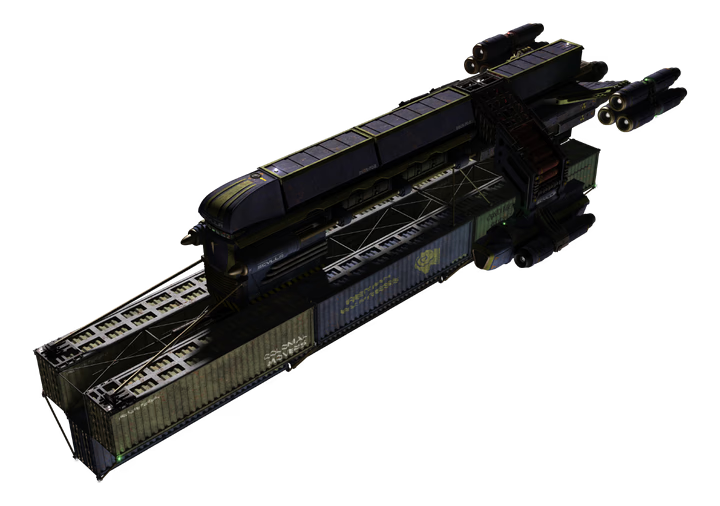
Armed with two guided missiles and a 30mm autocannon for close-range.
---
Additional Info: Peace, Democracy and Cooperation.
