Off to visit the little sister. Shall be back by Sun/Monday.
11 yrs ago
Trying to wrap my head around the new tools and bits of the site. Well done, Mahz.
Bio
Née 1991. I feel old already.
Been roleplaying from the age of 15, write on solo projects in my spare time. I heartily encourage interaction when it comes to writing and creative efforts. Like to think I'm an understanding but stern and solid GM when I host games, and a collaborative and creative individual. Used to draw. Write in advanced section.
While I might not be as omni-present a some of you are on RP:G, I have been a part of it since 2009-2010 (if my memory serves me right). However, I must admit that post Guildfall, my activity also dropped. Slowly getting back into things.
I attended university to acquire my master's degree in history. I already had an educational degree for history and English, and am teaching both in secondary school. Any questions? Ask.
I understand the RP is post-WWII (or its version of it). This is clear. What I meant was that I was willing to work out the history of my nation around yours, because yours is presumably our version of post-WWII Russia (or the closest thing to it). So if I decided to be our Poland, we could work out how I became independent, ect.
EDIT: Anyway, I'll think of something later.
Cool, let me know.
There's a period of turmoil mentioned in my nation sheet. You could've shaken your leash then.
Oh, herp. I meant post-WWII. And I was referring to yours being post-WWII, not mine.
My nation or Herp's?
All our nations would be post-WWII, with post-WWII tech and such. Time is an absolute concept. Your country might not have participated but the war still happened? I'm not sure what you're all getting at :p.
But... yes? If you want to collaborate on things.
Something like an Eastern European or Asian country it is for me, then. Thanks for the reroll.
If there is a player playing as something like post-Cold War Russia (I thought I read something like it), I wouldn't mind working something out so our histories are somewhat linked somehow.
My nation is built around the premise that the commie revolution failed and instead the old monarchy stayed in place. So I am not sure if that fits your 'post-Cold War Russia', also seeing as this is the start of our story's Cold War.
Poppin' this page's cherry. Mind you, this is a WIP. I leave it up to Seuss concerning map location. The colony/-ies mentioned are what Shadowkiller is speaking of.
Name: Najjaśniejsza Imperiya Stjurvikaya– Most Serene Empire of Sturvia
Demonym: Sturvian, Stjurvik
Description:
“Stjurvik”, as its rulers have previously called it, is a sleeping giant, with age-old traditions and ways of doing things. Here, the feudal way of life had become so entrenched that the serfs were as tied to the land as cattle, and with almost as few rights. Recent years have liberated the common folk somewhat, with reforms being introduced slowly. It is a vast, deeply conservative and religious country: Mother State and the Church are the two pillars of national belief. The Tsar may be the father of his people, but by tradition and practice he is a stern parent. Ivan the Terrible was well named, and he has not been the only ruler with an iron will. Sturvia needs a strong hand controlling the nation.
Now, however, Sturvia is changing, awakening. It is beginning to look outwards again, towards the best that the rest of the world has to offer in terms of ideas, culture and might. These things must be introduced carefully, to avoid the ills of free-thinking that beset some other nations. When Sturvia does fully realise its old strength, however, it will be formidable indeed. It has boundless resources to draw upon, and the steadfast courage of its people to bolster its armies. It can be a formidable foe, and a difficult one for an enemy to attack. One thing that Sturvia does have is space, and defensible frontiers. Invaders have paid dearly to cross into the Rodina or Motherland.
Being a great power is not easy, as any Sturvian will proudly tell you. The burden of leadership falls on their shoulders, whilst they have to contend with malcontents, upstarts and separatists who seek to tear order asunder. Just prior to the great conflict of the 1940s, the Sturvian Empire experienced a dangerous period of collapse and civil unrest – though some might recall it being more of a civil war. Some colonies had to be surrendered, for the Sturvians realise all too well that for the body to survive, limbs might have to be removed.
Ragged and tattered, the flags of Stjurvik were raised pompously aloft after the Tsar’s forces prevailed over the extremist rabble that had sought to overthrow him and his family. With the Empire’s military prestige repaired, the grand nation then plunged head first in the war which had set the world aflame. It did not, however, resurface unblemished and old resistances have started to flare up, accusing the reactionary regime of warmongering and indifference towards its subjects. Indeed, the ‘voice of the people’ can be heard recurrently in the streets of the cities, and protests occur frequently. Due to the role the army played in suppressing the revolts of the 1930s, increased presence in the streets and failure to assert Sturvian dominance, military popularity has plummeted.
At the cusp of the second half of the twentieth century, the Rodina prepares to pave its path forward. As of yet the nature of its future is still unclear, but not uncertain. While the Tsar has his goals set, he tries to buy the population’s support by emancipating the previously oppressed peasants and serfs which have forever formed the backbone of Sturvia’s agriculture.
Government: Absolute Monarchy with recent constitutional reforms that allow for local representation (via regional parliaments) and the emancipation of serfs.
Head of State: Tsar Dimitor II Pyot Karenov (46)
National Anthem:https://www.youtube.com/watch?v=umEDct4BoGcEconomy: (Just describe the major industries and how they are organized.)
The Rodina is first and foremost an agricultural nation, with only recent –if successful- forays into the land of industrialisation. Vast fields dominate the countryside, crops reaching as far as the eyes can see, painting the land golden in late summer. Wheat and comparable crops form the mainstay of the produce, while cabbages and potatoes form a solid second with local specialisations pursuing the production of flax, beets, onions and fruit orchards. Where the land grows rougher great herds of cattle and flocks of sheep roam the grasslands.
While not dependent on food imports, the same cannot be said for other things. Nevertheless, investments have been made in the industrial infrastructure, which results in a growing economy and improvements concerning production processes and output. Foreign experts are a welcome sight in Dimitor’s Sturvia, on the proviso that they are placed under close supervision lest they spread dissent among the growing worker’s class.
Mining has been a tried and tested field of Sturvia’s market, with access to iron, copper, chromium and other useful metals and resources, as well as some rare materials boosting the economy. However, Sturvia’s main natural resource that could take the world by storm now it grows more and more dependent on it, is oil. Stjurvik’s oil and petroleum deposits are seemingly endless and easily exploitable, acting as a literal and figurative lubricant for the nation’s improving industries.
In order to ‘unshackle’ Sturvia’s countryside from its age-old isolation, Tsar Dimitor II has organised the Imperial Railroad Initiative. Other factories and business conglomerates are also owned by the government or ancient aristocracy, but there is an increasingly important bourgeoisie. The middle class has recovered from the turmoil caused by the massive war and the relinquishment of some of Sturvia’s colonies, and is now rearing its head on the domestic market.
National Religion:
Sturvians are monotheists, believing in God as creator of the world, which he has placed under the care of seven holy beings or angels, the chief of whom is Melek Taus, the Peacock Angel, who, as world-ruler, causes both good and bad to befall individuals, an ambivalence reflected in myths of his own temporary fall from God's favour, before his remorseful tears extinguished the fires of his hellish prison and he was reconciled with God. The faith is known as Tausism. The Tsar is considered the earthly representation of the divine by hardcore believers. Other angelic entities are made manifest in a bear, wolf, dragon, unicorn, eagle, stag and hedgehog.
Population:86,000,000Geography:
(PLEASE be sure to identify where on the map you are, preferably by posting a clip of the region you wish to occupy. We may have to move you around to make it work. Don't be shocked if you don't get all the area you requested.)
Demographics:
By far, ethnic Sturvians are the most numerous among the millions of the Tsar’s beloved people. Naturally, regional differences and dialects exist, but they all identify as Sturvian. Other than some fringe-communities along the Empire’s borders, immigrant numbers are negligible. However, there are several smaller ethnic groups who have been part of Stjurvik for several centuries, their lands conquered from the 15th Century onward. The last notable expansion in the late 18th Century saw the incorporation of the Hettacks, a warlike people living in the south of what is present day Sturvia.
The Hettacks are far from a unified people, and live in semi-military communities occupying sparsely habited regions. There are approximately one million Hettacks, divided across a number of regions. Their way of life is semi-nomadic, or semi-sedentary depending on how one looks at it, and excellently suited for the steppe and highlands they call home. By the late 18th century, Hettack hosts in the Sturvian Empire occupied effective buffer zones on its borders. The expansionist ambitions of the Empire relied on ensuring the loyalty of these warrior Hettacks, which caused tension given their traditional exercise of freedom, democratic self-rule, and independence. Indeed, widespread dissent is not solely occurring in the cities, but also in the marches where some ethnic Hettacks demand increased self-government, as they had weathered the brunt of the war effort in the 1940s.
Another noteworthy ethnic group are the Zechi, some ten thousand strong, who live in tribal communities in the mountainous wilderness. Some of them are put to work in the mines, while others mostly focus on hunting and forestry. Relations between Sturvians and Zechi are tenuous at best, but the mountainfolk are too few in number to be a true threat.
Sturvensk – capital city
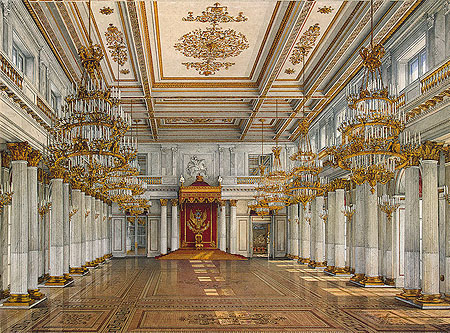
The cultural and political centre of the country, nestled on either banks of the Okriv River and hugged by small industrial towns and rich farmland beyond. Operas, museums and prestigious institutes dot the marble cityscape, statues new and old line the avenues. The Sturvikaya Reserve, Military Academy, civic college and university and a variety of ministries sprawl out along Salvation Square, in the shadow of the Imperial Winter Palace. For it is prohibited that any building is higher than the palace. Sturvensk has a long and rich history, and is supposedly the birthplace of the Empire. The capital even sports a decently sized port, the river itself widened to allow better access to the ocean and Sturvensk’s sister city. All railroads lead to Sturvensk, and so most goods and traffic must pass through or along the Tsar’s city.
The Imperial Winter Palace has been considered a manmade wonder for a long time. Construction began at the end of the 17th Century, with new additions per royal generation. The wealth of a nation makes for a most impressive building indeed. Adjacent to it stands the renovated Kremen, built on the old fortress. The Kremen functions as the seat of government.
The “Old Fathers of State” convene in the National Assembly, a misleading term since most of its members consist of landed gentry, with recent appointed members being industrialists and nouveau riches. It is mostly a platform of discussion, since the true power of the Empire lies with the Privy Council. Within certain legislative restraints, the Assembly may suggest and ratify laws, though it is more often than not the metonymical Kremen which dictates said laws.
Duma – major port and gateway, second city of the Empire,
The city of Duma lies at the head of the Okriv river and functions as Stjurvik’s main centre of export and commerce. In addition to its strategic and economic position, Duma is also the home of the Admiralty and navy. The Admiralty coordinates both the naval forces and mercantile shipping. If Sturvensk is the mind and beating heart of the Empire, then Duma is its muscle. Especially the harbour and northern districts are strongly industrialised, with many petrochemical facilities and heavy factories.
Regime Personalities
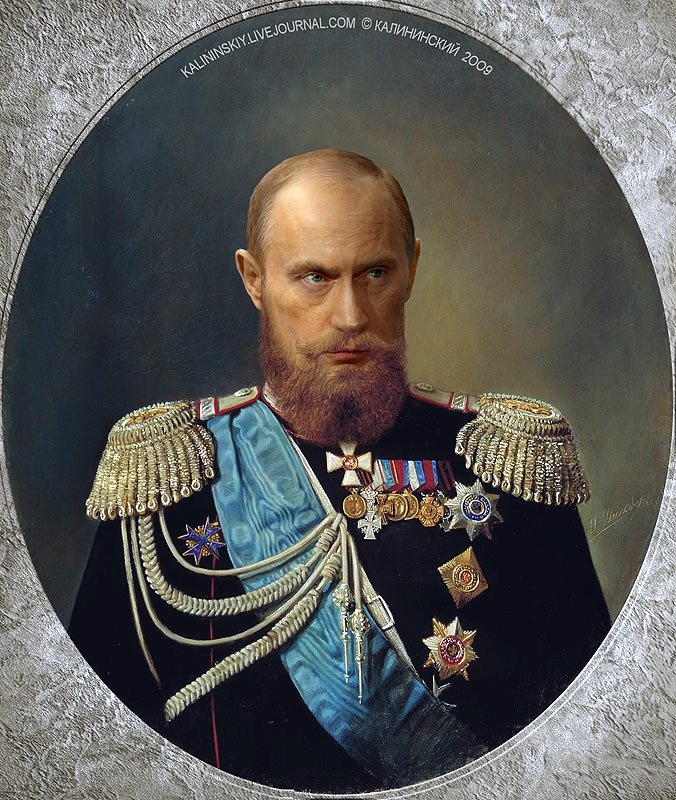
Tsar Dimitor Pyot Karenov (46) -
Tsesarevich Yvan Dimitor Karenov (21) -
Institutions
(Major institutions of the nations, such as legislative bodies, corporations and, most importantly, the military.)
The Privy Council – comprised of people endowed with antiquated titles who are in immediate contact with the Tsar. Other members include top brass of the military, State Secretaries, the executive of the Sturvikaya Reserve, and otherwise appointed intimi.
SIH - The royal family is the majority stakeholder in the Stjurviki Imperial Holding, an overarching syndicate that operates several daughter companies and corporations including but not limited to:
Okrivi Canneries
Pentastar Shipping and Logistics
Vikanjov Industries and Automobiles
Karenov Materials
National Railroad Initiative
Military NumbersActive Duty Component Total: 1,150,000 (1,000,000 NCOs and soldiers, 150,000 officers)
Army:
Divided into divisions but recently moving towards smaller battle-groups capable of operating independently. In general, Sturvian divisions are comprised of four regiments of around 3,000 men strong. Because of this, the use of brigades overlaps, though ad hoc brigades can be formed from two or more regiment size units.
Infantry equipment is homogenous, as specialisations are only now starting to happen. Most infantrymen are armed with bolt-action rifles or carbines (Mosin-Nagant, Kar, Lee-Enfield - 7.62×54mmR), while individual roles can be equipped with various apparel such as semi-automatic machine pistols (think MP44 or PPSH), anti-armour, semi-automatic carbines (SKS, or short range shotguns. Elite regiments or units, such as stormtroopers, are outfitted with state of the art assault rifles, for it is clear this is the way forward. All in all, the Sturvian army is a solid all-rounder, counting on its size and strength, with a recent development towards specialisation.
Self-propelled artillery is the supposed norm, but due to the sheer size of the Sturvian army, at least a third of all units still works with towable artillery pieces. Logistically, the Imperial Army is a powerhouse, with heavy investments made in apparel, motorised units and convoys to maintain supply lines. There were lessons to be learnt from the recent conflict, and Sturvia has taken them to heart.
Navy:
Air Force:
Other: (Such as KGB/Waffen-SS/Pasdaran/Other type troops -- internal security, or paramilitary forces) 100,000 Hettack irregulars
Superpower;
Population Density (Population - 86,000,000) -Adequately Populated; Some manpower for economic and military purposes, and social infrastructure is only under some pressure. Educational costs and civic projects are affordable.
Economy -Rapid Growth - The economy is performing well according either to design or accident, or a happy coincidence of both, and this situation puts money in the coffers of the nation and confidence in its citizens
Industrialization -Semi-Industrialized: An established industrial complex is present in the nation.
Domestic Technology -Modernizing: The industrial infrastructure is in the process of improvement, and this is a teething process. But the economy is seeing increased activity because of this investment. New technologies are becoming domestically available. However, there is a degree of dependence on imports, including in terms of the expertise to modernize the economy.
Educational Institutions -Comprehensive Public Primary Schools, Merit/test-score based secondary education (Trade/University Prep), and Private Universities
Domestic Political Stability -Widespread Protests Common
Mineral Deposits -Moderate deposits of iron, chromium, copper and the like.
Valuable Mineral Deposits -Trace deposits of rare earth metals, and platinum. Petroleum Wells -Vast Petroleum resources, that are easily exploitable.
Fissible Material Deposits -None
Military Recruitment -All Volunteer Force Military
Reliability -Racially Homogenous
Military Size -Large, relative to population: requires considerable upkeep, harder to equip/supply quickly.
Military Technology -Rapid Modernization Military Training and Morale -Decently Trained; High Morale
Military Leadership -Semi-Competent; Rose to their positions through a Military Academy
Military Popularity -Unpopular
Secret Services -Incompetent Secret Service; Loyal
I've been mulling that over, torn between something Asian or Slavic inspired, but definitely communist flavoured. There are widespread protests in my nation according to the roll, so think reactionary Russia dealing with upstart commies and anti-monarchists. What are you going to do, Boerd? Perhaps we can then start with creating two different ideologies.
@Sini
@So Boerd
Would either one of you be acceptable with my nation being a former colony of one of yours? My current take on my NS history is that it fought a revolutionary war for freedom against their colonizers from 1929-1935 being the first successful revolution in the world in which a conquered native people kicked out the foreign power that colonized/conquered them.
Depending on your nation (upon which is based on a RL nation) it will effect its name and culture etc.
Since Boerd declined, I'll say yes. From what I have of my history, that could tie in with a revolutionary movement on the homefront. Pulling back from fringe territories/colonies coincided with the formation of the new regime (or the beating down of rebels). Imperial overstretch wrecking havoc all around. I'd say my nation has been on the rebound since the latter part of our World War II equivalent.
Née 1991. I feel old already.
Been roleplaying from the age of 15, write on solo projects in my spare time. I heartily encourage interaction when it comes to writing and creative efforts. Like to think I'm an understanding but stern and solid GM when I host games, and a collaborative and creative individual. Used to draw. Write in advanced section.
While I might not be as omni-present a some of you are on RP:G, I have been a part of it since 2009-2010 (if my memory serves me right). However, I must admit that post Guildfall, my activity also dropped. Slowly getting back into things.
I attended university to acquire my master's degree in history. I already had an educational degree for history and English, and am teaching both in secondary school. Any questions? Ask.
<div style="white-space:pre-wrap;">Née 1991. I feel old already.<br><br>Been roleplaying from the age of 15, write on solo projects in my spare time. I heartily encourage interaction when it comes to writing and creative efforts. Like to think I'm an understanding but stern and solid GM when I host games, and a collaborative and creative individual. Used to draw. Write in advanced section.<br><br>While I might not be as omni-present a some of you are on RP:G, I have been a part of it since 2009-2010 (if my memory serves me right). However, I must admit that post Guildfall, my activity also dropped. Slowly getting back into things.<br><br>I attended university to acquire my master's degree in history. I already had an educational degree for history and English, and am teaching both in secondary school. Any questions? Ask.</div>