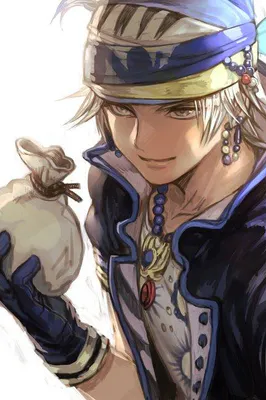
Name: Captain Aghilas Jêle Doeli Species: Addonian Sex: M Age: 35 Allegiance: Black Wyvern / Himself Appearance: Tall, imposing, with sea green eyes framed by dark hair and a large bushy beard. Standing 6'5", 235lbs, he's broad shouldered and usually wears a finely tailored, short cut, black satin-silk robe with silver trim. He wears a deep violet head-wrap, made of the same satin-silk, with a tight matching waist-wrap/shoulder sash, which carries a decoratively hilted nimcha, along with 4 flintlocks.
Backstory: Aghilas 'the Doel' was born son of a Doel slave-servant and an Addonian father he never met who promised to buy his mother's price, but never returned. As a young boy he was taken to sea as ship boy before his 10th year, growing up at sea aboard corsairs. Despite being a slave, Aghilas grew into a large, powerful young man respected among the crew, and a favourite of the corsair captain. It was during this time Aghilas was groomed as a lieutenant, and, in a turn of affairs neither he nor the crew talk about much, elected Captain after the position was abruptly 'vacated'.
Captain Aghilas, or 'the Doel' as he is sometimes called (despite looking quite Addonian), quickly became one of the best known Addonian Corsairs. Rumours abound however that he has recently had a falling out with several local Addonian princes not offering him and his crew their 'due' - with the result that the al-Marid sailed into Mina-Sakh with several suspiciously Addonian looking prizes, laden with slaves, booty. He and his crew have spent their time in port spending freely as the al-Marid is being refitted, and developed a sudden keen interest in his Doel heritage and sailing to the Calarian Main.
A larger than life figure in the piracy world there are some who've described him, at times, as 'a bit much.' Last anyone had heard he'd left the Circle Sea to terrorize the Calarian Main. His sudden appearance in Inburian waters under the banner of the Black Wyvern is an unwelcome sight for many merchants and naval men of the Circle Sea.
Name of Ship:Hamsat al-Marid Type of Ship: Xebec Rigging: Three masted xebec rigged, unusually for the time, with large bermuda rigged sails and copious jibs and other sails mounted for maximum sail area as well as trimming against the wind. Crew Compliment: ~100 Cannon: 17 - 14 12pdrs on a small gundeck - 3 4pndr swivel mounts, 2 fore, 1 aft. Description:Hamsat al-Marid, often simply called Hamsat or al-Marid is around 35m in length, a beam just over 8m, and a draft that ranges between 3.5. Displacing just under 200 tons, she has a sleek, streamlined hull. Less obvious to the eye is an expensively retrofitted and as yet uncommon copper sheathed hull, along with a wider, longer keel than typical for xebecs for better stability with her large sails and in heavy seas. In light to moderate seas under full sail she's fast enough to give even fast frigates a run for their money with the wind and when in doubt, she excels in crosswinds and sailing close to the wind for an escape. Struggles a little in heavy seas when stability demands cut into her speed.
Skills: Imperial Tutor - Ashryn is governess noted for her poise and way with young children, in addition to being a learned and capable tutor; regarded as one of the most sought-after governesses in the Haltian Empire, though for her career as such she's been exclusively in the employ of the Haltian Royal Family.
A Very Particular Set of Skills - Dame Ashryn is regarded by virtually the entire court as something of a harmless old biddy whose talent with children have somehow landed her in far greater esteem among the imperial family than her talents warrant. And while the conventional wisdom is that her bark is much worse than her bite, though she herself much prefers her role educating imperial family members in the finer arts, even while ostensibly retired Dame Ashryn is a high matriarch of the Order of the Shrouded Blade.
Weaknesses: Controlling - Dame Ashryn has had a privileged position within the Corfina household for generations now, having been close to both the former emperor as well as being the governess for then Prince Orrian. She can be both unapproachable and inflexibly arrogant even among those ostensibly her betters.
Perfectionist - Ashryn is a consummate perfectionist with exceedingly high standards and has been known to induce considerable anxiety not only in her charges, but those around her generally. She has also been accused of being abrasive in her own congenial fashion.
Background:
Backstory: Ashryn and her husband were close confidantes of Emperor Volon I before and during the Imperial conquest of Inburia, and while her husband was generally credited with being one of the Emperor's most trusted blades - and secretly a founding member of the Order of the Shrouded Blade - it was in truth something of a family affair, with Ashryn's role remaining largely uncredited. Some time after the death of her husband, Ashryn apparently entered a state of at least semi-retirement and was appointed governess (and presumably secret bodyguard) overseeing the education of Prince Orrian. As Orrian grew older her presence among the Western Court was increasingly less tolerated, and Orrian himself had grown to resent Ashryn's occasionally overbearing presence.
Since then she's been employed primarily by Orrian raising his own children, and reputed to be an extremely capable governess. She's spent the last decade or so fostering one of Orrian's youngest daughters, Princess Ilyana. One of Ashryn's final duties in this role is accompanying, and protecting, the now of age princess to a marriage ceremony with an influential duke of the Eastern Empire whom Orrian is looking to lure to the Eastern cause.
Name: Folwin of House Virlaeth, Duke of Planina, Special Advisor on the Council of Foreign Affairs Species/Race: Elgafolk Sex: Male Age: 473 Court Alignment: Eastern Imperial Court Role: Noble Diplomat - Financier Appearance:
Skills: Internationally Connected - The Duke of Planina is a longstanding fixture of the Haltian Imperial Court, having served (and been dismissed) from several prominent roles over the years including having served lengthy stints as Chancellor, Secretary of Foreign Affairs and Secretary of the Exchequer. He has extensive contacts with courts and families all over the Circle Sea. Diverse Holdings - The Duke of Planina was an early adopter of mercantile principles and rumoured to be the wealthiest family in the Haltian Empire. Financially adroit, and possessing assets and engaging in matters of private finance all over the Circle Sea.
Weaknesses: On the Outs - Duke Virlaeth has experienced so many 'falls from grace' at this point that it would be extreme to say he's truly fallen. However Virlaeth resigned from his senior post as minister of finance after reforms aimed at easing tensions between the Eastern nobility and the client human population failed. Another point of contention with the former emperor and court was the accusation that he'd been evading taxes by moving assets offshore through his private finance interests. Conflict Avoidant - Duke Virlaeth is no longer a particularly young man, preferring to leave conflicts, and roughing it in the field to younger men. Moreover at this point in his career, he studiously avoids giving offence on any front and has the money and resources to take the long view on all manner of things, something he is frequently criticized for among other members of the court.
Background:
Backstory: Folwin of Clan Virlaeth was once something of a renegade chief in his younger days, whose family had grown fat with foreign trade rather than raiding. Nonetheless when Inburian weakness was revealed by a series of successful and lucrative raids, he became one of the first voices lobbying for a unified invasion. Being familiar with the political and cultural situation inside Inburia he rose to prominence as one of the architects of the Imperial system as practiced.
Despite his ups and downs and occasional clashes with Volon I, Virlaeth had enjoyed the confidence of the former emperor, frequently filling senior roles, including several stints as chancellor, minister of finance and minister of foreign affairs. He was closely tied with the former emperor's policy of centralization over the past century or so, which combined with his promotion of humans to significant offices within the administration, and his house's status as one of - if not the wealthiest - in the empire(and perhaps on earth) he's something of an unpopular figure among the other high houses of the Haltian Empire.
In spite of this there are some who see him as a stabilizing figure and moderating influence within the Haltian Empire. His frequent clashes with both claimants, who see his influence as overbearing, was another reason for him being forced to resign from his cabinet position.
At this point he serves as a special advisor within the foreign ministry, largely seeing to his own affairs while avoiding significant contact with the Imperial Court. With the empire in crisis, and badly in need of funds, few expect him to remain in the doldrums for long.
Rudy nodded in affectation of sympathy at the gravedigger's plight. "Those are being retrieved now, don't worry yourself on that account sir. But I think I'd like to see the area all the same. You see, it occurs to me that to have killed so many right in this same, patch of cemetery. Not two hundred meters that way in the back alleys but right here. Right in your back yard so to speak. And you haven't noticed or seen anyone unusual wandering the grounds?" Rudy nodded again. "I think you'll admit, whoever is responsible, he's got to have some sort of system. Otherwise he'd have been noticed or caught already. And if I can just figure out his trick, well, then we figure out our killer now don't we? That's my thinking anyway."
Name: Captain Aghilas Jêle Doeli Species: Addonian Sex: M Age: 35 Allegiance: Black Wyvern / Himself Appearance: Tall, imposing, with sea green eyes framed by dark hair and a large bushy beard. Standing 6'5", 235lbs, he's broad shouldered and usually wears a finely tailored, short cut, black satin-silk robe with silver trim. He wears a deep violet head-wrap, made of the same satin-silk, with a tight matching waist-wrap/shoulder sash, which carries a decoratively hilted nimcha, along with 4 flintlocks.
Backstory: Aghilas 'the Doel' was born son of a Doel slave-servant and an Addonian father he never met who promised to buy his mother's price, but never returned. As a young boy he was taken to sea as ship boy before his 10th year, growing up at sea aboard corsairs. Despite being a slave, Aghilas grew into a large, powerful young man respected among the crew, and a favourite of the corsair captain. It was during this time Aghilas was groomed as a lieutenant, and, in a turn of affairs neither he nor the crew talk about much, elected Captain after the position was abruptly 'vacated'.
Captain Aghilas, or 'the Doel' as he is sometimes called (despite looking quite Addonian), quickly became one of the best known Addonian Corsairs. Rumours abound however that he has recently had a falling out with several local Addonian princes not offering him and his crew their 'due' - with the result that the al-Marid sailed into Mina-Sakh with several suspiciously Addonian looking prizes, laden with slaves, booty. He and his crew have spent their time in port spending freely as the al-Marid is being refitted, and developed a sudden keen interest in his Doel heritage and sailing to the Calarian Main.
A larger than life figure in the piracy world there are some who've described him, at times, as 'a bit much.' Last anyone had heard he'd left the Circle Sea to terrorize the Calarian Main. His sudden appearance in Inburian waters under the banner of the Black Wyvern is an unwelcome sight for many merchants and naval men of the Circle Sea.
Name of Ship:Hamsat al-Marid Type of Ship: Xebec Rigging: Three masted xebec rigged, unusually for the time, with large bermuda rigged sails and copious jibs and other sails mounted for maximum sail area as well as trimming against the wind. Crew Compliment: ~100 Cannon: 17 - 14 12pdrs on a small gundeck - 3 4pndr swivel mounts, 2 fore, 1 aft. Description:Hamsat al-Marid, often simply called Hamsat or al-Marid is around 35m in length, a beam just over 8m, and a draft that ranges between 3.5. Displacing just under 200 tons, she has a sleek, streamlined hull. Less obvious to the eye is an expensively retrofitted and as yet uncommon copper sheathed hull, along with a wider, longer keel than typical for xebecs for better stability with her large sails and in heavy seas. In light to moderate seas under full sail she's fast enough to give even fast frigates a run for their money with the wind and when in doubt, she excels in crosswinds and sailing close to the wind for an escape. Struggles a little in heavy seas when stability demands cut into her speed.
Species/Race: Human Inburian-Morktree native Sex: Male Age: 40 Court Alignment: Red Wyvern Role: Colonel / Warrior-Priest Appearance:
Strengths and Weaknesses
Skills: Firebrand Leader - Skotinódasos is a leader of zealous religious movement and draws to himself a collection of people from different walks of life, skills and abilities in a more or less organized religious network of close fanatics, less extreme followers, casual supporters and loose associates clustered throughout the Morktree interior and Inburian lands.
Partisan Knowledge - Skotinódasos has spent years eluding Imperial patrols and agents throughout the Morktree-Inburian borderlands and knows not only the terrain well, and knows the smuggling routes routes through the border areas very well.
Healing Magic - Skotinódasos manifested healing magic as a young man, and sought training amongst the tribal shamanic traditions of his maternal family within the Morktree interior
Organizer - Despite a lack of formal education, Skotinódasos has proven to possess a combination of energy, charisma and attention to detail that have made him a surprisingly effective organizer.
Weaknesses: Not A Soldier - Despite having undeniable presence and a distressing lack of fear, even on the battlefield, Skotinódasos isn't a soldier. He's not actually all that effective with either a firearm, pike, or any weapon at all for that matter. Nor is he, himself, a skilled or inspired tactician or strategist.
Enemy of the Church - Skotinódasos has been outspoken about the cozy relationship between the church and the Haltian occupation frequently highlighting the many ways the traditional faith-keepers of Inburia have thrown in with the Haltians and the total dearth of clergy amongst the rebels and agitators. His hostility has been amply returned.
Extremist - Skotinódasos active manipulation of pent up anger, rage and violence is alienating to those who've been insulated from the causes of these issues. Others worry about the growing influence former quarry slave has amassed for himself. He's bound to clash with enemies and allies alike.
Background:
Backstory: No one really knows Skotinódasos real name. He claims to have been born a slave and worked a quarry, thus he is often called 'Stone Breaker' as well. He also claims he descends from a mongrel family line of Inburians on his father's side and Morktree natives on his mother's - with some elgan and skultan ancestry. It is the Morktree line of his family that he attributes his magical abilities, but all of this is his own retelling.
What is known for sure is that a man matching Skotinódasos' description is referenced with Watcher reports connected to groups of escaped slaves engaged in agitation and banditry along the Morktree borderlines.
Initially considered a benign presence among the free-slaves compared to the more problematic forest and hill bandits he circulated with, many local and regional Haltian figures initially turned a blind eye to the shamanic priest and his followers. It was felt the secret slave meetings in the woods and quasi-religious services and healing helped settle the workers and that religious instruction would produce better, more docile slaves.
After a few years however, increased tensions and rising numbers of angry slaves and peasants fleeing the lands led to crack-downs on Skotinódasos healing cult. Unlike many previous bandit chiefs, Skotinódasos proved an elusive figure to track down even within imperial provinces. The peasant and slave populations greatly valued his religious teachings, and especially his healing magic, with many stories of him healing sick children and family members. Watcher reports bitterly complain that it was nearly impossible to move on him without locals, and even otherwise reliable informants became unreliable where Skotinódasos was concerned.
The crack-downs coincided with Skotinódasos turn towards more radical sermons and teachings. Increasing incidence of violence on both sides seemed to coincide, just ahead of the revolt, with Skotinódasos beginning to preach for a hard breach between humans and elgans in Inburia, and for the first time calling for a violent war of righteous retribution.
Skotinódasos was an attendee to the founding meeting of the Red Wyvern conspiracy. The only one present from a working slave or peasant background, his attendance only happened because he was already a well-known figure, and one of the organizers who'd attended on of his secret sermons invited him. His calls for a wider revolt among peasants and slaves led to him being largely side-lined during the affair. Skotinódasos was not invited to future meetings, and was rarely informed of the conspiracies wider plans.
Nonetheless he continued to be an invaluable contact for many. Though lacking in formal education, the self-taught priest proved to be a remarkably capable organizer that many of the Red Wyvern leaders found indispensable; his contacts and ability to navigate and arrange clandestine passage for both men and materiel being extraordinary. Despite this, he had no formal role in the organization and his contributions were anecdotal while he continued his own movement.
Skotinódasos was caught off guard when the Red Wyvern banner was raised, as he assumed he would be informed ahead of time.
He and what followers arrived at the Red Wyvern camp, finding it in a state of general disarray. As he and his followers possessed no military training or experience to speak of, he was largely relegated to a camp follower role, tending the wounded. Despite lacking any command authority to do so, he devoted much of his spare time to trying to help shore up badly mismanaged logistics while providing intelligence from his contacts. He was frequently reprimanded by army leadership, both for the break in discipline and concerns his followers comings and goings would compromise the camp to the Haltians.
Tensions continued between the priest and prominent Red Wyvern leadership figures. His supporters argued he provided badly needed moral and direction to the army, and his contacts and partisans were not being properly utilized. His detractors argued the man's promotion of unfettered violence among the slave and peasant populations did more harm to the cause than his merits could support.
Ahead of the Battle of Rodelkog, Skotinódasos held his largest sermon yet in which Elga prisoners taken by his partisans and smuggled into the camp were sacrificed. Though many were put off by this, many peasants and slaves availed themselves of the grand ritual he offered - promising to use his magics and the favour of heretical gods and spirits to weave protective magics that would protect men variously from spirits of fear that weakened men's hearts, and that would protect those of the faith even from Imperial bullets.
In spite of his obvious popularity - or perhaps because of it - Skotinódasos was assigned to the rear of the battle, healing the wounded and away from the fighting.
He did not stay there.
Amidst mounting, catastrophic losses the story goes that while treating the wounded, the makeshift station they'd setup was beset by men routing from the imperial forces.
Enraged, Skotinódasos and some of his supporters abandoned their posts to harangue, harass and - allegedly - beat these men back into and impromptu battle line. Many of the particulars of what occurred are pure fabrications by Skotinódasos or his followers, but many of the broad details remain based in fact.
One of the most often and vividly encountered memories of the battle shared by rebel and imperial survivors alike involve the so-called 'Mad Priest'. Most everyone recalls some story of this man, face beat-red, yelling like a lunatic while leading unarmoured and barely armed slaves and peasants through roiling clouds of smoke, tripping over bodies of their dead comrades in wave after awave after wave against armoured and disciplined imperial troops while the chanting of "Elefthería í Thánatos" - Liberty or Death - was said to be so loud that it drowned out the sounds of volleyed gunfire.
Skotinódasos himself was wounded three times. Men say the third time he was shot, he collapsed as though dead, and while he was carried from the battlefield, a young field slave named Georgios rushed from the lines to take up his place and led three more pushes against the line before he too was shot.
Cementing his legend, Skotinódasos allegedly came to and recovered enough to dramatically reappear in the final stages of the battle; having rallied yet another band of men to join the final push.
Though publicly affirming the result to be a vindication of the gods' and spirits' support of their righteous cause - privately Skotinódasos viewed the battle as a total and complete debacle, having witnessed the lack of preparation, organization and incompetence of leadership among the Red Wyverns first hand. Thereafter he was by far the loudest, most irreverently outspoken critic of the lack of organization, training and discipline that had been allowed to fester unchecked among the slaves and peasants that made up the bulk of the army. To this end he began organizing his camp followers into a new model battalion, The Hierós Lóchos or 'Sacred Battalion', drawing the most fanatical and zealous peasants and slaves as well as many former Owned Men veterans who see Skotinódasos as a badly needed voice of reform; demanding of them a total devotion to their training, duties and discipline.
Many view Skotinódasos as - obviously - a madman. Heresy. Black magic. Human - or at least elgan - sacrifices. Even setting these aside there are other obvious signs of his insanity, like the fact he and his core of fanatics refuse to accept either coin or any other form of payment for their services. Or their openly espousing the view that peasant and slave rabble, led by men without prior military training or experience, can not only meet a professional army on the open battlefield on equal footing, but smash them. His rising prominence, and inciteful rhetoric seems to promise worse things to come: he promises a storm of violence and insists any attempt to rid the world of the orcish blight will fail unless the elgan blight is first beaten back. Only then, he claims, will the Dawnbringer bring about the salvation of mankind.
After the bloodbath at Rodelkog, Skotinódasos has been far more proactive, throwing himself into preparing for and organizing a properly coordinated uprising among his growing network of contacts, trying to raise as slaves and peasants as he can across Inburia into a wildfire campaign of violence; replacing and swelling Red Wyvern's losses from the battle, keeping the Inburians on the back foot, and giving the central army badly needed time to properly organize and train itself to meet the Haltians on equal terms.
"I'm just repeating what the police said." the gravedigger looked skeptical of the assertion it was a murder." He was digging a grave on the edge of the old plague pits. Nasty place to dig since there are no records of where the bodies are.
Rudy nodded at this. had been interested in on this line of questioning, he seemed to lose interest with this response and looked back down at his notes, briefly writing something. "These days you must have some sort of system though to make sure you don't place bodies in the same place. I wouldn't mind seeing around the last grave he was working on."
Skills: Firebrand Leader - Skotinódasos is a leader of zealous religious movement and draws to himself a collection of people from different walks of life, skills and abilities in a more or less organized religious network of close fanatics, less extreme followers, casual supporters and loose associates clustered throughout the Morktree interior and Inburian lands.
Partisan Knowledge - Skotinódasos has spent years eluding Imperial patrols and agents throughout the Morktree-Inburian borderlands and knows not only the terrain well, and knows the smuggling routes routes through the border areas very well.
Healing Magic - Skotinódasos manifested healing magic as a young man, and sought training amongst the tribal shamanic traditions of his maternal family within the Morktree interior
Organizer - Despite a lack of formal education, Skotinódasos has proven to possess a combination of energy, charisma and attention to detail that have made him a surprisingly effective organizer.
Weaknesses: Not A Soldier - Despite having undeniable presence and a distressing lack of fear, even on the battlefield, Skotinódasos isn't a soldier. He's not actually all that effective with either a firearm, pike, or any weapon at all for that matter. Nor is he, himself, a skilled or inspired tactician or strategist.
Enemy of the Church - Skotinódasos has been outspoken about the cozy relationship between the church and the Haltian occupation frequently highlighting the many ways the traditional faith-keepers of Inburia have thrown in with the Haltians and the total dearth of clergy amongst the rebels and agitators. His hostility has been amply returned.
Extremist - Skotinódasos active manipulation of pent up anger, rage and violence is alienating to those who've been insulated from the causes of these issues. Others worry about the growing influence former quarry slave has amassed for himself. He's bound to clash with enemies and allies alike.
Background:
Backstory: No one really knows Skotinódasos real name. He claims to have been born a slave and worked a quarry, thus he is often called 'Stone Breaker' as well. He also claims he descends from a mongrel family line of Inburians on his father's side and Morktree natives on his mother's - with some elgan and skultan ancestry. It is the Morktree line of his family that he attributes his magical abilities, but all of this is his own retelling.
What is known for sure is that a man matching Skotinódasos' description is referenced with Watcher reports connected to groups of escaped slaves engaged in agitation and banditry along the Morktree borderlines.
Initially considered a benign presence among the free-slaves compared to the more problematic forest and hill bandits he circulated with, many local and regional Haltian figures initially turned a blind eye to the shamanic priest and his followers. It was felt the secret slave meetings in the woods and quasi-religious services and healing helped settle the workers and that religious instruction would produce better, more docile slaves.
After a few years however, increased tensions and rising numbers of angry slaves and peasants fleeing the lands led to crack-downs on Skotinódasos healing cult. Unlike many previous bandit chiefs, Skotinódasos proved an elusive figure to track down even within imperial provinces. The peasant and slave populations greatly valued his religious teachings, and especially his healing magic, with many stories of him healing sick children and family members. Watcher reports bitterly complain that it was nearly impossible to move on him without locals, and even otherwise reliable informants became unreliable where Skotinódasos was concerned.
The crack-downs coincided with Skotinódasos turn towards more radical sermons and teachings. Increasing incidence of violence on both sides seemed to coincide, just ahead of the revolt, with Skotinódasos beginning to preach for a hard breach between humans and elgans in Inburia, and for the first time calling for a violent war of righteous retribution.
Skotinódasos was an attendee to the founding meeting of the Red Wyvern conspiracy. The only one present from a working slave or peasant background, his attendance only happened because he was already a well-known figure, and one of the organizers who'd attended on of his secret sermons invited him. His calls for a wider revolt among peasants and slaves led to him being largely side-lined during the affair. Skotinódasos was not invited to future meetings, and was rarely informed of the conspiracies wider plans.
Nonetheless he continued to be an invaluable contact for many. Though lacking in formal education, the self-taught priest proved to be a remarkably capable organizer that many of the Red Wyvern leaders found indispensable; his contacts and ability to navigate and arrange clandestine passage for both men and materiel being extraordinary. Despite this, he had no formal role in the organization and his contributions were anecdotal while he continued his own movement.
Skotinódasos was caught off guard when the Red Wyvern banner was raised, as he assumed he would be informed ahead of time.
He and what followers arrived at the Red Wyvern camp, finding it in a state of general disarray. As he and his followers possessed no military training or experience to speak of, he was largely relegated to a camp follower role, tending the wounded. Despite lacking any command authority to do so, he devoted much of his spare time to trying to help shore up badly mismanaged logistics while providing intelligence from his contacts. He was frequently reprimanded by army leadership, both for the break in discipline and concerns his followers comings and goings would compromise the camp to the Haltians.
Tensions continued between the priest and prominent Red Wyvern leadership figures. His supporters argued he provided badly needed moral and direction to the army, and his contacts and partisans were not being properly utilized. His detractors argued the man's promotion of unfettered violence among the slave and peasant populations did more harm to the cause than his merits could support.
Ahead of the Battle of Rodelkog, Skotinódasos held his largest sermon yet in which Elga prisoners taken by his partisans and smuggled into the camp were sacrificed. Though many were put off by this, many peasants and slaves availed themselves of the grand ritual he offered - promising to use his magics and the favour of heretical gods and spirits to weave protective magics that would protect men variously from spirits of fear that weakened men's hearts, and that would protect those of the faith even from Imperial bullets.
In spite of his obvious popularity - or perhaps because of it - Skotinódasos was assigned to the rear of the battle, healing the wounded and away from the fighting.
He did not stay there.
Amidst mounting, catastrophic losses the story goes that while treating the wounded, the makeshift station they'd setup was beset by men routing from the imperial forces.
Enraged, Skotinódasos and some of his supporters abandoned their posts to harangue, harass and - allegedly - beat these men back into and impromptu battle line. Many of the particulars of what occurred are pure fabrications by Skotinódasos or his followers, but many of the broad details remain based in fact.
One of the most often and vividly encountered memories of the battle shared by rebel and imperial survivors alike involve the so-called 'Mad Priest'. Most everyone recalls some story of this man, face beat-red, yelling like a lunatic while leading unarmoured and barely armed slaves and peasants through roiling clouds of smoke, tripping over bodies of their dead comrades in wave after awave after wave against armoured and disciplined imperial troops while the chanting of "Elefthería í Thánatos" - Liberty or Death - was said to be so loud that it drowned out the sounds of volleyed gunfire.
Skotinódasos himself was wounded three times. Men say the third time he was shot, he collapsed as though dead, and while he was carried from the battlefield, a young field slave named Georgios rushed from the lines to take up his place and led three more pushes against the line before he too was shot.
Cementing his legend, Skotinódasos allegedly came to and recovered enough to dramatically reappear in the final stages of the battle; having rallied yet another band of men to join the final push.
Though publicly affirming the result to be a vindication of the gods' and spirits' support of their righteous cause - privately Skotinódasos viewed the battle as a total and complete debacle, having witnessed the lack of preparation, organization and incompetence of leadership among the Red Wyverns first hand. Thereafter he was by far the loudest, most irreverently outspoken critic of the lack of organization, training and discipline that had been allowed to fester unchecked among the slaves and peasants that made up the bulk of the army. To this end he began organizing his camp followers into a new model battalion, The Hierós Lóchos or 'Sacred Battalion', drawing the most fanatical and zealous peasants and slaves as well as many former Owned Men veterans who see Skotinódasos as a badly needed voice of reform; demanding of them a total devotion to their training, duties and discipline.
Many view Skotinódasos as - obviously - a madman. Heresy. Black magic. Human - or at least elgan - sacrifices. Even setting these aside there are other obvious signs of his insanity, like the fact he and his core of fanatics refuse to accept either coin or any other form of payment for their services. Or their openly espousing the view that peasant and slave rabble, led by men without prior military training or experience, can not only meet a professional army on the open battlefield on equal footing, but smash them. His rising prominence, and inciteful rhetoric seems to promise worse things to come: he promises a storm of violence and insists any attempt to rid the world of the orcish blight will fail unless the elgan blight is first beaten back. Only then, he claims, will the Dawnbringer bring about the salvation of mankind.
After the bloodbath at Rodelkog, Skotinódasos has been far more proactive, throwing himself into preparing for and organizing a properly coordinated uprising among his growing network of contacts, trying to raise as slaves and peasants as he can across Inburia into a wildfire campaign of violence; replacing and swelling Red Wyvern's losses from the battle, keeping the Inburians on the back foot, and giving the central army badly needed time to properly organize and train itself to meet the Haltians on equal terms.
Perfect. I'm taking heavy inspiration from Maximilien Robespierre and Guy Fawkes as well, but the working backstory is straight out of Oliver Cromwell: a wealthy-ish commoner with a surprising acumen for cavalry command, furthering a righteous cause while also exploiting the turmoil to ruthlessly seize power. The more brutal the methods (the more ethically ambiguous the character's legacy) the better.
Welcome to the party. I wouldn't worry about his legacy too much, wait till you meet the guys you'll be working with.
It actually might be worth touching base to hammer out backstories since anyone in the Red Faction probably knows each other reasonably by this point.