
 FortunesFaded
 Spiffy
 Scrawl Banditta
Gods, Men and Everything in Between
Turn 6 (1/3)
Turn 6 (1/3)

The Known World, circa 3,000 F.A.
The Age has a Name
The First Father finally looked over a grateful universe. There were no more infinite horizons, no more places where even the eyes of the Gods could not see. Those humans in Solas would come to know this as the First Age or the Age of Alnaeus, though such names would not come for many millennia. Instead, the Gods and Deities sculpting the world would have all figuratively looked up and realized one saddening fact: ALNAEUS was no more. Though it was not spelled out, the truth was evident. Every sliver of Power the Deities themselves authored was not of their own making, but rather being willingly siphoned from the First Father himself, until there was no more. Until he was no more.
Like a warm blanket ripped away on a cold day, the absence of the Father Father suddenly meant the thin curtain of the Cosmos was yanked away and to the Gods it was as if their senses was turned up to 100. The heat of the sun became evident--the pain of death, the warmth of new life, the changing of the seasons, all at once. While before the Gods existed in another Plane--a Higher Plane--they suddenly felt that door closed to them, and instead felt adrift in the very world they had created.
The Human City-State of Solas
The Elves of Edenia
The First Father finally looked over a grateful universe. There were no more infinite horizons, no more places where even the eyes of the Gods could not see. Those humans in Solas would come to know this as the First Age or the Age of Alnaeus, though such names would not come for many millennia. Instead, the Gods and Deities sculpting the world would have all figuratively looked up and realized one saddening fact: ALNAEUS was no more. Though it was not spelled out, the truth was evident. Every sliver of Power the Deities themselves authored was not of their own making, but rather being willingly siphoned from the First Father himself, until there was no more. Until he was no more.
Like a warm blanket ripped away on a cold day, the absence of the Father Father suddenly meant the thin curtain of the Cosmos was yanked away and to the Gods it was as if their senses was turned up to 100. The heat of the sun became evident--the pain of death, the warmth of new life, the changing of the seasons, all at once. While before the Gods existed in another Plane--a Higher Plane--they suddenly felt that door closed to them, and instead felt adrift in the very world they had created.
The Human City-State of Solas
The Order of the Archangel may have been the first established religion in the Known World, though later historians dispute this fact. The existing hierarchy meant that Order had the infrastructure in place when the realization came upon them that they were not created solely of luck. Some allege that ALCADEAS appeared to them in a dream, others spoke of a Prophet, walking among them, who spoke the Truth of Alcadeas.

Painting of a Temple of Alcadeas, City-State of Solas, circa 180 S.A
Similarly, the Cult of the Promised End remained a poignant reminder that humanity's sole father was not purely the Archangel. Instead, the confessed Black Brother of ALCADEAS and King of Nothing XANAROS felt the pulse of radical cult-like worship. These were fewer and more isolated, almost non-existent in Solas outside of shadowy nighttime arrangements hidden from the world.
Painting of a Temple of Alcadeas, City-State of Solas, circa 180 S.A
Similarly, the Cult of the Promised End remained a poignant reminder that humanity's sole father was not purely the Archangel. Instead, the confessed Black Brother of ALCADEAS and King of Nothing XANAROS felt the pulse of radical cult-like worship. These were fewer and more isolated, almost non-existent in Solas outside of shadowy nighttime arrangements hidden from the world.
The Elves of Edenia
In Edenia, the Elves had grown and matured, growing their fortuitous little huts of wood and stone along the river and lakes both in essence of seeking out nourishment and of the divine righteousness that was the worship of the Goddess of the Sea, ILLIAS. Unlike humanity--of which the Elves knew not existed--there was no discontent in the Elves. So bred and born were they that they knew only the love and worship of their mother of the sea. No Elf's heart knew another Deity, and the love that ILLIAS felt was magnified by the sole fact that her creation loved only her.
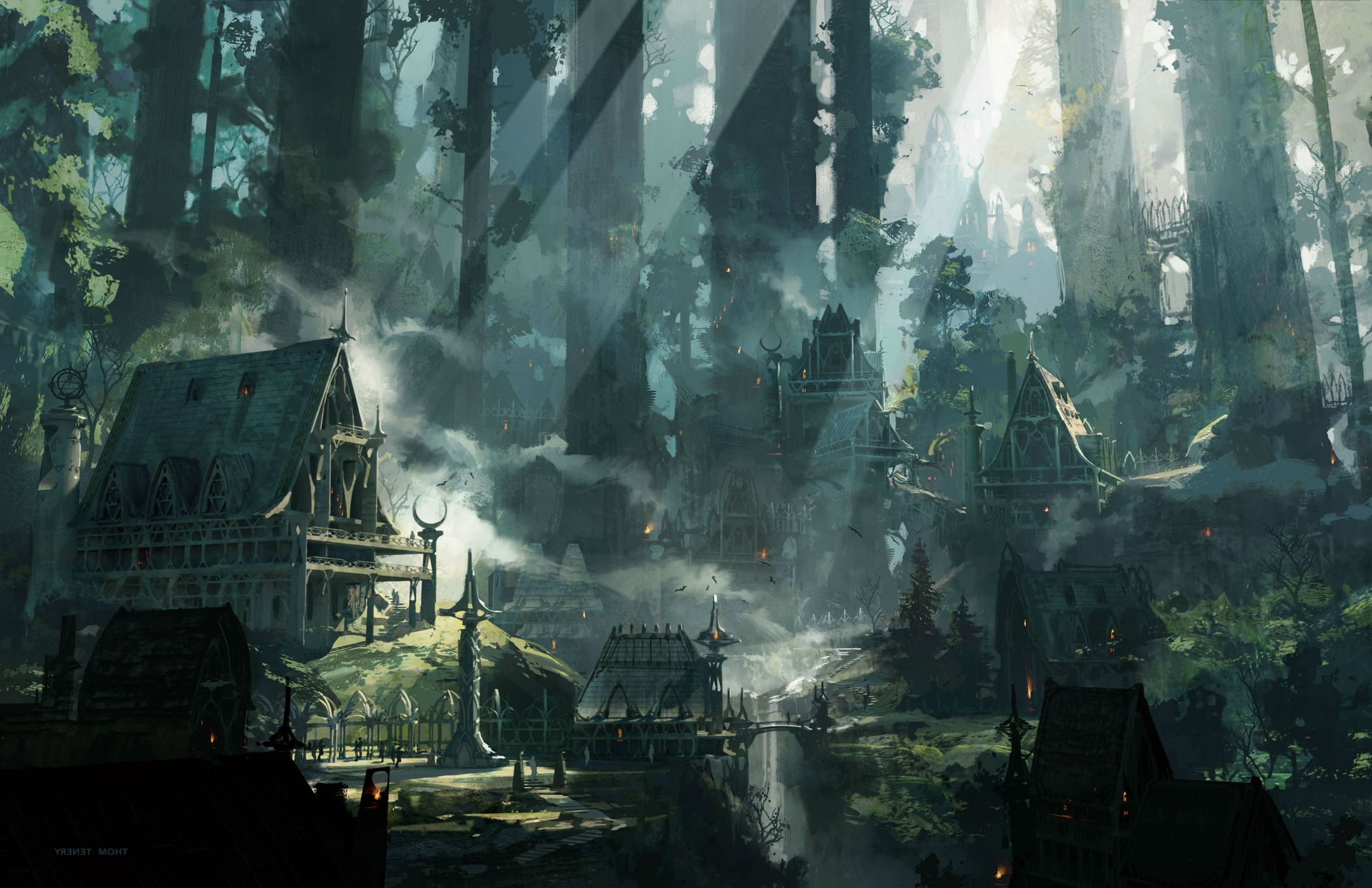
One of many Elvish villages in Edenia, circa 110 S.A.
One of many Elvish villages in Edenia, circa 110 S.A.