I've come to the realization that I have no idea what the Terminus' ships will be armed with. I was planning on just going with regular old laser/particle beams/plasma, but I feel like I'd be outclassed by everyone else by a significant margin.
Hmmm, maybe I'll go with something like with what the Reapers in Mass Effect have. Though I get the distinct feeling that molten metal accelerated to a significant fraction of the speed of light would do far more damage than just the big old lasers they appear to be in-game.
Depends on how much metal and what fraction of the speed of light. But yeah, they had to be more effective than plain lasers because it's basically a water cutter engineered up to eleven. That's bound to be more damaging and incredibly more penetrating than pure DEWs.
Might want to recheck some terms like Nihongo. (Unrelated, but I'm curious as to what is Druger is. I keep thinking of Drauger from Skyrim).
Not quite sure on how I feel about Karikabuum "rivaling the gun powder of the Dwarves". You're free to have it of course but I'd prefer it you change it so that it doesn't rival something that the dwarves have been perfecting for a hella long time.
There are no "winds of magic", might want to remove mention of that in the magic.
As for the military, I'd say focus on either cav or artillery and not both, not quite sure how having a diverse variety of races as levies/mercs is an advantage though, if anything it might be a disadvantage as racial divides and stuff would flare up. Even if non-violent, it sew distrust and the likes. Might want to reword your disadvantages:
"Light equipment for the raiders while the rest of the army can't keep up" - Doesn't quite make sense to me, is some of your troops more lightly armed? Why aren't they just staying with the main army like most light troops.
"Needs non-Uruk levies and mercenaries to make up for most of its unit types." - Does this mean that the Uruk army by itself is small (of only Uruks) thus requiring other races to bolster the ranks? Why not just use professional soldiers of those races instead of levies and mercs that can be bought off.
"Availability of non-Uruk units depends on location and nature of the campaign " - Not as confused as I am a bit worried for a massive fucking roster list.
I guess my point is, why not just have a smaller, elite army instead of this massive collection of races with weapons.
Druegar are dwarves excommunicated for their heretical beliefs (they don't respect the ancestors and insted revere only one god) and overall being culturally different.
Karikabuum is not gunpowder but other explosive mix and you'd be shocked how many chemicals can be better than gunpowder. That and the Uruk can thank the Druegar to perfect their explosives. So it's ancient shaman secret plus dwarven expertise with gunpowders. Of course it's a match for dwarven gunpowder.
Mongol Empire was infamous for their cavalry AND siegecraft. I am basically fantasy mongols. So yeah specializing in artillery and cavalry/mobile warfare.
Uruk has a rather massive army since by culture most of their members also practice warfare. The problem is that all of them prefer to ride on wargs and Uruk have yet to form a decent infantry. So they instead rely on other races to do that. Artillery is an exception (barring some elite artillery manned by Druegar) and so are kinda ranged units since orcs can just dismount. But they have no spearman, heavy infantry nor more unique variations on a type like for example aving archers (Uruk abandoned archery for centuries now).
There are army lists with 30-40 units IIRC. Mine is likely going to be smaller than that. I am also far from the only faction with diverse races. Albeit probably mine would be the most mixed. And why am I doing this? Because it's both realistic and fun. I am a minor history geek and know that ancient warfare was far from clean nor armies were anywhere close to homogeneous/uniform. Mongol Empire was basically about their core army of nomads or those with nomadic past AND massive auxiliary forces recruited from all over the place. My army will reflect that.
As for raiders limited to light equipment or whatever. Basically you can't carry most artillery with you on horseback nor you can have infantry marching 200 kilometers a day. Nomadic cavalry can do that and how! But for the same reason they have strict limits on weight and size of equipment. They also need stuff which is easy to maintain and can readily found resupply for. It's quite amazing how Mongol raiders could maintain the kind of mobility they did. Amazing or not that's an obvious drawback balancing my mobility. I can either be fast as hell and ditch infantry and many of my equipment. Or sacrifice that for a more decent army lineup.
Alright! I post you the skeleton of my NS for now. No unit profiles, spell lists and due to map fluctuations I currently didn't make a detailed map on where each place is located. I even need to expand a few section. Still, this should be enough for you to get a gist of what to expect with them.
THE GOLDEN HORDE
Overview
The Golden Horde is an emerging power in the southeastern corner of Salvus. Also referred as the Uruk Empire the chief power within these lands are the semi-nomadic Uruk people. Once split into numerous tribes the Uruks came united and began their conquest and still continuing. They are a warlike race and their raids already earned them dread and infamy along the borders. The territories of the Golden Horde are surprisingly diverse, mixing various races and cultures together. Unlike other nations the Uruk do not assimilate people into their culture and rather allow them to retain their integrity and safely continue their lifestyle as long they accept the rule of the Uruk. A strange approach without a doubt yet so far it works for the Golden Empire.
Geography
Yellow = Golden Horde Yellow = Golden Horde
1.) Plains of Viridia (Gijak'Tor) 2.) Khagan Highlands (Khagh'aan) 3.) Dwarven City States of Yngvar 4.) Sundaurdh Bay 5.) Llóthyen Martiarchy 5.) Kathíria 6.) Malibderan 7.) Jidor (friendly but not actually part of the empire)
Red dots denote capitals of each region. Blue dots denote one of the seven Cyclops tribes and the vague position of their territory. Purple dots are major Kashgar settlements.
History
Uruk were one of the numerous nomadic races living and traveling Gijak'Tor (also known as the Plains of Viridia). They were wanderers with no permanent holdings split into numerous tribes. These tribes were frequently fighting, both among themselves and in service of neighboring nations. That was until 300 years ago when a young and charismatic leader Orakgash Khagn united the Uruk under a single tribe, creating what would be latter be referred as the Golden Horde. Lifetimes of fighting and mercenary background steeled them and the Uruk began their long conquest. Their methods seemed savage yet hid surprising level of planning and discipline. The nations sharing the plains with the Uruk quickly fell to their might and became subservient to the emerging empire. The news spread like wildfire and the "horde of black orcs" were became known and feared.
Orakgash established the Uruk nation and set down the foundation of the empire. Yet his early death prevented him to see it reaching full maturity. In honor of him all supreme leaders adopted the title Khagn (often mistranslated as Khan) and continued to direct the Horde to their destiny of conquests. The Uruk also adopted a more sedimentary lifestyle with military leaders becoming nobles and owning lands gifted by the Khagn for their achievements.
[To be continued...]
Government and Society
The Golden Horde is a large empire of diverse cultures united under the Uruk's rule. They became the lords and masters of these lands, their chieftains and military leaders often gaining ownership over a piece of land. They demand money, resources and manpower while also having the ultimate say in any matter. This might seem pretty tyranical at first but in effect so long a community pays their tribute and don't resist the Uruk they are pretty much left alone. Indeed, practically every nation conquered by the Uruk kept their culture and resumed their lifestyle mostly unchanged. Rebellions do occasionally happen but these are quickly put down by the dreadful might of the Uruk army. In addition the presence of Uruk brought unified law and trade to these lands, making their economy flourish like never before.
As mentioned before the Uruk did not replace the existing governments more than they found necessary. Uruk generals and other nobles may have became their new masters but overall life went on as usual. What the Uruk changed was the elimination of borders and most internal conflicts. By the law of the Uruk all subjects were equal and must be treated the same regardless of their nationality (with the exception of the Uruks themselves). Laws that were imposed on the subjects are few yet violating any of them has severe consequences. Death penalty is common and certain violations may either risk killing one's entire family in retribution. This resulted in drastic reduction in crime rate as whoever foolish enough to disobey the Uruk were found dead. Of course the Uruk have their own laws applying to themselves. If anything these are even more strict, constructed in a way to both keep the hordes in the line and also to prevent the Uruk fighting strength to ever degrade. People are allowed to participate in any religion within the Empire. Not the Uruk, though. They traditionally follow their ancient shamanistic beliefs and unless one suffers through the difficult process to receive the proper papers they are punished under the threat of death if they are caught participating for other faiths. Shamans in general enjoy a particular renown within the Uruk. They are their religious leaders, magicians, scholars or even artisans.
The leadership structure of the Uruk nation is unique. First, they don't have a distinction between rulers/nobles and military leaders. A lord of a province is also the owner of the army of Uruks stationing in that region. The Khagn in particular is both the ruler of the Uruk Empire and the supreme commander of all the Uruk Hordes. Just like nobles for other cultures the right to be a commander is often hereditary. Those of higher birth are often guaranteed to lead armies by the time they reach maturity. Yet as practical as they are the Uruk does not bear with incompetence and those proven unfit to command are stripped of their rank and shame their family. In turn those with exemplary deeds can advance in ranks and further their family even if they were originally of "commoner" birth. There are even rare cases of members from non-Uruk races being granted the honor. Of course these "rulers" can't really spare much time to govern their country (barring a few exceptions). Instead there exist another social structure within the Uruk culture, the shamans. These people often belong to particular families and receive different upbringing from the rest. Shamans are all part of the religious caste of the Uruks but their duty doesn't end there. They are the scholars and intellectuals of the Uruk race. They can be teachers, healers, administrators, engineers and at times even the magicians of the Uruk. They keep records of their race and maintain knowledge. Shamans are a tightly knit society and perhaps the secret behind the Golden Horde's success.
Race Description
The Golden Horde encompasses multiple nations and thus sports a rather diverse ethnicity. As their rulers and conquerors the Uruk are the first among them. Uruk language is mandatory to learn for anyone within the empire. In the same language they refer to the subservient races as Snaga. While certain people make connection between Snaga and slaves the word long lost such meaning. Since the time of Orakgash the term Snaga referred to those non-Uruk who aided the horde, often in matters outside of fighting. Granted, this did not stop certain people to use Snaga as a degrading term, highlighting the part about them serving the Uruk. Unsurprisingly enough the Uruk are actually in relative minority compared to the total number non-Uruk races. There are a diverse number of human cultures, lizardmen, dwarves, cyclops tribes and even an elven forest. These societies are largely undisturbed by the Uruk.
Uruks are tall (2-2.5 meters at average) and muscular humanoid creatures with skin tone ranging from pale brown to pitch black. They have snake-like eyes which can see well even in low-light conditions and can sense infrared at short ranges to somewhat navigate even within the darkness. Their physique makes the Uruk considerably stronger than human and more enduring. On the other hand their powerful bodies require more food to be kept healthy. Uruk are omnivorous and their tough stomach can allow them to eat almost anything albeit they prefer standard cuisines. Due to their body makeup the Uruk are more resistant to poisons and diseases than humans. Uruk are unique in that they don't grow weak until they reach venerable age which is around 80 years. With some luck Uruks can even live for 120 years albeit a warrior is far more likely to die after half or even just quarter of that. Uruks have high birthing rates and reach maturity somewhat faster than humans. This leads to them currently struggling with rapid population growth, one of the main reasons for the Uruk conquests.
Uruks bear many resemblance to the Orruk and this lead them to be termed as "black orcs". Yet the Uruk are more somewhat weaker and definitely more humanoid in appearance. Some scholars theorize that Orruk and Uruk originate from a common ancestor but currently the two are definitely belong to a different species. Orruks and Uruk cannot interbreed. Albeit curiously enough Uruks can be crossed by other humanoid races, especially humans. Elf-Uruk hybrids are plausible in theory but the two races find each other mutually repulsive. Speaking of which while considered ugly to humans and number of other races, Uruks think the opposite and find certain "beauty marks" hilarious or disgusting. Uruk females are built as tough as their male brethren if not even tougher. They regularly fight alongside their male partner and only stop for the 4 months when carrying their child. Uruk male and female divide the job of rearing their child equally between each other.
Uruk religion is based on their tribal shamanistic roots. They believe in the "gods" representing the four elements as well as respecting the spirits of the land, the forest, the rivers and the mountains. Their religious figures are the Laguurz which roughly translates "to do magical". They were chosen from the brightest most gifted members of the tribe and aside from listening to the spirits they also conduct numerous studies and experiments.
They were priests, scientists and even magicians. Even in the present this didn't change. Laguurz are all taught in the Uruk religion of the four elements but then they specialize to study other arts. Not all Laguurz are gifted in the art of magic and rather most of them study as scholars, healers or even scientists. Laguurz represents the intellectual class within the Uruk society and indeed the word is used interchangeably with the meaning of genius. As such rather than shaman they are nowadays much closer to scholars and wise men who seek knowledge.
Wargs are ferocious creatures seemingly borrowing the characeristic of large bears and oversized wolves.
TBA
TBA
TBA
TBA
TBA
Economy/Industry
As mentioned prior the Uruk conquests unexpectedly helped the economy on the long run. No borders, unified laws, streamlined trade and prohibition of enmities went a long way to boost the wealth of all countries involved. Being the main trading partners with the Yngvar's Druegar or the Nihongo from Jidor are also something which shouldn't be ignored. Altogether the Uruk's focus on stability and trade benefited the region tremendously. The Khagn's palace is famous for its luxury and there are numerous tales of how the rulers find more and more ridiculous uses for their excess gold (even if most of these are exaggerations).
Development-wise the Uruk Empire is far more mixed. Huge swathes of their area are rural lands with sparsely any towns or cities. Albeit there are numerous exceptions like the mountains of Yngvar or the port region of Malibderan. Also most Khagns (or to be precise the shaman advisors guiding them) took considerable effort at developing their domain and dozens of Uruk-founded cities exist thriving with life. Industry-wise they borrowed both from Jidor an Yngvar to further improve on their technology. Naturally their main focus was on military and war. Furnances are a common sight even in the rural settlements. Karikabuum (Uruk's own take on gunpowder) in particular went through a massive improvement from wet substandard burning oil to a decent rival to even the gunpowder made in Thudrim Kadrin.
Karikasard is the namesake of this mixture. As the young god of violent fires the entity is part of the Uruk Pantheon and can also considered a war god. His name combined with the word "Buum" (Herbs) can together be translated as "herbs causing violent fires of war" which is a rather apt description for an explosive. Karikabuum (alternatively Kabuum or Kaboom for the noise it generates) is an unique Uruk invention, a balm like mixture of certain herbs and soil with function similar to gunpowder. It was first developed by shamans in order to reach a closer connection to the spirits of fire but it soon found use as a weapon. With sufficient knowledge it's possible to produce low-grade Karikabuum (also called Palsvaj AKA Blasting Jelly) without any special equipment which made it popular and widespread by the time of Orakgash Khagn's conquest. Better mixtures are dried of water and formed into either grains, balls or stalks for better combustion while also using purer and more refined ingredients. While many other kinds of gunpowder mixtures are known the Uruk Empire relies the most extensively on Karikabuum.
Magic
The Uruk does not rely on the Winds of Magic like most other cultures do. Instead the most gifted of their shamans can communicate with the spirits, generally those attuned with the nature or the four elements. Rather than commanding magic by influencing the Winds they interact with the spits for their aid. The mechanics are starkly different but in general the effects are similar. By the very nature of this magic most uses are bound to be supportive. Also while a mage might need to worry about the perrils and exhaustion, a shaman has different worries and limitations. Shamans are only mediums to communicate and spirits aid the Uruk out of goodwill or at times for a certain compensation. Abusing the spirits might lead them to deny your plea or worse make them turn against you in their wrath. Thus every Kastuurz (magic-casting shaman) needs to maintain a certain balance and make sure to keep the spirits pleased. Due to this Uruk in general are actually less likely to rely on magic than other races do.
Albeit the Kastuurz are not the only source of magic within the Golden Horde. Dwarves and their rune-smithing is well-known so is alchemy. Albeit these effects are less prominent and generally not listed among spells. On the other hand Viziers from Malibderan are an example of classic mages even if they ask for a hefty price to be hired. There are also mystics from the far southern continent of Nippon who rely on an unique source of energy. This power is usually referred as "ki" and originates from the body alone. Their effects are less pronounced but unlike magic they are far less risky on the user and can be utilized more often. Mystics from the faraway continent can be occasionally hired from Jidor, the Nippon-owned colony lying on a large island next to the Uruk Empire.
[Spell List will be added later]
Military
The core of the Golden Horde is compromised from their Uruk warriors. They are trained in warfare from youth and traditionally fight on their dreaded Warg mounts. Even after numerous military reforms the Wargs are the most valuable asset to the semi-nomadic Orcs. In top condition the Warg and its rider can traverse over a hundred miles within a single day and can survive on almost anything. This kind of mobility allows the Uruk to choose their battles and strike the enemy before they could gather their troops. Uruk are also surprisingly disciplined, their raiders are well-trained and very well coordinated in their movements, utilizing their mobility to the fullest. They are well aware of the benefits of a good command structure and unlike other nations where the leaders seek glory and lead their army from the front, Uruk leadership is far more reserved. They are savage where it's needed and pragmatical where it benefits them.
That being said, The Golden Horde's reliance on cavalry has its own drawbacks. Uruks themselves don't have much culture on infantry warfare and must recruit other races to cover that. In addition the high mobility of their cavalry cannot be matched by the rest of their army. There are semi-effective methods to carry artillery with the raiders but in general if faced with castles or large armies the Uruk cavalry must retreat and wait for the rest of the army to catch up with them. That and while mercenaries or levies from other races can compliment their forces well the availability of these units fluctuates massively. You can recruit Bolters from Yngvar to invade the eastern borders next to their home but expecting a large force of dwarves following you to fight Orruks to the West is often unreasonable.
Pros: - Focus on cavalry and mobility warfare - Decent choice of firearms and artillery - Diverse selection of units from various races and cultures
Cons: - Light equipment for the raiders while the rest of the army can't keep up - Needs non-Uruk levies and mercenaries to make up for most of its unit types. - Availability of non-Uruk units depends on location and nature of the campaign
[b]Name:[/b] Whats the Unit called?
[b]Type:[/b] What kind of unit are they?
[b]Short Description:[/b] One or a few lines about what they are, what weapons they carry, Total War style if that makes any sense
[b]Name:[/b] Whats is their name/titles?
[b]Position:[/b] What spot do they occupy in your faction?
[b]Powers:[/b] Do they have anything of note about them or use any spells or carry any unique weapons?
[b]Short Bio/Personality:[/b] A few short lines on why/how they came to power and how are they generally perceived.
@ClocktowerEchosHow's my NS? I haven't seen you commenting much on it yet. Granted, I was pretty occupied with Key's new space NRP. Just asking for an update. Also yes, I'll work on the rest soon.
That's how Federation starships were treated straight up until DS9, when ship got all WWII Pacific Theater. Hell, the TOS Enterprise is explicitly capable of glassing planets.
Well, it differed from episode to episode. Sometimes blowing up an asteroid was an issue or even keeping pace with it required the Enterprise to use their warp drives. Star Trek and consistency are two entirely different terms.
Anyways, I scale the power of my ships as appropriate for the situation in the NRP. I suppose my tech team can invent or pull some exotic stuff which can destroy an entire planet if that fits the narrative but usually the question, do they really want to? In this sense I am even closer to Trek, I suppose.
On another note, my starships technically have no weapons. None. Nada. Q-Bays aren't weapons just used as such and this function is very well veiled. Starships are also extremely efficient at managing their power thus getting readings on their energy levels outside combat is going to be tricky. This means if they claim to be just peaceful explorers during first contact situations, they very well appear to be as that.
Alright, I am more or less finished with the required modifications to use my civ here.
Solarian Star Federation
Civilization Overview
The Solarian Star Federation (usually shortened to Federation or SF) is a supernational government of human polities within the Rainbow Cluster. It forms a polito-economical union with the numerous governments in the System Sol and its neighbors. The Federation's origins date back to about 300 years following the end of the Last Great War, the most destructive event of their history. Weary of war and to prevent this from ever happening the committee decided on strengthening international communications, integrating economic systems while synchronizing politics to better reconcile with each other. They planned it step by step with the eventual goal being complete unification within a hundred years, a dream which never happened. From the outside the Federation may seem like a single body but in reality they are anything but that. There are countless nations and political parties each pushing their own agenda. Solarians may have avoided major wars for centuries now but their political forums are very much like warzones themselves. Similarly what once was a benign movement for peace and the good of Mankind turned into the plaything of economic powers. Money is the king within the Federation and as long as they can get away with it the political powers engage in various unethical deeds for profit. The Federation is a highly advanced civilization with many achievements, but this also made them overly confident in their technology. Ironically enough in spite of all their technological advancement the Federation lacked decently fast FTL drives for most of their history. This combined with the fact they are situated within a distant star cluster meant the Federation never encountered any sapient life aside from themselves. With the recent breakthrough with Farcasters the Federation now plans to send expeditions to unknown space in order to explore the galaxy.
Species Overview
On the first glance the humans of the Star Federation may seem to be the same as Terrans and other people originating from Earth. Yet the truth is more confusing, defined as Homo Sapiens Caelis (or Solarians), these people evolved and developed on Solus Prime with absolutely no relation to the inhabitants of Earth. The truth lies within the theory of convergent evolution. Solus Prime and Earth bore many similarities to each other and this combined with play of chance resulted in the Solarians who are eerily similar to terrestrial humans both in features and even culture. Yet being older than human civilization the Solarians long evolved to the frontiers of space. There are many minor differences like adaptation to varying gravity, improved intelligence and reflexes, extended longevity and resistance to most known diseases. The most striking differences happen after the birth. Technological advances in medicine, cybernetics and cosmetic surgery meant so long you had the money you could go completely wild. Solarians have yet to meet any aliens but name a popular sci-fi species and the Federation likely has a fan sporting their looks. Cybernetic enhancements are also rather common, especially computer-assisted brain functions typically referred as "Cogs". Each government has different regulations on what kind of alterations a citizen can do and in certain regions this could go to the extreme. Another major advancement was the technology to transfer human consciousness. As such it's possible to transfer one's mind to a different organism or even an entirely mechanical body. Due to complicated mechanics backing up or copying consciousness is difficult and also strictly banned within the Federation. Similarly while it's possible to transfer consciousness to military hardware memories of the Last Great War (especially the terror once delivered by Ego the Living Battlestation) makes such actions widely opposed by the public.
Technological Overview
The Star Federation may have not met aliens but had plenty of time and will to develop on their own. They made massive advancements in science and could be perhaps considered pioneers in many technologies. Manipulation of matter and fields can allow them feats which others may consider magical. Their impulse drives are seemingly reactionless engines that along with mass lightening fields can allow great speeds and at compact size. Q-Fabs revolutionized industry as versatile manufacturer devices that can assemble objects quickly and down to the last particle from already available materials. Their conversion reactors can extract nuclear energy from any common material and safe enough to power toothbrushes or cell phones. To a common citizen of the Federation it may even see there's nothing that technology cannot accomplish. That being said Federation has complex laws on the use of technology not to mention the extensive ways companies try to protect their copyright. The latter has the unintended side effect of making outsiders even more difficult to reverse engineer Solarian technology.
- Quantum Fabricators: Commonly abbreviated as Q-Fabs they are sophisticated devices which can alter and convert matter and energy to rapidly assemble objects. Q-Fabs are versatile and it can create anything it was programmed to. There are also Q-Meds, medical Q-Fabs used for healing and building biological matter. Knowing the right people and having loads of money can ensure that the wealthiest people can live theoretically forever. Q-Fabs can technically use raw energy to create matter but this is only utilized at sufficiently small scale. Spaceships generally have sufficiently abundant energy to use that alone for air and food replicators.
- Metastable Matter: A development which made Q-Fab technology far more accessible. It's an unique state of matter which is relatively stable and dense with easily accessible energy. Can be useful for batteries (though even more efficient methods exist) but first of all it's used as an intermediary matter for Q-Fabs.
- Fold Drive: Standard and reliable FTL method which manipulates spacetime to raise the apparent velocity of the vehicle beyond the speed of light. It has relatively low power consumption but comparatively slow speed and other inherent issues. Still, it's relatively cheap and has many alternative applications. Fold Accelerators for example can accelerate projectiles and vehicles at faster-than-light apparent velocities even if, without "fold sustainers", they revert to sublight speed after reaching a certain distance.
- Farcaster: The new long range interstellar travel method developed within the Federation. Also referred as the Hyperdrive it punches a hole in reality to the higher mathematical dimension of the hyperspace to allow faster-than-light travel. It consumes great amounts of energy thus the ships have special capacitors for this role. On the other hand the same method can be modified to transport smaller objects and Farcasters can have a limited application as teleporters. The only downside is that Farcasters are rather difficult to scale down thus unless there's a similar device around the teleportation is usually limited to one way trips. The speed of Farcasters is dependent on the power relative to the mass it carries. Thus systems like "Hypercarriers" (huge transports allowing many ships to dock) and "Hypergates" (large almost stationary structures which also use quantum linking to enhance the speed even further) exist.
- Impulse Engine: Standard sublight engines used by Federation spaceships. They expel mass particles at near the speed of light generated from pure energy which means they can have yet unheard level of specific impulse and henceforth their common name. Without the right conditions mass particles rapidly decay into relatively harmless photons thus also making this design the safest engine known within the Federation.
- Gravitics: Electromagnetics within the Federation were long replaced by gravitics, devices that move objects around with the force of gravity. While inherently gravity is a weak force SF scientific developments made countless mechanisms known to amplify them. Gravitic actuators, accelerators, propulsions are all commonly used within the Federation. This combined with the Higgs technology and mass lightening methods resulted in a massive boon for starship propulsion and the renewed dominance of projectile weapons.
- Hypercomms, Hypersensors: A family of devices that use known FTL methods to gather or transmit information rapidly over long distances. Their mechanism can differ by type with each having its own set of advantages and disadvantages. Hypercameras and Hypertelescopes for example gather the tachyonic shadow of electromagnetic waves to allow up to a certain distance to see events in real time regardless of light-lag. Another common hypersensor is the Foldwave Radar which is rather self-explanatory.
- Quantum Link: One of the oldest forms of FTL communication it uses quantum entanglement to instantly transmit information to the linked device. It used to be expensive and not very reliable but the technology reached maturity once other FTL mechanisms were understood. Abreviated as Q-Link this method offers lagless communication free of the typical interference. The only downside that you require to use more standard measures first to establish the link thus it generally only works between two familiar recipients. Q-Link can be also used for power transmission but this method accelerates the degradation of the link thus usually not advised. While free of normal interference there are "Q-Jammer" devices that are designed specifically to scramble quantum comms.
- Conversion Reactors: The most common method of power generation. They can be practically found everywhere, be it in factories, cars or even cell phones. Conversion reactors are the ultimate result of nuclear research and could be said to be the distant relatives of fission and fusion energy. Thanks to their degree of sophistication the conversion reactors are actually fairly safe and incredibly easy to use.
- Zero-Point Energy Extractor (ZPEE): The ramscoop of space-time, this complex device allows harnessing vacuum energy which makes it ideal for starships and other power-hungry machines. The device requires lot of power to run and difficult to scale down, thus they won't replace conversion reactors anytime soon.
- Vacuum Compression Capacitors: Just as space itself can be used to harness energy it also turns out to be the best method to store power. Vacuum Compression Capacitors and ZPEEs are virtually the same technology used for different purposes. In effect vacuum capacitors are zero-point energy extractors that are deliberately inefficient. For this reason they can be made more compact and many hi-energy equipment is relying on these. Actually, many companies within the Federation are working on the means to make vacuum capacitors even more popular and replace other alternate batteries. Its advantages over the other means are weight savings, far higher capacity and even safety. When destroyed the spatial compression within the cell ceases and space expands around the unit. Anything caught within its area of effect simply ceases to exist. Yet space holds massive energy densities thus the failure of a vacuum cell only results in minuscule expansion. Even for the most massive starship batteries it fails to erase the entire vacuum cell. Thus ironically vacuum cell technology is both the safest and most destructive power storage mechanism known by the Federation.
- Durachrome: The most common military grade armors are chiefly made of durachrome. It's a hard, superdensely packed material family with its variants used both for ground troops and starships. Due to its weight anything made from it usually requires mass lightening to compensate.
- Structural Integrity Fields: Special complex field which reinforces the bind of atoms and generates bubbles of fake mass to further enhance the toughness of material.
- Higgs Shield: An extension of structural integrity fields this kind of protection forms layers of fake mass generated by the field emitters which can act like a regenerative extra layer of armor.
- Lightwave Barrier: A rather peculiar type shield which contrary to its name actually traps tachyons in a limited boundary around the vessel. It deflects massless and low-mass particles like light and radiation the best while practically useless against heavier projectiles. Starship-based lightwave barriers also have some other properties to compensate for spatial effects.
- Gravity Deflector: The various gravitic devices can also produce a shield of gravity around the ship. These tend to extend pretty far, up to even hundreds of kilometers and activated only during combat. The gravity shield's main purpose is to intercept, disrupt and disperse incoming attacks instead of directly stopping them. The weakened attacks would be then handled by the rest of the defense systems.
- PASER: Projectile Acceleration Sustained by Effector Rails. It's a gravomagnetic mass accelerator and the basis of most weapon systems within the Federation. In spite of that the term PASER is most commonly used for handheld weapons since the term "gun" earned much notoriety during the Last Great War. For other weapons and devices using the same mechanism they merely use the term Gravomagnetic Accelerator or Grav for short.
- IGP: Intelligent Gravomagnetic Projectile. Common name for the projectiles launched from Gravomagnetic Accelerators. There are countless different kinds of IGP, some of them are entirely solid projectiles while others have sensors, AI, warhead, propulsion and at times even other features. The options are nearly limitless. IGPs are effectively the combination of physical projectiles and missiles.
- PPA: Pressed Particle Arms. Special use of gravomagnetic accelerators when unstable particles of incredible density are created on site and unleashed at velocities very close to the speed of light. The stream of particles are extremely thin, a nanometer or even less. Thanks to their density and concentrated nature the stream is extremely efficient at penetrating defenses after which the particles slow down and violently explode within. While shot from gravometric accelerators this kind of application requires special modifications not available for all PASERS or Q-Boxes. Due to the instability of the metaparticle mix PPA are relatively short ranged and the effectiveness of the stream weakens with distance.
- SAS: Spatio Accelerator System. Also called Fold Accelerators these weapons use Fold Drive derived mechanisms to accelerate projectiles faster than the speed of light. While this obviously increases their effective range compared to Gravomagnetic means the projectile is limited to a relatively narrow "fold channel" which prevents nearly any kind of maneuvering. Certain large ISFPs are also equipped with micro fold drives to mitigate this issue but at the expense of payload and other functions.
- ISFP: Intelligent Space-Fold Projectiles. The Spatio Accelerator variant of IGPs. Unless they are equipped with Fold Drives on their own they are known to have limited mobility compared to IGPs.
TBA
Military Overview
The main military force within the Rainbow Cluster is the Federation Starfleet. They are a multi-national force recruited from the military of other nations. Starfleet has strict selection process and only allows the best. While combat skill is important they put even more focus to human relations and handling stressful situations. They are hardly the only military, though. Each national government maintains their own military and police forces as well as security forces employed in private sectors. Still, when it comes to military power Starfleet is the largest factor, especially in terms of space force. Due to the memory of the Last Great War the term warship and associated aesthetics garnered a huge negative opinion. To avoid being labeled as proponents of war Starfleet eschewed dedicated weapons on their starships altogether. Instead of cannons, guns and missile bays the Federation uses modified Q-Fabs to create projectiles and launch them at various exits. Following that these projectiles are assisted and directed by altering the function of the shields. The end result is the Q-Box, a versatile weapon system which may be less powerful and much less efficient but with centuries of relative peace they never needed more. On the ground the Federation relies on drones and robots considerably though because of the terrors during the Last Great War they are always accompanied with a human operator supervising them. Anything done by these machines is the responsibility of the operator. Overall the size of the Federation military is small and almost more focused on PR than actual military needs. That being said their highly advanced technology allows them to get away with this surprisingly well.
The best of the best, the so-called "elite" of the Federation. Starfleet personnel are thoroughly selected and then pass a difficult training to become part of the main peacekeeping body of the Federation. In the age of drones and robots these people risk their lives for the sake of Mankind. Well, that's how it was supposed to be. In effect Starfleet is an old organization which grown increasingly clique-like. Starfleet indeed has a rigorous selection process, one so insane almost no person can pass. Yet many thousands of people are admitted to Starfleet each year. How? By the mere fact the system is full of faults and corrupt officials. Being admitted into Starfleet is no longer the matter of skills but connections. As such it comes as no surprise that the once highly competent Starfleet is much less than what it's supposed to be. Granted, Starfleet is still the greatest collection of the Federation's scientific and technological prowess but when it comes to combat ability their performance is...erratic to say at least. Starfleet combatants once used their skills combined with technology to be a superior force. Nowadays they use technology to supplement their skills and their inexperience at war makes them commit ridiculous mistakes on occasion. Exceptions still exist but your average Starfleet personnel knows little more about battle than how to pull the trigger. They can disassemble their PASERs or fix a phase modulator even in their sleep but many Starfleet members can't even throw a decent punch.
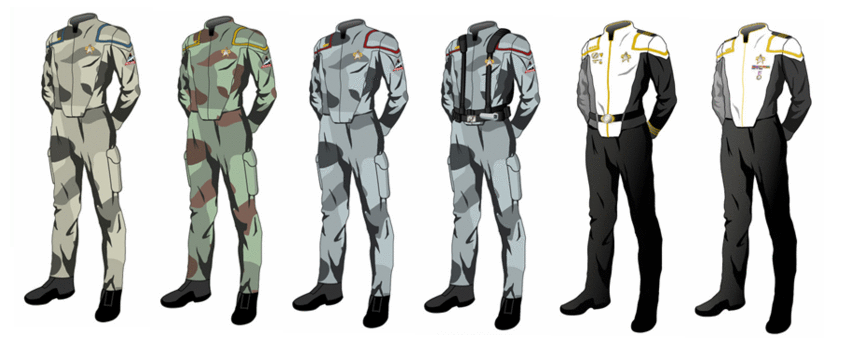
Specially made outfit which doubles as their protective suit. It's woven of durachrome-enhanced metamaterials and because of that the suit actually weighs over 10kg when not worn. The suit is durable enough to withstand certain small arms but that's only one of its function. The uniform is filled with various sensors both to check the surroundings and to monitor the status of the wearer. It's also equipped with an artificial gravity generator which doubles as an inertial compensator. The suit's wearer is cushioned from force and can walk in various gravities. Lastly the suit has an environmental shield to protect against hazardous environment and provide life support even in space.
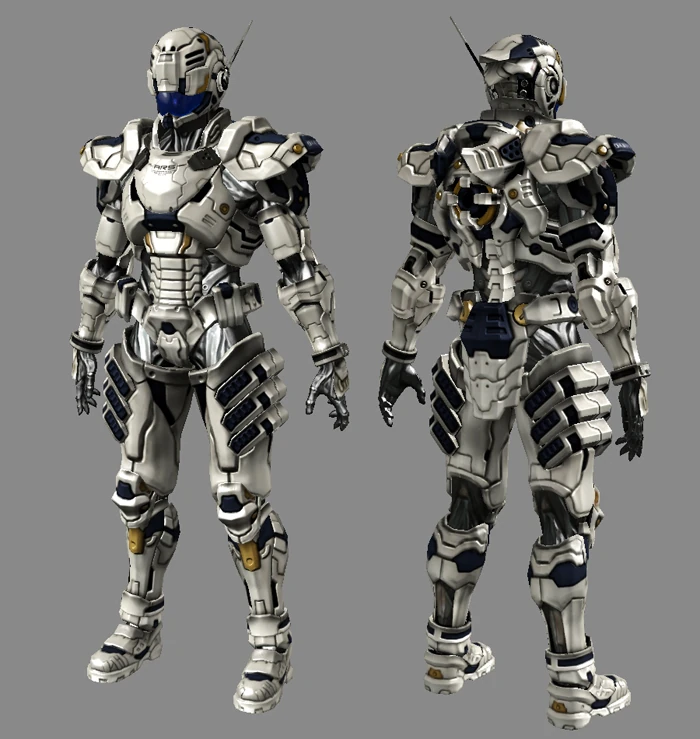
Augmented Reaction Systems Suit is a special equipment worn in the rare high-intensity conflicts. Only those who pass Class III Weapons Test can be allowed to wear ARS Suits and only when receiving the permission of the Captain or higher authority. Unofficially called the "Battlesuit" this compact armored suit is enhanced by inertial fields and gravitic acutators, giving the user massive strength and mobility on par with a land vehicle. For further boost it uses micro impulse engines that can both increase speed and allow the capability of flight. In terms of protection the inner suit is made of nanomesh muscle fibers sufficient against light anti-personnal weapons while the key areas are reinforced by durachrome composite plates. For this reason and other concerns the suit weighs around half a ton without the mass lighteners kicking in. Aside from armor it also sports complex shield system using Higgs shields, Lightwave Barriers and Gravity Deflector technology. It also has active protection systems and limited countermeasures. The suit has a micro Q-Fab/Q-Med for providing ammo, food and life support as well as do emergency operations on the field. The suit has a virtually enhanced interface along with various sensors and computer assistance. ARS Suits turn the otherwise frail Starfleet security personnel into a fighting machine fitting both the role of SWAT and vehicular assault. Starfleet has next to no combat vehicles and instead they rely on their ARS Suits to fill that out.
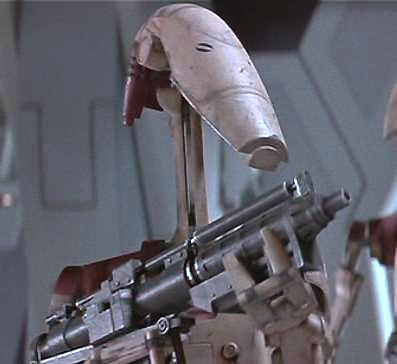
Federation Robotic Intelligence Enabled Normal Drone (FRIEND) is an AI-equipped humanoid machine made to replace flesh and blood infantry. They are based after the robotic armies from the Last Great War but with at least one major difference, they are bound to the orders of their designated (human) operator. FRIENDs have a rather sophisticated AI to rapidly adapt to various combat and non-combat situations but they are fitted with several restrictions for safety. The presence of human operator is only required for one thing: accountability. Anything the robots do are the responsibility of the operator. Technical specifications wise FRIENDs are built of light composites with only minimal use of Durachrome or similar superheavy materials in order to make them more economical. As a consequence FRIENDs are relatively unprotected albeit being machines they can sustain considerable damage before losing capacity for combat. Physically a FRIEND is stronger and faster than a regular man though nowhere close to the capabilities of the ARS Suits. They have sophisticated sensors and targeting system which can make them dangerously good shots.
Federation Interlinked Normal Drone for Escort and Recon. They are various relatively small floating disc-shaped drones that are generally used for advance scouting. Though their role is data-gathering and recon they usually come equipped with an MQB (micro quantum box) which is smaller and more limited than Q-Boxes or even PASERS but can be effective at fighting lightly equipped opponents. More importantly they have a myriad of sensors for analyzing their surroundings and feeding back the results via Q-Link. Actually, many FINDER drones don't even have an actual AI and instead they receive commands via a larger computer system. This saves weight but also make FINDERs useless once they're caught within a Q-Jammer field.
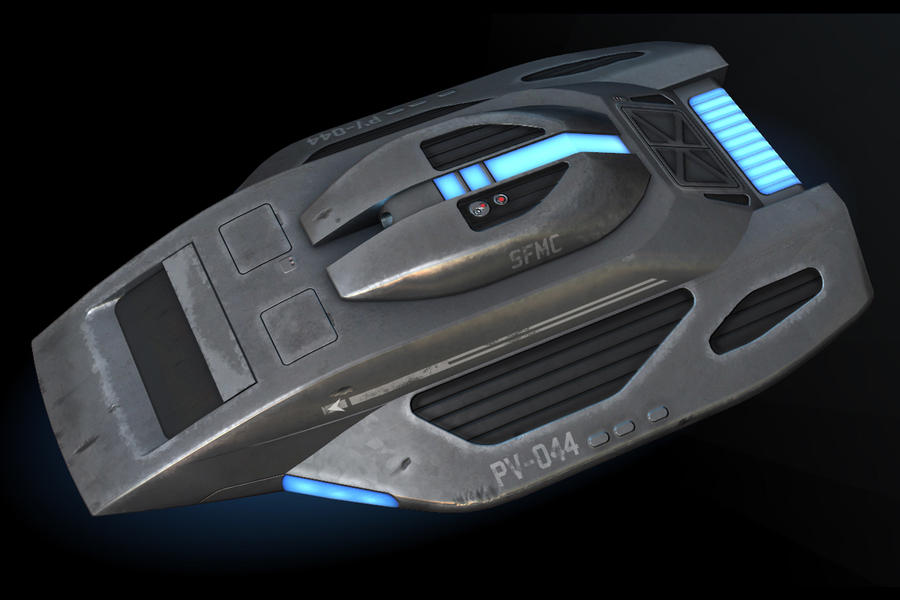
Is it a transport, a plane or a fighting vehicle? None of them yet can fulfill all of these roles. Tactical Transport is basically the Federation's mainline fighting vehicle. Just like warships, tanks and fighters also share a negative reputation. Using these terms or designing vehicles with such specialization are an easy way to label yourself as warmongering madman. At the same time technology advanced sufficiently that specialization was no longer necessary to fulfill these roles. Thus they developed the Tactical Orbital Aerial and Surface Transport (T.O.A.S.T.), a high-speed heavily protected troop and equipment transport equipped with inconspicuous yet significant firepower. Currently the most common variant utilized by Starfleet is TOAST-111 Vantgardeur Tactical Transport (pictured above). Compared to old models it's incredibly compact mostly thanks to the Pattern Storage technology which allows it to compress objects or even living cew into quantum-data while keeping them in a subspace vacuum cell. This is accomplished by a compact Shortcaster device capable of "beaming" people and equipment in and then "beam" them out wherever it's needed. As unbelievable as it may sound this method also improves survivability as the Pattern Hold keeping the data of the cargo could survive many things which the transport itself could not. Thus even if the transport is destroyed the Pattern Hold can be recovered and used to rescue its contents. In terms of armaments it has a CQB (Compact Q-Bay). Strangely enough the smallness of the Vantgardeur forced designers to make a rather controversial choice to give the Transport a sorts of turret on the top. This turret hides a Fold Accelerator necessary for high-performance PPE and anti-orbital scale firepower. For less powerful functions the vehicle can launch IGPs from practically anywhere. Mobility-wise the Vantgardeur can operate in all theaters, accelerate to hypersonic velocities or freely enter/exit the atmosphere. Albeit given the difference in power fighting a Starship with Tactical Transports is nothing less than foolish.
Starfleet obviously put the most focus on space forces. Their starships are top-notch to maintain their overall edge. Many technologies and scientific developments are first employed within Starfleet and knowledge of basic ship system is one thing all Starfleet members are well educated in. On the other hand the memories (or ore like propaganda) about the horrors of the Last Great War made the term warship taboo, as well as anything associated with it. While pistols and rifles are an accepted symbol of authority, any vehicle/vessel sporting gun turrets or any large weapons would be likely mark their users as crazy warmongers. As such rather than using actual weapons Starfleet developed the Q-Box, a weapon system relying on already existing elements to use them for offense. In terms of effectiveness the Q-Box certainly worse than purpose-built weapons but the Federation's technology is lenient enough to make these work. Believing in quality over quantity Starfleet has relatively few starships but each can pack quite a punch. The term "Starship" was actually coined by Starfleet to designate their new "not-warships" as a PR move. Since then any ship with interstellar capability is dubbed starship which was an intentional move in order to further mask from the general conscious the terrible firepower concentrated within Starfleet's hands. For similarly PR reasons the Federation had abandoned the old custom of using wet navy ship classifications.
Not exactly an armament but rather a "software update" and design philosophy for most combat spaceships within the Federation. Memories of the Last Great War its further demonization by propaganda made people averse to hearing about warships. They are weapons of war which is the furthest from the supposed ideology of their "peaceful" society. As such Federation combat ships literally have no weapons. Instead they utilize the already existing Q-Fabs, inertial control fields or even their shields and other systems in order to create, launch and guide projectiles towards their enemy. The exact mechanism are complex and differs from ship to ship. They can use gravomagnetic or spatio-accelerator mechanisms to launch IGPs/ISFPs of various size and specifications. Q-Boxes are versatile though certainly restrained in power compared to what a purpose-built weapon could do. Accidentally for civilizations unfamiliar with Federation technology they'd be unaware of any weapons existing aboard Starfleet ships. On the other hand since shields are involved with the manipulation of the projectiles it's possible to aim and time the attacks right the moment when part of the shields are exposed/vulnerable. Such methods are commonly employed during ship-to-ship combat between fellow Federation ships.
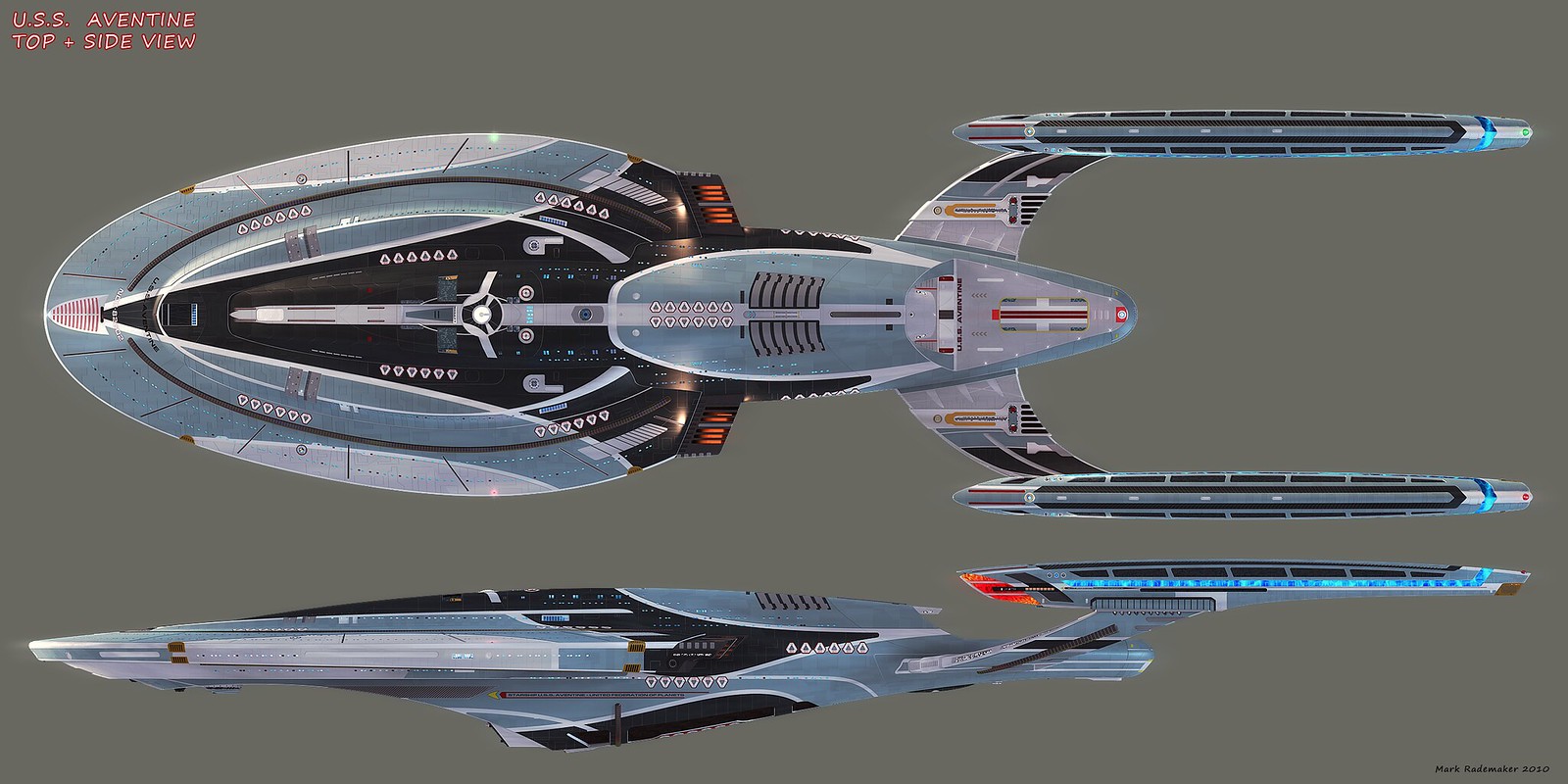
Name: Hull Classification LRTRS-7470HD Vega (also referred as Wāqi for its Arabic origins) Classification: Long-Distance Tactical Recon Starship (equivalent of a Battlecruiser in other cultures) Dimensions: length: 675m, width: 195m, height: 88m Standard Mass: 321,680,000 metric tons (prior to mass-compensation, doesn't include weight above the standard cargo) Standard Crew: 750 Powerplants: Conversion Reactors x 3, ZPEEU, Emergency Reactors Propulsion: Impulse Drives x 2, Inertial Propulsion System, Graviton Thrusters Interstellar Travel: Fold Boosters x 2 (most important for fast and economical travel, limited Fold/Farcaster capacity is always there) Armor: 275mm Durachrome Composite-S (reinforced by integrity fields) Sensors: Foldwave Radar, hypersensory package, GADAR, Hypertelescopes, backup sensors Defense Systems: Inertial/Integrity Fields (surrounding the structure), Higgs Shields (up to 9 layers usually 50-540m away from the hull), Lightwave Barrier (about 2.7km from the center of the ship), Gravity Deflectors (outermost layer extending to 70km in radius) Number of Primary Q-Bays: 120 (20 groups of 6 ports each) Shortcaster Arrays: 12 Main Dish: 1 Shuttle Bays: 4
The Vega-type ships are one of the newest starships developed within the Federation. Unlike past starships which needed refits the Vega was already made with Farcaster Drives in mind. Given Starfleet's doctrine saying well-armed is strange but as a ship with 120 Q-Bay primaries it's one of the most combat-oriented starships to date. Its more streamlined shape aids through the currents of hyperspace while the fold boosters are also optimized to enhance Farcasting. These reasons led for the Vega-class becoming the basis of their ultra-long range explorer ship the Enterprise.
Solsys Network also uses conversion power, though at this point in time not something they could mount on a toothbrush, Im thinking the smallest generators would be the size of a car engine.
Q-Fabs in the Federation tend to make issues with miniaturization rather negligible. There are exceptions, though. Like the extensive machinery required to contain and gather power from vacuum so truly small scale use is just counterintuitive.
For clarity, though. Federation don't rely too much on vacuum energy generation. It's kind of free energy but only until you add the various technical issues with it. At least for the Federation. They rather prefer their Conversion Reactors which are basically the holy grail of nuclear power to harness energy from nearly any material in a clean, safe and efficient way. These are safe enough you can put them in a electric toothbrush and never worry about the fact you put a nuclear reactor right next to your open mouth.
Why yes. Those warheads are more primitive then those fielded by the Federation and the Universal Union. Perhaps even inferior to them in most aspects.
Don't worry, Federation Starfleet doesn't have that many ships. Expect one or a couple of starships fighting your massive fleet. Generally the security of a system can be guaranteed by one decently equipped starship alone. I am kinda going with TOS Star Trek's interpretation of how starships were used. Think of star systems as countries and a starship as a nuclear aircraft carrier. One coasting close to your waters is usually scary enough.
@OphidianWell, understanding concepts from physics or at least the layman explanations of them shouldn't require any math skills, rest easy. As for vacuum energy missiles they can be your rarely used doomsday warheads. I mean with sufficient butchering of physics you can say that vacuum energy generation creates unstable exotic particles which might have effects so harmful it makes radiation fallout look like Disneyland.
As for tech how about having a "vacuum cell" in the warhead with finely controlled environment to momentarily harness this power into a massively powerful explosive device? They would be also fail-safe because it requires a specific activation and thus it won't blow up your ship upon damage or destruction.
 Member

 salamimike
 Durandals