@Dinh AaronMkI think it just means we should expect Napoleonic times or something. Though admittedly the reason why rifled guns and cannons didn't spread is due to the pressures of that war and then the recovery from its devastation.
Legend: 1.) Westewald (core territory, white star with black trim is the location of the capital) 2.) Collés Archipelago 3.) Medina Isles 4.) Haardam Commonwealth 5.) Beumann Island 6.) Olmeiqué
Core Overview:
Corax is a relatively small Edonirasi country located to the northwest. Also called Westewald the region is located within the temperate climate zone and can be split up to three sub-regions: coasts of Merensol, lowlands of Gladisylva and the mountains of Drachauer. Drachauer is a collection of mountain chains at Westewald's continental borders, Gladisylva has green pastures fit for agriculture and Merensol has a mixture of rocky, sand-filled and at times even swampy terrain. These three sub-regions were historically always competing with each other and their hierarchy depended on economic trends of the time. Beyond that Westewald is also divided to 11 Cantons in total which have historical roots in nation that existed before being taken over by the Ordo Draconis.
Colonies Overview:
Corax has a number of colonies for their growing sea trade empire. Collés Archipelago is a collection of tropical islands with scarce natural resources but very good harbors. Medina is similar and prior to the conquest of Haardam it was the primary transit point to reach Aradia. Haardam is a giant island, more than twice the size of Westewald. Further east you find Beumann Island, close to Aradia. Some even contest that Beumann/Hwasho (its original name) due to the "Long Road", a thin region of extremely shallow sea levels that during summer dries up sufficiently to create a direct land route towards Aradia. Of course the existence of Long Road also creates navigational hazards albeit after the Corax occupation they created a dam system to let ships through while also raising the sea level behind the Long Road. Though acting a bit belatedly but Corax also joined the venture towards the New World with them establishing Olmeiqué in the southern part of the continent.
SOCIAL OVERVIEW
Historical Overview:
I am using bulletpoints of history for now until I know more about the others nations near me.
- Westewald was a pagan region ruled by various small states - Ordo Draconis by the Holy Patriach's command invaded Westewald to convert them to Viasm - Multiple crusades gradually took the region and the Order invited foreigners from the neighboring countries - By the 15th century the entire region came under the Draconic Order's control - Reformation of the Viam faith washed over Edoniras like wildfire - Draconic Order split from the Patriarchy and took Westewald as their personal possession - Grandmaster of the Draconic Order founded a new dynasty of Corvinus (later renamed to Corax) - Economic upturn, naval shipping, manufacturing reputation - Colonial aims, industrial revolution, etc
Demographic Overview:
Inhabitants of the core region are referred as Westewaldians are a mixture of the original once pagan locals and immigrants from various neighboring Viam countries. As a consequence Corax has a fairly mixed population with most people knowing two or more languages. In spite of that inhabitants eventually developed a sense of identity as Westewaldians and they are proud to this fact. In terms of religion the state only recognizes Viam with all other faiths requiring exemption papers to practice. Of course above all they promote their variation of Viasm but at least on the surface they tolerate all the other derivatives. Socially Corax has three main layers: commoners (Landsmann), citizen (Burgher) and knights (Ritter). Commoners are exempt from taxes but have constraints to free movement and social advancement. Those who can buy themselves a permit and can keep paying taxes are freemen and wealthy citizen known as Burghers. Such people tend to own major businesses, usually born to famous craftsmen and merchant families. Lastly the knights (Ritter) who form Corax's de facto nobility. Unlike nobles though knights are elected to their title and are expected to contribute for the military. Knight titles are far more likely to be awarded to families with prior lineage of knights but the ultimate decision is made based on the candidate's personal performance. A knight has the right to own land, govern territory granted to him by the Grandmaster and of course wield arms in public. While civil governance exists the ultimate supervision is through knights and as such they remain a prominent class in Westewaldian society. Although by the start of the 19th century the distinction between Ritter and Burghers is becoming far less defined.
Political Overview:
Corax is technically a theocratic/stratocratic dominion where members of the Ordo Draconis fulfill every leading position. Headed by the Hochmeister/Grandmaster the base organization of Corax' governance is similar to a professional military, a monolithic system branching down to actual soldiers on the field. Directly beneath the Hochmeister are the Landmeisters who administrate and govern a large regions. Currently there are 11 regions in the Dominion, 5 divided for the mainland, 1 for the Collés Archipelago, one for Olmeiqué, one for Beumanns, one for Medina and its neighboring ports and finally two for Haardam. Landmeisters are not active duty soldiers nor picked for their skills in battle but their governing abilities. Beneath them are the Komtur who manage a sub-region called commandry. While smaller governing titles are used their application is more sporadic and at such stage the local civilian leadership takes over. These knight-governors of course also had their own deputies, advisors and officials. At the first glance this government may appear obstructive but in effect due to various facts the system was efficient and even somewhat liberal, inspired by the ideals from the Age of Enlightenment. The Hochmeister in particular has seemingly unlimited power but laws and the watchful eyes of his subordinate governors keep them in check. The Hochmeister is elected through the Generalkapitel attended by every knight with the title of Komtur or above. They also gather for political discussions or send out representatives for an almost parliamentary style system.
ECONOMIC OVERVIEW
Resources Overview:
In spite of its small size Westewald is relatively rich in resources. Drachauer region's mountains are abundant in minerals and new deposits are found each month. In particular Westewald became famous for the quality of their iron ore and resulting ease to produce decent steel. Precious metals like gold and silver are scarce though due to over mining during the middle ages and most coins are minted from import minerals. The lowlands are decently fertile and can be considered the country's food reserve. Forests and good lumber is also available in fair quantity. Overall the Corax mainland is gifted in natural resources and if not for their ambitions and steadily growing population they could be even self-sufficient on their own. Outside of their strictly defined national borders Corax has large plantations for various exotic goods like rubber trees, coffee, cacao, tea, spices and also mining efforts for coal, metals, precious metals, sulfur and nitrates. Colonies also provide grain and other necessary foodstuff imports to support the ever growing mainland population.
Industrial Overview:
Since the 15th century Westewald enjoyed reputation for their craftsmanship, especially clocks and weaponmaking. With strong governmental control the guilds were quickly replaced by manufactories and soon adopted machinery. Some of the first steam engines, used for operating pumps in mines, were utilized in Westewald. Railways connect all towns and even common in colonial territories. Corax has a fairly developed industry overall but if you have to pick one field they excel in the heavy industry. Combined with the great iron ore the steelworks of Corax are exceptional and good quality steel is considerably easier to acquire. They also acquired great expertise in gunmaking, proud to have many famous inventors working in the field. Corax also have ancient traditions on armormaking and given the knights' demands it remains a flourishing business. Since the early 14th century the Order always sought good craftsmen in cannonry and gunmaking which prevailed as Westewald transitioned into the Confederation of Corax. Currently, Coracian gunmakers are renown for their high quality products and while they might not approach the sheer output of Lancia or other top industrial regions their reputation for excellent guns remains. A typical Coracian product is the revolver, multi-shot pistol/carbine using rotating chambers. While they long lost monopoly on these products a huge quantity of revolvers are still made in Westewald. Due to political reasons Corax also sought cartridge technology, being its earliest widescale adopters. This is in part to the effort of limiting the power of civilian firearms but the transition also helped them to meet the rising demands for these fairly early. Corax's mining and heavy industry is remarkable and their light industry also saw decent development. Water and wind mills are extremely widespread and the usage of steam power is gradually gaining ground. That being said Corax can't compete with foreign textile industry and over half of their cloth products are imported from elsewhere. On the other hand Corax is the earliest adopter of rubber and while missing out on developing the vulcanization process first (using the natives' ancient means of stabilizing rubber instead) they are now recuperating from that loss and again becoming one of the larger rubber producers in the world.
Trade Overview:
Like every developed nation Corax is a net resource importer, using skilled laborers and advanced industry to pay back in finished products. As such while the Coracian iron ore is famous they still import nearly a hundred thousand tons of iron either in bar or ore form each year. Iron products in turn are one of the most famous exports of Westewald, tools and equipment from this region is put in high regard. Gun imports earn a special mention. while recent laws prohibit the civilian use of high powered guns their manufacture and sale is so important for the Coracian economy that such companies immediately earned an exemption from the law. Export of cartridges earns a special mention as these are mandated to be in dimensions unfit to be loaded by civilian firearms as such Coracian guns and cartridges for export can be identified by their bore/cartridge diameter. Rubber production also revitalized and Corax is one of the main exporters of rubber both in raw form and as finished products. As noted before Corax imports a lot of textiles, especially of the finer quality, as their own cloth industry is still failing to meet the new demands. Luxury goods while in some quality availible to them is still a well sought after commodity. Lastly but not least Corax is in a constant demand for gold. Due to overmining their gold reserves ran out by the 16th century after which they have switched back to silver based currency. While silver did well for local trade it became increasingly harder to use after the discovery of the New World. While colonial mining efforts and more importantly exploiting the natives of the New World averted the outright crisis the Coracian hunger for gold has yet to be sated.
MILITARY OVERVIEW
Army Overview
Corax military is relatively small but competent and highly organized. The most elemental unit in combat is the Lance/Lanze, rooted in the old tradition of knights fighting along with their retinue. Unlike those days Lances tend to be larger with usually 10 people including the sergeant commanding them. These optimally organize into Groups/Gruppen of 3-4 lances and similarly 3-4 Groups form a Company. Regiments are the smallest independent unit of circa 1200-2000 people that had their own artillery, support, sustainment and intelligence gathering groups. During major wars these regiments combine into Legions, the main organizational unit of the Coracian military. Corax soldiers are easy to identify for the fact they still wear helmets and breastplates, occasionally with the addition of other armor pieces. Coracian infantry can be also often found carrying revolver rifles. These provide good fire rate but at the drawback of less penetration and reduced stopping power. Corax also continued the tradition of Jaegers, light skirmishing infantry equipped with the new type breechloading long rifle for decent accuracy at range. Jaegers don't wear armor and sometimes their bright yellow and black uniform is replaced with more natural colors to help them blend into the environment. Compared to this Corax has relatively weak cavalry with most of them performing patrol and scouting duties. Dragoons exist who act as mounted line infantry with the occasional flavor of charges and some knights are still interested to become heavy cavalry.
Land Pattern 1832 Rifle - 9mm bore repeating rifle with a lever action married to a 8-shot revolver chamber. It fires a relatively light lead bullet to match contemporary breechloader rifles in range but at the cost of lethality. The weaker cartridge is necessary as revolver magazines are flimsier than single-shot breechloader mechanisms but it also means the natives have a harder time to effectively take down a Coracian soldier using a captured rifle, a welcome side benefit.
Gebhard 1837 Défenseur - Special revolver using a 12-round chamber sold to both civilians and the military. As a gun made with civilian specifications it fires a relatively weak 8mm bullet that would fail to penetrate Coracian breastplates. On the other hand the weapon is fairly reliable, fast and convenient to use. These weapons are especially popular with the marines but knights also often wield more ornate version of these.
Land Pattern 1826 "Brisanté" - Military revolver issued to officers, sergeants and jaegers for self-defense. It fires large 13mm lead projectiles from a 5-round chamber. It has great short range stopping power but uncomfortable to shoot with. The slow projectile can also ricochet off from armors or harder objects. Its nickname Brisanté is two-fold and translates to "The Breaker". It can break the charge of the attacker and also considered harmful to the hand of the user.
Walther Pattern 1840 "Chasseur" - Breechloading rifle used by jaegers and other skirmishing troops. It uses a trapdoor like mechanism where the user places the long 11mm diameter cartridge. Uniquely the gun also had a hexagonal barrel and special projectile to accommodate this. Unlike circular barrels this allowed tighter fitting bullet made of steel but also meant the rifle had to be cleaned after every 100 shots.
Pattern 1788 Schwert - A single edged cut&thrust sword used by knights, sergeants and at times the infantry. Unlike sabers of the time Schwerts are thicker with more dramatic bevel shape and a longer blade that tapers tremendously at the last fifth. The Schwert is meant to fight both armored and unarmored opponents and inspired by weapons like the broadsword and rapier, achieving a good compromise between the two. Admittedly this hybrid style also makes a Schwert more difficult to use and Coracian soldiers require more training.
- Pattern 1783 Kürass: Mass produced armor used to be worn by most Coracian soldiers. Prior to its development officers procured whatever armor they could acquire. Using by that time's standards modern industrial methods they manage to discuss a new standard for all common armors. This new type used the cuirass worn by cavalry as the basis. It featured a front plate with leather or reinforced cloth straps on the back. The base plate was relatively thin and mostly served as support for the rest of the armor. Depending on needs the soldiers could attach back and additional front plates to improve the armor, fastened by screws. This simplified production, maintenance and repairs. Until relatively recently front plate pieces of varying quality and thickness circulated in the army to balance between protection and comfort. A plate sufficiently thick to occasionally stop musketballs was rare, expensive, not to mention unbearably heavy. Even medium thickness plate additions were discarded when fighting in tropical climates. This prompted the development of a new "heavy" Schutzplatte using new materials. It had three main layers: front being a case hardened plate, middle is a thick layer of compressed paper fixed with glue and the back being a thinner layer of steel that also cover the plate from the sides, completely enclosing the paper layer. The new heavy plate weighed less than the previous medium pieces and while couldn't defeat any but spent musket bullets it could still handle most pistols. To reduce glare and effects of the sun heating metal Coracian soldiers also wear tabards with their uniform colors of yellow and black. Breastplates are questionably effective against guns but they have decent utility against more primitive weapons thus they enjoy popularity against natives.
- Ritterharnisch Pattern Götz 1812: Full plate harness worn by Coracian knights on the battlefield. Götz is a famous armorer craftsman family in the business since the middle ages. During the late 17th century the demand for high quality armors began to fade, meaning the end for many famous armouries worldwide. Corax had a different experience as knights stubbornly kept wearing their elaborate plate suits and thus Westewaldian armor industry remained strong. Pattern 1812 is the newest specification by the Draconic Order that empathized comfort, lightness and easier maintenance. While option for full armor coverage remained the new pattern focuses more on partial suit and its comfort even in tropical climates. One of its biggest yet also weirdest invention is the so-called Krieghelm, a large and heavy helmet no longer resting on the head but the shoulders. It features articulations and full protection of the head aside from the front. Krieghelms are heavy and capable of resisting rifle shots from skirmishers if hit from extreme ranges. On the other hand they heavily limit situational awareness and head traverse which makes them uncomfortable. Krieghelme are only supposed to be attached prior to battle and knights use more conventional headgear on patrols or other less dangerous activities.
Artillery Overview:
Corax is one of the pioneers of cannon development with the knights always being interested in the introduction of better artillery pieces. Cast steel guns are widespread in the military thanks to the combination of Coracian steelmaking and expertise in firearm gas seals. The most common piece is the 4-pounder rifled breechloader cannon that is light enough to be carried by two horses and mostly fires shrapnel projectiles. Supporting them you can see the Pattern 1839 Hagelbüsche, an oversized twin barrel 24-shot revolver rifle with exchangeable chambers. Effectively a machinegun its weight and finnicky mechanism prevents it from becoming the nightmare massed armies will face in the distant future. In fewer quantities Corax also employs 12-pounder rifled muzzleloader cannons, weighing almost the same as field guns of the past century. Though some may consider them excessive but in limited numbers Corax even possesses large 24, 32, 80 and even 120 pounder cannons and howitzers. Kriegzug or combat trains are a novel new concept providing mobility for the army previously unheard of. While other nations also realize the importance of rails the Draconic Order maintains entire cars for such purpose. Furthermore they are experimenting with mounting artillery on train cars, allowing the deployment of heavy howitzers with expediency previously unheard of.
Naval Overview:
As a rising naval power Coracian navy is modern but also somewhat moderately sized. Given their near-obsession with railways it is of no surprise they also push for steam power in naval use. More than half of their warships are propelled both by sails and steam. Steam sloops and frigates cruise all their territorial waters. Lineships are split into two categories, Kreuzers are unarmored but relatively fast and more economical. They are the capital ships in absence of the heavier Stahlschiff which features steel or wrought iron plates bolted onto its still mostly wooden hull. The reason behind this shift is widespread use of explosive shells. A few shots from a large bore shell cannon could easily sink any wooden battleship. As such Stahlschiff have a relatively thick 5-inch armor plate bolted onto them that is supposed to stop most shells. The explosion still tends to damage the bolts and could detach the plates thus such defense is limited utility but until the development of true ironclad ships this is the closest to efficient protection. Armaments wise the navy uses a lot of 12-pounder breechloader rifled guns along with 36-pounder howitzers and a few 120-pounder guns. While the smaller shells lack the sheer destructive power to catastrophically damage warships they still do reasonable damage and their shells are safer to storage than the large variants as well as not requiring special loading mechanisms. Naval mines are also in development and early variants are ready to be deployed in defense of their home ports. Research for self-propelled torpedoes is in process but so far there aren't any reliable means to keep them controllable. While spar torpedoes are an option the Coracian navy does not trust them. There are at least a few private ventures at developing submarines but so far they are more of a curiosity than what the government seriously consider.
Still needs some final touches but aside from that I think I'm finished, @duck55223.
Legend: 1.) Westewald (core territory, white star with black trim is the location of the capital) 2.) Collés Archipelago 3.) Medina Isles 4.) Haardam Commonwealth 5.) Beumanns Island
Core Overview:
Corax is a relatively small Edonirasi country located to the northwest. Also called Westewald the region is located within the temperate climate zone and can be split up to three sub-regions: coasts of Merensol, lowlands of Gladisylva and the mountains of Drachauer. Drachauer is a collection of mountain chains at Corax's continental borders, Gladisylva has green pastures fit for agriculture and Merensol has a mixture of rocky, sand-filled and at times even swampy terrain. These three sub-regions were historically always competing with each other and their hierarchy depended on the period's economy. Beyond that Corax is also divided to 11 Cantons in total which has historical roots in the time before being taken over by the Ordo Draconis.
Colonies Overview:
TBA
SOCIAL OVERVIEW
Historical Overview:
I am using bulletpoints of history for now until I know more about the others nations near me.
- Westewald was a pagan region ruled by various small states - Ordo Draconis by the Holy Patriach's command invaded Westewald to convert them to Dominian - Multiple crusades gradually took the region and the Order invited foreigners from the neighboring countries - By the 15th century the entire region came under the Draconic Order's control - Reformation of the Dominian faith washed over Edoniras like wildfire - Draconic Order split from the Patriarchy and took Westewald as their personal possession - Grandmaster of the Draconic Order founded a new dynasty of Corvinus (later renamed to Corax) - Economic upturn, naval shipping, manufacturing reputation - Colonial aims, industrial revolution, etc
Demographic Overview:
Inhabitants of the core region are referred as Westewaldians are a mixture of the original once pagan locals and immigrants from various neighboring Dominian countries. As a consequence Corax has a fairly mixed population with most people knowing two or more languages. In spite of that inhabitants eventually developed a sense of identity as Westewaldians and they are proud to this fact. In terms of religion the state only recognizes Dominian with all other faiths requiring exemption papers to practice. Of course above all they promote their variation of Dominians but at least on the surface they tolerate all the other derivatives. Socially Corax has three main layers: commoners (Landsmann), citizen (Burgher) and knights (Ritter). Commoners are exempt from taxes but have constraints to free movement and social advancement. Those who can buy themselves a permit and can keep paying taxes are freemen and wealthy citizen known as Burghers. Such people tend to own major businesses, usually born to famous craftsmen and merchant families. Lastly the knights (Ritter) who form Corax's de facto nobility. Unlike nobles though knights are elected to their title and are expected to contribute for the military. Knight titles are far more likely to be awarded to families with prior lineage of knights but the ultimate decision is made based on the candidate's personal performance. A knight has the right to own land, govern territory granted to him by the Grandmaster and of course wield arms in public. While civil governance exists the ultimate supervision is through knights and as such they remain a prominent class in Westewaldian society. Although by the start of the 19th century the distinction between Ritter and Burghers is becoming far less defined.
Political Overview:
Corax is technically a theocratic/stratocratic dominion where members of the Ordo Draconis fulfill every leading position. Headed by the Hochmeister/Grandmaster the base organization of Corax' governance is similar to a professional military, a monolithic system branching down to actual soldiers on the field. Directly beneath the Hochmeister are the Landmeisters who administrate and govern a large regions. Currently there are 9 regions in the Dominion, 5 divided for the mainland, 1 for the Collés Archipelago, one for Beumanns and two for Haardam. Landmeisters are not active duty soldiers nor picked for their skills in battle but their governing abilities. Beneath them are the Komtur who manage a sub-region called commandry. While smaller governing titles are used their application is more sporadic and at such stage the local civilian leadership takes over. These knight-governors of course also had their own deputies, advisors and officials. At the first glance this government may appear obstructive but in effect due to various facts the system was efficient and even somewhat liberal, inspired by the ideals from the Age of Enlightenment. The Hochmeister in particular has seemingly unlimited power but laws and the watchful eyes of his subordinate governors keep them in check. The Hochmeister is elected through the Generalkapitel attended by every knight with the title of Komtur or above. They also gather for political discussions or send out representatives for an almost parliamentary style system.
ECONOMIC OVERVIEW
Resources Overview:
In spite of its small size Westewalde is relatively rich in resources. Drachauer region's mountains are abundant in minerals and new deposits are found each day. In particular Westewald became famous for the quality of their iron ore and resulting ease to produce decent steel. Precious metals like gold and silver are scarce though due to over mining during the middle ages and most coins are minted from import minerals. The lowlands are decently fertile and be considered the country's food reserve. Forests and good lumber is also available in fair quantity. Overall the Corax mainland is gifted in natural resources and if not for their ambitions and steadily growing population they could be even self-sufficient on their own.
Industrial Overview:
Since the 15th century Westewald enjoyed reputation for their craftsmanship, especially clocks and weaponmaking. With strong governmental control the guilds were quickly replaced by manufactories and soon adopted machinery. Some of the first steam engines, used for operating pumps in mines, were utilized in Westewald. Corax has a fairly developed industry overall but if you have to pick one field they excel in the heavy industry. Combined with the great iron ore the steelworks of Corax are exceptional and good quality steel is considerably easier to acquire. They also acquired great expertise in gunmaking, proud to have many famous inventors working in the field. Due to an old law from the late 17th century Westewaldian commoners are prohibited owning firearms barring special cases. Consequently gunmakers began experimenting with airguns and currently Corax is the leader in the field of making air guns and at an affordable cost. This is of course in part thanks to their recently built factories and steel roller machines. Light industries in comparison are somewhat disadvantaged albeit doing relatively fine. Mills of the water and wind propelled variety are spread everywhere within the country. The influx of food from their colonial holdings might eventually help revitalizing this.
Trade Overview:
TBA
MILITARY OVERVIEW
Army Overview
Corax military is relatively small but competent and highly organized. The most elemental unit in combat is the Lance/Lanze, rooted in the old tradition of knights fighting along with their retinue. Unlike those days Lances tend to be larger with usually 10 people including the sergeant commanding them. These optimally organize into Groups/Gruppen of 3-4 lances and similarly 3-4 Groups form a Company. This can go up till the size of Legions with more than a thousand people and usually with their own artillery, support, sustainment and intelligence gathering groups. Corax soldiers are easy to identify for the fact they still wear helmets and breastplates, occasionally with other pieces of armor. Naturally such armor does not stop musketballs but can defend against bayonets and pistols. With the potential to encounter arrows and spears from rebellious natives the armors became even more useful, albeit somewhat uncomfortable. It might not be obvious at first but Corax soldiers more commonly carry airguns instead of firearms. Named the Pattern 1788 Windgun these rifles can fire lead balls at respectable velocities using precharged air reservoirs. While weaker than muskets and similarly ranged the Windgun has a 10-bullet magazine and somewhat faster rate of fire. Companies also have pump wagons to refill used air reservoirs. Infantry regiments can equip muskets when necessary and they also have companies of Jaeger (skirmisher or light infantry) usually eqiupped with rifles for long range marksmanship. The duty of these to scout ahead and disrupt enemy lines from ambush. Compared to this Corax has relatively weak cavalry with most of them performing patrol and scouting duties. Dragoons exist who act as mounted line infantry with the occasional flavor of charges and some knights are still interested to become heavy cavalry.
Land Pattern 1788 Windgun - Rifled repeating airgun manufactured in large quantities and in several variants. It fires a relatively weak 12mm lead ball up to the range of 100-150 meters and has a 10-shot tubular magazine. While a repeater it still requires multiple steps before the next shot can be fired thus it is only somewhat faster than a musket and considerably weaker. The butt stock doubles as air reservoir and can be sufficient for 20-30 shots and troops carry spares along with hand pumps for emergency charge.
Gebhard 1792 Air Pistol - Pistol with a relatively long barrel that fires 11mm balls made of iron. The reason behind this is to reduce projectile weight and propel the bullet at acceptable velocities. It has a 6-round internal magazine and unlike the rifle variant the Gebhard pistol was designed to be ready to fire as soon as the user pulled back the hammer.
Land Pattern 1795 Musket - Caplock smoothbore musket firing a large 18mm lead ball at respectable velocity. It can also fire special "buck & ball" shots for more spread and lethality at short ranges. While adopted by the mainland military the marines and expeditionary forces still prefer the airguns.
Walther Pattern 1775 Rifle - Breechloading rifle used by jaegers and other skirmishing troops. It started out as a flintlock but since then it's upgraded to a caplock with better quality breech to remain in service. It fires 18mm musketballs like the Pattern 1795 and is accurate up to the ranges of 300m.
Pattern 1772 Schwert - A single edged cut&thrust sword used by knights, sergeants and at times the infantry. Unlike sabers of the time Schwerts are thicker with more dramatic bevel shape and a longer blade that tapers tremendously at the last fifth. The Schwert is meant to fight both armored and unarmored opponents and inspired by weapons like the broadsword and rapier, achieving a good compromise between the two.Admittedly this hybrid style also makes a Schwert more difficult to use.
- Pattern 1783 Kürass: Mass produced armor worn by most Coracian soldiers. Prior to its development officers procured whatever armor they could acquire. To simplify this and achieve united quality they developed a standard breastplate, effecively a cuirass. It has a front and back plate made of rolled steel. The front part is fastened by a wire reinforced cross and waist belt on the back while the back plate is socketed into the front and fastened by metal screws.These plates are relatively thin and only protect against melee weapons. With this the armor is still incomplete until you fasten the Schutzplatte, a special plate. Schutzplatte has hardened steel front with a relatively thick layer of sawdust embedded in hardened wax in the middle and this is encased and sandwitched by a thin steel sheet to its back. The original design had wooden insert but shaping wooden sheets proved to be too expensive. Overall the armor gives adequate protection against pistols and spent long range musketballs while being relatively easy to repair compared to previous designs. Nowadays they also issue a thin fabric jacket over the plate to prevent it from catching too much heat. Aside from the breastplate there are helmets and special isue sabatons, wristguards and other plate additions that can be put on if necessary. Limb protection is especially popular for marines and expeditionary forces who frequently fight natives or at close ranges.
- Ritterharnisch Pattern Götz 1799: Full plate harness worn by Coracian knights on the battlefield. Götz is a famous armorer craftsman family in the business since the middle ages. During the late 17th century the demand for high quality armors began to fade, meaning the end for many famous armouries worldwide. Corax had a different experience as knights stubbornly kept wearing their elaborate plate suits and thus Westewaldian armor industry remained strong. Pattern 1799 is the newest specification by the Draconic Order that empathized comfort, lightness and easier maintenance. While option for full armor coverage remained the new pattern focuses more on partial suit and its comfort even in tropical climates. One of its biggest yet also weirdest invention is the so-called Krieghelm, a large and heavy helmet no longer resting on the head but the shoulders. It features articulations qnd full protection of the head aside from the front. Krieghelms are heavy and capable of resisting rifle shots from skirmishers if hit from extreme ranges. On the other hand they heavily limit situational awareness and head traverse which makes them uncomfortable. Krieghelme are only supposed to be attached prior to battle and knights use more conventional headgear on patrols or other less dangerous activities.
TBA
Naval Overview:
TBA
My incomplete NS. I'll keep editing it and will notify you when I am mostly done. Until then enjoy reading this for whatever it's worth.
@duck55223Can we have a Discord channel to discuss things more freely? I mean the OOC just started but there are key details like nation relations, lore and such that could be more easily talked about in a chatroom environment.
I am a bit held up by other NRPs but for a while I wished to play an early 1800s style game. So no fantasy, but completely made up geography and custom nations, right? I have no objections to that.
Official Name: Menel Ndor en'Yllendthyr (Heavenly Empire of Yllendthyr) Common Name: Yllendthyr (internally also often referred just as Ymherodraeth or the Empire) Preferred Demonym: Yllendlen (plural: Ylendlin) Government: Feudalist Imperial Parliamentary Theocracy Leader: Ymherastareth - Iallril Iorthoniith Isyranshara en'Yllendthyr Dominant Species: Elf (nationality-wise they call themselves Yelinor or "high elves") Population: 24,882,941 (according to the last census) Area: 1,407,492 square kilometers of land, 8,623,892 square kilometers of territorial waters Yllendthyr used to be a faraway collection of islands ruled by the equally eccentric Yelinor (high elves). They've spent millennia in relative isolation, only making the bare minimum of outside contact. Eventually their growing population forced them to expand and in about 250 years ago they began taking over other nations at the shores. After centuries of conquest Yllendthyr is now an empire controlling most of the Median Sea. They rule over many different cultures and species, ironically making them a minority within their own empire.
Demographics Overview
Out of the nearly 25 million subjects the empire only a bit more than two million are elves. More than half of the population are humans, mostly in the continental regions. Other races within the empire include fairies, dwarves, orcs, trolls and even centaurs. Elves of course enjoy special status and reputation within the empire with all other species viewed as secondary. Fairies are closely aligned with Yllendlen elves and often become their personal attendants. Another large group remained on their islands under the rule of their Queen, they are rarely seen by outsiders. Dwarves enjoy relative autonomy under Yllendthyr's rule and retained most of their old laws. Those who had left their mountain holds often work as traders or mercenaries but there are an increasingly common sight of dwarven craftsmen in major cities. Trolls have their own tribal communities who swear fealty to Yllendthyr. Their life is mostly unchanged albeit trolls in mercenary groups or working in cities are slowly becoming a trend. Humans and and to a lesser extend orcs form the chief portion of Yllendthyr. Unlike most other species that chiefly remained in their isolated autonomous communities they are ruled by elvish lords and government structure. Most centaurs live in the wilderness under semi-nomadic tribal communities that generally only support Yllendthyr in military matters.
Yllendthyr's official religion is the Arvandor which believes in the creator and supreme god Ao whose myriad of Aiurons sang together to shape the world. In practice Arvandor is loose with the definition of what Aiurons are and is willing to accept any other deity as part of their ever growing pantheon of entities. This effectively made way for religious freedom so long clergy of these faiths submit to the Arvandor priesthood and pay lip service to them. Of course the long term goal is assimilation of foreign faiths, another step for Yllendthyr to keep these regions under control.
Ymherastareth (Hierophantissa-Empress) of Yllendthyr she's the ruler of land and religion within the Empire. Her beautiful appearance radiates purity and charisma not marred with even the passage of centuries. Thanks to this she's revered as a saint in Yllendthyr and even the highest nobles serve her with blind loyalty. She's a powerful sorceress if not the most powerful magic user within the Empire. As the archpriestess her duty is also that of prophecy and interpreting the Arvandor's will. As such Iallril commands frightening power in Yllendthyr even without a single soldier or peasant directly serving her. Without ever raising her voice the nobility jumps at the opportunity to fulfill her commands. It goes without saying that Iallril is quite politically active and is considered a charming yet shrewd negotiator. Under her rule Yllendthyr had become surprisingly proactive by Yelinor standards, turning from an isolated archipelago into one of the major powers in the continent. Of course not even Iallril is safe from critique and with her growing fame so sprung up rumors of her cruelty and two faced behavior. Of course no loyal Yllendlen would believe any of these lies and they keep her image on a high pedestal.
Magic Overview
Yelinor, especially those who had born on Yllendost, consider magic as "life" or part of their nature. Yelinor children are always taught about magical arts and the empire has a well-oiled institutionized system for magic learning. Enchantments are somewhat pricey yet widespread in the realm with alchemy, spellsmithing and other arts experiencing their golden age. That being said this doesn't make every high elf into a magic prodigy nor they have millions of skilled mages. The average Yelinor only knows a few convenient cantrips or spells required for their profession. Mages are still quite valued and are relatively uncommon in Yllendlen employ. While it can be seen almost anywhere Yllendthyr has a fairly tight gasp on magic knowledge, tied to their faith, government or even the military. Being connected to their government is usually the best way to learn magic and this gives them an additional leverage. It also propagates the idea of magic and the state being almost synonymous to each other. Magic power in Yllendthyr is equivalent to the government's authority and magic users of the state always command respect.
One thing is for sure, magic knowledge is institutionalized by the Empire and it has a firm gasp over it. While there are always other, less noble ways to learn the ways of arcane the government and religion supported forms are so dominant the message is very clear: "Serve us and you can use magic. The power of spells is synonymous with the power of Arvandor and the Empire". This also has a quite interesting attitude to magecraft and sorcery, it commands respect. The use of magic often implies imperial authority and it's both respected and feared by the general populace. To reinforce this Yllendthyr have constructed a large network of Sorcery Towers, finely decorated lone watchtowers looking over a town or important piece of land supposedly with a powerful magic user at the top who can see all their misdeeds and punish them. Of course this is just overblown rumors and while magic users can indeed station these towers they are for defensive purposes rather than serving as an all seeing omnipotent eye. Yet thanks to the reputation of magic within the Empire the very presence of these towers manage to keep people in line.
The Shining Star of Yllendthyr, the empire's crown jewel, religious icon and symbol of their authority. A holy tower carved out of a tall mountain and decorated by shiny Yaksa mirrors. Yllumírë is the capital and religious central of Yllendthyr. On its top rests a holy device casting a twinkling light anywhere within the reaches of the empire. Given the distance of the horizon such feat should be impossible and as such it can be suspected to be magical. The function of the holy device is a mystery and aside from the inner circle of the Rmpire knows if Yllumírë has any practical purpose aside from serving as an icon to their might. As a holy city any aggression or wield of arms is forbidden within its confines. Astirith, the holy guardians are the only exception whose duties include safeguarding the relic, protect the Arvandor faith and upholding order within the city.
Technological Overview
By medieval standards Yllendthyr is a relatively rich and well-developed nation, especially in its core islands and major cities. The previously fragmented countries came under a singular government and its expansive trade network which gave a tremendous boost to the region's economy. Industry-wise guilds are thriving thanks to the unified government oversight and increasing number of procedures include spellcraft for better results. In a world dominated by monocultural and often even monoracial countries Yllendthyr has the advantage in learning procedures and arts previously exclusive to only a certain species. While special agreements are made to forbid the deepest secrets of orc, dwarvish and other racial magic knowledge the fruits of previously isolated research fields had a noticeable effect. Gunpowder, previously only common in dwarvish nations, is particularly rising in popularity. Yllendthyr even developed their own variant called Súmál which is more pure and can have varying noises depending on the "gun instrument" you use. Spellsmiths who use magic to better forge metals allow the refinement of a variety of metals. While this art is common in elvish communities it became truly widespread in Yllendthyr. The Empire also have a strange interest towards flight and gryffnn/griffin riders are common as both for travel and messaging. They even developed special carriages drawn by griffins for better transport. At the pinnacle of air transport is the skyship using the combination of unique materials, enchantments and direct usage of spells. They are quite expensive and difficult to steer, as such only aristocrats and the military can afford them. Yet that only makes them appear all the more magnificent.
Military Overview
All state soldiers in Yllendthyr are elves, preferably Yelinor. This of course limits the size of their army but also concentrates more power in the hands of the dominant race who would be otherwise outnumbered. Their most common soldiers are the rangers (Ceidwad) who are living a semi-nomadic lifestyle of patrolling the realm and ambushing all who trespass or otherwise go against the Empire. Yelinor culture dissuades meaningless sacrifices and don't consider standing around in stiff battle lines a viable tactic. Instead they avoid direct confrontations as much as possible, preferring to wear down their enemies through attrition and constant skirmishes. When they must fight head-on, like most elves, Yllendthyr relies on constructs. They are called the Onqára (stone monks) and they are available in relatively large quantities. When offense is considered the Yllendlen military is all about speed and mobility, preferring to launch lightning fast raids with their elite Gryffn riding air cavalry. As gifted in magic, Yllendthyr has an unusually large ratio of spellcasters. Enchanters are the most numerous who boosts armaments, tinker on the field and perform duties similar to combat engineers. Priests are also common who cast supportive spells and most importantly can use magic to cure various wounds and aliments. Battle mages are relatively rare but they can be sorts of comparable to artillery. Speaking of which Yllendthyr is one of the first elvish nations to adopt gunpowder, making cannons and even rocketry a common sight in their battles. Personal firearms in comparison are a bit lacking and gunners usually form troupes who consider their art equal fight and musical performance. Yllendthyr in general is enamored with the idea of a good battle also pleasing to the ears and they often use sounds to their own benefit.
Naval Overview
Yllendthyr is well-renowned for their naval might and known to operate over a thousand warships. Their most iconic naval vessels are the Swanships (Alphcayr). These small and swift vessels equal sailing cutters and they can be found almost anywhere within the Empire's reach. Faster than any other sailship and surprisingly agile, Swanships achieve this in part at the sacrifice of power. On paper both Swanships and even larger Yllendlen warships appear weak, lacking the throw weight of human vessels. Yet it fits Yllendthyr's doctrine just fine and many admirals found their demise at chasing elvish ships only to be worn down and annihilated as the result. Larger warships are called Eardil ("loved by the sea") and can be considered Yllendthyr's ships of the line. Although per human terminology they are closer to early modern era frigates and cruisers in firepower than dedicated battle vessels. Yet their sheer numbers and unique Yllendlen tactics make them a formidable threat.
Anaria, a small system located at the outskirts of the Aurolian Republic. A fringe world with not even a hundred years of history. Undeveloped and too far for the government to comfortably reach Anaria is considered a dangerous place most attractive to adventurous and poor people. Anaria had their fair share of pirate attacks and once even had a foreign fleet passing nearby. While insignificant compared to the riches of the core worlds the natives all loved this place and kept the peace in their own way. The place had its charm, unlike the usual hellholes you might find at the edges of the Republic. After a while this sorts of reputation turned into one of Anaria's main source of capital, foreign trade. Those who had traveled for the core worlds first had to pass through the wilds of the Fringes and among them Anaria was considered one of the safer places. Space ports, spaceship services, entertainment, you name it. Anaria had you covered. Consequently the travelers who passed through the system also enriched Anaria which the local government wisely spent on further ensuring the safety of their people. The cycle continued and many expected that one day Anaria would become a honorary member of the core worlds with all its benefits.
Those hopes and dreams are about to be crushed under the might of a new foe. Sensors picked up the sign of strange capital ships passing through the asteroid belt at warp speed. Like many star systems Anaria was surrounded by a cloud of asteroids, in this case about 200AU away. Well-prepared the Anarian Defense Fleet (ADF) long planted sensors in the asteroid field yet those should've detected the opponent from nearly a lightyear away, forget 200AU. What was going on? Admiral Deacon immediately ordered high alert, gathering all ships to intercept. Anaria's defenses were formidable, dozens of escorts, several cruisers, two heavy cruisers and even a Victory-class battleship titled ASS Endurance were all ready to protect their home. Meanwhile the enemy was beelining for Anaria Prima, the only habitable place in the system. A few AU away, near the moon of Anaria Secunda, the hostile fleet ceased warp travel in preparation of the upcoming combat. For some reason though all sensors and communications experienced a strange noise, as if all their equipment were calibrated wrongly. Yet what surprised them the most were the appearance of the ships.
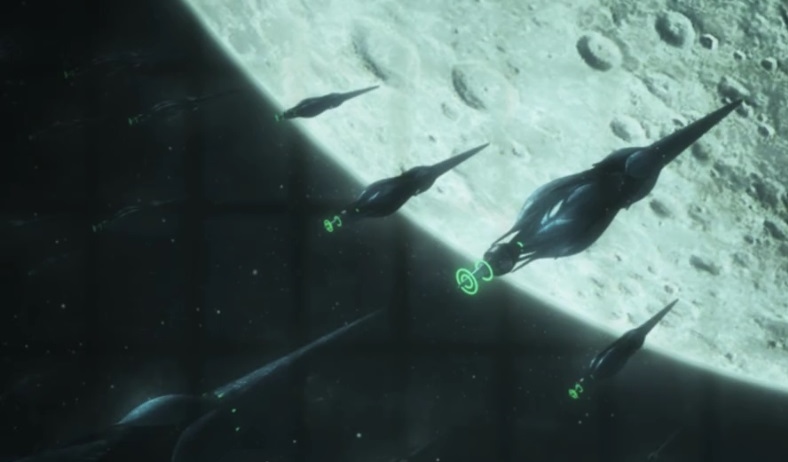
They were big, about the size of light cruisers. All shaped like thin metal needles. Sensors were a mess so maybe it's just an error but the mass readings of each ship measured above a million tons! What was going on? Encapsulated by these appeared to be a large capital vessel in the excess of 500 meters, most likely their lead ship. Does that make the rest mere escorts? The thought terrified Deacon only to be shaken by an even weirder discovery. Like rose petals the sides of the large red ship opened, revealing a containment space filled with smaller warships. Starships carrying fighters and other smallcraft was a standard sight but a warship which carried other warships? Like bees these smaller vessels spread out, screening for the rest of the fleet. The two fleets were now roughly even in numbers.
" Launch all fighters! " Admiral Deacon ordered the two light carriers to empty out their complement of 500 fighters, most of them are the old TSA-5 Talon Strike Fighters. Yet while outdated their munitions are still deadly and combined with just enough bombers they could be a threat to even battleships. Although it would take a while before they reach the battle line. Meanwhile the enemy was about to enter weapons range. Given they have yet to fire a single shot it is plausible the unknown fleet has shorter effective range than them. Capitalizing on this Deacon ordered to fire and suddenly hundreds of particle ripper bursts flew into the other direction... only to veer off their intended course.
Deflector shields? Something else? The fact sensory data got suddenly scrambled suggests near full spectrum coverage. Anyways, the enemy's defense field is troublesome. Most likely it could be only effected from shorter ranges. And given the nature of the engagement the opponent is most likely focusing most of their power on the frontal shields. Focus fire and/or re-routing power to the weapons could be viable counters. Unfortunately their sensors are unreliable right now and re-routing power would leave them too vulnerable. He had a third option, issuing that immediately. Rather than regrouping with the fleet the fighters spread out and prepared for flanking maneuvers. A few minutes later Deacon received reports concerning missile launches. At first Deacon thought it might be intended for the fleet but further reports confirm the missiles were sent against the fighters. Isn't that a bit too early? Even if outdated the Talon fighters are fast enough to evade long range missile fire. Even more mystifying was the fact when the sensor staff told him that all missiles suddenly self-destructed. Was that a diversion or...
" Recall all fighters! Cancel attack! " But he was too late. Reports indicate nearly 80% loses. All fighters were hit by hyperdense debris fields. Or were they? Kinetic submunitions warheads on a degree of speed, finesse and density previously unheard of. What little scattered data they had implies kinetic impactors too small for the naked eye to see punching through the hulls at near-relativistic velocities. Meanwhile the enemy flagship's energy levels were spiking. Soon enough a vibrant red beam came forth, hitting one of the heavy cruisers dead-on. As if self-destructing the great ship exploded from the center, leaving nothing but scattered debris. Deacon used to serve in the Aurolian Navy and saw dreadnoughts in combat but never experienced firepower such as this. Correction, in terms of energy levels beam didn't even approach that of the main guns of dreadnoughts. Yet as if by sorcery the beam effortlessly passed through the cruiser's defenses and detonated right in its center. Following that the small ships on the enemy side opened fire, unleashing similar red beams. Unlike before the shield systems were sufficient to weather this sorts of firepower although at the cost of focusing them to one direction. In contrast the large vessels didn't bother to fire. As suspected they concentrate on shield energy in order to cover for the rest of their fleet. Somehow disconcertingly they didn't slow down, either. The enemy flagship fired for the second time, annihilating the other heavy cruiser. Panic spread through the ADF as many people contemplated on their chances of survival. At the same time Deacon began to wonder, the enemy appeared to have accurate sensor data to pinpoint their ship positions. The ADF also struggles with random errors considering their sensory signals. Is it plausible they've missed something? Does the enemy have an infiltrator group close by messing with their sensors while also marking targets? Given strangeness of the enemy's technology it is plausible. If that's so the battle was already lost before it could've started. Then there's only one question, why spare him? Why shoot the heavy cruisers and ignore the lead ship? Why don't just shoo-
*BOOOM*
A quintuplet of blinding white lights pierced the hull of the ASS Endurance, starting a fatal chain of explosions. It didn't come from the Asterian fleet but another direction much closer by. Under the cover of gravitational waves existed a strange mech, roughly 15m tall. It sported four cannons, two overhead and another two replacing its lower arms. The name was Kriemhild, once the priced heirloom of the Berthold family now in the possession of the Schwarzwulf knightly order in the service of Her Royal Majesty Wilhelmina Adelheim. In spite of being smaller than any warship the mech held incedible power and an appearance which almost made it unearthly. Of course, Kriemhild was something beyond even the science of the Drachenreich, a machine built around a piece of alien technology. The true function of this mighty device is unknown but it allows gravity control beyond the limits of even the Asterians. One of these effects include gravity waves that bend all rays, effectively jamming communications and sensors. The effect relies on distances, the effect grows weaker with proximity between the object and sensor while the jamming effect also being the strongest at the source, making the Kriemhild hard to detect. In addition the gravity control can be harnessed into weaponry, achieving material compression unheard of. The product are the four Neutronium Cannons or N-Cannons that shoot nanometers thick streams of matter compressed close to the density of neutron stars. This effectively make them a superior variant to macro particle cannons. Although at the cost of even shorter effective range.
" Got their flagship. Leaving the cleanup to you. Returning to the Schwarzseele. Good hunting! " A subtle laser comm with the above message reached the Asterian fleet. The voice belonged to Siegward Guntram von Kriemhild, exalted ace pilot and the greatest knight in service of Her Majesty. With his wish to defeat the enemy leader by his own hands fulfilled the great knight has nothing else to excite his thirst for battle. Meanwhile the Asterian fleet is pushing closer, only a few minutes away from direct collision. In that moment they disperse a swarm of smallcrafts, Ritterpanzers. The agile mechs and their powerful M-Rifles do a short work of the fleeing ADF and proceed forward to destroy the remainder of the orbital assets. At the same time the ten Degen-class castles begin planetfall, targeting population centers and other places of military importance. Like giant meteorites hitting the surface the castles crash down with effects akin to nuclear devices.
Destruction reigned and without waiting for the craters to cool the Order of the Black Wolves began their invasion. Missiles and artillery fire rained down, followed by the massed launch of atmospheric fighters. Soon entire divisions emerged from the castles, ready to take this planet and its resources all for themselves. Meanwhile the castles stood firm, their appearance resembling ominous steel flowers.
Also a quick primer on Asterian military. Ritterpanzer are our mechs, usually piloted by knights. They are capable of both atmospheric and space flight. They can come down via orbital re-entry albeit their capabilities are somewhat worse in the atmosphere. They are usually slower than fighters but more agile. Other weapons include artillery which can have extreme range though they require spotters. Still, they rarely leave the castles. Various conventional looking vehicles are also present so you have a bit of free right mentioning them. Infantry are present, tend to be rather conventional in looks and uses semi-auto plasma guns most of the time. The main frontline troops are the knights in power armor called Panzerharnish to which the regular infantry mostly adds as recon and fire support. Panzerharnish are a bit like mini mechs in performance. As mentioned fighters are present and I roughly described them in my NS, so check that.
As for numbers I wish to leave that vague for now. We can agree on something on Discord if you want. Probably each castle held a division worth of troops but this can change either upwards or downwards if it's needed.