- Basic Information
Name: Hector Sibassius.
Age: 45.
Race: Colovian Imperial.
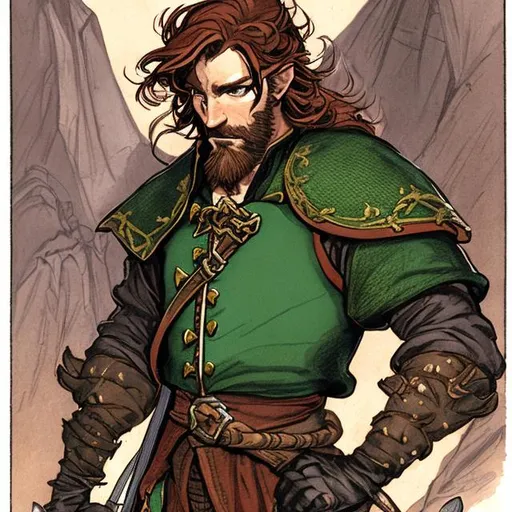
Appearance and Personality: Tall and well-built by Imperial standards, Hector looks as if the blood of old Atmora still runs strong in his veins, measuring 6’3” from toe to tip, sporting broad shoulders, a narrow waist, powerful hands with strong knuckles and limber fingers, and well-defined thighs and calves -- muscular, not hulking, but athletic; a swimmer's physique, or, indeed, a warrior's, shapely and masculine even as he approaches middle age. Aside from numerous scars, there is little to blemish his tanned skin. Even his body hair is scarce, or perhaps merely so light that it is difficult to see, until the sun catches it and a thin layer of pale dew reveals itself.
Not as gruff as a Nord but not as graceful as a Breton, his open face is long and chiseled, expressive and austere in equal measure. His aquiline nose cuts a straight line from his firm brow to his mouth, which is wide and emotive -- a broad grin with pearlescent teeth, a thin grimace set in anger, a knowing half-smile, flitting briefly, seen and unseen in the same moment. His close-clopped hair hugs the contour of his skull, a shimmering patina of gold ever so slightly flecked with silver. Hector is undeniably handsome, and yet there is an intensity to his sapphire-marine eyes, bright gems with pinprick pupils deep-set beneath his brow, that does not invite romantic advances -- it speaks of a man possessed of, or perhaps
by, drive and purpose, to whom there are never enough hours in a day, who sorts people into ‘problems’ or ‘insignificants’, and who seems married to an ideal far beyond the limits that the needs and demands of a single person can place on him.
There is, in fact, a touch of the manic about him. Hector oscillates between serene, meditative prayer, and a restless vigilance that waits for no one -- always moving, investigating, pursuing, assessing. One might tell him to stop and smell the roses, and he would halt, behold them, inhale deeply, praise their beauty, congratulate the gardener, and pledge himself to their protection, all meant and sincere, and yet never able to rid himself of the impression that he is already on his way to his next objective. He displays a great interest in the world around him, in history and current affairs, in the habits of the great and good and the furtive dealings of the small and desperate, but not in permanent attachments to any of them, gaze shaded in the melancholy of a man who knows what happens when they are broken. Aside from this, he is friendly, helpful, selfless to a fault, courageous in the face of danger, stalwart in his mission and an eager teacher, but also uncompromising, stubborn, vocal in his judgements and his good opinion once lost, is lost forever. Woe befalls the wicked who cross his path, especially dabblers of the dark arts or servants of the Outer Forces -- and even merely those who have been afflicted by them, for both lycanthropy and vampirism are cancers to be excised in the paladin’s eyes, and he does not believe in a cure.
To this end, Hector is armed and armored during his travels. He wears a medium-weight mixture of chainmail and plate armor underneath a white tabard -- if there ever was a coat of arms emblazoned on the front, it has now faded entirely with age -- and a long white hooded cloak, edges frayed from exposure to the elements. In full regalia, including gauntlets, greaves, and distinctive greathelm, every inch of Hector’s skin is covered and protected and he looks like nothing more than an anonymous hedge knight, armed with a steel hammer carried in a loop on his right hip, a battered kite shield on his back, a dagger sheathed at his left hip, and a large claymore of unknown make, carried in a weathered scabbard beneath the shield across his back. Out of his armor, Hector will be seen in simple but sturdy clothes in various colours.
- Abilities
Skills: - Blunt Weapons: A hammer is both a tool and a weapon, and this symbolism of its dual role is why Hector relies on a one-handed steel warhammer to fight against the people and beasts of Mundus. It can inflict non-lethal damage by breaking an opponent’s hands or claws, ending a fight without the risk of mortal bloodletting that the use of a bladed weapon always carries. But if needs must and push come to shove, it is more than capable of crumpling steel plate beneath its weight and caving in skulls with devastating force. There is technique involved here, to maximize the impact of the swing, to seek attack angles that undermine the opponent’s guard, and to smash an enemy’s weapon aside with a reverberating clang that runs up through their swordarm. While it all looks very simple at first glance, be assured that Hector knows what he’s doing.
- Blocking: He pairs his hammer with a kite shield, its surface slightly curved to deflect incoming blows and wide enough to cover his head and torso fully when raised. A lot of conflicts aren’t worth killing anyone over, but similarly they aren’t worth dying over either, and Hector will fight defensively when possible. That said, he can use the shield to interrupt his opponents with a bash and even its rim can be a weapon, especially when slamming the tip at the bottom of the kite shape into a prone enemy for a brutal finisher.
- Bladed Weapons: No mercy will be shown to the undead, the accursed, or the unnatural, however, and it is for these enemies that Hector unsheathes the storied sword carried on his back. He wields the claymore in the manner of the Ewl Wyra Scryi, an ancient fighting style developed to combat significantly larger foes than the swordsman himself, featuring wide arcing swings and powerful running thrusts, including an exceedingly difficult but very effective low duck followed by an upwards lunge, designed to impale a monster’s head as it descends to strike. Against such a foe a shield will provide no defense, and Hector instead relies on evasiveness and momentum to stay out of harm’s way and within striking distance. It is a dance of death, but Hector accepts this challenge gladly, for it is while destroying and banishing the enemies of the Nine that he feels most alive.
- Medium Armor: In his opinion, a balanced middle ground between weight and protection is ideal and suits the warrior in a variety of scenarios. Hector is highly experienced in wearing his customised suit of armor and it fits him like a second skin.
- Athletics: A long life on the road and even partially in service of the Imperial Legions has kept Hector fit and vigorous. He can march for hours on end and knows how to traverse difficult terrain, including the basics of mountaineering.
- Music: Hector is an accomplished, if not prodigious, amateur musician, with a fine singing voice and appreciable skill on the lute. Liturgical songs are a perennial favorite, of course, though he has been known to surprise friend and foe with the occasional lecherous tavern ditty.
Magic:- Restoration: A paladin is not only a warrior, he is also a healer, and Hector specialises in Restoration magic as a result. His expertise is versatile -- he is capable of healing himself and the wounds of others with a touch, from lacerations to broken bones and internal bleeding, and he also knows how to Fortify his body and mind in preparation of a hard fight or arduous task -- he enhances his Strength when wielding his warhammer against heavily armored foes, while he opts to boost his Agility when fighting a monster, and lastly his Personality when having to argue his case with whatever local authorities are interfering with his business.
- Destruction: Magic can, of course, be used to heal and harm in equal measure. Hector is not as capable with Destruction spells as he is with Restoration magic, but he can do enough to supplement his otherwise melee combat-oriented fighting style with snaking tendrils of Shock magic, lobbed balls of Fire magic or stake-like icicles of Frost magic.The most potent Destruction spell he can muster is a Cloak of Flames that surrounds him, serving to intimidate, wrongfoot and burn enemies as he chases them down.
Blessings: Through intense devotion and fanatical dedication, Hector has managed to obtain the Blessings of the Nine Divines -- or, if nothing else, channeled his faith and force of will into a modest resource of divine power. An extremely skilled Mysticist would, upon investigation, discover that there is a genuine presence of Aetherial energies, associated with the realms of the Divines, around Hector’s person, but whether this has been
bestowed on him or
manifested by him, in the ways of unbound and unstudied magic like the Thu’um and the Shehai, is impossible to tell.
- Paladin of the Nine: In lieu of the invocation of a specific aspect of any of the Divines, Hector exudes a supernatural sense of purpose and power as long as his face is revealed. Upon beholding his visage, the faithful are comforted and inspired by his presence and liable to recognize him as an ally, even if they do not know why, whereas the wicked are vulnerable to a sense of trepidation, and any Abominations (Daedra, lycanthropes, the undead and vampires) will know that a champion of the Divines opposes them. Those of a neutral disposition will experience neither sensation, but still behold in him something more than the average Man.
- Mercy of Mara: Intoning a prayer of Compassion to the Mother Goddess, Hector’s next healing spell on another person turns into Lay Hands, a divine touch that not only heals all but the most grievous of injuries, it also restores the patient’s fatigue completely and imbues them with renewed courage. The ability to do so must be renewed by praying at a shrine before Hector can invoke this Blessing again.
- Sight of Stendarr: Calling upon the God of Justice, for justice is blind and yet all-seeing, Hector’s eyes are suffused with a mild glow and he gains the ability to see any of the Abominations, even if they are hiding in the darkness or their appearance is magically concealed, for several minutes. The ability to do so must be renewed by praying at a shrine before Hector can invoke this Blessing again.
- Aura of Arkay: Invoking the Bringer of Light and the Lord of the Wheel, Hector can Turn the Undead in a radius around him, forcing them to flee or be turned to ash as the foul necromancy that animates them is banished by divine light. The ability to do so must be renewed by praying at a shrine before Hector can invoke this Blessing again.
- Triumph of Talos: A Blessing that can only be tapped into during moments of the most dire need, when the Enemies of the Emperor and the Empire threaten to overrun Hector and his allies and all hope seems lost. In such grave circumstances, a fervent prayer to the Stormcrown and the Lord of Shining Hosts will imbue the paladin with the fearsome strength and the resilience to injury required to turn the tide, ending either with his victory over the Enemy or with his death. If victorious, Hector will be sapped of all fatigue and be forced to rest for a full day afterwards, and the ability to call upon this Blessing will remain dormant for an extended period of time, even after praying at a shrine.
Hector has not yet received, or manifested, the Blessings of the remaining Nine Divines.
- Equipment
Personal Items: - Hector’s armor, a medium-weight set of chainmail, plate and leather underneath a plain white tabard.
- White, hooded cloak.
- Simple cream-coloured clothes worn beneath the armor.
- An amulet of Talos worn as a necklace.
- Keys to a room in the city as well as a shack in the Great Forest.
The Lock Box:- A steel warhammer with a square head and a short leather-wrapped handle, designed to be wielded in one hand. It is plain and unadorned.
- An old and battered steel kite shield. There are faint traces of paint that indicate it may have once displayed a crest or coat of arms, but this has faded away.
- A simple iron dagger and its sheath. Useful in cramped spaces or for throwing.
- A coinpurse with a modest sum of septims.
- A large claymore with a silver blade and a reinforced mithril core, featuring a wide crossguard and a long grip. A red ruby is set in the pommel. It is an ancient and storied sword with a unique enchantment; its blade glows blue in the presence of Daedra and it banishes their lesser varieties when struck. Hector carries it in a worn and battered scabbard and has wrapped the hilt and pommel in dirty linen rags to hide its fine make and ruby gemstone. Its name is DO SILA ALTADOON, inscribed in a pre-Aldmeri runic script along the length of the blade. An expert swordsmith or man-at-arms might recognize that the sword’s proportions suggest an origin as a one-handed weapon for a much larger swordsman than any of the mortal races alive today, save perhaps the largest Khajiit, and Hector merely wields it with both hands out of necessity.
Stored Items: In his room at one of the city’s inns, there is a a traveling bag with a few changes of clothes, several instructional tomes and bestiaries on hunting monsters and Daedra, two potions of Cure Disease and Cure Poison, dried rations and a water flask, as well as a lute.
In his cabin in the Great Forest, Hector owns a small library of religious, theological, occult and arcane texts -- covering either the subjects of his own faith or the nature of his enemies -- and a modest armory with backup weapons and armor.
Background: Born to a pair of wandering preachers -- part teacher, part healer, part crusader -- on the southern shores of Elsweyr, Hector had an adventurous and turbulent childhood. Their work as errant servants of the Divines took them all over Tamriel, and the young Imperial had traveled the length and breadth of large parts of the continent before he even turned ten summers old, and experienced a great many of its cultures firsthand. Everywhere they went and remained for a few months at a time, Hector would make new friends and learn new things from them, weaving a complicated and worldly tapestry against the backdrop of the faith and morals that he inherited from his parents -- faith, especially, was the only constant in a churning sea. Prayer, lessons and meditations were frequent and mandatory, but Hector felt no resentment and clung to them fiercely instead, the stable and eternal nature of the Eight and One being his port in the storm. They were always there for him and Hector frequently imagined their comforting presence as friends and advisors, as only children can do. For his parents were often busy, leaving him in the care of the troupe they traveled with, an eclectic ensemble and network of merchants, nomads, scholars and vagrants. Sometimes his parents even returned wounded from their absence, much to young Hector’s consternation, but the only explanation he ever received was that the world was a dangerous place and they were working to make it safer.
When he was old enough to understand, his father explained to him that they were adherents, perhaps the very last, of an old Imperial religious tradition. So old, in fact, that it had lost its name, and they simply called it the Way. Or maybe it never had any other. They were builders of order and civilisation and destroyers of chaos and barbarity. And civilisation there was -- from the glittering crystal spires of Summerset to the great bone-grey mausoleum of Necrom, Hector saw it all during their travels. For a while, it seemed to him that civilisation and order were already everywhere, and there was precious little chaos to destroy. This was the handiwork of the Empire, he was told, and of the greatest of the Eight and One, Talos, Tiber Septim, Lord of Shining Hosts, who had united Tamriel under one banner and established the continent-spanning rule of law that he had witnessed. “But something like that takes work to maintain,” Hector’s mother had told him. “A lot of work. Our work. Divine work.” They remained vague about what it was exactly that they were protecting the Empire from. Surely the might of the Red Legions was enough against any threat? In the meantime, his father taught him how to fight, by sword and hammer and spell, in the evening hours after dinner, and Hector went to bed tired of the exercise -- and tired of being trained to fight phantom enemies, it would seem.
As young men are wont to do, Hector found himself rebelling against his parents and their traditions and wanted something different for himself. He wanted to serve the Empire still, but saw no need to do what they did. Instead, he wanted to join up with the Imperial Legions when he came of age. His father, realising that they had to show him the Way entirely or lose him to other pursuits, took him to be fitted and armed by an armorer and brought him along on his next expedition. They were in Skyrim at that point, in the cold swamps near Morthal, and as they walked, his father explained the true nature of their quarry -- Abominations. The Empire, he explained, was beset on all sides, from without and within, by unnatural, accursed and extraplanar forces. It was a shadow war fought on the fringes, in the cities, and even at court. Akatosh and the Emperors had established a Covenant and an Empire that denied such forces at every turn, keeping the jaws of Oblivion shut and shining light in the dark spaces where vampires, lycanthropes and liches would hide. It was a war that the Empire had been winning for thousands of years, but total victory was never attainable, and every so often the Padomaic forces of Chaos, in their various guises, struggled to tip the scales. The Way was a lifelong dedication to preventing this from happening, enforcing the Order of Anu and protecting the greatest gift that the Eight sacrificed so much of themselves to create: Tamriel.
“What is it that we hunt out here then, father?” Hector asked, wrapping his cloak around tightly in the bone-chilling air of Morthal.
“Vampires,” his old man breathed, and the word hung in the air like fog.
The days that followed, Hector only remembers as a blur. There was a cavern, darkness, torches, a large sword, fear, courage -- by Stendarr, there was
courage. Claws, fangs, screams, wings, blood. Bone crushing beneath his hammer. Pain. Flashes of magical fire. Prayer, not muttered under one’s breath, but bellowed like the resonant chiming of a cathedral bell, prayer that banished the dark and the fear and the pain. Strength in his veins. A warm presence at his shoulder. Righteous anger. Death and judgement.
And then sorrow, a heavy grief that smothered his throat like a surge of hot blood, carrying the dead weight of his father’s mutilated corpse and his mighty silver sword out of the swamps, cheeks streaked with tears.
Hector does not remember what became of the vampires. He only remembers his mother’s scream and the gasps of horror from the troupe. He remembers sleeping for three days and nights, saved from damnation by an alchemist and a priest, excising the virus from his blood before it could take root.
“I can’t do this.” Hector remembers saying that. He remembers the guilt for a moment of indecision, paralysed by fear, the details now beyond recall, that he
knew in his heart of hearts was what got his father killed. An averted gaze, and then a final hug from his mother.
The Legion awaited him. It was a quiet time in most of the Empire, following the Warp in the West and its Miracle of Peace, and Hector obtained an easy posting in the reforged kingdoms of High Rock. Patrolling the roads, manning the garrison, playing cards and dice, smoking and drinking, camaraderie with the men, long looks from the women, a warm bed, a passionate touch. It was a very different kind of life, and Hector lost himself in it entirely, desperate to forget the horrors of the swamps. The Way was not for him, he had decided. He wasn’t afraid of the occasional fight and he would gladly march to war for his beloved Empire and its gods, but not that. Never again. It wasn’t long before he realised he had stopped seeing the Divines from the corners of his eyes, his imaginary friendship with them replaced with
real friends, comrades in arms, a brotherhood forged in duty, something less transient, for the first time. It should not come as a surprise that he also quickly fell in love with a Breton girl his age, all bright emerald eyes and raven locks by name of Leyah, who worked as a cook for the local garrison. To her, the tall and well-traveled Legionnaire was exotic and exciting. To him, the girl whose family had never left their hometown in the past three generations represented a home. There was a whirlwind wedding, and a pregnancy, and a daughter named Sara.
Then, inexplicably, came the guilt. The silver sword that Hector had inherited from his father would stare at him as it poked out of the chest that contained his meager belongings in the barracks. When he was alone at night -- duties prevented him sleeping at his wife’s house in Wayrest every so often -- he found himself assailed by a sense of purposelessness. The happiness he had experienced by finding a home for himself began to evaporate. In his dreams, he saw his father’s rent and disemboweled corpse-form scrambling around, frantically trying to finish something -- writing a book, cleaning the house, cooking, it was different every time -- while shoving his intestines back into his gore-bloody gullet. Disturbed, Hector reached back for his faith and returned to dutiful prayer and meditation, even church attendance, listening with rapt attention to the sermons delivered by the priest in the Temple of the Divines in Wayrest. But the more he listened, and the more he loitered at home and doted on his new daughter and loving wife, the more he soldiered on and slowly climbed the ranks in the Legion to earn a modest officer’s commission, the more he prayed and reflected, the more he realised that he was going about his life entirely incorrectly.
The Way was calling him. There was a sense of unease in the air in the Empire, almost imperceptible, and Hector couldn’t shake the feeling that something was going to go terribly
wrong. Hushed whispers in clandestine meetings spoke of the waning years of the Third Era. Why? What was going to cause it to end? Hector didn’t know, and couldn’t tell, and sometimes he thought he was merely hallucinating the things he thought he heard, but the more he consulted the Divines in solitary reflection, the more he felt that he was right. Something was coming. It was time to act.
He resigned from the Legion and took up his father’s arms. Leyah was shocked and frankly quite outraged, until he explained, after which she was moderately outraged -- no matter which fancy divine calling he attributed his decisions to, he was still leaving his wife and his five-year-old daughter to roam the continent in search of some kind of evil to destroy. Hector promised to return frequently and sent back any money he made from his exploits to support them, but a stonefaced Leyah merely nodded. There would be no true understanding. Hector hadn’t really expected it. He knew he sounded crazy. Perhaps he was crazy. But he knew in his heart of hearts that he was
right, and strangely enough, in the face of his newfound conviction, he felt stronger than ever.
Many years of adventures, too expansive for this record, followed. Hector wandered, noticed, investigated, pursued, fought, destroyed -- cults of Deadra worshippers and conjurers, covens of witches and vampires, scheming liches, uncontrolled lycanthropes -- and wandered again. He rekindled his contact with the old network of travelers that his parents were part of, and through them learned of the whereabouts of his mother. She had returned to the south coasts of Elsweyr, remembering her time there as some of the happiest, and settled down to start a small chapel dedicated to Arkay. Hector, in a long and winding path, made his way there, and the two were overjoyed to see each other once more, and she saw the silver sword on his back and immediately blessed him and his ventures to come. When he told her about the horrifying dreams in which his father had visited him, she looked away and Hector sensed a flicker of guilt before it was gone again, but he never managed to figure out why. Either way, the road beckoned.
He kept his promise to Leyah and regularly made the trip back to Wayrest, bearing coin and gifts from far away, and every time Sara was more and more excited to see him, while he could see that Leyah loved him less and less. After the fifth such return in as many years, she demanded a divorce from him so that she could remarry. She had found another. Hector said nothing, and simply signed. He felt no pain anymore. The light of the Eight and One was with him, and within him, and Mara’s love was all the love he needed. He kept coming back just to see Sara, but even she became less interested, and even resentful as she turned into a young woman in her own right. “Why couldn’t you stay?” she asked him bluntly once, her mother’s green eyes staring at him accusingly. Hector had no answer that could satisfy her. Nothing that could make it right. She scoffed, and they spoke very little since.
Time, then, brings us to 3E433. The Imperial astrologers have divined in the heavens that Mehrunes Dagon has returned to Oblivion and is plotting against the Empire once more. For a while now, Hector has observed that his usual quarry of Daedra cultists have been migrating towards Cyrodiil. In the intervening years, he has never been able to shake the feeling that the catastrophe he sensed still had not come to pass, no matter the foes he already defeated. The Heartland had always been an area of peace and stability and the powerful rule of law, and Hector had never extensively visited his ancestral homeland much during his travels. But now the time had come. He settled into an abandoned hunting cabin in the Great Forest and made it his base of operations, and from there he has been wandering again, trying to sniff out any hint of sedition and Padomaic meddling. Whatever is happening, it is well-concealed, for he has turned up little, and in frustration and for lack of a better idea, he has traveled to the Imperial City to attend the festivities surrounding the engagement of Geldall Septim. Perhaps it was time that he paid tribute to the Septims in person for the first time, inheritors of Talos and the most righteous rulers in all the lands…
Ambition: To save the world from something really,
truly dangerous, that will make all of his devotion and sacrifice worth it.