Excuse me my fine colored compatriot but might you be capable of giving me directions to that place where all the poor underprivileged people, most of who are of your race live?
Dinh AaronMk
 Member
my beloved (french coded)
STATUS: As an American [user could not afford rest of post] 1 yr ago
- Last Seen: 10 mos ago
- Joined: 12 yrs ago
- Posts: 7860 (1.75 / day)
- VMs: 13
-
Username history
- Dinh AaronMk 12 yrs ago
-
Latest 10 profile visitors:
-
Most recent →
 AliceAbigail,
 Scrawl Banditta,
 Wilted Rose,
 mickilennial,
 Ekreture,
 Supermaxx,
 erikh
erikh
Status
Recent Statuses
1 yr ago
Current
As an American [user could not afford rest of post]
6
likes
3 yrs ago
Never spaghetti; Boston strong
3 yrs ago
The last post below me is a lie
1
like
3 yrs ago
THE SACRIFICE IS COMPLETE. THE BOILERMEN HAVE FRESH SOULS. THEY CAN DO SHIFT CHANGES.
2
likes
3 yrs ago
Was that supposed to be an anime reference
Bio
Harry Potter is not a world view, read another book or I will piss on the moon with my super laser piss.
Most Recent Posts
In
If you're a sixteen-to-twenty-four-year-old male, you should be smoking cigarettes.
→
9 yrs ago
Forum: Spam Forum
Regarding the sales tax revenue misappropriations, we should probably make petitions to hold those state representatives accountable.
Thanks for providing the critical article. I'm also aware that the Chinese Communist Party has a habit of trying to spin news in its favor. I agree that Roosegaarde should've put his tower in an industrial area, and I'd like to see what would happen in such a scenario. I'd also like to see it tested in a city like Los Angeles.
In comparison, a 1996 study by McCubbin and Delucchi estimated a $450 billion upper bound to the societal cost of automobile caused air pollution in the USA. If we ignore inflation, and assume that lower emissions in the modern day are balanced out by higher populations and/or greater usage of gasoline fueled vehicles, this societal cost is still $85 billion over the combined health costs, mortality based economic losses, and most recent smoking treatment expenditures you listed. If the societal cost is actually 50% the estimated upper bound, it's still more than 50% the societal costs caused by cigarettes.
I can accept that Roosegaarde's tower may not work as advertised, and that gasoline fueled cars might not cause as much damage to society as cigarettes. But, I'm alright with paying more sales taxes for cigarettes, especially if the higher prices force less people to smoke, and if the taxes are used to mass produce systems that can clean the air. If used properly, $16 billion or more can go a very long way.
You act like it's simple to re-appropriate public funds to a relevant and more effective program and then quickly suggest these funds are re-appropriated elsewhere.
In
If you're a sixteen-to-twenty-four-year-old male, you should be smoking cigarettes.
→
9 yrs ago
Forum: Spam Forum
@Shoryu Magami
The US government got $16 billion in 2015 from cigarette sales taxes. That's more than enough to build an ionic smog vacuum tower in its 10 most populated cities. China built one in Beijing last year, and it seems to be working. Carbon dioxide causes respiratory problems for urbanites, as it's denser than regular air. Carbon monoxide is less dense, but causes more health issues by latching onto red blood cells.
By preventing these problems, you prevent medical expenses that drain economic productivity, so it's very profitable.
16 billion dollars raised is by far not enough to offset the 170 billion dollars in health costs each year as estimated by the CDC, who like-wise estimates the economy looses 156 billion a year from pre-mature death of other-wise working-age individuals, or from illness related to the habit. Expenditures for smoking-related treatement were on 50 billion in 1993, 22 billion in 2003, and as of a 2016 report cost the health-care system 39 billion.
State governments are supposed to appropriate a minimal amount of funds from tobacco sales taxes per year to cessation/quitting programs but so far only two states even meet the recommended level (North Dakota, Alaska) and one state (Oklahoma) even bothers to meet the half-way mark.
You could use the funds to build smog-scrubbing towers in ten cities, but the results of the tower in Beijing are arguably pretty poor for a working model and its placement hardly strategic. The article you posted too even admits:
UPDATE: However, there’s some debate over just how accurate the Ministry of Environmental Protection’s statistic is, and how effectively the smog-sucking tower really works. The Chinese Forum of Environmental Journalists (CFEJ) discussed another assessment of the tower. The best statistic gathered didn’t meet World Health Organization standards, according to CFEJ, for PM2.5 particles. They said ultimately the tower is very limited in scope. They suggested the tower be renamed the “Haze Warning Tower” instead, in keeping with Roosegaarde’s goal of raising awareness, as the government, scientists, or entrepreneurs seek better solutions to address China’s air pollution issue.
Of additional critical reading to this effect.
This pretty much keeps the dark narrative cloud hanging over China in terms of numbers its own government puts out: that being they're over-inflated. The Chinese government isn't a very transparent or approachable organization, less so than the US or US state governments; all qualms aside. And speaking to an engineer friend of mine he raises concerns over the program based on its non-strategic placement of the emplacement, that it's not actually anywhere that does any good at the source and is a mere publicity stunt. They could have installed it in or near a smokestack to scrub the exhaust as it comes out and to help shoot the problem then and there, which is really the real theme in China: it needs to clean up its industry at the very source.
But using that 16 billion in tax earnings figure to buy a few towers still doesn't resolve the ill-effects of smoking on an expenditure level. As it stands, and as I pointed out, the costs associated with smoking still outweigh the reward from tax earnings by a ration of 2:1 against smoking at its best estimates, and you could find more cost-effective things to do with that money that building ten effectively publicity stunt towers.
In
If you're a sixteen-to-twenty-four-year-old male, you should be smoking cigarettes.
→
9 yrs ago
Forum: Spam Forum
Don't smoke cigarettes, smoke communism. The class-conciousness that comes as a byproduct will win you all the women.
But guys, how do I go brrt? No one's answered my question about going brrt.
How do you brrt?
Name of Nation:
Tabernacle Empire
Flag:

Government Structure:
Theodemcratic Confederacy
Leader(s):
Thomas Monmont
Josiah Brown
Enrique Young
Alan Carpeter
Culture:
The nominal and official language of the Empire is English, though Spanish is widely spoken as well and many of the leading individuals in the Empire have grown up to speak English, Spanish, and any number of minority languages within the area.
There is an informal cultural divide persistent within the Empire that carves the Empire into two ambiguous cultural districts. The more southerly regions having adopted many Mexican fashions and traditions where as the north contains more persistent antiquated habits of the old American culture.
In general, the ruling religion of the Empire is Mormonism and on-again, off-again concentrated missionary work or even violent local pogroms has strengthened The Church of Later Day Saints throughout. Minority populations of Catholicism persist in Mexican villages as mainstream protestant religion remains elsewhere.
The hierarchy of the Church of Later Day Saints was revived after a period of darkness after the bombs fell by a man calling himself Alex Smith, since its restoration it has for the passed several centuries persisted as a political force among the scattered Mormon communities and it currently presided over by its president; Thomas Monmont
Demographics:
70% - White
20% - Hispanic
5% - Asian or Pacific Islander/'descendant'
3% - Black
2% - Native American tribes
Nation History:
Following the fall of the bombs the communities of America's south-west and Mexico's north tried to pull themselves through for a time. The waning of government power in either country saw to a reliance on growing local power in the towns and cities of the region, as with the rest of the two countries.
With the devastation of either country though came the growing ambiguity of the border and eventually the whole dismissal of it. As communities settled into the post-apocalypse new orders of local rule came into fruition and so did the general habits of man. Warfare re-emerged as larger towns skirmished against each other for feeble resources, trying to maintain populations and economies roughly equal to those that had kept these desert towns alive in the years before the bombs. In a few years, the power of the cities came into play and polities began to form around the major cities of the south-west.
Among this shifting power structure was the coalescence of the Mormon community from Utah who banded together in loose defense pacts against their enemies. These pacts would mature into alliances and eventually into a sense of governance and the Mormon kingdom in southern Utah came to take it upon themselves to take the fight to their enemies and they began to march south, proactively seizing land and reinforcing their base.
The Mormon Kingdom was however a “kingdom” in name only, as an easy identifier among themselves and the people that came to fight against them. The governance of this kingdom was a loose and decentralized affair in some ways reminiscent of the political styles of the Native Americans. To the Mormons it was an emergency attempt at government focused on their local community and church leaders who took to reviving the Tabernacle to not just pray but to organize their communities in the face of opposition and war.
It was in this atmosphere that a man named Joseph Smith stepped into the political scene. An otherwise unnoteworthy man who had sat quietly in the pews, Alex Smith claimed himself to be a conduit of the lord's power; a prophet on Earth. Joseph, who had been known by his small group of friends as being otherwise erratic soon defined and underscored his legitimacy as a prophet through flashes of genius so profound that it could not help but consider him as a prophet of the Lord.
His visions and work was sporadic, but came with lightning force. At times he would spend days or weeks silently only to suddenly burst forth with strings of commands or confused tongues that managed to find the road ahead for the communities.
Young Smith often talked about separated communities far to the south, who were warrior in nature and need but required help. This sparked a Southern Crusade and men from across the territory of Utah came to him out of need for purpose. Converting them all to Mormonism, he ordered them south to the old lands of Mexico. A war-path was initiated across the deserts of Nevada and it would take years before they reached Mexico. Alex Smith would not live to see them cross into Mexico's northern deserts and he passed away at the age of 58.
The church meanwhile went lost for a year while the community attempted to decide what to do. It was said that one night in the Nevada desert a young mother awoke from a clear dream where she claimed to have been spoken to be the angle Moroni who confided in her that it would be God's will to take up after Joseph Smith. When she managed to return to Salt Lake City she confided in the leaders there what she had seen and triggered then and there an election for the next president and prophet of the Church.
The second president after Alex Smith was named, Thomas Olds. Olds first mission was to revive the Mexican Crusade and the scattered forces of the Utah army was reorganized for its purpose and sent south.
On reaching Mexico the Utah army did indeed find a lost branch of their own people who had defined themselves as warriors. Long beset since even before the bombs by their own trials, the tribes in Mexico had become incredibly combatants and had fended off long sieges from cartel groups. So much so in fact that they had managed to forge a kingdom of their own in northern Chihuahua state called The Kingdom of Dublan.
The warriors of Dublan nearly went to war themselves against the men from Utah who had come to relieve them by divine mandate and it wasn't until the interference of Thomas Olds that the two forces were drawn into an understanding and there was much relief. Being reunited, the two communities combined their efforts against the boundless enemies in the desert.
Some generations after, the large Mormon kingdom went through reforms brought on by civil strife and conflict within. The third church president – now uniformly referred to as The Prophet – Howard Paines had to initiate a council between all the major rulers in the kingdom. Under this conference the men present begrudgingly built a fully fleshed model of government to control the expanding political mass and to define the rights within. Drawing from antiquated inspiration the rights of the realm evolved into respect in and towards regional governing bodies. They were called democratic in principle, and enjoyed the structure of old state government organization but it became apparent in time that these young democracies could not hold to the virtues and models of such government and powerful families came to rule in the strongest of these states. While retaining the trappings and titles of a democratic state they became very much monarchies, thus giving rise to the Tabernacle Empire.
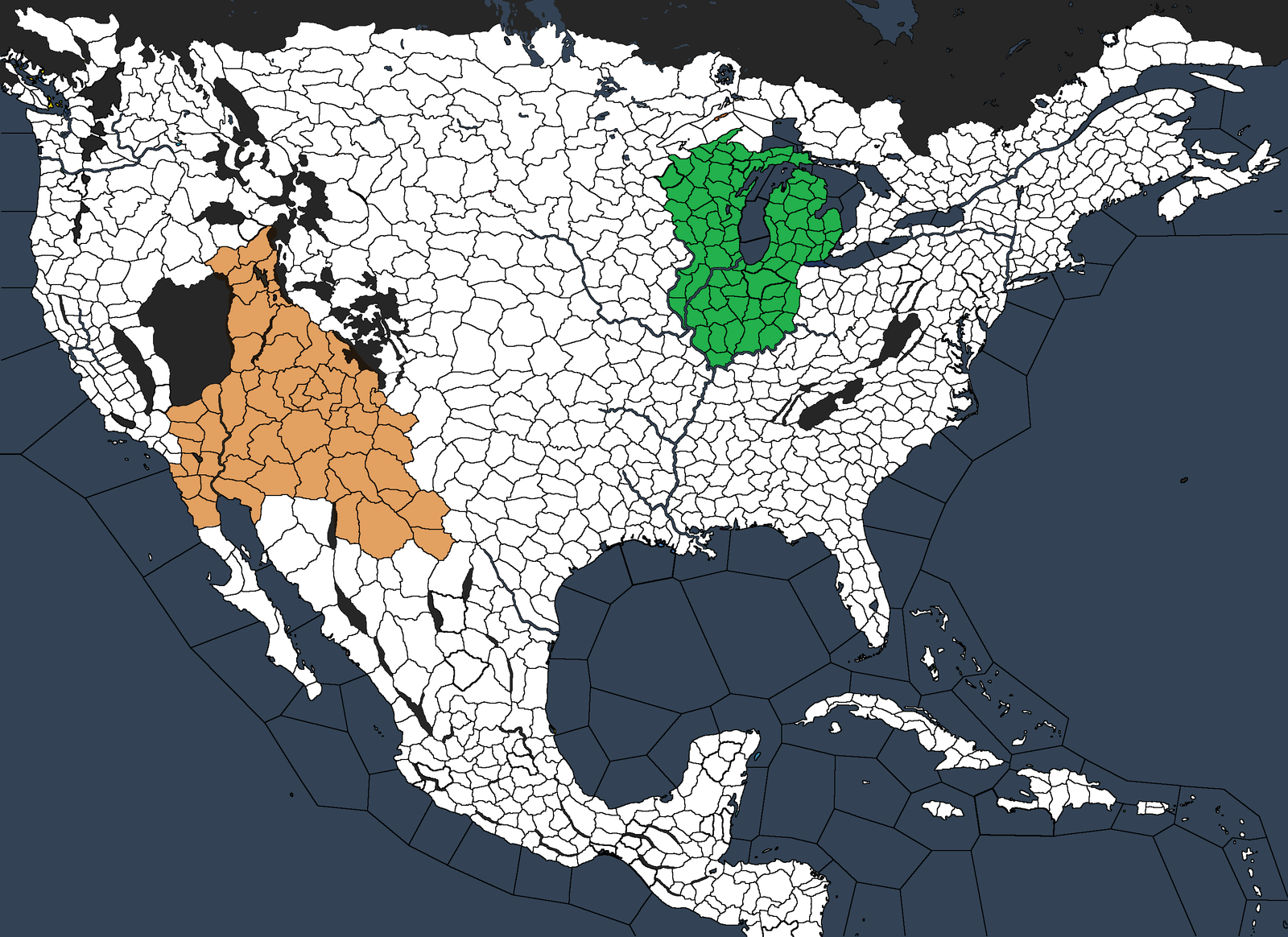
Since then, four major polities have emerged in the realm that surround various independent counties and free cities: The State of Chihuahua, Deseret, Baja California, and the Church itself.
Description of Economy:
With most of the Empire in the desert, much of the agricultural economy throughout the realm is simply subsidiary for the local populations. But large scale ranching is a major industry in the east and the estates of Chihuahua maintain large maize and chili plantations in the dry rocky climbs. On the coast in California there are much richer farmlands where orchards of fruit-bearing trees and grain is grown.
Regions in the north in and around Deseret Utah are rich mining fields, bearing the metals for the empire.
Description of Military:
There is no standard imperial army, instead every political unit raises in some way their own military. The smallest counties and municipal governments can only manage volunteer, self-armed and equipped militia forces for their own defense and use. However the larger states like Deseret and Chihuahua can raise their own standing military force and they are trained to those own local expectations.
Tabernacle Empire
Flag:
Government Structure:
Theodemcratic Confederacy
Leader(s):
Thomas Monmont
Josiah Brown
Enrique Young
Alan Carpeter
Culture:
The nominal and official language of the Empire is English, though Spanish is widely spoken as well and many of the leading individuals in the Empire have grown up to speak English, Spanish, and any number of minority languages within the area.
There is an informal cultural divide persistent within the Empire that carves the Empire into two ambiguous cultural districts. The more southerly regions having adopted many Mexican fashions and traditions where as the north contains more persistent antiquated habits of the old American culture.
In general, the ruling religion of the Empire is Mormonism and on-again, off-again concentrated missionary work or even violent local pogroms has strengthened The Church of Later Day Saints throughout. Minority populations of Catholicism persist in Mexican villages as mainstream protestant religion remains elsewhere.
The hierarchy of the Church of Later Day Saints was revived after a period of darkness after the bombs fell by a man calling himself Alex Smith, since its restoration it has for the passed several centuries persisted as a political force among the scattered Mormon communities and it currently presided over by its president; Thomas Monmont
Demographics:
70% - White
20% - Hispanic
5% - Asian or Pacific Islander/'descendant'
3% - Black
2% - Native American tribes
Nation History:
Following the fall of the bombs the communities of America's south-west and Mexico's north tried to pull themselves through for a time. The waning of government power in either country saw to a reliance on growing local power in the towns and cities of the region, as with the rest of the two countries.
With the devastation of either country though came the growing ambiguity of the border and eventually the whole dismissal of it. As communities settled into the post-apocalypse new orders of local rule came into fruition and so did the general habits of man. Warfare re-emerged as larger towns skirmished against each other for feeble resources, trying to maintain populations and economies roughly equal to those that had kept these desert towns alive in the years before the bombs. In a few years, the power of the cities came into play and polities began to form around the major cities of the south-west.
Among this shifting power structure was the coalescence of the Mormon community from Utah who banded together in loose defense pacts against their enemies. These pacts would mature into alliances and eventually into a sense of governance and the Mormon kingdom in southern Utah came to take it upon themselves to take the fight to their enemies and they began to march south, proactively seizing land and reinforcing their base.
The Mormon Kingdom was however a “kingdom” in name only, as an easy identifier among themselves and the people that came to fight against them. The governance of this kingdom was a loose and decentralized affair in some ways reminiscent of the political styles of the Native Americans. To the Mormons it was an emergency attempt at government focused on their local community and church leaders who took to reviving the Tabernacle to not just pray but to organize their communities in the face of opposition and war.
It was in this atmosphere that a man named Joseph Smith stepped into the political scene. An otherwise unnoteworthy man who had sat quietly in the pews, Alex Smith claimed himself to be a conduit of the lord's power; a prophet on Earth. Joseph, who had been known by his small group of friends as being otherwise erratic soon defined and underscored his legitimacy as a prophet through flashes of genius so profound that it could not help but consider him as a prophet of the Lord.
His visions and work was sporadic, but came with lightning force. At times he would spend days or weeks silently only to suddenly burst forth with strings of commands or confused tongues that managed to find the road ahead for the communities.
Young Smith often talked about separated communities far to the south, who were warrior in nature and need but required help. This sparked a Southern Crusade and men from across the territory of Utah came to him out of need for purpose. Converting them all to Mormonism, he ordered them south to the old lands of Mexico. A war-path was initiated across the deserts of Nevada and it would take years before they reached Mexico. Alex Smith would not live to see them cross into Mexico's northern deserts and he passed away at the age of 58.
The church meanwhile went lost for a year while the community attempted to decide what to do. It was said that one night in the Nevada desert a young mother awoke from a clear dream where she claimed to have been spoken to be the angle Moroni who confided in her that it would be God's will to take up after Joseph Smith. When she managed to return to Salt Lake City she confided in the leaders there what she had seen and triggered then and there an election for the next president and prophet of the Church.
The second president after Alex Smith was named, Thomas Olds. Olds first mission was to revive the Mexican Crusade and the scattered forces of the Utah army was reorganized for its purpose and sent south.
On reaching Mexico the Utah army did indeed find a lost branch of their own people who had defined themselves as warriors. Long beset since even before the bombs by their own trials, the tribes in Mexico had become incredibly combatants and had fended off long sieges from cartel groups. So much so in fact that they had managed to forge a kingdom of their own in northern Chihuahua state called The Kingdom of Dublan.
The warriors of Dublan nearly went to war themselves against the men from Utah who had come to relieve them by divine mandate and it wasn't until the interference of Thomas Olds that the two forces were drawn into an understanding and there was much relief. Being reunited, the two communities combined their efforts against the boundless enemies in the desert.
Some generations after, the large Mormon kingdom went through reforms brought on by civil strife and conflict within. The third church president – now uniformly referred to as The Prophet – Howard Paines had to initiate a council between all the major rulers in the kingdom. Under this conference the men present begrudgingly built a fully fleshed model of government to control the expanding political mass and to define the rights within. Drawing from antiquated inspiration the rights of the realm evolved into respect in and towards regional governing bodies. They were called democratic in principle, and enjoyed the structure of old state government organization but it became apparent in time that these young democracies could not hold to the virtues and models of such government and powerful families came to rule in the strongest of these states. While retaining the trappings and titles of a democratic state they became very much monarchies, thus giving rise to the Tabernacle Empire.
Since then, four major polities have emerged in the realm that surround various independent counties and free cities: The State of Chihuahua, Deseret, Baja California, and the Church itself.
Description of Economy:
With most of the Empire in the desert, much of the agricultural economy throughout the realm is simply subsidiary for the local populations. But large scale ranching is a major industry in the east and the estates of Chihuahua maintain large maize and chili plantations in the dry rocky climbs. On the coast in California there are much richer farmlands where orchards of fruit-bearing trees and grain is grown.
Regions in the north in and around Deseret Utah are rich mining fields, bearing the metals for the empire.
Description of Military:
There is no standard imperial army, instead every political unit raises in some way their own military. The smallest counties and municipal governments can only manage volunteer, self-armed and equipped militia forces for their own defense and use. However the larger states like Deseret and Chihuahua can raise their own standing military force and they are trained to those own local expectations.
Shit he's on to me.
@Nerevarine
I don't think things would fall as far back as Hackbutts and handcannons. But pretty much any smooth-bore fire-arm might be the norm since they'd be easier to handle. But rifled barrels can still be machined with normal work benches; they'd just be expensive. But the use of springs can still keep contemporary firing mechanisms in vogue (if not going to center or rim-fire weapons with percussion caps, at least using flint or matchlock rifles).
So with that, I suppose if we're allowing this then I am more than happy to express interest.
I don't think things would fall as far back as Hackbutts and handcannons. But pretty much any smooth-bore fire-arm might be the norm since they'd be easier to handle. But rifled barrels can still be machined with normal work benches; they'd just be expensive. But the use of springs can still keep contemporary firing mechanisms in vogue (if not going to center or rim-fire weapons with percussion caps, at least using flint or matchlock rifles).
So with that, I suppose if we're allowing this then I am more than happy to express interest.
I don't recall the Secret History of the Mongols even mentioning the Great Wall. It's been a while since I read it though.
Based on my understanding of the Wall and the Mongols, the Great Wall actually played a pretty minor roll in stopping them. They either some how managed to get around it or even bribed the guards to let their armies pass. Or they climbed it and took over. They pretty much probably Mulan'd the wall.
Or they smashed it and passed through because at the time China was fighting itself again with the Northern Song fighting the Southern Song so it's not like anyone noticed Genghis Khan's pyramid of skulls being built up just on the other side.
© 2007-2026