Name of Nation:
Tabernacle Empire
Flag:

Government Structure:
Theodemcratic Confederacy
Leader(s):
Thomas Monmont
Josiah Brown
Enrique Young
Alan Carpeter
Culture:
The nominal and official language of the Empire is English, though Spanish is widely spoken as well and many of the leading individuals in the Empire have grown up to speak English, Spanish, and any number of minority languages within the area.
There is an informal cultural divide persistent within the Empire that carves the Empire into two ambiguous cultural districts. The more southerly regions having adopted many Mexican fashions and traditions where as the north contains more persistent antiquated habits of the old American culture.
In general, the ruling religion of the Empire is Mormonism and on-again, off-again concentrated missionary work or even violent local pogroms has strengthened The Church of Later Day Saints throughout. Minority populations of Catholicism persist in Mexican villages as mainstream protestant religion remains elsewhere.
The hierarchy of the Church of Later Day Saints was revived after a period of darkness after the bombs fell by a man calling himself Alex Smith, since its restoration it has for the passed several centuries persisted as a political force among the scattered Mormon communities and it currently presided over by its president; Thomas Monmont
Demographics:
70% - White
20% - Hispanic
5% - Asian or Pacific Islander/'descendant'
3% - Black
2% - Native American tribes
Nation History:
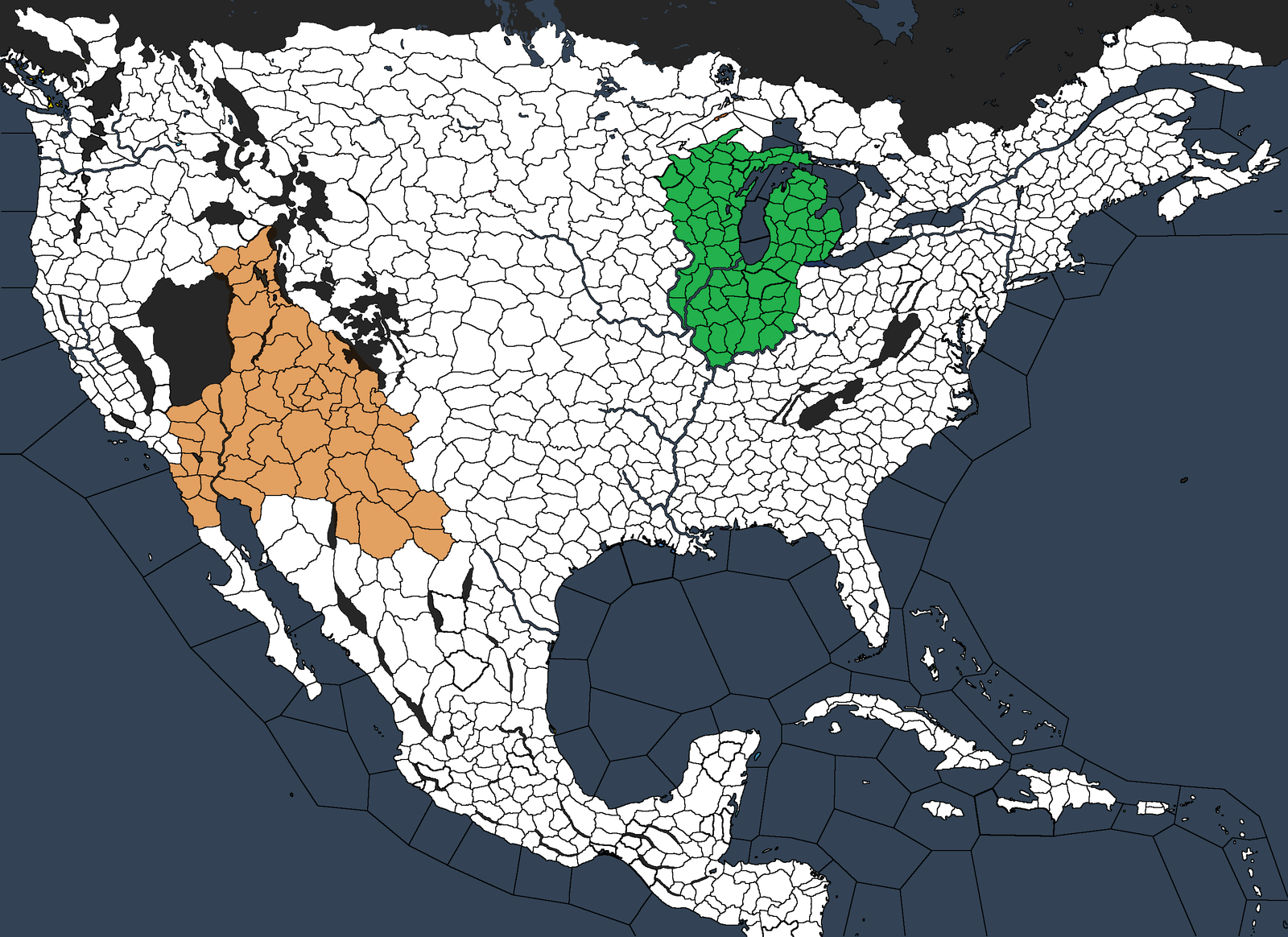
Following the fall of the bombs the communities of America's south-west and Mexico's north tried to pull themselves through for a time. The waning of government power in either country saw to a reliance on growing local power in the towns and cities of the region, as with the rest of the two countries.
With the devastation of either country though came the growing ambiguity of the border and eventually the whole dismissal of it. As communities settled into the post-apocalypse new orders of local rule came into fruition and so did the general habits of man. Warfare re-emerged as larger towns skirmished against each other for feeble resources, trying to maintain populations and economies roughly equal to those that had kept these desert towns alive in the years before the bombs. In a few years, the power of the cities came into play and polities began to form around the major cities of the south-west.
Among this shifting power structure was the coalescence of the Mormon community from Utah who banded together in loose defense pacts against their enemies. These pacts would mature into alliances and eventually into a sense of governance and the Mormon kingdom in southern Utah came to take it upon themselves to take the fight to their enemies and they began to march south, proactively seizing land and reinforcing their base.
The Mormon Kingdom was however a “kingdom” in name only, as an easy identifier among themselves and the people that came to fight against them. The governance of this kingdom was a loose and decentralized affair in some ways reminiscent of the political styles of the Native Americans. To the Mormons it was an emergency attempt at government focused on their local community and church leaders who took to reviving the Tabernacle to not just pray but to organize their communities in the face of opposition and war.
It was in this atmosphere that a man named Joseph Smith stepped into the political scene. An otherwise unnoteworthy man who had sat quietly in the pews, Alex Smith claimed himself to be a conduit of the lord's power; a prophet on Earth. Joseph, who had been known by his small group of friends as being otherwise erratic soon defined and underscored his legitimacy as a prophet through flashes of genius so profound that it could not help but consider him as a prophet of the Lord.
His visions and work was sporadic, but came with lightning force. At times he would spend days or weeks silently only to suddenly burst forth with strings of commands or confused tongues that managed to find the road ahead for the communities.
Young Smith often talked about separated communities far to the south, who were warrior in nature and need but required help. This sparked a Southern Crusade and men from across the territory of Utah came to him out of need for purpose. Converting them all to Mormonism, he ordered them south to the old lands of Mexico. A war-path was initiated across the deserts of Nevada and it would take years before they reached Mexico. Alex Smith would not live to see them cross into Mexico's northern deserts and he passed away at the age of 58.
The church meanwhile went lost for a year while the community attempted to decide what to do. It was said that one night in the Nevada desert a young mother awoke from a clear dream where she claimed to have been spoken to be the angle Moroni who confided in her that it would be God's will to take up after Joseph Smith. When she managed to return to Salt Lake City she confided in the leaders there what she had seen and triggered then and there an election for the next president and prophet of the Church.
The second president after Alex Smith was named, Thomas Olds. Olds first mission was to revive the Mexican Crusade and the scattered forces of the Utah army was reorganized for its purpose and sent south.
On reaching Mexico the Utah army did indeed find a lost branch of their own people who had defined themselves as warriors. Long beset since even before the bombs by their own trials, the tribes in Mexico had become incredibly combatants and had fended off long sieges from cartel groups. So much so in fact that they had managed to forge a kingdom of their own in northern Chihuahua state called The Kingdom of Dublan.
The warriors of Dublan nearly went to war themselves against the men from Utah who had come to relieve them by divine mandate and it wasn't until the interference of Thomas Olds that the two forces were drawn into an understanding and there was much relief. Being reunited, the two communities combined their efforts against the boundless enemies in the desert.
Some generations after, the large Mormon kingdom went through reforms brought on by civil strife and conflict within. The third church president – now uniformly referred to as The Prophet – Howard Paines had to initiate a council between all the major rulers in the kingdom. Under this conference the men present begrudgingly built a fully fleshed model of government to control the expanding political mass and to define the rights within. Drawing from antiquated inspiration the rights of the realm evolved into respect in and towards regional governing bodies. They were called democratic in principle, and enjoyed the structure of old state government organization but it became apparent in time that these young democracies could not hold to the virtues and models of such government and powerful families came to rule in the strongest of these states. While retaining the trappings and titles of a democratic state they became very much monarchies, thus giving rise to the Tabernacle Empire.
Since then, four major polities have emerged in the realm that surround various independent counties and free cities: The State of Chihuahua, Deseret, Baja California, and the Church itself.
Description of Economy:
With most of the Empire in the desert, much of the agricultural economy throughout the realm is simply subsidiary for the local populations. But large scale ranching is a major industry in the east and the estates of Chihuahua maintain large maize and chili plantations in the dry rocky climbs. On the coast in California there are much richer farmlands where orchards of fruit-bearing trees and grain is grown.
Regions in the north in and around Deseret Utah are rich mining fields, bearing the metals for the empire.
Description of Military:
There is no standard imperial army, instead every political unit raises in some way their own military. The smallest counties and municipal governments can only manage volunteer, self-armed and equipped militia forces for their own defense and use. However the larger states like Deseret and Chihuahua can raise their own standing military force and they are trained to those own local expectations.
 Member

 AliceAbigail
 Scrawl Banditta
 Wilted Rose
 mickilennial
 Ekreture
 Supermaxx
 erikh
erikh