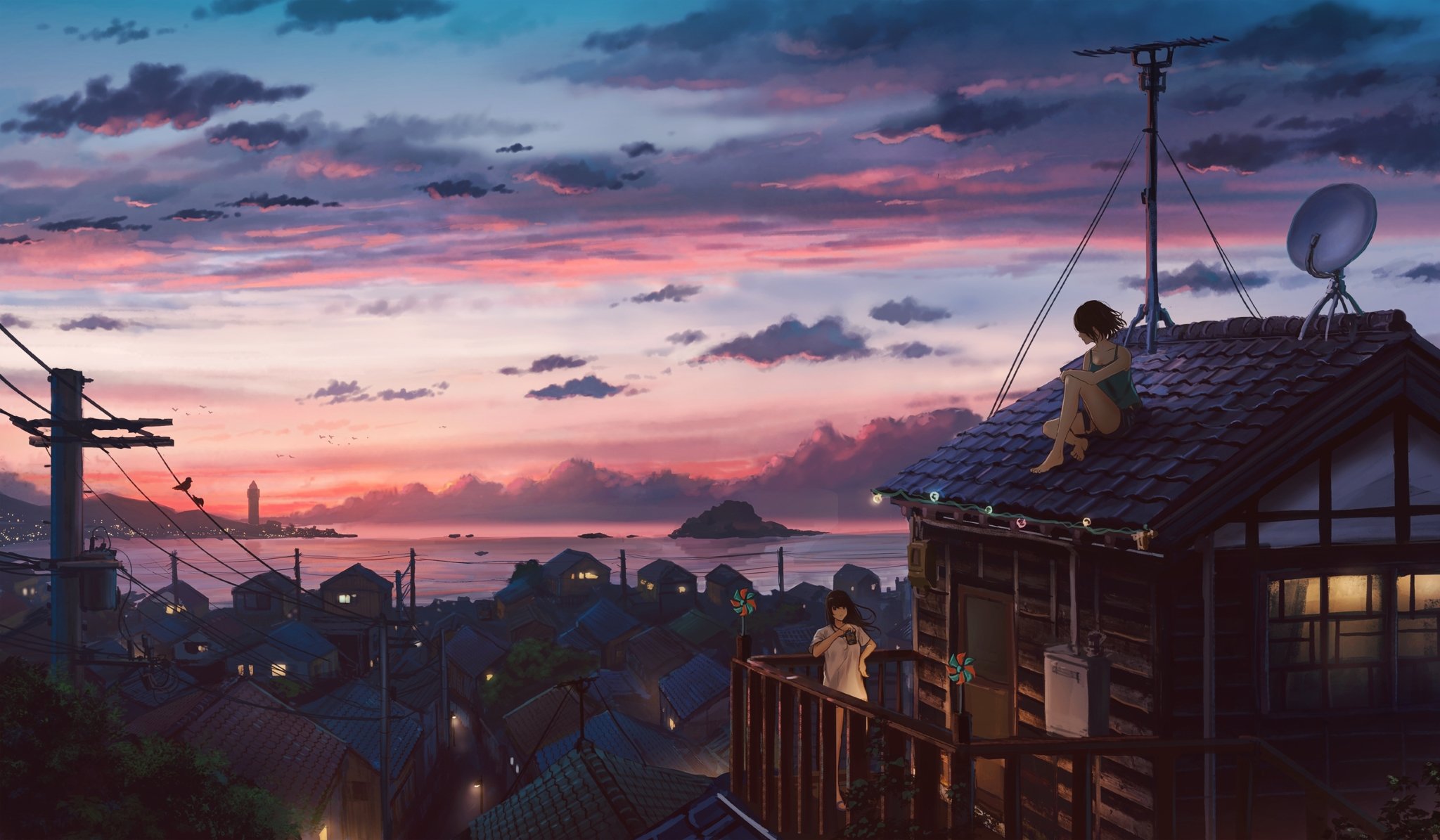
The wind seemed keen to hurry Quinn along. It whistled playfully by her, pushing at her back when she slowed, or carrying up myriad scents to entice her. Normally Hovvi smelled like the lake, like boat and brine and fish. But in the afternoon sun, with the impromptu market bustling and the legions of foodcarts and vendors hard at work, the air had new things to bring her—things that were new even to the Hovvi folk themselves. Saffron, grilled onion, caramelized bananas and apples, garlic, honeyed ham, the tongue-sweet smells of chocolate, of dusted sugar and fresh maple.
The wind made promises to her ears as well. Beneath the heavy current of thousands of voices were the waves of music, the cheering, the thumping that seemed to touch her all the way to the bone.
The sights of the world had enwrapped her, now the rest of it rushed to bring her in.
Her road was unbarricaded, and delivered her to the bright alleys behind a row of restaurants and trinketeers. Beyond them the street was teeming with bodies, all moving past or across one another seamlessly. Everyone seemed to be going somewhere, but no one seemed to actually get to where they were going.
Navigating was difficult without the experience one gets from being literally anywhere but their own room for sixteen years straight. The excitement made people pushy, made them impatient, intolerant for clumsiness. Along the sides, carts blocked in the road like barricades themselves. Vendors barked louder than the shouting and the music, waving their food and wares out at anyone who looked like they could afford it. As such, most didn’t give Quinn much more than a glance.
The lake was close, the boardwalk wall of screens would only get brighter as the day waned. Plenty still screened the empty quarry, but now, with speakers rolled out beside them, many displayed what must have been the stage further into town, packed so densely with people that even the ants couldn’t get closer.
A young man stood on the stage, accompanied by a backing band, but the lights were on him. He sang and played guitar, and did both exceptionally, though it seems clear that even if he didn’t, the crowd would be just as excited.
Further down were the docks for lake-tours, with big ferries chugging in, vomiting out people before more piled on. Past that was the local marina, which was decidedly less crowded, and anchored there were a few dozen smaller boats. A few were scattered out across the lake, likely townsfolk who would rather fish than deal with the mass of tourists.
On the opposite side of the street, signs were erected pointing further into town.
COMMUNITY CENTER
RISC PILOT INTERVIEWS
COMPATIBLE APPLICANTS ONLY
Earlier there would have been a line to the Community Center reaching this far back, but by now many of the applicants had either been seen, or decided they didn’t want to miss the party waiting for a job they probably weren’t going to get anyway.
So, with a world of choices now open to her, Quinn was suddenly faced with another.
On the clearest morning in months, Hovvi was cast in a shadow. Aerie Station hovered in low orbit, aligning itself with the town as the body of its crew—numbering more than the whole population below—scurried about, preparing to disembark.
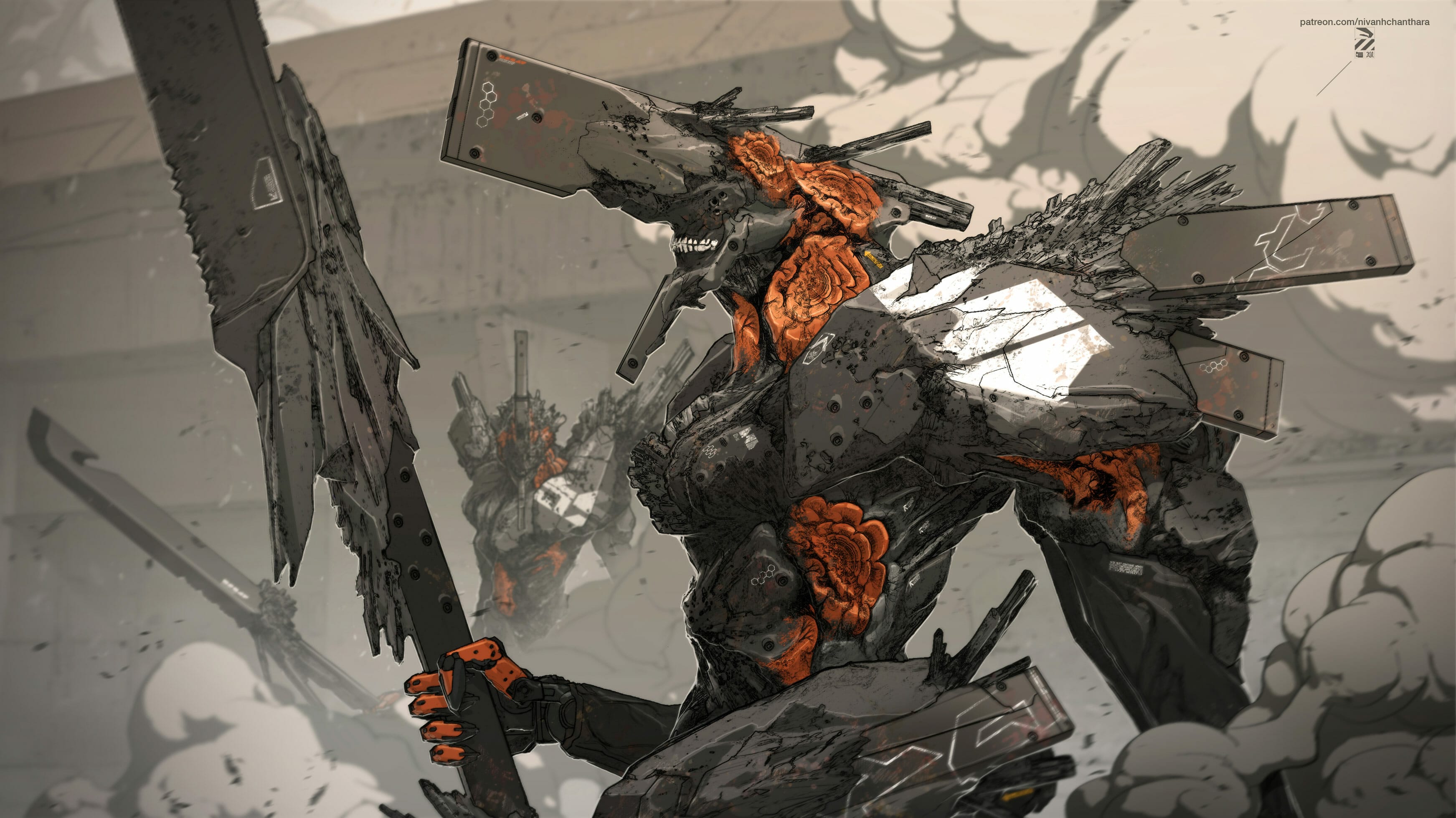
In the hangar belly more shadows were cast. A trio of giants, flesh scored and twisted with strange metal, stood aboard the quarter-mile disc of the elevator platform. Soldiers swarmed at their feet, as military vehicles and containers full of all manner of equipment were loaded into place. More than a thousand men, and that would only be the first drop. But those giants, the Saviors, they were an army a piece.
“C’mon, Besca! Are you sure we can’t bring Dragon down? Like, not even just for the night? It can come back up in the morning before the singularities open!”
Besca Darroh wished she’d brought her cigarettes. People looked at you funny if you drank this early, but no one gave a shit if you smoked. She scrolled absently through her tablet, septuple-checking the inventory, and looked up to see Dahlia giving her the eyes. A good effort, those usually worked on her in every matter that wasn’t piloting, but even if she wanted to let the girl into the cockpit—which she didn’t—she couldn’t.
“Sorry, Deelie, orders are from on high. Dragon stays in orbit unless it’s needed.”
Dahlia lolled her head back. “But isn’t this supposed to be, like, a display? I should be down there!”
“You’ll be down there.”
“Helping!”
They came to a stop beside Grauritter, the Savior belonging to Hadrian Ghaust. The modium growths about its legs and arms were thick—thicker on one arm than the other—and coupled with the reinforced plating, it almost looked armored.
“You saying Ghaust and the others can’t handle this?” Besca teased. When Dahlia didn’t bite, she threw an arm around the girl’s shoulder and pulled her close. “It’s a mild singularity, and you’re right, it is a display. But the world already knows what you can do, hm? What it needs to know is what RISC can do without you, so that they don’t even want to think about what happens if you do get involved. What’s the best weapon?”
“The one you never use…” Dahlia mumbled.
“Atta girl,” Besca said, letting her go. “Now you’re gonna be down there, and you’re gonna enjoy the party. Do you know how weird it is having to twist a teenager’s arm for that? There are poor, bored children out there who have homework, or are grounded, who would kill to go out and get as drunk as you and Safie are gonna get.”
Dahlia’s face flushed the way it always did when she was about to lie. “W-we don’t—”
“And tell your dad I said hi. If things slow down I might take him up on that fishing offer. The lake down there, oof, just beautiful.”
“Alright, alright.”
“And also there’s that new lady in medical? Hathleen? She’s about his age and she does yoga.”
“Besca!”
“I’m just saying, she’s single, and the pickings are slim. We could get him office work right next door, and the dorms are coed.”
Dahlia plugged her ears. “Nope nope nope! I don’t hear this! I don’t hear you trying to hook my dad up with your coworkers! Again! I don’t hear it and I’m walking away!”
Besca grinned, watching her scamper off, satisfied that her mind would be off piloting long enough to touchdown. This wouldn’t be the first singularity they’d run without her, but it would hopefully be the next in a long line of them to come. Ghaust was seasoned, Lucis and Safie were young but they were still adults. Dahlia might have been their trump card, but she was a kid.
Sometimes it seemed like noone else remembered that. Not even Dahlia.
Three hundred and sixty-four days out of the year, Hovvi had a population of five thousand people, with a modest bump in summer months from lakeside tourists.
Today that number was doubled.
When word spread that RISC was turning the singularity into a veritable military parade, flights to Hovvi sold out in hours. By the time the blockades went up to stymie traffic, ten thousand people had made it into town. The streets were filled to bursting with Runa cityfolk, with opportunistic vendor stands hocking seafood and confections and trinkets made as far away as Tohoki. Hundreds upon hundreds of pilot hopefuls flooded the Community Center; queues to the simulation rooms ran for hours, with the highest scores carrying priority interviews with RISC recruiters.
Erected all along the boardwalk were massive walls of screens; some played archived footage of the RISC Saviors repelling invasions all across Runa, others streamed from the empty quarry on Hovvi’s outskirts, where the singularity was supposedly meant to open. RISC had set up a barricade on that side of town, unequipped at first, and lightly-manned—until the space elevator landed.
With the lake to the west and the quarry to the south, RISC anchored in the north, in a wide cattle-field. Hovvi had its Community Center, but beyond that, technology was still largely Pre-Accord. Hardlight, beam-alignments, all foreign machines to people who lived beyond the cities, to say nothing of the things the elevator delivered.
The platform came down in a soft-light cage, carrying Soldiers in powered suits wielding weapons that, in some cases, didn’t even look like weapons. They rode in armored vehicles, on tanks or hovering stages toting artillery the size of houses. Ammunition in trunks as wide as cars with bullets just as long. Chainguns mounted atop spray-steel walls, with feed-belts that could have spanned entire neighborhoods.
Then the Saviors came down. The RISC duo of Grauritter and Jubilee were first, and their pilots, Hadrian Ghaust and Safie Calhan, were received with the applause and adulation expected of national heroes. They boarded their giants, and walked off the field and around the town to the southern barricade as the elevator rose back up to Aerie Station.
Magnifique, the Casobani Savior, came down with the last of the equipment. Lucis Abroix stood perched upon its shoulder, smiling and waving as the crowd below exploded with riotous cheering. Fans, paparazzi and foreign journalists had been among the first arrivals to Hovvi, eager for the album debuts Lucis tended to drop at events like this.
With a showman’s bow, Magnifique joined the other Saviors quarry-side.
By mid-afternoon, Hovvi was surrounded by the might of the RISC. The tourists loved it, of course. The locals were mixed; business boomed, lake-tours and restaurants filled out and stayed filled. Some places saw more money come through in hours than they’d see the rest of the year.
People walked the neighborhoods, eyeing old houses and talking loudly about how yes, they loved the city, but wouldn’t living here be delightfully quaint? Most decided they’d rather just summer. They went to the lake houses instead.
The hours went. Stages rose, the air filled with the sound of music and the clamor of too many people in too small a place enjoying themselves too much to care.
Besca stepped into the back lot of the Community Center and leaned against the door with an exhausted sigh. Late afternoon now, she’d been conducting interviews since morning. There was only so much she could take at once, only so many times she could ask the same questions—and get the same ‘this is what you want to hear, right?’ answers—before the names and faces all blurred together. There’d been promising candidates, she didn’t remember them anymore. Not that it particularly mattered.
This wasn’t her job. It should be—she managed the pilots, she should have a say in who got in and who didn’t. But at the end of the day RISC would choose someone based on a checklist, and a scoring system she’d skimmed once and never looked at again because it didn’t work. The last two pilots were disasters, but they’d lucked out with Safie. Now they thought they could do no wrong again, and chances were they’d be leaving Runa with someone who would be dead in two to three months.
God, who did she have to kill to get a smoke around here?
Lucis smiled into the mirror, checking his teeth and smoothing the last of the moisturizer onto his cheek. “Saff, you are an absolute miracle worker! Honestly, with talent like this you’re wasted as a pilot.”
Safie giggled, fluffing out his hair. “Just wanna make sure you look good—you don’t make that too hard. Oop, close real quick for me.” She came around and Lucis shut his eyes so she could work on the eyeshadow. “But hey I heard the demos. You could walk out there wearing a trash bag and those songs’ll still kill.”
“Ugh, I could kiss you but I’m not gonna waste your gloss.”
“Oh, you seen Ghaus by the way?”
Lucis scoffed. “Out past the checkpoint, of course. I practically begged him to come on to the Chloe and Road interview with me, and do you know what he said?”
“Nothing.”
“He said nothing! He just stared at me like some kind of chiseled homunculus. I’m trying with him, Safie, I really am. I’m not saying we have to be best friends, but a little camaraderie, you know, it’s good for appearances.”
Safie leaned back, appraising her work. Lucis must have sensed she was done, and opened his eyes. He blinked happily into the mirror, nodding approval. “He’s just not comfortable with that sorta stuff, Lou. But I’m sure he appreciates you trying to include him. I think that’s sweet.”
“You’re an angel, Saff. Sure you won’t come on stage with me?”
“Can’t, can’t. Deelie’s dad really wants to take us out fishing.”
“Mmh, scheduling can be such a pain,” he said, standing. He hugged her lightly, kissed the air on either cheek. “Give me two or three minutes to draw the crowd.”
Safie smiled, nodded. She put on her hoodie and sunglasses, which was usually enough subtlety when Lucis was around. With a wave farewell he left the trailer, and as the door shut there was an almost deafening roar of excitement from the nearby crowd.
When the coast was clear she scurried out unnoticed, and made for the docks on the far side of town where Dahlia was meant to meet her.
Along the waterside cliffs, where the roads were narrow and beaten and missed even by locals, where a lone house, modest, without windows on its second floor, stood quietly at the face of the lake, something had happened. Something more miraculous than the singularities, or the Saviors and their famous pilots, and all the forces of RISC that came with them.
On their way out of town days prior, the residents—a mother and father, by only the most technical of definitions—had made their first mistake in many, many years. A small mistake, a simple mistake, and one that would carry incalculable consequences for them, for Runa, and in fact for every last soul on Illun.
Established in the wake of Westwel’s destruction, the Runan Isles Savior Corps is by no means the most impressive program on Illun, but it’s well-funded and well-run by a few survivors of Westwel’s own Corps.
Character Info
Name – Besca Darroh Age – 35 Affiliation – R.I.S.C.
Originally from Westwel, Besca Darroh has been around Saviors her entire life. Her grandfather had helped fell the Modir who would become “Dragon,” and her father had headed Westwel’s burgeoning Savior program. She met dozens of pilots, watched as their connection to the Modir ate away at their minds and bodies. Other nations treated their pilots like a resource to be burned through, kept at arm’s length in all but public affairs. Besca, however, went out of her way to engage with Westwel’s pilots and even piloting candidates, caring after them with a degree of humanity which was, frankly, missing in the programs of other nations. Her methods were derided as frivolous and naïve by her peers, but the pilots appreciated it, which, to her, was all that mattered.
She lost many things in Westwel’s fall; her home, her father, her friends, and no small piece of her faith in humanity, but ironically enough she didn’t lose her job. When Runa took in her country’s refugees, and subsequently acquired their first Savior, they came to the last living member of Westwel’s program for help in founding their own.
Nowadays, Besca doesn’t often involve herself in the politics of the program. Technically speaking she isn’t even chief of operations—a position occupied by the Runan government—but rather, her duties revolve around “pilot maintenance.” While she hasn’t lost her desire to make life easier for the pilots, she isn’t nearly as incorrigibly optimistic or sunny as she once was.
Character Info
Name – Dahlia St. Senn Age – 18 Affiliation – R.I.S.C.
Dahlia was a toddler when her home was destroyed by the Modir, spirited away from Westwel in the arms of a family friend. She spent the first fourteen years of her life in the quiet, lakeside town of Hovvi. She was, like many children, absolutely enthralled by the Saviors, so when she tested positive and was whisked away into orbit, Dahlia thought her dream had come true. She missed her friends, and her adoptive father, but this was her opportunity to do something important. This was her chance to help.
She had no idea.
Runa’s Savior, Dragon, had not been phased by a single pilot until Dahlia entered the cockpit. With its potential finally unleashed, she was able to end invasions within minutes—which was crucial, because she couldn’t remain connected for much longer than that before the giant’s neural regeneration reached critical levels.
Dahlia has become Runa’s WMD, and as such, she actually doesn’t pilot as much as she did before R.I.S.C. acquired its two other Saviors. Besca has become rather protective of her, not wanting to risk putting her in situations where she may be forced to over-exert herself, or risk being overtaken.
Character Info
Name – Hadrian Ghaust Age – 38 Affiliation – R.I.S.C.
Hadrian Ghaust is Helburke personified. He is strong, unrelenting, stoic to a chilling degree, and utterly devastating in the cockpit. Ghaust is also a veteran pilot, having commanded the Savior Marrowman in service of the Helburken crown for 20 years, and despite a phasing speed so slow that he rarely deigns to use his magic at all, he was well on his way to becoming one of his country’s most accomplished pilots.
However, Ghaust’s priority has always been the fight against the Modir, and Helburke’s clamor for political power is something he viewed with silent disdain. To him, using Saviors to settle diplomatic disputes isn’t just wasteful, it’s shameful. So, when Helburke ordered him to bring Marrowman to bear against the newly-risen Runa’s Dragon, he refused. When, then, he was given the ultimatum of going through with the duel or forfeiting his rank and position, he looked his general in the eye, ripped the pilot’s medal from his collar, and left his home behind.
Overnight Ghaust was made a Pariah in Helburke, and his home turned against him. He was forced to leave, and though several foreign programs sought him out, Ghaust denied them all, even passing up a pilot’s seat in Eusero. Instead, he went straight to the burgeoning program in Runa, who was more than happy to take him.
Character Info
Name – Safie Calhan Age – 22 Affiliation – R.I.S.C.
R.I.S.C.’s newest pilot, Safie has spent the past year earning her place at Dahlia and Ghaust’s sides. Born and raised in Runa’s largest city, Queenshand, Safie was one of countless starry-eyed youths who dreamed of the day she’d get to step inside the cockpit of a Savior. A positive connection-test put her on the path, but it was the months upon months of personal training, rigorous study, and nights spent running sims until dawn that pulled her ahead of the other aspirants. With a phase potential speed just above average, she was a perfect fit between Runa’s other two pilots.
While Dahlia has accrued something of a heroic mythos about her, she’s often reclusive and hesitant to make many public appearances. Safie on the other hand loves to meet the people she’s helping, be that with personal visits, answering fan-mail, or simply getting her hands dirty cleaning up after the messier invasions. Some see her approach as distinctly Euseran, but Safie didn’t become a pilot for the attention, she became a pilot because it was the right thing to do.
Character Info
Name – Lucis Abroix Age – 25 Affiliation – Casoban, on loan to the R.I.S.C.
Casoban’s sole effort to save Westwel, while ultimately futile, planted the seeds of goodwill between it and Runa. Casoban has always lived in the influential shadows of Helburke and Eusero, but allied with Runa, the two manage a strong presence on the world stage.
As a show of solidarity, Casoban has even begun sending a Savior of its own as backup to Runa’s invasions. Enter: Lucis Abroix.
Lucis is perhaps one of Casoban’s most beloved pilots, despite having only a handful of deployments to his name. Handsome, personable, with a poetic flare and the voice of an angel, many people back home already consider him the face of Casoban’s Savior program—a role he is more than happy to play. Lucis makes regular public appearances, seemingly never missing an opportunity to espouse his love for the beauty of the world, and his burning desire to protect it from the Modir.
Welcome to Amygdala Circuit, a mecha-horror RP in a world beset by the Modir: bloodthirsty, interdimensional giants wielding devastating weapons and magics. To face these hellish invaders and the hordes of horrific creatures they lead, you will need to arm yourself with humanity’s only real hope at survival, and perhaps even victory: the monsters themselves.
But outside of the cockpit, the world is no less dangerous. While some of Illun’s people enjoy living in “post-war societies,” this international peace is often tenuous, and exists on the exploitation and suffering of smaller nations without monsters of their own. With armies rendered nearly obsolete, the struggle for power revolves mostly around the unspoken threat of violence carried by these reined-in monsters. From nation to nation, pilots are revered as everything from celebrities to pariahs; symbols of peace and the faces of oppression.
You will endure hell, both from without and, especially, within. With help you might just survive, but alone you could become the very thing you fear most.
Nothing brings people together like the threat of extinction.
Illun faces an alien enemy that cannot be reasoned with, which knows no fear and wants without compromise the complete and utter annihilation of every living thing. Naturally, when presented with the option of dying on principle, or uniting and surviving, the people of Illun chose the latter. The best and brightest minds from across the world came together to develop a means of fighting back against their invaders—and fell embarrassingly short. Even their most advanced weaponry could only slow the tide of lesser creatures, to say nothing of the giants, from which they drew nothing but the meagerest drops of blood. It wasn’t until they began experimenting on the strange, dead things that headway was made.
The shift in power was gradual at first, and derided by most for the secrecy shrouding it; no one knew how these weapons were being developed, how long it would take, or if they’d even work at all. The people were met with complete radio-silence, and a fearful unrest began to boil: until the first of the Modir fell.
Awe silenced man and beast alike. Government militia swooped in like vultures, the giant was ripped apart limb from limb until nothing remained but the head and torso, and then it was carted away into the deepest, most well-protected bunkers. Nothing was heard again for months. The attacks resumed, increased in frequency and fervor. Cities crumbled, millions died. Humanity was once again pushed to the brink, and in what would have been its final hour, it found deliverance.
A man-made Savior.
The taken giant emerged, its body restored, and turned its weapons and magics against the other Modir. More of the enemy fell in one day than had fallen in years, and when the dust settled, the Savior remained. It knelt to the ground, a hulk of flesh and alien metal steaming with Modir blood, and went slack like a puppet without strings. From the back of its head arose a lone, human woman.
In the aftermath, the fallen Modir were once again cut apart and dragged away. Another Savior emerged, and another, and another. Before long the reined giants were at every invasion, ready to repel the Modir and their ravenous armies. The war was no longer so devastatingly one-sided; humanity could finally fight back. For the first time since the invasions began, Illun found hope.
The better half of two hundred years has passed since the first Savior rose, and the war between Illun and the Modir has reached a plateau. The Modir’s forces are seemingly endless, but the human-piloted Saviors are, generally speaking, much stronger. Now and then a new variant of the giants will emerge, wielding some powerful new weapon or hitherto unseen magics, and they may succeed in felling one or two Saviors, but if the bodies can be salvaged, Illun is always ready to replace lost pilots.
The depths of Modir intelligence are not fully understood, but they seem aware that they tend to lose man-to-man confrontations, and so their personal appearances are rarer these days than earlier in the war. Nevertheless, their invasions continue, and wherever the singularities appear, tides of smaller—but hardly less deadly—creatures pour forth.
The mightier nations of Illun are more than happy to keep the stalemate going. Smaller nations without Saviors of their own find their larger, more fortunate neighbors often leveraging their safety for compliance in border disputes, and leniency in trade deals. Governments like to tote that their people live in post-war societies, where international conflicts are resolved with diplomacy and, failing that, the silent threat of whatever horrors might be wrought by homeland Savior warfare. Minor disputes are sometimes handled with a degree of theatre, wherein nations will send one or two Saviors to remote areas desolated by Modir invasions to duel.
The reality is that much of the world lives under the iron boot of a privileged few nations, and the post-war bliss that exists for some is more often a pre-war anxiety for most.
Humanity’s hope: the enemy, weaponized against itself. So much about the Saviors is kept hidden from the public, and even from the pilots. Most assume that the people inside simply puppet the dead giants around, but this is only half-true.
They aren’t dead.
When a Savior is made, a section of the subdued Modir’s brain is removed, rendering them essentially comatose. That void is filled by the pilot, who, once linked with the Savior’s mind via the cockpit, is able to control them with as much ease and familiarity as their own body.
Here are some key aspects to piloting a Savior:
Modir bodies are an amalgamation of flesh and a hyper-resilient, alien metal dubbed “modium”. The modium weaves in and out of the skin like a patchwork exoskeleton, and while all Modir share a generally uniform figure, their individual armors can vary wildly from one to the next. They all stand at roughly 35 meters tall, with builds that could be considered “average” to “hideously thin,” with the occasional outlier.
Saviors and Modir are also shockingly fast for their sizes, with speed and reflexes that seem to completely disregard terrestrial physics. They are not the slow, cumbersome giants of fairytales, these things can move, and move they do. As such, pilots are trained not only to utilize a Savior’s unique weapons and magics, but also in CQC.
Modir bodies display the miraculous ability to regenerate almost any damages done to them, so long as the brain remains intact. This regeneration slows significantly if the heart is damaged, but even a severed Modir head will, eventually, grow itself a new body. All pieces removed from the body and head rapidly dissolve into pools of the near-black ichor that is Modir blood.
This presents a danger to the pilots. The Modir themselves are evidenced to be resistant to pain, but linked-in pilots are not. Chemical inhibitors can trivialize most artificial wounds, but if a Savior has its arm ripped off in combat, the pilot will, to put it gently, struggle with their composure. As well, while a Modir can technically survive having its heart destroyed and its head removed, these injuries will almost always result in instantaneous death to the pilot.
In addition to the more standard, man-made arms, each Savior has access to a unique weapon, which they can quite literally pull into existence utilizing smaller, more localized versions of the singularities used to invade Illun. These weapons vary wildly in appearance and application, some of which are simpler, and others entirely alien in design.
The development of Saviors is a closely-guarded, international secret, the finer points of which are kept even from the pilots themselves. But what could not be hidden from them were the dangers they’d face just for linking up with the giants, and there is no greater danger than the one at the core to the entire process itself: The Amygdala Circuit.
Linking to a Savior comes with a myriad of risks both physical and psychological. Rule one of piloting is and has always been: “Do it as little as possible,” and for good reason; the longer a pilot stays connected to the Savior, the likelier they are to lose control. Remember that the Saviors are not dead Modir, only subdued, lobotomized, and comatose due to the removed section of their brains. Pilots aren’t just pilots, they are bridges between the Saviors and something…else. Something terrible. Prolonged sessions in the cockpit can and have led to pilots being completely overtaken by the Savior’s cognitive regeneration, losing both themselves and the giants to that elsewhere thing.
Veteran pilots have also reported issues outside of the cockpit, from invasive, alien thoughts, to modium growths on the skin. While so far, none of these side effects have proven to be directly fatal, they have driven more than a few pilots into an early, permanent retirement.
The advent of Saviors quite literally brought humanity out of the dirt. Gone are the days of bunker-cities and strongholds built beneath mountains, of disconnection and power-scarcity. The biggest cities of Illun are incredibly advanced, with skylines comprised of massive towers and roadways that sprawl and wind, connecting hundreds of miles of urban landscape together. Titanic space stations orbit the planet, housing Saviors to be deployed at a moment’s notice wherever they may be needed.
Outside of these cities the world is still widely modernized, however the propensity for singularities to appear in lesser-populated areas has led to more than a few towns being cut off from the rest of the world by ruined, untraversable terrain. This is especially true in less powerful countries without Saviors of their own, who have had to make compromises not only for the lives of their people, but then for the aid in rebuilding afterwards.
Here are some of the major players in today’s world stage:
Eusero has an industrious history, and has led the world in technological advancements since even before the Modir’s invasions began. Indeed, the first Savior arose on Eusero soil, and though it is generally taught and accepted that the Savior project was an international collaboration, Euseran schools tend to focus more acutely on familiar, less foreign-sounding names.
Eusero has arguably the most expansive defense program in the world, boasting a whopping seven Saviors, and some of history’s most remarkable pilots. Its cities are vast and vertical, and between them the land is mostly flat, hospitable, and well suited for agriculture.
Eusaran society idolizes their pilots, treating them like celebrities. They make public speeches, visit children’s hospitals, and routinely appear on late-night talk shows; you’ll find their faces on everything from billboards to cereal boxes. To be a pilot in Eusero is to have one’s name forever etched into the hearts and minds of an entire nation.
In the mountainous country of Helburke, civilization is…strange. Their architecture is ancient, their laws are draconian, and their wills are utterly unshakable. Helburke’s cities lay behind prodigious walls of stone and steel, and are built in tiers descending down the faces of mountains older than written history. High-towered castles and sprawling cathedrals are not uncommon sights in Helburke; indeed, one might look upon a village there and be shocked to find something as mundane as electricity.
But Helburke is not lost in time. Its aesthetics are only that, representative of their national identity, but never a hinderance. Helburke is bested in Savior-count only by Eusero, having six to its name, all of which carry long and brutal histories, and while its technological advancements might not be as plentiful as in Eusero, it is still a nation of keen, practical minds. Helburke has never shied from displaying its might in the face of any perceived slights, and is always the first to put forth duels as an answer to any diplomatic dispute.
Its citizens are hardy and proud; when the world reformed following the rise of the Saviors, and the nations’ governments collectively banned firearms from all but military use, the citizens of Helburke chose to carry swords at their hips rather than be unarmed—a practice still present to this very day.
The pilots of Helburke are regarded more with respect than adulation. They are seen as warriors, standing at the vanguard to defend their home, and their people, from the greatest threat humanity has ever faced. It is a legacy-defining honor to be selected for the Savior program in Helburke, and often times tournaments are held in which prospective candidates must fight, sometimes to the death, for their spot in the cockpits.
The Tohoki peninsula is a lush, vibrant land guarded from the Dim Sea by a range of snow-capped mountains. Once ruled over by Aridea, it declared independence following the empire’s fall, though Helburke to this day still claims Tohoki was rightfully ceded to it in the aftermath. As such, tensions between to the two nations have always been high.
Though it holds only two Saviors, Tohoki has made advancements in defensive technology rivaling, and in some cases even surpassing Eusero. They were the first nation to successfully graft extra modium onto a Savior without rejection. Though other countries have managed to replicate the feat, none achieve the same quality. Nowadays, Tohoki is regularly commissioned for armor from programs across the world, cementing itself, for now, as a necessity.
Tohoki pilots are viewed with a respect more closely resembling Helburke than Eusero. There’s little in the way of fame, but plenty of reverence, and pilots are often selected from its engineering schools, whose students spend most of their academic lives working on and studying Saviors.
Considered by many to be the most beautiful country in Illun, Casoban is a land of rolling hills and seaside vistas, where people spend their lives in luxury, relaxing on beaches and indulging their hobbies with all the time and means in the world. Though not the smallest country, it is still dwarfed by its political contemporaries, and its influence marks the first notable drop when moving past the “big two” of Eusero and Helburke.
That said, one should not underestimate Casoban. In more ancient times, Helburke was said to have tried to conquer them on no less than three separate occasions, and was rebuffed each time by Casoban’s comparably small yet devastatingly effective militia. Nowadays, and as is the case with most places, their military power is devoted almost entirely to their Savior program, of which they possess four.
Casobani pilots share a similar sort of fame with their Euseran cousins, only with a bit more pomp. Here, the pilots are not just protectors, they are cultural icons, and as such they are often as well educated as they are trained. Casobani pilots are always also lauded artists, musicians, actors, writers, and so on. The people revere them, almost even deify them, and those that retire—who can still function—normally go on to teach at the country’s world-renowned Savior Academy.
Sometimes called “The Pastel Isles” for the unique, gentle colors of its trees. Runa is a single, large island surrounded by a handful of smaller islands, and more than a handful of smaller islets. While once only really considered for its tourist trade, Runa has recently stepped into political relevance in the fallout of a disaster fifteen years earlier, where the neighboring island-nation of Westwel was overwhelmed by a Modir invasion. With their home ruined beyond repair, most of Westwel’s survivors were forced to emigrate, and were welcomed with open arms into Runa.
As a result, Runa acquired Westwel’s single Savior, and shortly thereafter, went on to acquire two more. Today, Runa still finds itself strongarmed on many matters by other, larger nations who believe they are unready for—and perhaps even undeserving of—such power. Whether or not they’re right, that power, along with the raw skill of Runa’s pilots, have kept the vultures at bay. For now.
And here is a timeline of some notable events:
2000
The first singularity appears, and the Modir invasions begin. Millions of lives are lost, and many nations crumble in the first days before the Modir mysteriously withdraw. Attacks continue in this sporadic fashion for years.
2010
The first Savior, classified “Spirit,” emerges from a bunker in Eusero in the midst of a devastating invasion. The Modir are driven back in the ensuing fight, and two more giants are collected. The tide of the war changes almost overnight.
2015
The Modir invasions are repelled by Saviors with consistent success. The various remaining nations of Illun come together at the new, hopeful dawn of their world, and form the Illun Accord, swearing that the only war left to be fought is the war against the Modir. International regulations are set, beginning what many consider to be an era of world peace.
2300
The Aridean Empire breaks faith with the Illun Accord and uses Saviors to invade its neighboring countries. Eusero and Casoban attempt to intervene, but it is not until a single Savior from the tiny, occupied nation of Helburke attacks from within that the Aridean front is broken. In the aftermath, the Empire is crushed, and Aridea is ceded to Helburke.
2455
Westwel, a relatively small island nation, manages to repel an invasion and subdue a Modir without a Savior—a feat which has not been achieved for nearly half a millennia. With its newfound influence, Westwel manages to bring both itself and its neighbor, Runa, out from beneath the iron heel of tariffs imposed upon them by Eusero and Helburke.
2485
The Modir invade Westwel again, in the widest-scale assault launched in hundreds of years. The island is overrun, and both Eusero and Helburke conveniently fail to intervene until it is too late. Casoban Saviors arrive and manage to repel the Modir, but the damage is done. Westwel’s scarce surviving population leaves their ruined home behind, and find refuge in Runa.
2496
Runa’s sole Savior acquires a new pilot with startling capabilities. Dahlia St. Senn, an orphan from Westwel, manages to capture two more Modir for Runa in her first year. Helburke manufactures two conflicts justifying duels with Runa within a single month, and loses both, costing it two prized pilots, and nearly one Savior. St. Senn becomes internationally known for her piloting skill, and Runa begins to see begrudging respect from other major players on the world stage.
And with that, it seemed Kyreth’s initiation was a success. She’d expected as much, of course, but for it to go so smoothly was a pleasant surprise. Less pleasant was the sudden and blatant outing of them both as Tainted—a displeasure she felt and saw reflected in Kyreth. The shadowy boy was proving to be a bit meddlesome.
Nonetheless, Aleka’s explanation of Veraz was intriguing. It was also, probably, complete horseshit. A place where her kind might live unburdened by the baleful gaze of Azaiza may very well exist, but nowhere in the world was benevolence free, or without intent. Tainted, Asvari, it didn’t matter what they were called, people would find their reasons.
As if to demonstrate that very point, a halfling joined them from upstairs, and the first thing she did was wish them death.
Lilann sighed, but she was good at hiding her own frustration, even without a mask. Kyreth was more emotive, turning away like a kicked puppy. She watched the woman go, studying her carefully; the elvish ears, the utilitarian clothes and the hovering fan. Aeowyn Silventria. This name she would remember.
It seemed even places like this were no better than the taverns of Dranir, just prettier.
While the prim young woman introduced herself as Eila, Kyreth ushered Lilaan aside, taking a seat in one of the chairs. It appeared he’d noticed Aeowyn’s name as well, and his concern, while touched up for any eavesdropping ears, was still nice.
“Am I thrilled by the idea of being mentored by a bigot? No, I can’t say that I am.” she said, nonchalant about the volume of her own voice. “But I doubt I’ll have to worry about it. If she doesn’t kill me outright, she’ll likely just refuse anyway—and then kill me.”
Really, it was no worse a hand than any other she’d been dealt. Even without a mentor this was still a job in a place with good stories. She grinned at Kyreth. “But enough dreariness, look! You’re in! Steady work, apprenticeships; how many Tainted in Relfin can say they landed a chance like that? You did good, I think, coming here.”@Obscene Symphony
Lilann listened carefully as Aleka took down her information. In a way it almost felt like she was given more than she gave, something she knew better than to believe, especially when it came to information. Genesian, Asvari, the mysterious and allegedly irascible Lady Silvantris. These were things she’d remember.
“Well,” she said. “It wouldn’t be the first time someone’s tried to strangle me, all the better if it’s only over my profession.”
Her attention split then. The lion’s share went to Kyreth, to his own exchange with Aleka. Part of her lamented having doffed her mask; his cover name was sloppy, but the way he slid so easily into the lie of their partnership would have had her beaming with pride. Instead, she shot him a good-natured scowl cracked with a grin, to help sell the story. Smart boy.
A liar too, intentionally or by nerves. But it was clear to her—and likely to many of the others—that he’d neglected to mention being an aetherborn. His glowing freckles had outed him to her last night, and while the ample light of the Bounty House didn’t make him quite so radiant, she doubted he could pass as your average Tainted for very long.
Not that anyone should want that.
Nonetheless, if that was his angle, she was committed. Their false-partnership was about to be ratified, so she figured she ought to do her part to keep it up. Kytheth Bertasson. She’d remember that, too.
On the other end, Cerric finally answered the question that had led her to the house at sword-point. It was an excellent story, and one she didn’t buy for a second. Cerric was a skilled orator; he described things in a deliberate way, he put emphasis where it mattered, fluffed his language at the right times. In her experience, the most frightening, gruesome, and terrible parts of a story were often the most embellished.
Did she believe in demons? Of course—she was Tainted. Did she believe this Rancor to be the spawn of a warlord's dying fury? Eh.
Cerric didn’t seem to, either. Normally she would have considered it poor form to discredit one’s own story, but he wasn’t speaking to a tavern of half-drunk adventurers, or an alley of slighted gamblers. They were future employees. No reason to lie to them—their wasted time came out of Mystralath’s wallet, after all.
Still, as he dropped the melting sculpture into Ceolfric’s hands, she couldn’t help but giggle. If they’d come all this way for the demon to be nothing more than a local fairytale, she’d be disappointed, but likely not more than him. That was enough.
Lilann followed Kyreth’s attention to the boy acting as their shadow, which was much more of a literally apt description than would have been with others. He was clearly aetherborn with hair like that—if it could be called hair—and his overall demeanor wasn’t particularly bright even by comparison. He seemed upset, or wary, both of which she was no stranger to. If she could have collected a bounty for every time someone got uncomfortable when two Tainted conversed, she could buy the pants right off Lord Mystralath’s powdered, noble ass.
Lilann noted his quick dismissal of the woman, and tilted her head as he stalked towards them. Part of her wanted to be upset with his bold-faced suspicion, but she’d been around enough blocks to know that aggression was not a game the Tainted were invited to play. Besides, the boy looked young, at least younger than her. So, she gentled herself.
When Mr. Laidon finished speaking, she slid gracefully up to the boy, close enough to look right up at him from behind her mask. As he had done, she lowered her voice to a whisper, just for them.
“I find curiosity quite compelling, don’t you?”
And then just as swiftly, she twirled around and made for the desk as Ceolfric stepped away. The bandit finally got to his point, which, she had to admit, she was curious about as well. For the time being however, the most important thing was to secure employment for herself—and Kyreth. Of course.
Clearing her throat, she decided to take Mr. Laidon’s offer of good faith and removed her mask. With a polite bow and a smile, she approached Aleka at his desk.
“Good morning. My name is Lilann, surname: Storyborn. I come from Dranir, I have no living kin, and for work I tell stories—I even get to be in them from time to time. You'll find my influence anywhere people talk about their heroes, living and dead, though you'd be hard-pressed to find mention of me by name. As for my classifications, I’m afraid I don’t quite know what you mean, either. But, if it helps, I can move things with my will once I’ve touched them. And this—” She turned then, and gestured right at Kyreth, motioning for him to come forward. “Is my close friend, whose employment is packaged with my own. A boon to the house, I assure you, to have us working together in Lord Mystralath’s interests. Come, Kyreth, tell him a bit about yourself.”@Obscene Symphony@Trainerblue192
Lilaan halted as she passed through the doors, more than a little surprised by the difference between the building’s quaint exterior, and its lavish interior. Plush couches, soft rugs, and beyond the comfortable amenities there was still the piano, the fireplace, and the lovely tapestries hanging on the walls. Even the masonry was artful, with wood and stone worked into an artful aetheric material.
It seemed the bounty house had been wearing a mask of its own.
She tried not to gawk—best not to look like a vagabond, especially if it was true. People like the hedgeman might be able to waltz into a high-end place like this looking like they’d just crawled out of the dirt—which was also true—but Lilaan had a losing complexion that wouldn’t afford her such leniency. Kyreth did too, unfortunately, and he stuck out more than most. A very cold part of her thought it best to create distance, but she stamped that down. He’d been kinder to her than most people, even other Tainted. As it stood, their goal was the same, and she meant to seem them both achieve it.
Of course, there was no rush. Skirting near the clerk’s desk, she overheard the hedgeman give some of his details. His name was Ceolfric, and while she was already well aware of his feelings towards violence, and his past as a brigand was all but tattooed on his forehead, she was still surprised to hear that he was from Dranir. Lilaan was no stranger to brigands and bandits, she’d been robbed many times in her travels between towns and on the backs of trade caravans. Plenty of the heroes whose tales she wove were born from fights with roving warbands and bloodthirsty cultists—which was, funnily enough, where plenty of them also died.
A brigand and an aetherborn. By his description she might not have believed it, were his tongue not proof. She tried to recall if she’d ever encountered anyone like that, but most of the scuffles she’d seen were matters of clashing swords, not wicked enchantment. Then again, with a talent like his, it might have been difficult to tell. Perhaps she ought to have been concerned that he was angling for the same work that she was. Instead, she found herself woefully intrigued. But that was a matter for later.
For now, she returned to Kyreth.
“Well, what do you think? Charming, isn’t it? There are certainly worse places to find work. Pity about the company,” she said, nodding over to Ceolfric. “But I believe this might be the safest we’ve been all day.”@Obscene Symphony

 Lemons
 Supermaxx
 Zeus23
 Yankee
 Raijinslayer
 SkyeOfStars
 Not a Sayan
 VenusSundew