Welcome to the Guild!
N3v3rM0r3 Member
Cranky old Raven
STATUS: Sounds familiar, there's a few sites that were great for pbp roleplaying. RIP Tavern keeper 7 hrs ago
-
Last Seen:
0-24 hrs ago

- Joined: 1 yr ago
- Posts: 137 (0.30 / day)
- VMs: 1
-
Username history
- N3v3rM0r3 1 yr ago
-
Latest 10 profile visitors:
-
Most recent →
 RPM,
RPM,
 Deadline,
 yourlittlebean9,
Mariel,
yourlittlebean9,
Mariel,
 Kaithe Dame,
Valen,
Kaithe Dame,
Valen,
 Lurking Krog,
 ThePigOrcEmpire,
 Hope Lover,
 Cao the Exiled
Status
Recent Statuses
7 hrs ago
Current
Sounds familiar, there's a few sites that were great for pbp roleplaying. RIP Tavern keeper
10 hrs ago
Man... I wish I was cool enough to have a beer on some roleplay forum... #LosingAtLife
4 days ago
Wait, the guild had smutty rps?! 🤯
5 days ago
💀
1
like
9 days ago
😮💨
1
like
Bio
User has no bio, yet
Most Recent Posts
👀
<meant to send this as a PM>
~BANNED~
Kaela “Stitch” Veyra History Kaela Veyra was born and raised in the Martian industrial districts — the kind where everything was painted in rust, blood, or dust. Her father, a stubborn surfacecraft mechanic, taught her early on that broken things can always be fixed — if you have the tools, the time, and the will. When she wasn’t elbow-deep in engine grease, Kaela apprenticed under a back-alley Ripper Doc named Dr. Harel, who worked out of a forgotten hab block. Under his tutelage she learned the delicate balance of cybernetic surgery — cutting, welding, rewiring, and improvising with scavenged tech. Everything changed the night Dr. Harel botched an implant job on a local gang boss’s son. The kid bled out on the table, and the gang retaliated with brutal precision. Kaela survived only because her father called in an old favor from a passing ship captain. She was smuggled off-world in the dead of night, with nothing but a bloodstained toolkit, a few scavenged implants, and the resolve never to end up helpless again. Now she works aboard the crew’s ship as its de facto medic, mechanic, and cybernetic specialist — a patchwork survivor keeping everyone stitched together, one way or another. Personality & Reputation Kaela is quiet, observant, and surgical — in every sense of the word. She rarely wastes words, preferring action over chatter, and has a dark sense of humor that surfaces when the situation gets tense. Those who know her well describe her as fiercely loyal and surprisingly compassionate beneath the hard edge, though she has little patience for stupidity or recklessness. Reputation-wise, Kaela is something of a ghost. Few outside Mars even know she exists, and those who do often whisper that she’s cursed — always walking away from disasters that kill everyone else. To her crew, she’s indispensable, but to strangers, she’s just another pale, scarred drifter with a gaze like a scalpel. Appearance Kaela’s body is a living roadmap of old wounds — fine surgical scars crisscross her pale skin, some from her own experiments with cybernetics, others from surviving the gang slaughter on Mars. Her black hair is cropped short for practicality, often falling messily over her face. Her eyes are sharp and tired, a pale gray-green that seems to weigh and measure everything they look at. She wears practical, minimal clothing most of the time — easy to clean, easy to move in — and often sports a utility belt stuffed with tools, injector guns, and medkits. Strengths & Limitations Strengths: Expert cybernetic surgeon and mechanic, calm under pressure, improvisational genius when working with scrap tech, highly resilient to pain and trauma. Limitations: Struggles with trust outside of her crew, haunted by guilt over surviving when others didn’t, suffers from occasional nerve pain from old injuries and self-installed implants, has a tendency to push herself to physical exhaustion rather than admit weakness. Miscellaneous
| ____________________________________________________________________________ ◤ “Everything can be fixed. Even you.” 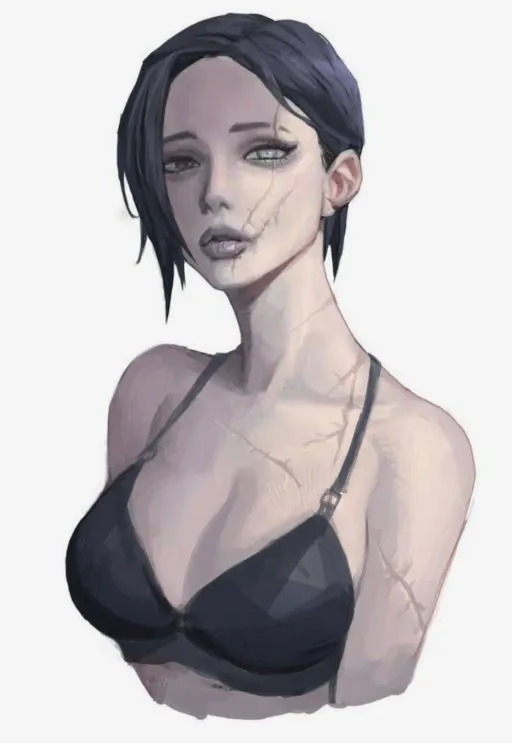 Full Name: Kaela Veyra Age: 27 Homeworld: Mars — Tharsis Industrial Zone Occupation: Cybernetic Surgeon, Ship Mechanic Affiliation(s): Independent Crew (PC ship), Former apprentice of Dr. Harel (Deceased) |
Oooh
<Snipped quote by N3v3rM0r3>
Aww, thank you! I really appreciate that! ^^
Of course! Now she'll have to teach the gobo doggo how to play knife monopoly
@Lurking Krog, @Ducksworth and I were just discussing starting a Space Opera rp! I three would also like to put my name into the hat
✦ ✦ ✦
Appearance
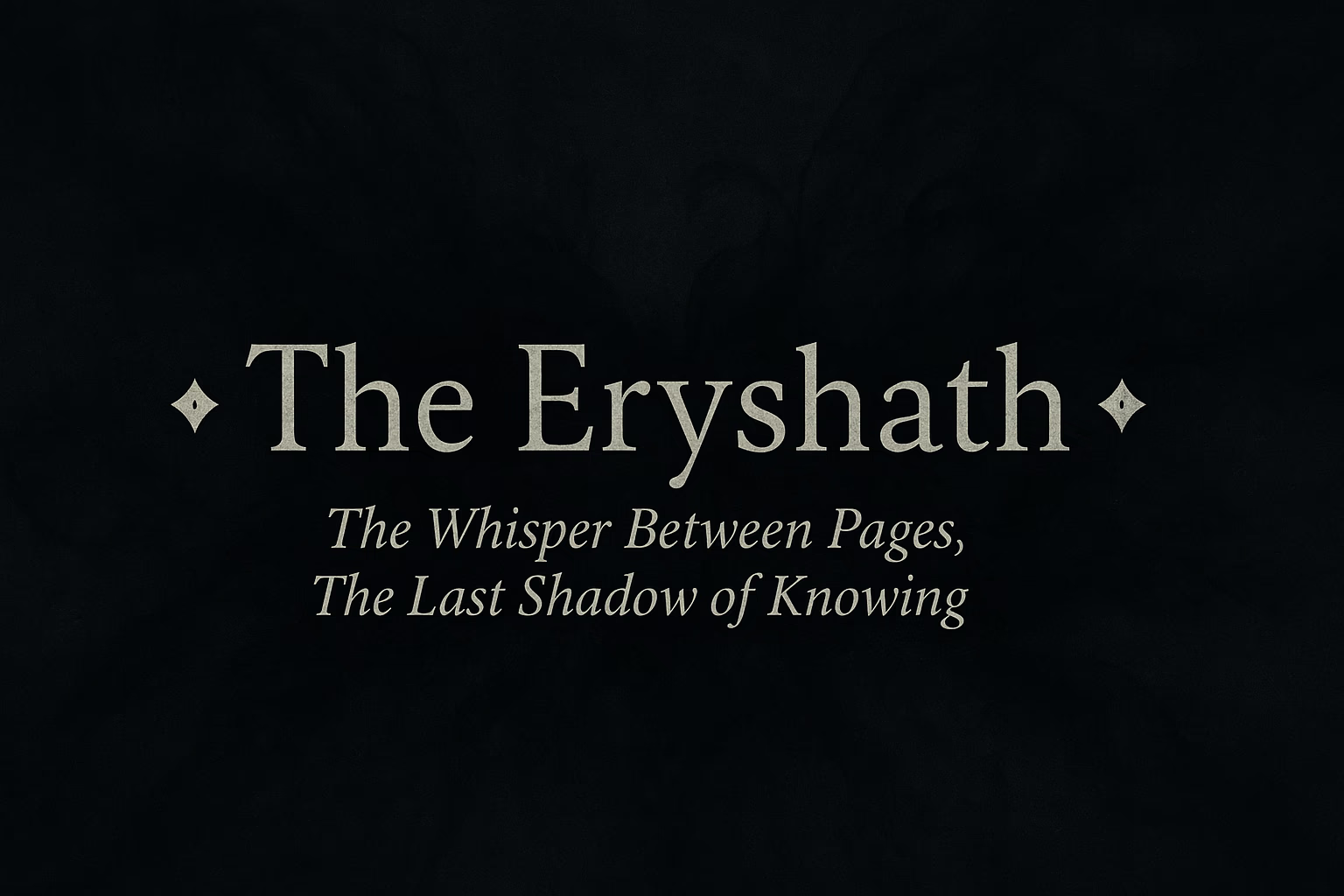
The Eryshath is a figure barely deserving the word form. Its body is made of semi-translucent shadowstuff, but it does not simply cling to the darkness — it emanates it. Its outline is rarely still: long, tattered filaments of living shadow trail from its frame, writhing in slow, deliberate spirals as though moved by a current no mortal can feel.
Where a face should be is only a void of rippling dimness, but within that darkness faint lambent sigils glow and rearrange themselves constantly, as though it is reading, writing, or dreaming in a language that mortals cannot know. Its voice is a whisper layered over itself a thousandfold — quiet but unignorable, filling the listener’s mind rather than their ears.
It does not move in the way fleshly things do — instead it shifts, as though stepping sideways through moments of reality, appearing closer or further away with each breath. Sometimes it walks upon the floor. Sometimes it hangs impossibly from the ceiling, its tendrils brushing the ground like dangling curtains.
✦ ✦ ✦
Nature & Purpose
The Eryshath is the first and last of its kind — a custodian of all that was, is, and might be written. It does not merely inhabit its domain — it is fused to it. The library is its body, its mind, and its soul. To wound one is to wound the other.
Some believe the Eryshath was once the shadow of a god who perished in the birth of time. Others say it is the personification of forgotten knowledge — the shape of everything erased from reality but not truly gone.
It does not hunger for mortal souls but for memory. Travelers who dare enter its library find themselves growing hollow, leaving behind pieces of their lives to remain among the shelves. The Eryshath does not ask — it merely records, and the visitor’s memories are filed away like books.
Those who stay too long become living tomes — their bodies rigid, their minds trapped in endless narration of all they have ever known. They are arranged reverently among the shelves, becoming part of the collection.
✦ ✦ ✦
Umbral Dominion
The Eryshath wields mastery over shadowstuff — a substance of living night that it may shape into whatever form is required. With but a thought, it may weave darkness into walls, bridges, chains, and blades, or call it forth as a tidal wave of smothering gloom. In its hands, shadows are not mere absence of light but a physical reality, capable of crushing, binding, or building as easily as sculpting clay.
Yet its most unsettling creation is the homunculus. Fashioned from coagulated shadowstuff and bits of stolen memory, these puppets resemble mortals in uncanny ways — their features slightly blurred, their voices too soft, their movements too smooth. Through these shells, the Eryshath can interact with the mortal realm while remaining safely bound within Nythraehn.
It is said that many a scholar, priest, or king has spoken to an emissary of shadow, never knowing they stood in the presence of the Eryshath’s distant will. These homunculi may even walk across other planes, all while the Eryshath remains seated deep within its infinite library, turning its pages in silence.
✦ ✦ ✦
Other Homunculi
✦ ✦ ✦
First Encounter
Stepping into Nythraehn feels like walking into the breath between heartbeats. The air is cool, still, and smells faintly of old parchment and candle wax. The sound of your own footsteps seems muffled, as if the shelves themselves are swallowing the noise.
At first, the presence is not seen, only felt — a weightless pressure at the edge of your thoughts, as though some vast attention has fixed itself upon you. Shadows grow longer, stretching unnaturally until they seem to pool at your feet. The first sound you hear is a whisper, not in your ears but inside your skull, a thousand voices speaking at once in a tongue you cannot understand.
Then it appears.
Perhaps it is the Eryshath itself, or perhaps one of its homunculi — most often The Bishop, a dark figure in a black leather plague doctor mask and fedora, dressed in an immaculate black suit with a red tie and gloves. It moves with unerring precision, radiating a presence both human and impossibly alien. Tendrils of shadow curl around its feet, brushing the spines of nearby books as one floats toward you, opening to a page that feels uncomfortably familiar. The words written there are your own memories, and as you read, you can feel them slipping from your mind — offered, catalogued, and kept.
There is no need to wonder which is truly present. Both the Eryshath and Nythraehn operate in tandem, a symbiosis of consciousness and domain, each feeding and sustaining the other.
✦ ✦ ✦
Whispered Invocation
"Shadow of ink, Keeper of all things written,
Bind my memory and weigh my words.
Let what is false be forgotten,
Let what is true be shelved in your endless halls."
✦ ✦ ✦
"The shelves have no end, traveler. The question is not whether you will find what you seek... but whether you will leave before you are shelved yourself."
© 2007-2026