_____________________________________________________
10th of Midyear, 4E 200
Stros M’kai…
The golden morning sun shone down across the breadth of the Abecean Sea, casting its light upon Stros M’kai. A solemn, scorching island perched on the edge of the known world, steeped in legend and inhabited by people as unyielding as the place they call home. The Ra Gada denizens of Stros M’kai carry the legacy of ancient Yokuda, their steadfast nature second only to their immense pride in their bloodlines. In every grain of sand and every weathered stone some say that Stros M’kai itself carries the very spirit of Yokuda, nurturing its descendants with a subtle will. Even setting aside such sentiment, there is no denying that the island and its people exist as testaments to the past and promises of a future.
The skies this day were mostly clear and the sapphiric vast of the sea sparkled as the unrelenting Midsummer heat made the air over the water shimmer. The soft, briny breeze carried the cries of seagulls fluttering overhead. Waves rose and fell in a slow, rhythmic breath, their ascending crests dissolving as quickly as they formed. The ever-fickle tides of the Abecean gently lapped against the white sands of Stros M’kai, making for welcoming scenery and fair sailing.
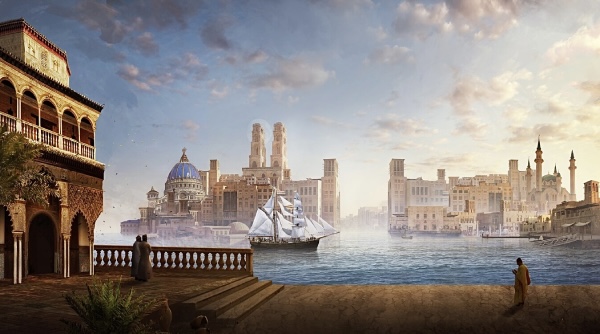
A single dhow, its twin sails taut in the wind, glided along the coastline with the sun at its back. Its bowsprit pointing at its destination: Port Hunding - capital of Stros M’kai and jewel of the Abecean. A wealthy city and a center of trade, culture, and diplomacy. Named after the legendary Sword-singer, Frandar Hunding, Port Hunding was a symbol of refuge and strength. From a distance, its white stone buildings and fortified harbor stood resplendent against the rolling dunes and craggy hills beyond. Several buildings rose high over the rest, engulfing parts of the inner city in shadow. The two most prominent structures were a grand temple, easily recognizable by its colorful stained windows, and a domed palace fit for a king.
The harbor was crowded with merchant vessels and fishing boats, though none could be seen entering
or leaving. A peculiar stillness hung over the water, ill-suited to so great a port. The dhow gracefully entered the embrace of the harbor, the crew taking in the sails as the helmsman delicately guided the small vessel among hulking galleons and longships.
“Dead slow ahead,” the captain called as the port side of the ship eased into line with an open dock. The dhow was commanded by a man named Isam, a ranking member of the Port Hunding city guard. His humble vessel belonged to the patrol fleet, which had sent out a small flotilla at dawn to investigate fires that had been seen in the night less than a league from Port Hunding.
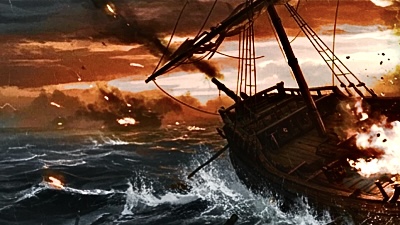
When the flotilla arrived at the site of the fires earlier that morning, they were met first by flotsam strewn across the sea and bloated corpses drifting among it, mostly Ra Gada and Cyrodiilics. Four survivors were discovered soon after. The blazes, Isam and his fellows learned, had been from a battle out at sea. When questioned the four said they were from a merchant vessel. Their ship, the
Arslan’s Fortune they had called it, was on its return to High Rock from the city of Anvil when it was blown off course and later attacked by pirates. During the fighting both ships were damaged by a sudden explosion and sank. Isam was ordered to deliver the survivors to Port Hunding and leave them in the care of the authorities. Afterward, he was to rejoin the flotilla along the southern coast of Stros M'Kai.
The dhow’s mooring lines were secured, Isam turning from where he stood at the bow to gaze over the four people huddled together near the main mast. Two of them were scraggly Ra Gada men, wearing the plain linen clothing and tall leather boots common among sailors. Of the other two one was a northerner - a Nord or maybe a Breton given her pallid skin and light hair. Isam could rarely tell with mainlanders. She was adorned in the fine robes and gloves typical of nobles and apprentices. If she was a magic user she would find little welcome here. But that was of no concern to the captain. The fourth was
strange, Isam could think of no other way to describe her. Or at least, he assumed the fourth survivor was a woman, their face indecipherable to him and their colorful clothes were of a bizarre pattern. Several of Isam’s men had been staring since they had first pulled that one from the water.
With a slight shake of his head Isam stepped forward, chainmail clinking beneath his billowy shawl. One of the Ra Gada recoiled as the tall, bearded guardsman came close, his dark eyes passing scrutinizingly over each of his “passengers” for a moment before he finally spoke.
“We have arrived. Welcome to the grand Port Hunding,” Isam paused for a moment then continued, his tone turning slightly callous, “I must tell you all I have not the time to guide any of you through the city. And I see no reason to have you escorted to the garrison. There is naught else I can do, other than offer my sympathies for your lost fellows and suggest that you visit the embassy. It is not far from the docks. If you need food and a place to rest you should go to the Palm and Shell nearby or -
if you happen to have the coin - the House of Pearls in the noble quarter.”
One of the other guardsmen nearby chuckled to himself, thinking his captain being sardonic. There was a
thunk as the gangplank was dropped across the short gap between the side of the ship and the dock. Isam stepped to the side, waving his right arm to indicate that it was time for the hapless sojourners to leave his company. Even with all the ships in the harbor huddled together, unmoving,
there was still life in the port. Dockhands shouted to one another as they hauled cargo about. Sailors tended to various needs of the resting ships while vendors haggled with customers over goods. Fishmongers gutted the morning’s catch at long wooden tables. Even amid the harbor’s palpable uneasiness the docks carried on with its daily cadence.
“Say your thanks to Tava that we found you so far out at sea. Perhaps we will find others. You must go now so that we may return to our duties. My sympathies again, and better fortunes unto you.”
 Member


 Gunther
 Shoopuf
 loco rococo
 Birdboy
 Vampiretwilight
 iibread
 FalkinPAAAWNCH
 Salt and Love
 Bork
Bork Bonesaw McGraw