Good luck with the RP; I admit I'm not particularly interested in roleplaying the Freespace world, but I love these games to death. There are plenty of terrific mods for them, too!
Slamurai
 Member

- Last Seen: 5 mos ago
- Old Guild Username: Aristocrap
- Joined: 12 yrs ago
- Posts: 2239 (0.49 / day)
- VMs: 7
-
Username history
- Slamurai 6 yrs ago
- █████████ 7 yrs ago
- ██████ 12 yrs ago
-
Latest 10 profile visitors:
-
Most recent →
 AP Ottovan
Status
Recent Statuses
7 yrs ago
Not my own words, but: "Enjoy memes and have a good time online, but develop a solid sense of self-worth that is rooted in a reality that doesn't disappear when the battery charge is empty."
4
likes
7 yrs ago
The spam. It hurts.
1
like
7 yrs ago
Yeah, and you're under arrest, pal.
1
like
Bio
User has no bio, yet
Most Recent Posts
@HylozoistI don't really know what to say about this one; it's not something I'd go out and voluntarily listen to. Very niche and idiosyncratic, but it's kind of carefree and whimsical. Not quite a fan of the style though, not interesting to me. meh/10.
Check it. 
@Plank Sinatra@pugbutterIt wasn't intentional, I swear.

@Plank Sinatra@pugbutterIt wasn't intentional, I swear.
We're maximizing the potential for love!
Posted my char in the CS; Frame to come.
@Plank SinatraSweet! Looking forward to this Laurent/Sparr dynamic. Add yourself to the CS tab.
Iznea, Capital of Hyrkos
The room was dimmed, save for the glow of candelabras set about the wide platform, upon which stood a life-sized effigy of solid ivory. It had the form of a young dancing woman, carved to a marvelous realism. Such was its likeness that if its flesh colored and sprung to life, it would be the desire of all men and the envy of women.
Prostrate before the idol was a lithe figure, olive skin shining in the candlelight, dark hair woven and decorated with ostentatious bands. She wore only a gold-chased girdle encrusted with gems and a silken skirt, transparent as gossamer. Her eyes looked to the white face above her, arms outstretched and grasping at air.
“Twenty years it has been, since I have taken the throne in my brother’s place! Twenty years and he has not returned to me. But he cannot be dead - every man on the field that day was examined for his likeness,” Princess Yadira exhaled, wringing her hands together. “I have done all I can for Hyrkos, if only by the guidance of Vizier Gaspar and Agaipos’s friends. Yet I am afraid! The Dakarragord have only grown stronger since their conquest. Amberland is no more, and Riawin is a shell of its former glory. Hyrkos is alone and, without Agaipos, I too feel as such! Oh Ishtar, what do I do?”
Yadira’s head drooped in resignation and she groped at the marble floor. She was exhausted from all this kingly work, even with the tutelage of Gaspar and the reassuring words of Agaipos’s inner circle, two decades of a monarch’s duties bore down on her like a river erodes stone. To gossip and play with her handmaidens again, and run among the gardens as she did in her youth! That was the life she wanted again.
A silky, feminine voice stirred Yadira from the marble, and lips parted in an O of surprise, she gazed on Ishtar’s idol.
“Be at ease, daughter of Eneas.” The words were rhythmic and honeyed, and they seemed to come from all around her, besides the effigy itself. From it, Yadira sensed an intangible presence of immense power and knowing.
“I know what it is that ails you. Follow my directions, and in doing so, save your brother, your kingdom and the entirety of Askor with it. Place Hyrkos in the hands of Vizier Gaspar and gather up a troop of one-hundred and eight trusted men. Go you to Cormyral and seek out Duchess Lynette ‘The Lioness.’ Dark events transpire in the east, and Mycae will fall...”
“Oh, but I am frightened! I know nothing of the lands in the east!” Yadira moaned with a shudder. But her goddess did not speak again. The princess picked herself up from the floor, and as she did so, her eye caught glimpse of a trinket on the altar that had not been there before. Gingerly, she picked it up, dainty fingers wrapping around a gemstone as white as milk. At its touch, it felt warm and comfortable, like a toy a child prizes above all others. Yadira slid the cord it hung from around her neck, and slipped from the chamber, half-terrified, but with a liveliness in her step that told of a surge of purpose.
* * *
And so Yadira mustered one-hundred and eight of her finest Tagmata, departing from Iznea by ship. She had left Gaspar to act as regent in her absence, and kissed her handmaidens goodbye. Upon the canopied aft, stretching her limbs on silken cushions, Yadira spared a long gaze at her homeland, fingers tight around the white gemstone at her breast.

Need to solidify relations when folks are online. Still drawing a blank on fitting heroes, but I have some characters established.

For thousands of years, Hyrkos has been under the rule of a monarchy. The king wields absolute power, in theory. His most significant duties include commanding the army, directing the Hyrkossian religion, and managing diplomatic affairs. His administration governs from the capital palace. He is the only individual who may conclude treaties and mint coins. He oversees the incomes of the kingdom, and its treasures. These include Hyrkos' mines, forests, royal landed properties and port duties on commerce. The king’s administration receives a tithe of the crops harvested by the lower class, which is then stored in case of famine.
Succession in Hyrkos is, by tradition, hereditary, patrilineal and generally respects primogeniture. Numerous cases exist, however, of kings without legitimate sons naming other relatives heirs. Upon the coronation of child kings, mothers have sometimes ruled as queen regent.
The king is assisted by a Royal Vizier, who represents the king’s interest to the public. The seat is usually filled by a close relative or lifelong friend. The vizier oversees the bureaucratic workings of Hyrkos delegates the responsibilities of government officials. They also direct the construction of government buildings and infrastructure.
Below the king and his vizier sits the Council. The Council is a collection of individuals chosen by the king to aid him in governing the kingdom. There are three categories of membership. The first are nobles chosen as personal advisors and ceremonial bodyguards. The second are persons chosen for life from the aristocracy. The last are the highest-ranking and important generals of the army. Many of Hyrkos' aristocracy are members of the Council by birthright, or chosen by previous kings, and so the king has less control over its composition than it would seem at a glance.
Hyrkos has several administrative districts acting as intermediaries between the central government and cities. These were established following the dissolution of the impractical general assembly. Each district is responsible for a number of major cities and the surrounding villages inside its borders. These districts carry out nationwide legislation from the central government and bring local affairs to its attention.

Major cities with populations over _ shown.
Hyrkos is a peninsular country, stretching from the eastern continent almost to the west. It is surrounded by water and buffered by the Darash Mountains inland, making its natural borders well-defined. The climate of Hyrkos is diverse, varying as one goes from the maritime territory further inland. The country is divided into four key geographical and administrative regions: Agaion, Khorshem, Thargos and Imryr.

Northwest of Khorshem, the Agaion region has a Mediterranean climate. Winters are mild and wet, while summers are hot and dry. Some of Hyrkos' richest farmland is located here, in the fertile lowland valleys. Olives and olive oil are a major commodity of the region. It is home to many beaches. Agaion is among the most densely populated regions of Hyrkos.
The Hyrkossian capital, Iznea, rests in the south of Agaion. It has the largest population of all Hyrkos' cities, and the busiest port. From the royal palace, the king resides and manages the country.
The central region of Hyrkos is known as Khorshem, specifically where it is semiarid plateau. The Khorshemite Plateau is surrounded by hills and mountains, which snake in and out of the fertile coastal territories. Khorshem receives little rainfall, but irrigated agriculture produces wheat, barley, cotton, tobacco and other goods. Many basins are located here, the result of inland drainage or erosion. They vary considerably in size, and when they fill with rainfall, the water is saline, as it has no outlets to the sea. What forest there is is confined to the north and northwest. Khorshem is rocky and steep along the northern coast, save for valleys where rivers flow between gorges.
The inland Thargos region of Hyrkos has a more severe climate. To the north of the Dominion’s province of Sanjudown, and along the Eisen border, the terrain is rugged and elevated, and sees higher levels of precipitation. Harsh winters brings heavy snowfall. The valleys and plains of eastern Hyrkos tend to have fertile soil on account of the Darah Mountains’ volcanic ash.
Imryr sits in the southern tip of Hyrkos, bordering what was once Amberlander territory. It is made up of vast coastal plain and recovered floodland. It has fertile soil due to its proximity with the Darash Mountains, and is home to many farming villages, although has fewer major cities and population density than in the north.
An array of fauna lay claim to Hyrkos' wilds, key species being foxes, wolves, bears, deer, wild boar and squirrels. Lynxes are present, but very rarely spotted. They are considered good luck, if found. Wild birds include eagles, grouse and owls. A variety of fish and marine life can be found in the rivers that snake through the country.
The inhabitants of Hyrkos' peninsula have always considered the Amberlanders under Dakarragord as being a distinct ethnic group, although related by virtue of a shared Hyrkossian culture that has dominated the region for thousands of years. Different dialects of the Hyrkossian language are spoken across the coastline, with the primary language of the peninsula called Iorian Hyrkossian, and that of the Amberlanders Phyrgian Hyrkossian. Both are mutually-intelligible to Hyrkossian speakers.
The inhabitants of the Hyrkossian peninsula are dark-haired, with tanned, swarthy skin and aquiline noses. It is commonplace for scented oils, waxes or lotions to be applied to hair. Women wear their hair in elaborate braids, piled on top of their heads, or in ponytails, while men keep theirs cropped short. Wool is worn during the winter, and linen in the summer. Clothing is dyed in bright colors or kept white. Often, the color of one’s garments corresponds to the city one lives in. It is fashionable for wealthy women, especially high-class courtesans, to wear garments of incredibly sheer, almost transparent linen.
The Hyrkossians worship a number of ancient gods, chief of which is called Ishtar. Her domains include fertility and the earth, the cycle of life and the harvest. Though most often depicted as a female of immense beauty, Ishtar is thought to be able to assume any form she pleases. It is believed that her presence manifests in her idols within Hyrkos' major temples, sometimes all of them at once, and at others, changing from one to another. These temples are known for their ostentation and luxury, even rivalling minor kingdoms elsewhere. The beauty and reputation of Ishtar’s temple prostitutes is well known outside of Hyrkos. Ishtar is invoked on holidays celebrating the harvest, the cycles of seasons, during childbirth, the eve of a surgery or medical procedure, before meals and when couples attempt to conceive.
Aristocratic families dominate Hyrkossian society, whose principal source of wealth is raising and herding cattle and horses. Members of this aristocracy gather in what is called symposia: a gathering of noteworthy individuals in extravagant drinking parties, serving as a forum to discuss and exchange ideas, or simply to revel and celebrate special occasions. These venues facilitate interaction between the prominent folk of society, and characterized by an egalitarian atmosphere, whereby all are welcome to partake and contribute. Food and wine is served and entertainment is provided by slaves, hired musicians or courtesans. Games are occasionally played between symposium-goers for fun and bragging rights. The level of debauchery varies from symposium to symposium.
Young men must hunt a wild boar as a rite of passage before they are permitted to participate in symposia in full. Hunting is another popular activity for the elite.
Dancing and music is incredibly important to Hyrkossian culture. There are over two-hundred distinct dances, each appreciating war, humor, athletics, religious worship and holidays, weddings, funerals and other events or celebrations. One of the most sought-after traits in both sexes is a partner practiced in dance. Lyres, flutes, tambourines, cymbals and castanets are the most widely played instruments, often accompanying these dances.
Weddings are grand affairs whereby brides ritually travel from their house (or the city gates, in the case of far-away families) to the house of their grooms seated in chariots full of gifts. The chariots are followed by members of the bride's’ family, and are preceded by friends of both partners, playing instruments and waving torches to light the way and ward off misfortune. During the ceremony, the bride eats a fruit provided by the groom, symbolizing his duty to provide for her from thereafter on. The ceremony is followed by feasting and passionate celebration.
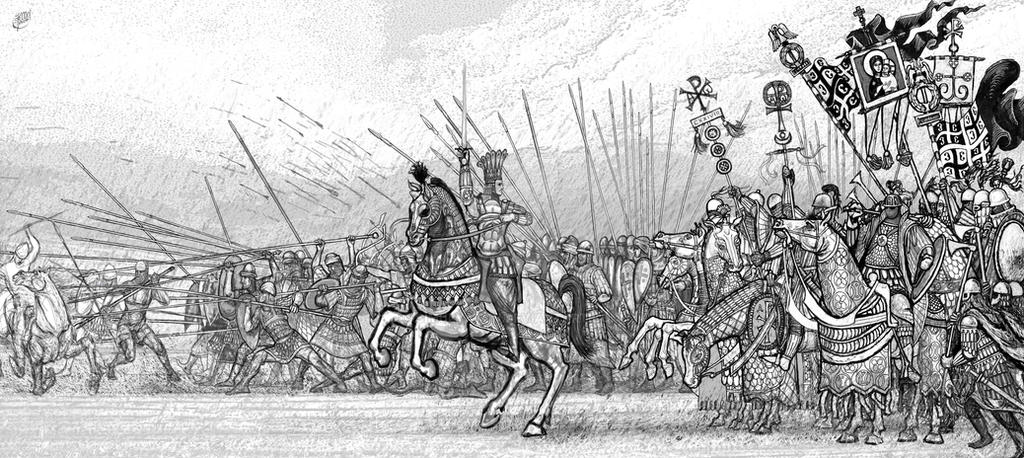
The nucleus of the Hyrkossian army is made of regular units stationed within Iznea. Chief of these is the Tagmata, elite regiments of guardsman cavalry. The Tagmata act as both ceremonial bodyguards of the king, and the striking hand of the army. These soldiers are equipped like cataphracts, dressed head to toe in glimmering mail and lamellar.
Elsewhere, Hyrkos’ soldiers operate under a provincial system. Soldiers stationed in regional districts about Hyrkos are commanded by military governors, or strategoi, who possess their own full-time personal retinue. These strategoi are assisted by civic officials in matters of administration: finance and soldiers’ pay, legal affairs, taxation, revenue, and so on. The common soldier under a strategoi would be a freeman, owning a plot of land in the district governed by his strategoi in payment for his service.
The basic unit of Hyrkossian soldiers is called a banner. Infantry banners are organized into units of 256 men - sixteen groups of sixteen men each. Three-fourths of heavy infantry banners are spearmen; the remaining fourth are equipped as archers. These banners are commanded by a small hierarchy of four sergeants under a commanding officer.
Light infantry is generally organized as one troop type, rather than mixing archers and spearmen as their heavier counterparts do. Their number is often smaller as well.
Cavalry units usually number 300 men - six groups of fifty. These would be mostly lancers, with a lesser number carrying bows in addition to, or instead of, lances. Each subunit of fifty men is led by a sergeant, and the whole banner by an officer.
In reality, units usually operate under-strength, if wounded or sick men and new recruits are taken into account. The size is also dependent on the district they hail from, and how many men a strategoi can muster.
Chain mail, scale and lamellar armor all see use by Hyrkos soldiers, with lamellar being the most widespread. Iron is the chief material for lamellar plates, but leather and bone are also evident. Lamellar armor is either sleeveless or very short-sleeved, and reaches the waist. Scale corselets are comparable in size, though mail is often seen reaching to knee-length, with long sleeves.
In place of sleeves on lamellar and scale corselets, many have leather strips hanging from the waist and shoulder. Soldiers may also wear leather or splint armor vambraces and greaves. Helmet aventails can be either chain, lamellar, leather, or quilted cotton. Hyrkossian helmets follow a universal design, being conical with nose guards and made of iron.
The shield of a heavy infantryman resembles a three-by-four-foot oval, while some carry a circular shield of a 30-inch diameter. Light infantry carry a small round shield about a foot in diameter, as do many cavalrymen and archers.
The principal weapons of the army are lance and sword. A cavalryman’s lance is twelve feet long, while infantrymen carry a slightly longer version. Other spears include shorter variations and nine-foot javelins.
Swords come in two main designs, the first being thirty-six-inch long, straight and double-edged. The other is a single-edged saber about the same length. Maces are also seen, but seldom carried by troops other than cavalrymen.
The Hyrkossian bow is a compound design, 45-48 inches long. It is used both by foot archers and cavalry. Two cavalrymen in every five carries one instead of a lance.
In the last millennia, the Hyrokssian peninsula has had a turbulent history, characterized by conflict with its neighbors. Prior to the Dakarragord’s invasion of the Amberlands and Riawin-controlled territory south of the peninsula, Hyrkos and the Amberlanders had been in numerous conflicts over the spans of their existence. In antiquity, when both nations were but city-states, each warred over territory at the border at Imryr, and over control of the inlet. Though they were both of a common culture and language, there was no nationalist school of thought in those days.
Though they were prone to bouts of fighting, they were also infrequent allies. When the ancestors of modern-day Dakarragord arrived south of the peninsula by the sea, they settled in a region of the Amberlands they called Sujan. They were left alone until Hyrkos, Amberland and Riawin eventually grew intolerant of their presence and formed a league. The combined army marched on Sujan and drove the Dakarragord into the Darash Mountains.
Sporadic fighting between the Dakarragord, the Amberlands and Riawin persisted for centuries. During this time, Hyrkos took a backseat to the conflict, concentrating its efforts on strengthening its powerbase and expanding across the peninsula. It grew inland, bringing into its fold city-states in eastern Khorshem and Thargos. The Darash Mountains, and the Dakarragord, were surrounded from nearly all sides.
When the Dakarragord cleaved their way south, the Amberlands had not been prepared. Twenty years ago, Vaemaradosth Dakan, the newly-established tyrant of the Dominion, united the Dkarragord tribes and capitalized on Riawin’s declining power. Huge swathes were cut from Riawin and Amberland territory in the Vaemaran Wars, as retaliation for injustices done nearly a millenia ago. Hyrkos lost a strip of the province of Imryr, now called ‘South Hyrkos’ by the Dominion. Its efforts prevented further incursion towards the peninsula, but it could not save the Amberlands from complete domination.
Hyrkos sits uneasily above the Dominion, memory of its explosive domination still fresh in its mind. Many within feel for their Amberland and Riawin counterparts, but are uncomfortable at the prospect of another war. Meanwhile, Hyrkos bridges the gap between the eastern and western continents, as goods flow up and down the inlet, and foreign ships pull into Hyrkossian harbors.
Other characters TBA.
The Kingdom of Hyrkos
Government
For thousands of years, Hyrkos has been under the rule of a monarchy. The king wields absolute power, in theory. His most significant duties include commanding the army, directing the Hyrkossian religion, and managing diplomatic affairs. His administration governs from the capital palace. He is the only individual who may conclude treaties and mint coins. He oversees the incomes of the kingdom, and its treasures. These include Hyrkos' mines, forests, royal landed properties and port duties on commerce. The king’s administration receives a tithe of the crops harvested by the lower class, which is then stored in case of famine.
Succession in Hyrkos is, by tradition, hereditary, patrilineal and generally respects primogeniture. Numerous cases exist, however, of kings without legitimate sons naming other relatives heirs. Upon the coronation of child kings, mothers have sometimes ruled as queen regent.
The king is assisted by a Royal Vizier, who represents the king’s interest to the public. The seat is usually filled by a close relative or lifelong friend. The vizier oversees the bureaucratic workings of Hyrkos delegates the responsibilities of government officials. They also direct the construction of government buildings and infrastructure.
Below the king and his vizier sits the Council. The Council is a collection of individuals chosen by the king to aid him in governing the kingdom. There are three categories of membership. The first are nobles chosen as personal advisors and ceremonial bodyguards. The second are persons chosen for life from the aristocracy. The last are the highest-ranking and important generals of the army. Many of Hyrkos' aristocracy are members of the Council by birthright, or chosen by previous kings, and so the king has less control over its composition than it would seem at a glance.
Hyrkos has several administrative districts acting as intermediaries between the central government and cities. These were established following the dissolution of the impractical general assembly. Each district is responsible for a number of major cities and the surrounding villages inside its borders. These districts carry out nationwide legislation from the central government and bring local affairs to its attention.
Geography
Major cities with populations over _ shown.
Hyrkos is a peninsular country, stretching from the eastern continent almost to the west. It is surrounded by water and buffered by the Darash Mountains inland, making its natural borders well-defined. The climate of Hyrkos is diverse, varying as one goes from the maritime territory further inland. The country is divided into four key geographical and administrative regions: Agaion, Khorshem, Thargos and Imryr.
Northwest of Khorshem, the Agaion region has a Mediterranean climate. Winters are mild and wet, while summers are hot and dry. Some of Hyrkos' richest farmland is located here, in the fertile lowland valleys. Olives and olive oil are a major commodity of the region. It is home to many beaches. Agaion is among the most densely populated regions of Hyrkos.
The Hyrkossian capital, Iznea, rests in the south of Agaion. It has the largest population of all Hyrkos' cities, and the busiest port. From the royal palace, the king resides and manages the country.
The central region of Hyrkos is known as Khorshem, specifically where it is semiarid plateau. The Khorshemite Plateau is surrounded by hills and mountains, which snake in and out of the fertile coastal territories. Khorshem receives little rainfall, but irrigated agriculture produces wheat, barley, cotton, tobacco and other goods. Many basins are located here, the result of inland drainage or erosion. They vary considerably in size, and when they fill with rainfall, the water is saline, as it has no outlets to the sea. What forest there is is confined to the north and northwest. Khorshem is rocky and steep along the northern coast, save for valleys where rivers flow between gorges.
The inland Thargos region of Hyrkos has a more severe climate. To the north of the Dominion’s province of Sanjudown, and along the Eisen border, the terrain is rugged and elevated, and sees higher levels of precipitation. Harsh winters brings heavy snowfall. The valleys and plains of eastern Hyrkos tend to have fertile soil on account of the Darah Mountains’ volcanic ash.
Imryr sits in the southern tip of Hyrkos, bordering what was once Amberlander territory. It is made up of vast coastal plain and recovered floodland. It has fertile soil due to its proximity with the Darash Mountains, and is home to many farming villages, although has fewer major cities and population density than in the north.
An array of fauna lay claim to Hyrkos' wilds, key species being foxes, wolves, bears, deer, wild boar and squirrels. Lynxes are present, but very rarely spotted. They are considered good luck, if found. Wild birds include eagles, grouse and owls. A variety of fish and marine life can be found in the rivers that snake through the country.
Culture
The inhabitants of Hyrkos' peninsula have always considered the Amberlanders under Dakarragord as being a distinct ethnic group, although related by virtue of a shared Hyrkossian culture that has dominated the region for thousands of years. Different dialects of the Hyrkossian language are spoken across the coastline, with the primary language of the peninsula called Iorian Hyrkossian, and that of the Amberlanders Phyrgian Hyrkossian. Both are mutually-intelligible to Hyrkossian speakers.
The inhabitants of the Hyrkossian peninsula are dark-haired, with tanned, swarthy skin and aquiline noses. It is commonplace for scented oils, waxes or lotions to be applied to hair. Women wear their hair in elaborate braids, piled on top of their heads, or in ponytails, while men keep theirs cropped short. Wool is worn during the winter, and linen in the summer. Clothing is dyed in bright colors or kept white. Often, the color of one’s garments corresponds to the city one lives in. It is fashionable for wealthy women, especially high-class courtesans, to wear garments of incredibly sheer, almost transparent linen.
The Hyrkossians worship a number of ancient gods, chief of which is called Ishtar. Her domains include fertility and the earth, the cycle of life and the harvest. Though most often depicted as a female of immense beauty, Ishtar is thought to be able to assume any form she pleases. It is believed that her presence manifests in her idols within Hyrkos' major temples, sometimes all of them at once, and at others, changing from one to another. These temples are known for their ostentation and luxury, even rivalling minor kingdoms elsewhere. The beauty and reputation of Ishtar’s temple prostitutes is well known outside of Hyrkos. Ishtar is invoked on holidays celebrating the harvest, the cycles of seasons, during childbirth, the eve of a surgery or medical procedure, before meals and when couples attempt to conceive.
Aristocratic families dominate Hyrkossian society, whose principal source of wealth is raising and herding cattle and horses. Members of this aristocracy gather in what is called symposia: a gathering of noteworthy individuals in extravagant drinking parties, serving as a forum to discuss and exchange ideas, or simply to revel and celebrate special occasions. These venues facilitate interaction between the prominent folk of society, and characterized by an egalitarian atmosphere, whereby all are welcome to partake and contribute. Food and wine is served and entertainment is provided by slaves, hired musicians or courtesans. Games are occasionally played between symposium-goers for fun and bragging rights. The level of debauchery varies from symposium to symposium.
Young men must hunt a wild boar as a rite of passage before they are permitted to participate in symposia in full. Hunting is another popular activity for the elite.
Dancing and music is incredibly important to Hyrkossian culture. There are over two-hundred distinct dances, each appreciating war, humor, athletics, religious worship and holidays, weddings, funerals and other events or celebrations. One of the most sought-after traits in both sexes is a partner practiced in dance. Lyres, flutes, tambourines, cymbals and castanets are the most widely played instruments, often accompanying these dances.
Weddings are grand affairs whereby brides ritually travel from their house (or the city gates, in the case of far-away families) to the house of their grooms seated in chariots full of gifts. The chariots are followed by members of the bride's’ family, and are preceded by friends of both partners, playing instruments and waving torches to light the way and ward off misfortune. During the ceremony, the bride eats a fruit provided by the groom, symbolizing his duty to provide for her from thereafter on. The ceremony is followed by feasting and passionate celebration.
Military
The nucleus of the Hyrkossian army is made of regular units stationed within Iznea. Chief of these is the Tagmata, elite regiments of guardsman cavalry. The Tagmata act as both ceremonial bodyguards of the king, and the striking hand of the army. These soldiers are equipped like cataphracts, dressed head to toe in glimmering mail and lamellar.
Elsewhere, Hyrkos’ soldiers operate under a provincial system. Soldiers stationed in regional districts about Hyrkos are commanded by military governors, or strategoi, who possess their own full-time personal retinue. These strategoi are assisted by civic officials in matters of administration: finance and soldiers’ pay, legal affairs, taxation, revenue, and so on. The common soldier under a strategoi would be a freeman, owning a plot of land in the district governed by his strategoi in payment for his service.
The basic unit of Hyrkossian soldiers is called a banner. Infantry banners are organized into units of 256 men - sixteen groups of sixteen men each. Three-fourths of heavy infantry banners are spearmen; the remaining fourth are equipped as archers. These banners are commanded by a small hierarchy of four sergeants under a commanding officer.
Light infantry is generally organized as one troop type, rather than mixing archers and spearmen as their heavier counterparts do. Their number is often smaller as well.
Cavalry units usually number 300 men - six groups of fifty. These would be mostly lancers, with a lesser number carrying bows in addition to, or instead of, lances. Each subunit of fifty men is led by a sergeant, and the whole banner by an officer.
In reality, units usually operate under-strength, if wounded or sick men and new recruits are taken into account. The size is also dependent on the district they hail from, and how many men a strategoi can muster.
Chain mail, scale and lamellar armor all see use by Hyrkos soldiers, with lamellar being the most widespread. Iron is the chief material for lamellar plates, but leather and bone are also evident. Lamellar armor is either sleeveless or very short-sleeved, and reaches the waist. Scale corselets are comparable in size, though mail is often seen reaching to knee-length, with long sleeves.
In place of sleeves on lamellar and scale corselets, many have leather strips hanging from the waist and shoulder. Soldiers may also wear leather or splint armor vambraces and greaves. Helmet aventails can be either chain, lamellar, leather, or quilted cotton. Hyrkossian helmets follow a universal design, being conical with nose guards and made of iron.
The shield of a heavy infantryman resembles a three-by-four-foot oval, while some carry a circular shield of a 30-inch diameter. Light infantry carry a small round shield about a foot in diameter, as do many cavalrymen and archers.
The principal weapons of the army are lance and sword. A cavalryman’s lance is twelve feet long, while infantrymen carry a slightly longer version. Other spears include shorter variations and nine-foot javelins.
Swords come in two main designs, the first being thirty-six-inch long, straight and double-edged. The other is a single-edged saber about the same length. Maces are also seen, but seldom carried by troops other than cavalrymen.
The Hyrkossian bow is a compound design, 45-48 inches long. It is used both by foot archers and cavalry. Two cavalrymen in every five carries one instead of a lance.
Heroes
History
In the last millennia, the Hyrokssian peninsula has had a turbulent history, characterized by conflict with its neighbors. Prior to the Dakarragord’s invasion of the Amberlands and Riawin-controlled territory south of the peninsula, Hyrkos and the Amberlanders had been in numerous conflicts over the spans of their existence. In antiquity, when both nations were but city-states, each warred over territory at the border at Imryr, and over control of the inlet. Though they were both of a common culture and language, there was no nationalist school of thought in those days.
Though they were prone to bouts of fighting, they were also infrequent allies. When the ancestors of modern-day Dakarragord arrived south of the peninsula by the sea, they settled in a region of the Amberlands they called Sujan. They were left alone until Hyrkos, Amberland and Riawin eventually grew intolerant of their presence and formed a league. The combined army marched on Sujan and drove the Dakarragord into the Darash Mountains.
Sporadic fighting between the Dakarragord, the Amberlands and Riawin persisted for centuries. During this time, Hyrkos took a backseat to the conflict, concentrating its efforts on strengthening its powerbase and expanding across the peninsula. It grew inland, bringing into its fold city-states in eastern Khorshem and Thargos. The Darash Mountains, and the Dakarragord, were surrounded from nearly all sides.
When the Dakarragord cleaved their way south, the Amberlands had not been prepared. Twenty years ago, Vaemaradosth Dakan, the newly-established tyrant of the Dominion, united the Dkarragord tribes and capitalized on Riawin’s declining power. Huge swathes were cut from Riawin and Amberland territory in the Vaemaran Wars, as retaliation for injustices done nearly a millenia ago. Hyrkos lost a strip of the province of Imryr, now called ‘South Hyrkos’ by the Dominion. Its efforts prevented further incursion towards the peninsula, but it could not save the Amberlands from complete domination.
Hyrkos sits uneasily above the Dominion, memory of its explosive domination still fresh in its mind. Many within feel for their Amberland and Riawin counterparts, but are uncomfortable at the prospect of another war. Meanwhile, Hyrkos bridges the gap between the eastern and western continents, as goods flow up and down the inlet, and foreign ships pull into Hyrkossian harbors.
Relations
Characters
Other characters TBA.

I love me some Conan.
Oh god, what have I done?
@Krayzikk
@Foster
@pugbutter
Everyone who's posted a sheet is accepted! I apologize for not being clear when your sheets were first posted; "Good to go" & "(pilot) checks out" = Accepted. Throw your sheets in the CS section!
I see that @Sanctus Spooki has a few minor sections to fill out, but I have no complaints so far. Assume you're accepted!
That gives us four Ghosts, and my sheet will make five!
@manapool1
@Plank Sinatra
Anyone else that hasn't gotten a sheet up is welcome to join; we can find a way to accommodate you.
IC development in progress!
Also, please note we have a Discord channel for OOC banter and other things: discord.gg/su4BMXZ
@Krayzikk
@Foster
@pugbutter
Everyone who's posted a sheet is accepted! I apologize for not being clear when your sheets were first posted; "Good to go" & "(pilot) checks out" = Accepted. Throw your sheets in the CS section!
I see that @Sanctus Spooki has a few minor sections to fill out, but I have no complaints so far. Assume you're accepted!
That gives us four Ghosts, and my sheet will make five!
@manapool1
@Plank Sinatra
Anyone else that hasn't gotten a sheet up is welcome to join; we can find a way to accommodate you.
IC development in progress!
Also, please note we have a Discord channel for OOC banter and other things: discord.gg/su4BMXZ
© 2007-2026