Welcome to Chronicles of Minadra, a High-Fantasy RP concept set in the original world of ‘Minadra’. Broadly speaking the intention is for a Tolkein-type vibe to the RP. The tech level is generally around 1000-1100 CE in Earth years.
In this RP you will take on the role of an adventurer in a party put together to recover an ancient treasure, though this will turn into something more epic, with the fate of all of Minadra in your hands…
There will be quite a bit of Lore in this RP, because we've built the world from the ground up, but you won't be expected to read all of it! Not all of it is included in the hiders below.... this is just a taster as this is an interest check after all!
So if you are interested or have any questions, let me know!

A Few Significant Places
The Plains of Morgador: The Plains of the Morgador ('Plains of Battle' in the Sidfirian language) have an ancient and significant history dating back to the Golden Age where the area was once the heart of Sidfir civilisation. During the Apocalypse, the place was the site of the Final Battle of the Apocalypse where the Graced Peoples defeated Brethnor's servants.
In the Silver Age, the Turakindi built their civilisation upon the ruins of the old Sidfirian cities in this same place, only for their civilisation to similarly be destroyed in the First Cycle War.
Now the Morgador is a place of ancient ruins, largely abandoned, home to ancient secrets and terrible dangers.
The Domain of Vaurinth: This is the place where Vaurinth lurks, surrounded by foul creatures. Nobody who crosses the Raxanor Mountains has ever returned.
The Taurethil Forest: A great forest filled with strange magical creatures and the hidden cities of the Fair Folk. Unless you have been invited and have an escort (or are one of the native races), venturing into the Taurethil Forest is ill-advised and very dangerous.
The Grey Mountains: The Mountain range where Aderynel, a young Sylpharim Scout, has just found an ancient Turakindi ruin that you are setting out to explore...
Ealdormuda: A pleasant coastal city of thatched wooden houses and long halls surrounded by a low stone wall and a dyke. Ealdormuda is the seat of the King of Eaham, who lives in the Great Stone Hall built atop the central hill, guarded by his Housecarls. This is the location where your party is assembling before setting out...
Primordial History
The Time Before Time
In the beginning, there was no space and there was no time. There was only Eruherion. Then, Eruherion breathed and breathed life into the first of its creations, a being of its own likeness without form, and it named the creation ‘Brethnor’. And Eruherion and Brethnor dwelt \in the primeval darkness.
Then Eruherion breathed life into other beings in the darkness. All were beings of pure spirit without shape or form, yet not rivalled Brethnor in its strength or power. These beings became known as the ‘First-Born’ in the ages to come.
Then Eruherion created the world, set the boundaries between heaven and earth, and made all the creatures that dwell in the sky, in the sea, on the earth and beneath it. Eruherion named the world ‘Minadra’ and the First Born descended from the Heavens, took on form and dwelt upon it.
But Brethnor did not take on physical form. In Brethnor’s pride, Brethnor asked Eruherion which of its creations Eruherion loved the most, for Brethnor was the most powerful. Eruherion answered that it loved all its creations equally and for the first time, Brethnor felt anger and jealousy. And on that day, evil was born into the world.
The Golden Age and the Apocalypse
Then Eruherion created the Golden-Age races the Jinn and the Sidfir.
The Jinn were people of the elements – earth, fire, water and air. They were solitary beings that went to dwell in places where they could be near the element of their affinity. The Sidfir, meanwhile, were a people of mind, magic and spirit who built cities of beauty upon Minadra that have never been surpassed in the ages since. There was no death amongst the Jinn or the Sidfir and Eruherion walked amongst its people under the guise of many faces and Eruherion was pleased with its creation.
It was then that Brethnor took on corporeal form and moved amongst the races. And Brethnor spread temptation and corruption amongst both the First-Born and the Golden-Age peoples, never creating but twisting and perverting. Many First-Born fell to Brethnor’s temptation while the Jinn and Sidfir who fell became known as the Gorthaz and Fomori.
In the parts of Minadra under the gaze of Eruherion, all appeared well, yet in the darkness, evil grew, until the time came when Brethnor’s followers thought themselves powerful enough to destroy the Graced people of Minadra and rebuilt it in Brethnor’s twisted image. In the place now known as the Plains of Mordagor, the vast hosts met and fought and for the first time, blood was shed on the fields on Minadra. The losses were countless on both sides, but eventually the Graced peoples triumphed and those twisted First-Born, Gorthaz and Fomori who survived fled into the dark and hidden places of Minadra.
The Golden Age lasted 14,840 years.
The Silver Age and the First Cycle War
Eruherion saw the suffering and death that had come upon Minadra and created Nalmarin – a place beyond the reach of Brethnor’s corruption, where its Creations could go. And Eruherion set the First-Born ‘Hirlome’ to guard the gates of Nalmarin so that no creature might enter that would bring corruption to it. Nalmarin is the place where the souls of the righteous travel after death.
On Minadra, the lines of the Jinn and the Sidfir gave the shoots of new races. The Turakindi (who are now known as giants), the Gwylfinn (who are now known as the Fae of the Seelie Court) and the Valindor (who are the ancestors of humans).
The races of the Silver Age were not immortal like the Jinn and Sidfir – they aged and died and the souls of the righteous among them travelled to Nalmarin. Similarly, the world was not free of strife, as the Golden Age had been, yet they built great cities and tended the forests and Minadra healed from the wounds of the Apocalypse.
Yet in the darkness, the Evil beings that had survived the Apocalypse of the Golden Age began to multiply and their corruption began to spread among the races of the Silver age. From the Tarakindi came the race known as the Durgorim, the Unseelie court of the Gwylfinn was founded and the Valindor were corrupted into the Thaurindor.
And in the dying days of the Silver Age, the Hosts of Darkness spewed forth onto the land, fighting a war that lasted for 20 years and left Minadra in ruins once again. Ultimately, the Graced people triumphed for a second time though a mere handful of the First-Born and few of the Golden-Age people survived to remain on Minadra after the First Cycle War. And the evil creatures retreated into the dark places once again, led by one of the last First-Born on Minadra, a being known as Vaurinth.
The Silver Age lasted for 13,440 years.
The Age of Steel and the Coming Cycle War
The Steel Age races sprung forth from the line of the Silver Age races. The races of the Age of Steel are shorter lived and lack the magical talents of the Silver Age peoples, yet they have multiplied and spread across the face of Minadra, rebuilding again, though not with the same majesty as the races of the Silver Age though in places the cities of the Valindor, the glades of the Seelie Court and the last bastions of the Sidfir remain to provoke awe.
It is now the year 4,017 of the Age of Steel and in the shadows, a darkness is moving again. Vaurinth has revealed himself after millenia in hiding and a Second Cycle War is now all but inevitable…
Religion
While Eruherion is a distant creator in the Age of Steel, this has not always been so and there are entities still alive today who have had very real experiences with the deity, although these are exceedingly scare: a handful of djinn and ancient Sidfir.
Because of this, however, there is no debate as to the reality of Eruherion or how he would prefer his creations to behave - with Prudence, Justice, Fortitude, Temperance and Honour. Good and evil are inherent aspects of existence and while there is no formal worship of Eruherion, most peoples attempt to live in his ways. Those who do are referred to as ‘Graced’ people. Those who do not are referred to as ‘Fallen’.
Amongst the Graced peoples, particularly in the races born in the Age of Steel who have no contact with Eruherion in life, there are some (particularly in some human cultures) who choose to devote their lives to contemplation of the deity, living in secluded monastic communities. These monks, while usually peaceful, will gladly take up arms against ‘Fallen’ creatures.
In the Golden Age, Brethnor moved amongst creation, tempting peoples away from Eruherion and asking them to worship Brethnor in his place, promising that he could create a world from the ashes of Minadra, where the every-desire of his faithful would be met. Brethnor tempts by appealing to Lust, Gluttony, Greed, Sloth, Wrath, Envy and Pride. Those who choose to worship him are, over time and generations, transformed into a twisted version of their former self, driven by impulses to kill and destroy.
Since the Goden Age, Brethnor has not walked upon Minadra, but he still has many creatures to do his will in the world. The most powerful of these is the entity known as ‘Vaurinth’, a First-Born from before the creation of Minadra.
Those who have met Vaurinth describe him as exceedingly beautiful, though his exact appearance shifts between encounters. From accounts of the 1st Cycle War and Apocalypse, Vaurinth is also unimaginably dangerous on those few occasions he chooses to take the field.
Death, the Afterlife & Ghosts
Prior to the Apocalypse that ended the Golden Age, there was no death amongst Eruherion’s children. This was changed in the events that ended the Golden Age. Though the souls of all the races of Minadra remain immortal, their bodies do not and can be destroyed, whether by violence, the weathering of time, or in the case of the younger races, the ravages of disease.
With the Apocalypse though, the Djinn and Sidfir cried out for a place to go away from the suffering and destruction of Minadra. So Eruherion created Nalmarin; a place where the souls of the righteous would travel after death, through the Vale of Mist (or the ‘Nandehise’ to the Sidfir) in the South of Minadra. Eruherion set Hirlome, the Lord of Mists, to guard the Vale and ensure no unworthy soul should enter.
Sidfir, uniquely, are able to enter the Vale without first tasting death, though they can never return.
Unworthy souls, meanwhile, cannot enter Nalmarin and instead fall into the outer, primordial darkness where their master, Brethnor dwells.
Some souls choose to remain on Minadra after their time, usually if they feel they left business undone. Living in the cold shadow these souls become corrupted by malice towards the living while the memories and personality they once had drain away into nothingness. These beings become the ghosts, wights and liches of legend. While hostile, the dead are not creatures of Brethnor, and are as hostile towards Brethnor’s servants as they are to the people of Eruherion.
Magic
Magic is a strange and powerful supernatural force that flows directly from Eruherion, though this does not mean it can only be used for good means and like Eruherion’s creations, it can be corrupted. A few beings, particularly those of the elder races are capable of mastering it in various forms. Certain beings may also be capable of imbuing magical properties on objects such as doors, gates, weapons and armour though in the age of steel magic, in all its forms, is increasingly rare.
Magical Beings
There are a variety of creatures, both sapient and otherwise which are imbued with magical abilities which allow them to circumvent the laws of nature. The Sidfir and Gwylfinn are able to move across a landscape and leave no trace of their passage, almost as if they were weightless, while the Djinn are composed, in part, of the elements to which they have an affinity.
Spells and Natural Powers
Some creatures are able to use magic in a variety of ways, though with the exception of the First Born and Djinn this is generally in subtle ways that require incantations and arcane rituals, such as the spells that the Gwylfinn use to hide their settlements from the outside world.
While most of the peoples of Minadra have an innate capacity for magic, it takes many decades of study to master the simplest of spells and the longer-lived races such as the Sidfir, Gwylfinn or Valindor tend to produce the most competent mages. One might expect a mage from one of these societies to be able to produce light in the darkness, manipulate the emotions of others, imbue an object with magical properties, create an illusion with some degree of efficacy, or engage in a battle of wills with their Fallen counterparts to cast or interrupt another mage while they attempt to cast a spell. In addition, some races excel at certain forms of magic, e.g. the Gwylfinn excel at illusions.
Djinn possess tremendous magical ability, especially in relation to their native elements. Able to manifest great storms, earthquakes, tsunamis and similar, that can alter the landscape around them. They can similarly imbue objects, and even individuals, with elemental abilities.
Magical Objects
Objects such as weapons, armor, doorways etc. can be enchanted (or cursed) to produce an effect in the presence of certain people. Curses are generally the domain of evil beings. A weapon might be enchanted to glow in the presence of creatures of the Host of Darkness, or cursed to produce festering wounds or a sense of dread and foreboding. A door might be enchanted to only open for a person able to speak a pass-phrase.
The physical characteristics of objects can also be manipulated by an enchanter. Weapons and armour can be hardened to a supernatural level. Weapons can also be enchanted to slice through armour more easily. If an enchanted weapon strikes enchanted armour the outcome is dependent, in a large part, on the skill of the enchants who did the work.
Languages of Minadra
Most languages in Minadra belong to the ancient ‘Sidfirian’ language group, descending over countless generations from the language spoken by the Sidfir people in the Golden Age (and still spoken by the Sidfir now).
Chart of the Sidfirian languages

Other than the Sidfirian group there is one other, much smaller language group, the ‘Sylpharim’ language group.
‘North Sylpharimese’ is spoken in the Bodeira Mountains and amongst the human population of Truynum Gorleuini.
‘South Sylpharimese’ is spoken in the Grey Mountains and the Ambarones.
The other two languages are Turakindian (spoken by the Turakindi) and Gundrukanian (spoken by the Gundrukan).
In the last three centuries, due to the rising prominence of the city of Segestica, ‘Arventian’ has risen to become the lingua franca of Minadra. Most of the more prominent members of society, especially anyone who intend to travel and people who are likely to interact with them (e.g. Innkeepers) will have passable ‘Arventian’, though most peasants will only speak their own local dialect.
Mages, nearly all of whom aspire to be as close to the great Sidfir mages, also tend to have a grasp of the Sidfirian language.
Traders will also often have a grasp of multiple languages.
Weapons
The standard infantryman of the Age of Steel tends to go into battle with a spear, a sword or handaxe, a shield, and some form of open-faced helmet.
Two Handed Weapons and Polearms
Bastard Sword:A large two handed sword with a blade of around 40 inches in length and grip of 6-12 inches. Used amongst the Occidarions (particularly the Treuring) and, to a lesser extent, Borearion cultures.
Kontos: A long, two-handed lance used by cataphracts in the Regnum Arventia and Varadaban Empire.
Lance: The long single-handed spear favoured by mounted Knights of many culture groups.
Long Axe: A two-handed axe that can be over five-foot long. Popular amongst the Huscarls of Eoham.
Spear: A ubiquitous battlefield weapon, used extensively by cavalry and infantry alike.
Hand weapons
These are normally used as a sidearm.
Arming Sword: A short double-edged sword with a cruciform crossguard. Up to around 30 inches long. Used extensively by Treuring, Hrankrajanie and Samotrekan knights, but not much outside of that. An effective weapon, but definitely designed as a sidearm.
Spatha (Sword): The straight, long, double-edged sword that most cultures use. It can be up to 40 inches long. Infantry usually use a variant with a sharp, stabbing point. Cavalry tend to use a variant with a rounded point to avoid stabbing themselves in the foot.
Mace: Maces are commonly used by the Cataphracts in the Empire of Varadaban, but not in most of the rest of the world.
Axe: One-handed axes are used extensively, often as a sidearm by poorer soldiers who use the weapon to cut wood as well as fight.
Seax: A long, single-edged, fighting knife (sometimes up to 20 inches long). Quite common amongst the Occidarion and Borearion cultures.
Thrown weapons
Javelin: A light, throwing spear.
Thowing Axe: A small axe that can be thrown with devastating effect. Used extensively by the Stromfolc.
War Dart: A short, fletched, dart with a lead weight on the end. Used extensively by the Arvenses.
Ranged weapons
Shortbow: The most common bow in Minadra. Three to four foot long, the short bow is a simple-to-make, effective hunting weapon that is also quite dangerous on the battlefield.
Composite bow: A short, compact, powerful recurve bow, originally designed for horse archery and used by the Prathmava. The use of this bow has since spread to the Arvenses, Skeropalians and Mitradaevaka.
Longbow: A 6 to 7 foot long bow with a heavy draw strength. It takes extensive amounts of time to build up the muscle power to use this bow properly. Used by the Fair Folk, Valindor and Pellmorwyr culture.
Crossbow: The slow-firing but powerful ranged weapon prefered by the Gundrukan and Treuring.
Armour
While plate armour is a thing in the setting, it is usually only worn by the ancient Sidfir and Valindor peoples. Humans wear mail or scale.
Shields
Round Shield: A round wooden shield with a metal boss, usually around 36 inches in diameter. This is the basic shield of most soldiers.
Oval shield: A larger shield used in amongst the Arvenses and Skeropalians. It is of a similar design to the normal round shield but is an oval, a little wider than a round shield, and up to four feet tall.
Kite shield: A long, narrow shield with a rounded top that tapers to a point at the bottom. Usually only around 20 inches with but up to five feet tall. Originally this was used by Treuring knights, but has also been taken up by the Stromfolc, Eahamingas, Hrankrajanie and Samotrekan peoples. In recent years the Firidor have also begun using this shield.
Helmets
Conical Helmet: A tall cone-shape helmet designed to deflect blows away from the head.
Click for an image or another.
Enclosed Helm: The Helmet favoured by elite Treuring Knights and Nobles. Unlike most other designs, the Enclosed Helm covers the face with a steel plate.
Click for an image or another.
Firindorian Kettle Helmet: An open faced helmet with a short brim and, sometimes, an ornamental crest.
Click for an image
Nasal Helmet: A type of conical helmet with a bar down the front to protect the nose. Made of a single piece of metal, making it stronger than ridge helmets and spangenhelms.
Click for an image or another.
Ridge Helmet: A bowl shaped helmet with cheek and neck guards. The individual pieces are joined together along a prominent ridge along the centre-line of the helmet.
Click for an image or another.
Spanghelm: A cheap but effective helmet made of multiple sheets of metal held together with metal braces. Sometimes has cheek flaps, a nose guard or spectacle guard.
Click for an image or another.
Body Armour
Aventail: Chain neck armour. Can connect up to the helmet, covering the lower face for extra protection.
Boiled Leather: Cheap, light armour. Used to make helmets and breastplates that can be worn over mail for added protection or just on its own. Sylpharim tend to wear boiled leather in preference to heavier armour so they can still fly.
Gambeson: A padded jacket worn under mail or scale to soften blows or sometimes as a cheap form of armour, all on its own.
Greaves: Protection for the shins. Usually made of lamellar.
Hauberk: A full-length coat of mail or scale.
Haubergion: A short male or scale shirt.
Lamellar:Pieces of armour made of small plates of steel or bronze. Cataphracts and Prathmava cavalry often wear lamellar vests over their mail.
Spaulders: Metal plates to guard the shoulders. Mostly only worn by cataphracts.
Surcoat:A colourful piece of fabric worn over mail or scale. Serves the purposes of telling everyone who the wearer is, keeping metal armour out of the sun and looking stylish.
Gender Relations in Minadra
Gender relations in Minadra are generally more equitable than one might expect in the Middle Ages. Women can, and do, train as mages and scholars. Outside of a few cultures, however, women do not generally participate in warfare. They are not expected to join levies, are not allowed to become professional soldiers.
The exceptions to this are the Sylpharim (who generally fight as light skirmishers) and the Prathmava human culture.
When it comes to inheritance laws, most cultures follow a variant of the ‘Sidfir Laws’ that give preference to legitimate male offspring in inheritance and assumes that live within a Tribal/Extended-family unit. Married women are understood to move, with marriage into the Tribal/Family unit of their husband, while any unmarried daughters become the responsibility of their oldest living brother upon their father’s death as does the father’s widow.
This is in contrast to ‘Sylpharim Laws’, which are only practiced amongst the Sylpharim towns and in the Truynum Gorleuini. Under this legal system all offspring inherit equally regardless of gender or legitimacy. Older offspring keep any indivisible titles (which is more relevant in the petty principalities of the Truynum Gorleuini than the Republican Sympharim cities) but land is otherwise split up and a bereaved spouse will usually retain all property until their death. While fairer, this system can lead to infighting between embittered rival siblings.
The Sidfir (High Elves)
Main Language: Sidfirian
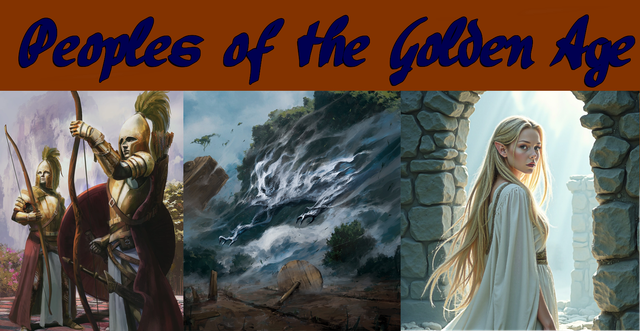
In the first day of the Golden Age, the Sidfir were formed from the clay of Minadra, by the hands of Eruherion, who breathed life into its creation.
Immortal, graceful, and fair, the Sidfir stand taller than most of the other races, with the men rarely under 6’6’’ and the women seldom under 6’. They have fine features, pointed, leaf-shaped ears with grey eyes and fair hair. A magical race, the Sidfir leave no footprints where they tread, have exceptional low-light vision, but also have considerably more strength than a human of a similar size, the reflexes of a cat and can surpass a human in all five senses. Sidfir are not all mages, but those that are are the most powerful to have ever lived upon Minadra, some of the more legendary of whom have rivalled the First-Born for power. All Sdfir are naturally gifted in the use of magic and, as the eldest of the ‘Fairfolk’, Sidfir can communicate telepathically with one another.
On the other hand, Sidfir fertility is extremely low with siblings often born centuries apart. Sidfir also develop extremely slowly, with a Sidfir only being fully developed at 50 years of age.
In the Golden Age, the Sidfir spread across Minadra, building cities of beauty and grace, unsurpassed in the ages since. Their Capital was the white city of Telepimas though many other Sidfirian cities rivalled it for beauty. Telepimas became the heart of art, culture, magic and philosophy.
Despite this, the temptation of Pride lured many Sidfirians to rebel against their maker and embrace the ways of Brethnor, becoming the first Fomori.
In the first days of the Apocalypse that ended the Golden Age, Telepimas was utterly destroyed, with no trace remaining of her or her people. Occasionally artefacts from her are unearthed, although these are dangerous, as often afflicted by Fomorian curses as they are not.
After the destruction of the city, the Sidfir, Jinn and Graced First-Born, rallied and in the place now known as the Plains of Mordagor, the two armies met. The Battle of Mordagor was bloody beyond comparison with magic deployed in a manner never seen before or since. Few survived and in the aftermath, when the Fomori and other enemies had fled to the dark places, many Sidfir cities were left unpopulated and fell into gradual ruin before being lost to time.
The Sidfir population never recovered, though in the Silver Age of Minadra, they remained a significant force, guiding the development of the Silver Age races (the Turakindi, the Gwylfinn and the Valindor), while their Golden Age brethren, the Jinn, remained solitary beings. When the forces of Darkness rallied again, in the First Cycle War, the Sidfir led the Graced peoples in their resistance against the darkness.
Once again, the war decimated the Sidfir people. Those who remained retreated to three surviving holdings, Calaquesse, Lomendil and Gwaedhros. In the wake of the First Cycle War, many Sidfir sages were left feeling that Minadra is hopelessly doomed and that actual hope lies only in ascending to Nalmarin. Uniquely, Sidfir magic allows them to pass through the Vale of Mist (which they call the Nandehise), travelling to Nalmarin without first dying. Many Sidfir do so every year, leaving Minadra behind, never to return.
The Fomori
The immortal Fomori are one of the most terrible of the Cursed races who succumbed to the temptations of Brethnor though, thankfully, in the Age of Steel, their numbers are few. Fomori are most usually found acting as generals in the Hosts of Darkness or as agents.
The Fomori have all the strength, grace and magical ability of their Sidfir brothers and sisters and retain their natural beauty, though their eyes have gone from the characteristic Sidfir grey to deep, black pits, without a trace of white. Those who have looked into the eyes of a Fomor describe it as peering into a black, bottomless pit. As one of the most corrupted of the Fallen races, the Fomori project an aura of despair and darkness around themselves.
The Fomori see themselves as superior to all other races and are particularly known for their cruelty and sadism towards captured enemies or, indeed, their own underlings if the fancy takes them.
The Djinn
Main Language: Telepathic with no natural spoken language.
In the first days of the Golden age, Eruherion created the Djinn. In those first days there was little to set Djinn and Sidfir apart, but unlike the Sidfir the Djinn made no attempts to modify nature or build cities. Instead they lived, and continue to live, solitary lives. The Djinn show a preference for one of the four elements, Fire, Earth, Water and Air and tend to dwell in places where this element is present (the Djinn’s ‘place of power’), perhaps at the mouth of a river, on a high hill top, deep in the earth or in the cauldron of a volcano.
The Djinn are immortal, semi-corporeal beings, with their bodies seemingly partially formed of the element they are made up of. They are gigantic, often towering 20 feet or more above the landscape, when they choose to emerge from their place of power, which is rare. The Djinn are magical beings, with powerful abilities to manipulate the element they have an affinity for.
Due to their solitary nature, almost no Djinn have been born since the first days of the Golden Age, though many of the Silver and Steel Age races are of Djinn lineage. Preferring their own company, the Djinn do not typically engage with the affairs of the other races though can become stirred to action if their place of power is endangered.
Like the Sidfir, the Djinn are a race prone to pride and, prior to the Apocalypse, the Fire and Earth Djinn, in particular, often fell to the temptations of Brethnor becoming the creatures known as the Gorthaz.
In the deep darkness of subterranean caverns and the shadows of volcanoes, guarded by Fallen Djinn, the hosts of Darkness built up to spill out onto the lands. Always comparatively few in number, the Djinn were decimated by the Apocalypse. Those Djinn still loyal to Eruherion retreated to their places of power, while the Fallen Djinn did the same.
Few Djinn participated in the Cycle War, most remained in their isolated places, though those that did proved to be powerful, and terrible allies of the Silver Age races.
In the Age of Steel, Djinn still exist in places of elemental power though they are exceedingly rare and rapidly fading into myth. The days when every river had a Djinn are gone, remembered only by those few remaining Sidfir, who were born before the apocalypse.
The Gorthaz
It is almost impossible to tell if an elemental entity is a Graced Djinn or a Fallen Gorthaz, yet those that do take delight in destroying those Graced people foolish enough to enter their domain. In the deep, dark parts of the world, the Gorthaz have had a pivotal role in guarding the places the Hosts of Darkness have used to rebuild after the Apocalypse and the First Cycle War.
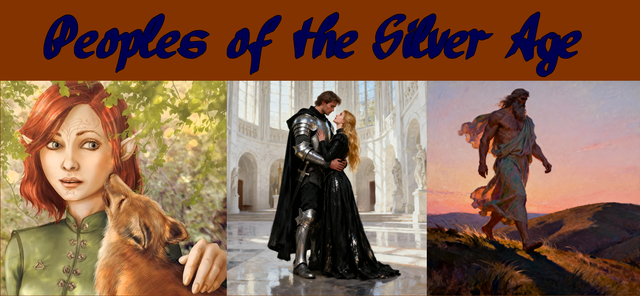
The Gwylfinn (Fae or Wood Elves)
Main Language: Sidfirian
The Gwylfinn, or ‘Fae’ as they are called by the Steel-Age peoples are the diminished descendants of both the Sidfir and the Jinn. While similar looking to the Sidfir (including the leaf shaped ears), the Gwylfinn are slightly smaller than their immortal cousins, with men standing at an average of 6’2’’ and women at an average of 5’8’’. Gwylfinn also have a greater variety of hair and eye colours, with a variety of darker shades being seen (though no Gwylfinn has black hair). Gwylfinn tend to show a natural aptitude for magic and as one of the line of ‘Fairfolk’, can communicate telepathically with one another.
While being immune to diseases and poisons the Gwylfinn are not immortal and will naturally age and die, though their average lifespan is around 7,000 years. While Gwylfinn still only reach their majority at 50 years, fertility is also higher than the Sidfir, with Gwylfinn able to produce a child around every 100 years, though after 5,000 years of age, they are usually no longer fertile.
Gwylfinn form affinities for particular types of nature, either the subterranean world (underworld Gwylfinn), the land (forest Gwylfinn), the water (water Gwylfinn) or the creatures of the sky (mountain Gwylfinn) and like-minded Gwylfinn will build small settlements in these regions. Gwylfinn mages are gifted in the control of familiars (associated with their form of nature) and illusion magic, which they use to shelter their settlements from unwanted intrusions.
Forest Gwylfinn can tread as stealthily as the Sidfir on land, Water Gwylfinn can swim indefinitely while floating high in the water, while Underworld Gwylfinn have exceptional low light vision. All kinds are every bit as graceful, though they lack the strength or magical prowess of the Sidfir.
The Gwylfinn will occasionally come together to form a Court to decide on collective action. Since the fall of many of their number to the temptations of Brethnor, the court of the Graced Gwylfinn has been known as the ‘Seelie Court’, while that of the Dark Gwylfinn is known as the ‘Unseelie Court’.
The Gwylfinn took on a major role in the First Cycle War, though in the years since, they have retreated to their secret settlements and are seldom seen in Minadra unless they wish to be. Few settlements are found near those of other races, most being found on rugged, uninhabited shorelines, in deep forests or in the depths of ancient cave systems.
The Unseelie
The Unseelie Fae are driven by an insatiable Envy of their immortal Sidfir progenitors. Gifted by a twisted form of Immortality by Brethnor, the Unseelie appear haggard and drawn, sacrificing their natural beauty for an eternity in the darkness.
Unlike their Seelie siblings, the Unseelie are not affiliated with nature, but can still control the dark and twisted creatures of Brethnor. The Unseelie have lost their capacity to create illusions, but have magic capable of cursing the ground they dwell upon and creatures that live upon it, spreading Brethnor’s filth throughout the natural world.
The Turakindi (Giants)
Main Language: Turakindian
Of the lineage of Djinn, and to a lesser extent, Sidfir, the Turakindi were the first race to try to truly tame Minadra and while their cities were never as beautiful of the Sidfir, the Turakinda were the first to clear forests, damn rivers and carve paths through the treacherous mountain paths.
Turakindi stand tall, taller than that of any of the other Silver age races, with men standing at an average of 12’ and women at an average of 11’. Turankindi are wiry, muscular creations and while they do not typically cast spells in the manner of the Gwylfinn or the Valindor, they have a unique and unparalleled ability to infuse magic into their creations, creating weapons and armour of the finest craftmanship. As descendants of the Djinn, over centuries dwelling in a place, the Turakindi will begin to take on the elemental nature of their environment.
The Turakinda live for around 2,000 years, reach their maturity at 50 years and are able to conceive again about every 50 years, once the previous child has reached maturity.
Prior to the Cycle war, the Turakindi built the most prestigious kingdoms of Minadra, building out over the ancient Plains of Morgador and the surrounding territories. Those that fell from Grace and became the Durgorim were tempted both by Pride at their accomplishments and Rage directed at those who dared to attempt to imitate their greatness.
During the Cycle War, the Turakindi formed the bulk of the forces of the People of Grace and paid a disproportionate toll for their involvement in the fighting. Many of the arts and construction techniques of the Silver Age Turakindi were lost. Cities were abandoned, forming ruins which can still be seen millenia later, faded but still standing despite the ravages of time - a testament to their ancient skills.
Small communities of Turakindi can be found in the ruins of their ancient cities or in other isolated communities, trying to relearn the techniques lost to time and rebuild their former glory. In some regions, Turakindi lead communities of humans or dwarves. All remain fundamentally opposed to the forces that destroyed their Kingdoms of Old.
The Durgorim
The Fallen Turakindi are creatures of Pride and Rage, hating both the natural world for its perceived imperfection and the creations of ‘Inferior’ races. The Durogrim are creatures of pure destruction, who have lost all of their creative potential in their fall from Grace though they have retained their ability to imbue magic in objects and many of the fouler curses, that unwary people fall trap to, are the creation of the Durgorim.
An Durgorim is typically stronger than one of the Turakindi, though coincidentally more uncontrollable and they form some of the more dangerous creatures in the Hosts of Darkness.
The Valindor
Main Language: North Valindorian
During the height of the Silver Age, the Valindor were the most numerous race in Minadra. They stand the same height as the Gwylfinn (an average of 6’2’’ for men and 5’8’ for women) though they lack the leaf shaped ears and in the world today are easily confused with humans (who are their descendants). Valindor are the direct descendants of the Sidfir, with no Jinn blood and like their forefathers are immune to diseases and poisons, though similar to the Gwylfinn are not immortal and will naturally age and die, though their average lifespan is also around 700 years. While Gwylfinn still only reach their majority at 50 years, fertility is also higher than Sidir or Gwylfinn, being able to produce a single child around every 30 years, though after 450 years of age, they are usually no longer fertile. Similar to Gwylfinn and Sidfir, the Valindor are typically a fair race, though they have all the hair and eye colours seen amongst humans.
Valindor lack the grace of the Sidfir, though they possess their strength and are typically much stronger than any Silver or Steel Age race with the exception of the monstrous Tarakindi. The Valindor produce some offspring with strong magical potential though these are few in number and are not as powerful as those with Sidfir or Gwylfinn heritage, though with the exception of the Firindor, no Age of Steel Mage can usually equal a Valindorian.
During the Silver Age the Valindor spread out across the fertile plains of Minadra, building cities that reminded the Sidfir who saw them of the cities of the Golden Age, though they were never quite able to capture the same glory. More so than any other race of the Silver Age, the Valindor were ready to do battle against the Host of Darkness. Alongside art and culture, the Valindor have always pursued the military arts, though violence is always restrained by a strict code of Justice, Mercy and Honour.
Like the Gwylfinn, the Valindor fought in the First Cycle War and like the Gwylfinn took catastrophic losses from which they have never recovered. Cities that were not destroyed in the fighting were abandoned to fall into ruins. The Valindor, however, did not despair of the world. While the Valindor withdrew to their more remote strongholds, in these citadels they have found a sense of strength and purpose, celebrating the beauty of Eruherion’s creation while remaining steadfast and ready to take up arms again in the defence of the Graced peoples.
Of particular significance to the realms of the Steel Age peoples is the Kingdom of Thangolad and the great citadel of Caryandor which stands vigil against the gathering darkness in the North. When the Second Cycle War comes to Minadra, it will first break upon Caryandor.
The Thaurindor
The Thaurindor form the elite divisions of the Host of Darkness. They are physically more muscular than Valindor with bestial features and skin that ranges from a dark, burned appearance to pallid and corpse like.
The Thaurindor are creatures of Rage and have sacrificed most of their intellect, developing a massive bestial strength in the process.

The Firindor (Fading Folk or Low Elves)
Main Language: Firindorian
The Firindor, who are often called ‘Low Elves’ by the other races are the diminished descendants of the Forest Gwylfinn and the youngest of the ‘Fairfolk’. While similar looking to the other Fairfolk (including the leaf shaped ears), the Firindor are not much taller than humans with the men standing an average of 6’ tall and women an average of 5’7’’. Unlike the other Fairfolk, the Firindor have all eye and hair colours one might see amongst humans although they remain pale in complexion. While the Firindor do not show an especially strong aptitude for magic (though greater than other Steel Age races) they have retained the ability to communicate telepathically with one another and can still move as silently as their Forest Gwylfinn ancestors, leaving no trace of their passing.
While suffering little disease, the Firindor are not immune to poisons with an average lifespan of only 350 years. Like other Fairfolk races, Firindor grow up slowly and reach their majority at 50 years, though Firindor fertility is high and they are able to produce a child around every 4 years, becoming infertile after around 250 years.
Firindor retain much of the grace of their Fairfolk counterparts, though are no stronger than a human. Like the Forest Gwylfin, the Firindor prefer to remain in deep woodland, building their communities there. These tend to be larger than Gwylfinn communities and the Firindor will clear land for farms, though they almost always leave several miles of woodland as natural camouflage to hide their settlements. While lacking the Gwylfinn aptitude for large-scale illusionary enchantments, when they do take the time to train in the magical arts, Firindor tend to excel at illusion magic.
Firindor are more likely to be found near the settlements of humans and other peoples and are willing to trade and negotiate. Armed conflict between Firindor and humans tends to be the result of logging Firindor ‘barrier woods’ (Most recently between the Firindor Kingdom of Elarion and the Arvenses in the War of Gallus Nasica in 3803 AS).
The Firindor are known as bow skirmishers, often employing ‘hit and run’ tactics in the woodlands they call home. They also have some of the finest, heavy spearmen of the Steel Age races, fighting in dense, well coordinated formations. Firindor Spearmen wear heavy mail hauberks and helmets (usually kettle or ridge helmets). They carry large kite shields in their offhand, while each warrior also carries a long spear and sword (most commonly a falchion). These troops are only encountered, however, if the Firindor are forced into a pitched battle, which they try their best to avoid.
While Firindor settlements are found throughout the vast Tuarethil Forest, their cities are mainly located South of Lake Calmenen. The most prominent of these are the cities of Nimrithil and Calenoril, and the Kingdom of Elarion.
Sample Archetypes: The Ranger, The Diplomat, The Steward
Gurzat (orcs)
Gurzat is a general term for the hordes of ill-disciplined and frequently cowardly, deformed creatures that make up the bulk of the Host of Darkness. Believed to be twisted Firindor and Humans, Gurzat prefer darkness to daylight and, where it is an option, will time their attacks for after nightfall. Gurzat have poor armour and weapons, are slightly smaller than their Graced cousins, are not especially intelligent, though they are cunning. Gurzat are filled with an incredible capacity for cruelty and are well-known for torturing and devouring anyone unlucky enough to fall into their clutches.
The Gundrukan (dwarves)
Main Language: Gundrukanian
The Gundrukan (meaning stone raisers in their own language) are the oldest of the Age of Steel races, having been born to the world on the eve of the Cycle War and are seemingly not of the lineage of any of the earlier races. The Gundrukan, while small in stature, are known for their creativity and adventurous spirits, building impregnable bastions in their mountain homes that burrow as deep into the mountain sides and they extend above them.
With their affinity for construction, the Gundrukan attracted the notice of the Turakindi in the final days of the cycle war, who hoped that their smaller brethren would be helpful in preserving the legacy of their guardianship, though over the course of the first millennium of the Age of steel, the relationship between the two peoples soured due to the perception, on the part of the Turakindi, that the Gundrukan were thieves intent on stealing their ancient techniques, while conversely, the Gundrukan began to feel that the Turakindi saw them as little more than slaves.
Gundrukan males stand an average of around 4’6’’ tall, while the women stand, on average around 4’4’’. Gundrukan are stoutly built, muscular and strong for their size. Like the Turakindi, Gundrukan magic tends to revolve around enchantment of magical objects and they fashion the finest weapons and armor of the Age of Steel. The lifespan of one of the Gundrukan is around 210 years. They reach their majority at around 40 years of age, produce a child around every 2.5 years, and are generally past reproductive age at around 150.
The Gundrukan live in several large and well defended cities in the mountains on either side of the Morgador plains and the old Turakindi realms. These cities usually go as deep into the mountain as they extend below and are often the gateway to massive and complex mining operations. The most prominent of these are Fjallborg to the West of the plains and Stormfjellheim to the East. From these cities the Gundrukan frequently mount expeditions to the ancient Turakindi cities in search of lost treasure and technology. This often brings them into conflict with the remaining Turakindi.
In combat, the Gundrukan tend to favour a mixture of light infantry armed with javelins and crossbows in support of densely packed formations of heavy infantry militia.
In their quest of treasure and secret knowledge, some Gundrukan have succumbed to the temptations of Brethnor, often brought down by their Avarice.
Sample Archetypes: The Steadfast Defender, the Fortune-Seeker, the Craftsman/woman
Fallen Gundrukan and Troglodytes
Most Fallen Gundrukan have retained largely similar physical characteristics to their Graced cousins and are equally adept in the same areas (save for a tendency to place terrible curses rather than benign enchantments). These creatures are known as ‘Fallen Gundrukan’ though a few have become twisted into something entirely different - the Troglodytes of the deep places of Minadra.
Those Gundrukan who have become Troglodytes have lost most magical and creative capabilities. Their bodies have become twisted, hunched and animalistic. Their noses have widened and expanded while their eyes have shrunk. Gundrukan craftsmanship is reduced to a mere parody with troglodyte forces armed with but a few crude weapons and wearing only the simplest of clothing. They are, however, terrifyingly strong, and while their sight poor, can track by scent and sound, making them terrible adversaries in the deep places of the world.
The Humans
The first humans were born from the lineage of the Valindor and dwelt initially in the Plains of Tridanu. More curious and adventurous than any race before them, the humans spread from their birthplace and can be found from the frozen lands of Ledosever in the far north, to Varadaban by the Vale of Mist in the South and from Truynum Gorleuini in the West to far beyond the Eastern reaches of the Kingdoms of Jugkrai.
Humans are varied in their appearance and culture. They are generally divided into six main groups (named by scholars at the University of Segestia), who speak similar languages/dialects:
Eldarions: The first humans.
Borearions: The Northern peoples.
Oriarions: The Eastern peoples.
Austarions: The Southern peoples.
Occidarions: The Western peoples.
Sylpharions: Those who speak the Sylpharim language.
The Prathmava of Tridanu (Eldarions)
Main Language: Central Valindorian
The Prathmava see themselves as the first humans and still speak a variation of the ancient ‘Central Valindorian’ language. They are tall people, tanned in appearance with blonde, or reddish hair and fierce, pale eyes. They live a nomadic lifestyle in the plains of Tridanu where they raise the finest horses in Minadra. They sell these mounts to many of the other human peoples and in return purchase weapons and armour. The Prathmava nominally owe loyalty to their King, Ardaros, though in practice the tribes only assemble under the King’s banner in times of peril for all. The Prathmava are unusual in that, like the Sylpharim, their women fight alongside their men. The Prathmava are born to the saddle and are the finest horsemen in all of Minadra.
The Prathmava are known for wearing colourful caftans, embroidered sashes and felt hats. Prathmava knights cover themselves in heavy chain, scale or lamellar armour.
Sample Archetypes: The Horse-Lord, the Herdsman, the Shieldmaiden
The Hrankrajanie of the Divided Kingdom of Jugkrai (Borearions)
Main Languages: North Jugkaraian in the North, South Jugkraian in the South.
Many centuries ago, the Kings of Ledosever became aware of orcs in the Rzhagomir mountains. Concerned about them spreading South, they sent message to the Rex of the Regnum Arventia who sponsored an expedition to establish fortresses along the Southern border of the Rzhagomir range. The land to the South, was good, however, and many settlers followed, eventually establishing, around 600 years ago, the ‘Kingdom of Jugkrai’.
Jugkrai quickly eclipsed the motherland in wealth and prestige. Though in the last fifty years the country has fallen into a dynastic civil war between branches of the ruling Sviatolev dynasty. Few realise that the Northern Sviatolevs have fallen under the sway of Vaurinth, who preyed upon their Envy and Lust for power, though the Holy Orders that once held the border castles have nearly all aligned with the South. As it stands, the Southern Sviatolevs are led by Prince Eruherislav, while Prince Voysislav leads the Northerners. Many long, brutal battles and sieges have been fought, with no end in sight.
The Hrankrajanie have been influenced by the fashion of the Treuring Kingdoms and their men usually wear a long, woolen tunic and hose, while often also wearing a wide, intricately embroidered belt. Women will usually wear a dress, which, depending upon the wealth and status of the wearer can be colourfully dyed and intricately embroidered. For the most part, the Hrankrajanie are a fair, ruddy people, often with blonde hair and blue eyes.
The Hrankrajanie infantry fight in a shield-wall, much like the Ledosevertsy, though they prefer the kite shields and round shields of the Treuring to the square shields of the Ledosevertsy. Due to the ongoing war, professional soldiers and mercenaries are common in the shieldwall, as well as forming companies of archers. These soldiers wear mail and usually either a spangenhelm or conical helmet. Hrankrajanie Lords can also draw on feudal levies and armies may also have a body of poorly armed feudal levies armed with spears, short bows and farming implements. Like the Treuring, the knights are the core of the army and are every bit as fierce as their Western cousins. Nobles wear colourful surcoats over their mail, mostly to identify themselves in battle.
The Hrankrajanie are great castle builders and still has many prosperous towns in the South, though many areas have been devastated by the war between the Sviatolev princes. Beggars and refugees are a common sight on their streets.
Sample Archetypes: The Paladin, the Mercenary, the Disinherited Noble
The Ledosevertsy of the Kingdom of Ledosever (Borearions)
Main Language: Ledoseveran
Ledosever is a harsh frozen land with long, dark winters where the rivers freeze over and short summers. It is an unforgiving land though starkly beautiful with mysterious lights that shimmer in the skies in the depth of winter.
The people, meanwhile, are known for their warmth, hospitality, storytelling and kindness towards strangers. The Ledosevertsy make their homes from timber, digging them partially into the earth to provide natural insulation in the harsh winter. Monasteries are a common sight in the land and often form the seed of a small town. The Eastern border of Ledosever, the Vostoritsa river, is dotted with small, wooden fortifications, which they call ‘Strazhovitsa’ (Sentinel Towers) to guard against the Host of Darkness.
The Ledosevertsy are tall, often blonde, ruddy people. They tend to favour simple woolen clothing supplemented with furs against the biting cold of their homeland. Fur hats are almost universally worn in winter.
The Ledosevertsy tend to fight in a shield-wall. They carry rectangular shields decorated with civic symbols and images of Saints. The body of the shield wall itself is a mixture of their tribal, warrior class (whom they call the ‘Voiny’) and less well armoured militia. The Voiny tend to wear a mixture of scale or mail armor, or sometimes just a thick gambeson. Helmets are usually either spangenhelms or conical helmets. Weapons are usually, a spear and a sword/axe though archers are also a common sight. While the Ledosevertsy have few cavalry, those whom they do are highly regarded lancers. These troops form the elite, mounted companions of the Nobles and are known as the ‘Sviatodruzhina’ or ‘Holy Companions’.
Sample Archetypes: The Paladin, the Storyteller, the Warrior Monk
The Samotrekan of the Samotrekan Principality (Borearions)
Main Language: South Jugkraian
South of Jugkrai are a people known as the Samotrekan. Until the civil war in Jugkrai, the Prince of Samtrekan pledged fealty to the King of Jugkrai, though when war started, the Prince decided not to participate and the Samotrekan have been left to their own devices for the past 50 years. The principality is a fertile, densely populated land with many cities and castles along the coasts and rivers that has grown wealthy through trade which they ply on the coasts, riverways and Bekhazun Lake in clinker built cogs, often guarded by a detachment of marines.
The Samotrekan are tall people with reddish hair and blue or green eyes. They dress similarly to the Ledosevertsy - the men usually wear a long, woolen tunic and hose. Women will usually wear a dress, which, often with bead jewelry to ornament it.
The Samotrekan do not levy peasants into their armies but rely on the wealthiest amongst the nobles and abbots to raise and maintain ‘Banners’ of professional soldiers when necessary. This means that their armies tend to be mostly cavalry, with large bodies of lightly armoured cavalry armed with spears and javelins, screening a heavy body of knights. Those infantry they do field tend to be of high quality. Kite shields, mail or gambesons, spangenhelm or conical helmets are all commonly used. Surcoats are usually in the heraldic colours of the noble or abbot who raised the ‘Banner’. Infantry will usually be either bowmen or heavy spears.
Sample Archetypes: The Abbot-Knight, the Veteran, the Marine
The Arvenses of the Regnum Arventia (Oriarions)
Main Language: Arventian
The Regnum Arventia is a large, peaceful Kingdom in the South of Minadra. The people there are generally olive-tanned skinned with darker hair and eyes than their Northern counterparts who live in well-planned cities studded with soaring domes and marble pillars. The Arvenses are an industrious people, producing large amounts of luxury goods that makes life within the towns and olive groves of the Regnum is the envy of many.
Because of the fact the Regnum has faced few threats, the Arvenses are poor castle builders, tending to build little more than an earth rampart topped with a low wooden (or occasionally) stone wall in places where they feel a defensive structure is needed, treating them as temporary affairs, rather than structures built to last the ages, as their cities are.
The Arvenses wear brightly coloured dresses and tunics (white is a favourite colour, though hard to keep clean), embroidered with intricate geometric patterns along with small fur caps. Most Arveni men choose to be clean shaven. The Arvenses prize learning and their capital of Segestia is well known for its University.
The industrious nature of the Arvenses has brought them into conflict with the Firindor in the past (most recently in the War of Gallus Nasica in 3803 AS), when they have encroached on the edges of the Taurethil Forest, though generally they are a peaceful people.
Unlike many of the Northern Kingdoms that rely on levies in warfare, the Regnum’s (small) army is made up entirely of professional soldiers who carry a large oval shield and are issued with mail or scale armour, a ridge helmet, throwing darts, a long sword and a spear. Screening the main body of troops, the Regnum will employ skirmishers armed with javelins or compound bows. Cavalry come in a variety of forms from light horse archers through to heavily armed cataphracts in banded plate and scale. Shields are painted in regimental markings while troops are trained to respond to trumpet signals and follow their regimental dragon standard which is carried next to the ‘Ordinarius’ who commands the Regiment. While often inexperienced, the Regnum’s soldiers are well equipped and have always given a good account of themselves in battle.
Sample Archetypes: The Tactician, the Veteran, the Scholar
The Skeroparalioi of the Skeroparalia (Oriarions)
Main Languages: Arventian in the Southern towns, South Jugkraian in the Northern towns
The Skeroparalioi live on the coast North of the Regnum Arventia and were, at one point, seen as the same people as the Arvenses, both living under the rule of the Regnum Arventia. There is, and has only ever been one long, lonely coastal road linking Skeroparalia with Arventia and this led to the Skeroparalioi diverging from their Southern neighbours in language and culture, though to look at them, the two peoples appear much the same.
Once, Skeroparalioi was a land of great cities, much like that of Arventia, but the land suffered greatly during the war of Arventian Succession just over 200 years ago and the Skeroparalioi now live mostly in small, but heavily fortified fishing towns and villages that cling to the coast. There is no central ruler, rather the land is divided up between many petty Kings and Princes.
While Arventia once ruled over the Skeroparalioi, the wounds of the war run deep and the Arventians have not sought to reimpose their rule. The Skeroparalioi tend to view the Arvenses as the architects of Skeroparalioi demise, while, in turn the Arvenses see the Skeroparalioi as rebels both against the Regnum and Eruherion.
The Skeroparalioi fight in much the same manner as the Arvenses though with more skirmishers and less cavalry (and no cataphracts). Skeroparalioi foot soldiers are organised as militia for their respective towns. They are not as well equipped as their Arvensian counterparts, usually carry javelins in place of war darts, favour the spangenhelm over the ridge helmet, and, since they are required to purchase their own gear, often don’t wear mail, relying only on their helm and shield for protection. These shields, rather than bearing regimental insignia, are decorated with the insignia of their home town.
Sample Archetypes: The Citizen-Soldier, the Spy, the Sailor
The Mitradaevaka of the Empire of Varadaban (Austarions)
Main Language: Mitradaean
The Mitradaevaka (or ‘Friends of the Ancient Fair Ones’) migrated in Millenia past to settle around the last homeland of the Sidfir and the Vale of Mist. The Mitradaevaka view themselves as the friends, pupils and protectors of the Sidfir. The Mitradaevaka are an honest and plain people, who teach their children to value truth above everything and have a deep respect for history and tradition.
The Mitradaevaka have olive-tanned skinned, curly dark hair and dark eyes. The men wear long, brightly coloured robes over trousers favouring yellow and purple dye (where it can be afforded). Women tend to wear long flowing dresses and bejewelled headwear and heavy earrings.
The Mitradaevaka build cities dotted with painted domes, gardens and water features. While a pale comparison, they are inspired by the Sidfir cities of old.
There is no knightly class amongst the Mitradaevaka, though like the Arvenses they make extensive use of professional soldiers. Most Mitradaevaka nobles and soldiers fight mounted, either as cataphracts on horse or camel or as lightly armored horse arches. Cataphracts usually also carry bows, along with their lances, curved swords and small round shields. Some guards will also fight in the manner of Arvensi infantry, with a spear, sword or mace, and a large round shield. These men form the backbone of the infantry which is otherwise made up of poorly armed levies. Occasionally, a Mitradaevaka army will also field one or two of the colossal monsters known as ‘elephants’ which they drape in heavy armour and use to trample their foes.
Sample Archetypes: The Scholar, the Noble Warrior, the Veteran Soldier
The Eahamingas of the Kingdom of Eaham (Occidarions)
Main Language: Eahamish
The Eahamingas are the descendants of a tribe of Treuring who crossed the Sturmsund Straights 1,000 years ago, at the same time as the Stromfolc, continuing further west along the coast, settling at the mouth of the River before spreading South over time to the Northern fringes of the Varadaban Empire.
Close contact with the Gundrukan of Fjallborg over the centuries has given the Eahamingas a deep interest in metalwork and their brooches and other jewelry are prized across Minadra while their swords and war axes are also regarded as being of an especially high quality.
The Eahamingas appear much like the Treuring (tall, powerfully-built people, often with blonde or red hair and blue eyes) and dress similarly, but with more jewelry (men usually wear a long, woolen tunic and hose. Women wear dresses, which, depending upon the wealth and status of the wearer can be colourfully dyed and intricately embroidered). The Eahamingas also tend not to fight mounted (though they do use some light cavalry), instead forming a dense infantry shieldwall of men armed with spears and javelins. Noble Eahamingas and their knights (whom they refer to as ‘Housecarls’) fight on foot, usually carrying a huge two-handed axe and a sword and often begin a battle by challenging their opponents to honourable, single-combat between the armies.
Eaham is home to many monasteries dedicated to the worship of Eruherion. These are peaceful places, often filled with beautiful tapestries and illuminated manuscripts.
Sample Archetypes: The Housecarl, the Chronicler, the Warrior-Monk
The Stromfolc of the Kingdom of the Strommark (Occidarions)
Main Language: Stromish
1,000 years ago, two Treuring tribes migrated across the Sturmsund Straights, one of whom went on to found the Kingdom of the Strommark. The Stromfolc are skilled sailors and shrewd merchants whose shallow-bellied, swift ships trade along the coasts of Minadra from Varadaban to Ledosever. These ships typically have a single square sail and a bank of oars.
The Stromfolc appear much like the Treuring from whom they are descended: tall, powerfully-built people, often with blonde or red hair and blue eyes. In battle they prefer to form dense shield walls with a mixture of kite shields and smaller round shields. When charging, or receiving a charge, a Stromfolc battle line will hurl a volley of thrown axes and javelins before closing.
Stromfolc men usually wear a long, woolen tunic and hose. Women wear dresses, which, depending upon the wealth and status of the wearer can be colourfully dyed and intricately embroidered.
Sample Archetypes: The Warrior-Sailor, the Merchant, the Shield-Bearer
The Three Kingdoms of the Treuring (Occidarions)
Main Language: Treurish
The Kingdoms of Schwarzdorn, Drachenfels and Eisengrund are the home of the Treuring. The Treuring are a tall, powerfully-built people, often with blonde or red hair and blue eyes. They are a settled people who build cities and castles along the coasts and rivers of their domains and farm the land extensively
Treuring armies tend to be made up of a core of fierce knights and well-equipped nobles (usually wearing mail hauberks with spangenhelm, nasal helmets or very occasionally an enclosed helm) armed with lances, large kite shields and a variety of other hand-held weapons. These men are supported by professional crossbows and heavy soldiers and, often, a large body of poorly armed feudal levies armed with spears, short bows and farming implements. Nobles wear colourful surcoats over their mail which both helps protect from the heat and identify the wearer
Treuring men usually wear a long, woolen tunic and hose. Women will usually wear a dress, which, depending upon the wealth and status of the wearer can be colourfully dyed and intricately embroidered.
Sample Archetypes: The Knight Errant, the Lady of the Court, the Mercenary
The Pellmorwyr of Truynum Gorleuini (Sylpharions)
Main Language: North Sylpharimese
The Pellmorwyr people arrived to the West of the Republic of Republic of Bryncaer around 2,000 years ago and while they had once been a seafaring people, upon landing on the shores of the place now known as Truyum Gorleuini, the Pellmorwyr burned their ships and settled.
The Pellmorwyr are a tanned people, usually with dark hair and eyes. Their men trim their beards into long, drooping moustaches. Their tunics, dresses and cloaks are often woven in intricate plaid patterns and while they are happy to trade with passing Stromfolc, they rarely venture far from shore in their fishing vessels and, aside from the odd wandering troubadour, tend to keep to themselves in the isolated castles and towns of their peninsular.
After centuries of isolation alongside the Republic of Bryncaer, the Pellmorwyr have taken to speaking the Sylpharim language. Poetry, music and song are valued highly in Pellmorwyr culture. They do not have a single Kingdom, rather a number of Petty Princes vie for power and internecine warfare is relatively common.
Bryncaer knights largely arm themselves in the manner of the Treuring, carrying lances and kite shields and wearing long mail hauberks, though they favour the ridge helmet for head gear. They ride short, rugged horses, smaller than those in the south. The rest of their armies are typically made up of lightly armed levy spearmen and and large numbers of archers who pepper the enemy with arrows at the start of a battle before retreating behind the lines of spears. Bryncaer archers are well regarded, being seen as the best human marksmen in Minadra and use the longbow extensively.
Sample Archetypes: The Ranger, the Knight Errant, the Troubador
Gurzat (orcs)
Gurzat is a general term for the hordes of ill-disciplined and frequently cowardly, deformed creatures that make up the bulk of the Host of Darkness. Believed to be twisted Firindor and Humans, Gurzat prefer darkness to daylight and, where it is an option, will time their attacks for after nightfall. Gurzat have poor armour and weapons, are slightly smaller than their Graced cousins, are not especially intelligent, though they are cunning. Gurzat are filled with an incredible capacity for cruelty and are well-known for torturing and devouring anyone unlucky enough to fall into their clutches.
The Sylpharim (Skyborn)
Main Languages: North Sylpharimese in the Bodeira Mountains. South Sylpharimese in the Grey Mountains and the Ambarones.
The Sylpharim are of the line of the Air Djinn and mountain Gwylfinn and like most of the races of the Age of Steel, have limited magical aptitude, although they have retained a supernatural ability to tame birds and where they have taken the time to perfect a magical craft, tend to show aptitude in the fields of Domaturgy (the binding and control of wild animals), which the Sylpharim themselves call ‘Cuivethir’, and Aeromancy, which the Sylpharim call ‘Súlendur’.
Sylpharim look much like humans, though they also have a large set of wings sprouted from their backs, usually feathered in either black or white, though a variety of brown shades also exist. Sylpharim can fly and are extremely agile, even when standing on the ground, having lighter bones than most other peoples. They are also slightly smaller than humans, with the men standing an average of 5’7’’ tall and the women and average of 5’2’’. This in turn means they don’t tend to be especially strong and can break bones easily. Sylpharim live and develop in much the same manner as Humans.
The Sylpharim view themselves as a free people and their society is unusual in that there are no noble classes. Rather, their citadels, built in the high places of the earth, are governed by elected officials. Also, unusually, Sylpharim women are found in their militia and warbands.
Sylpharim warriors tend to wear only light armour and will attack an enemy force by flying above it and peppering it with thrown or dropped weapons before deciding to either retreat or, if the enemy are sufficiently disorganised/demoralised, diving on them to engage in melee combat.
Perhaps because of their descent from the Air Djinn, despite their freedom loving nature the Sylpharim have not fallen into darkness any more than the other races born in the Age of Steel.
Sylpharim are divided into two groups, the Northern and Southern Sylpharim. The Northern Sylpharim founded the Republic of Bryncaer, where most Northern Sympharim still dwell, while their Southern brethren founded the twin Republics of Ardbenn Solas and Binn Nechtain on either side of the plains of Mordagor and the ruined cities of the Turakindi.
Sample Archetypes: The Liberator, The Magpie, The Renegade
Harpies
Those Sylpharim who have succumbed to the temptations of Brethnor, are known as Harpies. Harpies have descended closer to a bestial form, sometimes losing their arms or acquiring talons or beaks. They can be a terrible threat to travellers who inadvertently wander into a place where they have made a home.
The Vinyalie
Main Language: None. Gifted at language acquisition.
The Vinyalie (or ‘People of New Growth’) stand as creatures of endless renewal and curiosity. First seeded from the Gwylfinn, the Vinyalie are travellers first and foremost, going out amongst the world and its peoples to tell tales and sing forth the truths of creation.
They take a humanoid form typically, though the plant-like structures of their bodies can lend themselves to abnormal shapes as well. Each Vinyalie is formed from a heart, a seed-like thing perhaps four inches in diameter. From this seed, vines form in sinuous structures bristling with leaves, flowers, thorns, and otherwise. Their faces house facsimiles of human sensory organs, and often they will shape their bodies to possess some abnormal traits and stylings. They possess uncanny senses, able to see in the darkest night and take in all that the world has to offer in its fullest.
The Vinyalie are theoretically immortal, though in reality they undergo a renewal approximately every 40 years. In this renewal, the Vinyalie recedes into their seed pod and emerges with no clear memory or continuity of identity with who they were before. They may remember stories, some language, and sensations from past lives, but for all purposes, they are a new person who could pursue entirely new tastes and interests. New seed pods take multiple years to create, and involve the meeting of multiple Vinyalie to contribute to its creation.
There are small communities and conclaves of Vinyalie, but typically they are found interspersed among the other peoples. They are often itinerant, though sometimes they can find a certain attraction to a certain place where they prefer to remain. They universally love to tell stories and produce art of all sorts, with great ballads and works of beauty in their wake.
Sample Archetypes: The Bon-Vivant, The Story-Teller, The Pleasure-Seeker
The Draughlith
The Draughlith (meaning ‘Withered Spawn’ in the language of the Gwylfinn are the result of Vinyalie whose beings have been corrupted by Hubris and other temptations of Brethnor. Their bodies bloom blackened thorns, pallid fungi and trailing, entangling creepers slick with mildew and other filth. On the breeze they carry the scent of damp soil, rot and mould.
Like the Vinyalie, the Draughlith renew every 40 years, burying their twisted seed heart in a mound of slain people and other creatures. They emerge with no clear memory of the past but with renewed hatred for the foes of their past life and seething vendettas to pursue. The Draughlith do not typically appear amongst the armies of Vaurinth but serve his will by spreading fear and suffering, terrorising lonely stretches of road or isolated farmsteads.
The Beastfolk
Over the past century a tiny percentage of human births have, seemingly randomly, been of creatures which seem to be half-human and half of some other animal (the exact animal varies by region). Often ‘Beastfolk’ children are killed, sometimes a parent attempts to raise them themselves. These creatures are generally shunned in human societies even though (at the insistence of the Mages) nearly every Court on the continent has offered them protection. A few have found their way into their own communities, usually in the wild places where few humans will interfere with them.
Sidfir and Gwylfinn scholars believe that this process is result of Eruherion’s creation of a new race of people, the first of the Age to Come. As such, Beastfolk are seen by many as heralds of the end of the Age and the coming of a new Cycle War.
Beastfolk are believed to live short lives, probably no more than 50 years, though relatively little is known of them or indeed, whether they are a single race or many. Typically, Beastfolk are seen as more physically robust than humans, though less intelligent and almost incapable of magic, though only time will tell how true these beliefs are.
As the Beastfolk are such a new race, no twisted form of them exists so far, though their maltreatment by humans has led to no small number falling victim to the lies of Brethnor and Beastfolk are often found scattered amongst the ranks of Gurzat in the Host of Darkness.
Sample Archetypes: The Outsider, The Noble Savage, The Village Guardian
2x Like