Avatar of Dinh AaronMk

Status

Recent Statuses

1 yr ago
Current As an American [user could not afford rest of post]
6 likes
3 yrs ago
Never spaghetti; Boston strong
3 yrs ago
The last post below me is a lie
1 like
3 yrs ago
THE SACRIFICE IS COMPLETE. THE BOILERMEN HAVE FRESH SOULS. THEY CAN DO SHIFT CHANGES.
2 likes
3 yrs ago
Was that supposed to be an anime reference

Bio

Harry Potter is not a world view, read another book or I will piss on the moon with my super laser piss.

Most Recent Posts

@Frengo

One of the biggest bits of post-apocalyptic fiction anyways is the ruin it takes place in and feeding off the most basic of things left behind from the world before. Whether it's jury-rigging together cars in the same vein of Mad Max or Fallout where most of (or all of) society is built literally atop the ruins and the remnants of the material of the passed duct-taped together to create a usable tool. Society and humanity is too smashed for a cohesive enough society to arise to build anything as complex of high science-fiction (with actually very limited exceptions in Fallout).

It'd be a thing to pause and consider this. Though you might have "highly efficient crops" all that does is settle that there wouldn't be any wheat famines, or less of them. Not that anyone's spending any less-time harvesting and planting it.
Tibet

Lhasa


The wooden halls of the Potala Palace contained within their bowls a harsh bitter smell of burning fat. The acrid odors mingled with the heavy earthly aroma of woody musk and the ages of preserve in the wood of the ancient palace. Unhooded, the prisoner leered gloomily at the passing halls as he was dragged through the halls.

Elaborately carved wooden pillars, motifs decorated in amber and golden leaf, and the pale-yellow light of banks and beds of candles passed him by. Men in mismatched uniforms of plated armor and leather carried him through from under the arms. The clicking of the metal scales and plates in their armor was a somber and lonely music accompanying the distant, muffled chanting of monks. In the dim lighting their faces were hidden and obscured in the soft shadows and dim lights so they were only phantoms of men.

Their boots beat heavily against the centuries-preserved wood in a low drum-beat as they turned to a room off the side. The drumming of the leather soles ebbed to a muffled and muddled drum as they dragged him over carpet. Too weak to look up, the captive starred down at the twisting designs woven into the rug. With a hard thud, he dropped suddenly to meet the coarse weave. He gasped stiffly for breath before a voice beckoned him to rise.

He slowly rose to his hands and knees. The room was not large, and was in fact not any bigger than many peasant's huts. Though this only reinforced the size and palatial size of the Potala Palace. Woven tapestries of the Buddha and the enlightened afterlife hung from the walls. Narrow windows let in streams of golden light filtered through the dusty air. In darkened corners robed courtiers hung back in the shadows, hiding their whispers behind palms as they looked down at the beggar soul on the floor. The guards and soldiers with their scavenged suits and weapons loitered more clearly on either side of a throne of yellow cushions and blankets. Seated upon which was the cross-legged liege of the palace.

Samten Khyenpa Gyatso was a prince possessed. The man before him now was one who could claim to have seen him before when he was much younger. But then it was a glancing look at a man who enjoyed the presence of the monks over. Through his sullen brown eyes had once shown a compassionate charity.

But now through a karmic twist of fate, he now knelt before him at a worse time. Bent by malice and revenge, the prince was a lion in his mid-forties. His eyes shown with no charity or mercy, but an enraged and upfront emotion. That of anger, that of revenge, and that desiring which was stolen by him. Looking up he understood just how much he had loved his father and how much he would have him back. But he was gone now, and there was only him clutching the sword of Lhasa.

Samten did not need to speak for the prisoner to know why he was here. He was caught before he could flee the lands ruled by Lhasa for Kham, or even the far-away Dong. He couldn't make it to Sikkim or to Nepal. And not his laziness was paying up in spades for his treachery and his plotting. Looking at the prince, he knew that he knew. The power in his stare was beyond that of compromise and any word he spoke would be negated.

“Some might say the world needs more compassion.” he said in a low voice. His tone was low as if he were hiding it from the public ear as much as the whispering courtiers. He held a trembling hand to his brow and brushed aside a long lock of black hair, stuffing it underneath the brass crown of Lhasa. The faded tarnished metal was cast like that of the hats of the monks, a tall curved horn that bowed forward, decorated in horse-hair frills that dangled from the seams. “But when the dispassionate steal from someone something irreplaceable, I find myself double-guessing this philosophy. No matter the good work and the good word, the irredeemable and the foul will be crawling in the gutters. Looking up and ready to kill. And for what, dearest traitor?”

The assassin could only lay on the carpet, shaking from hunger, thirst, and of rage. He boiled deep inside but lacked the strength to walk. It had all bled out from his feet. He worked his tongue in his mouth, but the dry cotton that it had become produced only inaudible vocalizations. Behind him the two hunters that had recovered him triumphantly smiled.

“P-p-prince Chodah-ah-ak.” he finally croaked. He felt his stomach turn and twist inside of him. The sickly throws of nausea forced him to keel over at his betrayal to his liege-lord. He cried as he pounded his head against the carpet. But Samten watched, without amusement as the assassin punished himself. “That is the name I shall betray!” he declared.

“What is it you're afraid of?” asked Samten between clenched teeth. The assassin looked up at him, baffled.

“Of the misdeeds to commit, why is it murder!?” he boomed, “Theft, rape, assault. You could have done much more. But why attack your liege? And why in the name of some other!?”

Moaning, the prisoner laid his head on the ground. Samten sat atop his throne, burning and passionate with anger. If he had looked up he would have seen him glower with the energetic reds of the setting sun. He was there the end of day, all contained in the wrinkled face as round as the sun itself.

“Your noble sire,” bowed one of the hunters, “When we took the captive we found this on his person.”

With a thud a small leather pouch was thrown onto the ground between the prisoner and the prince. The two looked at it. The prisoner in feeble terror and the prince in cautious anger.

“Dare I take it?” he openly asked.

“We checked the contents, it was a paid contract.” the hunter acknowledged.

Somehow, this made the prince even angrier. As he shot from the throne he shouted in a thunderous voice, “And you were so in need for wealth!” he scolded.

He scooped the satchel from the ground and tore it open, “To think misdeeds to be committed for something as base as to why the war ended.” he scowled.

Inside the bag was an assorted collection of shimmer brass bullets, still fresh within their casing. Gemstones and gold nuggets shared space. The glittering wealth of corruption stared up at and Samten. With fury he threw it to the side, as if it were a venomous snake.

“Insolent thirsty greed!” he bellowed wrothfully, “Base misdeed!”

The courtiers nodded in agreement. The palace itself seemed to freeze at the judgement.

With a wave of his hand Samten closed the audience. “Intern this man into the dungeons, we will force the story from him in the days time. We'll decide sentence then.”

The prisoner cried as he was pulled back up to his feet by the guards and dragged off through the halls. Smiling triumphantly the two hunters walked casually across the room to the prince.

“Your honor.” the eldest bowed.

“Gyaltsen.” Samten acknowledged, “How is your brother?”

“Lobsang does well.” he answered, “This prisoner, you really think we can milk him more?”

Samten shrugged as he returned to the throne. Passionate anger still burned in his veins like hot iron. Sitting on the corner he rubbed his fingers across his palms. “Perhaps, but it's something I trust that Ngwang and you can no doubt accomplish.” he said plainly, looking up at the younger partner, “But here, now, I have the name I needed. I will have to prepare the response accordingly. I will have to dispatch word to your brother and we can put this together.”

Gyaltsen bowed, “It sounds like war is on the wind. May these fires be brief.”

Samten spat, “Chodak stole my family, I will steal the same from him.” he grumbled.

“But Chodak has no father. Though his brothers and sons will be the first to meet you in battle.”

“It's not them I want, it's his lands. They are the most valuable to him. I will add Ngari to my titles and imprison him.”

Gyalston the Hunter nodded, it was not in position to question it further. “I understand.” he said, though he wished for it to be shorter, temperament held to withdraw his reservations for the moment.

“We will begin seeing to our guest.” he said, turning to the door.
<Snipped quote by Dinh AaronMk>First off, microchipps don't require rare elements as an explicit need. Second, they are found outside of Congo.


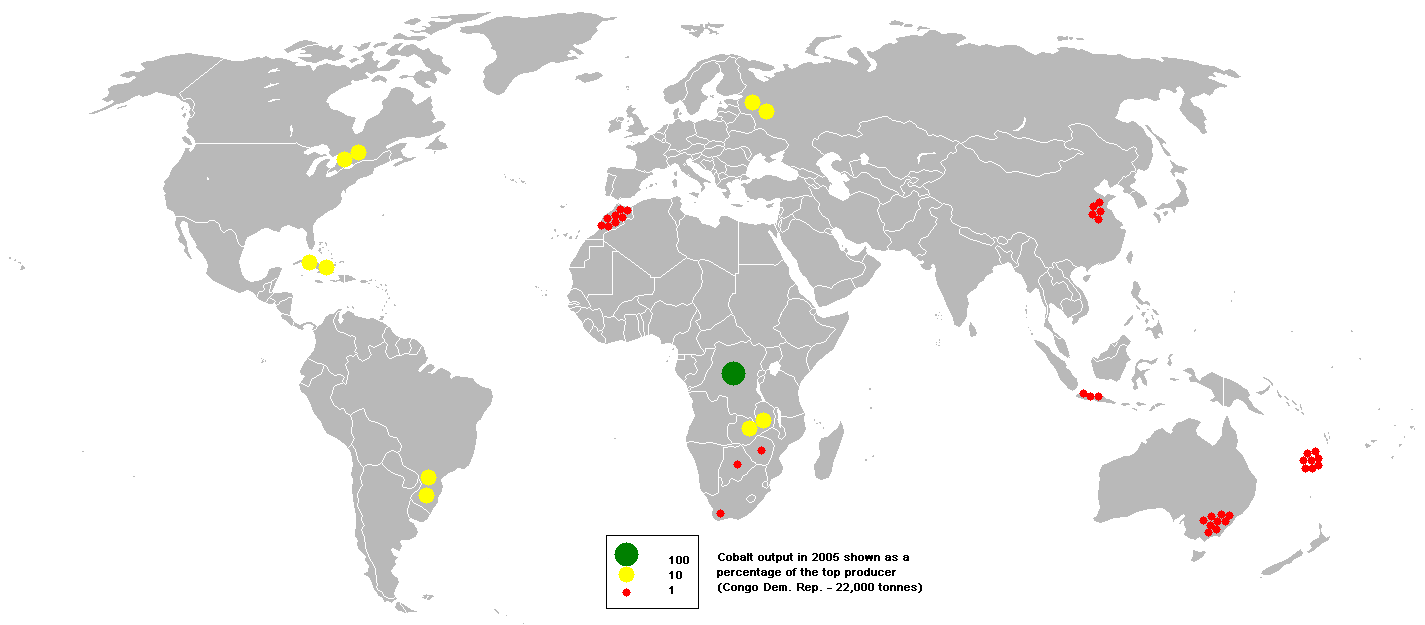
Actually no. While materials like Cobalt may be found in China they are fundamentally much more common and accessible in the Congo than elsewhere.


The greener the blob, the more there is.

Other important computational materials also have a limited range or have to be pulled from baser metals, like the Neodymium inside of hard-drives. And the other materials required are a massive and mundane undertaking, more so in refining these materials out or for use in high-tech equipment. And in post-apocalypse societies we're dealing with a world that should be more concerned internally on its own survival: you got to feed your people and defend them while managing the already limited array amount of resources already present.

just like guns many seemingly advanced technologies are relatively easy to produce with sufficient knowledge in less developed environments (though microchips are of course not them).


This is the point where I wonder if you read everything. Guns yes could be reproduced very easily without modern methods. Good parts from previous - if badly damaged - weapons could be re-purposed to make new weapons (as-in the practice of the as-so-mentioned Khyber Pass guns). But production of moving-part combustion engines from straight raw material would be a more difficult task.

Railguns and carbon-nanotubes are surprisingly among these. The latter was involved in the creation of Damascus Steel, for example.
Electromagnetic technology in general benefits from having few complex moving parts.


Uranium is one of those materials that like above need to be refined out of existing metals, namely a very specefic isotope of iron. And the metals needed for the magnets are intensely rare. you're not going to build one out of ceramic magnets. Even neodynium magnets aren't going to work. We're talking using Terbium and non-naturally occurring Dysprosi.

And the carbon nano-tubes present in Damascus Steel are not the same sort of carbon nano-tubes required for present high-tech. These structures are much smaller than the tubes already provided in "My Little NanoScience Starter Kits" you can get online. The sorts naturally occuring in bio-mass fires are much shorter to be used industrially in their relevant fields. You need lasers. Lasers need specialized miced-out optics, energy storage, and their own specialized mirrors.

Third, while this is a good excuse for low tech or shizo tech environment nothing really stops people from using something better. Aircraft and pre-war tech is all but endorsed by the OP also things are fine enough that global relations are becoming a thing again.


While in a writing world you can't stop someone from saying they can, it doesn't stop that in the actual setting that yes: there would be something stopping them. Namely the limitations in the resources to continue operating the machines or acquiring the non-native metals needed to produce them. And when you need to rebuild society there are other focuses that need to be played out first: you need to make sure the people and your army is fed. Its a lot harder to feed a population when you can't use mechanical tractors. You'll be putting more people out in the field with sickles and scythes than with a combine tractor. This requires far greater man-power in necessary labor so there'd be less available to practice science and engineering.

And even when the food is addressed it still needs to be distributed. You need people to also protect this populations. The levees, conscripts, or levees in an army aren't going to have time for research between drills or watching for and fending off raiders.

So when it gets broken down to a society that's not a century out of the shelters there's not a lot of people left behind to innovate new tech and the most economical option would be to keep what little is left operating running. But they'll get to a point where those can't be maintained anymore.

And who said the vault-dwellers just sit around and did nothing during this time. If they wanted to keep their lifestyle developing means to maintain their tech was one step they got to take.


There's a difference between knowing and having the means to make shit. When the production chain and facilities to make a Toyota are gone, then no amount of a mechanical engineering degree can save that. And when you have two (possibly three) generations living in a disconnected world reading text books and manuals on how to build a Toyota Camry they're not going to know how to deal with the Fordoyta Frankensteins that are rolling about.

Neither are they going to be able to handle everything else.

And in a world where we have nations to the size they are now it'd be appropriate to admit that not everyone went into a shelter. So there's a super-minority of academic individuals in a world that rebuilt itself to survival after the modern nation-state. And in a world where all nations disappeared as they did then the amount of nuclear war had to be beyond absolute. Life can survive that: but political institutions as we know them and everything else would not. They'd be a concept on paper but there'd be no way for any of that to actually be put to work beyond a constant recycling or pre-existing parts until they themselves died.

The main issue isn't know-how, it's the supply chain. And without the logistics network behind the know-how all that knowledge is useless. Generations after stepping out of the vault many might decide to forget their previous knowledge in favor of the more directly relevant skills on how to swap out a AK-74's firing mechanism onto the stock of a FAMAS. Or how to grow food again.

There's also the matter that seventy-years after the present day and after the bombs dropped no one would be making anything by hand anymore. So there'd be very few people with the personal experience of building much of anything which renders a lot of that moot. They might go into the vault knowing how to program how to manufacture an iPod into a 3d printer or model the cuts needed for a computer-operated milling machine to router out something, but the value of these machines die when no one knows how to use them, they were stripped and broken down for parts already, or the router bits are gone.

When you step into the world of rubbers and plastics, the supply-lines behind the modern world are broken down. Ultimately rubber seals will deteriorate, plastic will bake and harden until brittle, and metal tanks will rot out. The climate-conditioning for server plantations stop working and when the perfect environment for maintaining the circuits fail they too rot away and data is lost. And unless an empire maintains a rubber plantation in Sri Lanka or the frakking infrastructure (which is itself large and reliant on its own massive production chain) then rubber will not be produced for seals, hosing, or wire housing. The world would be at a level comparable to a more wood-and-metal era like the mid 19th century where leather seals and casings was all that's needed, and copper was the most effective medium of carrying an electrical current. Computers - if and when produced - would be the size of warehouses with the computational efficiency of a modern calculator but with no graphical read-outs.
@Byrd Man

Damn that's impressive.
“It is important to identify well the object of negation, for if it is not identified, you will unquestionably generate either a view of permanence or a view of annihilation.”

- The Lam-rim chen-mo

____________________

Tibet


Three men lay by the river-side, in only their clothes as the sound of the gently streaming water washed over the pebbles and stones in the river's bed. Nearby, two stout horses grazed from the scraggly grass that grew between the rocks as the waited, tied to the earth, for their masters to stir. The remnants of last night's campfire smoldered in a bed of ash, smokey tendrils rose through the cold morning air to be caught by their impermanence and swept up by the alpine winds.

Steely gray clouds loomed overhead, lit by the rising sun as it crested the Himalayan mountains. Basking in the golden and pink rays of a fledgling sun the darkness and the shadowy blues of night were gently brushed aside as the cycle of continuance marched on. The light glowed in the icy frost covering the rocks and the grass. As the light widened its rule from under and behind the thin rain clouds overhead so to did the three men stir in their sleep.

The first, feeling the warmth of the morning warm his cheek rose from the ground. A wind battered face looked up into the morning sky behind narrowed sleep designed eyes. A rudy head packed with a head of a messy black hair fell onto his shoulders packed with dry stalks of grass and motes of sand and dirt. Rising to his feet he brushed from his wool coat the dust and brambles of sleeping on naked ground and moved to the smoldering fire-pit. With gentle fingers he coaxed from the ashes the feeble infant flames of life and fed it with dry grassy timbers until a healthy smoldering burn was alight. And with the care of a young mother he opened a satchel at the ground alongside of it bricks of yak dung until the awoken fire was lapping and smoldering around the brick of shit.

As he cared for the fire, the second man stirred asleep, coaxed to wake by the bitter smell of the fire. Wiping the sleep from his eyes he turned to the fire and starred sleepily into it. He was an older man, the climate and the inhabitants of the world had not done well to his face or his body either. Nearly every conceivable point of his features were broken, cut, or worn to a hard leather. He glowered sleepily at the flame through pale brown eyes before sitting up right.

“It will be another several hours to Lhasa.” said the simply weathered man, “Should we warm tea now and eat, or wait until we are within site of the palace?”

His maimed contemporary held his silence to consider. A deeply tired air hovered heavily over him. He stood without talking for a long while. Perhaps he had not understood the question to early in the morning?

“Go ahead.” he bid sleepily, his voice tremored like the earth. And perhaps it would have if he shouted at mountains.

The other nodded, and rose from the fire to sift through the saddlebags that lay on the ground nearby. Made of the worn and beaten polyester of the yester-years before the war, the fabric and condition of the bags were that of something well beyond their original use. Large patches of wool or leather held the fraying the aging sacks together. Likewise, the kettle he pulled from them was not much better.

Walking towards the stream he stopped before the third man and looked down. He shown no pity towards him. A hood obscured his face and his hands and feet were bound by hide ropes. Already the flesh at his wrists and bare ankles were glowing a bloody red from abrasions. Likewise his calloused and scarred feet were beginning to open up from a long march across the plateau. The skin rubbed so thin in places it glowed pink as they threatened to tear open.

With a sharp kick from his boot the man woke the sleeping prisoner and he shot awake immediately with a dry gasping breath. Reeling on the ground his bound hands clutched for his stomach as he rolled. “Wake up.” the man ordered, “We're almost there.”

The captive was too windless to answer as he reeled in the dirt gasping for air. He had done more than simply wake him. But unconcerned the man turned away from him and kept to the river. The man was a bastard, and a criminal anyhow. There was no pittance to afford to him.

Crouching at the river's edge he opened the kettle and filled it with the crystal water that flowed from off of the mountain peeks. The glaciers would shine like diamonds and white-gold in the afternoon sun. And in the morning light they would glow like fire and gold. But they were not there, and as much as it would have been a sight to enjoy he could not dwell on the imaginary wants.

With the kettle full he capped it with a lid and turned back to the fire as their captive struggled to their feet. Sitting by the fire his partner was already fully awake as he pensively nibbled on the dry crumbs of wafer biscuits, no doubt more than stale.

He put the tea on the fire, and in silence joined his partner in breakfast. With the water inside finally came to a boil and whistled out from the neck he went to the packages again, bringing back a glove, a brick of tea, and cups. With steady hands he broke the brick of pressed tea and added the dried leaves to the cups that he split between he and his partner. Then poured for the both of them a full cup of piping, steaming tea. The leaves inside bubbled and stewed in the warm water, slowly turning it a soft amber color.

The morning sun rose up higher into the sky and the early morning chill dissipated. As the morning sun reached higher the frost of the earth warmed and soon bloomed with a white mist as the ground was steamed back to life.

“We should be on our way.” the older of the two hunters said. He drew a dry stare to the captive man that sat hunched in the rocks and the moss. His hands lay limp between two spindly legs.

The other nodded in agreement. “I'll prepare the horses.” he answered.

With a brisk wave, the rough-faced hunter brushed him off as he went to the horses. Whistling and singing softly he called for their attention as he collected their saddlebags and weapons. As the ponies were saddled the rougher individual stood up and walked to the prisoner sitting on the ground.

He was a sad shape of a man, worse off than most. His body was frail and his clothes hung off in broken rags. Even the mountain coat of yak hide was cut and frayed. Traces of blood were packed into the fur. And it was no wonder from the bandage around his arm.

“It's really amazing what you did,” he told him in a low voice, “To stir the hive as you did. Even if delayed, you really lit a fire.” the prisoner only wept quietly into his bound hands.

“Fucking pussy.” the old hunter spat, pulling him to his feet by the neck. Turning and pushing him to the horses he lead him towards the waiting mounts. Already his younger counterpart was waiting with a sword strapped across the back of his hip and a weather-beaten rifle hanging on his back. With a trained toss he passed to the elder his own gun and he swung it over his shoulders.

Taking hemp rope and leather bounds he tied the captive to his saddle before mounting. “Let's move.” he croaked. The younger obliged and kicked his horse to a slow trot. The other followed impatiently.

The hooves of the horses cracked and popped over the loose barren rocks as they trotted along. Every so often they would veer over the remnants of a broken and ancient asphalt road that wound through the landscape and the rocks, always with the river at its side. On either side the barren and gray hills of Tibet grew upwards, sliding them into the bottom of a soft valley between the bosoms of the Himalayas.

As they rode along and in the last breath of the languid still air of morning they heard the distant call of Lhasa over the hills. A low long note that echoed across the mountains peaks and through the valleys and gorges. It sang through the rocks, the grass, the sky, and the bushes. Even the river seemed to moan that long croaking song.

While it made the prisoner scarred, it was a cause of vigor to the riders. It was the sound of their end-goal and they kept riding.

Soon pillars of rocks began to line the road. Tied to the masts of these beacons yards of banners hung from hide and woolen ropes and fluttered in the cool Tibetan breeze. These prayer flags splashed bright colors across the sullen heights of Tibet. Exploding in a forest of red, yellow, oranges, blues, and greens. Lining the roads they even spanned into the distance and up the hills, so that even the grass and the rocks were lost amid a canopy of flowering color.

Continuing on further the outer sights of Lhasa became evident amid the forest of prayers. Shepards herding their goats and sheep among the hills. Observant pilgrims prostrating their way along the road, displaying their devotion every few steps as they bid the mountain spirits for their blessings. Or sought the outer light of enlightenment between their muttered chants. Few turned their heads up to the travelers as they trotted by, prisoner in tow. Fewer yet seemed to care. With cottage rifles on their shoulders, they were important men.

Finally the forest of prayers broke as the terrain suddenly opened up before them. A wide green valley shone in the late morning sun, dotted by still glistening lakes between fields and pastures of emerald greens, dotted and populated by the decay of an older world, graying buildings lining fading streets with twisting trees and herds of yak mulling between them. Where it was most open, farmers toiled in fields flush with the city's crop. And at the center of it all: the Potala Palace, a great monument of white, red, and wide-overhanging roofs and turrets. Within those walls the monastic power of Lhasa, and its secular political ruler shared tentative space within halls of yak-butter candles.

Justice, law, and interrogation would be served there as they rode to it. And so would reward. There was no greater greeting than to behold the great palace at the center of the city. Neither was the declaratory roar of its horns as the monks stirred about their morning rituals and called it out to the city from the high walls of the palace.
I have an idea of what I want to do alone, so it's not needed nor would it be really possible. I could always have news reach me, but it'd be rumors and it wouldn't be for a long time after-the-fact. Later I'll be projecting myself: but not now.
<Snipped quote by Dinh AaronMk>

I agree here. The only reason I'm questioning the tech level is wondering how advanced these suits got in 200 years since they were apparently designed in the bunkers. Also questioning because I want to draw a line between infantry armor and what be defined as a 'Power Suit'. Probably going to remove Power Suits from what the Empire produces since I don't really have reason for their existence.

I do wonder why any bunker would create Power Suits in the first place since they had no idea what was above. Sure, they probably were preparing for the worst but they could have done that easier with the production of weapons or stockpile having been prepared before the end of the War.


If the purpose though of these bunkers were to preserve populations than there'd be little point in functioning high-tech military-grade equipment. A simple biohazard suit like those we use today would be more than enough for exploratory purposes.


I would also be apprehensive to even suggest that these Bunkers be the mad experiments of a company like they were in Fallout. But the pervasive distribution of them would probably mean that no one group dug and built them, so that rules it out (the Vaults of Fallout were a top-secret government and corporate experiment for only America). But even then though, most of the people in the Fallout wasteland aren't or weren't descended from Vault residents either actually.

It's also plausible some nations developed power armors after they surfaced.


I'm going to openly and dickishly contest the possibility of this statement.

The sort of infrastructure needed for a society to produce new technology to the sort we're expecting is beyond the scope of our current non-states. Modern technology already is an international initiative demanding a diverse range of resources not always found evenly spread across the world (computing and the materials in computer chips for instance are largely only found in central Africa). Without this massive international infrastructure anymore I can't see anyone innovating into new areas of research or even accurately continuing post-war initiatives without using already dying devices (how is anyone supposed to ever produce a new CPU for a computer even when one inevitably fails, provided it hasn't been totally fried with an EMP blast which nuclear weapons put out? There's probably a very finite pool of resources for anyone to draw from to keep surviving technology alive).

There'd also be the population of appropriately educated individuals who would know enough about a thing to do that thing even if the resources were present. But since we're also talking about stuff on a broader scale than a decked-out Kalashnikov there'd also need to be a very large communications network that doesn't move at the speed of a potato nailed to the floor (remember that statement about modern tech being an international initiative?)

So really, if we're discussing stuff like power-suits or even airplanes (I feel) there's a limit that needs to be known beyond it being simply a game thing to keep stuff nerfed so no one can nerf someone else.

It's not to say that there wouldn't be groups without access to that, but since it's been a century or more since annihilation that's a lot of years of general wear on these things that would reduce their effectiveness or quality, if there's anything left. The number of people knowledgeable enough to use this equipment would be scant at best. So on that, these groups I feel would be something on the last legs of that tech, even at the last rolls of duct-tape so use of these resources would need to be incredibly measured; even in a defensive situation.

A charm of the apocalypse genre is often in just that: apocalyptic. Nothing works for its intended purpose or is run down. Or the quality is shoddy. Humanity is trying to leach of the remains of what was without any appropriate knowledge of what it was. A lot of people might figure out the simple things like smithing guns. And I say that because home-made guns are a pretty major cottage industry in the third-world: see the Khyber Pass guns.
@MetalLover

I wish to know one thing before I get to work on finishing my post, how advanced are we talking when it comes to Power Suits. Are they the clunky Fallout kind or are they more slim and maneuverable?


You know, this is one of the things where I feel I should throw something cautionary out and suggest: why?

The RP may be Fallout-like but there should be an effort to not let it be directly Fallout derivative, or it's rather stale. Likewise trying for all the hot tech possible makes the everything stale. Either it be rail-guns, power-shoots, or dank disco laser beams. There's a lot of cost associated with maintaining these and can ten either really small territories or sparsely populated regions (more so than before) cope with keeping this sort of thing around?

When governments also have to worry about food distribution I think the last thing on their minds would be appropriating dried-out fuel cells for Iron Man suits (let-alone currently experimental Exo-Suits) or acquiring the active, refined uranium needed to operate and power a rail-gun.

It's something that I realized was bugging me with the last Japan post. Never mind seemingly doubling his territory in a day or a week given the post on how time is progressing.
Fair enough, gives me time to work on PoW and other writings. I also still need to surf for inexpensive artists to get anniversary art commissions.
© 2007-2026
BBCode Cheatsheet