Avatar of Dinh AaronMk

Status

Recent Statuses

1 yr ago
Current As an American [user could not afford rest of post]
6 likes
3 yrs ago
Never spaghetti; Boston strong
3 yrs ago
The last post below me is a lie
1 like
3 yrs ago
THE SACRIFICE IS COMPLETE. THE BOILERMEN HAVE FRESH SOULS. THEY CAN DO SHIFT CHANGES.
2 likes
3 yrs ago
Was that supposed to be an anime reference

Bio

Harry Potter is not a world view, read another book or I will piss on the moon with my super laser piss.

Most Recent Posts

<Snipped quote by Shyri>

Also, how did German West Afrika become a duchy? Was it ennobled by the Kaiser, or is a unilateral thing? Is Feo's version of Germany creating new duchies at such a late hour? That's something you'll need to confer with to him.

The thing I noticed at the end too is you kinda bowl over the natives. Remember that Kamerun is going to be a majority native nation and native cultural traditions will still be strong. Don't RP Kamerun like it's a white European nation because that won't be realistic. You can do full white rule of course, but it might look a but apartheidy like Wyrm's Rhodesia.

Also also, why did the Germans occupy Spanish Guinea? That seems random. That would have risked bringing Spain into the Great War, which the Kaiser wouldn't of appreciated. It might look weird on the map, but really unless Feo is okay with Germany going to war with Spain I think Spanish Guinea should still be Spanish.


Enforcing a sort of Germanification of a population wouldn't sit well since it would symbolize cultural genocide to some, or threaten local culture and religion. It would encourage reprisal from the vast native population, which itself would for the sake of the regime's safety demand some sort of reprisal on their part or pulling back on their cultural conversions.

The rule of a white government too wouldn't be how it can enforce the Germanic language or arts in this case, but how it might also pay patronage to local ethnic groups to extend its reach in exchange for cultural protection from the cultural conversion, itself then intensifying local tribal or cultural rivalries or relationships.
China

Guangxi

Unmarked Location


A small packed room, smelling of cigarette smoke and fresh tea. Around a centrally placed table men in black coats were taking their seat. A meeting of field agents, the map of Vietnam hanging on the wall nearby spoke of the subject of the field officer's internal briefing. As the last man filed through the door, it was closed. The murmuring and wayward conversation hung for a moment longer as seats were taken, and a few chairs short several agents took position along the walls, propping files on clipboards against raised on the table in front of them.

“Comrades, I hope you've all had a good lunch.” a figure said at the head of the room. He was a burly man with a hunched back that made him look like a turtle. Old scars around his face made him appear as if he was scowling, though he smiled politely. His eyes were faded and shallow set, but his voice sharp and strong, “We all know the agenda today. Do we have any new information we would like to discuss. Bao Arban, Huang Du: you went to see our mutual friend, what's his position? Let's start there.”

“Nguyen Sinh Cung is apprehensive.” Bao Arban said, the Mongolian and agent who had identified himself as Two. “He holds the belief that any Chinese action in Vietnam would be perceived as being an imperialist project. He's pessimistic about intent and discussed if this would be another thousand years of Chinese rule.”

“And what did you say?” the commanding agent inquired.

“That rule in Vietnam would be Vietnamese. He served us lunch and we tried to convince him that we would be a stabilizing force. But that on the whole his people would be on the Vanguard. I don't think he bought it.”

“But is he receptive?”

“I assume so, but he's with holding his commitment.”

“Huang Du,” the commander turned, “What is your impression on the man?”

“He's a damn good cook and writes OK-poetry.” Huang Du remarked dispassionately, “I'm sure if we had the chance he could have served us a fine three-course meal. Puts the food here to shame.” there were rounds of laughter from the other agents.

“But I have to concur with my partner. Nguyen Sinh Cung doesn't seem to be very willing to go through to Vietnam with the thought of Chinese backing. But if I were to make a suggestion as to how or if we can then I would recommend letting him meet with Congress itself or Politburo. The man has respect for Hou, that much we learned over lunch. If we get the two to speak he may be convinced or at the very least made less stubborn to agree to terms with organizing Vietnamese battalions with Chinese support to end the civil war.”

“Understood.” the commander said, “As it turns out the Dragon wants a full report on this for the next Politburo session. I will include your suggestions for consideration.”

Huang Du smiled and bowed his head, “Thank you.”

“Before anything though I would like to make aware some important developments in Vietnam.” another agent said, “Pertaining to the possible identity of our supposed Trung.”

The commander lifted his head and nodded, bidding him to continue. The agent, stepping forward from the wall began, “Just these past couple of days our new played to the Vietnamese struggle as announced informally his identity.”

“His? Haven't we heard Trung referred to 'lady'?” another agent at the table asked.

“That may be the case but I find it hard to believe given whose flags we seen rising over Hanoi and the cities under Trung's control.” the standing agent said, walking towards the map he began fingering through the papers he held in hand. Making it up to the map he reached for a thumb tack and tacked to the northern portion of Vietnam an orange slip of paper with crudely drawn red stars arranged in a hexagon roughly around the center. “This is the best I've been able to replicate from what I've heard. Does this look at all familiar.”

“That's Phan Bội Châu's!” the commander exclaimed.

“So it is. I didn't recognize it at first so I needed it researched. But I was able to confirm it's the flag he used when he lead an army into Vietnam with remnants of the Kuomintang as the French state was collapsing.”

“His Vietnamese Restoration League was soundly beaten though, it couldn't be him.” one of the agents at the table pointed out, “I remember that. And he was killed in action too as the story goes. Are you going to suggest that was a story?”

“I doubt it.” said the agent by the map, “He's still very likely dead. If he hadn't died he'd be close to a hundred years old by now, assuredly he would have passed away if he hadn't been slain.

“No, what I think is going on is someone is trying to revive his legacy. All the symbolism points to a revival of his Republican legacy in northern Vietnam.”

“He was hardly popular to begin with.” opined the commander.

“If that's the case then shouldn't Trung's revivalist movement melt away?” Huang Du asked, cutting into the conversation.

“It may as well, or find only significant support in the north.” the map-side agent said, “The south has largely only ever been a monarchist's territory. Looking back through his movement he's only ever found real sympathy in the north. In the course of the conflict then in Vietnam, I would to give a tactical assessment that French backed reactionaries will continue to have a strong showing in the south, or local-reactionary backed French will continue to do so. Whoever would sooner deliver Confucian authority.”

“So we have a roughly ideology attached to the name?” an agent taking notes asked.

“It would appear so.”

“But what is Trung's relationship to the Vietnamese Restoration League?” Arban asked.

“If anyone can answer that question, then I am more than willing to hear it.” the map-side agent announced. The room was silent, confirm suspicions. Nodding he continued, “The best I can do is run on assumptions and hypothesis. Right now we have the return of the League flag so we can only guess it's a revival of the movement. Whether it's someone close to Phan Boi Chau or simply a follower bringing it back more than a decade later we can't know for certain until we see this leader, hear what this leader has to say, or find and capture someone close by. We will also not know who is backing them until we capture goods and supplies moving into northern Vietnam that might give indication on who is encouraging operations.”

“It sounds the next assessment you'll give is that we need to find and intercept supplies moving into the country.” the note-taking agent said.

Map-side nodded, “That's right. That'll help at least find out where the material for war is coming from and at the least destabilize the military operations in the north by encouraging a brief material shortage.”

“I hear there's a problem with pirates from out of northern Borneo or somewhere. Think we can get approval from the navy to use some ships?”

The heads in the room turned to the commander. He hung his head low thinking and shrugged. “I'll see what I can get done, boys. I'll put a request up and see what comes down.”

The shuffling and murmuring of the men confirmed their understanding and they moved on. “So what it sounds like is we have a conservative Republican movement in northern Vietnam then?” someone asked, “How does someone start a movement like this.”

“Typically they're known and accredited as someone who passed their imperial examinations. But with two emperors and French control in the nation there could easily be confusion on who is certified as being an accredited Confucian scholar. But that's how Pho had his credentials, the old Kuomintang dossier says as much.” map-side said.

“So assuming it's someone who was close to Pho, or who was in the original movement they are at the least adept Confucians?”

“Asking that now, I believe so.”

“I see, thank you.”


Hellenic Socialist Republic


As Vilage said, putting off until input by Chapa comes through. We wait for the Irish bastard.

<Snipped quote by Vilageidiotx>

I may end up going with another country, in that case. I completely understand the logic behind that, but the idea of the King-in-Exile and the massive changes in the Canadian government and society that would be brought over with him and the other exiles were somewhat central to the idea.

However, if necessary I can do something similar to what I had planned (minus the Royals) in a post-Commonwealth Republic of Australasia. The main obstacle standing in my way is my utter lack of knowledge about Australia and New Zealand beyond the little bit of research I've done on the area recently. Still, it could be fun- just a bit challenging for me personally.

Just let me know. I'm alright with doing either, I'm just a little partial towards Canada under a pseudo-Social Credit government. I can work with people here if you guys have an idea of what you think a British Republic could look like in this universe, or have any ideas to make it a bit more open for a future player.


As Vilage said, if you're going to need to perform broad, sweeping changes to someone else then it's going to be an issue. And last time something like this happened to Canada in the last RP things got awkward so I'm naturally hesitant on turning Canada into something that sounds like it might evolve into a proto-fascist state, under its known proto-fascist king.

If that's the case then I would say to sign up as Britain itself and we'll just hand the Commonwealth nations to you in a sort of relationship as Poland is to Germany. Effectively autonomous and independent, but in service to the Crown. And as such someone else could play as them, but they'd be in service to you. That's how I've thought of the Empire at least.
China

Nanning


Nanning was a city of small stone homes, squat and quaint that pressed against cobble stone and paved streets. Along with the clops of horses' hooves there were the low hums of trucks and cars passing down the old wide streets. Here and there above the blue and red-tiled roofs steel girded water towers flew over the cityscape in accompaniment by higher office buildings and state structures. Even further beyond smoke stakes of small outlying factories rose solo or in scattered pairs silently puffing up white plumes of smoke or steam from outlying mills and refineries.

But pushed to outside the city, the slag and smoke of the industry was far separated from the inner city, which glowed flush and green with tropical palms and orchids in the mild spring afternoon. Along the river barges carried raw material from inland to be unloaded onto trains for delivery to the city factories. And besides them the primitive river barges and junks of up and down stream villages brought in the day's harvest and livestock from up and down the Yongjiang.

“It's quiet the place you have for yourself.” the Bureau agent complimented as he stepped out onto a small veranda overlooking the river. Below a small river-side park stretched where already a few afternoon breakers were sitting with their lunches in the shade of pagoda style gazebos and large bushes.

“I got tired of Nanjing.” a thin wiry old man said in a frail voice. He laconically tapped against his wrist a fresh pack of unmarked cigarettes as he starred across the room to the agent leaning out his window enjoying the view. Across from the elder another black-coated agent reclined in a chair.

The apartment was small, but appeared large in the austere and plain decoration it was presented in. Its owner taking little or no affinity in an abundance of possessions it carried the distinction of feeling like the quarters of a village sage, where he might sit eating plain rice and carrying on his zen meditation. What little decorations that existed that might be called that were hung distantly apart to give the aura of being much, and hung openly to show what pride their owner held in them. On one wall alongside a three-drawer dressed hung a military uniform from the revolution, plain green with rolled back sleeves, the collar trimmed with red stitching and a crinkled orange star sewn onto the shoulder sleeve, deep pockets decorated the chest and sides just under where the elbows would rest, and on a peg next to it a fur cap. On another wall over a washbasin and wooden counter hung a small Vietnamese flag no longer than a foot and a half. It hung next to an equally small Chinese flag.

Few other decorations anointed the walls. Here and there hung photographs of old friends and glories, but behind their glass panes the age in the photographs was beginning to show and the folds in the paper were growing sharper even when pressed flat.

“Have you eaten yet today? I haven't, perhaps I should get up and cook you something. Perhaps I can make some dumplings!” the seated agent said with a half-hidden, knowing smile.

“Ah! Ah!” the old man bellowed, standing to his feet, “You will not! I have never known a Chinese soldier to cook anything. Particularly anything good. If you want to eat, I shall cook!” the old man said breaking into a brisk stride towards the wash basin. There along with it and the flags was a small cast-iron stove and pulling open the cigarette pack he produced a single white cigarette and clenched it between his teeth. “I will show you how a master goes about it.”

The agent laughed. At the window the other piped in, “You don't need to worry about me, I already ate.”

“Well that's good to hear.” the old man said, with a cigarette dangling from his mouth, “But perhaps I can interest you in a light. But for the stove and me.”

“Sure thing.” he said, fishing into his pockets for a matchbook as he crossed over toward him. The older man opened the door of the oven and tossed in a few loose shreds of newspaper and kindling sticks as a match was struck and thrown in after, as the second match was being struck for the cigarette the fire in the stove was beginning to crackle.

Taking a long draw on the freshly lit cigarette the old man sighed, low and crackling. “You know, ever since the Revolution finished in China I had to mostly cut back on smoking. I can not get any American cigarettes in this country, and yours are terrible.”

“We realize that.” the agent said, “It's why most of us don't smoke unless there's alcohol involved.” the old man scoffed, rolling his eyes but puffed contentedly away.

“I will say, cutting back does make waking up easier.” he chirped. “But you two didn't stop in to have a casual conversation. You sort never see anyone for casual business. What do you want from me?”

“Nguyen Sinh Cung, we want you for Vietnam.” the seated proclaimed in a declaratory tone of voice. He turned to look at him and gave a wide smile. “Aren't you happy?” it seemed to suggest.

But Nguyen merely rolled his eyes and sighed, holding the cigarette between his hands and making wide sweeping gestures. His eyes dropped to the floor. “And here I thought I would have given up on that.” he said.

Nguyen Sinh Cung was short, shorter than the agents and thinning. His dark skin spotty with blemishes and bony face made him out to be a frailer Hou with thinning hair, his bear was white and black twisted strands of hair and a short mustache completed the ensemble. But while old the compassion in his eyes had not dulled and he looked at the two agents with a weary expression of loss, “Why do you come to taunt me about this. I bid my time until the ghosts of the Revolution could be laid to rest. I've asked politely, I and my comrades to go home and restore our nation. And just now, years later you're asking me if I'm ready?”

“We are sorry.” the agent standing with him said.

“I'm sorry comrades, but I don't want your explanations.” Nyugen sighed.

“Do you have a moment at least to entertain us with your knowledge of people?” the man seated asked.

“Excuse me, but what's your name?” Nyugen asked, “I don't feel comfortable without having something to call you two by. I understand you don't like names.”

“You can call me One.” the agent standing said.

“I suppose I'll be Two.” the one seated said, resigned.

“Very well. One, Two... What is it?”

“We've been following the political situation in your home country for some time.” Agent One said, “We know the Emperor and the Mandarin but a new player has come up in the fight. We've heard the name Trung but we don't have any details. We were hoping you might recognize it as someone from the old Civil Service.”

Nguyen shook his head, and checked the stove. He went without answering for some time as he slid in a few logs and stoked the embers into a softly crackling fire. Afterwards as he filled a basin of water: “The name doesn't sound familiar. I can tell you it means middle, so my best guess is someone trying to be a middle ground between the two groups.”

“We thought so too, but analysis of the two parties suggests there wouldn't really be enough middle ground to make sense. But we still don't know enough about this individual's ideology let alone real identity to make a fix.”

“Was that all then? Just that question? I'll hardly be done making supper for two let alone three on that.” Nyugen complained as he dug out a sack of flour from a cupboard under the counter. He walked around the stove to a pantry from where he started to pull various vegetables.

“Not entirely,” Agent Two said, “Our orders after the collapse of the French state to revolution left us without reason to ever enter Vietnam, as you remember. Since then we've been more or less watching the country for the better part of the decade. These orders still stand, but as the climate in Indochina changes and we have reason to suspect a new party has gotten involved we're ready to re-evaluate this stance on the off-chance an outside power is making a power-play into the region. On the belief the original operations was to watch for any resurgent French activity beyond the plantation owners then we're in the belief that this might include anyone else.”

“Do you know who?” Nguyen asked, whetting the flour into a dough.

“We have a short-list, but no confirmation. Japan, Netherlands, the British through Singapore. Hell perhaps it actually is the French trying to subtly drift the country back to them or even Australia.”

“So it's a short-list of whoever and anyone.” Nguyen paused, looking up at them.

Agent Two shrugged, “We try our best, but that's only with actual information. We're trying.”

“So the silk strings with the sharp knives are at their wit's end!” Nyugen joked.

“These silk strings are much longer than that.” Agent One remarked as he walked back to the window.

“The main point of our visit is to probe for the possibility of political interest among the population of the Vietnamese veteran community in support to be the Vanguard in a Chinese supported restoration of order to Vietnam.”

“That is quiet the proposal, and I am honestly stunned.” Nguyen remarked, “But understand, gentlemen: while China has been generous in letting me and my people live here I do not think it washes away the debt of guilt it owes my people.”

The two agents starred at him baffled. Turning to the vegetables he began chopping them and continued, “The time I had to think about the issue the more I had to wonder how it might need to be done to avoid a second thousand years of colonization by China.” he went on, “And I concluded that even if you recreate the Vietnamese government in a free way would bring them back into Vietnam. And once you and your people are ascendant in Indochina how long will they remain as such.

“Hou said all men are family, as all in Asia are like cousins, and all in China are like brothers and sisters. And I have all respect for this statement. And I would very much like to see a Vietnam that is to China as a cousin is for his or her own. But think about it from the perspective of my people, my nation: is getting involved a saving of the family, or a sewing the hand onto a new body?”

The agents gave it a second of thought. “I depends on what you have to say about it.” Agent One said from the window.

“That is the problem, you haven't made commitment to the political thought on this issue.” Nyugen remarked.

“And while we cycle through questions of politics, comrade two pretenders at least square off for rule of the nation, a potential foreign third on its way if not there already. While in the south foreign domination enslaves your people.” Agent Two pointedly observed, “In the environment Vietnam exists in the country may well be sewn onto a whole new body and who says it won't be a thousand more years on them.

“We are today not a land of Emperors seeking new tracts of territory to enrich a private purse. China is the future, the new future.”

“And Vietnam will have that future, but I doubt China will need to have a presence in that.” Nyugen said, pausing to speak to the agents. When he finished he turned back to the food and went about kneading the dough for the dumplings.

“Someone will need to be there to set it on that road. By inviting you to be the Vanguard our intention was not to say you make a public face at the head of a Chinese army. We are very willing to go to Congress to suggest appropriations for arming an expat brigade of Vietnamese, composed of the men who survived the Revolution and are willing to go home and to provide all the guns and ammunition you might need. A Chinese boot need not ever touch the ground.”

“At least not in the public eye.” Agent Two chimed in.

“Suppose what you say is true, but I expect you'll want contr-”

“We do not want control. We do not imagine Hou will want to have control. Between us it's not throw a barrier between the reactionary outside and to prevent the infiltration of Asia by outsiders. If your government is so much willing as to do this, then the opinions of us two agents on the matter is fine and well. Beyond here are the choices of politics and given tacit approval we can begin moving more of our silk strings.”

There was a long thinking silence during which only the street sounds drifted up through the windows. The cars, the carts, the footsteps and the talking. The barges on the river and the horns and bells of city life. At the counter Nyugen rolled his vegetable dumplings and placed a pot of water on the stove where it gradually warmed.

“I've been writing poetry again.” he said conversationally.

“That's nice.” Agent One said. But the direct way he said it told Nyugen that it was not poetry he wanted to hear.

“I'll need to think about it. You've given me much to think about.”

“At least reach out, ask some of the others in the country and build up an opinion. Come back to us. Eventually we'll need to report back to Beijing on the conditions in Vietnam. Especially if we figure out who Trung is.”

“We'll tell you first.” Agent Two said.

“That's good.” Nyugen said softly, turning to them he asked invitingly, “Will you stay for lunch at least. You got me making dumplings and it'd be a shame to waste everything. It's vegetarian, I'm sorry. But I don't feel confident keeping meat at this time of year.”

Agent One stifled a laugh as the thought came to mind the plan might perhaps hinge on an icebox. But it felt too easy, too little. “We might as well.” Agent Two said.

“Good, I can tell you about my poetry then.” Nyugen smiled happily.

Chinese-Khazak Border


The sound of the motorcycle engine cut the still night air as they pull up just several miles from the border. Atop a rocky rise in the middle of nowhere the two young men stood with hats pulled down over their ears and collars pulled tight around their neck. The air was bitter cold, the sky was clear, and the not-so-distant border lay somewhere beyond the blackness of the night. Shuffling around the bike, Guo was the first to speak, “So, here we go: on and away?”

Chao nodded, though it was doubtful he would have seen it. “You think there will be anyone patrolling it?” Guo asked.

Both were understandably nervous. The excitement they felt as they looked out into the night in the general direction of where China stopped wasn't the same sort of giddiness both men felt when they decided to leave home to travel China on a road trip. This was in fact a more terrifying prospect to leave their home. Now all sorts of second thoughts were manifesting themselves, like could they ever come back home if they left? If anyone found out they had left the country would they be derided on their return? Would they get punished? How would the Khazaks treat them? What about any country after?

If they needed paperwork they had none on them. No identification to prove who they were and where they had come from. If they died out there would anyone be able to send their remains home? Were they dead already? The thoughts ran shivers down Chao's back. Guo was understandably nervous and afraid as well. At any point along this vague road they were on they could end up lost and anywhere but some dingy corner of Africa. They might find themselves in Europe, at the opposite end of some king's rifles for being Red Chinese, or associated with China. Or that is what he assumed would be the case.

The two young men looked uncertainly out into the dark night towards Kazakhstan. With a tough kick of his boot into the hard rocky earth Guo grunted: “Alright, if we're doing this let's go.”

“Let me drive.” Chao demanded before he could get to the bike.

“How so?” Guo asked.

“You've been driving it the most the last couple of days, to and from and about work. You got us here. Take a break and I'll get us across the border.” explained Chao.

But Guo laughed, “Nuh-uh, you just want to brag you crossed the border!”

Chao rolled his eyes, “Is that what you're going to make it about?”

“Fuck yeah. It's easy to see that. The two of us haven't been awake for more than two hours so why should I take a break. If anything, I'll cross the border. I'm taking the bragging rights for when we come back.” he decreed, with a confident click from his tongue against his teeth.

“Are you sure, you're not going to chicken out?”

“Hell no.” Guo said.

“Fine, but I'm driving across the next border.”

“You better hope it isn't into Russia then.”

Chao rolled his eyes, and together the two got into the bike. Guo into the driver's seat and Chao in the side-car. The bike's engine puttered and roared back to life and with the soft incandescent glow of the lamp light they began to roll down the hill, the tires bouncing off of loose rocks and stone. With the popping of loose pebbles mixing with the rumble of the motor they made their way to the dark border, a missile propelled by determination, but stupid goals, and blind to the world ahead of them.

As the bike rolled and bounced over the hard off-road terrain, making a slow course ahead Chao had time to think as he scanned the near-distance ahead of them where the headlight illuminated the packed desert earth. He wondered what they would find in the lands beyond China. More importantly, how he – they – might be expected to communicate. Neither of them knew any other language but Chinese. Chao had picked up some Arabic by traveling among the Hui, but would this get them anywhere? As he understood it, much of the world between here and Ethiopia would speak at least some Arabic.

But how was a Chinese man such as himself supposed to get through? What if the bike broke? What if they lost supplies: food, water, money. Could they negotiate for assistance? And what about for work? It wracked his nerves into a warped terror and he felt his heart palpitate and tighten in his breast at each passing turn of the tires towards the border.

If there was a point where one was falling into the precipice, feet detaching the solidarity of the earth and the back turning to show the man the safety he was leaving it was this moment. But it was a moment that dragged on for some time. Crossing the high central Asian steppe felt like an eternity, more when expecting to cross an invisible boundary. Neither of them noticed it when they crossed the border, and left China.

They kept driving, the sounds of the small motor engine popping and rumbling away into the night and leaving behind the Middle Kingdom. They were well outside the Chinese grasp, and were driving blind into the embrace of a new power. By this point they would continue to trade hands and houses until Mogadishu. But if these hands and houses would be closed, invisible, or open to them was for them to learn as they went on into the Kazakh night.

But the stars above, they were wondrous. Hours passed, and Chao turned his head skyward to watch. He thought they had to be in Kazakhstan now. And that thought dispelled the fear at the moment of full fall. There was no answer to how far they could keep going, if they would hit rocks or water or if traveling beyond here was to set a course through an infinite abyss. Perhaps it would be like falling through the Earth, to dive in through one end and pop out the other, then back through until he wanted to stop. He still felt fear, terror at the world around him. But turning up to look at the stars and seeing they were the same here as in China that there would be some consistency to the trip. One same thing to cling to where ever in the world he might be.

The Dragon Diaries


Li Chao

June 5th, 1960. The year of the metal rat

We've done it. Or so we hope. More than a few weeks of work at the vineyards and on the fields. They thought we were just migrants traveling around and they believed we'd be staying all season. We told them unfortunately we wouldn't and we'd be moving out, we after all just needed supplies for the road and were willing to work for it.

We hung on a little longer than we expected but we worked as hard as any. The men are are a good sort, simple and humble. But it isn't uncommon for many of the farm folk. It puts things into perspective sometimes. Here in the country the notions of politics are distant, more so now that I imagine they are not worrying about some robber baron or landlord's demands. The land is their own, and they work it as they need. Occasionally as it turns out some official may stop by and make demands and requests for certain amounts of something. But we were only temporary hands so it wasn't our position to ask questions. We just dug the trenches and repaired the irrigation.

The air here can get dry and hot. At high noon we all retire into the shade. The older men stand and watch the black water pipes with stern expressions under their wide leather hats as we avoid the heat, twirling their long beards. They may be farming but I get the impression there's still a little mongol left in these people. There's a look in their eyes as I can tell – as I can hope to see – that looks out on the horizon and wants to go to whatever distant point they see. But they stay put and work their fields. Then at night they sing their songs, drink their tea and their milk.

For a while we thought we had to sleep outdoors. It would be nothing hard, we have sleeping bags rolled up after all. But a few farmers let us into their homes and gave us a guest bed with the dogs or goats to keep us warm for the night. We took it happily, it's impolite to refuse a gift. And if the alternative is sleeping on sandy rocks then it sure beats that.

But in the end the final word on where the border is best crossed came in. Apparently one of the men community sometimes doubles as a smuggler of sorts. Or at least crosses the border often on his own. The guards he said would let him through but the paperwork is too much hassle to trade goats and camels with the folk on the other side so he always went around. According to him there's a point out in the open some ten to fifteen miles south of the main checkpoint that one can cross. The military tries to patrol as much as they can, but in the desert and at night they use the headlights on their cars so they can be seen miles off. So long as everything remains dark no one is around. If you're coming into the country though he says they'll see the tracks and that's when they'll chase you. But going out they have no choice but to let you through.

He can't speak much for the country of Kazakhstan though. He claims to only travel as far west as Urzhar to exchange livestock. But the country used to be Russian decades ago and warns that it perhaps might be a little like the rest of the old Empire. He advises we travel to Almaty, the capital to the south. But at any time before to try and find a way to swap out our Chinese license plate or lose it. It would be suspicious he believes to be seen with that anywhere outside of China.

He thinks at the least we'll find a train we can take to anywhere south and be on our ways. Guo and I agree: we can only hope on this.


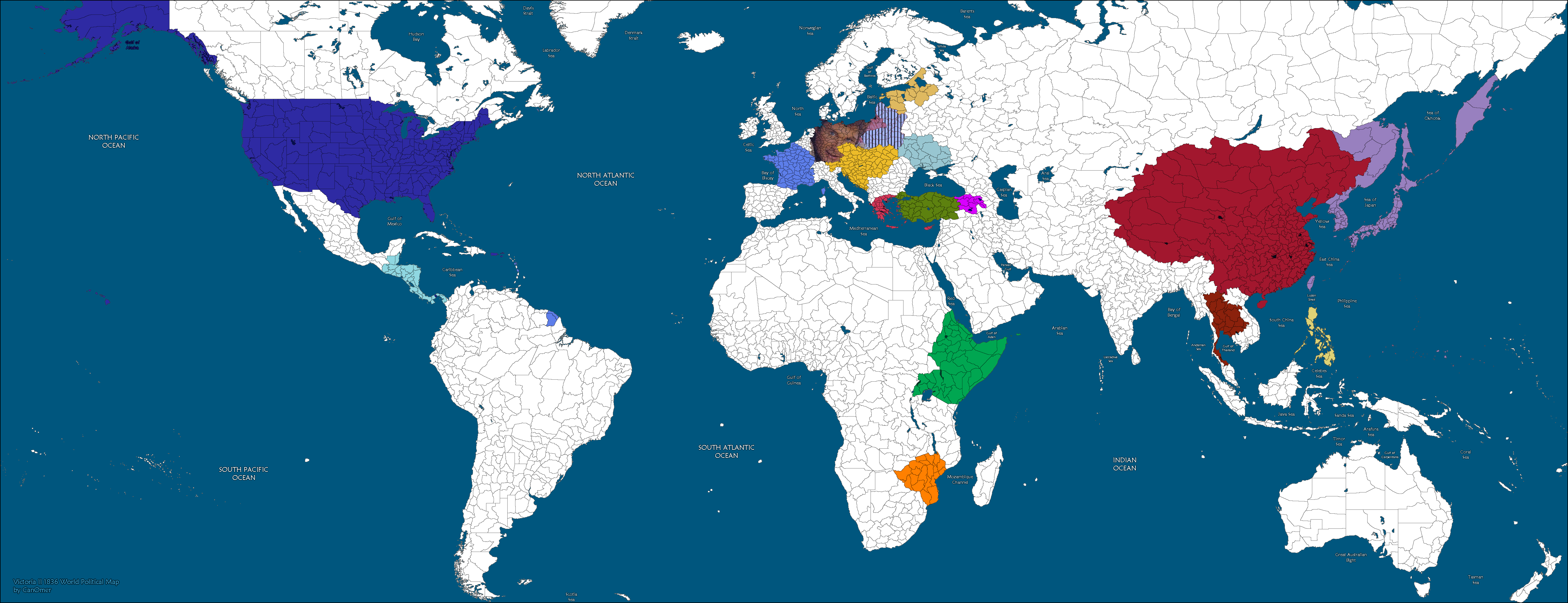
Looks like you fixed the dates. So I'll need to fix the map.
While a communist Thailand would certainly be more historically probable, something is just awesome about a tyrannical Kingdom of Siam expanding its imperialist influence all throughout Indochina and getting into border disputes with China and Burma. The thing is, a communist Thailand would probably be China's bitch proxy state, and that's boring.


Depends on how you define boring. If you can find the opportunities like Byrd does and can then you don't really need war.
China

Beijing


It would be understandable to visit Beijing and not pass the Central Military Committee's central command in the commute. By effort it was tucked outside of view. Easily considered outside of Beijing proper in the rugged hills north-west of Beijing. Here on the forested bluffs, with the odd farm field distantly visible in the faint blue haze beyond competing ridges, visible only from the top-most floors an unremarkable brutal building stood as a haunting axis by which many of the nation's military concerns turned.

Shaped like a bone, the offices occupied a long central paved space inter-spaced with islands of grass and trees as further on the rim barracks and outer service structures hid within dense cedar stands, erect and tall like spears driven into the earth. Even more distantly the sounds of military drilling was muted by soft bird song as rifle fire popped in the still forest air.

Within his office, Lou Shan Yuang turned with a steely look out the window in time to catch the gleam of a black sedan passing through the trees, the spring-time sun glinting off the black gloss. He stood with his arms crossed behind his back, and took a deep breath. He was uncompassionately cold, as he was towards many political affairs. To have to speak directly to a foreign agent he believed below his time, and he wished that he could easily pass it off on his Political Affairs sub-commander and be done with it. The conduct and decision making towards war, as it applied to convincing congress was his job, not Shan Yuang's. But with a weighty grumble at the back of his throat the car pulling up there had much to do with the confirmation to his circumstance.

He stepped away from the window and scanned his office. Three other officers were present with him, obliged to acting relaxed in the presence of their superior. As he turned to look over them they felt his gaze and looked up questioningly for their orders to come. “Do we have the materials for note-taking?” the commander asked.

“I can only guess so, comrade.” the shorter of the officers said, “Seeing as how the Lieutenant hasn't raced back to say he can't find anything I would say it's all in order.”

“You think so, Huan Yu?” Shan Yuang asked.

“I am confident.” the officer replied with a bow.

“Double checking: what was Politburo's orders over this affair?”

An older officer, a man who would have been a powerful section commander in the revolution but whose physical decline and attachment to the service prevented him from retiring from him responded in a dry wandering voice, “Comrade Tsai Tang wishes that this takes its course.” the order made Shan Yuang's gut tremble bitterly, “Politburo wants to know as much as Zhang Shu will be left to know, if not more.”

“I don't believe I heard that condition.” the commander remarked.

“It's Shu Wang's, if it means anything.”

“I suppose we're allowed to edit the official report?”

“No, that's not his style. He wants what we would feed Congress as irrelevant. Behavioral information, from our Russian or any he might let slip about any other personalities.”

“Understood.” the commander acknowledged, turning now from the men to a large ring table at the far-side. Here was the table normal command conferences were had. Regularly it would be cluttered with the paraphernalia of the military's branch commanders and Committee sub-commanders, left behind according to their own tastes. Normally, a wall divided it from Shan Yuang's normal office, but as he had sent for a large map of Russia; if the center had one at all, he had moved the wall, it was now strapped against the interior wall strapped open by velvet rope. This he hoped would give them all a large enough, unencumbered view of whatever size chart they had for Dymtro Radek to brief them on what he knew. Preliminary dossier information from The Bureau indicated he knew much but had never been pressed before, since the political climate didn't dub it urgent.

As an after thought Shan Yuang turned to the third unaddressed officer in the room. Unlike the others he wore a long black coat the trailed down to just above his ankles. He was clean all over, his face bearing no sign of stubble or scar, the long black coat pressed and ironed to the point the seams were sharp. For someone ostensibly ranks below the older officers in the room he carried himself almost as an equal. And once more, his hair was combed so tight back across his head it seemed to lift his face, giving him an eerie skeleton expression. “Out of curiosity, does Dymytro Radek like anything?” Shan Yuang asked.

“Ahh-” the black-coated officer started, turning his eyes up at the ceiling, “Tea, cakes, vodka.”

“Right, I'll make an order to bring some up. We could be in for a while.”

“Understood.”

“I haven't had lunch, I hope you wouldn't mind if the lieutenant brought up dumplings from the commissary for a light meal.” the older officer requested with the voice of a soft wind.

“Huan Yu, you want anything if we're calling up a round of dim sum?”

“Chicken's feet would be OK by me.” Yu replied matter of factually, “Some black tea as well.”

“And you?” Shan Yuang asked, turning to the Bureau agent.

“I'll just have some plain water. I ate before coming in.”

Shan Yuang nodded, and sighing apathetically motioned for everyone to claim a seat, “He'll be here any moment now. Let's not look like Congress now.”

One by one they picked out their seats, minutes later the office doors were opened and in stepped the Russian Radek, in all his priestly manner and his two closest men. One was a broad shouldered man, who surprised the military policeman escorting them when he broke rank and walked ahead to meet Huang Shan Yuang directly with an outstretched hand. The commander looked at the opened hand baffled, and realizing one of his mistakes the poor soul shook his head and withdrew it, bowing low instead. “Is sorry, I forget.”

“He normally watches these things.” Dymtro Radek explained politely, while his Chinese was far better than his obstinate companion's, it was thick with an accent.

“I understand.” Huang Shan Yuang said, recalling his initially experience with foreign brigade commanders, “It's been a long while since I have had to shake hands.” he held out a hand though to gesture at the open seats along the round table. “We have plenty of space, do take a seat. And introduce your companions.”

Dimytro Radek smiled, and directed himself and his two companions to the table. “I have with me Nestor Yanikovich” pointing to a smaller man with a wild waxed mustache to his left, “And Nikolov Nitski.” he directed their attention to the bear. “They are my closest confidants and loyalist of followers. You might say they're the Politburo of the organization.” he said with a political smile.

“To confirm for the records, if I understand this right we are meeting here today to discuss potential future operations in the Russian Far-East, as one congressman Zhang Shu is putting together.” he paused briefly to turn to Huan Yu who was already busily scribbling down a transcript of the proceedings here and taking minutes.

“That is my understanding.” Radek confirmed, “That at the least and moving ahead that the two of us would have achieved a strategic consensus in Russia, and hopefully find our first goals.”

“First goals, so I take it you already know this will carry on?”

“I did not fight and loose as a liberator for my people just to come out of it more retard than I was headed into it.” Radek explained dismissively, “I may not be a military scholar, but Russia is a rack that can stretch out the most well equipped enemy. You and I will agree we will need to approach our enemies carefully, I understand?”

“Much understood.” said Shan Yuang. “But one of the first things I want to know is if before beginning operations there are any localized assets that might be of use to us. Surely, not all of you are in China.”

“You would be correct in saying so.” Radek confirmed, “Only the core of my movement managed to escape. We do maintain clandestine communications with various underground or rural cells we are sure are safe and who are willing to pick up arms once again if we finally get the strong hammer we need to smite our enemy.”

“Where are they located, can you say? Do you have a list?” Shan Yuang probbed.

“Yes, we do. Do any of you at this table here speak any Russian?”

“I speak a little.” the elderly officer said, “I served in Manchuria in the revolution. Almost personally I had to coordinate with Russian units and men. I will not say I am perfect, but I can communicate.”

Radek's expression lifted and he smiled, “Nikolai can speak with you in that case then.” he directed, before turning to speaking in Russian to the large hulk of a man. He nodded, and rose from his seat and walked gracefully to the older man's side and pulled out a dossier from inside his coat and went over it with him.

“What does he do?” Shan Yuang asked, pointing to Nikolai.

“He's like a secretary of sorts.” Radek explained, “He can cut fire wood like a machine and keep the correspondences clean and presentable. I leave him in charge of that kind of work. I do not imagine he'd ever fail in keeping track of the where abouts of one of the committee presidents still in Russia.”

Shan Yuang nodded – acknowledging - and moved on, “As a general statement then where are most of them?”

“Largely around Irtusk, Krasnoyarsk. Much of the population of this part of the country lives along the Trans-Siberian rail road. We had contact with with the groups in Vladivostok and Khabarovsk, but since the Japanese invasion of the eastern coast and occupation communications with them has been difficult to establish and maintain. Eventually the runners stopped coming and we can only fear for the worst. From time to time we hear stories about slavery of our people, and if they are not all dead then they certainly toil over whatever it might be the Japanese put them too.”

“That is not unfamiliar.” Shan Yuang remarked. At that moment the door opened and a young lieutenant along with a female junior cadet pushed into the room a large map of the entirety of Russia on a large board. They panted heavily as they moved it into the middle of the room and looked at the men, straightening up immediately.

“Strike this conversation from the notes.” Shan Yuang advised as he rose, “Did we have trouble?” he asked the two.

They nodded quickly, “We had to carry it before reaching the elevator. It was in the basement.”

“Fine, if you cold bring it forward. We need to see it.”

The two carried out the request, and wheeled it towards them. As it stopped they went to attention and Shan Yuang presented them with an order for food. Out of respect he consulted with Radek for what he wanted. He answered he wanted tea and bread and his two partners said they'd have the same. The junior officers left the room.

“Tzu Ju-Long, are you finished going over that list?” Shan Yuang asked, speaking to the older commander.

“I believe so.” he said.

“I have a box of thumb tacks.” Shan Yuang said, leaning back to rummage in a narrow drawer. He found a small paper box and breathed a sigh of relief to see it was full, “Could you mark them on the map for us?”

“Certainly.” Tzu said, bowing as he rose. He walked around the table, picking the box up as he made his way to the map.

“If you could use the blue ones, please.” Huang Shan Yuang urged.

“Excuse me?”

“The blue.”

“Oh, yes. Thank you.” the old officer said, opening the box and methodically placing pins across the map, starting from the Amur and slowly working his way west, taking sparing glances down at the register in his hands. The pace was slow, having to hunt and find the small printed names on the old paper atlas map. As he went, Ju-Long prattled off the names of the communities, “Blagoveshchensk, Tynda, Irkutsk...”

He rambled on the names for some time, speaking as slow as he could fish out a tack, find the location on the map, and pin it. But over the corresponding five minutes a clear pattern, a zone was emerging spanning east to west along a vague path, from Japanese-held Russia to almost the Urals, sprinkled along the southern side of Siberia. There had to be no less than eighty, no more than hundred-twenty marked towns and villages.

“They call them... er, Soviets.” Ju-Long said, finishing. “How did you describe them, Nikolai?”

Nikolai looked shocked he'd be directly asked a question at the meeting and appeared to be immediately trying to find the right vocabulary in his limited Chinese to explain. But Radek saved him by a hair, “Worker's councils, districts. Congregations of the followers of people's liberation in Russia, and even outside of Russia, in China with me. The worker's soviet in Russia goes back to 1905 and would have been the driving force behind the post-revolutionary government had the Bolsheviks and other revolutionary forces had not fallen, and had the czar not achieved a shock moment of wisdom by withdrawing his men to deal with the bubbling discontent in the country. Though while the soviet was smashed then and in the years following and prior only to tomorrow its council tradition has been maintained peace-meal and independent through the Russian workers and peasantry, in dusty basements, barns, and country churches and yards. These soviets are my congregation.”

“I see, do they have any fighting men?”

“There might be.” There was a dour tone in Radek's answer, “Many of them are angry, they want to organize. But they are afraid. They don't have the material or means to organize with if they could. Small rifles and small-game shotguns are not tools you want to take to battle against the Amur Cossack.”

“The Amur Cossack? I take it he's the one that rules Siberia then?”

“They.” Radek corrected, “My mistake, the Amur Cossack Host, the local Cossacks. Commanded by Hetman Yuri Mykhalov. They used to rule out of Khabarovsk and Vladivostok depending on season and mood or their military need but the Japanese invasion and occupation of those territories pushed them west into the interior. Now I am afraid I do not know where Yuri commands from, but he still commands. Whenever the host feels the need to make its authority known I get letters about when it rides into a town to make a show, sometimes they pick up a man to hang for communism, anarchism, or syndicalism or some such; perhaps their charges are right or wrong I don't know. Then they leave.”

“You say ride, like on horses?”

“With horses, and cars, and bikes. They may control the oil fields in the north of Siberia but I don't think they have the capacity to refine it large-scale, so light equipment; no tanks. All the industrial refineries in the country are out west, towards Moscow and Saint Petersburg.”

“Does Yuri answer to himself?”

“No, he claims to still serve the Czar and his family. But his ability to do that, to take orders or lend support his suppressed by his distance from the Russian far-west so I suspect it is only lip service. In reality he rules as a warlord. As any Zhang Zongchang or Ma Qi.”

The office doors opened once again, the young officers now pushing ahead of them dining carts of round steaming baskets. On one a pitcher of water rattled next to small glass cups and a kettle of warm tea and tin cups. They made their way behind the men, where they quietly served from the carts.

“How are they armed, do you know if they're being supplied by anyone?”

“They're mostly using old imperial weapons. How or if they're being supplied with fresh weapons, parts, or ammunition I could not say. I know no one who has infiltrated the Cossack's ranks. They treat themselves as a closed world. They hold their own meetings, speak with their own people. They pull fresh warriors from people they know. They are at war in their own land against anyone and everyone if it deems fits.”

“Who do they feel they're occupying? Who do they think is occupying them?” Shan Yuang asked. He was starting to feel the Hetman was deeply paranoid. That he was not a man who felt he actually had the land, but had lost it already.”

“The Japanese? Who knows. Siberia on its own could be much better without him. Fundamentally the region could do well without any leader. So many of these villages and towns young and old live so far out of the extent of any civilization they've learned to live off the dessert itself.”

“Excuse me, but what does desserts have to do with Siberia?” Shan Huang inquired.

“Forgive me, but it's an old way to refer to the wilderness. Many of the populations are fairly independent and have become more so as the years went on after the czar's death. Simply put, if you leave them be they'll be happy the most.”

With the dishes of food passed around there was a pause. The young lieutenant took a seat next to Huan Yu who relinquished his note taking duties for the junior officer to do. Rolling his neck he loosened his hands before he entered into the conversation, “You are aware a military invasion of Russia would cause interference in these municipalities?” he asked, then peeling off the lid to his fried chicken feet, “How might they react to a column of soldiers passing through their streets, perhaps with a tank? How long might it be until the Hetman reacts?”

“They might grumble about inconvenience unless you stay.” Radek answered him. “But to the question about how long it might take Yuri Mykhalov to learn: I can't answer. Again, I am not adept at knowing where he is, so I also don't know the full range of his capabilities or how he communicates. I trust he might have spies in place around Siberia, it may be how they find the people the hang in anti-communism.”

“Would your men – your soviets – be receptive to trying to find that out to the best of their abilities?” he asked. Then turning to Lou Shan Yuang: “Without knowing this I am not comfortable in making any set strategic recommendations.”

“I know that, but we're on a short time table so there's not much to do about that.” the commander asserted.

“I might be able to see what can get done.” said Radek, “I won't obviously promise you men results before this is through. At best you'll be getting the information when you're ready to march in.”

“Understood, if you can get that done then go ahead. But for right now can I get the record to indicate that the strategic decision making is being done on the belief that we will have limited internal information as to the state of Siberia.”

“Yes sir.” the lieutenant said. Shan Huang sipped his tea.

“Perhaps for the purpose of being complete we can have a few best guesses on where Yuri Mykhalov might have moved to?” Tsu Ju-Long asked.

“If you're putting me there I would say anywhere in the area of Omsk, Tyumen, or Novosibirsk area. They're cities far from their traditional haunt, but shifts their power closer to the west and the Czarist pretenders. Yekaterinburg would put them on the very border of the concentrated western politic if not within 'foreign' territory.”

“That sounds about right.” Tsu remarked, “If that's the situation then I don't think he wants to stir up the west too much. Keeping his forces and command too close to them might flag he's willing to step into the fray. To me it sounds as though his survival has been a feigned indifference to the happenings of the west and less to do with his supposed loyalty to the czar or any likely king or emperor on the European side of the Urals. If we want to keep the conflict politically isolated from what is happening so far beyond the Urals so we don't provoke a unified alliance our best course would be to operate in such a way we don't push him further west, physically or politically. We need to keep him east-bound.”

“It's Siberia though, we're going to have a limited fighting season.” Shan Huang commented, “It's why we're doing this on such a close schedule after all, right?”

Tsu Ju-Long laughed, “I never once kept my ass glued to the chair for any longer than a week in Manchuria.” he cackled, giving a wide toothy grin, “Oh, you won't be able to do it with tanks or cars. Too cold a winter makes steel brittle, freezes fuel oil and gas just does not pop the way it should. So you stop using cars, fight on foot like men.”

“Or with horses.” the small wax mustache man said, Nestor Yanikovich.

Tsu Ju-Long laughed and smiled again, “With damn horses.”

“I've had the pleasure of watching the Mongolian regiments train in my residency here in China. I do not see the reason why we could not use them in force in the field. Where and when mechanical transportation fails us or is too limited we throw thick, woolly beast at it. Were these not the animals your people rode in conquest of all of Russia once before.”

Lou Shan Yuang leaned over the desk, “Genghis Khan was not one of our people.” he corrected, “And if you spoke Chinese, why haven't you spoken up before.”

“My mistake.” Nestor said dryly, “And forgive me, I had nothing to say before now. But my point still stands: why not use horses? Not in a main capacity, a limited one perhaps. One enough to keep the Hetman bottled up physically where we need him.”

“You know, commander,” Tsu Ju-Long began, leaning it: “He has a point about the horses. As I remember yours were only ever logistical support with the mules. But I have some experience with them as battlefield animals, I will advocate.”

“That was close to twenty years ago.” Shan Yuang corrected him, “Times have changed.”

“But not in Russia.” Tsu Ju-Long observed, “It's a broader Manchurian front. Dense forests, cold winter, sparse villages. They may be spread further around but it's not entirely unfamiliar. You southern city commanders had your show in Tibet. Politics had its in Mongolia. But let Russia be the show of the sons of the Manchurian Volunteer Brigades, foreign and domestic! I have men, old prodigies who've graduated beyond their young grasshopper days who could go in. It would mean much to these veteran rifles to expand the Revolution, and to not waste themselves away overseeing drills and parades.”

“Tsu Ju-Long, this may be getting ahead of ourselves.”

“Bullshit.” the aging officer laughed, dry and cracking. “At the rate Zhang Shu wants to move this and how he's played you into a corner of enough tacit approval to get the military commission in congress to go along with his little charade we are at a stage we have the upper hand for once in these affairs. We don't get to let them put their favorite seniors out into the field for a political career, but we can press our own sons at the head for one moment and be the star of the army, to be the star of an overlooked part of the army. The Central Column had its hour, I want now to be the Northern Column's: tomorrow the South will hopefully get Taiwan and the Revolutionary generation and its sons will have had the hurrah we need before we die.”

“Who is this man you'd like to lead?”

“I'll send you his file later today, right now I want to eat.”

Shan Yuang sighed, he knew he was right in his own way. “Very well.” he conceded, “We'll call today's conference to adjournment and eat. We'll sit back down if we have questions in the future.”

There was tacit agreement from around the table, and the junior officers were excused.
Hi, I'm bored so I'm kicking ideas around here. I'm thinking Thailand or Vietnam would be a fresh start (pinging colonial overlord @asuraaa). I see from the map that the Netherlands is unclaimed, so is Indonesia up for grabs?


Vietnam is sort of gearing up to look like a three-way Rising Storm 2 at the moment, as referring to Indonesia: see Bee's response.
tfw you go to bed hoping tomorrow will get better, only to wake up and now it begins feeling worse.
© 2007-2026
BBCode Cheatsheet