Dinh AaronMk
 Member
my beloved (french coded)
STATUS: As an American [user could not afford rest of post] 1 yr ago
- Last Seen: 10 mos ago
- Joined: 12 yrs ago
- Posts: 7860 (1.75 / day)
- VMs: 13
-
Username history
- Dinh AaronMk 12 yrs ago
-
Latest 10 profile visitors:
-
Most recent →
 AliceAbigail,
 Scrawl Banditta,
 Wilted Rose,
 mickilennial,
 Ekreture,
 Supermaxx,
 erikh
erikh
Status
Recent Statuses
1 yr ago
Current
As an American [user could not afford rest of post]
6
likes
3 yrs ago
Never spaghetti; Boston strong
3 yrs ago
The last post below me is a lie
1
like
3 yrs ago
THE SACRIFICE IS COMPLETE. THE BOILERMEN HAVE FRESH SOULS. THEY CAN DO SHIFT CHANGES.
2
likes
3 yrs ago
Was that supposed to be an anime reference
Bio
Harry Potter is not a world view, read another book or I will piss on the moon with my super laser piss.
Most Recent Posts
@LokiLeo789
Yes.
@Duck
It better. I'm tempted to not honor claims without applications. So you better get those apps out and done.
I literally don't make it very hard.
Yes.
@Duck
It better. I'm tempted to not honor claims without applications. So you better get those apps out and done.
I literally don't make it very hard.
Just a claim for now, however I'll be working on my CS for a while

@Katthaj
I think you missed the "advanced" qualification. The writing quality isn't up to snuff friend.
I think you missed the "advanced" qualification. The writing quality isn't up to snuff friend.
Alright everyone, I did it: roleplayerguild.com/topics/174527-our…
Name:
Jonaçoat
Flag:
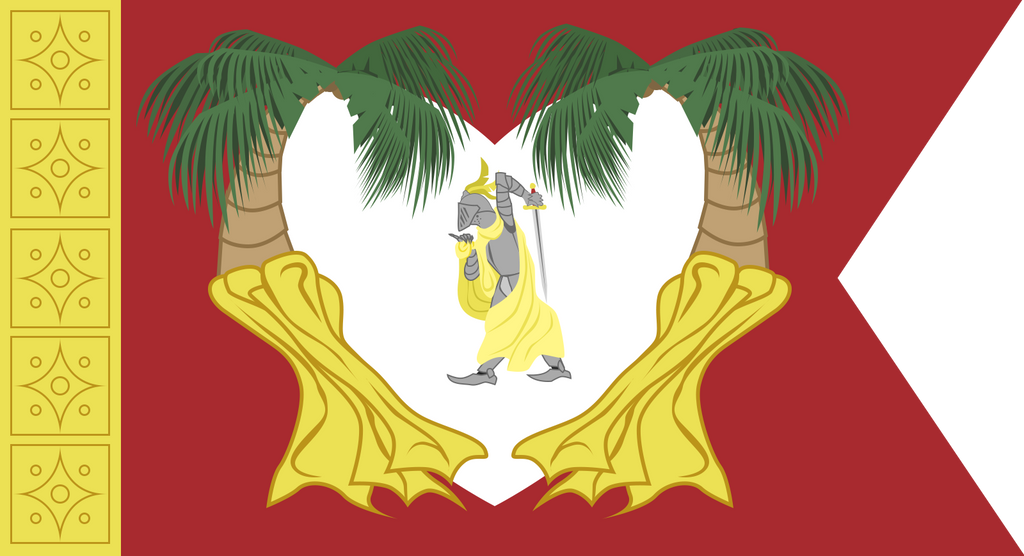
Location:

History:
Jonaçoat was a land of remarkable vistas and a stunning landscape, of rich soil and abundant timber. The earth was ripe with metallic fruits. Old adventurers before the deluge returned to their old imperial masters speaking in awe about a land made by and for the gods. In the days when man was still pious, such a landscape was regarded as the hunting grounds of the great world spirits and they were avoided except only for sacred pilgramages through its verdant valleys at the foot of towering pillars of stone thrust upward in ancient times. Men who returned remarked continuously on the majesty of the marble buttes that shot up to hold aloft the sky, and how the rivers were so rich with raw gold one need only to reach out and touch the pebbles at the bottom of the river beds and they could take out a fistful of raw gold.
As piety transformed into avarice and greed the relationship to this territory changed and simple long distance religious appreciation turned to material colonization as the empires before the deluge reached out with their hands to grasp at wide swathes of this holy land fertile in all ways and they began to swing their axes into the trees, bury their mines into its soil, and turn over the law with their hoes and plows. Before long the landscape was no longer that of quiet rectitude in search of a spiritual guidance but became the focal point in shifting political design as blood was spilled over it. Cities were raized and fortresses erected. The marble and white granite butes became a forest of flags as armies contested it in frequent warfare and merchants clattered over its roads seeking and bringing out its wealth in raw materials and the finest wines.
The defilement of the Jeweled Lands ma have been one of the reasons the gods sought to eradicate mankind and brought their sadness and their grief upon them, filling the valleys with water until the surf raked against the majestic buttes, swamping farms and filling mines. The farmers and soldiers of the valleys began their climb up into the highlands as their pillars to heaven became rocks at sea and the raging storms began tearing down many. And in a country bristling with fortresses at every high pass all came to them and they filled to capacity. Guard captains become defacto kings as their liege lords disappeared beyond the long gray distance of rain and storm.
The storms subsided and the seas again lowered. But not to their old level. As the descendants of the battered and wounded people who had fled returned to their ancestral homes they found their old land a swamp and they believed that there would be none of which was passed down to them in legend. But time, or the gods had other plans; whether in forgiveness or as a second trial. Life did return to the valleys and a depressed people found themselves with new farms, and new forests.
The first man to proclaim himself came to settle in the ruins of the fort he called the Castle Jamais. He, Priodoc I would found a dynasty that'd last a century and be filled with its own champions and men of legends. While little more than barbarians, the activities of Pirodoc and his sons would become the basis of songs. The Song of Pirodoc, where the great cannibals of Castle Samoix were exterminated for taking hostage and devouring the family of a local cow herd, whose sole survivor and youngest daughter Rachel would become Pirodoc's first wife. Their son Charlon would embark on a dangerous voyage by boat to nearby islands and is said to have fought men who had become one with the fish and exterminated their kingdom, saving a village of haggard boat people who made him a saint. Diaclordoc who went to bed with twenty women and fathered a hundred children, who were all bastards but became the first knights of his court.
The line of Priodoc would come to an end with the passing of Pirodoc III who was shot by a crossbow through the eye at a tournament and slipped from life on his sickbed sixteen hours later, his wife giving birth to his son six months later, but by then the family line had passed from rule.
In the intervening generations and centuries civilization reasserted and what was the low barbarity of the Pirodocs became mere romantic memory and the subject of a thousand local fables retold and maintained by bands of troubadours who lauded the Pirodocs for their bravery, or issued their stories as tales of warning for the people. As the lands further recovered from the great deluge and the terrors of the long rains subsided even further into memory, from terrifying story to distant antiquated legends the vintages of the ancient Jonaic returned. Further, the natural wealth of the deep earth returned to the surface as prospectors came to find golden and jeweled nuggets washing up along their tidal beaches and in old stream beds and rocks. The name Jonaçoat came to use as the influence of the old castle, now grand city of Jamais blossomed from an independent polity to the seat of a kingdom.
Today, song and romance bloom in the Jeweled Coast, in Jonaçoat. With the tales of the Great Deluge and of the deeds of the Pirodocs joining one another in mutual canon the nobility sees itself as defenders of pious virtue under the auspicious watch of the White Mother. This distinction does not come without its pitfalls, for as easily impressed with the cautionary tale brought by the Deluge there then is too the inspiration of romantic endearment by those of the Pirodocs.
Jonaçoat
Flag:
Location:
History:
Jonaçoat was a land of remarkable vistas and a stunning landscape, of rich soil and abundant timber. The earth was ripe with metallic fruits. Old adventurers before the deluge returned to their old imperial masters speaking in awe about a land made by and for the gods. In the days when man was still pious, such a landscape was regarded as the hunting grounds of the great world spirits and they were avoided except only for sacred pilgramages through its verdant valleys at the foot of towering pillars of stone thrust upward in ancient times. Men who returned remarked continuously on the majesty of the marble buttes that shot up to hold aloft the sky, and how the rivers were so rich with raw gold one need only to reach out and touch the pebbles at the bottom of the river beds and they could take out a fistful of raw gold.
As piety transformed into avarice and greed the relationship to this territory changed and simple long distance religious appreciation turned to material colonization as the empires before the deluge reached out with their hands to grasp at wide swathes of this holy land fertile in all ways and they began to swing their axes into the trees, bury their mines into its soil, and turn over the law with their hoes and plows. Before long the landscape was no longer that of quiet rectitude in search of a spiritual guidance but became the focal point in shifting political design as blood was spilled over it. Cities were raized and fortresses erected. The marble and white granite butes became a forest of flags as armies contested it in frequent warfare and merchants clattered over its roads seeking and bringing out its wealth in raw materials and the finest wines.
The defilement of the Jeweled Lands ma have been one of the reasons the gods sought to eradicate mankind and brought their sadness and their grief upon them, filling the valleys with water until the surf raked against the majestic buttes, swamping farms and filling mines. The farmers and soldiers of the valleys began their climb up into the highlands as their pillars to heaven became rocks at sea and the raging storms began tearing down many. And in a country bristling with fortresses at every high pass all came to them and they filled to capacity. Guard captains become defacto kings as their liege lords disappeared beyond the long gray distance of rain and storm.
The storms subsided and the seas again lowered. But not to their old level. As the descendants of the battered and wounded people who had fled returned to their ancestral homes they found their old land a swamp and they believed that there would be none of which was passed down to them in legend. But time, or the gods had other plans; whether in forgiveness or as a second trial. Life did return to the valleys and a depressed people found themselves with new farms, and new forests.
The first man to proclaim himself came to settle in the ruins of the fort he called the Castle Jamais. He, Priodoc I would found a dynasty that'd last a century and be filled with its own champions and men of legends. While little more than barbarians, the activities of Pirodoc and his sons would become the basis of songs. The Song of Pirodoc, where the great cannibals of Castle Samoix were exterminated for taking hostage and devouring the family of a local cow herd, whose sole survivor and youngest daughter Rachel would become Pirodoc's first wife. Their son Charlon would embark on a dangerous voyage by boat to nearby islands and is said to have fought men who had become one with the fish and exterminated their kingdom, saving a village of haggard boat people who made him a saint. Diaclordoc who went to bed with twenty women and fathered a hundred children, who were all bastards but became the first knights of his court.
The line of Priodoc would come to an end with the passing of Pirodoc III who was shot by a crossbow through the eye at a tournament and slipped from life on his sickbed sixteen hours later, his wife giving birth to his son six months later, but by then the family line had passed from rule.
In the intervening generations and centuries civilization reasserted and what was the low barbarity of the Pirodocs became mere romantic memory and the subject of a thousand local fables retold and maintained by bands of troubadours who lauded the Pirodocs for their bravery, or issued their stories as tales of warning for the people. As the lands further recovered from the great deluge and the terrors of the long rains subsided even further into memory, from terrifying story to distant antiquated legends the vintages of the ancient Jonaic returned. Further, the natural wealth of the deep earth returned to the surface as prospectors came to find golden and jeweled nuggets washing up along their tidal beaches and in old stream beds and rocks. The name Jonaçoat came to use as the influence of the old castle, now grand city of Jamais blossomed from an independent polity to the seat of a kingdom.
Today, song and romance bloom in the Jeweled Coast, in Jonaçoat. With the tales of the Great Deluge and of the deeds of the Pirodocs joining one another in mutual canon the nobility sees itself as defenders of pious virtue under the auspicious watch of the White Mother. This distinction does not come without its pitfalls, for as easily impressed with the cautionary tale brought by the Deluge there then is too the inspiration of romantic endearment by those of the Pirodocs.
They say the rains that flooded the world began four centuries ago. By the accounts of some scholars it was five. It was a deluge that began not without our knowing, having wrought it upon ourselves by our own making. It was atonement for the sins of humanity, whose vast and glorious empires dominated the world. The glittering lances of our knights and champions were hoisted defiantly against all those who would challenge their nobility. All had succumbed to their pride, lent their hearts over to their emperors and their Worldly Gods. And that when the great world spirits saw what had become of mankind they sought to punish humanity and sent great beasts.
But these monsters were not seen as a collective punishment, not by man. No, the lands they dragged their tails through and the villages they scorched was not a mere punishment. But a challenge. The billowing earth-shattering calls the great serpents issued were not a warning to the proud of heart and the vile of intention but a challenge. The self obsessed grandees took to them like the horns of war and the tourney. For over a century valiant souls set forth and one by one slew the beasts in combat and through treachery until man claimed ultimate victory and the divine beasts were laid upon the earth and their bodies salted the soil as they boiled in necrosis.
But the gods, stricken and taken aback saw what man had become, beyond their control and their capacity to rule through their divine providence. In their wisdom they felt shame. In their humility they felt sorrow. For their creations, small to terrible they wept for the sinful curse that had fallen man and their tears fell upon the world in a torrential rain. A rain which did not relent and as it poured across all four corners it began to sweep aside civilization in a flood. At once the men who had proclaimed themselves gods were without realms. The Emperors watched as they fled as their territories were broken and washed into the growing great sea at each fall of the raindrop. Mankind was sent into retreat and crowding onto shrinking high grounds they fought to escape the tide, entire people's forced into one another in a retreat of tragic poetry. The terminal sounds of war clang out under thundering storm clouds as a century of battle as kings lead their retinues to war against one another, always seeking to stay one step ahead of the other. The boots and hooves of men and horses turned the ground and weakened it until it too was washed away into the great rivers and made them greater. The gentle slide of marble palaces and granite castles crumbled away into broiling froth.
As the waters rose mankind scrambled upon its rocks, where sitting perched as the sirens they rose their heads to sing their invective rage against the great gale. With no more man to fight, and the rains washing away the civilization of man the barbarity of the gluttony and pride they had so carried revealed themselves to be barbarism and there was naught but anger. But as the rains continued, the rage turned to remorse as greatness faded to memory, then into misery as the sirens of man became husks in their meager existence. Finally the rains ended as the misery of man became its own storm, and the gods ceased crying. As the rains ended, and the sky opened for the sun to emerge the world slowly normalized.
Though the land as it once was would never return, as the gods had released such a storm of sadness, man could again repopulate it. Coming down from their rocks they dispersed through swamps that dried to forests, and were cleared for farms, and in the centuries after kingdoms returned. Man, tempered rebuilt and saw themselves across wide channels and ocean rivers. All had not perished, and all still holds promise for further songs.
This was their new world. A world for thalassocrats.
Welcome to Children of the Thassalocracy, a medieval post-Apocalyptic RP. Centuries ago a hundred-year long rain storm washed away Empire of old, whose vast territories spanned the globe and challenged the gods themselves. In the imperial vanity of civilization, the gods sought to punish them and knock them down a peg. First in sending greats beasts to destroy them. But these beasts were eventually defeated by the knights and champions of the old world. In their sadness the gods cried and brought the rains, erasing the old world and its politics and driving life into the highlands of the world. The sea levels swelled and the rivers burst into channels as lakes became seas and mingled with the oceans. The receding waters left behind only a world of islands, which is where mankind is today.
The world now post-Deluge is the equivalent to the early or mid 15th century, having now redeveloped to suit its current and new climate. What new songs shall be written?
It is permissable to play as other races than human, but I would prefer them to be roughly human. No extremes. Elves and the like are fine, but dwarves in the typical sense of short mountain dwelling people wouldn't likely belong, we can get away with saying they either drowned in their caves or are sealed away forever due to the great rains flooding their caverns. Magic though, I would rather not dabble in that. The most I will permit is some sort of mythical, esoteric interpretations. Or even something like Magical Realism (see: Hundred Years of Solitude).
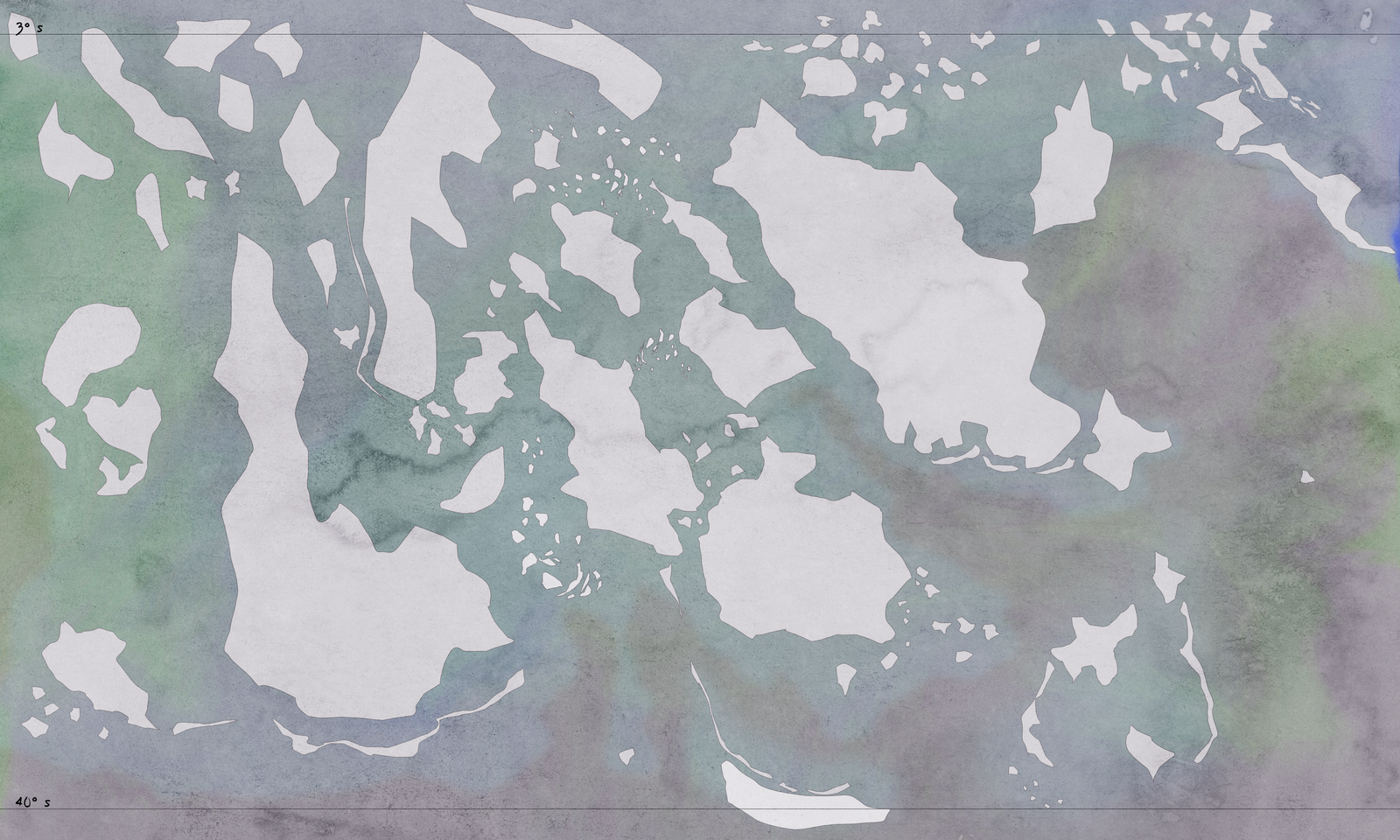
Without further ado, the app and territory map:
Name:
Flag:
Location:
History:
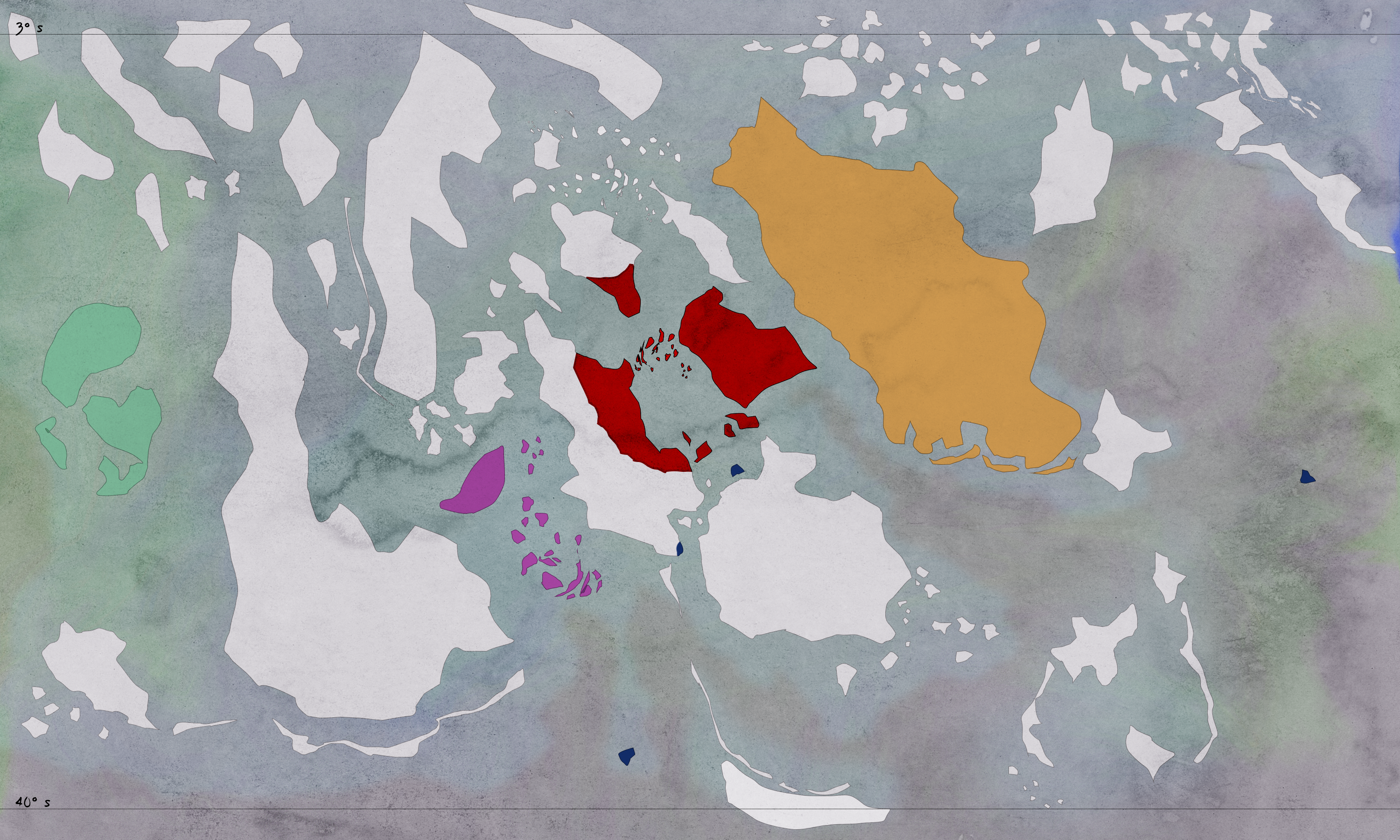
@Aleranicus
Do what you need to do.
I plan to put up the actual IC today. I had intended to yesterday but that never happened. Not because something happened to stop me, I just got distracted.
Do what you need to do.
I plan to put up the actual IC today. I had intended to yesterday but that never happened. Not because something happened to stop me, I just got distracted.
In
Non-Combat orientated characters in combat orientated RPs.
→
8 yrs ago
Forum: Roleplaying Discussion
I think the notion of the importance of non-combat characters in combat stories breaks down if you consider the character in question needs to be the most decisive figure in the story to play a role. Sort of taking on the story from your standard young adult angle where-in the main character of course has to physically combat the main villain or the central problem which is the narrative focus of the RP or story in question. But I think once you break through this limiting factor you can open yourself up to more possibilities than someone being just able to fight a something.
And the most fundamental question to being with is: what is the thing about the character I want to focus on, and how will it change him or her.
At the core of the idea is to imagine the character as himself having his own story, where while intertwined with the stories of other characters in the same universe or RP could be read as independent of all others. In that sense, besides simply filling out the application and stepping in looking to take events of the RP in stride as they happen is that you step into the RP with a character and a goal in mind for that character. How do you want that character to change by the end? What do you want to achieve? What's his or her conclusion? Is it a tragic death or suicide? Is it to acquire something new and meaningful, a life improvement? Figuring out what you want to achieve in the context of the RP other than "defeat the Big-Bad" or "Acquire the group objective" sets something complimentary to the story that allows you to focus on something else and won't lock you hard-core into the big meta-objective of the entire party of the entire RP.
Answering these questions will give you the final destination you want to arrive at. A motivation. The motivation for action doesn't have to be a spoken thing and can be unspoken, something unrealized by the character itself. Or the character can speak of some other motivation and arrive to a new one. Perhaps your character talks about finding out why a close family member has died and to what, but along the way realizes something else greater? From real literature, in Kenziboru Oe's book Death by Water (originally Sushi in Japanese) the main character intends to write an fictionalized account of his father's death and wants to look into the mystery and life of his father, to do so he has to access his father's red leather chest which his mother kept from him because she disowned him over an earlier novel, but on her death early in the novel he gains access to the chest through his sister who forgives him and he begin his work; but a quarter of the way through he doesn't learn anything and the entire focus of the novel shifts to something else completely.
A shift of focus just for you and your character to a different objective, autonomous of but dependent on the main RP objective may give you another option to write for, but you'll need to consider the interim in the meantime. On the way events are going to happen outside of your character and you'll need to decide how to engage with all of that in the meantime. One in an interesting way and also in a meaningful way. It may not perhaps be best for your absolute pacifist to spend the entire time with the main party and he'll have to peel off tactically at times to do something else while everyone fights cave goblins; there's after all far less ways to write about hiding behind a rock from injury as there are ways to write about fighting monsters. Period. You could probably think of this like Gandalf's coming and goings from The Hobbit or Lord of the Rings where he disappears from the focus of the story to go do things of his own that have impact with the story, investigating some mysterious circumstance or meeting with someone else which will bring things into the story.
Since the points between starting and ending are going to be the biggest area you spend time with your character in, this deserves the most meditation. Even in the step-by-step of Roleplaying. But also comes back around to the intent of the character. Referring back to my previous example of Death by Water: how does the relationship of the character with his Red Leather Chest change in the story, or how does it become abandoned for something else?
Another way to think about things might be how far can you get away with thinking not just about the character but the group as a whole and what sort of circumstances can you bring to bear on the group through the power of the pacifist character. If he's not going to be fighting the biggest dragons, how can his activities help or indirectly hinder their progress or just over all help with their development as a whole. To this I turn to a story I like to bitch about these days. A Fan-fiction actually.
Fallout Equestria is a crossover story between My Little Pony and fucking Fallout. I do like the concept for its juxtaposition of values and aesthetic it forces and apparently a lot of people do too within the MLP fandom. Or enough so that after the completion of and even during the writing of the original Fallout Equestria story a plethora of alternative side-stories bloomed. Some ignored, others praised as being central to the blooming sub-fandom's central canon. One of those is Project Horizons, a story which tries to take everything about FoE and crank it up to eleven. The main character gets into more fights and battles than the original story's MC and commits far more atrocities on her own than the original. And while the story attempts to come to terms with those, its never a complete exploration I feel. The story would have at the least benefited from someone to attempt to help the main character rationalize this shit; even if she proclaims herself to not be at all smart.
Setting aside any detailed analysis for how that could have been done, let's get to the point I'm making with that: in the course of the RP's story how does the non-combat character develop themselves but how does their relationship with his or her peers assist in the development of the other members. Does their existence intentionally or unintentionally create drama between them? Do they hurt or heal them? Can the existence of the pacifist help to conduct the changing values of the others to an "evolved" state in the end, not just physically stronger but also emotionally and psychologically more matured? And how does the rest of the group add to the development of the pacifist? Do they in turn encourage directly or indirectly, spoken or unspoken the pacifist/non-combatant member of the group to take up the gun or the sword and reshape their own relationship to violence and physical action?
A pacifist, non-fighting character is not without their own dynamic and fascinating challenges. They're not fighting external dragons so to say, but grappling with internal ones. And I think the idea of to write them and their own importance needs to shift from external exertion to something more internal. How also might the story be read if just from the pacifist? I've suggested their own goals, which may be their own plot and with their own conflict. In an RP environment you have the opportunity to unravel everything into their independent strings and read it as a story of each of the individual characters as you can re-weave it to be the story of all the characters going to achieve something as a uniformed braid of rope again.
And the most fundamental question to being with is: what is the thing about the character I want to focus on, and how will it change him or her.
At the core of the idea is to imagine the character as himself having his own story, where while intertwined with the stories of other characters in the same universe or RP could be read as independent of all others. In that sense, besides simply filling out the application and stepping in looking to take events of the RP in stride as they happen is that you step into the RP with a character and a goal in mind for that character. How do you want that character to change by the end? What do you want to achieve? What's his or her conclusion? Is it a tragic death or suicide? Is it to acquire something new and meaningful, a life improvement? Figuring out what you want to achieve in the context of the RP other than "defeat the Big-Bad" or "Acquire the group objective" sets something complimentary to the story that allows you to focus on something else and won't lock you hard-core into the big meta-objective of the entire party of the entire RP.
Answering these questions will give you the final destination you want to arrive at. A motivation. The motivation for action doesn't have to be a spoken thing and can be unspoken, something unrealized by the character itself. Or the character can speak of some other motivation and arrive to a new one. Perhaps your character talks about finding out why a close family member has died and to what, but along the way realizes something else greater? From real literature, in Kenziboru Oe's book Death by Water (originally Sushi in Japanese) the main character intends to write an fictionalized account of his father's death and wants to look into the mystery and life of his father, to do so he has to access his father's red leather chest which his mother kept from him because she disowned him over an earlier novel, but on her death early in the novel he gains access to the chest through his sister who forgives him and he begin his work; but a quarter of the way through he doesn't learn anything and the entire focus of the novel shifts to something else completely.
A shift of focus just for you and your character to a different objective, autonomous of but dependent on the main RP objective may give you another option to write for, but you'll need to consider the interim in the meantime. On the way events are going to happen outside of your character and you'll need to decide how to engage with all of that in the meantime. One in an interesting way and also in a meaningful way. It may not perhaps be best for your absolute pacifist to spend the entire time with the main party and he'll have to peel off tactically at times to do something else while everyone fights cave goblins; there's after all far less ways to write about hiding behind a rock from injury as there are ways to write about fighting monsters. Period. You could probably think of this like Gandalf's coming and goings from The Hobbit or Lord of the Rings where he disappears from the focus of the story to go do things of his own that have impact with the story, investigating some mysterious circumstance or meeting with someone else which will bring things into the story.
Since the points between starting and ending are going to be the biggest area you spend time with your character in, this deserves the most meditation. Even in the step-by-step of Roleplaying. But also comes back around to the intent of the character. Referring back to my previous example of Death by Water: how does the relationship of the character with his Red Leather Chest change in the story, or how does it become abandoned for something else?
Another way to think about things might be how far can you get away with thinking not just about the character but the group as a whole and what sort of circumstances can you bring to bear on the group through the power of the pacifist character. If he's not going to be fighting the biggest dragons, how can his activities help or indirectly hinder their progress or just over all help with their development as a whole. To this I turn to a story I like to bitch about these days. A Fan-fiction actually.
Fallout Equestria is a crossover story between My Little Pony and fucking Fallout. I do like the concept for its juxtaposition of values and aesthetic it forces and apparently a lot of people do too within the MLP fandom. Or enough so that after the completion of and even during the writing of the original Fallout Equestria story a plethora of alternative side-stories bloomed. Some ignored, others praised as being central to the blooming sub-fandom's central canon. One of those is Project Horizons, a story which tries to take everything about FoE and crank it up to eleven. The main character gets into more fights and battles than the original story's MC and commits far more atrocities on her own than the original. And while the story attempts to come to terms with those, its never a complete exploration I feel. The story would have at the least benefited from someone to attempt to help the main character rationalize this shit; even if she proclaims herself to not be at all smart.
Setting aside any detailed analysis for how that could have been done, let's get to the point I'm making with that: in the course of the RP's story how does the non-combat character develop themselves but how does their relationship with his or her peers assist in the development of the other members. Does their existence intentionally or unintentionally create drama between them? Do they hurt or heal them? Can the existence of the pacifist help to conduct the changing values of the others to an "evolved" state in the end, not just physically stronger but also emotionally and psychologically more matured? And how does the rest of the group add to the development of the pacifist? Do they in turn encourage directly or indirectly, spoken or unspoken the pacifist/non-combatant member of the group to take up the gun or the sword and reshape their own relationship to violence and physical action?
A pacifist, non-fighting character is not without their own dynamic and fascinating challenges. They're not fighting external dragons so to say, but grappling with internal ones. And I think the idea of to write them and their own importance needs to shift from external exertion to something more internal. How also might the story be read if just from the pacifist? I've suggested their own goals, which may be their own plot and with their own conflict. In an RP environment you have the opportunity to unravel everything into their independent strings and read it as a story of each of the individual characters as you can re-weave it to be the story of all the characters going to achieve something as a uniformed braid of rope again.
And raise Atlantis when the ice-caps remelt? My bets on Gorgenmast.
© 2007-2026