Avatar of Vec

Status

User has no status, yet

Bio

Just as humans grow and change with time, interests change as well. I wish I had the urge to roleplay like I used to...

Most Recent Posts

<Snipped quote by Vec>

Hold my beer Sarhush's Me


...

In other news, with my latest GM post, we are officially out of 'the Dark Ages'. This RP's very first Arc has been completed. This Age of First Light we have entered will see the rise of the very first civilizations and, potentially, the very first heroes and maybe even lesser deities...

On the planned-to-do things is to create a rough timeline of events as they unfolded. Nothing too precise, because the Dark Ages were quite fluid and creation was stil young. Don't expect a calendar out of nowhere now :)
A disclaimer/clarification on the Sun(s): The first post of the IC canonized a pale Sun existing before this new Sun created by Orranoth in this post.

The sun, if that pale disc hovering at the horizon can be called such, casts no shadows. It neither rises nor sets, suspended in permanent ambiguity.
as per the 1st IC post

Additionally, Arstus only ever made stars in collaboration with Moren, which essentially put the world in perpetual starlit night sky mode since the start of the roleplay. This new sun made by Orranoth is present alongside the old pale sun, but it is the only one that actually functions as a proper Sun, and is what will now cause the day-night cycle. In time it will swallow the old sun as it goes through multiple day-night cycles, until it eventually becomes the only Sun in the skies.

I can't wait to see what world destroying actions this following week will bring us...

The Sun rose.

Not gradually, not gently, but with the violent certainty of a wound torn open in the firmament itself. Where before there had been only the distant, cold glitter of stars filtered through ash-choked atmosphere, now there burned a disc of impossible radiance. Light poured down in torrents, golden and merciless, burning through the volcanic haze as though the world's dark veil had been nothing more than cobwebs.

Mortals across Ashuru threw themselves to the ground. Some wept. Others screamed. Many simply stared, uncomprehending, at the thing that now dominated the sky, this new god-star that demanded to be seen. The ash clouds, which had strangled the world for weeks, began to fracture. The Sun's heat drove powerful updrafts, tearing holes in the gray blanket, revealing patches of blue that most mortals had never witnessed. The air itself seemed to exhale, as if Ashuru had been holding its breath since the Cataclysm and only now dared to draw in something clean.

But the world was not ready, and within hours the plants remembered.

Seeds that had lain dormant in ash-smothered soil cracked open with audible pops. Roots surged downward with desperate hunger while shoots thrust upward toward the light with the frantic energy of the drowning breaching surface. In scattered clearings across the world, mortals watched in awe as the ground erupted into carpets of wildflowers: purple, yellow, crimson, white, blooming so densely that the earth itself seemed to vanish beneath quilts of petals.

It was beautiful, but too fast.

By noon, the flowers were already wilting, their brief lives burning out as quickly as they'd begun. The soil, already depleted by volcanic ash, had given everything it had. Where moments before there had been riotous color, now there were only brown, curling husks. Entire generations of flora compressed their life-cycles into single mornings, and those who witnessed it could not tell whether to marvel or mourn.

In the forests that remained, those the fires had not yet devoured, the trees went to war.

Branches that had spent months dormant now lunged toward the Sun like starving hands reaching for bread. Canopies thickened in hours, leaves unfurling with such speed that the rustling sounded like applause. But there was no coordination, no harmony. Trees that had coexisted for decades now fought viciously for the light, their branches tangling, their roots strangling one another in the desperate scramble for resources.

The forest floor, once dappled with gentle starlight, plunged into deep shadow. Undergrowth that had thrived in the dim now withered and died, choking beneath the sudden darkness. Vines erupted from the earth with predatory hunger, wrapping around trunks, pulling trees down in slow-motion collapse. Some forests began to smell wrong, suffused with the sickly-sweet rot of plants dying from their own unchecked growth.

And everywhere, everywhere, the pollen.

Grasses that should have taken weeks to mature shot up waist-high overnight, their seed-heads exploding in clouds of yellow-white particulate that drifted on the wind like smoke. Toxic flowers, beautiful and deadly things with petals like shattered gems, spread their spores with abandon. Mortals who inhaled too deeply fell into fits of coughing, their eyes streaming, their lungs burning. Some tribes wrapped cloth around their faces. Others fled into caves, into the underground, seeking refuge from the world that had gone drunk on light.

The few agricultural settlements that had begun to form faced catastrophe. Crops planted carefully, tended with desperate hope, now grew with such violence that stalks snapped under their own weight. Grain ripened and rotted in a span of days. Fruit swelled, split, fermented on the branch. Farmers wept over harvests that had transformed from miraculous abundance into grotesque parody: too much, too fast, and none of it sustainable.

In the village that had begun forming around the canyon where the god-orb had appeared, the people gathered their ruined crops and whispered prayers. They touched fingers to foreheads and raised them skyward, a gesture of faith that had become second nature to them. The god had given them knowledge: agriculture, construction, the foundations of civilization itself. Surely the god would not abandon them now.

But the heavens offered no immediate answer. Only the relentless, burning light of the new Sun.

In the canyon where survivors had fled from forest fires and earthquakes, something unprecedented was taking shape.

The settlement had grown rapidly, swelling from a handful of desperate families to a burgeoning community of refugees from a dozen different tribes. They came seeking safety, but what they found was purpose. The god-orb that had appeared to them weeks ago had granted gifts beyond measure: knowledge of agriculture, techniques for flexible wooden construction, and perhaps most importantly, a framework for understanding the divine that gave structure to their worship.

The buildings rose with startling efficiency. Wooden frames slotted together with geometric precision, their joints designed to flex during earthquakes rather than shatter. Foundations were dug according to principles that considered weight distribution and soil stability. It was knowledge that no mortal should have possessed, yet now dozens of builders worked with the confidence of master craftsmen.

The agricultural fields spread in concentric circles around the settlement. The first harvest had been catastrophic, with crops growing too fast in the new sunlight and spoiling before they could be properly stored. But the people did not despair. They gathered, they discussed, they applied the knowledge they'd been given. They learned to harvest earlier. To preserve more carefully. To plant species that might better tolerate the Sun's intensity.

Children ran through the streets with fingers perpetually stained by dirt and plant matter, already learning the techniques their parents had only just discovered. Elders who'd spent lifetimes as nomadic hunters now debated the proper depth for irrigation channels. The transformation was dizzying.

"We're becoming something new," an old woman said one evening, watching the sunset paint the sky in colors that had never existed before the Sun's arrival. "Not just a tribe anymore. Something... bigger."

"Excelsium," another voice added, speaking the name that had begun circulating among the people, whispered with a mix of hope and uncertainty. The god-orb's city. The place of eminence.

Whether they were ready for what that meant, none could say.

Word spread quickly among the desperate: there was a valley where the chaos could not fully reach. Refugees who stumbled into Gamblerdise told wild tales of being lifted from a dying coastline while they slept, of waking in a place where the very laws of nature seemed negotiable.

The valley itself was still strange, still dangerous in its unpredictable way. The forest to the north shifted when you weren't looking. The fields to the south refused to grow the same crop twice in the same location. The lake was half calm water, half something that rippled wrong and reflected colors that shouldn't exist.

But at the center, ah, at the center, there stood a temple of white and gold that gleamed in the new sunlight like a promise.

The structure defied easy explanation. Three stories tall, circular, built around something ancient and inexplicable that pierced through its heart like the axis of creation itself. Those who entered found a space designed not for solemn worship but for noise, for laughter, for games, for the clattering of dice against stone and the triumphant shouts of winners and the good-natured groans of losers.

The people who lived there, the tribe that had been saved from the ocean's retreat, moved with a confidence that other refugees found almost unsettling. They walked paths that seemed safe one day and treacherous the next with the ease of those who'd learned to read patterns invisible to outsiders. They played their games with genuine joy, even as the world beyond the valley continued to tear itself apart.

"How do you survive here?" a newcomer asked one evening, watching two children chase each other through the temple's main chamber with knucklebone dice clutched in their small hands.

An older woman, one of the original tribe, smiled. "We don't just survive. We live. That's the whole point. You learn the signs. The way the grass grows. The color of the lake. When to step forward and when to step aside. It's like a game, see? And if you're clever enough to learn the rules..."

"You win?"

"Sometimes. Sometimes you lose. But either way, you're playing. And that's better than just waiting to die somewhere else."

The temple's doors remained open. Inside, the sounds of laughter and friendly competition echoed through chambers that seemed larger than they should be. And at the heart of it all, that ancient thing, the Anchor, hummed with quiet authority, keeping the worst of the chaos at bay. It wasn't paradise, but it was possibility.

In the Valley of the Boulder, home to the Accord, eight tribes bound by ancient compact and shared reverence for a sacred stone, something miraculous and terrible had occurred.

The great God-Beast had fallen from the sky.

For three days and nights it convulsed at the base of the Sacred Boulder, its ichor spilling across the clearing in quantities that should have killed any mortal creature a hundred times over. The divine blood painted trees, grass, and stone in glittering patterns. Animals of all kinds kept vigil: birds, mammals, reptiles, even insects gathered to witness their creator's suffering.

And then, on the fourth day, the convulsions stopped. The God-Beast's wounds began to mend with supernatural speed. Broken bones realigned themselves. Torn flesh knitted together. What should have taken months of recovery completed itself in days.

But something else happened during those three days of bleeding.

The animals that had been touched by the spilled ichor began to change. A wolf's fur took on patterns that seemed to absorb shadow, allowing it to vanish into darkness even in broad daylight. A rabbit's eyes began to glow faintly, and when it fled from a predator, it left afterimages that confused pursuers. Birds developed feathers that crackled with tiny arcs of lightning. Snakes moved through earth as though it were water.

The changes spread. Not to every creature, only a minority, perhaps one in ten or twenty, but enough to transform the valley's ecosystem. Predators that had relied on simple strength now faced prey that could bend light or manipulate wind. Herbivores that should have been defenseless learned to command stone or shadow.

And in the deepest parts of the forest, where Saries's ichor had pooled most thickly, the changes were even more dramatic. Trees that swayed when there was no wind. Streams that flowed uphill for short stretches. Flowers that bloomed in response to thoughts rather than seasons.

The Accord's shamans consulted with growing urgency. Some called it blessing. Others called it curse. All agreed that their valley, and by extension the very essence of wildlife, had been transformed into something unprecedented: a place where the boundary between natural and supernatural had worn dangerously thin.

The underground held treasures, but it demanded payment.

Ma'otah's expedition had proven that beyond all doubt. Of the five who'd descended, only three returned, and they returned changed. Haunted. The copper ore they'd brought back was real, tangible proof that riches existed in the depths. But the two empty spaces around their campfire served as equally tangible reminders of the cost.

"The earth is alive," Ma'otah told the gathered elders, her voice quiet but firm. "There's something down there. Not just stone and darkness. Something that watches. That judges. That... trades."

She held up the chunk of copper ore, letting firelight play across its red-gold surface. "It wanted my necklace. The one my grandmother made. The protection charm. It looked at me with eyes like grinding stone and said it desired beautiful things." She swallowed. "And it kept its word. Showed us the copper vein. Led us back to the surface. But it also made it very clear: taking without asking means death. The caves themselves will kill you. Poison air. Falling stone. Fissures that open beneath your feet."

The elders deliberated long into the night. Some wanted to seal the cave entrance, to mark it as taboo and forbidden. Others saw opportunity, wealth beyond imagining, if only they could learn the rules of engagement. The copper Ma'otah brought back could be worked, shaped, turned into tools far superior to simple stone. What else might the depths contain? What other treasures might the god of the underground be willing to trade?

In the end, they reached a compromise born of equal parts greed and caution. They would leave offerings at the cave mouth: carved items, beautiful crafts, things of value that showed respect. They would call upon the name Ma'otah had been given: Khthon, the God Who Lay Beneath. They would ask before they took.

But they would not descend again. Not yet. Not until they'd learned more about the god who measured lives against jewelry and traded in both death and copper with equal indifference.

The first offering was buried at dawn: a small wooden carving of a rabbit, intricate and beautiful, wrapped in soft leather and placed in a shallow hole near the cave entrance. The woman who buried it, Ma'otah herself, whispered a prayer to Khthon, asking for safe passage, for fair trades, for the wisdom to know when taking was theft and when it was exchange.

The earth made no immediate reply.

But later that day, a young hunter exploring near the cave mouth found a single nugget of pure copper sitting on a stone, glinting in the new sunlight. It sat exactly where the offering had been buried.

In the realm of the dead, the Drowning Tide continued.

Spirits of marine life flooded in by the thousands: fish, mollusks, crustaceans, marine mammals, each one confused and disoriented by sudden death. The metaphysical architecture that the Goddess of Death had hastily constructed groaned under the weight. Anchors along the spiritual seafloor pulsed with steady light, drawing the dead toward organization and peace, but it was a near thing.

The initial chaos had subsided somewhat. The worst of the violence, when predator spirits tore into prey spirits out of instinctive habit, had been redirected by the careful placement of Anchors and the creation of spiritual currents that scattered incoming souls across a wider area. But new challenges emerged daily.

Terrestrial animals began arriving in greater numbers. Not drowned, but starved, burned, crushed. Herbivores that had relied on specific plants found their food sources either dead from too-rapid growth or transformed into something toxic. They arrived thin and desperate, their spirit-forms flickering with hunger that persisted even after death. Predators followed, equally confused by an afterlife that still seemed to demand hunting even when hunger no longer existed.

And mortals. Always more mortals.

Ur-humans killed by fire. By earthquake. By toxic pollen or collapsing trees. By infected wounds or simple exhaustion. Each one arrived at the black shore with questions the dead could not answer: Why had the world turned against them? Why had the gods allowed such suffering? When would it end?

The Afterlife expanded to accommodate them all, but expansion required constant divine attention. New Anchors. New pathways. New sections of the realm carved from raw death-stuff and shaped into something that could provide rest rather than merely store the deceased.

Some spirits adapted quickly to their new existence. They formed communities of the dead, gathering near Anchors that resonated with their nature. Fish-spirits schooled in bioluminescent formations. Plant-spirits grew spectral forests. Ur-human spirits built crude shelters from memory, trying to recreate the comfort of homes they'd lost.

Others struggled. Spirits that clung too tightly to life, those who couldn't accept they'd crossed over, began to fade at the edges, their essence fraying like old cloth. The Afterlife could offer peace, but only to those willing to accept it. For those who fought against death itself, the realm became less sanctuary and more prison.

Still, it held. The architecture remained stable. The Anchors pulsed with steady rhythm. And slowly, incrementally, the chaos began to resolve into something like order.

The dead, at least, had somewhere to rest. That would have to be enough.

The world had not ended, no. Against all probability, and despite divine excess and catastrophic transformation, Ashuru endured. Changed? Yes. Wounded? Most certainly. But alive and, in due time, thriving.

The Sun rose and set in its new rhythm, teaching mortals the meaning of day and night. Plants grew and died and grew again, their life-cycles gradually stabilizing as the initial shock of true daylight began to fade. Animals evolved and adapted, with Blessed beasts learning to wield their new powers while their mundane cousins learned to survive alongside them.

Mortals suffered. Mortals died. But mortals also built, and dreamed, and played, and found reasons to laugh even in the midst of catastrophe. In Gamblerdise, the temple rang with the sounds of dice and laughter. In Excelsium, wooden buildings rose in neat rows as refugees became citizens. In the Valley of the Boulder, the Accord watched their sacred valley transform into something unprecedented.

In caves across the world, brave and foolish explorers descended seeking treasure and finding death or divine trade in equal measure. In the Afterlife, the dead found rest. In the Dreamscape, shamans sought guidance from a god who offered riddles instead of answers. And in the forests, fires burned, but for the first time, the wilderness fought back.

The Age of First Light had begun, and no one, mortal or divine, could predict where it would lead.
On Conviction from worship: Generally, only direct posts that include gods would gain them conviction, however now with mortals in the mix the worship of mortals towards their patron gods can also apply towards conviction generation.

Worship is loose, can be whatever the god accepts and mortal is willing to do/give. However it needs to be written out in a post or part of a post in order for it to count towards activating the +1 con for worship, for that week. I am just unwilling to give con for worship that's 'implied' or done OOC. Lastly, only worship from living mortals counts towards conviction generation in this way.

The Kesh-Mir called the new land "Scar-Home."

It had been three dims since the world broke. Three dims since the earth had screamed and fire had vomited from the mountains and the sky had turned the color of old blood. Three dims since half their tribe had been swallowed by cracks in the ground that opened like hungry mouths, or buried beneath avalanches of superheated stone, or simply disappeared into clouds of ash so thick they choked on their own breath.

Forty-seven had survived. Forty-seven out of nearly two hundred.

They found refuge in a shallow basin where a spring still ran clear, nestled between hills that had somehow escaped the worst of the devastation. The water tasted of minerals now, sharp and metallic on the tongue, but it didn't kill. That made it sacred. They built their shelters low and wide, remembering too well how the earth could shake, how vertical things fell and crushed.

The hunters went out despite their fear. Prey was scarce—most animals had fled or died—but desperation made them bold. They learned to read the new landscape: where ash-fall was thick enough to muffle footsteps, where the ground was stable enough to trust, which plants had survived and which had turned poisonous from the black rain that still fell intermittently, burning skin and eyes.

They learned to cover their mouths with hide when the wind blew from the south, carrying choking clouds of volcanic dust. They learned that fires needed to be kindled in sheltered places, or the ash-laden air would smother them. They learned that the old songs about gratitude and plenty rang hollow now, so they sang new ones instead—songs of survival, of stubbornness, of forty-seven voices refusing to be silenced.

The elders spoke in hushed tones about the gods, about what terrible transgression had provoked such wrath. The younger ones didn't care. The gods had names and stories, but the Kesh-Mir had hunger and wounds and nightmares. Theology was a luxury for people who weren't slowly starving.

Still, they endured. The women gathered what roots and fungi still grew, learning through painful trial which could be eaten and which brought fever-dreams or death. The men hunted in pairs, never straying far, always watching the horizon for the telltale plume of a new eruption. The children, those few who remained, played quieter games now, games that didn't involve running far from sight.

Slowly, impossibly, Scar-Home began to feel like home.

⚬────────────────────✧────────────────────⚬

The boy's name was Teth. He was nine, small for his age, and had learned silence the way other children learned speech.

He had been with his father on a hunt when they were separated. Not dramatically—no earthquake, no predator, just Teth pausing to examine a track while his father moved ahead through the ash-dusted undergrowth. When Teth looked up, his father was gone. He called out once, twice, then remembered the first lesson of the broken world: loud sounds attracted attention, and not all attention was survivable.

So he walked. Following the direction he thought his father had gone. Trying not to panic. Trying not to think about the stories of children who wandered into the deep woods and never returned.

The forest here was strange. Less ash, more green. The trees grew thicker, older, their bark unmarked by fire. Teth noticed flowers—actual flowers, colors he'd almost forgotten existed—blooming in impossible profusion despite the fact that it was the wrong season and the world was supposed to be dying.

Then he saw her.

She stood in a small clearing, illuminated by shafts of light that seemed brighter than they should be. Her skin was bronze, but not the bronze of sun-touched flesh—bronze like heated metal, with dark fissures running across her arms and face, and from within those cracks came a faint glow, orange-red like the molten rivers Teth had seen pouring from the mountains the night the world ended.

Her hair floated. Not blowing in wind—floating, suspended as though underwater, each auburn strand moving independently in currents Teth couldn't feel. It reached her waist, drifting, hypnotic.

She wore something translucent and violet, a fabric that seemed more like colored air than cloth, draping her form without quite touching it. Her feet were bare. Where she stepped, vines erupted from the ash-choked soil, twisting upward in accelerated growth. Flowers bloomed in her footprints—white, luminous, already wilting as she moved on.

She was picking an apple from a tree, holding the fruit delicately between two fingers, studying it with the focused curiosity of someone encountering the concept of "apple" for the first time. She turned it slowly, watching light play across its red skin, tilting her head as though listening to something the apple might be saying.

Teth forgot to breathe.

Then her gaze lifted. Her eyes—amber, bright, glowing with the same internal light that leaked from the cracks in her skin—locked onto his.

She tilted her head, mirroring the gesture she'd made toward the apple.

Curiosity. Pure, inhuman, terrible curiosity.

Teth couldn't move. Couldn't run. Couldn't scream.

The woman-who-was-not-a-woman watched him, waiting, as flowers continued blooming around her feet and the world held its breath.


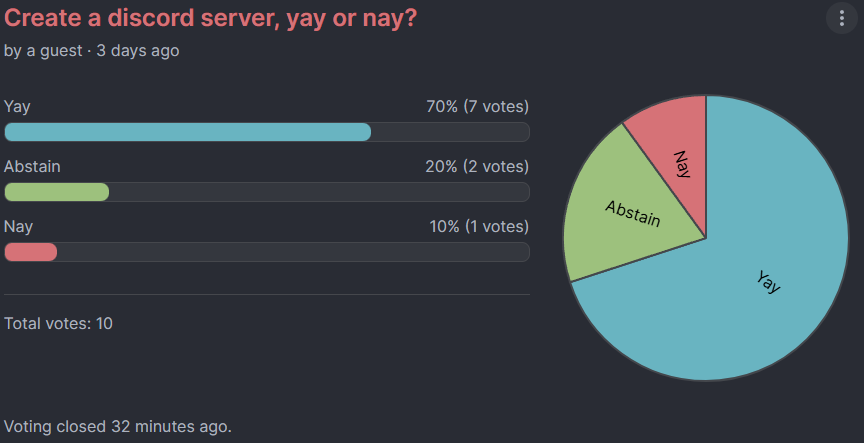
Here's the server, whoever wants to join is free to do so.
🥁🥁 Brrrrrrrr ba-dum chsh! 🥁🥁


With 9 (7 Yay + 2 Abstain) out of 12, 75% are in favor of making a discord.

Your will shall be doneSoon™.
Next weeks gm post isnt gonna be like the others, since I will be away with family for Christmas. Y'all will still gain base conviction for posting but any creations will be tallied in the next gm post after it. Take it easy lest you run out of conviction!
© 2007-2026
BBCode Cheatsheet