
Avatar of Vec

Status

User has no status, yet

Bio

Just as humans grow and change with time, interests change as well. I wish I had the urge to roleplay like I used to...

Most Recent Posts

@Theyra Are you sure about this decision? I did not do this to force you to quit, I did it because I knew it's an easy enough plot hook to create something for your character to strive for. You can find more humans everywhere, and since you didn't actually spend conviction on the sanctuary itself, you can use the 'destruction' as a catalyst/plot point for your new posts.

As for the conviction cost in general, if it's not covered in the divine reference guide, you can ask me here or in DMs for clarifications.
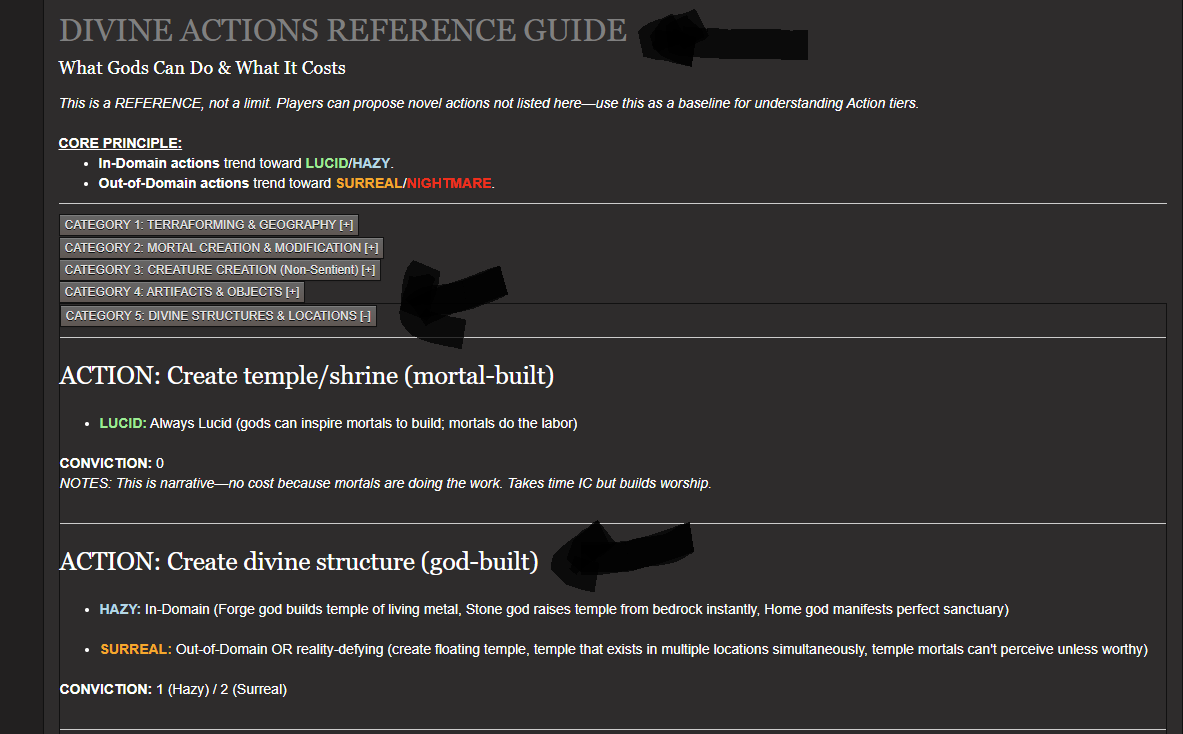

In this case, because it is out-of-domain for arstus, creating the sanctuary would be a surreal action, 2 conviction cost. However, since you had used the North Star as a guiding beacon for it, you could argue that it is connected to the Stars domain, so that would bump it down to 1 conviction, Hazy tier. You'd just need to spend a post or a part of a post actually describing the creation of the thing and not just off-handing/off-screening it.
Soon, I will be making a sweep of the IC and cataloguing significant locations/items of note and putting them in the char tab 0th post. If any one of you guys want to make my life easier, you can gather your own creations into separate hiders under your character sheets, but don't feel obligated to do so. I will get to everything in due time.
So I have been approached once again with concerns about communication.

Last time people did not come to a clear vote about creating a discord server.

Now, 20 days later, have the people changed their minds?
Please vote: https://strawpoll.com/GPgVYbv3vna
@Theyra The sanctuary, which you spent no conviction and no time creating IC, was destroyed by an earthquake and volcanic eruption. The humans were also killed. The North Star is a 2 conviction cost Surreal Action that creates a new terrain feature that is large and permanent.

sorry for the wait, it was a long one

Time moved differently for gods than for mortals. What felt like a breath to the divine spanned days for those who walked the earth. The world of Ashuru, young, unfinished, and volatile, continued its chaotic maturation under the watchful eyes and careless hands of its pantheon.

The Storm Birds had grown bolder, their flights carving patterns across increasingly unpredictable skies. The Hollow Tree stood as a silent beacon, its roots spreading deeper, its presence a magnetic pull for all things living and dying. Mortals multiplied, scattered, adapted. Some built. Some wandered. Some died. The crystalline roots pulsed with urgency beneath the surface, their light bleeding through cracks in the stone, though few noticed.

The rain still fell, but mortals had learned to work beneath it, to kindle fires in sheltered places, to drape hides over their shoulders against the chill. Already, the Me of Clothing had divided them: some tribes wore elaborate wrappings of dyed hide, marking status and kinship, while others remained bare-skinned, calling the clothed ones "soft."

In the warmth of cook-fires, families gathered to roast meat and soften roots, discovering that flame transformed bitterness to sweetness, toughness to tenderness. The Me of Cooking had made them linger longer at their hearths, speaking more, sharing more, becoming more.

In the forests and meadows, a new fungus had spread with unnatural swiftness. The Lullaby Shrooms grew in clusters near mortal settlements, their golden caps catching firelight, their midnight stems blending with shadow. The unwary tended to fall asleep mid-stride, only to wake hours later with no memory of dreaming. The bold had eaten them raw and seen visions that blurred the boundary between sleep and waking. Some spoke of walking through impossible landscapes, of hearing voices that tasted like colors.

The wise had learned to cook them first, and in doing so had discovered lucid dreams, journeys through inner worlds where a mysterious figure sometimes watched from the periphery. A few elderly ur-humans had begun pilgrimages to groves where the shrooms grew thickest, seeking the guidance of Sirna, though they did not yet know that name.

Deep in the ancient forests where Thornsteel vines had first taken root, something had been changing. Mortals who ventured into certain groves reported paths that seemed to appear overnight, not cut by mortal hands, but shaped, as though the forest itself had decided to allow passage. The routes wound between massive trees, over moss-covered stones, around dense thickets that would have been impassable otherwise.

Some followed these paths out of curiosity. Others, driven by desperation, fleeing violence, seeking refuge, searching for meaning, found them almost by instinct.

The way was not easy.

In those early days before the world broke, the paths had been merely difficult: steep climbs, treacherous stream crossings, dense undergrowth that tore at skin and clothing. But after the cataclysm, they became something more. Landslides blocked sections, forcing travelers to scramble over unstable scree. Tremors opened sinkholes that hadn't existed the day before. Predators, displaced by the geological chaos, prowled the routes hunting easy prey.

The Thornsteel vines grew thicker along these paths, their beautiful metallic blooms concealing thorns that could pierce leather and flesh alike. At certain points, places that felt heavy with significance, though mortals couldn't say why, the vines bloomed deep crimson, as though watered by blood that had never been spilled there.

Yet.

Those who persevered found themselves at the edge of a clearing that definitely hadn't existed on any previous expedition. Trees formed a natural palisade, their trunks growing so close together they created walls. Thornsteel vines wove between them, beautiful and deadly. Beyond, glimpsed through gaps in the living fortress, were structures of wood and stone that seemed both crude and elegant, temporary and eternal.

No mortal had yet reached the center. But word spread: there was a place in the deep forest where someone, or something, waited. A sanctuary, perhaps. Or a test. The paths called to certain souls, and those who answered knew they walked toward a destiny written in blood and sacrifice.

Beneath Ashuru's surface, in the deep places where light had never reached, Khthon's treasury lay hidden. Veins of native copper wound through stone like frozen lightning. Nuggets of silver glinted in cave walls. Platinum hid in scattered deposits, so rare that mortal hands wouldn't find it for generations. And gold, beautiful, perfect gold, traced delicate patterns through bedrock, creating art that would never be seen.

Deeper still, ores waited: magnetite and hematite that would someday yield iron, bauxite pregnant with aluminum, sulfides and oxides holding lead, mercury, tin. And everywhere, scattered like divine tears, gems caught what little luminescence filtered down from the crystal roots. Diamonds bent nonexistent light, sapphires blue as the drowned sky, quartzes in every hue, opals that seemed to hold fire within ice.

It was a hoard beyond measure. And it did not wish to be found.

The first discoveries were accidents. An ur-human digging for grubs broke through into a small cavity lined with glittering green copper carbonate. Another, seeking shelter from rain, found a cave whose walls sparkled with tiny quartz crystals. A third struck a stone while knapping and revealed a gleam of native gold, a nugget no larger than a fingernail.

The fortunate few who made these discoveries felt something shift in their hearts. The copper-finder began hiding their discovery, telling no one, visiting it daily just to look. The quartz-cave discoverer tried to pry crystals from the wall and was buried when the ceiling collapsed, killing three members of their family. The gold-finder clutched the nugget constantly, grew suspicious of everyone, refused to trade or share, and was eventually murdered by their own tribe for behavior that had become increasingly erratic.

Other expeditions into caves seeking these wonders met with inexplicable difficulties. Tunnels that seemed stable would collapse after the explorers passed, sealing off potential treasure. Veins that appeared rich from initial exposure would crumble to worthless powder when struck. Deep shafts would flood from sources that shouldn't have existed, driving miners back to the surface.

The earth was generous with its treasures, it seemed, but only on its own terms, and never without price.

Some ur-humans began to whisper that the stones themselves were alive, or that something ancient guarded them. They weren't entirely wrong. Khthon's essence permeated his hoard, and while the god slumbered or wandered, his domain remembered: these treasures were his, created for his pleasure, meant to rest hidden in the deep dark places where beauty needed no witness.

The earth was jealous. And the earth did not share easily.

Moren's pact with the Hollow Tree had borne fruit—or perhaps shadow.

Mortals, elderly and wounded and sick, felt the pull. They walked, often without conscious choice, toward the great tree at the heart of the forest. They arrived. They rested beneath its branches. They died peacefully, their essences crossing over to Moren's Afterlife, while the tree drank a sip of their vitality.

The tree had grown larger. Its bark, once merely pale, now gleamed faintly in moonlight. Its roots spread faster, farther, deeper. Fungi bloomed along its trunk—not Lullaby Shrooms, but something older, darker, symbiotic.

Animals, too, came to die beneath its boughs. The forest floor around the Hollow Tree was littered with bones, all arranged in neat spirals, as though the tree itself was organizing them.

Mortals began to leave offerings: tools, food, woven grasses. They did not know if the tree was a god, a guardian, or simply a place, but they knew it was sacred.

The tree did not answer. It only grew.

In the night sky, a single star burned brighter than all others. It did not move. It did not waver. The mortals called it the Unyielding Eye, or the Promise-Star, or simply the Guide. One tribe, grief-stricken and desperate, followed it for days, leaving behind the corpse-strewn grounds where wildlife had culled their numbers.

They walked with purpose born of faith, carrying their wounded, singing songs to keep the Guide watching over them, their only knowledge of their destination being that of a sanctuary promised by an otherworldly being.

For seven days they traveled. On the eighth, the Guide brought them to a vale nestled against the knees of the mountains themselves—a place where stone met earth in a natural amphitheater, open to the sky yet sheltered from the worst winds.

A spring ran clear from between the rocks, pooling into a lake that reflected the stars. Natural corridors of stone formed defensible choke points at the vale's three entrances, narrow enough that a handful of defenders could hold against many. The cliffs rose steep on two sides, offering protection and, if needed, watchtowers that could be carved from the living rock. There was space enough for hundreds of families, perhaps thousands if they built upward into the mountain's embrace.

They wept with relief. The elders declared this was the promised sanctuary, the place where they would no longer run, no longer cower. Within hours, they had kindled fires. Within days, they began to dream of permanence—of walls reinforcing the natural gates, of terraced gardens climbing the lower slopes, of children who would grow knowing safety rather than flight.

The ground betrayed them on the thirteenth night.

It began as a tremor, almost gentle, like the breath of some sleeping titan beneath the earth. Then came the roar—not from above but from below, from the very bones of the world. The mountains, their promised guardians, convulsed. Boulders the size of houses tore free from the cliffs. The stone corridors they had praised for their defensibility became killing chutes, funneling avalanches of rock onto families huddled in what they believed was shelter. When the first volcano crowned the nearest peak with fire, most of the tribe was already buried, their songs to the Guide still frozen on their lips, their sanctuary transformed in moments into a tomb of broken stone and ash.

Deep in the crystalline cavern, Excelsis watched as the great bell trembled.

The script, already difficult to read, had grown more fragmented. The percentage—66% at their last observation—had begun to flicker. 66%. 65%. 64%. 63%. Each downward tick accompanied by a resonant hum that vibrated through the gods' very essence.

Excelsis extended a tendril toward the bell, seeking to understand. The script rewrote itself before his eyes: STABILITY… CRITICAL… DEGRA... ACCELERATING… WISE… INTERVENTION.

Then the countdown lurched.

66% → 58%.

The bell rang once—a deep, mournful toll that echoed through every cavern, every crystalline root, every hidden place in Ashuru. The sound was felt rather than heard, a vibration that spoke of wrongness, of damage, of a wound torn deep. Deep inside Excelsis' mind one thought had quickly taken form: whatever was happening, it was happening now.

The negotiation took minutes. The consequences would last forever.

Khthon provided a copper blade; Sarhush created the first pickaxe, mounting it on wood harvested from the surface. Together, they descended beyond depth, beyond darkness, beyond any place that life should have existed.

And there, in a cavern beneath the ocean floor where the weight of the sea pressed down on stone like the judgment of reality itself, Sarhush struck the first blow. The ceiling cracked. Khthon widened the fissure, his power over stone and earth turning a crack into a chasm, a chasm into a catastrophic failure of structural integrity.

The ocean found the wound, and began to pour.

Water crashed into the cavern with the voice of a god screaming. The roar was so vast, so overwhelming, that it ceased to be sound and became pure force, pure violence, pure existence asserting itself against the void.

Sarhush barely escaped, his divine essence nearly scattered by the apocalyptic flood. Khthon pulled him deeper through solid stone, phase-shifting through bedrock as the water chased them down, filling every passage, every cavity, every space that had been empty since the world's creation.

Above, on the surface, mortal tribes looked up from their fires and daily struggles to see the horizon changing.

The ocean was leaving.

At first, it was subtle: tide pools that didn't refill, beaches that extended a few feet farther than they had the day before. Then it accelerated. The waterline retreated visibly, hour by hour, revealing seafloor that had never seen light. Former islands became connected by bridges of exposed seabed. Tide pools became dry depressions. Coral reefs emerged into air and began dying immediately, their brilliant colors fading to bone-white.

The ur-humans who lived near the coast watched in uncomprehending horror. Some tried to follow the water, walking out onto the newly exposed ground, gathering flopping fish and stranded sea creatures for an unexpected feast. Others fled inland, convinced the world was ending.

They were partially correct.

The draining continued for three days. When it finally slowed, Ashuru's geography had been fundamentally rewritten. Where once had been vast oceans, now only a few shallow inland seas and saltwater lakes remained, pooled in the deepest depressions of the former seabed. The islands, every single one, were now connected by exposed land bridges of silt, sand, and bizarre formations of coral and crystallized salt.

The world had more land. Sarhush's vision had succeeded. But, unfortunately, they weren't finished.

Deep beneath the transformed world, in spaces now flooded with displaced seawater, Sarhush and Khthon enacted the second phase of their bargain: they built a furnace.

Not a simple fire-pit, but a structure of divine ambition: massive chambers carved into the deepest bedrock, chimneys bored through miles of stone to carry heat upward, a construction that defied every natural law and most unnatural ones. The architecture was primitive and perfect, crude and cosmic, exactly what two gods working at the limits of their domains could achieve.

But they had no fuel.

Khthon solved this with characteristic pragmatism. He reached upward through the stone, extending his consciousness to the surface where Sarhush's fires had burned forests to ash and charcoal. He gathered those remnants: every burnt tree, every ember, every fragment of organic matter that fire had reduced to carbon. He compressed them through geological forces that should have taken millions of years, crushing the ash beneath the weight of his will until it became coal, lignite, dense black fuel that held the star's energy in chemical bonds.

He pulled it down into the furnace in vast quantities. Enough to burn for ages. Enough to melt the world.

Sarhush kindled the fire.

It caught immediately. Coal ignited in divine flame, heat blooming in the darkness like a newborn star trapped beneath the earth. The temperature rose: hundreds of degrees, thousands, climbing toward the threshold where stone itself surrendered its solidity and flowed.

The first magma formed three miles below Ashuru's surface.

Then deeper. Then everywhere the heat could reach.

The bedrock melted. Liquefied stone began to move, convecting in vast currents, seeking routes upward toward lower pressure and cooler temperatures. The furnace chamber became an inferno, then something beyond an inferno, a place where matter existed in states that had no names, where heat and pressure rewrote the rules of what could exist.

Khthon and Sarhush stood at the edge of their creation and simply... looked. They gazed upon the world as Khthon's crust splintered, tectonic plates forming and slowly moving under a sea of molten rock, causing unmitigated disaster to the surface whilst, deep underneath, a possibility that Ashuru might tear itself apart from within slowly bloomed.


The world screamed.

Every god felt it simultaneously—a psychic shock that transcended distance and domain, a sensation of fundamental wrongness that no divine being could ignore.

On the surface, the ground began to shake.

It started as a subtle vibration, the kind that might have been dismissed as a strong wind or distant thunder. Within minutes, it intensified to tremors that knocked ur-humans off their feet and sent animals fleeing in every direction their instincts suggested might be safe. There was no safe direction.

The earthquakes came in waves, each stronger than the last. The newly exposed seabed buckled and cracked, ancient coral formations shattering into powder. The landmasses that had existed since the world's creation developed fissures, some wide enough to swallow entire tribes. Mountains that Khthon had so carefully shaped groaned and shed avalanches of stone.

Then the volcanoes began.

The first eruption burst through the ocean floor—or what had been the ocean floor before the draining. Magma found the path of least resistance through fractured stone and punched through to the surface in a column of fire and ash that rose miles into the sky. The newborn volcano screamed its existence with pyroclastic flows that raced across the empty seabed, consuming everything organic they encountered.

A second volcano emerged from a mountain in the south, its peak simply exploding outward as pressure from below found release. Lava poured down its flanks, a glowing river that ignited forests and sent massive plumes of smoke spiraling into the atmosphere.

A third. A fourth. A dozen volcanic vents opening across Ashuru's surface like wounds weeping fire instead of blood.

The sky began to darken. Ash and smoke from the eruptions caught the winds and spread, creating a pall that dimmed—whatever already pale—sunlight the sun emitted across entire regions. Rain began falling again, but now it was black, acidic, carrying volcanic particles that burned skin and poisoned water.

The climate fractured. Regions that had been temperate became furnaces as hot ash settled on the landscape. Others, deprived of sunlight by the ash clouds, began to cool rapidly. The displaced ocean water tried to redistribute itself, creating massive flooding in some areas as underground rivers burst to the surface, while leaving others in drought as water tables collapsed into the new subterranean sea.

Mortals died by the hundreds. Entire tribes were erased—buried under ash, consumed by lava, drowned in sudden floods, crushed by earthquakes. The ur-humans who survived fled in every direction, creating the first great migrations as they sought land that wasn't actively trying to kill them.

And through it all, the gods watched what hubris and collaboration had wrought.

Across the world, the crystalline roots—those strange, ancient growths that predated the gods themselves—reacted.

In the caverns where the glowing roots grew, something unprecedented occurred. The roots, which had been spreading with patient inevitability since the world's creation, suddenly pulsed with frantic energy. Their luminescence spiked to near-blinding intensity, then dimmed, then spiked again in irregular rhythms that suggested distress or damage or both.

Some roots cracked. The sound was like glass breaking on a cosmic scale—sharp, final, wrong. Where they fractured, the glow leaked out like liquid light and dissipated into nothing, leaving dead crystalline formations that would never grow again. Light bled from the cracks—not the steady glow mortals had grown accustomed to, but something desperate, panicked, dying.

In a few locations, entire root networks shattered. The caverns they illuminated plunged into darkness. Mortals sheltering in those caves fled, screaming of the lights going out, of the world coming to an end.

Other roots seemed to convulse, writhing in ways that stone should not move, as though trying to pull away from sources of pain. They redirected their growth away from the new volcanic vents and fissures, shrinking back from heat that even they could not tolerate. Some grew brighter, hotter. They burned to the touch. The stone around them began to soften, to melt, to change.

But a few roots did something stranger. They grew toward the magma channels, extending delicate crystalline threads into the newly molten stone as though... drinking? Analyzing? Attempting to integrate this new element into some vast network that served purposes the gods could not fathom?

The roots' purpose remained unknown. But their distress was undeniable. They had seemingly existed since before the gods awakened, growing in patient silence. Now they screamed in the only language they had: light and darkness, growth and death, patterns that might be warnings or might be the simple reaction of living stone to a world that was breaking.

When the ocean drained, it left behind more than empty seabed and dying coral. Scattered across the newly exposed terrain—particularly in the areas that had been deepest water—lay shapes that gleamed with unnatural geometry.

The Knowledge Golems, beings formed from the fragments of the shattered Patron that Excelsis had pushed to self-destruction, had been living in the ocean depths, slowly coalescing into ambulatory entities of pure information. The draining had beached them, leaving them high and dry in an environment they were catastrophically unsuited for.

They did not die. Death might have been kinder.

Instead, they lay inert on the salt-crusted ground, their forms flickering between states of matter and concept, trapped in some liminal space between function and failure. When gods approached them—and several did, drawn by curiosity or concern—they found the golems completely unresponsive to divine will.

The gods learned quickly: the golems could not be moved, could not be activated, could not be destroyed without risking the loss of whatever knowledge they contained. They had become obstacles, monuments, mysteries.

Mortals, however, could approach them.

Brave or foolish ur-humans who ventured onto the transformed seabed found the golems and, having no context for what they were, treated them as they would any strange object: with curiosity, fear, and the universal urge to poke things with sticks.

When struck, the golems did nothing. When touched with bare hands, they sometimes flickered, their surfaces rippling like disturbed water, occasionally projecting fragmentary images or sounds that meant nothing to primitive minds: mathematical formulae that wouldn't be invented for millennia, historical records of events that hadn't yet occurred, philosophical treatises in languages that didn't exist.

The information remained locked within. But now it was accessible, in principle, to mortal rather than divine hands. The gods withdrew, frustrated and uncertain. The mortals remained, gradually building settlements near some of the larger golems, treating them as landmarks or nascent deities or simply convenient windbreaks in the harsh new world.

The golems waited, inoperable and patient, for someone capable of understanding them.

The weeks following what the surviving mortals would come to call 'the Cataclysm' were defined by survival and adaptation.

Mortal populations, devastated by the geological catastrophe, clustered in whatever safe zones they could find. Some gathered near the beached Knowledge Golems, finding the transformed seabed relatively stable compared to earthquake-prone forests or volcano-threatened mountains. Others fled to the Hollow Tree which, by some strange miracle, had subconsciously erected a barrier that shielded itself and a wide, spherical area around itself from the ensuing destruction.

A few brave or desperate tribes attempted the bloodied paths to Adria's fortress, seeking refuge in the deep forests. Most died in the attempt—crushed by earthquake-triggered landslides, impaled on Thornsteel thorns jutting from the graves of the previous fallen, lost in caves that hadn't existed before the world broke. But a handful survived, crawling bleeding and exhausted to the edge of the fortress clearing, where they found... well, that would depend on what Adria chose to do with them.

The dream-shamans who had been experimenting with Sirna's mushrooms found their visions growing darker, more urgent. The fungus thrived in the post-cataclysm world—ash-enriched soil and abundant death creating ideal growing conditions. But the dreams they induced now carried undertones of warning, glimpses of a vast consciousness hovering on the edge of awareness, a sense that something immense was watching with increasing attention.

The treasures in the earth remained jealously guarded, but the earthquakes had exposed new deposits, created new cave systems, revealed veins that had been too deep for mortal discovery before. The brave and greedy descended into the changed underworld, seeking wealth despite the obvious dangers. Most didn't return. A few came back with copper nuggets, silver flakes, tiny gems clutched in trembling hands, their eyes haunted by what they'd seen in the deep dark places.

Khthon's domain had expanded dramatically—the new magma system, the flooded underground seas, the fractured cave networks all fell under his purview, whether he wanted them or not. Sarhush had his land, thousands of square miles of new territory for civilization to claim. But both gods looked at what they'd wrought and felt... something. Pride? Horror? Satisfaction? Regret?

Perhaps all of the above.

The other gods watched and judged and adapted. Some might approved of the bold action, seeing it as necessary world-building. Others might be horrified at the destruction and chaos. Most might simply accept it as done and start planning, instead, how to work within this new, wounded world.

The Storm Birds, their ocean habitat drastically reduced, migrated inland in massive flocks, seeking the new lakes and rivers. Their presence brought rain to regions that had been drying out from ash-induced drought, inadvertently saving mortal populations that would have otherwise died of thirst.

Life continued. It always did. But the world had been permanently changed, marked by divine ambition and geological violence into a new configuration that no one—god or mortal—fully understood yet. Ashuru had survived, but barely...
@Shovel It's good. Go ahead and post whenever you want :)
I wonder how this 'draining the oceans' thing will go when one dear earth god realizes he just accepted his caverns being flooded with water corrupted by Yzechr
@Legion02

I re-read your post and had an interesting idea on how we could go about integrating all this without having to alter it too much. See your DMs as this might potentially count as spoilers.
@Cyclone@Legion02

I don't agree with Legion's summary of it being 'in-domain but extreme'. The Spark is, arguably, borderline out-of-domain due to the fate-manipulation aspect. I'd recommend either removing the challenge-creation mechanism or reworking it, if you want it to be still 2 Conviction.

If you want to keep it as is, however, I would say it deserves to be upgraded to Nightmare tier because it's introducing a fundamental reality-altering system (fate/challenge-scaling) that affects how events unfold. Nightmare tier is for "actions that fundamentally alter reality's rules or introduce cosmic-scale threats. (Which in this case would be 3 Conviction and 100% Turbulence)

If you leave it as is, I would also allow it to affect all sapients currently in existence, since it would be a significant enough action to warrant this. If you leave it as Surreal (after removing the fate stuff) it will only affect latter descendants and not current humans.

The talent/obsession/transformation parts are fine—it's specifically the "subtle forces made by the larger Spark blessing" that crosses into territory Excelsis hasn't established authority over just yet.
© 2007-2026
BBCode Cheatsheet