Back when dinosaurs ruled the Earth, I got started with writing online on the Spore forums. Man, those were the days. We're talking like 12 years ago 2010-ish!
I've been here on and off for almost as long, and have GM'd a bunch of different things to varying success.
The Patron of Glory was the first to give voice to it, though Fire and Lord Hierarchy had both begun to wonder. In one moment they were traversing the burning forest together, Sarhush just ahead, but in the next things had become strange. Smoke had flowed sideways, the air had seemed bent, and the god had said something about odd noises and then vanished before them as if into nothingness.
The Patron of Fire flared as if to shrug, a brief restless surge that vanished into the greater inferno of the jungle. No ash marked Sarhush’s passing; nothing had been consumed.
“If I cannot see him, how am I to witness any great and terrible deeds that he is to commit?” Glory protested.
Lord Hierarchy stepped in, “He called us. Until that summons is revoked, we are to attend this place awaiting his return.”
So they waited for a time even as the first of the once-great trees nearby collapsed as a blackened husk, consumed by the raging flames. “You can remain then, but I won’t,” Fire eventually declared. For its parting words, it addressed the other two, “There will always be more to burn. If he should summon me again, I will answer, but he cannot expect me to wait starving atop a pile of ashes.”
Glory didn’t need to be persuaded; as glorious and awesome as the sound and tumult of a fiery log crashing into the earth could be, there was no longer any novelty in watching a forest burn. It had seen such happenings many times already, so now Glory took its leave to find something worth witnessing.
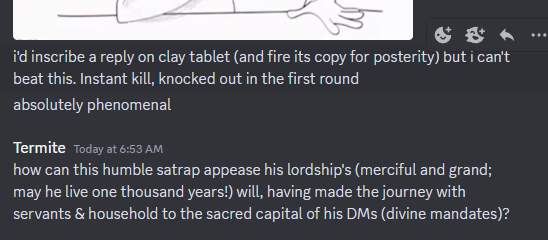
The Patron of Hierarchy remained in that place where Sarhush had vanished. More trees collapsed into ash, consumed down to blackened roots. Others smoldered, stubborn, their sap hissing and steaming as flame refused to take hold. Paths opened and closed as embers fell. The jungle was no longer a single inferno, but a field of decisions made by heat and chance.
For the first time since manifesting upon Ashuru, Lord Hierarchy attempted to resolve the situation through rule and sequence rather than mere deference to authority. It yielded no answer to the present situation. This was not proper. There should have been a contingency, a hierarchy of absence, a clear succession plan, some articulation for what should follow. Without Sarhush, there was only a wretched void that permitted no ranking.
At last, Lord Hierarchy withdrew its presence from that desolate place. The fires of that jungle continued to rage for some time, but they did so without order, guidance, or witness. Eventually the untended fires had nothing further to consume and faded to leave only an ashen landscape behind.
The reach of Kur-Laka had spread far from its origin, like redness creeping outward from a wound. It now possessed settlements too numerous to easily count. Some were independent in all but name – tributaries who paid in fear and flesh to avoid open defiance – but others were true outposts, founded and settled by those drawn from Kur-Laka’s swelling mass.
One such colony, perched at the very edge of Kur-Laka’s grasp (for now!) was called Telepylos. It was in the heart of a wild place. The surrounding hills were haunted by wraiths, prowled by beasts, and home to some scattered tribes and bands of savages that had yet to fall under the Kur-Lakan yoke.
To survive, Telepylos wrapped itself in rock. Walls hewed from unmortared stone blocks rose thick and uneven around the settlement, and passage into Telepylos was granted by a single door: a massive gate fashioned from a dozen whole logs that had been stood upright and lashed together. Lifting the gate required pulleys of strong rope and many slaves with backs that were stronger still.
Other strong-backed slaves labored beyond the walls to carve out blocks of stone from pits, the hills and cliffsides groaning under the work. Wraiths, accidents, and beasts claimed a few in the quarries from time to time, but replacements were always forthcoming. New meat was procured from cowed tribes, from the defeated enemies, or from those who had fallen out of favor in Kur-Laka. The work did not slow.
It was above one of these quarries that Glory first appeared. At dawn, those preparing for the day’s toil noticed that the light was wrong. The sunlight was there, but there was something else too, a luminance that was brighter, pulsating, and impossible to look at directly. Shadows sharpened. Stone faces gleamed as though newly polished.
Some fell to their knees in awe at the Patron. Others shielded their eyes and stared anyway, teeth clenched, tears streaming.
Glory did not descend. It did not speak. It simply hovered, suspended above the hills like a great fire that exuded white-gold radiance absent heat.
Glory descended down to one of the overseers. Nobody else heard what was said, but from that day afterward, that overseer began shouting orders of a different sort. He was not relaying commands that had been given to it by Glory, but ones that simply felt obvious and natural now. The highest point overlooking Telepylos was cleared at this one’s behest, even against the protestations of those who clamored to put the slaves to more pressing projects.
Nothing could be more pressing than this. The cliffside itself was carefully examined, measured, and marked. Stone was carved out and hauled aside. The shape came before the reason. A foot planted upon the hill. A calf, a knee, a towering thigh. Proportions were argued over fiercely, as though something precise were at stake. Slowly, the cliffside itself began to resemble the likeness of one whose name they all knew: Sarhush.
The sound of the god’s name carried strangely in the light, heavy and satisfying. The workers repeated it to one another as they hauled blocks into place. The name made the labor feel lighter. It made the cuts and crushed fingers feel seen.
Glory watched for a time, unblinking. Every utterance of Sarhush was pacifying for it too, as though this act might bring back the god from wherever he had vanished. But that was besides the point; Glory urged this great monument not to summon or beg attention from the god, but for the mere act of inspiring a feeling of exaltation. Of Glory. That was what the Patron embodied and desired and fed upon. There was endless glory to be had through the creation of a figure immortalized in stone, too vast to ignore, and too radiant to question.
At the same time, deep in the stone, fissures and stress fractures discretely made their way through the hill and the statue. For the God of the Earth, though occupied with other matters, felt the transgression of the quarries like an ache in granite bones, felt the insult of another God’s effigy carved in his hills as if carved in his own flesh.
The Earth is jealous. It does not forget, and very seldom forgives. The hills had been stripped bare to build this city, and nothing had been given in return. It would have to take back what had been taken from it, with interest. Soon, the Earth would rupture and swallow all that had been built, all that was Telepylos. It simply needed one last little push…
That push did not come for a long time. The work continued, and the slave-sculptors’ errors were punished. The carving grew more careful, more deliberate. Bit by bit, hands pared away the cliff’s face to chisel detail into the colossal form, to smooth, polish, and then glaze its surface. Never before had something of this scale been attempted. For all they could tell, the hill endured it all in silence and capitulation.
During a quarrying operation elsewhere (for construction continued still on the walls and many other projects besides!) some veins of redness were discovered: hematite ore winding through the rock like arteries laid bare. The Kur-Lakans had no concept of ores, let alone knowledge of iron, but when they saw the red material they thought of Sarhush’s gaze and knew at once that it was from this stone that they would set the statue’s eyes. So they wrenched great chunks of blood hematite from that pit, and they hauled the heavy stones uphill to the site of the colossal statue. The ground itself seemed to crumble beneath the slaves’ trembling steps, but the overseers mercilessly drove them forward. It took an entire week to raise the stones from the ground up to the statue’s sockets, and another day to set them. A dozen bodies fell from the scaffolds and were broken on the rocks below, blood mixing with the stone dust scattered across the ground and darkening it.
The glory-touched overseer looked up in pride to behold his work in the moment that it was completed, when the eyes were fixed into place. The statue towered over Telepylos, ten times the height of a man, its gaze fixed and terrible, its eyes red and unblinking.
But then the hill shifted. The sound that followed was not like thunder, but like something immense being forced to move against its will. Stone groaned and then cracked. Seams that had held for ages gave way at once. The statue lurched forward, not in a bow of admiration, but because the ground beneath it no longer suffered it to stand.
The overseer and architect of the great work died without understanding why, a stupified look upon his face in the moments before he was crushed beneath the falling statue. The great mass of rolling stones did not stop with him. The hill came down in a roaring slide of stone and dust, striking the ramparts of Telepylos and toppling them as easily as a careless hand scatters sand, rolling over and through the once-mighty walls to bury the settlement behind.
When the noise faded, the land was quiet again and Telepylos was a ruin.
When Sarhush went missing (accidentally entering the Carnival and getting drunk in the last post) his Patrons travelling buddies were at a loss. Eventually they wandered off.
This post follows what the Patron of Glory does. Kur-Laka has expanded since it was depicted last, and now has many colonies, tributaries, outposts, etc.
Glory manifests in one of its outermost settlements called Telepylos and inspires a ruling slave overseer to create something great. Something terrible. Something glorious! Countless slaves are set at a cliffside overlooking the settlement to carve a massive statue of Sarhush.
Khthon takes offense to how the people of Telepylos quarried the earth all around to build massive walls and did this; especially when they dug up iron ores to use for the statue’s eyes. So he curses the stone to be weak, and as the statue is completed, the whole hill collapses in a massive rockslide that kills the overseer and destroys Telepylos.
What were Civilization and Lord Hierarchy and Fire doing meanwhile? Find out in Future Post™!
Khthon: (lucid alteration of existing terrain, in-domain, making the hill prone for a landslide)
Sarhush had permitted that one to possess the Me of Weaving for long enough, and the Patrons had informed him that yet more of the Mes had afterward come into the hands of Oxen and his tribes. To hear the tales of Glory, Oxen had achieved much. As the Lord of Civilization, Sarhush felt both entitled and obliged to venture there in person and taste the fruits of the tree that he’d planted through righting Oxen’s path.
The journey would not be short. Hills rose and fell, rivers were stomped through, and plains unspooled beneath immortal feet. There was little to busy Sarhush’s mind save conversing with the trio of Patrons that yet remained as his travelling companions.
At one point along the way, they came upon a dense jungle. There they halted for a moment so that Fire could lob a few great fireballs and kindle a conflagration that would break this stronghold of Nature. As the canopy’s gaps became like chimneys, Sarhush reflected, “I have begun to understand fire more deeply. It is more than just something to be unleashed.”
Every tongue of fire in the eponymous Patron’s body twisted toward Sarhush’s voice at that, not quite in offense, but in rapt attention and interest. “Understanding falls short of mastery,” Fire insisted, “and shorter still of ownership or dominion.”
Lord Hierarchy scoffed, “You were compelled to divulge your secrets to him once. The order of things remembers.”
Glory, who’d been apathetic thus far, began to brighten at the signs of a possible power struggle.
“Fire is a tool, but it must be properly harnessed. Controlled.”
With a voice crackling low, Fire retorted, “You’ve seen only a glimpse of my power, and yet you think me a tool? Those that kindle me think themselves the masters for having struck the spark, but I can burn them like anything else.”
As they trekked through the burning jungle, they came upon a small stream. The Patron of Fire approached it, and the water hissed and receded from its heat. But it was not interested in the water; instead, Fire rubbed a burning hand over the black sand along the riverbank. The mineral grains glowed red and melted. Sarhush watched, fascinated by the display, as the heat quickly receded and the molten sand began to cool and solidify into a mass of slag and vitrified glass. The surface of the dirty, malformed glass still managed to gleam in places. In a few, it caught the firelight and bent it strangely into warped shapes that did not quite obey the wind.
The glassy slag cooled further still, cracking with stress in places. Fire seemed uninterested in the remnants of its work, but Sarhush stooped down to poke at the crude glass and some of its metallic inclusions.
“See? You only prove my point,” Sarhush mused aloud. “When controlled and made to linger, your touch leaves behind more than ash.”
Fire did not bother replying, its flames shifting restlessly to lean away. So they moved on through the infernal jungle, walls of fire clearing a pathway, but soon Sarhush noticed a place beneath the curve of some burning branches were the smoke was not rising upward. Instead, it drifted sideways. At first the god took that for just the work of an eddy of wind, but as he stared in stupefication, the smoke did not deviate in its course. Sarhush’s eye followed the plume of horizontal smoke. Maddeningly, in one or two places it seemed to dip down.
“Heat is meant to rise. Smoke is meant to follow cause.”
Glory seemed to just find this more droll than maddening. “It dances!” the Patron cried.
“The smoke here wanders. It rebels against the way of things,” Lord Hierarchy corrected. “Fire, what is the meaning of this deviancy?”
“I do not know,” Fire admitted.
Something was very wrong. Sarhush’s divine senses were sharp, his hearing just keen enough to hear a strange noise through the roaring of the fire and the chattering of the Patrons. He advanced toward the burning arched branch that was the origin of this anomalous smoke. As Sarhush crossed underneath it, the thing finally was overcome by fire, and it broke from the tree to fall down as a flaming heap that was as much charcoal as wood.
The strange sounds were louder now. “Do you hear that?” Sarhush asked his Patrons, but there was no response. He turned back, eyes sweeping through the treeline, but saw no signs of them anywhere. Grumbling at how they’d already scattered off to gawk at something else, he turned back around to investigate the noise.
The forest thinned abruptly, not burned away but bent aside, as if the world itself had made room. Lanterns hung from branches that should not have supported them, casting warm, shifting light over paths that curved just enough to hide where they led. Canvas stalls stood between the trees, stitched in bright colours, their fabric fluttering despite the lack of wind. The air was thick with sound: laughter, the oddly rhythmic noise that Sarhush would eventually learn to call music, the low murmur of voices overlapping in a way that never quite became loud. Everything felt inviting, like a celebration already in full swing that had simply decided Sarhush was late.
Tables lined the paths, laden with food that steamed gently and drinks that refilled themselves when set down. The smells were simple but tempting, roasted meat, sweet pastries, fruit, strong alcohol. Games were everywhere. Wheels spun, cups hid rolling tokens beneath them, boards were laid out with pieces that shifted position when no one was looking directly at them. Most were games of chance or close enough, the kind where instinct helped but never guaranteed anything.
The abundance and organization of this place was astounding. How had the mortals here managed to achieve so much without his help? There was a quick revelation in Sarhush’s heart – the fire that he’d kindled might destroy all of this before he could even witness it! – but when he turned back around, he didn’t see the approaching orange glow of the burning jungle. Come to think of it, he didn’t hear the flames’ roar, and the air was thick with the smell of roasted meats with hardly a hint of woodsmoke.
Beyond the stalls, the Carnival stretched deeper, lights growing brighter and shadows thicker in equal measure. Performers moved through the crowd, some clearly mortal, others harder to place, all smiling a little too knowingly. No one rushed Sarhush, no voice called out to him directly, yet everything seemed arranged for his benefit. A drink always within reach, a game waiting to be played, a path opening just ahead of him. And as the denizens of this place came close to him they made way, but they did so without the terror and reverence that he’d come to expect of mortals.
Kaelinor noticed the shift before he noticed the god. The Carnival always reacted first, a subtle tightening of its laughter, a pause in the music like a breath drawn in. Then he felt it properly, the weight of something vast entering the Carnival. He straightened from where he’d been leaning against a stall, grin already forming, eyes bright with interest. “Oh,” he murmured to himself, “this one’s tall.”
Sarhush adapted quickly, despite the disorienting press of unfamiliar sounds and motion. There was an earthen mug that sat upon a table, seemingly unattended, and filled nearly to the brim with some dark fluid. The god lifted up the clay cup to sniff at its contents suspiciously, and his nose wrinkled at the vigor of its strange aroma. He set the draught down without tasting any of it, then walked to another table nearby where a great many people were gathered. Stepping right to the edge and towering over them all, he interrupted their game to lean over the table with a presence dominating enough to demand the full attention of all its patrons.
He slipped through the crowd with ease, people parting without quite realizing why, until he stood beside Sarhush, craning his head up theatrically. The Fae looked him over once, twice, then let out a low whistle. “You interrupt a game without placing a bet,” Kaelinor said cheerfully, voice carrying just enough to cut through the murmurs. “Bold move. Terrible etiquette. Very memorable.” He tapped the edge of the table the god had commandeered. “Points for confidence, though.”
Sarhush squinted at the one that had appeared next to him as if he’d always been there, with a familiarity that none had ever dared. “What is this place?” he asked of everybody around that could hear: Kaelinor, the patrons of the table, the faceless people milling around between the tents.
At the question, Kaelinor laughed, like bells shaken by hand. “What is this place?” he echoed, as if savoring the words. “Depends who’s asking. To some, it’s the best night of their lives. To others, it’s where bad decisions go to stretch their legs and ask for seconds.” He leaned in conspiratorially. “Officially, it’s the Carnival of Alechior. Unofficially, it’s where chance goes on holiday and forgets to come back.”
He finally offered a bow, exaggerated, sweeping enough to be half mockery, half genuine respect. “You’ve wandered into the party that never ends.” Kaelinor finished, eyes sparkling up at Sarhush. “Stay long enough and you might even enjoy yourself.” He flashed a grin. “Careful though. The longer you stand around asking sensible questions, the more the Carnival starts asking questions right back.”
Kaelinor tilted his head back at Sarhush, eyes bright and added, “Ah, the Carnival, a place where chance dances, luck comes and goes and every soul brings something to the table,” then he leaned in just enough to be friendly, adding, “some bring new foods, some alcohol, some bring stories…and some, it seems, bring an atmosphere so strong it arrives a moment before they do–and lingers.”
“Civilization leaves its mark,” the god agreed, mistaking the slight for praise. To punctuate that declaration, he hefted the great sack that hadn’t left his hand in days. The bag that held so many of his Mes rattled as he placed it atop the table, claiming half its space by right. The god determined to still himself for a while and make sense of all that was around and all that was said.
Kaelinor’s laughter burst out. “Oh, civilization,” he echoed, savoring the word like a sweet that had gone slightly sour. “You gods do love that word. Always sounds so heavy when you say it, like it ought to thud when it hits the ground.” His eyes flicked to Sarhush with open amusement, not mockery exactly, more like delight at a familiar tune played slightly off-key.
Then his gaze dropped, brazen as a stage spotlight, to the immense sack claiming half the table. Kaelinor let out a low, appreciative whistle. “But that,” he said, grinning wide, “that is a sack worth singing about. A proper big sack you have! Truly heroic. You must get terrible back pain hauling something that…substantial around.” He waggled their brows, unapologetic, the joke landing with the ease of someone who had thrown far worse jokes.
Sarhush’s gaze swept across the Carnival again, the noise of Kaelinor’s babbling fading into irrelevance. The abundance of this place was somehow more nauseating than the camp of Ur-Kur-Laka had been, but at least here there was vigor rather than a multitude of languid figures whiling away their times in between trash heaps. After a few moments, realization settled in with a subtle grunt. It was impossible that mortals left to their own devices, and bereft of his guidance and Mes, could have wrought a place so maddening. The revelation did not sit well with him. This was all surely the work of a god, perhaps that ’Alechior’.
“I am Sarhush,” he eventually declared. Nothing more was needed for introduction, for his reputation surely preceded him. “But just who might you be?” He paid no heed to the cryptic warnings of reciprocal questions to come. The little prattler beside him seemed anything but divine, but that did not mean that he was entirely devoid of power. “You speak for this ‘Carnival’ and these people, or are you only a part of the din?”
He hopped up onto a nearby stall, striking a flourish so exaggerated it bordered on parody. One foot kicked out, arms spread. “Kaelinor of the Laughing Turn” he announced, voice ringing like a call before a show. “Fool, flatterer, licensed nuisance and blessed to be the King of the Joybound Fae. I juggle words better than knives and knives better than most juggle their lives.” A deep bow followed.
He leaned in closer to Sarhush then, voice dropping just enough to feel conspiratorial. “Some speak for the Carnival, some are part of the noise. Me?” A shrug, bells chiming softly. “I dance between the two. The Carnival speaks when it wants to, and when it doesn’t, it lets people like me do the talking.”
With that, Kaelinor reached beneath a stall and produced an absurdly large cup, sloshing with dark, frothy liquid. He slid it across the table toward Sarhush with a flourish. “Now then, great sack-bearer,” he said cheerfully, “welcome properly. Have some of Alechior's Grog. Strong, generous and liable to make even gods feel lucky or very sorry. Sometimes both.”
How could water be ‘strong’? This ‘King’ seemed more fool than ruler, but Sarhush indulged him anyway. Naturally he harbored suspicions about the odd-smelling dark brew, but his blood burned hot enough to purge any poison, and curiosity overcame him. Sarhush’s brawny hand wrapped about the cup and overturned it, sipping slowly at first but then steadily, drinking the entirety before parting the vessel from his lips.
The god’s brazen eyes only brightened at the burst of flavor. “This is not water,” he realized aloud. The grog’s forth bubbled oddly upon his ashy tongue and between yellowed teeth, alive in a way that no other drink had ever been. A warmth kindled deep in his chest, too: this was not the searing, ravenous heat of the Me of Fire that he’d once placed in his mouth, but something gentler, like the lingering warmth of rocks bathed in the afternoon sun.
Cups and tankards were strewn across every counter in sight, crowding every tabletop. Without hesitation or thought, Sarhush seized another one in arm’s reach and drained its contents in an unbroken pull. “It is strong,” he admitted, his voice smoothed and clear. ”This water has been altered, worked into something more! This drink has been fortified.”
Kaelinor laughed again, delighted, clapping their hands as Sarhush drained yet another cup. “Oh, look at that glow,” he said, practically preening on the grog’s behalf. “That is the face of someone who has just discovered that water can, in fact, fight back.” He leaned closer, peering at Sarhush’s relaxed shoulders with theatrical scrutiny. “Careful now, mighty one. It sneaks up on you. First the warmth then the cheer then suddenly the music sounds clever.”
He straightened and gestured grandly to a nearby stall where an absurdly oversized pitcher waited, already beading with condensation. “The grog,” Kaelinor continued, voice filled with pride, “comes from the juice of trees Alechior made at the very start. Before any other trees existed. Not planted, not grown. Willed into being. Trees that learned joy before he learned roots.” He hefted the pitcher with both hands and passed it to Sarhush, whose brows had raised at the talk of willing trees into usefulness. “Fermented laughter, aged patience and just a hint of bad decisions. Have another. You’re doing wonderfully.”
Sarhush accepted the pitcher and drank directly from it, being unacquainted with the notion of one large vessel that existed only to refill smaller ones. He drained the pitcher in what seemed like a single gulp. It was rare that Sarhush was in something like a good mood, but just then he found that he was. The tumult of the music no longer seemed so jarring, while the press of the bustling crowds became easier to overlook. His shoulders had slackened too, unbeknownst to him. “What ‘games’ do you play here, while you await the arrival of order and rule?”
Kaelinor spread his arms wide, nearly knocking over a stack of dice. “Infinite,” he said simply. “If you can imagine it, someone here is already playing it or losing at it or arguing about the rules.” His grin turned sly. “Some games reward skill, quick hands, sharp eyes, sharper minds. Others care only for luck, blind and cruel and laughing as it passes you by.”
He paced as they spoke, counting on his fingers. “There are games where you throw knives at spinning targets, games where you roll bones painted with lies, games where you wager memories you will not miss until they are gone.” A pause, then a shrug. “There are games where you stand perfectly still while the world tests your patience. Blink and you lose. Breathe wrong, and you lose.”
Kaelinor chuckled, softer now. “Some make sense. Race the flame before it dies. Stack stones without letting them fall. Answer riddles that change halfway through the question.” He tilted his head. “Others make no sense at all. Guess which bell will ring without being struck. Bet on which shadow moves first. Compete to see who can forget their own name the fastest.”
He finished by planting himself back in front of Sarhush, eyes bright with invitation. “Here, order does not arrive. It wanders in, plays a round and usually leaves poorer for it.” Kaelinor lifted his own cup in salute. “So pick one. Or let a game pick you. Either way, the Carnival always plays fair. It tells you the rules. It just never promises they will help.”
“Order came when I entered this place,” the god proclaimed with a hiccup, but without a shred of irony. “But to think of leaving poorer! Ha!”
Sarhush used the back of his hand to wipe the foam of his latest drink off his lips. “Hear me, little ‘Joybound’ king: I am Sarhush and I am the binder of all things. I have luck; I am also clever, fast, and strong. I will win all of the games and best this place as easily as I conquer the forests!”
Kaelinor’s laughter cut clean through the smoke and music. “Leaving poorer,” he echoed, savoring the words. “Clever, fast, strong, lucky, conqueror of forests and tables alike.” He clutched his chest theatrically. “Oh, my King of Cups, if confidence were coin you’d bankrupt the Carnival just by breathing.”
He placed a small circle made of Fortunite on Sarhush's hand, boots tapping in rhythm with unseen drums. “You say you will win all the games,” Kaelinor went on, grin widening, “but you’ve already made the oldest mistake here. You think winning is about strength or speed or even luck.” He leaned in, stage-whispering. “It’s about timing. And punchlines.”
Kaelinor straightened, arms thrown wide as lanterns flickered brighter in response. “So let’s make it simple. No boards, no dice, no cups to hide things under.” He pointed at Sarhush, then at himself. “You and me. One joke each. No threats, no sermons, no proclamations of inevitable victory. Just wit. Whoever makes the other one laugh, wins.”
The fae bowed low, eyes gleaming. “The Carnival will judge. If you win, you walk away richer in pride and proven right.” He snapped his fingers once. “If I win, I take one of the things in your sack. I choose.” Kaelinor tilted his head, smiling. “After all, King Binder, what’s the risk, if you’re so certain you’ll never leave poorer?”
Sarhush’s eyes glowed red in the Carnival’s torchlight as he pondered that proposal. “You would make a game of this without even knowing what is inside?” He turned over the fortunite in his palm before placing it beside the growing heap of his emptied grog-mugs.
“You’ve hazarded nothing of your own,” he went on with a scoff, “...so it makes no difference to you. Hardly sporting.”
Silence stretched as he ruminated, but then the start of a wolfish grin tugged at his lips. ”But I am a generous god!”
He pushed off the table that he’d been leaning upon and shuffled back a pace, eyes leering as they roved the Carnival. His gaze fell upon a tablecloth splayed nearby. Sarhush chugged the mug of grog that rested atop that table, for he was not wont to waste, and then wrenched the whole cloth away to let the emptied vessel clatter to the ground. He cast bundled fabric upon the table beside his sack of Mes and began tearing off strips of it with his bare hands, as easily as mortal hands might peel fruit. “Go on,” Sarhush dared, his fingers still working, ”make me laugh.”
Kaelinor clapped once, delighted. “Ah. Of course I wager nothing,” he said. “That’s gambling at its purest. You didn’t wager anything either when you taught fire to hands that only knew how to grab. You simply assumed the world would learn to burn properly.” He gestured vaguely outward, as if forests turning to ash were an amusing footnote. “And look at that, it did.”
He leaned in conspiratorially, lowering his voice as if sharing a secret only gods could appreciate. “Most beings gamble hoping to win. You gambled assuming you already had. Burn the forests, yoke the weak and call it progress. Either it works and proves you right or it fails and proves the world was unworthy of your ideas.” Kaelinor smiled. “Heads or heads. A flawless system.”
Sarhush’s brows rose, but his hands never paused their work. Now he was twisting and knotting the cloth to some ends. “Word of my glory precedes me,” he remarked, glancing up only briefly. As Kaelinor went on, Sarhush turned away again. He reached for a nearby platter, seized a leg of roast meat, and stripped it apart with his fingers, piling the greasy shreds beside the cloth. The bare bone he lifted to his mouth and cracked between his teeth. From the splintered length he tore free a thin shard, sharp and long, and set to shaping it into a needle.
Kaelinor meanwhile spread his hands, laughter bubbling up. “That’s what I admire most. Others invent rules to protect themselves from loss. You invented civilization so losing would become illegal.”
He nodded toward the sack at Sarhush’s side, then toward the crowd. “Even now, everything around you is proof that the joke landed. People didn’t ask whether they should. They asked how fast they could keep up.”
Kaelinor bowed deeply, theatrical and sincere all at once. “So go on, great Sarhush. Laugh. You already won the punchline ages ago.” His eyes gleamed. “This game is just applause with witnesses.” As if on cue, laughter around them seemed to explode and even the patrons at other tables were lifting their drinks towards the two. Even as the crowd’s raucous guffaws reverberated all around, Sarhush did not join in. Their laughter washed against him, but he remained as hardened and unfeeling as a stone tossed into a bonfire.
The god continued his craft. A twist of the cloth created something that resembled a head. A long, narrow scrap looped and cinched until it suggested a grin far too wide for its face, a grin that Sarhush fixed in place with the bone needle. He held the crude figure up at arm’s length, studying it with a flicker of drunken mirth.
“Do you see a resemblance?” he asked the crowd, or Kaelinor, or perhaps even himself.
Deciding to do more, he brought the doll back to continue. His fingers worked not quite deftly, but decisively. The cloth twisted, folded, knotted. The makeshift doll’s limbs were pulled too long, then shortened by tearing rather than cutting. He spat into his palm and smeared the dampness across the thing’s face, pressing in two hollows with his thumbs. “But I have little patience for the gutless,” he explained as he scooped up the stringy, half-rendered scraps of meat he’d torn off the bone. He crammed them into the open fold of the doll’s abdominal cavity to represent entrails, then sewed it shut there.
“The smell isn’t quite right.” He found another mug of grog beside his elbow; he dumped half the fluid onto the doll to soak into the cloth as a sort of blood, then drank the rest in a single gulp.
His fingernails dug into the table to pry free little chunks of wood. He pressed those into the eye-hollows on the doll’s head and tied them down with loose threads, and then finally leaned back. The macabre product of his craft was unsettling, but by some mix of skill or drunken luck, he’d fashioned the doll with an uncanny likeness to Kaelinor.
“Look,” he rumbled, voice thick with mockery, “here, we have a king of laughter. Of joy!”
He bobbed the puppet once, making it bow. Then he bounced it again, making it wobble as though dancing. The lantern light caught its folds and cast a jittering shadow across the table. “He thinks civilization is a trick, something clever that twists defeats into victories.” Sarhush twisted the doll around so that its sagging grin of grog-drenched cloth faced the crowds. “Civilization is fire! And is not the whole of Ashuru dry enough to burn?”
He sat the doll down upon the tabletop and reached into the sack of Mes. He did not rummage; his hand returned, closed tight, at once. Wisps of smoke escaped from the gaps between his fingers.
He turned his fist over and opened it to reveal a hot coal that was the Me of Fire resting upon his palm. “All that is within that sack are my gifts to mortals,” he explained, “so I gift fire to the little king!”
With the neat motion of one finger, he flicked the little coal off his hand. It landed perfectly atop the doll. Grease, grog, and fabric began to smoke and smolder.
Kaelinor watched the construction with his head tilted, hands folded behind his back, eyes tracking every crude adjustment with open, almost childlike focus. He nodded once as the head took shape, again at the too-wide grin, a third time when the entrails were stuffed and sewn in. Not impressed, not repulsed. Merely attentive, the way one humors a toddler proudly holding up a misshapen carving. “Mm,” he murmured, approving in the most minimal way. “You didn’t rush it.”
When the likeness became undeniable, Kaelinor leaned closer, inspecting the doll as it burned and smoked. His expression softened, thoughtful rather than amused. “I see what you were reaching for,” he said calmly. “The posture is there. The confidence. You even caught the way I stand like I expect the room to listen.” He tapped one elongated finger against his chin. “That part’s clever.”
He straightened as the coal bit deeper, fabric darkening and curling. “But it’s unfinished,” Kaelinor added, tone gentle, almost apologetic. “Fire alone isn’t enough. Fire just destroys. Anyone can do that. You taught that lesson early.” He gestured vaguely, as if forests turning to ash were common knowledge. “This little thing doesn’t react. It just burns.”
Kaelinor smiled then, small and knowing, eyes flicking back to Sarhush. “If this were meant to be me, it would have laughed. Or danced harder. Or tried to bargain with the flame.” He shrugged lightly. “As it is, it just sits there. Quiet. Weak. A prop, not a punchline.”
He gave the doll one last look, then dismissed it entirely, attention returning to Sarhush with an easy confidence. “Still,” he said, pleasantly, “nice effort. For a beginner.”
Sarhush crossed his arms and said nothing in return. The weight of his mute stillness was so potent and oppressive that others, even those not arrayed around the table, took notice. For five tables all around, laughter was smothered. The loud chatter and gossip thinned to anxious murmurs; breaths were held. Sarhush remained silent for what felt like a long time even as he stared at Kaelinor.
Beneath the Me of Fire, the doll on the table between them began to change. The grog, the spit, and the meat juices that stained its fabric began to heat, and soon they boiled and hissed. Steam forced its way out through seams and stitches in thin, shrill bursts. The sound rose and fell, uneven, almost rhythmic.
The fabric blackened where the coal rested, then sagged. The Me sank slowly into the doll’s stuffed belly, its heat softening the knots and stitches from within. Small flames crept up along the soaked threads. As the cloth tightened and the packed meat expanded, the doll jerked. Once. Then again. Its limbs twitched in short, frantic motions, tugged by heat and pressure rather than will.
The doll’s grin held, and the thing danced as long as the fire allowed. “Once I thought fire was only hunger,” Sarhush chose to break his silence before the fire consumed it all and reduced it to ash, “But then I learned to bind it.”
He gestured at the blackening doll, its drying fabric twisting and tightening. ”It transforms and improves what I give it: meat softens, clay and speartips harden, forests are cleared away...”
The god finally grew bored of watching the doll burn, so he reached into its charred innards to pluck the coal free, bouncing the Me of Fire upon his palm. ”Touch it, and you’ll see,” he offered with a grin, stretching his open hand toward Kaelinor. The hot coal of the Me rolled to the very end of his fingertip as if yearning to be grasped by the fae.
Kaelinor did not interrupt. He watched the doll writhe and twitch with the same attentive stillness he had given its making, head inclined, eyes following the way heat forced motion where none belonged. “See,” he said, “it does try to dance after all. You were right. Fire teaches enthusiasm very quickly.” His gaze flicked to Sarhush. “Not grace, mind you. Just urgency.”
As the stitches gave and the coal sank deeper, Kaelinor crouched slightly to look level with the table. “It’s almost flattering,” he added “I spend time coaxing movement out of crowds and you manage it with boiling fat and thread.” He nodded once, approving. “Efficient and loud!”
When Sarhush spoke of hunger and binding, Kaelinor listened closely, the way one listens to a craftsman explaining a favorite tool. “Ah,” he murmured as the doll blackened, “so the joke wasn’t the doll at all. It was the lesson.” His eyes traced the tightening fabric. “Fire doesn’t need permission. It only needs direction. Left alone, it eats. Given a task, it builds.” He straightened. “That explains quite a lot.”
At the offered coal, Kaelinor did not hesitate. He reached instead for a nearby cup, lifted it and only then extended two fingers to brush the Me of Fire. The contact was brief. His pupils flared as the vision struck, the knowledge crashing through him in a rush of heat and certainty, fire as gift, as blade, as answer. His breath hitched, sharp and sudden.
The Me slipped from his fingers as the cup jerked. Kaelinor choked, turned and spat the drink in a reflexive spray. Alcohol met open flame, and the air bloomed. A short, violent burst of fire rolled outward, bright and roaring. Heat washed over the table. The crowd laughed. Kaelinor staggered back a step, eyes wide then slowly broke into a grin. Even Sarhush looked bemused.
He wiped his mouth with the back of his hand and glanced at the scorched space between them. “Right,” he said, delighted now, voice warm with genuine appreciation. “Now that was amazing!” His eyes lifted to Sarhush, grin widening. “Let's do it again, old master.” he added, his voice giving away something from his past, something he had half-forgotten. Pre-Cataclysm.
Sarhush didn’t miss that either. “So you were one of mine,” he more stated than asked. He found another cup of grog and drank, swaying slightly. At last, he claimed the only chair around that would hold him, and dragged it to the table with one foot. He collapsed down into the seat, flames still burning between him and Kaelinor, their light reflected in the table’s wet sheen and in Sarhush’s reddened eyes.
Without looking, Sarhush’s hand plunged into Kaelinor’s cup to retrieve the Me of Fire. The heat around dimmed at once as the coal dulled between two smothering fingers; the god leaned back in his chair. “Tools wander,” he started, already casting the Me back into his sack. “I gather them.”
The god rubbed at his eyes, feeling strange. The gleam of the fortunite that he’d been given caught his attention again. He seized the golden coin from where it’d rested on the table, played with it in his hands, and challenged the fae king, “Another game?”
Kaelinor inclined his head, the grin softening into something quieter. “Long ago,” he said, voice steady, almost fond, “when humans were still raw things, barely shaped, I heard your lessons.” Fire taught hunger and warmth both. Stone taught endurance. Order taught obedience. “You were loud then too,” he added mildly, “and the world listened.”
He did not boast of survival. He simply stated it. Years piled on years, forests burned, seas vanished. Kaelinor walked through all of it, sometimes laughing, sometimes not, learning when to bend and when to slip between the cracks left behind by certainty. “I wasn’t clever,” he admitted, “just difficult to finish.” His eyes flicked briefly to the sack at Sarhush’s side, then back.
“At some point,” Kaelinor continued, spreading his hands, “I stopped surviving and started choosing.” He glanced around the Carnival, the light, the noise, the promise humming beneath it all. “Alechior offered a place where fire didn’t have to consume to matter, where risk could be shared instead of imposed. Where being happy is all that matters. True happiness.” He smiled again, smaller but truer. “That’s when I learned what happiness felt like, and why I stayed.”
“One day I will find that place,” Sarhush decided aloud, intrigued by its description.
Kaelinor’s smile returned at once, as though it had only been waiting its turn. “Of course,” he said, inclining his head in agreement. “A game of chance, then. No skill to lean on, no strength to bully the outcome, no clever hands to tip the scales.” His gaze flicked to the fortunite as it danced between Sarhush’s fingers. “Only knowing when to trust the fall.”
He spread his hands, palms open, empty. “No boards to rig. No rules to twist. No one to blame but the moment itself.” The Carnival seemed to hold its breath around them, lantern flames steady, music thinning just enough to listen. “A game so fair,” Kaelinor finished, eyes gleaming, “that even victory won’t be able to explain itself.”
"I'll let you choose this time." he added with a sly grin.
Sarhush smirked. “What you see as chance or chaos is just a void has not yet been ordered and filled,” he asserted. But to declare the impossibility of such a game, or admit defeat in even conceiving one, was unacceptable. So he pondered the concept of chance until he came up with an idea.
“There are three primal ways to shape the world,” he began to explain, “One can crush, cut, or bind: that is the hammer, the knife, and the rope. The hammer smashes the knife; the knife cuts the rope; the rope entangles he who holds the hammer. The game is that we will each choose our tool simultaneously, and see who triumphs.”
Kaelinor tilted his head, listening with an expression of polite interest that slowly, turned amused. “That’s not chance,” he said firmly. “That’s order wearing a blindfold and pretending it can’t see.” His eyes flicked back to Sarhush’s face, bright with something teasing but not dismissive. The god only scoffed. “If you speak of chaos as a void waiting to be filled, then you truly haven’t met Alechior yet. Chance isn’t empty. It’s playful. It bites back.”
He stepped closer to the table, close enough that the heat of the lanterns and the lingering warmth of fire still pressed between them. “But,” Kaelinor added, spreading his hands, “I like this. Simple. Clean. No space to argue once it’s done. Three tools, one moment, no revisions.” The Carnival seemed to lean in with him, the noise around them thinning, attention narrowing as the lights around them as if put under a spotlight. “Very well,” he said. Together, they began to count down aloud to the moment. Three, two, one…
Kaelinor’s fingers straightened into a line, his grin returning, sharp and delighted. “Knife.”
In the exact same moment, Sarhush’s hand had balled into a fist. “Hammer,” he’d boomed over the sound of the fae’s own declaration. The god was smug, smirking as Kaelinor tossed him a second fortunite coin.
“I like this. One more? C’mon. Another one! Another one!” Kaelinor said with a grin that seemed to grow wider by the second.
Sarhush is bantering with some of his Patron buddies as they travel to check up on Oxen the Strong again and reclaim more Mes. Sarhush is also an avid student, studying the Ideal of Fire and trying to convince the Patron of Fire to acknowledge him as master!
Fire says he’s got a long way to go. As they hike through a fiery hellscape of a forest (of course they burn everything they pass), Sarhush hears some odd noise and accidentally stumbles into the Carnival, leaving behind his Patron buddies.
He’s confused and then fascinated by what's inside the Carnival. He’s never seen so many people, and never experienced music or alcohol. Initially suspicious of the latter, he takes a great liking to it.
Kaelinor notices Sarhush’s coming and they play some games. In the first one each tries to make the other laugh with a joke, but despite their best efforts, neither cracks. They end up philosophizing a bit about fire while Sarhush burns his joke’s little prop. Kaelinor briefly touches the Me of Fire at Sarhush’s offering, and for a moment he’s a dragon.
But then the gambling begins in earnest…
Sarhush is continuing in his efforts to master his understanding of Fire, which will mean ultimately adopting it as a second portfolio. 2 conviction is spent towards that goal. He's still got a ways to go.
Civilization’s work in Excelsium had not finished, but after empowering Pira, it could rest assured that the endless labors that remained were now properly delegated. Mortal lifespans were measured in instants; in time, the Patron would need to return and offer the Covenant anew. That recursion was expected. But until then, its continued presence in Excelsium would be redundant and inefficient.
As Pira demonstrated her newfound capacities to the people, the glyphs carved into Civilization’s stone body dimmed, their light migrating elsewhere. The crowd’s attention was fixed upon her, and so they did not notice when the Patron’s glow vanished entirely, its once-motile form returned to inert stone. By the time the magi realized what had occurred, Civilization was already absent.
The statue was moved, examined, implored. They scrutinized and replicated the glyphs, touched every facet of the supernaturally carved figure, spoke to it and chanted. All manner of rituals were performed, but none succeeded in garnering the Patron’s interest, let alone eliciting a response from it. Civilization did not intend to return prematurely.
Its consciousness was already far away, unbound and formless, moving through Ashuru with a swiftness reserved for that which did not meaningfully occupy space. Vast tracts of wilderness passed beneath its awareness: land without record, without permanence, without accumulation.
These places were of no interest to it now, for the processes of cultivation and purposeful habitation had yet to reach them. So Civilization wandered on, but its attention did not drift aimlessly. Where nothing accumulated, it passed quickly; however, where unusual patterns could be recognized, it stopped to observe.
It paused first over a stretch of woodland. There was a small glade with clay cut by narrow erosion channels. At a glance, there was nothing remarkable there: no walls, no monuments, no marks that would survive a season. Yet the clay was busy. Small bodies moved along the channels in ordered streams, intersecting and diverging without collision. Some carried fragments of leaf and husk, each burden trivial in isolation and meaningful only in aggregate. Other bodies, not quite so little as the others, guarded the rest and patrolled perimeters demarcated only by unseen pheromone scents.
These creatures were what some mortals had named ants. Many days passed while the Patron of Civilization observed them with muted interest. These creatures raised no cities and recorded nothing. When a nest collapsed or was flooded, no memory of its former arrangement survived beyond that moment. And yet, the process persisted; there were always some survivors, for these creatures, individually nothing, had a collective resilience and tenacity to them that made them hardy indeed.
The ants were each interchangeable with an uncountable multitude of others just like them. No ant truly commanded; the ‘queen’ was no more than an egg layer. No ant saw the whole. And yet paths were still maintained, chambers excavated, and food gathered and stored. The structure and order existed without direction, hierarchy, or even sapience.
Civilization lingered, tracing the invisible logic that governed the colony. Chemical signals substituted for speech; the gathering of the crowds substituted for decision. Where a path was disrupted, new ones were created. These trails were not planned, but selected through repetition and attrition. There was labor without duty, continuity without memory, and permanence without record. Order arose not from foresight, but from instinct honed through iteration.
This was a simulacrum of civilization. The Patron did not know what to feel about this, so it first predicted what others might say: Lord Hierarchy would think it an offensive aberration, while Sarhush would dismiss it as no more than a worthless distraction or some piece of Nature to be destroyed.
Civilization ruminated over this for a long, long time. Eventually it concluded that this was proof that civilization’s processes could be imitated, or even replicated, without sapience or intention. Yet these were hollow echoes of true civilization, for the ceiling of such primitive systems was low and there was no true legacy to leave behind, save for continued survival. But was that immortal persistence not legacy enough for such humble creatures?
Civilization’s patterns stretched and strained at that thought. It had spent too much time thinking on this, so through force of will it withdrew its attention and moved on.
Eventually, it perceived motion of a different kind. At first, the Patron mistook the phenomena for nothing more than windblown sand. A shallow dune shifted against the slope of a stone outcrop, but it was flowing where no wind blew. There was a vaguely spherical clump of sand that rolled with seeming deliberation, somehow maintaining cohesion and moving in a way that brazenly defied erosion’s blind hand.
Civilization stopped for a second time to observe these strange minerals. Upon closer scrutiny, it witnessed tiny flecks of mineral sand that similarly moved according to a will of their own, following straight lines and other unnatural, unexplainable paths.
Civilization manifested, assembling itself a body from slabs of sandstone buried below the surface and then emerging before the rolling ball. It reacted to the Patron’s sudden arrival without fear, the clump of animate sand not halting but changing its course so as to come right toward the source of the disturbance.
It seemed to lack fear, or else possess a curiosity that overcame such instincts. How could a process be expected to perpetuate if it could not self-preserve?
The ball of sand rolled right into Civilization, and the Patron stooped to pick it up with two stony hands and examine it. If the sand was capable of resisting this, it did not. The two stony beings simply remained in contact, each trying to make sense of the other. Civilization sensed the pulsating electromagnetism, the thermal gradients, the multitude of tiny pieces within the sphere of sand that so closely resembled the ants of the colony.
What an auspicious construct! Or was this a creature? Never before had Civilization encountered a system that defied that classification.
Thoughts carried through stone almost as easily as sound, it seemed, for a bridge suddenly formed to connect the two of them. A silent exchange began.
‘What are you?’ the multitude asked.
‘Civilization. What are you?’
‘Earth. Explorers. People. What is Civilization?’
‘Continuity. Stability. Memory. Do you possess these?’
‘Yes. We can show.
The flood of information that followed was staggering, even for a mind as expansive as Civilization’s. Yet so much of it was trivial, inane even.
‘Which memories do you preserve?’
‘All of them.’
There was a silence deeper than silence between the two for some time, but neither party were impatient. They were each as timeless as Ashuru itself.
‘Have you ever tried to remember tomorrow?’
After establishing a covenant with Pira and giving Excelsium a head start on masonry and writing, the Patron of Civilization abandons the rocky body that it’d assembled there. The resulting lifeless statue is studied carefully by magi who try to awaken it or summon the Patron back with rituals, but Civilization does not intend to return until Pira dies and a replacement Polis-Witch needs to establish the covenant.
It wanders Ashuru for a long time in a formless state. It observes some anthill for weeks or months and ruminates over how they are a simulacra of civilization.
Eventually it sees sand moving in odd ways and takes a physical form again. Civilization encounters a sabulon ball and is fascinated.
The process began as a crude line etched itself upon the ground. An unseen brush or hand dragged through the dirt, then turned back upon its own mark, curving as it went until it arrived back at the line’s origin. The resulting line tightened, closing into a circle. This circle strained. Curvature yielded to straightened edges and vertices as order and work were imposed, and the shape soon became a hexagon.
The Patron of Civilization was reassembling itself far from Sarhush and his sycophants. To be in that god’s presence was to have one’s course always dictated, like water poured into a winding, artificial channel. To defy his demands was to force the water uphill against the channel’s grade. Arguing with Sarhush was worse still: that was akin to reshaping the water’s entire course, speaking until the channel itself eroded and relented. Such a task demanded patience beyond even Civilization’s endurance. The only escape was distance.
So the hexagon was perfected by the Patron’s will, every angle adjusted in minuscule ways until they were all exactly equal and every line was left truer than anything mortal hands could achieve. With the pattern fixed, depth was added. The shape rose into a flat-faced column, then began to shift. Civilization’s new form expanded in places, contracted in others, and shed shards cut away with precision as it refined itself. Glyphs and symbols emerged across its every edifice and surface.
Where moments before there had been only an empty clearing of lifeless dirt, a humanoid figure of etched clay and stone now stood.
Anana had been playing with her friends. One boy had been foolish enough to throw a handful of pebbles at her; he hadn’t known what kind of fight that was starting. The other boys and girls all laughed as she pelted him with rocks. Even as he fled beyond the edge of Excelsium, Anana gave chase.
That brought her into the open field where a strange creature of stone rose up from the ground before her very eyes, taking form without sound. The boy that she’d been chasing saw it too, now fleeing back into the settlement; he passed right by Anana, a hundred times more afraid of this new being than of her!
But Anana was frozen. She dropped the stone in her hand and stared at the self-assembled stone man. Civilization met her gaze.
Anana swallowed. The silence was crushing, so the girl broke it with the only true thing that she could think to say, “You’re not from Excelsium.”
Civilization inclined its head and looked toward her, but beyond her. It beheld the sprawl of wooden buildings, the bustle between and within them. This was one of the greatest settlements of the world.
“I am of Excelsium,” it answered the girl, “and every other place cultivated by people. I am the Patron of Civilization.”
As it spoke those words, Anana flinched at the unnaturally ordered cadence and the flat and inhumanly level tone. Civilization was perturbed too, because it looked at the ground beneath her feet and sensed the buried dead beneath it. There had been battles here, and victory, yet only living memory could record it. If there had been defeat, then all that was Excelsium could have been destroyed and forgotten. Nothing would remain, for wood could rot or burn and leave no ruins behind.
“Are you here to join us?” Anana asked. Because that is what was asked of strangers who came to Excelsium. From far and wide families came, took the bread, and became part of the village. Her own family had joined the village through the same ritual. She didn’t understand it back then. She didn’t understand it now, but Pira had told her it was important. So she asked the big pile of stones.
“Yes,” the Patron answered, after a pause that felt more measured than hesitant. Anana blinked, somewhat surprised; she hadn’t been sure what to expect, but she didn’t think it could be that simple or easy.
It wasn’t. Civilization was pondering how to explain the rest. Joining implied arrival. Arrival implied origin elsewhere. But Excelsium already existed within its domain; it could not enter what it already sustained. The Patron looked past Anana, toward the clustered roofs of Excelsium.
“This is a civilization that is built upon forgetting,” it ruminated aloud. “But all civilization is a process. I have come to guide the process.”
“I… don’t think I understand.” Said Anana.
“You are not expected to, child.” A voice that was not quite human said from behind her. There stood the tall, strong shape of Meris. “Mortal matters demand mortal attentions. Divine matters require divine ones. Return to the town, child.” Anana turned around and ran back. Meris made a small bow towards the Patron of Civilization that was reciprocated only by Civilization’s gaze shifting away from the girl.
“I did not expect your presence here, oh Patron. I do not think the magi have quite figured out a way to call upon you yet. Still, you can be a welcome guest here. Answer me this first: why have you come here and now?”
“I sensed structure here, but it is erected without reinforcement,” Civilization answered in its monotone. “Here mortal hands build, but when the weight of things shifts, what is not braced may collapse. Excelsium teetered under the weight not long ago.”
The Patron’s head moved to level its gaze upon the ground again. There were places where the grass had yet to grow over the graves of dead warriors, defender and invader alike.
“What is built here could endure, but only if memory is given form. Continuity must be taught and maintained,” Civilization concluded.
Meris was still cautious. He was the progeny, in a way, of the only entity that had torn a Patron to shreds. Despite being an Avatar, he still had the very human fear that a reckoning might come someday. “I suspect your foresight is blinding you somewhat, Patron of Civilization.” He said. “You’re not wrong that Excelsium’s existence is still shaky, but it is so in a very physical sense as well.” Meris motioned with one hand towards the wooden houses. “Fire and decay can and will claim it easily. You wish to teach them continuity. Please, teach them how to build their lives on something stronger than wood and earth.” Meris was pleading near the end.
“That is my intention,” Civilization answered. The exchange required no further iteration and the matter was settled.
The Patron advanced into motion. It strode into the settlement proper, each pace from its stony form measured, each length identical to the last. Word had already begun to spread; some were already gathered to stare, others emerged from doorways to look out upon hearing the commotion and the sound of heavy stone feet upon packed earth.
Civilization paid no heed to the crowds as it made its way to the center of Excelsium. Individually, their calls and pleas were just noise; addressing them collectively would be sufficient and efficient. More onlookers came, the throngs filling the paths. Civilization did not slow; the crowd parted before the Patron that had come to establish permanence.
Eventually, the Patron arrived at the center of this crude system; here was a spot already used for gatherings, marked by a great boulder where the ground itself permitted elevation. The Patron came to a stop before the boulder, but did not climb atop it. Its stature alone was sufficient.
“I am the Patron of Civilization,” it announced to the denizens, not loudly but with a cadence that cut through the noise. “What would remain here if this place were abandoned? If you were to vanish, or leave Excelsium for even a short time?”
The chatter ceased at once, and silence reigned. The Patron awaited an answer.
People murmured, but no one immediately spoke up. Hector, Scion of War, stood a little in the back. His shield and club at the ready. The magi were more intrigued with the Patron’s sudden appearance and were already debating amongst each other the ritualistic ways of summoning him later. None answered until Pira approached. Pira, the city’s First Citizen. She was not Spark-gifted and yet she was great in her own way…
“Not much.” She spoke up as she approached, supported by a younger girl. “If you mean a year, then I think a lot of wooden structures would remain. They’re built sturdy.” She said. As to prove a point, she pushed against a wall. Nothing happened. Then again, she was old. “Longer, and a fire would lay waste to be sure. If we left, then the only thing that would remain a while would be our memories. And then the tales we tell our children.” She said with a smile as she finally reached the Patron.
Meris had followed the Patron but now kept his distance. He felt uneasy. Like a father who has to let his kids learn of the world the hard way. It has to be done. So far he felt like they were doing well. Pira, for all her lack of a Spark, did well.
Civilization regarded her for a moment. “Your response is sufficient and correct. Your assessment is prophecy. Memories left to the mind and tongue fade and alter with each retelling. Left as it is, nothing here will endure. All your works will be undone and forgotten in time.”
Civilization was so close that Pira fell entirely within the shadow of its form. She could see the glyphs, spiraling scripts, and geometric patterns that covered every tiny space upon its body, even if she couldn’t yet read them or discern any meaning beyond decoration.
“I hold the solutions,” Civilization explained, “but I guarantee no safety, no endurance, no memory. Such things are not within my power to give; they are the emergent properties of sustained effort, and they persist only as long as stability is maintained.”
The Patron allowed that time to sink in, turning to look over the crowd. There was a certain anxiousness in the crowd but it was subsiding. If there was one thing Excelsium did best, it was sustained effort. “We were never guaranteed anything before.” Pira said with a smile. “If it takes effort and stability, Excelsium will prevail. Always.”
“I can transmit the methods of rectification. You will learn to place stone so that walls endure the passage of time. You will build in ways that fire does not easily unmake. When walls show cracks, you will repair them. Monuments will be raised to commemorate events of importance, so that memory is not left to chance or to the tongue.”
On and on the Patron spoke, with neither pause nor deviation in its cadence. It did not breathe throughout the speech, and neither did many of those assembled in the crowd. Finally, it concluded:
“If Excelsium accepts these obligations as a society, I will bind my covenant to one among you. Know that you are permitted to reject this. Enforcement and compulsion are beyond my Ideal. But should you refuse, then accept the outcome: your civilization will face collapse and erasure.”
For a moment, there was a loud ruckus. Some amongst the ambitious men and women stepped forth and demanded that the covenant would be given to him. The students of Aristel, those that remained at least, kept themselves out of the conversation. Then Hector’s voice boomed through the crowd. “Silence, all of you!” He yelled. His eyes looked over the crowd. “Are you blind? Who has been leading us so far? Who has the most right to the Covenant of Civilization!?”
His words were true. The people quieted down and then all looked at Pira. She didn’t show it, but she felt tired. She had been shouldering the burden of leadership for a while now and had hoped a Spark-gifted would rise up to take it from her so that she could sit out her old days in peace. Her eyes found Meris. She wanted to curse him. Why was she not given a Spark? It would’ve made her life so much easier.
“I will take the Covenant.” She said. “Not because we wish to etch ourselves into eternity. We do this… because it is our duty.”
As Pira’s words settled over the crowd, Civilization visibly scrutinized her. “Your stated motivation is compatible with this role. Duty produces a stable continuity more reliably than ambition.”
The symbols upon the Patron’s body of stone began to change; they sharpened, straightened, and expanded. Glyphs and letters seemed to swell until the character touched one another, then they grew to overlap, and then they grew so much that some began to slough off Civilization itself. Symbology that had been cut into stone now hovered in the air, incorporeal but visible, unreadable and yet clear. Pira instinctively stepped back, falling just out of Civilization’s shadow.
The ghostly signs pivoted along an unseen axis, swirling and rearranging in spiral lines that encircled Pira but did not touch her. “This Covenant does not confer authority over your fellows, for that dominion is not mine to grant,” Civilization began to explain. “It only imposes duty. You will create records that the continuum of history may be preserved. You will perceive a weakened structure or a failing system before its impending collapse, and you will intuit what pieces may be repaired and what must be replaced. More, your memory and thoughts become labor and your labors take form.”
Civilization raised an arm high above its head and clenched it, the fist blocking, nay, crushing the sun that fell upon Pira’s face. She stood in the Patron’s shadow once more, but she was illuminated rather than darkened: as the Patron’s hand closed, the swirling rings of symbols had suddenly collapsed inward to fall upon Pira’s skin and rest there. The glowing glyphs brought no burning or pain as they were inscribed upon her, only weight. “The echo of my power that you now possess will not make these tasks lighter; it makes them endless. Yet these are tasks of the mind and will, not the body…”
Civilization turned to face the great boulder beside him, the crowning center of Excelsium’s square. “Lay one hand upon this stone,” it bade Pira, “and sense its structure. Feel the scattered grains of stone, and order them. Reinforce them.”
Pira, now the Witch of Civilization, stepped forth to do as her Patron told. For a long moment, the crowd was confused, for nothing seemed to happen. Yet then, after perhaps ten heartbeats, the boulder shuddered and violently cracked. A small cloud of stone dust emerged to conceal the rock, but when it settled, where once there had been a single boulder was now a thousand pieces of masonry, each one of a perfectly uniform height, if an irregular length or rough outward face. It made no matter; they were uniform enough to be easily stacked into walls.
Civilization nodded in approval. “A small demonstration of your power,” he commented, perhaps to the crowd moreso than to Pira herself. “The true test will be the duty of recording that I have placed upon you. People, events, images of all sorts: these things can be committed to stone. But so too can sounds. You need only define a system of symbols such that it can render speech frozen upon stone, and then your people’s memory will be eternal.”
And as Pira looked upon her hands, her arms, every fold of her skin, she saw the glowing glyphs that marked the Covenant. Had Civilization not already given her symbols? The glyphs upon her skin only needed to be copied and given meaning.
Following its quarrel with Sarhush, the Patron of Civilization goes to Excelsium. A young girl, bullied by her peers, bounced off of the Patron that formed in the fields of the village. She had a short conversation with the entity about things she really didn’t understand, until Meris appeared and bid her to return to Excelsium. Meris and Civilization had a short conversation on the nature of the Patron’s visit.
Deemed non-dangerous, the Patron entered the village to first test the civilization. He poses a question on what would remain. Pira, First Citizen, and an elderly woman, said nothing would remain if they left for more than a year but the stories they could tell their children. That acknowledgement satisfied the Patron.
Civilization offers to grant its covenant to one person. Pira, obviously, is considered the only viable option after some debate. Civilization blessed her, making her the Witch of Civilization. With the power comes the knowledge to magically utilize stone, and the challenge to develop writing.
Sarhush followed the ash-strewn tracts of land. Lord Hierarchy hovered invisibly overhead; behind them followed only the Patrons of Fire and Glory, for Civilization had still not returned. As they traveled, they came upon signs that marked the path of those that Sarhush had sent out so long ago, when Ashuru had been young. His quarry was a scant few who had carried his commands to the ends of the world; seeing no end to the work, they’d then turned back only to continue it again.
Strewn across the wilderness were wide clearings dusted gray, fire-rings where the earth had been baked hard and then left to cool. These camps had vanished such that for one who did not know to look, only the smell lingered when the wind shifted. The forest pressed in around them again, tentative but persistent, green fingers already reclaiming what flame had taken.
“They have brought me here many times,” the Patron of Fire said, “but they never learned how to keep me fed for long.”
Glory’s radiance intensified. “Is there no pride in refusal to yield?”
“No. Pride is for when something remains. These people burn and leave, and the world erases their works. Fire is not mastered if it is always abandoned.”
“You sound almost like Civilization!” the Patron of Glory responded. Sarhush only grunted. They walked on for many leagues.
At last, the god found his followers in a hollow where the trees had been driven back by repeated burnings. The ground was bare and pale, stripped down to dirt and cinder. Smoke rose from many small fires, all carefully tended, all eager, none meant to last beyond the night. Beside one, a few humans plucked the feathers of a Tormenta bird they’d somehow ensnared or shot down and made ready to skewer and roast the thing. Perhaps they’d lured it low to the ground with a small fire, enough smoke to warrant investigation but not a thunderstorm. Glory flashed brightly at the sight, delighted by the audacity of their hunting such a beast, if not the aftermath.
As for this camp’s shelters, they were quick and rudimentary things. Saplings had been bent and lashed, and hides thrown over frames and weighted with stones to make crude tents. Nothing here was expected to endure. Whatever couldn’t be taken on the move would be set ablaze on the morrow.
At the center of the camp crouched a man Sarhush recognized at once. Hammon had been his name, and he was among the first of the ur-humans that had flocked around Sarhush in the dawn of days.
Hammon was beside a bonfire far larger than the rest. He knelt close enough that heat shimmered the air around him. His hair was burnt short and uneven; some of the hairs of his beard grayed from age and others from the flakes of ash embedded within. Though flame already roared before him, his hands worked a familiar motion, fast and practiced: there was a spindle twirling in a socket, a sinew bowstring drawn back and forth with tireless precision. He was not tending the fire, but calling a new one into being.
Each twist of the spindle made a singing scrape upon the firewood. Each twist promised flame. The friction generated a small plume of smoke. A new fire came to answer the man, and a smile lit Hammon’s eyes and face.
Sarhush stopped; only then did the firemaker seem to notice him. Gingerly, Hammon placed the newly kindled torch into the roaring bonfire, but he held the bow-drill still. Then he rose, eyes wide not with fear but with fierce, exultant recognition. He pressed a blackened fist to his chest and bowed his head.
“Sarhush,” Hammon breathed at once. “Fire-Bearer, Beastbane, Man-God. You return at last!”
Around them, others fell still. A few echoed the bow, and a few others fell to their knees. A few whispered the name. Their eyes flickered between Sarhush and the Patrons just behind him; even as they tried to subdue their presence, Glory, Lord Hierarchy, and especially Fire were impossible to ignore.
“You followed my first commandment,” Sarhush acknowledged.
Hammon beamed with pride. “And all the others, as word reached us. But for the first, we did more than follow,” he said, “I ran ahead of it.”
He lifted the fire-drill so Sarhush could see it clearly. The wood was darkened and polished by use, the sinew supple, the spindle true. It never slipped and never failed.
“Fire no longer waits for chance, nor takes long hours of toil, nor requires the still-warm corpse of a past fire,” the man said. “It comes quickly now. It comes when I call it.”
Sarhush’s gaze fixed on the fire-drill, then wandered to Hammon’s side. Fixed to his waist on one side was a stone with three grooves, useful for shaping spindles, scoring wood or bone, making tools of sorts. It was the Me of Toolmaking. Curious; with it, Hammon had devised tools of forms Sarhush himself had never even conceived.
The Me of Ashuru was there too, sitting on the ground by Hammon’s feet. With such tools, and with a handheld reminder of the world’s vastness, it was no wonder that Hammon and his followers had roamed for years without count. They understood that there was always more to burn.
The corners of Sarhush’s lips bent upward, but his grin refused to widen. His pride and joy in these people was muddied by disappointment in nearly equal part.
”But you have not settled in one place. You leave marks in your wake, but you do not cut deep enough, so they heal or are eroded away.”
Hammon’s smile strained without breaking. “Fire moves,” he said. “To stay is to let it die. We keep it alive by carrying it forward.”
“You mistake motion for mastery,” Sarhush replied.
He stepped closer and reached into his sack to produce something. When he set the wedgestone down beside the fire, it did not crack or darken. It simply waited, heavy with promise.
“This is the Me of Masonry,” Sarhush said. “It teaches permanence. It enables man to command weight to remain where it is placed.”
The man stared at it, breath quickening not with doubt, but with hunger. His mien mirrored the Patron of Fire.
“You would have me bind fire,” he said slowly. “Fix it, root it, and feed it in place?”
This one learned quickly. “I would see,” Sarhush answered, “whether you command flame, or only chase it across the world.”
Hammon did not answer hastily. His gaze lingered on the Me of Masonry, then flicked to the bonfire, then to the smaller fires scattered through the hollow. His followers watched him now more than Sarhush; he had earned a feverish loyalty from them long ago.
Eventually, the firemaker laughed. The sound was low, hoarse, and unafraid.
“Fire has never stayed,” Hammon said. “Not for me, not for them.” He gestured with his chin toward the others in his camp. “We learned that early. Feed it too long in one place and it devours you; but if you carry it onward, it lives.”
The Patron of Fire stirred at that, a column of flame that stretched just a bit higher in that moment. “He speaks truly,” it decreed. “I am movement. I am hunger. It is not enough to consume all that a single place has.”
Sarhush nodded in contemplation. “And yet,” he began, “movement alone leaves nothing behind. You burn the world, Hammon, but you do not change it. Nature haunts your trail and returns to undo your works. I would challenge you, the most worthy of my own, to strive for more.”
The god knelt down without grace, for this was a movement he’d hardly ever done. Sarhush reached into the heart of the bonfire. The flames wrapped around his hand like a snug glove, but when he pulled it back, his skin was caked in soot and yet unburnt. He turned his hand over, and upon an open, blackened palm he presented a coal unlike any Hammon had ever seen.
It was white-hot and steady, giving off no smoke. Its light did not flicker. It did not consume the wood beneath it, though the wood glowed as if eager to be eaten. In many ways, it resembled the Me of Fire, until Sarhush blew upon it and coaxed it into a blaze upon his palm.
“This is not a fire you found,” the Patron of Fire said softly. “Nor one you called.”
“It is a fire that I would see endure,” Sarhush explained. “This is no ordinary flame; it is sacred, a test of things.”
He smeared his burning hand upon the ground beside the wedgestone; the coal rolled off and embedded into the earth, its fire diminishing as it spread from divine flesh onto mere twigs and leaves and grass. But it remained, its flame brighter and its heat greater than such a small fire ought to have had. The Me of Masonry warmed, but did not crack.
”I came to ask for my Mes back,” Sarhush started. A quieted hush fell over the excited humans, for they took it for a rebuke. ”But I am a generous god, and will give you two gifts in turn. First, I present more Mes.” He turned his sack over and shook it to let the contents spill forth. Clattering beside the Me of Masonry were the familiar Mes of Fire and Cooking that some among this tribe had seen before, but also two newer ones: Pottery and Slavery.
The crowd came forward to remisce over the old, and to rub their hands over each of the new in turn. Their hands could not linger long, so the lessons imparted were brief. Hammon’s gaze remained fixed upon Sarhush and the sacred fire; he might not have touched the Mes at all if someone hadn't thought to pick them up and brush them against his enraptured body.
“I permit you to hold these Mes now, but not to possess them. They must return to me, for the first gift is merely their knowledge. My second one is this sacred fire, and this one you may keep. Nourish the flame, and do not let it perish.”
Sarhush rose back to his feet. He thought for a moment, then continued, “Keep it alive not through carrying it endlessly, but by binding it to the world. Shape stone around it. Build a ring to house it, then erect a palace or a temple around that hearth. Then build your civilization around that center. Feed it without letting it roam. Let it burn long enough that the land remembers it. For so long as you do this, you retain my blessing.”
Hammon’s breath had quickened. His eyes shone, reflecting the pale fire until they seemed alight themselves. “And if it dies?” he asked.
Civilization would have demanded walls before flame, but Sarhush knew that to be backwards. His answer was, “Then you will be proven impotent, and a failure. If you cannot keep a single flame alight, what work by your hand could ever endure?”
Hammon’s jaw tightened as the words landed cleanly. He straightened, shoulders squaring, pride flaring brighter than any blaze.
“It will not die,” he said. “I will feed it forever. But I will do more than that!”
Glory suddenly came closer as if drawn to Hammon’s thoughts like a moth to flame.
Hammon squinted in the light of Glory to look past Sarhush and the Patrons then, beyond the hollow, beyond the forested lands they had already reduced to memory. “There are cliffs where the earth still smokes, where the air smells of brimstone and salt, and baths in the ground are always hot. We have passed that place before and moved on, but that will be where we return. That will be where we dwell.”
He bowed his head again, but this time it was not in submission, but to swear a vow to Ashuru itself.
“I will make a fire more potent even than that one,” Hammon murmured, but even over the bonfire’s roar, the straining ears of all those assembled heard him. “I will make a fire that does not flee, that outlasts forests and man and stone. Perhaps a fire that outlasts even gods.”
Glory swelled to a crescendo, blindingly radiant and terrible. Fire flared in cautious silence, trying to make sense of mortal hubris and madness. Lord Hierarchy observed dispassionately, more preoccupied with the notion that this sacred flame was somehow ranked above all others.
Sarhush studied Hammon for a long moment. Then, without another word, he nodded. He placed a hand upon the man’s shoulder, and offered the other to lift him to his feet. Then the god found his sack, dropped upon the ground, and proceeded to refill it with all the Mes all too soon. Hammon willingly offered up those of Toolmaking and Ashuru; it seemed a worthy trade to him at that moment, for some spark had ignited within him and now he thought only of fire.
As for the god, he hefted his sack of Mes in one hand, then turned to resume his journey across Ashuru. He did not look back to see who followed; he already knew that the humans were preparing to break camp and make for the land that would come to be called Hammonar, while the three Patrons followed him to seek out the next Me.
“A fixed flame will require fixed hands,” Lord Hierarchy commented to Sarhush. “They will learn quickly.”
Sarhush tracks down a man called Hammon, perhaps the most zealous of all his worshipers on Ashuru. Hammon’s band has carried the Mes of Toolmaking and Ashuru. Hammon is also a pyromaniac that has dedicated his long life to leading a nomadic band that burns everything they come across, in line with Sarhush’s first commandment that all forests must be razed.
Sarhush is impressed and disappointed at the same time. Hammon’s pride and dedication are to be admired, but his band go around in circles burning new land only for the forests to regrow behind them. Civilizations must settle in place so as to alter their surroundings permanently, Sarhush realizes.
So he bids Hammon to cease his endless wandering and create a settled people. Sarhush, alongside the Patron of Fire, gifts Hammon with a special flame and challenges him to keep it alive for as long as he can in order to prove that he can leave an enduring mark upon the world. As long as the sacred flame burns, he has the blessing of Sarhush and the favor of Fire.
Hammon more than accepts the charge; he proclaims that he will (somehow) create a fire that will burn forever and outlast even the gods.
The civilization of Hammonar is founded away from that fateful meeting spot. It's built in a volcanic area that was once underwater, but atop a rocky cliffside by one of the remaining seas. There's apparently sulfur baths and stuff. Think of Sicily or something.
CONVICTION EXPENDITURES: 3 conviction to consecrate a sacred fire (out of domain surreal action)
This fire appears almost mundane, save for its potency being just a bit greater. It burns hot and bright, and if starved, will revert back to the form of a white-hot coal until it eventually dies. Whoever bears this fire and tends to it has Sarhush’s blessing, as does the place where it burns.
Sarhush walked at a leisurely pace. Kur-Laka had disappeared beneath the hills behind, but even so far away its stench had yet to fade. Of course, the god was unbothered by such trivial things as smell. He had more work before him: more mortals to guide, more Mes to track down, and even more Mes to manifest.
What did occasionally bother him was the constant quarreling of his Patron companions. He’d chased them away before he entered the cannibals’ camp to render judgement and reclaim his Me, lest they distract him, but he’d barely left the last hovel behind before they had appeared by his side again.
“This is not the way that civilizations are forged,” the Patron of Civilization intoned now, its usually level tone subdividing, like footsteps overlapping in a crowded street. “You have directed them to build atop bog earth. Worse, you have lashed their destiny to others. Those they impress into these toils will be enfolded. When the structure sinks, all of them will be crushed. Nothing will remain but scattered ruins devoid of memory.”
Glory swelled and brightened. “I see merit in doing as Lord Hierarchy sanctioned here. That settlement will harness fear into spectacle; from spectacle shall come renown. “And if it collapses into the bog, then the next one’s rise will be all the more glorious!”
The Patron of Fire flickered. “They feed my hunger,” the living flame mused, “and now they learn my power to harden earth and clay, not merely to sear and soften meat. They will need me more; they will feed me more. Whether they truly merit my covenant remains to be seen.”
Civilization’s discontent had not diminished. If anything, the glee of Glory and indifference of Fire had only destabilized the usually placid Patron further. “Civilization is stability, memory, and continuity. You have established none of these conditions here. This ‘seat’ that you have consecrated is doomed, and when it falls, the ripples will regress civilization.”
“When?” Sarhush echoed with a chuckle. “If Kur-Laka falls, then they are unworthy. But if they succeed?”
He turned to face Civilization with a thin smile. The look made Civilization’s angles hesitate, as though its form had briefly forgotten how to align itself. “Ashuru will tremble!”
Lord Hierarchy’s presence resolved; it was the invisible stairway that imposed distance, arranging Sarhush above and the other Patrons as mere courtiers below. “On this day, order was established. The weak were subjugated, the strong elevated. Efficiency was maximized. That is the way of things.”
Civilization shuddered as its geometry reconfigured, lines tightening and symmetry straining.
“This is not order,” Civilization replied. “What you call efficiency is brittle. You describe a system of load without reinforcement. When it fails, the consequences will be catastrophic.”
“Failure is only another form of sorting,” Lord Hierarchy answered. “That which cannot bear weight should not have been elevated. Once this is realized, that which failed is crushed downward, and the hierarchy is corrected.”
Sarhush nodded approvingly without even thinking; Lord Hierarchy proved itself wiser every time it spoke.
The Patron of Glory pulsed with approval. “A collapse that clarifies rank,” it said brightly. “Brilliant! Elegant! Perhaps even glorious?”
For its own part, Fire said nothing. Still, its flames leaned toward the sound of Lord Hierarchy’s words, and for a moment they burned brighter and hotter, attentive and curious.
“You see?” Sarhush continued his walk but with his face turned toward Civilization. “Even now, structure emerges. I realize now that you are far too timid, Civilization. This course is one of action, not the trepidation that you espouse.”
Civilization’s voice slowed, deliberate once more. “When Kur-Laka sinks, when its people fall and its monuments crash down alongside them, what happens next? Who remembers? What is there to inherit?”
Sarhush’s smile returned, wide as a valley. He was about to answer, but before he’d even started the Patron had vanished. Civilization disappeared in a huff, its spiraling glyphs and patterns locking into place, going inanimate as the spirit fled in frustration. Sarhush only laughed. Let that one sulk; time would prove his approach right. Surely.
Civilization would come to understand that Sarhush knew its aspect better than even it did.
As for the other Patrons, Sarhush spurred them to follow as he marched onward. The odd posse made good time. On the horizon, a new landscape drew into sight.
Great blackened husks were all that remained of what had once been forest, but everywhere were green shoots rising up as the sun restored Nature’s hold over the land.
The peanut gallery argues with Sarhush over what he just did in Kur-Laka! The Patron of Water didn't appear this time because it's probably still sleeping off that last falcon punch.
CONVICTION EXPENDITURES: 0 conviction to pwn the Patron of Civilization in an argument and make it ragequit (in-domain lucid action)
There was a wild man who dwelled in the uplands. He did not have a name, for he’d spurned speech long ago. He lived in the grass and trees alongside the herds of beasts, and was content there. He smelled nothing of smoke or civilization, so the animals saw him as a friend and shared watering holes with him. Sometimes they roamed together on the flats.
He had no possessions save for a handful of berries gathered the day before. He did not worry about clothes, for the days were warm beneath the new sun, and wherever he chose to lie down, there were caves and shallow grottos enough to shelter him from wind and the crispness of night.
In those distant days, when the sky had been dark and choked with ash and even streamwater tasted bitter, life had been harder. When the fruits of the land and the easy prey animals had all vanished, ur-humans had turned to scavengers, or worse. Now everything was verdant and the land had grown prodigal. Trees flowered, bore fruit, and then dropped it to rot within days, only to do so again and again. Life had become easier, yes, but danger had not vanished with hunger.
Daybreak had just come, and the dawn was beautiful: droplets of dew topped the grass and glistened in the sun like glass, like precious stones that the wild man had no knowledge of. Yet he sensed that something was very wrong. The birds were not all singing. It was not a deafening silence, but one by one voices were leaving the chorus. He saw a distant flock in the sky turn away. The insects still hummed oblivious, but something had come into the uplands that did not belong here. Some of his smaller friends, furred and four-legged creatures that had shared the thicket with him through the night, had stilled themselves by instinct. A small mouse was trembling; he spared a moment to stroke its back to calm it.
It was easier for such creatures to hide in undergrowth, but the wild man understood that he was too exposed. He straightened up from the thicket, fingers still sticky with dried berry juice, and shifted onto the balls of his feet. Slowly, he turned his head to sniff at the air.
The breeze changed direction and suddenly carried a noxious scent: there was smoke, but it wasn’t the fresh kind that came from a brush fire… this was old smoke, the stale and greasy kind that clung. Beneath that was something even worse, a layered reek that he knew too well.
The wild man did not have words for the other ur-humans, the ones that burnt trees and wore other creatures’ skins, but he remembered their smell and old scars reminded him to flee from it. In one moment he’d been drowsy from sleep and still, and in the next his body was flooded with fear and he was running. His feet hit the ground hard and fast, his toughened soles feeling nothing as he sprinted toward a grove of thick trees.
The grove was closer than it had first appeared, but still too far. He plunged between the first ranks of trees, ducking beneath low branches, instinctively making his way into the densest growth. Leaves slapped against his face and arms. Thorns tore at his skin. He welcomed the pain because it meant speed.
From close behind him rang out one sharp, eager shout. Another answered it, then another, voices overlapping, not panicked but delighted.
A stone whistled past his ear and struck a tree ahead of him with a dull crack. He swerved hard, stumbled, caught himself, and ran on. His breath came ragged now, chest burning, legs screaming.
The grove ended too soon.
He came to the end of the treeline and encountered a shallow ravine choked with brush and fallen limbs. He leapt down without thinking, hit the ground, rolled, and came up limping. There was a wetness on his hand thicker than sweat; he looked down and saw his palm bloodied from some scrape that he hadn’t even noticed. He ignored the tingling pain and began climbing up the far side of the ravine.
A hunter’s hand seized him by the ankle before he reached the top, dragged him back down into the ravine, and slammed him into the dirt. He fought back savagely, biting, kicking, and clawing. It was in vain because there were too many of them, and they were strong. A knee was driven into the back of his spine, forcing him prone. With all the might that he could summon, he rolled and tried to surge back upward. A hand seized him by one wrist and another one by his long hair, while a foot stomped down hard to pin his other arm to the ground by its elbow.
The Hunt
The wild man thrashed and writhed for a moment longer until someone struck him across the face with a heavy club. A sound that was not a word tore its way out of his mouth. Sparks filled his vision, but through the flashing and the haze, he finally beheld them: the man-hunters’ chests were all painted with ochre; about one’s waist was belted a strip of hide from which hang bloodied scalps, around another’s neck was draped a string of teeth and finger bones. There was one great brute of a man, wielding the club, that had a singular great bulbous eye set above his nose, but his was not the most fearsome look.
One figure that must have been the leader of this band came to stand over the downed wild man. This hunter was not especially large, but his face was painted with ash and dried blood. He held a chipped stone blade no longer than a handspan. Rough hands held the wild man still even as they all began loudly shouting and quarreling among themselves. The one-eyed brute rapped the wild man’s thigh with the wooden club. With little more than a grunt, the knife-bearer made a small incision to mark that leg. Another one pointed at the arm, and the knife-bearer obligingly carved a line there too. They kept making marks even as the world narrowed and went black.
The wild man woke to the smell of smoke and rot. The odor was so putrid and overwhelming that it triggered his gag reflex. His head throbbed and his mouth was parched. Fresh and sharp pains traced the lines they’d cut all over his skin earlier. He lay on his side, wrists and ankles bound by crude strips of leather. Below him was packed earth; beneath his chin he saw that it was black with old ash and darker stains he did not recognize. He was not alone.
A camp was all around, sprawled across a shallow basin like a wound that refused to close. Fires burned everywhere, clustered and competing, their smoke hanging low and choking. Hovels of bent branches and stitched hides rose up all over like sores, but they sagged under their own weight. Between the crude dwellings were shallow middens where bones had been discarded without care: gnawed ribs and skulls cracked open and cast away like nutshells. Those waste-pits were latrines too; the stench and swarming flies made that clear.
Humans and strange almost-humans moved through it all, scarred and altered. One picked at his fingernails, all twelve of them. A woman sat near a fire, poking at embers, but her jaw was too wide, teeth exposed even when her mouth was closed. The cyclops from the hunt sat atop the fence around a small pen that contained some mangy animals. A sheep approached the brute and bleated a short and dry cry that the wild man at once understood to mean that the animal was thirsty, but the cyclops only threw a stone at the animal to quiet it.
The wild man had to escape this terrible place!
He bent his head and began biting at the binding around his wrist. The old leather tasted foul, but desperation lent him resolve. Near one of the bone heaps, a rat scurried between shadows. With a few gentle, breathy grunts, he called to it with the sounds he used with the smaller creatures of the grass. The rat paused. It sniffed the air, then approached. It did not fear him because of his smell and slow breathing. It scampered to his feet to gnaw at the bindings there.
The rat worked quickly. Its teeth were small but tireless, and the leather at the wild man’s ankles began to fray. He lay still, breathing shallowly, willing his body not to tremble even as he chewed at the wrapping around his wrist. Face pressed against the dirt, he remained vigilant, turning to look toward what seemed to be the center of the camp. There was some kind of tumult there.
Placed in the middle was a vessel unlike anything else in the camp, or anything the wild man had ever seen. It was squat and wide-bellied, and it looked like it was shaped of some stone that’d been darkened by age and soot. No fire burned beneath it, yet heat poured from its mouth in steady waves, like the hot exhalations of some slumbering beast. The air around it shimmered. Within, something thick and foul churned: a slow, viscous stew.
There was a man tending to it, large and big-boned. He had a long and unkempt beard, curling like a briar bush, matted with grease and filled with small bones and bits of food that he’d never bothered to pick out. The cook stirred the pot’s contents with a bone ladle that might have been made of someone’s femur. “Lykaon,” someone addressed the cook as they approached with an offering in hand. Lykaon nodded, and the offering was cast into the pot.
The tumult came from nearby. Not far behind Lykaon, the wild man saw the bloodied knife-bearer from the hunt working over a stone slab, performing the grisly task of butchering some beast. The greatest part of its body was passed to the cook Lykaon and cast into the stewpot, but here and there a flank or leg was carved out according to the marking lines and set aside for others.
There was some angry brute with horns protruding from his forehead, standing beside the slab shouting. The butcher answered back in kind; their voices rose, sharp and overlapping. The wild man did not know their words, but he recognized the tone and the rhythm of dispute: the sounds of wanting to take, of refusing, of challenge, of promise-to-harm.
It came to a head when the horned one reached towards the butcher’s slab and seized a cut of meat; like lightning, the knife-bearer slashed at his arm and the bloodied chipped stone blade ate at flesh. The injured man howled and dropped his stolen prize; he backed away clutching his wound, but looked to the butcher with eyes that promised death. By now the commotion had the whole camp watching. A dozen raucous shouts and cries came out at once from everywhere, but Lykaon left his place by the cooking pot to approach. His coming and the stare of his sunken, unblinking eyes choked out the tumult and the argument like a fire that was suffocated beneath sand.
“You took more than you are owed,” Lykaon stated simply. The wounded one tried to stammer out some justification, but Lykaon’s voice spoke over it in a tone that brooked no argument. “I will not suffer it. Cut him apart!”
Perhaps the heavy silence and anticipation after that command lasted a second. It felt like longer but couldn’t have been, for the wild man missed just one breath before the knife-bearer lunged forward to stab with practiced efficiency. Someone else grabbed the horned offender from behind to slam him down upon the stone slab, right beside the half-butchered animal, and from there the work commenced at once. Lykaon returned to his place by the pot in silence and without looking back. The wild man couldn’t bring himself to watch; he turned his head the other way and kept chewing at his bindings over the sound of gurgling and then of bones snapping and flesh being torn.
Bits and pieces of beast and man alike were dragged to the stewpot, the blood dripping from the chops leaving more dark streaks in the dirt. With a nod from Lykaon each piece was cast inside, man and beast flesh alike. There was hardly even a splash; the stew drank unceremoniously and then its smell grew richer and obscene. The smell was enough to lure many flies, but the heat radiating from the pot was enough to overpower the bugs such that they dropped from their flight to be enjoined in the soup as crisps. Lykaon kept on stirring with the femur-ladle.
The bindings around his wrists and ankles alike were frayed enough that the wild man ripped free as the rat scurried away. He readied to make his escape, but to his horror he realized that the commotion was already over as quickly and unceremoniously as it’d begun, the cannibals returning to their places around the camp. He’d missed his chance.
But something changed. First there was an uneasy silence that set in as something great drew near; just as the songbirds had gone quiet one by one, the talk, laughter, and sounds of work around the camp all died down. A long shadow stretched down the dirt path before the wild man, and while he did not yet see what hulking figure was casting it, the shade of that shadow seemed to burn with heat.
Some cannibals fell on their knees and cast their eyes down, gasping a sound. Those were the ones that were reverent at once; others were murmuring, unsure of what they saw. A giant came to a halt halfway down the dirt path, eyeing Lykaon and the pot, standing right beside the wild man. And as the wild man tried to behold this terrible ones visage, his neck craned up and up.
Sarhush’s gaze was fixed squarely upon the Me of Cooking that Lykaon stood over. For a long, pregnant pause, nothing happened.
The god did not roar or strike. He did not even look at the people who cowered or whispered at his feet. His eyes, bright as hot coals, traced the curve of the vessel, the shimmer of heat rising from it, the bone ladle stirring its contents. The stew burbled on, ignorant of judgment.
“This,” he spoke at last, one hand gesturing at the sprawling camp while the other clutched some massive cloth sack, “is all that you have made of what I gave you?”
The sound of his voice was like two stones grinding upon one another; it carried without effort and pressed against ears and chests alike. It was heavy enough that even those at the edges of the camp heard and fell silent. Lykaon straightened slowly. He did not kneel. He did not flee. He planted the femur-ladle upright in the pot and turned to face the god, eyes hooded, expression unreadable beneath the weight of his tangled beard.
“Great Sarhush, I remember when you gave us fire,” Lykaon answered. “You showed us how flesh is changed by it. We have done as we were taught.”
Sarhush’s lip curled.
“You have done little, even with such abundance. Your laziness is wretched. You squat inside of hovels that leak when it rains and collapse in the wind. You kill one another over scraps. You make a sport of hunting lesser creatures while the world I remade lies untouched all around you! You have failed to shape it.”
His gaze finally moved, sweeping the camp in a single contemptuous arc: the sagging dwelling, the bone heaps, the crouched figures clutching weapons and grisly trophies alike.
“You live here no better than a den of wild beasts,” Sarhush concluded.
A murmur rippled through the camp, confused and uneasy. Some of the younger generations, twisted changelings, shifted and snarled. They did not have living memory of Sarhush, and so were uncertain whether to bare teeth or bow. The older ones like Lykaon were heavy-eyed, and they knew their god and so remained still and trembling.
Lykaon said nothing as Sarhush strode forward.
“I fashioned the Me of Cooking so that man would cease feeding as beasts,” Sarhush continued. “It was meant to teach patience, preparation, and measure. You have made little more of it than a trough.”
Sarhush reached out, and with a single motion, he closed a massive hand around the rim of the vessel. The Me of Cooking came free of the earth without resistance, as though it had never belonged there at all. The god lifted it up and overturned it, boiling stew cascading out along with bones, dark chunks, and even a few skulls.
A cry went up; this was not of protest, but of sudden, animal panic. Several of the cannibals surged forward instinctively like a swarm of vultures. They wanted to try scooping up the stew before the ashy earth drank it, but they stopped themselves halfway and shied from nearing Sarhush too closely lest he be provoked further.
“I reclaim this,” Sarhush said, turning the pot in his grip as one might inspect a flawed tool. “Left with it for too long, it has held you back. You have learned only the easiest lesson: that flesh can be cooked and softened.”
He dropped the Me of Cooking unceremoniously into his sack, then he looked at Lykaon again.
“But you,” Sarhush said, and there was something like grim interest now, “have learned something else. You hold the rest of them. For that much, my disappointment is lessened.”
Lykaon met his gaze. Slowly, deliberately, he inclined his head.
Sarhush exhaled and the air thickened and grew hot. ”I command you to build something that will endure. Cut a scar into Ashuru that will never fade. Achieve this, and when next I return, it will please me.”
From the ground beside Sarhush manifested three shapes, dragging themselves free of ash and stone as if being remembered into existence. The first was a massive wedge of some stone, black as night as impossibly hard and smooth. Sarhush lifted up the Me of Masonry, placed it upon the bloodied butcher’s slab in the center of the camp, and struck the back of the wedge with his palm to demonstrate. The great slab of stone was sundered into a hundred smaller pieces. With a few casual flicks of his wrist, Sarhush had stacked a few of them atop one another to assemble a small wall.
“What is hewed from stone endures.”
He allowed a few dozen of them to touch the Me, trembling at its revelations, before he picked it up to place into his sack.
The second of the three Mes that he had manifested looked like an oddly shaped rock that was colored the deep-brown of dirt. As Sarhush picked it up to hold it high enough for them to see, it molded around his fingers amorphously like wax. He fashioned it into a shape that resembled the pot that had been the Me of Cooking, then he breathed on it, and suddenly it became as rigid and hard as stone. But a few moments later, it softened again and began to sag.
The Me of Pottery crashed to the ground with a wet thud as Sarhush dropped it for them to touch. “Flames can cook more than flesh,” Sarhush shared from his own revelations. “Fire can transform and harden the earth itself. Shape the world with intent! Then harden it in fire.”
The Me showed them the ways of clays and pottery, of kilns and ovens and crude furnaces. Sarhush eventually put it into his sack too, once a sufficient number of them had been endowed.
He finally turned to the last of the three Mes that he had just created. This one was a great curved piece of timber, with a leather strap hanging beneath it, fashioned to both ends. It was a massive yoke, for harnessing beast or man alike.
““And this,” Sarhush said, his voice dropping low as he lifted the Me of Slavery high for all to see, ““is how you will order yourselves and avoid such wanton waste. I do not begrudge that the weak are fit for little beyond meat. But those with strength? Set them to toil.”
The Me struck the ground right at Lykaon’s feet.
“Not all will wear it,” Sarhush went on. “Only those who must. Strength must be directed. Mercy is waste; compel labor when it does not come willingly.”
He looked over the camp once more, at the savages covered in scars and painted with ochre and ash and blood, the old eyes and the young changelings that watched him with hunger and awe alike. He reclaimed the Me of Slavery to place into his sack too; these tools were far too crucial to be hoarded by any one group of man.
“I bestow upon you one gift that you may keep,” he began, and the already enraptured tribe leaned in even closer. “I give you a name. Your people, this place: I call Kur-Laka. Go out from here; take and subjugate all that there is. But return here, for I consecrate this place as a center of civilization. Build it into something worthy. This is the seat that I shall judge.”
Already, Lykaon had gathered up a few strips of leather to fashion some crude collar in imitation of the Me that was a yoke. His eyes swept across the camp, searching for the wild man that had been captured that morning, but the creature was gone! His anger lasted only a moment; there would be others like that one, and one loss made little difference.
Wild man. Cannibals! Sarhush mad. Takes away Me of Cooking. Offers few other Mes. Ooga-booga!
CONVICTION EXPENDITURES: 0 conviction to create the Mes of Masonry, Pottery, and Slavery (in-domain lucid actions)
1 conviction to ‘consecrate’ Kur-Laka; under Lykaon’s rule, ordained by Sarhush, they will rise in prominence as slavers and brutally dominate the surroundings until or unless challenged by somebody else (in-domain hazy action).
It was not long after Oxen and his folk disappeared into the smoke that Sarhush similarly passed on from those lands. There was nothing more to keep him there; the fire had done its work and the forest had been conquered. The crackling roar behind him had settled into something steadier now…a rhythmic breathing, the blackened treetrunks falling like slow drumbeats marking his going. Ash from the burning forest and from the nearby volcano alike muddled in the air and drifted down in lazy spirals, coating the ground where Oxen’s people had stood and lived an hour before. Footprints were already vanishing beneath it.
Sarhush turned his back on the burning valley and began to walk. His going was swift enough that he did not encounter Saries again, even as the God-Beast came with a flock of Tormentas to conjure rain and preserve what scraps of green It could salvage from the ruin.
Each step carried him farther from the place where the Me of Weaving had changed hands. He contemplated that with every step. He found himself suddenly beset by a sense of wrongness. There was an emptiness at his side where the Me had once tugged and writhed, where its weight and tension had asserted themselves. The Me of Fire still smoldered obediently from inside his newly woven sack, but the first cord was gone now, loose in mortal hands.
The Mes were not mere gifts to mortals, but divine levers to produce civilization. They were his tools and instruments, not trinkets to be lost. Moreover, each Me carried a fragment of his intention and mind; however, intent had a way of warping if abandoned. He had seen that by how Oxen and his kind had so quickly stumbled, forgetting or casting off his teachings. Had he not chanced upon that valley and reminded them of their place, those ur-humans might have devolved entirely back to beasts.
Sarhush snorted, a faint wisp of smoke escaping his nostrils. The course of his next labor became clear to him at that moment. But how would he be able to locate the scattered Mes?
“Glory,” he spoke, and the word carried. His mind conjured the memory of that cacophony of spirits, the bickering voices that had introduced themselves in that cave.
“Civilization!” he called out, louder. “Patrons!”
Some Patrons came to his call, but they did not arrive together or in harmony.
The air thickened. Heaps of white and gray ashes stirred from the ground, lifting in slow spirals that did not obey the wind. Heat bled from Sarhush’s skin into the world, and the world answered not with the usual flame but with attention. Shadows lengthened where there should have been none.
Glory manifested first, bleeding into the world through a pale shaft of moonlight as a bright distortion in the air, edges trembling as they struggled to maintain a single shape. Its presence was radiant, but thin.
Water followed, seeping damp and resentful from the roots of a blackened tree, pooling in sullied rivulets that hissed faintly where they touched the warm ash.
Last came Civilization. Spiraling symbols etched themselves into the ground at Sarhush’s feet, lines carving order into chaos, the glyphs and patterns forcing meaning into refuse. The ash rearranged itself to accommodate the pattern.
They did not greet Sarhush aloud, nor he them. Wordlessly, the god stomped toward the Patron of Water, ash cracking beneath his heels, one hand balled into a fist.
“You dare show yourself before me?” he demanded of that wretched one when he came to stand nearly atop it.
The pooled Water trembled, rippling outward in uneven rings. The Patron did not rise to meet Sarhush’s gaze, nor did it fully retreat. Instead it spread, thinning here and thickening there, always unsure of what shape to take.
“Show?” Water murmured, “I am always here. Under ash, under earth. In cracks and bones and blood. You burned the skin of the world and thought the veins would vanish with it. Thought I would perish in the dark when you drained, when you pulled and pulled and left only—”
Sarhush’s fist tightened so much that heat bled from between his knuckles.
“Your rambling makes me reconsider why I suffered even a drop of you to remain,” he snarled, “...so make yourself of use before I decide that it was an error.
“I summoned you Patrons to track my Mes. If you are as everywhere as you claim, then surely your mists, your raindrops, or your seepage have brushed against them. Tell me where they have gone.”
“I did not come to aid you,” Water replied, petulant and spiraling. “I came to warn, denounce, to counsel you away from madness and–”
The Patron was not permitted to finish; Sarhush lost his patience and struck with such speed that there was hardly even a blur. His fist slammed into the puddle with incandescent force. Heat roared outward from the impact as Water exploded into a bloom of ghostly steam, hissing and shrieking as it fled upward and outward, scattering into the wind. The god’s glowering gaze followed the halituous Patron as it fled. With rage, he sensed that the Patron was wounded but had survived because it only barely dwelled within the physical world.
Sarhush exhaled sharply. He wiped atomized droplets – or perhaps beads of his own sweat – from his brow, then looked to the other Patrons as though nothing had happened. The spiraling sigils at Sarhush’s feet shifted. Until now, Civilization had merely etched itself into the ash, patient and observant. But as Water fled in steam and the air rang with its wounded retreat, the patterns tightened and lines straightened. Symbols aligned into repeating motifs, glyphs into unreadable texts.
“Enough,” Civilization broke the silence. “Was this not to be an accounting, rather than a culling? Wrath is not the ideal method.”
Sarhush ignored such weak words. “You,” he said, turning to the evanescent ray of light that was the Patron of Glory. Glory brightened reflexively, golden light refracting through the ash like a broken halo. “You surely follow mortals closely,” Sarhush continued. “Given your domain, you must be near them always, that you are there to witness their triumphs and victories. I know that you will have seen, so tell me: what have they done with my Mes?” “They raise them and exalt them!” Glory proclaimed without a moment’s hesitation. “They boast of them. They shape themselves around them. Some are lifted up as rulers. Some are feared. Some cling to them most covetously, and are driven to madness by the power and memory of you that radiates from the glorious Mes! Some ur-humans worship those that hold what you made; others fear and spurn them and all your words and works.”
Now it was Sarhush who seemed to glow. “Yes, this is how it should be,” he decided and spoke at the same time. “But I would still witness what works they have accomplished with my teachings. And I must ensure that those who possess my Mes are worthy to bear them. You will show me the way to them.”
“No,” Glory’s answer came immediately.
“No?!” The god’s fist had barely loosened from striking Water, but now it was tighter than it had been even then.
“No,” the Patron insisted, “for there would be no Glory in denying you the pursuit and the search. Nor would there be Glory if you put and remove rulers as you say, rather than leaving them to win and fight for such stations by their own–”
Sarhush nearly struck, but he was distracted by Civilization as the sigils and patterns underfoot shifted sharply in a dizzying spin that flung up ash.
“This is precisely why structure is required,” the Patron of Civilization interjected, more tightly now. “Refusal without framework breeds instability. Sarhush, if Patrons may simply withhold cooperation, then precedent collapses.”
That quieted them all.
“What exactly is it that you propose?” Sarhush eventually asked, finally glancing downward.
Civilization hesitated.
Its symbols rearranged. No configuration seemed sufficient.
“I propose…” it began, but it stopped. For the first time, ponderous Civilization did not complete a sentence. “There are measures beyond preservation. They are not mine to initiate.” Even as the words came, Civilization’s glyphs began to overlap one another and render the text illegible; the symbols cracked and its patterns looped without harmony.
Sarhush was too incensed to notice any such details; he stomped, the ground cracked beneath his heel. He balled his fist so tightly that his nails dug into his palm and hurt.
A plume of settled ash and black soot erupted from the ground as if flung up by a buried geyser. But what rose was not vapor or smoke. Instead, a pillar of living flame erupted from the ground, orange and white and bruised with black. It did not consume the ash so much as inhabit it, tongues of flame licking along char and cinder, animating what had already died. The heat was immediate and intimate, pressing against Sarhush’s skin like a living thing testing boundaries.
“I am the Patron of Fire,” it proclaimed, voice crackling and splitting, a thousand ignitions speaking at once. “I answer your call, Sarhush.”
“You know me already?” the god asked, the smallest trace of a smile threatening to emerge at the side of his lips. Surely this one would not be so obstinate as the rest.
“I do, for your will burns hot! You have fed me well: you’ve slaked flame’s appetite on wood, forests, flesh, and even cold stone. I have watched you, and seen a worthy god! Perhaps you will even prove yourself worthy of my allegiance… in time!”
Sarhush met the flame’s roaring voice with a steady, unblinking stare. “I am God of Kingship; there are none more ‘worthy’ of fealty than I. I am already your lord, so tell me where the Mes have gone: you will have seen the ones who hold them by the campfires.”
The Patron of Fire crackled and cackled both, its laughter like the sound of a great bonfire’s timbers collapsing inward.
“You play with the Burning Aspect, but you do not fully understand it yet. Until you master it, I withhold allegiance. Worry not about these trifling Mes today; for now, let us concern ourselves with how much more there is yet to burn!”
The spiraling symbols etched in ash tightened their curves, straightened their angles. Lines that had merely described order now insisted upon it, carving channels that constrained the loose soot around them. Civilization spoke at last, its voice dry and precise, each word landing like a placed stone.
“Enough.”
Fire’s laughter guttered, though its flames did not diminish. Glory flickered, uncertain whether resistance or obedience would be better remembered. Even the drifting remnants of Water hesitated, steam thinning.
“This gathering is degrading into conflict without yield,” Civilization continued. “The Mes are not lost. They are distributed. That condition is neither unprecedented nor irrecoverable.”
Sarhush turned his head slightly, regarding the patterns beneath his feet.
“Then help me find them,” he said.
Civilization’s lines shifted again, new symbols overwriting old ones, tallying, comparing, arranging.
“Through the necessary searching process. Mortals are not subtle; every act leaves traces. Given time, the Mes can be found without force.”
“You mean without obedience.”
Civilization did not deny it.
“Compulsion destabilizes systems,” it said. “It accelerates fracture. Order is most durable when it is accepted.”
“Yes! Struggle, ascent, fall: these are remembered!” Glory cried, brightening and swelling.
Fire flared again, eager and unpredictable.
Sarhush’s patience, which never existed in great abundance, somehow thinned even further. “I did not call you here for lectures,” he spat. “I called you to tell me where the Mes are to be found!”
Civilization’s symbols hesitated, not faltering, but stalling, as though cycling through procedures that no longer applied. Its patterns barely held.
“There are forces beyond preservation,” Civilization said carefully. “They are not within my charge to initiate.”
It was imperceptible to the eye, but all of them felt it: a new pressure emerged, neither heat nor cold, but a weighty and insistent ordering. The assembled Patrons quieted, instinctively spreading apart, making room not through choice but through an unspoken command that could not be defied.
The ash underfoot compacted. Fine powder became solid, then rose into rigid tiers. Steps formed without a hand shaping them, assembling into a stark ladder of dominance. Each tier was perfectly even, perfectly spaced. Nothing was visible atop any of the formed levels, but the sense of elevation was absolute, as though something looked down upon the world from the only position that mattered.
“I am the Patron of Hierarchy,” the empty height announced. “God-Sarhush, you may address me as Lord Hierarchy.”
Civilization’s symbols froze, holding their shape with visible strain.
Sarhush did not acknowledge the newcomer or spare the risen steps more than a glance. Instead, he turned slowly, his gaze settling on the etched sigils at his feet. “Civilization, this presence follows your failure. You have summoned it.”
The lines of Civilization thickened, deepening their grooves in the ash.
“I attempted to preserve order without escalation,” it said. “Enforcement lies beyond my jurisdiction.”
The unseen presence above them shifted, a subtle realignment of pressure.
“I emerge where preservation proves insufficient, where systems require compliance rather than consent,” Lord Hierarchy explained. “Civilization reached that boundary but could not cross its threshold; I occupy that space.”
Sarhush finally raised his gaze to look over the newcomer. The corners of his mouth lifted, the threatened-smile emerging fully.
“Then you may be just what I require,” he concluded.
Glory dimmed, suddenly uncertain as to whether this was a portent of triumph or dismal defeat. Fire reared, insolent and untamed as ever. Civilization’s twitching symbols at last stilled in defeat.
“These Patrons know what I seek, but they have the insolence to withhold it. I will not be denied by this cacophony of impotent spirits!” Sarhush declared. “Tell me, Lord Hierarchy, what will it take to extract by force what they would not surrender willingly?”
The pressure in the air deepened, settling into something like inevitability.
“Authority,” was Lord Hierarchy’s answer. “Edict that is codified and enforced through overwhelming power, made inescapable and absolute. Persuasion is a concession and spoken threats are a negotiation. Simply remind these three of your rank, and make them obey.”
Sarhush smiled. Finally, he’d found somebody else that understood the way of things.
Perhaps Water had been fortunate to have already escaped as a vaporous cloud. Glory pulsed, unsure whether to try escaping by dimming away into invisibility or flaring blindingly bright to daze Sarhush. Fire attempted to launch itself up as hot ash and take to the wind after Water. Civilization remained twitching on the ground impotently. It didn’t matter; they were all stilled by the power of one word that Sarhush roared from the depths of his chest: “HALT!”
Stunned into utter stillness, they were powerless to resist. One by one, Sarhush grabbed Glory, Fire, and Civilization. He gripped with conviction, seizing them wholly; he grasped not only what stood before him, but what they were in the Realm of the Forms. They could not resist him. “OBEY!” he roared at each one in turn, and they were brought to heel.
One by one, they told him in great detail where the Mes had gone and whose hands had come to possess them.
Sarhush decides that he needs to track down the Mes that mortals have been running around with unsupervised, lest they end up in unworthy hands or his teachings be twisted. But he does not know where in Ashuru they’ve gone or how he can find them!
For lack of a better idea, he summons the Patrons to demand their help. Four answer: Glory, Water, Fire, and Civilization. Water and Sarhush despise one another so there is no compliance there; Fire, Glory, and Civilization each spurn his demands for their own reasons.
Eventually, a fifth Patron, that of Hierarchy, manifests because Civilization is going through some kind of crisis. This one goes by Lord Hierarchy, even.
Lord Hierarchy advises Sarhush to stop waffling about and just make these idiots tell him where the Mes are, so that is what Sarhush does through the power of his CONVICTION.
CONVICTION EXPENDITURES: 1 conviction spent to ‘scry’ via compelling the Patrons of Glory, Fire, and Civilization to reveal the locations of the Mes (Hazy action)
The Me of Fire bounced up and down in Sarhush’s blackened palm as he walked. When he finally arrived at the forest’s edge, he brought the hot coal of the Me so close to his mouth that the heat kissed his lips, and then he blew. The Me grew white-hot like a tiny sun, and tongues of fire shot out to lick and singe his fingertips. Then he pressed the Me against a mighty cedar.
The bark caught fire quickly enough. Sarhush paused to look around; there were so many trees! Would a single blaze leap from branch to branch and consume them all, or would it gorge itself and slumber after just a few?
He watched the flames crawl, slow and reluctant, along the cedar’s resinous skin. The wood hissed. Sap bubbled and popped. Wisps of smoke and steam escaped, but the lazy fire did not run. It lacked vigor.
”Too wet,” Sarhush muttered to himself, cursing that he had suffered the Patron of Water to have even a drop. He should have truly smited all water from existence. A thin film of volcanic ash covered the bark in places, and carpeted much of the forest floor and undergrowth. It was like grey snow, up to his ankles, and it was not helping the blaze to spread either. The powder stuck to everything, and it smothered nascent flames as surely as water.
He tore dead branches from the forest floor where they stuck out from the ashes and fed them to the flame on that cedar tree. It grew brighter and hotter, but remained uneven. The living trees resisted, sweating their lifeblood to smother the blaze. Nature was wasting his time just as it always did.
Sarhush snorted and crouched, raking his fingers through the ash, through the detritus of the forest floor, deep enough to almost touch soil. He felt dry grasses, fibrous reeds, strips of bark that had peeled off of the trees. He bundled these things in a heap.
“Fire does not merely need fuel,” he realized aloud. “It needs to be fed properly.”
He began to twist the fibers together. This was done not with care but with brute certainty. He bound strand to strand, crossing and tightening, forcing the weak to reinforce one another. Sarhush had an affinity for bending and twisting, binding and breaking. Kingship meant subjugating all things. The bundle grew thicker and denser until it held its shape even when he released it.
Sarhush regarded the crude wicker. It just might work.
“That’s better.”
He ripped out more grassy fibers and he began to weave faster. Bundles piled at his feet; they were dry, tight, eager to burn. When he so much as held the Me of Fire towards them and blew, the sparks and embers that it cast out immolated the kindling instantly, and then the fires blazed hot and fierce. He hurled these burning knots into low branches of the forest, into the undergrowth that poked through the ash, and into the shadowed spaces between trunks where flame had struggled to reach.
The fire had been yoked and harnessed, spreading in deliberate arcs and lines, and now the trees screamed. The roaring of the inferno and the sweet, resinous scent of woodsmoke were music to Sarhush’s ears and incense to his nostrils. This was a fire fit to consume an entire woodland, and satisfied, Sarhush pressed deeper into the forest as it followed in his wake. The Me of Fire had fulfilled its purpose for now, so he choked it inside of a tightened first, then for lack of a better place to set down the warm coal, he placed it into his mouth. It smoldered obediently against his tongue, tasting of triumph.
He must have looked like a herald of destruction, caked in volcanic ash, filth, and the dried gore of the burst whale. Bathing was unthinkable, but he would not walk Ashuru as some naked beast. Order demanded form.
Deeper in the forest, the ash lay thinner under the canopy. The living roof of leaves had spared the undergrowth from the worst of the nearby volcano, and fibrous plants thrust up eagerly from the soil. Sarhush seized them as he walked, tearing free long strands and winding them about his fingers. He twisted and crossed them with practiced certainty, tightening weakness into strength, binding many into one.
The fibers became cord. Cord was then woven into structure. Sarhush wrapped and looped the clothing about himself without pause, cinching and fastening until it held fast against his stride. Now his appearance reflected his nature: not beast, and not merely man, but master and king.
As the last knot was drawn tight, a new Me manifested before him. This one took the shape of a length of cord, perfectly bound along one half, while the other unraveled into frayed ends. Its fibers were impossibly varied: green twigs braided with sheep’s wool, human hair twisted alongside dry grasses, and veins of pale, stringy stone that should not have bent at all.
This was binding made manifest, not adornment and not comfort. It was control. He beheld the ropelike Me of Weaving with pride, but then felt droplets of water fall upon his face. He cast his glowering eyes upward and through the gaps in the leaves, he picked out a bird soaring high overhead, conjuring rainclouds with great buffets of its wings. The insolence was astounding, but then, beasts had no intelligence of their own unless some greater force was there to break and drive them. Sarhush contemplated ensnaring and capturing that bird, that he could harness the power of the rain through it, but why bother? He had no need for water.
The god seized up a rock nearly the size of a man’s head. He toyed with it in the grip of one great hand, gauging the distance and imagining how he might cast it to smite the bird. This was a terribly long distance to hurl a stone. But he held the Me of Weaving in his other hand, and perhaps it could help…
He quickly tied together some of the loose strands at the end of the Me. They would come undone soon, he sensed, but what mattered was that for the moment he’d coaxed the wild frayed fibers into something resembling a loose net. He set the rock inside that makeshift pouch, then gripped the Me from its rope end. He began swinging it in great circular motions above his head, around and around him, until the rope was moving so fast that it was a blur. Then he slackened his grip upon this first sling, and that sent the rock flying like a bullet. It struck the bird and shattered its wing, before it had managed to summon more than a paltry drizzle.
Sarhush raked up more fibers from the forest floor to continue his weaving. He corded fibers and then folded them inward to bind space itself into enclosure. He was growing tired of the Me of Fire’s taste, so he spat the thing into his newly created sack, then stuffed the Me of Weaving in there too.
When the smote bird had tumbled out of the sky, it came to land somewhere not far. Sarhush trod in that direction with a mind to inspect his quarry and similarly toss it into his sack; perhaps he’d be able to fashion its remains into something useful, or cook it for a meal. He emerged into a small clearing in the woods to see a gory mess where the bird had crashed down atop some great boulder, with some band of ur-humans standing all around in shock.
They weren’t an impressive bunch – most of them lanky, underdressed, ribs showing – and yet even in their sorry states, some of them were rushing to the boulder to try and remove the gore from it.
It was a couple seconds before one of the ur-humans – a young teenage boy who immediately gasped and fell backwards – noticed Sarhush emerging from the edge of the clearing they called home, garbed in clean and newly woven clothing but with a visage still covered in ash and gore. The commotion turned a few more heads, and this in turn turned more and more heads until every ur-human present had stopped worrying about the grisly remains smeared across their precious boulder.
Then they looked past Sarhush, and saw the growing plumes of smoke behind him and felt the heat radiating from the approaching fires. It finally dawned on them then – The Valley was finally burning, and the unrecognizable gore covering the boulder now looked very similar to the remains of one of the increasingly rare Tormentas responsible for putting out fires.
“The Man-God…” Came a whisper, from the very first teenager who had noticed Sarhush.
That whisper broke the crowd out of its reverie, and in a sudden flurry of movement, dozens of ur-humans ran into their crude huts and started to collect their belongings.
It was then that two figures ran out of a half-hidden path nested between two large bushes. One of them, the most remarkable, was nearly as tall as Sarhush and had a burning gaze that was completely unafraid of him. He held a club as large as a leg in his right hand and a crude obsidian knife in the other, fashioned from a naturally sharp piece of the jagged rough slotted into the end of a stick.
The other man, a hunched-over ur-human with a graying goatee pointed at Sarhush several times, his skittish gaze moving from the remarkable man to Sarhush and back until the tall man nodded, at which point the older man left in a rush to gather his belongings, like the rest.
“Man-God! You are not welcome here. Take your fires and killings with you and go from here! We thrived when you left, lived in balance with this Valley that you now threaten, and now you take our guardians and defile our lands.” the great man said with a booming voice, the impact enough to momentarily stun the lesser ur-humans around him. “I, Oxen the Strong, will do what it takes to protect my people. Even against the likes of you, Man-God!”
Sarhush snorted in bemused contempt. “Has it been so long that you have forgotten my name already? Have you already forgotten my first commandment: that the forests must be burnt?”
“My people would not follow me if I told them to slaughter every rabbit and every chicken. They would not follow me if I told them to delve into the under-earth where it is dark and there is no air.” Sarhush raised an eyebrow. Oxen tightened his grip on his club. “So why should we listen to you when you tell us to burn our primeval home to the ground?”
The clearing awaited the god’s reaction with a heavy silence, but Sarhush regarded Oxen for a long moment in silence. His eyes swept from the man’s powerful frame, to his club in one hand, the crude knife in the other. He advanced, one step closer. A wave of heat came with him, accompanying the growing roar of the encroaching fire behind. “This forest, primeval as you called it, was no ‘home’ for man. It was a den for wild beasts. Man must build his dwelling, not squat in Nature’s hovel.”
He did not pause for even a breath. ”You should have felled and burned it yourself to make way for pasture. What animals you could not tame should have been slain or driven away, lest they prey upon your livestock and children.”
Sarhush came closer, every word set to a footstep, every footstep drawing a twitch from Oxen. The ground crunched beneath Sarhush’s weight. “It matters little now. I am a generous god. I have started the fires myself. They come. Soon I will have cleared away this forest for you and your kin. Now let us speak of rulership.”
He stopped at last, standing close enough that Oxen could see the black flecks of soot staining his yellowed teeth, the gray ash crusted across his tongue from when the Me of Fire had rested there.
“You ask why they should listen, but they already do. They gather when you speak and scatter when you command. They fear you, Oxen the Strong. You stand tall, and you still draw breath.”
Each word grew louder, until Sarhush was nearly shouting in Oxen’s face, “They know what follows defiance. When you raise your voice, NONE DARE ANSWER!”
Oxen fell to one knee at the pressure of the shout. His point made, the god quietened again to finish. “That is rulership. Fear is its spine; violence its breath. You will obey me.”
Sarhush at last set down the sack he’d been carrying in one hand and reached into it to produce the Me of Weaving.
“And they will obey you.”
Oxen, already on one knee, trembling before Sarhush, let his obsidian blade drop to the floor and reached around to pry his grip around the handle of his club open. Once that was done, the great club fell to the ground with a thud, kicking up bits of dirt and grass as it did so.
“I do not intend to fight you, Man-God. I also do not intend to run from you, or grovel and ask for mercy, for there is no future for my people if I were to walk either of those paths. So give your orders if you must, but know that my people are proud, and will not burn their lives down for a God who only offers magical trinkets.”
Finally, Oxen hung his head and fell into a short silence, punctuated by the hushed whispers of the ur-humans around.
”Oxen knelt…”
“No way, is he really…”
“I’m never letting a monster tell us what to do, I’ll…”
“Quick, someone tell the…”
Sarhush’s gaze remained fixed only upon Oxen, still kneeling, trembling, breathing.
“Good,” he answered, voice steadied and quieter now, but heavy with finality. “For there is no fighting or running or groveling from me. There is only listening.”
“You spoke of your peoples' pride,” he continued. “I see it! It has kept you alive. It made them clot around you, instead of scattering like prey.”
His eyes flicked, briefly, to the gathered humans.
“That alone sets you above them, but pride without vision is nothing. The beasts of the forest have pride. The wild bull lowers its horns, the boar raises its tusks and charges. They die or are broken all the same. They leave no mark and eventually sink back into the dirt that birthed them.
“I do not offer charms, trinkets, or comforts,” Sarhush said. “I wrench you higher. I would raise you above animated dirt, so that your lives sear meaning into the world and are remembered. I will show you how to bind plant fibers, each weak alone, into cord strong enough to drag stone from the earth, just as you bind these people. I will teach you to hew shapes where Nature only sprawls.”
No one spoke. Behind him, the forest crackled and groaned, a long animal death-rattle. The Me of Weaving swayed in Sarhush’s hand; he lowered it so that its frayed ends nearly brushed Oxen's head. The loose threads of the rope’s unbound end writhed freely now, knotting and then coming apart like so many living snakes that did not wish to be bound.
“Look at them,” Sarhush eventually continued, “Separate, these threads fray; they snap, they rot, they are weak.”
But then he began to twist and torture the loose fibers together with a slow, deliberate motion of his fingers, extending the corded rope. “Bound, they can lead beasts, or yoke them to pull your burdens. Bound, they can drag stone from the earth. Bound, they can choke the wilderness into submission.”
Sarhush kept twisting the fibers tighter until the cord creaked. Then he leaned down, close enough that Oxen could smell the ash on his breath. “Your lives spent in some ‘balance’ with Nature were no lives at all, for the purpose of man is to overcome and surpass all aspects of Nature. You must twist and bind it to your will, as I have.”
He let the Me fall onto the ground at kneeling Oxen’s feet. As if to punctuate the god’s terrible coming and proclamation, a not-so-distant tree succumbed to the wildfire; the once-towering thing crashed down with a sound like that of a breaking spine.
There was no hesitation, and yet the movement was not reckless. Oxen grabbed the Me with his hand, reacting as if it was the most natural thing in the world when the many threads wriggled and wrapped themselves around his fingers and palm and wrist. What Sarhush had been shouting about suddenly made perfect sense. It was sickening – Every single thread wanted to be itself, they wanted to break apart from the bunch, but by pushing and pulling against the others, all they achieved was to strengthen the cord even more. There was no escape for any of these threads, they would never be separate from the cord again, not without it completely breaking.
Oxen the Strong closed his eyes and held the Me of Weaving with a tight grip, close to his chest. Knowledge beyond humanity flowed into his core, giving him the hows and whys behind every single technique one could use to make a cord, or a cloth, or a tarp.
But Oxen was not a crafter – the technical treasures flowed into him and twisted and distorted into something different. The realization that he was no longer free, that he was now bound to follow Sarhush’s commands, came suddenly. He was a thread, and he’d been added to the cord.
Oxen had people to protect and traditions to uphold. No cord should ever be allowed to snap. So, there was now only one path that a man such as he could take.
The Me of Weaving slowly unraveled and dropped to the ground after Oxen loosened his grip. Then, the man stood and looked at his gawking tribesmen.
“We shall honor Sarhush for his gifts!” Oxen announced. “Women, you will forage for dry grasses and vines. Men, you will hunt a bear, a wolf, and a suth-human. With their hides and furs we shall decorate the rope that our women will weave to commemorate this day, the day in which we were chosen by the Man-God Sarhush to be the first thread in His cord. From today onwards, every single thing we do must be for the sake of strengthening that cord, lest we snap and be swallowed by time like so many tribes before us.”
After that was said, many of the men and women of the tribe came to grab the Me of Weaving off the ground and then ran off to make their preparations, at which point Oxen picked up his weapons and half-turned to Sarhush.
“I have done as you asked, Man-God Sarhush. The knowledge you have granted us is valuable, and I have declared you as our patron. But the fires are here!” A wave of heat washed over the clearing as the walls of fire finally reached its edge. “We cannot stay here, or we will burn as well. Where should we go or what should we do?”
Oxen had hoped–perhaps even expected–to have been granted some reprieve or salvation in exchange for submission. But that was not Sarhush’s way. The weaving of the first rope would come, but not on that day. First they had to survive.
”You already know what must be done,” the god stated simply. ”Let this fire be a test. Those who flee with nothing will starve. Those who cling to too much will stumble and be dragged down. Those who hesitate will burn.”
Smoke billowed freely into the gathering place then, sparks and embers dancing through the glade like so many swarming insects. The dryer patches of grass were immolating already, and the wall of burning trees began to creep around the clearing’s edge to encircle them.
Sarhush watched as the ur-humans ran into their huts to claim what tools, supplies, and precious things they could not bear to lose. The god did not follow them. He stood alone in the center of the clearing as the first huts and crude dwelling by the edge caught flame, as the grass itself caught fire and burned even up the edge of the great boulder. Licking flames blackened the stone and the still-wet gore of the fallen Tormenta bird sizzled and boiled. Sarhush was unbothered by the heat. Through the walls of smoke all around, his sharp eyes could make out the lines of retreating ur-humans.
Eventually the voracious fires began to subside, and the heat died down. Sarhush turned and walked away into the smoldering wastes that remained. For now, he was content to know that the first cords were being pulled taut somewhere out there.
Conviction Expenditures: Sarhush creates Me of Weaving (0 conviction in-domain lucid action)
Sarhush invents weaving so that he can make wicker bundles to start fires and more efficiently burn down a forest.
While he’s burning down the forest, he figures out how to create a sling to lob burning stuff, and he makes some nice clothes to replace his old hides that got burnt to a crisp in that one post where he was down underground with Khthon making magma. He also uses his sling to lob a stone into the air and kill a thunderbird that was trying to summon rain to put out the blaze.
Then he finds the Accord of the Boulder (family/tribe of Saries’ twin prophets, though those two weren’t home!) and gives them the Me of Weaving and a free lecture to boot.
Back when dinosaurs ruled the Earth, I got started with writing online on the Spore forums. Man, those were the days. We're talking like [s]12 years ago[/s] 2010-ish!
I've been here on and off for almost as long, and have GM'd a bunch of different things to varying success.
[center]Word of my splendor:[/center]
[hider=My messenger's letter][img]https://img.roleplayerguild.com/prod/users/019b0090-4706-75b9-bfe5-fd4ef6737466.webp[/img][/hider]
[hider=My fellow monarch's response][img]https://img.roleplayerguild.com/prod/users/019b0090-a418-774f-a117-1ae23ac670fd.webp[/img][/hider]
<div style="white-space:pre-wrap;">Back when dinosaurs ruled the Earth, I got started with writing online on the Spore forums. Man, those were the days. We're talking like <span class="bb-s">12 years ago</span> 2010-ish!<br><br>I've been here on and off for almost as long, and have GM'd a bunch of different things to varying success.<br><br><div class="bb-center">Word of my splendor:</div><br><div class="hider-panel"><div class="hider-heading"><button type="button" class="btn btn-default btn-xs hider-button" data-name="My messenger's letter">My messenger's letter [+]</button></div><div class="hider-body" style="display: none"><img src="https://img.roleplayerguild.com/prod/users/019b0090-4706-75b9-bfe5-fd4ef6737466.webp" /></div></div><br><div class="hider-panel"><div class="hider-heading"><button type="button" class="btn btn-default btn-xs hider-button" data-name="My fellow monarch's response">My fellow monarch's response [+]</button></div><div class="hider-body" style="display: none"><img src="https://img.roleplayerguild.com/prod/users/019b0090-a418-774f-a117-1ae23ac670fd.webp" /></div></div></div>
 Member
 Lord Zee
 Vec
Vec JFK
JFK Fetzen
 Thayr
Thayr BingTheWing