█ ███ ██ █ S U M M A R Y █ ██ ███ █
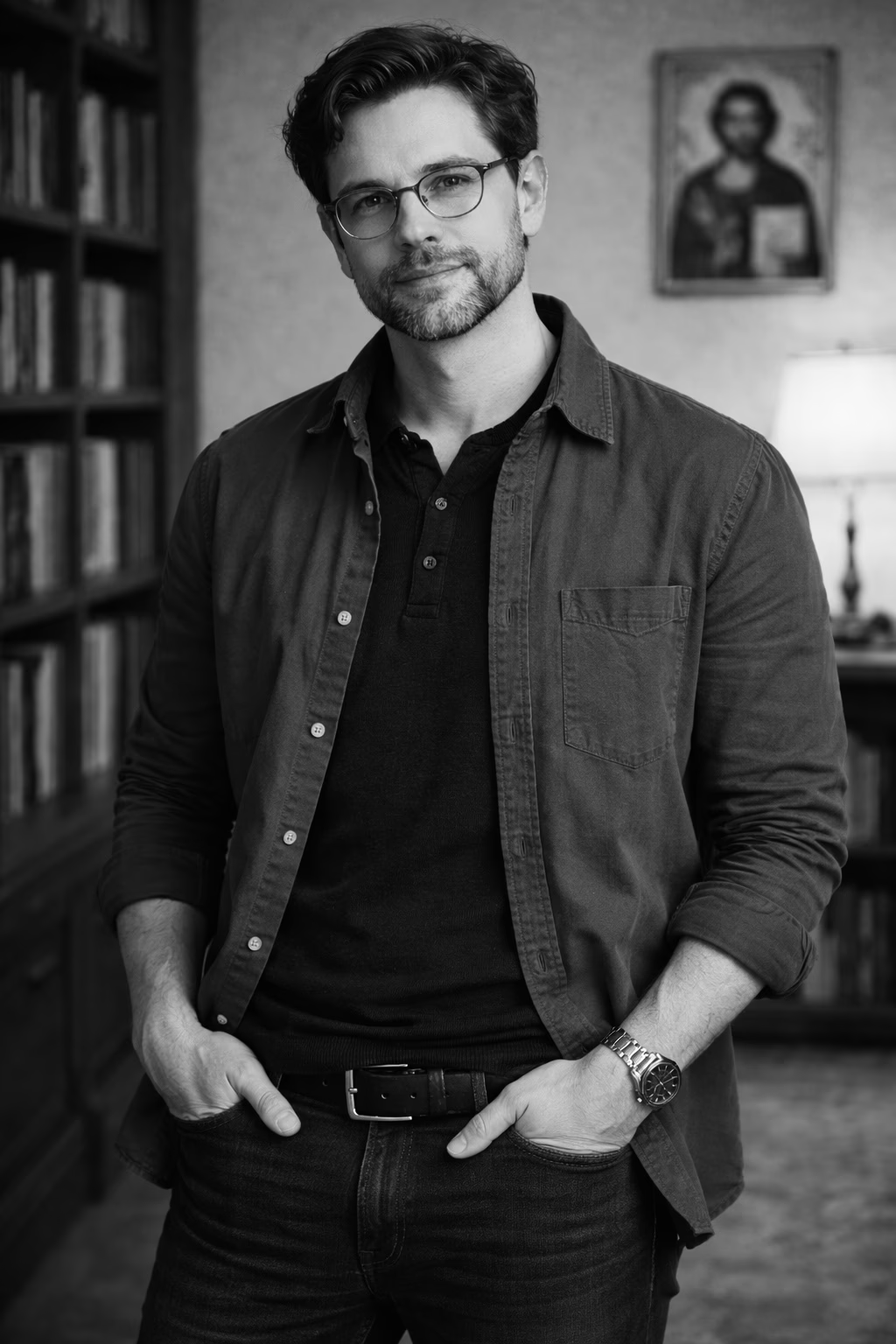
CHARLES MATTEO APONTE
AGE 35
GENDER Male
ETHNICITY/RACE Caucasian
MARTIAL STATUS Single
SEXUALITY Bisexual ▔▔▔▔▔▔▔▔▔▔▔▔▔▔▔▔▔▔▔▔▔▔▔▔ | ▅BIOGRAPHY▅▅▅▅▅▅▅▅▅▅▅▅▅▅▅▅▅▅▅▅▅▅▅▅▅▅▅▅▅▅▅Charles Matteo Aponte was born between countries and temperaments, into a marriage that seemed, even in retrospect, improbably balanced. His mother, Elena Croft, was an American gifted cellist whose emotions lived close to the surface, who believed music was a moral language, a way of teaching the heart how to behave. His father, Lucien Aponte, was Swiss, a computer engineer devoted to systems, elegant logic, and the quiet comfort of precision. They met in Zurich while Elena studied abroad, two people speaking different dialects of devotion; hers loud and luminous, his restrained and exacting. Their love never burned theatrically, but it endured, and when Charles was born, they raised him carefully between New England summers filled with salt air and song, and Zurich winters shaped by glassy streets and disciplined silence.
From his mother he learned how to listen for feeling beneath words, how sorrow could be disguised as humor, how admiration could be coaxed from strangers with the right cadence of voice. From his father he learned that order was power, that patience could outlast anger, that the most durable control was the kind no one noticed being exercised. Even as a child, Charles understood instinctively which parent to resemble at any given moment. He cried easily when his mother watched, clung to her skirts, absorbed her tenderness, but with his father he was still and observant, his questions sparse and exact, his attention sharp enough to be unsettling. Adults called him sweet, thoughtful, gentle. They never realized how often he was measuring them in return.
His intellect emerged early but without spectacle. Charles did not announce answers, he waited to be asked. He did not correct classmates, he let them reach the conclusion themselves, then quietly confirmed it. By adolescence he was already practicing a careful choreography of humility, allowing others the comfort of competence while ensuring he remained indispensable. He skipped grades with apologetic smiles, graduated high school years early, and accepted attending Princeton with polite gratitude, as though opportunity were something he merely happened upon rather than something he had positioned himself to receive. At university he cultivated an image of calm brilliance, the soft-spoken prodigy who played cello late at night in empty practice rooms, who stayed behind to help classmates sort out their code, who never raised his voice even when others did. Profesors trusted him, peers confided in him. He learned that people revealed more when they felt unjudged, that secrets rose naturally in the presence of attentive silence.
After graduation, he did not chase headlines. He chose obscurity, precision, and accumulation. He moved through several tech companies, improving infrastructures, solving failures no one else could untangle, never staying long enough to threaten those above him, always leaving behind the faint impression that things worked better after he had passed through. Managers described him as reliable, gracious, unusually mature. He sent money home. He called his mother every Sunday. He listened to his father speak about restraint, about how technology was a blade that cut both ways, about how the most dangerous men were not the loudest ones.
Harvard’s fellowship program found him the way such institutions always did, quietly, reverently, as though brilliance were a natural resource that required stewardship. He immersed himself in behavioral modeling, predictive systems, machine learning architectures designed to anticipate human decisions before the mind itself had settled. He spoke often about ethics, about responsibility, about the importance of building tools that protected the vulnerable. His papers were elegant, his arguments persuasive, he asked questions that sounded like concern and functioned like reconnaissance. It was during this period that LUCENT first took shape, not as a corporation, but as a philosophy, that chaos was simply data insufficiently gathered, that morality was a variable influenced by environment, incentive, and fear, that people could be understood well enough to be guided without ever realizing they were being led.
▅CAREER▅▅▅▅▅▅▅▅▅▅▅▅▅▅▅▅▅▅▅▅▅▅▅▅▅▅▅▅▅▅▅▅When Charles founded LUCENT at twenty-eight, the narrative wrote itself. The philanthropic prodigy. The half-European visionary. The quiet genius who quoted Rilke in interviews and funded youth orchestras in cities no investor could locate on a map. He spoke of privacy as sacred while designing systems that understood the precise geometry of its erosion, of connection as salvation while perfecting the architecture of observation. LUCENT grew with unnatural speed, not through spectacle but through absorption, threading itself into infrastructure, communication platforms, financial systems, and security networks until disentanglement became unthinkable. Every company he’d worked for in the past slowly folded into LUCENT, as if it were his plan all along. Charles remained, in public, unchanged by the ascent, gracious in interviews, reserved on stage, endlessly patient beneath the lights, always crediting his mother for his empathy and his father for his discipline, presenting himself as the fortunate convergence of art and logic, compassion and code.
His name became linked with countless groundbreaking donations and side projects. Millions flowed into mental health initiatives designed to modernize crisis-response technologies, into digital literacy programs for rural communities, into refugee education platforms that provided classrooms to children who had no direct access to an education, into disaster relief infrastructure that promised food and shelter first and foremost. He framed these gifts not as charity but as responsibility, as though wealth were a temporary condition and stewardship the only moral posture it permitted. He spoke in the polished cadences of a man who had practiced sincerity until it became indistinguishable from instinct, threading ethics in AI, human-centered design, and the dream of a safer internet into speeches that sounded less like corporate addresses and more like benedictions. His interviews trended. His lectures went viral.
Twice, committees spoke his name into the same sentence as the Nobel Peace Prize. Twice, journalists speculated about timelines, probabilities, inevitability. Charles responded with modest smiles, soft deflections, carefully worded statements about collective effort and unfinished work. He cultivated the impression of a man perpetually surprised by his own significance, as though success were something that happened around him rather than because of him.
Both of his parents would have recognized the truth, if they had known how to name it. Elena would have seen how easily his kindness opened doors, how naturally people leaned toward him, how quickly admiration softened into trust. Lucien would have understood how deliberately he chose which doors remained closed, how every public vulnerability was measured, how every confession offered to him became another thread in a widening lattice of influence.
Charles did not lose his gentleness as he rose. He refined it. He sharpened it into something precise enough to slip past defenses, persausive enough to gather loyalty, intimate enough to invite confession, and durable enough to rearrange entire lives without ever staining his hands. To those who know him only by reputation, he remains the rarest of men, a genius without arrogance, a billionaire without cruelty, a visionary without appetite for harm. To those who look closer, to the politicians he’s blackmailed, the whistleblowers he’s ensured were buried under lawsuits or character assassination, to the competitors he’s driven to to suicide via financial and social sabotage, he is something else entirely; a man who learned, very young, that control does not require force, only time, attention, and the discipline to be underestimated. |