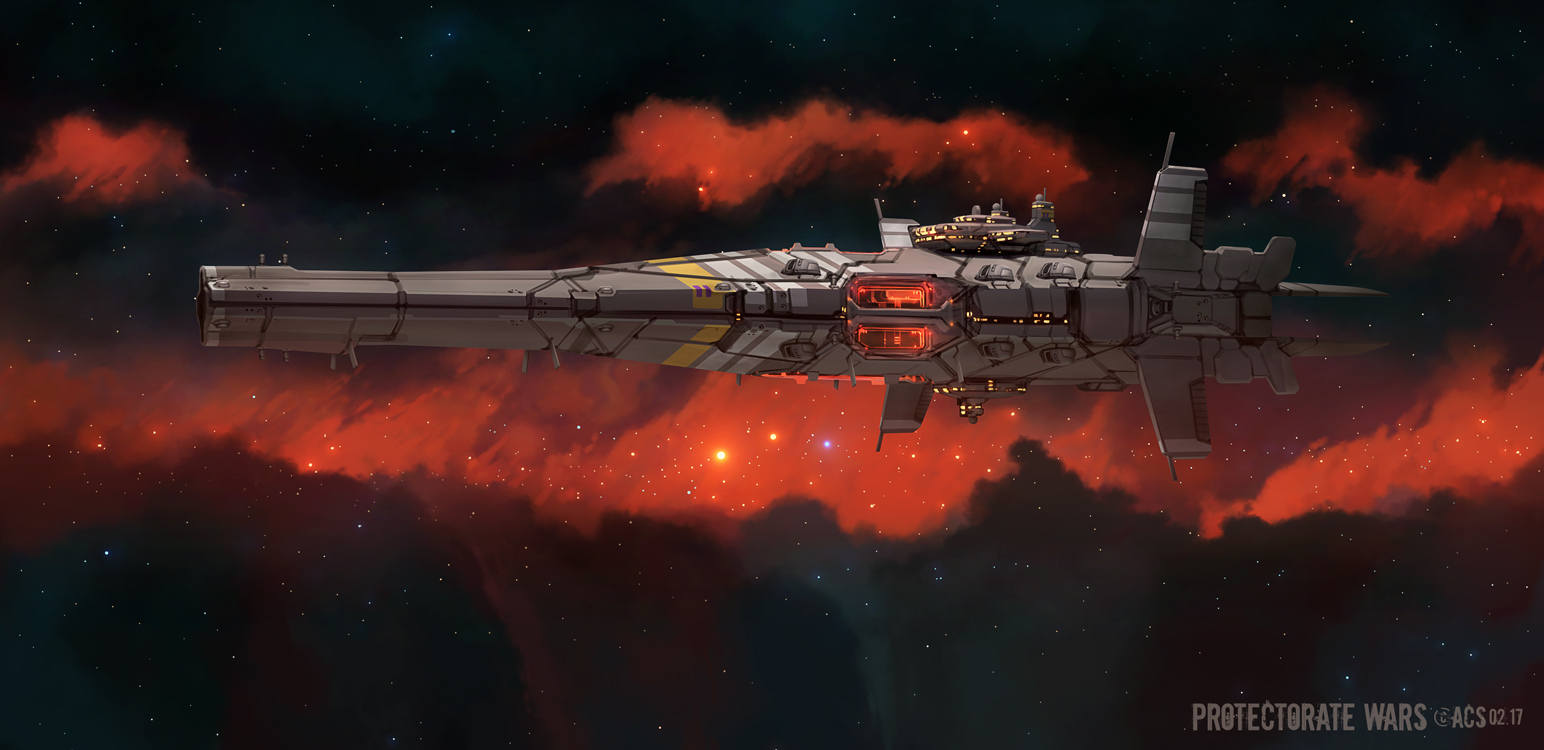
This is a list of a few items that is utilized by the military of the Pan-Solar Confederacy and in most cases openly available for sale.
- Projectiles -
Terran Federation Standard cartridge type 65The single most common round used by UNISEC is the Terran Federation Standard cartridge(TFS65), a round slightly smaller than the .50 caliber round utilized by modern firearms, but larger and with greater velocity than the .45ACP round. The TFS65 is a full-metal jacket round, utilizing a brass casing with a steel tip. The steel tip is not actually a solid warhead, but contains a hollow, that when impacting a mass, crumples and blossoms open. This causes devastating damage to soft-tissue, causing wounds that are typically rendered untreatable in the field, with massive blood-loss typically claiming more victims than the internal damages. In terms of effectiveness against armor, it predictably has far less effect.
A variation of the TFS65 is the TFS65-AP, an armor-piercing variant that utilizes spent uranium as the tip of the shell. The spent uranium core was utilized due to its pyrophoric nature and the self-sharpening that enables it to penetrate armour more effectively than other materials utilized. It's a bit more expensive than the standard TFS65, but for its effectiveness against armour, and that it is still just as effective against infantry, it is easily one of the more effective rounds for small arms.
The TFS65-APHE round is similar to the TFS65-AP, in that it is an armor-piercing round, but it differs in its means of armor-piercing. The TFS65-APHE utilizes an explosive warhead, and a tungsten-carbide penetrator all encased in a jacket of copper. When the shell impacts an armored surface, the warhead detonates to create a path for the penetrator, allowing greater penetration into the armored surface. The downside to this is that rarely the armored surface is not dense enough to ignite the warhead, and the shell does penetrate. This makes it impractical against soft-targets, and when pricing comes into the equation makes it seem a poor choice when compared to the TFS65-AP.
Anti-Material Rifle AmmunitionWhen the TFS65 class of ammunition is not quite adequate, the .950 Excalibur round enters the picture. Utilized by the dedicated AMR of UNISEC, the Excalibur round is capable of excellent armor penetration from long ranges and still maintains optimal accuracy. The downside to this round is the excessive power of the round, in that the recoil has been known to shatter the shoulder of the firer if not properly braced.
Grenade RoundsAnother alternate ballistics round is the TFS19 family of grenade rounds. The most commonly utilized TFS19 shell is that of the standard fragmentation round, which detonates in a storm of molten shrapnel. Other rounds in this family include: Flares, Gas canisters, Flash-grenades, Incendiaries, Smoke, Air-Burst, and the Armor-Piercing round.
Energy MunitionsIn early years UNISEC dabbled lightly in energy weapons and their possible applications in the field, but fell repeatedly short. This still holds true into the Corporate Era, however they have since relinquished their hold on military arms to Solexus Engineering in that regard. Foremost among their products is a universal cold-fusion energy cell which powers all of their small arms. The Type-18 power cell is a long lasting energy source that can almost indefinitely power standard laser weapons, give particle weapons a lifetime spanning multiple wars and even sometimes stabilize plasma weapons. Functionality depends entirely upon the weapon, though regulators can be modified to increase power throughput with relatively little difficulty.
Rail-Rifle MunitionsWhen discussing UNISEC firearms, one cannot overlook the 8mm Rail-Rifle cartridge, a projectile specifically designed to be fired from a rail-rifle platform such as the UNISEC-DA/00-IPW/MWS/16. The cartridge is a highly advanced ballistics round that can be electronically programmed by the firing platform to detonate at predesignated points in time, or when a certain density has been reached. Though not quite capable as the TFS65 in terms of kinetic stopping power, the standard 8mm cartridge's ability detonate inside targets makes it much more dangerous, enabling it to literally blow off limbs. The 8mm also comes in a shaped uranium round, meant for armor-piercing and typically used in assault-rifle versions of the rail-rifle.
Shotgun ShellsUsed by the UNISEC-DA/00-IPW/NSS/54, the TF12 family of shotgun shells is a highly effective range of ammunition available to the common consumer and hardened veteran alike. The most commonly utilized round is that of the TF12/R, the shell being filled with vulcanized rubber shot so as to avoid puncturing the interior of a starship.
- Infantry Arms -
- UNISEC-DA/00-IPW/MWS/x35The MWS/x35 is one of the pioneering achievements of UNISEC weapons design, giving the common infantryman a cutting edge weapon that is reliable and inexpensive. It utilizes a rail-system built into it's interchangeable barrels, allowing it to adapt to a changing war zone as and when the user requires. Fire control is done through an advanced computer built into the receiver and firing pin mechanism ensuring that the rate of fire and velocity are within tolerances for the equipped weapons-packs. With the base package starting as a sidearm type pistol, a simple addition of the MWS/x35-AW shifts it into an assault weapon role, while the MWS/01-SSW enables it to engage in squad support duties by laying down higher rates of fire. This weapon system has been so successful in the theater of war, that Second Division fully utilizes it across the entire division, and Third Division specialists more often choose one over specialized weapon systems. Below are some of the weapon packs utilized by the MWS/x35.
-- MWS/x35-AW: This is the Assault-Weapon pack, bringing the MWS/x35 into an assault role, and switching its firing modes into three-round burst, single-fire, and limited full-auto.
-- MWS/x35-SSW: The Squad-Support Weapon is an addition that brings a rapid-fire suppression role to the MWS/x35, capable of sustaining higher rates of fire over a broad area.
-- MWS/x35-SMG: An SMG attachment bridges the gap between sidearm and assault-weapon, enabling a rapid-fire function, but at a shorter range and tighter accuracy.
-- MWS/x35-DMR: The Dedicated Marksman-Rifle attachment is a more conventional long-range support weapon, capable of semi-automatic fire, but without the armor-penetration of the traditional sniper-rifle.
-- MWS/x35-FD: The Flechette Discharger is a shotgun type weapon, which splits the round as it's fired causing a spray of razored shrapnel.
UNISEC-DA/00-IPW/LBR/338The UNISEC Long-Barreled Rifle is the standard in conventional ballistics weapons. Chambering the standardized TFS65 round and capable of freely switching between single-fire and burst-fire, the LBR remains close to its ancestors as a Battle-Rifle. Its rail systems along the sides of the barrel allow it to freely utilize a majority of the weapon modifications UNISEC has developed, with many LBRs sold with popular add-ons for reduced price.
UNISEC-DA/00-IPW/SBR/56The Short-Barreled Rifle is, at heart, a modified LBR that has been engineered to operate in close-quarters and in a more specialist role. The shorter barrel contains an inbuilt suppressor system, that when combined with the TFS65-Subsonic rounds, enable it to be near silent when fired. Though its effective range is half that of its predecessor, the SBR remains a popular choice among both Third Division troopers, as well as valued customers. The SBR also maintains the same rail system utilized by the LBR, though it cannot adapt to some of the larger modifications.
UNISEC-DA/00-IPW/NSS/54One of the more robust weapons utilized by UNISEC is the Naval-Security Shotgun, a superb example of a hardy, all-weather weapons platform that can excel in nearly any battlefield. It's stainless-steel construction, and gas-operated locked-breech design make it not only sturdy, but also gives it very little recoil for the caliber of shot it fires. Standard NSS' fires vulcanized-rubber shot from an eight-round magazine or a 32-round drum-mag. The standard shot is made of vulcanized-rubber, due to the lethality to organic targets, without excessive damage to the interior of starship corridors. The NSS can also chamber any of the variety of shells available, with anti-armor, and incendiary shot just two of many.
UNISEC-DA/00-IPW/AMR/38When you want to reach out and touch someone in a meaningful way, there's always the UNISEC Anti-Material Rifle. Built with internal recoil-compensators to provide a more stable firing platform, the AMR gives off little recoil despite the .950 Excalibur round it fires. The AMR comes stock with two separate barrels, one of which is integrally suppressed and has a muzzle-brake at the end, the other with standard rifling. The weapon is typically used in an anti-armor role, though its accuracy at 2,000 yards lends itself well to more conventional sniper duties.
UNISEC-DA/00-IPW/LGL/73Devised as a way to bring the firepower of a heavy weapon to the hands of the standard infantryman, the Light Grenade-Launcher is a highly portable reusable launcher system that has been universally accepted within the Third Divisions. Its success can be tied easily with the design of the weapon, taking many cues from the design of their rifles, and giving the soldier inherent familiarity with the weapon through this. The weapon comes with a rangefinder built-into the top rail, making it unable to be modified in the same way as other weapons, though the rangefinder is well accepted as more than adequate. Accepting all forms of the TFS19 grenade round, the LGL/73 can adapt to nearly any situation with the right ammo, and it's gas-operated firing system enabling it to have nearly zero recoil.
UNISEC-DA/00-IPW/LAW/67The Light-Anti-Tank weapon is a shoulder fired, fire-and-forget missile launcher designed to keep a soldier on the move, while enabling the common infantryman the ability to take down heavy armor. The sighting system for the weapon utilizes a range of options for tracking, one of the more efficient methods being that of "painting" the target with an ultraviolet tag. The tag sends a beacon to the warhead, which keeps the missile on target until contact. With a variety of warheads to choose from, the LAW is a potent weapon of war.
UNISEC-DA/00-IPW/LMG/358True to the name, the LMG/358 is a light machine gun purpose built to provide a squad-support role without the need for a heavy-weapons team. The newest mainline iteration of the weapon features a greater focus on minimal moving parts and electronic firing systems, as well as integration with the Gauntlet to allow the user far more control. With such features and a reliance on lightweight 4.7mm caseless ammunition, it is easily able to maintain a stable RoF of 800 rounds/min on fully automatic.
UNISEC-DA/00-IPW/CW/76The CW/76 or "Concussion Weapon" is not actually one singular item, but instead a broad family of melee weapons for close combat. Ranging from six-inch knives to hundred-pound mauls, the universal trait is that of a powerful energy field surrounding the striking surface powered by an energy cell in the handle or Gauntlet. How the weapon functions upon impact is determined by switching the field between "sustained" or "pulse". In sustained field mode, the field will hold integrity and become a cutting surface. When used with slicing or thrusting weapons, this gives the edge far greater penetration power against materials it would normally glance off, but will impart significant heat on contact when applied to blunt instruments. With mauls, clubs or hammers it is instead best to use the pulse function where it will immediately discharge the field violently on impact.
Solexus Engineering Type-26c Plasma DischargerOne of the first functionally reliable Plasma weapon designs, the Type-26c has seen extensive use within the Third Division as a squad-support weapon when dealing with entrenched enemies. Under the primary firing mode, it projects a superheated stream of material up to 30 meters and at temperatures upwards of 2800°C in the air with a deviance of 2-300°C upon contact. The material will then adhere to the surface and continue burning until it exhausts itself. Secondary fire for the Type-26c launches spheres that spontaneously combust and is primarily used for ranged anti-tank roles due to the extreme temperatures.

 Captain Uni
 ASDAValueMilk
 Scrawl Banditta
 Quest Abandoner
 Lunamaria Hawke
 Sep
Sep Sir Lurksalot
 Not a Sayan
 Neziul