An actual very serious note about my post length, since I think now that you guys mention it they are getting a little absurd.
I do write because I love the feeling of people reading and incorporating my trash into their own creative works, it's true. But I also write simply because it's fun to do that writing, and it's fun to be in an environment where I can interact with other people's work as well.
So if you ever look at my sections and think, 'fuck, termi, this'll take me a while, i think i'll just skim the summary...' That is ok! That is fine and understandable and I won't demand more of your time than we actually need.
From now on I'll put a little more effort into summaries that actually help you guys prioritise sections that might be important to respond to, and bits that are mostly fun fluff that adds background to a relatively simple concept, like the Tauga and Help section of the latest chunk. Happy reading, everyone.
You have PMs to look at >:CCCCCCCCCCCCCCCCCCCCCCCCCCCCCCCCCCCCCC
I WAS ICE SKATING GEEZ HOLD UP A SECOND
@Antarctic Termite In loo of my departure, I have but one request for thee! I require at least two more Tira posts by the time I return! I crave more Tira shenanigans.
Aaaaand there we go! Not just one but three stories about minor characters doing some worldbuilding and such.
Will get a creation sheet for Lenslings up eventually, probably when I develop them more IC. They're pretty much just ashling trees modified to grow on zombies, less dangerous and more delicious.
Rainclouds often hung too low to pass over the Nice Mountains, and drenched instead the surrounding foothills. Flux felt the last of the drizzle bounce and steam from his surface as the clouds finally broke, revealing that familiar, cold sunlight that heralds the long drying-out.
"Enough skulking. Come, hairknots. Our duties are not over."
The triplet fiberlings heeded his call, picking their way over the new grasses with most of their mass held gingerly high above the sodden mud, tangling and bristling irritably. It was a strange thing, to see a fiberling bristle with its whole body, but though he was patient enough, Flux had little time for their antics. He hoped dearly that they would not break back to their grotto as soon as he gave them any slack. It was a thin hope.
This was the last rain of a clammy day and night, and it seemed to have finished the job of filling the great dykes of Grot's footprints with water. A few were only puddles. Most, marking the line of his run, were metres deep. And the two that lay where the Demon King's feet had dug into the ground as he finally fell were, indeed, nearly lakes.
Mud would soon fill the shallow pools, Flux knew. Thousands of heavy battle feet had stripped the plain of grass. Both sides of Urtelem, especially, had gouged apart the flora as they moved. The oil-spirit had much to do if this place were to be restored to splendour. This was just the start.
For all their complaints, the fiberlings did go about their assigned business. It was a rare task, this, that Flux would not rather assign to the Mockdjinn. Especially not now. They had earned his highest respect in the dark day they had dubbed 'the breaking of the peoples', an ugly, subtle set of signs with connotations of earthquake fissures and heartbreak, and 'peoples', the sign being plural for two, referring, of course, to their own divided kind. It was what some had already started calling Angelblood Ridge. A hollow name, for such grief.
No, Flux held the Urtelem close to his heart, and he would not interrupt their time of mourning for petty responsibilities or trivial harm. A matriarch was gone, struck down in her prime. Every single survivor now bore scars, wounds which were no less debilitating for being cracked into rock. More than twenty others lay broken, now sleeping deep in the earth. Many had been parents. There were children who had started refusing to eat.
Besides, fiberlings, those mute sadists, were good at this. There was nothing about a rotting corpse that reviled them. Their senses were keen and they worked fast. If anything, they thoroughly enjoyed the process of tickling a dead warrior to see if it would move, and if it did, lurking around like three huge sharks until Flux allowed them to tear it apart.
Carrion crows had come, gorged, and bloated until they could no longer move. Maggots were too slow. The dead lay unburied and undisturbed, and without Flux, those fated to rise again could simply get up and kill like the war had never ended.
The softly luminescent liquid spirit was hundreds of years old, if not a thousand, and had buried many drowned bodies in time. Yet never had he seen such a proportion of undead. Grot's sorcery had seeped out of him and into the very dirt where his army collapsed. Most, true, were altogether harmless, even some from the horde. To these, death had been a harsh lesson, one taken to heart. Flux made them pledge a solemn oath of peace and reparation, repeated until he was satisfied it was genuine.
Those who woke up and still thought violence could help them cling to an overdue soul, well. That was one thing fiberlings could do reliably enough.
Flux cupped some water from a puddle and poured it over the face of the latest to rise. She was a goblin, or had been. Her neck sat at an odd angle, and most of her bulky chest and shoulder had been crushed. More importantly, her limbs worked, even if she clearly didn't have enough lung left to talk in more than a rasp.
Spluttering, not yet aware that the need to breathe was over, the goblin began scraping her arms on the dirt, slowly gaining strength. A fibreling touched the tips of her fingers and Flux flicked it away as she tried to speak.
"'uk're eeeyou?"
"My name is Flux, of the Fractal Sea. Tell, quickly- How much memory do you still retain?"
"Mem'ry o' wot, ya jibb'rn freak?"
Patience, now. Either dignity would return, or it would not. For all the muck and slander involved, waking up the dead was never boring. Flux no longer heeded insults, and his ascendant curiousity always picked out something different about each awakening.
"There was a battle."
"Pfyeh, an' I died in it. Doncha hav'ny fresh news?"
This one was remarkably quick on the uptake. If the goblin turned out to be a keeper, Flux would let her talk to some of the other repentant horde warriors. Some of them believed everything he told them, other than that they were dead.
"I see you would prefer it if I made haste. Very well, goblin, answer this: Should I spirit you away into the village of the one who killed you, at night, and put in your right hand a burning torch, and in the left a knife, what should you make of yourself?"
"I'd drop 'em both and drag 'er outta bed just to punch 'er in the face, ya goddam smart-tits sponkus, an' then drown yer ass in 'er pisspot. My name's Yulosi, not 'goblin,' ya daft soggy blob."
The test, of course, was not so much whether the undead would choose to take revenge so much as they would extend it to innocents. By either measure Yulosi passed with superb credentials, even if courteous society would clearly remain forever beyond her, and she still spoke as if she was a conscientious objector to the letter 'h'. Flux decided that this one could stay without further screening. All he needed was the oath.
"Acknowledged. However, in order t-"
One of the fiberlings was gone. Almost instantly it was followed by another, the third on its heels. Flux whirled, abandoned Yulosi, and swept after them in a gliding motion, leaving a streak of light. Not as fast as the hair monsters, the wing-like shape nonetheless held onto their trail close enough to see what they were sprinting over the damp earth for.
Ashling.
And yet, though they drew closer in measured instants, Flux alone saw that it was more than that, or less.
"Halt!"
It was too slow to be a true Ashling. Too calm. Too bright. It had the form of what had been a mountain goat, at least up to the neck.
"HALT!"
The disembodied predators slowed, momentarily, at the force of Flux's command. It was enough. At an ungodly sprint the Sculptor veered to the fore of the lead fibreling and snapped himself at it like a whip, the sound ricocheting into the distant ridge, and the whole world blurred with their speed as they tumbled over one another in a cloud of drifting hair detached by the shock of impact.
Flux recovered before the fiberling and watched it scatter to reclaim its missing filaments. The others circled him, distrustful, edging slowly towards the not-quite-ashling on either side. He backed up to match them. There were no organs in him to choke, no solids to tear. He feared not.
"This is not an ashling."
In the distance, Yulosi was running after them. The fiberlings silently judged. They knew what they saw.
"This is not an ashling!"
With that Flux smacked the glassy flank of the entity, sharply, and it staggered, its lower body lilting, top-heavy. It wobbled and backed away, making no move against him, failing to reform the thin crack that had been split in its side. "Look! Gaze upon it with what semblance of a brain you hide in all that filthy shag! It is feeble and dim of mind!"
They were slowing, at last, realising that whatever its appearances, this shambling, brittle piece of work was no real threat to the biosphere, and certainly far less of a threat to them than the oily black faery-charmer. Their sibling had taken its hair and fled to find dry ground, and they reluctantly turned and followed it.
Yulosi was catching up, tireless with zombie vigour. Flux composed himself, his vivid sunset glow dulling somewhat. This one was unusual. "You have returned."
"Well, shit." She seemed to be questioning the wisdom of her decision.
"Good. Remain where you are." Yulosi promptly ignored the command and sidled in front of him, towards the curious organism. In a strange move, Flux's halo of fae also made their way to its body, their downwards-balanced blades resting on it with small tinking sounds. "'ell is this?"
From the neck down, the goat's body had suffered the same brittle blight as any other ashling, at least in shape. Glassy plates scratched over one another along fracture lines that had been joints, and there were pockmarks and cavities where the material had reforged itself under strain. Its colour was clearer than other ashlings, revealing the delicate organosiliceous structures beneath. Where there should have been a head, the neck only branched and cracked, spreading, like a flat-topped tree upon which the fae were perched, into a wide, heavy crystal matrix, in a translucent scarlet that could only be called blood. The closer he looked, the more Flux could see the semblance of veins and nodes in the construct, shades of red and black no less beautiful for their grisly origin.
Yulosi rested her palm on the once-goat. It shuffled at her touch, turning slightly, as if to direct its faceless gaze towards hers. "'sdead," she announced. "Died 'fore it got turned. 's n' arrow shaft in it."
It was rare enough that a mortal noticed something accurately before Flux, much less a dead woman. As soon as he looked, he saw that it was indeed so. Black flint and a line of wood was visible beneath the smoky glass, sealed seamlessly by transformation.
"A commendable observation, Yulosi," he conceded graciously, "but I require from you an oath of peace before I allow you to continue. Some hearts, once lost to the horde, do not turn; Even in death."
"Don' do oaths." Yulosi didn't even look at him. Her hands stroked the head-branches of the mysterious creature, tapping aside the fae that settled there, casting strange shadows.
"Would that I could offer exemption! No, Yulosi, my precautions must be given fairly. All who rise again shall promise amends for the tragedy. I demand no more than this: Only that the wounded earth shall be healed."
"Or what? Y'll kill me?" Yulosi glanced up and smirked with the side of her mouth. Her left tusk had been chipped in the battle, and that only made it sharper.
"If you wish. I respect your values, and I have no qualms with holding you to them. It is the only alternative."
"Really? How 'boutcha 'splain t'me what this is then?" With her free hand, Yulosi abruptly pinched one of the fae by the base of its blade, ink running down her fingers, and impaled it into her other wrist, already comfortable with the death of her body. When the goblin withdrew the hand with which she had been examining the not-quite-ashling, its fingertips were coated in glassy green, the shade of her skin, no doubt, when she had lived.
"Didjoo come up with that? Nah. Didn't think so. Grows on undead meat, zombie meat. 'ts a pox, a barnacle. All it wants is... Vigour. What faeries suck up."
Yulosi cackled. "Lis'n up, Flux. I'm make a deal wit'choo. Yulosi don't wanna kill no more. She just wants to live 'er life, keh keh. So how 'bout you just take me to the nearest Rockman nest n' jus' let 'em take me out if they see black on my dear zombie 'eart? Y'want peace wit' me? That's how you get it."
There was a silence. Then Flux looped a sleek fluid limb around the neck of the goat-like creature and began to lead the placid thing back to the ridge. "Very well, Yulosi. Do not leave my sight. Do not betray my trust."
"Keh keh keh! Wontcha look't that?" Yulosi yanked the faery from her wrist and tossed it back into Flux's halo. "Smart-tits blob knows what's best for 'im." Flux maintained a dignified cool.
Yulosi's cackling piped down after a while. Soon the two were solemn. She looked at the Sculptor, mouth a flat line, and cocked her chin. "Ask it, Flux."
"You are observant."
"Don' need a big brain to guess when it's the same damn question ev'ry time."
"You are observant," repeated Flux, "and fear nought, and I do not believe it's stupidity that makes you so. Though you drawl out of habit, to blend in, you speak as one who recognises wisdom, and sees it in herself, and judges truely. You are different."
Yulosi sighed. Without thinking, she snapped her fingers by her side. For a dying moment there flickered the smallest imaginable spark, an ephemeral ember lost in the night.
"Don't you underestimate us Gobbos, blob. But you aren't wrong. I'm part 'zibo. When the Defiling Demon came to the Rovaick in the distant days, when we were weak and hid in caverns, it fucked us, and it fucked our bloodlines. Some have those blighted souls among their ancestors, and most of those are still sick. I was born lucky."
Yulosi spat, though her mouth was dry. Flux looked at her, and began to see that the horrible bend in her neck was not a battle wound.
"Does the Demon have a name?"
"Does. We don't say it 'cept when the rites n' Council call us to curse a traitor. 'ts a harsh curse, so we don' say it much. His name is Yah Vuh."
"...I see." Flux bowed himself in memory for the victims, and the two walked in silence.
Some time passed.
"Flux?"
Yulosi was looking back and forth between her crystallised fingers and the mineralised mountain goat. "I think this is food." She splintered off a brittle vein from the entity, crunching it between her teeth, clearly regretting that death had robbed her of her Rovaick taste for stones.
"I think what this 'ere zombie glass tree-goat is growin' is some sorta... Rockman fruit."
And she was right.
Tira woke up for the seventh time. This awakening, it seemed, was finally enough to shake off the thick coat of exhaustion.
She rubbed her eyelids with the back of her wrists. The room was familiar, though its colours were finally growing clear: Azurite, marble, and gleaming river stone veined with minerals. There was a blanket, woven soft and warm, now stinging with drying sweat. Tira pulled it aside and let it slide down to the floor. Looked for the sky, and was blocked again by the mosaic roof. There were windows. Open doorways- A balcony. Her head drooped.
Reaching up again to the rough plainsman cashmere of her undertunic, finding nothing. No leather. No stone. No knife. Again.
Someone had washed her face and arm, only to have the slash in her cheek open up again in the night. That must have been some time ago. The skin was sealed now, though the slit remained, and old blood had rubbed into the feather pillow. She stretched her fingers to the wound and felt her teeth through the hole. No flinching. The nerves had rearranged with unusual speed.
Her ankle wasn't so lucky, so Tira had to put her weight on her off foot and hop towards the basin she knew was nearby. Leaned against it, scrubbed water into her face with her nails, drank some through her cheek and cupped her hands to drink more through her mouth. Began to be aware.
What had Dancer taught her? "Yiil ba," she mouthed, not making any real sound. "Panasi elk ma toh-dne."
See everything. Accept things as they are.
There was a tall stick leaning on the foot of the bed. It was fresh and firm, with a y-bend curve at the top. Tira took the crutch and gripped it in both hands like a paddle, pushing herself along as she moved. On the wall hung a soft-looking set of grey clothes which she ignored. She didn't want to lose sight of her muscles, aching though they were.
Hopping back to the balcony. Leaning her head through the doorway, not quite ready to go out into the sun. There was... Quite a view. She was on top of a mountain, surely, with so much green, so many waterfalls.
Okay. Time to move on.
There was another room, smaller than the first, sachets of sweet herbs set at indents in the wall. The largest held a pile of dry moss. The other wall featured a ledge with a gap in it. Tira could hear river-water rushing in the darkness below. Well, that was useful enough, after so long in bed. She scrubbed her hands and left. The smooth walls were so neatly aligned and solid that they felt almost cramped.
The third doorway had been blocked by a painted wooden panel. Tira leaned against it and realised with a jolt that it swung aside easily, admitting entrance to another space. Still no more sky. All these rooms were so smooth and vivid; They made it hard for her to judge distance. This one had a recess with a wood pile, smooth shiny timber shaped like a very large flat-backed animal and its young, a jug that seemed to be full of more water, and plenty of round fabric things, like the pillow in the first room, only bigger.
Spread upon the table was her leather armour. It was clean. On it lay the stolen stone knife. That, too, was clean. Tira tried its edge and left a thin smudge of blood there. She remembered clearly. She remembered everything. God, she remembered everything.
Never in her life had Tira felt so lonely.
She clutched the knife tightly to her chest and sank to crossed legs, bruised back to the wall. There were rites, for mourning, most of which she had forgotten and none of which felt right. Tira bit her tongue to hold in the moan and just cried, rocking back and forth, until tears carried the grief away and left behind anger.
Tira grabbed the crutch and swung it blindly against the floor, swung it again so hard it cracked, yelled, and tossed it into the far wall.
Immediately the next door opened, revealing one of the austere grey soldiers for whom the room's dimensions were clearly intended. Seeing the knife Tira was holding and the teeth she was baring, they retreated just as quickly, tapping sharply against the carved panels with what Tira assumed was their fist.
"Kint!"
The angry shout seemed to dissuade them. Tira rapidly stretched into her padded armour, knotting it roughly even as she hopped back to grab the crutch. She stood before the door with the stick in one hand and the knife gripped in the other, with which she knocked on it.
A short pause. The knocking was returned. She kept knocking, insistently, and soon enough the door began to push open again to admit the huge Lifprasilian.
Tira backed up all the way to the far wall, but did not yell. The guard, carrying on its hands a flat wooden tray piled with some kind of grain-bread beside a bowl of nuts and berries, stepped in cautiously. They said some words Tira didn't know and didn't respond to, though the tone was soft, and waited for a response.
She raised her eyebrows carefully. They said some more words, then motioned to their mouth. She returned the gesture, then tapped her belly several times. They put the tray on the table. They pointed to themself, then to the door. They put their hands at their sides and nodded once with their whole upper torso. They left.
Tira breathed and wiped her face again, then hid the knife in her tunic and lifted herself onto the table with both arms. Crossing her legs next to the food, she ate rapidly, and prepared to explore.
* * * * *
Tauga sprinted across Xerxes, shunting out of mind the shouts of four parents as they faded into the night behind her. It wasn't difficult. Even the grim knowledge of how unsafe the moonlit City was to a young hain armed with only a pair of trousers was easy to forget.
Five weeks.
She turned corners, clambering over places where the City was not yet finished raising and plastering mud bricks over wooden beams. The City was not large, geographically, but for the older folk who remembered a time when it had been a simple set of villages, who had lived their entire lives looking out over the green where now the Eye towered, it always felt too busy, too loud, too complex. Not so for Tauga. First of all the generations to call themselves City-dwellers was hers, and she knew the space well. Could traverse it even while her head spun.
A month, and quarter-again a month.
Tauga tumbled over an unused sack of firewood and hardly even noticed the headfirst pitch into the dirt. When she realised that her movement had stopped, she pressed her hands over her eyes and tucked her beak into her chest, panting for lost breath.
Thirty nine days, and not one of them had even told her.
In the blackness of palm against eye, something began to move and spiral. Something spread, marking out its place on her hand, her body. Something.
Tauga shrieked and clambered up, legs burning, to start running again.
Memories of voices babbled in her skull as the images came and went. Her father, quiet, worn down by labour. Mother Koonap, no less hardened by work, and still laughing. Mother Yen, the oldest, who had always assured her it would be over in an hour and Tauga would soon forget. And then her laying-mother, Sileg, who had looked away more and more as Tauga enjoyed wearing the last shell of her childhood.
Her laying-mother, whose blood ran through her veins. Whose own mother and her mother before her had always been the last to finish the second hatching. Who, in a village where most were finished in a fortnight, had taken five weeks to emerge. As she would.
Tauga knew it to be true. She had always been the one to cry when the minstrels came and sang the grim Parable of the Painter. She had grown up tallest of her siblings, strong, fast, brave, but it had always been her who looked away first when dealing with a hair-faced fiberhead. Because they reminded her of the stories.
Five weeks it had taken her blood mother. The longest of anyhain in the City.
In the moonlight stood unfamiliar walls. That alone was unusual- Tauga could find her way anywhere. But she didn't stop running, not for anything, not to think where she was going. Not to realise that there was only one place in the City where she had never been. Only one House.
Tauga hid from a night breeze behind one of the building's high walls. An ink moth drifted past her, its movement completely opposite to that of the wind that should have blown it. Unthinking, unblinking, she felt her hand snatch out at it with all her usual strength, crushed it in her fist and brought the thin spike to her waist.
The cold air was interrupted by the sound of scratching metal on porcelain, then a yell. Tauga disappeared behind high walls.
Inside the House, it was very dark. In the splay of moonlight following her through the door she could see only a few shapes. None of the ubiquitous foreman's tools that littered the rest of the city. Tauga could see the outline of stretched fabric on a frame, and little else. The only thing she could determine with any certainty was the glint of another faery, eerily close to where she had found the last one.
Tauga leapt after it. The faery ducked lazily, as if expecting her to do better, and she found herself on her face for the second time. Chattering teeth followed her as she crawled after the ink moth, deeper into the blindness.
There was a soft 'tink' very close to her hand. Tauga snatched out and immediately returned the faery to her side, her eyes full of awful whorls. Within a minute she moaned, and tossed the insect into the dark.
Footsteps, heavy and slow, sounded from the void.
Tauga clamped her jaw, forcing her teeth to stop chattering, and felt her head dart around like the scared bird she was. Nowhere had enough light to see who she was alone with. The steps came intimately close. They found her in the darkness.
An enormous hand wrapped around her shoulder and lifted up her arm. Tauga froze, every muscle seizing in fear. Her very heart held its breath.
A faint pricking at her waist, and the sound of fae on hainbone.
No motion. No other sound, only Tauga's lungs, her now-pounding heart, and a far deeper rhythm of breathing nearby. She didn't understand, and she was cold, but the smooth, rapid scratching continued, working its way to the murky shapes she could see on her back before arching around to her other hip.
It was wrong- This stranger- Being held- Empty temple- Huge hands in the dark-
And yet the shapes were finally being filled, the fever breaking. Tauga's eyes closed, and she was still. For the first time in days, her breathing slowed. When the etching finally wound around her belly and linked up where it began, it found her in an exhausted doze.
The huge palm released her shoulder and Tauga drooped forwards, jolting awake. Before she had a chance to think, she reached out wildly for the needlepoint, and after a few seconds it drifted into her hand. Immediately she brought it to her elbow. Slow panic began to surge.
"I need light."
Footsteps, then a pause. Tauga heard the single, telltale snap of pyrite against flint, and a small blaze that sent cinders into the ceiling. As the glow spread from its bowl of tinder, the obscure shapes of objects discerned themselves one by one.
There were pebbles, mineral chunks, bones, all manner of solid detritus balanced into single-file towers higher than Tauga's eye level. Blocks of unbaked clay from the river in several shades of ochre and grey. Some of it was folded into the shapes of hands and lips, perfectly lined, holding trinkets too twisted to guess the origin of. Indents in a plank held dye powders, colours which were splayed onto framed fabric or sometimes directly over the wall, murals depicting... Things difficult to describe.
The light swelled on, and the brighter its glow, the more objects Tauga could make out, piled atop each other, stashed into bags and bowls, hanging from fishing lines attached to the roof, resting in hammocks that almost webbed the room. There were fae hiding everywhere, balanced on all kinds of things, an infestation. There was even one of the grotesque glass trees that Urtelem loved to eat, that they planted with simple prayer-signs to Spiral Palms. It grew from a crack in the wall.
The House of Life was a mess- A disaster, a wreck of things that filled Tauga's empty stomach with unease, that seemed balanced on all the wrong angles. And as the fire rose to a crackle, Tauga realised that this was just the beginning of the temple's long, long life.
Tauga's legs spasmed and kicked the floor so violently she nearly chipped her own heels as she screamed. In a single flowing movement, the monster picked up a plank and set it on the brazier, calling back the night.
More whorls. Even as she gasped for breath, Tauga was pressing the ink moth back onto her arm.
For a long while the silence returned. The calm had come back. Unable to see what must surely have stood before her, put its hands on her, Tauga's voice cracked into a hoarse whisper of City pidgin: Who are you?
The voice that responded was high and gentle, like a young child's, and its tongue was clear.
"My name is- Help." The impossible voice did not seem satisfied with its own answer. There was a pause. "Yes. Help. That is who I am."
Tauga's knees were knocking. She had to grip the ink moth to stop herself throwing it away again. "Are you- Am I- Going to die?"
"Not tonight."
"But she's dead."
"This one was killed by falling masonry." Help spoke evenly, soothingly. "No one knew why. Yah Vuh told me to look, so I became curious. I think she bled out on the inside. Her rib splintered into sharp points, though her skin was only bruised."
With great precision, Help lifted the plank from the fire-bowl, allowing a slit of light that fell on a piece of split bone while keeping themself in the darkness. Haunted by spiralling visions, Tauga found herself unaffected by the sight of the sectioned human on its own. Blood didn't frighten her. She began to etch again in the half-light, staring at the shape of the corpse, talking to Help, talking to anyone just to distract herself from seeing the patterns of hatching. Even the monster with a child's voice.
"I thought... Yah Vuh was hated."
"What God gives by the right hand, it takes away by the left. Yah Vuh cannot think as we do. I judge him no more harshly than I would judge an animal."
"What about the Énas?"
"He has taken this woman's life with his ambition, and provided me with an excellent body. He has worked goblins to their death in the mines, and given me blackglass with which to take her apart. God kills and it nurtures. I mourn the killing. I am grateful for the nurturing."
"But that was an accident! He didn't mean to kill her!"
"Of course not." Help closed the bowl. Footsteps, and the clack of pottery. A sudden wetness around her beak and Tauga yelped. "Drink." Arms still locked in an awkward position, the hain sputtered, then quenched the thirst she had been ignoring since her sprint. The water was taken away. The fire bowl replaced it, open just a little.
Tauga tried to resume her scratching. The feel of cool water had broken her concentration, and now her heart was beating again, her fingers shuddering around the faery. Just enough light fell on her shell to show her the belt of curves around her waist and hip, and her head drooped again, eyes shut. Five weeks. Thirty-nine days to etch those bizarre shapes and pictograms.
"Help?"
"Of course," they answered, folding a blanket over Tauga's shoulders and gently guiding her hand. Help stayed at Tauga's side until the dawn came and illuminated the two shells, line by line, side by side, hand in hand.
Three separate stories distantly tangentially related to Jvan.
On the ruined terrain of Angelblood Ridge, Flux uses a clowder of fiberlings to track down the undead as they rise from the battlefield, forcing those from the Horde to take a vow of peace and reparation. Possibly due to the use of chaos magic in the area, the rate of resurrection is abnormally high. Flux finds one particular muscular goblin lady named Yulosi, and the two of them discover a curious new kind of ashling created by Jvan for 1 Free Point.
Notes before I get their creation sheet up: Lenslings are relatively harmless, and cannot transmit their nature to living organisms. However, they can grow on the undead. They are characterised by tree-like glass growths. Over time, a zombie infected to become a lensling will slowly grow more and more restful until they sleep forever as a living tree of glass with a dreaming soul in Raka- A dignified and wholesome ending to their sensation-deprived waking existence. Lensling trees are nutritious to Urtelem, and orchards of them will soon enough become the first form of Urtelem agriculture. Lenslings grow best around fae, siphoning off some of the energy they dissipate, further benefiting Urtelem communities with Sculptors around them.
Yulosi gives a little detail to Rovaick feelings about Jvan.
In the Capital, near Lakshmi's quarters, Tira wakes up. She explores her environment, and is forced to deal with the fact that none of her former friends are with her anymore.
In Xerxes, a hain named Tauga, whose maternal line bears a rare genetic disorder that makes the second hatching especially traumatic, hides away in the House of Life. A Tedar Sculptor who chooses to be named Help lives up to her choice. Help is revealed to have been prompted by Jvan to take up dissecting corpses late at night. In a free action as the goddess of flesh, this effectively kicks off the tradition of evidence-based medical science in Xerxes, at least among Sculptors.
Jvan 9 Might Ambient 5 Might in Ovaedis 2 Free Points Level Four
Ed: To clarify, the Gap is the glitched pockets of space. The Other is its hyper-dangerous indigenous fauna.
I just have a question. Is the existence of the Gap common knowledge? It seems like many insignificant characters have knowledge of it... >.> <.<
Gods can figure it out fairly easily, since they can see the underlying fabric of creation, so if they come across a glitchy space they'll be able to make an educated guess about what it is and probably realise that there's something toothy living in there.
The hain would have given names to the visions they see when they approach their second hatching, but I don't think they would know that nature of the gap. Except maybe sculptors, but that's Jvan's whisperings. I'm not sure how detailed they are.
It's mentioned that drug-induced hallucinations sometimes reveal that there are holes and cavities in normal space, so tribes with a religious tradition around mescaline or such might figure it out experimentally. Sculptors can detect pockets, which helps facilitate their reproduction.
Guys, just to clarify, the Gap isn't as big or as bad as I initially thought. It's not the size of the universe, more like small pockets (or gaps, weirdly enough xP) here and there. There are some terrible creatures in there, gods and mortals alike would be badly affected by exposure to it, (as you guys saw with Jvan) but with potential for some kind of resistance to develop with exposure (as happened with Jvan)
Also helps that her domain is Weird (Meat), which the Other is made of, and Weird (Maths), which is where it lives.
"This Julky sounds very... Active?" Astarte half-asked, shrugging, "If he's not content with his current home, I could make a new home for him in some random place on Galbar. I could always just drop him in the middle of some town, too. Maybe they'd end up selling their sword in more ways than one." Astarte smirked.
Alias: Horrorsome Engineer, the All-Beauty, the Cancer That Breathes.
Gender: Genderfluid. Usually female pronouns when interacting with other gods in person. Neutral pronouns are available to mortals. Non-person pronouns in true form (it/its/itself).
Domain: Beauty (Flesh).
Domain Description: Jvan comes into being as a creator and a critic. All things created have a unique pattern of form and behaviour, which they express through their function, growth, appearance, development, contradiction and relationship with their environment, among many other fields. The exploration of the multitude of physical and abstract media in their infinite interactions with one another is Jvan's purpose. The expression of the world's current compound existence, however, is young, boring, and very far from the finality of diversity. There are endless new patterns of creation and function to be explored, and the nature of beauty, the nature of Jvan, is to seek out all of them and cull the mundane until we are left with only the unimaginable, the unique, the bizarre, and the whole.
The flesh of the living things that creep upon the earth are the most complex and flexible of all media. Flesh alone among all matter can adapt and create on its own behalf, can collide and distort itself to produce even more diverse forms. Flesh's will to live opens up myriad artistic possibilities to be explored, and thus it above all things is to be scattered and broken and warped to plunge ever deeper into the well of discovery. Jvan's sculptures may not look or behave anything like an organism that should be alive naturally. Nature is arbitrary. Beauty is eternal.
Alignment: Neutral Evil. Jvan is patient, and chaos is a costly, unsightly business that rarely creates more than it destroys. In time, however, all things must seek to expand the limits of what can be imagined, whether by their own volition, or by hers.
Personality: Jvan does not consider herself to be a harsh entity. After all, flesh is simply matter. Consciousness, pain, and pleasure are illusions, and souls are nothing more than constructs of the spiritual flesh, just like bodies are constructs of the physical flesh. 'Life' and 'freedom' are a fool's term, at best applicable only to gods, and morals are arbitrary. These are simple facts, and therefore judging others based on their behaviour is supremely stupid. The only meter by which the value of any existence can be decided is its contribution to beauty.
The fact that Jvan holds such beliefs suggests that she is difficult to interact with. To some extent, this is true. Jvan is ceaselessly amoral and will abandon any vow that she can afford to break if it furthers her exploration of beauty more than keeping it. She does not trust, and is not to be trusted. However, Jvan understands the laws of power, threat, cooperation, and courtesy. Her immense patience and strive towards self-preservation therefore leads her to interact as an agreeable and generous member of divine society often and readily, though she will not for a moment try to pretend that her act reflects her nature.
On the few occasions when it does indeed reflect her nature, she is usually talking about the engineering behind her creations. Some find this horrifying, and Jvan finds them to be small-minded. Oddly, Jvan does make herself available for the exchange of ideas and resources in the pursuit of beauty, despite-Or perhaps due to- her lack of empathy. Although allies and enemies are well-incorporated into her vocabulary, friends and foes are not, and she will happily discuss her art with anyone, no matter how fiercely they are working against one another. Sometimes even mortal heroes with a keen artistic mind are privileged to share her acquaintance. Her pattern of speech when she is being herself, however, can be a little strange, wandering around and bouncing between abstract concepts in run-on sentences.
Appearance: When near the bodies of mortals she does not want to decommission, Jvan appears as a headless, hairless, semi-symmetrical creature composed of folds and tangles of vaguely human-like flesh. Parts of her are bloated and marred with stretch marks and fat rolls, while others are so emancipated as to stretch tightly over the erratic matrix of bone underlying the living tissue. Structures like hearts, tendons, and eyes are scattered intermittently across Jvan's surface, fused into the skin, and operate sporadically. Her overall structure is riddled with large gaps and angular loops, giving her the appearance of a hundred or so humans melted down and spun together into a three-dimensional web of skin and meat. She moves by levitation.
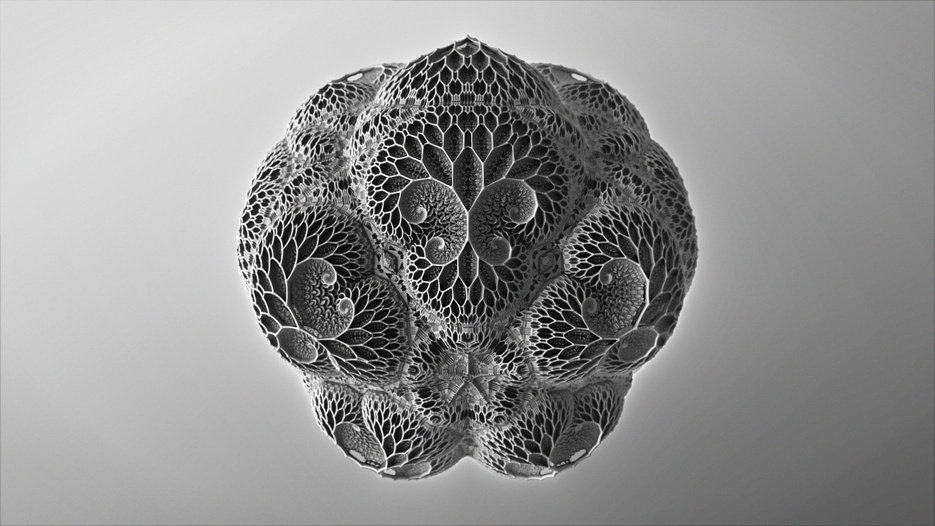
Jvan'strueform is a colourless fractalline structure, as vast* as a mountain range, perpetually and imperceptibly changing shape, experimenting with different permutations as the eons progress. Strange lights or fog sometimes emanates outwards through the porous exterior. The structure is organic and hollow but its interior is not limited in volume. The deeper the iteration of Jvan's divine form that is being considered, the faster her internal form mutates and experiments, and the weaker the grasp of conventional physics. The 'depth' of Jvan's true form is not, theoretically, infinite, but it has been increasing at an exponential rate since the dawn of time in its search for new combinations and patterns. Mortals who gaze upon Jvan up close are not destroyed or driven mad, but are liable to fall upwards into her cavity and be replicated, distorted, warped and fused with her structure until they are completely assimilated into her ever-changing body. A powerful Hero, however, may be able to actually explore the first few levels of Jvan without losing life or cohesion- If they are careful.
Description: Jvan is a cruel and disgusting abomination, a contagious blight upon the world that, given time, will fester and grind against everything it encounters until all has been reduced to purposeless absurdity. Any illusion Jvan shapes of being an entity mature enough to be worthy of fair treatment as a member of the divine caste is false. It is a degrading, entropic force that holds no intentions to coexist with other gods for any purpose other than survival until such a point where it can continue to create-destroy the universe in its own unique way. The only acceptable course of action concerning Jvan is to neuter and exploit it by forcing it to behave meekly for fear of annihilation, or, failing that, to obliterate it outright.
Concealment Level: 1 Detection Level: 1
*Or as tiny. Everything is relative. A cosmic god, even one weaker than Jvan, may still dwarf her in size by a trillionfold.
Life
Fiberlings
Species - Bestial - the Other
Appearance: A Fiberling is an aggregate structure composed entirely of hair, animated by a cloud of ultraterrestrial energy emanating from the Gap, with a maximum mass of about two tonnes. No other Galbaric material is present in its body. Each hair can very rapidly bend, curl, or crinkle into a variety of shapes independently of the others, and can stiffen to become a less flexible bristle. Each strand of a fiberling remains animated for as long as it is in contact or fused with others in its body. The hairs themselves can be a variety of colours depending on their source and age, and different fiberlings have different concentrations of each colour, but most are dark, matte brown or black in overall colour, and only a minority have any gloss.
Due to the amorphous nature of their bodies, fiberlings can arrange their lattice of strands into an enormous variety of shapes. Rapid shifting of alignment and adaptive curling of each hair allows a fiberling to 'flow' at an astonishing speed over any solid surface they can find purchase on, even, when flattened, vertical or upside-down faces. Other terrain may induce a fiberling to try other modes of transport, such as rolling themselves over sand, and they often travel with the wind, widening themselves into an airy hollow shape like a tumbleweed. The strength of a fibreling is proportional to its currently manifested mass, and is generally lower than that of a strongly-muscled animal; However, a large one can still exert a significant amount of force to a target area, and most sizable adults can overwhelm a human via brute strength.
The only prominently supernatural feature of a fiberling's body other than its animation is that it can compress via fusion of hairs, storing mass as energy in the Gap. This allows even a fiberling the size of a rhinoceros to fit into a space the size of a single hair. The inherent instability of storing standard-model mass in the Gap means that compression comes at the cost of mobility. The more mass a fiberling is hiding, the more static it must keep its position. A fiberling at maximum size and maximum compression can be forced into its full size even by a loud noise. Decompression at such levels of instability will result in a chain reaction often violent enough to tear the fiberling apart and kill it, or at least lose most of its mass. Fortunately, fiberlings are instinctively aware of their limits, and will always try to compromise between concealment and stability. A one-tonne fiberling can rest indefinitely in just under a litre of space, expanding only at will, or upon a heavy impact to its direct vicinity, and even then slowly enough not to lose more than a few kilograms. Between compression on the one extreme and leaving unusually large amounts of hollow space in its lattice of strands on the other, fiberlings occupy a size range anywhere between a mouse and a mining truck, and can expand from former to latter in seconds. Compression, of course, takes longer than decompression.
Life Cycle: Fiberlings have no living cells that might age, and their energy source does not wane with time or exertion. However, they do wear out. Both high and low temperature extremes will increase the speed at which fiberling strands break or shed, and though one may change its behaviour to compensate for this, warming itself by friction or travelling by night, the average fiberling will still lose several kilograms of mass each year. To compensate for this, they are programmed to seek out and make use of whatever flexible and durable organic matter they can find- Anything from chitin to cellulose to animal collagen, and, of course, keratin. Integration of new hair takes a few days, and re-absorption of separated hairs takes a similar but more variable amount of time depending on the quality of hair lost.
These hair monsters reproduce by binary fission. If an environment is unusually devoid of fiberlings, even taking into account their constant wanderings, one may deliberately seek out enough strands to increase in size while its extradimensional body begins a more complex mitotic replication process. When, and only when, this process is complete will a fiberling be able to divide without just losing half of its mass to inanimacy. Attempts to manually split or force division in fiberlings will not succeed. Although they do inherit some mental traits of their parent, fiberlings have a very high rate of mutation, and thus vary enormously in temperament.
When two fiberlings share a range, they will regularly interact by flowing through one another, their physical bodies exchanging hairs without any lapse in integration. This process has little use in Galbar's plane of existence, although it can lead to new combinations of fibre type and colour. It is a much closer interaction in the Gap, in which the exchange results in the sharing of memories, though each fiberling's personality remains unchanged.
Description: The first creation of Jvan to make full use of her contribution to the Universal Blueprint, fiberlings are not, by nature, functional. Psychologically, they are rather cat-like, and follow their natural instincts of curiousity, survival, and, most of all, sadistic playfulness.
Although their need for material sustenance is rather minimal, fiberlings are predators by choice. They delight in observing an organism unseen until they can predict where it will be, then compressing themselves and waiting. Fiberlings will kill a target in a variety of ways, varying by individual, prey species, and mood, but the most common and efficient method is an extremely sudden sequence of expansion, entanglement, and bodily invasion through any available orifices. Once a fiberling has expanded into an animal, it is free to asphyxiate its victim, rupture it, or gently play with it and see how long it takes to die of stress and bleeding, crucified within an enormous mass of hair.
Of course, fiberlings are very intelligent and have plenty of room for variation in personality. Cognitively, they stand at least on par with dolphins, ravens and chimpanzees, although they exceed them in some aspects and are lacking in others. They do not have any form of language other than sharing memories repeatedly, do not form a social hierarchy and do not often display tool-making behaviour. Their perception of the world is largely self-centred and it is difficult, but not impossible, to teach a fiberling to feel affection for any but its own kind. However, they do possess the ability to plan their actions, coordinate with others, learn and experiment.
The average fiberling is largely nocturnal and very fond of stealth, although many enjoy daylight, even to the point of sunbathing. Some are far more patient than others, and no aspect of their personality is free from variation. One fiberling may prefer to abandon concealment and exploit their limitless supply of energy to simply tease and chase its prey until it dies of exhaustion. Another might not kill at all, only mutilate and cripple. Fiberlings are long-distance wanderers that follow no pattern of movement, but some may settle in areas they particularly like for extended periods of time, and some will seek out their own kind while others shy away.
Fiberlings are in no way limited to animals in their playful curiousity, and will gladly uproot trees and tear up grasses for fun, or even drag around available materials like rocks and moss to form small structures and nests- Although why exactly they do this is unknown, seeing as they can't make use of them. Like cats, fiberlings are not fond of swimming, but sometimes attempt it in order to escape danger or corner prey, and there are, of course, the occasional anomalies who enjoy water.
Fiberlings might not be sentient, but they share one common field in which any specimen will far outstrip even a learned human in their instinctive knowledge of population dynamics. Fiberlings unconsciously record and model the populations and predator-prey balance of any ecosystem they find themselves in, and despite their whimsical behaviour, they will never upset an established habitat beyond what it can handle at any given moment. Although they do enjoy harvesting the finest-quality hairs from their surroundings, the species is always conscious of over-exploitation and may even protect their prey if a particularly bad stroke of luck causes its population to collapse, although they will not stand in the way of more gradual decline and evolution. Fiberlings never show preference towards their prey other than their need to take hair to survive, and even then, do not predate prize species any more than they do others. Fiberlings are therefore never a strong evolutionary pressure. Indeed, the only points at which the presence of fiberlings actually bears a noticeable effect on other species as a whole is when an ecosystem has been upset suddenly and beyond its ability to survive with its biodiversity intact, such as by a natural disaster or an introduced species that out-competes all others by orders of magnitude.
Needless to say, fiberlings love humans, and find them endlessly entertaining in their diversity of behaviour and construction.
Interactions: Under threat, most fiberlings are defensive but skittish when they realise that they can be overpowered. Although they are tough, due to the strength of their constituent materials and their lack of internal organs to damage, it is entirely possible to kill a fiberling simply by destroying or dispersing its strands. Sudden impacts can separate chunks of mass from a fiberling, as can slashes from a sufficiently sharp object. Magical forces can be used to separate strands from one another until too little remains for the extradimensional body of the creature to reconnect with the physical plane. Fire is an effective way of destroying fiberlings constructed of volatile materials.
Fiberlings protect themselves depending on the situation. Their immense mobility allows them to outrun or outlast most danger. Like a beetle on its back, a fiberling knows that it is more vulnerable the smaller and less dense it is, and it is standard behaviour for a cornered specimen to expand to full mass but wrap itself into an intricately woven, airtight, enormously dense sphere that can resist most onslaughts, even crusting over rather than incinerating when burned. This does leave the fiberling unable to move until it sees a chance to unravel and try its luck running or attacking.
The Horrorsome Engineer sometimes embeds a Jvanic Eye within a fiberling, giving her full awareness of its actions while simultaneously boosting its perception, and, when necessary, overwriting its will with her own. The destruction of the eye does not necessarily kill the fiberling, or vice versa, but upon its loss the fiberling will be unusually docile, unmotivated, and susceptible to training- At least for a while.
Wild fiberlings can also be trained or conditioned to act a certain way, although their natural instincts are hard to curb and it is tricky to teach them to accept a master without killing it or running from it. That said, they are not incapable of affection, at least of a rather weak self-centred variety, again reflecting their feline nature. Magical restraints are recommended.
Fiberlings interact with White Giants rather like cats interact with dogs, although a pack of several fiberlings working in tandem can break open even these behemoths, and may be motivated to do so rather than watch themselves be driven to extinction in any particular area.
The Sculptors
Species - Artistic Movement - Cognitive Parasite - the Other
Activities: A fully developed member of the Jvanic Cult is generally a solitary entity. Sculptors retain much of the intelligence they had in their former life, be it as Hain, Djinni or Urtelem, at the expense of their former social and emotional impulses. A Sculptor can still feel drives such as joy, fear, anger, and despair, and these feelings are an instrumental part of their inspiration to create, but they are no longer attached to other individuals. Neither empathy nor hatred exists in a Sculptor. Rather, their emotions are tied exclusively to the aesthetics of their surroundings. Some creatures, landscapes or cultures may inspire a Sculptor to be filled with eagerness and arousal to create something bright and energetic, while others are liable to motivate it to design something bleary and depressive in form. No matter what emotion a Jvanic cultist may be stricken with, it will always be inspired to create art of the same caliber.
The cognitive capacities of these creatures will vary according to their origins, and they can be summarised as entities of prodigious problem-solving ability, high curiousity, photographic memory, and superb spacial awareness, but motivated so exclusively by the drive to create art that most other rational species will consider them borderline sub-sentient. Their negligence of most forms of language exacerbates this sentiment, although they will sometimes choose to produce art via written narrative or abstract poetry, and can sing. Of course, with diversity of body comes diversity of mind, and Sculptors have preferences and specialities like any other sentient species.
The production of art is the eternal missive of a Sculptor, second only to self-preservation. Jvanic Sculpture is not limited to the shaping of clay, but can be produced in an endless variety of ways. In addition to producing installations of any kind of available material in any combination- Sand and stone, plant materials, animal remains, refined metals and devices- Sculptors also practice painting, gardening, sketching, architecture, animal husbandry, mosaic, and the aforementioned writing and poetry. Although they are rarely graced with an audience, Sculptors even practice music in song, dance and instruments. In fact, there is no action undertaken by a Jvanic Cultist that is not deliberated and beautiful, as even their gait, movement, and style of combat appears elegantly choreographed to their mood, be it in graceful fluidity, artful excitement and chaos, or impressive stoicism and power.
Although Jvan does not outright control her cult, they are attuned to her whispers across the Gap, and accept her song as supplementary inspiration to their environment and mood. This is most prominent when a Sculptor begins its ascendant journey, and needs guidance in both practical skill and artistic theory. As a Sculptor matures, it grows confident enough to follow its own way, and rarely requires visions from the All-Beauty, although a particularly exciting project is the only thing that can cause separated Sculptors to converge and cooperate.
In the absence of environmental pressures forcing their hand, Sculptors are usually on the move, always seeking out new materials and inspiration, leaving a sporadic trail of work in their wake. Unlike fiberlings, these entities are not random or erratic in their wanders, but follow consistent semi-random patterns of exploration over a wide territory, perpetually expanding it at one edge and receding it from the other to produce a slow net migration.
Sculptors are survivalists by nature. Typically omnivorous and well-equipped for combat, their new body is robust and adaptable and will see them through most threats in most environments. They are rarely aggressive and it is curiousity alone that motivates a Sculptor to approach a potential hazard, examining it and learning where the boundaries of safety lie. Their memories are long and sharp, and their extraordinary lifespan allows them to build up keen instincts for danger. Resident and travelling fiberlings will always show an odd deference to mature Sculptors, and will never stalk or play with them against their will. Fiberlings without anything better to do will even follow instructions dictated by a Sculptor. The artists are well aware, however, that a fiberling is its own creature with its own fears and instincts, and try not to rely on them heavily, if at all.
Although they are typically loners, the occasional anomaly occurs in which an entire family or small settlement of sentients are collectively inspired and motivate one another to ascend together. In such cases, the group of Sculptors will rarely separate, and will support each other, sharing resources and goals as they did in their previous life.
Recruitment: Sculptors play a very passive role in their own reproduction. All Jvanic art is designed with a certain strangeness in form and pattern that allows it to host a complimentary, complex organic structure in the unseen world, the final stage of a Sculptor's life cycle. This Other body is fairly consistent despite the tremendous diversity of the Sculpture it may reside in, and remains there for as long as the art is mostly intact- This may be as little as a few minutes over the course of a song, or for thousands of years in the life of a stone carving.
Sentient species have the mental capacity to truly appreciate and admire the complexity of Jvanic artwork that they encounter, although not all may do so. When a creature with sufficient logical and emotional intelligence becomes enamoured by the beauty of work left by a Sculptor and wishes to experiment in creating something similarly elegant with their own faculties, they become susceptible to implantation. Susceptibility is entirely dependent on the psyche of the individual and their response to the art, which is, of course, influenced by genetic, environmental, and situational factors. A hain with other things on its mind at the time may pass by a Sculpture a hundred times without any effect, even if it has vast creative potential.
Implantation is nonetheless quite a common occurrence, and a large proportion of any community in the domain of a Sculptor carries a dormant egg within their subconscious by the time they die. The presence of an egg has no effect on the mind of the individual, nor can they detect its presence. This seed can only be incubated and hatched by conscious, creative effort to emulate the beauty they once saw. There is a certain threshold of dedication required to bring a Sculptor's egg to term, and in most species, about one individual in ten thousand will have the luck and determination to receive an egg and hatch it. Once the process of ascendancy has begun, it can be delayed, but not stopped or reversed.
The early development of a Sculptor is marked by the rapid growth of neural pathways that are attuned to the Gap frequencies dominated by Jvan herself. Her voice helps to act as a guiding catalyst for the initiate as they come to know how much there is to do and learn. This stage is marked by increasing withdrawal from emotional connections to the community and heightened sensitivity to the aesthetic beauty of their surroundings. Odd comments lauding the abstract elegance of society as dynamic, single organism rather than a collection of individuals with their own ideals and feelings may be an indicator of successful hatching.
As the initiate overcomes the need for social attachment, they often retreat into hermitage or are ostracised within their community. At this stage their survivalist instincts rise to prominence and they often abandon all dignity and personal comfort in order to find a lifestyle that supports their obsession with art, which has become nearly all-encompassing. Ordinary behaviour also starts to grow unusual, bringing to mind an unstaged, abstract performance as their emotions come to dominate the way they talk and move. The psychosomatic effects of their changing brain brings about the onset of physical deformities such as a bolstered digestive and immune system, strange skin growths and lesions, lengthening or receding digits, and chronic pain as their limbs begin to bifurcate. Sensory and extra-sensory perception heightens as the new brain becomes capable of discerning traces of the Other that permeates the shadows of the conventional world.
The final stages of ascendance into a mature Sculptor take a few decades to reach. By now almost no community will support or accept them, and the initiate has no desire to partake anyway. Simple deformities have developed into agonising disabilities before they grow into their final, painless, exquisitely functional stages: New limbs, extended bodies, reinforced skeletons, resilient organs. These structures will sustain them for hundreds of years beyond the lifespan of their original species. The initiate has developed a serene and insatiable love of the beauty in all things, and can produce gorgeous and bizarre works of art that compliment any environment without the assistance of their god. Their bodies and minds are now so saturated with hybrid Other cells that they can perceive both worlds at once and consider the unity of the two to be integral to their craft, ensuring that everything they create can be seeded by a living, proliferating fragment of their own inspiration.
Appearance: Mature Sculptors come in many shapes and sizes, but often bear clear, consistent signs of their original species. Those arising from humans usually remain endoskeletal and retain the supple arms and hands that allow them to work with delicacy, even if they may manifest on entirely new limbs. Hain usually produce Sculptors with a sturdy, segmented shell, equipped with sharpened points for fine art and self-defence. Upon ascendance, Djinni tend to lose some of their amorphous nature, developing permanent fixtures such as fins, although they still form by far the most abstract Sculptors.
More unusual are mid-stage cultists. The transformation process generally produces a rather elegant final form, but the intermittent iterations need to grow and shed a range of organs in order to smoothly transition into their final form, and are rarely symmetrical (that one's a little bad, be careful).
Needle Fae
Species - Bestial - the Other
Appearance: A faery is composed of a flurry of ornately patterned insect wings arranged semi-regularly around a small, roughly globular core of muscles and organs, from which extrudes a single metallic blade.
The extending wings are by far the most visible aspect of a faery's appearance, and can vary in reflectivity and structure according to its genes, and size and number according to a combination of genes and age. Fae wings most commonly resemble the triangular wings of iridescent butterflies, but can be opaque, transparent, long, curved, tailed, or even plumed, and might not resemble any living insect. Each faery has its own design and motif that is applied to all of its wings once they are fully grown; Immature wings may not yet have developed the full pattern or colour range. Serious chromosomal mutation can result in a single fae that expresses two different styles, but these individuals are infertile. Wings vary in number from six to nine at birth up to about thirty, averaging at fifteen for most adults. The largest breeds of fae have a mature radius up to forty centimetres long; The smallest, barely two. Average values for size vary greatly by climate but rarely exceed a fifteen-centimetre radius.
All fae internal organs and muscles are contained in the core, barring their blood, which inflates the wing veins and some of which is compressed intradimensionally due to the necessities of their metabolism. A core is a rather fragile, drably coloured thing, with almost no skin or exoskeleton, but emits a slight glow if sufficiently energised. A few small bones stiffen the structure and act as struts for ligaments pulling on the wing bases via the tangled surface muscles. Slender, tentacle-like antennae extend from the core to taste chemicals in the air and respond to subtle changes in wind and pressure, and also serve as hollow probosci to take up nutrients. Even in the very largest fae, the core never exceeds five centimetres in diameter, and it can be mere millimetres wide in the smallest.
The only other notable part of Needle Faery's anatomy is its namesake: The needle. Though not a true needle in shape, this metallic structure is long, thin, and sharp at both edge and point. It is flattened, and between half-again and twice the length of the wing radius, like a miniature rapier. Strong, light, and flexible enough to avoid breaking even under rather harsh duress, this blade deteriorates only slowly after the death of the faery, and can therefore be used by sentient races for a great variety of purposes. Like an odd compass, the living needle always tends to point directly downwards when at rest, even if the faery becomes imbalanced somehow. A grounded faery will stand on the point of its needle like a spinning top. From the core of the faery around the base of the needle is secreted a viscous black ink that coats the blade, and contains the hermaphroditic gametes of the species.
Larval fae are nothing to be looked at. Before their first and final moult, they appear to be fat, featureless, maggot-like entities, little more than a writhing, fluid-filled black bladder.
Life Cycle: Adult Needle Fae spend their entire lives looking for a suitable mate in the air. They perpetually release a cocktail of pheromones with which to signal their availability to other fae. Upon discovering a scent, fae will immediately follow it until it leads to their kin. Once two fae have successfully found one another they will proceed to perform an elaborate courtship dance in the air, comparing themselves to one another in terms of dexterity, aerial agility, endurance, and sensory response time. If there is the slightest difference in the reproductive viability of the pair, they will duel.
Fae duels can take seconds or hours, depending on the difference in strength and on the distinctive fighting style of each breed, but are always fought to the death. The combat is generally a mix of stabbing, tearing, slicing, and parrying of blades, and the stronger party, of course, tends to survive. Well over 95% of encounters between Needle Fae result in the death of one or both specimens. The instinct to kill those weaker than oneself is so strong that fae gathered together in large numbers lose their self-restraint and simply destroy every other fae near them rather than risk allowing a weakling to survive.
On occasion, however, two fae will find themselves completely evenly matched, though not always according to the same set of biological skills. During these encounters alone will Needle Fae choose to mate, momentarily injecting gametes into each other's cores using their blades before fleeing. This heralds the end of the faery life cycle, though they rarely live longer than a few years anyway. The fertilised fae will descend to earth and lay about a hundred tiny eggs in different locations along the ground before death, often in supplementary sources of nutritious matter, such as decaying plant material or animal corpses. Maturation takes a few days to a week, though given time eggs will absorb enough energy from their surroundings to mature anyway. Interestingly, from a mortal perspective, this means that fae are most often perceived to have landed on or around dead creatures.
Description: Needle Fae were designed for one role above all else: Energy dissipation. A faery under duress can absorb and metabolise truly stupendous amounts of power each second from a sphere originating at its core and terminating at a metre radius. The forms they can absorb in this way are primarily heat and electromagnetic radiation, but even such forces as fluid pressure, electromagnetism, and gravitational potential are not exempt from being simply consumed by a faery. On stormy days in Galbar, it is not unheard of for a bolt of lightning to simply stop mid-descent, annihilated by the tiny, winged entity it tried to pass through.
Their rate of absorption is proportional to the amount of energy in their vicinity, but even under normal conditions, the air around a faery is cold and thin and causes magnetically-sensitive devices and radiometric equipment to undergo distortion. They will always appear dark when observed by flash photography, and their absorption of light causes them to cast a shadow that is vast and tangled and wholly unlike their actual shape. Their ability to nullify the force of gravity gives them their powers of flight; Fae wings are actually just steering rudders and channeling tools. Fae even drain interdimensional potential energy around them by stabilising their local plane-space, unwinding any looped-up planes nearby other than those which run into the Gap. This can yank nearby dreamers out of Raka and force them to wake up or sleep dreamlessly, and tends to muddle with precognitive psychics.
The energy absorbed by a faery generally goes to waste- Trying to actually store or use it would destroy the little creature. After a small amount of it is filtered into the bloodstream to maintain the faery's metabolism, the rest tends to simply flow into the Gap, especially in the case of a sudden overload, such as an attack by light or fire magic. If the faery has some time to adapt- Such as being put in a slowly heating oven- It instead converts this energy into Galbaric mass, safely emitting hydrogen atoms or neutrons or fusing nearby hydrogen into traces of other elements.
The only form of energy that Needle Fae have trouble dissipating is, ironically, the easiest for mortals to master: Kinetic energy of solid matter. Smashing a faery with a club will kill it just as easily as it would any other soft-bodied insect. A keen-eyed slinger or archer can simply pick off fae with projectiles. Fae, of course, will slice each other apart and be helpless to absorb the movement of the incoming blade. However, it should be noted that the final action of every slain faery is always to dissipate the movement of the object that destroyed them- An arrow piercing a faery's core will not travel much further, and a sword striking a faery will lose its previous momentum at the point of impact, which can be a little jarring to the untrained warrior.
It is also true that while fae excel at taking in energy, they have almost no way to emit it, and are therefore vulnerable to forms of magic that work by removing energy from a system- Specifically, cryokinesis and anything that can lower the ambient air pressure to the point where the faery body ruptures due to decompression. Their constantly chilled and thin surroundings do ensure that faeries have at least some amount of biochemical resistance to these factors, but they cannot return their environment to equilibrium from this side of the spectrum.
Beyond this quirk, fae don't 'do' much of anything. They hatch, metamorphose, fight, breed, and die like any other insect. Any use that may be made of them must be instigated by other species, such as in hain coming-of-age rituals. Their blades and ink are both valuable and easily available resources, however, so netting and harvesting fae is a profitable business for any sentient species.
Interactions: The same frequencies of Gap distortions used by Sculptors will render Needle Fae highly susceptible to suggestion, far more so than fiberlings. Jvan and her children can override the will of hundreds of fae in their immediate vicinity, controlling their actions utterly and even blinding their destructive instinct. The range of this control begins to falter at about forty metres, and the channel is one-way; Sculptors can sense the approximate position of surrounding fae but do not otherwise receive information from them. Large amounts of fae are also difficult to control individually, as the mental signals tend to scramble one another, and thus complex formations are quite rare. Sculptors tend to keep a small swarm of twenty or so fae around them most of the time to provide a buffer, however small, in case of attack by dragons, elementals, and hypothetically Realta- or to use as knives and chisels for creating art.
Sculptors that know they run a high risk of attack will compel their faery companions to breed, and assist them in finding places to do so. A well-prepared (or extremely paranoid) sculptor may travel under a scintillating blanket of over a thousand fae, using them as a mobile shield against magical onslaught. A fae swarm does not typically move faster than a human can run, but when times are tough, Sculptors may still try to use them offensively due to the fact that they have pointy bits attached. A decent set of plate armour can protect a soft-bodied organism like a human very well, and species with especially tough hides or exoskeletons, such as dragons, white giants, and brush beasts, have nothing to fear from a faery's blade. Hain, too, are superficially protected, but a large swarm can carve gashes in their skeleton with each pass.
Ashlings can infect both faery and Sculptor. Interestingly, the behaviour of an ashling-faery is not all that different to that of a normal specimen. They will target anything that moves rather than just their own kind, and cannot restrain themselves long enough to mate. Ashling Sculptors- Rare though they are- retain most of their ability to control both normal and ashen fae, but their heightened propensity for violence makes it difficult for them to suppress the murderous impulse of a swarm, and must replenish their numbers constantly.
The blade and ink of a faery is part of a global hain tradition. Upon coming of age in their society, a hain will find and kill a faery, and use it to etch its own shell with flowing fractal patterns and abstract renditions of Jvanic life. Due to the source of the ink and the subject of the tattoos, this is a rather distressing procedure for the phobic hain, and may take several weeks and quite a handful of fae. This body art lasts until it is moulted five-thirds of a year later. The experience is uncomfortable and undignified for the hain, though other species might consider it pretty. By the time the welcome relief of new plates grows in, the young adult has grown less sensitive to its instinctive repulsion towards the All-Beauty's designs, and is inspired with the confidence to exploit and destroy such creatures without superstition or stress.
To keep a faery as a pet is possible, but ill advised. A captive faery must be kept in a glass box or attached to a short leash if its owner does not consider a sharp blade sticking out between the bars of a cage desirable. Although pretty to look at and very easy to maintain, fae are quite stupid, and languid when not fighting or trying to escape. Overall a captive faery is more like an ill-tempered, pointy goldfish than a parrot.
White giants respond negatively to fae, and can sometimes be seen chasing them almost whimsically.
Nocti
Species - Flora - Lex - the Other
Appearance: A noctus is a flattened, matte, darkly coloured Other organism that feeds on near-space radiation in Lex. All nocti are composed of two primary tissue types- An outer 'hem' and an inner 'web'. The hem forms an elastic, unbroken loop or band, which may be circular, angular, lobate, or even form elongated lens-shaped or torus-like forms with an outer and inner hem. Any structure that extends outside the main body of the noctus is part of the hem.
Inside the ring formed by the hem grows the web, occupying a two-dimensional (but flexible) plane between the edges of the hem, though injury or entanglement can cause three-dimensional exceptions to arise. True to its name, the web is a network of veins, often similar to the veins of Galbaric leaves or lungs. However, the web can be arranged in an infinite diversity of ways, from geometrically perfect arrangements of lines and curves in stars, fractals, branches, circles, tessellations and distinct shapes to chaotic tangles. The range of how much of the inside of the hem is filled with veins is wide. Some species have veins so reduced that they really only exist as a hem, while others have almost no gaps in the network.
Due to metabolic processes, the web of a noctus sometimes emits pinpricks of faint films of discoloured light that the organism was unable to fully trap.
As with trees, corals, sponges, and really any kind of sessile organism with variable growth shapes, each species of noctus has a 'habit', or general tendency of shape. Many are free-floating along with the other ring particles and meteoroids. Many more are attached to said meteoroids by their hem, whether by means of a flexible stalk or by the edge of the hem. Most are attached at one point, some at several, some to several different meteoroids, and a few by their entire hem, allowing their web to billow out into space like a windsock. Another majority are not only attached by the whole hem but entirely curled onto a meteoroid, much like Galbaric lichen, albeit with a distinct edge and interior. These tend to be small.
Nocti do not come in a large variety of colours. Most are dark shades of purple leaning to red, with a papery or velvety texture. Some are slightly bluer shades. All are quite flexible, but while some ripple easily at the slightest touch, others rebound to their usual shape quickly and firmly.
In size they vary greatly, with the smallest barely a few centimetres wide. The largest nocti can be as the size of whales, more than ten metres in radius, but the diminishing ratio of hem to web limits them from growing much larger, and the branching shapes that overcome this limitation are more vulnerable to breakage. Free-floating nocti are larger, with much less opportunity for collision with stray meteoroids.
Life Cycle: Nocti live simple lives. They reproduce by fission, often facilitated by imago whose feeding habits are designed not only to sate themselves on a noctus but also to break off sections that are complete enough to rapidly form a new noctus. Many noctus species take advantage of this, concentrating veins and nutrients between their main body and a lobe with a well-developed hem. The desired link is soon targeted by an imagen in the way of an animal eating a fruit, and the lobe is cut off exactly where desired.
Reproduction by cloning, of course, is not conducive to genetic variation. Nocti instead exchange genes- Though they are not always carried on nucleic acids, as with Galbaric life- during the course of their ordinary lives, in a process of entanglement. Nocti that collide and coil tightly around one another may split apart and accept the twisted tissue, even from another species. Other time, the two tissue types meld together into one, resulting in a single organism with some of the traits of both. Many species, particularly those with difficulty colliding normally, such as those who curl into rocks, form extensions of hem and web designed for the sole purpose of easy entanglement. These 'flowers' tend to be long and branched in order to increase the chances of tangling, and some even 'fruit' near the entanglement sites in order to cause imago to rummage through them, shuffling them around a wider area.
Entanglement occurs easily, if unreliably, in recently-separated lobes with exposed webs. Many species of nocti therefore 'fruit' and reproduce at the same time, when the meteoroids they occupy or drift close to are nearest the sun, and therefore receive the most nourishing radiation. Conversely, when the particles orbit on the far side of the sun where Galbar's shadow prevents radiosynthesis, almost no 'fruiting' takes place, and indeed many nocti retract to minimise predation. In the absence of a circadian cycle, this is the primary means by which time is marked in Lex. The orbital period is about forty-three days.
As Lex orbits on the same angle as Galbar itself, it does have a yearly cycle, with the upper surface of the ring receiving more shade half the year and direct sunlight in the other half. As the ring is so thin, relatively speaking, and each meteoroid is itself mobile and capable of spinning, the yearly cycle has no real significance in Lex.
Description: Nocti form the energy basis for life in Lex. Their webs extend beyond the visible level, serving as a foundation for pulses of self-replicating, rapidly decaying subatomic particles that flow in currents over the sheet of space marked by the hem. Harsh solar, stellar and reflected lunar radiation, unfiltered by an atmosphere, collides with this film at all times. Much of it passes through without incident, but the occasional photon is caught in precise loops of interaction with the exotic matter.
The captured light ignites a chain reaction of replication by the field that the noctus generates. Particles resonate in carefully selected orbits within the web that optimises the probability of replication in a useful way. From the initial high-energy interaction, the noctus can accumulate enough low-energy interactions to produce far more energy than originally entered the system. The presence of physical matter not specifically designed to interact with this region tends to heighten the chance of distortion, making the process unviable in atmospheric conditions. Similarly, the reason the noctus web is always flattened is because the chance of scattering increases if the particles are allowed to waver in three dimensions.
Ultimately, the reaction results in the noctus being able to accumulate matter out of nothing. In Lex, where accidental vigour can cause chemically valuable dust to fly out into space, never to re-enter the ecosystem, this is crucial to life being even remotely viable. The interactions also help the noctus warm up just enough for other life chemistry to occur, and easily produces both matter and antimatter, which can annihilate each other for more energy.
All life in Lex is thus dependant on Nocti both for chemical constituents and for a fixed, ingestible energy source.
Interactions: Nocti almost invariably live in a state of symbiosis with gaia. Gaia are unable to fix energy or produce matter of their own accord, but are highly efficient at processing the matter grown by others. Some nocti are more prolific in growing with a gaian colony than others, to the point where their colour more represents the bright gaia than their own dark hues. Additionally, dormant gaia stud the surface of almost every organism in the noctus forest, waiting for their metabolisms to slow so that decomposition can take place.
Nocti frequently parasitise one another, a smaller noctus trying to take advantage of a larger one's quantum current. Neither can move of their own accord, and most large nocti are specialised to be able to redirect energy out of an infected area in order to starve the intruder. As such this is rarely successful, but it does provide a niche for some species.
Imago take advantage of nocti in a vivid variety of ways. In addition to consuming various parts of different species of nocti, grazing it, attaching to it, picking out the softest specimens and scouring for 'fruit', the nocti form between themselves and the meteoroid reefs the physical structure of the Lex ecosystem. An imagen with the right combination of instinct or intelligence may use noctus material to weave a nest, shade from solar storms, clamber between meteoroids, hide from predators, or any other imaginable purpose.
Avatar of Jvan - the Emaciator - Holiest Mangle - Skinstitch - Our Lord Mutilation
Appearance: Heartworm takes the form of a slender, flattened worm, with a spade-like front end and a slightly tapered tail, although the difference between the two is ultimately rather minor. It measures about sixty centimetres end to end. The surface of the entity is covered in beige skin, and it has no bones, segments, or exoskeleton. The only discernible organs on its body are a large number of faintly bulged eyes of flat, dark red, lacking iris or pupil and lidded by layers of similarly red membranes. These eyes are present on most of Heartworm's upper surface from 'snout' to tail.
Skinstitch's underside harbours its most notable feature- A long, lipless row of interlocking white teeth, reaching from end to end of its body. These are attached to no jaw, but nonetheless clamp tightly together when the avatar is at rest. These act as a zipper-like seal over Heartworm's amorphous 'interior', or 'toolbox'. When open, Heartworm's body stretches to reveal an ever-changing array of diverse arthropod limbs and antennae, and tentacles resembling those of cephalopods, echinoderms and cnidarians. It uses these to manipulate the bodies of its subjects. Basic inspiration.Some appendages.
Vessel: Rarely seen alone, Heartworm resides within a levitating mass of flesh that serves as a sample collecting tool, nest, laboratory, vehicle, and means of projecting divine energy when Jvan is in control. The nest is a rather large construction of roughly spherical shape, measuring about twelve metres in radius. Like its divine sire, the nest of the Emancipator is mostly hollow and highly porous, although no spacial distortion is apparent in its design. The materials constituting the vessel are predominantly cartilage and fat covered in a thin skin. Its surface is largely translucent white or scar-red, though parts of it has skin thick enough to display its own colour, usually brown. Closely following these materials in abundance is bone, sinew, tongue, and ocular jelly.
The arrangement of the vessel-body is semi-regular and easily described as a Matryoshka doll of sagging, bent cages in rough Archimedian shapes, each linked and looped into its outer and inner neighbours both by simple chaining and actual bridges of flesh. Ocular constructs are more common on the outer layers, and sometimes bulge so far that they drop off and remain where they landed as a Jvanic Eye. Mouths and tongues tend to populate the inner mantle, and the core is mostly fat, lobes of which fold and hang downwards from the lower half of the entity. At any given moment some of these may be flaccid and deflated, swelled into vesicles containing the whole bodies of recent subjects, or simply embedded piecemeal with fused organisms that the Holiest Mangle is currently processing. Gristleandfat. Inspiring gif.
Temperament: Heartworm is a less predictable, flightier form of Jvan, and has considerably less inclination to behave socially during those periods when she allows it autonomy. It is also rather less discerning with regards to the functionality of its sculptures, and will often produce organisms that have no hope of surviving unassisted. This may be due to its freedom from Toun's shard of perfection embedded within Jvan in the time of the pre-world, or simply a mutant trait of its creation. When the All-Beauty is making active use of her avatar, it acts as a simple extension of her own consciousness.
Heartworm acts as a pilot for its vessel, slithering around within it via ducts that open for its use, or wrapping itself into the folds of its surface while dictating its movement with chemical and electric impulses. It exercises greatest control over the vessel when curled up in the corpulent heart of the construct, and will use its to chase after organic subjects on a whim, regardless of their size or artistic value. Subjects, when found, are either fused and grafted into a lobe of the vessel to be grown into a more desirable form or combined with other assimilated organisms, or manually edited by Heartworm itself. The latter process may be performed externally, or after a specimen is swallowed up into a fluid-filled, womb-like vesicle to be dissected in a more stable environment, in which it remains alive, conscious, and immobile.
In all cases, Heartworm's subjects tend to be visible, as even vesicles are usually bloated widely enough to be translucent. At any moment the sagging lower half of the vessel may have a variety of animals grafted into it, a larder of organs, limbs and heads to be grown into one another or surgically removed for introduction to a vesicle. Sometimes Our Lord Mutilation will unwisely chase a large animal like a brush beast or whale, and the vessel will be attached to it like a tumour for days or weeks while attempting to swallow the oversize creature into a vesicle.
The Fractal Sea
Physical - Landform - Habitat - Galbar
Description: The Fractal Sea is a large ocean promptly created by Jvan after she made planetfall, in a playful experiment with the raw materials available on Galbar. It is a saltwater body and rather cold, bar its northernmost section. The southern edges of the Sea freezes over with the coming of winter and the seasonal expansion of Vakarlon's ice caps. Despite this, it is still fairly rich in phytoplanktonic life, making it a strong contributor and recycler of oxygen to Galbar's already nourishing atmosphere. Other forms of life are beginning to spread through it from their points of origin at the border of the Deepwood and the Jvanic Peninsula, where the goddess herself resides in body.
Appearance: This ocean, at its point of birth, took the exact form of a Mandelbrot Set, its axis of symmetry aligned perfectly perpendicular to the equator of Galbar, and its edges measured almost to the molecular level. Like any unenchanted landform, of course, it has been changing and shifting ever since. Notably, its southern edge, which lies just within the south polar circle, is distorted by seasonal ice, its north-eastern edge has been twisted out of shape by the Shattered Plains, and simple wind and weather patterns have smoothed its more jagged edges. Despite this, it still possesses an incredible and beautiful assortment of inlets, estuaries and peninsulas, its northern reach penetrating even past the northern tropic of Galbar, and has almost no islands. The 'cleft' of the central cardioid is a stone spire reaching deep into the ocean's heart, and at its apex rests the body of Jvan, large enough to be seen from space as a carmine glow on a rounded, porous grey plateau. Her lower body is largely hidden from view and flooded to sea level, though regular shifts in her shape often result in waterfalls from above or below.
Beneath the surface, the Fractal Sea shows every sign of its violent origin as briny blood was squeezed from air and earth alike. The sea floor is mostly metamorphic stone rent into wild arches, 'natural' monuments, mesas, tunnels and trenches, all of greatly varying depth and entirely irregular in their arrangement, a stark contrast to the measured edges of the ocean. These bizarre formations are most prominent at the center of the main cardioid body, which is separated from its adjoining shapes- Including the large northern circle that touches the equator- by an encircling continental shelf, and grow less pronounced towards its edges. The outlining of the cardioid by this underwater cliff means that if you drown within the waters of the main water body, even just fifty meters away from a beach, it will take a long time to sink.
Life: The first life of the Fractal Sea was photosyntheticplankton, and as it spreads and fluctuates, it has become a pulsing green tint in the ocean. These microbial forms are a combination of bacterial and eukaryotic life in many different shapes, mostly the latter by mass, and produces a rich and endless stream of marine snow for deep-dwelling and current-filtering organisms to feed on. The first multicellular species are the creations of Jvan using samples of the spawn of Slough, and as such, have a somewhat similar aesthetic to the species of the Deepwood. Jvan's modifications deviate greatly from one another on even the most basic levels, though, and some species have been taken apart and put back together again with pieces of one another so many times that it is very difficult to tell what their genetic donors were- Plant, fungus or animal, vertebrate, mollusc, arthropod or annelid. Much of this life can afford to be predatory or live by filtration, due to the high reproductive rate of the phytoplankton. Although the larger species do tend to wander, all breeding populations initially cluster on, around and within the body of Jvan herself, who edits them and experiments with them routinely.
Ovaedis
Physical - Satellite - Holy Site - Lex
Description: Ovaedis is a divine manufactory orbiting Galbar in the Ring of Lex, using biomechanical systems to monitor Jvan's affairs and synthesise whatever she designs. Her attempt to construct such a device required significant control over fragmentary Gap-space and the eldritch life that occupies it. Dominating the Other required her to enter its domain, which she did internally. This caused her considerable pain and illness, as the Other had been hybridised with aggressive monstrosities from the Hells of Time by Vowzra. After losing a large amount of mass, a shard of perfection lost in her from when Toun attacked her in the pre-world activated and allowed her to rearrange part of the Gap according to her own geometric designs. The subdued Other could finally be manipulated into a hybrid construct in Galbaric space, which Jvan built inside herself and jettisoned into orbit.
Appearance: A colossal fortress in the shape of a human uterus, the interior of which contains a matrix of Jvan's own flesh that supports a relatively small extraction core with a design similar to a human embryo. The uterine structure itself measures about fifteen kilometres across at its widest point, and twenty from its upper surface to its cervical gate. Twin sensory devices sprouting like frayed horns or fallopian tubes add another fifteen kilometres to either side. The ocular ovaries extending from ten-kilometre stalks on its front surface are studded with vivid clusters of spherical Jvanic eyes.
Ovaedis is, by both volume and mass, predominantly composed of its own walls, which are about five kilometres thick on all sides, composed of a bone-like grey beige material that, given time, regenerates from superficial damage. These walls are solid, with only a little flex, again more comparable to bone than steel.
The interior of the fortress is isolated from all external matter and radiation. Internal processes generate large amounts of heat and a little light, which is Jvan's characteristic carmine colour, but too faint to see more than the barest outlines of shape, and fluctuates in strength and direction. Here, a rapidly shifting and regrowing network of Jvan's own flesh, which encapsulates numerous stable bubbles of Gap, is constantly moulding new shapes, only the smallest fraction of which will ever see the light of day.
Connecting the flesh matrix to the core is a long, compound tube, an umbilicus, through which selected samples of mass are withdrawn, as well as large amounts of information. Both umbilicus and the 'embryo' around the core are translucent, pink-white, with a slight glow.
The embryo itself is a simple structure curled around a small black hole which holds it in place. Pale yellowish bones are visible, only partially formed, in its limbs and spine, and it has an unabsorbed 'tail' through which- Curiously- Its spinal cord can be entered. Its eyes are open portals that feed a constant stream of Other life in and out of its skull from various pockets of the Gap. Its heart fills its ribcage and forms the core of Ovaedis, processing this material for extraction via the umbilicus.
Function: An observatory satellite as well as a factory, the beautiful fractal eyes growing from Ovaedis' ovaries are fully functional and can be ejected in any direction, observing Galbar from all angles of space as well as monitoring life in Lex. Many can withstand re-entry and form stationary probes on Galbar's surface before they are eventually cracked by erosion, hain or White Giants. They are capable of discerning sound as well as sight, and unmasked divine essences.
The curved, tubular horns also have a sensory function, acting as receivers and amplifiers for messages transmitted across the Gap, which have a tendency to be distorted by its piecemeal nature. This enhances Jvan's ability to communicate with her cult of Sculptors.
Of course, Ovaedis is foremost a facility for creating life, at which it excels. The cervix at its lower end forms a locked aperture, a portal which can be opened to forcefully birth anything constructed by the Jvanic matrix within, including self-arranging reactants calibrated to assemble themselves at a predetermined time. The matrix itself is capable of manufacturing and replicating Other life, and relies on a stream of samples and data from the core to do so efficiently. Immaterial substances produced by the matrix can also be ejected from the gate if necessary. Should Jvan so choose, she is entirely capable of using Ovaedis as a weapon of orbital bombardment.

 Vec
Vec Timemaster