Back when dinosaurs ruled the Earth, I got started with writing online on the Spore forums. Man, those were the days. We're talking like 12 years ago 2010-ish!
I've been here on and off for almost as long, and have GM'd a bunch of different things to varying success.
Well I figured I can always just edit it over there. I've never quite liked having a sheet in both the OOC and the character section because then it means two posts to update.
Ah, I think you're jumping to conclusions a bit quickly. The religion isn't Islam (rather dragon worship, as I was eventually going to make a section describing). I can see why you'd think otherwis with 'Caliphate' and 'Sultanate' but I just chose those words because they are less cliche than 'kingdom' or 'empire'.
As in for the culture, they are actually based mostly off the Mongols, a people that are indeed known more for violence than they are for much else (a bit unjustly perhaps, as they did promote trade and tolerance to some extent). I noticed the Russian influence in your nation and saw that the only real desert in the world was right there, so I figured we'd be neighbors. For a long time the Russians were constantly fighting off Kazan, Nogai, the Golden Horde, and so on, which led me to this idea.
So believe me when I say I'm not trying to dehumanize Arabs or demean their culture or their history. Now I'd like for my nation to be a somewhat bloody and archaic one (more suited for the medieval and Rennaisance times than the era this RP is in) but if you for whatever reason still object I'll change that.
Edit: But speaking of the Russians and their fighting steppe hordes, any interest in making some history between our nations? It doesn't necessarily have to be just wars.
((Since I don't have much time at the moment and I'd like to get some feedback and see other sheets before fleshing mine out more, this is just an outline for now.))
The sheet is nearing completion.
--==-=-==--
Nation Name:
The Sultanate of Tin; sometimes informally called 'The Caliphate' or 'The Dragon's Lands'
Common Demonyms for the people of Tin: Tinite, The Tin, Tin men, The Dragon's People
Nation's History:
In the dawn of time, the vast steppes of Tin were home to countless nomadic tribes. Pastoralism and the saddle being their way of life, these steppe hordes were unrivaled horsemen and for centuries were the bane of civilization in the region: they would fight the settled folk, and permanent occupation being no choice for nomads, any city that they took would be looted and then razed. For centuries this went on, with the Ajdar Faith eventually appearing from within the depths of the Kumush Desert. Those harsh lands bred harsh men, and the tribe that believed in the Ajdar proved themselves the mightiest tribe of the steppes. Through the sword or through spreading the Ajdar Faith, that tribe brought the others to heel and culturally assimilated them. At last the Sultanate of Tin was formed, stretching from the heart of the Kumush and encompassing hill, mountain, forest, and riverland. Gone were the nomadic khanates, making way for permanent settlements and a feudal, land-based government. The nomads could now travel across a united land for months before finally reaching the Sultanate's borders.
Eventually, the Sultanate grew so large that with its primitive technology and crude lines of communication, it could neither manage nor hold on to any more lands. So Tin stagnated and remained at that size for centuries. While the Sultans could not bring more lands under their direct rule, they could bring other lands under their religion (or so they thought) and so this time period was fraught with many crusades and wars of religion, mostly to no avail. With the invention of the radio, telegraph, airplane, and so on, the world shrunk and the Tinites once again look outwards to expand. This culminated in the start of their colonization/conquest of the Zanjir Islands, with preparations for it beginning about ten years ago.
Fellow nomadic horsemen, the Ventians have had a relatively peaceful past with the Timites. In the past Tin never did raid what is now Ventium, for there were no villages there that could be raided! The occasional land dispute and skirmish took place between hordes, but there were no wars or invasions. To this day, many of the Tinites in the northwest by the border have paler skin and a unique dialect, probably a result of having some Ventian blood.
Once the Sultanate and the Tsardoms formed and consolidated their people, interactions died down. There was virtually no contact, trade, or exchange between the two nations until rather recently, when they brokered a trade agreement and established cordial relations.
Though the Sultanate has always begrudgingly respected fellow empires and monarchs with a legitimate right to rule, relations with Yamatai have traditionally been poor. The source of the contempt began centuries ago. Not long after the Tin and Yamatai had established contact, tales of rich, foreign lands reached the ears of men with an abundance of greed and a lack of scruples. Pirates from both Yamatai and Tin began to raid coastal villages and ships of the other realm, with the two nations' regimes at times not caring (or even endorsing such actions) and at other times not having the resources to fully stop it. This piracy has continued on and off for centuries, and is one of the largest factors that led to Tin following Ventium's example and modernizing its navy to deal with the problem of piracy.
Yamatai pirates were the driving force behind Tin's research into submarines, and are one of the reasons that the traditional Tinite ways of fighting on land made way for Tin creating an impressive navy. Indeed, during this era of piracy many corsairs from both sides made their hideouts and bases on the Zanjar Islands, and that is how the archipelago was first discovered. Now, both Tin and Yamatai are in conflict as both seek to take the Zanjar Islands, for their abundance of resources and strategic importance as naval bases.
To the north of Tin's wastes, near the region now known as the Daryo Riverlands, there once existed many small villages and towns, the lands divided and ripe for plunder. In ancient times before the formation of the Sultanate and the unification of the Tinites, these were amongst the various lands constantly pillages by the various khanates and their unstoppable steppe hordes. Masters at riding, they exploited such tactics as fake retreats and the Parthian shot, taking advantage of their inhuman affinity to fire bows from horseback and perform complex maneuvers with their cavalry.
Eventually the various nomadic tribes of Tin were all assimilated to one, the khanate system was abolished, and then the Sultanate was formed. What followed was a long period of peace; with a massive demesne already, immeasurable wealth, and access to every resource known at the time, the Sultans were in no mood to conquer more. The warbands stopped invading the Sultanate's northern neighbors, and this period of tranquility saw the rise of several theocratic monarchies in the north as the people there began to unify and adopt feudalism just as the Tinites had done.
This could not stand for the Caliphate; it had been content to tolerate the presence of a few small city-states and villages in the north, but the rise of whole kingdoms was worrisome. Such kingdoms could grow and eventually threaten Tin's dominance. So, the Sultans proclaimed holy war upon the infidel kingdoms, urging all righteous worshipers of the Lord of the Eternal Sky to ride out and fight (but not conquer; for Tin was already so large that it was difficult to rule). While spreading the Ajdar Faith would expand Tin's influence the true motives behind these Crusades were no doubt gold and blood; by killing off the peasants and looting the lands as their ancestors had, the Tinites would grow wealthier and stronger while their new rivals would be crippled and thrown into turmoil for many years to come.
In those times before the Industrial Era, the Tinites were much closer to their roots as warlike steppe hordes. With the blessing of the Sultans, great hosts of horsemen emerged from the steppes once again, though this time they brought muskets rather than bows. Not the invincible armies that they had been in their glorious past, the Tinites started a series of wars far bloodier than they would have liked. Still, you could say that they won: they accomplished their goal of creating turmoil, as the countryside burned and war left countless infidels as nothing more than feasts for the vultures and jackals.
While at a first glance it would seem that these wars were nothing but gratuitous bloodshed, they profoundly affected the history of both Tin and the people to the north. For Tin, these wars ushered in the era of Crusades, during which Tin fought numerous religious wars for the sake of spreading Ajdar, rather than conquering new lands. This paved the way for the later Crusades over the Narida mountains and into KalMea.
As in for the impact on the north, they were devastated for centuries to come; the aristocracy, and to some extent society as a whole, were torn asunder and violently consumed by the smoke and inferno of war. In the thick of this turmoil were then so-called Valkyerians. A weak and enslaved people, the Valkyerians did not fight. Rather, they worked the fields and simply watched as their overlords were drafted and marched off to be slaughtered. As the government that oppressed them began to crumble, the Valkyerians grew bold. The Great Defiance, as it was called, occurred when droves of the Valkyerian slaves exploited the chaos by breaking free of their chains and fleeing into the mountains to create their own state.
In this way, the Valkyerians had Tin to thank for the present state. Their chains lubricated by the rivers of blood spilled by the Tinites, they were able to break free. Still, relations were bound to go sour. Arkil, as the Valkyerian state was called, eventually managed to conquer the pathetic remnants of the kingdoms that had once held them in chains. Their new, unified state was called The Greater Republic of Avalia; a wretched 'democracy' that was an insult to all righteous monarchs. Once again, the Sultanate looked to the north and saw nothing more than an infidel state and potential rival, and this state had grown even larger than its successors!
Just like they had countless times before, the Tinites once again invaded the lands to the north. The Industrial Age being ushered in, the Tinite armies were even more antiquated than before. While they were growing farther and farther from the mighty and unstoppable hordes that they had once been, Tin was still a formidable force even though it had yet to industrialize like Avalia had begun to. Casualties were massive on both sides of the bloody war, and while Tin inflicted damage, they did not even come close to rendering Avalia as a dying husk of its former self, like they had done to the previous kingdoms and had hoped to do once again.
By far the most costly and unsuccessful Crusade from Tin's perspective, this ushered in the end of the Era of Crusades and gave the Sultanate reason to begin its gradual process industrialization and reforming its army. It also ensured that horrible relations between Avalia and Tin would persist for year, and that any Ajdars unfortunate enough to be living within Avalia's regime would be brutally persecuted, and that any Valkyerians within Tin would be similarly oppressed. Overall Tin's history with the north has always been a bloody one, and perhaps it will remain that way forever. In any case, to this day both Avalia and Tin have their border heavily fortified.
Just as the first Sultans of a unified Tin sought to purge the infidel kingdoms to their north, the Caliphs similarly saw the Kallabis' lands through the hungry and brazen eyes of warlords. With the Caliphate neither understanding nor caring about the culture and religion of the Kallabis, invaders poured out of the Dragon's Lands and swept through KalMea, burning entire cities (and the people that lived in them) for the worship of false idols. After a long and bloody war the Tinite hordes were at last stopped, yet they had conquered huge swathes of land; roughly half of KalMea was now held by humans.
Many of these marauding invaders stayed and settled the land, the generals of the hordes declaring themselves nobility and set themselves uo as lords over their conquered lands. Tin was already so enormous that it struggled to manage its own lands, yet the conqueror-lords were still annexed to various degrees by Tin. Slowly relations began to cool, and conditions began to improve for the Kallabis in the conquered lands. Trade began and with communication came understanding; the Kal and Ajdar Faiths were more similar than different and so they saw one another more as being slightly misguided as compared to infidels or heathens.
Eventually, the Caliphate grew tired of clinging onto their lands beyond the Narida Mountains. The sheer distance away from the rest of Tin made them hard to manage. Several rebellions occurred in the region with the population of humans gradually began to see rule by the nearby and friendly Kaliabis as preferable to direct rule from a Sultan thousands of miles away. So, not seeing any reason to try suppressing rebellion after rebellion and cling onto that tiny region when they already ruled more land than they could manage, one of the ancient Sultans gifted a large portion of the conquered part of KalMea back to the Kallabis. Following suit, over the next decades the following Sultans either sold or gifted away their remaining lands beyond the Narida Mountains, as a sign of good faith. With the change in rulers many of the humans emigrated back to Tin, but a large population was content to remain.
That was centuries ago, in the past. Nowadays the ancient Crusade is nothing more than a brief mention in history tomes; any hostility between KalMea and Tin has long since vanished. As in for the sizable human population in KalMea, it has been diluted to some extent by immigrants hailing from nearby Yamatai, yet the vast majority of the human population is still Tinite. Many kept to the Ajdar Faith and still look to the Sultan of Tin as their religious leader, yet they no longer have exclusive loyalty to the Sultanate. The humans of KalMea are just as loyal to the government as the Kaliabis are.
Trade between the nations still continues to this day. As the world began to industrialize, Tin found itself with near endless resources yet only a few cities with the manufacturing ability to exploit such raw materials. Naturally they looked to sell their excess resources elsewhere, and so since the turn into this new era Tin has shipped vast quantities of metal ores into KalMea. There the metal is refined. Some of the refined metals stay in KalMea and some are returned to Tin to be processed there. KalMea works Tin's metal into vehicles, heavy machinery, and countless other things. Some of these products are sold back to Tin, while the Kallabis keep some for themselves. As of late, with the need for fossil fuels growing exponentially, KalMea has imported Tin's petroleum and coal to supplement their own sources.
When the ancient hordes first heard word of a wealthy and exotic land across the sea, known as the Man Hu Kingdom, they were struck struck green with envy. One of the great khans became determined to do what had never been done by a horde before: cross a sea to ride across foreign plains and bring back spoils of war for the glory of his khanate, or perhaps stay in that land as its conqueror and new master.
So the khan led his horde up and down great stretches of coast, taking every fishing village he saw and enslaving all the inhabitants. At last, when he had thousands of slaves, construction began. It is said that ten thousand backs labored for ten years building his great fleet. These boats were no doubt flimsy and barely sea-worthy, having been built by mere fishermen under the watch of Tinites that they little of ships or sailing. Still, there were hundreds if not thousands of ships, a massive fleet for that time, and the Tinites were ironically such inexperienced sailors that they likely had no clue that their ships were flimsy.
When the horde attempted to cross the sea and invade that faraway kingdom, disaster befell them. A great storm rolled in when they were too far gone to turn back yet not close enough to escape the sea's wrath. The khan and his horde prayed to their Lord of the Eternal Sky to banish the rain that they might live to take this land in his name, but no salvation came. Men drowned by the thousands, and the waters swallowed more than half the fleet before the rains abated and the sun returned. Broken and believing themselves to be victims of black magic or evil gods, the bitter survivors turned their ships around and sailed back home, having lost the stomach for conquest. For centuries after that region of the sea and the lands beyond were believed cursed, and none dared to go there.
Eventually the hordes were united and khanates disbanded, the Sultanate rising to power. The Sultans eventually stopped believing in the increasingly old and mythicized superstitions of that land, and so they sought to establish contact. Lucrative trade deals were soon brokered, yet these attracted pirates. The two nations worked together to rid themselves of these pirates that plagued the trade route, creating an early form of alliance. Recently Man Hu succumbed like so many other nations had and turned itself into a Republic, the new nation called Dong Wei. While this perturbed Tin, they still were allies and trade partners with the new regime, so little changed. Nowadays Tin imports gold, silver, and the like from Dong Wei. They primarily export their petroleum (as well as what excess weaponry they have). The two nations are also military allies. Influence from Tin and missionaries has also resulted in Dong Wei having a small population of people adhering to the Ajdar faith.
Race:
Though they might consider themselves separate from and superior to the human race, the Tinites are similar enough to mankind. Their skin is olive, their hair black in youth and silver in old age. Their eyes are either the brown of mahogany or the piercing black of vultures' eyes. The people of Tin possess a language of their own, with a few regional dialects. The cadence of this tongue of theirs is harsh and abrasive, like the rustling of blown sands. They are of a more violent and barbaric like than most other civilized people of this day, at least the ones that continue to live in the Sultanate. No doubt this is due to their Conservative government and emphasis on adhering to ancient tradition.
Government Structure:
Officially the government works as a monarchy, with the Sultan holding unlimited, undefined, and essentially absolute power over near anything that he cares to rule over. In practice, the government is more like a theocracy than a monarchy; the Sultan is still a despot with near unlimited power, yet he is seen as a demigod that bridges the gap between mortality and divinity, with many even going so far as to call him a literal god, the Firedrake incarnate. This means that they are nearly no revolts or uprisings, as to defy the Sultan would be to both defy the law of men and the will of the gods. Still, it also means that the Sultan cannot ignore the faith or its principles, as doing so would call into question the integrity of his divinity.
In terms of succession, the Sultanate is absolutely agnatic. No woman may ever hold any position of power in the government, yet that is rarely a problem. As their religion permits polygamy, rulers usually have a good selection of sons to choose an heir from. There is no such law as primogeniture guaranteeing the eldest son his father's position, and similarly there is no gavelkind guaranteeing any other sons any inheritance whatsoever. What traditionally happens is the favored son is declared heir, and then the clergy and other nobles more often than not support him and that is that. Occasionally, when several sons gather support or no son was clearly declared heir, there will be infighting. Jealousy between the several wives of important rulers can oft lead to them assassinating the others' sons in order to increase the likelihood of their own coming to power.
As a whole, the Sultanate operates under a federal system. The land is split into many small provinces that are ruled as sheikdoms. The sheikhs, as the feudal rulers of these regions are called, are hereditary nobles that in turn have the power to appoint lesser nobles to help administer even smaller subdivisions of the land. While the sheikhs can overrule their lesser nobles at will and the Sultan holds absolute power over all others, the rulers very rarely seek to undermine the authority of each other or create conflicting precedents and laws. Instead, the government operates under hazy yet still rather clear levels: the Sultan almost exclusively deals in important affairs that affect the nation as a whole such as war and diplomacy, the sheikhs write most of the laws and perform most high-level administration, and the nobles beneath the sheikhs do the more visible tasks such as leading small armies and managing the commoners and villages.
While the Sultan's unchallenged rule lends the realm much stability, the continuation of feudalism combined with these old traditions make the government dangerously unstable and inefficient at times. Still, Tin has steadfastly resisted any revolution. The foreign ideas of 'democracy' do not lend themselves well with the mostly incompatible religious and tribal systems of Tin, and so the existing government has remained strong whereas changing society has toppled many similar regimes in other lands. While the roles of the various officials are overlapping and not very well defined, it works as a mostly effective federalism and has remained efficient enough to have not undergone any major reformation in the past century or so.
Vying for favor with and influence over the Sultan are several main groups, such as: the Temple, the Aristocrats, the Bureaucrats, the Trade Guilds, and so on.
Leadership:
Interregnum; the previous Sultan recently died and has yet to be succeeded. It seems likely that Babur, his youngest son, will be soon coronated, as the prince has already had the rest of the claimants to the throne arrested or assassinated and has been backed by several powerful nobles.
Sultan Tartu Babur Genghis Khaghan now rules, though he has only just came to power and as such the political situation is rather unstable.
Notable people include:
-Sultan Tartu Babur Genghis Khaghan: The ruler of Tin, his name and titles could be roughly translated to, "Emperor Babur the general of the generals and the son of Tartu". Before his coronation he was known as Tartu Babur Mirza.
-Tsoloman: Lord Commander of the Temple Guard (or more formally, his title is Amir of the Janissaries), a high ranking officer to be sure. He has direct command over the Temple Guard stationed in the palace and the capital, while his subordinates control the vast majority that are deployed elsewhere. He is a close friend and adviser to Babur.
-Baktu Khaghan: The second highest ranking military officer, after Sultan Babur.
-Nahku Mirza: The exiled brother of the previous Sultan, uncle to Babur. Currently he is serving as an advisor to Premier Commissar Velikaya, having been granted asylum in the PRK.
-Sanjar Khan: The highest ranking military officer in the Zanjir Islands, commander of the occupying forces and responsible for overseeing the subjugation of all remainder natives and suppression of any uprisings. He is a pragmatic and brutally effective general, not overly cruel yet at the same time more than willing to use an excess of violence or intimidation in order to gain the upper hand. He is regarded as a hero by the mainland, while the Zanjir garrison under his command view him with more ambivalence. To the natives of the Zanjir, he is seen as a demon.
-Tolon Bey: A petty noble that controls a small town and oasis in a region of the Kumush known as the Scythian Waste. While he only has perhaps a thousand men (a rather large amount of a noble of his rank, though nothing in comparison to most sheikhs) and is technically a mere petty noble, he managed to gain the trust of the previous Sultan and was appointed as a high magistrate and minister of foreign relations. As one of Tin's foremost diplomats, he wields a great deal of power. He is known for his sharp wit and craftiness.
Total Population:
The bureaucracy of Tin recognizes approximately 250,000,000 people as citizens, with a median age of 25. Of these recognized citizens, more than 99% are ethnic Tinites. This is because Tin's conservative government has always taken a rather anti-immigration stance; however the government has occasionally granted asylum to people when they perceive a benefit to doing so, and refugees that convert to the Ajdar Faith are sometimes permitted entry. Skilled laborers from other parts of the world are regularly commissioned by Tin, and occasionally these workers will successfully petition the government for citizenship. Still, these people not of Tinite race are a tiny minority in the Sultanate, but where they do exist they usually congregate into communities with others of their race, forming neighborhoods or even districts. Most large cities have at least a few small places with a notable presence of some minority.
Complicating things are the Sultanate's current occupation and colonization of the Zanjir Archipelago to the south. The islands were not uninhabited and are home to several million inhabitants, though the vast majority of these natives are recognized neither as citizens (nor even as actual people) by the government that now claims jurisdiction over their lands. Thus far these natives have been rather brutally oppressed, and in villages suspected of harboring local resistances, the Tinites have been known to go so far as to conduct massacres.
Nation Map:
Geography:
The landscape of Tin is dominated by desert and steppes, the flatlands separated by numerous large mountain chains. The northern hinterlands, near the border with Ventium, are lush riverlands that are home to the vast majority of farmlands. The western coast is densely forested by large, deciduous trees.
The largest population centers are on the coasts, with the southern peninsula being by far the most urbanized region in the country. Off of this boot is an island that is home to Saroy City, the capital of the Sultanate. Most large cities are in this region with a few notable ones within the Kumush desert, but lately the fertile (and long uninhabited) western coastline of Tin has experienced the greatest growth and urban development. Far to the south of Saroy City, across half an ocean, are the Zanjir Islands. Recently claimed and occupied by the Sultanate, several of these islands are dominated by rainforests.
Worth noting is that with their huge swathes of land and relatively slow industrialization, a far higher percentage of Tin's population live in rural regions than in most other nations. Large cities still exist, it's just that there aren't as many as one would expect for a nation of Tin's size and population.
Economy:
The great drylands of Tin have been used for ranching for several thousand years. One can find great herds of horses, cattle, goats, sheep; virtually every domesticated grazing animal in the world is reared by at least some of Tin's shepherds. To the north in what the Tin refer to as the Daryo Riverlands, there are endless fields of farmland. The small and more recently settled western coast is home to a healthy forestry industry with the far larger eastern coastline home to most of the fishing industry. Tin's lowlands are broken by many chains of great mountains, and this mineral wealth does not go untapped as coal and metal ores are Tin's largest exports.
Huge amounts of petroleum exist beneath both the deserts of Tin's heartlands and the newly colonized Zanjir Islands. While the Sultanate currently taps into almost none of these deposits, (the oil being newly discovered and the oil industry only just starting to appear) Tin has the potential to become an oil empire. Combined with their existing coal mines, they would own a huge share of the world's fossil fuels.
While they have a great deal of resources as mentioned above, for a nation of its size Tin is not very industrialized. Several of the large urban centers have manufacturing sectors, but Tin primarily produces and exports raw materials and agricultural products as compared to finished goods, luxury items, or high-tech devices.
Tin's economy has resisted traditional, free-market capitalism to some degree. Businesses can be legally opened by anybody, but doing so is difficult and costly and almost all businesses end up being owned by nobles (or a part of larger guilds that charge their members fees, with the fee money usually finding its way to nobles). Serfdom and slavery were officially abolished (albeit long after the rest of the world did so) yet there is not true capitalism; trade guilds control most of the production and employment in the country, effectively working as massive worker's unions in that they represent entire industries and are almost mandatory to join. The difference between these trade guilds and actual worker unions or socialism is that these trade guilds primarily cater to the whims of the wealthy and the aristocrats; not those of the workers that are their actual constituents.
Worth noting is that Tin claims jurisdiction over the strait into the Inner Sea, and controls most trade going in or out of the sea by boat. Usually content to grow rich by exacting a small toll from each of the countless ships passing through, Tin has previously threatened to deny access through the strait to nations that issue provocation. Doing so would likely have a severe impact on the economy of any nation embargoed like this, as several large markets would suddenly be almost entirely cut off. Still, Tin has yet to actually follow through and deny a nation through the strait.
Technological Overview:
Tin offers very little public education to its masses, and there are only a handful of universities. New ideas from philosophy and science have been known to conflict with older ideas backed by tradition and the Temple, and for this reason academics are looked upon with some disdain. Needless to say, this attitude and culture means that Tin usually lags somewhat behind other nations technologically, and it is a rare thing indeed for some sort of new invention or innovation to originate in the Sultanate. Instead, Tin relies on foreign help and labor to bring in new technologies and modernize sectors that fall too far behind.
There is some ongoing research, however. The government pours money into several research programs, though almost are for the purpose of improving the military rather than learning more about the world or improving the average citizen's life.
Large swathes of Tin's lands still lack electricity, though almost all large cities and most suburbs possess it. In many of the rural areas shepherds live almost the exact same lifestyle as their great-great grandfathers, though farmers have begun to modernize by increasingly using mechanical devices like tractors in place of work animals, consolidating small farms into much larger ones, and making use of modern pesticides and fertilizers.
As in for the urban areas, they are far more up to date in terms of technology. Especially the very large cities such as the capital, a healthy manufacturing industry keeps them modern. With only a few large cities possessing manufacturing capacity in the predominantly rural and raw-materials economy, efficiency is highly prized. This results in new technologies being sought out, and so along with military research, the constant desire to improve manufacturing efficiency is the only internal force that pushes to modernize the Sultanate. What few factories Tin possesses could be called average in terms of technology. Because of the nation's huge size, the Sultanate has invested in large radio and telegraph networks to manage its huge domain. Many radar systems are also installed to help protect Tin's large borders, especially to the north. A decent road system exists, though in many places the roads are narrow and not maintained as well as one might expect.
Good relations with a few more technologically advanced nations (most specifically Ventium) mean that while Tin is almost never the first to get their hands on new technology, they don't fall too far behind in most important areas. In general, Tin's military and factories are somewhat modern, but in most other areas the country lags between one to three decades behind.
Religion and the Ajdar Faith:
Religion plays a huge role in the Sultanate's culture and doings. Whilst religion has begun to die down and gradually lose its importance in the rest of the world as governments become secular and people turn to science for their beliefs, in Tin growing nationalism has had people cling to their religion and its ideals as tightly as they ever have.
The religion that Tin follows is referred to as the Ajdar Faith, with Ajdar being a Tinite word for 'dragon'. In short, the Faith's practitioners believe in one supreme deity, whose true name must not be spoken and is known only by the highest members of the clergy. This 'Lord of the Eternal Sky' or 'Firedrake' (as the deity is often called) takes on the form of a massive dragon, and in the earliest days of the Ajdar it is said that the skies burned red as the mighty god himself flew through the airs, his followers beneath his wings, and set fire to all those who opposed his will. In these days brave men could live forever and the ancient Tinites were godlike in their power, such was their magic. But that was not to last forever, as the Dragon finally met his match. Another group of people, with the help of their vile pagan gods, managed to wound the Firedrake and force the mighty dragon to retreat to his home in the heavens, and with his disappearance also disappeared the countless boons that he had gifted to his followers. The Lord of the Eternal Sky (and with him the blessing that he had bestowed) will not return until his followers have eradicated all the other false faiths and created a Sultanate in his name, that follows his teachings and principles.
The Sultan of Tin is also known as the Caliph of the Dragon, and is officially the head and face of the religion, though he does not hold power over the rest of the clergy. The reverse is true; the clergy holds great power over the Sultan. But in any case, the Ajdar Faith believes that all of the last great prophets have died. The Lord of the Eternal Sky has nothing more to say, for his people know what to do: they must destroy all other faiths. This has left the Caliph with little responsibilities other than to spread the Ajdar Faith (through force if necessary) and maintain the current state of things, ensuring that the Dragon's laws are continually adhered to. The Temple, as the body of clergy as referred to, is a primarily militarist organization and has close ties with the military.
From an outside standpoint it would appear that religion is crippling the Sultanate, as the Temple and Clergy resist progress both culturally and technologically, and that is not an entirely unfounded opinion. The Ajdar Faith is notoriously intolerant of other beliefs, and the both the Sultan's government itself and the Tinite people openly persecute any who would dare to question or stand up to the Ajdar. Immigrants and refugees that refuse to convert are often turned back, and the very law system of the Sultanate is based upon religious rules and ideals that have not changed in centuries. This of course means that the Ajdar Faith strains relations between Tin and the rest of the world. Most nations see the Ajdar as a force that opposes humanity, education, and progress, and viciously try to keep the Ajdar from gaining a foothold in their lands to prevent Conservative-extremist ideals taking root. In the past Tin has also vigorously fought to push its faith into other countries, and where they succeeded the converts often rebelled and served as spies for the Tin, which has only thrown fuel onto the fire in this situation.
The Ajdar is also a great strength for Tin, though. It unites the people and creates nationalism the likes of which is rarely seen. Because the Sultan of Tin is also proclaimed the Caliph of the Dragon and instated as the head of religion, the Ajdar ensures stability within the realm and mass instability elsewhere (as foreigners who believe in the Ajdar sometimes end up becoming more loyal to Tin than to their actual homeland). The Temple also works closely with the nobility and military, and are especially helpful for placating the commoners and maintaining the status quo of feudalism and laws.
Military:
Tin boasts a large military force, with a versatile navy and impressive army; however, its air force is small and lacking. Aware of this deficiency and loathing others' air superiority, the Sultanate has invested an astronomical amount of research and funding into anti-air weaponry.
Between the navy and army Tin has approximately 15 million soldiers in the standing army. This number has recently been raised so high due to the occupation of the Zanjir Islands and the rising threat of the PRK.
Large armories exist and Tin could raise several million more soldiers if they conscripted their citizens, though these men would be inferior to the better equipped and extensively trained standing forces. This would be a last resort though, as conscripting a large amount of citizens would bring the economy to a grinding halt and have negative effects that would be felt for years.
Tin's highest ranking military officers are the khaghans, the khans of khans. Foremost of the khaghans is the ruling sultan.
Most land armies are divided into hordes of up to 100,000 soldiers, with each horde under the command of one khan (general). Noyans are the officers that control smaller detachments of 10,000 or so. Beneath the Noyans are the petty noble officers, like Beys.
In some parts of the world, the barbaric infidels leave orphan boys to beg on the streets and starve. In other parts, the state sends them to orphanages where they are raised by spineless nannies. In Tin, orphans have a glorious future ahead of them. When a family is too poor to provide for their sons or has an unwanted child, those boys (along with orphans) are adopted by the Temple.
Raised amongst soldiers and trained for combat from the very day that they are adopted, these boys eventually grow to become men; and not just any men, but the most feared and disciplined soldiers in the Sultanate, and perhaps the entire world.
These soldiers are the Temple Guard, known formally as the Janissaries. Existing as a caste of their own, they are technically slaves owned by the Temple. There is no quitting the Temple Guard, though retirement does exist in the form of maimed or elderly Janissaries being made quartermasters, officers, the trainers that raise and drill the next generations, government officials and bureaucrats, or even Temple Clergy. Although they are owned by the Dragon and lose many freedoms, their position is still envious to the point that many young sons beg their parents to donate them to the Temple.
As far as training goes, Janissaries have almost a lifetime of it. Whereas most other nations take on new recruits that are aged 18 (or perhaps child soldiers as young as 12), the average Janissary was adopted before reaching the age of seven. Indoctrinated and trained for so long, by the time they ever set foot on a battlefield they are masters at sword, rifle, pistol, explosives, and even stealth. They are also trained to drive military vehicles and ride both horse and camel. Overall, they are excellent as elite shock troops, forward rangers, assassins, guerrilla fighters, and everything between. They are truly the pinnacle of Tin's military might, though unfortunately the expense of training them for so long and the Temple's inability to adopt unlimited boys means that the Temple Guard, while large, still comprise only a fraction of Tin's army.
The standard uniform of the Temple Guard are brightly colored, thin, loose robes that keep them cool in Tin's harsh sum and conceal the modern armor that they wear beneath. They hide all but their eyes by pulling cloth masks around their necks up to cover their mouth and nose. This is partially to protect them from breathing in the sand and dust that permeates Tin's dry air, and also because the face of every Janissary is the Temple itself. Their heads and beards are kept completely shaven, and they wear modern helmets beneath brightly colored turbans. Between the turbans and masks all that can be seen of their faces are their brazen eyes, yet another factor that adds to the aura of terror that they exude. The guns and general weaponry that they carry to battle varies depending on the mission, but they still carry their traditional swords for use in close quarter. As far as grenades go, utterly abysmal relations with the PRK means that fyrurock is impossible to acquire in large enough amounts to equip an army, so Temple Guards are issued flashbangs and rather nasty shrapnel grenades. They also carry small cloth slings that allow them to throw their grenades much farther than a normal arm could, or to hurl stones and such as a last resort.
These are the soldiers in the retinues maintained by the landed nobility. Normally these soldiers defend their nobles' lands and enforce the law, but in times of war the nobles are obliged to contribute a large amount (if not all) of their soldiers to the hordes to go on campaign. They are also entitled to arrive in person to command their soldiers if they like, but usually the nobles send a relative or close friend to command, or else simply entrust the khan and noyans to find a suitable officer.
Rivalry between nobles creates an arms race of sorts for their retainers, and as such these soldiers are rather modern. Some are still trained to fight as cavalry, but many are only taught to ride horse and camel as a form of transportation.
Their standard uniform is a modern flak jacket and helmet, thought these are colored a light tan, like the sands and dry grass of Tin, rather than the green of most similar uniforms. For close combat the cavalry have scimitars, while the other infantry use large knives that can be quickly attached to or detached from their rifles as bayonets.
Used weapons are usually semi-automatic rifles or bolt-action rifles, with a few specialized soldiers carrying anti-vehicle grenade launchers or sniper rifles. Recently heavy machine guns have been introduced to Tin's military, and with their popularity they are quickly becoming commonplace.
Shamol being the Tinite word for 'wind', these guerrilla soldiers are named after their tendency to quickly ambush enemies and then vanish like the wind after a short skirmish, inevitably returning later to strike again.
These ambush tactics are rarely used offensively. Rather, they are defensive strategies utilized by local militias and soldiers whenever Tin is invaded. Simply letting their foes roast in the desert sun is often demoralizing enough, but through constantly harassing enemy forces they can weather down the enemy's resolve even further.
Shamol Fighters conceal their entire bodies with robes designed to blend in with the ground when they lay down. Usually Shamol fighters favor sniper rifles to take down enemies from hidden positions in the distance. When they do attack directly, the preferred weapon is a fully automatic assault rifle, as these can quickly deal a lot of damage before the Shamols retreat. Of course, they often have to make do with whatever weapons are available.
Just as iconic as the Temple Guard, 'sea jackal' is the (somewhat derogatory) nickname for Tin's privateers. Often breaking what few nautical laws Tin demands that they adhere to, many of them are simply ruthless criminals and pirates. Still, during times of peace they are usually tolerated and given the right to safe harbor in Tin's cities, provided they do not plunder any ships belonging to people that Tin cares about.
In times of war their help might be commissioned by the Sultanate (or other nations) for a small fee, but often they offer their services for free in wartime with the understanding that they will keep any ships or cargo that they capture from the enemy, selling that and ransoming enemy sailors for their pay.
Sea Jackals make rather effective boarding parties, and tales of their vicious effectiveness often enough make their victims surrender without a fight. Usually covered in tattoos, piercings, and looted jewelry, they have a rugged and somewhat unsettling appearance.
They sail in everything from captured military ships to luxury yachts or fishing boats, and like to fly the flag of the nation that they raid so as to be harder to identify by coast guards and gain the element of surprise when they attack. They have been known to sometimes S.O.S. in order to lure victim ships to them.
So @Zendrelax, are you going to try to find me this turn? I'm curious about how this is going to go down
Actually one of the two lumberjack parties would have went north and followed the coast right about to where your scouts are now. You could encounter the lumberjacks out in the wilderness, or just miss them and head over to Njor.
I stated interest in the other thread but right now I'm a bit tentative about joining, as I'm not confident that I'll have enough time to post every two days as the rules request. School will be out soon though, so in a week or two there's a decent chance that I'll hop in.
A small group of men were seated in Danr's mead hall, eating their breakfast together. The mead hall was at last quiet enough to allow Danr some peace; with the existing longhouses expanded and more homes built besides, the chieftain had told most of the people who regularly sheltered in his mead hall to find another place to use as a home. Now there was just Danr, his son Dag, and some close friends (renowned warriors or nobles, almost all of them) that inhabited the spacious hall.
Of course, he kept around one or two servants as well. One of them was now bringing food to the hungry men assembled around the tables. Danr looked down at the wooden bowl before him, containing a porridge made from boiling oats. Porridge. There was not much else that could be made from the oats that the Ards were now growing. The cabbages could be mixed into stews and such, yet the rye even more useless than the oats. Traditionally the tribe had grown rye as animal feed and for brewing into beer or baking bread, yet the wolves would not eat feed made from the rye and the tribe had neither the means of brewing beers nor that of grinding flour and baking bread. So for now, the rye was simply put into storage while the cabbages and oats were eaten.
Danr ate a mouthful of his porridge. The stuff was hearty enough, albeit mushy and bland in flavor. No doubt the others at the table thought the same, for they began to mix honey into their food for flavoring. The honey had caught on quickly and was now a favorite of the tribe, yet it was somewhat scarce so the people had to ration themselves. Dag and the others at the table stirred just a few drops from the cup of honey into their bowls of porridge, while Danr callously poured a spoonful or two into his. Being the chieftain had its benefits.
Now that they were eating, the men could begin their discussion about what the tribe would do next. It started with one commenting, "The lumberjacks we sent along the coast are sure taking their time."
Another countered, "Finding a forest, chopping down a dozen trees, lashing them into a raft, and floating it back takes time."
"Still, something could have happened to them?"
Danr put that notion to rest with a terse reply, "What could happen to band of men with big axes? Maybe I'd have worried a while back before we knew that we were alone in these hills, but I already made myself look like a fool running about looking for skraelings." He took a moment to eat some porridge, and after swallowing, he confidently waved his hand and stated as fact, "There are no skraelings in these parts that could have killed them. Wolves or bears wouldn't attack a group that big. I'm sure that the lumberjacks are fine."
"The miners came back. Said they've dug up tin, copper, and iron, and a great bounty that is. To find all three in one spot is nigh unheard of," one of the warriors optimistically said after a long silence.
Danr gave a mild response, "Good. Our old weapons and tools are all dulled and a fair few are broken. It's about time we made more. Find the smiths and whatever idle hands are available, and have them build a smithy for the village."
One of the others objected, "The mine is days away. We're talking about having men carry sacks of rocks from that mountain all the way back here to the smiths? The smithy should be over at the mine so that we only need to bring back the finished crafts, that's only common sense."
Danr considered that for a moment. "Well then we'd need to send the smiths to live over there, and their families would want to go too. So then we'd have to build houses. We'd be always lugging entire sacks of supplies over there to support so many families, so it wouldn't even spare us any work. Unless they made enough supplies for themselves, but by now we're talking about building an entire village and sending away half of the tribe." The chieftain shook his head and continued, "No. The miners can smelt the ores into bars over there to spare us bringing back 'sacks of rock', but we aren't giving that mining camp an entire smithy."
That was reasonable enough, the others figured. "So be it," one of them said, "we'll send the miners over there more supplies, and tell them to build a smeltery. A charcoal kiln too, as they'll need fuel to melt the ore. For now, we have no choice but to dedicate a few people to always journey back and forth, bringing the miners whatever supplies they need and carrying back the metal bars."
Their meal finished, the men stood from the table and made their way to the large doors out. Dag unbarred the heavy wooden doors, and with a mighty heave he pushed the things open. Snows had evidently come during the night, as the stuff had piled up outside the door to the point where opening it had been difficult even for Dag. The men filed out of the mead hall and into the cold snow, the conversation now shifting to less important matters.
As he held open the door, the chieftain's son gazed out at the snow-covered, wintery landscape. It brought back some of his fonder memories of the Fatherland, where there had been no shortages of snow. He recalled being a small child, playing with others in the snow, and going down hills with skis and sleds. Dag felt a surge of pride as he witnessed one of the mighty wolves that he had captured and tamed. The beast was off in the distance, sniffing at something. Suddenly, as he mused to himself of sleds and dogs, his thoughts came together! Dag began to feel the obsession that he was wont to have, the same one that had led him to tame the wolves.
Interrupting his father and the others men, Dag suddenly spoke for the first time that morning, "I have an idea. Do you remembers the 'sleds' that we once built as toys for the children, the things that could slide down snowy hills?"
They looked irritably at Dag, seemingly annoyed that he wanted to build playthings for the children when there was far more important work to be done. Before they could open their mouths, Dag went on, "The wolves that the hunters and I tamed are quick and strong. They have good endurance too. Do you think that they could pull a big sled, one with people or metal bars in it?"
Some were skeptical, but others immediately saw the brilliance of Dag's idea. In any case, even the skeptics were standing with snow above their ankles. Making the journey to the mine on foot would be a nightmare with so much snow, especially carrying supplies or bars of metal. So they all decided that using dog sleds would be worth trying.
Dag had no clue how to go about building a sled or lashing the dogs to it, so beyond coming up with the idea he had nothing to do with the work. Others took it upon themselves, using what they had available or could find nearby to build a dog sled. The Ards hadn't trained the wolves to pull a sled and so they didn't expect it to be especially maneuverable or easy to control, but hopefully the crack of a whip of prodding of a stick would be enough to drive a few wolves forward with the sled being pulled behind. With any luck they would manage to make a working dog sled that could cut down on the travel time to the mountain and make transporting things back and forth much easier. Of course, it would only work when there was snow, but during the warmer seasons the mining camp could be abandoned and the miners could work on the farms or other things.
Summary:
-Danr is completely unconcerned about the lumberjacks that haven't come back yet -A smelting furnace is being built at the mine, as well as a small charcoal kiln to provide fuel for it. -An actual blacksmith's forge is being built in Njor. -Danr has decided to have the tribesmen process the ores into metal bars at the mine, but they are still sending the metal back to Njor to be worked by smiths. -Dag came up with the idea of a dog sled, which the tribe is building in the hopes hopes that it will be able to make the journey back and forth from the mine faster, at least as long as there is snow on the ground. If it works, the sled will be used to regularly carry supplies to the miners and bring back the metal bars.
I think you should stay. Sure, a lot of emphasis is on what you do with your turns, but there is still plenty of room for narrative to explain why/how your people do what they do. And if you look at my posts I'm pretty guilty of doing a lot of stuff in one turn; really I view the choices like Improve Food as focuses rather than individual actions. What I'm getting at is that in my opinion the turn system only impedes narrative if you allow it to; I've been able to do basically everything I've wanted without being hindered by it.
And Chenzor can correct me if I'm wrong, but I'm under the impression that it's about 100% narrative when two players decide to interact with each other. As in we could actually write out what happens in a battle between us rather than say what we're going to try to do and then have Chenzor write out the results.
I kind of feel like I'm being annoying, but I still need to know how this went:
-Prospectors and miners went towards the nearby mountain in search of metal ores. They plan on bringing back as much as they can carry, but are also looking for a good spot for a more permanent mine. -More scouts (and with them some lumberjacks) were sent out to follow the coastline to the south and the one to the north and west. The scouts are looking for larger forests near the coast or rivers, so that the logs can be tied into rafts and floated back to Njor.
Mainly because I need a lot of lumber and iron to make boats and find Voltus.
Back when dinosaurs ruled the Earth, I got started with writing online on the Spore forums. Man, those were the days. We're talking like [s]12 years ago[/s] 2010-ish!
I've been here on and off for almost as long, and have GM'd a bunch of different things to varying success.
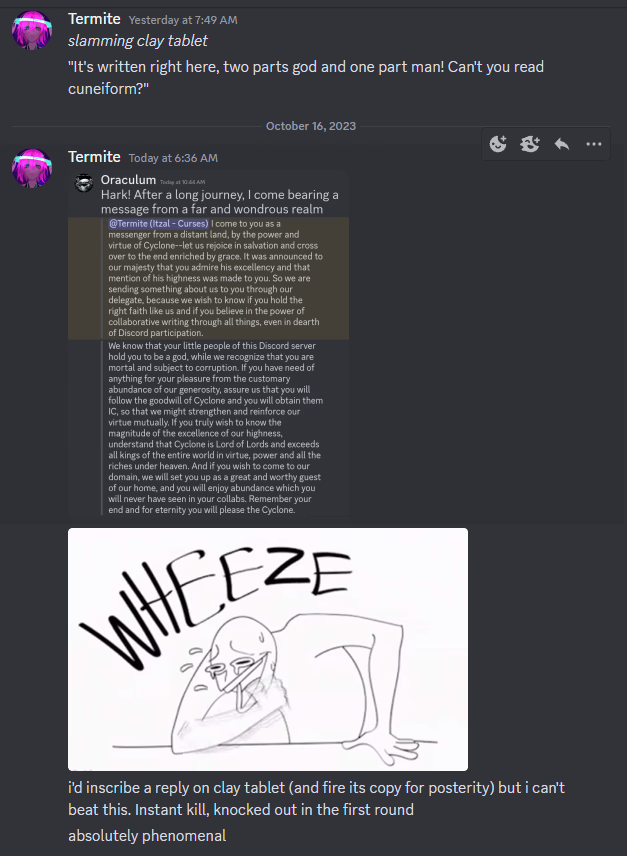
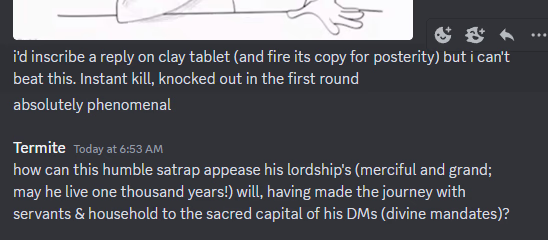
[center]Word of my splendor:[/center]
[hider=My messenger's letter][img]https://img.roleplayerguild.com/prod/users/019b0090-4706-75b9-bfe5-fd4ef6737466.webp[/img][/hider]
[hider=My fellow monarch's response][img]https://img.roleplayerguild.com/prod/users/019b0090-a418-774f-a117-1ae23ac670fd.webp[/img][/hider]
<div style="white-space:pre-wrap;">Back when dinosaurs ruled the Earth, I got started with writing online on the Spore forums. Man, those were the days. We're talking like <span class="bb-s">12 years ago</span> 2010-ish!<br><br>I've been here on and off for almost as long, and have GM'd a bunch of different things to varying success.<br><br><div class="bb-center">Word of my splendor:</div><br><div class="hider-panel"><div class="hider-heading"><button type="button" class="btn btn-default btn-xs hider-button" data-name="My messenger's letter">My messenger's letter [+]</button></div><div class="hider-body" style="display: none"><img src="https://img.roleplayerguild.com/prod/users/019b0090-4706-75b9-bfe5-fd4ef6737466.webp" /></div></div><br><div class="hider-panel"><div class="hider-heading"><button type="button" class="btn btn-default btn-xs hider-button" data-name="My fellow monarch's response">My fellow monarch's response [+]</button></div><div class="hider-body" style="display: none"><img src="https://img.roleplayerguild.com/prod/users/019b0090-a418-774f-a117-1ae23ac670fd.webp" /></div></div></div>
 Member
 Lord Zee
 Vec
Vec JFK
JFK Fetzen
 Thayr
Thayr BingTheWing