Got the bare bones of my NS laid out, I'm on my phone so there's no fancy formatting or anything. I'll add that once I'm on my computer, where it's easy to do
Name: Confederated Socialist States of America (CSSA)
Flag: TBA
Leader: James W. Ford
Government Ideology: Marxism-Leninism
Claimed States: South Carolina Mississippi Florida Alabama Georgia Louisiana Texas Virginia Arkansas North Carolina Tennessee West Virginia
Rough Population: 32,000,000
Capital: Jacksonville, Florida
Why Your States Decided to Unite: The Depression hit the southern USA hard. With the decline of northern industry, southern agriculture became less and less profitable. Herbert Hoover's destructive policies of giving more and more freedom to businesses made things terrible for the working man in the south. The working and living conditions of coal miners and factory workers worsened and worsened, and strikes were met with lethal and barbaric force delivered by private organizations and sometimes even the federal army. More and more people flocked to the unions in search of change, and with the labor unions came the CPUSA.
The ideals of Marx began to spread, slowly but surely, throughout the south. Talk of class divides and the alleged evils of capitalism began to overpower accusations of communist atrocities in foreign lands. By the year of the elections, the Overton window had been pushed shockingly far left of center. The countless unregistered African-Americans found themselves being escorted to the polls by armed men sporting red bandanas, all so they could register as communists without being assaulted. So popular was the CPUSA, in fact, that when Herbert Hoover swept the southern states the first argument were about whether it was the CPUSA that spoiled the Democrats or the Democrats that spoiled the CPUSA. However, the two parties found common ground in their hatred of the fact that Herbert Hoover had received the minority of the popular vote in the southern lands.
More intriguing, however, was the fact that the CPUSA had won more of the voters' hearts than the Democrats.
In an incredible display, CPUSA pundits and supporters came out of the woodwork and lashed out at the Democratic Party. By refusing to accept that the communists had won more support, it was said, the Democrats had let Hoover win. Had they simply chosen to support the majority of the people, of course, then Hoover wouldn't have won four more years. The communists believed it, and the communists seemed to be far more popular than the polls showed. This was not a majority among minorities, it was a true popular ideology. Perhaps, some said, Hoover shouldn't have been in office anyways. Perhaps it was been voter fraud on a massive scale. And the Democratic Party, also puppets of the bourgeoisie class, had done the same.
That idea brought the CPUSA into full prominence. Disgusted by the supposed foul play of their party, Democrats switched sides. Class consciousness skyrocketed even higher, as one couldn't walk into a bar of coffee shop without hearing "Damn bourgeoisie" muttered by more than one man. In the south the CPUSA lashed out against the Hoover administration, demanding his resignation. Of course, he refused to step down and went far enough to write off the entire south as "A bunch of good-for nothings who don't know what's good for them." Following that, one couldn't walk into a bar or coffee shop without hearing "Well, they say revolution is inevitable. And it's already happened in Russia..."
Finally, mounting pressure forced the government to act. The Treaty of Washington D.C. was signed, and the union was shattered. Immediately, the southern states blew up like the time bomb they had become. The existing state governments found themselves fighting hordes of communist revolutionaries, demanding that they bow to the wishes of the people. It was national guard and police against everyone else, since the federal military had split right down the middle between the communists and the democrat state rulers.
Chief among them was Oliver Law, a soldier whom had served in the First World War (and never, ever saw combat). During the election year he had recklessly chosen to move back to his home state of Texas in the hopes of helping swing the state towards communism. With his military training and unexpected knack for command, he was placed in charge of the 24th Texas Revolutionary Infantry, and soon distinguished himself on the battlefield. He rose through the (rather empty) ranks of the non-military branch of the American Red Army through his willingness to take chances and ability to improvise in the middle of battle. By the end of the war, he was a General. A General leading a ragtag army of coal miners with pickaxes and shotguns, but a General nonetheless.
When the dust had all settled, the political climate in the south was less than stable. Many said that they ought to join the Dustbowl States, but the party officials of the CPUSA were less than enamored with the midwest's specific brand of pseudo-anarchocommunism. In the end, the now communist southern states joined together into the Confederated Socialist States of America, a (pseudo) Marxist-Leninist state based around a strong vanguard party with the goal of reuniting America under communism. A world away in Moscow, Stalin raised an eyebrow.
The government was centralized and a new party formed, dubbed the Southern Communist Party (SCP) in order to avoid overt association with the CPUSA which had been headed by Earl Browder. A one-time election was held to choose who would be Chairman of the part and Premier of the nations for life, after all, there was little reason to change the leader every four years after the victory of communism. James W. Ford was elected, thanks to his undying (if perhaps somewhat blind) loyalty to the communist party and the people of America. This was a notable event, as Ford was very obviously not a white man. It showed just how far the South had come socially, and just how far socialism had come within it.
Stalin's raised eyebrow had now turned into a full briefing on the so-called "American situation" at the start of every day while he are breakfast. The clear intention of the CSSA to move towards a more Soviet-style government had piqued his interest. Diplomats were flown, offers were made, hands were shook, and by the end of it all the newly formed CSSA found in its possession shiny new tanks, airplanes, and a non-trivial amount of subsidies and trade deals.
Those new resources were put to work when the SCP took a page right out of Stalin's book and began a Five-Year Plan. The farms were collectivized, and industrial expansion began with the construction of new factories being paired buildings across the nation being converted to factories in order to fully utilize the vast raw material output of the south.
Diplomacy with the Dustbowl States took an odd turn with Trotsky's arrival. Though not the most publicized event, the government was well aware of it. The Southern Communist Party called a meeting in Jacksonville, as did the Soviets in Moscow, to discuss the situation. Neither meeting came to any conclusion, and so Ford and Stalin met behind closed doors aboard the CSS North Carolina to decide what ought to be done. Both were opposed to Trotsky and the ideals of the nation in which he had sought refuge, but they were also both well aware of the rising tide. Germany and the Sister Republics were proof that fascism was gaining power, and they had to be willing to pay any cost necessary to defend against fascism. Ford knew that Trotsky, a Russian, would be hard-pressed to gain any major power in America. Meanwhile, the Dustbowl States were ultimately a weakened land that followed an ideology that was by no means absolutely incompatible.
And so, after days of discussion, it was decided that the Soviet Union would stay out of the situation while the CSSA would remain friendly towards them, unless by some chance Trostskyism rose as the prominent ideology.
>tfw there isn't enough class consciousness for revolution >tfw you will never fight alongside your comrades to bring communism to the people >tfw you will never plant organic crops in Rojava to feed the proletariat Feels bad man
I'm liking this idea, so I think I'll throw this in. I hope it's okay for me to mention some insects, since they're essential to the whole "reclaiming matter" thing. If it's a problem I can change it.
Name: Sea Of Swarms
Geography: The Sea Of Swarms is a vast ocean, and what it lacks in solid land it makes up for in sheer expanse. Islands dot the waves, sandy beaches covering the vast structures of bone that exist to keep the sea's waters from flooding into the innards of the world. The water is not salty, but full of microscopic particles of bone shaved off over thousands of years. This gives the water a special nutrition to it, and the rivers that flow into the countless islands seed the land with nutrients. Within the center of the larger islands and dotting the seas are massive sinkholes that lead into the planet, allowing it to take advantage of the interesting land that has formed on it.
Method of Recycling Matter: Massive swarms of insects and tiny sea animals take any old matter their instincts choose to, then return to one of the many sinkholes to deliver the matter to the planet for consumption. Ocean sinkholes near constantly draw in water, allowing the planet to reclaim some of the bone the water has taken from it.
I expect Erdogan to go full Palpatine and declare himself "President for life" amid cheers of the civilians and the entire west calling it a great win for democracy.
Libertarians and Anarchism actually have a lot in common. Libs have actually been called 'anarachists with money'. When it comes to the state they both share a lot of views about wanting the government to 'butt out' or not be involved at all if they can help it.
Problem with Ancap is that its headed by Stefan Molyneux who has a very specific brand of Anarcho-capatalism and displays cult like behavior.
This is true. I actually had a debate last night over whether or not Anarcho-capitalism was just feudalism with megacorps, and I made the point that whenever I see or hear an ancap describing their ideal society it sounds like normal anarchism but with coinage.
I doubt a left libertarian is going to have much good to say about an an-cap. Actually, I am pretty sure nobody but An-caps have anything good to say about An-caps. Even a lot of right-wing libertarians look at the an-caps as something of a crazy uncle who says embarrassing shit in public.
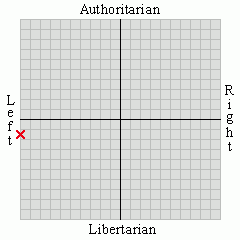
I'd say this is pretty inaccurate, as are most of my political compass results. I should be way higher on authoritarian, around the middle really. I'm perfectly fine with where I'm at horizontally though, seize the means of production etc. I feel like putting responses that are SOCIALLY liberal put you further down on the libertarian scale for some reason, even if you happen to intend to give people who practice hate speech ten years hard labor in the Alaskan gulags instead of just saying "Now now, that's awfully rude!"
Also I got 9.85 on left. Suck it, @ACPM. I'm the most left of all the leftists here so far.
@Heat 7/10. I love the instrumental, but the vocals kill the vibe I got from it. It's easy to see why someone would like it though, so I can't give it less than a 7/10.
I'm a weeaboo communist. Are you surprised?
EDIT: You probably are now, but I'm not going to tell you why you wouldn't have been like two years ago. You get to agonize over that yourself.
<div style="white-space:pre-wrap;">I'm a weeaboo communist. Are you surprised?<br><br>EDIT: You probably are now, but I'm not going to tell you why you wouldn't have been like two years ago. You get to agonize over that yourself.</div>
 Member

 Alisdragon911
 TokyoPewPew