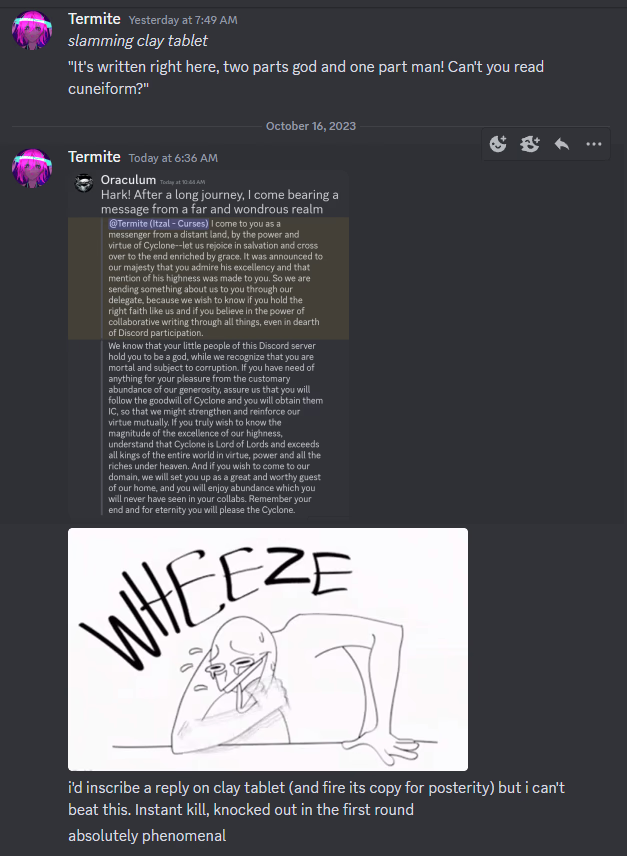
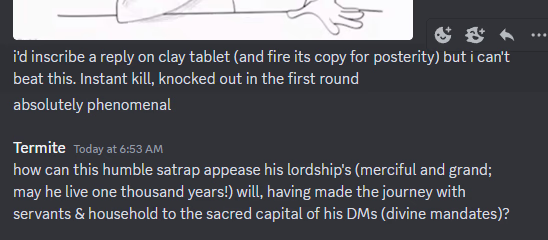
Back when dinosaurs ruled the Earth, I got started with writing online on the Spore forums. Man, those were the days. We're talking like 12 years ago 2010-ish!
I've been here on and off for almost as long, and have GM'd a bunch of different things to varying success.
Sarhush emerged back onto the surface in a place that had once been a seafloor. He clambered out of a deep fissure, steam pouring around him, the ground still warm beneath his feet. The air around tasted of salt, sulfur, and ash. Far in the distance, he saw the ground slope upward into what looked to be a great plateau: it took him a moment, but he realized that rise must have once been an island. A smile cut across his face, sharp and satisfied. Nature had yielded and the wretched water was gone.
Sarhush began walking in the direction of the former island. Dead fish and sharpened salt crystals littered the sandy ground everywhere, but the soles of his feet were tough, and it did not bother him to tread upon the bones of lesser creatures. Ashuru was not delicate and neither was its master. Carrion birds circled overhead, but they were not so numerous around this banquet as one might expect; the ashen skies had seen to it that many of them had succumbed alongside their would-be meals.
Eventually, Sarhush came across a great stinking mound of flesh that was squarely in his path. He inspected it as he grew nearer; if he’d ever taken the time to swim in the sea or even sit by the shore, he might have seen whales and recognized this corpse for what it was. Alas, his disgust for the oceans meant that he’d never witnessed such a creature before that moment. He gazed upon the great beast’s rotting corpse without recognition, let alone anything like remorse for how the creature had suffocated when the waters receded. As if in answer to his callousness, the bloated whale exploded in a geyser of gore just as Sarhush drew near, the gases trapped within it building until they finally tore the body open.
Some failed leviathan, then. A creature that had depended too long on a softness the world no longer permitted. Another worthless piece of Nature cleared from his path.
As he stepped through the gory remains and climbed over the whale’s now exposed spine and to the other side, he came across a dead ur-human lying upon the silty ground, yet with a corpse that seemed unwounded. Sarhush wasn’t bothered. Those bereft of strength or wits naturally succumbed, but there would always be some worthier survivors to carry on the great toil, to realize his dream of Civilization.
Besides the dead human, the still-damp sand was bubbling. Sarhush approached with a keen eye, and a keener nose, and saw immediately what had happened: toxic fumes were escaping from deep underground, rising up from a barely visible fissure to poison the air. This one had approached the dead whale hoping for an easy meal, only to suffocate for the attempt. Bad luck!
Sarhush didn’t think of things the same way Alechior did, but he did understand chance. Some were favored, others were not; just as some were strong and others weak, some clever and some dull. That was simply a fact of existence. And in this existence, Sarhush concerned himself with the living: the strong, the sharp-witted, and the lucky. The rest were no more consequential than the wind.
He continued his trek towards the island-plateau. When the slope steepened and he began climbing what had once been a beach, the ground shifted beneath his feet. There was movement below, not yet violent, but like some great beast stirring in its sleep.
"You endure," he announced aloud, not to the carrion birds scattering in the sky, nor to the distant figures of a few hardy surviving beasts fleeing across the broken flats, but to Ashuru itself. "Good. I would have been disappointed otherwise."
As he’d been climbing up from the fiery depths, it had seemed as though the whole world had been screaming, a cry both psychic and deeply real. But he saw now that it had all been just noise, like those bothersome Patrons squabbling in the hole. Ashuru was durable. If it had turned out that he was so mighty, his power so terrible, that he’d managed to break the world to the point that it was no longer a suitable place for his great work of cultivated Civilization, then he would simply smash the pieces back together.
Ashuru answered his words with a deafening boom, like the trepid roar of a half-broken beast straining against its captor. A second sound soon followed: a deep rumble, like that of rolling thunder.
"Hear this," he told it, his booming voice carrying effortlessly across the world. "You have more land than before, to be built upon and cultivated."
Sarhush cast a baleful eye upward and saw a mountain further inland, its angry peak glowing red, ash rising upward in a widening halo about it.
He trod upon a shard of obsidian, because he’d been looking upward. The thing was wicked-sharp, but not enough to break his skin. Sarhush looked down upon the glassy black rock and smiled; this was something new. "You have more varieties of stone to be broken, shaped, used! More fire to be put to work."
He continued his climb even as the slope grew ever steeper. Rocks shook loose above him, scattering down the incline like pollen shaken from a leaf. Some glowed red-hot; one struck his shoulder and burst apart, spattering molten fragments across his skin.
Sarhush laughed.
"No more forest to blight you," he listed off. "Less sea to soften you and impede my work."
The volcano roared again, but in strain more than fury. Lava surged, ash billowed, and the mountain’s scream deepened as pressure sought release. The world was not defying him, not truly; it was trying to learn a new shape.
But Sarhush liked its current shape well enough. He stepped through the lava flows, weathering the heat, and came to stand at the very peak. Here lava bled freely and great clouds of ash were coughed up with every heave of the earth. Beneath his feet, the stone trembled continuously, as though uncertain how much more it could bear.
"Heel," he threatened Ashuru, "lest I strike and burn you into submission again."
The mountain settled. Its convulsions slackened into a low, uneven pulse. The lava ceased its gushing and began to scab over the open wound of the world, at least for now. Ash still fell, but more slowly, as if the sky itself were catching its breath.
Confident that the world understood the lesson, Sarhush stood upon its pinnacle and turned from the volcano’s mouth to take in the clime below. His satisfaction did not last.
Far in the distance, a line of greenery still marred the land. There was a surviving treeline, stubborn and defiant, sheltered from the lavaflows by a gulch that had been torn open through the earth’s recent thrashing. It seemed that some forests remained after all.
Sarhush scowled.
"I will correct that," he promised, and began his descent.
Did you think Sarhush would feel guilty? Lol. Lmao!
He loves everything that's happened. He walks through the hellscape talking to himself. He threatens to hit a volcano with a stick and burn it, and it settles down (thanks to Khthon's taming of the volcanos, not anything Sarhush actually did there) and this makes him immensely satisfied.
But then Sarhush sees a couple trees and his blood pressure spikes again.
"God-Brother. The seas are draining. I have fulfilled my end of the bargain. Now, it is your turn to do so. Cling to me once more. We shall travel to the bowels of the Earth.”
“So it shall be,” a soaked Sarhush answered.
The Earth swallowed the two Gods once again, and brought them to the very deepest point of the earth, in a small air pocket that Khthon had created for this very purpose. The copper pickaxe laid on the floor, carried here by his power once he realized it had been lost to the flood. "Here is the very bottom of our world,” the God entoned. "Here we shall ignite the greatest of all fires, so that stone will forever hold its warmth, forever be transformed, forever change what it touches.”
"Tell me, Sarhush. You have fire. What needs to be done so that it spreads beneath?” Khthon asked. "I have seen ash and wood, but stone does not burn as they do, and they do not burn hot enough to melt the Earth.”
“Fire hungers, but its palate is broad. All that once lived can be set aflame, but down here there is nothing. We will require fuel from the surface.”
Still soggy, Sarhush at least managed to resist shivering as he reclaimed the pickaxe. With a mighty few swings, he dug out a great hollow of stone. To him, the trough represented a mouth. Soon, that would be the searing maw of the greatest fire the world would ever know, but there was more work to be done first. He widened and deepened the mouth, swinging his pickaxe wildly and without care to neatness or symmetry. He hurled the loose stones aside and worked until the fractured stone floor itself seemed sore, seemed to recoil from his strikes.
“Soon, you will eat,” Sarhush dismissively spoke to the maw. “But not yet, for you would only choke and suffocate. First, you must breathe.”
Sarhush rapped the copper pickaxe gently upon the walls around, ear pressed against stone, listening carefully to the echoes. He began to tunnel to where he heard signs of another large cavern. This would be the nose, the lungs. When the nostrils of that nose finally stretched from the back of the maw into the vast reaches of a second airy void, he turned back.
What was a maw and a nose without a head and skull? With the stone rubble from his digging, Sarhush began to stack stones and arrange them into mortarless walls. Where there were gaps, he crammed small pebbles and bits of dust. When stones would not fit together well or gaps persisted, he hammered and battered the wall, and in his rage he compressed and crushed the loose bits together. In the end, he’d hewed a head, the skull so tight that the insides might have been nearly choking. The maw could breathe in, but it lacked the power to exhale. Sarhush struck upward with his pickaxe to right that.
He excavated a tortuous tunnel that twisted and writhed through the foundations of the earth. Within, the heat and smoke would scour, burn, and seep into the stone. This would not be a chimney so much as an artery of scorching heat, a path of suffering carved into Ashuru’s bones.
Sarhush descended back down the way he’d come, climbing out from inside the maw. He looked back and beheld his creation. While the world had yet to know the words for his artifice, his work had wrought the first furnace.
Sarhush finally threw down the copper pickaxe, battered and ugly as his toil had rendered it. Then he looked to Khthon. “Fire is a beast that hungers like any other. I have built its skeleton, but now it requires food. Go to the surface and bring down as much fuel as you can; nigh anything that lives or once lived will serve. Then, I shall make a blaze so hot that it will wake the stone.”
Khthon heeded the other God’s words, and rose back to the surface. He did not have to look far for fuel, for he emerged in a large swathe of burned forest. The ground was littered with ash and the burned husks of tree trunks. They would serve as fine fuel. From his body grew arms and hands, and he grasped handfuls after handfuls of ash and charcoal, pressing them down into a small, hard, brownish-black lump. Satisfied with his creation, he ordered the soil to swallow the ash and compress it into coal as he had done, and to then bring it back to Sarhush’s creation.
With this part of the land cleaned from debris, Khthon moved to the next, each time taking the ash and burnt plant debris, each time condensing it into coal, until most of the devastated lands were cleaned of any trace of fire, leaving only empty plains. The coal also evolved, each time getting darker and more dense, until it gained a luster, and Khthon knew it could not get any purer.
He wandered some more, eventually approaching a mortal campsite. He saw that the creatures living within had crafted their own fires. When all seemed occupied by one task or another, Khthon approached some more, looking into the fire pits. The mortals seemed to be burning almost living firewood; the God knew instinctively that his coal would burn much, much hotter than it ever could. And yet one fire burned brighter than the rest, and when he looked into it, he found a small speck shining a fiery gleam. He plucked it out of the fire and held it out in front of his face, admiring as it continued to burn alone. And then the vision came.
Deep, certain knowledge of fire. What it is, what it does, and how to make it. But also what it is for. Warming, yes. Lighting up the darkness, too. But also destroying. Killing. Burning all to the ground. Melting all that can’t be burned. Bending the unbendable, shaping the unshapable, and if all else fails, destroying it. A weapon and a tool in one, the first step in taming all that is Wild.
Khthon almost dropped the burning speck with how hard he flinched at those thoughts. How harsh and unpleasant a view of the world, for all that you can think of is how to abuse it! It must be one of Sarhush’s creations. Perhaps he could make use of it when igniting the Earth into magma.
He sank back into the soil, still unseen by the ur-humans nearby, and returned to his God-Brother’s side. ”I have acquired fuel aplenty for the blaze. It lies within the surrounding Earth; call to me and I will bring it out.” Khthon handed over the Me of Fire still gently smoldering in his hand. ”I believe this… thing belongs to you. Perhaps you can make use of it?”
Sarhush was beside the mouth of the still-cold furnace, casting chunks of coal and lignite into its maw. The strange new stones were heaped up beside the furnace in massive piles, but the furnace would hardly fit anything more. It was nearly time for the fire to begin its feast.
When Khthon returned, Sarhush looked up. The sight of the smoldering object in hand was a pleasant surprise; he didn’t even notice the shift in the other god’s tone. “Ah, you’ve found the Me of Fire!” He took it from Khthon and lifted it to inspect anew. “This was one of many gifts that I bestowed unto the mortals above, that they could learn to mimic my own power and mastery over the world. Yes, it will aid us in this work.”
Sarhush blew gently on the ember that was the Me, and the thing flared to life. Where it had glowed a dull orange, it now was white-hot. Unceremoniously–almost lazily–Sarhush tossed the thing into the maw of the furnace, and in an instant it ignited the great piles of coal. A massive inferno soon filled the furnace’s stone head. A blast of warmth filled the whole room. Sarhush’s hide clothes, still soaked from the floodwater, helped him weather the already uncomfortable heat.
But this was not enough. Sarhush began throwing more and more coal into the furnace, for its maw was so vast that the flame within was able to consume the fuel as fast as it could be flung inside. Meanwhile, Khthon sank back into the stone and began to guide the heated stone and let it permeate through the Earth. When one part grew hot, it would be swapped with another that was still cold. Slowly but surely, the heat spread more or less evenly from the furnace, growing ever hotter every second. The stone around the furnace began to glow red hot, and softened, until their texture turned slightly gooey.
The fire burned hot, and fast, but not fast enough. Soon, Khthon realized that past a certain radius around the furnace and its winding chimney, the heat could go no further. The hot stones would cool off before more could join it. The fire was simply not big or hot enough.
What must one do when they want a bigger, better fire? Better fuel is one answer, but they already were using the best fuel available. The logical next step is then more fuel. Sarhush was shoveling it in as fast as he could, but Khthon knew he could be faster.
”Move aside, brother.” This was the only warning Sarhush had before a veritable torrent of coal emerged from the walls and rushed into the blazing maw of the furnace. The flames grew bigger and hotter than ever, until they became a blinding white. The heat had grown so violently fast that it embrittled and cracked the stone walls of the furnace; then the whole thing began to sag and glow as it too started to melt. The walls that had contained the inferno now caged it no longer. It roared and spread, guzzling an avalanche of coal as it blasted heat and soot upward through the chimney-artery.
Khthon could feel that the surrounding caverns were not spared from the same fate; slowly, and without much intervention by the God, stone, metals, and even a few gems began to melt into magma, which flowed into the hollows of the deep earth, until all was united into one great lake of liquid fire. The stone groaned. Pressure grew, as more magma accumulated in too small pockets, and in a few places the stone cracked and let it seep upwards. Whether it would breach the surface, or cool and settle in the depths, would remain to be seen. Finally, the Earth was given the spark of warmth that it lacked, and Khthon, too, smiled, for he knew that the heat would sustain his world for as long as he desired it to.
As stone itself had been made to bend and yield, the formerly cold and lifeless bones of Ashuru could now shudder. The world had been given warmth through the fire they’d forced into its bowels.
The cavern around the molten furnace was a hell of soot and glare. Sarhush stood bare-skinned amid it, soot-streaked and steaming from sweat, the charred remnants of his clothes discarded like shed skin. He would have given the pickaxe back to Khthon, but the handle was reduced to ashes and the copper head a puddle on the floor. Still, Sarhush remained unharmed. Firelight crawled over him and lit in his eyes.
“There,” Sarhush said, not loudly, but with certainty. “Stone awakens because it has been made to suffer.”
Khthon wants to make magma and has Sarhush to help him. Sarhush knows a thing or two about making fires, so his plan is to build a massive furnace in the bottom of the world, with a chimney to carry the heat through the depths of the world. He builds this monstrosity, but they have no fuel, so Khthon creates coal and lignite by dragging down and compressing the ash and charred remnants of the forests that Sarhush and his mortals burnt.
They stoke a massive fire and make lava.
CONVICTION EXPENDITURES:
Magma and volcanism are created. 4 conviction collaborative nightmare terraforming action [Sarhush spends 3 conviction, Khthon spends 1 conviction (in-domain action)]
Coal and lignite were also created. 0 conviction in-domain lucid action (for Khthon)
You guys see Zee's post? The cat understands the evils of the water, because he is a wise lord. This is why Sarhush had to drain it.
The aftermath isn't depicted IC because Sarhush and Khthon are underground and don't go up to investigate what happens, but I'm imagining that the world goes from being covered by 80% water to something like 20%. What's left is continuous land that has big lakes and inland seas rather than an endless ocean with occasional islands.
Perhaps Yzechr's curse no longer affects all water and is confined to one of the remaining seas (and perhaps concentrated and made permanent, if it can't wander about the whole ocean anymore). Just an idea; I'll leave that to Vec and Cmm to establish if they want to go with it.
I'll probably draw a map of the world soon if nobody else wants to. It'd be useful for placement of mortal civilizations.
Sarhush crawled deeper into the crevice with his torch in one hand and stone axe in the other. This was a narrow and confined place, and it felt as though the stone itself subtly shifted against his movements. Frustrated but resolute, he pushed through, and where rock scraped his flesh and hide clothing, it only embittered him. Water soon began to coat his face and body. It dripped from porous, leaking stones above; not even down here could he be spared from the insult of the cold rain and the accursed oceans.
"I will tame and destroy Nature,” he swore aloud, his voice echoing back from a hollow expanse just ahead, "and this wretched water will be first to meet my wrath!”
Three things happened in the next moment. First, he finally emerged from his crawl through that tight tunnel into a vast cavernous expanse. Second, his torch finally sputtered from a subterranean draft and died, but it was no matter, for there was a light that emanated from strange crystalline patterns above. Sarhush beheld the great cavernous vault and wondered at those rootlike tendrils of glowing crystal and at the gleaming jewels and metal veins that lined the walls. It might have enthralled him, had urgency not already hardened his purpose.
The third thing that happened was a great flash of green and white and fractal shapes, like lightning glowing through a canopy of leaves. Suddenly there was a serpent where moments before there had been only dark nothingness. This being was vast but not large, its coiling form only suggested rather than contained; its scales were like the bark of birch trees, and its eyes green balls of moss.
Taken by surprise, Sarhush cast aside the useless stick of his dead torch and then grasped at the snake with that open hand. His massive fingers passed through a fog of nothingness when they tried to grip the serpent. For a moment he was surprised, and he nearly lashed out with the stone axe in his other hand, but then he squinted in the darkness and understood what he saw, comprehending the essence of this Serpent-that-was-More.
“I am the Patron of Nature,” the serpent declared, its voice neither hiss nor roar. Its speech was like a layered sound of a stream’s murmuring, roots cracking stone, and distant thunder rolling across plains. “I speak for the trees, for the trees have no tongues. I speak for the beasts, who remember without words; I speak for the growing and the creeping, for wilds untamed. I speak for Nature, because its god upon this world does not lower itself to bargain with–”
Sarhush snorted with contempt."And what god might that be?” he humored the Patron.
“The one you name Saries,” the Patron answered, and for the first time there was strain in its voice, “...whom you leash and drive and wound, thinking your cruelty to be mastery.”
The Lord of Civilization smiled, his yellowed teeth looking not dissimilar to the flecks of gold in the rough stone walls. "Saries,” he laughed, "is just my hound. I have already broken him to the yoke; he hauls logs for my mortal worshipers. If he is the strongest champion of Nature, then Nature was conquered before it ever knew there was a war.”
Sarhush was actually quite enjoying this. “Nature is a transient inconvenience,” he continued, booming voice echoing through the cavernous depths. “It grows, but only to forget itself and be forgotten. It leaves no monument or record, and permits no greatness to be built until it is cleared away. I see how you embody the wretched Ideal of Nature as you are: intangible, unaccountable, yet in the end no more than a petty annoyance.”
Sarhush leaned forward, eyes burning like the smoldering end of his discarded torch.
“I said I would see Nature destroyed. All of it!”
The serpent recoiled from every word. It was wounded by the weight of inevitability and unyielding intent, but not afraid. “You cannot destroy Nature,” it answered more softly now, voice like rustling leaves, “for it is vaster than you or Civilization could ever be. You can burn, salt, and scar the land, but Nature will survive and return!”
“A challenge, is that? All in due time. I will spare not a single corner of the wildlands. But first, I intend to see about the rain and the oceans. I will smite from existence the abomination that is Water, and you can bear witness, little powerless voice that you are!”
“I object!” came a crashing voice from above. The light of the crystalline roots, far above, blurred, their light scattered as the caverns darkened with reflections. A deluge of water seemed to crash down from where it had condensed on the ceiling above them, but when it struck the floor and Sarhush leaped as if about to be drenched, the great splashing and misting of water turned out as ghostly and ephemeral as the serpent. From the pool of water-that-was-nothing-yet-more, there arose some humanoid figure, watery form ever shifting, as if it could not decide what it wanted to look like. “I am the Patron of Water,” it declared, “and I denounce your vow as folly. I, whose wisdom stretches from the bottom of the sea to the highest raincloud! You would destroy me, smite away Water? It is not some tiny facet of Nature; it is a cornerstone of Life. Through your callous and short-sided rampage, all would be undone! No cities could rise, no men or animals could drink–”
Sarhush rapidly tired of that one’s flowing rambles.
“Maybe it would end life as you know it, but know that I am a god even as you are mere noise. If ever the promise of Civilization was ended, then I would find a way to rebuild it,” he stated coldly, as fact.
Nature and Water both began shouting back at him simultaneously, but their words were interrupted by a thundering boom. Blocks of perfectly cut masonry tumbled from above and erupted from the walls like so many hailstones, but there was an unmistakable order about them, and they slammed together to assemble a pyramidal form. Then the pyramid seemed to fold, its many stacked platforms twisting, withdrawing, and protruding. It became like an etched tablet, every surface covered with pictographs of mortal armies and cities and crafts, and then it finally completed its transformation and became like a man of stone whose every edifice was perfectly measured and hewed.
“As the Patron of Civilization, I must speak,” the newcomer asserted even as the others kept clamoring, and this one captured Sarhush’s attention. Its voice was steady and restrained as it began, “You speak truth, Sarhush: Nature is our enemy, and bringing it to heel will increase our mutual virtue. But as for Water, it would erode what its betters raise and call that patience; it would drown names, scatter peoples, and boast that all things return to it. It is not worthy of respect, but even still, can it be said to be any worse than a beast? Break it to heel, subdue it to your will, but you need not destroy Water utterly. It can prove useful once put into its place!
“Know that Civilization is not merely conquest over Nature and the lesser Ideals. It is continuity. Constraint. It is the endless toil, the ordered fight against disruption. You threaten to erase too much, too quickly, and in this chaos you would snuff out the fire that you have so carefully begun to kindle.”
“Who taught mortals to start fires?” Sarhush demanded, “Or to knap stones, shepherd beasts, fashion hides into clothes?”
They were all silent, even Civilization. Sarhush looked smug as he said, “It was I, through the power of my Mes, who first began Civilization. And I could just as easily do it again! But the world shall not end; it shall obey. I have heard Water’s plea and found myself amused, and perhaps Civilization inherits some grain of wisdom from mine own, so I am moved enough to say this: I shall still destroy the oceans, but perhaps I will suffer the rain to continue, that some water may persist in rivers before it finds its way to the emptied seas to be drained away.”
A bright, ringing laugh split the cavern. The glow of the crystals above intensified, gradually over the course of a few moments as the laughing grew louder. In dramatic fashion, once the light was as blinding as the sun, it coalesced into a radiant figure of light, whose outline was sharp with triumph and monumentality.
“My Ideal is Glory,” cried the fourth Patron to manifest in the cave. “So this is your plan, Great Sarhush? You have descended to the bowels of the world to destroy the water–or at least the oceans–through draining them? Tearing a hole through the flesh of Ashuru and letting the seas themselves cascade into these depths? Yes! Let it be remembered! Let the earth heave and quake, let the seas and all that dwell within them perish! Let the greater part die alongside the endless seas, but spare a few, just a few, to remember and to honor your name! What is a world unscarred, if no one sings of it?”
Nature and Water cried murder; Civilization began to quibble over the details. They were all drowned out by the arrival of yet another. Behind the Patron of Glory, the air itself shattered as something manifested violently. The air fractured, and sound broke. A presence flickered, unstable, reforming itself with every moment just long enough to tear itself asunder in even more spectacular fashion.
“Cataclysm welcomes this,” the fifth Patron intoned from many mouths of grinding stone. “This world is too lush. Let it dry and crack, let it burn. Let it end! Ignore these fools; spare nothing and nobody!”
The cavern filled with overlapping voices now: there was the Patron of Nature pleading cycles and balance, Water swearing doom and collapse, Civilization cautioning restraint, Glory exalting the conquest and the tumult for conflict’s own sake, Cataclysm exulting in the promise of ruin and urging Sarhush to indulge in unrestrained destruction.
Sarhush listened to the cacophony. He listened to them all. Now they were bickering among themselves and over one another, hardly even paying him any mind by this point. Eventually, it was too much to contain. Sarhush guffawed, laughing harder than he’d ever laughed before.
“You are all echoes bickering over a stone, shouting at it as though sound alone could move it to your designs. You do not even see that I already have it in my hand. You, who exist half in Ashuru and half in nowhere, cling to your Ideals, but they are weightless and intangible. My Mes are of this world, and they move it. None of you can stop me. What are any of you but noise?”
A tremor shook the cavern walls, and from them emerged a boulder. From the boulder first emerged a head sporting an eyeless visage, and then a torso devoid of arm to carry that head.
Khthon looked upon the commotion taking place in his caverns. Trespassers not of this world, as well as the God-Brother he had been seeking, disrupting the peace and quiet he had toiled to create. Luckily, none of his treasures seemed to have been harmed, but such disrespect stung all the same...
"Tresspassers. God-Brother. Patrons, if that is what you call yourselves. I am Khthon, and this is my domain." The God's voice was as monotone and even as usual, but the subtle trembling of the stone walls and ceiling surrounding them betrayed his irritation. "I tolerate your presence in the shallows. Yet, you come deeper. Even though the depths wish to remain hidden. Even though they are devoid of life. You do so, and break the silence within."
"Why dare come here? Are you thieves, wishing to ransack my domain? Or simple fools who do not know where it is appropriate to squabble?" He turned his head towards Sarhush, and though he had no eyes, his gaze burned all the same. "Explain."
“Finally, someone that’s more than noise,” Sarhush mumbled at Khthon’s arrival. Then louder, he called out in answer, “I am Sarhush, and I have come down here to save the nascent world that Civilization may thrive above!”
The whole room erupted with the tumult of the five Patrons again. “ENOUGH!” Sarhush roared at them. “We’ll suffer your noise no longer! Begone, all of you empty spirits!”
The Patrons scattered and fled, their manifestations vanishing as suddenly as they’d arrived.
“Their noise offended me too,” Sarhush explained to Khthon, “but I didn’t invite them here. They came of their own will to bark and plead with me after I declared that the oceans above will be drained.”
Kthon relaxed as the noise lessened. "Why drain the oceans? How would it benefit this… ‘Civilization’ you speak of?" He tilted his head curiously. ”I do not see how my caverns could help you. Water is of no interest to me. Nothing within my realm holds power over it."
“The oceans are no more than an accursed, poisoned waste that mars Ashuru. One of the others saw fit to corrupt them at the dawn of our creation. I fell into their depths while wrangling the God-Beast Saries, and I decided then that I would have nothing more to do with the water, even if it would hinder my coming and going across Ashuru. But now the sky itself weeps! Rainfall descends to put out the fires of Civilization. Then it finds its way to the rising sea, eroding all in its way and carrying the earth with it.
“I can see how this ends: the land will be flattened into nothingness, the oceans will rise forever and drink the whole of the world. I will not stand for it! Civilization cannot thrive beneath the waves. But I have a clever idea to stop this.”
He set down his stone axe, and brought him two hands together cupped. “Where you see my hands, see instead the whole world,” he began. Then he spat a great glob of phlegm and saliva into his cupped hands. “And in that, see the smothering, wretched oceans. But where the earth is breached…” The god loosened his cupped hands just a bit, enough to let the spit begin to drip through the cracks of his fingers. Sarhush’s hideous grin almost stretched from ear to ear.
Khthon looked at the slowly dripping liquid, his expression unreadable. He understood what Sarhush desired, and knew exactly how it would go; many of his caves, during their formation, had opened beneath the sea or other bodies of water, and remained flooded to this day. It did not bother Khthon, since whether it is flooded or not, what is underground remains underground.
"I see what you desire, yet the why escapes me still. You speak of the fate of the surface world with such urgency, but have given me no reason to care for it. Even if the world were to rest beneath the waves, the earth would still rest beneath it all. You speak of great Civilization, yet still have not explained what it is, or why I should desire it." He gestured with his head to Sarhush’s stone axe. "“I can see from your tool that it must have to do with the creatures now crawling all around the surface. Their usage of stone might be clever, but I have no care for them beyond that. They are loud, and many, and always seem to be rushing somewhere. I do not understand their appeal."
“Ah, Civilization…It is my project, my calling, my purpose! But how to explain it? Hmmm…” Sarhush thought for a moment. “It is cultivation! Civilization is the shaping of the world itself, transforming from a lesser and primitive state to a better one. It is a long and slow process that demands the labors of many hands, working under the direction of those endowed with might and command. It is not merely conquest over Nature…It is continuity! Unrestrained, eternal! It is the endless toil, the ordered fight against emptiness!”
Sarhush had tried to quote some of those eloquent words from the Patron of Civilization, but he felt as though he hadn’t quite said it all the same way. But it was of no matter; his own interpretation of Civilization was surely the right one.
"And so you would seek my aid to see it prosper. Hmm." Khthon thought carefully on Sarhush’s words. Taking the raw stuff of godly creation, and shaping it in new ways through mortal hands… The Earth God might not feel strongly about mortals one way or the other, but the thought of that very first blade he saw, made from his stone, still stuck in his mind. And there would be more such crafts? Better ones?
He still did not understand the lofty ideals of his God-Brother, but he understood the simple material reality. Mortals needed dry land to survive, time to shape the surface, and materials to create more crafts. The seas, if they truly did rise as he claimed, were putting them at risk, and he sought to bury the water to save the helpless creatures.
Of course, burying the seas would not make them disappear; pressure and time would have them reemerge as water sources eventually, and they would form rivers and lakes, be fed by the rains, and return to the earth to begin the cycle anew. Such cycles, Khthon knew plenty. Stone wasn’t exempt, eroding into sand and transforming into rock again, changing under pressure and reforming into another form. Sarhush still seemed to be ignorant of such truths. He would have to learn the hard way.
"Very well. I will admit I am curious to see what else these mortals can craft. You wish to drain the seas, yes? Then through our will, cracks will form in its bed, and drain it all into my domain. The sea will then belong to the world beneath, and to me."
"But such favors do not come for free. A fair trade must be made. To do your biddings, I will require something in exchange. First, a vow. Never again will you or your ilk trample upon my domain without offering proper tribute. If you are to benefit from my work, then I too shall get something in return." Khthon’s gaze fell upon Sarhush’s discarded stone axe again. "Second, your axe. From my stone it was made, and to me it will return."
"For this small price, we can change the world together, and all will leave satisfied."
Sarhush wiped off the remaining spit on his hands as he looked down at his stone axe on the floor. “This trinket? My first attempt at a tool? It is my custom to be generous, so I gift it to you freely,” he said before kicking it in Khthon’s direction. “But you expect me to swear a vow? Ha! I did not come down here as a beggar; I was prepared to do this thing alone. The seas will be drained, whether you aid me or not.”
So he would have destroyed his caverns just to obtain what he wanted? Khthon’s voice grew colder. "Be careful of your words, God-Brother. If I cannot extract a vow from you, then I will demand something else. An act of world-shaping in exchange for another."
"The Earth is cold and dead. It will never be alive in the way the surface is. But it still requires animating. I wish to give it warmth and heat. To give it the power to melt and transform by itself. I am weakened by the shaping of the Earth, yet this task remains to be done." He looked at the axe and the earth swallowed it, protecting it from harm, and then gestured to the stone beneath them. "In the deepest of depths, help me create the Earth’s lifeblood. Magma will then flow and fuel further wonders, and should it ever breach the surface, I am sure you will find it a utility. You shall have my aid in return."
Sarhush stared at Khthon for a long moment as he mulled that over. Then he barked a short laugh. “You speak of giving dead stone warmth, as if it were something to coddle. But that is not what you truly want. You would put the earth to toil, driving it from its torpor and forcing it to work.”
Whether Khthon realized it or not, he had asked the perfect person. None knew better than Sarhush how to tame, subjugate, and yoke.
“Stone does not need to live,” Sarhush continued. “It needs to be bound, broken to purpose, and set beneath a burden it cannot refuse.”
He let the weight of that sink in before he finished, “That burden is fire.”
A thin, predatory smile crept across Sarhush’s face.
“Fire already knows my hand. I bestowed its Me unto man. I used it to incinerate the forests that infested Ashuru’s skin.” He turned his gaze downward, as though already measuring the depths. “Very well. I will outdo myself. I will build a fire so great that every surface blaze will seem a tiny spark by comparison; so vast that it will drive an imperishable heat into the very bones of Ashuru! In return, you will help sunder the bottom of the seas and drain them into the depths.”
Sarhush stated it all as fact and didn’t bother waiting for accord. He looked to one of the rough stone walls and jabbed a finger at it, poking hard enough to dent the stone. “This work will require tools,” he declared, “And not like the axe that I just gifted to you. Its edge is too broad. Stone must be pierced, not felled like a tree.”
The god’s burning eyes swept across the cavern and found a seam of flint. He was upon it in a few great strides. He plunged his fingers deeply into the stone, and heaved and tore out a jagged chunk. Then he began smashing the rock against the wall.
The sound of clanging rocks filled the cavernous hall. There was a wildness and savagery to his motions, for he put a terrible strength behind every blow, yet precision and purpose were hidden in each motion. Flakes of the flint separated cleanly, and a wicked edge took form, culminating in a sharp point. Sarhush retrieved the charred stick that remained of his extinguished torch. It was flimsy, but it would have to suffice. He pressed a thumb into the flint toolhead with such force that it dug a hole where none had been before. Then he forced the stick through, and thus did he fashion the first pickaxe.
He tested the thing by swinging it against a stony wall, and roared in outrage as the flint head shattered against solid granite.
Khthon looked at Sarhush in amusement as he shattered his tool. "Do be careful, God-Brother. Not all stones are equal. What is hard is often also brittle.” He willed the earth to carry his body to Sarhush, and then called to the stone within the wall. From it emerged a piece of raw copper, a small piece of a nearby larger vein, leaving nothing but a slight ripple in the rock. It clattered to the ground, already in the crude shape of a pickaxe head. "I will lend you this for the duration of our toil. It shall not shatter.”
"Make your tool, and then I shall transport us to the still dry caves beneath the seas. We will begin our work there.
“Then it is decided.” Sarhush removed the stick from the remnants of the ruined stone pickaxe, then pressed it through the new copper head. The metal was cold to the touch, and gleamed a fiery orange as it reflected the light from the crystals overhead. Sarhush’s fingers moved slowly as he outfitted it onto the handle again. He tore off a strip of hide from his own clothes and used it as a binding to reinforce the joint where wood met metal, almost as if trying to find some excuse to feel and inspect the copper for a few moments longer. But then he was finished. He tested it with a mighty swing, and witnessed stone crack with a small, satisfied grin.
"I see that you are done. Come near.” The ground slowly began to swallow up Khthon’s body as he prepared to travel. "Cling to my body. I shall see that we get to our destination swiftly. Do not try to speak during the voyage. You might swallow dirt if you do.”
Sarhush obliged by jumping on top of Khthon. Khthon sank the rest of the way into the rock, carrying Sarhush with him. Soon they began moving through the earth as if it was water, the stones themselves carrying them towards their ultimate goal. It took only a few minutes of travel before they emerged into the deepest of all the undersea caverns, covered in dirt.
"This cavern is small, but deep. It connects to many others. Our work will begin here,” Khthon stated, looking at the close walls and low hanging ceiling. "Strike where you wish to crack the ceiling, and I shall endeavor that all stone split in its path, until it reaches water.”
“Let’s waste no time,” was all that Sarhush had to say. With more agility than might have been expected for something with his ogrelike form, he climbed a short ways to reach the low ceiling. Gripping the wall with his toes and one hand, with the other arm he began slamming the pickaxe into the stone above.
A crack appeared, small at first, and then larger and larger as the pickaxe did its job. A few more hits and then… An ear-splitting crack rang out as the stone cleanly split, and split, and split, much deeper than should be possible, the cracks spreading deep into the rock and splitting into many different branches and linking many caverns, until they all finally reached the bottom of the sea. A creaking sound began, and a few minutes later, a few drops of salted water finally began to drip into the cavern.
It had not occurred to Sarhush until that moment just how precarious his position was. Suddenly, a great rumble shook the walls and ceiling, and a deluge tore the cracks into the ceiling wide open. Cascading seawater flooded into the chamber, the pre-existing cracks linking this cave to others seemingly not enough to slow it at all. The weight of an entire sea bore down from above, so the deluge came with such pressure that it pulverized stone and reached the ceiling in barely a few seconds. Sarhush, who’d begun scrambling wildly away from the cracks, was caught in the surge and swept through black tunnelways, coughing as the water slammed him into the stone walls and floors.
He was tossed about like a seashell in the tides, and panic filled him as his lungs screamed for air. In the darkened waters, it was as though he was grappling with Saries all over again. With mighty thrashing and kicking he managed to fight his way to the top of the surging water and steal one gasp of air, but then he was dragged under again. The copper pickaxe was long gone. Eventually, when the water slammed him into a wall, his scrambling fingers caught hold of some rocky protrusion. That was all the purchase he needed to begin climbing, and in only a few moments he’d scrambled up the soaked rock wall and onto a ledge above the rushing water. There he coughed up saltwater, then panted, furious, and trembling with a rage and humiliation that he refused to name. His eyes darted through the black tunnels, frantically searching the darkness for a way to escape the rising rapids below, only for Khthon to emerge from the stone behind him.
Sarhush goes into a cave and starts talking to himself about how much he wants to destroy Nature, and apparently Water too. This elicits an appearance from the Lorax the Patron of Nature, but Sarhush just mocks and taunts it. Then the Patron of Water comes to nag and gets similar treatment. The Patrons of Civilization, Glory, and Cataclysm show up and mostly egg Sarhush on; but it’s a circus and in the end they are all just bickering with one another in a dark hole in the ground while Sarhush laughs.
Then Khthon shows up and all the Patrons are shooed away. Khthon is swayed to help Sarhush with his genius plan to drain the oceans by opening a massive hole beneath the seafloor that leads into the caverns below. This goes about as well as you’d expect.
CONVICTION EXPENDITURES:
A massive drainhole is created at the bottom of the ocean, suddenly and violently lowering sea levels (the existing islands are now connected; smaller inland seas and saltwater lakes are left in some of the lower spots of the former ocean; subterranean rivers, aquifers, and even seas now exist in the cavern system below, and some probably harbor life.)
Does The Spark affect only future generations of mortals since it's meant to be something they're born with, or would some of the already-alive ones that had been around for a while suddenly find themselves obsessed with something, and quite good at it?
Your last post segues really well into mine, I think. Sarhush is up to something down in the caverns, and what a place for Khthon to find him!
I don't expect to have much time to write over the next 72 hours or so, so feel free to write another post of your own in the meantime. But then toward the end of this week or in the weekend, I'd like to write one together. Actually, Frettzo knows my intentions for Sarhush and wants Saries to be involved too, so we might end up with a three person collab.
But at least in the beginning it could just be the two of us because I don't think Saries would turn up until the end.
This time, Sarhush responded a bit more softly, "You are heard. You have asked for a name, and I shall grant it."
He stood there for a minute, ruminating over the task and taking in all that was before him. Then the rain began, and droplets of accursed wetness fell upon the god's brow. His teeth gnashed and ground at one another, unseen behind his scowl.
"I style you Sirna," he soon proclaimed. Perhaps Sarhush's divine perception was sharper than any--even he himself--could ever know, and with a mere glance he could sense the true name of a being. Or perhaps Sirna's earlier revelation of their name, closer to the time of their arrival on this world, was a mere premonition of the divine proclamation that Lord Sarhush would utter thereafter. OR perhaps it was mere coincidence, for Sarhush did seem to fancy names that began with an 'S'.
Whatever the case, the rain was deeply bothersome on many levels. It pattered upon the shoulders of Sarhush, who seemed unmoved by its weight even as he seethed inside like a silent, hissing coal buried beneath wet snow. He listened to Sirna while that other god answered the gift of a name with some words punctuated by an almost insulting suggestion:
"If I may offer my thoughts...You have a vision for this world. A clear one. A great one, perhaps. But you seem in a rush to shape it to your will. The mortals may do well with some breathing room,’ continued Sirna. ‘Are you not interested in seeing what they will bring to fruition on their own, given time?"
Ha! Breathing room. Time and room enough in the emptiness of our sleep,' was what Sarhush thought, but his parting words spoken aloud were sharper still.
"For these mortals...breathing room?" He snorted, not cruelly but with the dismissive certainty of someone humoring a child. "The world you walk through,” he gestured broadly, to the distant forest fires that still barely smoldered in the rain, to the fields of ash and charcoals, to the pens that held sheep and cattle, the stone tools, the trails already beginning to be cut into the earth by the sheer movement of so many feet, "...exists only because I have shaped it so. You think that I move too quickly, that I might perhaps fell the trees and set their timber to dry before burning them all. I think that I move perhaps too slowly, for there is so much work to be done, and so many misguided beasts and gods making the task harder!
"You recognize my great vision, so you must realize too why this work must be done. Is time so worthless that you would set it aside to spoil? Whether nature is conquered and civilization rises by my hand, or through the hands of those that I have directed, the outcome will be the same. All mortal works are the same as my own works. Their accomplishments testaments and additions to my own glory and teaching."
His eyes shone like embers.
"They may grow, yes, and in time complete works of their own. But this will be facilitated by my guidance, and under my command. Without the Mes, they would still be as beasts. Without a leader, they would lie in the mud, dreaming forever."
Then Sarhush looked to the newsprung fungi, and his lip curled. "As you perhaps intend. But it is no matter. You cultivate dreams while I cultivate deeds. Let us see which takes firmer root!"
Sirna was gone. Sarhush did not particularly care what that one thought or how much it had heard. The work remained.
He now allowed his displeasure at the rain to be seen, and he stepped back beneath the protective shelter of a rocky overhand to escape that shiver-inducing wetness that reminded him of the sea.
This rain was a terrible and egregious thing. It halted his fires, and worse, in Sarhush's great foresight he could see that this rain would doom the world. Even as small rivulets formed in the earth by his feet, he could see the water carrying away specks of dirt, eroding them and bearing them to the sea. As the rain continued, the waters would only ever rise, and eventually the sea would drink the whole of the land underfoot and all his work would be undone. He would not allow it!
As he shivered beneath the overhang, he looked down and beheld his own nakedness. It reminded him of a beast. All around him, the ur-humans too were shivering with their bare skin exposed to the wind and cold rain. No more!
"To cover one's self is to rise above the like of beasts," he declared.
"What does that even mean?" one of the cavemen asked.
Another, overcome by modesty now for the first time, covered what bits of her nakedness she could with her hands.
Sarhush stomped out into the rain, towards the pen where he had trapped his cattle. He dragged one forth and slaughtered it with his stone axe; the hungry humans gathered around to feast, but he waved them off as he began meticulously parting hide from flesh. When he had skinned the animal, he wrapped the still-bloody pelt about himself, and considered the task done for the moment. To the humans, he tossed the remaining scraps of hide that he'd skinned from the bull.
There was one strip of hide that seemed different from all the rest. It was covered in strange geometric patterns that no mortal could have imagined or woven, and it was supple and yet untearing, thin and yet warm and waterproof, and it always seemed the perfect size to wrap around the body of its wearer. This was the Me of Clothing, and he gifted it to these followers.
There remained the bloody meat and carcass of the bull. Some of the hungrier ur-humans were circling around the thing like vultures, more concerned with eating than with crafting clothes even now that they had grown to understand that their nakedness diminished them in Sarhush's eyes. That weakness and lack of discipline was disgusting, but hunger was powerful. Sarhush himself felt it, so he claimed a bite of the bull's flesh.
Rain wept over the bleeding carcass, and the soggy meat was vile.
An orange glow emanated from a nearby cave where some of the other ur-humans had taken shelter. Here, a particularly industrious one had gathered some of the timber and sticks that had evaded the great blaze they'd started at their god's request, and he had somehow dried these woods scraps enough to start a crude fire with some implements. Sarhush shouldered the human who'd started that fire aside, though he did offer at least a grunt of praise.
The warmth revived Sarhush's muscles and drove off the damp, but it did something even better to the meat that he held above the fire to dry. The heat and smoke transformed the cut of flesh, cured it, improved it. This fit perfectly into his vision of Civilization. Thus was created the Me of Cooking, which took the form of a strange earthen vessel whose bowels ever emanated heat. He set the firepot down that the mortals could wonder at it and know what it meant to cook their food over fire rather than eat it raw and unrefined as beasts.
Still, Sarhush was crowned by worry and trouble. How would something like cooking even work underwater, once the rain had consumed the world? How was he to survive going down there again into the cold and briny dark, where he could not even breathe?
Lost in thought, he looked up, and suddenly noticed a small crack in the back of this little cave in the hillside. Something compelled him to investigate it; he seized a burning branch from the bonfire even as the ur-humans held their skewers of meat above the flames to roast; there was plenty of fire left for them to cook and stay warm, but this little torch would help Sarhush see in the back of that dark crevice. He approached it, found it narrow but traversable even for a being of his bulk, and began to crawl deep into the stony bowels of the earth.
Sarhush names Sirna, and then proceeds to philosophize.
The obnoxious rain triggers him into making Mes of Cooking and Clothing that he gifts to the humans around him (0 conviction in-domain lucid actions).
The rain really, really bothers him because he's convinced it will not stop and will drown the whole world. Also because he hates water in general.
In the end, he starts spelunking down into the caverns below Ashuru; who knows what he's up to now? Probably something terrible.
With a satisfied grin, Sarhush looked to the distance. There were great plumes of white, gray, and black that rose like mighty towers to touch the sky, narrow at the bottom and wider on top. The sweet smell of smoke pleased him; already his followers were destroying those trees that still marred the horizon.
His revelry was interrupted by the arrival of another god. Sirna's appearance was as graceful as it was sudden; they had not been long upon this world but already he'd grown so accustomed to the crude stumbling and bumbling of these ur-humans, of Saries, and of the beasts that he'd domesticated. Those were things that he could hear from a mile away and which never took him by surprise.
But this shouldn't have been unexpected--it was bound to be only a matter of time before the other gods realized that they lacked his vision and came to him to seek counsel and direction.
'Greetings,' the newcomer said.
"You are seen," Sarhush answered back.
'Do I have you to thank for this influx of mortals on Ashuru’s surface?'
Those words did not elicit such a quick response. Sarhush ruminated over them for a moment or two.
"In one moment I was in the sea, thrashing with the great beast that I have named Saries, subduing and domesticating it as is the proper way of things," he began, "Then in the next, I emerged triumphantly from the accursed waters, and I beheld thesee creatures all around!"
He gesticulated at a group of the ur-humans who stood watching the strange conversation attentively. There was an intelligence behind their eyes; they seemed to understand at least tone and meaning if not whole words, but they did not ever speak back.
So they could only stare dumbly back when Sarhush's gaze shifted from the other god and fell squarely upon them, and the god asked, "What are you called? Where did you come from?"
It had never occurred to Sarhush until that moment to ask any question of the mortals--what use had he, the wise and all-knowing, have for asking questions?--but now he realized the great flaw in these mortal beings before him. They could listen, and obey, which already made them useful. But they could never speak or command, for they were bereft of such higher intellect. This left them mindless in a sense, and useless as vessels for civilization. Without speech, they near entirely were devoid of the powers of organization and initiative. If they would never accomplish anything on their own without his direct supervision and command, then they were limited and crude tools, like that sharpened stone before he'd crafted it into the first axe.
From the power of this revelation, a great brazen tongue manifested in Sarhush's hand: the Me of Speech. Its metallic surface was covered in symbols too numerous and varied to count; there must have been one symbol for every sound that a real tongue could ever shape.
"Behold! The Me of Speech. With this I shall bestow upon these creatures the power to tell us of the place whence they came from."
Sarhush gestured them forward. They approached with some trepidation; this turned out to be wise, as he proceeded to quickly strike them, one after another, with the great cudgel of a Me. But where before they had been silent or condemned only to grunts, they now cursed and cried out in pain with full words.
"Where did you come from?" Sarhush demanded of them, his booming voice overpowering their moans and whines. He threw the bronze tongue to the ground; they could claim it carry on the work of bashing the rest with it later, for Sarhush had far more important things to do with his time.
"From the sea," one of them replied, "in one moment there was nothingness, and in the next, there was water. It blurred my eyes, but by instinct, I held my breath and thrashed until I could come ashore. There I saw the others, and we gathered to dry in the light of that first day. And then you emerged from the water, triumphant over the Great Beast, and we followed you."
"Hmph." It was hardly an answer; then again, if one asked Sarhush from whence he'd come, could he have answered any better? Any more eloquently? "They must have manifested from the Egg of Potential, where it was torn asunder in my battle. These ones look like me, so perhaps they were shaped from my thoughts and likeness. And perhaps the lesser and wilder beasts came from the chaotic, unrefined thoughts of Saries."
Yes, Sarhush was confident in that theory. But now that he was thinking about it, he still did not know what to call these creatures that looked so much like him. "Another question now: what are you?"
This one, none could answer. Even with the gift of words, they could only shrug.
It fell to Sarhush, naturally, to name them then. He had to name almost everything it seemed: the world, Saries, these folk. "I name you folk humanity," he began. But that word lacked power. "Mankind." Again, the word rang hollow. He tried a third and final time: "People."
There! That was a word that had power to it. There was so much power within it that a second Me manifested; this one looked like a tablet of hardened clay, imprinted only with the shape of a human hand and foot. The prints were perfect in their shape, too perfect to ever be real, almost like the divine Forms. But this was such a powerful Me that it transcended mere humans; it contained the knowledge of understand of all peoples, creatures capable of organization, of forging civilization. Perhaps it was as powerful as the Me of Ashuru. But Sarhush was not overly attached to these Mes, so he dropped it down and watched as the ur-humans gathered around it, trying to fit their own hands and feet within the shaped molded onto the tablet.
Sarhush finally turned back to Sirna. "In short: yes. You may thank me, Sarhush, for these mortals. But you have not offered your name. Do you lack one too? From my customary abundance of generosity, I would bestow one upon you."
Sarhush responds to Sirna, and in the course of his long-winded rant, he generates Mes of Speech and People. These are given to the mortal 'ur-humans' that have been following him around. (0 conviction in-domain lucid actions)
Then Sarhush asks if Sirna needs a name too, because he's on a roll naming everyone and everything in his "customary abundance of generosity".
Mighty Sarhush eventually awakened from his long rest. There was still a terrible pain coursing through the arm that Saries had chewed, and this left him in a foul mood. The smell of sea spray irked him too; almost instinctively, he wanted to put distance between himself and the vile sea, for the memory of nearly drowning in it was still fresh.
It pleased his sensibilities to look around and observe some of the ur-humans shepherding the animals of this land; but the trees and wilderness all around were a blight to the eyes that he would suffer no longer. With purpose, he rose to his feet from the beach where he’d lain down, and made his way towards the nearest of the offending trees.
The humans, inquisitive and natural followers that they were, saw him stomping towards the forest with purpose, and they followed to watch what their great patron would do next. Sarhush squatted, wrapped his arms around a mighty oak, dug his fingers into its bark, and heaved with all the might within his legs to rise. He uprooted the whole tree, wrenching it from the earth, and then threw it down on its side. Then he did the same to a poplar, and then a juniper… he spared no tree from his wrath.
The humans tried to do as they saw, but they were far too weak to simply cast down whole trees. Then pushed and kicked and hanged from the branches, but it was all their could do to break off the low-hanging limbs and leave the trunks. That would not do.
Really, the exertion that it took to rip up the trees was quite taxing even for mighty Sarhush. There had to be a better way.
Where before the ground underfoot had been little more than loose grains of blackened sand, there were now stones aplenty, larger and sturdy rocks. Sarhush took note of that, and lifted one to inspect it. He bashed the blunt stone against the trunk of a nearby tree, just as he’d bashed the Egg of Potential upon the head of Saries, but this did little save splinter and dent the wood. So he cast that stone over one shoulder – there was a watching ur-human that barely managed to leap out of the flying rock’s way – and looked for a better rock. He soon found one with a jagged edge; with it, he could cut into the bark. Slowly, he hacked and sawed through a tree’s trunk. This was better, but it still did not feel quite right.
Sarhush sat down to rest, for by now he was covered in sweat. He lifted another stone, and began knocking them against one another. It demanded some thought and attention, but with careful enough strikes, he was able to chip off bits of the first jagged rock using the second one; in this way he knapped an even more wicked edge onto his stone. And then with the thing in hand, cutting through the tree bark became easier still, but he was still simply palming a rock and bashing it against something.
There had to be a better way. He sat beside a small thicket to ruminate on how to best destroy the forest. Some fibrous plants tickled at Sarhush’s skin as they waved in the breeze. Annoyed, he wrapped a brawny hand around the plants and ripped them out of the ground; this was much easier than wrenching up a whole tree. But as he held the small plant stems and felt how flexible they were, it occurred to him that these might be capable of lashing his cutting-stone onto the end of a stick. With that idea in his mind, fashioning the first stone axe was a quick and simple thing.
He put that axe to the test, and found it viciously effective. The god’s booming laughter rang out across the land as this clever creation allowed him to fell the trees ten times as fast. The Mes of Flint Knapping, Tool Making, and Woodcutting manifested like treasures heaped before his feet; he kicked them to every mortal that approached him. There were many such mortals that had come to him, for curiosity prompted them to investigate the terrible, thunderous, nearly incessant sound of trees crashing to the earth. Sarhush called out to them all as they gathered and laid hands upon his sacred Mes, ”Do as you have seen! Spare not a single tree; that is my commandment. There is great power in numbers, and through our mutual efforts shall we cleanse this land.”
Soon, night began to fall. As the sky darkened and the air grew crisp, Sarhush stopped. There was a great hunger that overcame him, so he made his way to one of the cattle that he’d tamed and decapitated the animal with a single blow of his mighty stone axe. He bit into its flesh; the metallic taste of blood filled his mouth, and after many great bites he left perhaps half the bull on the ground for his hungry worshipers to finish.
Sarhush shivered in the night’s breeze, but he was a clever god, so it did not take long for him to discover that he could rub the fallen trees against one another with great vigor to heat them and set them aflame. Soon, the Me of Fire manifested in his palm. He and the humans crawled across the darkening landscape to gather up wet and green timber, for fallen trees now littered the earth everywhere, and pile them up into great bonfires.
The thought occurred to Sarhush that there were so many trees around that they could not easily be counted; and these were just the ones that he could see! How many other woodlands might have already sprung up across the world? Destroying the forests would be much easier if he were to skip this intermediate step of felling the trees and simply set the live trees aflame. He beckoned the ur-humans closer. The Me of Fire rested in his palm; it burned, for the thing took the form of a red-hot ember, but he pressed it upon the hand of each human in turn for a moment or two. A few saw the others wincing in pain and tried to flee, but the furious shouts and stomps of Sarhush frightened most of them into submission and obeisance. Soon he had bestowed knowledge of fire upon hundreds of the humans, and he set them loose into the flammable wilds like so many embers upon the wind.
Sarhush creates the Mes of Flint Knapping, Tool Making, Woodcutting, and Fire (all 0 conviction in-domain lucid actions).
He quickly bestows these gifts upon some of the primitive humans around him, and then commands the humans to cut down forests. But then he decides that simply cutting down all the trees would take too long, so he sends out a second wave of hundreds of them to light the wilderness on fire.
Back when dinosaurs ruled the Earth, I got started with writing online on the Spore forums. Man, those were the days. We're talking like [s]12 years ago[/s] 2010-ish!
I've been here on and off for almost as long, and have GM'd a bunch of different things to varying success.
[center]Word of my splendor:[/center]
[hider=My messenger's letter][img]https://img.roleplayerguild.com/prod/users/019b0090-4706-75b9-bfe5-fd4ef6737466.webp[/img][/hider]
[hider=My fellow monarch's response][img]https://img.roleplayerguild.com/prod/users/019b0090-a418-774f-a117-1ae23ac670fd.webp[/img][/hider]
<div style="white-space:pre-wrap;">Back when dinosaurs ruled the Earth, I got started with writing online on the Spore forums. Man, those were the days. We're talking like <span class="bb-s">12 years ago</span> 2010-ish!<br><br>I've been here on and off for almost as long, and have GM'd a bunch of different things to varying success.<br><br><div class="bb-center">Word of my splendor:</div><br><div class="hider-panel"><div class="hider-heading"><button type="button" class="btn btn-default btn-xs hider-button" data-name="My messenger's letter">My messenger's letter [+]</button></div><div class="hider-body" style="display: none"><img src="https://img.roleplayerguild.com/prod/users/019b0090-4706-75b9-bfe5-fd4ef6737466.webp" /></div></div><br><div class="hider-panel"><div class="hider-heading"><button type="button" class="btn btn-default btn-xs hider-button" data-name="My fellow monarch's response">My fellow monarch's response [+]</button></div><div class="hider-body" style="display: none"><img src="https://img.roleplayerguild.com/prod/users/019b0090-a418-774f-a117-1ae23ac670fd.webp" /></div></div></div>
 Member
 Lord Zee
 Vec
Vec JFK
JFK Fetzen
 Thayr
Thayr BingTheWing