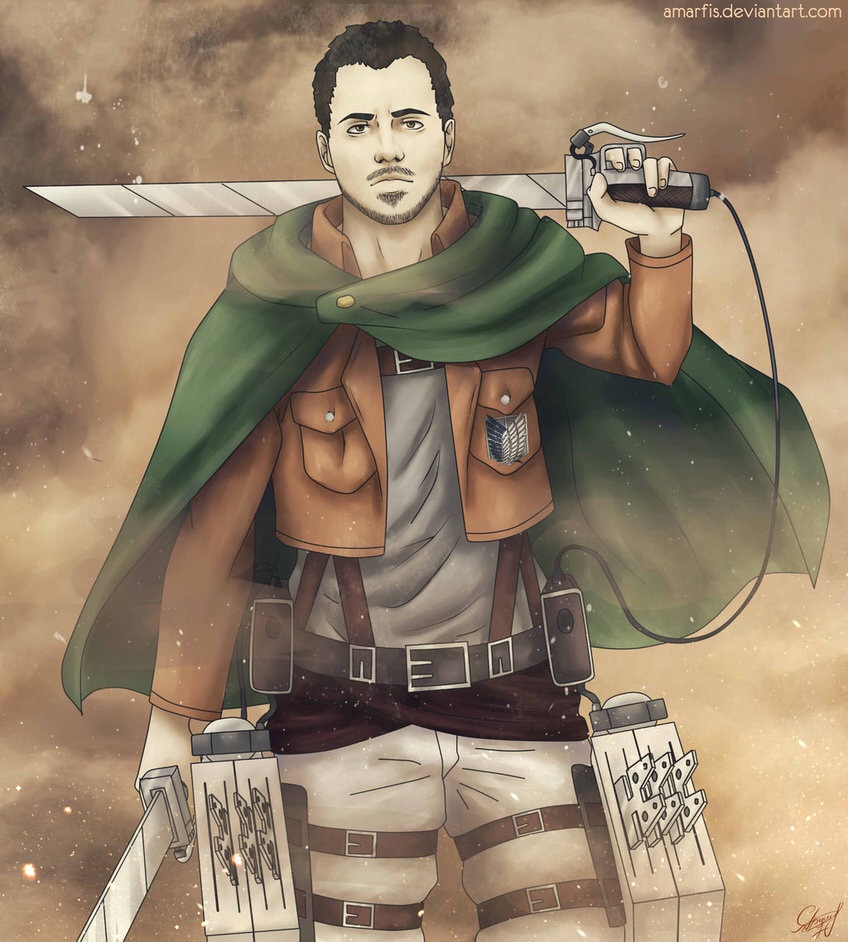
Personality If there were two ways that Grant could sum himself up with, he'd most likely choose his natural talent to deliver humour or his not-so-natural ability to ride horses. Whether or not either of them are fully true is up for debate, but that doesn't stop him from being the light of the party when needed. Being someone who needs material for such banterous remarks as his own, Grant found himself constantly feeling the need to keep an update on everything that is going on, something that may flaw his future. It keeps him occupied if he wanders throughout crowds to fantasise over the latest news. However, if there is one rule he knows to abide by, he can tell if any humorous remarks are necessary, and can remain serious to situations not considered a laughing matter.
From his early introduction to horses, Grant can be considered a quick-thinker; his ability to keep his wits about whilst in motion had been noted by his uncle, though he stated there was much progress to be taken at the time of the note's creation. With small groups of friends, Grant can be seen as a comforting boy, due to the nurturing of animals from his home, often ensuring they all receive any relief of tension whenever it is needed. Some of the kids said it's his most likeable trait, but Grant can be quick to deny it. On top of this, he loves to sketch, draw or do whatever can to satisfy the arts in creativity. For himself, it is what he considers his most talented non-combat trait.
Background Not too far from the edges of Wall Maria, a small town claimed itself as Grant's birthplace and early home, where most of the few settlers worked around farming and trading around the entire circumference of Wall Maria. Originally hailing from the West, reasons that were unexplained to Grant resulted in him having to leave on a 'Business Trip' with his Uncle, Mateo Julius. His father remained back at the town, stating that someone needed to ensure that all of the trading caravans were kept in order and the stallions were kept in line during their long tour. It confused him as to why no one else came, but that never struck his mind. The next year of his life would be an amazing and exciting experience.
The pair followed a clockwise pattern, starting on the Western District, to the Northern, Eastern and concluding on the Southern District. Between each district was a difficult journey, but it picked up the chance for Grant to further progress his skills in horse-riding. One of the lead stallions, a black thoroughbred named Rhys, soon became Grant's prize possession, enjoying any galloping trips along the way. Whereas it became apparent that he wasn't to do much in any of the trades, any free time he had was either spent socialising with the current district's inhabitants, hearing amazing tales from other citizens or generally galloping around the streets whenever he could. During his stay in the Northern District, one caravan trader's son, Luca Isina, took the liberty to giving him the nickname 'Swifty', due to the speed Rhys could provide for Grant. Luca, more specifically, was a close friend of Grant during his stay. They were so close that Luca eventually snuck away from his own caravan and into Grant's, soon hitchhiking on their journey around the walls. The two picked up an interest in learning about the Military Branches, where they grew and excitement and lust for information seeking telling more tales of bravery to the children.
The two remained friends all the way to the Shiganshina District, where they planned on storming around the streets on horseback whilst Mateo delivered his final trading deal. Why waste the opportunity? The two were only going to be staying in the area for a short time. Well, they'd have to get permission from the Stationary Guardsmen within the area, but with their interest in their branches and military backgrounds, they'd get along fine enough for them to look the other way. Grant knew that this was going to be the greatest conclusion to their trip, and when he would return, he could pursue a life within the walls with a promising career. At least, that was the plan...
Appearance Roughly 6'1" in height, Aleyev stands at a fair height for a man of his age. He has a brown shade of hair which still has hints of the brighter blonde he held as a youngster. The style is never really as neat and more ruffled than as expected, as the harsh reality of war has shown him formality gets killed within minutes of being on the frontlines. Aleyev's eyes shimmer a glistening emerald shade, which contrasts against the dirt-ridden world him and his comrades are to be plunged into. A heavy stubble surrounds his mouth and lower face. His body structure, as a whole, is moderately well-built, though there's nothing too much to brag about. The uniform worn in Squad 914 is the usual attire of the Russian Infantryman, but loosened in areas, battle worn and altered with a few harnesses usually used for carrying rifles. Upon his face lies a scar across his cheek, and a burn mark stains a small area of his right shoulder.
Personality Though one of the two more 'Experienced' members of Squad 914, as considered by the USSR Military Staff, Aleyev managed to maintain his humanity and humour throughout his dismal career. One moral virtue he has followed throughout the few years of combat he's served is that he must know who his comrades are in order to survive. This can lead to dire consequences when their death comes around, it helps boost his confidence that may sometimes be lost and scattered in his early days on the frontline. Mass slaughter during Kursk and engagements at Leningrad have left him far too considerate for those he grows attached to; he can be compassionate to those who serve around him, but also tough in ensuring less mistakes are made. Whilst not the ideal leader, he does show potential for taking charge or supporting Non-Commissioned Officers in the act of war.
Relationships To be updated...
Classification Specialist
PPSH-41 with a refined barrel for lengthened shots
Experimental Gear Whilst appearing like a general handgun, the SHG-48 acts as a multi-use compressed support-handgun for infantry personnel with capabilities of both supporting friendly units, providing new routes or harming hostile infantry with quick succession. One of Stalin's research officers, Atyre Ushaeke, was given this by a defective Spanish engineer, who had been given these plans by his superior in order to enhance the arsenal of the Spanish Infantry. This engineer was a supporter of the democratic Spanish ideals during the Civil War, and was unable to reach British intelligence in time for a secure development programme. The equipment given to Atyre showed a rifle capable of firing multiple unique ammunition rounds at incoming infantry. However, when the engineer tried to escape the Russian lands, fearing German invasion, he was accidentally shot by Guardsmen of the research facility he had been assigned to.
Atyre showed the documentations to Stalin, hearing that he'd be approving multiple types of experimental weaponry for the Red Army. What Stalin found frustrating was the fact that there was no guidance of how to build it, and the impractical size of the rifle. This resulted in Atyre being forced to make improvements to the design, knowing that the Spanish may have copies of the document. His knowledge of out-mastering the designs of the opposition came at the cost of high expectations. Atyre, however, developed the SHG-48 eventually.
Whilst the concepts of the original Spanish design were similar, the SHG-48 was created. A large handgun, roughly the size of a sawn-off Double-barreled shotgun, it was scaled down from the original design to act as a projectile launcher in the form of experiment ammunition, which were developed and tested before being cleared for field-testing. The SHG-48 loaded single cartridges and canisters of ammunition into the side, where a hammer controlled the slider where the ammunition was entered from. First of all, the developed lethal canister given as ammunition was the 'Impact Gas-Canister'. Using similar detergents from the Great War, lethal toxic gas was compressed down into an impact-based round that exploded and released the gas with quick responses. The purpose of this ammunition was to either clear out areas or kill enemy forces before they had time to react to a releasing gas, making it greater than a regular canister grenade.
After this, the weapon was given an ammunition designed to burn. As Atyre was clearly inspired by many different grenade weaponry that the Red Army had the ability to use, incendiary rounds were also created for Close-Quarter clearing. Upon the pressing of the trigger, a short-burst of the compressed and heated gas would burn out from the front of the barrel for roughly half a second. Whilst not having the long-term advantage of constantly reigning fire upon the foe, or the extended range, it would alight the clothing and equipment of any individual caught within a six metre distance.
Another round unique for the weapon is the 'Charge' round. Whilst grenade-launchers were common as rifle attachments, Stalin had hoped to create a small, handheld firearm that had the potential to bring the same mechanics. However, the difference with Atyre's 'Charge' rounds was that it wasn't fully designed to fire grenades to kill. Using an arced tip, like a drill, the rounds were designed to dig into a surface and explode. Using an analogue timer, the user would turn the dial to create a time-delay for the explosion which could be between three to sixty seconds. Whilst some may presume that they were for injuring or killing, Atyre was to train the experimental user to use it for creating new pathways, the drill functioning best in some metal and concrete surfaces. This would be used to break through housing walls, not thick base concrete, and allow the team to move, if enough rounds are used, through small gaps in buildings. Another use can be looked towards using it to lightly damage small armour, such as tank treds or side-car motorbikes.
The final unique round is the 'Shrapnel' round. The Shrapnel round was designed to be used for situations such as infiltration, hoping the weapon could be targeted towards resistance members to sell as profit. Using the compression system, the noise the SHG-48 made was not as loud as expected. This meant that the user could fire a small projectile for a given distance. However, the design of the round failed in shooting individual rounds, eventually leading to a 'Shrapnel' effect. Like a fragmentation grenade, but less destructive, the weapon was used to clear out small rooms or machine-gun nests by direct fire, rather than needing to get close enough to lob a grenade inside. However, there is a restriction on medium-to-large range, as the user has no direct optic or accuracy to use.
Other types of small rounds used for the weapon that give it support needs are small flares and regular smoke rounds. These allow it to be used by both users for attacking enemies and doing general support events behind the act of war.
The weapon itself was powered by a compression system. Canisters were inserted into the grip of the handgun, where each canister could provide between 4-9 shots before needing a reload. The size of the compression canisters allow for decent ammunition amounts to be on a person. In Squads and teams, canister ammunition were ideally stored in the field-bags of soldiers or in crates of walking tanks and regular tanks. However, if shot, these have the power to create a small burst of air. This is enough only to fling the user or a very-close individual to aside, though Atyre predicts it shouldn't be enough to kill or majorly harm anyone.
Background Aleyev was born to a Russian widow in 1924 in the settlement of Suzdal. Not being too far North of Moscow, he was able to visit the Capital regularly and gain the interests of the culture he lived around. As a boy, he dreamed of moving towards the western directions, heading into inner-Europe to try out other cultures as an aspiring photographer or journalist. His mother married another man, who became a loving step-father to Aleyev. Unfortunately, before he had the time to finish his studies, get a job, earn enough money and move west, Fascism happened.
The world around Aleyev fell apart as the Second World War was initiated. Whilst Russia did not fight Germany at first, or show any real involvement except from a few unheard battles against the Japanese, the fact Europe was cut off from the rest of the World devastated him. However, it wasn't until the initial invasion of the Soviet Union that left his world shattered into pieces. Without warning, soldiers flooded the town, military police personnel began evacuating children into a more centralized area of the USSR, hoping to give them early training for the upcoming battles ahead. Though by 1939 Aleyev was 15, he was still taken away alongside the rest of the youngsters.
He wrote to his mother a lot, hearing about the accommodations that his Step-father was achieving as a successful soldier, even through the winter victories throughout the first few years of the war. Aleyev was proud of his family, and his mother for taking up a job in a militarized factory. Stalin needed everyone's help to defeat the Fuhrer, and every family was needed. At least his was doing their part. It wasn't until late 1942 when his smiles would decimate. The news was everywhere...Axis Powers initiated Operation: Sealion.
Though the children and people of Russia were not directly linked to Great Britain in any way, they understood what it meant. With France gone, and now the British soil under the control of the Axis, the full swing of the opposition would set its eyes upon the USSR sooner or later. And as predicted, the Russians were the only target by 1943. Families began to flood back from the eastern side of the Soviet Union, as the predictions of war had taken its toll. The Germans were heard of making gains, retaking all of Poland, despite the pact they had with the USSR. A slow, but progressive movement made its way towards Moscow, but it was being held back by an almost uncomfortable size of troops from the Red Army. And it was by 1945 that the stalemate began. What would become three years of stillness, but fully blended with chaos, would be the days that Aleyev would live for. When he turned 18, he finally denied the thoughts of refusing conscription, signing up after hearing of the havoc on the war-grounds.
The Step-Father of Aleyev was met only once after signing up, only happening to be in the same camp as he was during Aleyev's training. The two met, spent the day together, discovering about the time they had apart and what had been done. An officer of the field, his Step-father was a proud addition to the Yanovich family. But the time to meet was short, as the next morning the commanding officers had him shipped out, on a flanking mission to insert via Greece in an 1946 operation. He never made it ashore as the news headlines broke out. No one made it back, not even the naval fleet sent out to support them. It was a disaster, something Stalin punished his officers heavily for.
By early-to-mid-1946, Aleyev received his first taste of combat. On the defensive line around Kursk, where the Germans had numerously tried to take again and again, Aleyev saw his first days of defensive firing. He defended, day in and day out, for a year, with the occasional charges that gained only a few hundred yards of ground than what they had before. It was here he learnt the true meaning of comradeship, to value your brother or sister in arms in order to survive out in the field. It was until 1947 where he remained in the fields of Kursk, waiting and fighting with people he learnt to trust.
And as of then, he was transferred, where the attempts to take back the lost city of Leningrad were made. Here, what should have been a devious win for the Soviet Union turned out to be a year of hell. The 2nd Shock Army, where Aleyev was placed within, were encircled and cornered for the months to come. Many lives were lost, as the desolate city turned into a place of small skirmishes, urbanised warfare and ambushes following that of a metropolitan guerrilla. Nowhere was safe. Aleyev rarely opted to speak about his experiences in Leningrad, as should anyone who managed to make it out alive. Due to how disorganised the Soviet troops were during the attempts to recapture the city, it's uncertain how many people died, what battles occurred during that year and how many German, Italian and Spanish troops were killed during that time.
Once the 4th Shock Army made a temporary breach in the circumference around the city, which had trapped over 500,000 Soviet Troops for the entire year, there was a seven hour period in which all units who were still trapped had to make it to the breach before it were to be abandoned. The casualties of the 4th Shock Army were the result of this temporary breach, but hundreds of soldiers who managed to find out about the breach rushed as fast as their hearts and will to live could take them. 549 troops managed to reach the exit in time, before the 4th Shock Army were forced to withdraw. It is estimated that a further 6,000 Soviet Troops were still in the City after its abandonment. Many Soviet Generals and the survivors regret leaving, saying they should've stayed even with the opportunity to withdraw - commending their deaths.
From then, Aleyev reached 24 years old, two days after he returned to the safety of the Red Army's territory. It was November by the time he had returned. He spent the next month going through a recovery programme set up for the 500+ soldiers who had made it out of the city. Whilst the luxuries they were given weren't far greater than what they were normally used to, the fact they weren't to fight made it a heroes return. Many of those didn't feel like heroes, though. By the start of 1948, January, a man approached him whilst sitting on a 'Platoon' balcony, where about 60 men were living at the time of the programme. He stated that by the order of Stalin, Aleyev was needed for something a lot more crucial. The words "The Soviet Union were now the torch against the Fascist foe" were enough to get him interested. And it was here that Aleyev was called to meet Atyre Ushaeke, the infamous scientists and inventor who Stalin took a large interest in...
Experience Basic Training - A few months
The Continuous Defense at Kursk - April to December - 1946
The Disaster at Leningrad / Operation High-Wind - January to November - 1947
Family Otto Hudsvaka - Step Father [K.I.A.] Alyona Yanovich - Mother [Alive]
World War II should've ended with the defeat of the Third Reich by the Soviet Union, and the dropping of two nuclear payloads onto Japan. That's how the world should've been left, where the course of the entire future of Earth would remain, changed forever to learn from its mistakes of mass war. However, this never happened. At least not in the way many expected.
The year is now 1948. The Third Reich and its Fuhrer have already defeated all but one single enemy. Germany was assisted by an array of much needed help given from the Spanish after their Civil War outcome left a Fascist ruler on top. By 1942, Germany, Italy and Spain amassed a large-scale invasion of Southern England. The Italians landed in Portsmouth, the Spanish invaded Norfolk and Germany desperately landed in London, causing a few desperate months of fighting that led to the surrender of Great Britain, now split into two halves: that of an installed German-governed area in the south, and a puppet government in the north. Before the Americans could make a move into retaking Germany, the Imperialist Japanese forces somehow sprung into action, landing thousands of troops onto several wide-spread landing zones on the West Coast of America, keeping them busy and at bay. As for now, all eyes rest on the Soviet Union, the last standing force against the Axis.
Technology has developed only for the war efforts, and the new inventions of both German and Russian war machines have excelled at an alarming rate. By late 1946, the German production line sought the first Wandertank, or 'Walking Tank', and the Russians retaliated with the first armoured bipedal unit.. Naval ships grow bigger by the day, and aircraft become faster, deadlier and larger than before. The German forces and Russian forces have clashed more than enough times to create a stalemate across the border, not too far from Moscow. With their dictator evacuated from the Capital and moved further East, the Russians hold for what seems to be a second rendition of Stalingrad, where Moscow stands on the brink of ending in a bloody siege that will drain the life out of both sides.
In a desperate attempt to both test newfound equipment and to cause a distraction across this Eastern Front, known now as the Final Front, the government conscripted those young and possibly considered fit enough to fight of both genders, hoping to create Squad 914, the 'Eksperimental'nyy otryad', experimental squad.
In the time of need, now only a few allies are left standing against the might of the Third Reich. Their mettle was put to the test when taking out the main contenders, the so-called allies of Europe and beyond, when they struck hard and fast in a campaign of blitzkrieg and aerial superiority. Within years, Europe was within their control and the focus on the rest of the world was now imminent. Three main fronts were now open, and several smaller areas lurking with its conflict, the Fuhrer’s clutches on the world were tightening with every growing day. With his allies, all was coming up sunshine for the Reich whilst a dark and gloomy age of war engulfed the surviving members of the free world.
Europe had succumbed to a great tragedy alongside the first few years of the war. As expected, the invasions of Poland and the Baltics resulted in the outburst of the second world war, leading to the French and British alliance to target their newfound enemy once more. However, with blitzkrieg tactics unlike any other, Germany were able to push into France, sweep through Belgium and pursue a strong chain of victories until they now annexed and occupied most of the mainland Europe. Fighting on land ceased for a few months before the invasion of the Balkans was set into motion, swiftly driving their Yugoslavian, Bulgarian, Greek, Albanian and Romanian adversaries off the face of Europe’s map without remorse. All former ties between the Reich and the Balkans were defied under the Fuhrer’s ever growing egotistical mindset of the war. Onto the border of the one allied Turkish homeland, Italian and German troops focused their attention on suppressing major areas of resistance. And when Portugal were pressured into joining an unorthodox reformation into the Nationalist Spanish homeland, soon enough the Axis grew one times larger than before. The Mediterranean was secured and the final battle was afoot.
Eventually, the final operation to claim Europe under an iron cage was afoot. Operation Sealion. The official invasion of Germany’s largest threat. Britain were not fought within Europe on land that much since the failure at Dunkirk. Here, the Italians took the opportunity with the German Afrika-Korps to secure the Suez and other major colonies in Northern Africa. Erwin Rommel was praised with his success in driving the British from Tobruk, giving some much-needed relief of pressure in the deserts. Italy were then tasked with pursuing and hunting down a large French army lurking in the shadows of Western Africa. Becoming some of the harshest zones of fighting during 1941, they were eventually cornered outside of the Belgian Congo before marking their last stand and dying out. It wasn’t the only French Remnant Army to exist, as there was still one within Canada, Britain and several reports about some in Indochina, but this was the only one of concern during that time. Gains in Africa were ceased around that time, becoming a powerhouse of oil and rubber for the Axis war-machine. South Africa halted its position and heightened its defences to the greatest of their ability, hoping that the upcoming storm would someday die off and leave them be.
1942 came around, and the plans for Operation Sealion were now being set into motion. The largest naval and aviation encounter for the entirety of the war came in the form of the Battle for the English Channel. Hundreds of ships were clashed against one another. The superiority of the Royal Navy’s might was heavily thrown against the strong will of the Italian, Spanish and German fleets, all of which were also stocked up with excess vessels recovered from their conquest of Europe. British Intelligence also stated that Scandinavian ships were also spotted in the fleets, but confirmation was never shown. Either way, the overall clash of ships eventually came to an end when the combined might of Europe’s assaulting vessels left an opening to the British homeland, temporarily. Italy landed their forces in Portsmouth. Spain and Germany combined their efforts into Folkstone and the Fallschirmjager, reinforced with Bulgarian volunteers, were dropped into London during a vicious bombardment. Street fighting ensued, and many German paratroopers lost their lives in the course of the battle. It wasn’t until the German and Spanish army took control of Folkstone and Dover where the urban hell that was the Battle for London was relieved of its pressure. Panzer divisions accompanied by heavy aerial bombardment swiftly stormed the Capital, taking out Buckingham Palace and Parliament in its wake. News of Britain’s leaders were left uncertain, as some were reported to have fled to the Dominion of Canada whilst others opted to stay behind and go down with their nation.
Weeks after the fall of London, Britain called its surrender. Fearful of the storm, Ireland too followed. It was the final day of Europe’s security being rehabilitated under the Fascist ways. Many areas of concentration were largely cut off. Austrian, Czechoslovakian, Hungarian and Netherlandic volunteers were primarily used as Hitler’s Gestapo for Britain’s major cities whilst the Wermacht went on their witch-hunt for British resistance groups propping up everywhere. It wasn’t until the Battle of Edinburgh were the final remaining troops of the British Army were evacuated to several of its dominions and colonial settlements. Keeping them under control proved to be a tough challenge and cost many German lives as large influxes of civilians were imported into the cities to undermine and oust the natives of the empire’s heart.
1942 was coming to an end, and finally the Germans could focus on what their next two objectives were. When the United States of America, seeing the threat as out of control and beyond all statures of liberty, formally announced their declaration of war against the Nazi German occupation, promising to back their neighbours without hesitation from now on, the Reich sought to make ties with its newfound allies in Asia, who too were planning on dealing with the Giant of the Pacific. On top of that, Germany still had to concentrate a large amount of forces on the largest adversary of all, the Soviet Union of Russia. Following the defeat of Britain, Sweden, Norway and Finland all joined together in unison and agreed to Hitler’s demands.
The United States of America remained neutral, despite their support of equipment towards the Canadian and British troops, until the eventual fall of Great Britain. Many of its allies slandered America’s leaders and prompted them as incompetent and ignorant towards the danger Germany showed, stating that their involvement in the war was far too late. Refugees from France, Belgium, Greece and Britain began to run small riots and protests in major cities weeks before they declared war on Germany. Even with the results coming in, the refugees were not happy. America thus struggled with convincing the European Remnant Armies stationed within its borders to cooperate. A small state of disorder broke out amongst the ranks and the armies fell into small splinter groups. Some generals decided to section themselves off and report only to themselves and certain members of congress before they would eventually join back together.
Douglas MacArthur was the leading figurehead into reunifying the American Army when they discovered the Mexican Fascist coup that slipped beneath their radar. In their own internal affairs, they were unaware of the German influence of their neighbour, giving birth to the Synarchist Mexican States. Equally, several countries who had already adopted these extremist views, such as Venezuela, Columbia and Ecuador, were also starting to compromise with America’s enemies. MacArthur saw this as a major threat to the nation and rallied his forces, along with the reformed American Army, to defend the borders, arriving days before Mexico launched an attack of its own. Holding the front wasn’t too difficult, seeing the Mexicans as slightly inferior by weapons and equipment until successfully supplied by the Italian and Spanish forces nearby. The Spanish worked closely with the Mexican uprising and sent large expeditionary forces into their land to coexist and provide large-scale support, occupying them for the rest, if not the majority of the war.
In 1945, after years of fighting on the Mexican front, the German, Italian, Scandinavian and Spanish Armadas were spotted on the Eastern Coast before bombarding many of its coastal cities. The Atlantic Scourge indefinitely drew more than two thirds of the American Navy over to combat this unequally huge fleet. They still composed themselves of British ships that had been left in dockyards as well, which were in construction when the invasion occurred and completed when their occupation began. Though Germany hadn’t intended on it, these British Mock-ships were the reason the attack began so well. It caught the Americans off by surprise, thinking it was yet another remnant ship or two at first. The Battle for the Atlantic lasted for about 2 weeks at its peak before the American Navy was forced to retract a portion of its fighting forces to the Pacific. Unaware of the cooperation, though expectant of their arrival, the Japanese launched a naval campaign throughout their land, sinking masses of ships whilst encountering losses of their own. And somehow, with luck and strength on their side, a successful beach landing at Alaska was finally settled after the fall of Pearl Harbour and Hawaii. One by one, certain areas on the Western Coast were attacked by Japanese forces, marking the stalemate that would last the next four years. German marines landed in Newfoundland and Labrador to draw the Canadians away from the American frontlines, eventually leading into the forests of Quebec. However, when pressures on the Russian front continued, Italy were tasked with handling the Canadian push up to the present day, seeing almost all Wermacht troops as vital to the defeat of the Soviet Union. Eventually, after the first few months of attacks and counter-assaults, the frontline would result in a stalemate. The Japanese claimed most of the north-western parts of North America, linking the Alaskan invasion point to their Portland frontline. Here, America stood still, fighting with large scale battles sometimes reminiscent of the first Great War.
The invasion of Manchuria and formation of Manchuko left China at a small disadvantage. When civil war broke out in the Chinese states, fracturing it into a series of warlords and reformed governments, the battle between Communist and Republican forces was ceased when Japan eventually began its invasion following the incident at Marco-Polo Bridge. Fighting was brutal, but Japan made use of the mountains, jungles and cities it had to pass through as their long-term rival began to collapse. By 1940, to everyone’s unsurprising expectancy, China fell into the hands of Japan, creating the Reformed Government of China. A nationalist mindset was planted into the minds of those who opposed both the Communist and Republican government that previously fought for land. One by one, the warlords of Yunnan, Guangxi, Shanxi and so forth were swallowed into the empire’s embrace. However, it didn’t spell out the end of the war for Japan.
Large imports of resistance followed the annexation of China. Those who were unable to flee to neighbouring countries resorted to hiding out in rural towns, settlements and strongholds to oppose their new occupants. Bombings, shootings that resulted in the deaths of civilians and many other ruthless tactics to belittle the Japanese were carried out, though were ultimately used as a statement of propaganda towards the Chinese conscripts. A new anti-resistance sentiment covered the nation and a tale of guerrilla warfare and unequivocal espionage took place. Several members of the British S.O.E. were deploy to help these resistance groups, much like they had been in Poland and France. Some of the Chinese Resistance Groups were considered morally sound in comparison to their counterparts, though were undermined by the ruthless battle between the apparent good and evil that had been painted in the newspapers. Groups like the Shān shīzi were considered to be genuine fighters for freedom, whilst other groups were considered to be terrorists that put only a bad name for the fallen nation.
Japanese Troops were then finally in agreement to joining German plans and secretly aligned themselves with the Axis. Emperor Hirohito spoke to the his officers in a strange campaign that hinted towards the alliance, as he feared that American or Russian spies may be lurking around his nation. Eventually, they were tasked with the campaign against Indochina and the British Raj.
Vietnam, previously under French control, was forced to seek independent governmental figures after the fall of their master nation. However, whilst a few political battles resulting in internal bloodshed broke out, the arrival of the French Remnant suddenly reinstated order and balance to the nation. When installing their military democracy to prepare Vietnam for any possible invasions, the French and Vietnamese grew a strong relationship to one another. Eventually, the Viet-French National Army was born, splitting half and half between both enlistees of the nation and survivors of the European annexation. However, despite this, the Soviet Union were somewhat eager to poke their nose into its internal affairs. Sending several diplomats of their own, they offered to assist in the reformation of Vietnam’s army and government for the next few years they had to spare. France, still heavily influential to the communist agenda before the war, were quite accepting of their allies’ help. Vietnam’s natives were sceptical at first but heard about the tragedies of China and how the USSR were offering refuge to many of its citizens, seeing them as a true ally. With this positive mindset, the Soviet Union were quick to press their own ideological matters into the war. This was a plan that had been going on since prior to the war, where many Soviet teachers had been sent into schools in Indochina to simply teach Russian to those attending regular school hours. The bonds were tightly enclosed, and eventually the Remnant learned of Japan’s involvement with German affairs.
1945 came close, and Japan were edging their forces closer and closer towards their border than the year crept. In February, Russian military advisors were requested the Indochinese-French Minister of Defence, Jeán Petra, for the possibility to strike against Japan before they could invade Vietnam. It was a decisive plan, one that was risky in all terms. Codenamed: Libération du Tigre, the Soviet advisors approved of the plan and supplied the French with much-needed landing craft. Their target was Nanning, capital of the former Guangxi Clique. Over 600,000 troops, compromising of the 400,000 French Remnant Army and 200,000 Vietnamese soldiers, were called into action and embarked on the 5th May, 1945. The initial beach-landing took the Japanese by surprise, as their coastal defence at the time compromised of a single garrison and several divisions of Chinese Conscripts. But when the news of the naval spearhead towards Nanning came about, Hirohito saw the threat of an uprising. The news of the French and Vietnamese landing could not reach the rest of China as they could see it as a spark of rebellion. And so, the Imperial Army and Navy were quick to cut off the entrance route to their naval invasion and trap all 600,000 troops between the Southern Chinese Sea and Nanning. Fourteen days of fighting occurred before it ceased. As far as reports go, only 3 soldiers managed to return to their homes. Two French privates and Corporal Sih Bao. Bao, who was commended for his ability to escort these two French soldiers back to the Soviet Union after finding out Vietnam had been attacked, was later recruited to be an officer of a project called: 'Eksperimental'nyy otryad'.
Once Vietnam fell, Laos, Cambodia, Siam and Burma also fell quickly. However, whilst their occupation was swift, resistance reached a new height. Japan could not successfully push its way into the British Raj, who’d been holding on dearly to the nations in between the Imperial Giant and itself, as these resistance cells were forcing the army to slow down. It is still said that in 1948, the British Raj still has only lost a small fraction of its land due to the constant rises of rebellion in these countries. Japanese intelligence suggests that the Soviet Union has something to do with the Burmese rebellions.
The Soviet Union had been a major player since 1942. Russia left itself largely out of the war after the losses they received in the first Great War. Stalin saw that fighting them was once again useless and decided to try and compromise with Adolf Hitler in the earlier days of the war. However, their pact of truce was broken during these years, shortly after the fall of Britain. It was here that the largest graveyards of the war formed. Kursk saw the biggest armoured conflict of the war thus far, seeing huge defensive strategies that managed to hold onto Moscow dearly. For years, Russia lost only a partial amount of its great land, refusing to fight Japan under the conditions of both suffering with their own issues. Many criticized the military staff who agreed to lay unaggressive to their Japanese counterparts, but Stalin argued that the German threat had to be conquered first.
For years, the Russians held out. Yards became soaked in blood and drowned out one another. Russian intelligence spent most of its time supporting nearby nations whilst holding the stalemate against the Germans. With their forces spread all across the world, Germany couldn’t get the overall edge they desired over their counterparts and settled nicely for their immovable wall of manpower. They even conscripted large amounts of women and young boys into their army to overpower the German war-machine that attempted to push in every day. Yet in 1947, everything changed.
The Second Battle of Kursk once again began when Germany stormed the Eastern Front with more men than they had ever used before. Conscripts from all European walks of life were suddenly being used in this offensive. However, as the war had progressed longer than expected, new technology also found its way onto the frontline. The Walking Panzer, developed formally by German Scientists, marched onto the battle and overcame the harsh terrain that their previous panzers struggled with. The Russian’s were now being forced into a bloody brawl against their adversary, eventually having to rethink their plans of defence to a far more obedient and formal formation. However, when the Scandinavian Reich joined the Axis and made easy gains in Northern Russia, Leningrad was threatened once more, calling for a large detachment of troops to its calling. Infamously known as the tragedy at Leningrad, very few soldiers survived what happened next.
Many soldiers went into Leningrad with the hopes of taking a break from Kursk. The Stalin-Line around Moscow was where almost all of the army was currently posted, as almost all of the fighting took place there. Leningrad was a change in scenery and pace that they thought they could exploit against the Scandinavians, but a mismanagement of logistical support resulted in the entire city of Leningrad being surrounded and brought to its knees, resulting in a few months of fighting. Very few soldiers managed to escape the city alive and were reigned heroes. Some say that the viciousness of Leningrad surpassed the previous encounters at Stalingrad years before. The mental torture that many of its few survivors were heavily wounded with were given a rehabilitation programme off the frontlines. Many saw the Walking Panzers as a technological threat to the Union, and Stalin established the URD, Union Research Department, who were in charge of creating newly inventive designs that were previously shown earlier in the war. These drawings dates back as early as 1940, but now Stalin had accepted their construction and testing, which would eventually lead to the formation of Squad 914 in 1948. And it was here, during the start of 1948, that Moscow fell, pushing the Russian forces into Siberia where the final ultimatum was to be decided. Russia, having only one trick left up its sleeve, sought to recruiting many of its refugees, allies beyond its borders and implement the new designs for technological warfare to surpass the Reich’s presence.
In Oceania, however, Australia and New-Zealand were eager to keep up the fight. Japan had always been a threat to their nation, having their eyes peeled upon them at all times. When they invaded America, the ANZACs were relieved of some of the pressure and managed to secure naval superiority around their nation. Finally, they were safe, to some degree. Now, they coexist with the Russian Research departments and conduct many of their experiments in the desert wastes of Australia where civilisation does not flourish. Working hand-in-hand with their Soviet Allies, finding it difficult to reunite with their Canadian counterparts, the ANZACs have taken part in many Asian campaigns. Currently, Australian and New-Zealander special forces are the driving force for the liberation of Burma and Siam. They have currently reclaimed Malaysia and the Dutch-East Indies from the Japanese occupation. Some ANZAC troops were even transported to the Eastern Front and have proven themselves battle worthy…
As the war exceeded expected dates, new countries involved in this worldwide conflict began to experiment further than ever before. On the forefront of this technological revolution, the German Reich utilised its very best in scientific discoveries to further replicate the future of modern conflict. Everything improved. Weapons became more reliable and equipment became more advanced than the last. New and outlandish pieces of technology were outfitted into the ranks of all armies and a second arms race began, trying to pressure each army into creating the ultimate machine of war. Though Germany was in the lead, there were definitely some nations that had brought some interesting technology to their tables…
Germany were obviously ahead of the game. With their rivals from the United Kingdom defeated, they had little competition for the second arms race. The United States of America were now busy with its own invasion that slowed down their progressive advancements in creating the ultimate weapon. Instead of focusing on weapons to end the war in one swoop, the Fuhrer approved the doctrine of war mongering machines that could continue their steady progress. And the greatest asset to improve was their Panzer divisions…
With the war dragging on far longer, the first major advancement was in 1946 during the Battle of Kursk where May saw the first deployment of the Super-Heavy Tank variant. They had their flaws, indefinitely, and suffered massively from their weight and lack of speed but made up for it with layers upon layers of armour. Fourteen were deployed to the Russian front where seven were destroyed, two were captured and five were safely returned to Berlin and reconstructed into a mobile defence platform that could be deployed in irregular FOBs. German scientists, most prominently one under the name of Arthur Von Brandebarg, looked for creating an alternative to the Super Heavy Tank. His designs for a Gehhilfe, nicknamed the “Walking Panzer”, were already under construction as part of the Berlin Research and Development Division under the alias of Projekt Wunderwaffe, but Arthur wanted to see his designs mass produced and thrown into different variants. Tests conducted in 1945 for Walking Panzers were successful but largely overshadowed by the size of the Super-Heavy tanks the Fuhrer had once desired. Now he had plans to implement these walking tanks, able to maintain armour and defence alongside mobility, into the Russian fields of war to test their combat credibility. Fifty were constructed by November and deployed into Kursk, where they proved successful in breaking through 4 defensive lines previously unbreakable by normal panzer divisions. Arthur was credited as a national hero and promoted to chief of Projekt Wunderwaffe after this success, creating his own divisional army of Walking Panzers for the Wermacht. They saw their peak achievements in Leningrad during the final weeks of the siege, tearing most of the city down into rubble. Following this victory, German scientists then showed designs off to its allies, even given them a few walkers of their own to design from, where Japanese, Spanish, Mexican and Italian variants of the walking tank were employed into their army.
As for the Luftwaffe, the Reich’s aircraft was loosely balanced between propeller and experimental jet-based aircraft. Fighters were usually kept with the more orthodox engines to keep up mobility, agility and performance whilst bombers and CAS variants of aircraft became the leading front for Jet-Propelled aircraft. The Luftwaffe now sits amongst some of the most technologically advanced air-forces in the world, contested only by the viciously talented Australian Air Force.
The Soviets, however, didn’t start their progression of technology until the fall of Leningrad. The URD were slightly late to the party and played the role of advancing infantry tactics over armoured specialisation. This proved effective in the Battle for Moscow, early 1948, when many variants of experimental anti-vehicular and anti-personnel weaponry was supplied to its troops. They were used right up until the fall of the Kremlin. And so, a wide variety of scientists from both within the USSR and defects from Republican Spain, Britain and Italy found their way into the URD. Though limited in their designs, the first official tests for outlandish equipment deemed too uncertain to produce was placed in the hands of the newly formed Squad 914. With a mission more suicidal than the rest, these troops, new and old, were to deploy and utilise this newfound equipment to test its efficiency and potentially change the course of the war.
<------>
This Roleplay focuses around an alternative outcome to the Second World War where the Fascist European and Imperial Asian nations became dominant. The Third Reich is only faced with a single enemy, the Soviet Union. Whilst Japan has to maintain its gains in both a broken China and the new front on United States soil, the European states face huge odds which clash out for years longer than the war should have. Russia held its ground, and still has, but has been pushed back from its borders, soon to make a stand in Moscow. However, with the war taking longer, newfound technology has shaped the battle to a more...interesting state.
The thread itself takes technological inspiration from things like Wolfenstein, where some gadgets are tested in the field from both sides. As I will explain later, the idea of experimenting with technology in a dieselpunk fashion is important for the roleplayers, as it will play a part for individualising their characters amongst the class system the Roleplay will follow. Now, more specifically, I must talk about the characters in question.
For this Roleplay, each player will take up one, or the option of a few side characters aside, leading role of a sole Russian individual. We focus on a group of individuals, of either gender, brought into the world of conflict via conscription or transfer. Several from the Reserves away from the combat, as well as a majority of fresh faces in the military, are brought together to train and fight for what the Soviet Union call their Black Project. A more informal term would be Squad 914. As previously discussed, this fighting group, whatever their final size, are dependent on the use of experimental warfare and equipment. Their mission, however, is to be eventually dropped into the heart of the Frontier's command zones, where they are told to draw attention away from the front lines to give the main Armed Services the breakthrough they need into China.
This Roleplay will be split into a few arcs. The only revealed arcs I can give are the Training Arc and the Battle of Hanoi Arc. Past that comes the Beyond Arc, where the main objective of these soldiers and misfits will come into play.
<------>
For the creation of the characters, there are a few things that need to be taken into consideration. These include: the characters themselves, the classification of the character and the specialised equipment. Firstly, the characters themselves would be looked at. This isn't anything special, just the regular Character Sheet you'd find in any other Roleplay. I do ask, however, for a moderately detailed description for the character, but all of that in particular will be explained and shown in the CS at the end of this section.
As for the classification of the Character, I'd need to introduce the character class system. These decide on the standard equipment and weaponry that they would face, also giving the individuality and abilities they would be trained under. Whilst most of them are given standardised weaponry and set pieces of equipment, primaries and secondaries can be changed depending on the experimental equipment assigned to the character. However, most of the equipment would likely be tertiary equipment, which will not result in the replacement of the standard weaponry. Any questions as to if they wish to change the assigned weaponry. Full-on realism isn't required for the weaponry, though, so some inaccuracies may occur to fit the dieselpunk setting.
Rifleman The common rifleman is the most frequent class of soldier throughout the entire Russian Army, however due to the diversity of Squad 914 they are not the bulk of the warfare group. However, what remains the same of this type of trainee is that they both use the same equipment and remain as one of the most adaptable of all the classifications chosen throughout their training. The Rifleman usually is issued the Mosin Nagant or SVT-40 if the resources are available. Like most, they are usually equipped with several explosives and a Tokarev TT-32 sidearm. Some grenades can be swapped out for the Diakonov rifle-grenade attachment.
Specialist Commonly known as the 'Specialist' throughout the authorities of Squad 914, this infantry unit follows tactics of adaptability, following orders of suppression, shock tactics and breakthrough movement in order to support their fellow comrades. A favoured unit throughout the Squad and their particular set of fighting skills, the Specialist provides all the assistance they can. Alongside the TT-32 sidearm, the Specialist is normally supplied with the infamous PPSH-41, which provides impressive firepower for one single unit. Though any soldier can provide makeshift versions, the authorities of Squad 914 supply specialists with conditioned Molotov Cocktails.
Support Whilst the term 'Support' is very widespread amongst all military branches, Squad 914 designates their Light Machine gunners and suppression units as Supportive units, where they cover and pin down as many forces as they can. The most common weapon for this unit would be the DP-28 LMG, alongside a standard TT-32 sidearm. When it comes to equipment, sometimes the Support is categorised for those whose experimental weaponry acts as a heavy primary, replacing the DP-28. Support specialists sometimes use small amounts of fragmentation grenades to clear out rooms and advantaged areas in order to gain the perfect emplacement position. Support members can also be different by using Anti-Armour weaponry, such as the PTRS-41.
Combat Medic The Combat Medic does exactly what it says on the tin. It fights, and it heals. Being given different types of medical equipment, some experimental, these crucial members are aimed towards caring for their comrades with both compassion and determination, however that isn't a fixed trait for them. Squad 914 treats Medics as VIPs, where they are to be swerved away from the most dangerous path. That doesn't mean they join their comrades up on the front, as they need to be there when they need to do their job. A standard Combat Medic in Squad 914 contains a AVS-36 rifle with an automatic configuration, as well as the standard TT-32 sidearm. Their experimental equipment sometimes varies from being supportive to weaponised, depending on what the superiors of Squad 914 decide.
Marksman The Marksmen of the Soviet Union military are granted by all for their skills in taking out the oppositions. Squad 914's training staff hope to create a marksman who can adapt to both long-ranged and close-quartered firefights, where they can support their team without having to sit miles away from them (Though that tactic still can be done). Depending on their choice of scouting equipment and attachments, the Marksman would genuinely have a Mosin-Nagant retrofitted with optics or the semi-automatic SVT-40 rifle, which is preferred to most closer marksmen. Their sidearm consists usually of the Korovin Pistol for its concealment size.
Combat Engineer The Combat Engineer is what makes the weaponry work. Each chosen Combat Engineer is trained and given all the details for each experimental weapon or gadget prior to their first deployment in Moscow. This is to give them a sharp knowledge of how to maintain these equipment pieces if they were to become faulty out in their deployment, without the need of the designers or production teams themselves. This is what allows everything to work perfectly. They are treated similarly to Combat Medics by their comrades, or at least are told to be treated in such a way. They are armed, usually, with the compact PPS-43 and the TT-32 as a sidearm.
These classes will not restrict the characters completely of their abilities in combat, as the physical and mental capabilities of the characters will mostly effect how they act and function both on the frontlines and behind the lines of their enemy. Now, for the Character Sheet. I ask for you to at least get all of the necessary details, which you should be able to identify, down into your CS, but the rest you can customise, decorate and add to with good intention. I intend to allow character relationships to be an important factor in this alternate and dieselpunk historical setting. The relationships between each character will need to be tracked as the Roleplay goes on, making sure that the characters' ability to survive will depend on how they like, love, dislike or hate another comrade. However, if you wish to use your own classes, seeing these as only guidelines, then by all means request such.
*An image of some sorts may be helpful, if not, go for a description of the character's appearance later on in detail.*
Name Self-explanatory
Age Self-explanatory
Gender Male or female. Sexually identifying as an Attack Helicopter is forbidden in the USSR
Birth-date / Location Self-explanatory
Appearance Describe what the image chosen does not; if not image is given then make this detailed highly
Personality Self-Explanatory
Relationships This can be simple as each character eventually interacts with them, but this will be updated more in detail as the RP goes along.
Classification What classification does the Soldier fall under? Include equipment or add its own section for it
Experimental Gear This will be thoroughly checked by me to see if it is plausible, but you can be creative with what you see. Requests for tweaks in its design may be asked for. Provide an image if possible, if not a good description of it.
Background The biography of your character. Keep fairly well made, making sure that enough is known about the character. Large details is optional. This can be updated as the RP develops on more.
Experience For those who are a previous reserve, that would only cover 'Military Training'. Myself and another user (Upon request) who have a little bit of fighting experience will add a tad more to it
Family Self-explanatory
Theme Song Just a bit of fun, really. Optional at most.
<------>
And that, ladies and gentlemen, is the roleplay at most. If there are any questions as such regarding the lore, the equipment, the dieselpunk technology or the general roleplay, please feel free to ask me. I may elect or request for a co-GM or two to assist in helping the Roleplay. They will be tasked with suggestions and management assistance, making my busy life a little bit more easier. Either way, I thank you for reading this, and for those interested who have not already stated, get yourself in my radar before any drastic decisions or events happen, just so we can include you. I may be accepting players throughout the Roleplay.
"I'm like a messiah, only less significant, important, powerful or useful."
Nicknames 'Swifty'
Age 17 - Pro-Breach Age
Height 5'10"
Weight 154 lbs
Body Stature Fairly Built
Personality If there were two ways that Grant could sum himself up with, he'd most likely choose his natural talent to deliver humour or his not-so-natural ability to ride horses. Whether or not either of them are fully true is up for debate, but that doesn't stop him from being the light of the party when needed. Being someone who needs material for such banterous remarks as his own, Grant found himself constantly feeling the need to keep an update on everything that is going on, something that may flaw his future. It keeps him occupied if he wanders throughout crowds to fantasise over the latest news. However, if there is one rule he knows to abide by, he can tell if any humorous remarks are necessary, and can remain serious to situations not considered a laughing matter.
From his early introduction to horses, Grant can be considered a quick-thinker; his ability to keep his wits about whilst in motion had been noted by his uncle, though he stated there was much progress to be taken at the time of the note's creation. With small groups of friends, Grant can be seen as a comforting boy, due to the nurturing of animals from his home, often ensuring they all receive any relief of tension whenever it is needed. Some of the kids said it's his most likeable trait, but Grant can be quick to deny it.
Background Not too far from the edges of Wall Maria, a small town claimed itself as Grant's birthplace and early home, where most of the few settlers worked around farming and trading around the entire circumference of Wall Maria. Originally hailing from the West, reasons that were unexplained to Grant resulted in him having to leave on a 'Business Trip' with his Uncle, Mateo Julius. His father remained back at the town, stating that someone needed to ensure that all of the trading caravans were kept in order and the stallions were kept in line during their long tour. It confused him as to why no one else came, but that never struck his mind. The next year of his life would be an amazing and exciting experience.
The pair followed a clockwise pattern, starting on the Western District, to the Northern, Eastern and concluding on the Southern District. Between each district was a difficult journey, but it picked up the chance for Grant to further progress his skills in horse-riding. One of the lead stallions, a black thoroughbred named Rhys, soon became Grant's prize possession, enjoying any galloping trips along the way. Whereas it became apparent that he wasn't to do much in any of the trades, any free time he had was either spent socialising with the current district's inhabitants, hearing amazing tales from other citizens or generally galloping around the streets whenever he could. During his stay in the Northern District, one caravan trader's son, Luca Isina, took the liberty to giving him the nickname 'Swifty', due to the speed Rhys could provide for Grant. Luca, more specifically, was a close friend of Grant during his stay. They were so close that Luca eventually snuck away from his own caravan and into Grant's, soon hitchhiking on their journey around the walls. The two picked up an interest in learning about the Military Branches, where they grew and excitement and lust for information seeking telling more tales of bravery to the children.
The two remained friends all the way to the Shiganshina District, where they planned on storming around the streets on horseback whilst Mateo delivered his final trading deal. Why waste the opportunity? The two were only going to be staying in the area for a short time. Well, they'd have to get permission from the Stationary Guardsmen within the area, but with their interest in their branches and military backgrounds, they'd get along fine enough for them to look the other way. Grant knew that this was going to be the greatest conclusion to their trip, and when he would return, he could pursue a life within the walls with a promising career. At least, that was the plan...
"The key to survival is teamwork, and with me you're going to be involved in a lot of that."
Nicknames 'Jutt'
Age 25 - Current age
Height 5' 10"
Weight 174 lbs
Body Stature Fairly Built
Personality Despite being one of the more recognised and respected soldier's amongst the Scouting Legion, Mateo isn't as strict off-duty as some might expect. His upbringing and experience with travelling has left him to be quite a sociable individual, which strengthens the bonds he has with those who he commands. Whereas the advantages of building these relationships improves the performance of fighting and working as one squad, it can also bring personal sorrow when it comes to the death of any of his own comrades. Mateo has been used to the sight of death since the start of his service, but the personal losses take their tolls in privacy. Seeing a commanding officer breaking down is noted as one of the more horrific sights in any combat situation, so controlling his emotions is a skill he's been forced to take.
Mateo can be focused, almost completely, when being put upon tasks. Having partaken in some of the more exclusive and classified operations the Survey Corps have slipped under the noses of the public, the elite has found himself to understand all the possible dangers that lurk outside the walls and all the anomalies that they might encounter. Towards the younger and newer soldiers, he can seem quite protective, but also disciplinary towards their progress. Every soldier counts, so he sets his mind to seeing them all through each mission. Time and time again, the spirit of his work ethic has bagged him a great reputation, right up until his temporary discharge, throughout the multiple branches. However, since his temporary discharge, his copings as a leader have somewhat diminished, making him almost dependent on the team rather than his own decision making.
Background Mateo was born many years after his older brother was, his mother being quite old and weak to look after him. Because of this, both Mateo and his brother Johan forged a strong brotherly bond that was almost impossible to break. The two were fantastic as a duo, always helping one another around the farm as both Johan and himself learnt to take care of their elders with success and dignity. As they grew up, however, the first signs of separation and conflict were afoot when Mateo decided what he wanted as a career. Every month, an expedition of saddled soldiers would ride past their home, sometimes stopping to see how they were and tell tales of their stories. The young boy was almost instantly intrigued and captured in the wonders of the walls and their commitment to protecting it. It filled him with courage and the lust for service, which easily conflicted Johan's opinions. Through the fear of losing his younger brother, Johan almost halted the dreams of Mateo in order to protect him from any harm; however, that didn't stop the boy from making his way come true. Mateo ran away, like any boy would do, shortly after his Mother's death, where he fled to the walls in seek for a purpose in life. No longer did he want to wait for the harvest to flourish, that was his brother's bidding to commit to.
The years passed, and through his training years, he excelled in the arts of ODM maneuverability and balance. This became his reason for success, and acted as a catalyst for his uprising. Ranking an impressive status of #4 in his training programme, he quickly denied the opportunity to serve in the Military Police in order to pursue his original and initial purpose for enlisting in the first place. Soon enough, he flew into the ranks of the Scouting Legion, eager to get the experience required to excel through life.
Mateo served an impressive deal of expeditions and side-jobs during his service, building a name for himself in defending the flanks of the expeditionary formation. After a misconception with the commander at the time, his superior could never pronounce the surname of Julius properly when reading it out on paper, causing him to shorten it to 'Jutt'. The reasons for this decision were strictly unknown, but it instantly stuck as a nickname, almost always replacing his initial surname. Eventually, as time passed onwards, Mateo was called up by his CO to partake in several small-scale reconnaissance operations involving scouting regions that weren't encountered on major expeditions. Eventually forging his way into a specialised Squad, he took part in some more dangerous operations, involving watching Titan groupings and Herds moving along the hills of the horizon. The squad were good, great even, with their reputation of doing the bidding of whatever officer wished. However, the glory was short-lived, and after a horrific decision making from Mateo and two of his fellow comrades, most of the Squad weren't to return, resulting in a temporary discharge. Shameful and weakening as it was, he took the two years off to return to his hometown, seeking shelter and a place to stay.
His brother was more than happy to see him alive, but was still against his decision, having only seen him for the first time in years. The nephew that Mateo had left behind was now more mature, grown up and active as a child. Mateo took the time to get back into the gears of looking after the nephew, helping him grow up the way that Johan had shown him. Forging a strong relationship with him, he mused as to why his older brother had chosen his spouse's surname after their marriage. It was later revealed that the change was due to the shame that Mateo had brought unto the family, causing many family disputes over the months he spent living there. During his final year, Mateo was tasked with making money in a large-scale trading run across the entire wall's perimeter. Originally disagreeing to it, a violent clash between Mateo and his brother forced him to take Grant and leave for the trading route in fear that the violence may also be inflicted across to Grant. The two continued their journey in almost solitary, not hearing a single word from the family back at home.
It was during their last district on the tour where Mateo witnessed the Colossal Titan breach the walls, catching him off guard quicker than anything had ever done before. Even with the experience he had, the sight was quite terrifying, but the panic had almost neglected any signs of finding Grant. With panic, he searched the streets in sheer worry of losing his only loving member of his family. Before long, he was ushered out of the way, towards the gates, where he hoped to link up with his nephew as soon as he could. Luckily, the two managed to briefly meet at Wall Rose's safety, where they lived together for a short amount of time. Out of thin air, Mateo was once again called up for service earlier than expected, being dragged back into the uniform he was punished from wearing once before.
The years during Grant's training were mostly kept quiet for Mateo. He was once again enlisted to the expeditions, and became a supporting leader for several squads at a time. His time of service and valour eventually granted him the honours of becoming a Lance Corporal, where he would gain command of small groups himself, usually those who were fresh out of training. This was where he excelled further, and would continue onwards to produce some great soldiers again and again, until the time he would once again reunite with the family member he was split from in Trost.
Relevant Service Year 837 to 840 - '101st Training Corps' | Year 841 to 843 - '1st Service of Scouting Legion' | Year 845 to ____ '2nd Service of Scouting Legion'
Family Fern Julius - Mother [Deceased] Ricardo Julius - Father [Deceased] Thom Hyral - Older Brother [Survey Corps Captain] Johan Julius - Older Brother [Unknown] Grant Hyral - Nephew [Alive]
 Banned