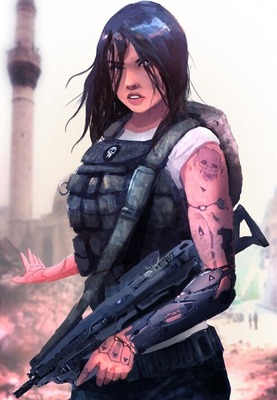
Name: Fuka Astor-Nakano (typically shortened to Fuka Nakano)
Callsign/Nickname: Peacenik
Age: 41
Gender: Female
Appearance: 
The first thing people usually notice about Fuka is her height. Standing at six feet and two inches she'd be of impressive stature had she been a man, and for a woman it's even more so. She attributes her height to her father's genes, as by all accounts her grandfather towered above his peers. Instead of a giant's bulk, she has a professional soldier's lean muscles and powerful core, a build suited to long treks carrying heavy gear. Fuka's youthful appearance belies her veteran status, her years of combat experience concealed by a fresh-faced complexion lacking imperfections. Closer inspection reveals trace marks of reconstructive surgery, with jagged marks scattered across her cheek and brow. These tiny details are leftovers from the blast that put an end to her infantry career, the damage to her face minor enough that it left no lasting complications. The same cannot be said for her left arm. While not entirely blown off, it was mangled to uselessness, requiring amputation and replacement from just above her elbow.
Nationality: Dual American-Japanese citizenship
Personality: Fuka is calm, quiet, grim, and somewhat imposing in demanour. She speaks reservedly, rarely raising her voice or even taking on anything but a neutral facade. While capable of working with and showing concern for her teammates, she's far from warm with them, deliberately maintaining a layer of separation between herself and her subordinates, and likewise with those above her.
This carefully manicured display is an exercise in self-control. Fuka thrives off of stress in a way that is almost certainly unhealthy, and craves action in the form of combat to a worrying degree. It would threaten her career if this was ever known so she makes sure it isn't. She keeps herself in check and watches those who she doesn't trust to do the same like a hawk. She's far more measured and deep-thinking than she lets on. While she did her best to buck family tradition, her upbringing in a clan of blue-blooded political officers rubbed off on her. She sees herself as a warrior-scholar, well-educated and capable of discussing politics and history intelligently, but is really meant to be on the battlefield.
Despite her family background and service to the N/UN and its various constituents, Fuka is not really a believer in its goals or legitimacy. That isn't to say that she's a saboteur or a rabble-rouser; she simply does not trust it to last. She remembers enough of the world pre-Heavenfall to be wary of taking sides; having watched once unshakable powers collapse in the face of unexpected calamity, she assumes the same will happen again. Part of her reasoning is that much of its power projection relies on people like her: mercenaries. If the so-called United Nations are busy battling cartels in the ruins of Central America or trying to rebuild in the remains of Los Angeles, how can they compete with the largely intact Chinese or a megacorporation that gets too confident? That said, she is highly patriotic, bordering on nationalistic, regarding her home country. Japan and the United States are part of the N/UN, and more importantly, they and the N/UN have the same enemies, so she'll fight for it.
History: Fuka Nakano-Astor was not just a military brat; she was
the military brat. Her father was Major-General Thomas Astor of the United States Army, stationed in Kanagawa Prefecture as the head of Major Command Japan. Her mother was Kaede Nakano, a pharmaceutical executive-turned-Kanagawa governor who fostered a close relationship with General Astor. They were married within a year of meeting, and Fuka was born not long after, one of five children in total: two older half-brothers from her father's previous marriage and a half-sister from her mother's, with a full-blooded sister following three years later.
Her lineage was impressive. The Nakanos were old money, some of the first commoners to make their fortune trading with the outside world, while the Astors had a legacy of military excellence going back to the Civil War. (Indeed, Thomas was somewhat legendary for having achieved the rank of major-general at the impressively young age of forty-five). Every child in the Astor-Nakano clan was expected to achieve greatness in some way, and regardless of whatever career they chose they would all do at least one tour of armed service. The pack accompanied Thomas on his rounds and sat in on some of his less sensitive meetings to get acclimated to the bureaucracy, picking up the idiosyncrasies of Army life.
This path had been laid out for Fuka before she was born, and in truth she didn't want to walk it. But growing up immersed in the military meant she saw no other outcome for herself. Her older siblings were rarely seen figures due to their burgeoning careers (ROTC and eventual officers' commissions for her brothers while her sister followed the elder Nakano into politics) but they were measuring sticks against which Fuka was often compared. By her early teens she had more or less come to terms with the fact that she would be joining up as soon as she was allowed, unless of course the Soviets set off nuclear war.
The issue was that she had always been... off, by her own description. Her parents said she was reserved, but Fuka believed she just wasn't wired right compared to other people. She chafed at the thought of careerism or political power, unwilling to spend her days dressing up to shake hands. She craved action. Having spent time practicing judo and kendo growing up she found that she had, to put it bluntly, a taste for violence. She liked testing her skill in an environment where screwing up meant immediate harm, and whenever she could she sparred with people at maximum speed and full contact.
It made sense then that she looked to the infantry, a branch that promised lots of training and to be the first into the fray. Her parents were less than thrilled with her choice but weren’t about to deny her military service, so at seventeen they signed the required papers to send her off to the military. The first recruiter tried to convince her to enter as a communications specialist but she was thoroughly uninterested in simply filling a quota and walked out of the office. She did that three more times until she found a recruiter who could give her what she wanted: Option 40, a shot at the 75th Ranger Regiment.
She breezed through basic and advanced training before moving on to the more specialized Airborne school, endlessly practicing falls from a thirty-foot tower until she was allowed to throw herself out of a plane. While the physical experience wasn’t overly strenuous for her the strict attention to detail scratched an itch in her brain. This was a task where failure to perform perfectly meant landing miles off target or breaking a bone, perhaps worse. There was no room for screwing up, so she didn’t.
After three weeks of that came the RASP. Due to the specific requirements of the regiment weeding out non-citizens and spec ops being very much a boy's club Fuka was simultaneously the only foreigner and the only woman in her cohort. This didn’t bother her in the least because training to be a Ranger was hard enough that she was, for the first time in years, actually excited about something. Over the course of a month of pre-RASP and then eight weeks of the real deal she was constantly sore and deprived of sleep, run ragged by smoke sessions in the wet cold of rural Georgia while being expected to understand and master weapons handling, small unit tactics, navigation, trauma care, and the fundamentals of long-range reconnaissance patrolling.
The experience sucked beyond belief; Fuka loved it. Upon graduating and receiving her black beret she finally felt like she had figured something out. And in a stroke of incredible luck, she had finished just in time for the Gulf War to kick off.
At eighteen years old Fuka was thrown into the thick of combat, seizing airfields and raiding isolated targets too strongly defended or too isolated for conventional troops to reach. She also worked in close coordination with other elements of special forces and intelligence services, her company taking part in raids alongside Green Berets, Delta Force, Britain’s legendary SAS, and the CIA’s enigmatic Special Activities Division. It was with those quiet professionals that Fuka went toe-to-toe with the Soviet Armed Forces themselves, fighting the war her father had been prepping for.
She served with distinction and was decorated multiple times, earning a Bronze Star for taking the initiative in defending a stranded and outgunned Marine detachment against a force of motorized Republican Guards. Later she was commended for her tenacity and quick thinking under fire during a joint raid on a suspected listening post led by the CIA. Fuka, armed with a medium machine and ostensibly moving to provide sweeping overwatch, marched forward while laying down suppression fire when she spotted Coalition captives being held in an outbuilding. Her actions resulted in the rescue of the Coalition airmen and the capture of multiple Iraqi soldiers and a pair of Soviet advisors working as interrogators. For this, she received both a Silver Star and an Intelligence Star, earning her the nickname Star-Studded (which, thankfully, did not stick).
The war ended inconclusively, leaving Fuka a war hero with no plans or goals. She had gotten a taste of combat and found that, like any other drug, the first high was always the best. She next served in the Balkans as part of a small special forces detachment curtailing the worst of the militia violence and providing training to friendly forces, but this was a far cry from what she was used to. Iraq had been the sixth-largest military in the world, backed by the Soviet empire with equipment and actual boots on the ground. The squabbling sectarian forces in Yugoslavia lacked skill and will, and multiple times Fuka caught herself wishing the enemy would stand and fight instead of melting away at the first sign of ambush.
She was losing herself to the job to some degree. She had come to see the Soviets as not only enemies but godsends, committed soldiers led by experienced officers who could provide a challenge. Even better were the rare occasions when she was pitted against her direct counterparts in the Naval Infantry, Airborne Forces, and various Spetsnaz detachments. She had a good working relationship with her team but wasn’t as close as one would expect considering their line of work, and again she found herself wondering just what exactly was wrong with her. The final straw came when she woke up one morning from a vaguely remembered but pleasant dream and realized it had been about seeing a pair of Hinds touch down with yet more people to fight.
She left the Army after her second tour, taking her honorable discharge papers and Uncle Sam’s college money to study political science. Her parents were delighted to have her back and looking to her future after such a meritorious career. They hoped that she’d now find herself a respectable job, perhaps working for one of her sisters to begin learning the ropes. Fuka entered college with the best of intentions, trying to settle in and make friends while enjoying the campus life.
Within two weeks she realized she couldn’t take it. University wasn’t easy per se, but after everything she had done it was incredibly low-stakes. Hearing students bitch about homework or professors being firm with deadlines made her eye twitch, and with such a strictly regimented lifestyle she found herself finishing assignments quickly and then spending the rest of the day searching for things to do. She did pick up judo again as well as boxing but those were just distractions, a way to burn a few hours and trick her body into thinking it was back in combat. Having taken a standard course load for the semester she ended up begging any professor with empty seats to take her, managing to fill up her schedule with double the credits typically allowed. This helped, but it just wasn’t the level of stress she had come to expect and enjoy.
The stress she didn't care for came from her parents, always checking on her directly or through her siblings. They meant well but the incessant badgering and trying to set her up with lunch meetings and interviews and friends with work steadily drove her mad, fighting to ignore the pressure to cave and do what they wanted as she worked on papers she really didn’t care about. To minimize contact, she enrolled in winter and summer courses, staying on campus year-round.
This was not sustainable. At the beginning of her second year Fuka suffered a serious mental breakdown, sitting in her dorm room unmoving and not eating. After a week she recovered and made her excuses to professors and family for the radio silence, swearing to keep the incident to herself. She knew that mentioning it to anyone would only keep her from doing what she needed to: returning to the Army.
She graduated that year in half the time it usually took because of her extreme course load, and immediately walked back into the 75th. She spent the end of the 90s more or less constantly deployed, traveling across the Horn of Africa and Central America to destroy some target or train some friendly force. Getting sent to stomp out little brush-fire conflicts was a step down even from the Balkans but at this point she had to take what she could get.
On one of these excursions she was sent into Laos to provide support for royalist rebels opposed to the Communist Pathet Lao and their Vietnamese/Chinese allies. A planned strike against an artillery position was jeopardized when the Ranger squad learned that the militia they were expecting to provide support had decided not to show. Fuka, now a staff sergeant and thus leading the team, made a rare show of emotion by violently cursing their ‘allies’ before ordering the squad forward; they would do it themselves. The ensuing assault turned into a close-quarters brawl, the Rangers outnumbered but making use of their superior arms and training to hack through the artillery unit. Fuka herself bludgeoned an enemy conscript so brutally that she ended up shattering the plastic stock and buffer tube of her rifle over his head, nonchalantly picking up his and continuing to fire.
This incident and her reputation for constantly asking for forward deployments solidified her nickname: Peacenik, an obviously ironic moniker.
The third deployment she was in Peru, once again involved in joint Army-CIA operations against both the Maoist Shining Path and the Leninist Túpac Amaru Revolutionary Movement. In fact, she was in the middle of a mission when the Heavenfall struck. She survived largely by blind luck: her part of the team had been scaling a mountain while the others were in the town below when a tidal wave struck. In a demonstration of her now-controlled approach to chaos, she took advantage of the event by reordering her collection of Rangers, CIA, and Peruvian Army and police before launching a series of raids on the now-shattered cell hiding in the mountains and rubble. She broke the spine of leftist rebellion in the region before getting pulled north into Mexico to fight the cartels and white nationalist invaders taking advantage of the country’s collapse.
Her luck ran out towards the start of her fourth term of service, when the vehicle she was using for cover was struck by a sicario’s anti-tank grenade. The resulting blast ripped her arm off at the elbow and peppered her face with steel shrapnel, leaving her alive but very much unable to fight. Fuka got a Purple Heart and a second honorable discharge, while her family’s money and connections bought her the best prosthetic available and near-perfect reconstructive surgery (a procedure she consented to mostly for the sake of her mother). While her new limb had almost 100% function compared to the original, Fuka could not escape the phantom pain that came with such an injury. She chalked it up as the price of survival and was more concerned about what the hell she was going to do now.
Her family, well aware of the political fluidity of both Japan and America, tried again to encourage her to enter government, but she was, as ever, determined to never do that. She didn’t so much pick the Navy as she ended up there-it would be hard to convince ground forces to take her and she was again plagued by the restlessness that ruled her life. In an attempt to stave off a second mental collapse she walked into the recruiter’s office, explained her situation, and said that flying seemed fun.
The destruction worked in her favor. Many qualified pilots who had been deployed were dead or missing after the disaster and the United States was scrambling to recover. Already a college grad she was able to enter OCS immediately, and then put through a truncated version of flight school.
By 2008 she was fighting again, but this time she was in the sky. First deployed to Central America to face off against Colombian and Venezuelan pilots battling for control of the sky, she would later attend the highly competitive TOPGUN program and was then sent to her native Japan to train the Air Self-Defense Force and fend off attacks from, funnily enough, her old enemies from Laos. She enjoyed the change of pace that came with dogfighting, but, as always, restlessness crept in. She had spent more than a decade thinking of herself as poor bloody infantry and nothing else, so shifting into the role of an officer at the helm of a hundred million dollars' worth of equipment was tricky for her.
She was struggling to figure out whether or not she’d re-up for another term when she was offered a way out. The N/UN was reliant on PMCs but unwilling to let them operate completely unobserved, sending trusted servicemen and women to act as liaisons. A spot opened up for the air wing of Shattered Steel, a group with which she was familiar due to a friendship with one of its airmen. She jumped at the chance, putting her name down as a candidate. Decorated, extremely experienced, and with a clean record she was the perfect choice.
She was transferred laterally to serve as second-in-command of the 5th tactical squadron and immediately saw intense combat.
Personal Gear: M110 Semi-Automatic Sniper System in 7.62mm.
Springfield XD-M in 10mm.
Survival KnifePersonal Aircraft: F/A-18F Super HornetAircraft modifications: - The 18F was originally a two-seat variant of the Hornet, but the Navy converted some of its stock to single-seaters due to a lack of personnel post-Heavenstrike. Fuka's more comfortable serving as her own Weapons Officer.
- Upgraded avionics
- Upgraded Radar: AN/APG-81
- Iron ball paint to absorb radar waves
- Glossy black paint scheme and stylized rabbit head on tail
Anything Else: - The handle "Peacenik" dates back to her days in the Rangers. She would regularly volunteer (and in some cases actively badger) for patrols likely to come into contact with the enemy, and Peacenik was bestowed on her as an ironic trophy.
- Her "black bunny" style livery is in honor of the lieutenant commander who trained her to fly, a veteran of the VX-4 evaluation squadron.
- Fuka semi-jokingly calls herself the family's black sheep due to her sibling's achievements and her comparative lack. Her half-brothers, Thomas Jr. and Evan, are career officers in the U.S. Army while her sisters went into politics. Her full-blooded sister, Ayaka, is a Congresswoman out of Arizona, while Chieko is a member of the Japanese Diet. Yōko, the highest climber, is Deputy Prime Minister. All three are known for their hawkish and nationalistic tendencies, with Ayaka calling for the United States to rebuild and start projecting power while Chieko and Yōko push for Japan to increase its military and take a harder stance against pro-Chinese nations in Southeast Asia to solidify control of disputed territories (namely the Senkaku Islands). Fuka is sometimes approached by lobbyists looking to get an in with her family, which she finds amusing and annoying.
- She used to smoke heavily but has recently begun to wean herself off the habit using sweets.
 Fish of Oblivion
 Finetales
 Not a Sayan
 Inertia
 Fetzen
 FourtyTwo
 PrinceAlexus
 Neziul
 Scrawl Banditta