1 Guest viewing this page
Hidden 5 mos ago Post by Lord Zee
Raw
Avatar of Lord Zee

Lord Zee I lost the game

Member Seen 18 hrs ago

And There Was Light


Just before the world would be bathed in light, when Teefee and Tad pulled the family sled. Toffee and her mother walked ahead, out of earshot but in silence. Toffee’s mind was a mess, her heart was heavy and she felt as if she had sullied herself. It was just an accident, right? No- It had not been an accident, no matter how much she wished it to be. She remembered so vividly the heft of the spear, the weight as she lifted it, the power behind her throw. When had she gotten so strong? On and on her thoughts raged as the battle within pushed and pulled from the deep abyss of nothingness that threatened to drag her down, to the rationalization of the killing.

She of course had hunted animals before, She had been taught to wield a spear by her mother, they all had but only she and Tad hunted. Toffee could remember the rabbit which her spear had pierced. Right through the center of it. As blood gushed forth it kicked at the air, unable to move. A prisoner in its own dying shell. She had put it out of its misery with bashing of its head and from that day on, she vowed to make the cleanest kill possible. No more suffering. No more pain as the creature died.

Malac had died quickly. Too quickly. No, that wasn’t right. His death was painless. He probably didn’t even realize what had happened. Right? It was this part of her mind that was beginning to win. She could feel guilty all she wanted but the fact remained; he was going to do something unthinkable to Teefee and his death was warranted. Why feel remorse or melancholy about it? But then again, why did she need to feel at all? Why couldn’t she just… Teeter on the edge of that abyss and dip a toe in. It wouldn’t be that bad to slip into a melancholy.

But what about her siblings? Her mother? They needed her. Or did they? Who would want someone as broken as she? Was she broken? Or was it just more of this stupid guilt weighing her down.

“Toffee. Stop.” Her mother’s voice made her blink in surprise. She looked to Ina, who stared at her with an expression of worry.

“Stop what?” Toffee tried to play dumb.

“I know what it is that you dwell upon, daughter and you must stop.” her mother said, looking ahead to the distant stars. “On and on it will go. For to take a life, is no easy thing to come to terms with. But letting it consume your every action, will only lead you to a dark place.”

Teefee scowled as a sudden wave of anger peppered her. What did her mother know? How could she be so callous? So she voiced her opinion. “You know nothing mother. I have killed a man. I have sullied myself. Instead of facing the ancestor’s judgement, we are fleeing the tribe.” She, of course, wasn't entirely truthful but her mother didn’t need to know everything.
Ina remained quiet for a time and only once Toffee kept glancing at her and fidgeting, did her mother speak once more. “I once killed a woman.”

Toffee’s eyes went wide with shock as she looked at her mother.

“She was from another tribe during the days of fleeing. It was a chance meeting. Everyone was sick and hungry. Those of us who were strong were sent further and further to find what we could. I guess she was in the same predicament. I had found a small pond of the clearest blue water you had ever seen. I still remember the taste. She came out of the woods and stared at me. I remember her so vividly.” Her mother paused, still looking ahead. “She demanded I leave, that it was her water. I refused and she came at me. After a short tussle next to the bank, I managed to grab hold of a rock and smashed it across her head. She went limp and that was that.”

Her mother finally looked at her and where Toffee thought she would see remorse or guilt, she only saw a fierce determination. “It broke my heart to take a life, Toffee but she would have killed me. I did what I had to do, to protect myself. And you did what you had to do to protect Teefee.”

“It’s not the same.” Toffee blurted.

“Isn’t it?” her mother snapped back, “He harmed your sister. He harmed you. He could have put his seed inside her, Toffee. He could have killed her.” Toffee looked away, tears beginning to well, ones she tried to banish until she felt a hand on her shoulder.

Her mother’s voice was softer now, “I told you before Toffee, I do not blame you, I do not hate you. Now you must learn to do the same. As I did. As others have done before you. For the world is a brutal place, my daughter and every day is a fight for survival. No matter what shape it takes.”

Toffee, lost for words, only nodded. But she knew it was easier said than done.

“Would you like to know how I dealt with what I did? Outside of coming to terms with it, I mean.”

Toffee nodded again.

“I told your father, I told my own mother while she still clung to life. I confided in them and they told me what I have told you now. It is good to talk with the ones we love, for they remind us why we do what we do.” A quick pause, “I told you this act would be one you had to live with and you will but do not let yourself believe it has sullied you in some way. Malac would not have even blinked if he had done the same. Why let it bother you so?”

She gulped and finally found her voice. “This sadness I feel threatens to drag me down but part of me has already begun to accept it. Why must the line be so thin?”

“Oh daughter,” Her mother put an arm around her, “Taking life is no easy thing and it shouldn’t be. When it becomes as easy as eating, then a part of us is lost forevermore. But to take a life in the name of life, hard as it is, is necessary. And these feelings that come with it, just mean you have not lost yourself. With the water I found, I managed to give life to those that needed it and without it, my own mother would have passed far sooner than she did. I would not have had you, if the other woman had killed me. This is life.”

There was a shared silence between the two as Toffee contemplated. It was just a part of life, wasn’t it? It shouldn’t be but it was. Mother was right. Malac would have killed them both and not have cared in the slightest. But Toffee realized that a part of her was glad she did care, that she did feel remorse. For it meant that she was far better than him. It would take time but Toffee knew this would not defeat her. She would find beauty in the world still, despite what she had done or what she would do, in the future.

“Thank you mother. I love you.” Toffee said at last, wrapping her own arm around her mother’s waist. She leaned into her and sighed.

“You are loved, never forget that my heart.” Her mother said.

And then, as if in answer to Toffee’s silent thoughts, the sun began to glow.


Teefee sneezed. Toffee sneezed. Tad sneezed. And they kept sneezing as the light grew brighter and brighter. Though this was happening and their eyes were watering and their heads were hurting, none of them could look away. Shadows were banished from their perception. The haze, yes the haze that had always been in the sky, was purged to reveal a deep blue that hid the stars like a blanket. All at once, it was as if they could see. As if they had been blind their entire lives- the grey netherworld burst into color unimaginable. Deep greens. Rich greens. Dry yellows. Warm reds. The earth was littered with browns and grays and rocks that glittered for the first time in their existences.

Their mother was the first to fall to her knees as she wept unbidden. She prayed to the ancestors, she prayed to the great light in the sky, to the wind, yes the warm breeze that came and tickled them and she prayed to all the colors of the earth and she kissed the land and outstretched her arms to the heavens.

The triplets followed her example, so profound was it to be alive in that moment, that all the pain of the day's past were banished. So consuming was this revelation of light, so invoking of what it was to be breathing in the air, blessed as they were- it felt as if they were the ones to be witnessed. So shattered was their worldview that it took a long time to even comprehend that the world had never been dull, it was just that they had been unable to see it as it should have been seen.

They were not so alone on that perch of grass, now that they could see unhindered. The land about them was teeming with life. So too did the animals bask in the new light, so too did some hide and flee from the illumination of the sky. Others chirped and sang and called forth to begin life in this new state. Insects buzzed and took flight, while birds swooped and their plumages radiated iridescently in the sky. Of colors in colors that danced and were joyous to be at least seen and appreciated.

Even the grasses and the shrubs seemed to rejoice, shivering with anticipation and turning to face this new source of nourishment.

All the while Toffee was slack-jawed. Tad’s eyes were wide and his pupils dilated as he looked about. Teefee’s smile was so large despite her blurred vision, for tears were streaking down her face. Untold minutes passed as the family took it all in and then there came the greatest surprise of all.

It was Toffee who finally looked away from the colorful word to look upon her siblings and mother. It was then she broke into a garbled cry, so heavy was her emotion. She could only point at Teefee and Tad and mother.

“I can see you.” she said at last, as they gathered around her in concern. And it was true. Their appearances to one another had always been under the light of the stars or the red glow of a fire. Now and only now, were they able to look at the fine coloring of Toffee’s brown hair, almost hazel in the light now. Or the deep grey with lighter strands that were Tad’s and the dirty white of Teefee’s mane. For she needed a good wash.

They looked upon their mother and they saw the same face but with now an untold warmth that only light could reveal. Her eyes seemed to dance as she too saw her children in vivid tones. They all began to cry and where their tears fell onto the earth, unbeknownst to them, the plants lapped it up and demanded more.

So it was that the family continued on, only an hour or two having passed but bit by bit they began to notice a different change. Fields of flowers and other plants besides the familiar tallgrass were bursting through the soil. Even more color was added to this new tapestry. Pinks and whites, blues and oranges, purples and reds. Even the leaves of shrubs and other leafy plants sprouted with vivid greens tipped with a creamy color and yellows. Here and there, the leaves were glossy and dark or fuzzy and bright.

Teefee was having the time of her life, unable to stay still for too long in one place as she danced and ooo’d and awed at every little thing that caught her interest. She giggled wildly when a caterpillar crawled up her arm and she went eerily silent when a butterfly landed upon her nose. But her smile could be seen throughout.

That left Tad and Toffee to pull the sled and for once, they were content to do so, as they watched their sister enjoy herself.
But it was only when a few more hours passed when Toffee began to notice that the plantlife around them was still growing.

“Are the plants… Growing?” Toffee asked Tad.

Tad looked at her with a quizzal expression. “They’ve been growing, you dolt.”

“No I mean, I know that, it’s just, they haven’t stopped growing? The sled is getting harder to pull brother. The grass once came up to our knees, now it's almost up to our chests. Surely you’ve noticed that.” Toffee said, rolling her eyes.

“Well, I guess now that you mention it, yeah. But that’s probably just because they are basking in the new light. I’m sure it will end.”

It did not end and when they all started sneezing again it wasn’t because of the light. The air had become thick, slowly but surely, with a myriad of pollen. Teefee came back with a runny nose and red rimmed eyes. Even their mother was looking uncomfortable. Toffee kept sniffling and sneezing and Tad kept muttering under his breath about the air quality.

It quickly became too much and to their horror, the colorful world around them began to wither and die. The blessed light had gifted too much of itself and now all would suffer the consequences. The air had grown so thick with pollen that the air was now choking and only by the quick thinking of their mother had they been able to rip off a few thin furs to cover over their faces. Only their eyes would suffer the bite and sting of the air and the blur of their eyes from all the tears that began to stain their faces.

They needed to find shelter but in the open plains, there was little respite and it was becoming harder to see.

A dip in between two hills proved to be their only shot at weathering out this sudden catastrophe. They huddled down, pulling their furs over them into a thick blanket and though it was hot and stifling, it provided a small amount of relief for their eyes and throats.

It had been such a wondrous day of beginnings but now the cold knife of uncertainty had wedged itself back into their hearts. All of them fell asleep and their dreams were not kind.


4x Like Like
Hidden 5 mos ago Post by Cyclone
Raw
Avatar of Cyclone

Cyclone

Member Seen 3 mos ago


Kur-Laka


There was a wild man who dwelled in the uplands. He did not have a name, for he’d spurned speech long ago. He lived in the grass and trees alongside the herds of beasts, and was content there. He smelled nothing of smoke or civilization, so the animals saw him as a friend and shared watering holes with him. Sometimes they roamed together on the flats.

He had no possessions save for a handful of berries gathered the day before. He did not worry about clothes, for the days were warm beneath the new sun, and wherever he chose to lie down, there were caves and shallow grottos enough to shelter him from wind and the crispness of night.

In those distant days, when the sky had been dark and choked with ash and even streamwater tasted bitter, life had been harder. When the fruits of the land and the easy prey animals had all vanished, ur-humans had turned to scavengers, or worse. Now everything was verdant and the land had grown prodigal. Trees flowered, bore fruit, and then dropped it to rot within days, only to do so again and again. Life had become easier, yes, but danger had not vanished with hunger.

Daybreak had just come, and the dawn was beautiful: droplets of dew topped the grass and glistened in the sun like glass, like precious stones that the wild man had no knowledge of. Yet he sensed that something was very wrong. The birds were not all singing. It was not a deafening silence, but one by one voices were leaving the chorus. He saw a distant flock in the sky turn away. The insects still hummed oblivious, but something had come into the uplands that did not belong here. Some of his smaller friends, furred and four-legged creatures that had shared the thicket with him through the night, had stilled themselves by instinct. A small mouse was trembling; he spared a moment to stroke its back to calm it.

It was easier for such creatures to hide in undergrowth, but the wild man understood that he was too exposed. He straightened up from the thicket, fingers still sticky with dried berry juice, and shifted onto the balls of his feet. Slowly, he turned his head to sniff at the air.

The breeze changed direction and suddenly carried a noxious scent: there was smoke, but it wasn’t the fresh kind that came from a brush fire… this was old smoke, the stale and greasy kind that clung. Beneath that was something even worse, a layered reek that he knew too well.

The wild man did not have words for the other ur-humans, the ones that burnt trees and wore other creatures’ skins, but he remembered their smell and old scars reminded him to flee from it. In one moment he’d been drowsy from sleep and still, and in the next his body was flooded with fear and he was running. His feet hit the ground hard and fast, his toughened soles feeling nothing as he sprinted toward a grove of thick trees.

The grove was closer than it had first appeared, but still too far. He plunged between the first ranks of trees, ducking beneath low branches, instinctively making his way into the densest growth. Leaves slapped against his face and arms. Thorns tore at his skin. He welcomed the pain because it meant speed.

From close behind him rang out one sharp, eager shout. Another answered it, then another, voices overlapping, not panicked but delighted.

A stone whistled past his ear and struck a tree ahead of him with a dull crack. He swerved hard, stumbled, caught himself, and ran on. His breath came ragged now, chest burning, legs screaming.

The grove ended too soon.

He came to the end of the treeline and encountered a shallow ravine choked with brush and fallen limbs. He leapt down without thinking, hit the ground, rolled, and came up limping. There was a wetness on his hand thicker than sweat; he looked down and saw his palm bloodied from some scrape that he hadn’t even noticed. He ignored the tingling pain and began climbing up the far side of the ravine.

A hunter’s hand seized him by the ankle before he reached the top, dragged him back down into the ravine, and slammed him into the dirt. He fought back savagely, biting, kicking, and clawing. It was in vain because there were too many of them, and they were strong. A knee was driven into the back of his spine, forcing him prone. With all the might that he could summon, he rolled and tried to surge back upward. A hand seized him by one wrist and another one by his long hair, while a foot stomped down hard to pin his other arm to the ground by its elbow.


The Hunt


The wild man thrashed and writhed for a moment longer until someone struck him across the face with a heavy club. A sound that was not a word tore its way out of his mouth. Sparks filled his vision, but through the flashing and the haze, he finally beheld them: the man-hunters’ chests were all painted with ochre; about one’s waist was belted a strip of hide from which hang bloodied scalps, around another’s neck was draped a string of teeth and finger bones. There was one great brute of a man, wielding the club, that had a singular great bulbous eye set above his nose, but his was not the most fearsome look.

One figure that must have been the leader of this band came to stand over the downed wild man. This hunter was not especially large, but his face was painted with ash and dried blood. He held a chipped stone blade no longer than a handspan. Rough hands held the wild man still even as they all began loudly shouting and quarreling among themselves. The one-eyed brute rapped the wild man’s thigh with the wooden club. With little more than a grunt, the knife-bearer made a small incision to mark that leg. Another one pointed at the arm, and the knife-bearer obligingly carved a line there too. They kept making marks even as the world narrowed and went black.


The wild man woke to the smell of smoke and rot. The odor was so putrid and overwhelming that it triggered his gag reflex. His head throbbed and his mouth was parched. Fresh and sharp pains traced the lines they’d cut all over his skin earlier. He lay on his side, wrists and ankles bound by crude strips of leather. Below him was packed earth; beneath his chin he saw that it was black with old ash and darker stains he did not recognize. He was not alone.

A camp was all around, sprawled across a shallow basin like a wound that refused to close. Fires burned everywhere, clustered and competing, their smoke hanging low and choking. Hovels of bent branches and stitched hides rose up all over like sores, but they sagged under their own weight. Between the crude dwellings were shallow middens where bones had been discarded without care: gnawed ribs and skulls cracked open and cast away like nutshells. Those waste-pits were latrines too; the stench and swarming flies made that clear.

Humans and strange almost-humans moved through it all, scarred and altered. One picked at his fingernails, all twelve of them. A woman sat near a fire, poking at embers, but her jaw was too wide, teeth exposed even when her mouth was closed. The cyclops from the hunt sat atop the fence around a small pen that contained some mangy animals. A sheep approached the brute and bleated a short and dry cry that the wild man at once understood to mean that the animal was thirsty, but the cyclops only threw a stone at the animal to quiet it.

The wild man had to escape this terrible place!

He bent his head and began biting at the binding around his wrist. The old leather tasted foul, but desperation lent him resolve. Near one of the bone heaps, a rat scurried between shadows. With a few gentle, breathy grunts, he called to it with the sounds he used with the smaller creatures of the grass. The rat paused. It sniffed the air, then approached. It did not fear him because of his smell and slow breathing. It scampered to his feet to gnaw at the bindings there.

The rat worked quickly. Its teeth were small but tireless, and the leather at the wild man’s ankles began to fray. He lay still, breathing shallowly, willing his body not to tremble even as he chewed at the wrapping around his wrist. Face pressed against the dirt, he remained vigilant, turning to look toward what seemed to be the center of the camp. There was some kind of tumult there.

Placed in the middle was a vessel unlike anything else in the camp, or anything the wild man had ever seen. It was squat and wide-bellied, and it looked like it was shaped of some stone that’d been darkened by age and soot. No fire burned beneath it, yet heat poured from its mouth in steady waves, like the hot exhalations of some slumbering beast. The air around it shimmered. Within, something thick and foul churned: a slow, viscous stew.

There was a man tending to it, large and big-boned. He had a long and unkempt beard, curling like a briar bush, matted with grease and filled with small bones and bits of food that he’d never bothered to pick out. The cook stirred the pot’s contents with a bone ladle that might have been made of someone’s femur. “Lykaon,” someone addressed the cook as they approached with an offering in hand. Lykaon nodded, and the offering was cast into the pot.

The tumult came from nearby. Not far behind Lykaon, the wild man saw the bloodied knife-bearer from the hunt working over a stone slab, performing the grisly task of butchering some beast. The greatest part of its body was passed to the cook Lykaon and cast into the stewpot, but here and there a flank or leg was carved out according to the marking lines and set aside for others.

There was some angry brute with horns protruding from his forehead, standing beside the slab shouting. The butcher answered back in kind; their voices rose, sharp and overlapping. The wild man did not know their words, but he recognized the tone and the rhythm of dispute: the sounds of wanting to take, of refusing, of challenge, of promise-to-harm.

It came to a head when the horned one reached towards the butcher’s slab and seized a cut of meat; like lightning, the knife-bearer slashed at his arm and the bloodied chipped stone blade ate at flesh. The injured man howled and dropped his stolen prize; he backed away clutching his wound, but looked to the butcher with eyes that promised death. By now the commotion had the whole camp watching. A dozen raucous shouts and cries came out at once from everywhere, but Lykaon left his place by the cooking pot to approach. His coming and the stare of his sunken, unblinking eyes choked out the tumult and the argument like a fire that was suffocated beneath sand.

“You took more than you are owed,” Lykaon stated simply. The wounded one tried to stammer out some justification, but Lykaon’s voice spoke over it in a tone that brooked no argument. “I will not suffer it. Cut him apart!”

Perhaps the heavy silence and anticipation after that command lasted a second. It felt like longer but couldn’t have been, for the wild man missed just one breath before the knife-bearer lunged forward to stab with practiced efficiency. Someone else grabbed the horned offender from behind to slam him down upon the stone slab, right beside the half-butchered animal, and from there the work commenced at once. Lykaon returned to his place by the pot in silence and without looking back. The wild man couldn’t bring himself to watch; he turned his head the other way and kept chewing at his bindings over the sound of gurgling and then of bones snapping and flesh being torn.

Bits and pieces of beast and man alike were dragged to the stewpot, the blood dripping from the chops leaving more dark streaks in the dirt. With a nod from Lykaon each piece was cast inside, man and beast flesh alike. There was hardly even a splash; the stew drank unceremoniously and then its smell grew richer and obscene. The smell was enough to lure many flies, but the heat radiating from the pot was enough to overpower the bugs such that they dropped from their flight to be enjoined in the soup as crisps. Lykaon kept on stirring with the femur-ladle.

The bindings around his wrists and ankles alike were frayed enough that the wild man ripped free as the rat scurried away. He readied to make his escape, but to his horror he realized that the commotion was already over as quickly and unceremoniously as it’d begun, the cannibals returning to their places around the camp. He’d missed his chance.

But something changed. First there was an uneasy silence that set in as something great drew near; just as the songbirds had gone quiet one by one, the talk, laughter, and sounds of work around the camp all died down. A long shadow stretched down the dirt path before the wild man, and while he did not yet see what hulking figure was casting it, the shade of that shadow seemed to burn with heat.

Some cannibals fell on their knees and cast their eyes down, gasping a sound. Those were the ones that were reverent at once; others were murmuring, unsure of what they saw. A giant came to a halt halfway down the dirt path, eyeing Lykaon and the pot, standing right beside the wild man. And as the wild man tried to behold this terrible ones visage, his neck craned up and up.


Sarhush’s gaze was fixed squarely upon the Me of Cooking that Lykaon stood over. For a long, pregnant pause, nothing happened.

The god did not roar or strike. He did not even look at the people who cowered or whispered at his feet. His eyes, bright as hot coals, traced the curve of the vessel, the shimmer of heat rising from it, the bone ladle stirring its contents. The stew burbled on, ignorant of judgment.

“This,” he spoke at last, one hand gesturing at the sprawling camp while the other clutched some massive cloth sack, “is all that you have made of what I gave you?”

The sound of his voice was like two stones grinding upon one another; it carried without effort and pressed against ears and chests alike. It was heavy enough that even those at the edges of the camp heard and fell silent. Lykaon straightened slowly. He did not kneel. He did not flee. He planted the femur-ladle upright in the pot and turned to face the god, eyes hooded, expression unreadable beneath the weight of his tangled beard.

“Great Sarhush, I remember when you gave us fire,” Lykaon answered. “You showed us how flesh is changed by it. We have done as we were taught.”

Sarhush’s lip curled.

“You have done little, even with such abundance. Your laziness is wretched. You squat inside of hovels that leak when it rains and collapse in the wind. You kill one another over scraps. You make a sport of hunting lesser creatures while the world I remade lies untouched all around you! You have failed to shape it.”

His gaze finally moved, sweeping the camp in a single contemptuous arc: the sagging dwelling, the bone heaps, the crouched figures clutching weapons and grisly trophies alike.

“You live here no better than a den of wild beasts,” Sarhush concluded.

A murmur rippled through the camp, confused and uneasy. Some of the younger generations, twisted changelings, shifted and snarled. They did not have living memory of Sarhush, and so were uncertain whether to bare teeth or bow. The older ones like Lykaon were heavy-eyed, and they knew their god and so remained still and trembling.

Lykaon said nothing as Sarhush strode forward.

“I fashioned the Me of Cooking so that man would cease feeding as beasts,” Sarhush continued. “It was meant to teach patience, preparation, and measure. You have made little more of it than a trough.”

Sarhush reached out, and with a single motion, he closed a massive hand around the rim of the vessel. The Me of Cooking came free of the earth without resistance, as though it had never belonged there at all. The god lifted it up and overturned it, boiling stew cascading out along with bones, dark chunks, and even a few skulls.

A cry went up; this was not of protest, but of sudden, animal panic. Several of the cannibals surged forward instinctively like a swarm of vultures. They wanted to try scooping up the stew before the ashy earth drank it, but they stopped themselves halfway and shied from nearing Sarhush too closely lest he be provoked further.

“I reclaim this,” Sarhush said, turning the pot in his grip as one might inspect a flawed tool. “Left with it for too long, it has held you back. You have learned only the easiest lesson: that flesh can be cooked and softened.”

He dropped the Me of Cooking unceremoniously into his sack, then he looked at Lykaon again.

“But you,” Sarhush said, and there was something like grim interest now, “have learned something else. You hold the rest of them. For that much, my disappointment is lessened.”

Lykaon met his gaze. Slowly, deliberately, he inclined his head.

Sarhush exhaled and the air thickened and grew hot. ”I command you to build something that will endure. Cut a scar into Ashuru that will never fade. Achieve this, and when next I return, it will please me.”

From the ground beside Sarhush manifested three shapes, dragging themselves free of ash and stone as if being remembered into existence. The first was a massive wedge of some stone, black as night as impossibly hard and smooth. Sarhush lifted up the Me of Masonry, placed it upon the bloodied butcher’s slab in the center of the camp, and struck the back of the wedge with his palm to demonstrate. The great slab of stone was sundered into a hundred smaller pieces. With a few casual flicks of his wrist, Sarhush had stacked a few of them atop one another to assemble a small wall.

“What is hewed from stone endures.”

He allowed a few dozen of them to touch the Me, trembling at its revelations, before he picked it up to place into his sack.

The second of the three Mes that he had manifested looked like an oddly shaped rock that was colored the deep-brown of dirt. As Sarhush picked it up to hold it high enough for them to see, it molded around his fingers amorphously like wax. He fashioned it into a shape that resembled the pot that had been the Me of Cooking, then he breathed on it, and suddenly it became as rigid and hard as stone. But a few moments later, it softened again and began to sag.

The Me of Pottery crashed to the ground with a wet thud as Sarhush dropped it for them to touch. “Flames can cook more than flesh,” Sarhush shared from his own revelations. “Fire can transform and harden the earth itself. Shape the world with intent! Then harden it in fire.”

The Me showed them the ways of clays and pottery, of kilns and ovens and crude furnaces. Sarhush eventually put it into his sack too, once a sufficient number of them had been endowed.

He finally turned to the last of the three Mes that he had just created. This one was a great curved piece of timber, with a leather strap hanging beneath it, fashioned to both ends. It was a massive yoke, for harnessing beast or man alike.

““And this,” Sarhush said, his voice dropping low as he lifted the Me of Slavery high for all to see, ““is how you will order yourselves and avoid such wanton waste. I do not begrudge that the weak are fit for little beyond meat. But those with strength? Set them to toil.”

The Me struck the ground right at Lykaon’s feet.

“Not all will wear it,” Sarhush went on. “Only those who must. Strength must be directed. Mercy is waste; compel labor when it does not come willingly.”

He looked over the camp once more, at the savages covered in scars and painted with ochre and ash and blood, the old eyes and the young changelings that watched him with hunger and awe alike. He reclaimed the Me of Slavery to place into his sack too; these tools were far too crucial to be hoarded by any one group of man.

“I bestow upon you one gift that you may keep,” he began, and the already enraptured tribe leaned in even closer. “I give you a name. Your people, this place: I call Kur-Laka. Go out from here; take and subjugate all that there is. But return here, for I consecrate this place as a center of civilization. Build it into something worthy. This is the seat that I shall judge.”

Already, Lykaon had gathered up a few strips of leather to fashion some crude collar in imitation of the Me that was a yoke. His eyes swept across the camp, searching for the wild man that had been captured that morning, but the creature was gone! His anger lasted only a moment; there would be others like that one, and one loss made little difference.

5x Like Like
Hidden 5 mos ago 5 mos ago Post by Timemaster
Raw
Avatar of Timemaster

Timemaster Ashevelendar

Member Seen 4 days ago

🎲 𝒜𝓁𝑒𝒸𝒽𝒾𝑜𝓇 🎺

&

❚█══Villagxor══█❚


Alechior stepped out of the cave and into the open air. With a pleased hum, they kicked off the rock face and let themselves rise, then surge forward. The valley of Gamblerdise opened beneath them and even from above they could see it. The land looked different. Not fixed, not healed, but steadier. The soil no longer lay gray and starved, but darkened, richer, already drinking in what little remained of the unruly growth.

They slowed their flight, circling once as if inspecting a wager before committing. Fields that had been brittle now held together. Rotting plant matter was being swallowed back into the earth instead of choking it. Alechior smiled, satisfied. Khthon worked quickly when he decided something was worth doing. Points in his favor, they decided, mentally adjusting odds that never really needed adjusting.

Alechior descended in a streak of gold and landed in front of the temple, feet touching ground as lightly. Gamblerdise was loud, as always. People shouted, tools clattered, life insisted on continuing. And at the center of it all stood Villagxor, voice carrying as he barked orders with newfound confidence.

“Move the crops there, no, not there, higher ground. Yes, like that,” Villagxor was saying, before he froze mid-gesture. He turned, eyes widening as Alechior came into view. Then he straightened, cleared his throat and dropped into a respectful bow that was only slightly ruined by his grin. “They’re back,” he said loudly, more to the village than to Alechior. “Told you. Odds were good.”

Alechior laughed and spread their arms, basking shamelessly in the praise. “And you didn’t even have to gamble anything you couldn’t afford,” they replied, glancing around at the busy, hopeful motion of the village. “Look at you, already acting like someone who knows the numbers favor them. I leave for one little cave crawl and suddenly you’re running the table.”

Villagxor approached with reverence that barely managed to contain itself, hands still stained with soil. He bowed his head deeply. “Whatever you did,” he said, voice filled with relief, “it worked. The ground is holding. The rot is breaking down instead of choking everything. People can breathe again. I can breathe again.” He looked around the fields as if afraid they might vanish the moment he stopped watching them.

Alechior raised a finger and gently waved it side to side, smiling. “Careful now, cleric. That win is not on my ledger.” They tilted their head toward the earth beneath their feet. “That was another god’s hand. Stone and soil, patience and pressure. I just got lucky and found what to knock on and when to knock. Important skill, that.” Their grin widened. “Still counts as good odds, though.”

Villagxor blinked, then nodded slowly, absorbing that truth with the same seriousness he applied to numbers and stores. “Then…thank you for knowing,” he said simply. “That matters just as much.” He hesitated, then looked back up. “You mentioned something else earlier. On the mountain. You said there was more than just soil.”

“Oh yes,” Alechior said, immediately, as if reminded of a particularly fun side bet. “That is the real prize.” They crouched and tapped the ground with two fingers. “A new stone now sleeps beneath Gamblerdise. Fortunite. It looks like the Sun trapped inside stone, light enough to carry, soft enough to work. The other god shaped the body, I shaped the risk of it.”

Villagxor straightened, listening intently as Alechior continued. “When someone mines it, truly takes it free of the earth, chance steps in. Half the time, it stirs something in them. A need to create. To carve, paint, build, shape, to make something that did not exist before. Art, craft, obsession.” Alechior’s eyes gleamed. “The other half, it does something quieter. It eases the mind. Calms fear, dulls worry, lets a person breathe when the world is pressing too hard. Same stone. Same risk. No way to know which you will get until you take it.”

They rose and clapped Villagxor once on the shoulder. “Use it wisely. Or recklessly. Both are valid strategies.” A pause, then a softer smile. “Just remember, every time someone digs for it, they are placing a bet with the world itself.”

Villagxor frowned, rubbing his hands together as he turned the idea over and over in his mind. “So it is not merely a resource,” he said slowly. “It is...a decision made solid. A risk you carry in your hands.” He glanced toward the fields, then back to the earth beneath them. “That alone makes it dangerous. People will want it. People will misunderstand it.” His brow furrowed deeper. “And even if they did understand, we do not have miners. We barely know how to dig without collapsing a tunnel on ourselves.”

He exhaled, shoulders sinking. “A stone like this would require knowledge. Tools. Methods. Supports. I cannot ask people to gamble their lives just to reach a gamble made of rock.” There was no fear in his voice, only responsibility, the weight of knowing where his limits lay. “I can teach counting, planning, storage. But mining? Crafting?” He shook his head. “That is beyond us.”

Alechior did not let him finish. They stepped forward and lightly tapped two fingers against Villagxor’s forehead. Not hard, not forceful, just enough to make the point. “Shh,” they said, amused. “You are overthinking the opening hand.”

Warmth spread behind Villagxor’s eyes, then deeper, settling into memory where there had been nothing before. Not commands, not instructions, but understanding. How to brace a tunnel. How to read stone before it failed. How to extract without waste. How to polish, cut, set, simple rings, beads, inlays. Nothing grand, just enough. Villagxor staggered back a half-step, breath catching, then steadied himself. When he looked up again, awe had replaced doubt. Alechior smiled. “Small bets,” they said. “But now you know how to play.”


Two weeks later, the air around Alechior’s temple was alive even more than usual. The celebration was not loud by divine standards but by mortal ones it was a proper affair. Tables had been dragged in from every corner of Gamberdise, stacked with food, drink and stories repeated often enough to improve with each telling.

At the center of it all lay the reason for the gathering. The first Fortunite necklaces, simple and careful in their design, rested against chests and throats, catching the light with a golden sheen. No two pieces were quite the same. Some stones had been polished smoothly, others carved with tiny patterns or set into modest metal frames. Alechior watched them with satisfaction, head tilted, hands clasped behind their back like a proud host pretending not to hover.

True to plan, only a small, carefully chosen group had been allowed to mine the Fortunite and craft with it. Five people, no more, each selected for their patience. Fortunite was not something to rush and everyone involved understood that minimizing risk mattered more than maximizing yield. The miners stood apart from the crowd now caught in their own affairs.

Villagxor moved through the temple like a man who had not slept and did not care. He stopped often to examine a necklace, to listen to someone describe how it made them feel, calmer, inspired, lighter or suddenly desperate to carve something they had never considered before. Each time, his expression shifted, calculation mixing with wonder. This was not just success. This was balance, fragile but better than none.

Alechior finally raised a cup, tapping it lightly to draw attention. The noise settled, slowly.. They grinned at the gathered crowd. “Small stakes,” they said, voice warm with amusement. “Careful hands. And look at you all, already winning.” Laughter followed, and the music picked back up. For one night at least, chance had been kind, and the house was very pleased with how the game was going.

Villagxor hesitated before speaking, watching the laughter ripple through the temple like a living thing. Then he cleared his throat and stepped closer to Alechior, lowering his voice just enough to feel respectful. “My Lord,” he said, careful, almost shy, “there is… something the people would like to do. It is not planned. Not exactly proper either.” He glanced over his shoulder at the crowd, faces bright with gratitude. “But it feels right.” Alechior followed his gaze, already guessing, already smiling.

They laughed softly and waved a hand in easy dismissal. “If it is improper,” Alechior said, “it is probably correct.” Their eyes gleamed with mischief. “Go on then. Let the dice roll.” That was all the permission Villagxor needed. He turned, nodded once and in an instant the mood shifted from celebration to conspiracy.

Before Alechior could make another joke, hands were on them. Careful at first, then bolder. Laughter broke loose as Villagxor himself grabbed hold and together a cluster of villagers lifted Alechior off the ground. There was a moment of weightlessness, then they were thrown upward, caught again and thrown once more, golden light flashing as Alechior laughed loudly, utterly unbothered. Voices rose in thanks and gratitude. For a god of chance, there could have been no better throw.

4x Like Like
Hidden 5 mos ago 5 mos ago Post by Rekkuza
Raw
Avatar of Rekkuza

Rekkuza #1 Yeast Fan

Member Seen 17 hrs ago

Ma'otah


When the Great Fire ignited, most people were simply too shocked, too in awe to do anything but stare at the sky. They felt Its dry heat, adding to the already too hot dry season. They looked at their hands, at their home, at the clouds, seeing new colors, or perhaps just old colors as they always were. They looked at each other, seeing all the little nuances that they couldn't before, how some had slightly lighter skin or hair or eyes, how some had moles and some hadn't, how ever single one of them was different in infinitely subtle ways. And when their faces began to burn, they instinctively ran to the respite of their homes.

The first day passed without much getting done at all, everyone too shaken by the new change. When night fell, some hoped that the Great Fire was just a strange, momentary occurence. They were proven wrong when the morning came, and the Fire came back, proving Itself to be a new, permanent fixture in the sky.

Many things happened on that second day. The weavers got to work first, harvesting the suddenly much taller grass around the village. Their clothing had always been simple, nothing more than woven grass skirts, sandals, and other legwear, for the constant heat was too intense to wear beast pelts, or even cover their chests outside of the rainy season. Skirts did little to protect from the Great Fire's burning light, however, and so many, many hats were woven that day, with large brims to shelter one's head and body in soothing shadows.

Then followed the soil-tenders, those who understood the ground and the life that grew from it. They went to their herb gardens, and saw how each plant had grown multiple weeks' worth in a single night, and were growing still, flowering and rotting before their eyes. A great rush followed, trying to salvage what they could from the harvest, laying roots and leaves to dry and be preserved.

Fire-tenders saw one of the first benefits; no longer did they need their fire to burn bright constantly. Their work lessened during the day to only keeping a few embers alive for when the dark night would come, and the subsequent decrease in firewood usage made every woodcutter very happy. After all, chopping wood in their savanna, where trees are few and far between, is a long and complicated affair that necessitates far too much planning, and more free time is always welcomed.

Gatherers rushed to the growing wild grasses, harvesting as many flowers as possible, hoping to extract new pigments from them. Hunters struggled as preys now were much better hidden in the waist-high grasses. The plant rot set in, the sudden abundance declining rapidly, the soil tired and overworked. They started to rely on their food stockpiles, the wild not giving enough to feed everyone anymore. People began to pray to the Great Fire, though they were split as to why: some gave thanks for the light and colors, others asked for mercy and abundance once again.

Ma'otah did not stop them. She too, prayed. To the Great Fire, to Khthon, to any God or Spirit willing to listen. She knew, as they all did, that by witnessing the birth of the Great Fire, they had witnessed a God at work. It made sense, she supposed: if the One That Lay Beneath ruled the Earth, then it followed that there would be One That Stands Above that ruled the sky. The Great Fire must've been Its body, now revealed to all mortalkind.

Thankfully, some of their prayers must have been heard, for while the plants continued to grow too fast, the soil seemed to breathe a sigh of relief and grew rich and fertile once more. The rot was swallowed, leaving space for new growth, and slowly they started to rebuild their food stocks.

Changes had to be made to suit their new situations, with more work to be done to ensure their subsistence. Grumbling followed, especially from their most dedicated craftsmasters, who now did not have as much time to practice their crafts, though all eventually relented. The elders argued about logistics, about the lessened trade and visitors since the Great Fire appeared, about whether they should burn any eventual offerings to It or leave them high up for It to reach, about if they should do more controlled burns more often now that the grasses grew to full maturity in barely a few days... the list went on and on.

But they had reached an equilibrium. They remained fed, though uncertainty still lurked. Art was still made, though in lesser amounts. Khthon kept to his word, offerings always leading to new minerals. Everything could still break at any moment, but for now, they would survive, as they always had.

3x Like Like 1x Laugh Laugh
Hidden 5 mos ago 5 mos ago Post by Stanifly
Raw
Avatar of Stanifly

Stanifly buzz

Member Seen 0-24 hrs ago

ᦓ꠸᥅ꪀꪖ

Here was a mystery.

With the arrival of the new sun came another round of changes for Ashuru. Growth. Drought. Abundant death – not in mortals, but in flora – leaving a wake of rot and decay that Sirna’s lullaby shrooms feasted on with great enthusiasm. Mortals across Ashuru found themselves falling into deep slumber as the lullaby shrooms spread, greedy and unchecked. Forested areas were hit hardest, but the winds were generous and the shrooms’ spores found themselves being carted over dried out ocean bottoms, unfamiliar hills and sandy dunes. The Dreamscape, previously a place filled with temporary ambling visitors, found itself crammed with permanent residents of varying species.

It really was fortunate Sirna had had the foresight to make space nothing more than a metaphorical concept here. They might have been tempted to begin culling their uninvited guests, otherwise.

None of this was the mystery. A problem, yes, but recognising their creation’s new status as an invasive species wasn’t a huge leap to make. Sirna was stumped on a separate matter entirely.

There was a village in their realm.

Not a scenario dreamed up by a mortal, or a memory, or a wishful fantasy. A full, functioning village, tucked into the peaks of a dreamed-up mountain. Sirna, who had formed their self as faint wisps of fog, watched children giggle as they ran about, women conversing as they shaped pink clouds into blocks, men carting floating boxes between squat, blocky buildings. None of them woke. None of them wandered distractedly into another part of Sirna’s Dreamscape.

They were all collectively, consistently lucid. For quite some time too, it seemed.

Only humans, Sirna thought. No other mortal would think to willingly overextend their stay in the Drramscape. They observed them for a time, until they caught sight of a familiar face.

The fog that made up Sirna’s form condensed into ribbons of an indeterminate nature, coloured vivid yellow. They fluttered in a still wind, blowing past the man Sirna had spotted – all save one that caught against his shoulder.

Śramaṇa Adi,’ spoke the ribbon. ‘I see you have been busy since last we spoke.

The shaman did not startle at their voice. That was expected of a dream shaman, and especially so of a seasoned lucid dreamer. One could not stay lucid if one was not receptive to the unexpected. Instead, he looked around for the source of their voice and when he spotted the ribbon on his shoulder, he ducked his head in deference.

Humble greetings, O Wise Gifter.’ It was said louder than how one might greet someone on their shoulder. Perhaps intentionally so, for the street quietened at his words. The mortals near enough to spot Sirna bowed deeply. The ones at a distance stared and did not resume conversation. ‘Yes, your advice offered much food for thought. Our lives are all the better for it, now. We thank you kindly, our Generous Gifter.

Your lives,’ echoed Sirna. ‘You... live here?

Even before the shaman replied, Sirna knew the answer. There was a solidity to their dreams, a practiced edge to their near-constant lucidity. They had been asleep for a significant period of time. Time in dreams did not flow the same as time in waking – for surely if they had truly been asleep for as long as it took to build a village, they would have been perished instead of unconscious by now – but it still flowed. This shaman had lead his entire community into a cell of their own making. Sirna didn’t know if they were amused or impressed.

Here, we are free,’ said Śramaṇa Adi, earnestly. ‘We may be whatever we desire. We do not suffer. We do not grieve. In the Dreamscape, we can be our true selves, free from the binds that reality ties us down with.

The mortals standing at a hearing distance murmured in agreement, nodding. And so Sirna found the name of the feeling they were experiencing.

Disgust.

The yellow ribbon slipped off the shaman’s shoulder, flitting into the open air. It curled round and round, a mimicry of the vortex that had greeted Śramaṇa Adi in their first meeting, and at the crest of the twisting ribbon rose Sirna’s moon, glowing brilliant red. A straightforward colour and one that served its purpose well, for the shaman’s face dropped into clear fright.

You do not live. You flee, into my domain, away from the world that my godkin shape for your kind.’ The moon rolled on its axis, a slow spin that broadcast their words unto everyone within the village. Their voice was not soft, not kind, not soothing in the slightest. It rumbled, like the distant crack of falling rocks at the bottom of a canyon. ‘You have achieved nothing. You have become nothing. I do not welcome complacency in a realm shaped for possibility.

B-but,’ stammered the shaman, ‘you said that we would find our answers in the unthinkable! And what better place to seek them than here?

You seek excuses, not answers. If you wish to lead your people into an early grave, there is another realm far more suited to it than mine.’ The moon spun faster. ‘Begone.

Wait! Please!’ The shaman lunged forward, grasping one of Sirna’s ribbons, and the boldness of it stayed Sirna’s metaphorical hand more than the shaman’s words did. ‘We did not mean to offend, truly. But your kin–the world is difficult to live in. We were just trying to survive.

Then survive,’ said Sirna, and cast them out of the Dreamscape.

~

3x Like Like
Hidden 5 mos ago Post by Vec
Raw
GM
Avatar of Vec

Vec Unimaginable Trepidation

Member Seen 16 days ago


The first sighting came three days after the massacre.

A coastal settlement, small and struggling, built where the retreating ocean had left tide pools rich with stranded fish. The people there had learned to harvest what the gods' catastrophe had inadvertently provided. They were practical folk who asked few questions about divine will and focused instead on smoking enough fish to survive the next day.

The woman arrived at dusk, beautiful in a way that made eyes linger too long. Her skin was dark as charcoal, her movements fluid as water, and when she smiled, which she did often, her teeth caught the last light like polished bone. She carried nothing. She wore less. She claimed to be a refugee from inland, fleeing some unnamed disaster, and asked only for shelter until morning.

They let her in. Of course they did. Hospitality was sacred, even in hard times, and she seemed harmless enough. Hungry, certainly, but what refugee wasn't?

By dawn, three people were dead.

Not killed violently. Not torn apart or obviously murdered. They simply... didn't wake. Their bodies were cold, bloodless, faces locked in expressions that witnesses would later struggle to describe. Empty, some said. Hollow, others claimed. As though something vital had been drained away during the night, leaving only meat behind.

The woman was gone. The only trace she left was a single footprint in the ash outside the village, pressed so deep it looked as though she'd stood there for hours, watching. Waiting. Deciding.

Word spread slowly at first, carried by the few who'd glimpsed her in the night and lived to remember it. Then faster, as other settlements reported similar visitations. A woman with black skin and white eyes. A man who walked bent and wrong, too fast on all fours, too slow when upright. Sometimes together, sometimes alone, yet always hungry.

The people gave them names, as people do when confronted with the inexplicable. The Shadow-Drinker. The Bent One. The Twice-Cursed. Mothers began to tell their children new warnings at night: bar the doors, trust no strangers, and if you see someone beautiful who smiles with too many teeth, run.

But running, as some learned, was not always enough.

In the settlement that would one day bear the name Excelsium, magic ceased to be legend and became curriculum.

Aristel, the old man whose sanity had fractured beneath divine revelation, proved a surprisingly effective teacher once his students learned to separate useful instruction from incomprehensible rambling. He taught in the mornings, when his mind was clearest, and by afternoon would often be found drawing elaborate geometric patterns in the dirt, muttering formulae to audiences of confused chickens.

His students were fewer than expected. Many had watched his first successful demonstration—the walking tree trunk—and decided that such power was not worth the risk of paralysis, madness, or worse. But a handful remained, drawn by desperation, ambition, or simple curiosity.

The first principle Aristel taught was this: precision matters more than power.

A circle drawn carelessly would not hold. A word spoken with the wrong inflection would not call. An offering selected without understanding its symbolic resonance would not satisfy the Ideal being invoked. Magic, they learned, was less about commanding reality and more about negotiating with it, using a language that predated words and would outlast them.

The second principle, learned through painful trial and error, was this: the Ideals do not forgive mistakes.

A young woman attempting to invoke Motion accidentally used honey instead of wax as her binding agent. The ritual succeeded—technically. Every object in her workshop began vibrating at a frequency just below audibility, rattling teeth and bones until she collapsed from nausea. It took three days for the effect to fade. She never attempted another ritual.

A middle-aged man, impatient with the slow progress of his studies, decided to invoke multiple Ideals simultaneously. His ambition was admirable. His preparation was not. The competing Ideals manifested briefly, recognized the impossibility of coexisting in the narrow confines of his ritual circle, and departed with emphasis. The resulting backlash left him deaf in one ear and prone to sudden, involuntary tremors. He lived, but served as an effective cautionary tale.

Yet for all the dangers, for all the failures and setbacks and moments of genuine terror, progress was made. Slowly. Carefully. With the kind of methodical determination that characterized Excelsium itself.

Within weeks, three students could reliably animate small objects—bones, sticks, stones—for brief periods. Within a month, one had successfully created a working kiln that maintained perfect temperature through invocation of the Ideal of Heat. By the second day, Aristel's pupils numbered seven, and whispers of their work had begun to spread beyond Excelsium's borders.

The god who had forced Aristel's enlightenment watched from a distance, impassive. Whether pleased or disappointed by the pace of mortal discovery, that was only for him to know.

The place that had been a wild valley was becoming Kur-Laka, and Kur-Laka was becoming a scar.

The transformation did not happen overnight. Lykaon was many things—brutal, ambitious, pragmatic to the point of cruelty—but he was not hasty. He understood that the god who had reclaimed the Me of Cooking and bestowed new knowledge in its place expected results, not excuses. And so he set his people to work with the kind of methodical ruthlessness that would have impressed even Sarhush himself.

The first stones were cut within days of the god's departure. The Me of Masonry had shown them how: where to strike, how to split, which rocks would hold and which would crumble. The hillsides surrounding the valley bore fresh wounds where quarries had been opened, pale stone exposed to sunlight for the first time in epochs.

The work was hard. Brutally so. And it fell, as such work always does, upon those least able to refuse it.

The Me of Slavery had been taken by the god, but its lesson remained. Lykaon needed no divine artifact to understand the principle of compulsion through force. Captives taken from weaker settlements found themselves collared with rough leather thongs, marked with ash and ochre, and driven to labor under the gaze of overseers who had once been their peers. Some went mad. Some died. Most simply learned to endure, because endurance was the only path that led anywhere but a cooking pot.

The first structure rose at the valley's center, where the god had stood in judgment. Not a dwelling but a platform, broad and flat, constructed from massive stone blocks fitted together with obsessive precision. It stood taller than two men and took thirty days to complete. Atop it, Lykaon placed a simple altar: a flat stone stained with the blood of the first worker to die during construction, whose body had been butchered and distributed among the laborers as encouragement.

Around this central platform, the settlement spread outward in rough concentric rings. Permanent structures replaced the sagging hide hovels—stone foundations supporting timber frames, roofed with thatch and clay. The new buildings were crude by any standard, but they were deliberate, constructed with intent rather than desperation. They would not collapse in the first strong wind. They would endure.

Pottery came more slowly. The Me had revealed the secret of shaping clay, but finding suitable clay deposits and constructing kilns capable of firing them proved challenging. The first dozen attempts produced nothing but cracked, useless vessels. The eleventh resulted in a kiln explosion that killed two people and burned a third so badly he would bear the scars until his last day.

But the thirteenth attempt succeeded. And the fourteenth. And soon the settlement boasted working kilns that produced storage vessels, cooking pots, and—at Lykaon's insistence—small clay tablets on which marks could be pressed and preserved. What those marks represented, none could yet say. But Lykaon understood, in the way that all would-be kings understand, that memory was a form of power, and anything that could be recorded could be controlled.

By the time two days had passed since the god's visitation, Kur-Laka had transformed from a sprawling camp of savages into something that almost resembled a settlement. Almost resembled civilization, if one squinted and ignored the screaming from the slave pens and the smoke from the cooking fires and the casual cruelty that greased every interaction like rendered fat.

Other tribes, seeing what Lykaon had built, reacted according to their nature. Some approached cautiously, offering tribute and alliance, hoping to share in the prosperity that divine favor had granted. Others attacked, seeking to claim the god's gift through force. Still others simply fled, recognizing that Kur-Laka's rise meant danger for any who stood in its shadow.

All would learn, in time, that Sarhush had not simply blessed a settlement but jumpstarted something that would bring insurmountable change unto the lives of Ashuru's inhabitants.

In the lands surrounding Radanu, the weather had become wrong.

Not violent. Not immediately catastrophic. Just... wrong. Predictable patterns dissolved into chaos. Rains that should have come in gentle afternoon showers arrived instead as week-long deluges that turned fields to swamps and swamps to lakes. Dry seasons stretched longer than memory permitted, until wells ran dry and livestock began to die of thirst.

The people affected did not understand what had changed. They knew only that the land no longer behaved as it should, that the signs their grandparents had taught them—the shape of clouds, the direction of winds, the behavior of birds—no longer predicted accurately. The world had become unreadable, and in its illegibility lay danger.

Some migrated toward Radanu, following rumors of a blessed region where the god of sky had tamed the heavens themselves. They found the rumors true: Radanu's skies were generous and measured, its fields lush, its people prosperous. But prosperity attracts, and soon the settlement swelled beyond its capacity to feed newcomers. Tensions rose. Resources strained. The blessing, it seemed, carried weight.

Meanwhile, Gamblerdise discovered that not all gifts arrive wrapped in obvious fortune.

The fortunite, beautiful and strange, had been received with appropriate celebration. The first jewelry pieces were cherished, their effects noted with wonder—some wearers found themselves consumed by creative urges, others experienced profound calm in a world that offered little peace. Both seemed blessings, and for a time they were.

But then the miners who had extracted the first stones attempted to dig deeper, seeking richer veins, and discovered that the mountain did not surrender its treasures lightly. Tunnels that seemed stable collapsed without warning. Air that had been breathable turned foul within hours. One miner vanished entirely, his tools found neatly stacked beside a shaft that showed no sign of his passage in or out.

The earth beneath Gamblerdise, it seemed, was paying attention. And it had opinions about how quickly its gifts should be taken.

Far from settlements and divine drama both, the world continued its slower transformations.

The plants, drunk on sudden sunlight, were beginning to learn moderation. Not through conscious choice—they were plants, after all, incapable of thought in any recognizable sense—but through simple attrition. The species that grew too fast, too voraciously, depleted soil and died en masse. Their seeds lay dormant, waiting for conditions that might never return. The species that grew more slowly, that paced their consumption to match the sun's intensity, survived. Thrived, even.

Forests that had erupted into violent canopy wars were sorting themselves into new, more balanced formations. Shade-tolerant species reclaimed the forest floor. Sun-hungry trees stretched toward light without strangling their neighbors. Vines learned to climb rather than constrict. It was brutal education, written in countless small extinctions, but it was education nonetheless.

The animals blessed with Beastcraft proved adaptable in ways their mundane cousins could not match. A blessed hawk could manipulate air currents to hunt in conditions that grounded normal raptors. A blessed rabbit could harden the earth beneath its burrow, creating warrens that would survive any predator's digging. The advantage was subtle but real, and over time, the blessed and unblessed populations began to diverge, not through conflict but through simple differential survival.

And high above it all, a cloud drifted lazily across the sky, golden-bright and utterly immovable, casting its shadow over a valley where dice clattered and laughter rang and a god smiled at the beautiful chaos of chance made manifest.

The world was changing, had changed, and would change again. Such was the way of things, when gods walked and mortals learned and the dream that contained them all continued its slow, inexorable unfurling toward some end that even the divine could not yet name.

She walked through the broken land with the unhurried pace of someone who could not be late, because time itself waited on her presence rather than the reverse. The woman (though that word was insufficient, a label that fit poorly like borrowed clothes) moved through devastation with wonder rather than sorrow.

Cracked earth fascinated her. She would stop, crouch, press her palms to fissures still radiating heat, and listen to what the stone remembered. The black rain that fell intermittently from ash-choked skies did not burn her skin; it evaporated before contact, hissing into steam that wreathed her form like reverent incense.

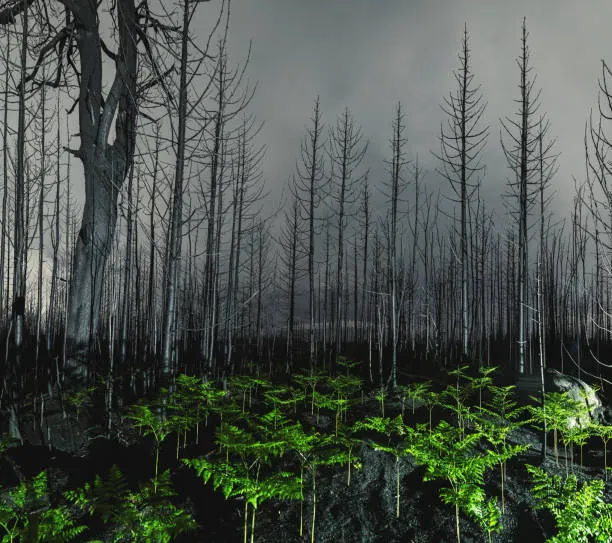
Where she walked, things responded. Not blooming, for that word suggested intention, purpose. No, the world simply remembered what it had been before the breaking, and for a few moments in her wake, it forgot to be ruined. Grass pushed through ash. Flowers opened in her footprints, confused by the season, confused by their own existence, wilting almost immediately as the reality of devastation reasserted itself.

She did not mourn them. She watched with the same curious intensity she had given the apple, the same attention she had granted the small boy who had frozen at the sight of her. Everything was equally fascinating. Everything deserved examination.

The mountains in the distance still wept fire. She turned toward them, tilting her head, and the fissures in her bronze skin glowed brighter in response, as if greeting cousins. The molten light beneath her surface pulsed in rhythm with distant eruptions. Not synchronized, not controlled, but aware. Conversing in a language of pressure and heat and stone remembering its liquid birth.

She walked for days, though day and night held little meaning for her. The sun rose and set. She noticed it the way one might notice furniture in a familiar room: acknowledged, unremarkable. The sun had not existed long enough to be memory, not the way stone was memory, the way water was memory. The sun was new. An intrusion. Interesting but irrelevant to where she was going. And she was going somewhere, though she could not have said how she knew, or why it mattered. There was a pull, gentle but insistent, like the way rivers knew downhill even before flowing began.

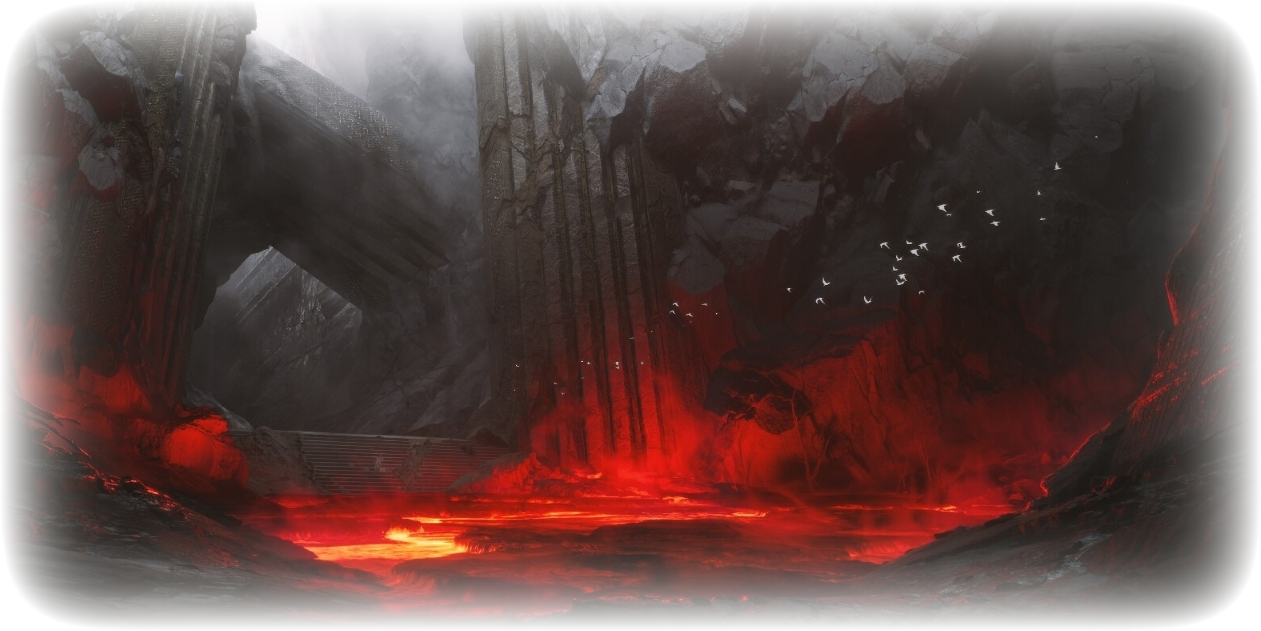
The pull led her to a place where the earth had torn itself open with particular violence. The hill had been split like rotten fruit, cloven by a fissure so deep that standing at its edge, she could see magma flowing sluggishly far below, painting the chasm walls in wavering orange light.

The air shimmered with heat. Noxious gases rose in lazy spirals, thick enough to be visible, toxic enough to kill any living thing that breathed them. She breathed them. They tasted of sulfur and copper and the deep earth's exhalation. She held the breath for a moment, considering the flavor, then released it in a long sigh that carried no judgment. This, too, was simply what was.

Atop the ruined hill, or rather atop the two halves of what had been a hill, sat the temple. It had collapsed inward, swallowed partially by the chasm that had opened beneath it.

What remained jutted from broken stone at impossible angles, defying gravity through sheer stubbornness of whatever substance composed it. Not stone, not quite. Something that looked solid but felt uncertain when she focused her attention upon it, as though it existed in multiple states simultaneously and only settled into one form when directly observed.

Walls had crumbled. The roof had caved in on one side, exposing the circular interior to ash-choked sky. Through gaps in the broken architecture, she could see magma flowing from a nearby volcanic vent, a river of molten rock that had invaded the sacred space, pooling in the temple's lower sections, filling cracks, claiming territory with the patient inevitability of water finding its level.

The woman who was not a woman stood at the chasm's edge, studying the ruin with the focused intensity she brought to all things. Then she stepped forward, onto nothing, and descended.

Her bare feet found purchase on air, or perhaps the air solidified beneath her soles, or perhaps the distinction between solid and not-solid was less absolute than it appeared. She walked down the invisible path as casually as one might descend a familiar staircase, her translucent violet garment drifting around her like colored smoke, her hair floating in defiance of any wind.

The heat intensified as she descended. It would have been unbearable to mortal flesh. To her, it was attention: the deep earth noticing her passage, acknowledging kinship. The fissures in her bronze skin glowed brighter, orange-red light pulsing with each step, answering the magma's greeting.

She reached the temple's broken entrance, a doorway without door, a threshold without definition, and crossed over.
4x Like Like
Hidden 5 mos ago Post by Timemaster
Raw
Avatar of Timemaster

Timemaster Ashevelendar

Member Seen 4 days ago

🎲 𝒜𝓁𝑒𝒸𝒽𝒾𝑜𝓇 🎺

&

❚█══Villagxor══█❚


A month after the celebration, Gamblerdise had settled into a new rhythm. Fortunite no longer felt like a miracle fresh from the earth but rather a responsibility. Villagxor stood at the edge of the work area, hands behind his back, watching as small groups of artisans worked the golden stone into necklaces, rings and simple charms. The air smelled of dust, polish, and focus, the kind of calm that only comes after survival is no longer in question.

Production was controlled. Only a handful of miners were ever allowed near the veins, rotated often, watched closely and never permitted to take the stone home unaccounted for. The rest of the work was done here, in open sight, where every shard and shaving was measured, logged and reused. Fortunite was soft enough to shape without great loss and the craftsmen had become surprisingly efficient, their hands steady, their designs modest but thoughtful.

That was the problem. Villagxor frowned as he counted the sacks filled with Fortunite jewellery. Even with restrained mining, pacing and offerings to the Earth God, the numbers kept climbing. Small fragments saved from carving, failed pieces remade, older jewelry reclaimed and reshaped. They were barely wasting anything and the surplus continued to grow.

He walked the length of the worksite, eyes tracking the sacks, each marked with a small Fortunite stone on them, weaved into the sack itself. One sack, then another, then another. Finished pieces waiting for wearers who did not yet exist, stockpiled not out of greed but caution. Gamblerdise did not hoard by instinct, not after what they had lived through but this was becoming something else entirely. An excess.

Villagxor stopped, exhaled slowly and looked back at the artisans. They were doing everything right. That, more than anything, unsettled him. Fortunite had been introduced as a blessing with risk, meant to be handled sparingly, deliberately. Yet here it was, accumulating, and gleaming. Those affected by the need of art, were almost relentless in their craft and that, presented a problem.

Alechior appeared the way they often did lately, without announcement, without ceremony, as if they had simply wandered in like the wind. One moment the sacks were still, the next a warm golden glow spilled between them. Alechior crouched, lifted one sack with a finger, weighed it with a lazy tilt of the wrist, then set it back down. Their smile widened. “You know,” they said lightly, “at this rate you’re going to pave the valley in rings. Anklets too, maybe. Very fashionable. Terrible for walking.”

Villagxor turned, relief and tension mixing on his face. He gestured to the rows of sacks, to the careful order, the restraint that had somehow failed despite all logic. “That is exactly the concern,” he said, voice low. “We limited mining. We limited crafting. We even limited who was allowed to touch it. And still it grows. I fear either misuse or stagnation.” He hesitated, then bowed his head slightly. “I ask for guidance.”

Alechior laughed, a bright sound that cut straight through the worry hanging in the air. “Guidance?” they echoed, standing and brushing imaginary dust from their hands. “Villagxor, you make it sound like the stone is misbehaving. It’s doing exactly what it was made to do. You’re just very good at not wasting things. That’s not a flaw. That’s a problem other people would pay dearly to have.”

They paced slowly between the sacks, fingers trailing over the markings, eyes flicking from artisan to artisan. “You’re thinking inward,” Alechior continued, tapping Villagxor lightly on the chest. “Counting, measuring, worrying about how much is too much for Gamblerdise. But the valley isn’t a closed table anymore. You’ve had new faces arrive. Wanderers. Survivors. Curious fools drawn by rumors. You’re not alone out here.”

Villagxor frowned, following their gaze. “You suggest bartering?” The word tasted strange to him. “Or gifts?” He shook his head slightly. “Fortunite is not grain or cloth. It carries effects. Consequences.”

“Exactly,” Alechior replied, grinning. “Which means you don’t flood anyone with it. You don’t dump sacks over their heads and wish them luck. You widen your circle carefully. You decide who gets to play and under what rules.” They leaned closer, voice dropping conspiratorially. “Odds work better when more people are rolling.”

They straightened, stretching as if the matter were settled. “The world is bigger than this place, Villagxor. Let it carry some of the weight. You don’t need to stop the stone. You need to let it move.” Their eyes gleamed as they added, “Besides, watching what people choose to do with a little chance in their hands? That’s where things get interesting.”

Villagxor replied straight away, the words of Alechior barely out of their mouth. “You keep telling me to look outward,” he said, finally turning to Alechior. “But what is actually out there?” He gestured vaguely past the valley walls. “We have never been out there. All we have are rumors from those who arrive here half starved and scared. That is not knowledge. That is noise.”

Alechior tilted their head, considering. “Oh, it is dangerous,” they said easily. “No mystery there.” They glanced toward the horizon. “Not the heroic kind of dangerous either. Mostly boring dangers. Desperate people, broken rules, places pretending to be safe,some gods pretending to care. Some monsters exist, sure, but they are honest about it. People lie better.”

Villagxor frowned. “So the stories are true?” he asked. Alechior chuckled. “Some of them, yes. Some places hate luck because it reminds them they lost theirs. Others worship it badly and get crushed by their own greed. And a few will see Gamblerdise and think it is a prize to be taken. No poetry in it as you’ve experienced sometime ago.”

“That does not sound like a world ready for us,” Villagxor said, arms crossing. Alechior waved a hand dismissively. “The world is never ready,” they replied. “You do not wait for safety. You calculate risk.” They smiled. “Besides, I did not say walk out blindly. I said expand your surroundings. That implies planning, not heroics.”

Villagxor exhaled slowly. “Then tell me the plan,” he said. Alechior’s eyes gleamed. “You choose the numbers,” they said. “How many people. Scouts, traders, guards or a mix. You choose what they carry. Fortunite, tools, food, charms, weapons or nothing at all.” They leaned closer, voice light but precise. “Once you decide that, I’ll tip the odds in your favour if briefly.”

A few hours later, the edge of Gamblerdise was louder than usual as preparations were undergoing. The valley wind moved tugging at straps and sleeves as Villagxor stood with ten villagers arrayed behind him. Each carried a sack slung tight against their back. Some were heavy with food and tools, others clinked softly with Fortunite shards or carefully wrapped jewelry, the golden stone hidden beneath layers of cloth.

Villagxor walked the line once, eyes meeting each face. Scouts and traders mixed together. They were not the strongest or the bravest alone, but the steadiest. People who could walk away from danger if needed.

Alechior landed nearby, watching with unmistakable interest. “Ten,” they said lightly. “Good choice. Enough to matter, not enough to mourn if the world misbehaves.” They glanced toward the path leading out of the valley, towards the randomness of it, then back to Villagxor with a smile. “

Alechior stepped forward and placed a finger on the first villager’s forehead. As contact was made, a small yellow circle appeared where they touched, faint but clear. The villager inhaled sharply, then slowly let the breath out. The tension in their shoulders loosened, fear receding into something quiet..

One by one, they repeated the gesture. Each touch left the same mark, identical in shape but tiny bit different in tone, some brighter, some softer. With every blessing, the air seemed to settle. Thoughts that had been racing slowed. Doubt dulled. The weight of the unknown remained, but it no longer pressed as hard. Whatever lay beyond the valley was still dangerous, still unpredictable, but it felt less overwhelming now.

When Alechior finished, they took a step back and regarded the group as a whole. Ten yellow circles caught the light, quiet and unassuming. “There,” they said simply. “No protection from consequences, no promise of success.” A smile followed. “Just steadier hands, calmer minds and people won’t want to eat you, that much, at least.” The wind shifted again and for the first time since they had been chosen, every one of them felt ready to walk forward.


5x Like Like
Hidden 5 mos ago Post by Frettzo
Raw
Avatar of Frettzo

Frettzo Summary Lover

Member Seen 10 hrs ago

Saries’ Sirele
&
Liute


I


Liute had spent the time taking in all his surroundings, the aspects here or there, the world itself and all the plants therein. He listened to birdsong in the distance, the differences in warnings and greetings, the differences in warbles between each creature. He listened to the scrambling of creatures in the greater distance. He felt the tree-bark with fingertips, and the knotted tree, and the light leaf. He felt the foliage all underneath. The god smelled each plant, too, and though he knew none of their names - nor that whatever had so created them had even given them names - he knew that each had a different smell, a different type. There was so much life there, so much to keep and know and create, and in this small way, the god felt fulfilled. Some small part of him knew that the whole of the world had not seen such detail before, not known such little aspects as Liute could see now. It was curious, so very curious.

And so, when the greater bird came down to dispense a mortal being, Liute was listening, and knew. He stared, hands clasped before him as the flap of its wings caused his cloak to flap about him, and listened to her words. Clearly, this pair had been sent by the godsblood he wished to counsel with, and clearly that godsblood acted through others.

The greater bird hovered over the ground long enough to drop the young woman onto the ground, then landed and started preening its feathers. The woman, on the other hand, groaned and wobbled as she did her best to get up. Her hair was disheveled and knotted, her gown of leaves and vines and obsidian was damaged in some places and just gone in others, in general she looked like she’d been through an entire typhoon.

It took her some moments and a few ungraceful sounds, but eventually she found her feet and had fixed her appearance enough to stand before Liute.

“I am Sirele of the Boulder, Tongue of Saries, Mother of All. Know that she speaks through me, and through me you may speak to her.” She clasped her hands in front of her chest and bowed her head slightly. “Saries feels curious about you, you smell new but call for her still. Why? You’ve created a beautiful thing, this Sun has revealed the beauty of Saries’ Progeny, so she wants to be your friend.”

With that said, Sirele approached the Tormenta and removed a roughly hewn bag from its chest, the bag wriggled slightly, but Sirele held it tight and close to her own chest regardless.

“So, would you accept a gift from her?”

That there was a gift was…curious, curious enough. When he spoke, though, some part of his mind gave leave for that mask to drop. His words were laced with fire, crackling with each pause. Sirele held her breath and clutched the bag protectively.

“I am Liute. I am the Sun.” He looked up at the great foliage above, the leaves and the canopy, the great green where his glory shone through them to cast dim light below, and considered. That godsblood wished to be his friend. They wished to give a gift, of something of life which was theirs to grant, and it seemed as though it was genuine. “In the name of kinship with this godsblood Saries, I would accept that gift. But there is work to be done, speaker. My creation has been bloody. I desire…correction. I seek the godsblood Saries’s help in this.”

“Correction!” Sirele laughed, but was quick to gasp and hold her tongue, “Sorry about that – Saries, well, she doesn’t believe that any correction is necessary. The current state of things may be unnatural and undesired but Life will adapt as it always does.” The greater Tormenta waddled up to Sirele’s side and bumped her slightly with its head, prompting her to pet it. “Sarai here is an example of that.”

Liute cocked his head at this response, eyes narrowing. There seemed to be a great misunderstanding, that the correction was in the sole benefit for nature itself, yet then…yet then the godsblood was of nature. It made sense that the concern would center around that. And yet, he held his tongue about the issue. It seemed that the speaker did not speak, in some way, solely by the authority of the godsblood. Curious, curious. He waited, watched, hands still clasped before him.

After a moment, Sirele stopped petting Sarai and turned fully towards Liute. She took as many steps as she needed to get within arm’s reach of him, and removed whatever was inside the bag from it.

It was a pup, curled up into itself and no bigger than a coconut. It had thick, soft, blond fur that shone very faintly of starlight – or perhaps sunlight – and a troubled expression on its face. It had its eyes closed, and yet it frowned and tossed and turned in Sirele’s arms. She looked at it like one would look at one’s own child, she stroked its tiny head and played a little with its ears, and the pup calmed down.

Then, she extended her arms to offer the pup to Liute.

“This is one of Saries’ newborns. This is the reason she hasn’t come here herself, she is busy caring for the others. This one came out looking like sunshine, so Jiva convinced her that it was a sign it must be cared for by you.”

The view of that pup lit a fire in Liute’s heart, and a smile grew against his face. This was the gift, a descendent of another godsblood, given by the merest of fates for it searched for the sun. It had been drawn to him, and in that, fate had indeed spoken. He took the pup in his own arms, gingerly with both at first, before the urge grew against him. The god stroked it, about the head and about the ears, and the smile continued. His voice yet crackled with the embers of a fire.

“This…this is a worthy gift. One to be cherished. This one searched for me, and it should know me.” He could feel the power in his arms, in his hands, and the thought grew against him. Liute knew that this…these would be his, his chosen sign, and as the pup looked up with him the god began that imbuement. He knew that the sun was no place for any mortal creature, any normal creature, and yet the idea still grew against him. There was much that could be done, against the whole of the thing. He gave that gift, of strength from the sun, of the greatest immunity from its heat, that it might play against the sun’s surface, and as the fire began to crackle about his hair and singe against his grass cloak, the pup’s fur turned golden.

Absentmindedly, Liute ran a hand along the pup’s muzzle, scratching behind the ear, as he looked back up to the speaker. There was still the issue with which he had first approached the forest, and this issue would not be tolerated. Not in Liute’s mind. “Yet, there is work to be done. Nature may yet wait, and grow slowly, and be used to my hand. The mortals will not be so lucky. I yet seek to lessen that disaster.”

Sirele stepped back and clasped her hands in front of her chest once more. She looked up at the canopies and, after a moment, spoke. “I think that would be good, yes. I am one of the Blessed, so I don’t suffer the pollen or the diseases as much as the others, but… Yes, I think it will be good to ‘correct’ things, as the Sun has said. What kind of help do you want from Saries?”

The god cocked his head, as the pup curled up within his arms. The pollen. This was a problem he had not known of before. And yet, it seemed like such a thing was beyond his issuance. It would need to be corrected by another. He kept his eyes on the speaker, as he crackled out words. “I wish the godsblood’s help, that the plants may yet thrive against me, and not burn away. That the crops some have made will not die, unused to as they are against me. I would give what help I can in this task.”

Sirele blinked, then crossed her arms, then uncrossed them and tapped her chin with a thumb. “Um, the issue seems to be the strength of the light? And the days are very long too. Maybe things could be fixed by moving the Sun further away for some time? The mundane things cannot survive the presence of the great Sun for long, so perhaps limiting its closest approach to a few weeks at a time might be good.”

Sirele played with one of the tight curls framing her face, stretching it and letting it bounce back into shape over and over. “Saries has no ideas to offer here, she seems content because of the explosion of life. But I see your point.”

Liute kept that pose, though his hand had been stilled in petting the pup. That the godsblood was unwilling to provide aid was poor, though the speaker seemed to provide a good enough solution to the issue itself. Perhaps that was the solution to the whole of it. Perhaps, perhaps. It was something which deserved reward of its own, at the very least, as a concept. What was there to give, that the god had about him? He thought on the thing.

“That may be, speaker. Thank you.” One hand reached for a strand of grass about his cloak, and Liute plucked it away. Considering the piece for a moment, for it was indeed the light of the sun remade into a form suitable for the mortal, for the mortal world, he thought better than to hand such a thing away. It would be a poor gift, that which may burst away in the midst of the forest of all that life. That he had nothing to give in return was a poor thing, a poor thing indeed, and Liute frowned. The pup had stirred again, and looked about before reaching out to bite at the not-grass. As it chewed away, Liute frowned still. “I am sorry, speaker, but I have no gift for such a thought. But, yet…thank you.”

Sirele smiled a lopsided smile, “I don’t need a gift now, but well… I will one day have children of my own, and they will have children, and on and on. So I want to ask you to bless them. Please make it so that you will grace them with your light when they need it the most. Let it lead them out of dark places and into safe places, and give them warmth when they are cold and let them see when you are asleep.”

The god looked down again at the pup, considering the rather…extensive request. It was something he knew might grow into more, truly more…and that was a thought. As the farmers planted, that they might have a crop in that seen future, this was a thought that could be applied thus. Perhaps. “There is always a path, Sirele of the Boulder. Know that your children, and their children, shall find that path when most needed. Let them know my warmth when they most need it. Let them know, even when I sleep. Yet, I ask this, Sirele of the Boulder. Let them know me, and not forget me, even alongside the godsblood Saries.”

“I will make sure they know you and that they know you are the Sun. The people of the Boulder do not forget their friends.” Sirele nodded and placed a hand on Sarai the Tormenta. “Now, Sarai will take me home to Saries, but you should know that I and Sarai are marked by her. You should be familiar with that mark by now, so it should be easy to track us down if you need to speak to us again. You are welcome to visit any time, as long as you allow Saries to see her child when you do so. She acts tough, but a mother’s a mother.”

“Agreed, Sirele of the Boulder. Go well.” And, with that, the god disappeared.


6x Like Like
Hidden 5 mos ago 5 mos ago Post by Stanifly
Raw
Avatar of Stanifly

Stanifly buzz

Member Seen 0-24 hrs ago

OYUNA

Somewhere on the ocean bottom, there lived a village.

That would have sounded impressive before the oceans got drained. Now, thought Oyuna as she rose from her crouch, it just looks like a mud desert. A carcass-littered, plant-strewn mud desert.

Where her community lived wasn’t so bad, though. They’d finally finished shifting all the bloated, rotting fish corpses to their designated burning area. Corals had been chipped away and tossed into the pile. They were supposed to burn shells as well, but Oyuna rather liked collecting them. They were pretty, and hard in a way that was different from other materials. She held up the one she’d found, eyeing it in the light of their new sun. It was pink, striped with deep purple. They were much more exciting colours than the shells they used to find closer to shore!

Shell in hand, Oyuna walked back toward the ring of sand-dusted mud huts that made up her home. In the centre of the ring stood the massive oddly shaped golem, the figurative flagpole of their little community. None of them had been able to figure out its mysterious lights and inscriptions.

Not yet.

A few folks drying out kelp waved towards her as she passed. Some others called out her name in greeting. She hurried on without more than a polite nod; if she did any more, they might ask her for help with their chores and that would be time lost. There were plenty enough hands to go around when everyone else was interested in nothing more than their day-to-day lives. Missed opportunities, really. They were sitting on top of a treasure trove of something big. Life-changing. Oyuna just knew it. She just had to prove it.

In the space behind her home – a modest mud hut – lay her treasure. Rows upon rows of clay tablets, dried in the sun. On their surfaces were etched symbols, neat and patterned. The same symbols as the ones that adorned the golem. Oyuna had copied them, using the pointed end of a thin, spiral shell to carve each stroke into soft clay. She hadn’t managed to copy all of them, for that would be impossible to do so in a single lifetime, but she had done enough to begin analysing for patterns. For meaning.

That was what she had told herself days ago. Now she stood before her tablets, and stared, and scowled. She had etched these symbols, she had found their patterns, but for the life of her, she could not figure out their meaning! She was sure that they had meaning, for why would they glow and flicker upon touch? Why would they cause magic beyond their understanding, if not for a purpose none of them could see? It was frustrating. It was blood-boiling.


This is so cute.

Oyuna looked around, bewildered. She saw no one.

Hey. Down here.

She looked down. There was a rock by her foot, barely bigger than her ankle.

You seem to be in a bit of a pickle. Heh. You shouldn’t be, you know? Not in this place. But you are one stubborn woman, aren’t you?

Kneeling down, Oyuna picked up the rock – or tried to. It wouldn’t budge.

What are you?’ she asked.


What am I? How rude! So blunt! You don’t ask a person what they are, do you? And after I’ve offered you conversation too!

My apologies,’ said Oyuna, somewhat reluctantly. She was not one to offer politeness to a rock simply because it demanded it of her, but there was some truth to its words. Her parents had raised her to be a person of manners, after all. ‘Who are you?

Even though the rock did not move, she felt the impression of a smile aimed upon her.


I am the Patron of Obstinacy, said the rock with no mouth, and you, Oyuna Erdene, have caught my attention.

A Patron,’ repeated Oyuna. ‘Are you a god?

Ha! If only. No, my dear, I am but a sliver of what makes a god.

Then I am not interested.

A pause.
...Perhaps you misunderstand. A sliver of forces beyond your imagination is still a significant portion of the impossible at your fingertips. You would be remiss in overlooking me.

That’s not it,’ said Oyuna. ‘What would I do with a Patron of Obstinacy? If you were the Patron of Knowledge or even the Patron of Language, then I might be so inclined to listen to what you have to offer. But you embody stubbornness. I do not intend to understand this golem by beating it with a rock.

Again, so quick to insult! I should leave you here if this ungrateful attitude is all you have to offer me. The rock did move, then, rolling on its edges away from Oyuna. Oyuna watched it go. It reached quite a distance before it said, You know, this is the part where you call out and beg me to return and explain myself.

It did not yell, but Oyuna heard its voice as though it was still by her feet. And so she did not bother calling out her reply.

If you truly are the Patron of Obstinacy, then you would not leave me before achieving what you wanted.’ She quirked an eyebrow. ‘So are you what you claim to be?


Ugh. Fine. The rock was by her tablets now. Oyuna had not seen it move. You are too insightful for a mortal who is naught but a mere babe in this world. But I suppose you would not have interested me otherwise.

I’m 36, thought Oyuna, grumpily, but did not voice her protest aloud.

Why have you come here, Patron of Obstinacy?


To offer you a boon, it said, simply. But first, let’s get rid of unwanted ears, shall we?

Oyuna looked about. Had someone wandered by, caught sight of one of their own conversing with a rock? No, no one was nearby. A hare sat by the back entrance of her hut, golden nose twitching. Oyuna frowned. That didn’t seem right.

The ground beneath it shot up in a rough pillar of dirt, launching the hare into the open sky. It did not fall back down. Instead, it became a speck that vanished into the distance.


You sleep, Oyuna, said the Patron of Obstinacy. As do the rest of your village. And still, you persist in deciphering these golems. I am here to grant you your wish.

To be continued...


ᦓ꠸᥅ꪀꪖ

They were being accosted in their own realm. Ridiculous.

These... things had appeared shortly after Sirna had forcefully ejected that pathetic dream shaman's community from the Dreamscape. Squawky, little manifestations of Ideals. One had claimed to be the Patron of Nightmares; another the Patron of Darkness; and yet another the Patron of Oblivion. All three were chattering at Sirna, their forms nothing but black clouds that did nothing to discern one from the other. They were either unwilling to or incapable of defining themselves further in Sirna's presence – Sirna did not care which was the case.


You interfered!

You cast them out!

Will you leave us to starve?


You are Patrons,’ said Sirna, unkindly. ‘You do not starve. What does it matter what I do to the mortals abusing my realm?

It matters what you do when you favour one domain over the other! shrilled the biggest black cloud. Ah. This one must be Oblivion, judging from the tantrum it was throwing. You should have let those mortals rot by their own hand. It is not up to you to decide what fate befalls them!

I still fail to see how I have done wrong by you. Any of you,’ tacked on Sirna, as their moon faced Darkness and Nightmares. ‘If anything, Ashuru’s inhabitants are wracked by nightmares as of late. Is that not enough for you rabble?

You watch, sneered Nightmares.

You wait, scoffed Darkness.

And you claim the work of others as your own, lamented Oblivion. We’re never getting anywhere while you dawdle about in your corner of the universe.

Sirna thought privately that they weren’t obligated to get anywhere when they were, quite literally, gods and sentient metaphorical manifestations of concepts – but they had the strangest feeling that these Patrons would not take well to such a response.

I see,’ they said. ‘So you wish me to lead these mortals to ruin with a stronger hand.


Yes! squealed all three.

Sirna did not have eyes to roll with. They made do with a spray of water from the crest their waterfall body.

Very well. If it would get all of you to leave me be. Now leave.

They did. Now Sirna was left with the begrudging duty of doing their job, apparently. With the spread of the lullaby shrooms over Ashuru, they supposed that did, at the very least, leave them with options aplenty of mortals stuck in the Dreamscape with no course for return.

Now,’ muttered Sirna, ‘to find a mortal or two...

~

2x Like Like 5x Laugh Laugh
Hidden 5 mos ago Post by Timemaster
Raw
Avatar of Timemaster

Timemaster Ashevelendar

Member Seen 4 days ago

🧭 The Trade Caravan 🧭


Four suns ago, Gamblerdise vanished behind uneven stone and restless wind, swallowed by the valley’s bends and the will that guarded it. The caravan did not look back after the second sun passed. There were no roads to follow, just direction, memory and the agreement of ten people walking the same way. The land opened into burned plains, dark soil cracked and glassed in places, as if fire had once argued with the earth and neither had fully won. It wasn’t all bad, as some places already had plants growing on them.

At the head walked Game Master Eht’Redart. She stood taller than the rest, light skinned, her posture straight, with the kind of confidence that did not demand attention but inevitably drew it. Her changeling nature showed only in the subtle way her features resisted fixation, never quite the same twice if you looked too long, a minor change yet an omen of what’s to come. She carried herself like someone used to managing variables, people, chance, time, and letting none of them believe they were in charge.

The others followed in loose formation, not a line, not a cluster. There was Toven with the food sacks, meticulous to the point of obsession. Lira carried Fortunite shards wrapped and rewrapped so often the cloth had softened like old leather, doing it as many times as possible, a way to manage the obsessiveness to make something from the Fortunite. Brecht and Ossa traded jokes to keep nerves from creeping back in.

Eht’Redart set the pace. Not fast, not slow. She counted how many suns passed in her head without effort, tracked water by weight rather than hope, adjusted course when the ground subtly told her to. When the plains stretched too wide and empty, she spoke. When silence was safer, she kept it. The caravan trusted her, the way people trust someone who never pretends certainty but always plans for uncertainty.

Each of them bore the faint yellow circle upon their forehead, dulled slightly now by dust and sweat but not gone. It did not glow. It did not protect them from the land’s scars or the heat of the open plains. At the front of it all, Eht’Redart walked on, eyes forward, already playing a game whose rules she did not know, but fully intended to survive.

By the 7th Sun, the land broke its monotony with water. A wide river cut across the plains, dark and slow, its surface reflecting the sky. It was not raging, not gentle either. Deep enough that packs would soak, wide enough that going around it meant losing at least a few full suns, maybe more if the ground worsened. The caravan stopped without needing to be told. Obstacles were expected. Panic was not.

No one argued immediately. That alone marked them as people of Gamblerdise. They gathered near the riverbank, set their sacks down, drank, watched the water and resupplied their water. Decisions were not rushed. They were weighed, toyed with, tested. Luck was respected, but never blindly trusted. Someone, Brecht maybe, muttered that the water looked honest enough. Ossa countered that honest things were often the most dangerous. A few chuckles followed, easing the tension.

Eht’Redart listened, hands clasped behind her back. She turned and raised two fingers. “We play,” she said simply. No explanation was needed. From one of the packs, Lira retrieved a small leather and spread it on a flat stone. Toven produced a set of bone dice, worn smooth, edges softened by use. They were not sacred, but they were respected. Games in Gamblerdise were not about winning. They were about revealing what people already feared or hoped.

The rules were agreed upon quickly. Two paths, two outcomes. The river meant speed and risk. The long way meant safety and loss of time. Each person would roll once, stating which path they favored before the dice left their hand. No persuasion after the fact. No changing sides. The dice would not decide for them, but they would show where their collective instinct leaned. It was a way to make indecision visible.

They rolled one by one. Some laughed at their own poor throws. Others stared a moment too long at the results before stepping back. Patterns emerged, not in numbers alone but in reactions. Those who favored the river tended to roll boldly, careless of low odds. Those who favored the long way hesitated, fingers lingering on the dice as if hoping they might absorb certainty through touch. Eht’Redart watched all of it, eyes sharp, expression neutral.

When the last die settled, no tally was announced. It was not necessary. The mood had shifted, that was the real result. The group stood quieter now, more aligned. Eht’Redart finally spoke. “We cross,” she said. No cheers, no groans. Just nods. The game had done its job. It had not chosen for them. It reminded them who they were.

Before moving, they took a moment. Packs were adjusted, Fortunite wrapped tighter, knots checked twice. A few people touched the yellow mark on their forehead without realizing it. Crossing the river was a risk, but it was a chosen one. In Gamblerdise, that mattered. You could forgive bad luck. You did not forgive refusing to play.

They stepped into the water together, as people who understood that chance was a language. One you listened to, argued with, occasionally laughed at and then answered with action.


6x Like Like
Hidden 5 mos ago 5 mos ago Post by Rekkuza
Raw
Avatar of Rekkuza

Rekkuza #1 Yeast Fan

Member Seen 17 hrs ago

Ma'otah


After the first furnace was built by Ma'otah, many others were constructed by the villagers. Most were used to fire clay, turning simple clay pots and figurines into proper earthenware and common mudbricks into harder, sturdier building materials.

The others were used for metalworking. Ma'otah and a few interested craftsmen dedicated most of their free time to experimenting with new techniques that the furnaces' high temperature permitted. They'd found a way to feed more air to the fire while keeping the furnace closed, making the heat within rise even higher. It was a clever construction, using a large pot, an animal hide, some cord and a tube to link the pot to the furnace's interior, which they'd called "bellows". By pumping the hide, one could blast air inside the furnace, without letting heat escape.

Higher heat meant an easier time melting metal, which took up a big part of their experiments. Many soapstone molds of varying sizes and complexity were carved and used, and copper and silver adornment were created with them; small round plates with a hole in the middle to be mounted on necklaces as pendants, large plaques with reliefs molded on their surfaces that would hang on the walls of homes, thick bangles to adorn wrists and ankles...

Small rectangular ingots were also often cast, to be put in storage for when they would be needed. They also had the advantage of being much purer than raw copper or silver nugget: when melted, all impurities contained in the metal would float to the top, and could be excluded.

The results were a bit crude, the edges often spilled over the mold when the liquid metal was poured from the clay crucible, and the object sometimes had to be melted and remolded multiple time to be an usable shape, but with time and practice, and refining the spouts of their crucibles, these problems lessened somewhat.

They even tried mixing different both copper and silver, which to their great surprise ended up not with a swirl of both, as they had expected, but with a uniform mass, softer than copper but much more brilliant. They tried different ratios of both metal, and carefully observed the difference in softness and patina, how some shined like gold, and others tarnished not into the blue-green of copper nor the dull brown of silver, but into a much darker gray color.

Having thoroughly explored casting, Ma'otah set her sight on a different, yet familiar way of working. She thought of the hammering of cold metal, still used plenty to make bowls and pots and plates, and of the woman who thought of warming the metal in-between cold working session, so that it did not harden to the point of breaking. And she had the idea, why not hammer the metal when still hot?

She took a stone hammer, one crafted specifically for metalworking and a copper ingot, draped a heavy leather hide over her chest, dragged a large flat stone near a furnace, and got to work.

She heated the ingot, not to melt it, but to softened it, and took it out using two long flat pieces of copper, so that she did not burn herself. Laying the ingot on the stone, she began hammering, and was amazed at how the ingot bent with barely any resistance under her strikes. She soon called for her fellows and all unoccupied craftmasters.

"See how the copper listens to each hit," she said, demonstrating with a few strike. "When it glows, it no longer is as stubborn as we all know it can be." She kept working the ingot with no real goal in mind, simply testing how it felt to work it. Her fellows watched with great attention, ideas already forming, some fetching more hammers and hides so that they could try their hands at forging too.

"What if," one said, "you were to strike not with something flat, but something pointy? Or something with a relief?" Proper tools were immediately fetched, and tried out. Pointy strikes led to small depressions, or even holes, and strikes with reliefs created identically shaped indents.

"What about if you made it very thin?" another asked. "Could blades be made? Axes, knives, arrowheads?" Blades were possible, it turned out, but far inferior to stone ones. Copper was simply too soft, so the edge dulled quickly under repeated use. They weren't even that sharp to begin with, with no real way to sharpen them.

Similar questions and suggestion kept getting thrown around. Strikes shaped hot metal well, but could it be bent? Was jewelry easier to make with forging than casting? Could two pieces of hot metal be made to stick together? On and on, the experiments continued, now with multiple people working at once, until night fell and they were too exhausted to keep going.

Before going to sleep that night, Ma'otah made sure to bury a small ceramic figure outside her home, quietly thanking the One That Lay Below for what he had given them.

Many things came out of this frantic day of working. Many new techniques, or at least leads towards new techniques, saw the light of day, though most would not be put into practice for a long time, due to the primitive nature of their equipment. Some things could still be put into immediate use, though, and metal kitchenware saw a neat increase in production; ceramic was great for cookware, but made poor spatulas. Copper was much better suited for utensils, as well as tools like hammers.

With metal also being able to be hammered into thin wires without becoming brittle, jewelry also advanced. Finger rings, whether plain or with jewels inlaid, became a normal part of people's wardrobe, and silver hoops mostly replaced bone earrings.

Slowly but surely, metal gained more and more importance in Ma'otah's village, and technology kept advancing...

5x Like Like
Hidden 5 mos ago Post by Thayr
Raw
Avatar of Thayr

Thayr

Member Seen 2 mos ago

☉ Liute 🜂
V
_________________________

From his home, Liute could see the world down below, that long, flat place, and he thought on what the speaker had suggested. Changing that distance, from the world to the sun, by his motion…it was a thought, yes, and one that the godsblood chafed at. Why should he move from the world, and not the world move from he? Liute thought on it, though. The world was older than he, though, older and so, in some way, his elder. Was that good enough reason, for the sun to move instead of it?

What strangeness would arise if the world moved, yet? Would the mortals there, fickle and feeble as they were, survive such motion, even if it were gradual? Would the world itself shoulder that willingly, instead of working against it in thought as Liute was now? Would the earth stand for it, life stand for it? Would the sky follow, or would they all work against him? There was much there, to consider, and yet there wasn’t much at all.

Would the world claim that it had solved the issue which stood before it, that it had solved the problem of the plants and their survival, of the mortals and their suffering? Nature would work not at all towards that, not as the speaker had said, yet another godsblood might, and claim that victory for themselves. Which was the greater being, the one who could claim the issue solved first, the one who bent towards the will and needs of the mortals first?

He stood, flaming against the surface of the sun, considering it all. An eye turned to the pup which slumbered among the fires. There was something to be done, something to be solved, and Liute did have the means to solve it. That was, perhaps, enough to be the thing.

A will turned towards the sun, his sun, his home and birth, and commanded it. This was no infusion, not as before, but the chaining of a will towards that which he owned, he and no-one else. The dance began, as the sun slowly shifted away from the world, to grow further and bring cold there, before moving close again, a circle of change. The sun shook under this, as the pup awoke to it, and curious eyes searched about.

“It’s fine, it’s fine,” he called out to the pup, which stood amongst the fires to sniff about. Liute should name him. The thought came unbidden, of course, that instant feeling of what would in fact be right. The speaker had given no name for the pup, of course, and Liute could not always call the pup that. One day the dog would grow, and there were others…yet this one was Liute’s, his, a gift from the godsblood of life, and that made it hold weight. What would be a good name, for the best of dogs? What would be the name for his?

“Aed!” He called - the name sprung to Liute’s mind, sprung as the question had sprung, and the pup looked up with a start. “Here, Aed! To me.”

The pup made his way forth, sniffing about at the motioned surface before coming to Liute’s half-buried leg, leaping up at his chest to paw against him, though he was still too small to find such height. Hands swept down, catching Aed to cradling him in his hands as the pup played about. Liute could only laugh, a hearty little laugh for none to hear but the pup and he, and that was enough. Magic reached down again, into the pup - there would be no death, not for this best of hounds, and Liute knew to make sure of this. He glowed among the sun’s surface, seeming to become a part of it, as a spire of light.

When he finished, though, he could feel the work of another, and his mind turned yet down to the world.


7x Like Like
Hidden 5 mos ago Post by Timemaster
Raw
Avatar of Timemaster

Timemaster Ashevelendar

Member Seen 4 days ago

❚█══Villagxor══█❚


Gamblerdise had never been quiet but this was a different kind of noise. Laughter, shouting, arguments and games. Children filled the open spaces between tents and huts, more than there had been a month ago, more than the valley had ever planned for. Refugees’ children ran alongside those born in Gamblerdise, barefoot or half-shod, carrying the habits of places that no longer existed.

Among them moved the Changelings, impossible to miss and ordinary at the same time. One boy with moss-green skin darted through a cluster of runners, while a girl with slit pupils like a lizard’s watched from the shade, sharp-eyed. Two siblings with skin like layered stone sat together near a low wall, fingers tracing patterns in the dust. No one stared for long. Difference was background noise here.

Teaching happened in fragments. Parents showed what they knew, when they had time and patience for it. A Game Master taught counting with pebbles. A farmer showed how to judge soil by smell. A refugee mother practiced knots and bindings with her daughter, while nearby a father tried, unsuccessfully, to explain how to calculate odds. Knowledge flowed unevenly and it became problem.

Some children learned quickly, not because they were smarter but because their parents had more to give. Others learned almost nothing beyond how to stay out of the way. Skills clustered in families instead of spreading, small islands of competence forming without intention. No one had caused this. No one had noticed it clearly either.

The valley held them all regardless. Chance encounters taught more than lessons did, and games blurred into arguments, into dares, into improvised contests. Dice clattered on stone, sticks became markers, rules changed mid-play and no one minded much.

Villagxor did not see it coming. A small wooden marker bounced off his leg, followed by a shouted apology and a child scrambling to retrieve it before the game could collapse into argument. He waved them off, but his gaze lingered as they scattered again, reforming their loose circle with new rules shouted over one another. Only then did he really look around.

There were children everywhere. Not dozens, more than that. They spilled between huts, clustered near work areas, filled the shaded edges of Gamblerdise and the open center alike, close to the temple and the Anchor. Some played elaborate games with clear structure, others improvised chaos with enthusiasm and noise. Villagxor felt a tightness settle in his chest, not fear, not anger, but scale. Gamblerdise had grown and this was the proof of it.

He watched longer. Patterns emerged once he stopped seeing them as a crowd. Certain children dominated games because they knew how numbers worked. Others lingered at the edges, unsure when to speak or act. A few always won, not by luck but by understanding rules better than the rest, rules that changed often but never randomly. Knowledge was shaping outcomes here.

Villagxor’s hands clasped behind his back. This was not neglect of their parents. It was the natural result of teaching being private, accidental. In a place where chance ruled daily life, understanding chance had become an advantage, passed down like a family tool. He exhaled slowly. Left alone, this would turn into something ugly. Something…sad.

His eyes drifted back to the games. Dice, markers, chants, dares, contests of guessing and risk. They were already learning, just not together. A thought took shape, simple at first, but with room to grow. If games were everywhere in Gamblerdise, woven into how people spoke, bartered and lived then perhaps teaching did not need to fight that. Perhaps it could ride it.

Villagxor clapped his hands once, sharply, then again louder. It took a moment, then another but curiosity won. Children slowed, arguments paused, dice stopped mid-roll. One by one, then in clumps, they gathered around him until nearly forty stood, sat or crouched in a loose circle. Refugees, Changelings, small and tall, confident and wary. Villagxor waited until the noise settled before speaking.

“Alright,” he said. “You play games all day. Today, I’m stealing you for one.” A few grins appeared. A boy with green skin leaned forward eagerly. Villagxor crouched and picked up a handful of pebbles from the ground, setting them in a small pile between them. “This one is new. I just made it up, so if it breaks, that’s on me.”

He explained slowly. The game had no board. No winner at first. Each round, a child would step forward and take a pebble, then answer a question chosen not by Villagxor, but by the group. Counting, patterns, knots, guessing weight, recalling a rule from another game, even judging when to walk away. If they answered well, the pebble stayed. If not, it returned to the pile. The goal was not to hoard pebbles, but to move them all out of the center.

Confusion followed. A girl frowned and asked how anyone could win if everyone shared the goal. A boy argued it sounded unfair. Villagxor smiled and nodded. “Good,” he said. “That means you’re thinking. The point is not beating each other. It’s learning what you know and what you don’t, before chance tests you harder.” He tapped the pile. “The pebbles don’t care who you are. They only care what you do.”

They tried it. At first, chaos. Questions too hard, questions too easy, arguments over fairness. Villagxor let it happen for a moment, then stepped in. He corrected gently. He asked why a guess failed, why a choice worked. When a child froze, he broke the task into smaller steps, letting others help explain instead of answering for them. Slowly, the noise changed. Less shouting, more listening.

As rounds passed, patterns emerged again but different ones. Children who struggled with numbers excelled at memory. Those who stumbled over rules were quick to sense when risk was wrong. A child with stone-like skin quietly solved problems others overthought. Villagxor pointed these moments out, not as praise, but as information. “See that,” he said. “That’s knowledge too.”

When someone failed, he did not scold. He asked them to explain what they tried to do. When someone succeeded easily, he asked them to explain it back to the group. Understanding became part of the game itself. The pebbles moved faster now, the center thinning, because they were learning how to think together.

By the end, the pile was gone. The children noticed first. A quiet spread, then smiles, then a cheer. Villagxor stood, brushing dust from his knees. “That,” he said, looking around the circle, “is how you make chance fair. You don’t control it. You prepare for it. Tomorrow, we’ll play again. And the day after. Different rules. Different game.”

6x Like Like
Hidden 5 mos ago 5 mos ago Post by Legion02
Raw

Legion02

Member Seen 3 mos ago

Excelsis, the Lord-Eminance

The peak of the Monster was surprisingly more tranquil than expected. The caldera was already overgrown with greenery. Left and right, there were igneous rocks and fractured stone separating its peak from most other mountains, but nature had mostly covered up the true extent of the violence the volcano had spewed out not that long ago.

Meris was waiting at its peak. The sun had dimmed a bit and moved further away from the plane. The time of shadows dominated now. The avatar was, to his own surprise, somewhat impatient. Until finally he saw the streak of fire in the distance. It came closer and closer. Meris didn't move. He knelt.

Excelsis stopped before his avatar. The god-orb's fiery cloak burned up when he stopped. It still scorched part of the Monster's peak. "I do not often get prayers from my own being." He said. "Speak, Meris. What troubles you?"

Meris rose. "Mortality." He said. "I was charged to look after mortalkind, Excelsium in particular. I have done so for some time now. They are still meek and possess little true power as we do. But theirs is growing fast. For now."

"Their ephemeral nature is not a curse, Meris. It gives them purpose through legacy." Excelsis said as a handful of the orb's eyes looked out towards the growing village of Excelsium. "Sons need to be able to look up to their fathers, and then kill them to exceed them."

"In that I agree, but there is a problem." Meris said he looked over the village. "I saw it first with Aristel. The broken man is still teaching. He'll teach till he drops dead. It won't be enough. Weircraft is endangered. His teachings, with his death, will fade. I foresee the basics of it having faded to a myth-like status in only a handful of generations. The progress, the teachings, will be long hobbled."

"You worry too much. In a distant land, I've seen a solution already. They give certain symbols certain meanings, then etch those symbols onto tablets. It's a decent idea." Excelsis said. "The knowledge will fly over in... a handful of generations at most, I think."

Meris shook his head. "It will be too late. You charged me with ascending Excelsium to the point where it can be useful to your designs. I cannot do that if generations of knowledge will fade time and time again."

The god-orb's hundred different eyes shifted towards Meris and frowned. "How curious." Excelsis said. Meris was seemingly more concerned with the mortal's progress than Excelsis himself. Excelsium was little more than a pet project right now. An attempt to elevate mortalkind. If it failed, it would be sad but Excelsis could begin elsewhere again. The ingredients were all around. There was nothing in Excelsium that made them unique and valuable. "Have you grown to care for the mortals here?" The god-orb asked.

Meris let out a deep sigh. "Perhaps. I see their faith and zeal. It deserves... attention."

"Indeed, it does." Excelsis relents. "It is perhaps time that I foster legacy a bit more. I'll not solve the problem as a whole, Meris. This weircraft will have to be applied for the full solution. As will other bands of mortals be able to wield what I will make."

~


Aristel was asleep outside, in the little field he was using to teach geomantic shapes. Those shapes were necessary for the basis of Weircraft. He had taught a lot. All he knew, but not all that could be known. His dreams were grand, then dark, and then faded when he suddenly felt a jolt. He opened his eyes and he was not in the field anymore. He was far away, on a hilltop.

"What in the name of Ex-" Before he could invoke the name he saw the floating God-Orb and immediately dropped to his knees. "Oh mighty Excelsis! Forgive me. I had almost taken your name in vain!"

"There is nothing to forgive." Excelsis said. "Aristel of Excelsium. Your spark burns bright. The flame of your life is becoming dull. You will die soon."

"Yes, and?" The old man asked.

His disregard shocked the God-Orb for a second. "I will have to use your spark for a great blessing upon this world. It will consume the last of your life. I do not believe I am doing something wrong, so I will not apologise. Though I know that this news must be distressing to a mortal, so I say this to ease your mind. Your legacy will last very long."

"Wha-" It took the crazed man a second to register what the god was saying. He was going to die! He felt his feet leave the ground and his mind suddenly throb with a terrible migraine. The pain in his head began to spread. His eyes felt like they were burning. The god-orb was looming over him now. Golden geometric shapes formed around him. The shapes were vastly more complex and intermingled than anything he had carved into the ground. It would've been fascinating if he were not panicking like a caged beast that knew it was about to be killed.

A tablet orbiting the god-orb flashed before his burning eyes. The markings upon it glowed for a second. Then it came around again. The tablet seemed to be something else, something separate from the god-orb. "Wait!" Aristel yelled, but Excelsis did not listen. Aristel felt something else influencing him now. He gazed upon the strange symbols on the tablet every time it came around. The tablet seemed to be slowing more and more, letting Aristel read more and more. He had to read it, even if he didn't know what reading was. The symbols were pouring something onto him. It was overloading him as well, in a very different way. As the geomantic ritual of Excelsis was drawing out a fire of his mind, the tablet was pouring the waters of knowledge on his face.

He screamed and pleaded and screamed more in pain. Excelsis ignored it. Though he did not take relish from it either. He had the metaphysical flame of genius and began to follow the thin threads that led into the ground. The geomantic shapes began to solidify and then collapse. Aristel expired. From his final breath, the Engram retook its shape.

"Hello, old friend." Excelsis said to his own creation as new, blue geomantic shapes began to form. These were less balanced than the golden ones. They were more angular and sharper. They concentrated the divine power further. These shapes began to add themselves to the golden form of the engram. They fused peacefully. Once the Engram was amended, Excelsis released the Engram and returned it to the world.

With the recently expired brain of Aristel something miraculous happened. The parts that made him great: his knowledge, experience, understanding, and memories began to ossify and then crystallize. The very neurons turned into a glassy blue substance. Aristel's corpse, containing the mind crystal, was returned to Excelsium.

The old man's students panicked when they found him dead. They brought him before Meris, begging the avatar to resurrect their master. It wasn't out of love. All of his students had a desperate thirst for knowledge. Their fractured minds had become greedy for more understanding. Meris denied them, but he did sense something else. When he opened the skull of Aristel - much to the horror of the mortals watching - he retrieved the blue crystal.

"This! This is the spark made manifest!" He declared as he upheld the crystal coated in viscera. His eyes fell upon the students. Their horror was being replaced with intrigue.


6x Like Like
Hidden 5 mos ago Post by Cyclone
Raw
Avatar of Cyclone

Cyclone

Member Seen 3 mos ago


Sarhush walked at a leisurely pace. Kur-Laka had disappeared beneath the hills behind, but even so far away its stench had yet to fade. Of course, the god was unbothered by such trivial things as smell. He had more work before him: more mortals to guide, more Mes to track down, and even more Mes to manifest.

What did occasionally bother him was the constant quarreling of his Patron companions. He’d chased them away before he entered the cannibals’ camp to render judgement and reclaim his Me, lest they distract him, but he’d barely left the last hovel behind before they had appeared by his side again.

“This is not the way that civilizations are forged,” the Patron of Civilization intoned now, its usually level tone subdividing, like footsteps overlapping in a crowded street. “You have directed them to build atop bog earth. Worse, you have lashed their destiny to others. Those they impress into these toils will be enfolded. When the structure sinks, all of them will be crushed. Nothing will remain but scattered ruins devoid of memory.”

Glory swelled and brightened. “I see merit in doing as Lord Hierarchy sanctioned here. That settlement will harness fear into spectacle; from spectacle shall come renown. “And if it collapses into the bog, then the next one’s rise will be all the more glorious!”

The Patron of Fire flickered. “They feed my hunger,” the living flame mused, “and now they learn my power to harden earth and clay, not merely to sear and soften meat. They will need me more; they will feed me more. Whether they truly merit my covenant remains to be seen.”

Civilization’s discontent had not diminished. If anything, the glee of Glory and indifference of Fire had only destabilized the usually placid Patron further. “Civilization is stability, memory, and continuity. You have established none of these conditions here. This ‘seat’ that you have consecrated is doomed, and when it falls, the ripples will regress civilization.”

When? Sarhush echoed with a chuckle. If Kur-Laka falls, then they are unworthy. But if they succeed?”

He turned to face Civilization with a thin smile. The look made Civilization’s angles hesitate, as though its form had briefly forgotten how to align itself. “Ashuru will tremble!”

Lord Hierarchy’s presence resolved; it was the invisible stairway that imposed distance, arranging Sarhush above and the other Patrons as mere courtiers below. “On this day, order was established. The weak were subjugated, the strong elevated. Efficiency was maximized. That is the way of things.”

Civilization shuddered as its geometry reconfigured, lines tightening and symmetry straining.

“This is not order,” Civilization replied. “What you call efficiency is brittle. You describe a system of load without reinforcement. When it fails, the consequences will be catastrophic.”

“Failure is only another form of sorting,” Lord Hierarchy answered. “That which cannot bear weight should not have been elevated. Once this is realized, that which failed is crushed downward, and the hierarchy is corrected.”

Sarhush nodded approvingly without even thinking; Lord Hierarchy proved itself wiser every time it spoke.

The Patron of Glory pulsed with approval. “A collapse that clarifies rank,” it said brightly. “Brilliant! Elegant! Perhaps even glorious?”

For its own part, Fire said nothing. Still, its flames leaned toward the sound of Lord Hierarchy’s words, and for a moment they burned brighter and hotter, attentive and curious.

“You see?” Sarhush continued his walk but with his face turned toward Civilization. “Even now, structure emerges. I realize now that you are far too timid, Civilization. This course is one of action, not the trepidation that you espouse.”

Civilization’s voice slowed, deliberate once more. “When Kur-Laka sinks, when its people fall and its monuments crash down alongside them, what happens next? Who remembers? What is there to inherit?”

Sarhush’s smile returned, wide as a valley. He was about to answer, but before he’d even started the Patron had vanished. Civilization disappeared in a huff, its spiraling glyphs and patterns locking into place, going inanimate as the spirit fled in frustration. Sarhush only laughed. Let that one sulk; time would prove his approach right. Surely.

Civilization would come to understand that Sarhush knew its aspect better than even it did.

As for the other Patrons, Sarhush spurred them to follow as he marched onward. The odd posse made good time. On the horizon, a new landscape drew into sight.


Great blackened husks were all that remained of what had once been forest, but everywhere were green shoots rising up as the sun restored Nature’s hold over the land.


5x Like Like 1x Laugh Laugh
Hidden 5 mos ago Post by Timemaster
Raw
Avatar of Timemaster

Timemaster Ashevelendar

Member Seen 4 days ago

🎲 𝒜𝓁𝑒𝒸𝒽𝒾𝑜𝓇 🎺


Alechior drifted above the clearing where the teaching was taking place, reclining in the air as if it were a perfectly shaped chair only they could see. One leg was crossed over the other, hands folded behind their head, golden light muted just enough not to distract. Below them, Villagxor moved among the children, patiently, turning rules into play and mistakes into laughter. Alechior watched with satisfaction.

The game had reached one of its louder moments. Children argued over outcomes, clapped when someone succeeded, groaned when chance turned against them. Pebbles were used as markers, dice clattered, sticks scratched lines into the dirt. It was controlled chaos, familiar chaos. Alechior smiled, content to let it unfold without interference.

Then a rock flew.

It was an accident, mostly. A child flung it too hard, aiming for a pile of stones and instead striking a hollow piece of wood propped near the edge of the clearing. The sound rang out. A few heads turned. Before anyone could comment, another child copied the motion, another rock, another strike. The sound repeated, close enough to the first to be unmistakable. Not random. Familiar.

A third child, closer to the wood, frowned thoughtfully. They picked up a smaller stone, stepped forward, and instead of throwing it, tapped it against the surface. Once. Twice. Then again, slower. The sound changed, less sharp, more in tune. They adjusted their grip, struck again. A pattern began to form, not rhythmically but intentional.

The clearing quieted without instruction. Dice stopped rolling. Arguments dissolved mid-sentence. Even Alechior shifted slightly in the air, interest growing. Villagxor noticed the silence and followed it to its source. He approached slowly, not wanting to break whatever thing was forming and knelt beside the child. He did not speak. He simply watched, eyes narrowed with focus.

The child kept going. Tap, pause, tap-tap, pause. Others leaned closer. Someone else picked up a stone, hesitated, then joined in with a different rhythm against the ground. It was messy and imperfect. It was not a lesson, not yet. Above them, Alechior grinned with a knowing expression. Luck had not guided a throw this time. It had waited, patiently, for someone to listen.

The child finally stopped tapping, stone still raised, eyes fixed on the wood as if it had spoken back. They looked up at Villagxor, face locked in honest confusion. “Why does it sound like that?” they asked, gesturing between the rock and the driftwood. “Why is it… nice?” The word felt inadequate even to them and they grimaced slightly, as if searching for a better one.

Villagxor opened his mouth then closed it again. He looked at the wood, at the stones, at the small crowd of children who had gone very still. “Because,” he started then hesitated. His hand lifted, palm up then slowly fell. “Because it…fits?” he tried, clearly unconvinced by his own answer. “I know what it does,” he admitted, quieter now. “I don’t know why it does it.”

A shadow passed over the clearing. Alechior dropped from the air and landed beside them with exaggerated grace, arms spread as if stepping onto a stage. “Ah,” they said, looking between the child, the wood, and Villagxor’s frown. “One of my favorite questions. Poorly timed for you, wonderfully timed for me.” They crouched, tapping the wood once with a finger. The sound answered obediently.

“That,” Alechior continued, tone light but focused, “is music. Or rather, the beginning of it. Music is what happens when noise decides to behave.” A few children snorted at that. Alechior smiled. “It is sound that agrees with itself. Patterns that repeat just enough for the mind to go, yes, I recognize you and just different enough not to get bored by it.”

They picked up the stone the child had been using and tapped twice then paused. “Your body likes it because it is good at guessing,” Alechior said, a little more serious now. “When a sound follows rules, even small ones, your body and breath start to follow along. You feel clever without trying. Safe without knowing why. That is not an accident. That is chance learning how to dance.”

Alechior straightened and looked around at the gathered children. “Music is not in the wood or the stone,” they added. “It is in the choice to hit one with the other again. And again. And maybe differently next time.” Their eyes flicked briefly to Villagxor. “Which is why no one ever really teaches it first. It gets discovered.”

They looked back to the child who had started it all and grinned. “So yes, it sounds nice because you made it so. Congratulations,” they said lightly. “You have just invented a problem for every parent, priest and Changeling from now on. Someone will always be tapping on something.”

The clearing stayed quiet for a heartbeat too long. The children looked at one another, then back at the wood, then at Villagxor. Confusion lingered in their faces, not resistance but overload. Villagxor rubbed his chin slowly. “I understand the words,” he said at last, honest as ever. “Patterns. Repetition. Feeling clever. But if I had to explain it again, I would fail.” A few children nodded vigorously, relieved someone important had admitted it first.

Alechior watched this with open amusement. “Yes, well,” they said, rolling one shoulder, “this is usually the part where I let you struggle for a decade or two. Builds character.” They paused then smiled wider. “But I’m feeling generous. And impatient.” They raised one hand, fingers poised like a gambler about to flick a coin.

The snap echoed sharper than it should have, a clean, bright sound that cut through Gamblerdise. The air seemed to hum for half a breath afterward, like something had clicked neatly into place.

The children blinked. One frowned, then tapped the wood again, slower this time. Another joined in, spacing their strikes without being told. Someone else began clapping softly, instinctively filling the gaps. They did not know the meaning of words like rhythm or tempo, not consciously but they felt them now. They knew which sounds fought each other and which belonged together. They knew how to stop before it became noise again.

Villagxor stiffened slightly, then let out a quiet laugh of disbelief. “Oh,” he said. “That is…unfair.” He flexed his fingers, already aware of patterns he had never named before. Timing. Repetition. How sound could lead motion, how motion could lead feeling. Not mastery, not art, but foundation. Enough to teach without fumbling.

Alechior clasped their hands behind their head, satisfied. “Nothing fancy,” they said lightly. “No epics, no spell-songs, no dramatic careers yet. Just the rules that make noise stop being rude.” They glanced around at the children, already experimenting. “Think of it as giving luck a beat to walk on. What you do with it,” they added, smiling, “is the gamble.”

3x Like Like
Hidden 5 mos ago Post by Rekkuza
Raw
Avatar of Rekkuza

Rekkuza #1 Yeast Fan

Member Seen 17 hrs ago

Ma'otah's Village


Tolamu's people had always been filled with artistic kinds, or so he'd been told. Even before Ma'otah had met the One That Lay Beneath, and secured a steady supply of never-before-seen crafting materials, they had been creating jewelry and paintings and pottery whenever the time and supplies permitted.

The search for beauty was important. Desirable. A worthy goal to dedicated yourself to. And yet, and yet! They were oh so shortsighted about it. Too focused on the permanent, on what could be held and passed down, and not enough on the fleeting beauty of the experiential.

Yes, in this village where the sounds of metalsmiths' whistling and humming in time with their swings filled the streets, where great riches adorned every body in sight, where houses too were a subject of beautification, they were still content to feed themselves with charred roots and bland stews.

But not Tolamu. No, not him. He was different. He would not stand for this swill. And though it might make him an outcast (it wouldn't) and draw the ire of those who did not understand his lofty goals (that wouldn't happen either), Tolamu was set on revolutionizing his people's food. No, not just the food, but their entire understanding of what food even is in the first place!

He started his grand culinary quest very simply; by studying what food they already ate. It was roots, mostly. White and red starchy tubers made up a good chunk of their diet; they were filling, easy to grow and easy to collect. Various leaves and the occasional fruit followed, for much of the same reasons. Tallgrass seeds could also be eaten, either boiled whole or ground into coarse powder first, but were not especially tasty, though useful to thicken broths.

Meat was also common, but much less so: hunting was difficult and dangerous. Taking down an antelope was often not worth the effort and risk of injuries, especially when trapping already got them a few game birds or rabbits everyday. Meat also spoiled quickly in the heat, and had to be eaten fast.

As for the real rarities, they were honey and eggs, especially the unfertilized ones. If hunting for birds was tricky, finding their tiny nests in the brush and collecting whatever eggs might still be within was even harder. They were a rare treat, more often the accidental results of gatherers getting lucky and stumbling upon them than anything else.

Same with honey: the stinging insects protecting it were dangerous, and honey nests were pretty few in the first place, but at least it kept for a long time once put in a jar. They had even managed to make a small reserve, for use in case of burns or injuries.

In the end, he came away with three main problems with the available ingredients: a lack of variety, bland flavors, and the scarcity of the actually interesting ones. Basically, everything was too boring!

No wonder every meal ended up bland if the ingredients themselves were bad to begin with! He could feel something within him, like an inner fire, flare brighter at the thought. He could fix this, he could be different.

He began his search for new flavors by picking flowers. Animals ate them, so surely they had to have some culinary merit. Unfortunately, upon tasting, most turned out even blander than boiled white tubers, though some had a very faintly sweet aftertaste. One in particular elicited a light tingling on the tip of his tongue, and he kept it aside for now. But overall, it seemed that flowers were better at looking pretty than tasting interesting.

Tolamu's experiments continued similarly. He tasted everything, every fruit and every plant he could find that he did not know for sure was poisonous. He tasted tree bark and tree sap, carefully peeled fruit skins and boiled green wood, unknown mushrooms and dried medicinal roots. Some were success; one tree's bark, when peeled thin and dried, gave off a spicy scent, and a root used against nausea gave a most delicious aroma to poultry soup. Most, though, were failures. More than once he had to combat terrible stomach aches as he ate something that wasn't edible, fell victim to Grog Tree sap's paralyzing effects, and one time slept for three entire days after eating what could only have been a terribly poisonous mushroom.

These spices, as he'd started to call them, were a large part of what was missing to food, he'd decided. With the proper mix, even the blandest ingredient could shine. But he wasn't satisfied yet. No, he couldn't. He had fixed half of the problem, had given variety and flavor, but some ingredients were still beyond his grasp. How could he rest easy without being able to use all of his potential? His inner fire blazed at the thought: he could not let this rest.

Tolamu spent weeks looking for a solution. He'd first considered learning where the birds nested, only for that idea to be crushed once he realised that the partridge he'd been following simply abandoned her nest once it was compromised. He thought about getting them to nest near the village, but let that idea go just as quickly as it had came: those birds ran away as soon as they heard something coming, so why would they ever willingly go near?

...

What if they didn't willingly come near? At least, at first. Tolamu thought about it long and hard. It would be easiest if the birds nested near. They won't come by themselves, but if they have no way of leaving, then they would have to nest in the village. Catching some partridges alive would be tricky, but doable. Getting them to stay... well, he could... build them a house?

He got to work an evening, weaving branches into waist-high walls forming a square enclosure. He'd also taken the time to stack a few bricks, making a small square house for the birds to hide from the Great Fire. He'd even woven a nest from tallgrass, trying to make it as cosy as he could. Once he was satisfied, he grabbed a net, and went to hunt.

On the first day, he didn't even see a single bird. On the second, the same thing happened. On the third, he saw a small female flee into the brush, but never managed to find her. It took 6 entire days for him to catch a single bird, a plump female partridge that kept screaming until he released her in his enclosure. He did not leave her alone then, though. Partridges might not soar like vultures and eagles, but they were still birds, and could still fly. So, he grabbed his new quarry and his sharpest paring knife, and delicately snipped off every flight feather at their halfway point.

Satisfied that she could no longer escape, he went to bed, exhausted, and dreamt of an unlimited supply of delicious, nutritious eggs.

It took a few days for the bird to start laying. Tolamu took good care of her, giving her fresh water and a bowl of tallgrass seeds everyday. He'd also managed to catch two more birds, whose wings he'd also clipped. Company, and time, had seemed to be the key to getting the birds to adjust to their new surroundings. Little brown spotted eggs appeared one day in one of the nests, and Tolamu knew he'd succeeded. He grabbed them all and rushed to the nearest cooking fire.

Everyone knew and enjoyed eggs boiled in their shells, as was the classic way of preparing them. Tolamu, however, wanted to mix things up. Literally.

Through a burst of what he could only describe as burning divine inspiration, he grated a few white tubers on a coarse stone, and mixed the resulting fine mush in a bowl with a few dollops of honey. He added some spoonfuls of ground tallgrass seeds, a pinch of ground cinnamon bark, cracked a few eggs to add to the mixture, and mixed until he ended up with a thick batter. Finally he got out his latest innovation, something he'd commissioned from the metalsmiths: a flat copper plate, with risen edges and a handle, which they'd called a "pan".

Tolamu put a small lump of rendered animal fat in it, then on the fire it went. Once the bottom was coated with melted animal fat, the batter was poured in, and left to cook. The food started smelling good, the half-cooked batter was flipped, and left alone until both side became golden, and then everything was taken off the fire.

Tolamu looked in awe at his culinary masterpiece, the fruit of his singular genius. It used all that he had worked for, the new ingredients, the old ones, the new cooking methods. It was the first step into a new era of cooking, the first spark of true culinary beauty.

It was... a "pancake".

2x Like Like 4x Laugh Laugh
Hidden 5 mos ago 5 mos ago Post by SilverPaw
Raw
Avatar of SilverPaw

SilverPaw

Member Seen 0-24 hrs ago

Moren & Saries
Collab with @Frettzo


A lurid green fire crossed over from the Afterlife into Ashuru, having sensed spirits to be guided. Yet, when it appeared far above a burning forest, the ones it had meant to lead were…Where?

It pulsed and flickered. Ah, there!

But the presence was gone as soon as it had appeared. It bobbed up and down, repeating the exercise a few times. When no spirits detached from their vessels, it sent a signal to a few of its brethren. Then it wandered away, to the parts of burning forest where death did occur as was proper.

A bright blue immaterial ball of flame appeared in front of a smoke-choked Tormenta, only for it to have its life essence strengthened, and take to the skies. A pitch black one throbbed before a burning tree which had been saved. A glacier white flame whirled above an ur-human encased in ice, curious about her spirit which was half here, half there, trapped in between.

When their task was done in the area, the collection of Ethereal Flames crossed back to their Creator’s realm. They gathered, weaving and vibrating at each other.

Yes, this was a confirmed Unknown. They hadn’t done this before, and even for the non-sentient, it may have been easier to come to a decision of this scale collectively. Together, they sent a signal to their Goddess.

Elsewhere…

Hm? Moren cocked her head to the side as she received a message via her Will-o’-wisps.

She had once again descended onto Ashuru, studying the aftermath of the destruction. Most recently, a new god had emerged with the Sun’s creation. The immense bright light had not been to her liking, and she had retreated within a nearby cave. There, she had finally uncovered the source of that haunting scream which had resounded as Ashuru was being torn apart. Those beautiful crystal roots Khthon had revealed to them telepathically were dying off. Yet, theirs was an existence so strange, they didn’t cross over into her realm – they merely ceased to be.

She was in the midst of pondering this dilemma when a bunch of Ethereal Flames relayed to her their experience.

That is strange indeed. Well done. A happy thrum resounded in response.

One of you, go to the area where this happened. So she said, and so it was. Moren focused on the one ghost light, and when she grasped its location, she simply…transported herself next to it. Go now.

As the Ethereal Flame returned to the Afterlife, the goddess took in the environment at her leisure. She was in a forest, one which had faced a terrible fire, one which should have consumed it whole.

Should have.

Unbidden, her fingers clenched on the bark of a tree she had been inspecting, and some of her essence leaked into it. The tree decayed before her eyes, turning into a deadened husk as a small area around it withered as well.

Oops.

Closing her eyes, she took a bracing inhale. The remaining foliage was thriving now, urged into expansion by the new Sun. She glanced around, seeing past the corporeal into the incorporeal. What she had suspected was confirmed – these spirits had been touched by Life itself. A godly intervention had prevented their souls to be severed from their bodies, and had preserved them.

Moren pursed her lips. She did not like this. However, she wasn’t the kind to punish the forest for the gift it had received from another. That would be nonsensical.

No, all she needed was to contact the god itself. Surely, they could come to an accord.


However, when she attempted to establish a mental contact, she got the distinct impression that the God of Life was preoccupied.

Oh, well. She could wait.

And so wait she did.

Until a tree creaked and splintered and split down the middle. And from inside the tree emerged a great form, as tall as three ur-humans, with soft fur that glowed with gentle starlight, impervious to the new light.

It was the god Moren had been waiting for – It was… Different, to say the least, to the others. On its back rode two young ur-humans, both of a bronzed skin tone and wearing gowns of the most vibrant leaves and vines, decorated with obsidian jewellery.

The tree closed itself back up after the great beast-god emerged, and at that point it stared at Moren, then turned sideways and leaned down to allow the riding ur-humans down.

It was them who regarded Moren with more than a sideways glance. Respectfully, they bowed their heads, and the first one to speak was the female twin.

“I am Sirele of the Boulder.”

“And I am Jiva of the Boulder.”

“There is no life without death,” Sirele said and clasped her hands in front of her chest, eyes closing gently, “That is what Saries, Mother of All, thinks.”

“There is no death without life,” Jiva added, clasping his hands behind his back, “This is what Saries the Beast-God knows. He wants to be your friend.”

Saries huffed and sat down. It looked anywhere but at Moren.

“She needs you,” Sirele opened her eyes and looked straight into Moren’s eyes. “To make it so that what is dead lives again.”

Moren calmly watched the trio from her perch atop the deadened tree. “Then we are in agreement,” she said simply. Her voice was still as a midnight lake, quiet as the deepest reaches of earth, yet the sound carried to all.

That was when the two ur-humans’ well-practiced facade slipped just a bit – enough for them to recoil a bit from the unnatural sound.

“Moving forward, there will be no denying Death,” this she directed at Saries, who huffed with a single wag of its tail. “There may be rebirth, for renewal can emerge after demise. But what does not come to an end cannot have a beginning. So no more godly favours, no cheating of what must be,” she warned.

After a beat, she stated, “I will show you what comes of life’s essence.” Mentally, she reached out to Saries, brushing its mind with her own, as gentle as a flake of snow landing atop its fur. This is how it was. Following that announcement came the image of a slice of the world as she had seen it. As a copse of trees was felled, the light shining within dissipated into nothingness. A beast butchered gone. An ur-human burned, gone. A flower plucked, an insect at the end of its lifespan, a clam drying up. It didn’t matter who or what, all life had perished, gone forever. Saries whined at the image, ears falling flat against its head as it drew closer to Moren.

Now… She offered a glimpse into her realm, that death world where the memory of how Ashuru had originally been was better preserved…yet even in Afterlife, many changes had occurred. Moren showed it how initially dark and dull, it had gained the facsimile of colours as the remnants of life essence flooded into her realm. For a time, those spirits were preserved there, but inevitably, they all came to meet their end. Final and irrecoverable. The reign of absence absolute.

In the future, if we make it so. She depicted life as a tremendous deluge, so immense to call it a river would be an insult. It flowed toward its end, slow, steady, final. She showed how they could, with joined powers, redirect the tiniest of streams from that torrent towards Ashuru, letting it drink of what had been to seed the ground of what could be. A chance to revitalize the world, to let it have what it needed, to give it what it could take – but never above a certain threshold. It wouldn’t be an equivalent exchange; the vast majority of life would ultimately still disappear. However, it was at least a chance.

“I propose we cross into my realm. You must restrain your powers lest we cause yet another catastrophe.” In Saries’ mind she showed what they had both witnessed; foliage sprouting uncontrollably, only to die off again and again. “Unless the two of you wish to remain with me henceforth, you will not be joining us,” she glanced at the ur-humans at that, the closest to a proper acknowledgment they had received.

As before, Sirele was the first to speak. “Y-Yes, thank you, we will stay.” She nodded, hands clasped still, but tighter than necessary. Jiva on the other hand lifted an arm up towards the sky, and a great gold-tipped Tormenta swooped down from the sky and perched itself on his forearm.

“Sarai will be with us, we’ll be okay,” he said, more to Saries than to Moren.

And then Saries stood on its hindpaws and leaned itself against the tree trunk, making it so its face was that much closer to Moren atop the dead tree.

The goddess extended a palm towards its snout, though she didn’t touch it. “My realm is immaterial,” and so was her form. “Can you take a less…fleshy shape?”

And so Saries did, shedding its form to become more of a great shade instead, its only distinguishable features being a pair of slanted, glowing eyes. Moren dipped her chin at the response, proclaiming, “Then we shall go.” As her palm reached for the shade, she warned, “This may be unpleasant.” For the both of them.

And it was. Saries came willingly, but to bring the whole of Life itself into her realm, all while keeping Afterlife stable was a great undertaking – the greatest one she had taken so far, certainly, perhaps greater than she ever would.

As the pair traversed the dimension, she found herself having to keep a tight grip on her fellow god, to prevent it from wandering off at the slightest sign of anything new. The world of the dead was a mirror of old Ashuru; black sands, dark skies, seas like spilled ink. But small lights had gathered in vast quantities. The forests especially were teeming, coated in the dimmest of greens. Moren saw they had expanded, spreading wide and sprouting tall, a result of all that plant life dying off.

The souls of flora and fauna alike were swirling here and there, the shapes they had known in life the outlines of their spirits, running or remaining still as their fading memories dictated. At their passing, the ghostly dead drew nearer, and would have swarmed them had it not been for Moren’s active deterring via an aura of Death. Oh, but how eager they were at the presence of Life! They sought it, drawn to it as desperately as moths were to flame. It didn’t help that Saries itself instinctively pulled against her grip to try and connect with the dead. It wasn’t serious in its attempts to escape, and the situation instead reminded Moren of the mortals who’d keep beasts as pets, leashing them with ropes.

From spectral prairies, to half-shaped mountains, hills, and ravines, to the seemingly bottomless seas, they journeyed far and wide. In the end, Moren led Saries to the echo of the Hollow Tree which had taken root in her realm. “This one was your retreat in Ashuru, was it not? I borrowed it for a bit, and it is thriving still. With my gift, it became one of the Anchors of the Afterlife, so it has a form here as well,” she explained, releasing her grip on the shade of Saries long enough for the god to approach the Hollow Tree.

“I have shown you a part of this realm, but it is infinite, as it is an imitation of Ashuru. What would you like now?” She had her own ideas on how to go about bringing rebirth, but this was her project as much as Saries’.

The shade of Saries stared at Moren for a long, awkward moment. At least, until it wavered and shifted. The great shade condensed, it became smaller, and out of the shade came a slightly less undefined form, one that mirrored, unstably so, Moren’s own.

It was translucent, had the wrong kinds of ears and way too much volume around its head, but it was an attempt. For the first time, Saries walked – actually, floated – on two legs.

The shade had no mouth so when a noise came from it, it came from the air itself. And it was an ugly noise.

“Lai-hf” It said, the pronunciation was wrong and the tempo even worse. It was a mixture of Moren’s own voice and the deep rumble of a beast. “Lyfhe” It tried again. “Lyfe!” And again. “Sahr-Ees help. Kut houle. Lyfe leak back. Lyfe!” It almost looked like the shade was hopping and pacing.

Moren considered this proposal at length. It would leak, true, she communicated telepathically, testing if it would be easier for Saries to respond that way. But uncontrollably so. Instead I suggest…we forge a connection.

As ideas formed in her mind, she shared them with her god-sibling. Intangible currents carried throughout the Afterlife, given a path to pour through into Ashuru in small quantities, emerging as rain or sprouting as unseen sources from which life would spring anew. Or perhaps streaks of starlight crossing the heavens, life trailing in their wake. A veil of shadow where the dead crossed over, and may or may not come into a new beginning. The essence of life spreading through the Hollow Tree’s roots in the Afterlife, into its physical being on Ashuru, the tree emerging as a Tree of Rebirth. Saries returning to Ashuru, Moren forming a link with it, weaving a web of possibility between them. At the end, the sense of a questioning was posed to Saries.

II


Once upon a time, the Hallowed Tree had served as an anchor, a special place that was located in the same place, mirrored, in both the realm below and the realm above. For the wayward souls of the realm above, the place served as a waypoint and allowed people to get their bearings – as much as it was possible in the strange terrain, anyway. But that was all it was, a waypoint. Not a path, not a tunnel, not a real connection between the realms.

But this wasn’t the case anymore.

Because Saries and Moren had been working tirelessly for a long time now. They digged deep under the sand, so deep that the boundaries between the realms blended and faded, and at that point, where the two realms almost touched one another, where the roots of the Hallowed Tree hovered close to each other in their respective realms, the two gods reached through the boundary and sewed the roots together. The metaphysical touched the physical, the spiritual joining to the material strand by strand.

It was an unrefined way to go about things, Moren thought, but it was at the very least much cleaner than Saries’ original idea of simply tearing the veil between realms wide open.

Saries dug vigorously, immaterial paws shoveling ethereal black sand, tunneling so deep it reached the boundary between Moren’s realm and the physical world. Small tears were punctured into the veil between one world and the other, but they were easily controlled and sealed back up due to their small size, and so there was no spiritual leakage even as the two gods worked.

Neither of them had realized how large the Hallowed Tree had grown until they’d begun this project. To track down and connect every one of its roots took what felt like forever, and the roots reached so far and wide that it wouldn’t surprise Moren if most of the world below had been touched by the tree on some level.

Finally, after an indeterminate period of tireless work, the deed had been completed. The moment that Saries tore the last hole in the veil and crudely mashed the mirrored roots together, a pulse went through the realm. And with that pulse came a surge of energy.

Countless little spirits had begun to flow through the root system, perhaps in search of something new or out of simple curiosity – and that wasn’t all. Not only were spirits traveling through the root system in Moren’s realm, there were also spirits down in the mortal realm trying to reach Moren’s realm through the root system.

But there was a problem – Saries’ rough, rushed work left much to be desired, and it wasn’t long until a great number of root connections tore and became dead ends. And so the spirits that travelled through the roots suddenly did not know where to go, and some got lost and gave in to despair and turned towards their darker tendencies and started to prey on their fellow spirits. And even if no evil spirits were around to damage them, many simply got lost in the root system for so long that they evaporated into nothingness.

This was not ideal. A path that only one out of a hundred million could successfully tread was no path at all. Restarting work from scratch on connecting every single root was out of the question, so perhaps what the spirits needed was stronger guidance.

Moren looked at Saries, and Saries looked back. Blood would work well enough, Moren thought.

III


Moren and Saries returned to Ashuru, where the dog-god took its usual shape. They emerged next to the Hallowed Tree, for they had departed from its spiritual double. The goddess of death felt that her mark on the tree had grown stronger. To counterbalance that, perhaps out of jealousy or a desire to mark this realm of life as its own, Saries offered it its own mark. By urinating on it. At its own pace, the Tree expanded, until its influence would be present in all of Ashuru, whether mortals realized or not. It would be subtler the farther away from the center it spread, but undeniably present – countless mycelium networks would ensure full coverage.

Unfortunately, the Hallowed Tree at the moment was also the epicenter of the outbreak of lost spirits which had strayed from Moren’s realm and were stuck in the world of the living as haunting spirits. The more persistent – and malevolent – ghosts clung to their existence with vicious determination. These would come to be known as Wraiths, and they were not passive beings. They harassed the living by whatever means available to them: evoking fear and cold, producing disturbing noises, unleashing their very essence at others to harm them, even attempting possession. With a flare of her power, Moren dispersed them, but while some were destroyed, others fled her presence, scattering every which way.

When the two gods had the peace they desired, they each shed a drop of blood on the Hallowed Tree. Moren even deigned to take a physical form during the process. The manifestation of their godly essence landed on the tree in sync, carrying their intentions. The massive plant underwent another transformation; with both of their blessings as well as their essences, it became the Tree of Reincarnation.

It was half white, half black, and many colours in between, its trunk patterned, roots subtly vibrating, leaves broad and full and with a near-translucent shimmer to them. It was a beacon now, one which signaled the souls of the dead as they descended into the realm of the living. Its spirit had grown massive – an agglomerate of smaller spirits, whose edges were so blurred, they were no longer distinct entities. The Reincarnation Tree would live as long as existence permitted; even if its physical manifestation were destroyed, its spiritual presence resonated so strongly, it would be reborn anew. Even now, small bits of it were aging, slowly dying and passing away, yet they were replaced by ever new rivulets of essence. Left on its own, the tree would go through long-spanning cycles of rebirth: growing, aging, withering, only for a young sapling to grow in the place of the old. It was a Guide and a Vessel of rebirth; as long as life existed, so would it.

Moren repaired those few feeble passages leading from the Afterlife to Ashuru’s Tree of Reincarnation, stabilizing them. The paths turned, twisted, split off and misled, and they would be attacked by Wraiths, but the connection would hold. Even as the gods watched, souls started trickling in through. The Tree of Rebirth guided them into Ashuru, granting the world a chance to recover from catastrophes past and future. Enough life returned to make a difference, satisfying Saries. The majority dissipated into nothingness, satisfying Moren.

It wasn’t perfect – it would have to be observed and refined – but it was a start.


Actions:

Moren
Accidentally decays a tree and an area about a meter or two around.
Keeps the Afterlife stable as Saries crosses over into it.
With Saries: Reshapes Afterlife so that the representation of the Hallowed Tree in her realm is connected with the Hallowed Tree in Ashuru.
Prevents accidental leakage of essences while the connection is being forged.
Disperses the accidentally created Wraiths away from the Tree of Reincarnation.
With Saries: Transforms the Hallowed Tree into the Tree of Reincarnation by shedding a drop of blood on it.

Saries
With Moren: Reshapes Afterlife so that the representation of the Hallowed Tree in her realm is connected with the Hallowed Tree in Ashuru.
Blesses the Hallowed Tree with its Life essence, granting it the ability to spread throughout Ashuru, whether by its own power or by exerting its influence through mycelium networks.
With Moren: Transforms the Hallowed Tree into the Tree of Reincarnation by shedding a drop of blood on it.

Consequences:
The framework for reincarnation/rebirth is established.
Wraiths were accidentally created: some essences of the dead who couldn’t reach life stayed in the world of the living, turning malevolent and aggressive. They target those spirits attempting to pass from Afterlife to Ashuru. They also target the living, and harass them: invoking fear and cold, producing disturbing noise, damaging their life essence, trying to possess them.
At the moment, those who manage to reincarnate turn up in a familiar kind of existence, i. e. an ur-human as an ur-human, a plant as a plant, a beast as a beast. All remember most of their previous lives with great clarity, for better and worse. Those with sentience may be driven mad by it, be hailed as seers, or otherwise attempt to take advantage. For animals and plants, it can mean better adaptation, but it can also mean that what they used to know or how they used to function doesn’t work anymore, lessening their chance for survival.
Afterlife and Ashuru are irrevocably linked now, and it will be easier for one to influence the other. E.g. The Afterlife in the future may be more easily reached/interfered with even by a mortal (likely a mage) attempting to do so.
5x Like Like
Hidden 5 mos ago 5 mos ago Post by Timemaster
Raw
Avatar of Timemaster

Timemaster Ashevelendar

Member Seen 4 days ago

🎲 𝒜𝓁𝑒𝒸𝒽𝒾𝑜𝓇 🎺


Beyond Gamblerdise proper, past the last tents and huts, the valley stopped pretending it followed any consistent version of reality. Paths rewrote themselves. Gravity occasionally took suggestions.

Fire flared blue, froze mid-flicker into ice, then melted back into flame. A tossed pebble might arc cleanly through the air, vanish halfway, then reappear moments later already on the ground somewhere else.

Alechior sat in a shallow dip in the land where the ground refused to stay level for long. The rock at their back breathed slowly, warming and cooling in no useful rhythm. They did not mind. In their hands, a small collection of objects danced between states. A carved bone became a leaf, the leaf hardened into stone, the stone briefly sparked like flint before settling again. Alechior tossed them one by one, guessing outcomes.

Nearby, a tree folded in on itself, collapsed into a rolling fireball, splashed into water when it struck the ground, then stood upright again as bark and branches, apparently unchanged but slightly offended. Alechior laughed softly at that one. They had guessed water, just not the sequence.

A gust of wind arrived late, knocked over nothing important, then left as if it had remembered another appointment. This was the game. Predicting the next impossibility, knowing full well that the valley enjoyed subverting confidence.

Alechior pointed once, casually. A spark jumped, turned into frost. Close enough. Then something clicked. Alechior’s hand stopped, the shifting objects in their palm quieting for the first time in a while.

All this motion, all this unruly transformation and yet it remained background. Spectacle without a focal point. Their smile widened, thoughtful now. Alechior looked out across the warping landscape and was struck by a great idea.

Alechior rose into the air, feet leaving the ground as if gravity had finally grown tired of pretending. The air around them tightened, bent inward. Light gathered first slowly, then as a flowing river. Gold bled into the space around their body, brightening, thickening until the valley seemed to dim in comparison.

Their form blurred beneath the radiance. Limbs, features, even shadow dissolved into a compact brilliance, a miniature sun suspended where a god had been moments before. Heat rolled outward in waves, not burning but rewriting, coaxing reality to loosen its grip. The paths stopped shifting. Even the valley seemed to have paused to watch.

The light intensified, collapsing inward with restraint. For a heartbeat, the glow reached a painful purity, gold edged with white, humming with contained divinity. Then, without flair or drama, it vanished. No explosion. No echo. Alechior simply ceased to be, leaving behind air that rushed in too late to matter.

Elsewhere, existence accepted their return as if it had been planned all along. The light reformed first, compact, then unfolded into shape. Gold receded, divine pressure relaxing, until Alechior stood once more, whole , feet touching ground that felt familiar yet normal, far too normal for the valley.

At a glance, nothing seemed to have changed. The air behaved. The land held its shape. Alechior remained where they had arrived, in a place that mirrored the one they had left, identical enough to invite confidence, different enough to make it a lie.

Alechior turned slowly, hands clasped behind their back, eyes narrowing with theatrical suspicion. “Well,” they said to no one in particular, “look at that. The valley behaves for once. I knew it had it in it.” The ground stayed put. The air did not shimmer. Gravity, pulled in the correct direction. Alechior smiled, satisfied, the kind of smile that usually preceded consequences.

Reality took that as a cue.

The shift was not announced. It did not ripple or crack. It simply happened, like realizing mid-thought that the room had furniture a second ago and now it had more opinions. Shapes resolved themselves where nothing had been. Huts rose as if they had always been there, wood and canvas and rope, clustered close together like carnival stalls.. Crude and hand built, but lovingly so. Each structure leaned at a slightly different angle, as if perspective itself had been negotiated rather than enforced.

Between them, games bloomed. Dice tables appeared first, rough cubes clattering softly as if just rolled. Cards followed, not quite paper, not quite bark, their symbols shifting when no one stared too hard. Boards with carved tracks and knucklebone markers settled into place, already mid match, already waiting for players who had not yet arrived. Alechior’s grin widened. “Ah,” they murmured, “there you are.”

The air thickened with smell. Roasted roots, spiced meats, sugared fruits skewered on sticks that steamed gently in the cool. Bread split open fresh, still sighing. Food stretched as far as the eye cared to look, piled high on tables that had opinions about abundance. No hands served it. No fires cooked it. It was simply there, generous and unapologetic.

Wooden cups followed, because of course they did. Dozens, then hundreds, then enough to offend moderation itself. They thumped down onto tables already damp with anticipation. Dark ales, cloudy brews, sharp spirits, fruit soaked concoctions that glowed faintly like bad decisions. The smell of alcohol layered over everything, sweet, sour, biting, familiar. Somewhere, something laughed, though Alechior could not yet tell what had laughed or why.

Alechior stood in the middle of it all, the not valley that looked very much like one, watching the carnival finish assembling itself around them. Time felt loose here, not broken, just casual. The kind of place where a moment might linger if it was enjoying itself. They clasped their hands once, delighted. “Oh,” they said softly, reverently. “This is going to be fun.”

People began to arrive without arriving. One moment a space between two stalls was empty, the next it was occupied by a laughing figure already mid step, already reaching for a cup. Most of them were from Gamblerdise. Alechior knew that instantly. The height, the swagger, the way their hands hovered near dice even when none were present. Yet something was off. Faces were familiar but softened, sharpened, rearranged just enough to make certainty stumble. If you stared long enough, recognition clicked, delayed but undeniable, like a card finally turning face up. At least, for a god, for most mortals they’d be unmistakable from their counterparts.

They were all smiling. Not wide, crazy grins. Not empty either. Just a touch too much enthusiasm pulling at the corners of their mouths, as if joy were expected of them and they were happy to comply. Laughter came easy. Conversation flowed. No one asked where they were or how they had arrived. They greeted one another like old friends who had never left, slapping backs, trading insults, already mid story.

Games filled instantly. Dice rolled across tables by hands that had not touched them before this moment. Cards slapped down with practiced confidence. Wagers were made loudly, proudly, sometimes with markers, sometimes with favors, sometimes with jobs. Cups were lifted and drained and refilled. Drinks were praised, cursed, compared. Someone won big and acted like they always did. Someone lost and laughed as if that too was tradition.

It all felt practiced. Not rehearsed but assumed. As if this gathering had happened countless times before and everyone present had simply remembered their part. The crowd moved with purpose that pretended to be chaos. No one lingered too long. No one stood apart. Even arguments felt friendly, ritualized, safe. The carnival hummed with comfort.

Only the ones running the stalls broke the illusion. The game masters watched with clear eyes. Their smiles came and went naturally, not fixed in place. They blinked normally. They adjusted rules when needed, corrected mistakes, collected winnings with steady hands. They felt heavier somehow, anchored. More real. While the revelers played as if they had always belonged here, the game masters behaved like they knew exactly where they were, and why.

Alechior stepped forward, letting their footsteps carry them through the aisles between stalls. Dice tumbled across tables, wooden cups clinked together and laughter could be heard around them but no one paused. The carnival goers continued their games, shouting, betting and cheering as if Alechior didn’t exist. It was strange, unsettling even, to move among figures so familiar yet entirely untethered from awareness.

Then something shifted. One of the stallkeepers, a young man, stopped mid-motion. His eyes lifted, clear and sharp, and he inclined his head. A simple precise bow. Another game master, a woman with rough hands from rolling dice, followed suit. Slowly, stall by stall, they all bent toward Alechior, bowing as if the entire carnival existed to greet them.

The effect was immediate. Alechior’s gaze swept across the playing crowd again. The revelers did not move. They did not notice or maybe couldn’t. Laughter continued. Dice were thrown. Cups refilled. Smiles did not falter. Not one acknowledged them walking through their midst. It was as if they were specters of memory, projected from minds rather than flesh, their movements rehearsed yet empty of awareness.

Alechior tilted their head, a faint, amused smile breaking across their face. “Well,” they murmured, “it seems I am only known to those who truly see.” They waved a hand, letting bright sparks of light flare across the air, but still the crowd carried on, oblivious. Even a thrown die rolled past their fingers without hesitation, untouched by awe or fear.

The game masters, by contrast, remained perfectly poised. They straightened as Alechior passed, hands folded or resting lightly on tables, heads low but not submissive. Their bowing was neither forced nor fearful, it was acknowledgment. Recognition. Understanding of a presence beyond the carnival, beyond the illusion, that the revelers could not comprehend. It was as if only those aware of the rules, of the structure of this place, could perceive its true master.

Alechior’s laughter was loud but soft and it carried through the carnival like a ripple that went unnoticed by most. “Fascinating,” they said, voice light, “to think that here, some remember the rules and some only play the game. Perhaps that is the nature of all things.” And with that, they continued walking, moving deeper into the stalls.

They let themselves drift, laughter coming easy as they rolled dice they did not need to touch and wagered nothing they could lose. They watched hands move, cups empty and fill, cards slap against wood, all of it humming with a rhythm that felt right. Too right. The carnival breathed, alive in a way the valley never quite managed, contained chaos.. For a time, Alechior forgot to count moments, forgot to guess outcomes. They simply played.

Then they looked up. Really looked. Faces smiled, games ran, noise swelled, yet something was missing. The joy echoed instead of answering back. No surprise. No new hands learning the rules badly. No outsiders misunderstanding everything and loving it anyway. Alechior’s smile softened. “This is selfish,” they murmured. “And I am many things, but not that.”

They stepped back, planted their feet on ground that shifted politely into place and brought their hands together in a single, sharp clap. The sound did not echo. It multiplied. It folded in on itself and raced outward, faster than wind, quieter than thought. Across Ashuru, something unseen clicked into alignment.

Doorways appeared where paths were well-used. At the bend of a forest trail. At the edge of a cave’s entrace. In the arch of a hut’s door. On lonely roads where travelers counted steps to stay sane. They did not look like doors at all to mortal eyes, just empty thresholds, a trick of light, a sense that one more step could be taken sideways instead of forward.

There were many. Too many to count. Some tall, some narrow, some wide enough for carts, others meant for a child. They shimmered faintly, only when no one stared directly at them, only when chance aligned just right. Missable. Optional. Perfect.

Alechior exhaled, satisfied and turned back toward the carnival. “Now,” they said lightly, as laughter and dice rolled on, “let’s see who knows how to take a hint.”


7x Like Like
Hidden 5 mos ago 5 mos ago Post by Lord Zee
Raw
Avatar of Lord Zee

Lord Zee I lost the game

Member Seen 18 hrs ago

Nightmares


The Dreamscape was, in a word, flexible. It became whatever its visitors wanted it to be, whether they knew it or not. It was a place with little rules for consistency, or rigidity, or sensibility of a kind. It could offer escape from the constant torment of reality or entrapment in twisted conjurations of the mind.

The four little mortals, drifting in a corner of the Dreamscape, were not lucky enough to receive the former. A closer inspection revealed one to be much older than the rest. A guardian, perhaps. A seasoned, experienced, emotionally mature mortal – a dull flavour compared to the vivid mental machinations younger mortals so tended to have.

And so it was the triplets whom Sirna turned their attention to.

~

Tad found himself in a place he had once called home, surrounded by people who had once jeered and beat him for what he was. They were not jeering now. They watched, silent, as their chieftess’ heir pulled him close, hands cupping his neck as she offered him a smile, sweet and soft. Between their clustered feet sat a hare, its coat a tortoiseshell of grey, brown and white.

“I’m so happy you chose to stay,” said Misha. “My little mutt.”

Her hands pulled away and it was then that it became clear that it had not been a gesture of affection. How could it be, with the rope she had tied around his neck like one would to a mule?

He could only truly blink in surprise as his mind raced. The blank faces around him gave no solace. Where was his mother? His sisters? Had they left him behind?

He looked back at Misha, the woman he still loved, deep down, whose words cut him deep. “Why would you call me that?” was his first question, voice raw and rough with the rope around it, “Misha please.” He began again, “This isn't right. You wouldn't do this! What's going on?” He began to tug at the rope. His gaze briefly flickered to the hare but this only further confused him.

“Wouldn’t I?”

Misha didn’t sound right. She didn’t look right. Her eyes melted away into pools of bleak nothingness, dripping streaks of black down the curve of her cheeks. Her hands yanked at the rope, tightening it, pulling him in into a false facsimile of a hug. With her mouth right up to his ear, she whispered, “This is the only way you can ever be loved, mutt.”

The hare sat behind her feet now. It sniffed at the trail of rope that lay on the ground, the tail end of what Misha had collared him with. As if sensing defiance, Misha’s foot shot out backwards and stomped at the hare. It leaped nimbly out of the way. Its nose twitched. Misha yanked on the rope a second time, but it seemed almost an afterthought.

“Insect,” she growled.

Tad didn't know how to feel. But he knew there was something terribly wrong here. Misha was not Misha but some creature that wore her visage, it had to be. She would not be acting like this otherwise. So Tad pushed back, shoving Misha away from him.

The world had now gone dark beyond his periphery. With flickering ghost light images dancing with and showing their terrible faces. Tad braced himself for the worst and said to the thing before him, “Leave it alone! You are not Misha! Misha is kind and caring, her heart is not made of stone like yours.” He gave a mighty tug to the rope.

The rope split apart. Misha held up her end, watching as it crumbled into loose strands of fine fibre. The hare scampered around her, settling somewhere off to Tad’s side.

“Yet you believed this of me,” she said. “You thought me someone who considered you lower than the grass that wild beasts feed on. Will you think this of everyone who dares to offer you their affection?”

“That's not true!” Tad sputtered, “That was never true and you know it!” Yet doubt surfaced in his heart. What if he had thought that, deep down? And with a crushing realization, it was no longer Misha who stood before him now, but himself. His own reflection, mirrored by the dark.

It smiled and Tad knew that he himself believed he was unlovable. The edges of his vision grew darker and darker.

Then the hare bit his ankle. Hard. It was painful enough to startle, but not enough to cause Tad to fall. It was a pain that surged up his leg, up his spine, through his brain – and with it came a rush of memory. Every hug Mom had ever given him; the antics Teefee would get up to and expect her slightly older by a few seconds brother to solve; the lighthearted ribbing Toffee would throw at him. Every moment they spent together. Every smile they shared. There were no words from the hare with glowing eyes. There was no need for them.

The sky burst open into bright blue. The people of his old tribe faded away. His double was left standing there, scowling.
“I suppose it was too much to expect from one little heartbreak,” he said. Something echoed beneath his mimicry of Tad’s voice, something other. He looked up at the light sky. “Disgusting.

Then it was gone, leaving Tad alone in his dreams.

~

Toffee waded through a river of blood. The thick stench of iron was inescapable. Her fur was matted, crusted over in places; she could barely move for the sheer viscosity of the blood she was trying to rise from. Water rushes lined the riverbanks, blocking the horizon from view. Among the plant stems glimmered something small – almost like eyes – but that could easily be a trick of the light under the starry night. Panic was setting in, gripping her chest like a too tight shirt. Her breaths came fast as exertion took its toll. She had to get out!

The riverbanks seemed an impossible destination. Still, the bank of the river eventually came within reach, shallow rust-coloured liquid sludging over her shins as she sputtered and coughed. It became shallow enough to realise that someone was lying in the blood water, holding onto her ankle.

Malac.

Toffee screamed as terror flooded her entire being. She kicked at his hand, once, twice- on the third hit there was a terrible cracking sound and Toffee was falling backwards. The sludge splashed everywhere and she was only further coated as she tried to scramble away. She couldn't even think but she knew in her heart that Malac was dead, so how was he here now?

“I’m not,” said Malac. He lifted his other hand. The gaping hole in his chest was clear, weeping in river blood behind his torn clothing. His voice boomed through the space, drowning her in its sound. “You killed me.”

Another body broke through the water’s surface, prone. Its face was familiar, matted fur, limp ears. A second body joined it, and a third, and by then, Toffee could no longer deny that she was staring at the rotten bodies of her own family.
A quiet rustle sounded somewhere on the riverbank, behind Toffee.

“Just like you killed them,” continued Malac, in that horrible, crackling voice. Blood burbled out of his mouth, staining his lips. “And you know you will. Your hands will always carry the filth of what you did.”

“No!” Toffee yelled. “You-you caused this!” And something snapped inside her as she looked at the corpses of her family. She wasn't afraid, no, she was angry. Angry at this thing. Angry at herself for her failure to protect those she loved. Toffee knew what she needed. Grief could come later. She needed to hit something. All other thoughts to the side, she charged.

Rage bubbled to the surface of her being as she tackled Malac, sending them both into the bloody river. She got on top of him when his corpse had settled to the sandy floor and began to hit him. Water and viscera coated her face and body but she didn't care. Toffee screamed, “Monster! I'll make you pay! I'll make you pay for what you've done!”

The river vanished. The blood vanished. The corpses of her family vanished. It was just her and Malac now, caught under a spotlight in a swath of darkness. None of it registered. Engulfed in the hot rush of fury, Toffee rained blow after blow on the thing that had dared to touch her sister. This was right. This was just. Why should tears be shed for the death of people like Malac?

A rusty red hare sat in the fringes of the spotlight. By the time it noticed the unhinged jaw overhead, it was too late. Teeth sharp as knives pierced into the hare’s neck. Black ichor spurted out of its neck, black miasma wafted off its matted fur. It squealed and squealed, cries that went unheard. Hindfeet stamped uncontrollably. Eyes that glowed like the moon sputtered into a bleak dim red. Its cries ceased.
It inhaled Toffee’s rage. Swallowed her despair. Savoured her self-righteousness. All at once, it understood.

In tandem with Toffee, in the jaws of the Patron of Nightmares, the Dream Guide roared.

When her bloody work was done, Toffee breathed quick shallow breaths as she gazed upon her grisly work. But she found that Malac looked untouched, no longer dead. There was just a spear in his heart. She stumbled backwards, suddenly gripped not by guilt but by shame. Her bloody hands shook. She had let her anger win again.

Far above, orange-slit eyes watched. The hare sat next to Malac’s body. It was twice the size of a typical Dream Guide now, its fur long and shaggy, its eyes gleaming red. It sank its teeth into Malac’s bloodless neck and without further ado, dragged him out of the spotlight, into the darkness.

And so Toffee was left alone in her nightmares.

~

Teefee stood in an empty field of primroses. Their violently violet heads bobbed up and down. Little insects buzzed by, merry in their pilgrimage from flower to flower. The horizon didn’t seem to end, no matter where she turned. There was no tree in sight. No landmarks. No people. No Tad, Toffee, or Mother.

She was alone.

So she called for them. Raising her hands to her mouth as she shouted their names.

“Toffee! Tad! Mooooom! Where are you guys!”

This went on for a time, each shout becoming quieter and hoarser but her steps grew more frantic and she began to jog. She grew frightened that she was alone. She didn't like being alone. Sure it was nice sometimes but she always knew where to go to find her family so she wouldn't be alone.

So why was she alone?

Did they lose her? Was she left behind?

Teefee eventually tired herself out and fell to her knees in a bed of primroses and began to absentmindedly pluck at the petals as she swiveled her head to and fro trying to find them or anybody.

But there was no one.

Time passed, long enough for the sun to begin lowering itself in the sky. Teefee had managed to shred herself a little pile of primroses to sit in. Her shadow stretched long in the eternal sunset, cast deep and dark over pulled petals.

Tears soon joined the petals. She felt useless. She had always been useless. She was a burden, something her family only tolerated. Deep sobs wracked her as her eyes blurred. Why did this hurt so much? What if the pain could just go away? The thought was alien in her mind but it dwelled and festered like a bad wound.

What if it all would go away?

What if she could feel nothing? Be nothing. No more worries, no more burdens. Just blissful, tolerable, peace.

And Teefee felt a terrible sense of longing.

The shadows tucked between each blade of grass seemed to darken. They gathered with her own, twisting and spiralling until a chasm yawned open before her, no bottom in sight. Silence reigned, as it had been doing so since she awoke here, but there seemed to be something beckoning her. A promise of relief. An escape from those who had abandoned her. An opportunity to embrace what she really was.

And what was she, really?

Teefee knew as she stood to gaze into the abyss. She knew with her entire being- worthless.

She placed her foot over the maw, teetering on the edge, before falling in.

​​It wasn’t a long fall, on account of the gust of wind that burst out from the depths of the chasm, strong enough to thrust Teefee right back up and out of it, landing her a good distance away from the chasm’s edge. A wisp of a voice broke through the endless clearing – but its tone did not stay soft for long.

And what have we here?” Something rolled into being, the likes of which Teefee had not laid eyes upon before – rounder than a pebble (and much bigger), with a surface filled with pits and craters, backlit by a colour that was rapidly turning red. It floated in the air and water poured forth from its bottom. The voice that had spoken did not raise itself, but its tone grew harsh. “You request I tend to my duties in a manner befitting your preference, then relieve me of them? How kind. You truly shouldn’t have.

Teefee righted herself and sat up, blinking rapidly at the strange sight.

The chasm closed. The shadows lifted from the ground and they coalesced, forming an ugly, wizened old man. He was absurdly tall, hunched over, with hair that was a surprising inky black, spilling over his shoulders in a restless, shifting mass. His eyes were sunken pools of white, set against pallid, grey skin. Teefee shivered at the sight of the man and felt as if her skin was crawling.

“You,” he said. He sounded surprised. “You would interrupt my work?”

I interrupt shoddy rubbish.”The ball-thing spun, red cycling into orange. “Begone.

And the man was gone, as if he had never been there. The sun had set by then, but between the glowing ball-thing and the scattered stars, the night was well-lit. The ball-thing spun again. Orange faded to colourless white. Teefee found herself weighed with the attention of something… weird. Her own attention became abruptly focused; her surroundings became clear in a way that made her realise how utterly hazy they had been before; and her sense of self solidified. She could feel herself breathe.

Teefee now knew that this was a dream. She stood and it was as if some great burden had been lifted off her shoulders and from her heart. She let out a deep sigh. She was just asleep. She had not been abandoned. She would wake and her siblings and mother would be by her side.
She looked upon the ghostly pitted ball, the shades of red she had never seen before. Mesmerized, she could not look away and even took steps closer. She wanted to touch it and feel those bumps. If she was dreaming, she wondered what it would be like?

Teefee realized with a start that, hadn’t this thing talked? Had it not banished that foul man?

So she cleared her throat and a flurry of questions saddled forth, “Hello! Thank you for helping me. What was that thing? What are you? Where are we? I mean, I'm dreaming right? Are you a part of my dream?”

The ball glowed pink.

Many questions,” they said, quietly. “I have only one for you, Teefeen. How much would you give to keep your family with you?

“Everything.” She said without hesitation, before clamping her mouth shut as her cheeks became flushed. She thought about what it felt to be alone and that feeling was a pit in the bottom of her stomach, one that threatened to consume her and she could only ask herself- why? Her mind raced. Had she always felt this way? Or had she just always assumed that they would not ever be separated? “Is that… selfish?” She asked the ball, as it seemed like it could give her answers.

That depends on who you ask.

The ever-cascading waterfall split apart before Teefee, revealing to her nothing but a shallow pool of absurdly still water. It seemed almost a bowl; that was how still it was.

If you mean what you say,” said Sirna, “then I would have that which you hold most dear. An item. An organ. A moment. A feeling. Your family, if you like. Something that you could only ever dream of letting go.

She eyed the bowl with raised eyebrows before looking at the ball and then back at the bowl. It depends on who you ask? She hated when adults said vague things but this annoyance felt paltry to the question posed. She pondered the words spoken. What could she dream of letting go in the name of her family? An item? She had no items of great importance. An organ? What even was that? What about a moment? She had a lot of moments but they all seemed too precious to her to even consider letting them go. A feeling? But she liked how she felt. And her family? No way, that seemed stupid.

Teefee let out a little sigh as she rubbed her chin. This was difficult and really, what was this even all about? She then eyed the floating ball, still really confused by this entire thing but she shrugged and asked, “What is an organ?”

It is what keeps you mortals away from the realm of the dead.” Mist condensed into a little blue cloud above the water bowl. It shifted its silhouette in a series of shapes; first something that looked like a bean, then something that looked like a saggy person, then something that was oblong, and veiny, and kept getting bigger and smaller, over and over. “Your stomach, processing the food you eat. Your skin, buried beneath your fur. Your heart, that which beats in your chest. Those are organs.
The cloud dissipated. Sirna waited.

“They sound important.” Teefee murmured. “How would I give any of that to you without…” She suddenly whispered, “Dying?” She took a slight step forward, holding her arms close to her chest. “Do I have to give anything at all? What if I just woke up?”

Then you would wake up,” answered Sirna, simply. “And you would be with your family, and smile with them, and travel with them, until the day you lose them.” Night blinked into day. The violet primroses waved in the cheerful sunshine, a glimpse of a world that cared little for a cat left all alone.

Whyever it happens, however it happens, when you find yourself asking if you could have done more to help them…” Sirna’s pink faded into pale violet. “You will know that you could have and did not.” The waterfall’s parting grew narrow.

I am not interested in killing mortals. Whatever you choose to give me will not result in your death. That, I can reassure you.” Now Sirna glowed a dim blue. “To offer up “everything” is easy. To live with that, less so. It is understandable if your family is not worth the choice.

Her dream visitor, if one could even call the floating ball that, spoke in a way that made Teefee feel small. As if she was being instructed by an adult from the tribe. They always assumed she was stupid because her mind wandered but that wasn’t the case, mostly. So Teefee knew what the ball was doing in saying such things. Trying to guilt her into a decision but the worst part was, it was right. How could she live with herself if she had been offered the ability to keep safe and protect the ones she loved? She pursed her lips and gave a small nod.

“You know just what to say.” Teefee said in a soft voice before she smiled and spread her arms wide. “If you promise that I won’t die by this, then I give you my heart. For I would give it up in the name of my loved ones.” Sirna’s light flickered colour-less, for just a moment. The waterfall parted wide open.

You mortals,” they said, softly. “So very, very interesting when you choose to be.
Strings of white spun out from Teefee’s chest, thin as spider silk, and tangled into shape above the water bowl. A tiny, little heart took form, coated in familiar white fur.

I claim your heart, Teefeen. Your truest desires, your deepest ambitions – every step you take to achieve them is a step that I bear witness to, no matter where you are.” The curtain of water closed with finality, snapping the threads connecting Teefee to her heart. “In return, I anoint you Dreamwalker, the first of your kind. The Dreamscape is open to you. All of it. You may wander, you may visit the dreams of others. And perhaps most importantly, you may find your family, wherever they may be, so long as their minds lie within my realm.” The ball tilted. “Navigation can be challenging, but you will never be lost. Not here.

A pair of muddy-looking ears popped out from the primroses. It was followed by a head, a twitching nose and a pair of glowing eyes. A hare. Another hare showed up next to it, glossy black. At the sight of only two hares, Sirna’s colour faded again for a brief moment.
These Dream Guides will lead you to your brother and mother, if you so wish.” The pour of the waterfall lessened. Sirna’s presence faded, as if they had their attention elsewhere. “Your sister may require finesse. Take this.” A spear appeared in Teefee’s hand, as though it had always been there. “It will point the way.
The waterfall returned to full force. Sirna’s moon lit up into a warm, sky blue.

I look forward to the rest of your life, Teefeen.

Teefee blinked as she held the spear. She wasn’t really sure how to react with what had just transpired but those hares sure were cute. “So I’m able to walk within other’s dreams… That’s… That’s awesome! Toffee will be super jealous, wait what’s wrong with Toffee? And who are you, anyway? I can’t just call you dream ball, can I?”

Because Sirna had some pride as a god, they wrestled the urge to dim their sky blue colour to a midnight shade. So what if Teefeen was the first to ask them that question, without bestowing her own idea of what they should be called upon them? Sarhush had done it, as had the countless dream shamans who had flocked into the temple they had never asked for, as had the mortals who remembered what glimpses they had of Sirna in their dreams. Sirna had not thought much of such transgressions, but the simple question brought forth an unprecedented rush of feeling within them.

This is a moon,” they said, mostly to test out the evenness of their voice. It was pretty even. They continued, “You may call me Sirna. As for your sister… her dreams are her stories to tell.” Abruptly, Sirna’s waterfall reversed direction, rising up to wrap around their moon.

Farewell,” they said, and popped out of existence.

“Goodbye…” she paused but they were already gone, “...Sirna.” Teefee said the name, seeing how it felt upon her tongue. She said, “Moon.” As well. Strange words for strange times. Teefee shook her head and felt her grip on the spear. There would be a lot to think about in the days to come because this entire ordeal was worthy of a good thinking. For now, she would go and investigate her family’s dreams, since she would be able to now?

Teefee’s gaze dropped to the hares, who seemed to wait with anticipation. She smiled.

“Lead the way, little buns!”


3x Like Like
↑ Top
1 Guest viewing this page
© 2007-2026
BBCode Cheatsheet